
Judge, 1918-02-16 · page 7 of 36
Judge — February 16, 1918 — page 7: what you’re looking at
What you’re looking at
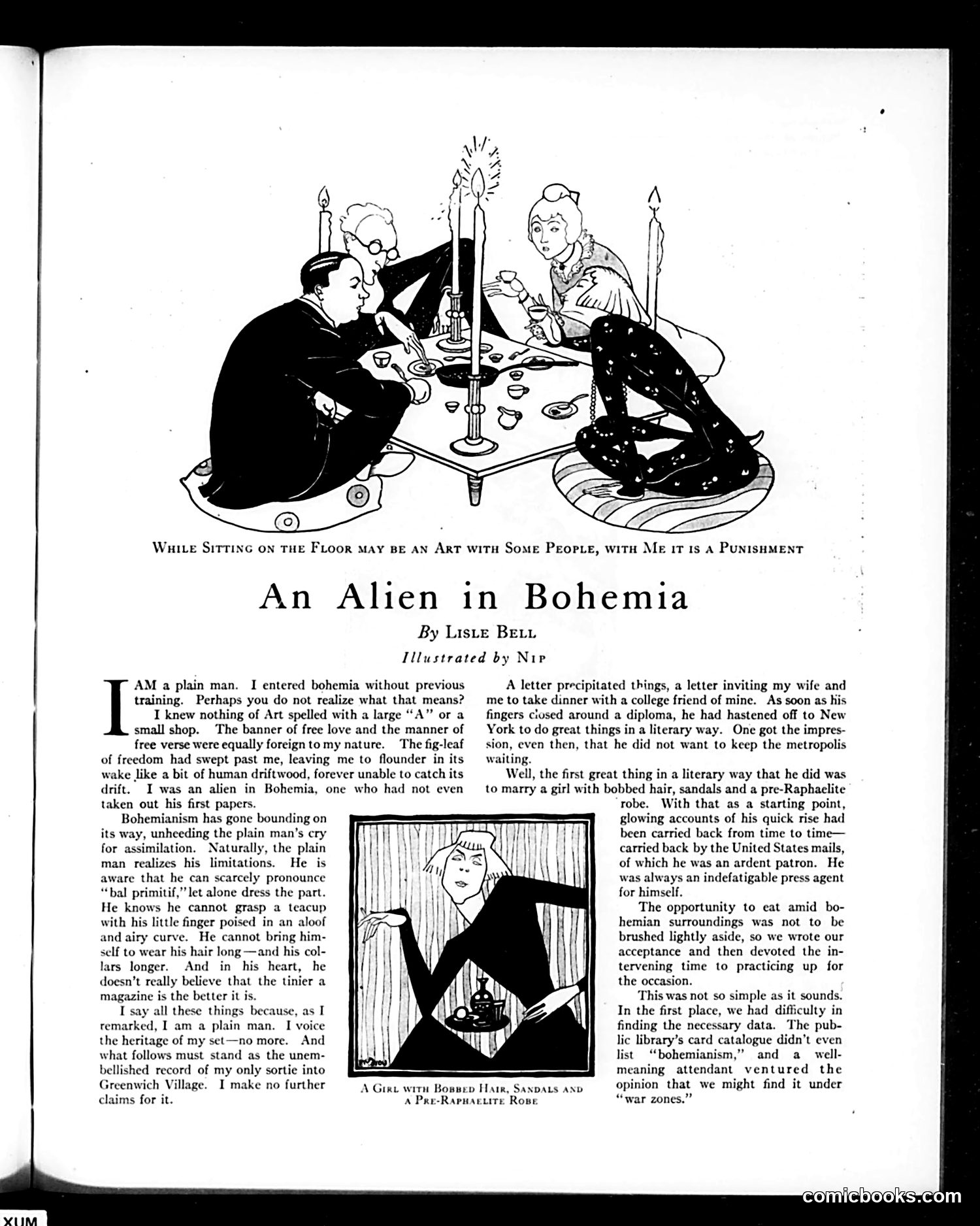
This story satirizes the author's discomfort with 1920s bohemian culture in New York's Greenwich Village. The narrator is a conventional "plain man" who lacks understanding of modernist artistic movements, free love ideology, and bohemian fashion (bobbed hair, sandals, pre-Raphaelite robes). The satire targets both the bohemians themselves—presented as pretentious, affected, and self-promotional—and the plain man's bewilderment at their world. The joke that the library catalogs bohemianism under "war zones" suggests bohemian lifestyles seem as alien and threatening to mainstream society as warfare. The accompanying illustration shows bohemian dinner customs (floor-sitting, candlelit informality) that horrify the conventional narrator. The piece mocks the collision between traditional middle-class values and the avant-garde artistic scene that defined 1920s New York.
📄 Transcribed text from this page (OCR, searchable)
Machine-transcribed from the original scan — historical spelling and the odd misread are preserved.
WLIM. Wuite Sittinc on THE FLoor May BE AN ArT with Some Peop.e, with Me 17 1s A PunisHMENT An Alien in Bohemia By Liste BELL Illustrated by Nip AM a plain man. I entered bohemia without previous training. Perhaps you do not realize what that means? I knew nothing of Art spelled with a large “A” or a small shop. The banner of free love and the manner of free verse were equally foreign to my nature. The fig-leaf of freedom had swept past me, leaving me to flounder in its wake like a bit of human driftwood, forever unable to catch its drift. I was an alien in Bohemia, one who had not even taken out his first papers. Bohemianism has gone bounding on its way, unheeding the plain man’s cry for assimilation. Naturally, the plain man realizes his limitations. He is aware t he can scarcely pronounce “bal primitif,”’ let alone dress the part. He knows he cannot grasp a teacup with his little finger poised in an aloof and airy curve. He cannot bring him- self to wear his hair long —and his col- lars longer. And in his heart, he doesn’t really believe that the tinier a magazine is the better it is. I say all these things because, as I remarked, I am a plain man. I voice the heritage of my set—no more. And what follows must stand as the unem- bellished record of my only sortie into Greenwich Village. I make no further claims for it. A Giat wrtn Bossen Harr, SANDALS AND. A Pre-Rapuacuite Rose A letter precipitated things, a letter inviting my wife and me to take dinner with a college friend of mine. As soon as his fingers ciosed around a diploma, he had hastened off to New York to do great things in a literary way. One got the impres- sion, even then, that he did not want to keep the metropolis waiting. Well, the first great thing in a literary way that he did was to marry a girl with bobbed hair, sandals and a pre-Raphaelite robe. With that as a starting point, glowing accounts of his quick rise had been carried back from time to time— carried back by the United States mails, of which he was an ardent patron. He was always an indefatigable press agent for himself. The opportunity to eat amid bo- hemian surroundings was not to be brushed lightly aside, so we wrote our acceptance and then devoted the in- tervening time to practicing up for the occasion. This was not so simple as it sounds. In the first place, we had difficulty in finding the necessary data. The pub- lic library’s card catalogue didn’t even list. “bohemianism,” and a_ well- meaning attendant ventured the opinion that we might find it under “war zones.”