
Judge, 1918-02-16 · page 8 of 36
Judge — February 16, 1918 — page 8: what you’re looking at
What you’re looking at
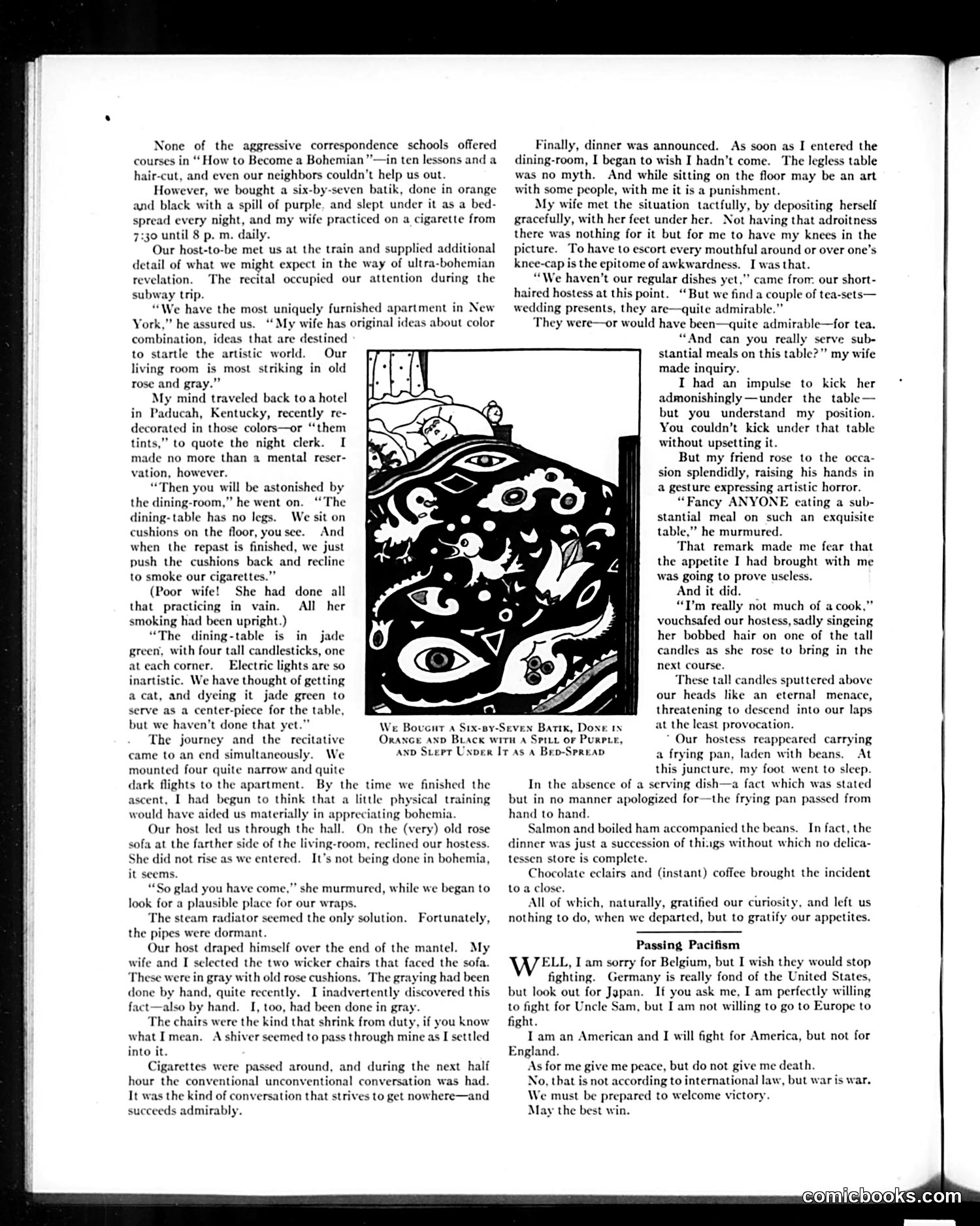
This is a humorous essay mocking **pretentious bohemian affectation** in early 20th-century New York. The narrator and his wife attempt to appear "bohemian" by purchasing a batik bedspread and practicing cigarette-smoking, then visit ultra-bohemian hosts in Manhattan. The satire targets: 1. **Bohemian pretense**: The hosts' self-conscious "artistic" choices—old rose and gray décor, legless dining tables, candlelight instead of electric lights, a jade-colored table with a dyed cat planned as centerpiece—are presented as ridiculous affectations rather than genuine creativity. 2. **Performative unconventionality**: The "conventional unconventional conversation" that "strives to get nowhere" mocks how bohemians perform non-conformity through artificial rituals. 3. **Discomfort masquerading as sophistication**: The physical awkwardness of floor-sitting and the hosts' studied indifference (the hostess doesn't rise to greet guests because "it's not being done in bohemia") are presented as absurd. The accompanying illustration shows an ornate, chaotic batik design—the visual embodiment of affected bohemian taste.
📄 Transcribed text from this page (OCR, searchable)
Machine-transcribed from the original scan — historical spelling and the odd misread are preserved.
None of the aggressive correspondence schools offered courses in “ How to Become a Bohemian”’—in ten lessons and a hair-cut, and even our neighbors couldn’t help us out. However, we bought a six-by-seven batik, done in orange and black with a spill of purple, and slept under it as a bed- spread every night, and my wife practiced on a cigarette from 7:30 until 8 p. m. daily. Our host-to-be met us at the train and supplied additional detail of what we might expect in the way of ultra-bohemian revelation. The recital occupied our attention during the subway trip. “We have the most uniquely furnished apartment in New York,” he assured us. “My wife has original ideas about color combination, ideas that are destined to startle the artistic world. Our living room is most striking in old rose and gray.”” My mind traveled back toa hotel in Paducah, Kentucky, recently re- decorated in those colors—or “them * to quote the night clerk. I made no more than a mental reser- vation, however. “Then you will be astonished by the dining-room,” he went on. “The dining-table has no legs. We sit on cushions on the floor, you see. And when the repast is finished, we just push the cushions back and recline to smoke our cigarettes.”’ (Poor wife! She had done all that practicing in vain. All her smoking had been upright.) he dining-table is in jade with four tall candlesticks, one ach corner. Electric lights are so inartistic. We have thought of getting a cat, and dyeing it jade green to serve as a center-piece for the table, but we haven't done that yet.” The journey and the recitative came to an end simultaneously. We mounted four quite narrow and quite dark flights to the apartment. By the time we finished the ascent, I had begun to think that a little physical training would have aided us materially in appreciating bohemia. Our host led us through the hall. On the (very) old rose sofa at the farther side of the living-room, reclined our hostess. She did not rise as we entered. It’s not being done in bohemia, it seems. “So glad you have come,” she murmured, while we began to look for a plausible place for our wraps. The steam radiator seemed the only the pipes were dormant. Our host draped himself over the end of the mantel. wife and I selected the two wicker chairs that fac These were in gray with old rose cushions. The grayii done by hand, quite recently. I inadvertently d also by hand. I, too, had been done in gray. ¢ chairs were the kind that shrink from duty, if you know what I mean. A shiver seemed to pass through mine as I settled rettes were passed around, and during the next half hour the conventional unconventional conversation was had. It was the kind of conversation that strives to get nowhere—and succeeds admirably. lution. Fortunately, covered this We Bovour a Six-py-Seven Battx, Done ty Orance ano Biack witu A Sprit oF Purpte, Ano Steet Unver It as a Bep-Spread Finally, dinner was announced. As soon as I entered the dining-room, I began to wish I hadn’t come. The legless table was no myth. And while sitting on the floor may be an art with some people, with me it is a punishment. My wife met the situation tactfully, by depositing herself gracefully, with her feet under her. Not having that adroitness there was nothing for it but for me to have my knees in the picture. To have to escort every mouthful around or over one’s knee-cap is the epitome of awkwardness. I was that. “We haven’t our regular dishes yet,’’ came from: our short- haired hostess at this point. “But we find a couple of tea-sets— wedding presents, they are—quite admirable.” They were—or would have been—quite admirable—for tea. And can you really serve sub- stantial meals on this table?” my wife made inquiry. I had an impulse to kick her admonishingly—under the table— but you understand my position. You couldn’t kick under that table without upsetting it. But my friend rose to the occa- sion splendidly, raising his hands in a gesture expressing artistic horror. “Fancy ANYONE cating a sub- stantial meal on such an exquisite table,” he murmured. That remark made me fear that the appetite I had brought with me was going to prove uscless. And it did. “T’m really not much of a cook,” vouchsafed our hostess, sadly singeing her bobbed hair on one of the tall candles as she rose to bring in the next course. The I! candles sputtered above our heads like an eternal menace, threatening to descend into our laps at the least provocation. ~ Our hostess reappeared carrying a frying pan, laden with beans. At this juncture, my foot went to sleep. In the absence of a serving dish—a fact which was stated but in no manner apologized for—the frying pan passed from hand to hand. Imon and boiled ham accompanied the beans. In fact, the dinner was just a succession of thiags without which no delica tessen store is complete. Chocolate eclairs and (instant) coffee brought the incident to a close. All of which, naturally, gratified our curiosity, and left us nothing to do, when we departed, but to gratify our appetites. Passing Pacifism LL, I am sorry for Belgium, but I wish they would stop Germany is really fond of the United States, If you ask me, I am perfectly willing Surope to fighting. but look out for Japan. to fight for Uncle Sam, but I am not willing to go to fight. Tam an American and I will fight for America, but not for England. As for me give me peace, but do not give me death. No, that is not according to international law, but war is war. We must be prepared to welcome victory. May the best win.