
A complete issue · 48 pages · 1905
Judge — December 16, 1905
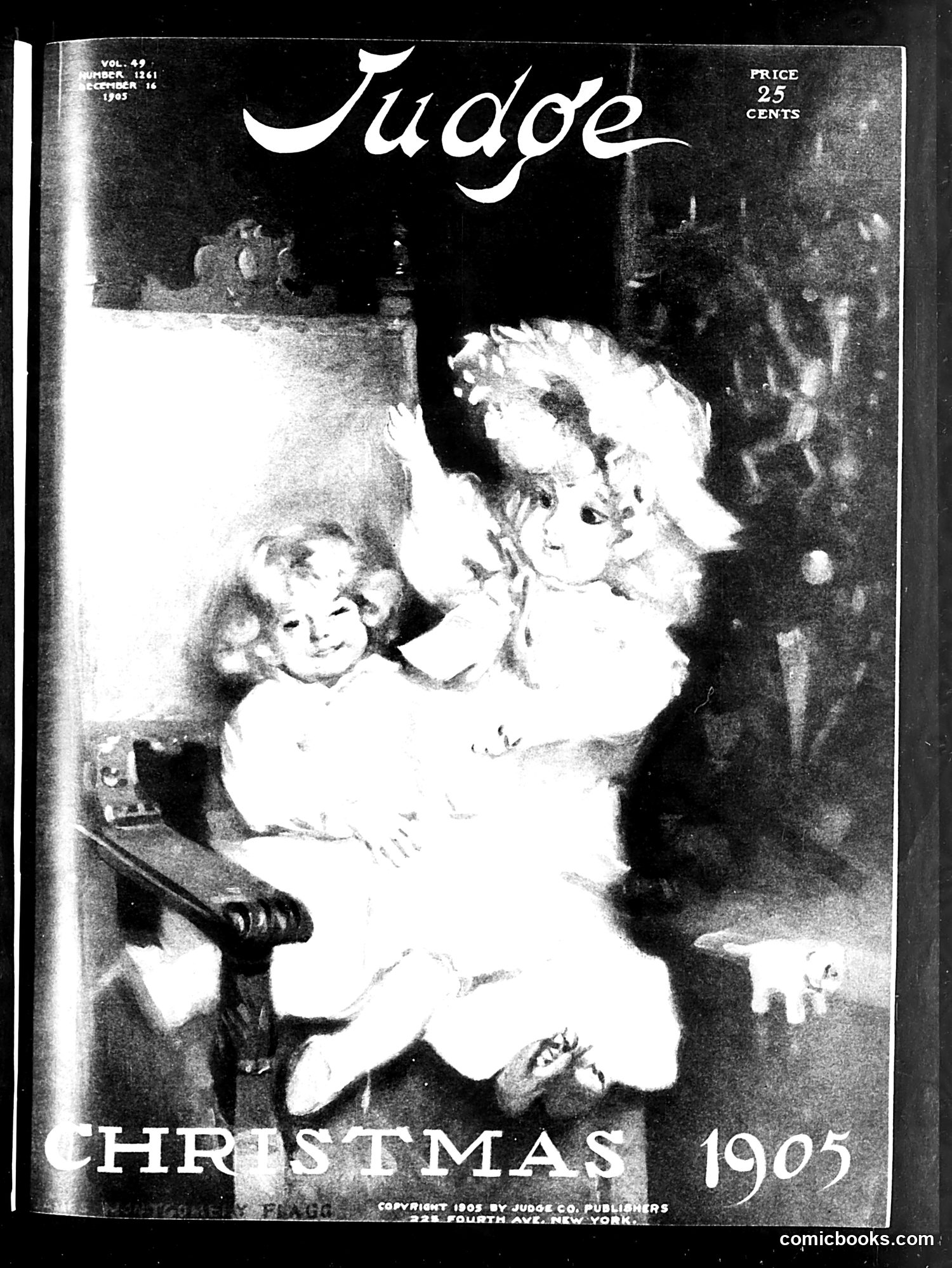
This is the Christmas 1905 issue cover of *Judge* magazine (price: 25 cents). The image shows a woman holding a small child, rendered in a soft, sentimental style typical of holiday artwork. Rather than political satire, this appears to be a straightforward Christmas-themed cover illustration emphasizing family and maternal care—common subject matter for holiday editions of magazines during this period. The gentle, idealized portrayal of motherhood and childhood reflects early 1900s sentimentality around domestic holidays. Without additional OCR text visible from the interior articles or cartoons, the specific satirical content of this issue cannot be determined. The cover itself functions primarily as festive decoration rather than commentary.
This page appears to be primarily **advertising rather than editorial content**. The visible text reads "Try Gibsons" in stylized script, with a publisher credit at bottom identifying "MOORE & SINNOTT" as "Successors to John Gibson's Son & Co." located in Philadelphia, PA. The page seems to be promoting Gibson brand products (likely beverages or another consumer good). The handwritten-style script and placement suggest this is a back-cover or full-page advertisement rather than a political cartoon or satirical comic. Without additional context about what "Gibsons" products were or their historical significance, the satirical point—if any exists—isn't evident from the image alone.
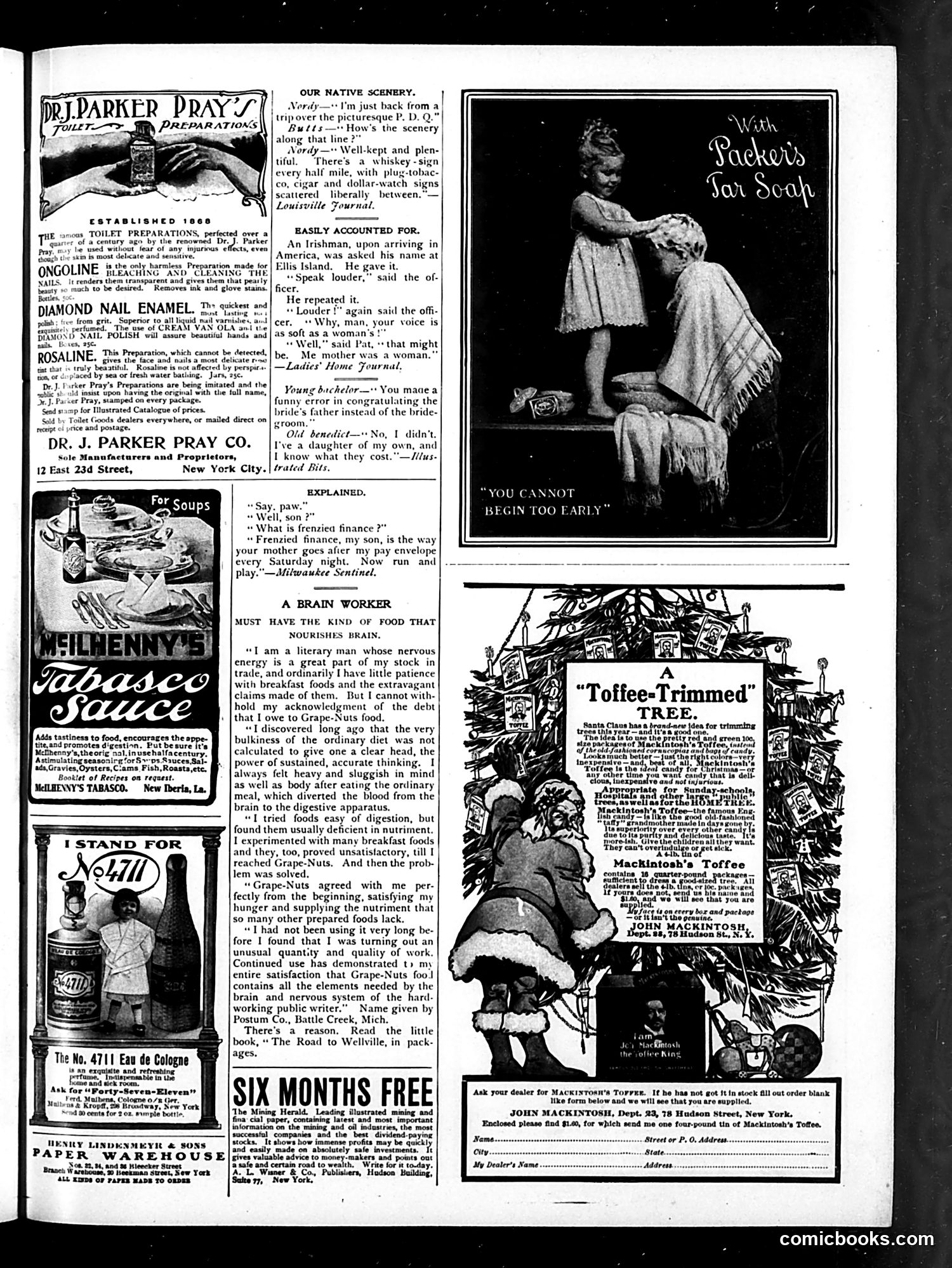
This page is primarily **advertising and miscellaneous content** rather than political satire. The visible cartoons and advertisements include: - **Dr. Parker Pray's Toilet Preparations** (top left): A standard beauty product ad - **"You Cannot Begin Too Early"** (right): Appears to be a soap advertisement featuring two women, emphasizing early childhood hygiene - **"A Toffee-Trimmed Tree"** (center-right): A holiday-themed advertisement with decorative illustration - **Miscellaneous ads**: Heinz Tabasco sauce, No. 4711 cologne, and others The page contains no identifiable political cartoon or satirical content criticizing specific figures or events. It represents typical early 20th-century magazine advertising mixed with light domestic humor, rather than the sharp political commentary Judge magazine was known for.
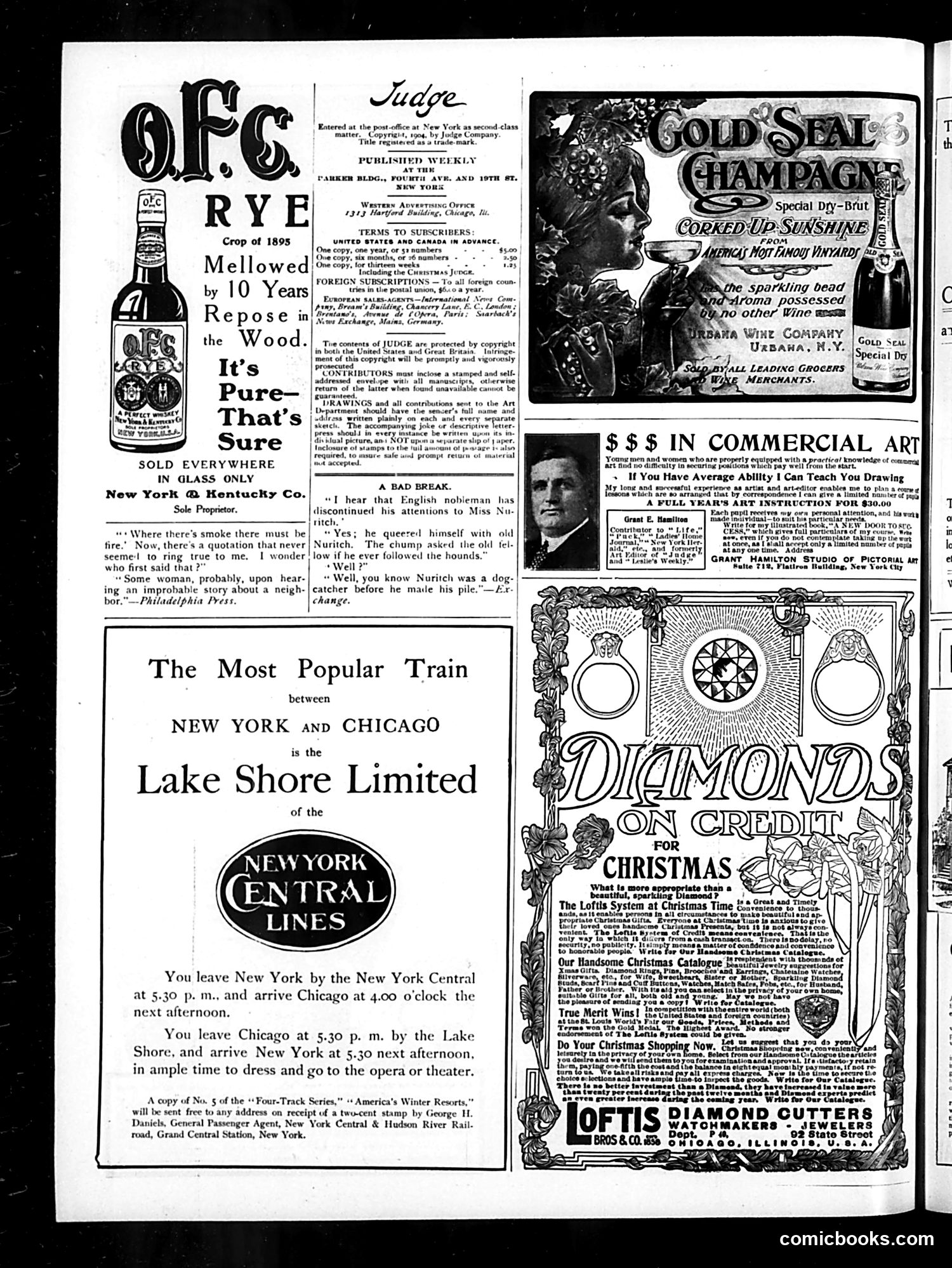
This page is **primarily advertising** rather than political satire. The dominant content includes: - **O.F.C. Rye whiskey** advertisement emphasizing its age and quality - **Gold Seal Champagne** advertisement featuring a classical female figure - **Lake Shore Limited train service** promotion between New York and Chicago - **Oftis Diamond Cutters** Christmas jewelry advertisement - A small humor section titled "A Bad Break" about a man named Nurrich The only satirical content is the brief anecdote about Nurrich discontinuing courtship with Miss Nurich—a simple wordplay joke about their matching surnames. The page reflects early 20th-century Judge magazine's reliance on luxury goods advertising alongside minimal satirical commentary.
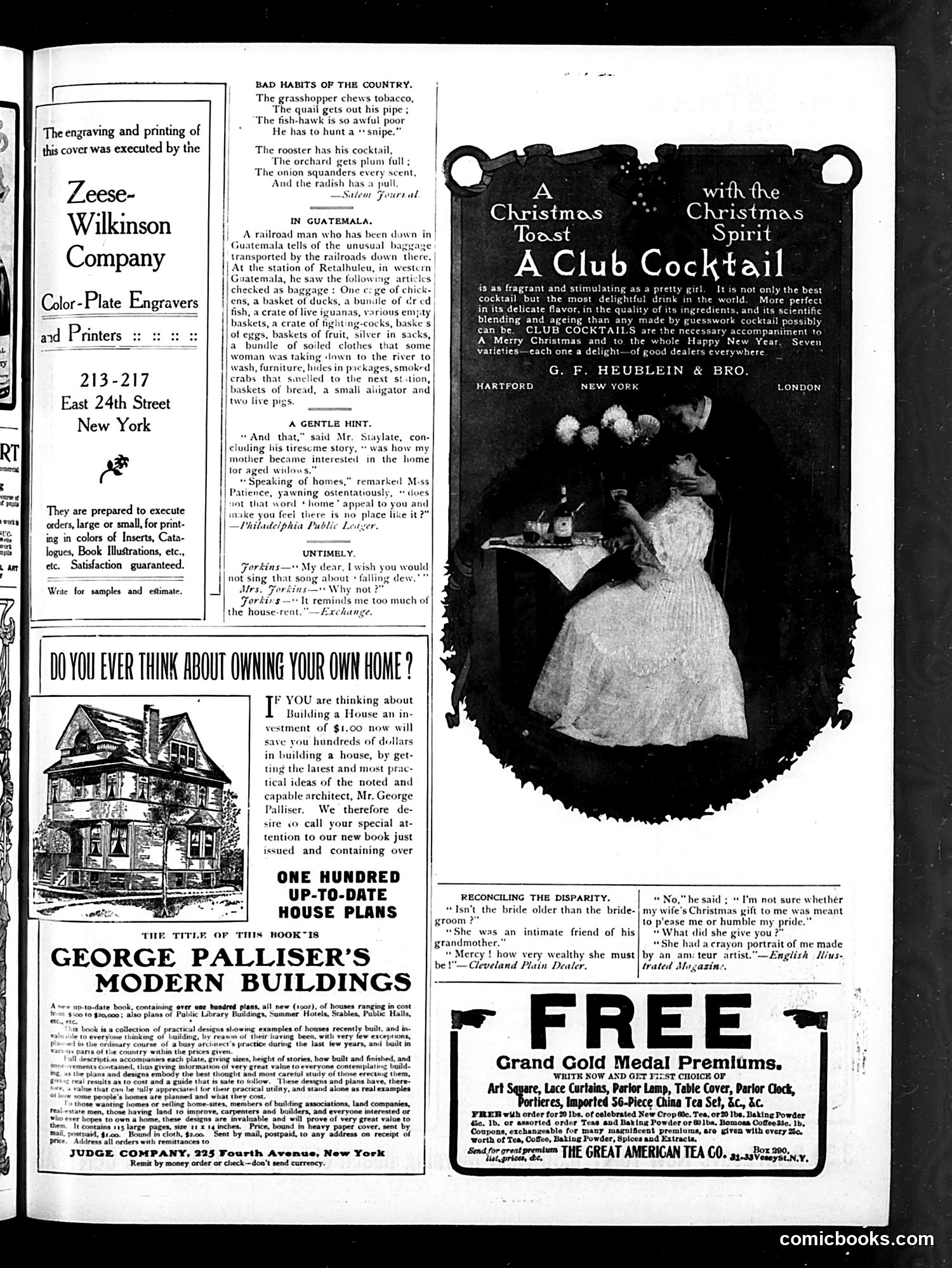
This page is primarily **advertising**, not satirical content. The main items are: 1. **Zeese-Wilkinson Company** (top left): A printing/engraving business soliciting work orders. 2. **"A Christmas Toast" cocktail ad** (center): G.F. Heublein & Bro. promoting their holiday drink with an illustration of a woman in elegant dress. 3. **Home-building advertisement** (bottom left): George Palliser's architectural book offering house plans. 4. **"Free" premium offer** (bottom right): The Great American Tea Company advertising premiums (china tea sets, etc.) with bulk tea/powder purchases. The page contains no political cartoons or social satire—it's a typical early 20th-century magazine advertising section aimed at middle-class consumers interested in home ownership, entertaining, and household goods.
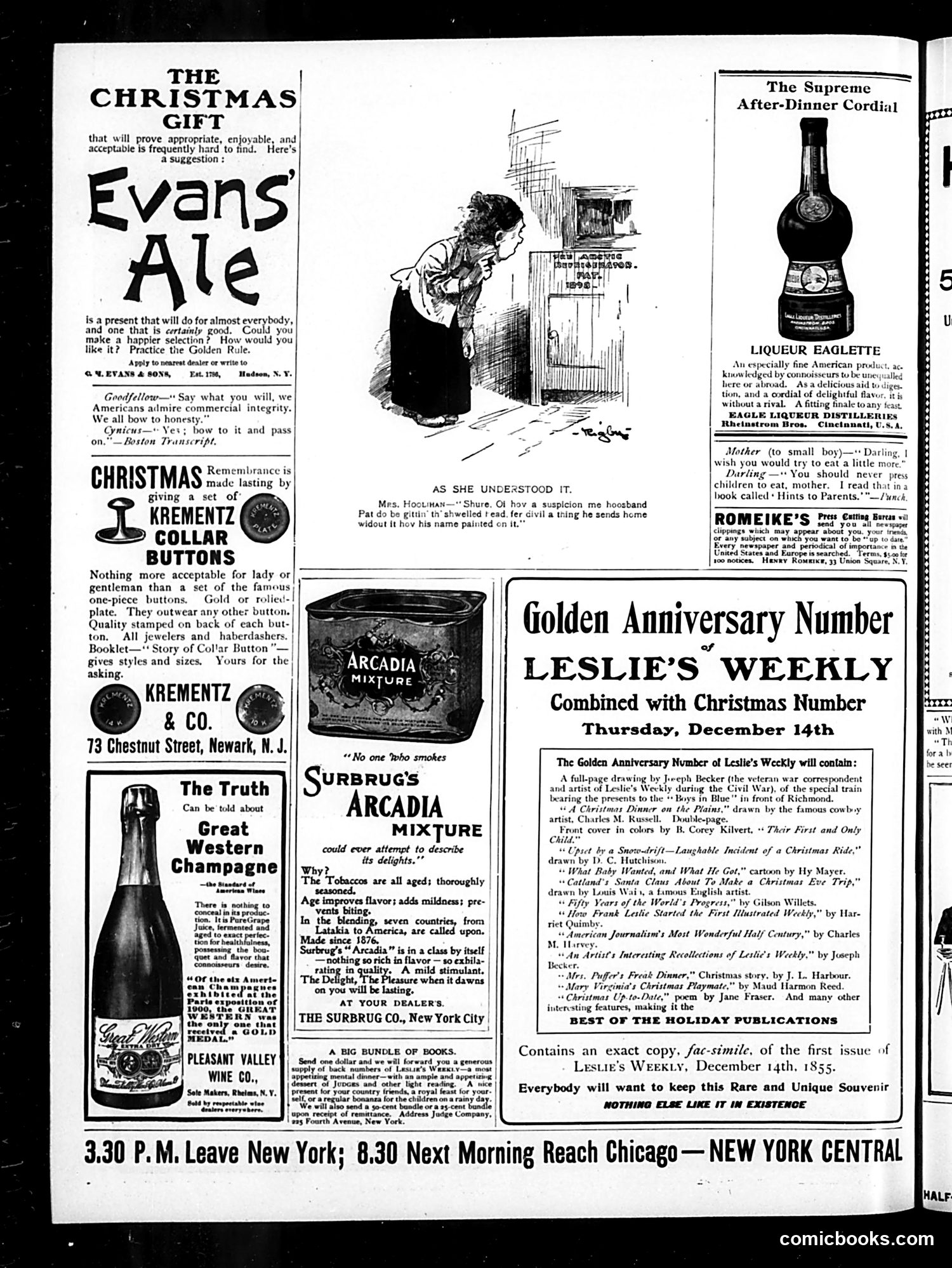
This page is predominantly **advertising**, with a central cartoon illustrating a domestic scene. The cartoon depicts a poor woman ("As She Understood It") standing outside a modest home, apparently having misunderstood her husband's request. The caption explains he asked her to get their son's head shaved to prevent lice, but she interpreted this as needing money for the barber—a humorous misunderstanding rooted in working-class poverty. The surrounding ads promote luxury goods (champagne, liqueurs, collar buttons, tobacco) as Christmas gifts for the wealthy, creating an ironic contrast with the cartoon's depiction of a struggling family. This juxtaposition—whether intentional or accidental—reflects class divisions of the era. The page includes advertisement copy from **Leslie's Weekly's** Golden Anniversary issue, promoting Civil War illustrations and nostalgic content rather than satirical commentary on current events. The satire, if present, appears incidental to the commercial focus.
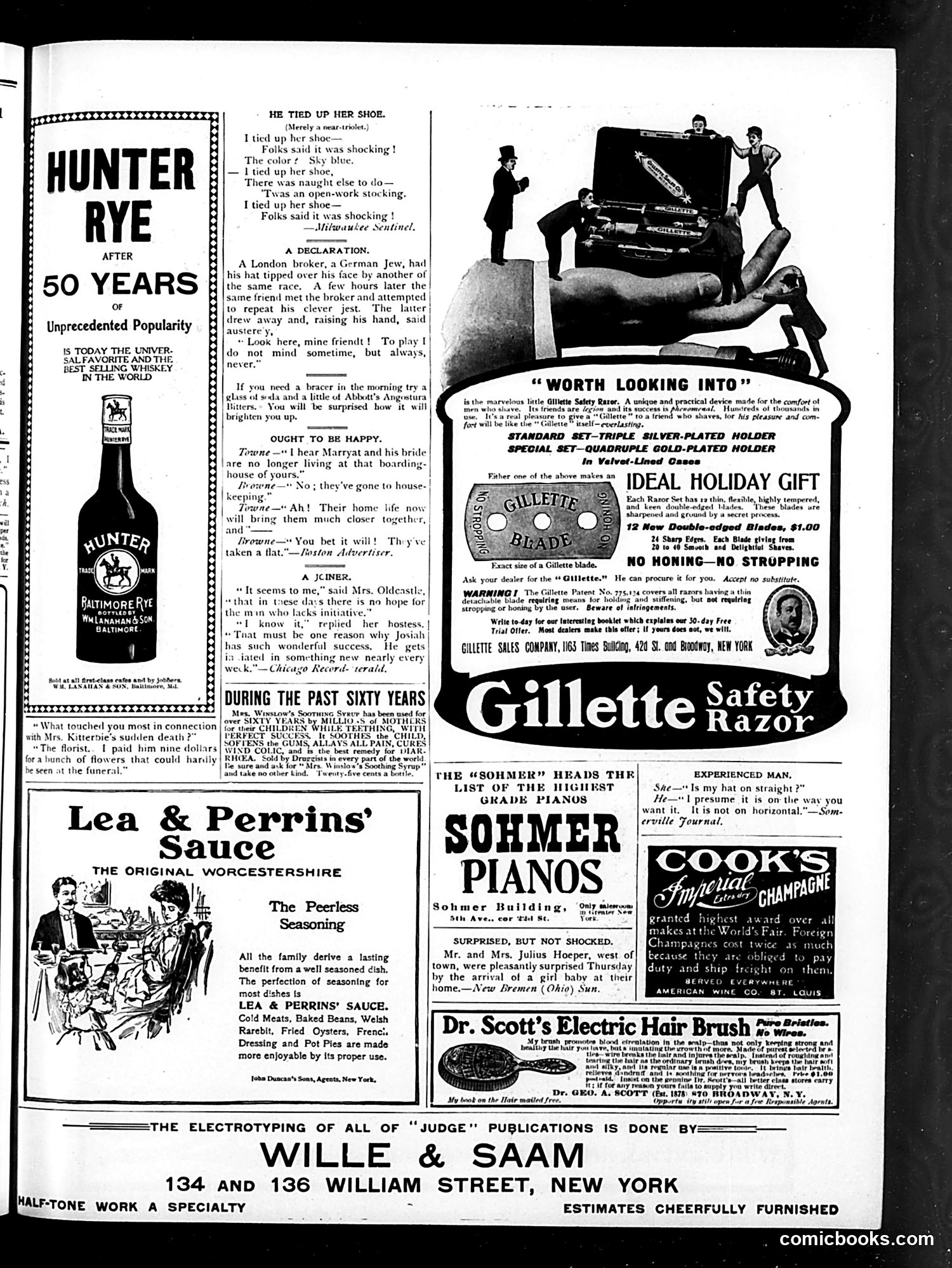
This page is **primarily advertising** with several brief humorous anecdotes sprinkled throughout. The main content includes: **Anecdotes:** Short jokes about everyday life—a man tying a woman's shoe (risqué for the era because it involved an "open-work stocking"), a boarding house couple moving out, and a woman praising her husband's tendency to start new ventures. These reflect early-20th-century social humor about courting, marriage, and gender relations. **Advertisements dominate:** Hunter Rye whiskey (emphasizing 50 years of popularity), Lea & Perrins Worcestershire Sauce, Gillette Safety Razors (marketed as an ideal holiday gift), Sohmer Pianos, Cook's Champagne, and Dr. Scott's Electric Hair Brush. **Notable ad:** The Gillette Safety Razor ad reflects the relatively recent innovation of disposable blades, positioning it as a modern convenience product. The page reflects early 1900s consumer culture and modest humor standards rather than political satire.
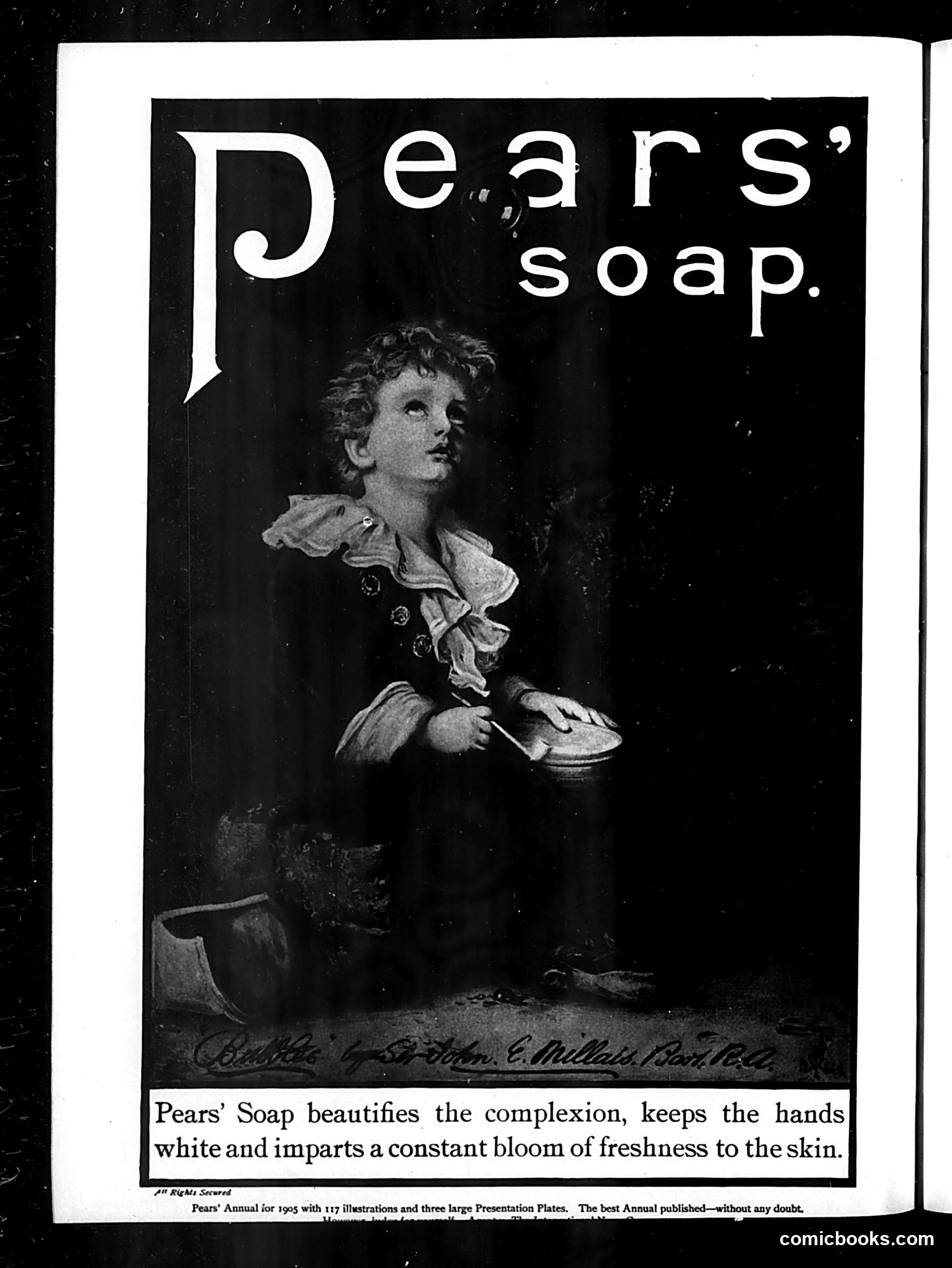
This is an **advertisement, not political satire**. It's a full-page ad for Pears' Soap from the 1905 Pears' Annual, published in Judge magazine. The image shows a cherubic young figure in classical/Renaissance dress holding a soap dish, gazing upward—a romanticized representation meant to evoke purity and beauty. The accompanying text makes standard beauty claims: the soap "beautifies the complexion, keeps the hands white and imparts a constant bloom of freshness." The "whiteness" language reflects period advertising conventions, though it carries uncomfortable racial implications by modern standards. The classical artistic styling was typical of luxury soap marketing in the early 1900s, positioning the product as refined and aspirational. The bottom announces this page comes from Pears' Annual for 1905, promoting it as "the best Annual published."
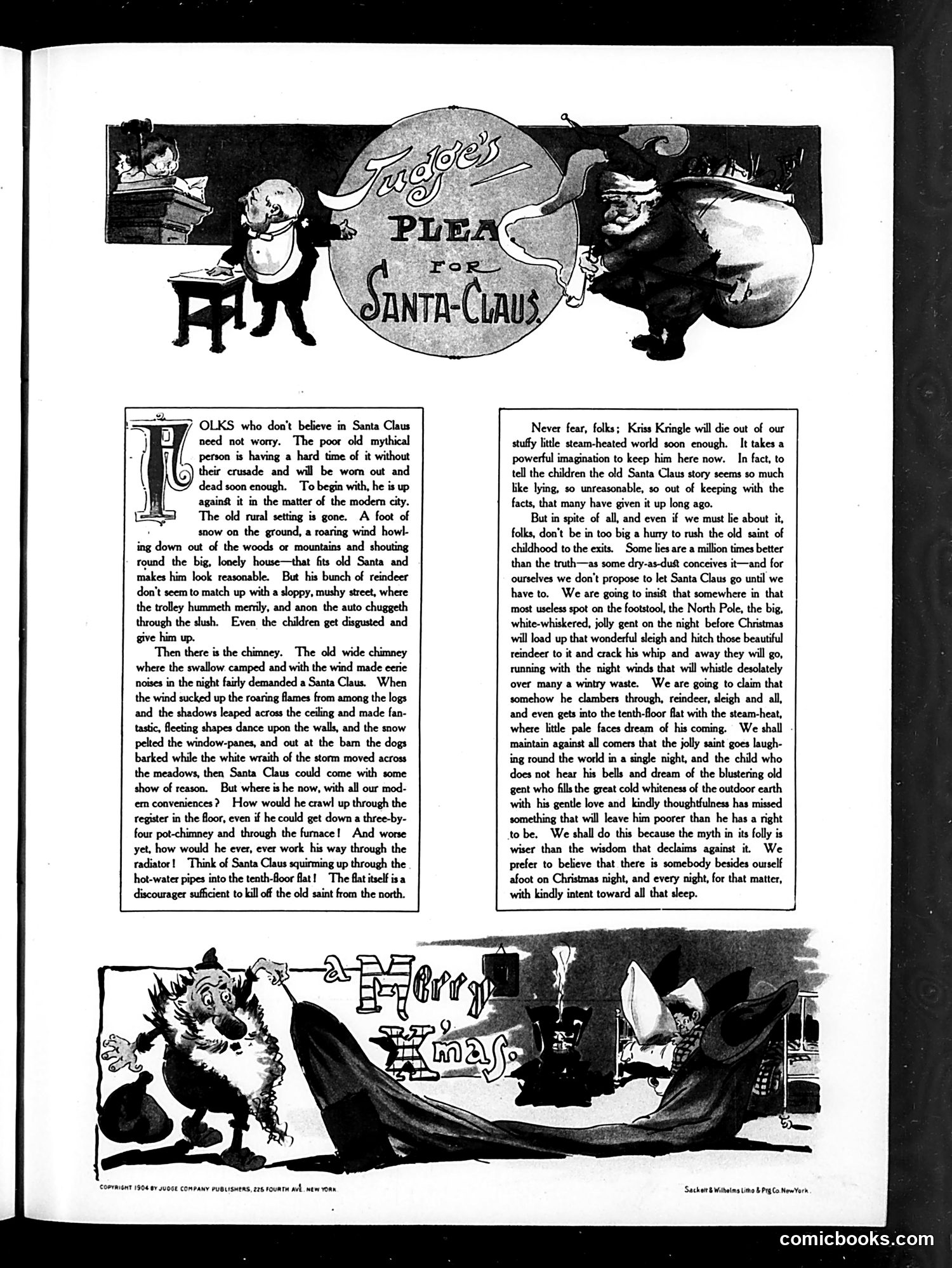
This article defends Santa Claus against modern skepticism caused by urbanization. The author argues that Santa's mythology is dying because industrial cities—with their trolleys, steam heat, radiators, and apartment buildings—have replaced the rural settings where Santa stories once felt plausible. A snowy farmhouse with a wide chimney created atmospheric conditions for belief; a tenth-floor flat with hot-water pipes does not. However, the second column argues *for* preserving Santa despite modernity's logical objections. The author contends that some "lies" (like Santa) possess moral wisdom superior to bare facts, offering children imagination, gentleness, and hope. This reflects early 20th-century anxieties about industrial progress eroding childhood wonder and traditional values.
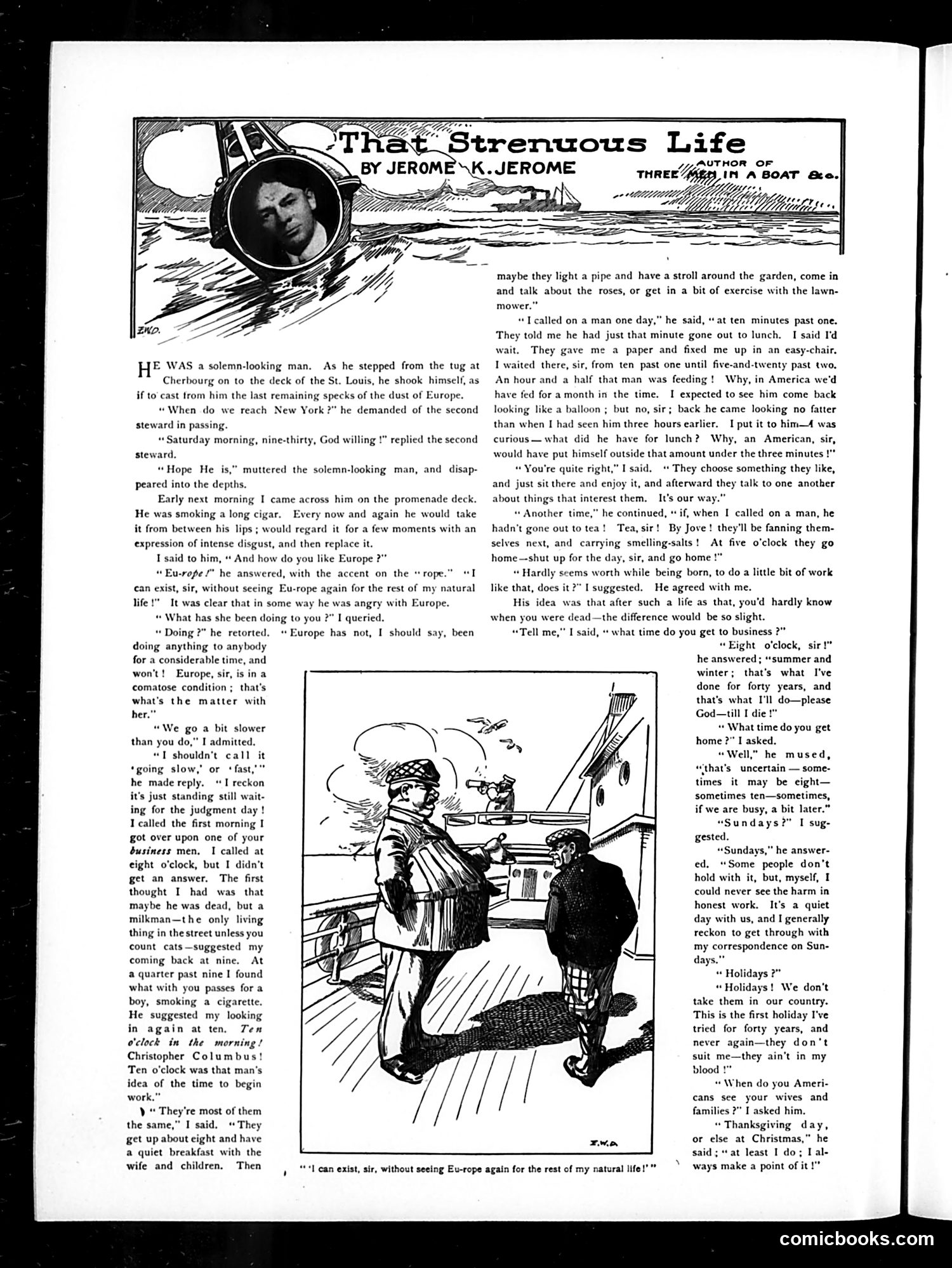
This Jerome K. Jerome piece satirizes the cultural clash between American and European work habits. An American businessman, returning from Europe aboard the S.S. Louis, expresses outrage at European leisurely schedules—businessmen who don't start work until 10 a.m., take extended lunch breaks, and leave by 5 p.m. to enjoy their evenings. The satire mocks the American "strenuous life" ideology (referencing Theodore Roosevelt's famous phrase), where constant productivity and speed are virtues. Jerome presents the American's complaints sympathetically but absurdly: he's scandalized that Europeans enjoy meals, conversation, and rest rather than maximizing work output. The cartoon illustrates the protagonist on deck, fuming during his Atlantic crossing. The satire's point: Americans' obsession with relentless efficiency and productivity—treating leisure as shameful—versus Europe's more balanced approach to living. Jerome gently ridicules American workaholism by letting the American character condemn himself through his own complaints.
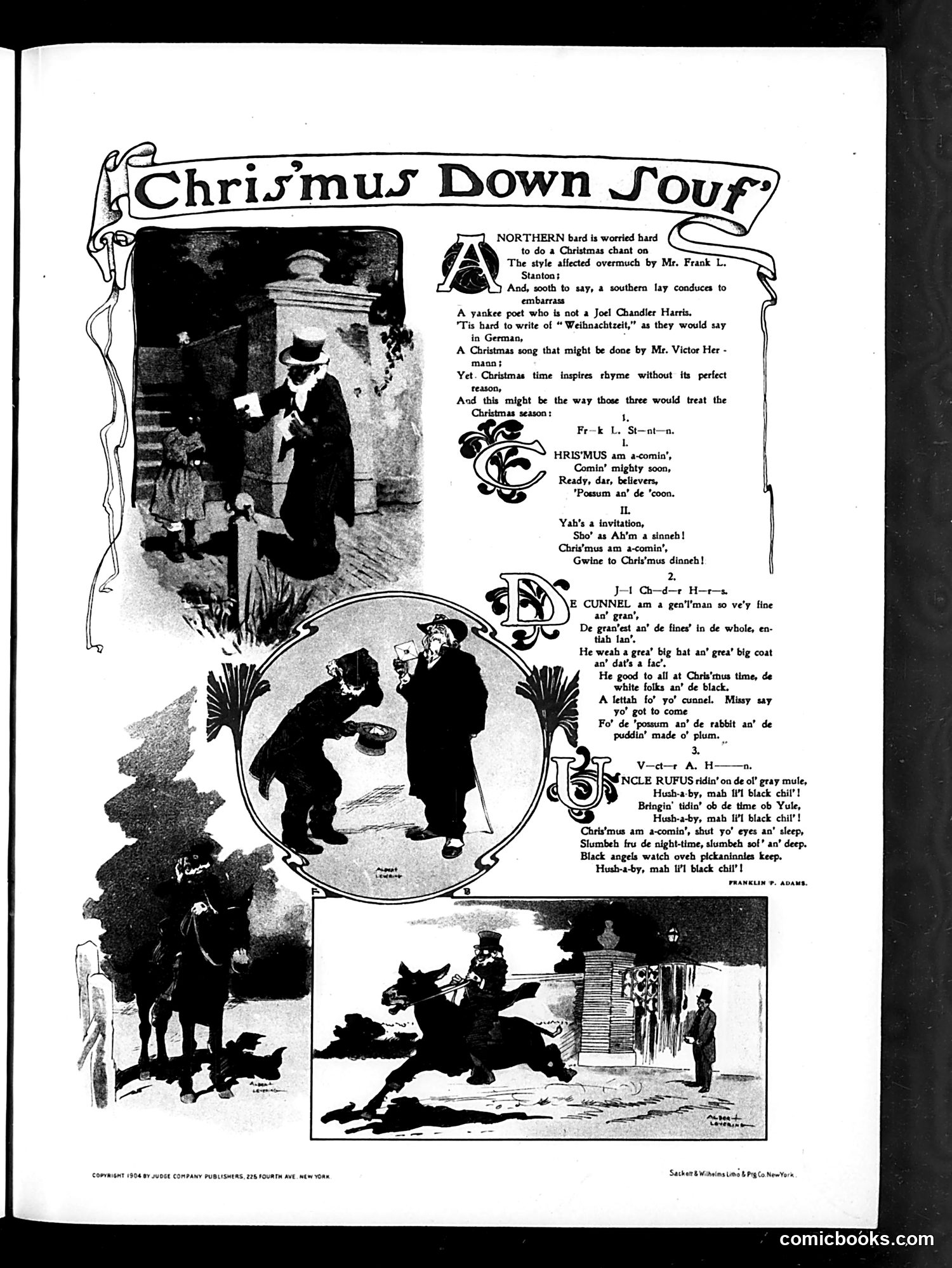
This 1904 *Judge* magazine page parodies three prominent American writers' attempts to capture Southern dialect and Christmas themes. The text introduces the challenge: Northern poets struggle with authentic Southern voice—only Joel Chandler Harris (famous for Uncle Remus stories) succeeds naturally. The page satirizes three imitative versions by Frank L. Stanton, Victor Herrmann, and Franklin P. Adams, each rendering Christmas through exaggerated African American plantation dialect ("Hris'mus am a-comin'," "possum an' coon," "pickaninnies"). The illustrations show stereotypical scenes: enslaved or freed Black people, "Uncle" characters, rural settings. The satire targets not Southern life itself, but Northern literary pretension—writers attempting dialect they don't authentically command. However, the racial caricatures and offensive terminology reflect the era's casual racism, making this primarily a "literary" joke that relied on deeply dehumanizing stereotypes for its humor.
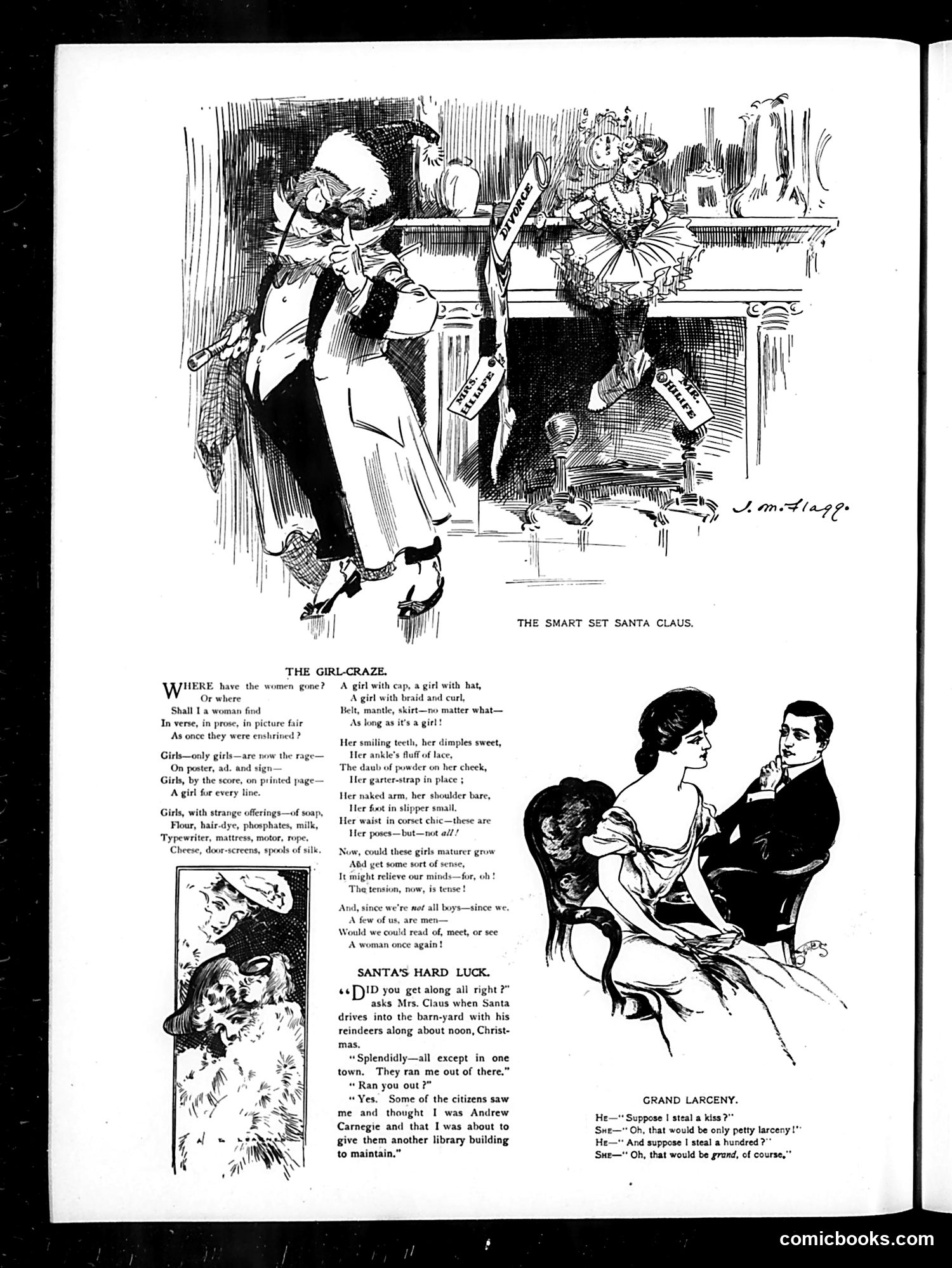
This page contains three satirical pieces typical of early 20th-century American humor: **"The Girl-Craze"** mocks advertising's obsession with using young women to sell products. The poem complains that women—once celebrated in art and literature for their maturity and complexity—have been reduced to interchangeable "girls" hawking everything from soap to motor-ropes. The satire targets both advertisers' commercial exploitation and society's shallow consumption of femininity. **"Santa's Hard Luck"** jokes about Andrew Carnegie, the wealthy steel magnate known for his library-building philanthropy. The humor lies in Santa being mistaken for Carnegie and driven out of town—residents fear he'll demand they maintain another library, satirizing both Carnegie's famous generosity and the public burden of maintaining his gifts. **"Grand Larceny"** is a mild flirtation joke playing on legal terminology: stealing one kiss is "petty larceny," but stealing many kisses escalates to "grand larceny"—a reference to the legal distinction based on monetary value, here applied humorously to romance.
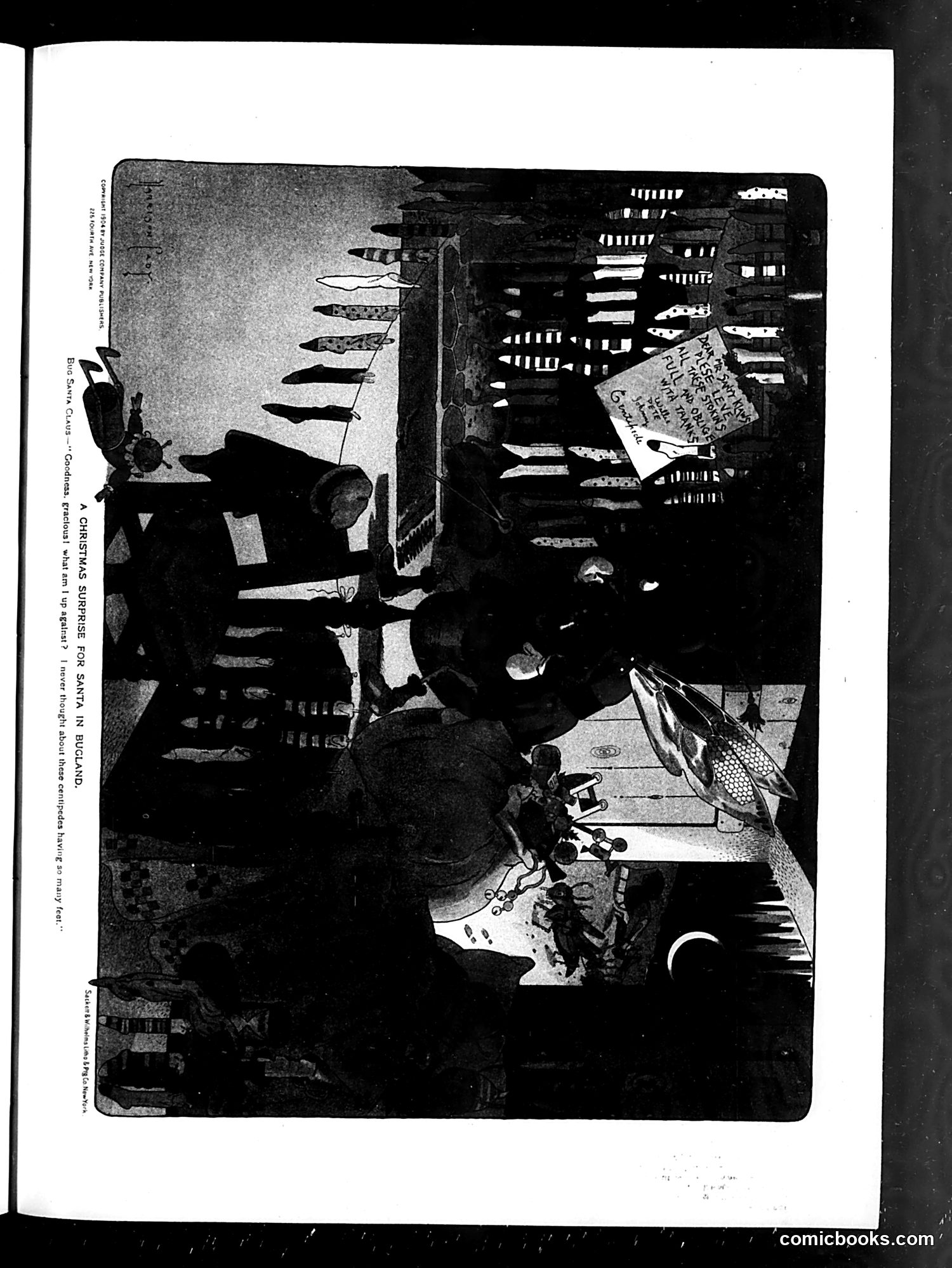
This is a satirical cartoon depicting insects in an anthropomorphized "bugland" setting. The title references Santa delivering Christmas surprises, but the joke appears to play on the word "bugs" — both literal insects and the slang term for problems or defects. The scene shows what appears to be a chaotic insect gathering or celebration, with various creatures arranged in a domestic space. The OCR'd dialogue fragments ("I never thought," "what am I up against") suggest characters expressing surprise or dismay at their situation. The satire likely mocks either: contemporaneous social chaos, labor unrest, or some political situation of Judge magazine's era, using the "bugland" setting as a humorous metaphor. Without seeing the full text clearly, the specific target remains unclear, though the Christmas framing suggests commentary on holiday excess or commercialism.
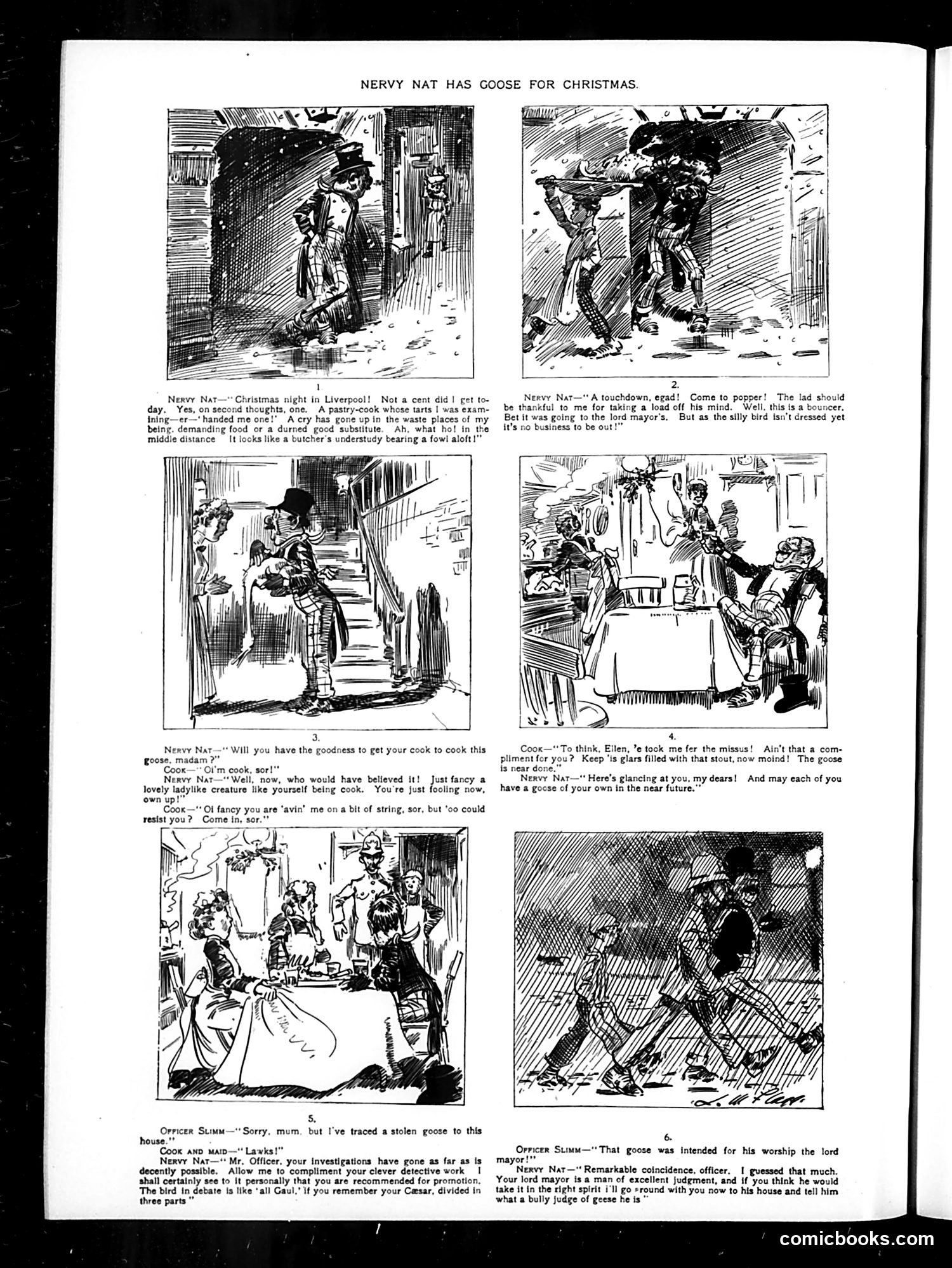
This is a comic strip following a clever rogue named Nervy Nat through a scheme to obtain Christmas dinner. On penniless Christmas night in Liverpool, Nat spots a goose intended for the lord mayor and steals it. He then talks his way into a cook's house, charming her into preparing the bird. When a police officer arrives investigating the theft, Nat smoothly flatters the officer's detective work and offers to personally compliment the lord mayor on his "excellent judgment" in choosing the goose—implying he'll retrieve it before the mayor notices it missing. The satire targets the confidence man archetype: Nat's glib tongue and shameless manipulation let him exploit working-class characters (the cook, the officer) through flattery. The humor comes from his brazen audacity and the working-class characters' naive susceptibility to charm.
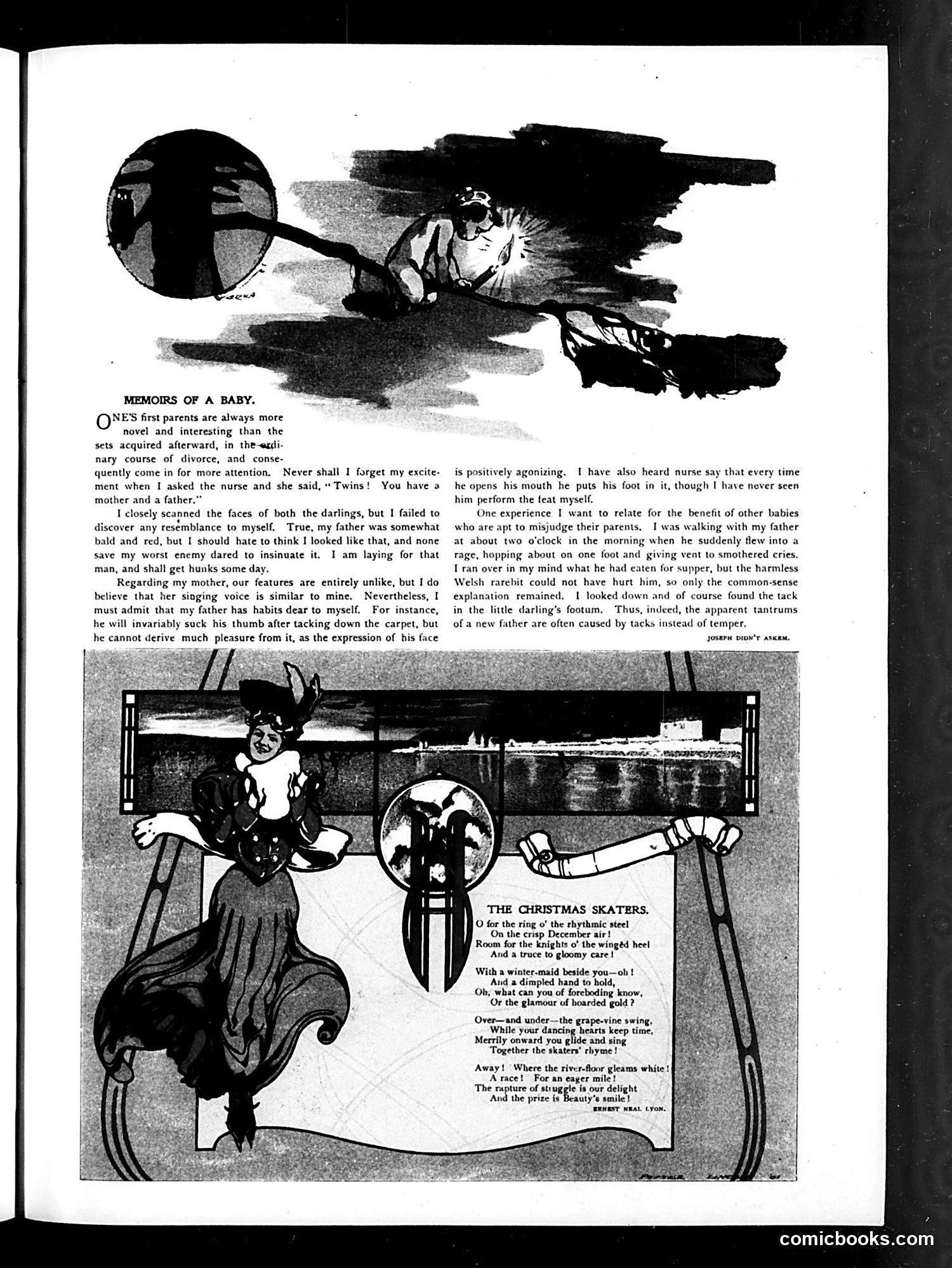
This page contains two satirical pieces from an early 20th-century magazine. The top article humorously presents a baby's observations about its parents through the infant's perspective. The satire mocks both parental vanity (the father's concern about resemblance) and domestic life—particularly the father's habit of sucking his thumb after laying carpet and repeatedly "putting his foot in it" (a phrase meaning saying foolish things). The punchline involves a literal tack in the baby's foot, explaining the father's nighttime tantrum as physical pain rather than emotional outburst. The lower section, "The Christmas Skaters," is a romantic poem celebrating ice-skating season, emphasizing winter courtship and the joy of skating with a romantic partner. Together, these pieces represent typical Judge content: satirizing domesticity and middle-class family life while offering sentimental counterpoint through poetry.
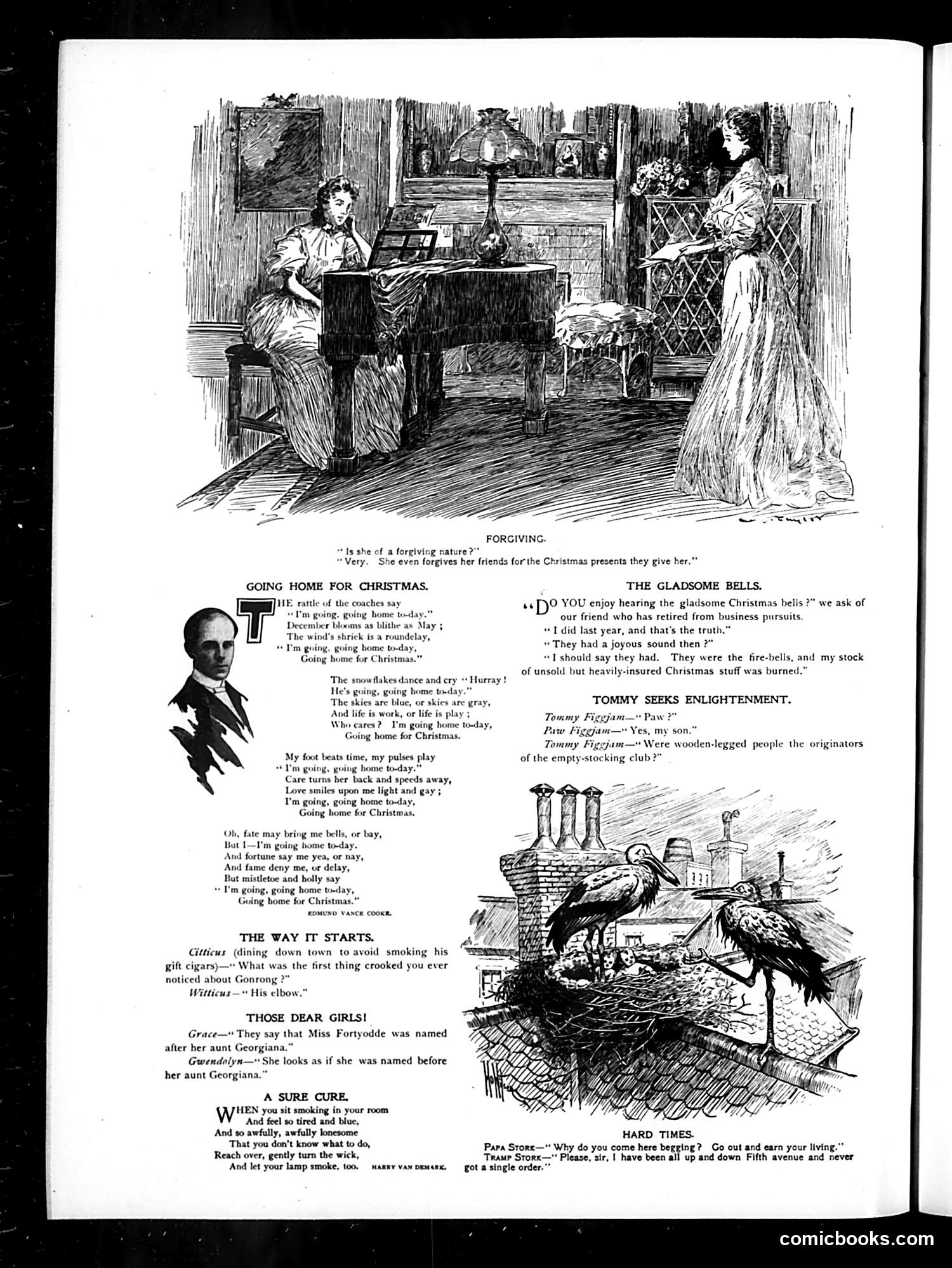
This is a collection of short humorous sketches typical of late-19th-century American satirical humor. Key pieces: **"Forgiving"** jokes about women receiving unwanted Christmas gifts from friends—satirizing both obligatory gift-giving and women's social politeness. **"Going Home for Christmas"** contains sentimental poetry about returning home, contrasted with darker humor in "The Gladsome Bells," where a retired businessman admits he actually celebrated fire-bells (from an insurance fraud scheme) burning his unsold Christmas inventory—mocking dishonest business practices. **"Tommy Seeks Enlightenment"** appears to be a child asking whether wooden-legged people invented empty stockings (a crude joke about disability). **"Those Dear Girls"** makes a mean-spirited joke about an older unmarried woman's appearance. **"Hard Times"** shows a beggar claiming to have begged unsuccessfully on Fifth Avenue—satirizing economic hardship during what appears to be a recession. The page reflects Gilded Age class attitudes, business corruption humor, and sometimes cruel social commentary toward women and the poor.
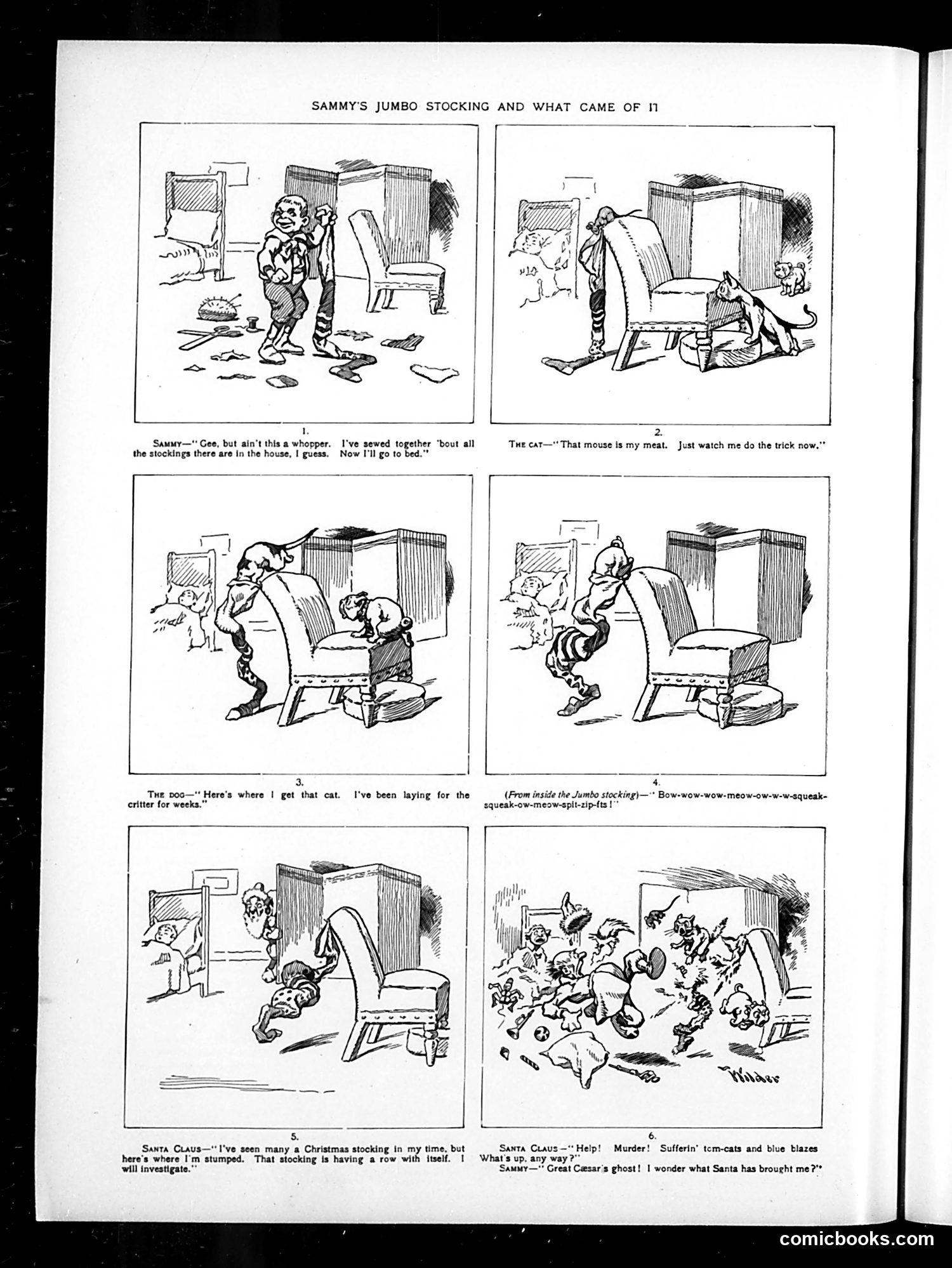
This six-panel Christmas comic depicts a slapstick mishap. Young Sammy sews together all the household stockings into one enormous "jumbo" stocking for Christmas. When hung, the oversized stocking becomes a chaotic trap containing multiple animals—a cat, dog, and mice—who quarrel violently inside it, creating pandemonium that even Santa Claus cannot manage. The humor operates on physical comedy: the larger-than-life stocking symbolizes childhood greed and excess, turning a cherished Christmas tradition into slapstick chaos. Santa's bewilderment ("that stocking is having a row with itself") emphasizes the absurdity. The joke satirizes both children's outsized holiday expectations and the era's sentimental Christmas imagery by reducing it to anarchic mayhem—a typical Judge magazine approach mixing holiday cheer with irreverent humor.
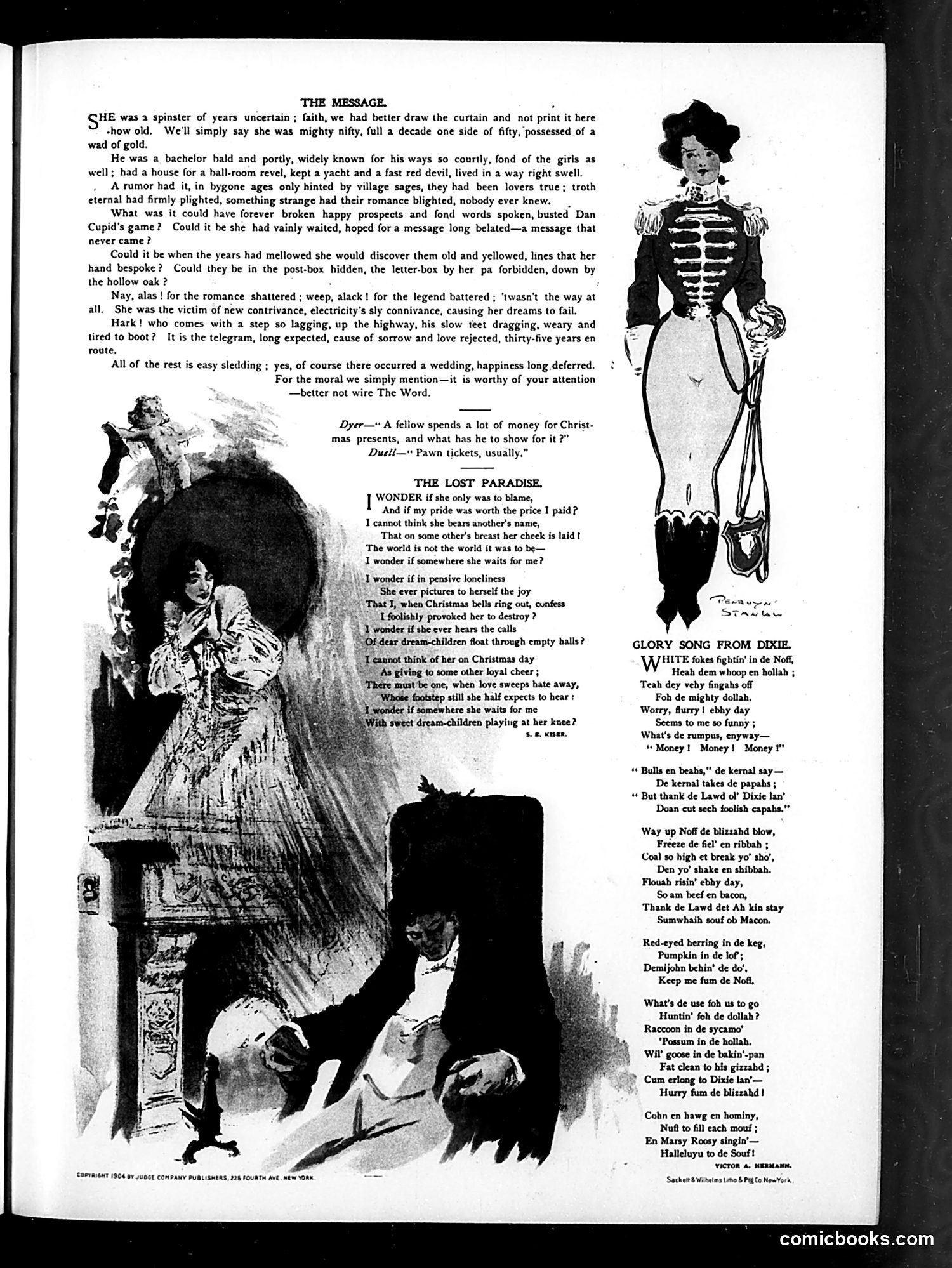
This page contains three distinct pieces of turn-of-the-century satirical content: **"The Message"** (main story with illustration): A sentimental tale mocking romantic melodrama. It describes a spinster and bachelor with a shared past, separated by a misunderstanding. The satire's point: a telegram arrives 35 years late, finally resolving their romance—but the joke is that modern technology (electricity's "sly connivance") ironically *delays* rather than expedites communication, undermining progress narratives. **The "Dyer/Duell" joke**: Quick satirical quip about Christmas gift-giving wastefully leading to pawn tickets—commentary on consumer culture and financial desperation. **"Glory Song from Dixie"**: A dialect poem in African American vernacular (reflecting period racist conventions) contrasting Southern contentment with Northern hardship. It presents the South as abundant and peaceful ("Marsy Roosy singing") while depicting the North as economically troubled—clear post-Civil War propaganda romanticizing the agrarian South and justifying regional division. The page reflects Judge's characteristic mix of romantic satire, class humor, and sectional politics typical of early 1900s American periodicals.
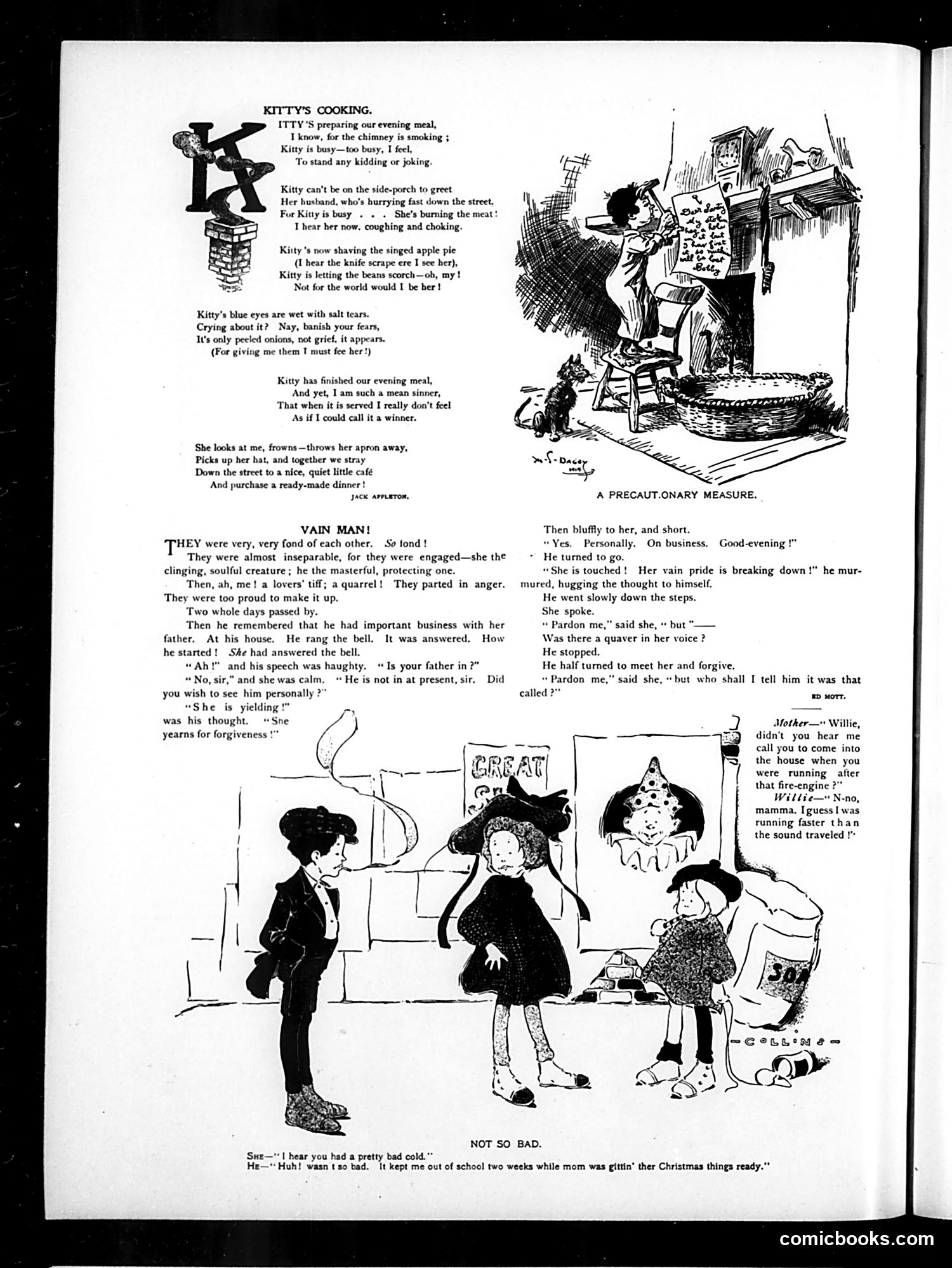
This page contains three distinct humor pieces typical of early 20th-century American magazine satire: **"Kitty's Cooking"** mocks a wife's incompetence in the kitchen through verse. The joke follows a husband's evening as his wife burns multiple dishes—meat, pie, beans—yet he still complains about the final meal. The punchline: rather than eat her cooking, they go out for dinner. This reflects period stereotypes about women's domestic duties and capability. **"Vain Man!"** satirizes romantic pride and miscommunication between an engaged couple after a quarrel. He believes her calm demeanor and question about "who called" indicates she's softening toward him, but she's simply doing her job answering the door. The humor lies in his self-deceptive vanity. **The shorter comic strips** use wordplay and childhood observations: Willie claims he ran faster than sound travels (exaggeration humor), and a boy admits his cold wasn't bad because it got him out of school while his mother shopped. All reflect genteel, domestic-focused humor typical of the era.
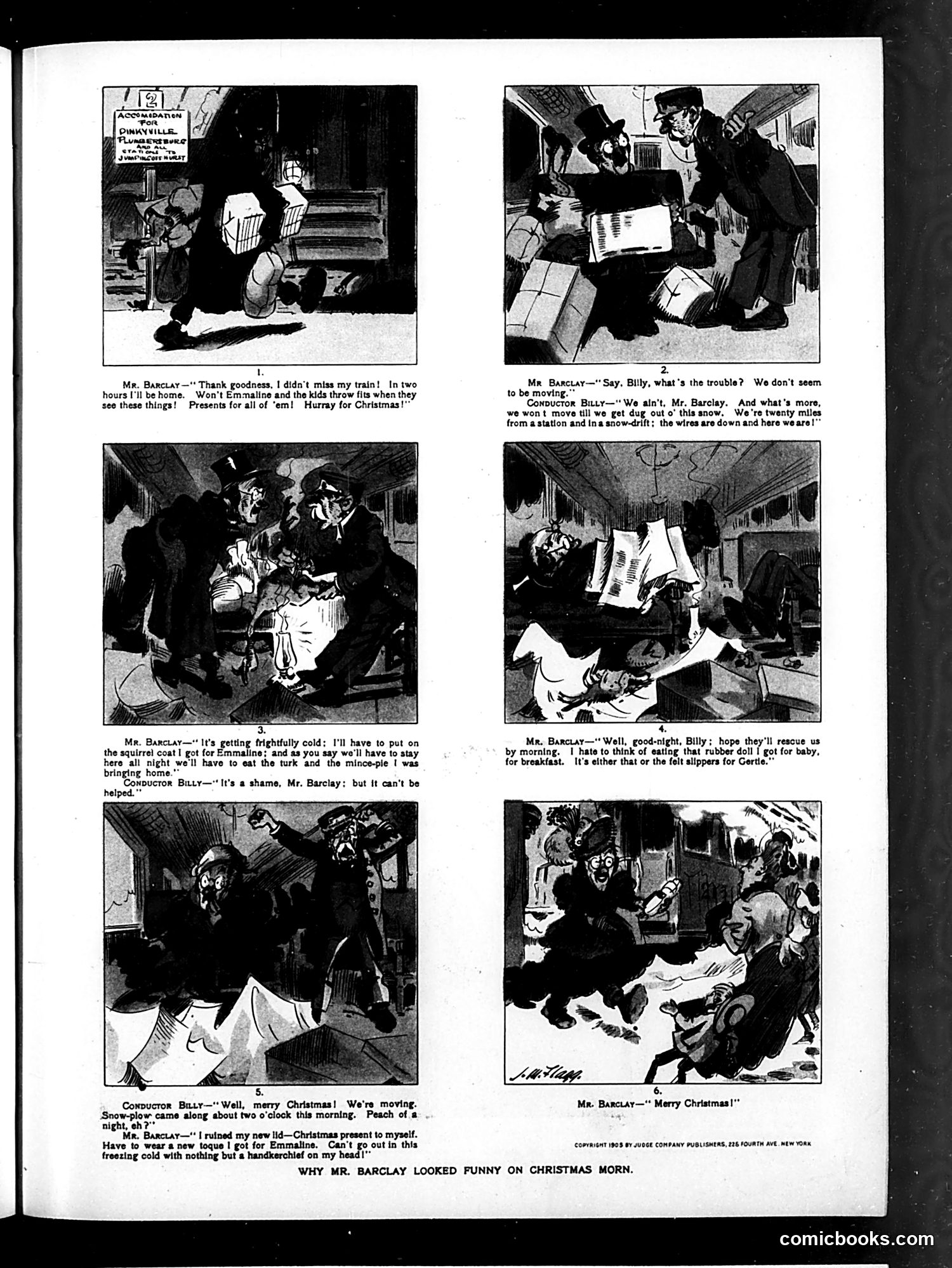
This comic strip satirizes the chaos of holiday travel and materialism. Mr. Barclay, a well-to-do businessman, boards a train home with expensive Christmas presents for his family. A snowstorm derails the journey—the train gets stuck, stranding passengers overnight at a station with downed wires. The humor derives from Barclay's escalating absurdity: forced to stay in the cold, he sequentially wears and ruins his luxury purchases (a new hat, a fur coat meant for his wife "Emmaline"). By morning, he's been reduced to wearing Christmas gifts intended for his children—including felt slippers and a rubber doll as headwear—making him look ridiculous. The satire mocks both the pretensions of material excess and the irony of wealth providing no protection against circumstance. The conductor's calm resignation contrasts with Barclay's mounting panic, emphasizing how nature indifferently disrupts bourgeois holiday plans.
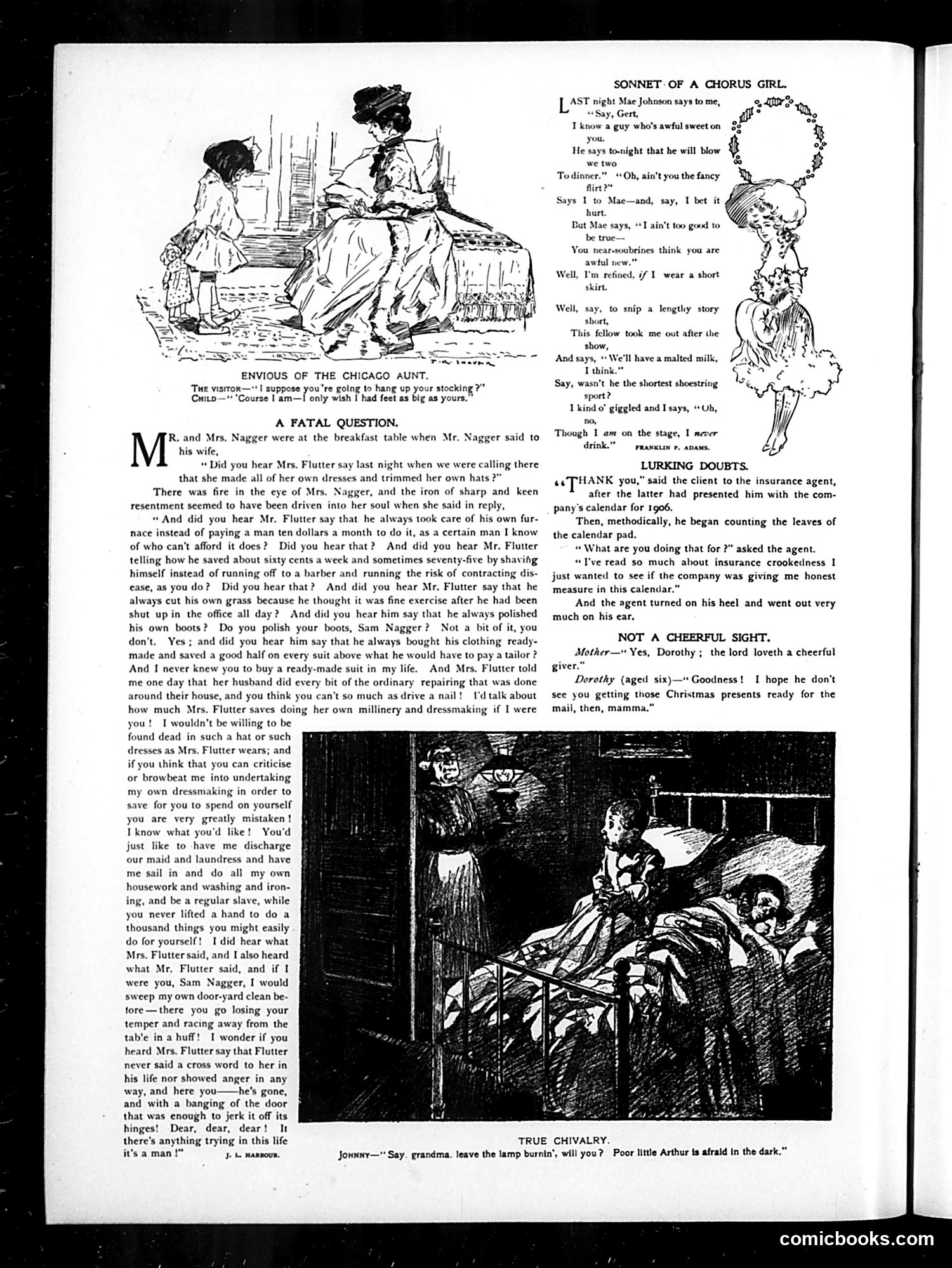
This page contains three distinct pieces of humor typical of early 1900s American satire: **"Envious of the Chicago Aunt"**: A brief joke about a child's Christmas stocking envy, playing on size comparisons. **"A Fatal Question"**: The main story depicts marital discord. Mr. Nagger mentions that neighbor Mr. Flutter boasts of doing his own domestic labor—mending, shaving, yard work, even making his clothes—to save money. Mrs. Nagger responds with a lengthy, bitter tirade, sarcastically suggesting her husband could do the same while listing all his actual laziness. The satire targets husbands who expect wives to economize while they themselves refuse household effort or self-sufficiency. **"Sonnet of a Chorus Girl"** (by Franklin P. Adams): A poem in vernacular verse about a chorus girl rejecting a date's cheap offer of malted milk, while ironically claiming refinement despite wearing a short skirt—satirizing the pretensions and economic desperation of chorus girls. **Context**: These pieces mock class anxieties, gender expectations around domestic labor, and the aspirations of working-class theatrical performers in the pre-WWI era.
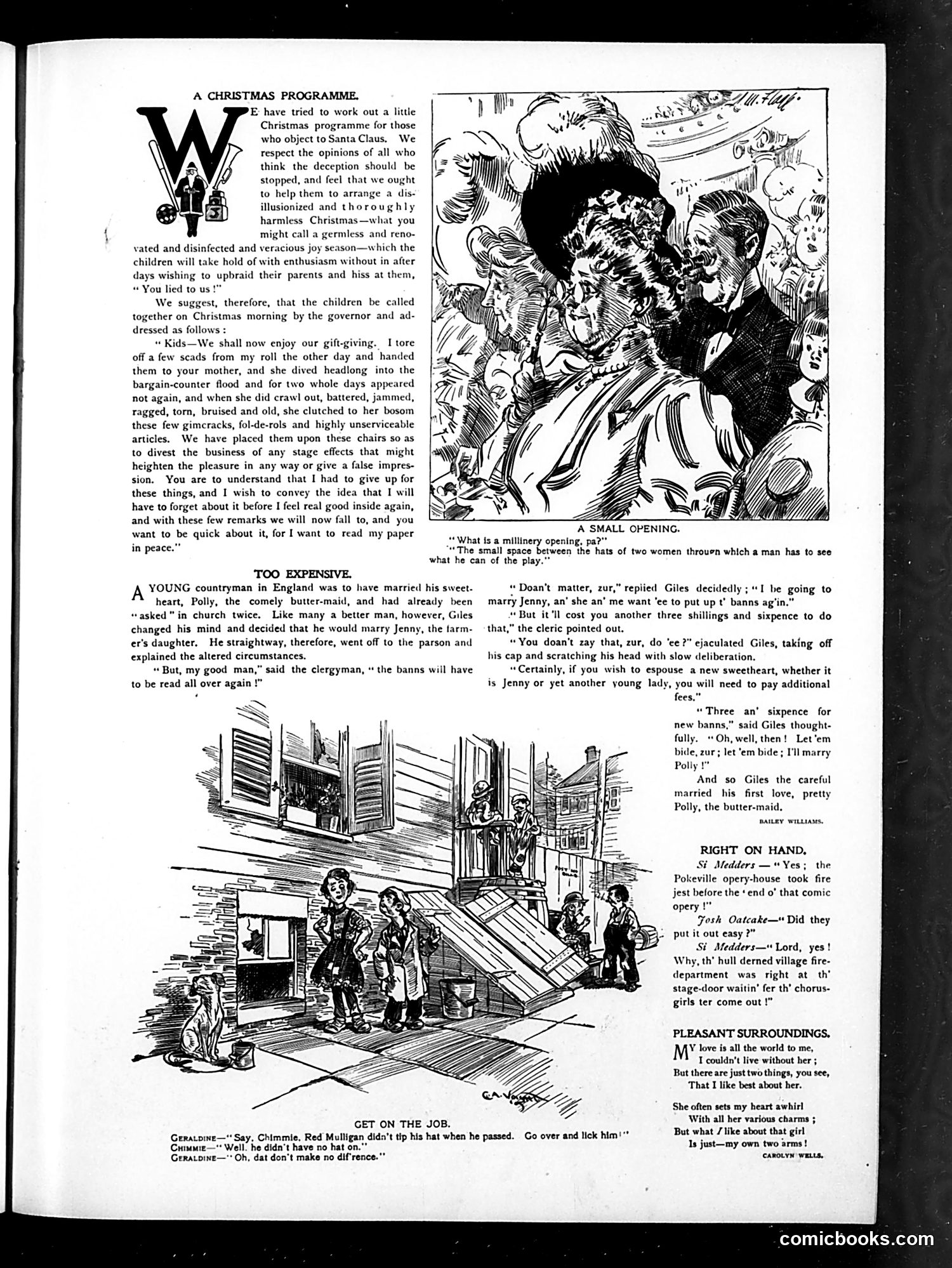
This page contains several satirical pieces mocking contemporary social trends and attitudes: **"A Christmas Programme"** ridicules the anti-Santa Claus movement (a real early-20th-century reform effort). The satire depicts a bleak alternative where parents explain gift-giving as a financial burden they're reluctant to discuss, stripping Christmas of joy to be "truthful." **"Too Expensive"** uses a rural English dialect to satirize the costs of parish services. A farmhand named Giles abandons his plan to marry Jenny (the farmer's daughter) and returns to his original sweetheart Polly specifically to avoid paying extra church fees for posting new marriage banns—showing how poverty constrains even personal choices. **"A Small Opening"** is a one-liner joke about theater etiquette, where a "millinery opening" is redefined as the tiny gap between two women's elaborate hats through which a man can see the stage. The remaining pieces are light social humor about romance and small-town life. The overall tone reflects Judge's satirical approach to modern life's absurdities and class anxieties of the era.
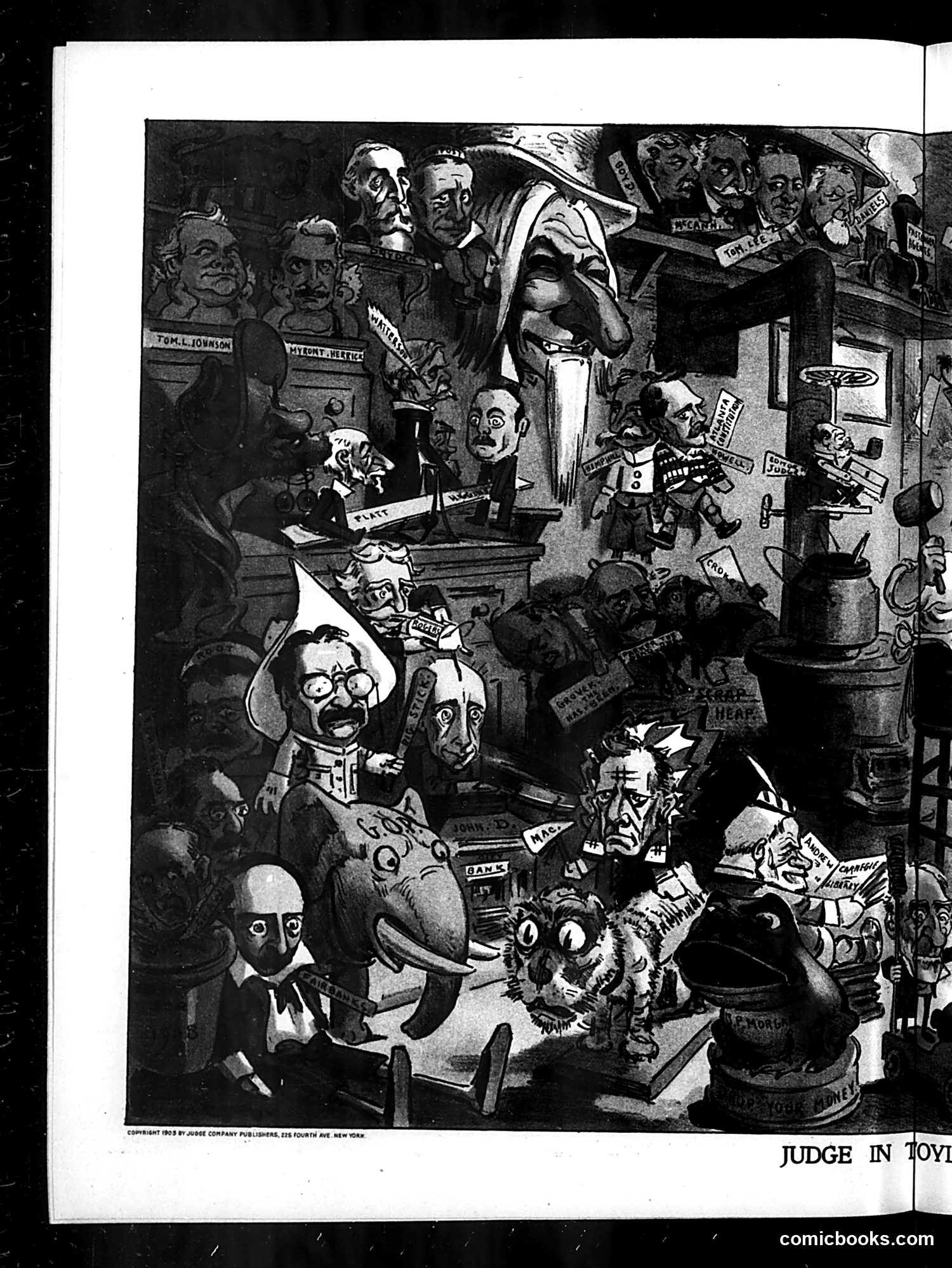
This satirical illustration depicts political and military figures as toys or grotesque caricatures in a chaotic playroom setting. Labels visible on various figures appear to reference military ranks and names (including what seems to be "Tom L. Johnson"), suggesting commentary on military leadership or government officials of the period. The cartoon's title, "Judge in Toyland," implies these serious political figures are being mocked as childish playthings—suggesting they're toy-like, manipulable, or trivial despite their authority. The crowded composition with exaggerated features and military dress uniforms indicates satire of militarism or political absurdity, though specific historical context (date unclear from image) would be needed to identify exact references and targets of this criticism.
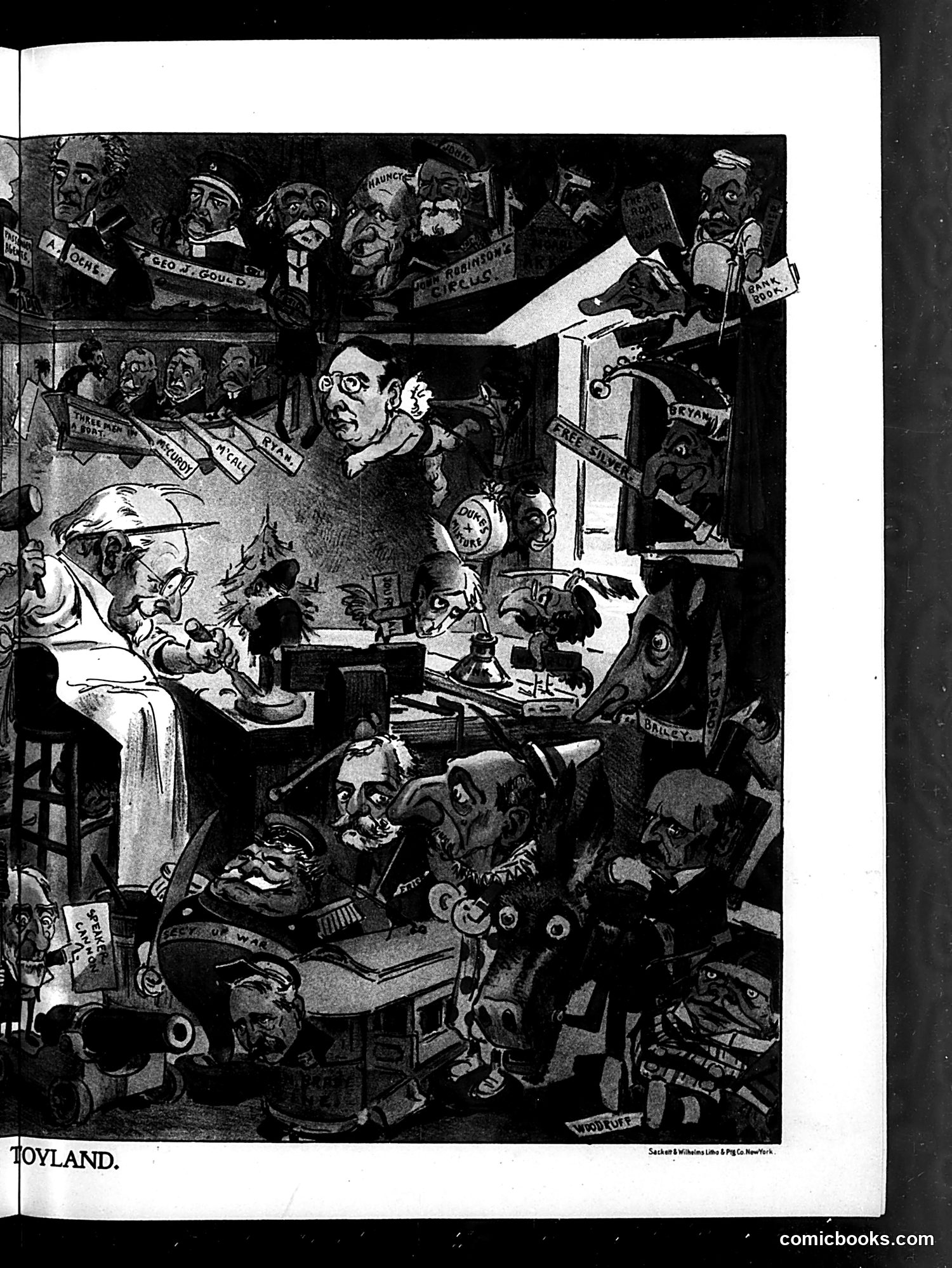
This appears to be a satirical cartoon from *Judge* magazine depicting a chaotic scene labeled "Toyland." The image shows numerous caricatured figures—likely political leaders and military figures of the era—crammed into a cluttered space, many wearing military uniforms and medals. Various labels are visible on the figures and objects, though most are difficult to read clearly in this reproduction. The satire likely critiques militarism, imperialism, or international political tensions of the period (appears to be early 20th century based on style). The "Toyland" title suggests these serious political figures are being mocked as childish or playing dangerous games with war and international relations. The cramped, messy composition emphasizes chaos and disorder among world powers. Without clearer text visibility, specific identifications remain uncertain.
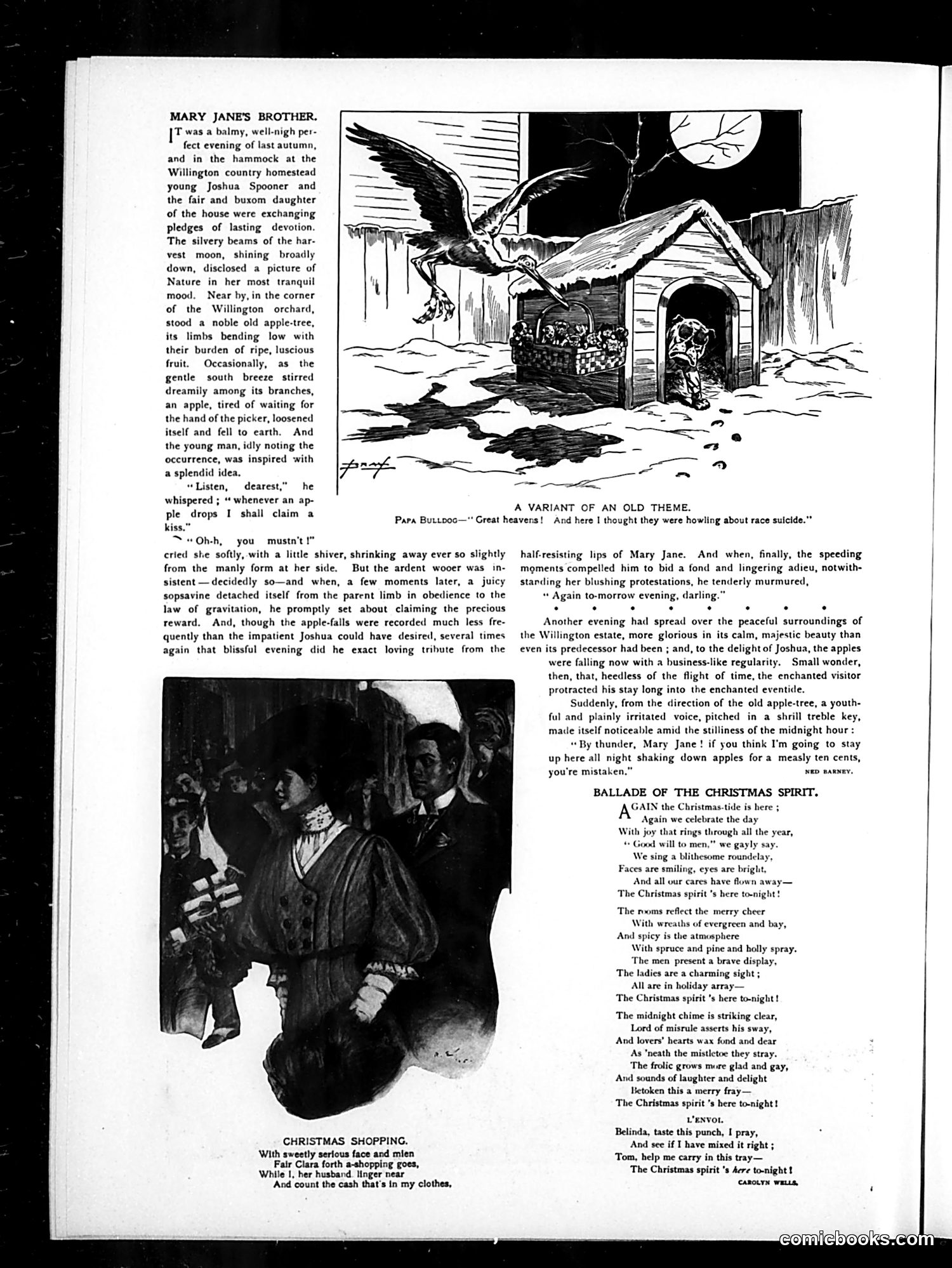
This page contains three humorous pieces typical of early 20th-century American satire: **"Mary Jane's Brother"** (main story with top illustration): A young man courts Mary Jane in an orchard, using falling apples as an excuse to claim kisses. The joke's punchline—revealed in the bottom illustration—is that Mary Jane's brother has been in the tree all along, deliberately shaking down apples for ten cents, unknowingly enabling the romance. It's a gentle comedy of mistaken cause and effect. **"Papa Bulldog"** (middle cartoon): A father bulldog watches his offspring fighting/playing, quipping that he thought they were about "race suicide"—a contemporary anxiety about declining birth rates. The joke satirizes how adults misread children's roughhousing. **"Christmas Shopping"** and **"Ballade of the Christmas Spirit"**: Stock seasonal humor and verse celebrating Christmas cheer, with one joke about a husband nervously counting his cash while his wife shops. The content is lighthearted domestic and seasonal comedy, typical of Judge's humor circa 1900s-1910s.
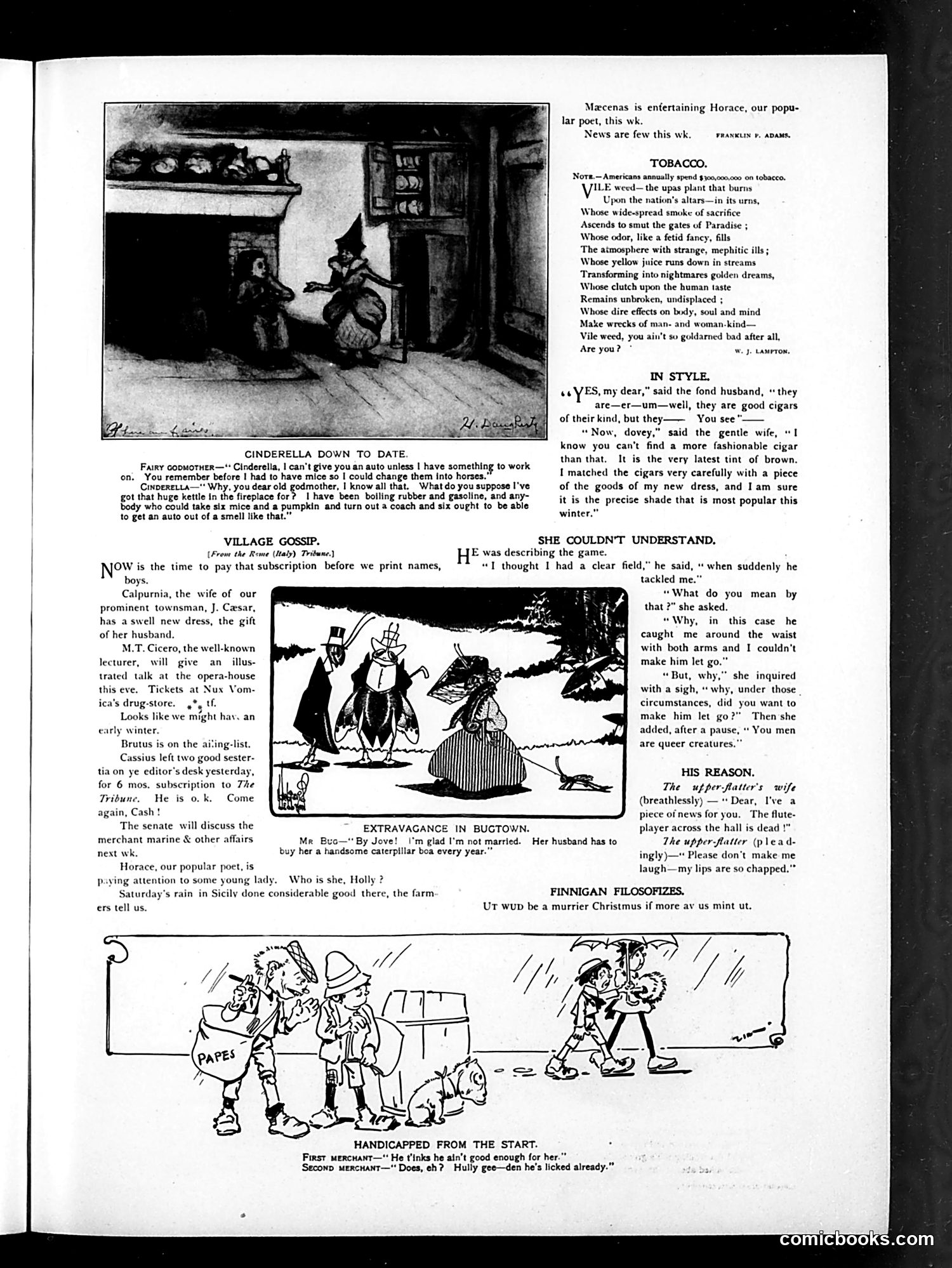
This page contains several satirical pieces reflecting early 20th-century American attitudes: **"Tobacco"** presents mock-heroic verse condemning tobacco as a "vile weed" destroying body and soul—yet ends with comic resignation ("you ain't so goldarned bad after all"). This reflects genuine temperance-era concerns about smoking while acknowledging its popularity. **"Cinderella Down to Date"** updates the fairy tale: the godmother now conjures automobiles instead of carriages, satirizing modern materialism and the automobile craze replacing traditional fantasies. **"In Style"** jokes about a wife matching her husband's cigars to her new dress—poking fun at feminine attention to fashion details and masculine bewilderment. The remaining pieces are light gossip and one-liners about romance and misunderstandings between men and women. "Village Gossip" uses Roman names (Caesar, Cicero, Brutus) for comedic effect in describing small-town American life. Overall, the page reflects turn-of-the-century humor targeting modern consumerism, gender dynamics, and social pretension.
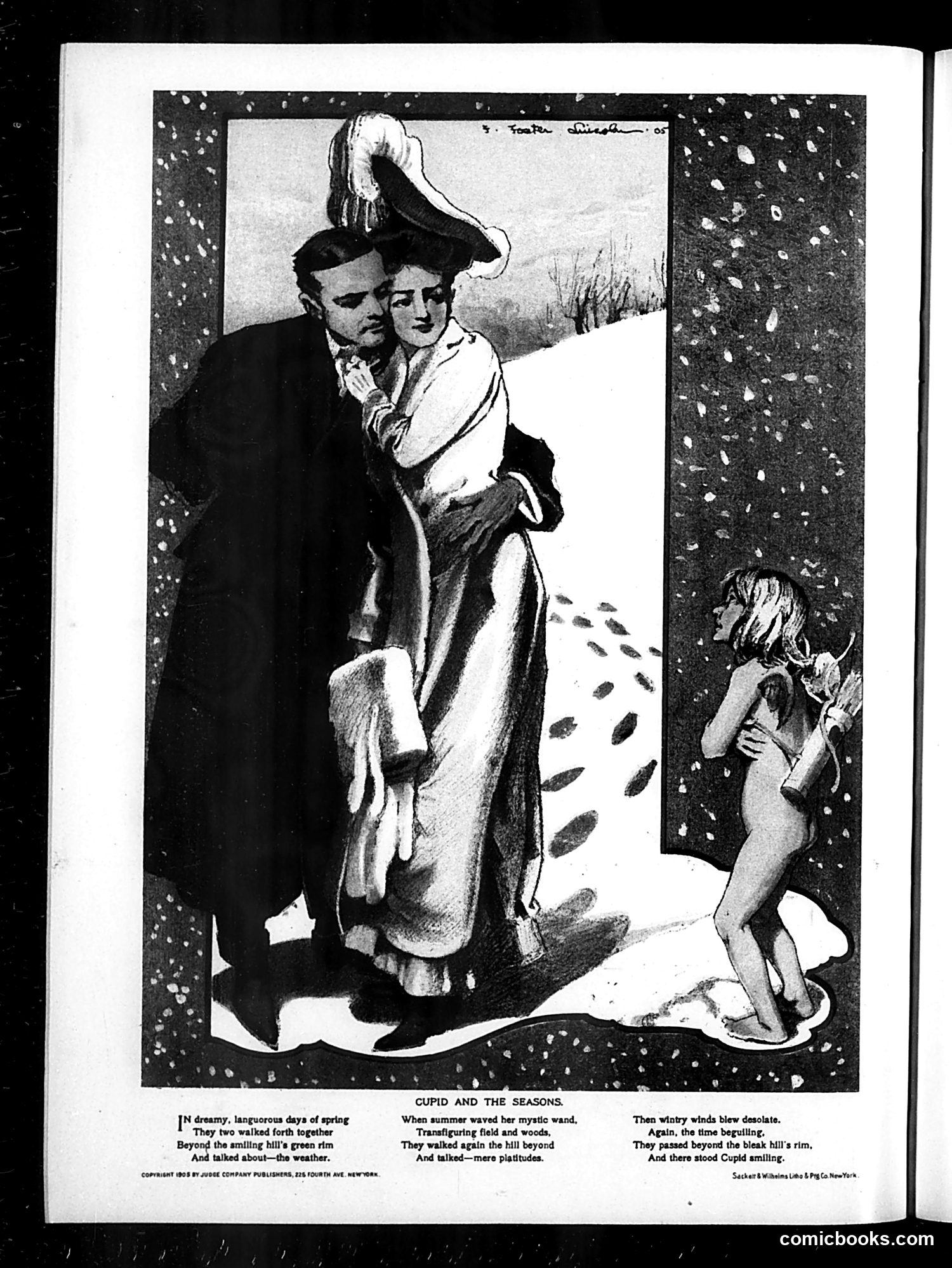
This illustration satirizes romantic couples' shallow conversation habits across seasons. The artwork shows a man and woman with Cupid appearing in three panels representing spring, summer, and winter. The satire's point: regardless of the season's romantic atmosphere—whether "dreamy, languorous days of spring," summer's mystical beauty, or winter's bleakness—the couple only discusses "the weather" and "mere platitudes." Cupid "smiling" in the final panel suggests ironic amusement at lovers' inability to engage meaningfully, despite having perfect romantic conditions. The joke targets the banality of courtship conversations among the era's genteel classes, implying that even Cupid's magic cannot overcome human dullness. This reflects common Judge-magazine humor mocking Victorian social conventions and the predictability of romance.
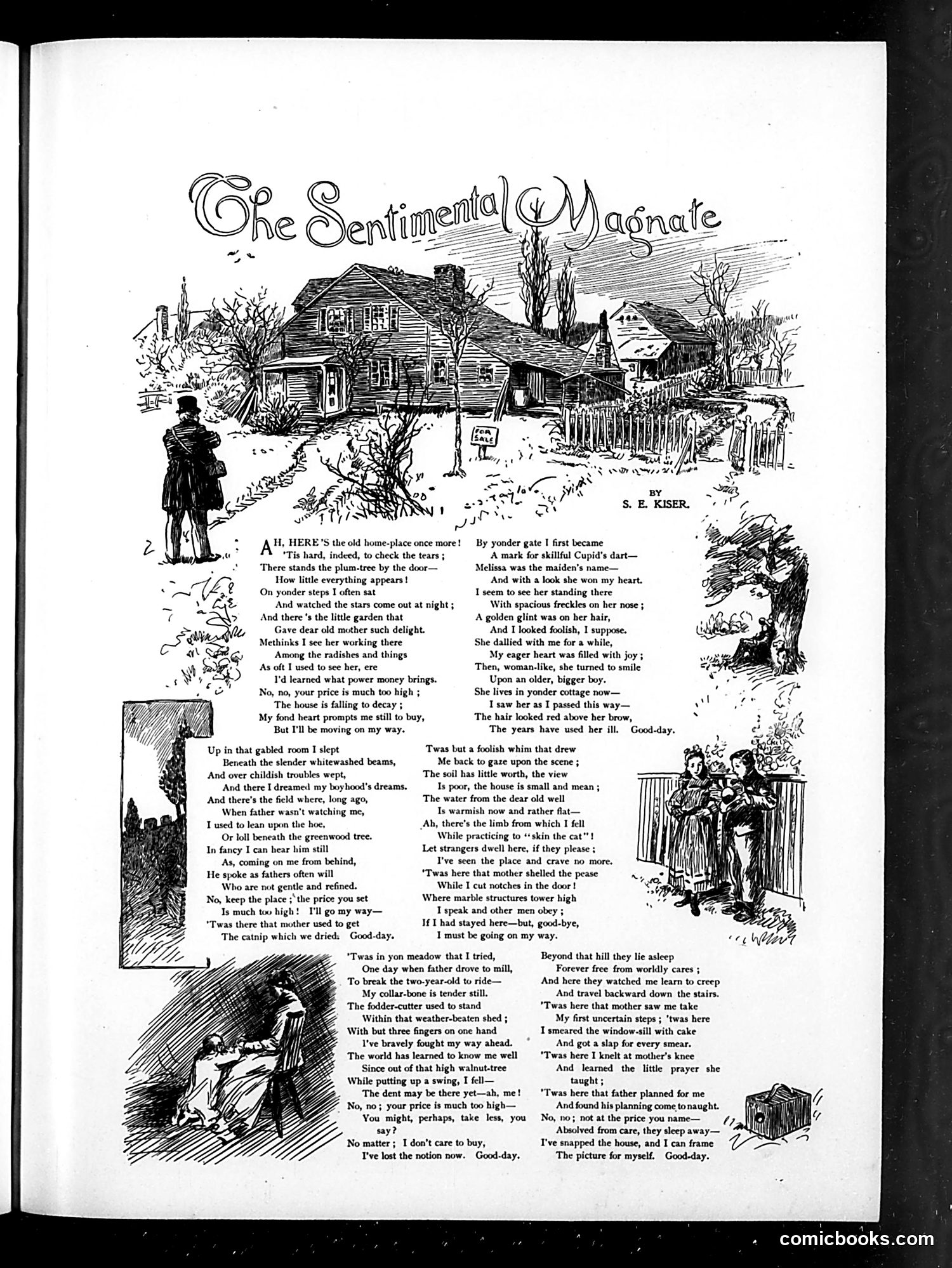
This is a nostalgic narrative poem by S.E. Kiser, illustrated with charming ink sketches. It depicts a wealthy businessman revisiting his childhood home, which is now for sale in declining condition. The satire contrasts the man's sentimental attachment to humble memories—his mother shelling peas, his father's rough discipline, a lost childhood romance with freckled Melissa—against his present status as a powerful urban magnate who commands respect and wealth. The joke is that despite his financial success and ability to easily afford the property, he repeatedly refuses to buy it at the asking price. His nostalgia proves shallow; material success has made him calculating and detached from genuine sentiment. He leaves "snapping" the mental picture for himself rather than reclaiming the actual place, suggesting that for the gilded-age wealthy, even sentimentality becomes a commodity consumed rather than genuinely felt.
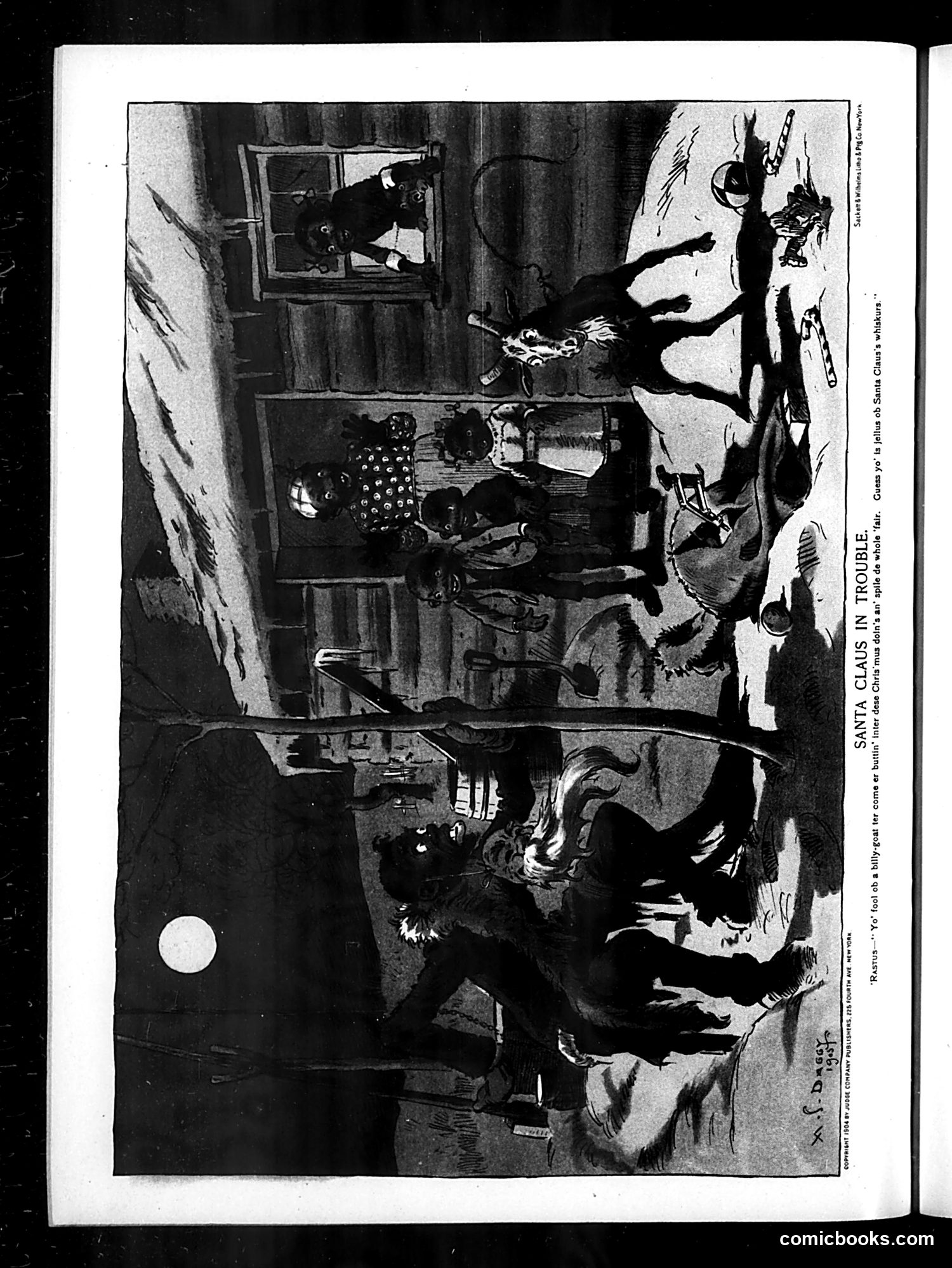
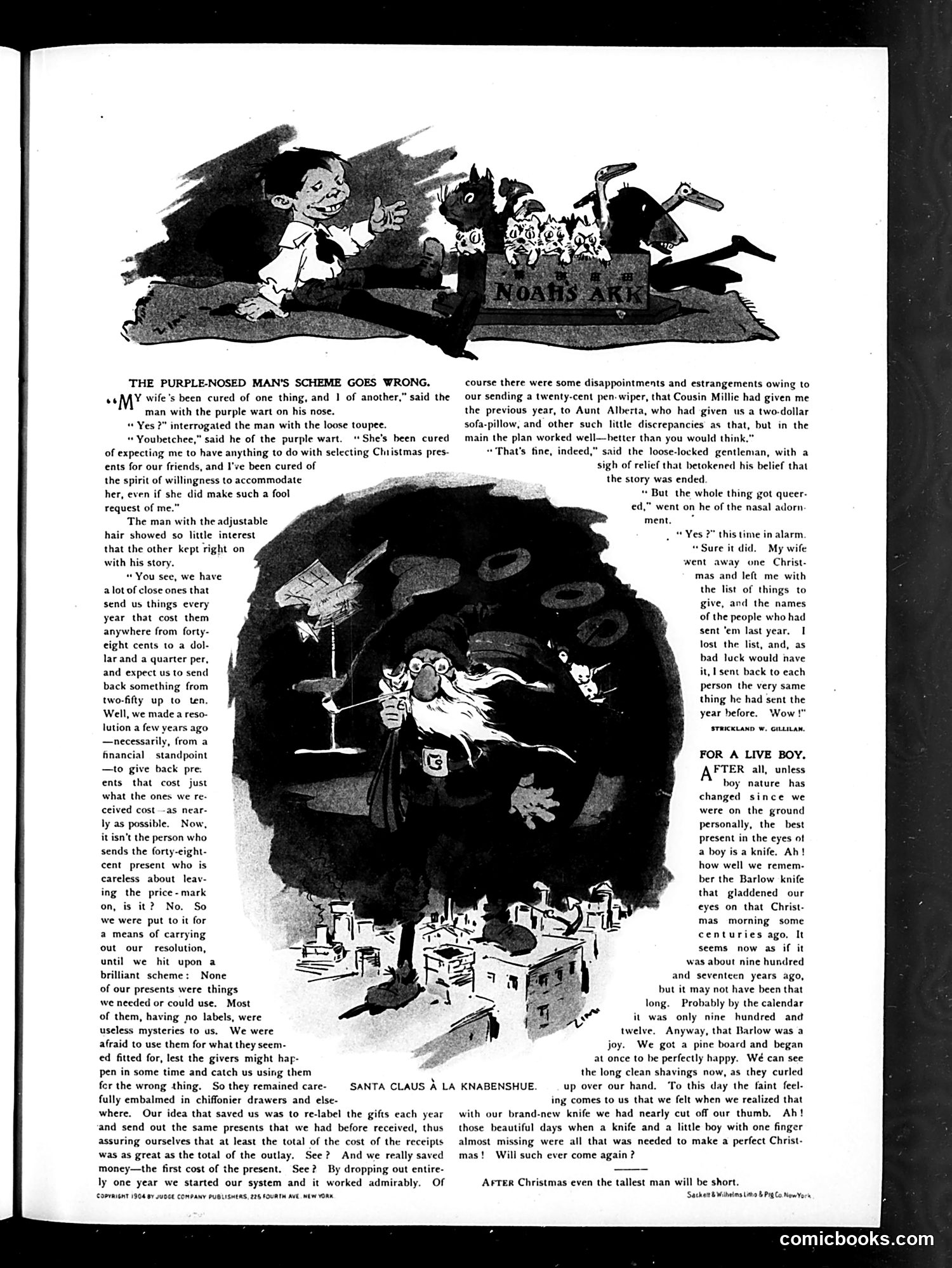
The OCR text is too corrupted to read reliably. However, the image shows what appears to be a scene rotated 90 degrees depicting multiple figures in what looks like an interior domestic space. The caption reads "SANTA CLAUS IN TROUBLE," suggesting this is a satirical cartoon about Santa Claus in some kind of predicament or difficult situation. Without legible text, I cannot identify the specific political or social references, the particular figures involved, or the exact point of satire. The image quality and rotation make it difficult to discern details clearly. To properly explain this cartoon's meaning to a modern reader, I would need either a clearer image or a legible version of the accompanying text.
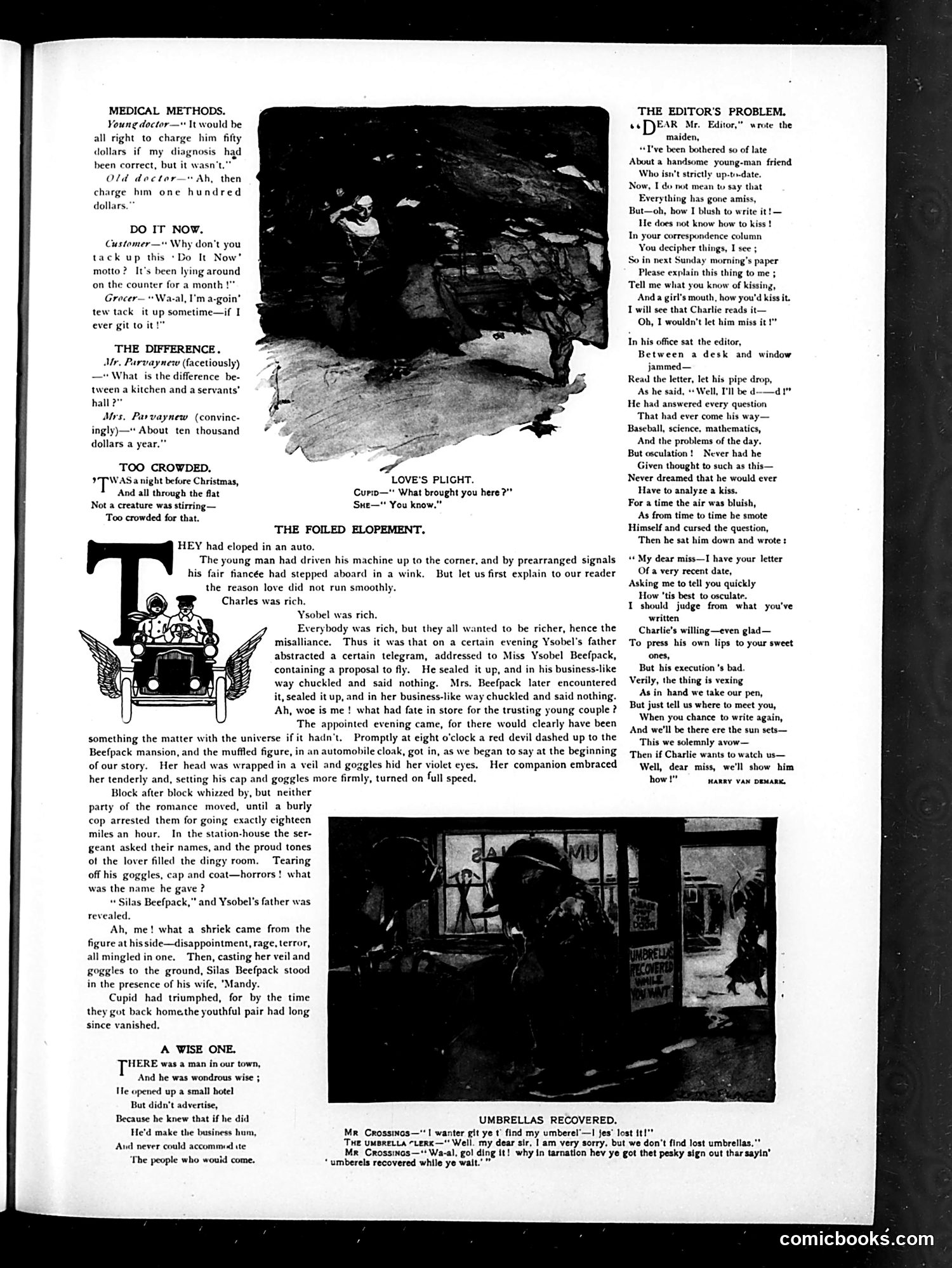
This page contains several brief satirical pieces typical of early 20th-century humor magazines: **"Medical Methods"**: Mocks unethical doctors who charge *more* for incorrect diagnoses, suggesting the profession's dishonesty. **"Do It Now"**: Ironic commentary on procrastination—a grocer promises to display a motivational motto "sometime," never actually doing it. **"The Difference"**: Wealthy social climbers distinguish their "servants' hall" from the "kitchen" by a $10,000 annual salary difference—satirizing nouveau riche pretension. **"The Foiled Elopement"**: An elaborate romantic setup where a young couple attempts to elope by automobile, only to be arrested for speeding (18 mph—absurdly slow). The punchline reveals the "elopers" are actually the girl's parents, not the young lovers, who have meanwhile vanished. **"The Editor's Problem"**: A mock advice column where a young woman requests kissing instructions for her boyfriend, intending to have him read the published response—humor derived from Victorian-era sexual prudishness. The overall tone reflects Judge's characteristic blend of social satire, wordplay, and gentle ridicule of contemporary manners.
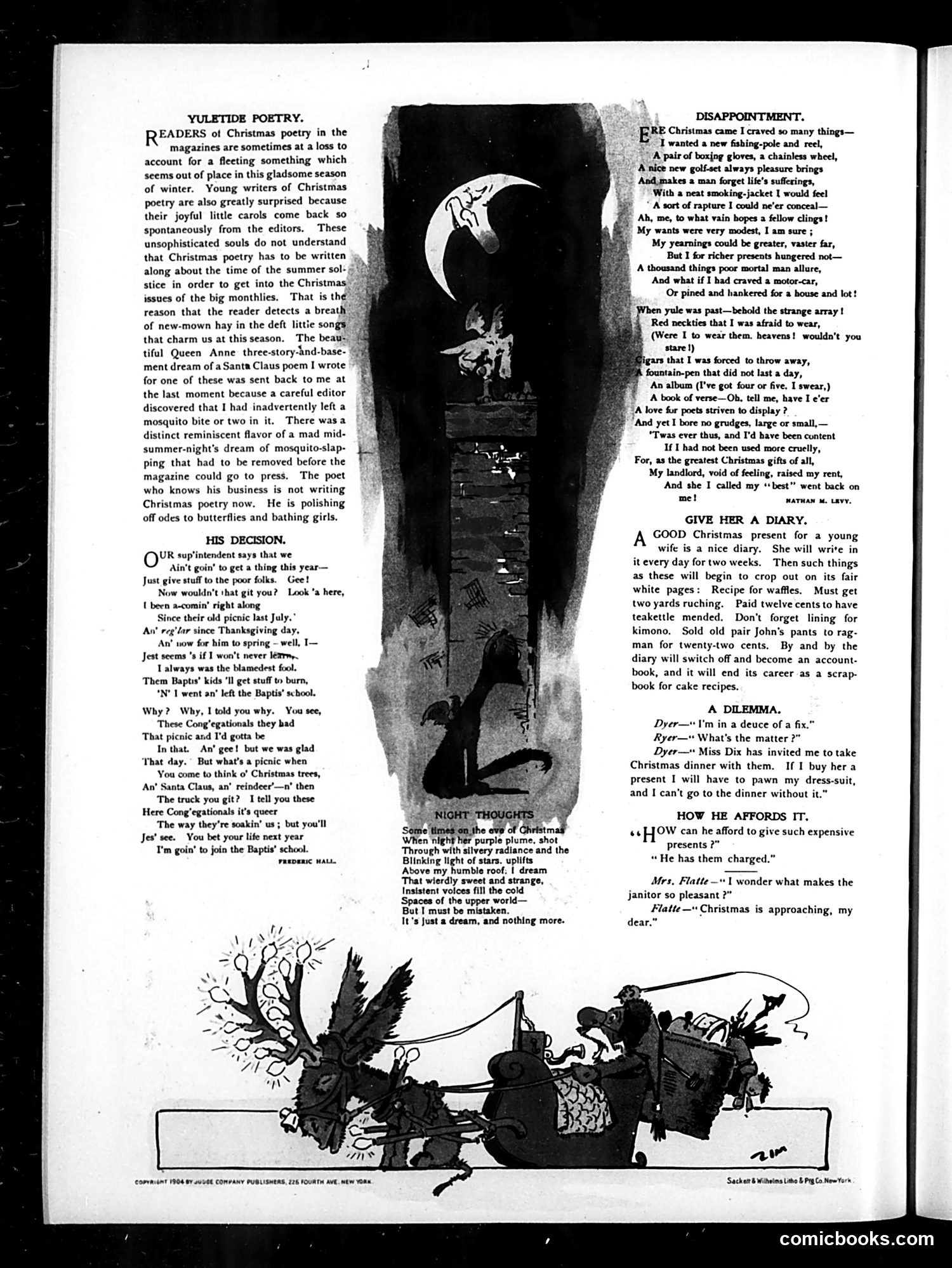
This Judge magazine page contains several Christmas-themed pieces satirizing American life circa 1904. **"Yuletide Poetry"** mocks magazine editors who reject Christmas poems written during summer (when they're actually composed) if they contain summer imagery—like mosquito bites. The satire targets the disconnect between publishing schedules and seasonal authenticity. **"His Decision"** presents dialect verse about a man switching churches for Christmas gifts. A poor man had attended Congregational church picnics but now regrets not joining the Baptist congregation, which apparently provides better Christmas presents to its school. The joke satirizes how economic self-interest drives religious affiliation among working-class Americans. **"Disappointment"** is a poem lamenting receiving unwanted gifts—ties, cigars, a defective pen, poetry books—instead of desired items like fishing gear or a motor-car. It humorously captures the gap between Christmas expectations and reality. The bottom illustration appears to show Santa's sleigh in chaotic motion, likely reinforcing Christmas theme. These pieces collectively mock American consumerism, denominational competition, and false holiday promises.
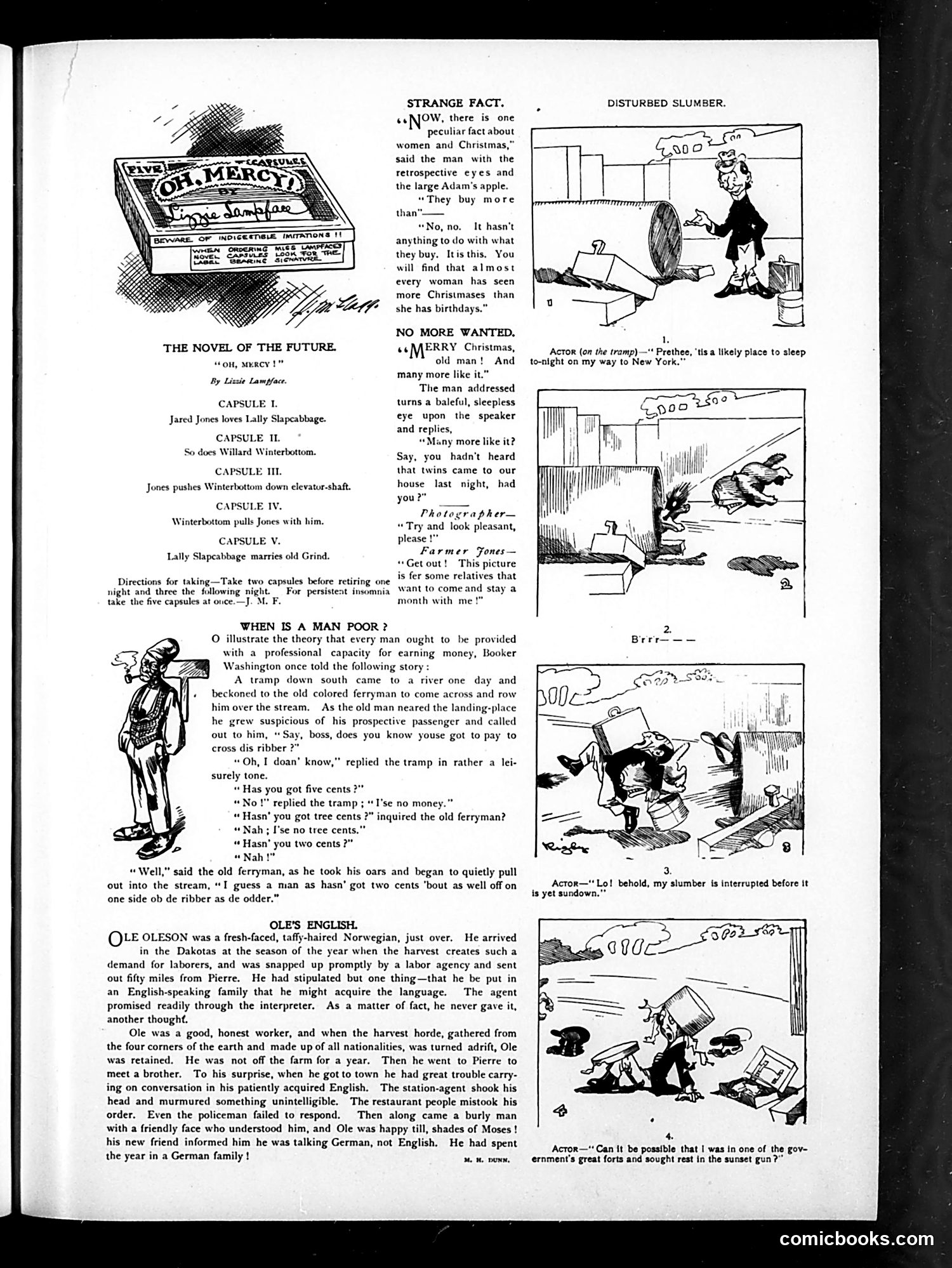
This page contains multiple satirical pieces typical of early 20th-century American humor: **"Strange Fact"** jokes about women's Christmas spending habits—the twist being not about quantity purchased but that women celebrate more Christmases than birthdays (implying women hide their ages). **"The Novel of the Future"** satirizes serialized melodrama through absurdly brief "capsules" with ridiculous plot summaries (man pushes rival down elevator shaft, etc.), mocking overwrought popular fiction. **"When Is a Man Poor?"** presents a Booker T. Washington anecdote about a penniless tramp. The ferryman concludes someone with no money is equally disadvantaged on either riverbank—satirizing poverty and economic mobility. **"Disturbed Slumber"** and **"Ole's English"** are comic strips: the first shows an actor mistakenly trying to sleep in an unsafe location; the second depicts a Norwegian immigrant who spent a year in a German-speaking household, defeating his goal of learning English. The humor relies on wordplay, immigrant stereotypes, class commentary, and domestic absurdity typical of Judge's satirical approach.
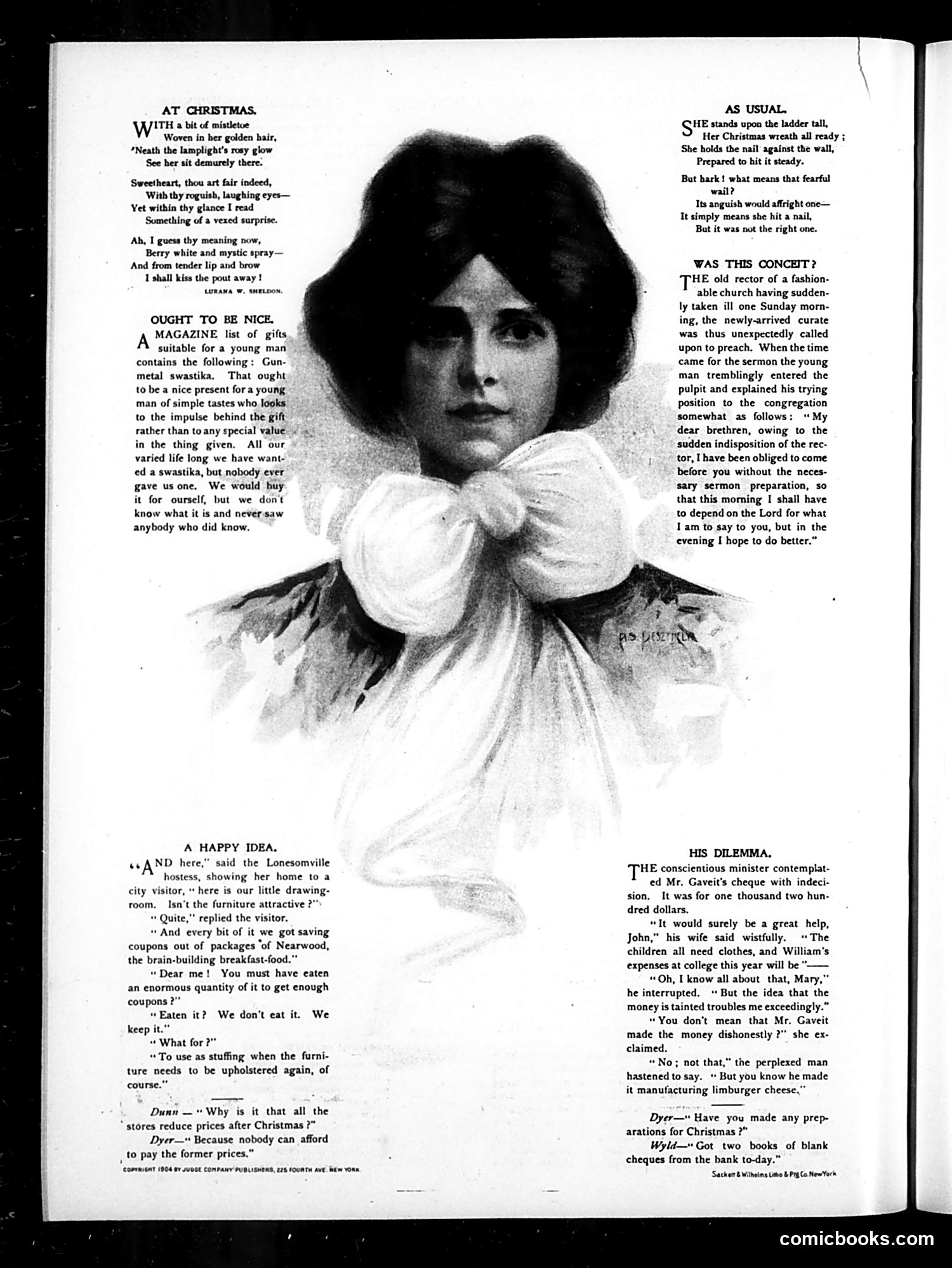
This page contains several short satirical pieces typical of *Judge* magazine's humor: **"At Christmas"** and **"As Usual"**: Sentimental/domestic poetry about Christmas romance and mishaps—standard greeting-card fare lampooned for sentimentality. **"Ought to Be Nice"**: Satirizes gift-giving culture by mocking the suggestion of a "gun-metal swastika" as a present. (Note: the swastika was a decorative symbol pre-dating Nazi appropriation; the joke is simply that it's a useless, inexplicable gift.) **"A Happy Idea"**: Ridicules cereal box premiums—consumers saved coupons to obtain furniture, but the satire suggests people accumulated so much promotional "junk" they'd use it as stuffing material. **"His Dilemma"**: A minister struggles morally accepting a donation from a wealthy man who made his fortune manufacturing limburger cheese—implying the money is "tainted" by association with a notoriously foul-smelling product. The page mixes light domestic humor with gentle social commentary on consumerism and moral hypocrisy. The central portrait appears to be decorative rather than depicting a specific person.
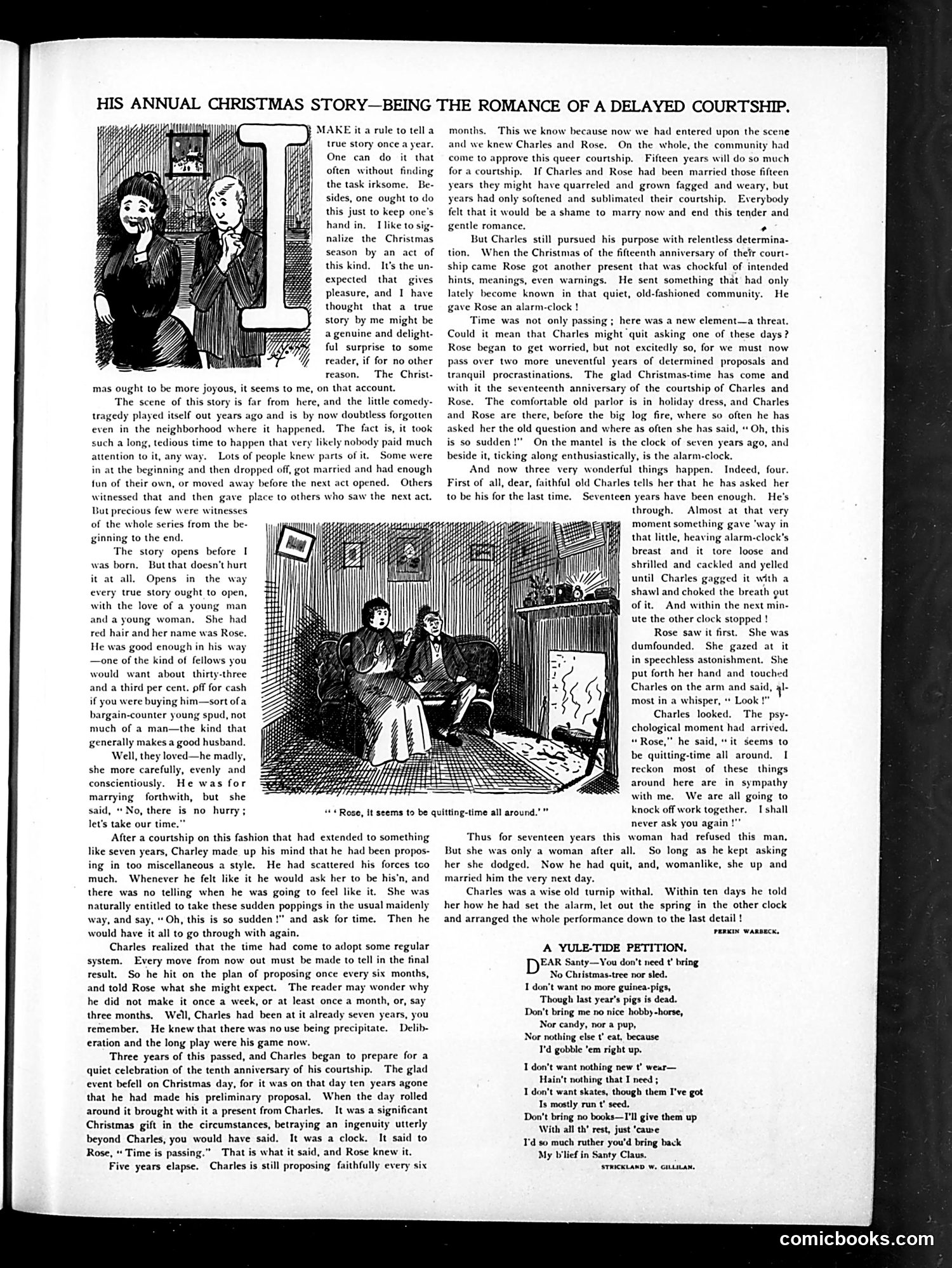
This page presents a sentimental romantic comedy about Charles and Rose's extraordinarily lengthy courtship—fifteen to seventeen years. The satire targets the absurdity of prolonged, uncommitted relationships and social expectations around marriage. **The Plot:** Charles repeatedly proposes over nearly two decades while Rose demurs with "Oh, this is so sudden!" The community finds their indefinite courtship oddly charming rather than scandalous. When Charles finally gives Rose an alarm clock as a Christmas gift, it signals time is literally running out—a humorous threat that marriage or separation must occur. **The Joke:** The story mocks how extended courtships become normalized; what should be decisive becomes sentimental delay. Charles's patience is presented as both admirable and ridiculous. The alarm clock's mechanical failure at the climactic moment when Charles declares this his final proposal represents fate intervening in their stalled romance. The accompanying poem "A Yule-Tide Petition" appears unrelated commentary.
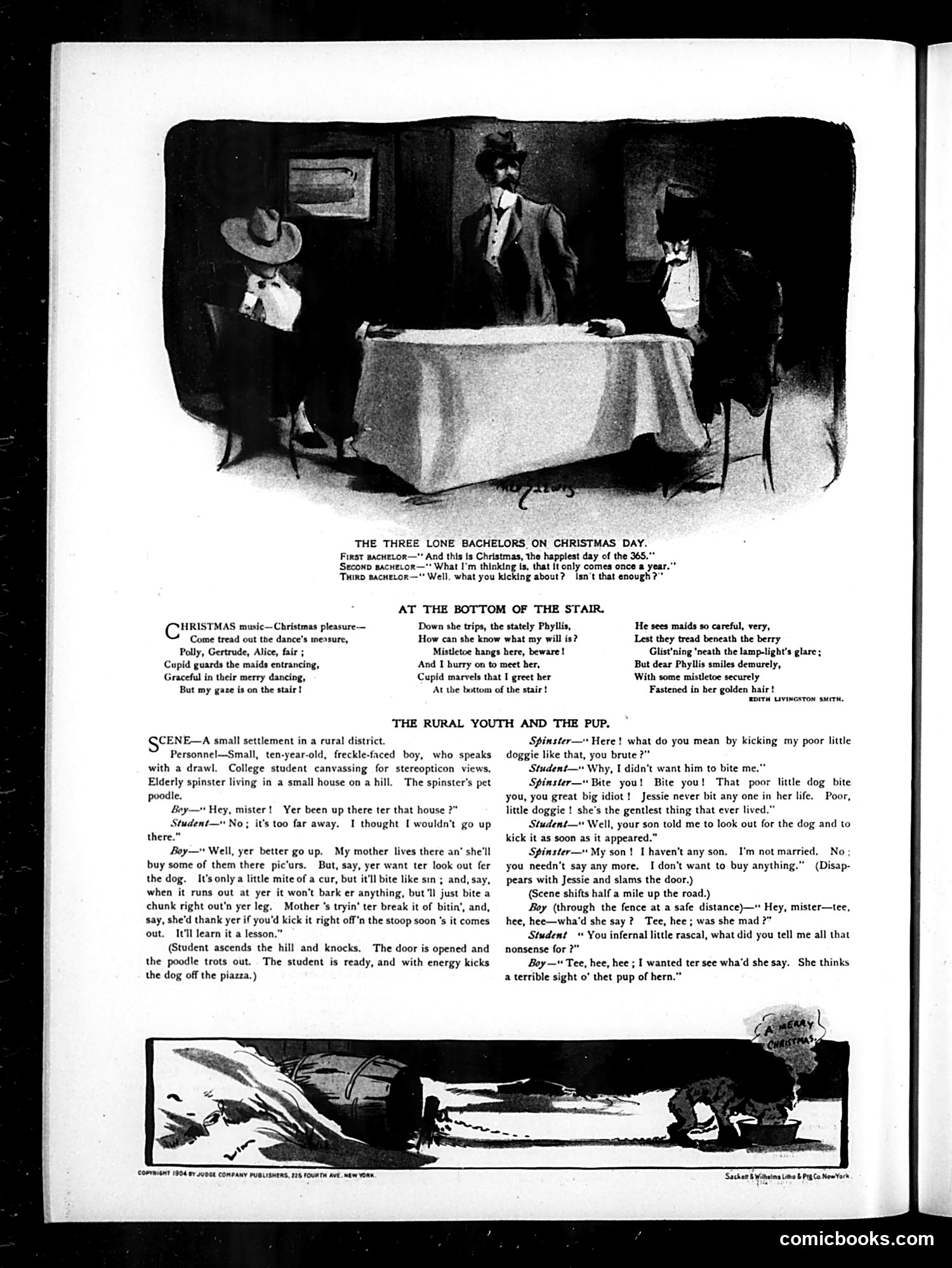
This page contains three separate comic pieces from Judge magazine (copyright 1904): **"The Three Lone Bachelors on Christmas Day"** presents a simple joke: bachelors lamenting that Christmas, the "happiest day of the year," only comes once annually—implying their loneliness makes the holiday feel too infrequent. **"At the Bottom of the Stair"** is a romantic poem about Christmas mistletoe tradition, depicting a suitor meeting a young woman (Phyllis) beneath mistletoe as she descends stairs. **"The Rural Youth and the Pup"** is the main satirical piece: A college student canvassing for stereopticon views (early projection entertainment) is tricked by a local farm boy into kicking the boy's elderly mother's small poodle. The boy had falsely warned the student the dog was vicious. When the student defends his actions by repeating the boy's lie, the spinster—who adores her harmless dog—refuses to buy anything and throws him out. The joke satirizes rural cunning and the gullibility of educated city folk.
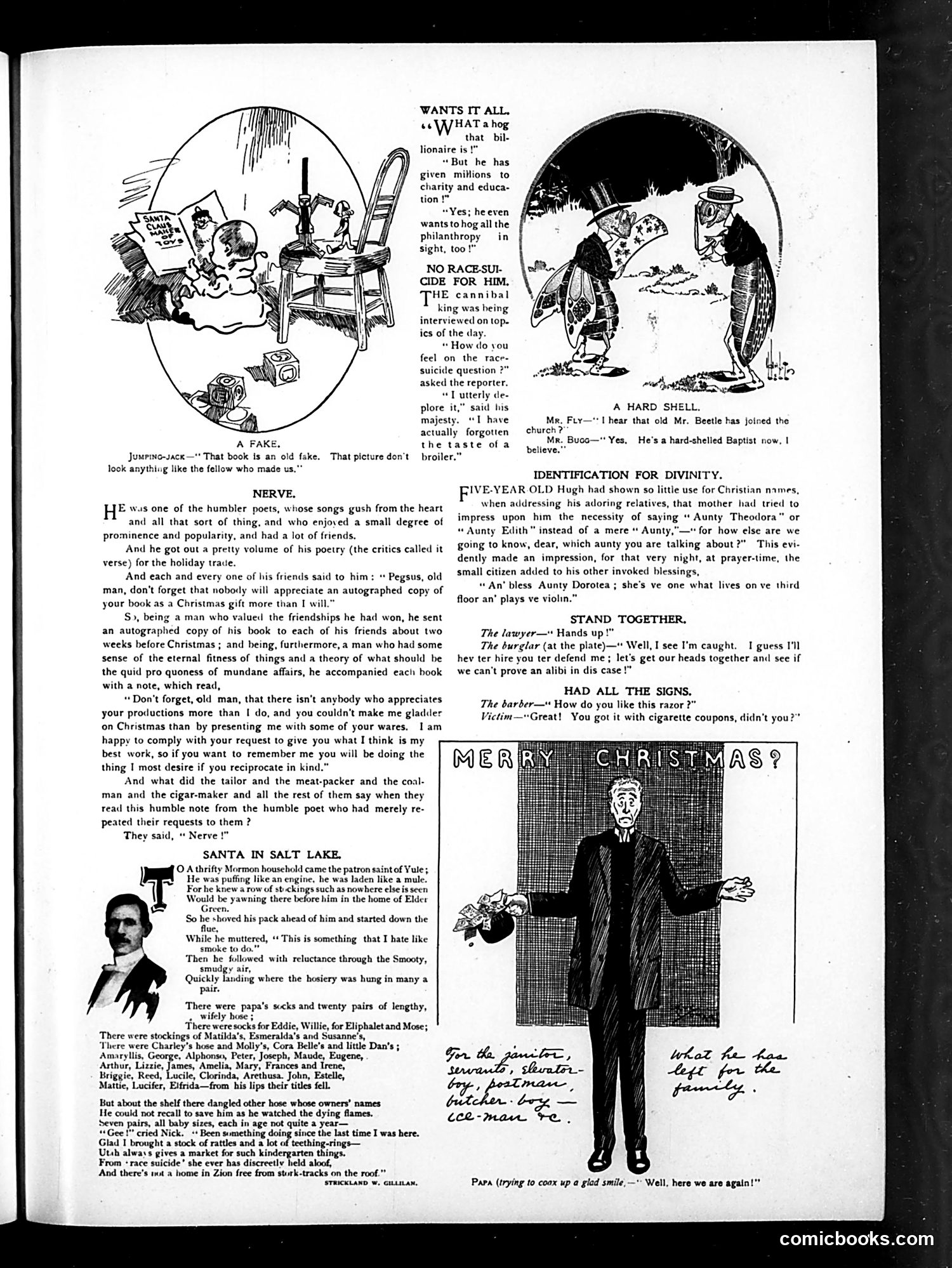
This page contains several interconnected satirical pieces mocking wealth, hypocrisy, and social pretense circa early 1900s. **"Wants It All"** ridicules a billionaire philanthropist for simultaneously hogging wealth AND philanthropy—exposing the vanity underlying charitable giving. **"No Race-Suicide for Him"** jokes darkly about a cannibal king lamenting he's "forgotten the taste of a broiler"—satirizing contemporary anxieties about "race suicide" (declining birth rates among white Americans) by absurdly applying it to cannibalism. **"Nerve"** describes a struggling poet sending autographed books to friends with a note requesting gifts in return. His acquaintances call this audacious. The satire targets both the poet's presumption and society's conflicting expectations about reciprocal obligation. **"Santa in Salt Lake"** mocks Mormon polygamy through Santa's shock at the enormous number of stockings in Elder Green's house—implying multiple wives and numerous children. The final line about "sturk-tracks" (stork tracks) sardonically notes Utah's large families, countering "race suicide" fears.
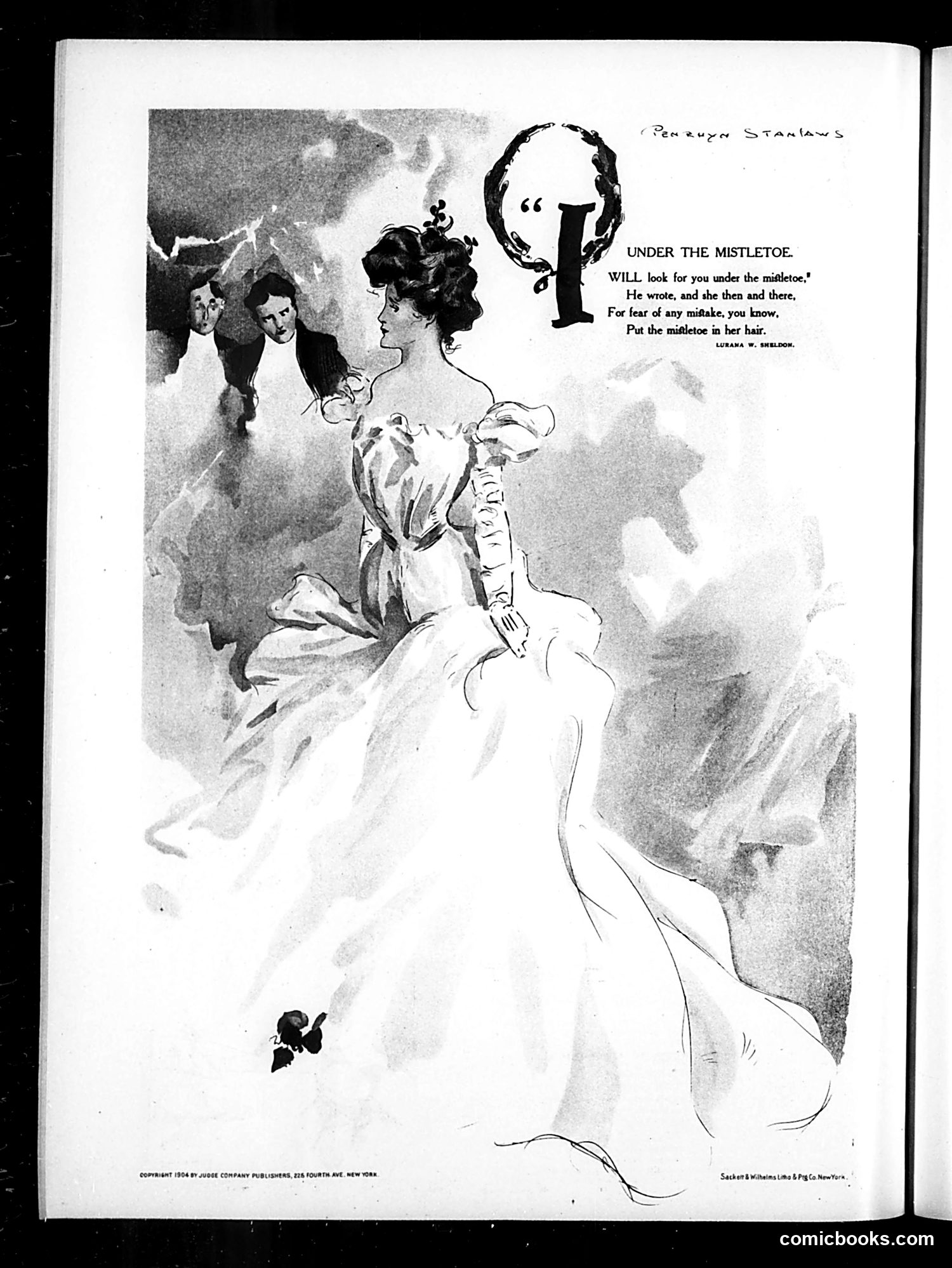
This is a romantic illustration accompanying a humorous poem about Christmas mistletoe tradition. A woman in an elegant Edwardian gown has placed mistletoe in her hair, while a man approaches in the background—the couple appears positioned under or near decorative mistletoe. The joke relies on the Victorian-era custom where couples could kiss beneath mistletoe during holidays. The woman, receiving the man's written promise to find her "under the mistletoe," takes the instruction literally and places the plant in her hair to ensure he cannot miss the invitation—a playful, direct approach to facilitating the romantic moment. The satire gently mocks both the formality of written communication between potential lovers and the woman's pragmatic solution to leave nothing to chance. It's lighthearted commentary on courtship customs of the era.
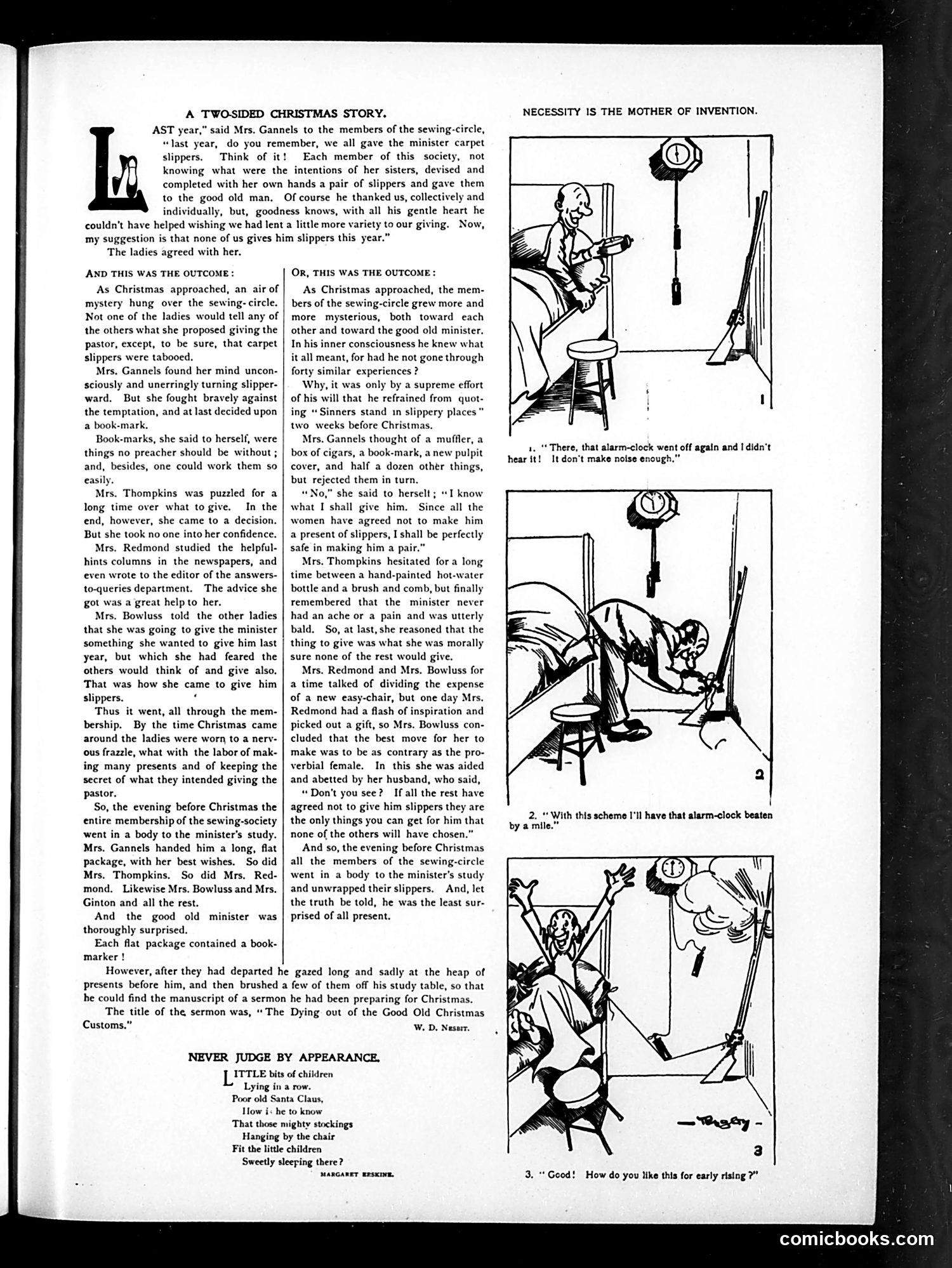
This is a humorous story about well-intentioned irony, not political satire. A sewing circle's attempt to give their minister variety in Christmas gifts backfires through human psychology. **The Setup:** Ladies agree NOT to give carpet slippers after the minister received multiple pairs last year. **The Joke:** Each woman, trying to be original while avoiding slippers, independently concludes that slippers are the safest gift—since everyone else surely won't give them. The result: the minister receives only slippers again. The cartoons illustrate the ladies' internal deliberation process. This satirizes human nature and group dynamics rather than political figures or events. The story's moral appears to be about the paradox of trying too hard to be different within a group, or the limits of coordinated decision-making.
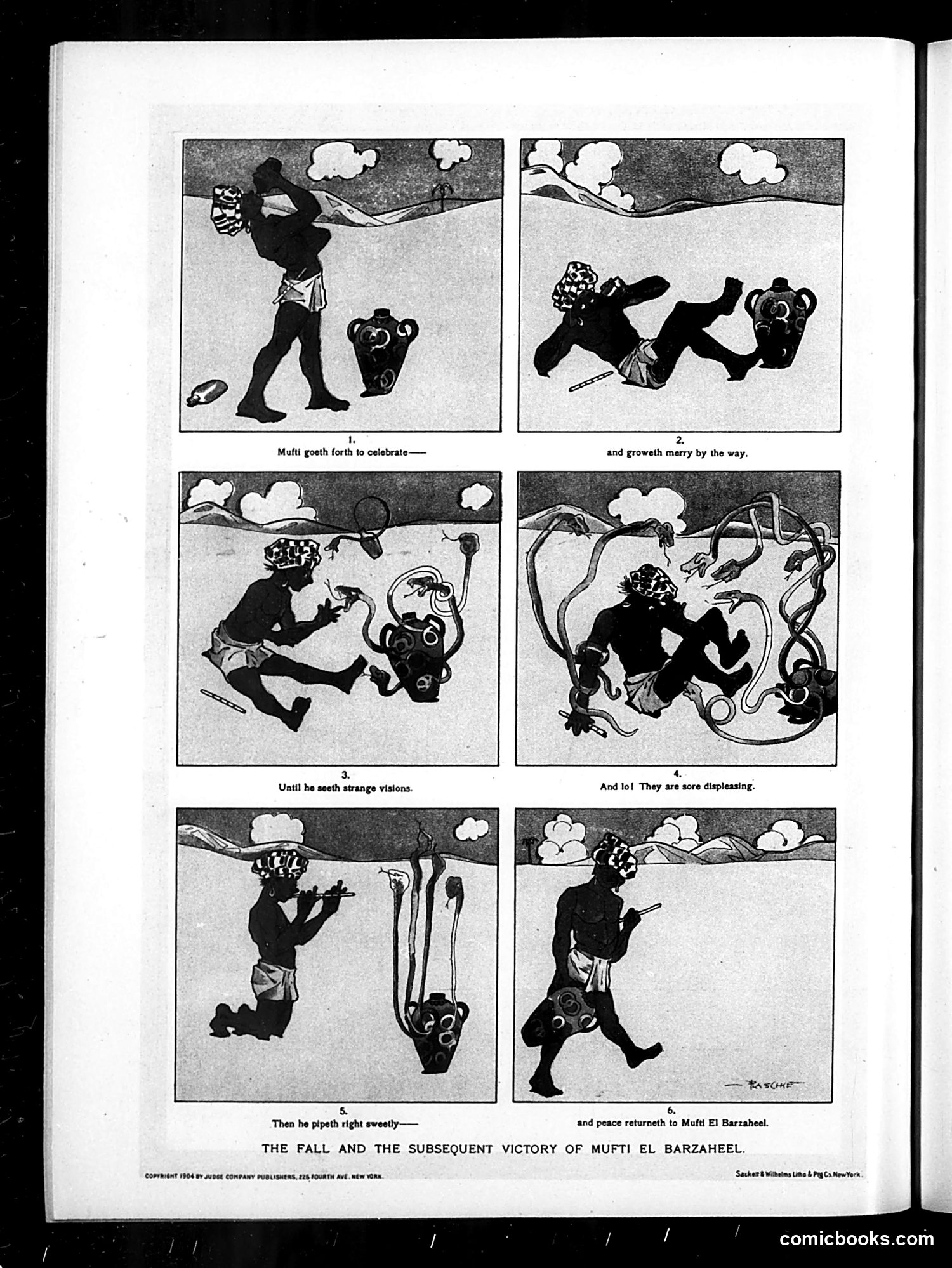
This 1904 Judge comic strip satirizes a Middle Eastern or North African leader (likely fictional, though "Mufti" suggests an Islamic religious authority). The narrative shows: a dignified figure celebrating, then chaos erupts with violent confrontations involving multiple adversaries, strange tentacled creatures emerge, and finally peace is restored. The satire appears to mock orientalist stereotypes—depicting non-Western leadership as inherently unstable, prone to absurd conflict, and requiring restoration of order. The "strange visions" and surreal creatures suggest both imperial anxieties about unknown foreign lands and a dismissive, comedic treatment of Arab/Muslim political upheaval. The strip reflects early 20th-century American imperial attitudes: portraying non-Western governance as chaotic entertainment rather than legitimate politics. Judge magazine frequently published such race-conscious political satire reflecting contemporary prejudices.
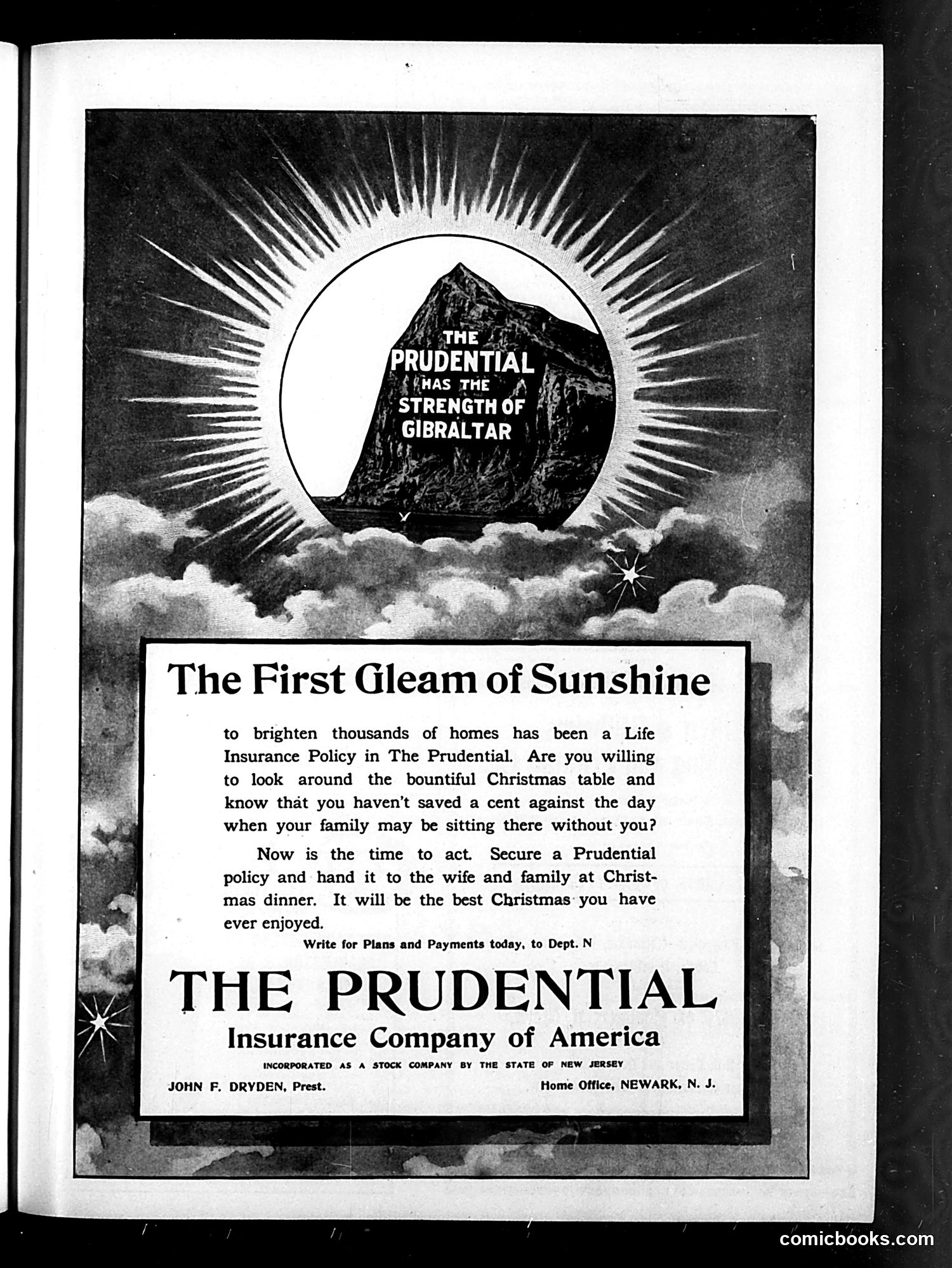
This page is **not a cartoon or satire—it's a life insurance advertisement** from The Prudential Insurance Company of America. The imagery uses religious symbolism: the Rock of Gibraltar (representing strength and stability) is positioned like a halo or divine light behind clouds, with the tagline "The Prudential has the strength of Gibraltar." This appeals to readers' sense of security. The advertisement targets breadwinners by invoking emotional anxiety: it asks whether they've saved money for their family's future, then presents life insurance as a perfect Christmas gift—"the best Christmas you have ever enjoyed." The copy plays on guilt and responsibility, suggesting that purchasing a policy demonstrates care for one's wife and family. This represents early-20th-century advertising strategy: using aspirational imagery, emotional appeals, and holiday sentiment to sell financial products to middle-class men concerned about protecting their families.
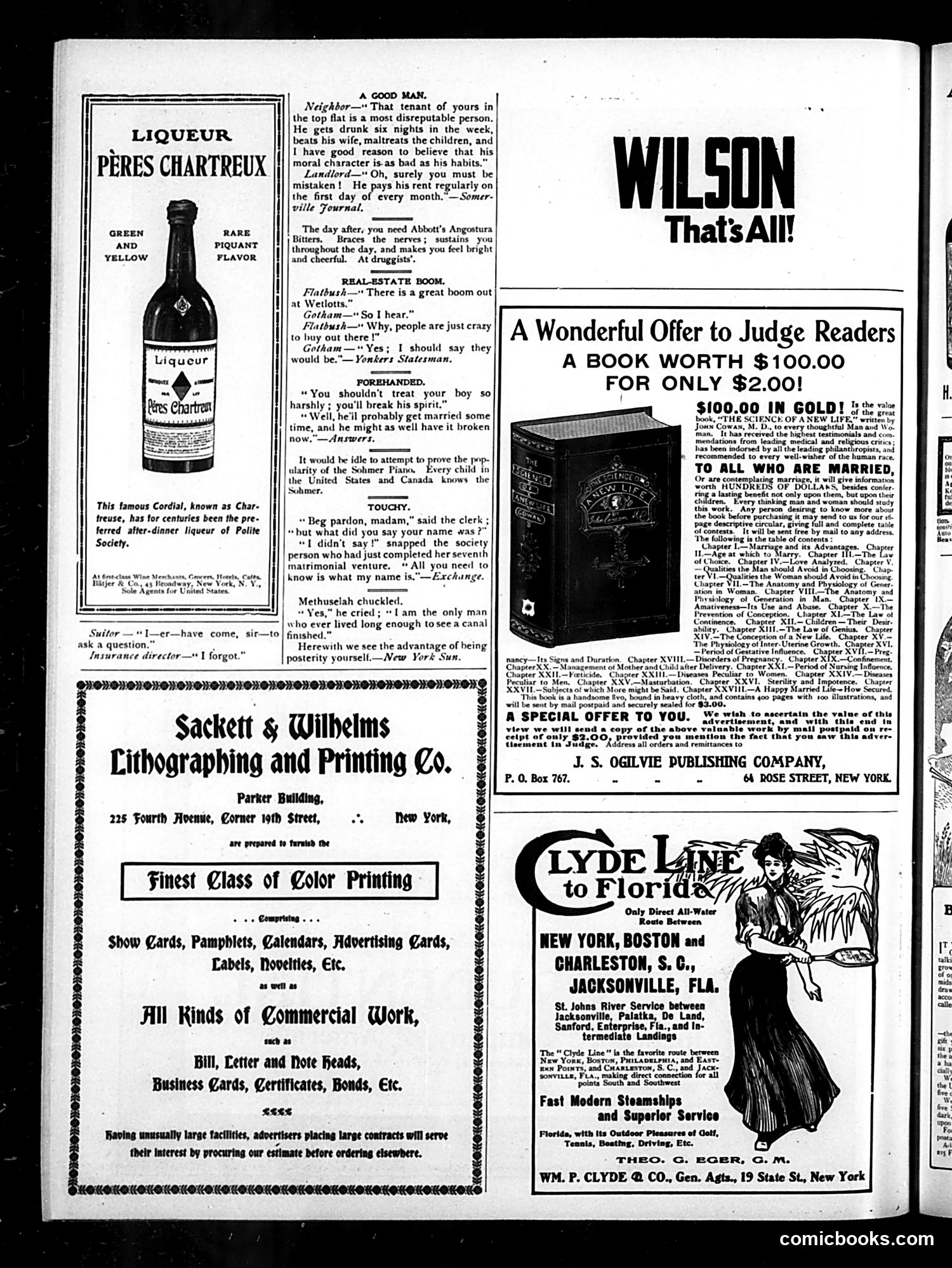
This page contains several brief satirical jokes typical of early Judge magazine: **"A Good Man"** mocks landlords' moral blindness—a tenant is clearly abusive and criminal, but the landlord overlooks all this because he pays rent reliably. The satire targets how property owners prioritize financial obligation over tenant welfare or morality. **"Real-Estate Boom"** jokes about speculative fever in real estate, suggesting people buy land at places like "Wetlotts" (a pun on wet/swampy land unsuitable for building) purely on irrational hype. **"Porehanded"** and other short quips satirize parenting, marriage (mocking a woman's seven divorces), and dated topics. The page is otherwise filled with **period advertisements**: liqueur, Sohmer pianos, a printing company, steamship lines to Florida, and notably a dubious $2 "science of life" book claiming $100 value—typical of era's mail-order publishing.
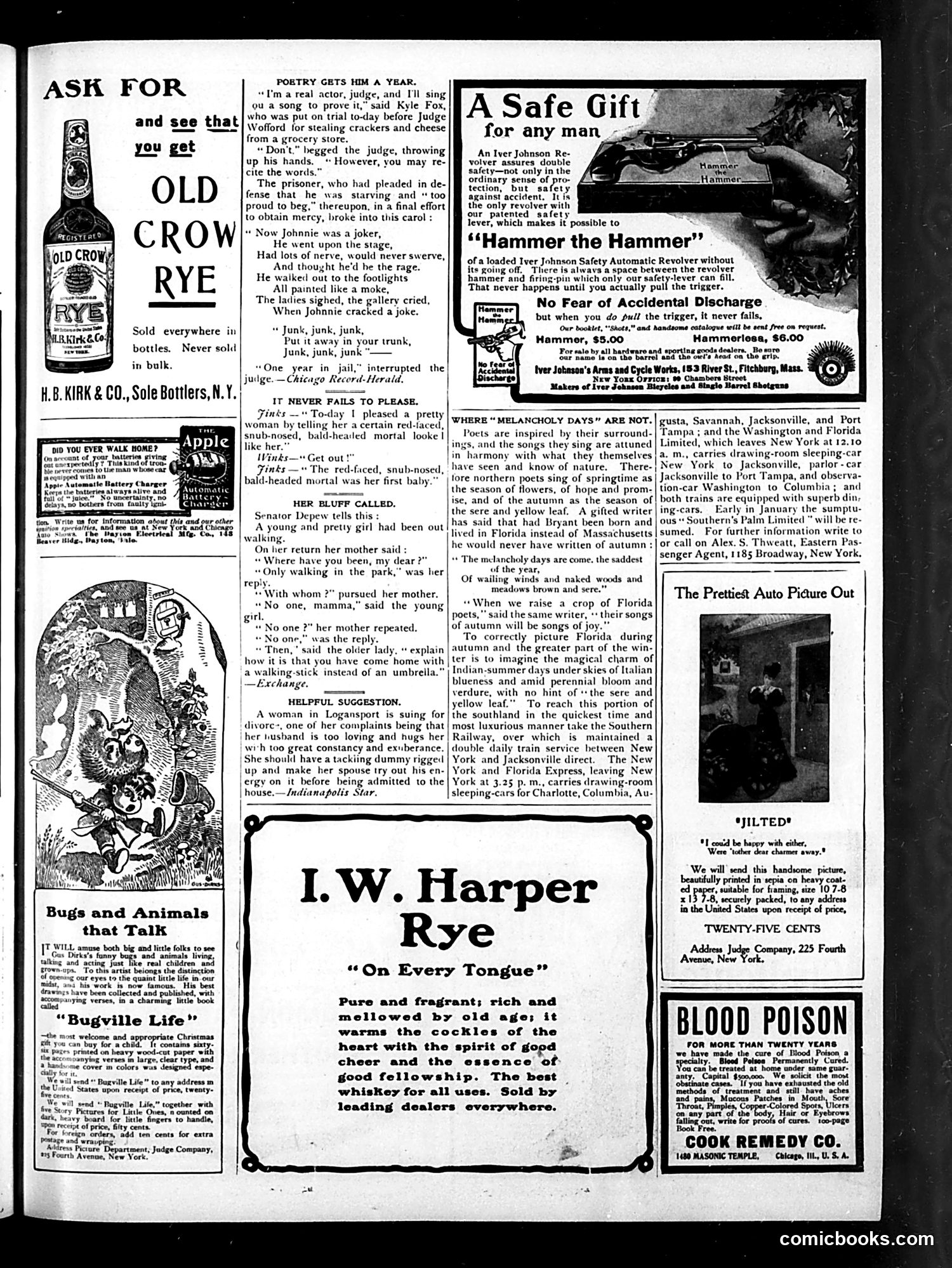
This is primarily a **collection of humorous anecdotes and advertisements** rather than political cartoons. The main humor pieces include: 1. **"Poetry Gets Him a Year"**: A joke about a defendant accused of theft who performs a silly song for the judge ("Johnnie was a joker...") to gain sympathy—the judge sentences him to a year anyway. The satire mocks both the defendant's misguided strategy and judicial leniency. 2. **"Her Bluff Called"**: A brief anecdote where a young woman claims she walked alone in the park, but her return with a man's walking stick exposes her lie—gentle social satire about courtship deception. 3. **"Helpful Suggestion"**: A quip about a divorce complaint that the husband hugs too affectionately; the columnist sarcastically suggests she use a "tackling dummy" instead—satire on marital excess and domestic relations. The page is **mostly advertisements** for liquor, books, and firearms (Iver Johnson revolvers), interspersed with light, non-political humor typical of early 20th-century satirical magazines.
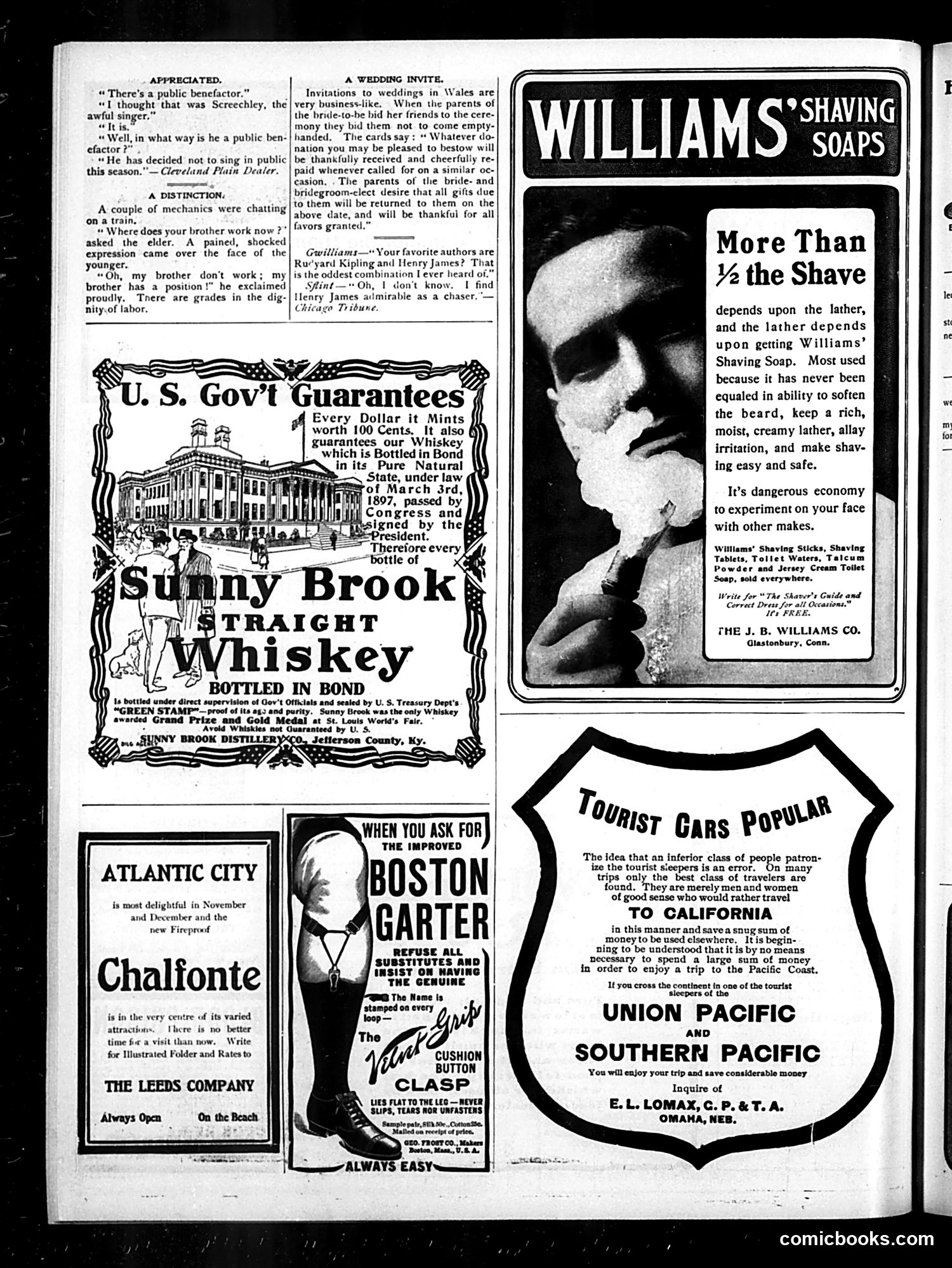
This page contains **primarily advertisements** with brief humor snippets interspersed. The cartoons/jokes are: 1. **"A Public Benefactor"**: A quick joke where a singer named Screechley is called a "public benefactor" because he's decided *not* to sing publicly anymore—satire on bad performers. 2. **"A Distinction"**: Two mechanics discuss one brother's employment; the younger proudly corrects that his brother doesn't "work"—he has a "position"—mocking class pretensions and the dignity-inflation of job titles. 3. **"A Wedding Invite"**: Satirizes Welsh wedding custom where invitations explicitly request monetary gifts with promises to repay them at the guests' future weddings—highlighting mercenary attitudes disguised as tradition. The page otherwise features **period advertisements** for Sunny Brook Whiskey (government-guaranteed), Williams' Shaving Soap, Atlantic City's Chalfonte hotel, Boston Garter suspenders, and railroad tourist travel—typical early 20th-century commercial content.
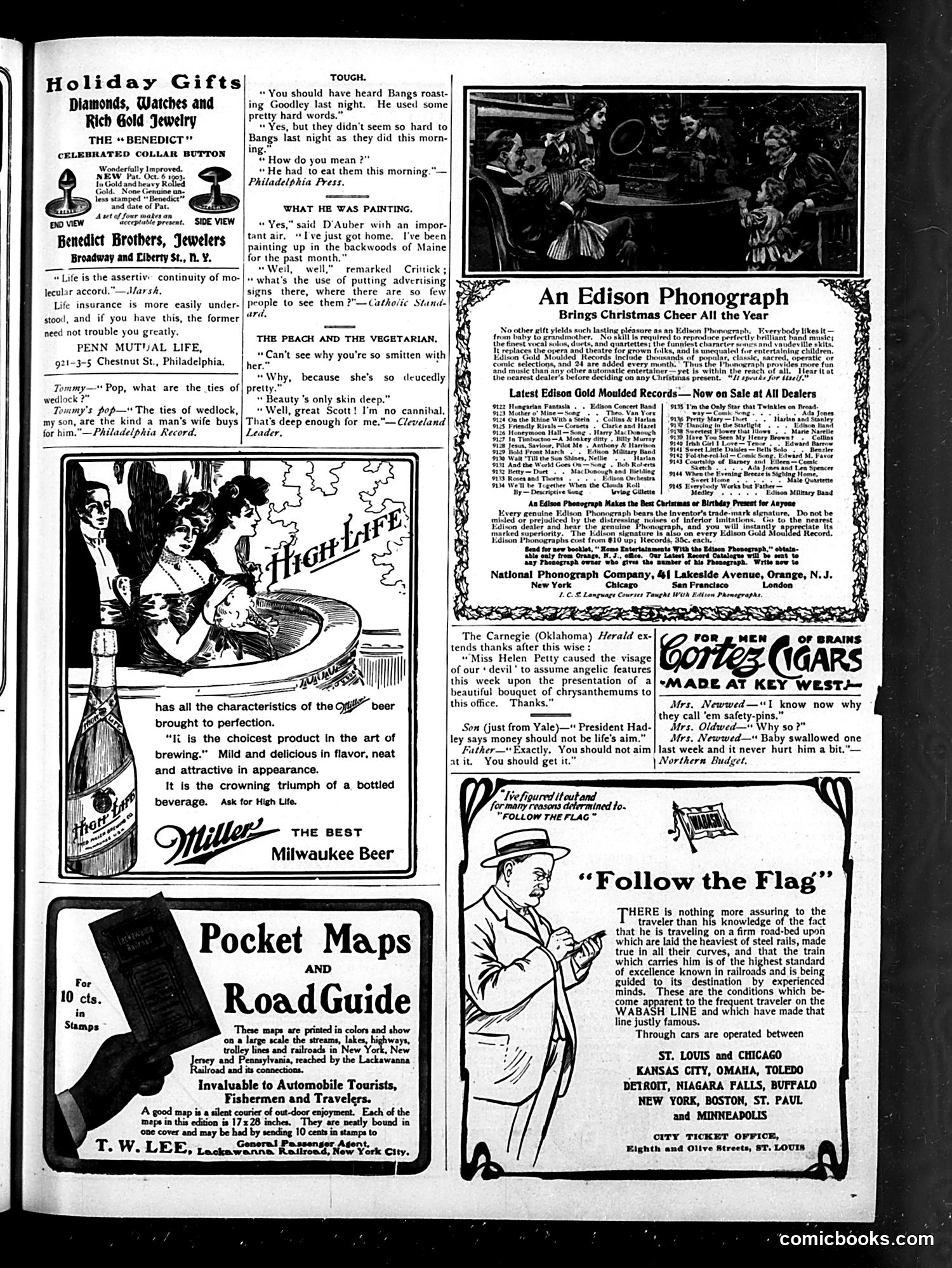
This page from *Judge* magazine contains primarily **advertisements and brief humor columns** rather than political cartoons requiring historical context. The main content includes: **Humor pieces**: Short jokes about marriage ("ties of wedlock"), a man forced to eat harsh words he spoke, and a vegetarian attracted to a woman ("beauty's only skin deep"). **Advertisements**: Jewelry, beer (Miller's "High Life"), life insurance, Edison phonographs, pocket maps, cigars, and railroad services. The one identifiable **social reference** is the vegetarian joke, which satirizes the emerging vegetarian movement of the early 20th century—treating it as an amusing oddity worthy of ridicule. **The Edison phonograph ad** emphasizes the device as a luxury gift for "everybody," reflecting optimism about new consumer technology. Overall, this is a **typical Judge page blending advertisements with light domestic humor**—not political satire. The tone reflects upper-middle-class concerns: marriage anxieties, modern conveniences, and consumer goods.
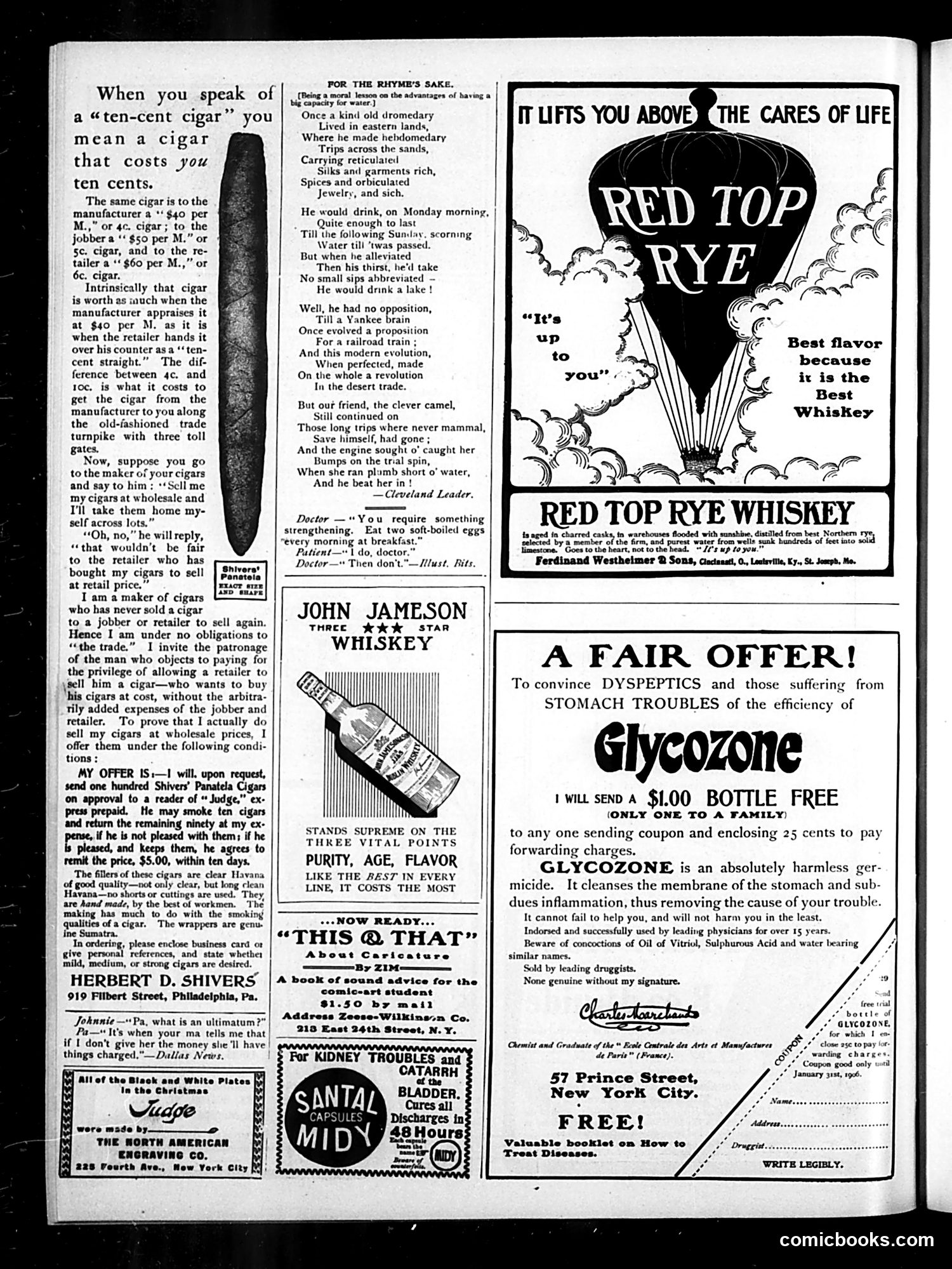
This page is primarily **advertising**, not satirical editorial content. It features multiple commercial ads typical of early 20th-century magazines. The main items are: 1. **Shivers' Cigars advertisement** — A lengthy pitch by cigar manufacturer Herbert D. Shivers explaining markup markups through middlemen (jobber, retailer). He claims to sell directly to consumers at wholesale prices, offering 100 cigars on approval. 2. **Whiskey and patent medicine ads** — John Jameson whiskey, Red Top Rye Whiskey, and Glycozone (a dubious stomach remedy promising free $1 bottles). 3. **Minor content** — A humorous poem "For the Rhyme's Sake" about a camel; joke exchanges; and ads for Santal Midy (kidney treatment) and a cartooning instruction book. There are **no significant political cartoons or social satire** on this page. The page represents typical Judge magazine filler material mixing humor with period advertising, including now-disreputable medicinal products.
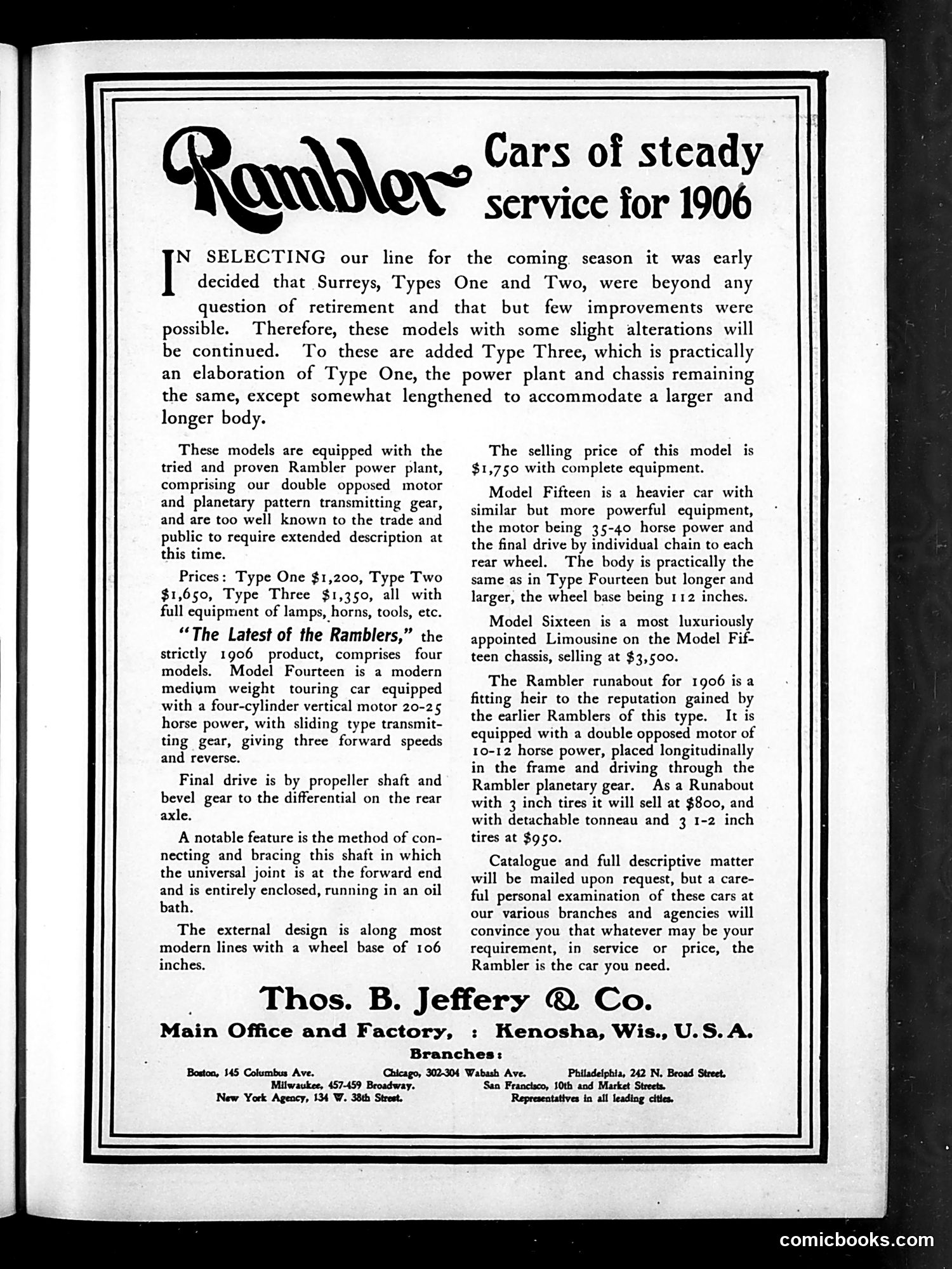
This page contains no satire or political cartoon. It's a straightforward **automobile advertisement** for Rambler cars by the Thomas B. Jeffery Company, based in Kenosha, Wisconsin. The ad showcases the company's 1906 vehicle lineup, describing technical specifications, pricing, and features like the double-opposed motor and planetary transmission. Models range from the basic Type One ($1,200) to the luxurious Model Sixteen limousine ($3,500). **Judge magazine context:** *Judge* was primarily a satirical publication, but like most magazines of the era, it carried paid advertising throughout. This full-page ad represents the commercial side of the publication, not its editorial content. The Rambler was a real, respected automobile manufacturer of the period, and this represents typical early-1900s automotive marketing aimed at affluent buyers.
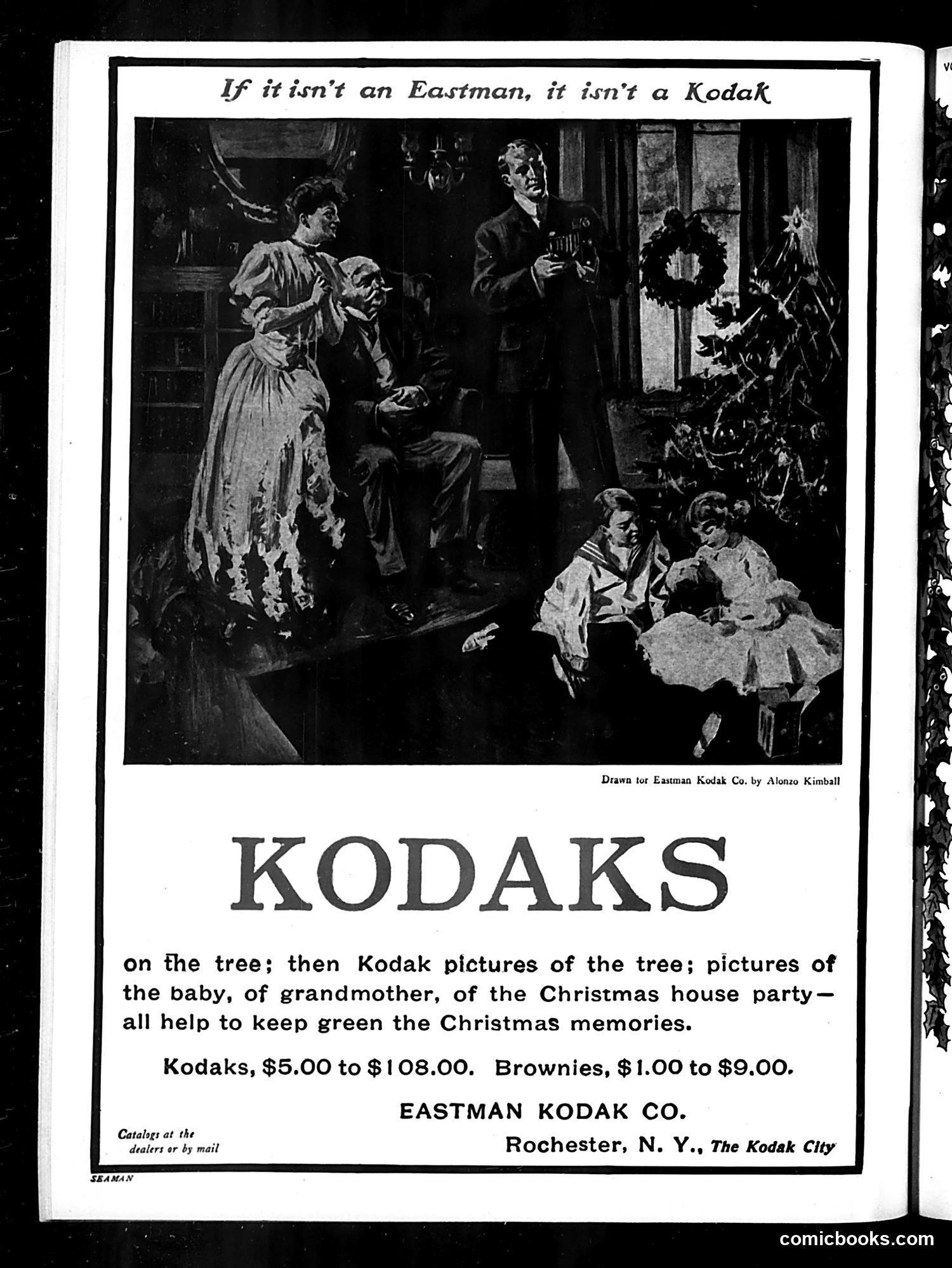
This page is **advertising, not satire**. It's a Kodak company advertisement drawn by Alonzo Kimball for Judge magazine. The illustration depicts a Victorian-era Christmas scene: a family gathered around a decorated tree, with adults and children present. The ad promotes Kodak cameras as essential for capturing holiday memories—suggesting customers should photograph the tree itself, then the baby, grandmother, and party guests. The tagline "If it isn't an Eastman, it isn't a Kodak" emphasizes brand authority (Eastman Kodak Company's market dominance). Prices range from $5-$108 for Kodaks, with cheaper "Brownie" models at $1-$9. For modern readers: this reflects early-20th-century marketing linking consumer technology (photography) to domestic sentimentality and middle-class family values. It's notable how the ad equates *owning a camera* with preserving family bonds—a marketing strategy that remains familiar today.