
Judge, 1905-12-16 · page 35 of 48
Judge — December 16, 1905 — page 35: what you’re looking at
What you’re looking at
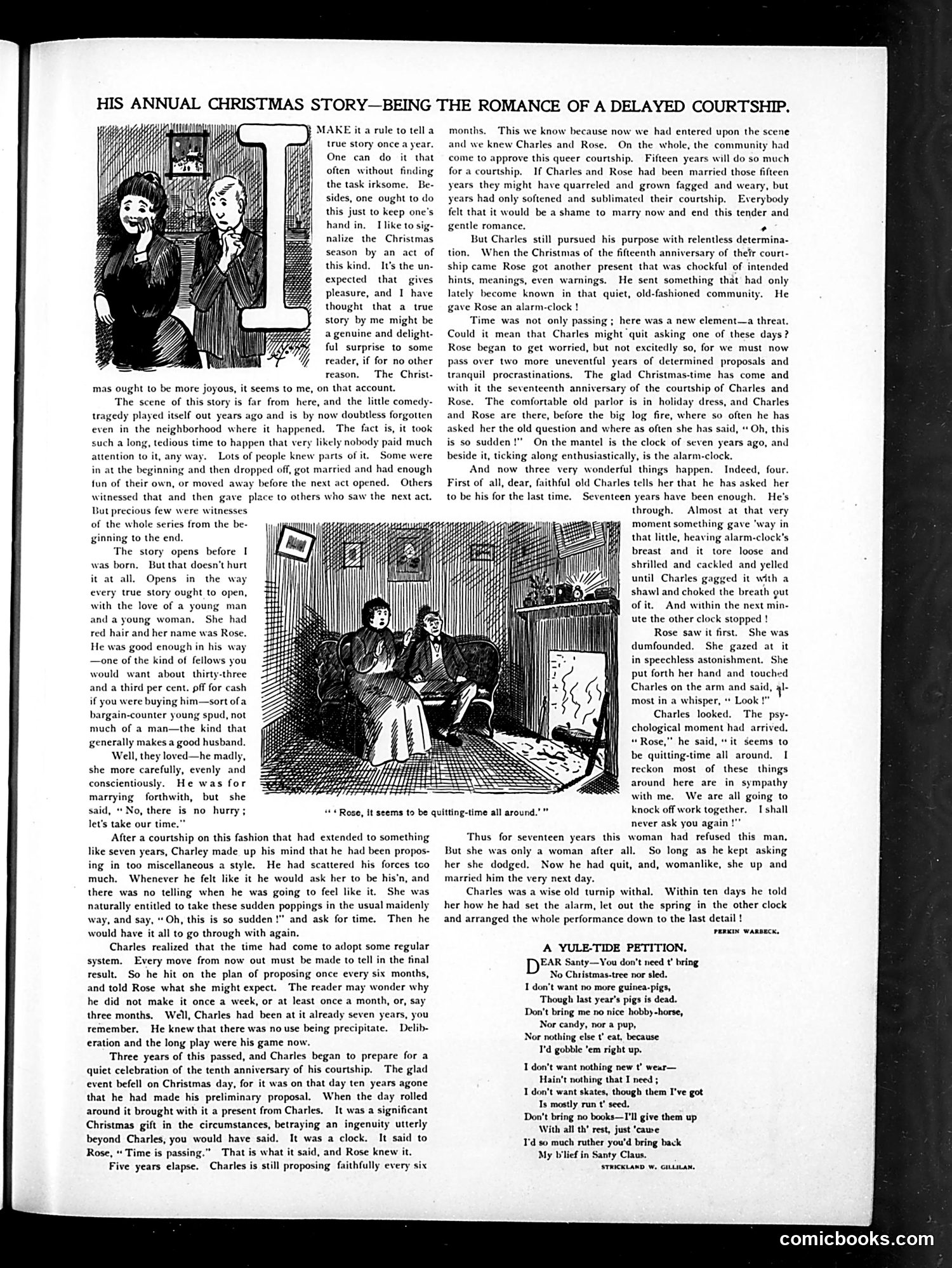
This page presents a sentimental romantic comedy about Charles and Rose's extraordinarily lengthy courtship—fifteen to seventeen years. The satire targets the absurdity of prolonged, uncommitted relationships and social expectations around marriage. **The Plot:** Charles repeatedly proposes over nearly two decades while Rose demurs with "Oh, this is so sudden!" The community finds their indefinite courtship oddly charming rather than scandalous. When Charles finally gives Rose an alarm clock as a Christmas gift, it signals time is literally running out—a humorous threat that marriage or separation must occur. **The Joke:** The story mocks how extended courtships become normalized; what should be decisive becomes sentimental delay. Charles's patience is presented as both admirable and ridiculous. The alarm clock's mechanical failure at the climactic moment when Charles declares this his final proposal represents fate intervening in their stalled romance. The accompanying poem "A Yule-Tide Petition" appears unrelated commentary.
📄 Transcribed text from this page (OCR, searchable)
Machine-transcribed from the original scan — historical spelling and the odd misread are preserved.
MAKE ita rule to tell a months. This we know because now we had entered upon the scene true story oncea year, and we knew Charles and Rose. On the whole, the community had One can do it that come to approve this queer courtship. Fifteen years will do so much often without finding for a courtship. If Charles and Rose had been married those fifteen the task irksome. Be- years they might have quarreled and grown fagged and weary, but sides, one ought todo years had only softened and sublimated their courtship. Everybody this just to keep one’s felt that it would be a shame to marry now and end this tender and hand in, like tosig- gentle romance. o nalize the Christmas But Charles still pursued his purpose with relentless determina season by an act of tion, When the Christmas of the fifteenth anniversary of their court- this kind. It’s the un- ship came Rose got another present that was chockful of intended expected that gives hints, meanings, even warnings. He sent something that had only pleasure, and I have lately become known in that quiet, old-fashioned community. He thought that a true gave Rose an alarm-clock ! story by me might be Time was not only passing ; here was a new element—a threat. i) agenuine and delight- Could it mean that Charles might quit asking one of these days? i y ful surprise to some Rose began to get worried, but not excitedly so, for we must now i reader, if for no other pass over two more uneventful years of determined proposals and reason, The Christ- tranquil procrastinations, The glad Christmas-time has come and with it the seventeenth anniversary of the courtship of Charles and iy | Nt mas ought to be more joyous, it seems to me, on that account. The scene of this story is far from here, and the little comedy- tragedy played itself out years ago and is by now doubtless forgotten even in the neighborhood where it happened. The fact is, it took such a long, tedious time to happen that very likely nobody paid much attention to it, any way, Lots of people knew parts of it, Some were in at the beginning and then dropped off, got married and had enough fun of their own, or moved away before the next act opened. Others witnessed that and then gave place to others who saw the next act. But precious few were witnesses of the whole series from the be- ginning to the end. The story opens before 1 anita was born, But that doesn’t hurt H ified UN every true story ought to open, with the love of a young man a and a young woman. She had l k & red hair and her name was Rose. y “ He was good enough in his way —one of the kind of fellows you would want about thirty-three and a third per cent. pff for cash if you were buying him—sort ofa bargain-counter young spud, not much of a man—the kind that generally makes a good husband. Well, they loved—he madly, it at all, Opens in the way i Rose. and Rose are there, before the big log fire, where so often he has asked her the old question and where as often she has said, « Oh, this is so sudden !" The comfortable old parlor is in holiday dress, and Charles On the mantel is the clock of seven years ago, and beside it, ticking along enthusiastically, is the alarm-clock. And now three very wonderful things happen. Indeed, four. First of all, dear, faithful old Charles tells her that he has asked her to be his for the last time. l Seventeen years have been enough. He's through. Almost at that very moment something gave ‘way in that little, heaving alarm-clock's breast and it tore loose and shrilled and cackled and yelled until Charles gagged it with a shawl and choked the breath gut of it. And within the next min- ute the other clock stopped ! Rose saw it first. She was dumfounded. She gazed at it in speechless astonishment. She put forth her hand and touched Charles on the arm and said, 41- most in a whisper, * Look !" Charles looked. The psy- chological moment had arrived. “Rose,” he said, “it seems to be quitting-time all around. I reckon most of these things around here are in sympathy with me. We are all going to knock off work together. I shall she more carefully, evenly and conscientiously. He was for marrying forthwith, but she said, “No, there is no hurry; let's take our tim never ask you agai After a courtship on this fashion that had extended to something Thus for seventeen years this woman had refused this man, like seven years, Charley made up his mind that he had been propos- But she was only a woman after all. So long as he kept asking ing in too miscellaneous a style. He had scattered his forces tco her she dodged. Now he had quit, and, womanlike, she up and much. Whenever he felt like it he would ask her to be his'n, and married him the very next day. there was no telling when he was going to feel like it. She was Charles was a wise old turnip withal. Within ten days he told naturally entitled to take these sudden poppings in the usual maidenly her how he had set the alarm, let out the spring in the other clock way, and say, “Oh, this is so sudden!” and ask for time. Then he and arranged the whole performance down to the last detail ! would have it all to go through with again. PERKIN WARBECK, Charles realized that the time had come to adopt some regular system. Every move from now out must be made to tell in the final result. So he hit on the plan of proposing once every six months, and told Rose what she might expect. The reader may wonder why he did not make it once a week, or at least once a month, or, say three months. Well, Charles had been at it already seven years, you remember. He knew that there was no use being precipitate. Delib- eration and the long play were his game now. Three years of this passed, and Charles began to prepare for a quiet celebration of the tenth anniversary of his courtship. The glad event befell on Christmas day, for it was on that day ten years agone that he had made his preliminary proposal. When the day rolled around it brought with it a present from Charles, It was a significant Christmas gift in the circumstances, betraying an ingenuity utterly beyond Charles, you would have said. It was a clock. It said to Rose, Time is passing.” That is what it said, and Rose knew it. Five years elapse. Charles is still proposing faithfully every six “Rose, it seems to be quitting-time all around.’ A YULE-TIDE PETITION. DFA® Santy—You don't need t’ bring No Christmas-tree nor sled. I don’t want no more guinea-pigs, Though last year’s pigs is dead. Don't bring me no nice hobby -horse, Nor candy, nor a pup, Nor nothing else t' eat, because I'd gobble ‘em right up. I don’t want nothing new t’ wear— Hain’t nothing that I need ; I don’t want skates, though them I've got Is mostly run t’ seed. Don't bring no books—I'll give them up With all th’ rest, just ‘came T'd so much ruther you'd bring back My b'lief in Santy Claus. STRICKLAND W, CILLILAN. comicbooks.com