
Judge, 1905-12-16 · page 10 of 48
Judge — December 16, 1905 — page 10: what you’re looking at
What you’re looking at
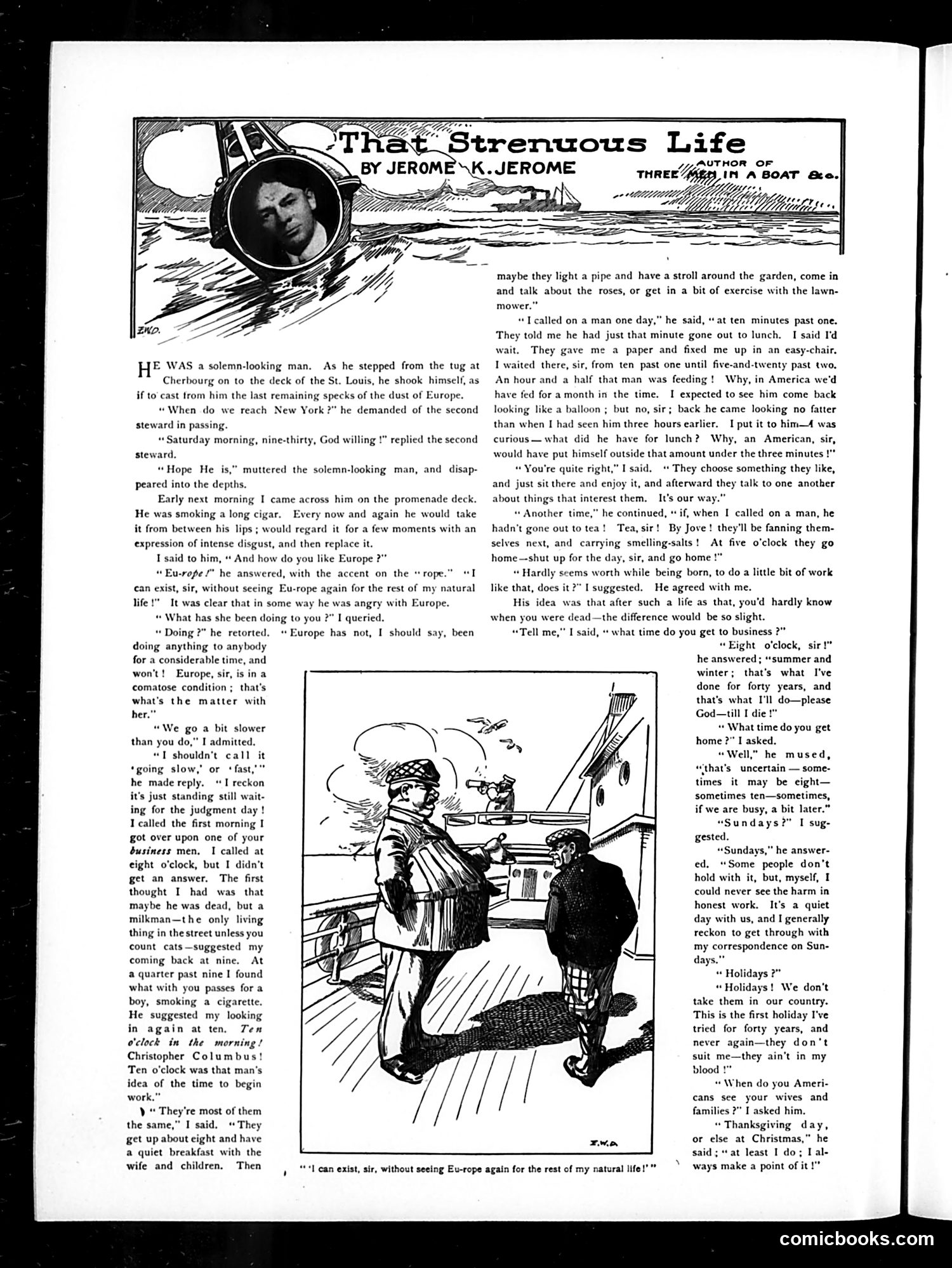
This Jerome K. Jerome piece satirizes the cultural clash between American and European work habits. An American businessman, returning from Europe aboard the S.S. Louis, expresses outrage at European leisurely schedules—businessmen who don't start work until 10 a.m., take extended lunch breaks, and leave by 5 p.m. to enjoy their evenings. The satire mocks the American "strenuous life" ideology (referencing Theodore Roosevelt's famous phrase), where constant productivity and speed are virtues. Jerome presents the American's complaints sympathetically but absurdly: he's scandalized that Europeans enjoy meals, conversation, and rest rather than maximizing work output. The cartoon illustrates the protagonist on deck, fuming during his Atlantic crossing. The satire's point: Americans' obsession with relentless efficiency and productivity—treating leisure as shameful—versus Europe's more balanced approach to living. Jerome gently ridicules American workaholism by letting the American character condemn himself through his own complaints.
📄 Transcribed text from this page (OCR, searchable)
Machine-transcribed from the original scan — historical spelling and the odd misread are preserved.
E WAS a solemn-looking man. As he stepped from the tug at Cherbourg on to the deck of the St. Louis, he shook himself, as if to’ cast from him the last remaining specks of the dust of Europe. “When do we reach New York ?" he demanded of the second steward in passing. “Saturday morning, nine-thirty, God willing !” replied the second steward. “Hope He is,” muttered the solemn-looking man, and disap- peared into the depths. Early next morning I came across him on the promenade deck. He was smoking a long cigar. Every now and again he would take it from between his lips; would regard it for a few moments with an expression of intense disgust, and then replace it. I said to him, * And how do you like Europe ?” “Eu-ropel" he answered, with the accent on the “rope.” «I can exist, sir, without seeing Eu-rope again for the rest of my natural life!" It was clear that in some way he was angry with Europe. “ What has she been doing to you 2” I queried. “Doing ?" he retorted. “Europe has not, I should say, been doing anything to anybody for a considerable time, and won't! Europe, s ina comatose condition ; that's what's the matter with her.” “We go a bit slower than you do,” I admitted. “T shouldn't call it ‘going slow,’ or * fast," he made reply. “I reckon just standing still wait- ing for the judgment day ! I called the first morning I got over upon one of your business men, I called at eight o'clock, but I didn’t get an answer. The first thought I had was that maybe he was dead, but a milkman—the only living thing in the street unless you count cats—suggested my coming back at nine. At a quarter past nine I found what with you passes for a boy, smoking a cigarette. He suggested my looking in again at ten, Ten o'clock in the morning! Christopher Columbus! Ten o'clock was that man’s idea of the time to begin work,” ) “ They're most of them the same,” I said. “They get up about eight and have a quiet breakfast with the wife and children. Then “**L can exist, sir, without seeing Eu-rope again for the rest of my natural life!’” AUTHOR OF THREE Gijgsy in A BOAT &xo. _ WY. maybe they light a pipe and have a stroll around the garden, come in and talk about the roses, or get in a bit of exercise with the lawn- mower.” “called on a man one day,” he said, “at ten minutes past one. They told me he had just that minute gone out to lunch. I said I'd wait. They gave me a paper and fixed me up in an easy-chair, I waited there, sir, from ten past one until five-and-twenty past two. An hour and a half that man was feeding! Why, in America we'd have fed for a month in the time. I expected to see him come back looking like a balloon ; but no, sir; back he came looking no fatter than when I had seen him three hours earlier. I put it to him—4 was curious—what did he have for lunch? Why, an American, sir, would have put himself outside that amount under the three minutes !"" “You're quite right,” I said.“ They choose something they like, and just sit there and enjoy it, and afterward they talk to one another about things that interest them. It's our w: “Another time,” he continued, “if, when [ called on a man, he hadn’t gone out to tea ! By Jove ! they'll be fanning them- selves next, and carrying smelling-salts! At five o'clock they go home—shut up for the day, sir, and go home !" “ Hardly seems worth while being born, to do a little bit of work like that, does it ?" I suggested, He agreed with me. His idea was that after such a life as that, you'd hardly know Tea, sir! when you were dead—the difference would be so slight. “Tell me,” I said, «+ what time do you get to business ?” “Eight o'clock, sir!" he answered ; “summer and winter; that's what I've done for forty years, and that’s what I'll do—please God—till I die ! + What time do you get home ?” I asked. “Well,” he mused, ‘that’s uncertain — some- times it may be eight— sometimes ten—sometimes, if we are busy, a bit later.” “Sundays?” I sug- gested. Sundays,” he answer- ed. “Some people don’t hold with it, but, myself, I could never see the harm in honest work. It’s a quiet day with us, and I generally reckon to get through with my correspondence on Sun- days.” “ Holidays ?” “Holidays! We don't take them in our country. This is the first holiday I've tried for forty years, and never again—they don't suit me—they ain't in my blood 1" When do you Ameri- cans see your wives and families ?” I asked him. “Thanksgiving day, or else at Christmas, said; “at least I do; Tal- ways make a point of it comicbooks.com