
Judge, 1905-12-16 · page 19 of 48
Judge — December 16, 1905 — page 19: what you’re looking at
What you’re looking at
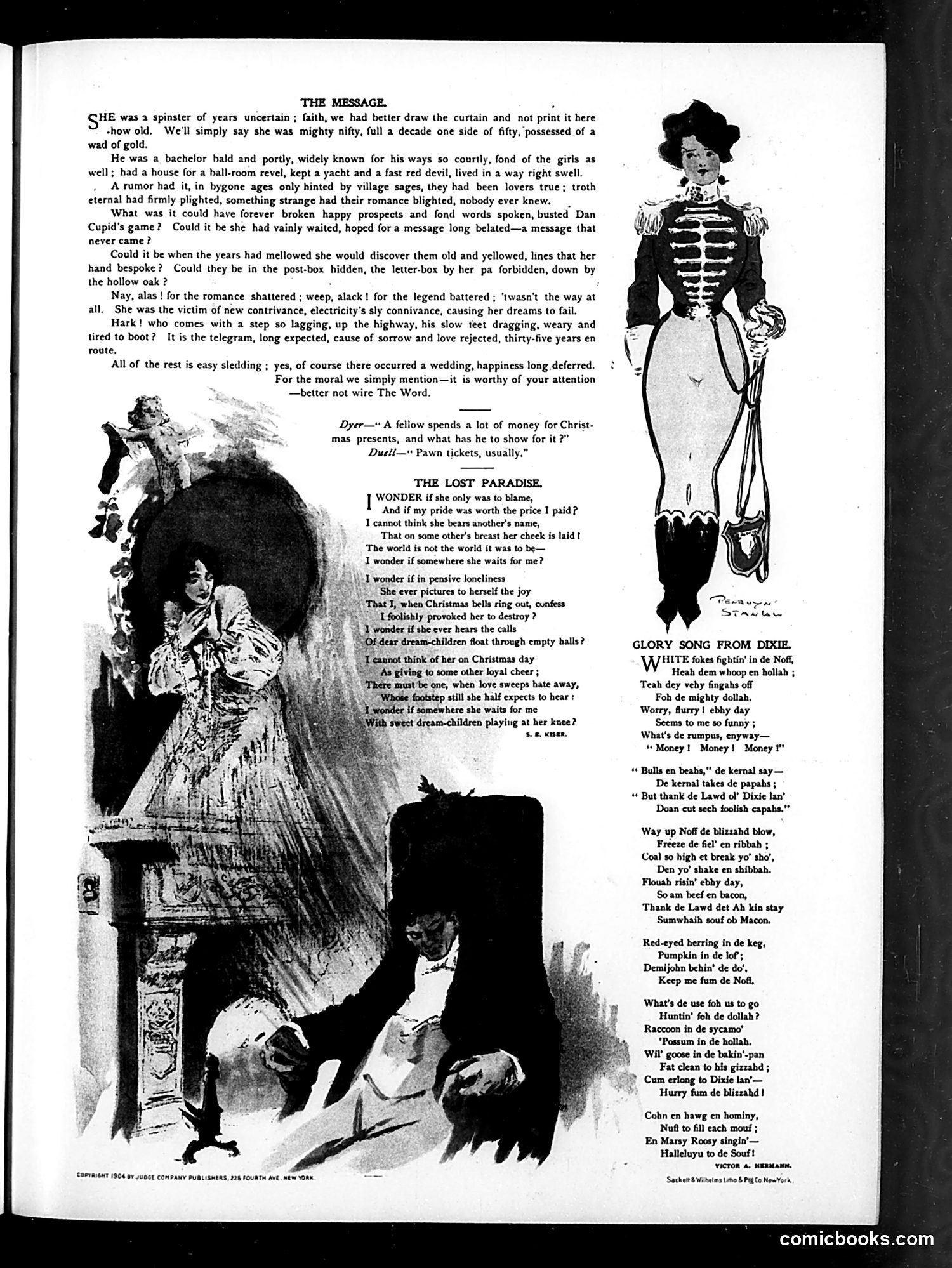
This page contains three distinct pieces of turn-of-the-century satirical content: **"The Message"** (main story with illustration): A sentimental tale mocking romantic melodrama. It describes a spinster and bachelor with a shared past, separated by a misunderstanding. The satire's point: a telegram arrives 35 years late, finally resolving their romance—but the joke is that modern technology (electricity's "sly connivance") ironically *delays* rather than expedites communication, undermining progress narratives. **The "Dyer/Duell" joke**: Quick satirical quip about Christmas gift-giving wastefully leading to pawn tickets—commentary on consumer culture and financial desperation. **"Glory Song from Dixie"**: A dialect poem in African American vernacular (reflecting period racist conventions) contrasting Southern contentment with Northern hardship. It presents the South as abundant and peaceful ("Marsy Roosy singing") while depicting the North as economically troubled—clear post-Civil War propaganda romanticizing the agrarian South and justifying regional division. The page reflects Judge's characteristic mix of romantic satire, class humor, and sectional politics typical of early 1900s American periodicals.
📄 Transcribed text from this page (OCR, searchable)
Machine-transcribed from the original scan — historical spelling and the odd misread are preserved.
‘THE MESSAGE, SHE was 2 spinster of years uncertain ; faith, we had better draw the curtain and not print it here chow old. We'll simply say she was mighty nifty, full a decade one side of fifty, possessed of a wad of gold. He was a bachelor bald and portly, widely known for his ways so courtly, fond of the girls as well; had a house for a ball-room revel, kept a yacht and a fast red devil, lived in a way right swell. A rumor had it, in bygone ages only hinted by village sages, they had been lovers true; troth eternal had firmly plighted, something strange had their romance blighted, nobody ever knew. What was it could have forever broken happy prospects and fond words spoken, busted Dan Cupid's game? Could it be she had vainly waited, hoped for a message long belated—a message that never came? Could it be when the years had mellowed she would discover them old and yellowed, lines that her hand bespoke? Could they be in the post-box hidden, the letter-box by her pa forbidden, down by the hollow oak ? Nay, alas! for the romance shattered ; weep, »,alack ! for the legend battered; ‘twasn't the way at all. She was the victim of new contrivance, electricity’s sly connivance, causing her dreams to fail. Hark! who comes with a step so lagging, up the highway, his slow teet dragging, weary and tired to boot? It is the telegram, long expected, cause of sorrow and love rejected, thirty-five years en route. All of the rest is easy sledding ; yes, of course there occurred a wedding, happiness long deferred. For the moral we simply mention—it is worthy of your attention —better not wire The Word. Dyer—" A fellow spends a lot of money for Christ- mas presents, and what has he to show for it ?” Duell— Pawn tickets, usually.” THE LOST PARADISE. ] WONDER if she only was to blame, And if my pride was worth the price I paid? I cannot think she bears another's name, That on some other's breast her cheek is laid ‘The world is not the world it was to be— I wonder if somewhere she waits for me? I wonder if in pensive loneliness She ever pictures to herself the joy ‘That J, when Christmas bells ring out, confess I foolishly provoked her to destroy ? ‘I wonder if she ever hears the calls “There must be one, when love sweeps hate away, “Whole footstep still she half expects to hear: 7 Saeaier if somewhere she waits for me Vith swect dream-children playing at her knee? sa, cise, COPTmIEMT 1906 BY JUDGE COMPANY PUBLISMERS, 22% [OURTH AVE, MEW YORK GLORY SONG FROM DIXIE. WHITE fokes fightin’ in de Not Heah dem whoop en bollah ; Teah dey vehy fingahs off Foh de mighty dollah. Worry, flurry! ebby day Seems to me so funny ; What's de rumpus, enyway— “Money! Money! Money I"* “Bulls en beas,” de kernal say— De kernal takes de papahs ; “ But thank de Lawd ol’ Dixie lan’ Doan cut sech foolish capahs.” Way up Noff de blizzahd blow, Freeze de fiel’ en ribbah ; Coal so high et break yo’ sho’, Den yo! shake en shibbah. Flouah risin’ ebby day, So am beef en bacon, ‘Thank de Lawd det Ah kin stay Sumwhaih souf ob Macon. Red-eyed herring in de keg, Pumpkin in de lof Demijohn behin’ de do Keep me fum de Noff, What's de use foh us to go Huntin’ foh de dollah? Raccoon in de sycamo’ "Possum in de hollah. ‘Wil! goose in de bakin’-pan Fat clean to his gizzahd ; Cum erlong to Dixie lan'— Hurry fum de blizzahd ! Cohn en hawg en hominy, Nuf to fill each mouf ; En Marsy Roosy singin'— Halleluyu to de Souf! VICTOR A. MERMANH. ‘Sachem & Wilbelms Litho & Pig Co NewYork, comicbooks.com