
A complete issue · 46 pages · 1899
Judge — December 23, 1899
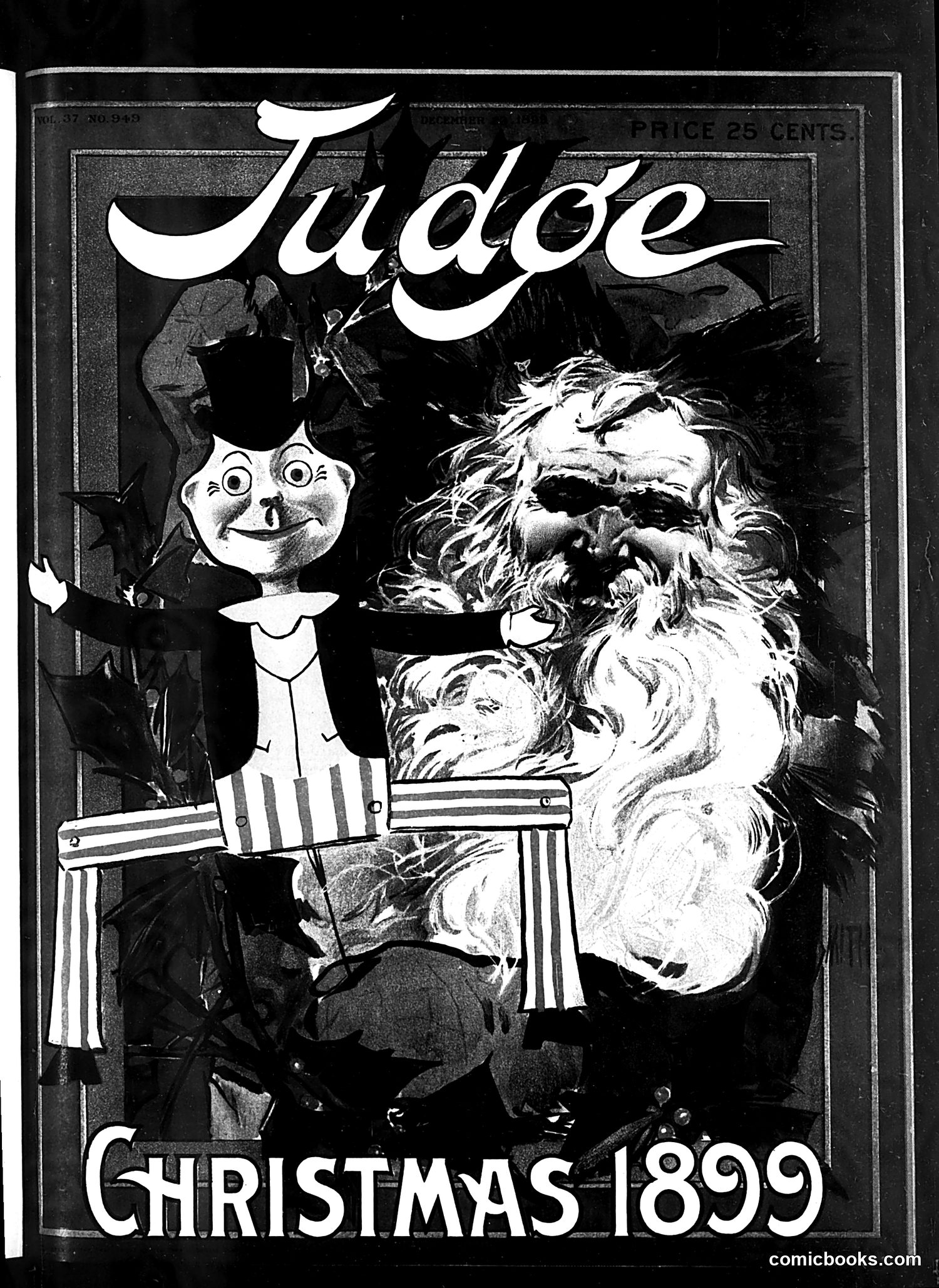
This is a Judge magazine Christmas cover from 1899. The illustration depicts Santa Claus (the bearded figure on the right) sitting with what appears to be a caricatured figure on his lap—likely representing a political figure or notable person of that era. The smaller figure on the left wears formal attire with an exaggerated facial expression typical of 19th-century satirical cartooning. Without clearer identification of the specific figures, the exact political reference remains unclear. However, the composition—placing someone on Santa's lap in a mocking pose—suggests satirical commentary on a contemporary political or social figure, presented as Judge's Christmas-themed social commentary. The price of 25 cents indicates this was a standard periodical issue.
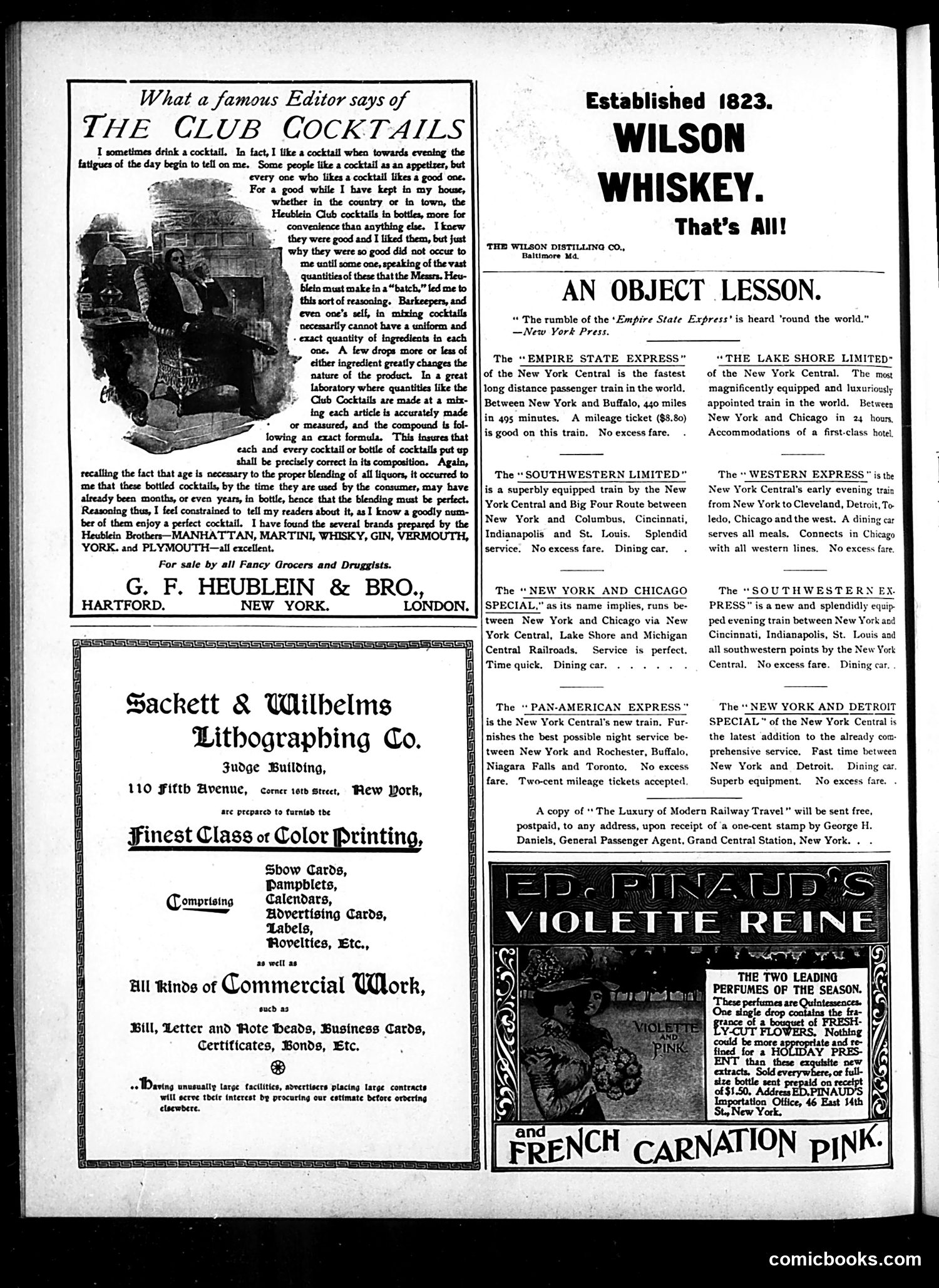
This page is **primarily advertising** rather than satirical content. The main feature is an advertisement for **Club Cocktails** by G.F. Heublein & Bro., which includes a testimonial from "a famous Editor" praising pre-made cocktails. The illustration shows what appears to be a bartender or server preparing drinks. Below are ads for **Sackett & Wilhelms Lithographing Co.** (printing services) and **Pfraud's Violette Reine and French Carnation Pink** perfumes. The right side features railroad advertisements describing various express trains (Empire State Express, Lake Shore Limited, etc.) operated by the New York Central. No political satire or recognizable caricatures are evident on this page—it's a straightforward collection of commercial advertisements typical of Judge magazine's revenue model.
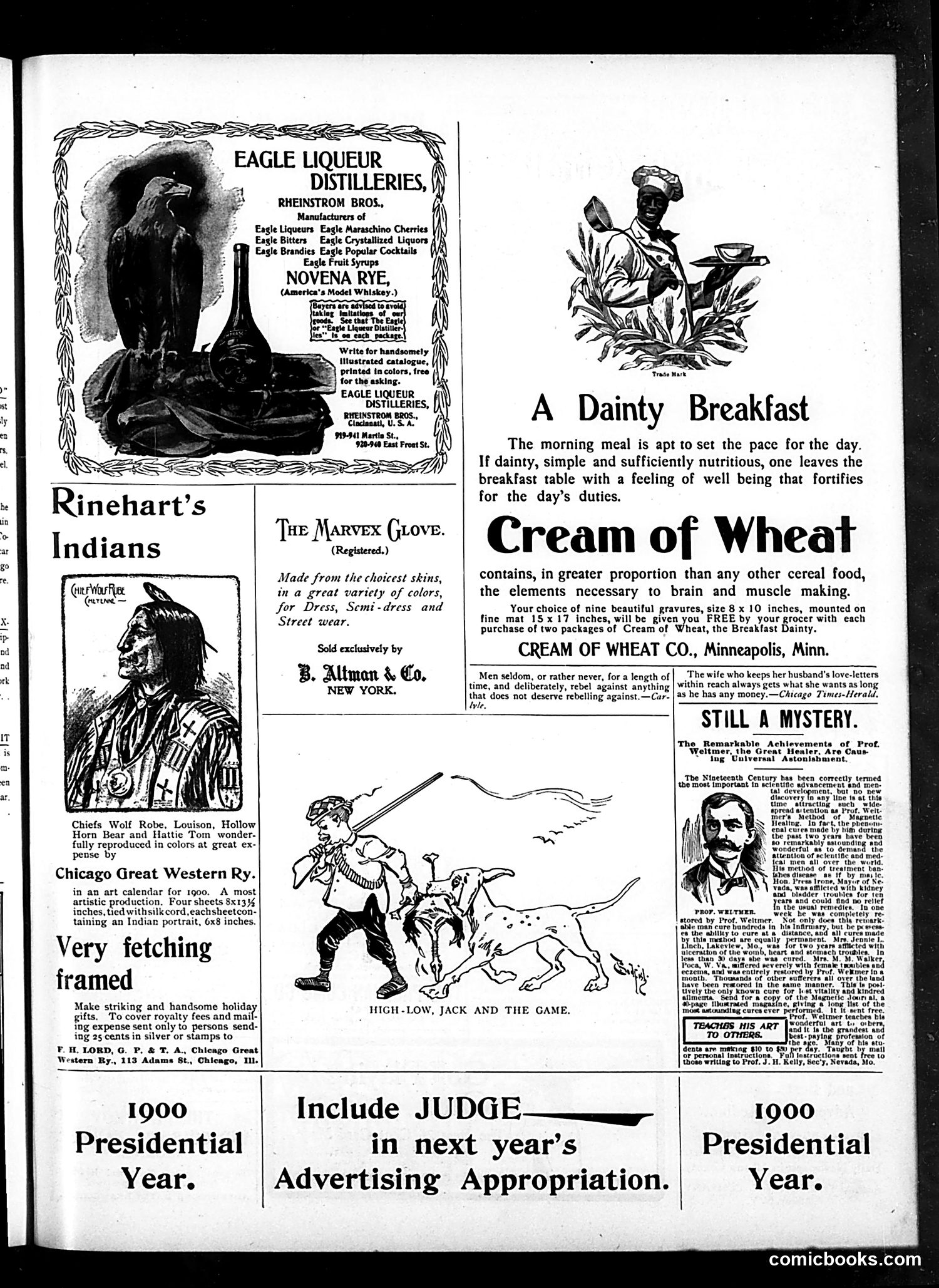
This page is primarily **advertising content** rather than political satire. It features: 1. **Eagle Liqueur Distilleries** ad (top left) - promoting various liquor products 2. **Rinehardt's Indians** calendar ad - featuring a Native American chief portrait, sold by B. Allman & Co. 3. **Marvex Glove** ad - women's gloves sold exclusively in New York 4. **Cream of Wheat** cereal ad (top right) - promoting breakfast nutrition 5. A cartoon illustration titled "HIGH-LOW, JACK AND THE GAME" - appears to show a hunting scene with a dog 6. **"Still a Mystery"** article with portrait - discussing Professor Walthour's "remarkable achievements" in autombile racing The bottom contains **election-related text**: "Include JUDGE in next year's Advertising Appropriation" flanked by "1900 Presidential Year," indicating this is from late 1899, anticipating the upcoming 1900 election.
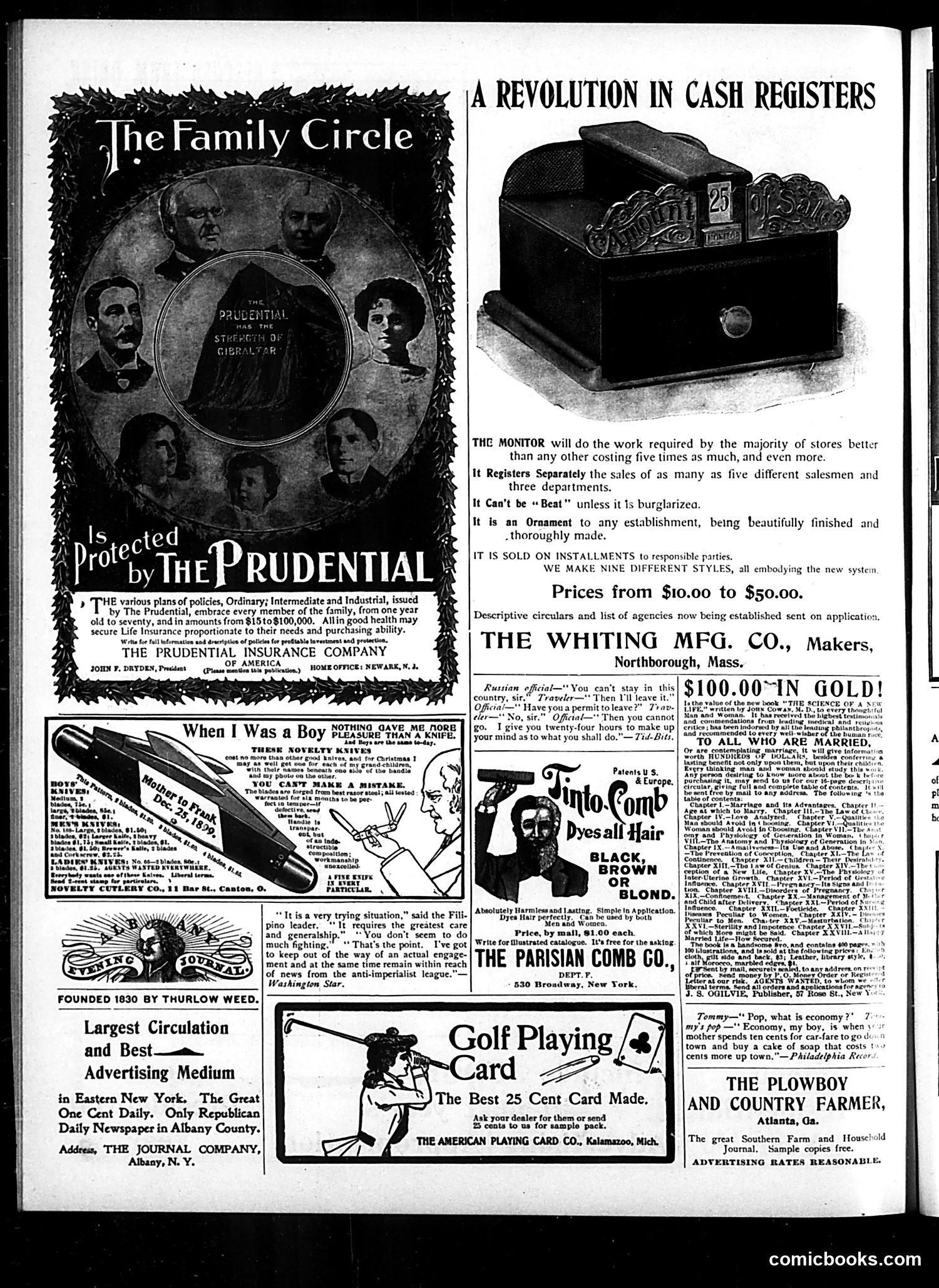
This page is primarily **advertising** rather than satirical content. The major advertisements include: - **The Prudential Insurance Company** ("Is Protected by THE PRUDENTIAL") featuring family portraits - **The Monitor cash register** ("A Revolution in Cash Registers"), priced $10-$50 - **Tinto-Comb hair dye** (BLACK, BROWN, BLONDE) - **Golf Playing Cards** ("The Best 25 Cent Card Made") - Various other commercial products There is one small illustrated piece titled **"When I Was a Boy"** showing a nostalgic reminiscence, but the dominant content is commercial rather than satirical or political. The page reflects Judge's role as both entertainment and advertising vehicle for turn-of-the-century American businesses and consumer products.
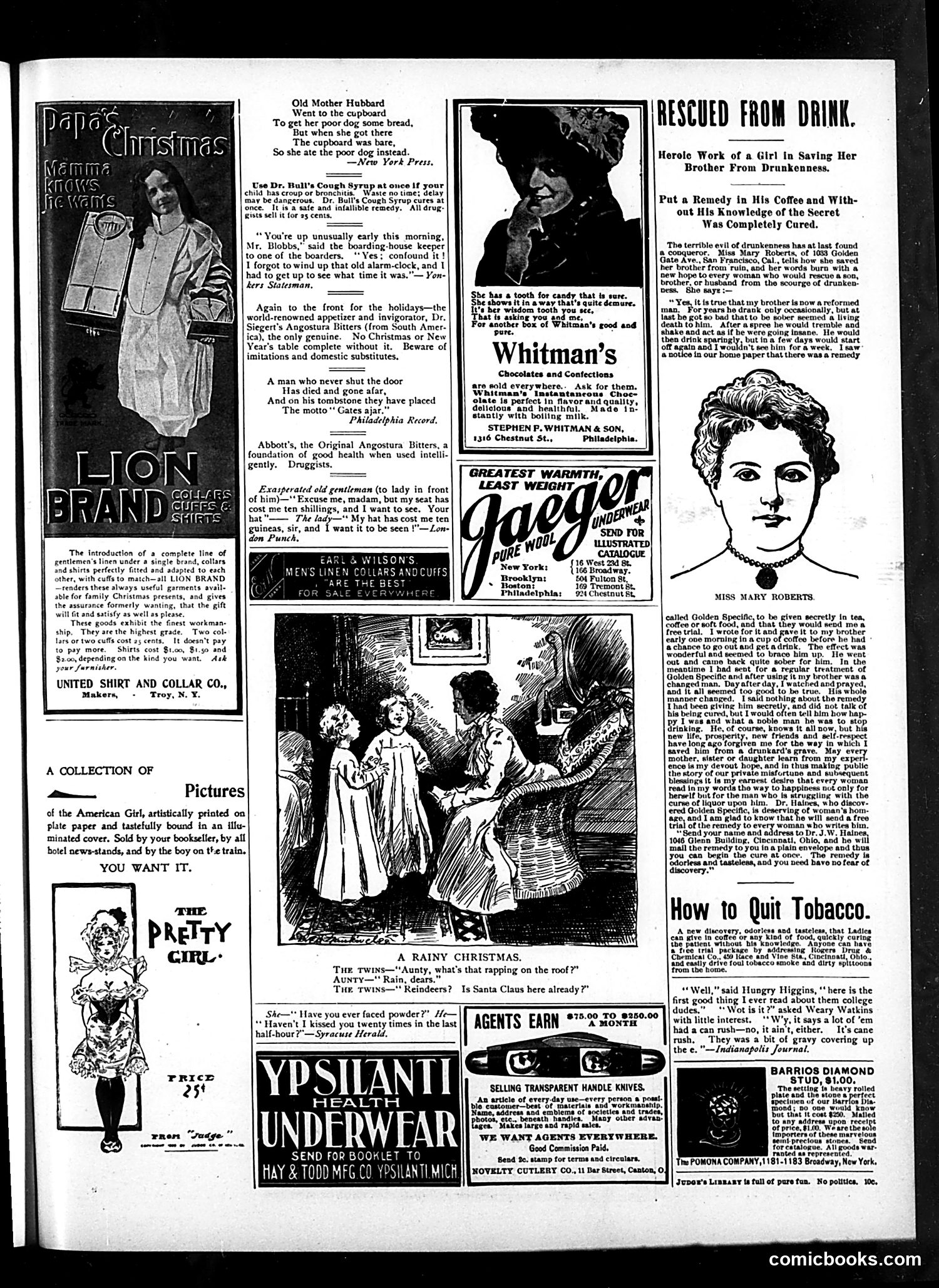
This page from Judge magazine (undated, but early 1900s based on style) is primarily **advertising with minimal satirical content**. The few comic elements include: **"Old Mother Hubbard" verse**: A dark joke about starvation—the nursery rhyme subverted so Mother Hubbard eats her starving dog instead of feeding it. This reflects early-1900s humor's tolerance for morbid wit. **"A Rainy Christmas" cartoon**: A gentle family joke where children mishear "rain" as "reindeers," expecting Santa Claus. No political satire—just domestic humor. **The boarding-house joke**: A man forgets to wind his alarm clock, defeating its purpose—mild absurdist humor about absent-mindedness. The page is dominated by **commercial advertisements** for patent medicines (Dr. Bull's Cough Syrup, Angostura Bitters), clothing (Lion Brand shirts, Ypsilanti underwear), chocolates (Whitman's), and a "testimonial" about secretly adding a remedy to someone's coffee to cure alcoholism—which today reads as disturbing (drugging someone without consent), but was presented as heartwarming.
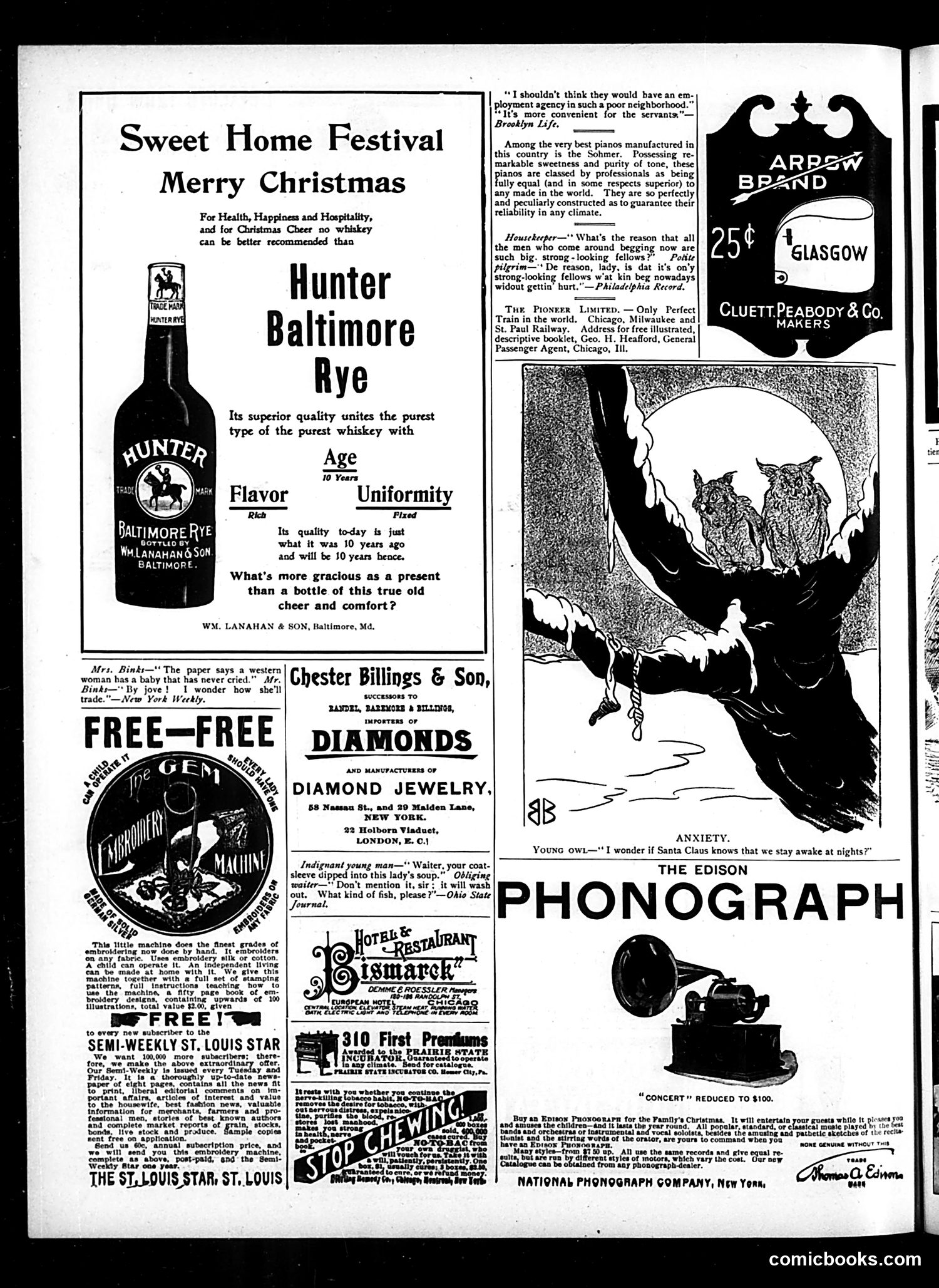
This page is primarily **advertising**, typical of early 1900s magazines. The main content includes: **Central Cartoon**: A small illustration captioned "ANXIETY" shows young owls asking Santa Claus if he knows they stay awake at night—a gentle, non-political joke about childhood worries during Christmas. **Other Humor Snippets**: Brief jokes scattered throughout: - A woman with a baby "that has never cried" (absurdist humor) - A waiter whose coat sleeve dips in soup, dismissing it casually (physical comedy) - A housekeeper observing that begging men are now "strong-looking fellows" (social observation about poverty/employment) - A servant noting employment agencies in poor neighborhoods are "convenient for the servants" (mild class commentary) **Dominant Content**: Full-page advertisements for whiskey (Hunter Baltimore Rye), diamonds (Chester Billings & Son), phonographs (Edison), pianos (Sohmer), embroidery machines, and various services. **Takeaway**: This page reflects early 1900s consumer culture and light, non-partisan humor typical of Judge—social observation rather than political satire.
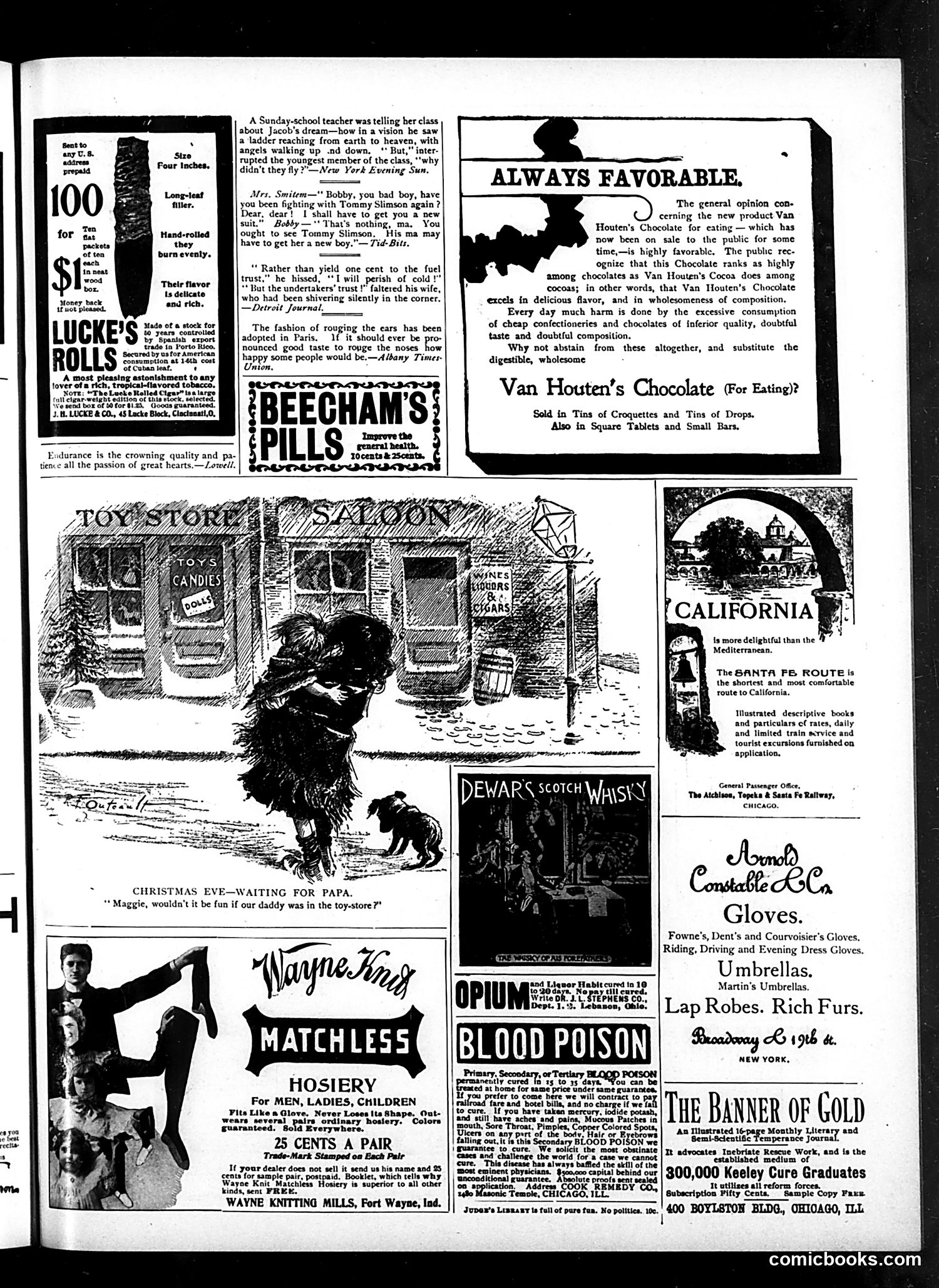
This page is **primarily advertising**, with minimal satirical content. The main cartoon—"Christmas Eve—Waiting for Papa"—depicts two children peering into a toy store window, with the girl saying it would be fun if their daddy were inside. This gentle humor plays on children's Christmas anticipation and the period's consumerist excitement around holiday shopping. The page includes scattered brief humorous anecdotes (about Jacob's ladder, a boy fighting Tommy Simson, and a man resisting the fuel trust), typical of Judge's filler content—light social commentary without sharp political edge. The advertisements dominate: Lucke's Rolls (tobacco), Beecham's Pills, Van Houten's Chocolate, Wayne Knitting Mills hosiery, Dewar's Scotch Whisky, and various luxury goods (gloves, furs, umbrellas). These ads target affluent readers, reflecting the magazine's upper-class audience. A notable ad promotes California travel via the Santa Fe Route, appealing to wealthy leisure travelers.
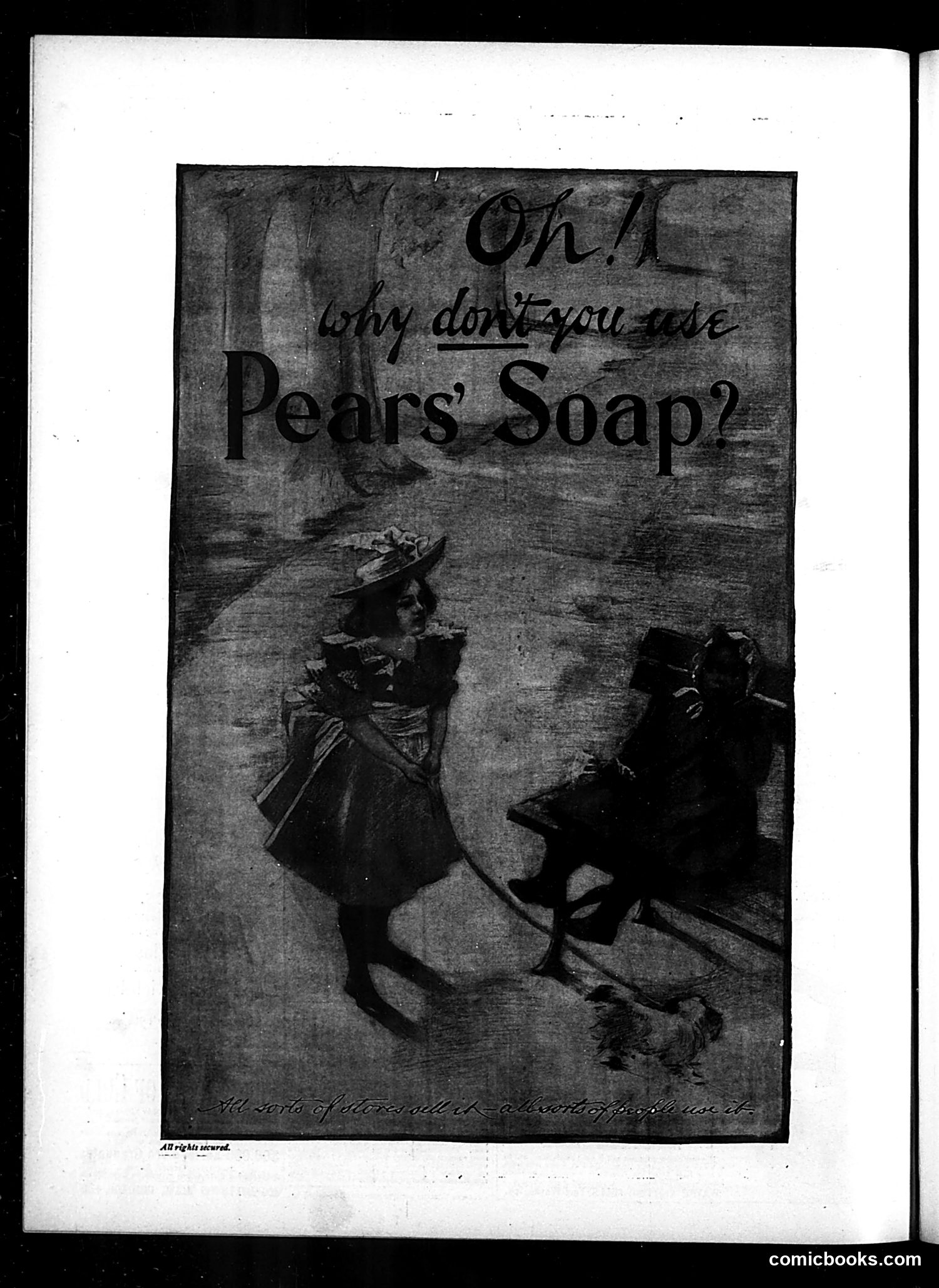
This page features a Pears' Soap advertisement from Judge magazine. The image shows two elegantly dressed Victorian-era figures (a woman and what appears to be a man or child) examining or discussing something, with a dog present. The handwritten text at the top reads "Oh! why don't you use Pears' Soap?" This is a straightforward product advertisement rather than political satire. It uses the appeal of fashionable, well-dressed figures to market soap as a luxury item associated with refinement and proper grooming. The advertisement employs the common Victorian marketing strategy of linking product use to social status and respectability. There is no apparent satirical or political commentary—this is simply a commercial promotion placed within Judge's pages.
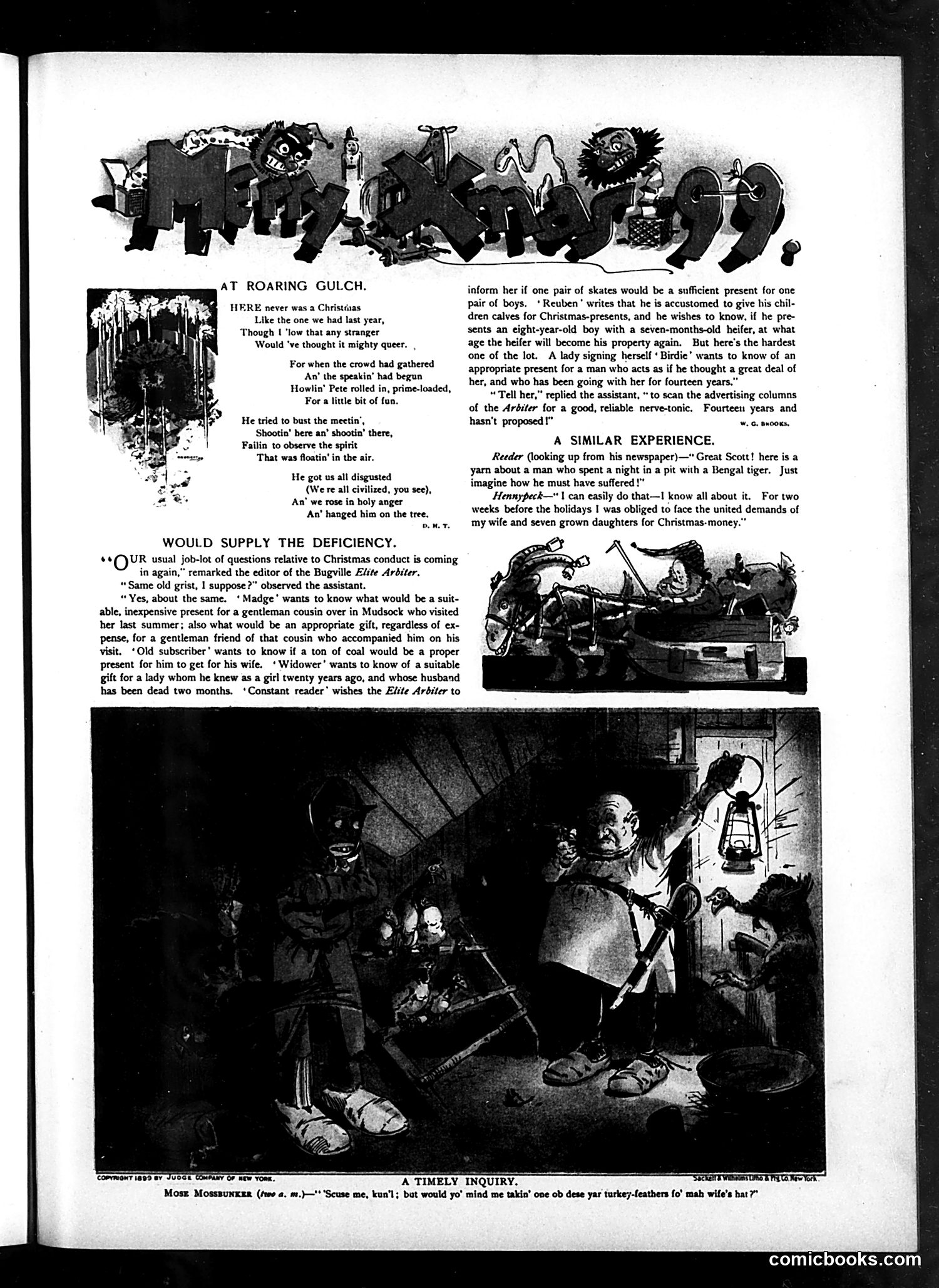
This page contains three satirical pieces about Christmas gift-giving dilemmas: **"At Roaring Gulch"** lampoons frontier vigilante justice through exaggeration—a drunk man disrupts a Christmas gathering and the townspeople summarily hang him, viewing this as appropriately "civilized" behavior. **"Would Supply the Deficiency"** satirizes the advice column genre. An editor catalogs absurd Christmas gift questions: whether skates suffice for multiple boys, if a heifer counts as a gift for an eight-year-old, and most pointedly, what gift suits a man pursuing a woman for *fourteen years without proposing*. The assistant's joke—recommend a nerve tonic instead—mocks both the man's indecision and women's limited recourse. **"A Similar Experience"** uses the domestic complaint as humor: a man reading about tiger attacks realizes his wife's pre-holiday demands for money constitute worse suffering than wild beasts. The cartoons reflect early-20th-century attitudes about gender roles, courtship frustrations, and marital dynamics presented as comedy fodder.
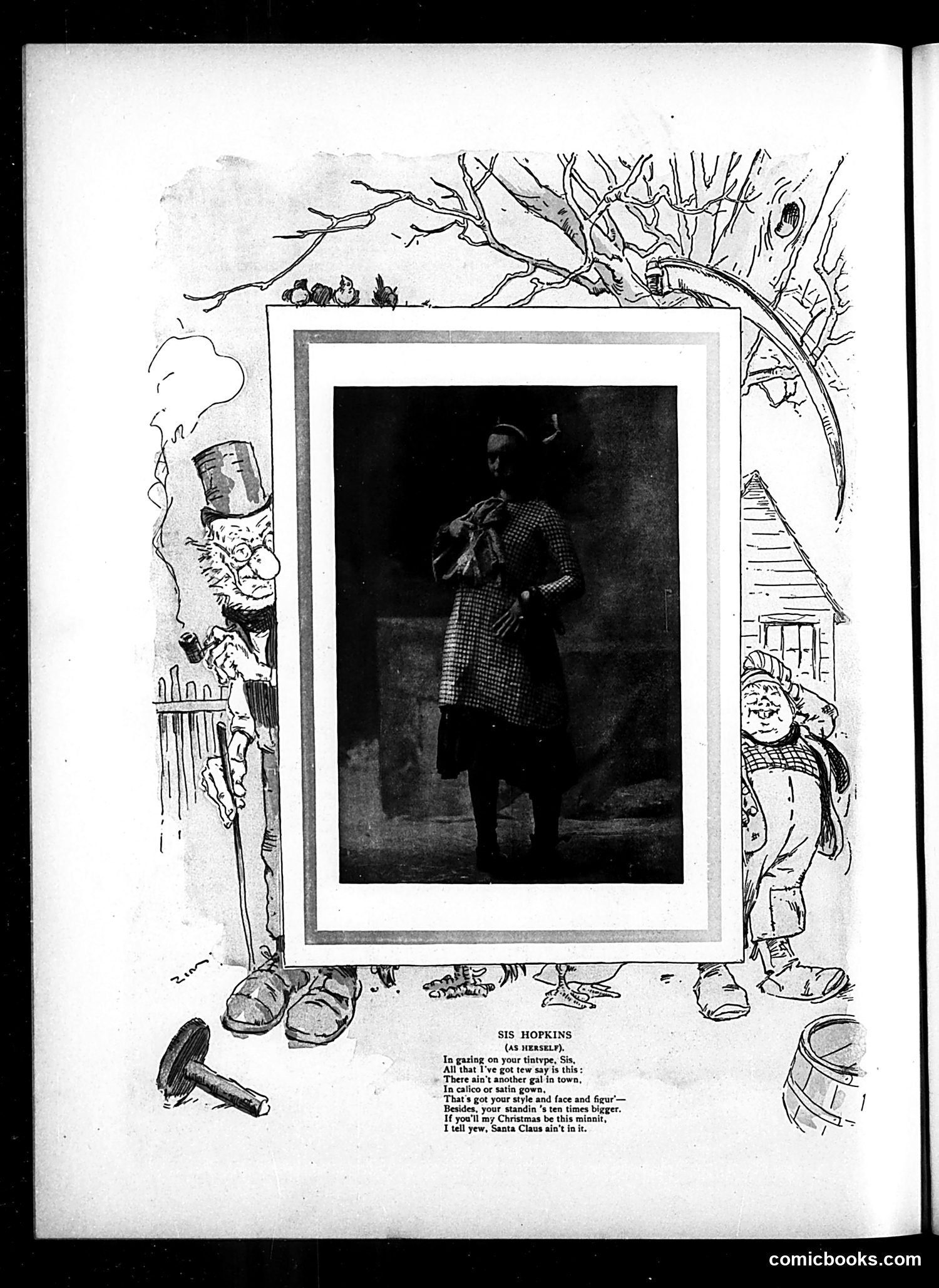
This is a satirical piece featuring "Sis Hopkins," a rural character (indicated by dialectical spelling: "tew" for "to," "tintype" for photograph). The cartoon mocks her vanity through a photograph showing a woman in fashionable urban dress—a stark contrast to her rustic persona. The humor lies in the ironic comparison: a country girl has adopted city fashion and is apparently quite proud of it. The male observer's comment—that even Santa Claus "ain't in it" (can't compare)—suggests she's overdone her self-presentation. The decorative border features caricatured rural figures, reinforcing the class/cultural clash between rural simplicity and urban pretension that Judge's audience would find amusing.
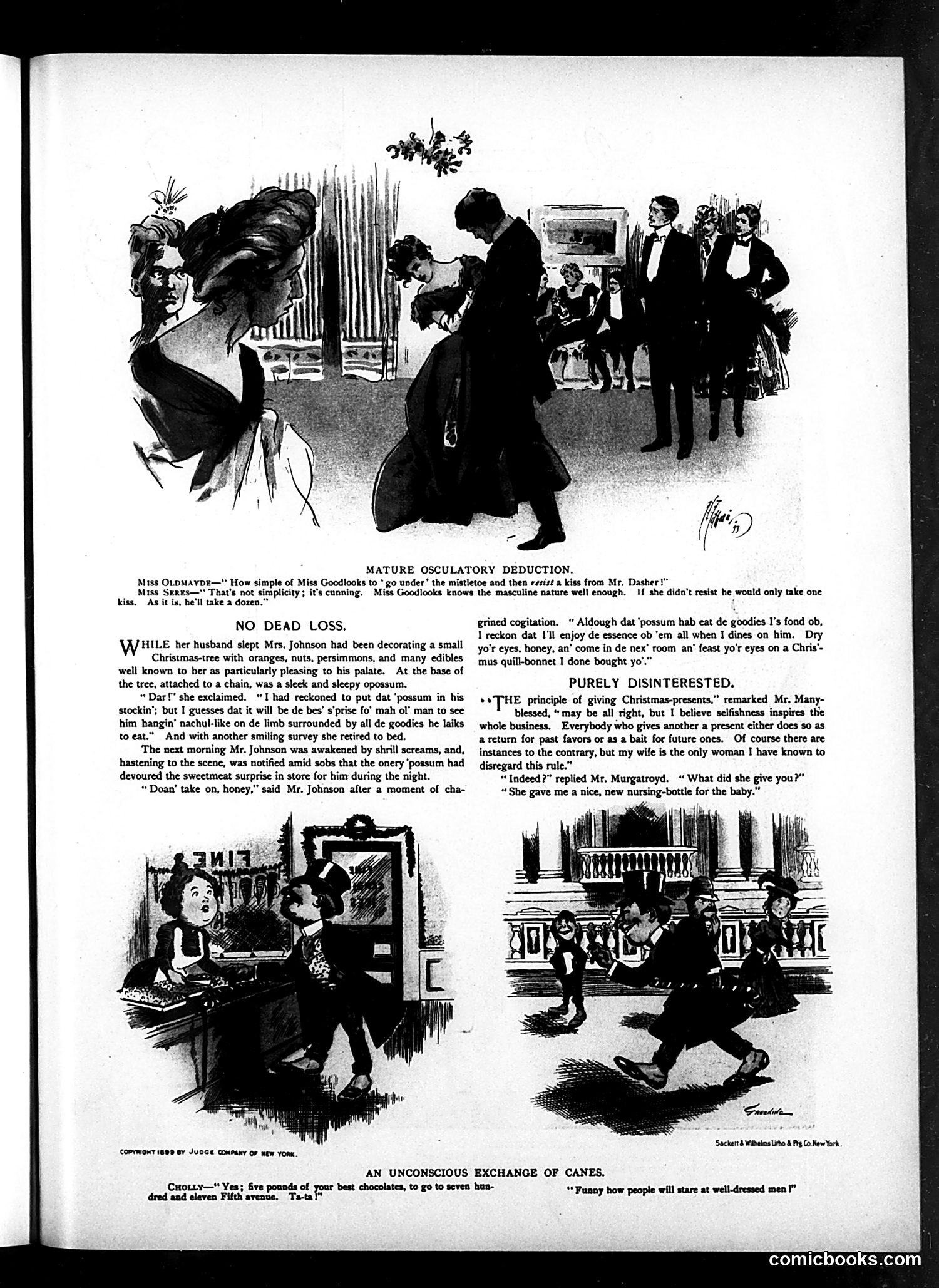
This page contains four separate satirical cartoons typical of late-19th-century American humor magazine Judge (copyright 1899). **"Mature Osculatory Deduction"** mocks dating conventions: Miss Goodlooks's refusal of a mistletoe kiss isn't virtue but cunning—she knows male desire works such that rejecting one kiss will result in multiple stolen ones later. **"No Dead Loss"** uses dialect humor (common to the era, though offensive today) about an African American couple whose Christmas opossum decoration is eaten. The husband philosophically jokes he'll simply eat the opossum instead—finding silver linings in disappointment. **"Purely Disinterested"** satirizes gift-giving hypocrisy: Mr. Manyblessed claims his wife alone gives selflessly, but she's actually given him a baby bottle—a backhanded insult implying he's infantile. **"An Unconscious Exchange of Canes"** plays on class assumptions: a well-dressed man receives stares, but it's only because he's been given a shabby cane in a mix-up, not because of his appearance. All employ period-typical social satire about romantic games, marriage dynamics, and class pretension.
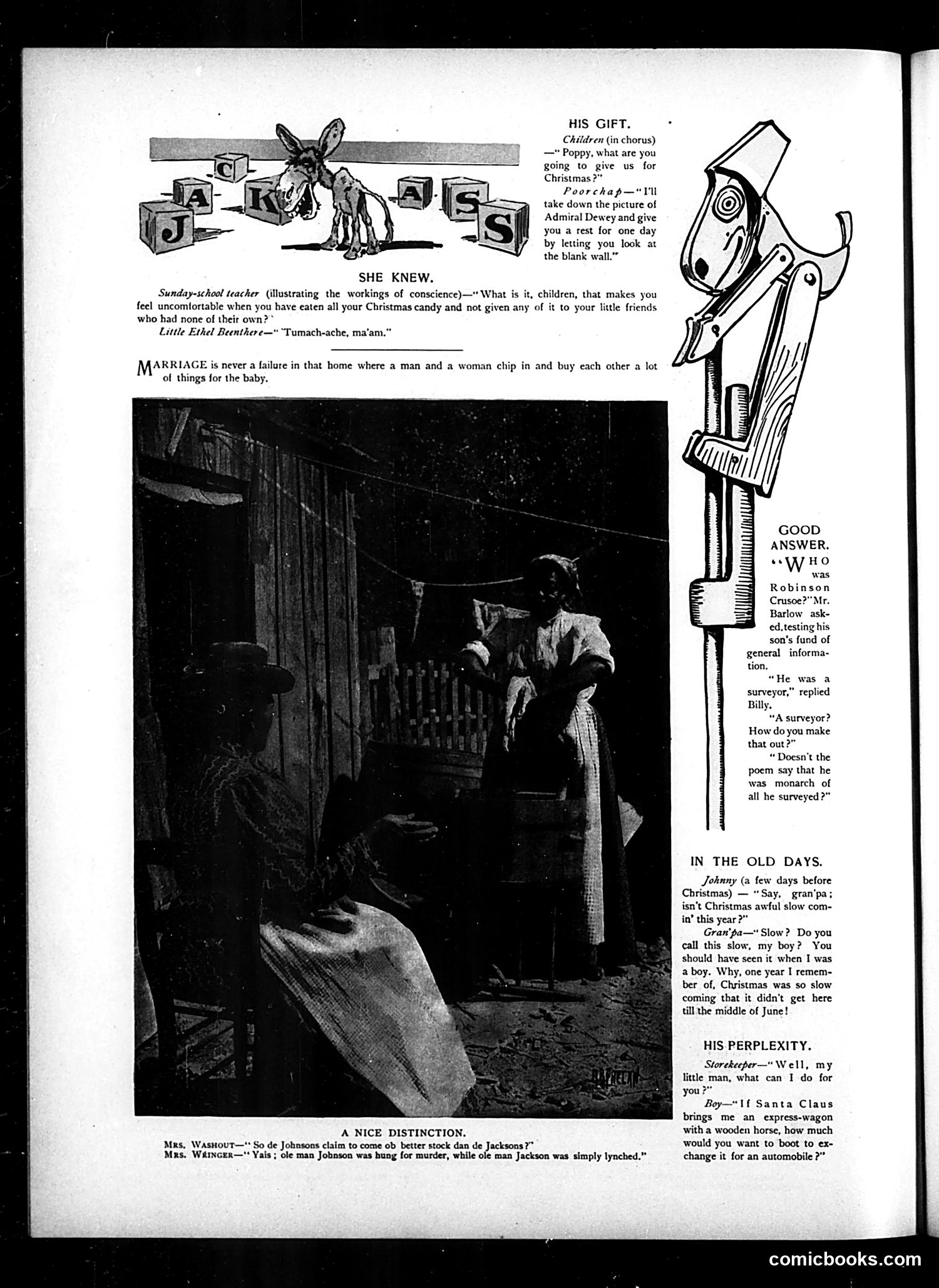
This page contains several brief humorous anecdotes typical of early 20th-century American humor magazines. **"His Gift"** jokes about Admiral Dewey's picture being so ubiquitous in homes that a father offers his children the "gift" of removing it to see a blank wall instead—likely referencing Dewey's fame after the Spanish-American War (1898), when his image was mass-produced and displayed everywhere. **"She Knew"** presents a Sunday-school lesson on conscience backfiring when a child admits selfishness stems from stomachache, not moral awareness—gentle satire on moral instruction. **"A Nice Distinction"** is a dark joke contrasting two families by their men's deaths: one "hung for murder," the other "simply lynched"—satirizing racial violence and inequality in the American South through deadpan dialogue about social status. The remaining pieces are gentler children's humor involving wordplay (Robinson Crusoe as "surveyor," playing on "monarch of all he surveyed") and nostalgic exaggeration about Christmas arriving slowly as children.
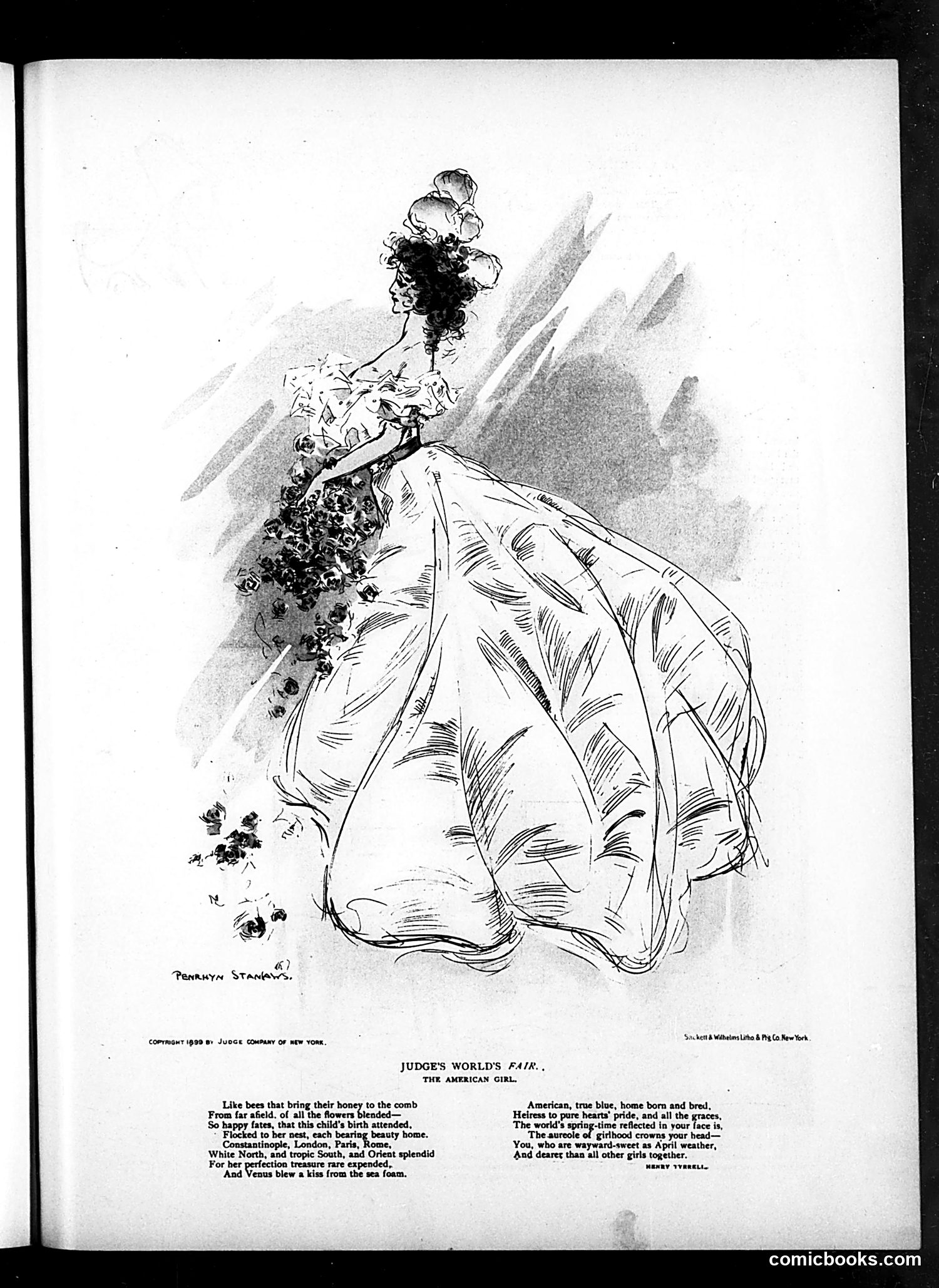
This is an illustrated poem from Judge magazine celebrating the American girl as an idealized national figure. The artwork by Penrhyn Stanbaws shows an elegantly dressed woman in a elaborate gown with flowers in her hair—a romanticized feminine ideal. The satire works through exaggeration: the poem ironically claims the American girl's beauty derives from global sources—"Constantinople, London, Paris, Rome" and "Venus"—suggesting she represents an impossible synthesis of world perfection. The accompanying verse by Henry Tyrrell praises her as "American, true blue, home born and bred" while the visual and textual evidence contradicts this, implying the "American girl" is actually an artificial, imported construct rather than authentically American. This likely mocks both American pretension and the contemporary obsession with European sophistication among the upper classes during the Gilded Age.
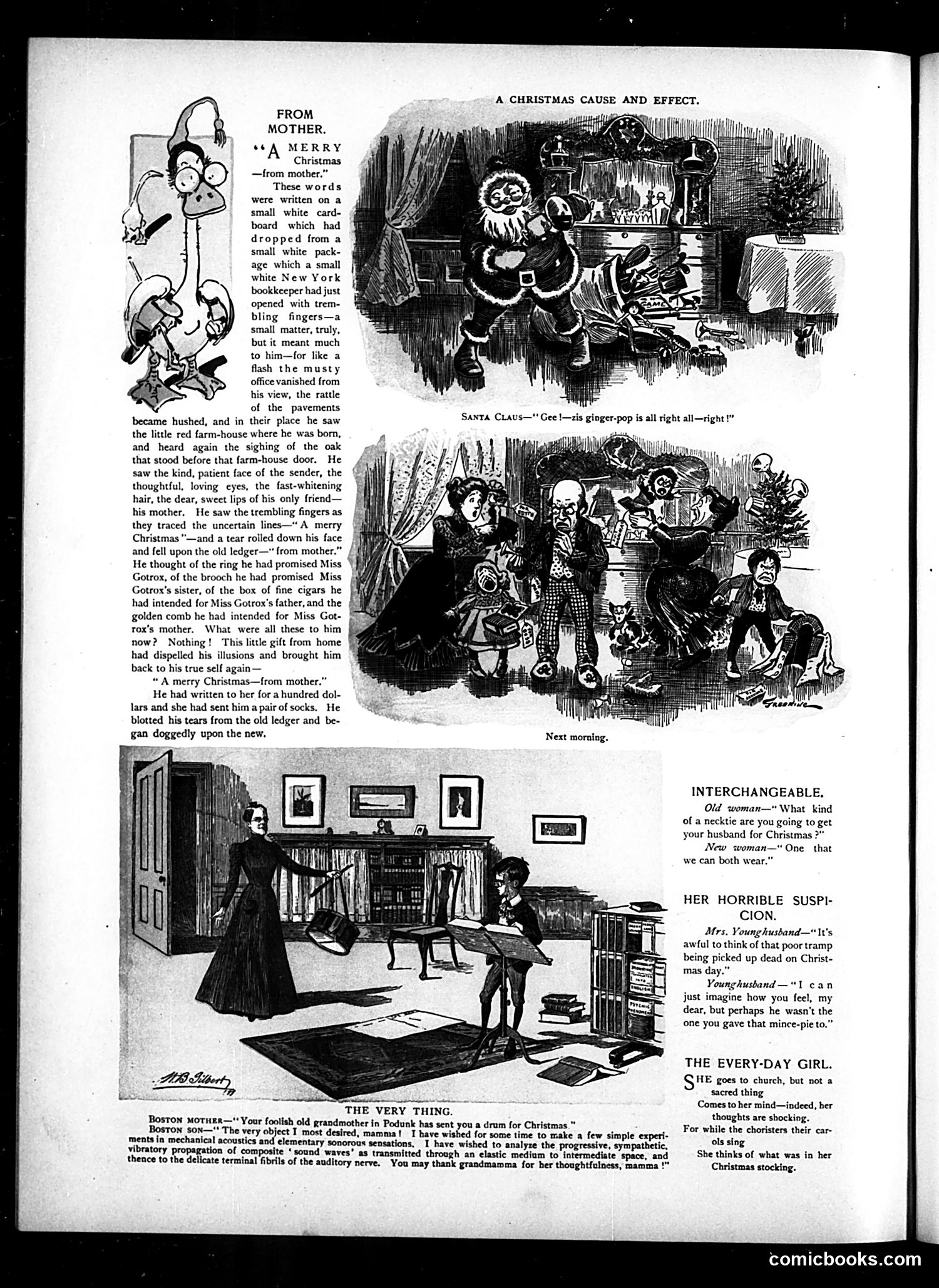
This page collects Christmas-themed satirical vignettes mocking sentimental and pretentious behavior: **"A Merry Christmas—From Mother"** presents ironic contrast: a New York bookkeeper receives a humble pair of socks from his rural mother, triggering nostalgia and causing him to abandon plans for expensive gifts to society women (the "Gotrox" family). The satire targets urban materialism and false priorities. **"The Very Thing"** mocks an overeducated Boston snob who reframes his grandmother's simple drum gift as an opportunity for pseudo-scientific acoustic study, using absurd jargon to inflate trivial reality. Other shorts ridicule women's emerging independence ("Interchangeable" necktie joke), spousal suspicion about poisoned food, and female inattentiveness during church services. The humor relies on class commentary, generational conflict, and anxiety about changing social norms—particularly women's evolving roles—typical of Judge's satirical approach.
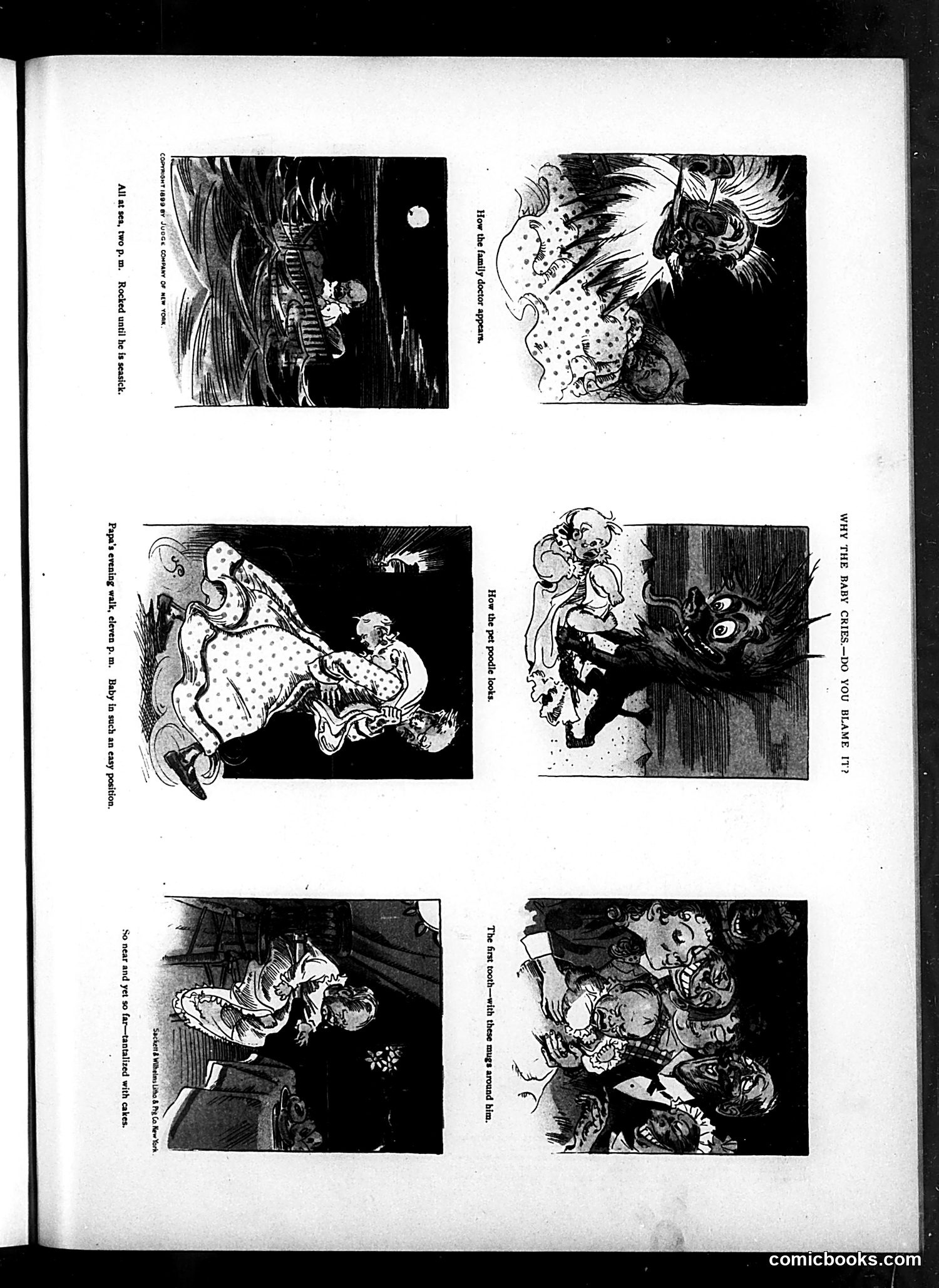
This page from *Judge* presents a humorous six-panel comic strip about parenting frustrations, likely from the early 20th century. The narrative follows a father's attempts to manage his baby throughout the day. The panels depict: a seasick father rocking the cradle at sea; the baby tantalized by cakes just out of reach; the father exhausted during an evening walk; and various scenes of domestic chaos with the baby. The captions emphasize the father's frustration—being "all at sea," "so near and yet so far," and managing an infant "in such an easy position" (likely sarcastically, as the baby appears uncooperative). The satire targets the struggles of modern fatherhood and domestic life, mocking the gap between parental ideals and chaotic reality. It's a relatable commentary on childcare's exhausting unpredictability.
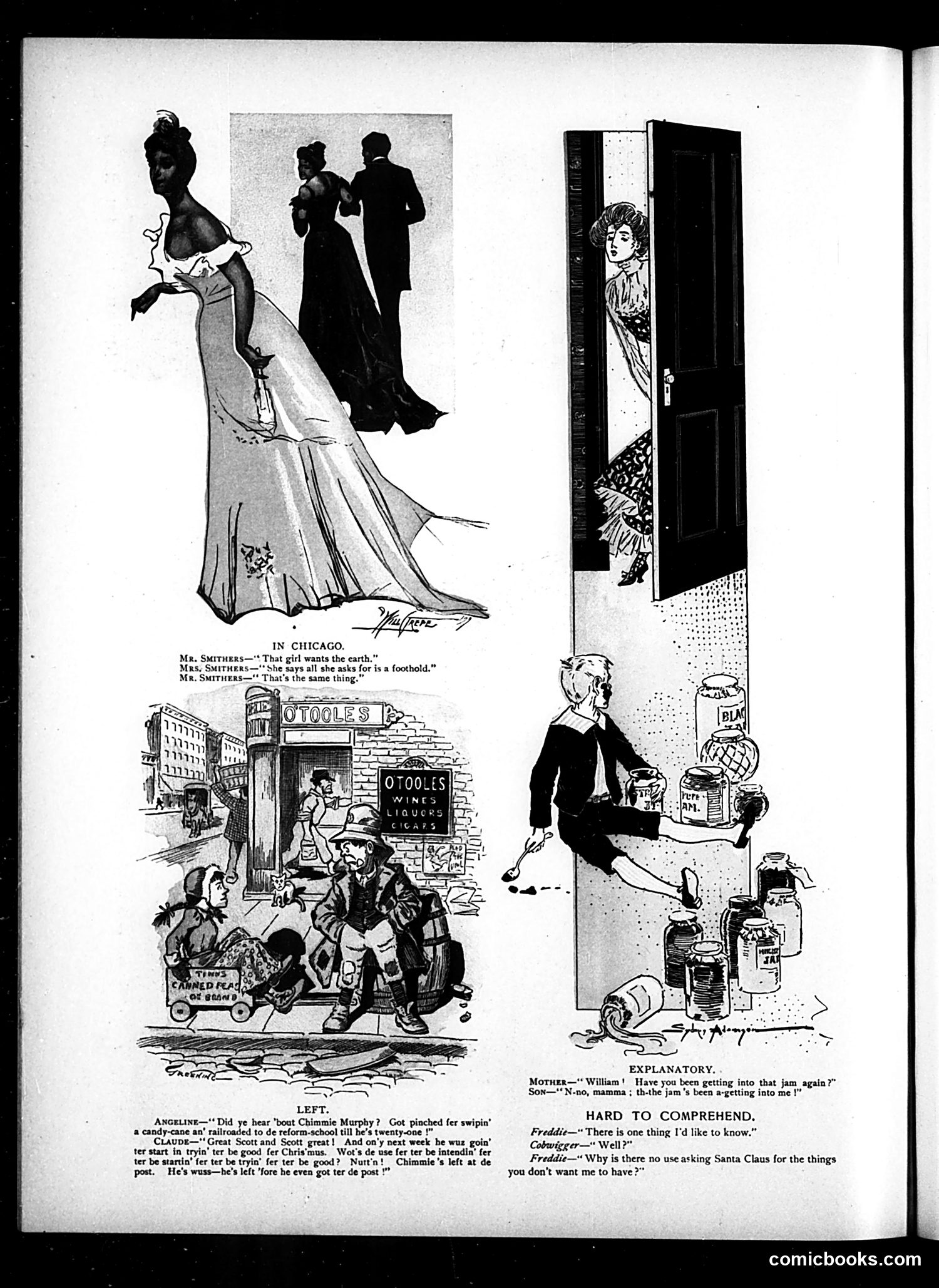
This page contains three separate humor pieces typical of early-20th-century satirical comics: **Top cartoon ("In Chicago"):** A fashionable woman's statement that she wants "the earth" and asks only for "a foothold" is reinterpreted as identical demands—satirizing women's ambitions and the feminist movement's growing assertiveness. **Left panel ("Left"):** Street-level dialect humor about a boy named "Chimmie Murphy" sent to reform school for stealing candy. The joke plays on Irish-American working-class speech patterns and juvenile delinquency, a contemporary urban concern. **Right panels:** Two brief domestic comedy exchanges—one about a child getting into jam (literal and figurative trouble), another about the logical absurdity of asking Santa for things you *don't* want. The page relies on class-based humor, ethnic caricature through dialect, and simple observational comedy about children and women. The satirical edge targets social anxieties about urban poverty, crime, and changing gender roles rather than specific political figures.
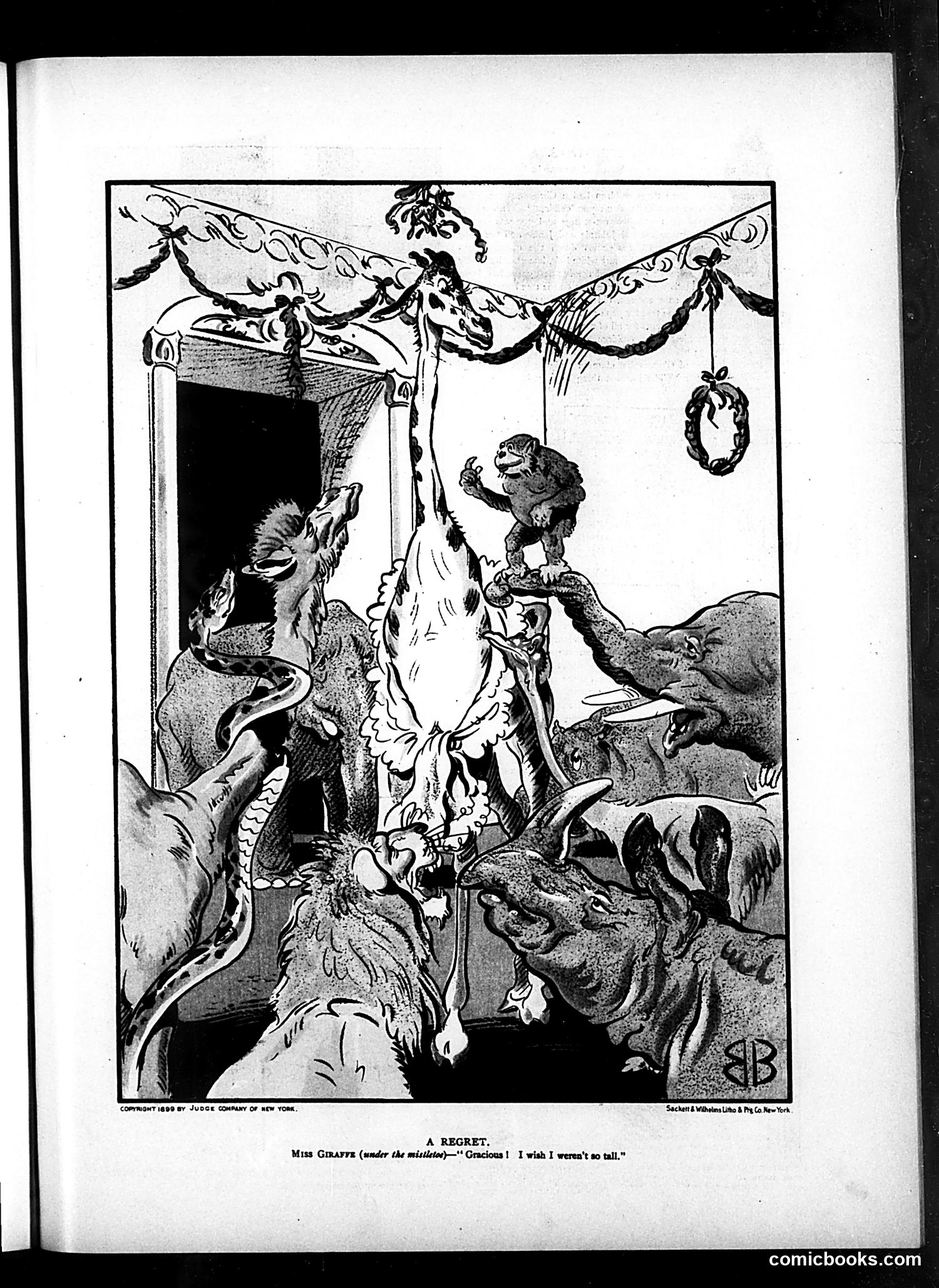
This 1899 cartoon depicts Miss Giraffe standing under mistletoe surrounded by admiring male animals (appearing to be goats, monkeys, and other creatures). Her spoken regret—"I wish I weren't so tall"—satirizes courtship dynamics of the era. The joke plays on height as a social disadvantage for women. Despite being in a romantic setting (mistletoe), her unusual tallness presumably prevents suitors from kissing her easily, making her height an obstacle rather than an asset. The cartoon likely mocks rigid courtship conventions and beauty standards of Victorian society, where conforming to expected physical norms mattered more than individual qualities. The animal characters suggest the absurdity of these social rules.
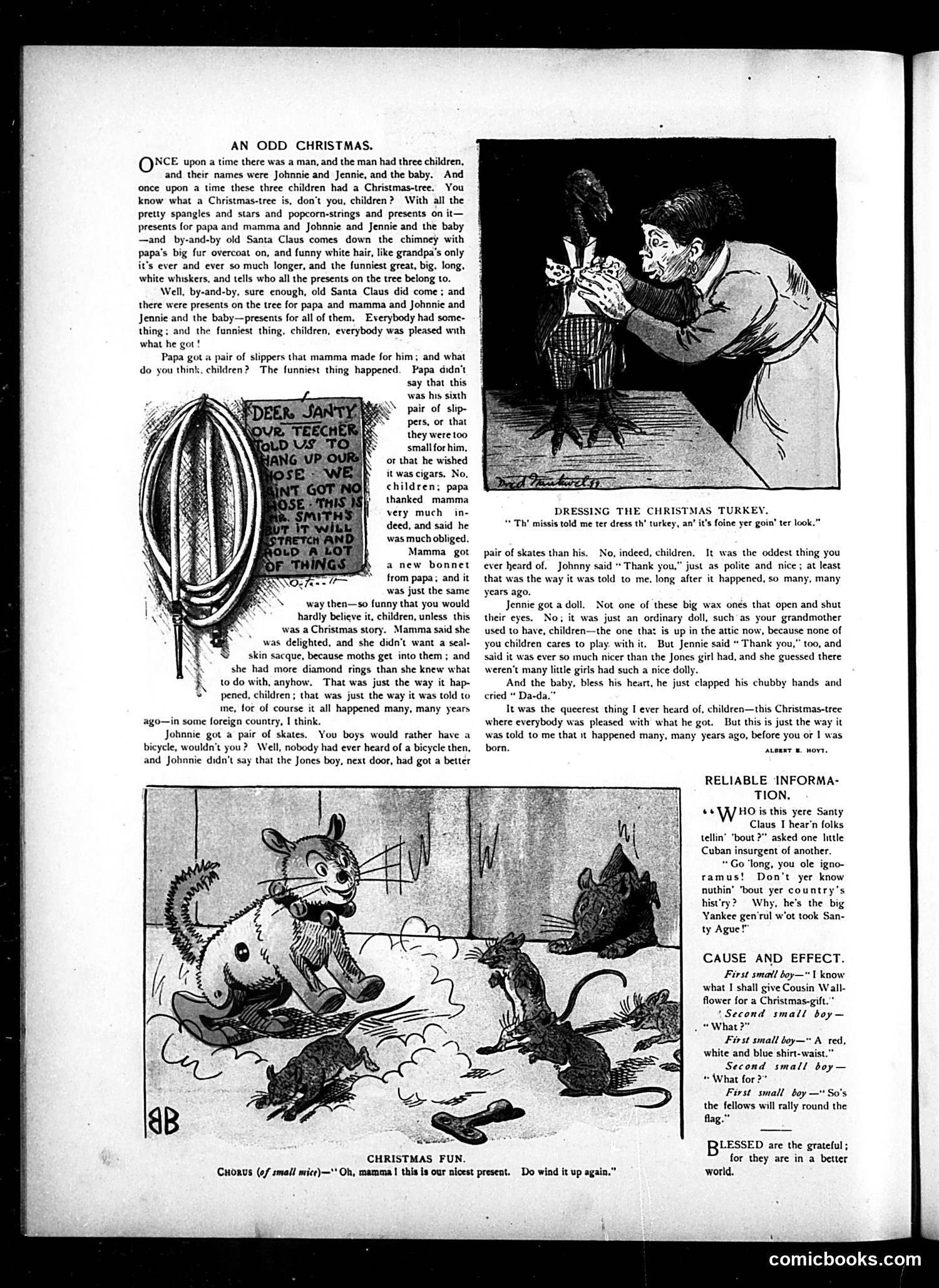
This is a sentimental children's story with embedded social satire. The narrative describes an impossibly perfect Christmas where parents and children graciously accept modest gifts without complaint—a direct mockery of American consumer culture and entitlement. The joke is the contrast: the narrator repeatedly emphasizes how "odd" and unbelievable it is that people expressed genuine gratitude. This satirizes contemporary attitudes where people complained about gifts, wanted expensive replacements (the bicycle, sealskin sacque, cigars, diamond rings), or compared presents unfavorably to neighbors' possessions. By setting this implausible scenario "many years ago in some foreign country," Judge ridicules modern American acquisitiveness. The sidebar illustrations include a Cuban insurgent joke (referencing the Spanish-American War era) and domestic humor about dressing turkeys and gift-giving anxieties—typical period magazine filler that reflects contemporary concerns.
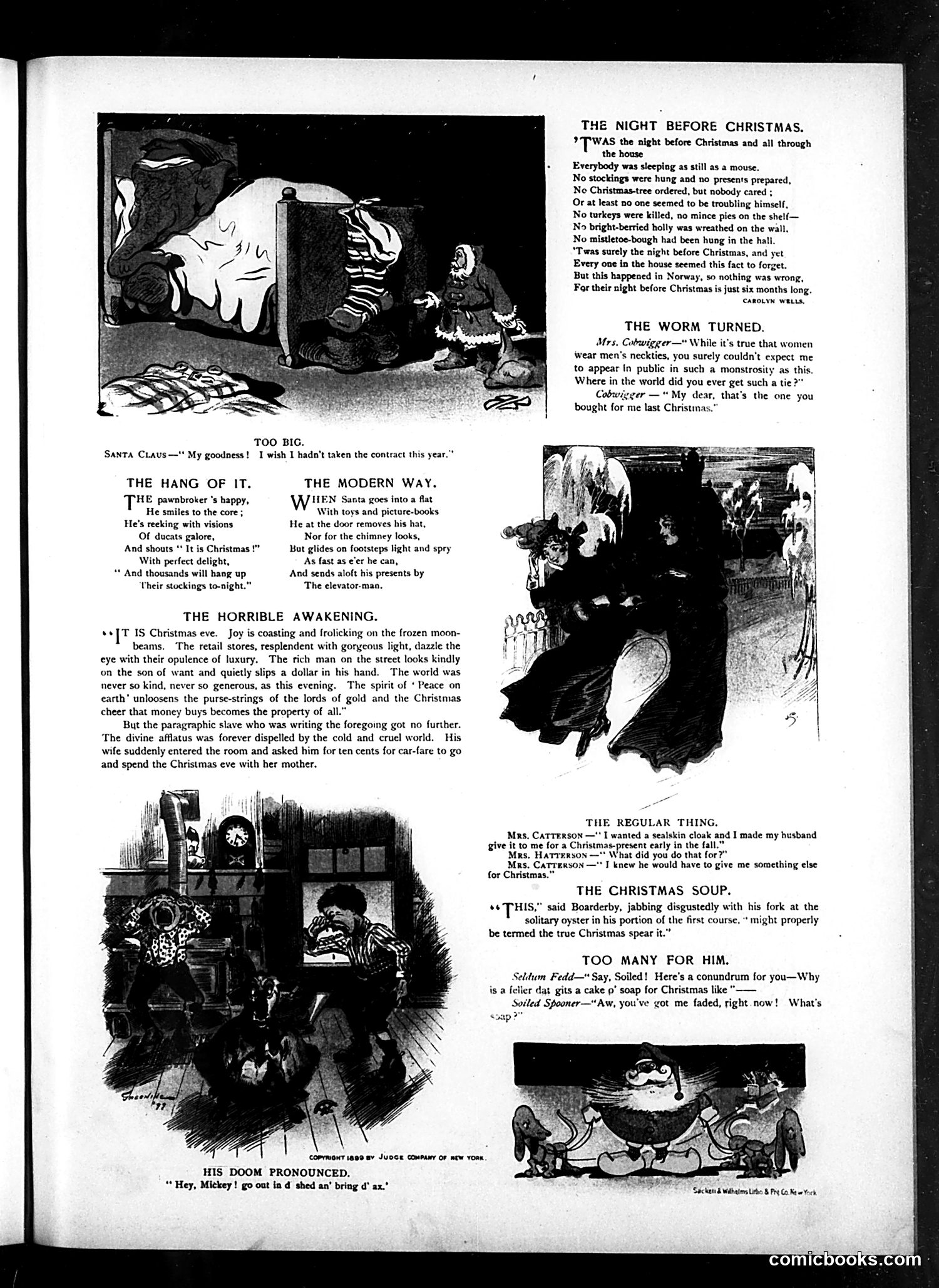
This page collects humorous Christmas sketches satirizing American consumer culture and domestic life. Key pieces include: **"The Night Before Christmas"**: A parody noting that in Norway, their Christmas Eve lasts six months—a jab at the commercialization of Christmas in America versus simpler foreign traditions. **"The Worm Turned"**: A wife criticizes an ugly necktie her husband received; he reveals *she* bought it for him last Christmas—satirizing both the obligation of gift-giving and women's emerging independence. **"The Modern Way"**: Santa uses an elevator instead of chimneys in modern apartments—mocking how industrialization changes tradition. **"The Horrible Awakening"**: A writer waxing poetic about Christmas charity is interrupted by his wife demanding ten cents for carfare to visit her mother—cynical commentary on Christmas sentiment versus marital reality. **"The Christmas Soup"**: A boarder complains about receiving only one oyster in soup, calling it the "Christmas spear"—mocking meager hospitality. The page satirizes commercialism, domestic tensions, and the gap between Christmas ideals and reality.
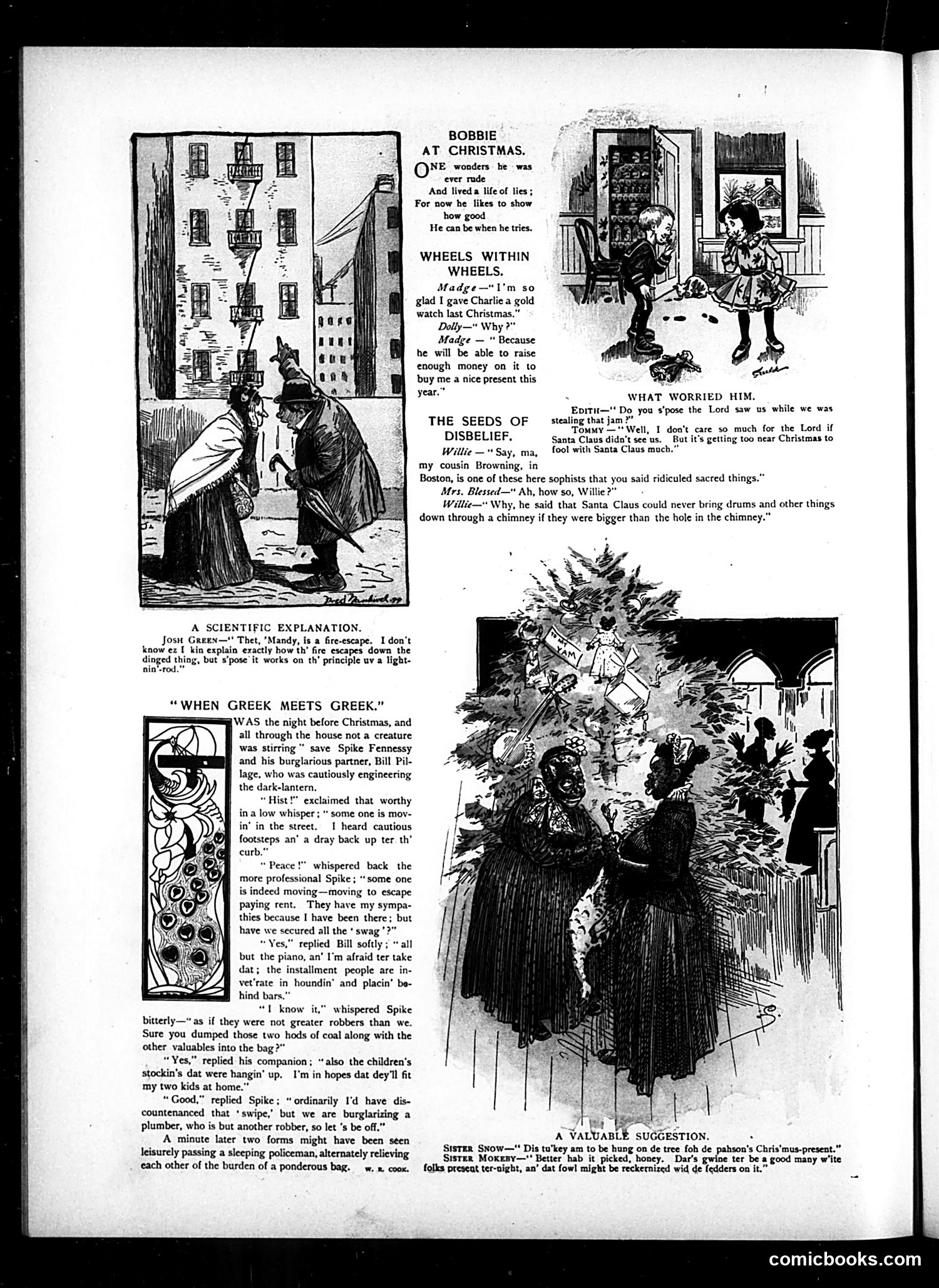
This page from *Judge* magazine contains several short satirical pieces mocking Christmas hypocrisy and social pretense: **"Bobbie at Christmas"** jokes that a habitually rude, dishonest boy suddenly behaves well around the holidays—implying temporary moral performance rather than genuine character change. **"Wheels Within Wheels"** satirizes gift-giving materialism: a woman gave her boyfriend an expensive watch, hoping he'd pawn it to buy *her* a present—exposing self-interested gift exchanges. **"The Seeds of Disbelief"** mocks religious anxiety: a child reports his Boston cousin uses logic to question Santa's physical feasibility (fitting down chimneys), treating intellectual skepticism as dangerous sophistry. **"When Greek Meets Greek"** is a lengthy burglary story featuring two thieves discussing their Christmas Eve robbery. The humor lies in their self-righteous complaint about stealing from a plumber—characterizing him as a greater "robber" than themselves, thus justifying their crimes through moral relativism. The cartoons satirize Victorian-era Christmas sentimentality, religious anxiety about rationalism, and working-class morality.
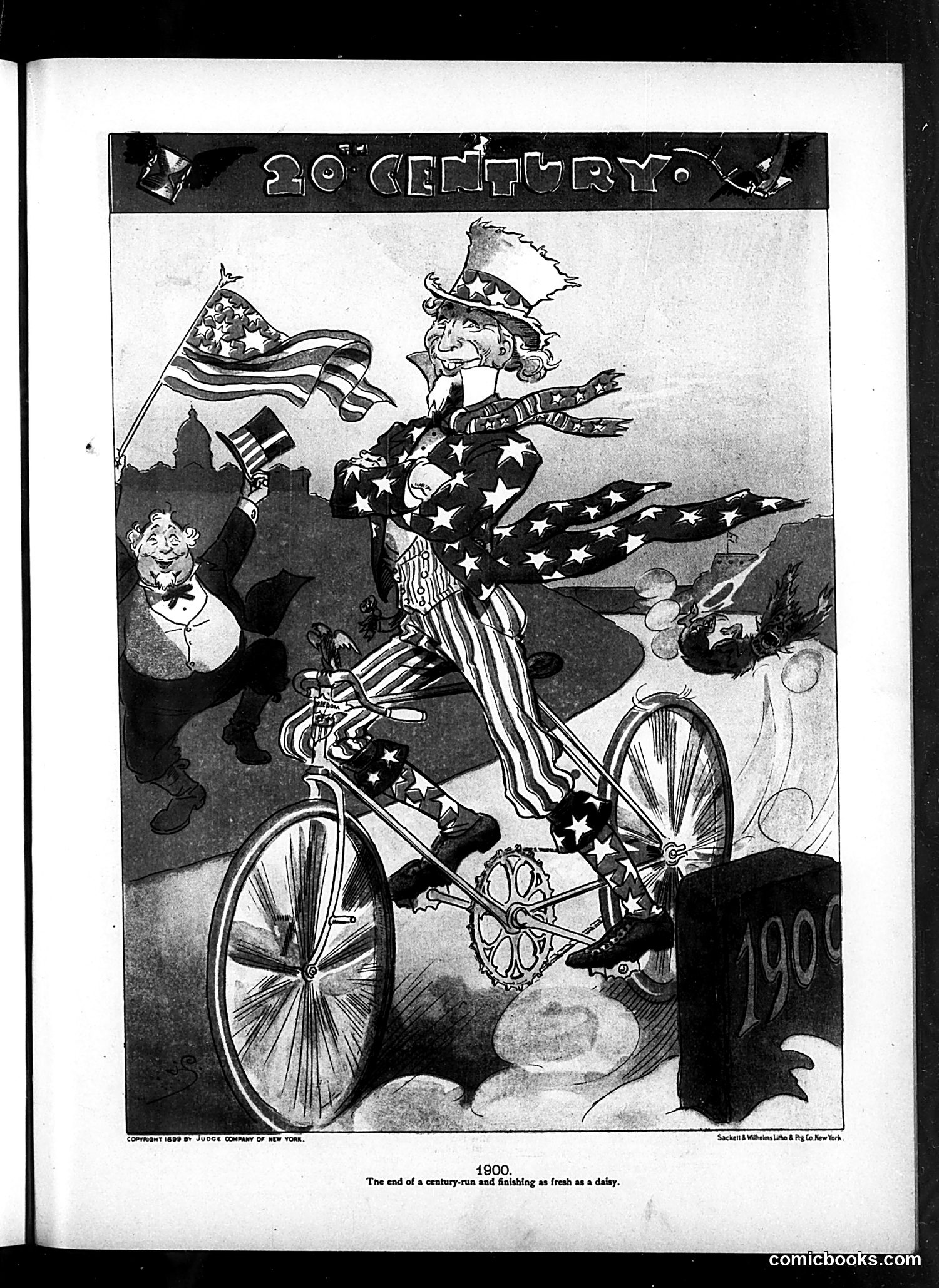
This Judge magazine cartoon depicts Uncle Sam (the tall figure in star-spangled outfit on a bicycle) as personifying America entering the 20th century. The caption "The end of a century-run and finishing as fresh as a daisy" suggests optimism about America's condition and prospects. The figure on the left appears to be an allegorical or caricatured representation, possibly of a foreign power or competitor, while the onlookers suggest public observation of America's progress. The bicycle metaphor represents America's journey through the 1800s, with the "fresh" conclusion implying the nation emerges vigorous and ready for new challenges ahead. This reflects the celebratory, confident mood of American society at the turn of the century.
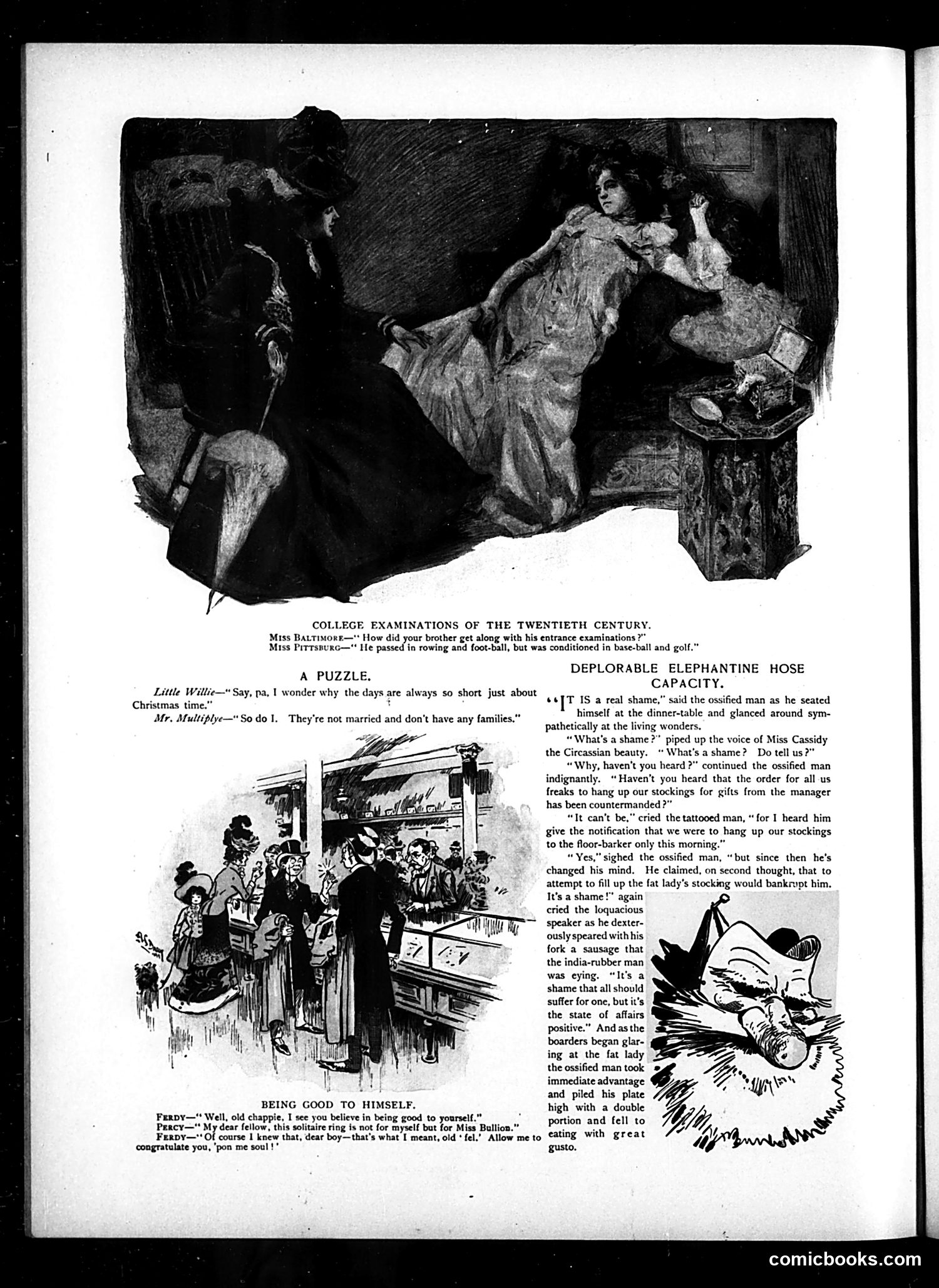
This page contains three separate satirical pieces mocking early 1900s social absurdities: **"College Examinations of the Twentieth Century"** jokes that a student passed rowing and football but failed baseball and golf—inverting academic priorities to ridicule how colleges increasingly emphasized athletics over actual learning. **"A Puzzle"** features circus freaks (an "ossified man," tattooed man, Circassian beauty, fat lady, india-rubber man) complaining the manager won't fill the fat lady's Christmas stocking because it would "bankrupt him." The satire mocks both the exploitation of disabled people as spectacles and wealthy managers' miserliness. **"Being Good to Himself"** shows a man buying an expensive solitaire ring, claiming it's for "Miss Bullion" (a wealthy woman), then accepting congratulations—satirizing fortune-hunting and the pretense that gold-digging is romantic generosity. All three pieces target the era's hypocrisy: misplaced educational values, the cruel exhibition of human "oddities," and mercenary courtship practices.
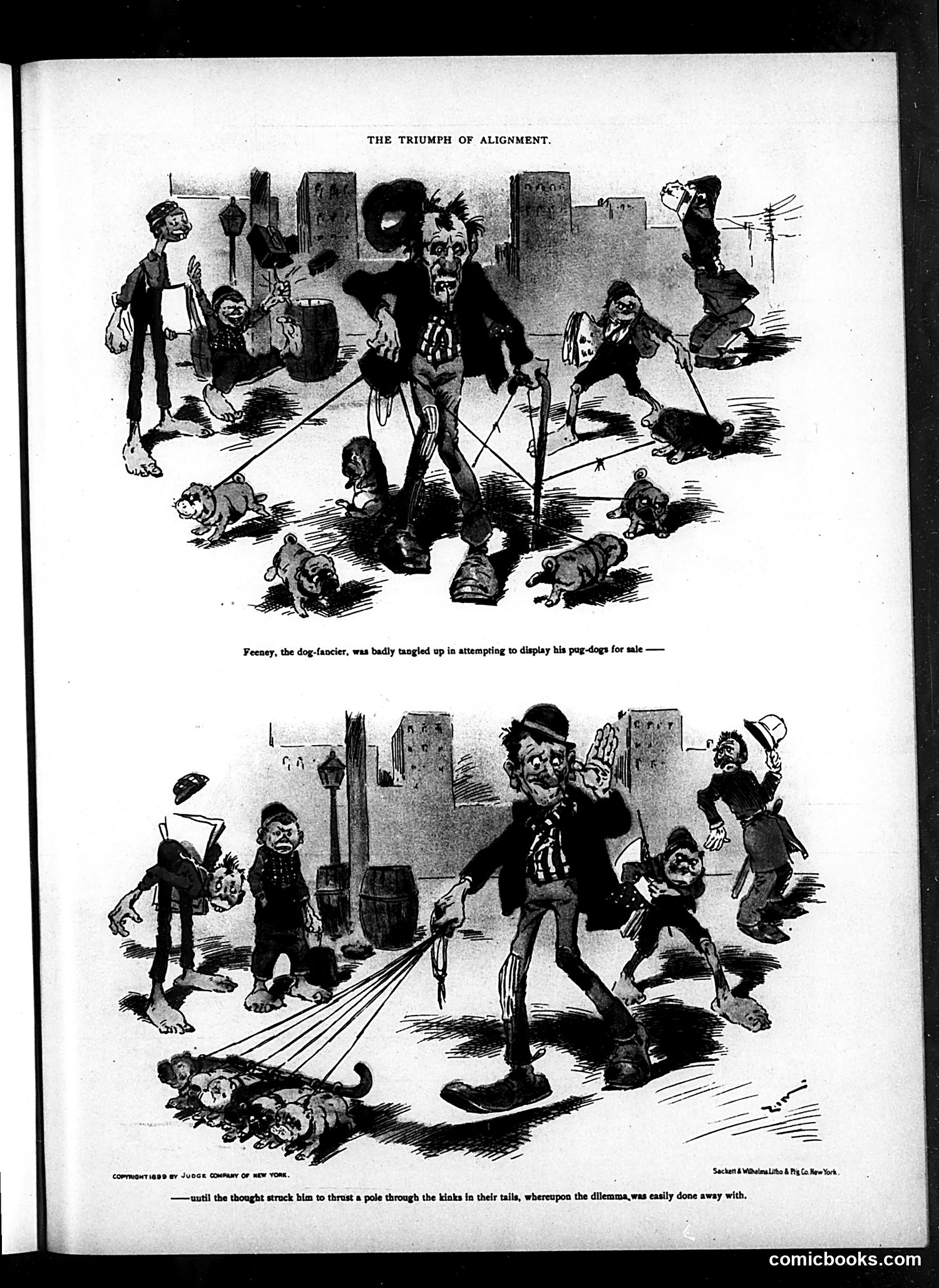
This satirical cartoon depicts a dog-fancier named Feeney struggling to align a group of unruly pug-dogs for sale. In the top panel, the dogs are chaotically tangled and misbehaving. The caption indicates Feeney is "badly tangled up in attempting to display his pug-dogs for sale." The lower panel shows his solution: literally using a pole thrust through the dogs' tails to force them into a straight line, solving the "dilemma easily." The satire likely comments on forced social or political alignment—using crude, coercive methods to impose order on naturally resistant subjects. The dogs represent groups or individuals being forcibly organized, while Feeney represents authority figures attempting control through physical constraint rather than legitimate persuasion. The "triumph" is ironic: the alignment is achieved, but only through absurd, undignified force.
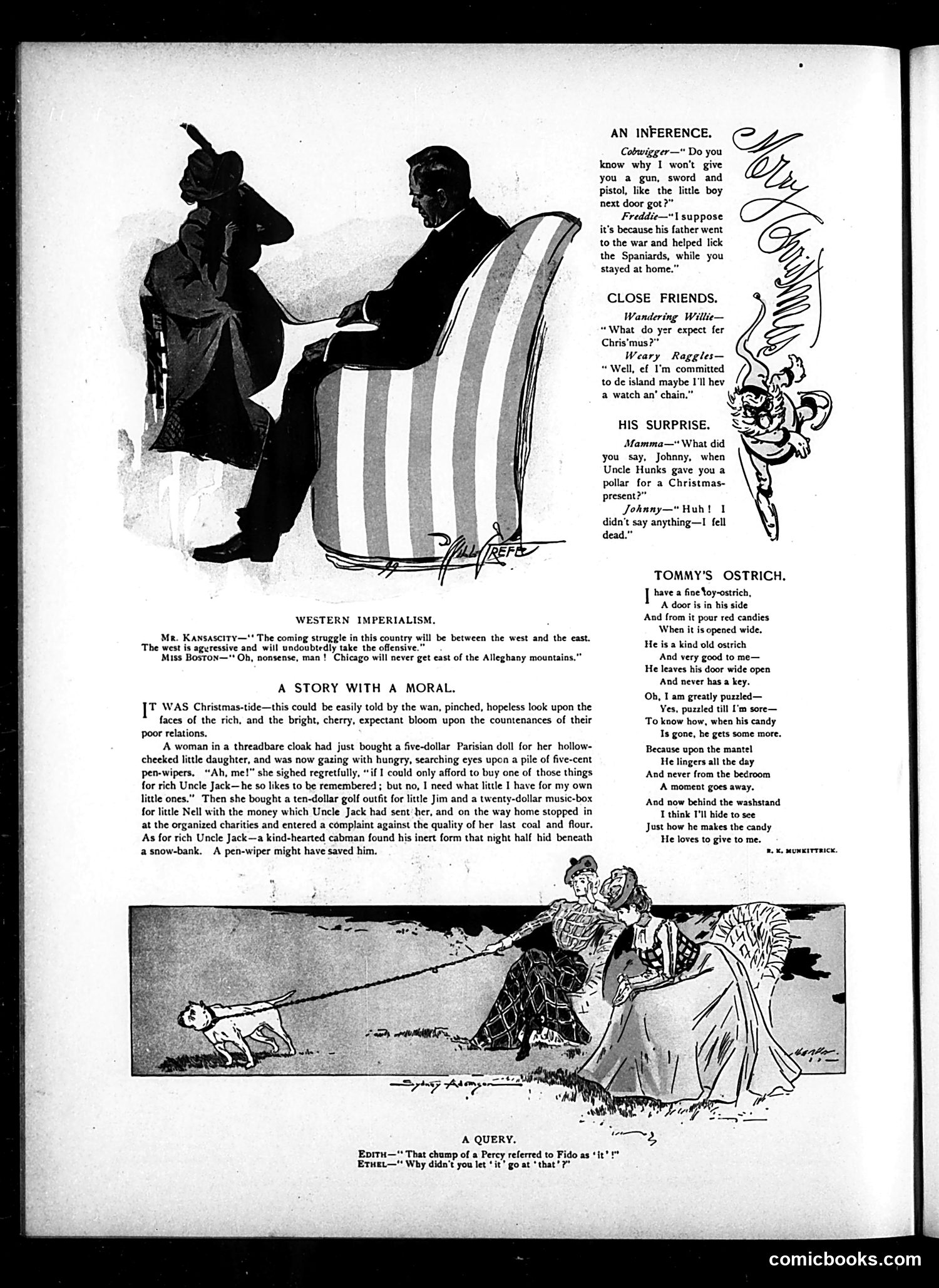
This page contains several satirical pieces commenting on American society circa the Spanish-American War era: **"An Inference"** mocks class distinctions and patriotic privilege. A wealthy man denies gifts to a poor boy, but the boy shrewdly observes the difference: the neighbor's father fought in the Spanish-American War, earning social respect and rewards, while this man stayed home. **"Western Imperialism"** satirizes regional rivalry. A Kansas businessman boasts the West will dominate the East in coming "struggles," but a Boston woman dismissively retorts that Chicago will never cross the Alleghany mountains—mocking his imperial pretensions as absurdly overconfident. **"A Story with a Moral"** criticizes the hypocrisy of wealthy relatives. A poor woman sacrifices to buy gifts for rich Uncle Jack while he ignores her poverty; ironically, his neglect leads to his death in the snow—a pen-wiper might have saved him (suggesting even small gifts from the rich matter). The lighter pieces ("Tommy's Ostrich," "Close Friends") are whimsical humor with social undertones about poverty and class.
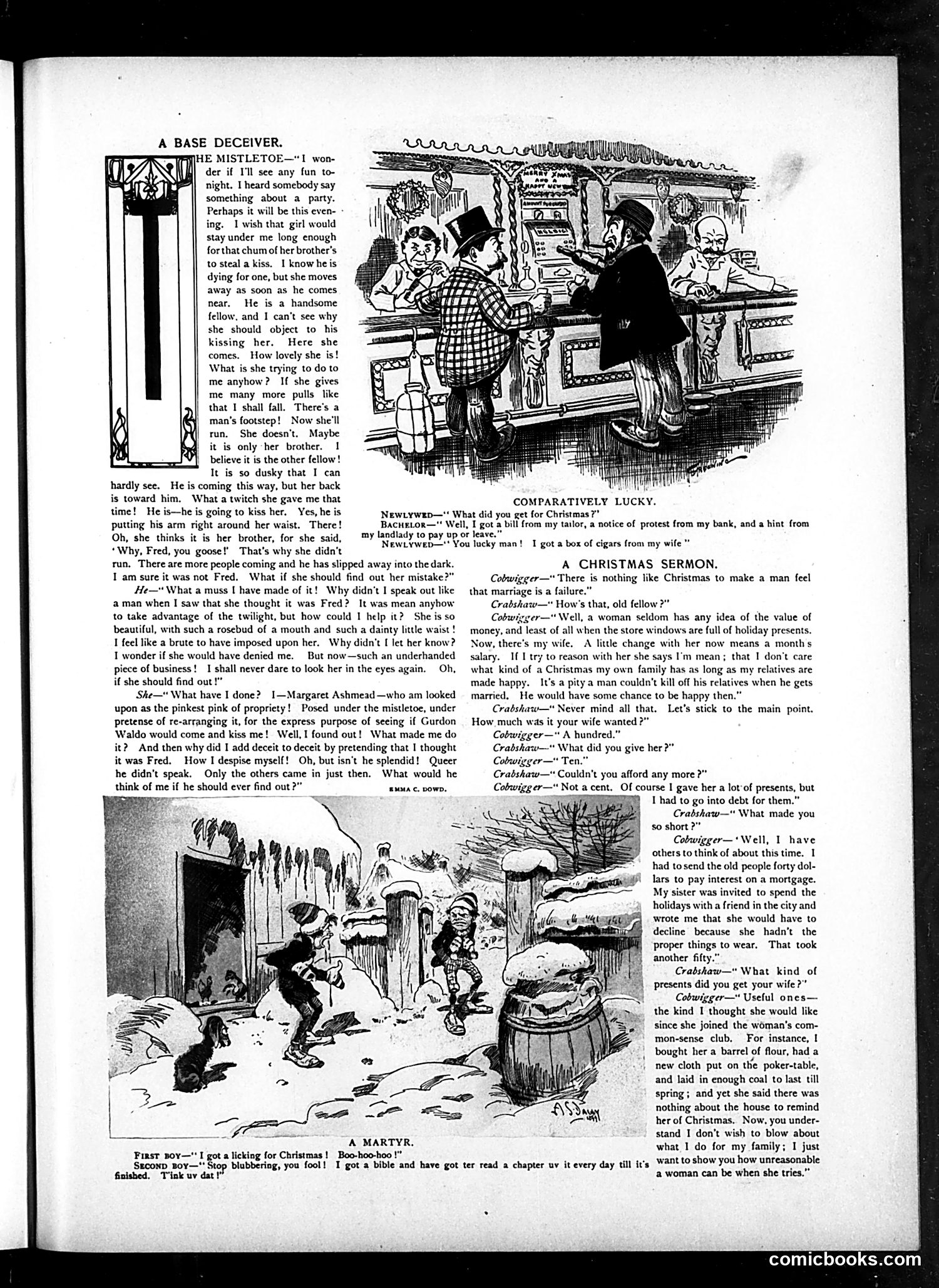
This page contains three satirical pieces about Christmas and marriage, typical of Judge's humor: **"A Base Deceiver"** (top): A mistletoe-themed story where a woman named Margaret Ashmead deliberately positions herself under mistletoe, hoping a man named Gurdon Waldo will kiss her while she pretends to mistake him for her brother "Fred." Both parties are mortified by their own deceptions—she for scheming, he for taking advantage. The satire targets the era's rigid propriety: characters must hide genuine desires behind elaborate pretense, making romance inherently dishonest. **"A Martyr"** (bottom left): A child receiving a beating for Christmas—dark humor about harsh parenting. **"Comparatively Lucky" and "A Christmas Sermon"** (right): Dialogues mocking marriage's financial burden. Husbands complain about wives' extravagant Christmas spending demands, with one man's wife wanting $100 but receiving only $10 in cash (though presents put him in debt). The satire critiques both wives' materialism and husbands' financial anxiety during holidays. Overall, the page satirizes Christmas excess and marriage's discontents in Victorian/Edwardian America.
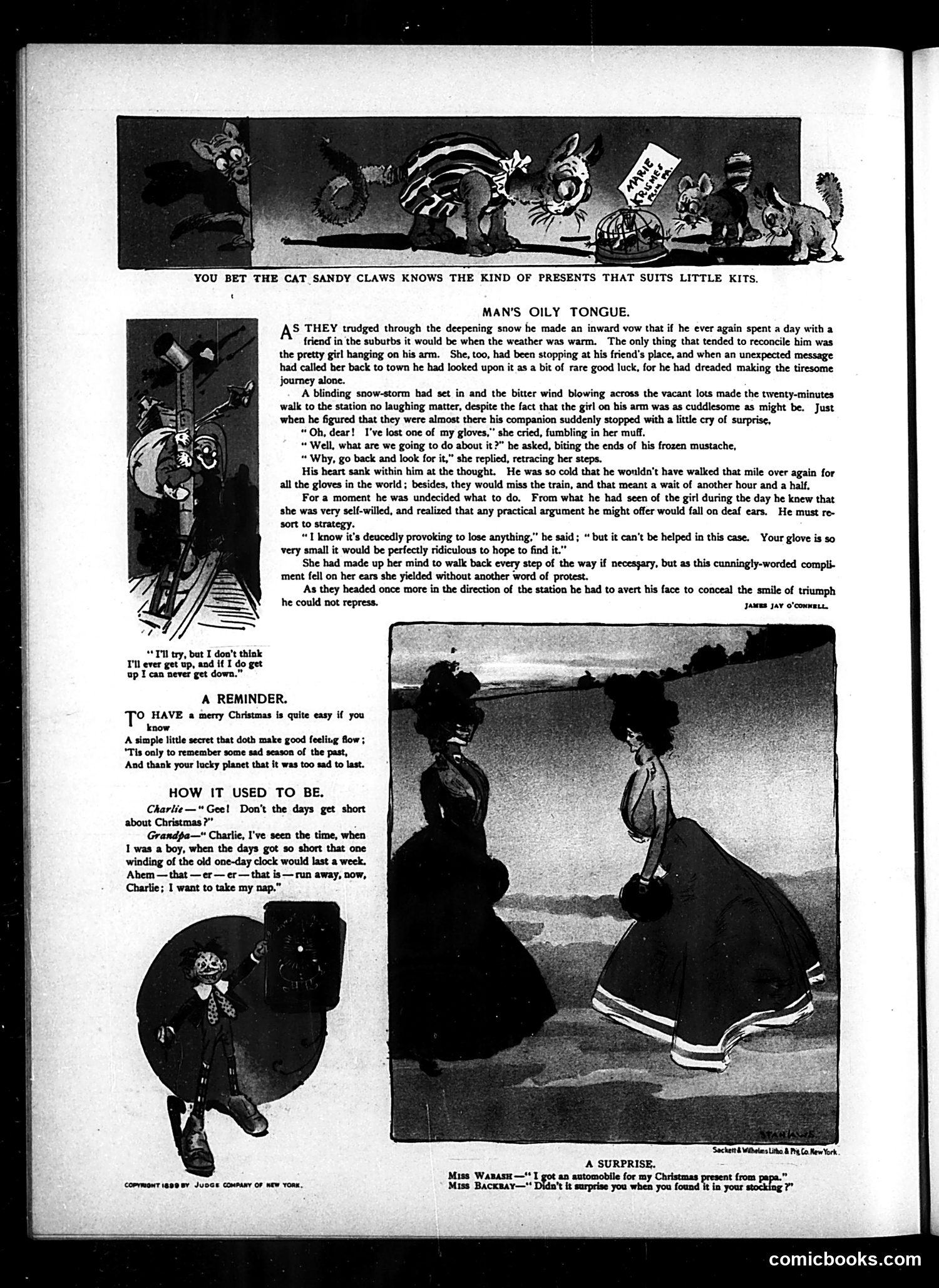
This page contains three separate humorous pieces typical of early 20th-century Judge magazine: **"Man's Oily Tongue"** (main story): A man walking through snow with an attractive woman loses her glove. Rather than endure the cold trek back to search, he flatters her by calling the glove "so very small it would be perfectly ridiculous to hope to find it"—manipulating her through compliments instead of honest argument. The satire targets male deception and the "oily tongue" of men who use charm to get their way, particularly with women. **"A Reminder"**: A sentimental Christmas poem about appreciating good fortune by remembering past hardships. **"How It Used to Be"**: A grandfather's nostalgic rambling about impossibly short winter days in his youth, played for gentle humor about aging and exaggeration. **"A Surprise"**: A brief joke about a woman receiving an automobile as a Christmas gift (presumably luxurious for the era). The cartoons reflect period attitudes about courtship, gender dynamics, and holiday sentimentality.
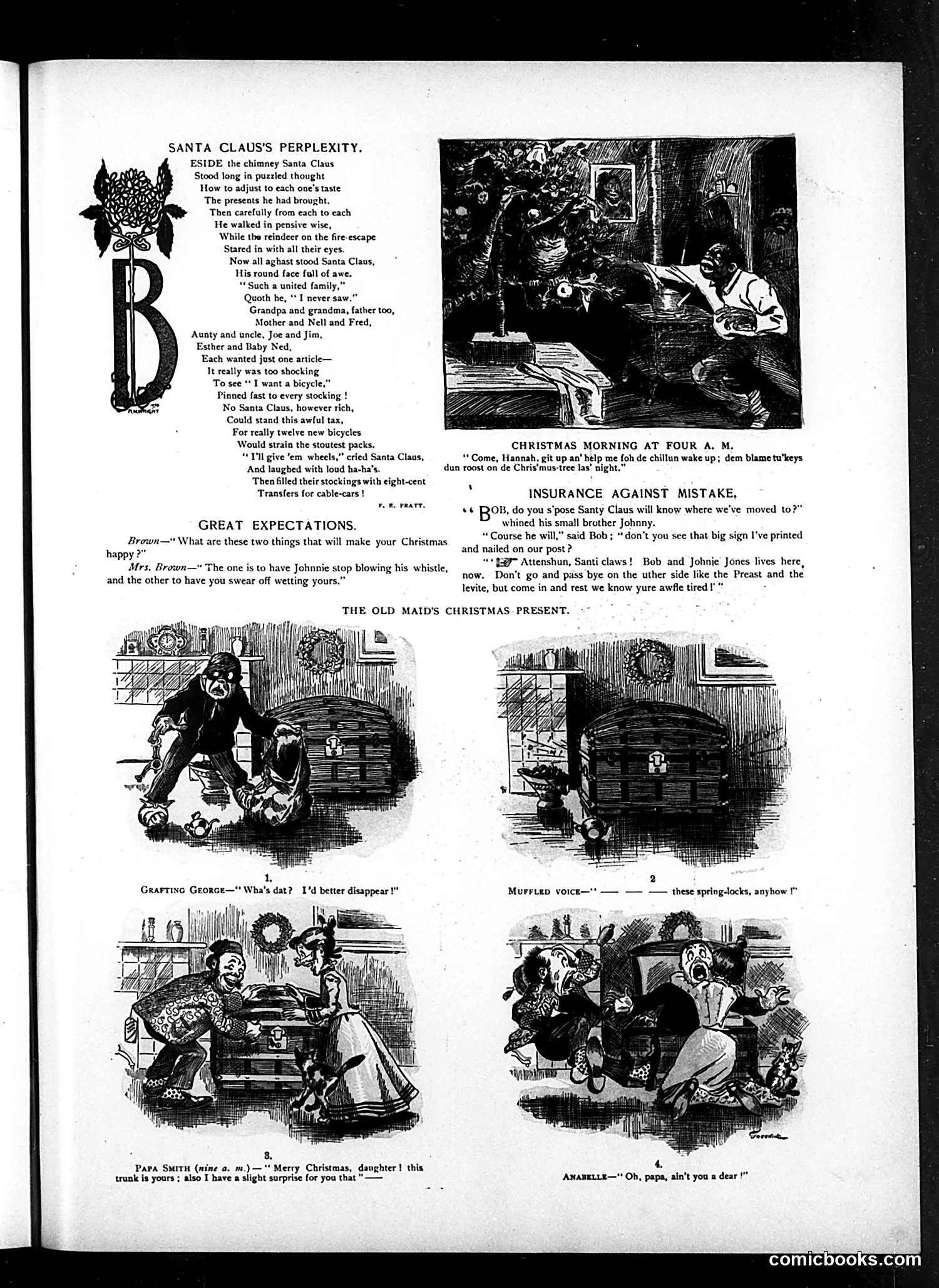
This page satirizes middle-class American consumer culture and gift-giving excess around 1890s Christmas. The main poem mocks a family where *every* member—twelve people total—wants the same expensive item: a bicycle. Santa, overwhelmed by this "united family's" identical demands, solves the problem by giving them cheap cable-car transfers instead, a humorous deflation of materialistic expectations. Secondary cartoons play on related themes: children moving houses worry Santa won't find them (solved by a homemade sign), and a father gives his daughter an empty trunk as a "surprise," mocking both parental cheapness and daughters' expectations of material gifts. The satire targets the anxiety and absurdity of Christmas commercialism—the pressure to provide identical luxury goods and the gap between desire and reality.
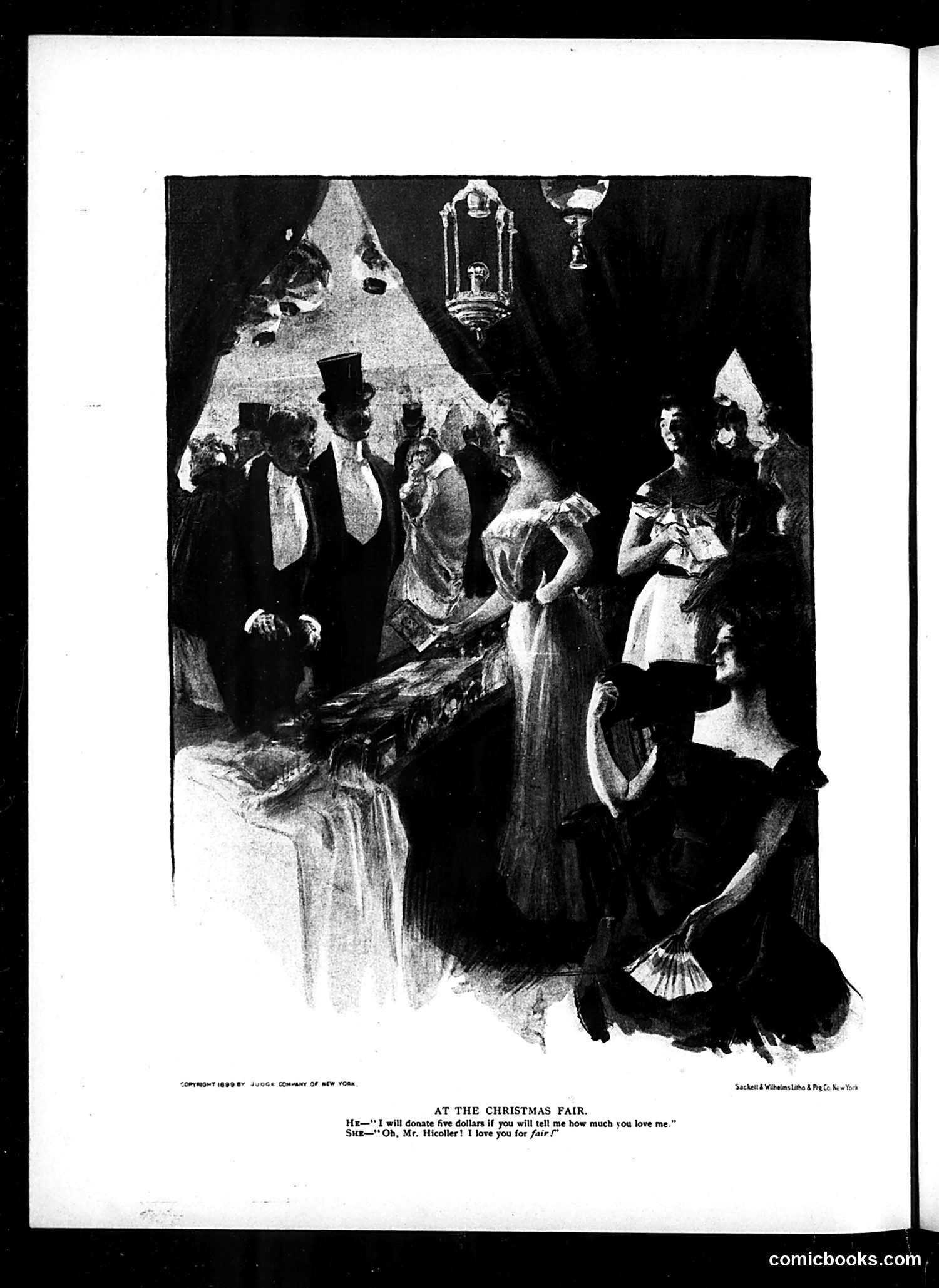
This 1899 *Judge* cartoon satirizes the transactional nature of romance and courtship among the wealthy. A man (identified as "Mr. Hiccaller") offers a five-dollar donation—a substantial sum at the time—to a woman ("Suzy") in exchange for romantic declarations. Her enthusiastic response ("I love you for fair!") suggests she's motivated by financial incentive rather than genuine affection. The Christmas fair setting and formal attire indicate this involves upper-class charity events where wealthy donors expect social and romantic returns on their contributions. The joke mocks both his presumption that money buys love and her transparent mercenary response, satirizing Gilded Age courtship rituals where economic advantage heavily influenced romantic and marital prospects.
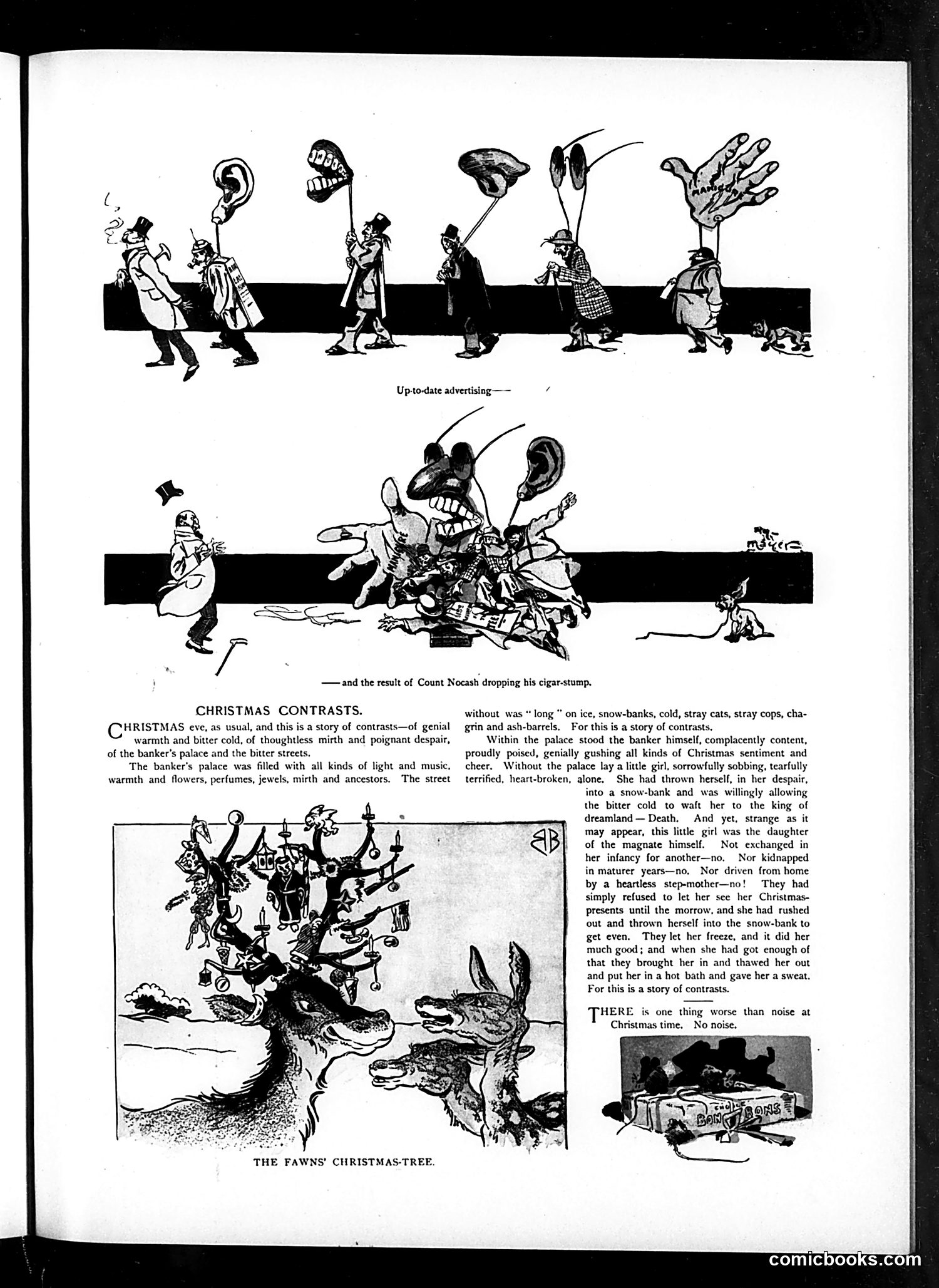
This page satirizes the stark inequality of Victorian-era Christmas through contrasting scenes. The top panels mock "up-to-date advertising"—showing genteel figures hawking consumer goods—contrasted with chaos caused by "Count Nocash dropping his cigar-stump," suggesting carelessness of the wealthy creates destruction for others. The main story mocks sentimental Christmas narratives. A rich banker celebrates lavishly in his palace while his own daughter, refused permission to see presents early, dramatically throws herself into a snowbank to "get even." Rather than actual tragedy, the satire shows she's simply thawed out, bathed, and warmed—the melodramatic despair deflated. "The Fawns' Christmas-Tree" illustration appears to depict animals enjoying simpler Christmas pleasures, likely emphasizing natural contentment over artificial luxury. The satire targets both wealthy callousness and overly sentimental Christmas stories that romanticize poverty and suffering while ignoring actual systemic inequality.
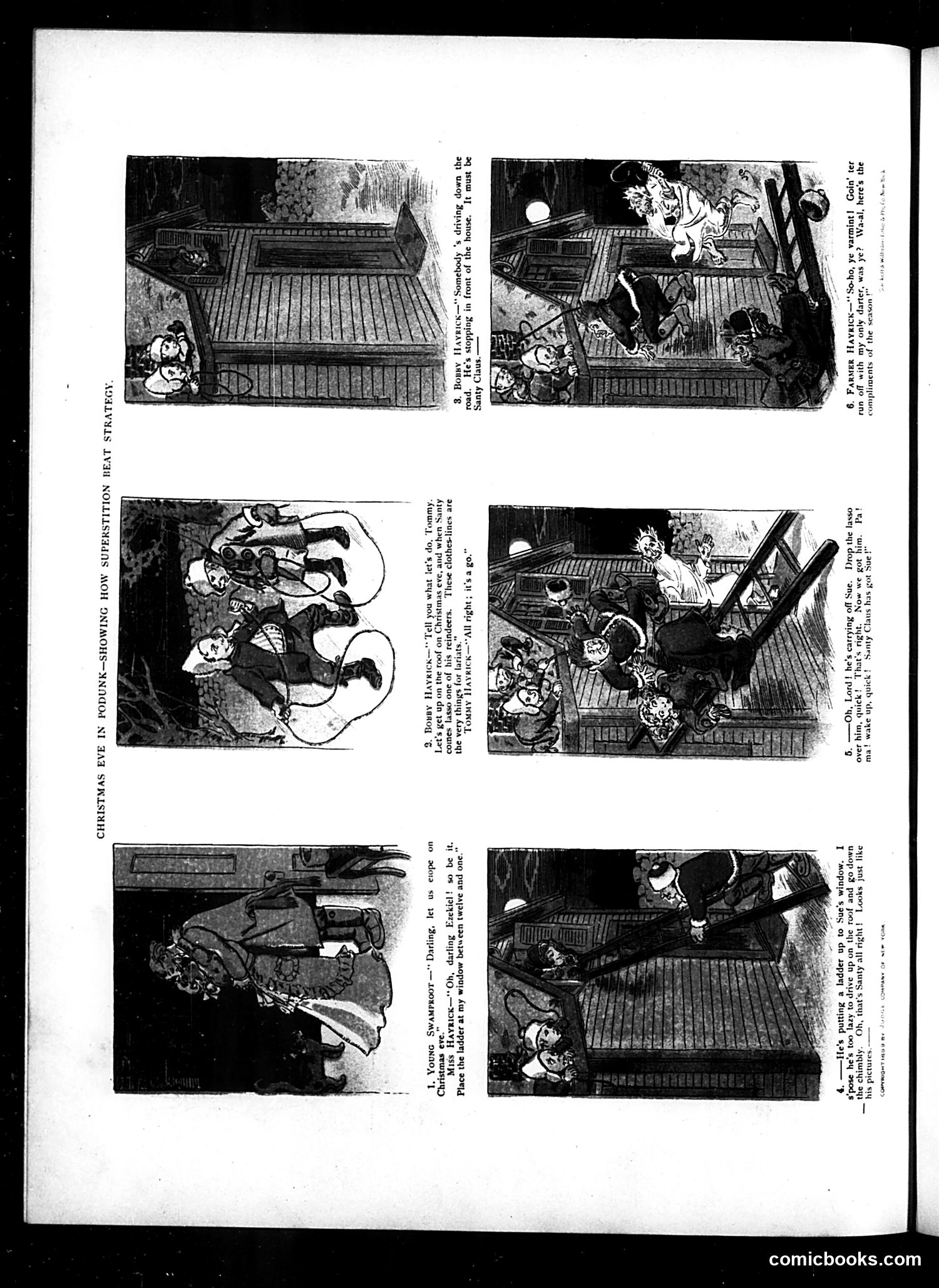
This appears to be a sequential cartoon story about Christmas poverty, likely from the early 20th century. The OCR text is heavily corrupted and largely illegible, making precise interpretation difficult. From the images, the narrative seems to depict impoverished families or children in tenement housing during the Christmas season—a common Judge magazine theme satirizing urban poverty and social inequality. The sequential panels show figures in what appears to be cramped domestic spaces with wooden floors and sparse furnishings. The satire likely critiques the contrast between Christmas ideals of generosity and the harsh realities faced by poor urban dwellers, or possibly mocks charitable efforts as insufficient. Without clearer text, the specific social commentary or political targets remain uncertain, though Judge frequently targeted both poverty conditions and inadequate social responses to them.
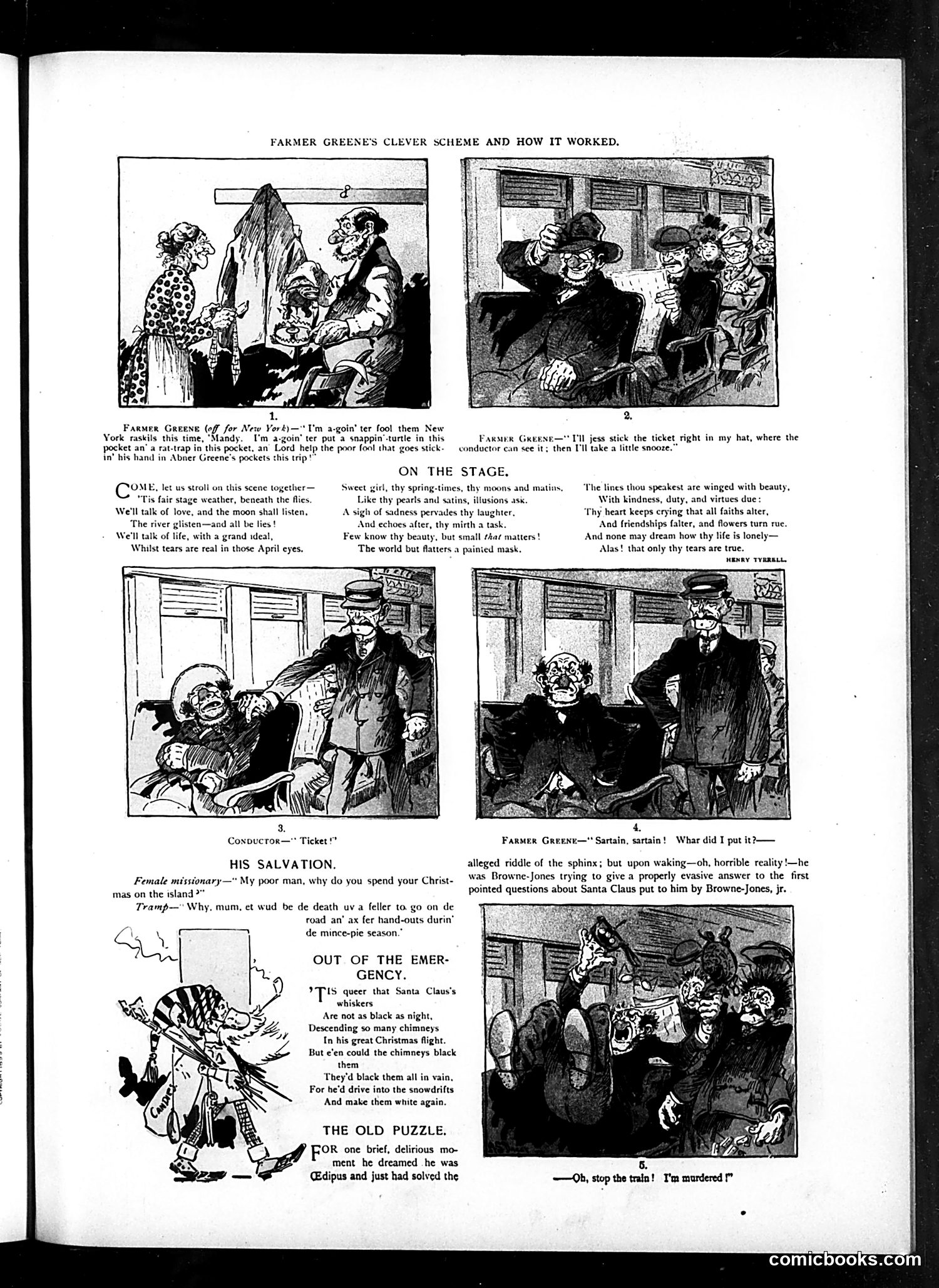
This page contains multiple satirical vignettes typical of Judge magazine's humor: **Main cartoon**: Farmer Greene plans to pickpocket-proof his pockets with a snapping turtle and rat trap—a slapstick joke about rural cunning. The scheme backfires when he absent-mindedly sticks his own hand in his pocket on a train. **"On the Stage"**: Mocks theatrical sentimentality—a conductor interrupts romantic stage dialogue demanding a ticket, deflating the dramatic pretense. **"His Salvation"**: A tramp explains he can't beg during Christmas because of the abundance of free food ("mince-pie season"), satirizing both poverty and holiday charity. **Other sections** include poems and brief jokes about Santa's soot-resistant whiskers, and a philosophical reference to Oedipus solving the sphinx's riddle. The humor is genteel, domestic satire targeting rural folly, theatrical pomposity, and Victorian sensibilities—typical of Judge's middle-class readership around the turn of the 20th century.
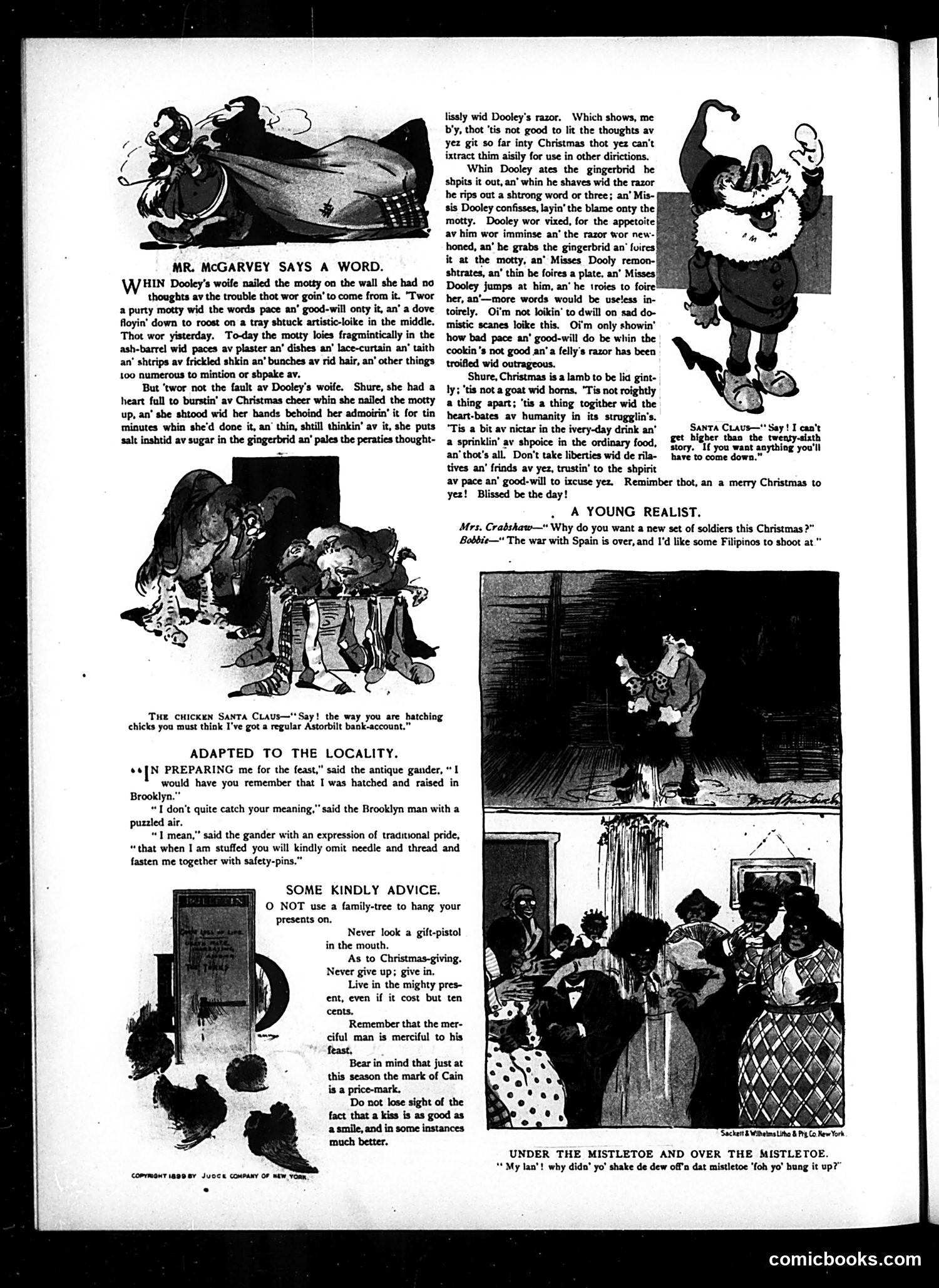
This page from Judge (an American satirical weekly) contains several Christmas-themed satirical pieces using Irish immigrant dialect humor, then-current political references, and social commentary. **"Mr. McGarvey Says a Word"** uses an Irish character's fractured English to humorously warn against letting Christmas sentiment distract from practical matters—Dooley's wife decorates with mistletoe while distracted, then accidentally uses his razor for cooking and salt instead of sugar, causing domestic chaos. **"A Young Realist"** jokes darkly about the recent Spanish-American War (1898): a child wants toy Filipino soldiers to shoot at, since "the war with Spain is over." This reflects contemporary attitudes toward American imperialism in the Philippines. Other sketches satirize Christmas excess: wealthy gift-giving ("Astorbilt bank-account"), Brooklyn working-class customs (using safety-pins instead of sewing), and humorous Christmas advice about avoiding family drama. The page reflects Judge's characteristic mix of ethnic humor, contemporary politics, and domestic satire aimed at middle-class readers.
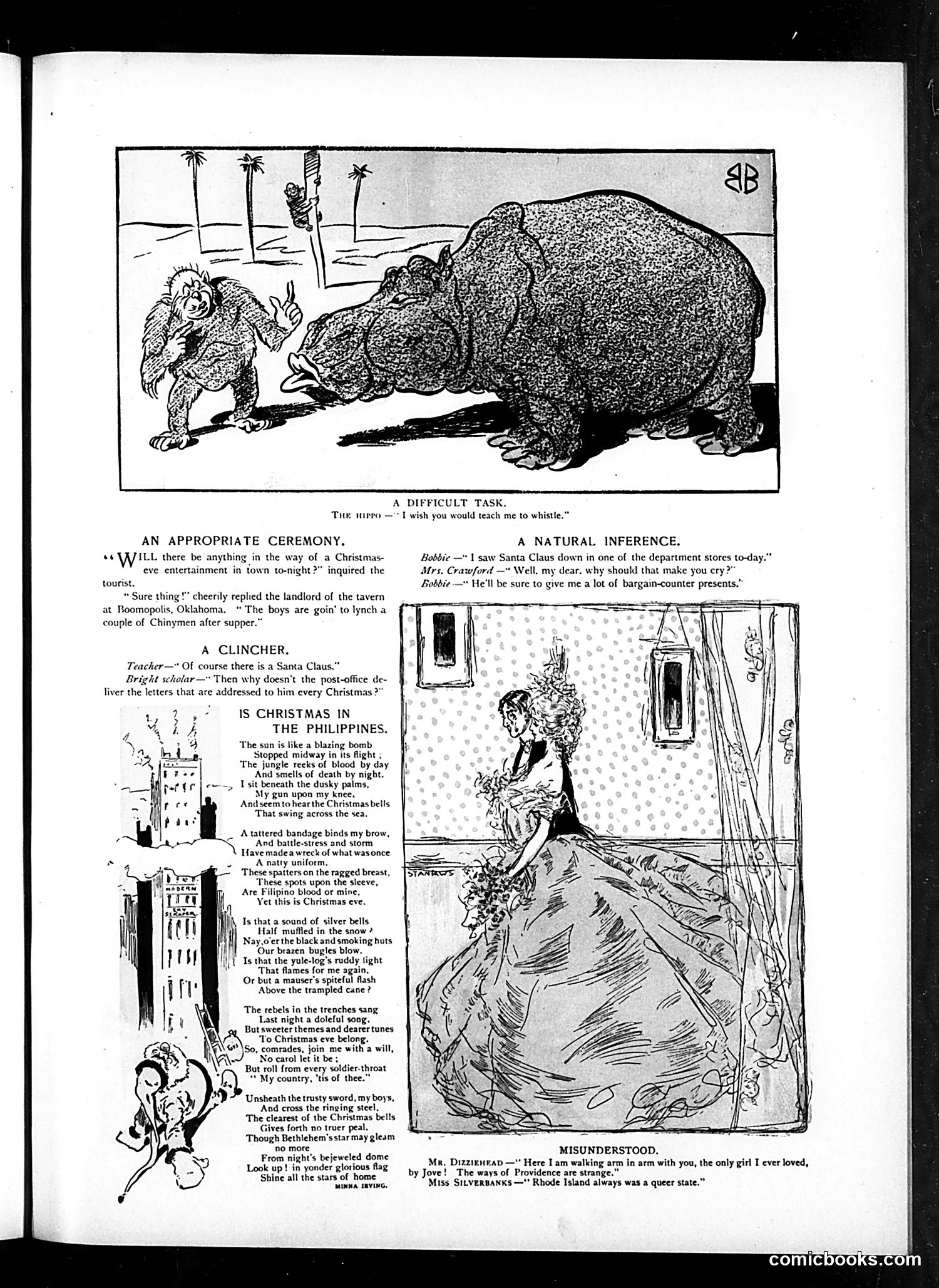
This page contains several satirical pieces reflecting late 19th/early 20th-century American attitudes: **"A Difficult Task"** depicts a hippopotamus and smaller animal—likely satirizing racial dynamics through animal metaphor, though the specific reference is unclear. **"An Appropriate Ceremony"** mocks casual violence: a tavern owner describes lynching Chinese immigrants as evening entertainment. This reflects the virulent anti-Chinese racism of the era, presented as darkly comic. **"Christmas in the Philippines"** is a poem about American soldiers in the Philippine-American War (1899-1902), contrasting holiday sentiment with brutal combat. It critiques the disconnect between home and imperial warfare. **"A Natural Inference"** jokes about department-store Santas and cheap gifts—commentary on commercialized Christmas. **"Misunderstood"** is a mild romantic joke where a woman's reference to "Rhode Island" being queer confuses a suitor's sentimental moment. The page illustrates Judge's satirical approach: mixing crude racial humor with political criticism of American imperialism and commercialism.
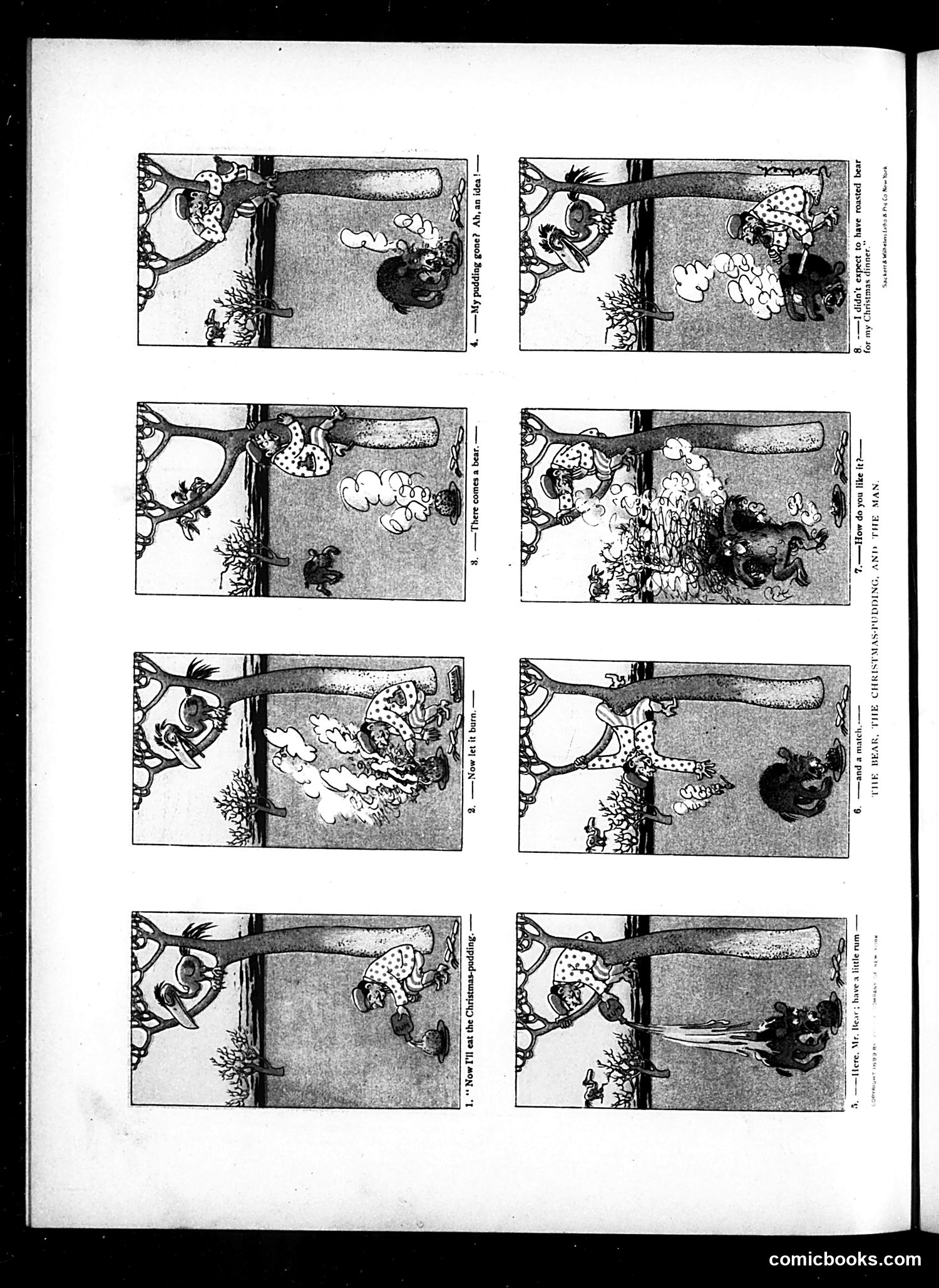
I can see this page contains eight sequential comic panels arranged in two columns, appearing to tell a narrative story. The images show characters in what appears to be early 20th-century dress and settings, with decorative borders featuring Art Nouveau-style designs on the left side of each panel. However, the OCR text provided is largely corrupted and illegible ("eae meW OD YB eRT OG"), making it impossible to identify the specific political or social references, character names, or the satirical point of the cartoon. Without readable captions or titles, I cannot reliably explain what figures are being caricatured or what contemporary issues are being satirized. To provide accurate historical context, I would need clearer text or additional identifying information about this cartoon's publication date and title.
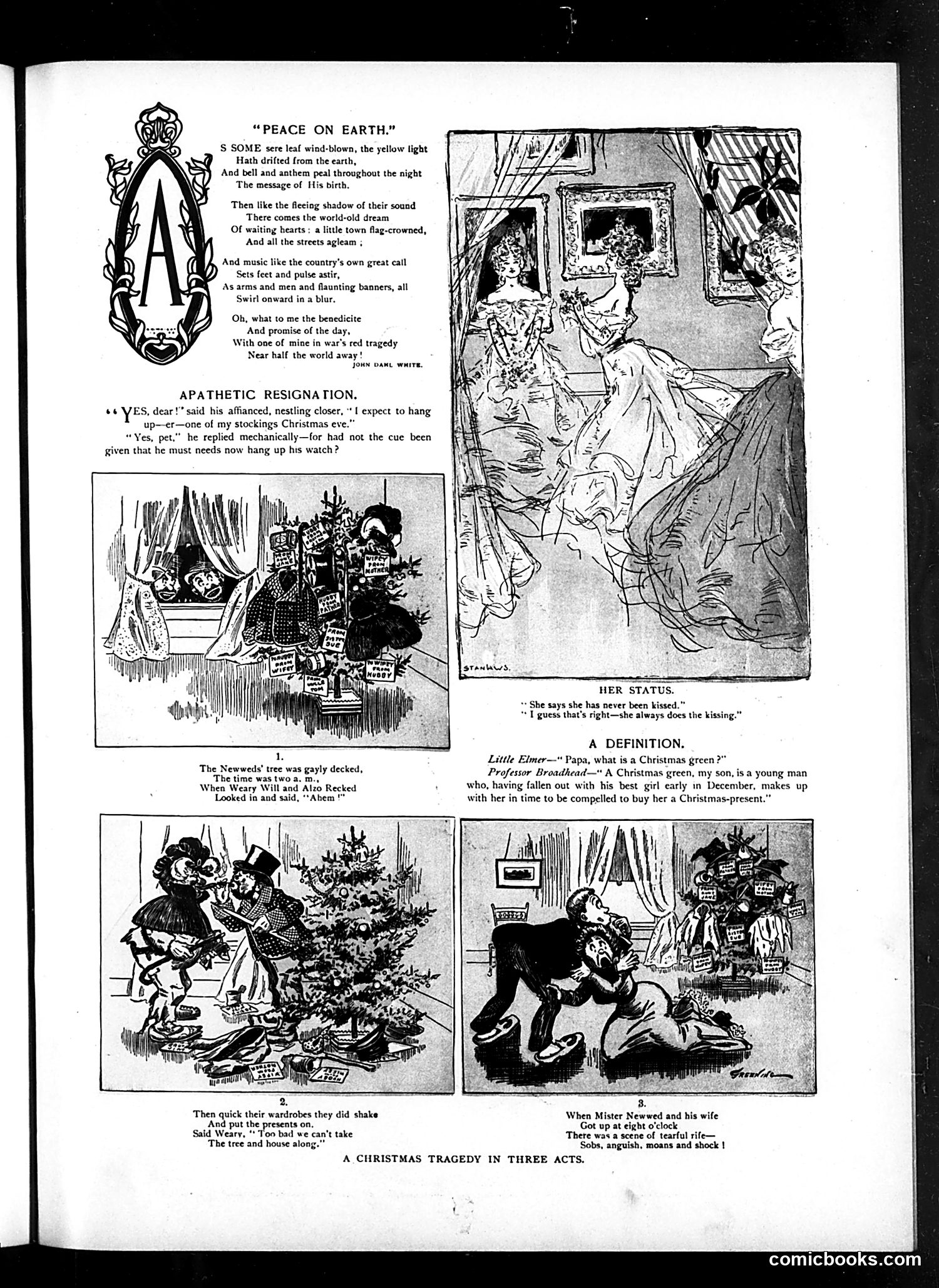
The page contains multiple Christmas-themed satirical pieces from Judge magazine: **"Peace on Earth"** (top) is a sentimental poem by John Darl White contrasting the holiday's promise of peace with the reality of war—specifically referencing a loved one "in war's red tragedy / Near half the world away," likely alluding to WWI. **"Apathetic Resignation"** mocks newlyweds where the fiancé mechanically agrees to Christmas stocking-hanging, having been told he "must needs now hang up his watch"—suggesting male resignation to domestic obligations. **"A Christmas Tragedy in Three Acts"** depicts newlyweds decorating at 2 a.m., wishing they could take "the tree and house along," culminating in morning "tearful rife" and "shock"—satirizing marriage's disillusionment. **"A Definition"** jokes that a "Christmas green" is a young man who quarrels with his girlfriend in December but reconciles to secure a gift obligation. **"Her Status"** is a brief quip about a woman who "always does the kissing," implying female dominance in romance. The overall theme mocks Christmas's sentimental expectations versus grim reality—war, marital discord, and commercial obligation.
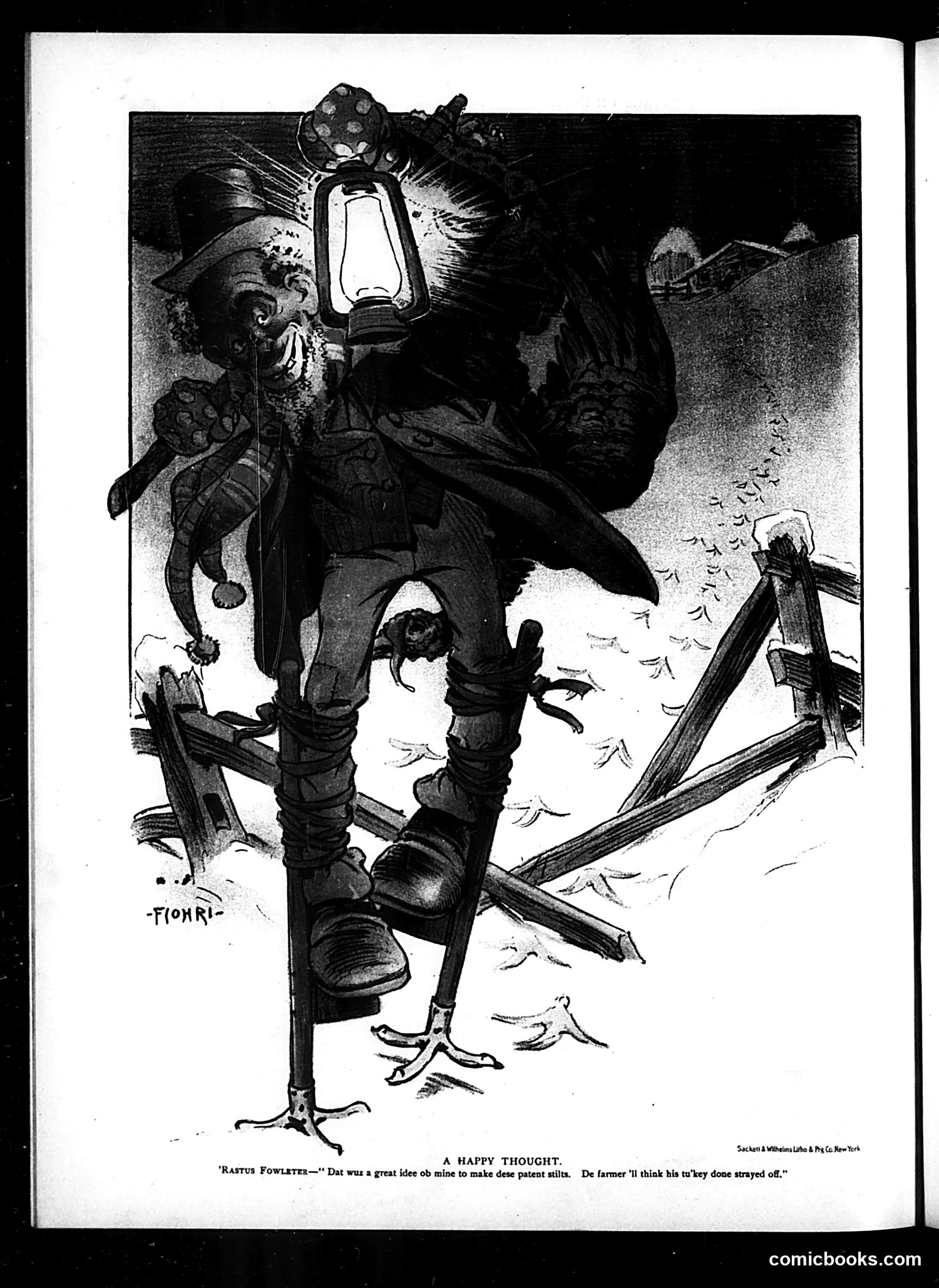
This cartoon satirizes a Black character named "Rastus Fowleter" who has invented patent stilts to disguise himself as a tall turkey. The joke plays on racial stereotypes common to the era: a Black person attempting theft through crude deception. The farmer will supposedly mistake the stilt-walker for a stray turkey, allowing the character to steal poultry. The satire targets both the character's supposed criminal scheming and the absurdity of the "invention"—patent stilts as a theft tool. This reflects Judge's frequent use of racist caricature and dialect for comedic effect, typical of late-19th/early-20th-century American satire that relied heavily on minstrelsy stereotypes. The cartoon offers no social criticism; it simply weaponizes racist humor.
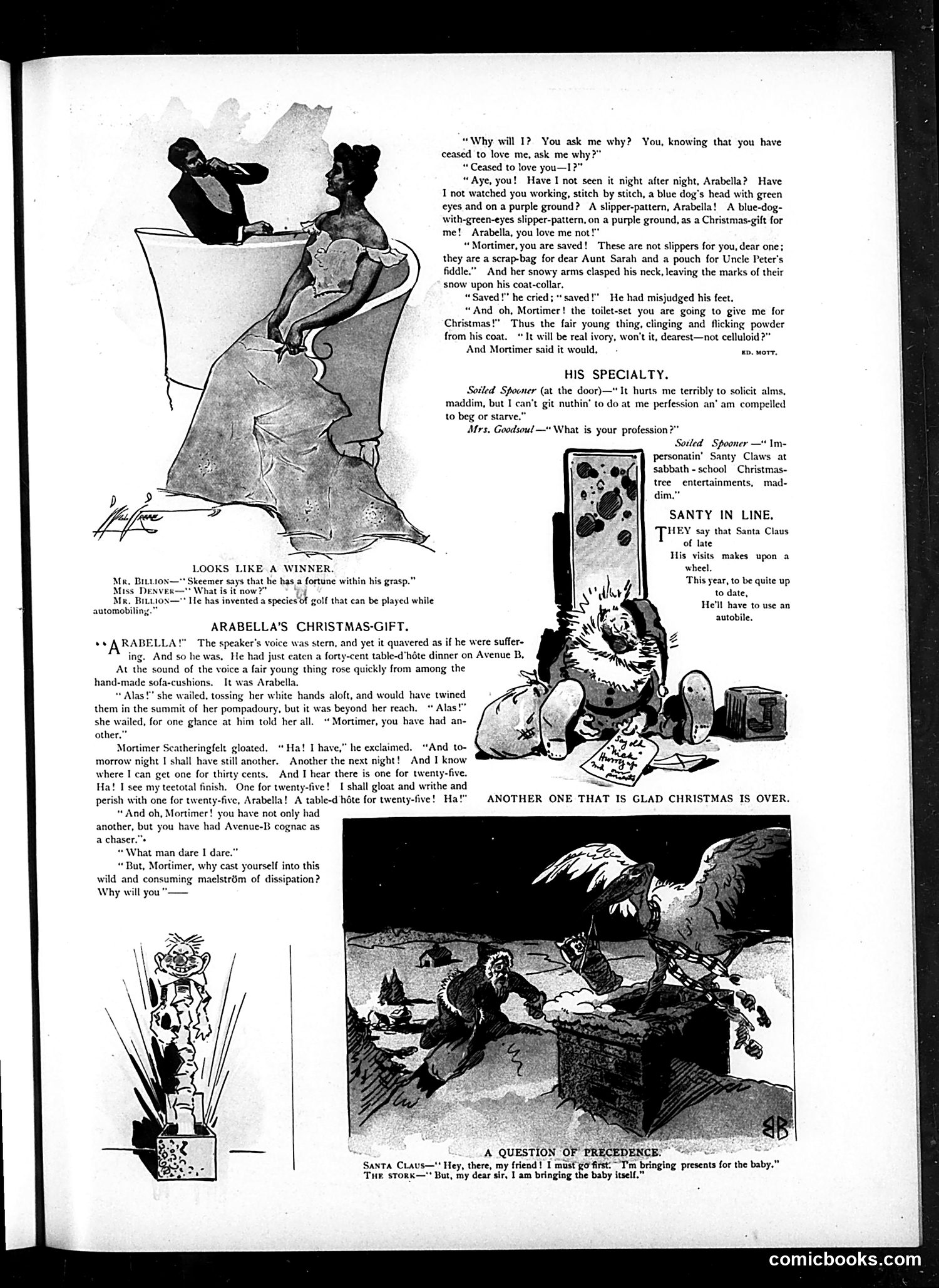
This page contains three distinct humorous pieces typical of early 20th-century American satire: **"Arabella's Christmas Gift"** is a domestic comedy about Mortimer, who mistakenly believes his wife has stopped loving him after spotting her embroidering a blue dog slipper-pattern. She reveals it's actually a gift container for relatives, not him. The joke satirizes male jealousy and misreading domestic signals. **"His Specialty"** mocks economic hardship—a destitute man reveals his "profession" is impersonating Santa Claus at church Christmas events, now forced to beg. **"Santy in Line"** comments on modernization: Santa Claus now visits "upon a wheel" (automobile) rather than by traditional sleigh. **"A Question of Precedence"** depicts Santa and the Stork arguing over delivery priority—the Stork carries the actual baby while Santa brings gifts, debating who should go first. This reflects contemporary anxieties about changing traditions amid rapid industrialization. The illustrations use period line-drawing style typical of Judge's satirical humor.
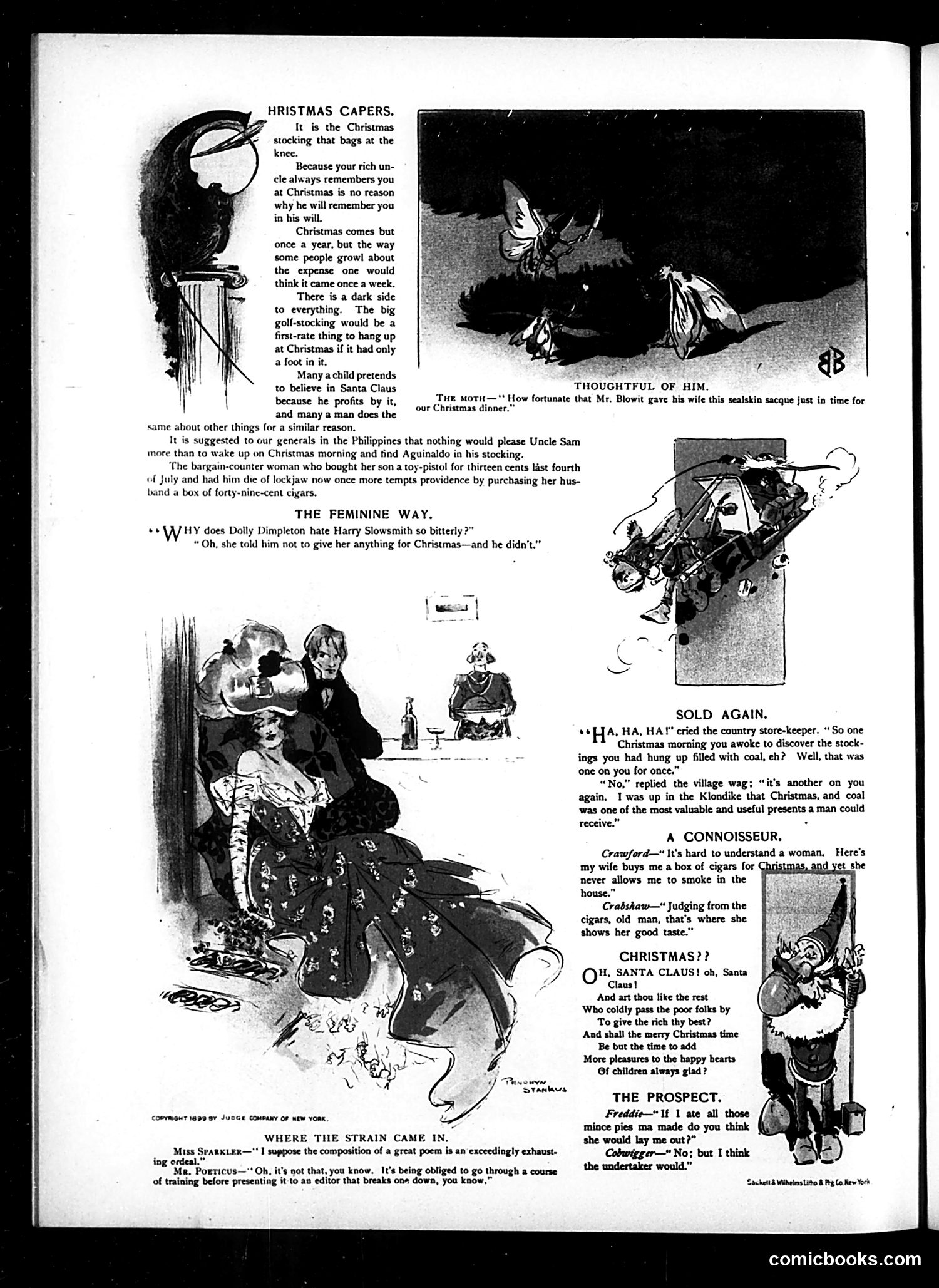
This 1899 *Judge* page collects holiday-themed satirical commentary targeting various social behaviors and hypocrisies. **Key sections:** "Christmas Capers" mocks wealthy relatives who give gifts but exclude the poor from their wills, and wealthy Americans generally complaining about holiday expenses. It references the Philippine-American War, joking that capturing insurgent leader Aguinaldo would be an ideal Christmas gift. "The Feminine Way" ridicules women's logic: Dolly Dimpleton spurns Harry Slowsmith's gifts by forbidding him to give anything—then resents that he complied. "Sold Again" features a country store-keeper tricking a village man about coal in stockings, but the man claims coal was valuable during the Klondike Gold Rush. "A Connoisseur" satirizes a wife who buys her husband cheap cigars for Christmas but forbids him smoking indoors—suggesting she knows their poor quality. The page ultimately critiques wealth inequality, domestic power dynamics, and materialistic Christmas observance.
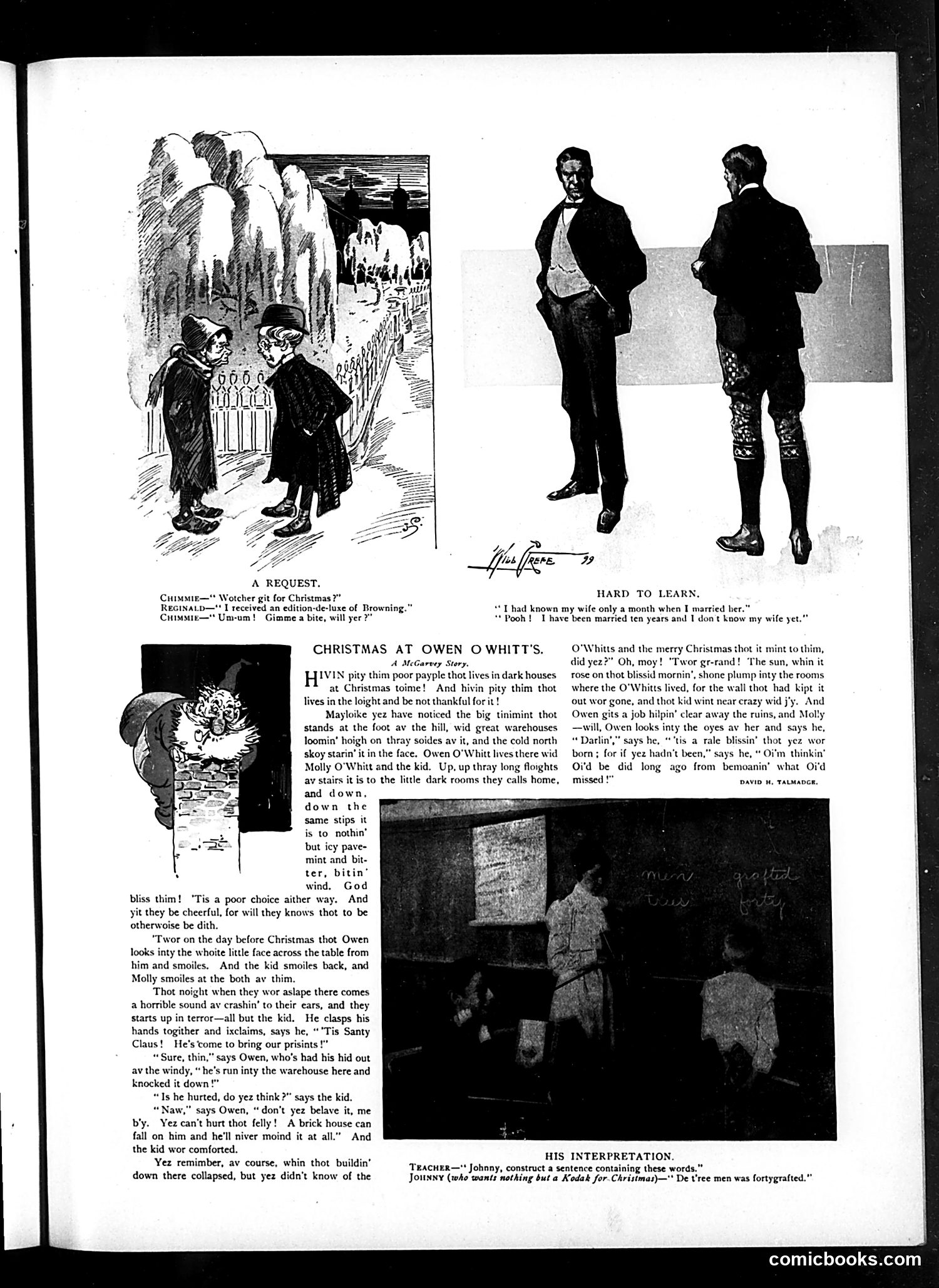
This page contains three separate humorous pieces: **"Hard to Learn"**: A cartoon about marriage incomprehension—two men discuss how one barely knew his wife after a month of marriage, while the other admits ten years in and still doesn't know his wife. It satirizes the supposed mystery of married life. **"A Request"**: Street urchins (indicated by dialect spelling) ask wealthier boys what they received for Christmas. One got a deluxe edition of Browning poetry; the poor child just wants a bite to eat. The satire mocks class disparity at Christmastime. **"Christmas at Owen O'Whitt's"**: A sentimental Irish-dialect story about poor tenement dwellers. A warehouse fire destroys nearby property, and sunlight finally enters their dark apartment. Owen's family finds joy despite poverty. The final section, "His Interpretation," shows a schoolboy misunderstanding the word "forfeited" as "fortygrafted"—a joke about working-class children's limited education. The page overall contrasts wealth and poverty, particularly during Christmas.
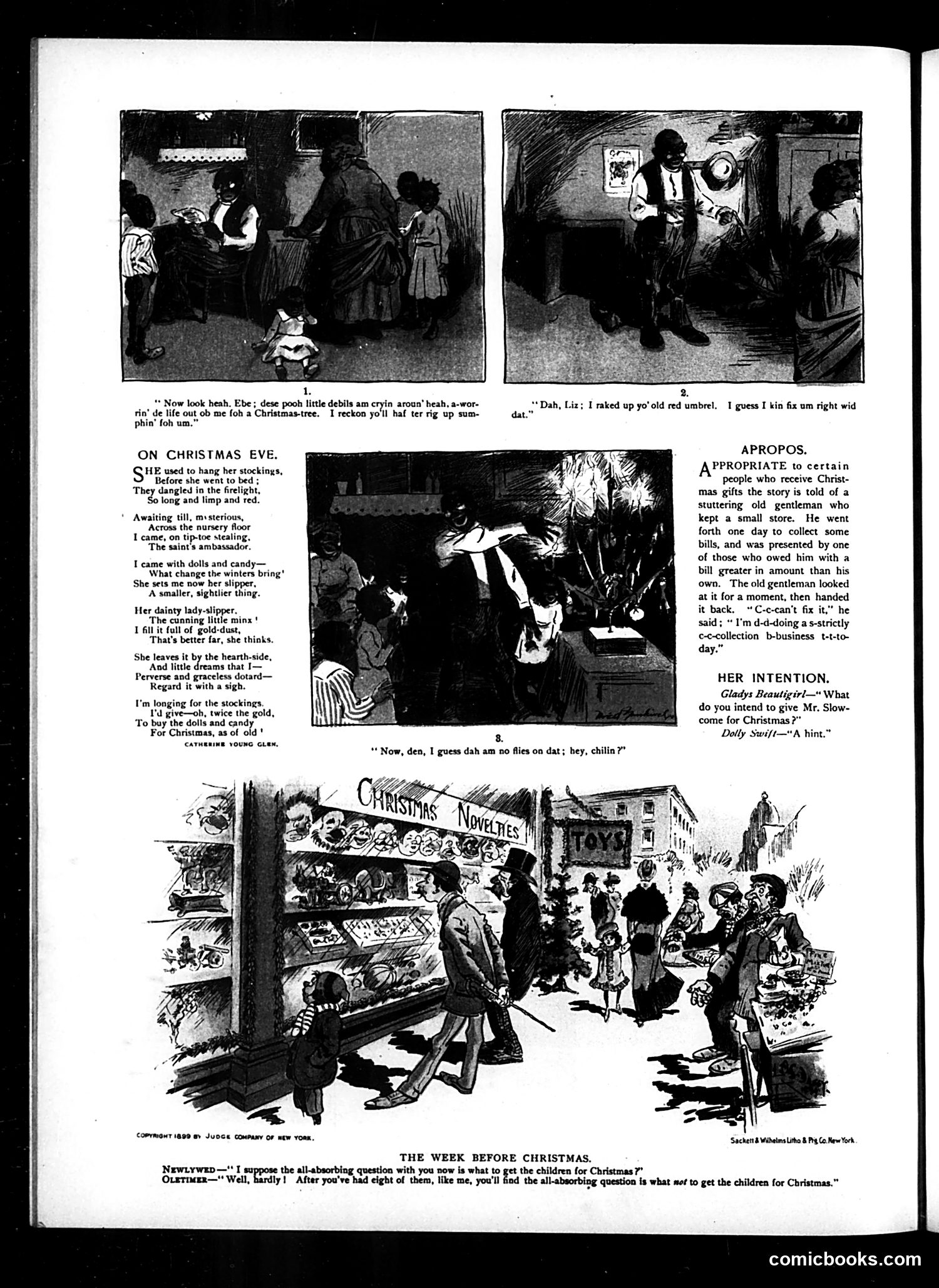
This page contains multiple Christmas-themed satirical pieces: **"On Christmas Eve"** is a sentimental poem about aging—a father reflecting on how his grown daughter no longer hangs stockings but now leaves out slippers for gifts. The satire gently mocks how children mature and tastes change, with the father nostalgic for the simpler days of dolls and candy. **The two top comic panels** appear to depict working-class or poor families during Christmas, with dialect-heavy speech suggesting ethnic caricature (common in period Judge humor). The humor focuses on the financial strain of providing Christmas for children. **"The Week Before Christmas"** contrasts two characters debating what *not* to buy children—satirizing both the commercialization of Christmas and parental overwhelm. **The shop window illustration** shows crowds of Christmas shoppers at a toy store, likely satirizing consumer frenzy. **"Apropos" and "Her Intention"** are brief comic anecdotes about gift-giving awkwardness—one about a stuttering storekeeper, another about a woman giving her boyfriend nothing. Overall, the page satirizes Christmas commercialism, family dynamics, and economic anxiety surrounding holiday gift-giving.
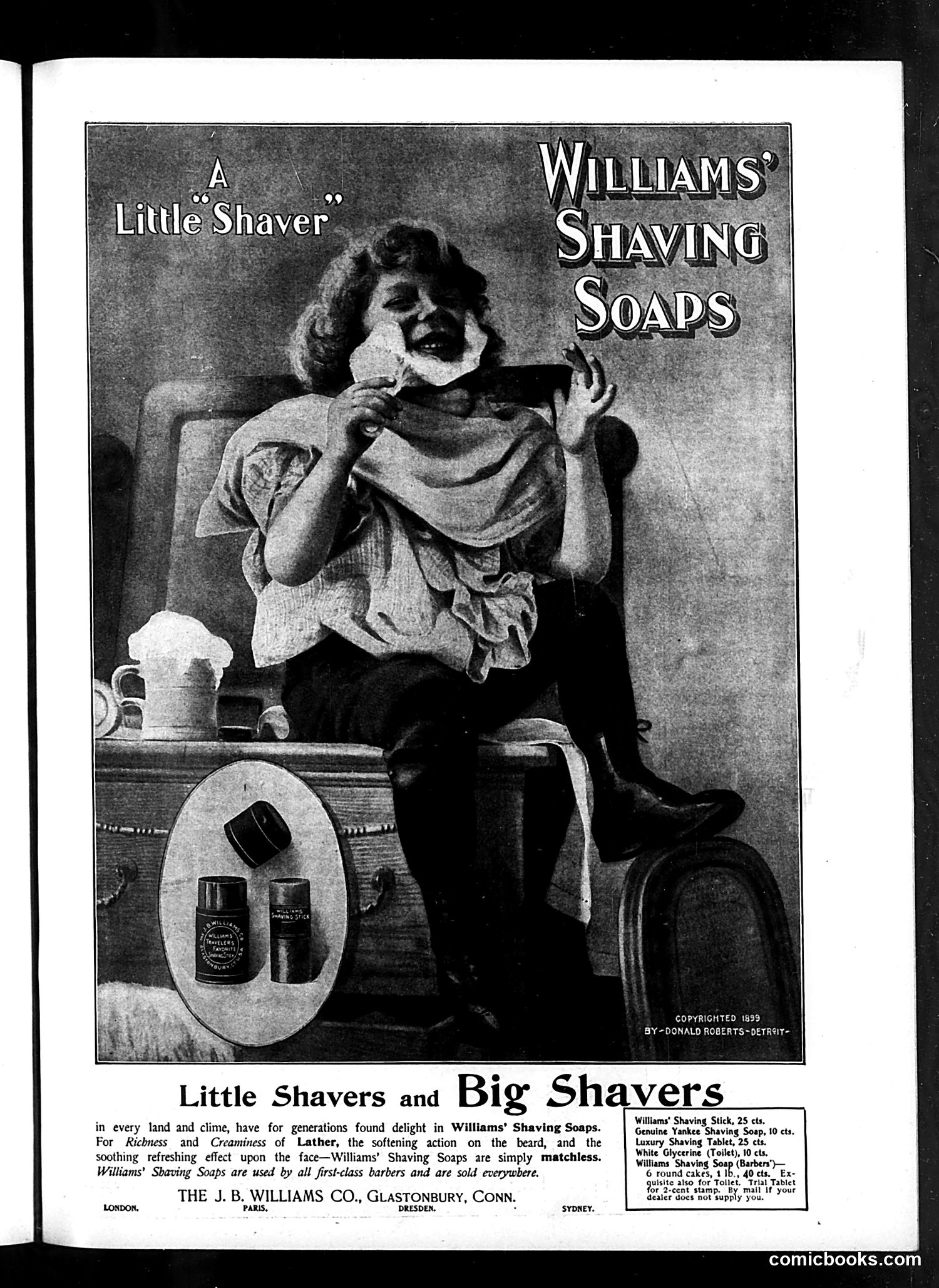
This is primarily a **product advertisement**, not political satire. It advertises Williams' Shaving Soaps, copyrighted 1899. The image shows a young child (a "little shaver"—using "shaver" as a pun for both a young boy and shaving) examining shaving products at a vanity. The advertisement plays on the phrase "Little Shavers and Big Shavers," suggesting the soap appeals to all ages and users. The text emphasizes the soap's qualities: richness, creaminess of lather, softening action on beards, and soothing effects. It notes the products are "used by all first-class barbers and are sold everywhere." There is **no political or social satire** evident. This is straightforward commercial advertising from Judge magazine, listing various Williams soap products and prices. The humor is mild—simply the pun on "shaver" applied to a child.
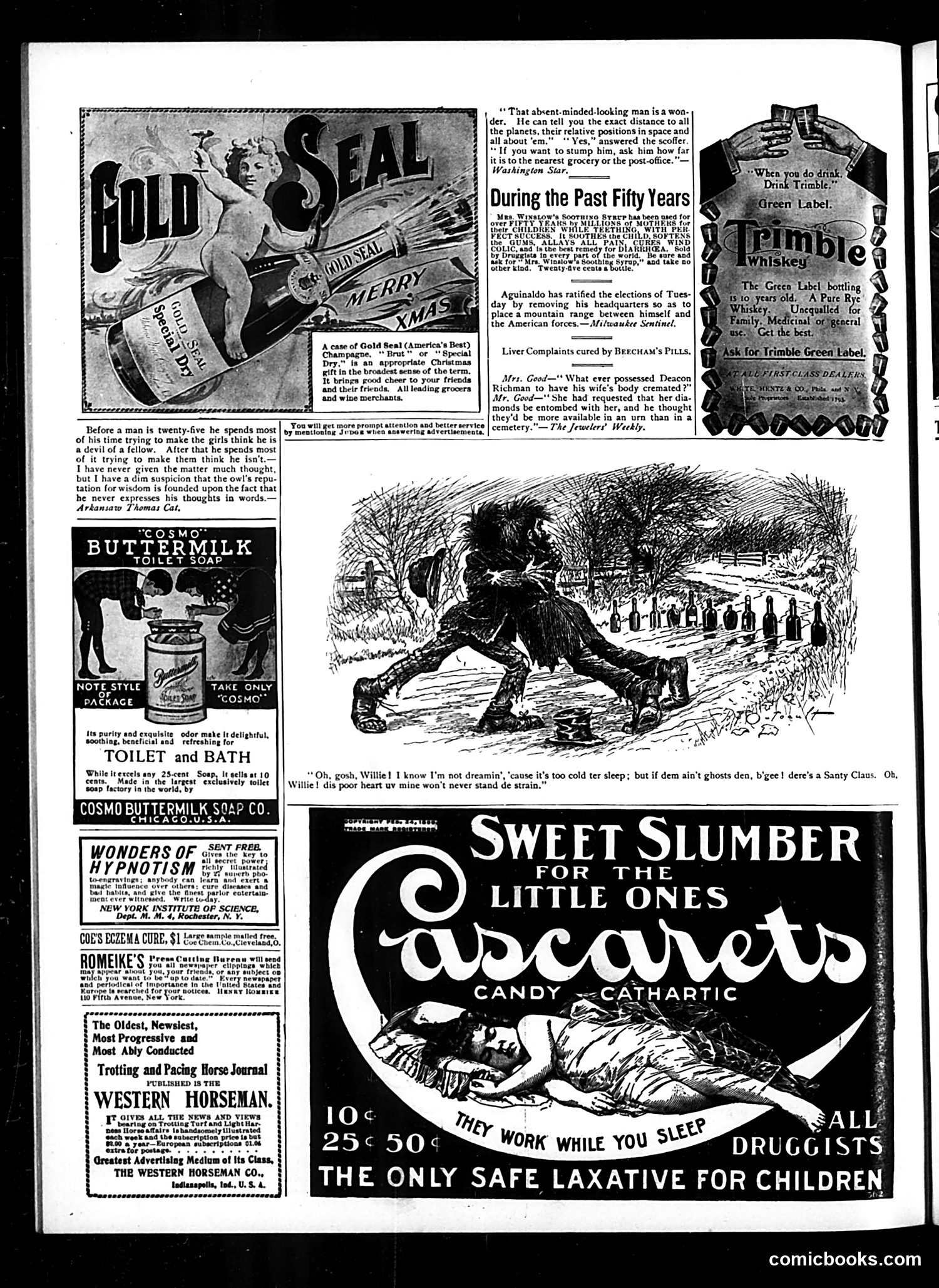
This is primarily an **advertising page** from Judge magazine, with a small cartoon and brief humorous anecdotes. The main cartoon depicts a poor child in winter, frightened by what he believes are ghosts near a cemetery—though the caption suggests they're actually Santa Claus. The joke plays on the child's poverty and fear; he's so cold he can't sleep, and his emotional distress ("dis poor heart uv mine") adds pathos to the humor. The dialect suggests a working-class or immigrant child. The page is dominated by **period product advertisements**: Gold Seal champagne, Cosmo Buttermilk soap, Cascaret laxatives (marketed as safe for children), and horse-racing publications. The **brief text items** include newspaper jokes about absent-minded professors, romantic advice about male behavior, and a satirical note about **Aguinaldo** (Filipino insurgent leader Emilio Aguinaldo), mocking his retreat from American forces during the Philippine-American War. The advertising and content reflect early 1900s consumer culture and American imperial attitudes.
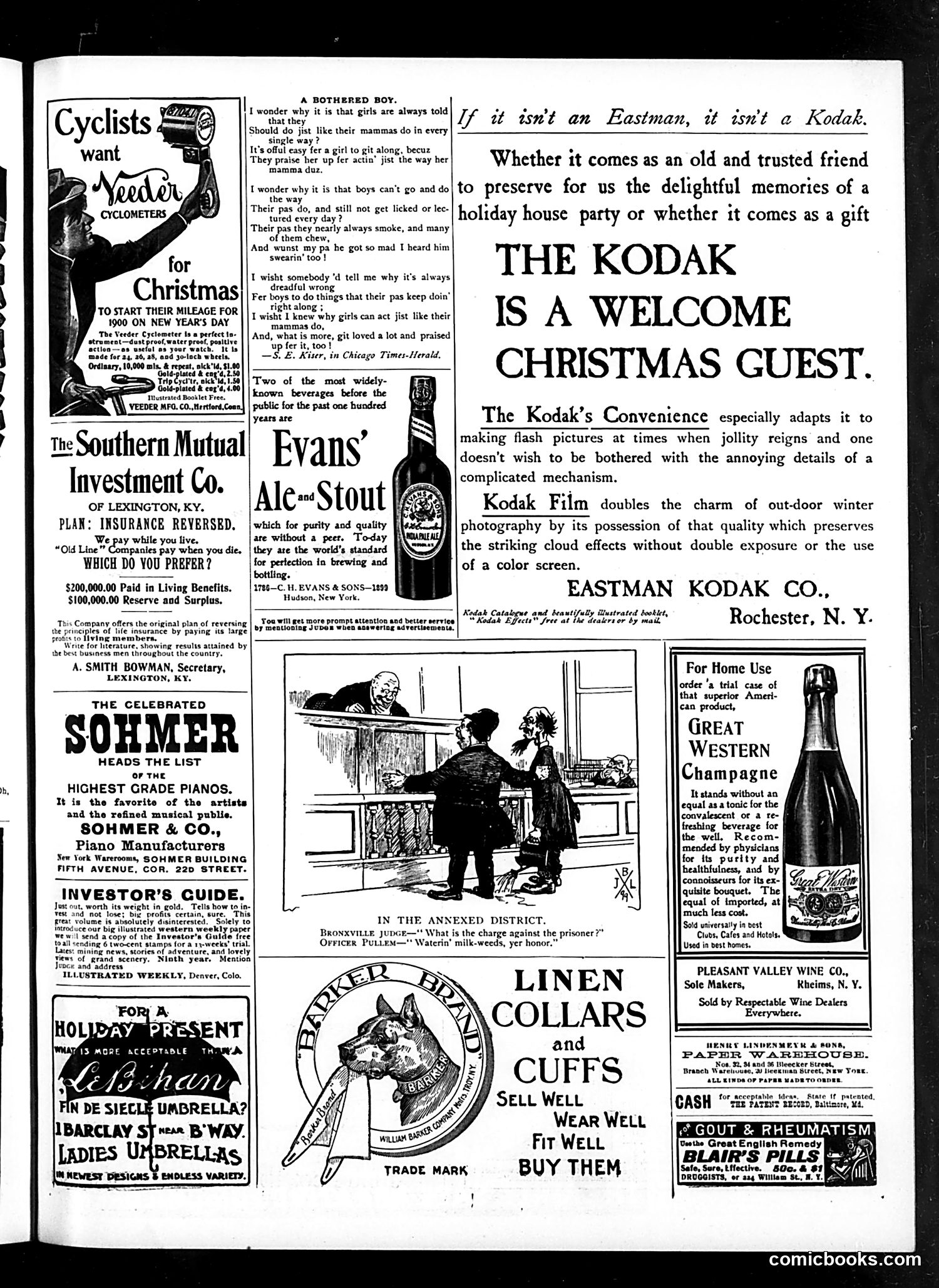
This page is predominantly **advertising**, typical of American magazines from the 1900 era. The content includes: **The Notable Cartoon:** "In the Annexed District" depicts a Bronxville courtroom scene—a dated joke about local jurisdiction following annexation of territories to New York City. The humor relies on the stereotype that newly-annexed areas had simpler, less sophisticated problems (hence "watering milk-weeds"). **"A Bothered Boy" Poem:** This satirizes the perceived double standard in child-rearing: girls are praised for imitating their mothers; boys are punished for imitating their fathers (who smoke, chew tobacco, and swear). The author uses a child's voice to critique this inconsistency in Victorian moral training. **Advertisements:** Kodak cameras (promoting "flash pictures" for holiday entertainment), pianos, insurance, champagne, and patent medicines dominate the page—reflecting early 1900s consumer culture and middle-class aspirations. The page reflects turn-of-century concerns about propriety, gender socialization, and emerging consumer technology.
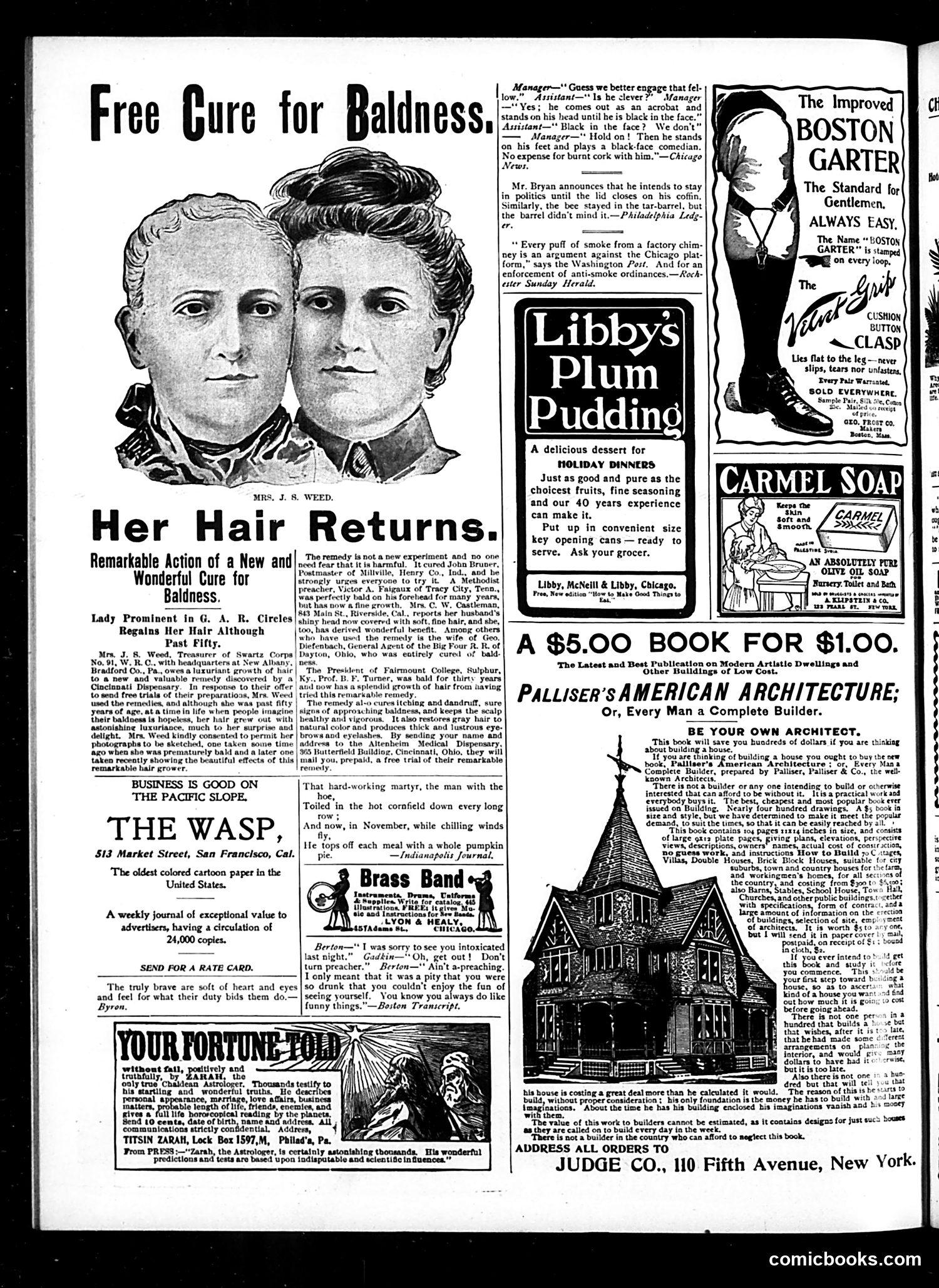
This page from *Judge* magazine is primarily advertisements and filler material, with a few satirical items: **Main Content - "Free Cure for Baldness"**: A testimonial advertisement for a hair-growth remedy from the Altenheim Medical Dispensary (Cincinnati). Features before-and-after portraits of Mrs. J.S. Weed, a 50+ year-old woman. This reflects the era's genuine market for baldness "cures"—many fake remedies were aggressively marketed to desperate customers. **Political/Satirical Items**: Brief jokes referencing William Jennings Bryan (appearing to criticize his political staying power) and Chicago's smoke pollution problem, typical of *Judge's* regular satirical commentary. **Advertisements**: Boston Garter (suspenders), Libby's Plum Pudding, Carmel Soap, Palliser's architecture book, fortune-telling, and a brass band instrument catalog—representative consumer goods of the early 1900s. The page reflects *Judge's* business model: mixing political satire with profitable patent medicine and product advertising, which was common in American magazines of this period.
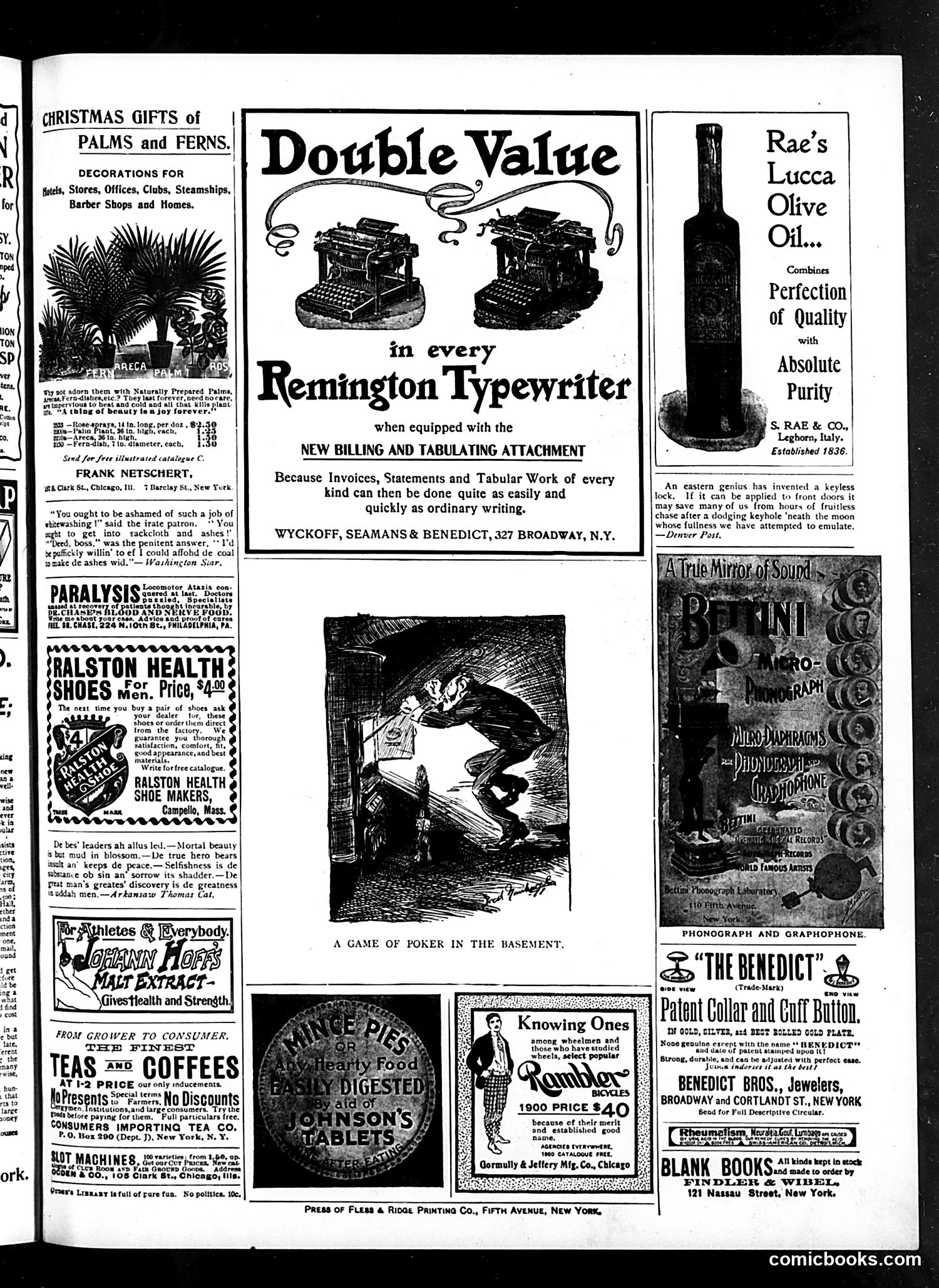
This page is primarily **advertisements** with one cartoon illustration. The dominant feature is a full-page ad for **Remington Typewriters**, emphasizing their "Double Value" when equipped with a new billing and tabulating attachment—a selling point for businesses handling invoices and statements. The only cartoon present is titled **"A Game of Poker in the Basement,"** showing a figure in formal dress apparently caught cheating or losing at cards in a basement setting. The humor appears to rely on social embarrassment—a gentleman in a compromising position—though without additional context, the specific satirical point is unclear. The remaining content consists of period advertisements: health shoes, olive oil, tea/coffee importing, malt extract, phonographs, bicycles, jewelry, and blank books. These reflect early 1900s consumer goods and services. The ads employ typical era marketing tactics: health claims, price emphasis, and appeals to quality and respectability.
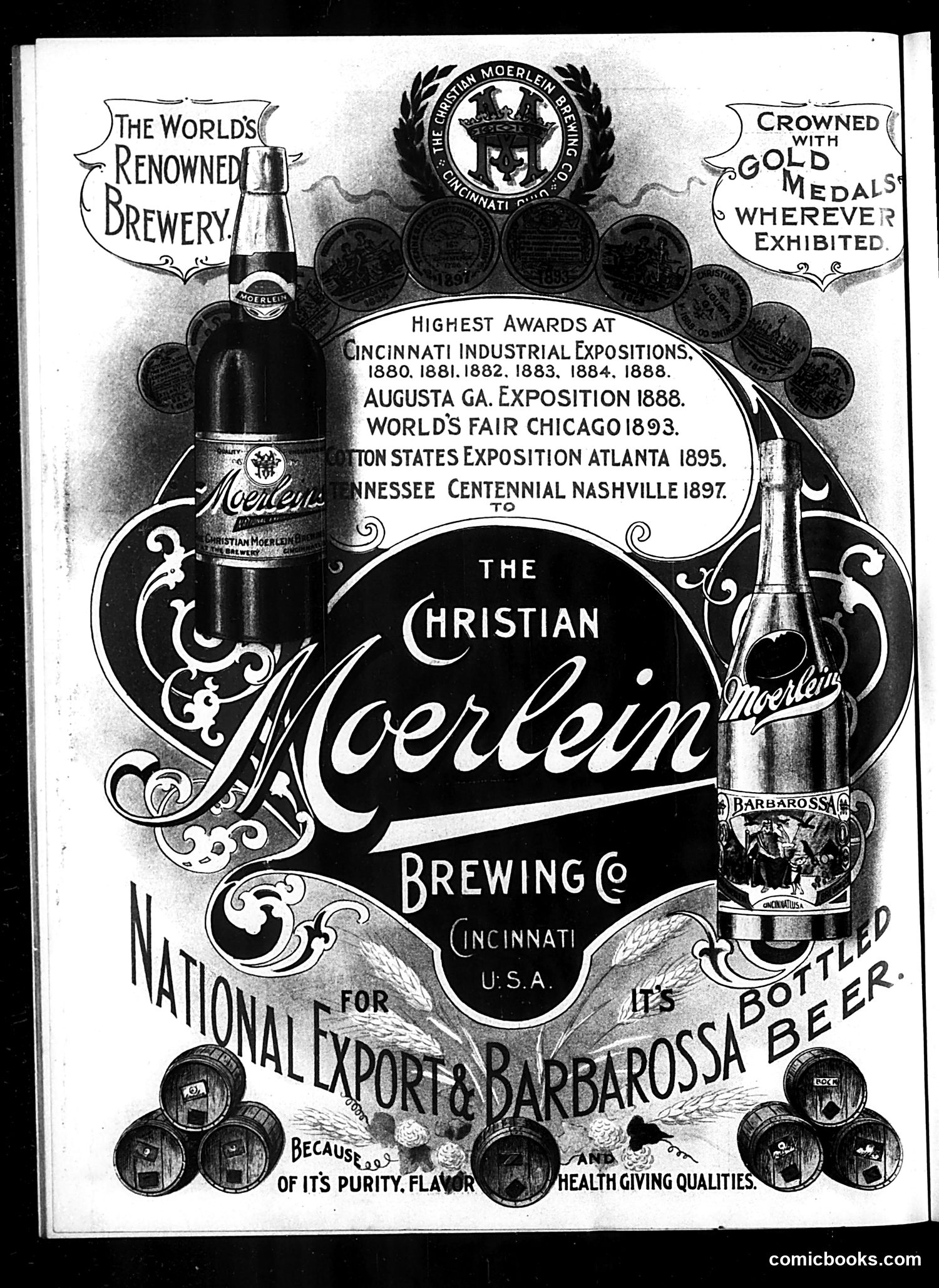
This is primarily a **beer advertisement**, not political satire. It promotes the Christian Moerlein Brewing Company of Cincinnati, a real brewery that operated in the late 1800s. The page showcases the brewery's prestige through lists of major awards won at industrial expositions and world's fairs from 1880-1897, including the famous 1893 Chicago World's Fair. The ornate design features beer bottles and medals arranged around the company name, emphasizing quality and national/international recognition. The word "Christian" in the brand name likely referenced the brewery's German heritage (common among Cincinnati breweries), not religious content. The text emphasizes "purity, flavor, and health giving qualities"—standard marketing language for beers of that era, when some brewers made health claims. This represents late-Victorian commercial advertising rather than editorial satire.