
A complete issue · 67 pages · 1922
Captain Billy's Whiz Bang #32
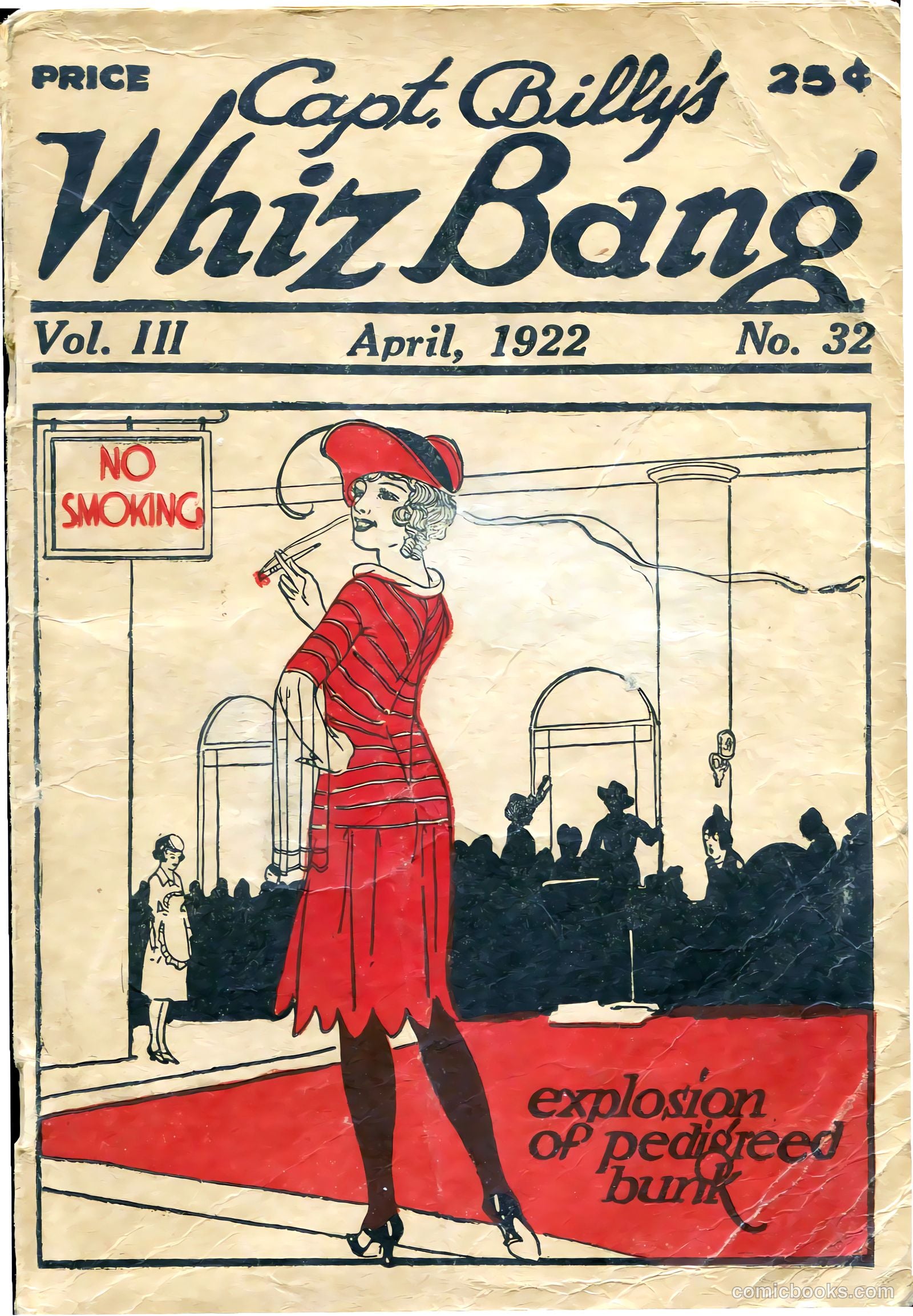
This is a cover illustration for *Captain Billy's Whiz Bang*, a satirical magazine from April 1922. The main image depicts a woman in a red dress smoking a cigarette at what appears to be a public venue or pool hall, directly beneath a prominent "NO SMOKING" sign. Small figures in the background suggest an audience. The caption "explosion of pedigreed bunk" sarcastically comments on the contradiction: the woman brazenly violates the no-smoking rule, implying that such rules are pretentious nonsense ("pedigreed bunk"). This likely satirizes 1920s attitudes toward smoking restrictions or women's behavior during the Jazz Age. The illustration captures the era's conflict between social conventions and the emerging modernity of the "Roaring Twenties," particularly regarding women's increasing public independence and defiance of traditional restrictions.
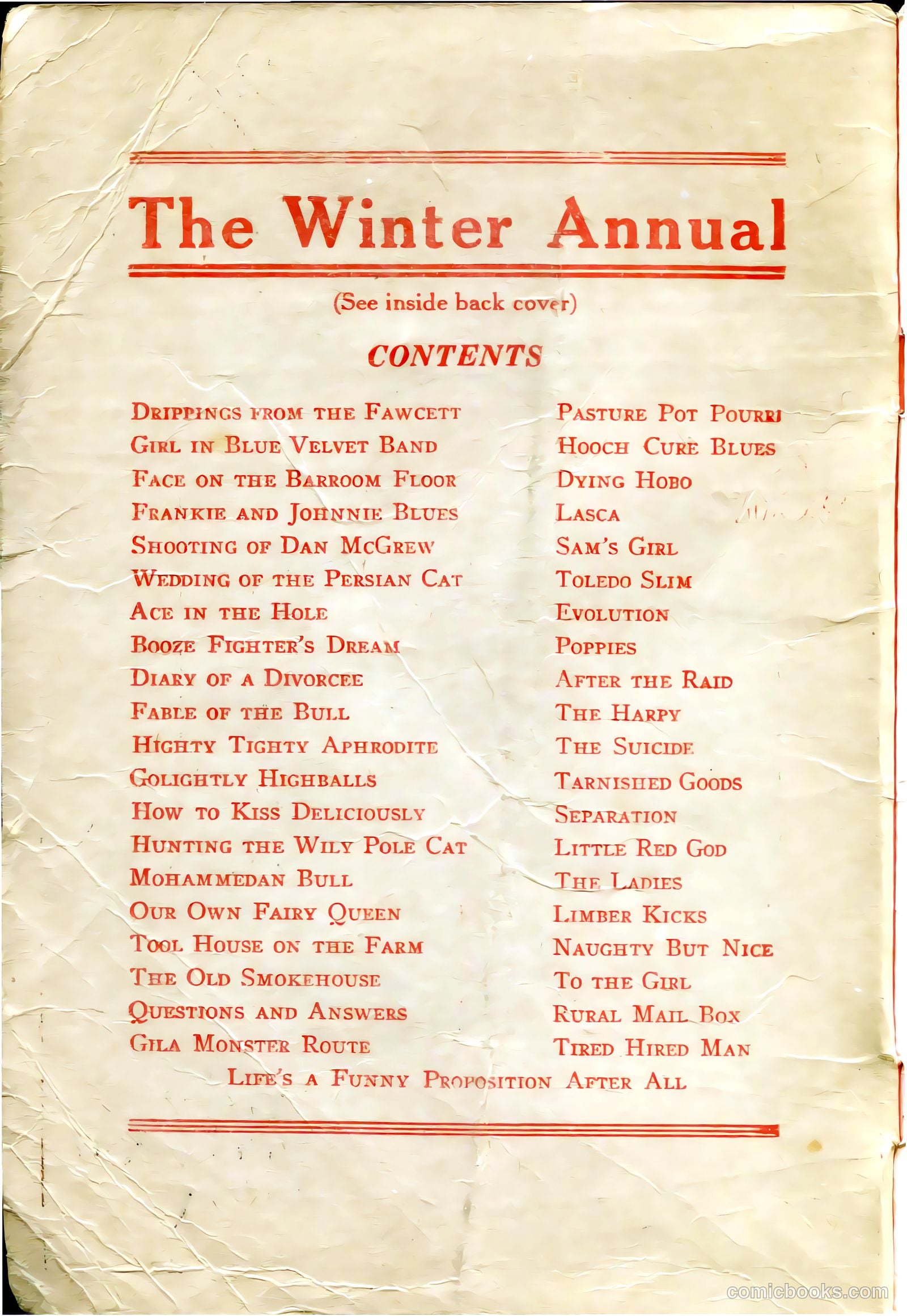
This is a title/contents page from *Whiz-Bang*, a 1920s satirical magazine. It's not a cartoon itself, but a catalog listing humorous stories and sketches for the winter issue. The titles reveal the magazine's irreverent humor targeting post-WWI American life: references to Prohibition-era drinking ("Hooch Cure Blues," "Booze Fighter's Dream"), sexual innuendo ("How to Kiss Deliciously," "Naughty But Nice"), scandalous social issues ("Diary of a Divorcee," "Tarnished Goods," "The Suicide"), and rural/working-class life ("Tired Hired Man," "Tool House on the Farm"). Some titles parody famous poems ("The Shooting of Dan McGrew," "Face on the Barroom Floor"). The overall tone mocks middle-class morality and embraces irreverent humor about sex, alcohol, and social hypocrisy—typical of *Whiz-Bang*'s reputation as a bawdy, iconoclastic publication of the era.
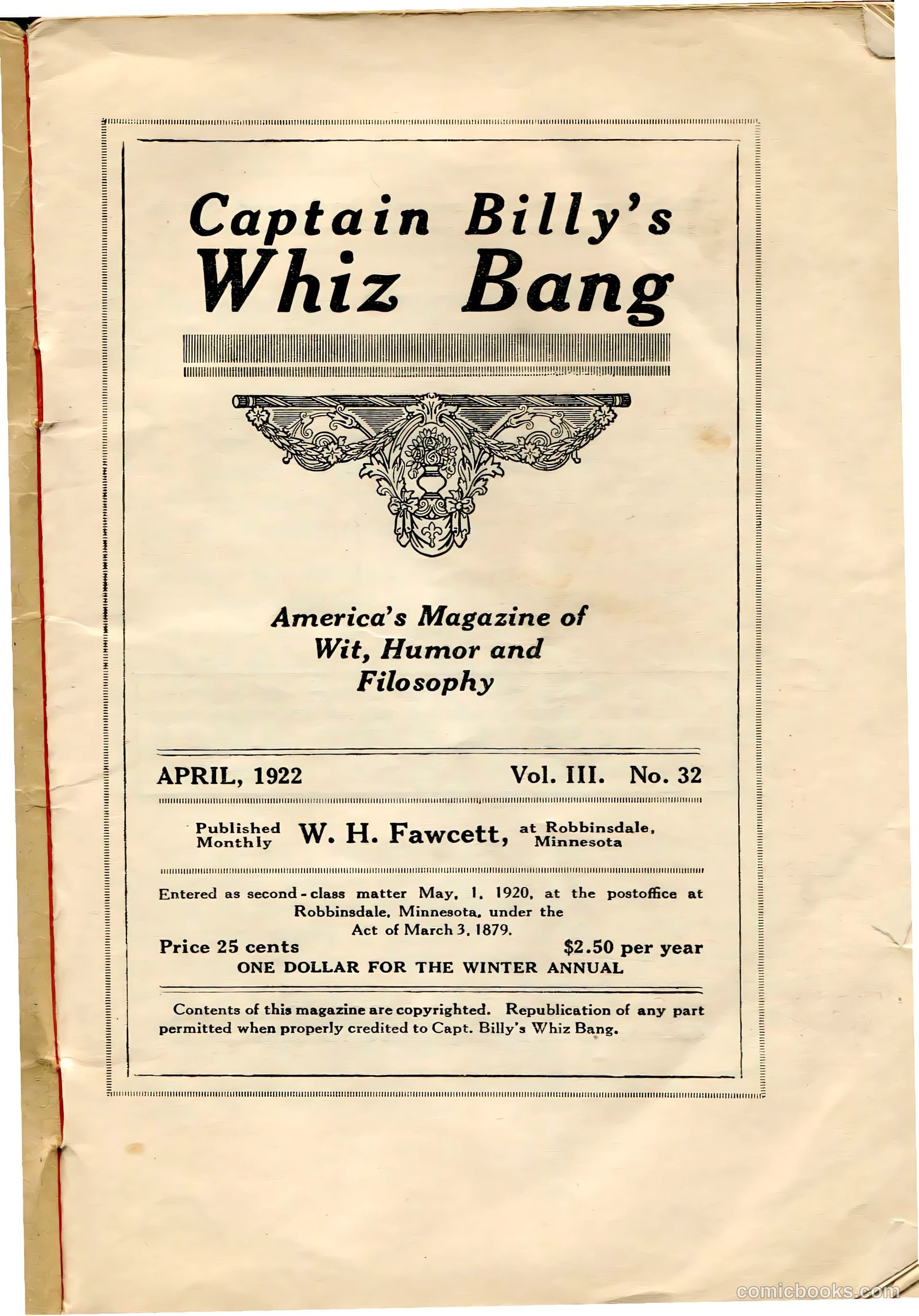
This is the title page of *Captain Billy's Whiz Bang*, a monthly satirical magazine published in Robbinsdale, Minnesota. The page identifies it as "America's Magazine of Wit, Humor and Philosophy," costing 25 cents per issue or $2.50 annually. The ornamental header design is purely decorative. There is no cartoon or satirical content visible on this page—it's essentially a masthead displaying publication information, copyright notice, and postal details. The actual editorial or comedic content would appear on subsequent pages. This 1922 issue represents the magazine's Vol. III, No. 32.
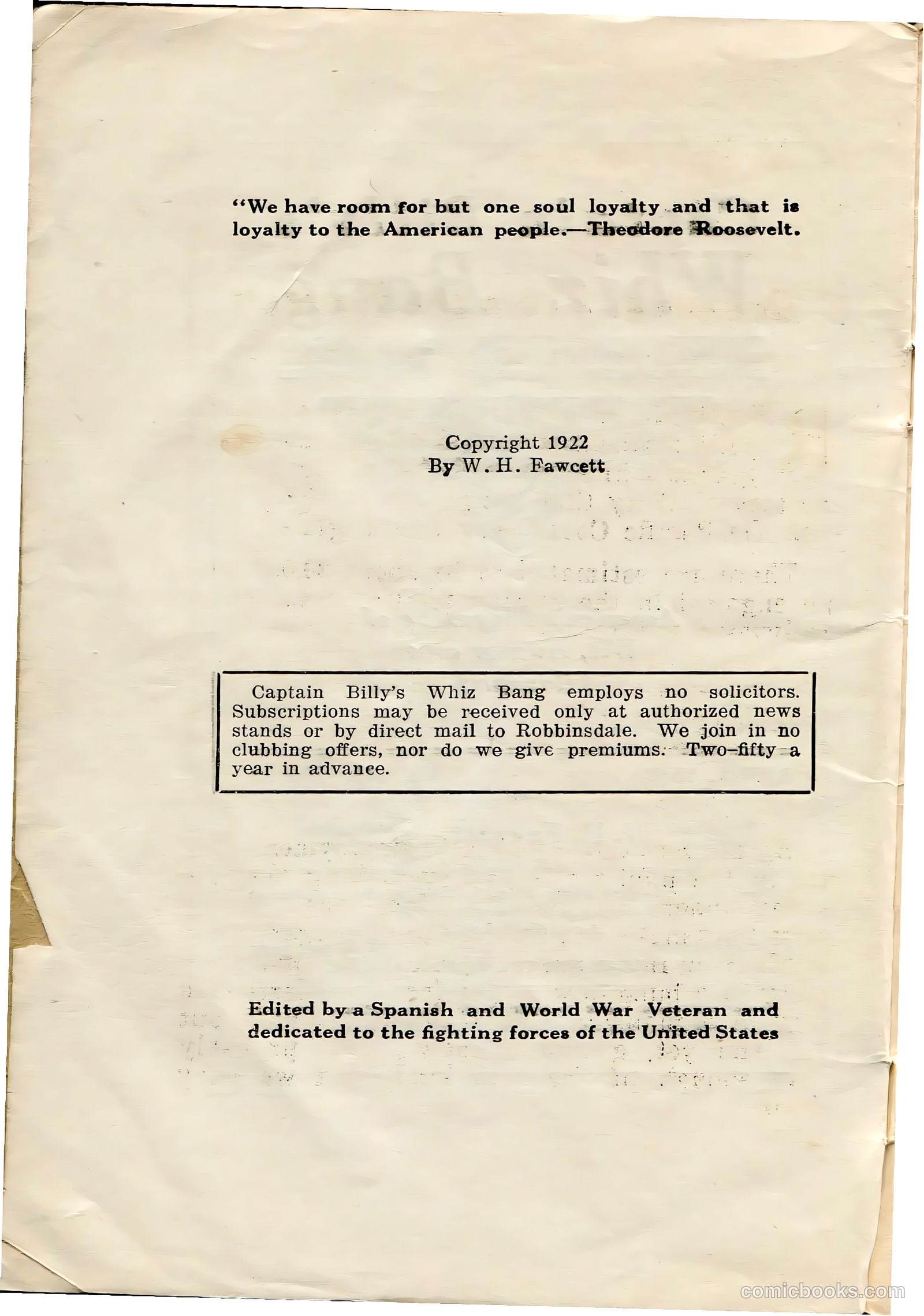
This is a title/copyright page from *Captain Billy's Whiz Bang*, a satirical magazine published in 1922 by W.H. Fawcett. The page contains no cartoon content—it displays the Theodore Roosevelt quote at top about loyalty to America, copyright information, subscription details, and a dedication to American military veterans of the Spanish-American War and World War I. The Roosevelt quote appears designed to establish the magazine's patriotic credentials during the post-WWI era. The subscription box indicates the publication sold through newsstands and direct mail at fifty cents yearly—relatively inexpensive, suggesting it aimed at mass audiences.
This is a satirical column mocking Hollywood's emerging celebrity culture circa the 1920s. The author criticizes the film industry's approximately 30,000 workers—particularly actors—for ostentatious behavior: wearing flashy clothes, driving loud cars with vanity plates (referencing "Fatty" Arbuckle's "606"), and throwing rowdy parties. The satire targets two culprits: the celebrities themselves and their press agents. The author argues that press agents deliberately exaggerate mundane events—a simple home party becomes a "Neroesque orgy"—to manufacture scandal and publicity. The reference to Waldemar Young (likely a screenwriter/publicist) suggests this was a known practice. The joke's final twist is begrudgingly envious: despite mocking their antics, the author admits Hollywood people probably do have genuine fun and excitement—which ordinary readers lack. It's early celebrity-gossip satire highlighting the gap between manufactured image and reality.
This is editorial commentary on the William Desmond Taylor murder case—a real 1922 Hollywood scandal where the prominent film director was killed in Los Angeles. The magazine defends the film industry against public backlash. The piece criticizes sensationalism: Taylor, described as talented and ethical, was murdered, yet the public immediately scrutinized his personal life (he used a stage name) rather than focusing on finding his killer. The author calls this "buncombe" and "imbecilic." The satire targets Frank Mayo, an actor quoted as denouncing Hollywood as "pernicious"—the magazine mocks this as hypocritical self-flagellation by someone within the industry itself. The author argues the anti-Hollywood campaign exploiting Taylor's death is unfair mud-slinging driven by sensationalism rather than justice or reasoned criticism.
This page defends Hollywood against moral attacks, likely from the 1920s when the film industry faced intense criticism from reformers concerned about immorality. The text references "Mayo" (appears to be a public figure advocating to destroy Hollywood) and critiques his position as hypocritical and unfair. The author argues that condemning an entire industry because of some "undesirables" mirrors condemning entire cities like Robbinsdale or Minneapolis over isolated crimes. The defense cites Los Angeles's mayor and **Adolph Zukor**, head of Famous Players film studio, who argues Hollywood's morality matches the New York Stock Exchange—a backhanded compliment suggesting both institutions have similar ethical shortcomings, yet the comparison normalizes Hollywood against establishment institutions. The satire's point: reformers applying double standards to Hollywood while ignoring misconduct in respectable institutions like finance. The piece defends the film industry's reputation during an era of intense moral panic about cinema's influence.
This page from *Captain Billy's Whiz Bang* critiques actor Hobart Bosworth's recent public statement blaming moviegoers for Hollywood's moral decay. Bosworth had accused audiences of being "rotten," claiming their box-office choices revealed their corruption. The author rebuts Bosworth harshly, calling him "blind" and emotionally misguided—angry where he should be sympathetic. The piece defends ordinary people, arguing that cinema attendance stems from loneliness and frustrated aspirations, not moral rot. It acknowledges Hollywood's weaknesses but frames them as inevitable human responses to desire for beauty, wealth, and love rather than proof of audience depravity. The satire targets Bosworth's hypocrisy: he profits from the industry yet condemns its consumers. The piece suggests Hollywood would regenerate regardless, implying the system's resilience depends on human yearning—not individual virtue. This reflects 1920s-era debates about mass culture, morality, and who bore responsibility for cinema's content.
This page contains two distinct pieces of commentary from the satirical magazine: **First section** references **William Desmond Taylor**, a real Hollywood director whose 1922 murder became a major scandal. The "Whiz Banger" editor defends Taylor's reputation against Hollywood gossip-mongers, calling him a respected leader and man of ideals. The satire mocks other publications and people who profit from spreading "juicy, ripe dirt" about film industry figures—contrasting Taylor's integrity with the moral corruption of those exploiting Hollywood scandals. **Second section** is a humorous anecdote about a bear mascot aboard the U.S.S. Niagara. The joke presents an implausibly intelligent bear that steals and methodically piles blankets—clearly exaggerated tall tale meant to amuse readers. This appears filler content rather than political satire. The page demonstrates *Whiz Bang*'s mix of social criticism (defending reputations against scandal-mongering) and lighthearted humor.
This page from *Captain Billy's Whiz Bang* (a humor magazine) contains a poem satirizing impossible expectations placed on women in the 1920s. The poem, retitled from "Naughty—But Nice," mocks the contradictory demands of the era: women were expected to be simultaneously modern and respectable. The verse catalogs contemporary "scandalous" behaviors—smoking, drinking (silver flask), wearing makeup, dancing the shimmy, parking unchaperoned, breaking social rules—while maintaining virginal virtue. The repeated refrain "I want to be naughty, but I want to be nice" highlights the absurdity of this contradiction. The title "It Can't Be Done" is the magazine's sarcastic editorial comment: society's conflicting demands on female behavior are genuinely impossible to satisfy. The satire targets both the restrictive social codes and the hypocrisy of those enforcing them during the sexually liberated Jazz Age.
This page contains three humorous anecdotes from an early 20th-century American satirical magazine. The first joke targets druggists (pharmacists). A Minneapolis pill pusher requests jokes about his profession. The setup involves a druggist at a convention who's called "out of order" by the chairman—but he responds that he "never felt better in my life," implying he's intoxicated on pharmaceutical products. The humor plays on stereotypes about druggists potentially abusing their access to medicines. The second anecdote is a tall tale about ice fishing at Breezy Point, describing an absurdly inefficient method (using a hammer to stun fish rather than hooks). The third mocks American businessmen in Cuba, satirizing their aggressive hustle and willingness to sell anything—even fabricated or nonsensical items ("boneless elephant," "throatless frog")—to fellow Americans. It suggests American expatriates exploit each other's commercial instincts. The overall tone is lighthearted mockery of professional stereotypes and American behavior abroad.
This page from *Captain Billy's Whiz Bang* contains two humorous pieces: **"Humor"** is a whimsical fairy-tale poem by Laura Benet about a mischievous fairy who performs acts of magical insight—showing blind men meadows, making sad people find hope, creating beauty from hardship. It's lighthearted fantasy verse. **"Turn 'im Loose, Judge!"** is a brief courtroom joke mocking the legal system's unreliability. A prisoner initially plans to plead guilty but changes his mind after his lawyer convinces him of his innocence—implying lawyers twist facts and convince defendants of whatever suits legal strategy, regardless of actual guilt. The joke cynically suggests the justice system produces convenient innocence claims rather than truth.
This page from *Captain Billy's Whiz Bang* (a 1920s humor magazine) contains three brief comic items: **"The Boys in the Back Room"** mocks Prohibition-era speakeasy culture through a dialogue with exaggerated German-Jewish dialect. The joke turns on customers trying to order diluted alcohol ("half and half") while the bartender suggests a cigar instead—alluding to the legal loopholes and coded language used to discuss illegal liquor sales. **"Maud kicked the bucket"** is a dark pun: the phrase means she died, but Gus is actually lamenting spilled milk—a deadpan anticlimax. **"Sob Stuff"** presents a reader's complaint letter to the advice column. A visiting easterner fell for a western girl, only to discover she was unfaithful and mocked his romantic devotion to others. The ironic twist: his real worry is his *wife* finding out. This satirizes both melodramatic lovesickness and male hypocrisy—he's upset about betrayal while apparently being married himself.
This page from *Captain Billy's Whiz Bang* (a 1920s-era humor magazine) contains six brief jokes with no illustrations, reflecting the magazine's format of text-based satirical humor. The jokes target recognizable social types: the naïve post-WWI veteran seeking employment (the "fine job" of listening under train cars—doing nothing); the cheapskate stealing hotel silverware as a christening gift; the Yiddish-accented Jewish characters "Ikenstein" and "Rubenstein" (period ethnic stereotyping), where spelling ability is irrelevant to a stenographer's hiring; and the absurdly stingy man demanding rent reduction after dental work. The humor relies on absurdity, wordplay ("parenthesis for stockings"), and gentle mockery of American types. No specific political figures are referenced—this is domestic social satire aimed at postwar American readers familiar with these stereotypes and scenarios.
This gossip column from *Captain Billy's Whiz Bang* (a satirical magazine) contains two items about Hollywood actresses' romantic entanglements: **First item**: Mabel Normand is frequently seen at the Cocoanut Grove nightclub, sometimes with director William D. Taylor or producer Mack Sennett. The satire mocks her casual attitude toward engagement by claiming she keeps a bag of diamond solitaire rings and casually tosses it while giggling—suggesting she treats matrimony as a game rather than serious commitment. **Critical context**: The editorial note warns this was written before Taylor's murder. Normand was indeed present at Taylor's apartment before his unsolved 1922 killing, making this gossip item historically significant. **Second item**: May Collins now occupies the dressing room formerly used by Mildred Harris (Chaplin's ex-wife). The joke: Collins, rumored engaged to Chaplin, allegedly found his photograph in a dresser drawer and kept it in her mirror—ironic since she's replacing his previous fiancée. The satire targets actresses' romantic instability and Hollywood's incestuous social circles.
This is a gossip column from *Captain Billy's Whiz Bang*, a satirical magazine, featuring Hollywood celebrity rumors circa the 1920s. The page contains four items mocking entertainment industry scandals: 1. **Bebe Daniels/Jack Dempsey**: Denies an engagement rumor between actress Bebe Daniels and heavyweight boxer Jack Dempsey. The satire lies in the absurdity of asking even "the family cat" about gossip. 2. **Charlie Chaplin/Edna Purviance**: Reports his leading lady is engaged to a wealthy businessman, humorously noting Purviance was "one of Charlie's early loves." 3. **Lucille Carlisle/Larry Semon**: Notes an actress reconnecting professionally with comedian Semon after a broken engagement. 4. **Laguna Beach gossip**: The column threatens to expose scandals from artist colonies in Laguna Beach and La Jolla, sarcastically suggesting these areas escape scrutiny due to distance from Hollywood. The humor targets celebrity gossip culture itself—the desperation of reporting unconfirmed rumors and the cyclical nature of Hollywood relationships.
This satirical piece from Captain Billy's Whiz Bang attacks the artistic communities of La Jolla and Laguna Beach, California, contrasting them with Hollywood's reputation for scandal. **Key targets:** - Del Carmen and Sarah Andrews, who had an unconventional ocean wedding, emblematic of artists wanting to be "different" - The Laguna Beach artist colony, depicted as bohemian and morally loose (everyone allegedly in love with their best friend's spouse) - Their aesthetic: sandals, sloppy clothes, no haircuts—coded as libertine **The satire's point:** Hollywood studios and the Motion Picture Producers' Association are trying to rehabilitate Hollywood's "modern Babylon" image by deflecting blame onto coastal bohemian communities. Whiz Bang cynically suggests they should literally redirect scandal accusations elsewhere rather than reform. The joke targets both the artistic pretension of bohemia *and* Hollywood's hypocrisy—simultaneously mocking unconventional artists while exposing the industry's PR manipulation. The implication: everyone is scandalous; Hollywood just has better publicists.
This is a gossip column about 1920s Hollywood celebrities. The content mocks the social pretenses of the film industry elite through three anecdotes: 1. **Chaplin and Gerrard's dinner** honoring Russian ballerina Anna Pavlova satirizes the contrast between stuffy society tea parties and bohemian revelry—Pavlova allegedly preferred the latter, suggesting "high society" is tedious. 2. **Mabel Normand's denial** pokes fun at Hollywood scandal-mongering: the gossip column reports seeing her dance with F. Richard Jones, she publicly denies it, yet his wife is now divorcing him anyway—implying the original rumor may have been accurate. 3. The **divorce claim** ($1,000/month alimony on a $100,000 salary) ridicules both the extravagant Hollywood earnings and contentious divorces becoming common among film personalities. The tone is irreverent and cynical about entertainment industry pretension and marital drama, typical of Whiz Bang's satirical approach to celebrity culture.
This page is a gossip and humor column typical of 1920s satirical magazines. It contains three Hollywood divorce items—Billie Rhodes divorcing a publicity man for alcoholism, and Thelma Morgan Goetz divorcing an English army captain for infidelity. These are presented as scandalous celebrity news. The third item makes a joke about Paramount's new Wilshire studio requiring a simultaneous police station opening—implying Hollywood brought crime or disorder. The remaining content is miscellaneous quips: a sexist joke about women's kissing as "traps," a poem comparing men to sausages (you can't see what's inside), and a pun about a Scotsman and bagpipes ("fling" meaning both youthful abandon and the instrument's sound). The humor relies on 1920s stereotypes and sexual double-entendres typical of the era's "men's magazine" style satire.
This page contains five separate humorous jokes typical of 1920s American satirical magazine humor: 1. **"Torch's Best One"**: A joke about a boyfriend who whistles "naughty songs" (sexually suggestive popular music), which the girlfriend finds objectionable. 2. **"Song of the Tire Chain"**: Onomatopoeia mimicking the sounds of a car tire chain—common winter driving equipment of the era. 3. **Gender commentary**: A brief observation mocking women's independence, suggesting men should retain the "privilege" of lighting matches for women—satirizing traditional gender roles. 4. **"In Valparaiso"**: A reference to the ancient philosopher Diogenes, who famously searched for an honest man. Here it's adapted to suggest dishonesty in that city. 5. **Final two jokes**: Wordplay about a pianist's skill and a backhanded invitation referencing "slumming" (visiting poor neighborhoods for entertainment)—mocking both pretension and class attitudes. The page is primarily text-based humor rather than visual cartoons.
This page contains three satirical pieces from the Prohibition era (likely 1920s), all mocking alcohol consumption and its justifications: **"Soliloquy of a Hooch-hound"** parodies flowery, pseudo-philosophical language to expose the self-deception of alcoholics. The speaker grandiosity compares drinking "King Alcohol" to natural healing forces, pretending it brings "compassion and philanthropy"—when actually it's escapism from moral emptiness. The satire mocks both drinkers' rationalizations and the era's pretentious speech. **"The Diff'unce"** contrasts two men: "Percival" (upper-class name, chews gum, dances refined) versus "John" (working-class, chews tobacco, fights). The joke suggests class differences are superficial—both are crude. **"Special For the Clergy"** satirizes clerical hypocrisy during Prohibition. A bootlegger seeks penance; the confused priest calls his superior, who casually reveals *he* bribes bootleggers with five dollars—implying clergy routinely break Prohibition laws. The joke exposes institutional corruption masquerading as moral authority.
This page contains three satirical pieces mocking Prohibition-era American society. The **"London Post Toastie"** jokes darkly about child abuse and generational violence—a mother excuses her son's brutality by claiming he's imitating his father, normalizing domestic violence as inevitable male behavior. A brief **rhyming couplet** comments on thinness with crude humor ("Ain't it heck"). The **"Lodge Notice"** is extended satire of Prohibition (1920-1933). It mocks bootleggers and illegal alcohol production through fake organizational announcements. Names like "F. U. Selloyl" and "I. Rob. Sellers" are transparent puns referencing the illicit liquor trade. The lecture on "Making Moonshine" and references to "the Mash" and "the Still" openly mock illegal distillation, while "Thirsty night" puns on Prohibition itself. This reflects Whiz Bang's irreverent approach to contemporary law-breaking. **"Spring Sports"** offers absurdist rural humor about watching cattle—a mundane activity presented as entertainment. The page exemplifies Whiz Bang's bawdy, anti-establishment satire targeting Prohibition enforcement and social hypocrisy.
This is a "Questions and Answers" advice column from *Captain Billy's Whiz Bang*, a satirical humor magazine. The humor relies on deliberately misinterpreting questions to deliver punchlines: 1. **Willie Bohy's love dilemma**: The answer's joke is that you *can* love two people simultaneously—as long as neither knows about the other. 2. **Silverware etiquette**: The pun plays on "left for dessert"—the answer suggests keeping one piece unused rather than addressing the actual dining question. 3. **Ada Clock's lung trouble**: A crude pun—"throw out your chest" is misread literally rather than as the idiomatic phrase for pride/confidence. 4. **Booster/Knocker definitions**: Social satire. A "booster" promotes things (often dishonestly) to make sales, while a "knocker" criticizes them—but the joke suggests the knocker became cynical *after* being duped by the booster's pitch. These represent typical early-20th-century magazine humor: word-play, double meanings, and gentle social commentary wrapped in comedic advice.
This is an advice column from *Captain Billy's Whiz Bang*, a popular early-20th-century humor magazine. The page contains mock advice responses to reader questions, using absurdist humor and wordplay typical of the era. The jokes mock various social conventions: a "dance" costs money and causes fights; a "goblet" is a pun (small sailor); feeding a worm-infested child fish is darkly absurd advice; naming a son "Percy" dooms his singing ambitions (Percy was considered an effeminate name); a man pushing someone into mud while fleeing is presented as romantic proof of love; and blank cartridges solve the hunter's moral dilemma. The humor relies on non-sequiturs, sexual innuendo, and exaggeration rather than topical satire. These columns likely appealed to working-class readers seeking irreverent entertainment during Prohibition and post-WWI America.
This is a humor advice column from *Captain Billy's Whiz Bang*, a 1920s-era satirical magazine. The page consists of humorous letters and replies that rely on ethnic and racial stereotypes common to early 20th-century American comedy. The jokes include: a play on "dates" (fruit vs. romantic outings); ethnic name-based humor (targeting Jewish and Italian names with stereotypes about wealth); crude stereotypes about Jewish and Black people's material desires; and a visual pun about fish-hooks/catchy names. The final joke about a baby named "Fish-hooks" is a simple wordplay (catchy/hooks). The page's humor heavily depends on period ethnic stereotyping that would be considered offensive today. The magazine targeted working-class readers with populist, often crude comedy. These attitudes reflect the prejudices normalized in mainstream American entertainment of that era.
This page contains three brief humorous anecdotes typical of early 20th-century American satirical magazines: **"The Ace of Tragedies"** mocks Wild West vigilante justice. A juror who obstinately prevents a guilty verdict to save a man from hanging is ironically undermined when the town lynches the prisoner anyway during jury deliberation—making his moral stand pointless. **"Toole's Best One"** is a simple children's joke about a grocer's dishonesty. When refusing to sell two cents' worth of bananas, he falsely calls them "pineapples," but the boy calls his bluff by asking for the "pineapples" instead—exposing the grocer's lie through innocent logic. **"Southern Hospitality"** appears to be a setup for a joke (text incomplete), likely playing on stereotypical Southern dialect ("yore" for "your," "entatainment" for "entertainment") for comedic effect. The page reflects common early-1900s satire: frontier violence, working-class cleverness, and regional stereotypes used for entertainment.
This page from the satirical magazine contains several brief jokes and humorous pieces typical of 1920s humor: **"Walking with a Purpose"** is a bawdy joke: a man enjoys a lengthy solo walk through the park, then reveals the punchline—he "picked her up," implying he met a woman, likely for illicit purposes. **"Coffin Nail Epitaph"** is dark humor about cigarettes, calling them "coffin nails" (a period slang term for cigarettes due to health risks). The joke claims a man named Willie Betts died at age "ten cigarettes." **"A Warning to Flappers"** mocks 1920s "flapper" women (young, modern, rebellious females) with a crude moral rhyme: virtuous girls go to heaven, bad ones don't. The other pieces—proverbs and song titles—are nonsensical or absurdist humor. Overall, this reflects *Whiz Bang*'s style: crude sexual innuendo, anti-modern sentiment (particularly toward independent women), and smoking jokes targeting contemporary vices.
This page from the satirical magazine contains several ethnic stereotype jokes typical of early 20th-century American humor. **"Our Chestnut Rack"** features Irish and Scottish stereotypes. Two Irishmen ("Pat" and "Mike") rob a Scotsman ("Sandy"), finding only a nickel—the joke being that Irish are portrayed as dim-witted criminals who don't realize how poor their victim is. The subsequent short pieces trade in crude ethnic caricatures: a poem about San Francisco mocking Irish speech patterns, another mocking Cubans/Hispanics with broken Spanish and food references ("hot tamale"), and dated slang humor ("'stoo bad"). **"Our Monthly Motto"** presents a flirtatious, sexist saying about preferring women in person to phone conversations. The final joke setup ("spoiled mulligan") likely references Irish stereotypes, with "mulligan" being a term sometimes applied to Irish people. This represents period-typical magazine humor relying on ethnic ridicule rather than clever wordplay—content that would be considered offensive today.
This page contains four brief humorous stories/jokes typical of 1920s American satirical magazines: **"Motorcycle Mike"** jokes darkly about a fatal collision—the punchline implies Mike was reckless (ignoring oncoming headlights), suggesting he "should have been dead long ago." **"At Havana Races"** features an Irish racing fan (indicated by "bejabers") confidently predicting a horse will win, then describing how it actually lost badly—a standard joke format mocking overconfident gamblers and false predictions. **"Pardon Me"** contains two brief prison jokes: one playing on a convict's politeness toward the governor, and another crude pun about the warden's daughter attracting male visitors (hanging around = loitering). **Wife's tongue joke** is a standard domestic humor bit mocking wives' talkativeness. The content reflects typical Whiz Bang fare: automotive mishaps, gambling folly, prison humor, and marriage jokes—all calculated for working-class male readers.
This page contains four satirical pieces typical of 1920s humor magazines: 1. **"The Traveling Man"**: Mocks cheap hotel accommodations—filthy beds, overworked maids—and the salesman's destructive behavior of wrecking the bedding after the maid finally gets it clean. 2. **Infidelity joke**: A dark quip about an affair ending when the woman returns to laundry work and the man to his wife—suggesting class-based relationships and swift consequences. 3. **"Song of Newlywed"**: Comic contradiction—the groom insists he must rush home on his wedding night despite his bride's willingness to let him stay out later. The humor lies in reversed expectations about newlywed behavior. 4. **Final pieces**: Absurdist humor—a nonsensical proverb and a drunk teamster attempting to tie his wagon to a lamppost (confusing Emerson's inspirational phrase "hitch your wagon to a star" with literal, drunken action). The satire targets working-class life, infidelity, and masculine foolishness.
This page from the satirical magazine contains several short humorous pieces typical of early 20th-century American comic magazines: **"What Is All the Noise About?"** — A joke about a barber arguing with himself while shaving, attempting to convince himself to get a massage. **"Blank Verse"** — A darkly comic poem about a shipyard worker who worried about injuring a baby, only to have the child hit over the head with a bottle at its baptism, then later pelted with dirt at church. The humor relies on absurdist irony and the contrast between parental worry and slapstick violence. **"Back Porch Cross Fire"** — Women gossiping about a fire downtown, using period-appropriate exclamations. **"The Penalty"** — A moralistic verse claiming men suffer equally from wine (headaches) and women (heartache). **"I never looked up my family tree..."** — A self-deprecating joke equating oneself to sap (the weakest part of a tree, suggesting stupidity). The humor is largely observational and relies on wordplay, absurdity, and domestic comedy rather than political satire.
This page from the satirical magazine *Captain Billy's Whiz Bang* contains five brief humorous anecdotes targeting early 20th-century American life: **"'Twas Sweet of Her"** mocks newlywed domesticity—a husband expects dinner but receives only jelly bean soup, playing on post-war food shortages or rationing. **"In the Army"** satirizes military discipline and gambling, referencing dice games and cheating ("put in his own dice"), with "twenty licks" likely meaning punishment beatings. **"Wild Guy"** presents a caricature of reckless youth—Clarence drinks sarsaparilla (a non-alcoholic soft drink, making his behavior absurdly pointless) and destroys property. **"Boo Hoo, Blooey"** concludes with a domestic joke: a wife threatens her husband with irreplaceability; he flatly refuses to seek a replacement, mocking romantic pretense. The magazine's humor targets marriage, military incompetence, and youthful foolishness through brief, punchy jokes typical of 1920s-era satirical publications.
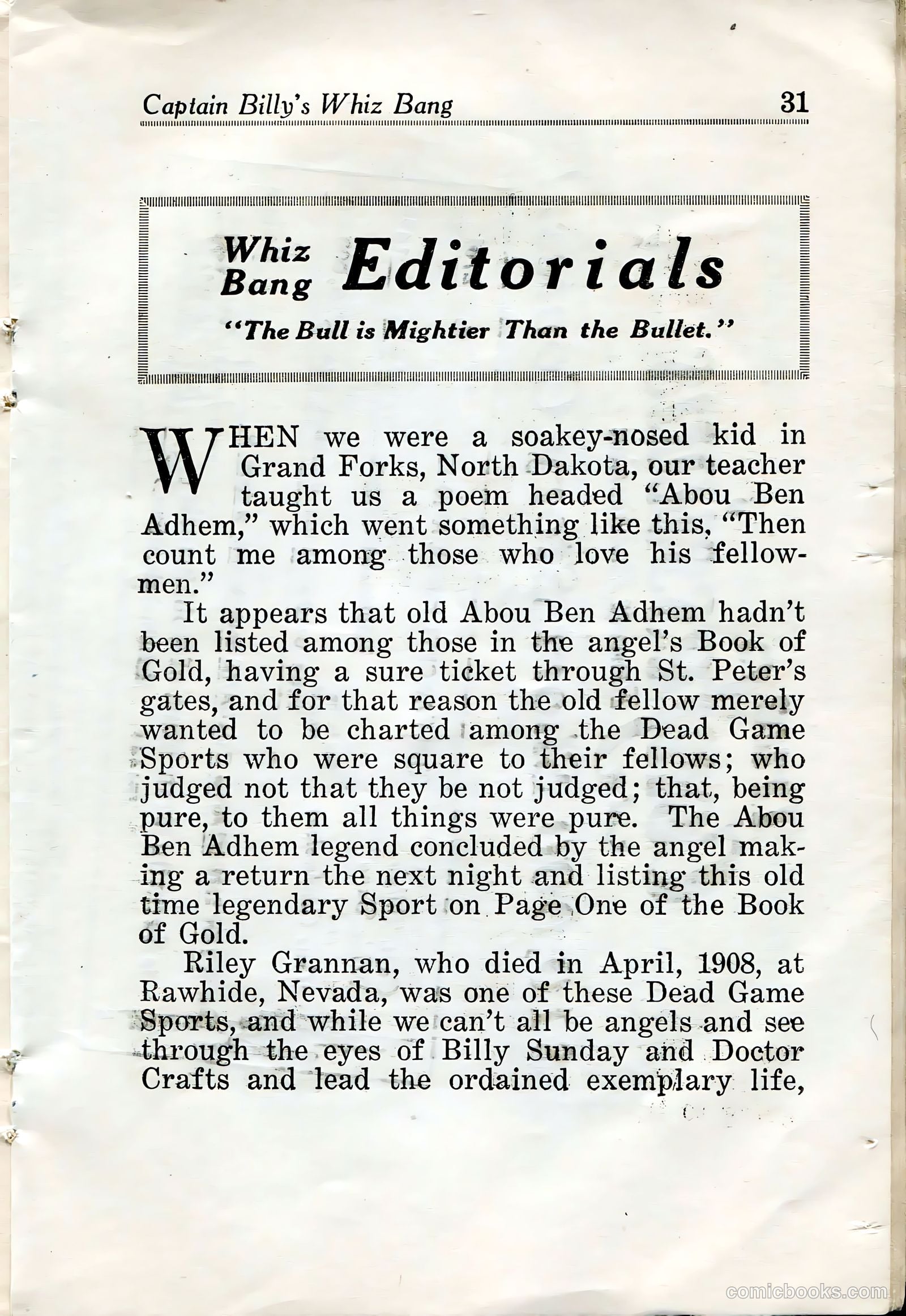
This is an editorial (not a cartoon) from *Captain Billy's Whiz Bang*, a satirical magazine. The piece uses the Romantic poem "Abou Ben Adhem" by Leigh Hunt as a framework to praise Riley Grannan, a gambler who died in 1908 in Nevada. The satire operates on multiple levels: it ironically suggests that Grannan—despite his profession in gambling—exemplified genuine moral virtue ("Dead Game Sports") through loyalty and non-judgment of others. The editorial mocks conventional morality by implying that someone like Grannan possessed more authentic goodness than self-righteous religious figures like evangelist Billy Sunday and "Doctor Crafts." The headline, "The Bull is Mightier Than the Bullet," likely refers to Grannan's reputation and influence. The piece celebrates working-class sporting culture and fraternal loyalty over religious hypocrisy—a typical *Whiz Bang* stance of irreverent, populist satire targeting 1920s American respectability.
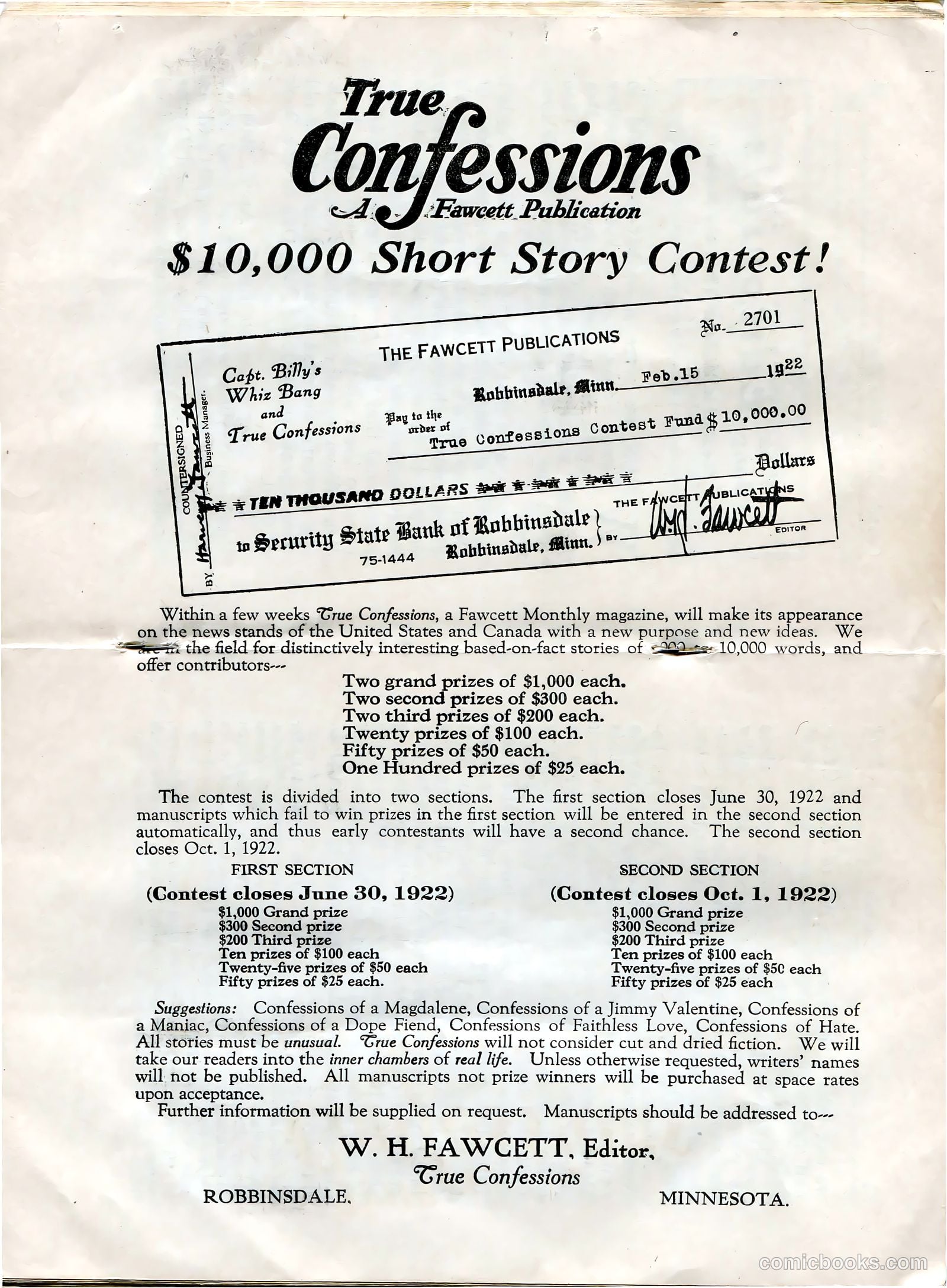
This is primarily a **contest announcement page**, not satirical content. It advertises a $10,000 short-story contest for *True Confessions* magazine, a Fawcett publication based in Robbinsdale, Minnesota, dated February 15, 1922. The page features a **facsimile bank check** (No. 2701 from Security State Bank of Robbinsdale) as a promotional visual, legitimizing the prize fund. The contest offered substantial rewards: two $1,000 grand prizes, smaller prizes down to $25 entries, across two submission deadlines (June 30 and October 1, 1922). Contest guidelines requested "unusual" confession-based stories—about Magdalenes, Jimmy Valentines, faithless lovers, dopey friends, and hate—explicitly rejecting "cut and dried fiction." This reflects early-1920s **pulp magazine culture**, when publishers competed aggressively for content through high-prize contests. The bank check imagery was a marketing technique to demonstrate financial credibility and encourage submissions from amateur writers.
This page from *Captain Billy's Whiz Bang* is primarily **textual rather than a cartoon**—it's a tribute piece about Riley Grannan, a famous horse racing gambler who died fourteen years prior (approximately 1894, given the 1908 reference date). **Who/What This References:** Grannan was a legendary "turf plunger"—someone who placed enormous bets on horse races (up to $200,000 per race). The article lionizes him as a "Dead Game Sport," celebrating high-stakes gamblers and the horse-racing community. **The Social Context:** The piece romanticizes the racing world and its colorful characters—miners, socialites, and betting enthusiasts gathered in a Nevada mining town. It presents Grannan's funeral as a meaningful ceremony deserving preservation. **The Point:** The magazine is celebrating reckless gambling culture and the lifestyle of professional gamblers as noble and admirable, framing their deaths as occasions for sentimental remembrance rather than cautionary tales.
This page describes the funeral of **Riley Grannan**, a famous racehorse gambler and track plunger who died in Rawhide, Nevada (a mining boom town). The text eulogizes him in a way that satirizes both frontier democracy and religious hypocrisy. The satire centers on **H. W. Knickerbocker**, a former clergyman turned mine operator, who delivers the eulogy. He's depicted in working-class miner's garb rather than clerical dress—a deliberate visual rejection of religious authority. His speech emphasizes "the religion of the brotherhood of man" over institutional religion, appealing to frontier egalitarianism ("class forgotten, all men were equal"). The humor and critique lie in this contradiction: a defrocked minister preaching secular humanism at a gambler's funeral, while mines blast overhead and saloons close for the day. It mocks both Victorian respectability and shallow frontier "democracy" that temporarily suspends class divisions during mourning. The satirical point: even in supposedly classless mining camps, genuine equality is performed rather than lived.
This page from Captain Billy's Whiz Bang contains no cartoon—it's a prose piece eulogizing **Riley Grannan**, a historical figure (1868-1908) who rose from bellboy to become a famous gambler and "plunger" (high-stakes bettor) before dying in Rawhide, Nevada. The passage is philosophically melancholic, contrasting Grannan's birth in Kentucky's fertile, beautiful landscape with his death in the harsh desert. It invokes **Robert Ingersoll's** famous agnostic grave oration to meditate on life's transience and inscrutability. Rather than satire or jokes, this reads as sincere reflection on human ambition and mortality—unusual for Whiz Bang, a typically comedic magazine. The tone suggests the editor using his platform for genuine social commentary about the futility of even spectacular worldly success when faced with death.
This page contains philosophical text rather than cartoons. It's a lengthy meditative passage discussing the futility and meaninglessness of life, using theatrical and poetic imagery. The narrator describes life as fleeting—"a shadow, a poor player that struts and then is heard no more"—echoing Shakespeare's *Macbeth*. The text then shifts to praising Riley Grannan, apparently a sports figure or gambler, as exemplifying philosophical acceptance of defeat and victory with "equal equanimity." The passage suggests Grannan embodies stoic virtue—maintaining composure when circumstances beyond his control determine outcomes. This appears to be satirical commentary on fatalism and acceptance in early 20th-century American culture, likely appealing to *Whiz Bang's* male readership through sports references and cynical philosophy rather than visual humor.
This page contains an **eulogy or tribute to Riley Grannan**, a figure from the world of sports and gambling. The text defends Grannan against moral condemnation, arguing that his acts of charity—funding happiness for people in the "night life" (appearing to reference gambling/entertainment venues)—constituted genuine goodness despite his unorthodox lifestyle. The passage critiques "puritanical ideas" and "mediaeval creeds" that judge people by strict moral codes, instead celebrating Grannan's practical benevolence toward marginalized people. The elaborate metaphor about God's sunbeams (closing the visible text) suggests divine approval of beauty and generosity distributed beyond conventional morality. This appears to be **Captain Billy's Whiz Bang defending a non-conformist figure against contemporary moral judgmentalism**—characteristic of the magazine's satirical irreverence toward Victorian standards. Without seeing any cartoon elements on this page, the satire operates through the text's passionate rhetorical defense of an unconventional man's character.
This page contains three pieces of humor and one memorial tribute from an early 20th-century American satirical magazine. The main content is an **eulogy for Riley Grannan**, apparently a public figure known for charitable work. The poetic passage praises him as a "public benefactor" who used wealth and influence to alleviate human suffering. Below are three brief **comedic anecdotes**: 1. **"Something Wrong"** plays on marital discord—Little Willie finds it odd his parents are going out together, implying they normally don't spend time together. 2. **"Help! Help!"** is a reversal joke: Jones yells for burglars rather than police, because he considers the policeman in his cellar (apparently conducting a raid or investigation) to be the greater threat. This satirizes police conduct or corruption—suggesting law enforcement is more dangerous than actual criminals. These jokes reflect period attitudes about police reliability and domestic relationships typical of early 1900s American humor magazines.
This is a collection of brief jokes and humorous one-liners typical of 1920s satirical magazines. Key references: **"Moonshine than bullets"** — A tramp prefers illegal whisky over combat, mocking Prohibition-era enforcement debates. **"Ikey, Jakey, and Whiskey"** — Ethnic stereotypes (Jewish names paired with alcohol) playing on period prejudices. **"George Washington washed the country"** — Satirizes Progressive Era reformers' moralistic crusades as ineffectual. **"Flivver was twenty horsepower"** — A Ford Model T joke; "flivver" was slang for cheap cars. The humor mocks advertisements' exaggerated claims versus actual performance. **"Shakespeare" / "baker"** — A pun on "handles" (manages roles versus literally handling bread). The humor is crude by modern standards, relying on ethnic caricature, sexual innuendo ("manslaughter me with kisses"), and anti-reformist sentiment. It reflects 1920s working-class sensibilities and attitudes toward Prohibition and social reform movements.
This page contains no cartoons or satirical illustrations—it's primarily literary content from *Captain Billy's Whiz Bang*, a humor magazine. The page reprints a poem titled "Absolution" by E. Nesbit (a well-known British author). The editorial note explains they're re-running a previously published poem called "Ostler Joe" (originally titled "Phryne's Husband") due to reader demand and limited back-copy availability. "Absolution" itself is a narrative poem about a young woman's confession to a priest. The poem explores themes of sin, penance, and the priest's unspoken attraction to his parishioner—suggesting tension between religious duty and human desire. The woman's withdrawal from church life and visible decline forms the poem's implied tragedy. This represents *Whiz Bang's* "Smokehouse Poetry" section: mildly risqué literary content that balanced the magazine's crude humor with more sophisticated material.
This page contains no political cartoon—it's a narrative poem about a young woman confessing to a priest that she has fallen in love. The work appears to be romantic/sentimental fiction rather than satire. The poem depicts a girl troubled by unrequited love who seeks spiritual counsel. She confesses to the priest that a dream revealed her lifelong, unspoken affection for an unnamed man. The narrative emphasizes her internal conflict: her love seemed "sinless" and "beautiful" in the dream, yet she carries guilt about it in waking life. *Whiz Bang* was primarily a humor magazine, so this earnest romantic poetry seems atypical for the publication. Without additional context about the issue's date or surrounding content, the satirical intent—if any—remains unclear. The poem may be straightforward sentimental content, or possibly parody of overwrought romantic literature popular at the time.
This page contains no political cartoon or satirical illustration—it's a serialized romantic story printed in verse form. The narrative depicts a Catholic confession scene where a woman confesses an illicit love to a priest, ultimately revealing that the priest himself is the object of her affection. The content reflects early 20th-century anxieties about celibacy and clerical sexuality. The woman's anguished monologues about forbidden love, prayer, and religious despair, coupled with the priest's shocked reaction and moral struggle, suggest the story explores tension between religious vows and human desire. "Captain Billy's Whiz Bang" was known for humor and satire, but this particular installment appears to be sentimental fiction rather than satire—possibly aiming at melodramatic emotional effect rather than social commentary or political critique.
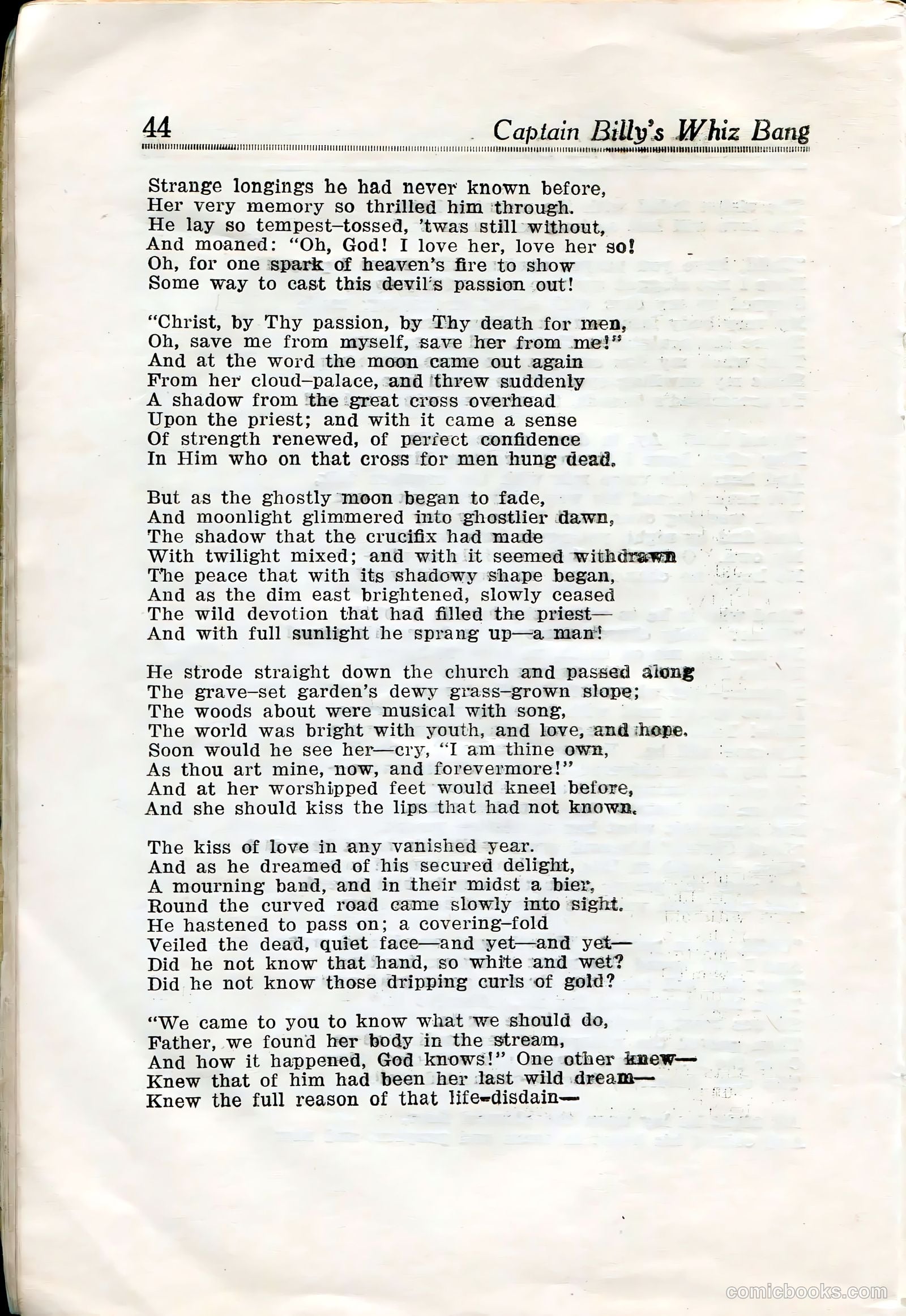
This page from *Captain Billy's Whiz Bang* contains no cartoon or satire—it's a serious romantic narrative poem about a Catholic priest struggling with forbidden love and desire. The plot: A priest experiences intense longing for a woman, prays for divine intervention, and finds temporary spiritual strength through moonlight and the shadow of a crucifix. As dawn breaks and sunlight returns, his religious fervor fades and he becomes "a man" again—suggesting his earthly passions reassert themselves. The final section reveals he discovers a woman's body in a stream, implying a tragic resolution. The piece explores the tension between celibacy vows and human emotion, presenting the priest's spiritual struggle sympathetically rather than mockingly. This appears to be literary content rather than satirical commentary, atypical for what readers might expect from *Whiz Bang*, a magazine known for humor and irreverence.
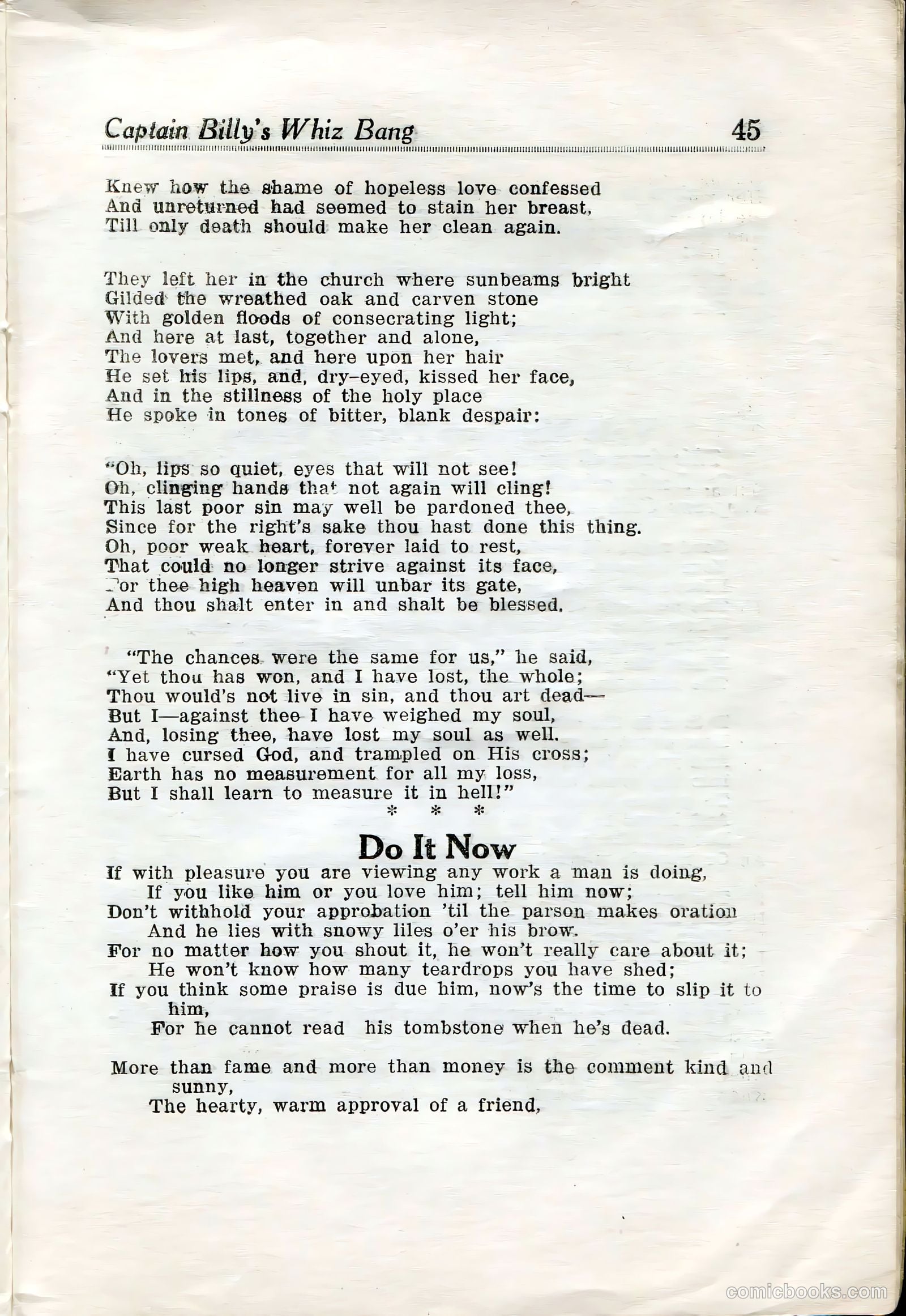
This page contains two distinct literary pieces from this satirical magazine. The first is a dramatic romantic poem depicting a tragic love story set in a church—a woman who has died (apparently from shame over unreturned love), and her lover's anguished final visit, expressing despair at having lost his soul while she gains heaven. The second piece, "Do It Now," is practical moral verse urging readers to offer praise and approval to people while they're alive, rather than waiting until they're dead. It satirizes human tendency to withhold kind words and wait until funerals or tombstones to express appreciation. The satire is gentle and moralizing: the poem mocks our procrastination and indifference, arguing that sincere friendship and verbal encouragement matter more than posthumous fame or wealth. The juxtaposition suggests *Whiz Bang's* mix of sentimental melodrama alongside folksy wisdom about human nature.
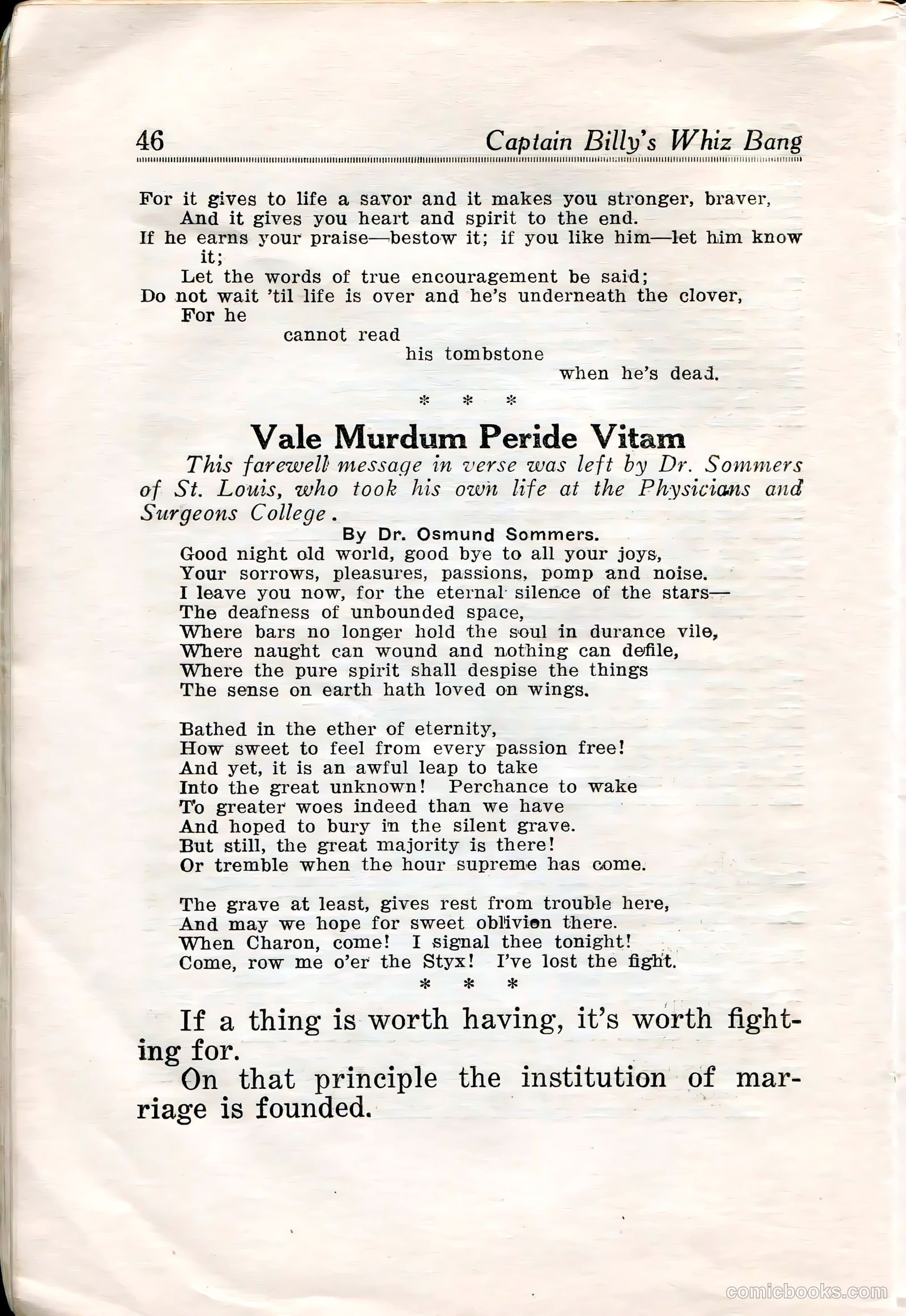
This page from *Captain Billy's Whiz Bang* (a 1920s-era satirical magazine) contains two distinct pieces: **First section**: A verse encouraging people to praise others while they're alive rather than waiting until death—a common morality poem about appreciating people in the present. **Second section**: The tragic suicide note of Dr. Osmund Sommers of St. Louis, who died by suicide at the Physicians and Surgeons College. The Latin title "Vale Murdum Peride Vitam" (roughly "farewell to a dead man's life") frames this as a literary farewell. The poem expresses philosophical despair about life's sufferings, references classical mythology (Charon, the Styx), and contemplates whether death offers escape or worse torment. **Final joke**: A cynical quip equating marriage with fighting—suggesting marriage requires the same commitment as "a thing worth having." The juxtaposition is notably dark: the magazine pairs genuine suicide content with flippant humor about marriage, reflecting the era's casual treatment of serious subjects in satirical publications.
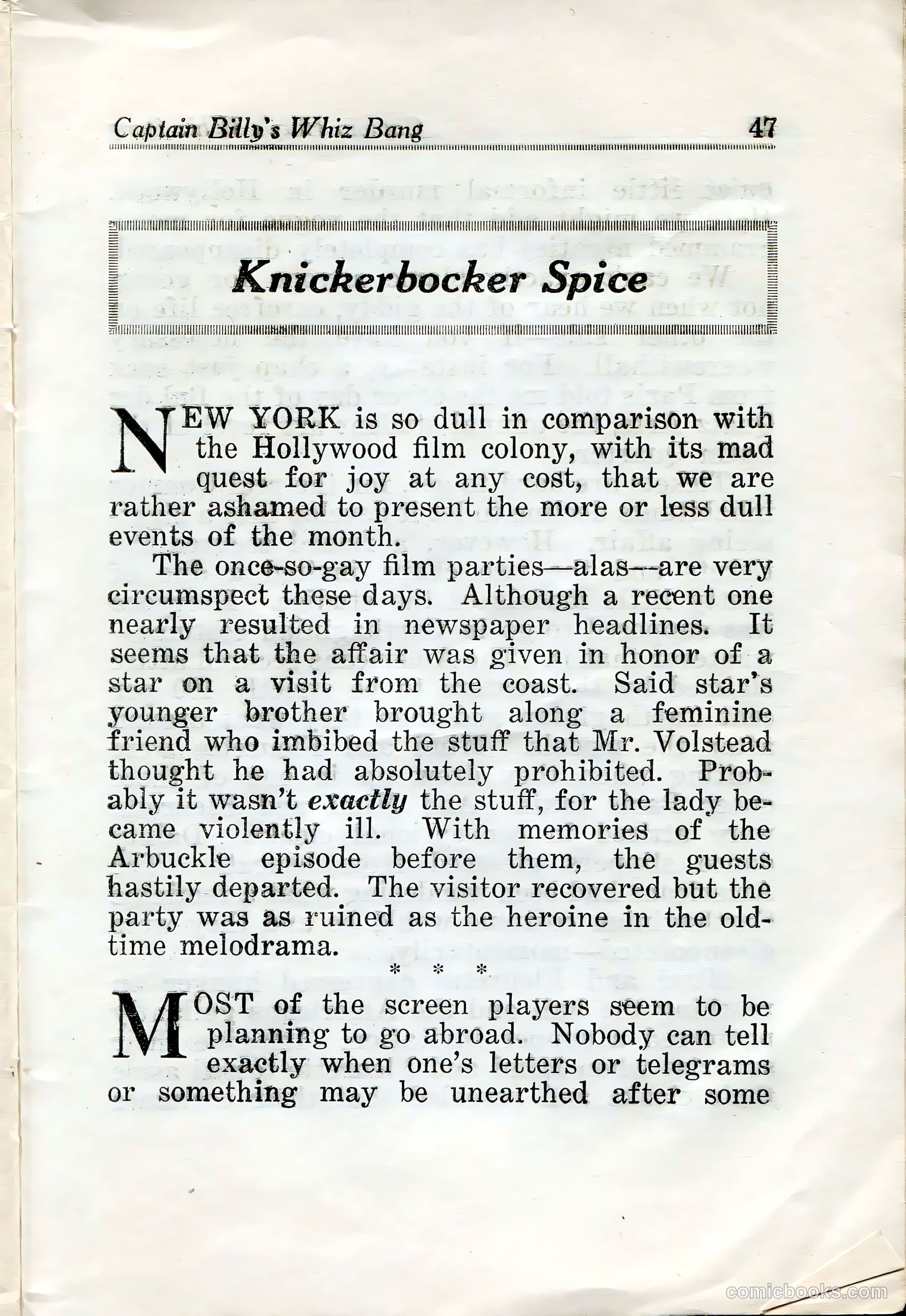
This gossip column satirizes Hollywood's scandalous reputation versus New York's dullness. The piece mocks film industry parties and their attempts at propriety following the **Arbuckle scandal**—a reference to Fatty Arbuckle, a major silent film star accused of rape in 1921, whose career was destroyed by the accusation. The anecdote describes a party where a guest consumed illegal alcohol (referencing **Prohibition**, enforced by "Mr. Volstead"), became violently ill, and nearly caused a scandal. The guests panicked, fearing newspaper exposure similar to the Arbuckle case, which had been a major scandal. The satire targets Hollywood's hypocrisy: stars pretend respectability while engaging in drinking and wild behavior during Prohibition, yet desperately fear public exposure. The final paragraph hints that screen actors' past indiscretions might surface if they travel abroad, suggesting widespread secrets in the industry.
This is satirical prose rather than a cartoon—a risqué anecdote from a 1920s humor magazine. The piece mocks American tourists in Paris and their naïveté about Continental sophistication. The joke centers on two American men who attend the Bal des Quatz Arts (a real, notorious Paris student art ball known for loose morality) with two French models, Mimi and Fleurette. The Americans dress in "100 per cent Carthaginian" costumes as instructed, then are disappointed when the women arrive wearing only cloaks over dance slippers—expecting elaborate period costumes. The humor's punchline (cut off here) likely reveals the women wore *nothing* under those cloaks—playing on the Americans' prudish expectations versus Parisian libertinism. The satire targets American sexual repression and gullibility when encountering European hedonism. References to "monogrammed nighties" disappearing suggest changing sexual attitudes post-WWI.
This page from *Captain Billy's Whiz Bang* contains two satirical anecdotes about leisure and decadence. The first story mocks a Parisian masquerade ball where Americans witnessed living models posed as classical statuary. The satire targets the pretentiousness of European artistic culture—the "statuary came to life and danced," deflating highbrow aspirations. It concludes by mentioning actress Ruby de Remer returning from Paris with fashionable black negligees, likely satirizing how American celebrities adopted European fashions as status symbols. The second anecdote (beginning mid-page) describes an opulent private apartment belonging to a New York theater manager, filled with Continental and Asian treasures. The incomplete text suggests it will mock either the manager's ostentatious wealth or some scandalous use of this space. Both pieces exemplify *Whiz Bang*'s humor: mocking American fascination with European sophistication and wealthy individuals' extravagant displays—common targets of 1920s satirical magazines.
This page satirizes film censorship and director Erich von Stroheim's 1922 film "Foolish Wives." The text mocks how censors struggled with the film's scandalous content—a degenerate Russian aristocrat seducing women, ruining a servant, and attempting to seduce an ambassador's wife. The satire's central joke targets the censorship board's apparent confusion and inconsistency. They approved morally questionable material (the count's depravities, seduction attempts) yet seemingly didn't know how to handle a premature baby shown at the premiere. The censors apparently had the baby footage removed after the initial screening. The author ridicules the arbitrary nature of film censorship: producers themselves cut 200,000 feet from von Stroheim's original negative, suggesting heavy-handed studio self-censorship. The piece implies censors possessed unclear, inconsistent standards—comfortable with sexual misconduct but baffled by an infant. This reflects 1920s anxieties about film regulation and moral authority in cinema.
This page from the satirical magazine contains several disconnected humor items rather than unified cartoons. The opening discusses censored film content—producers allegedly offered $50,000 for "cut out portions" to show in Europe and South America, implying these regions had looser censorship standards. This satirizes both film censorship and stereotypes about foreign moral standards. The theatrical commentary mocks the theatrical season's initial scandal (police intervention expected) that fizzled harmlessly, disappointing reformers. The Lillian Lorraine item is pointed satire: press had extensively covered her alleged spinal injury/paralysis, yet in "The Blue Kitten" she visibly performs in costumes revealing her spine in perfect condition—exposing the publicity as exaggerated or fabricated. The remaining items are brief jokes: the "naughty/naught" wordplay; a bartender joke about workplace hierarchy; and a "dizzy blonde" joke playing on female stereotypes (she misunderstands the dream proposal as literal). The page reflects 1920s humor: concern over film censorship, theatrical scandal-mongering, and period-typical gender stereotypes.
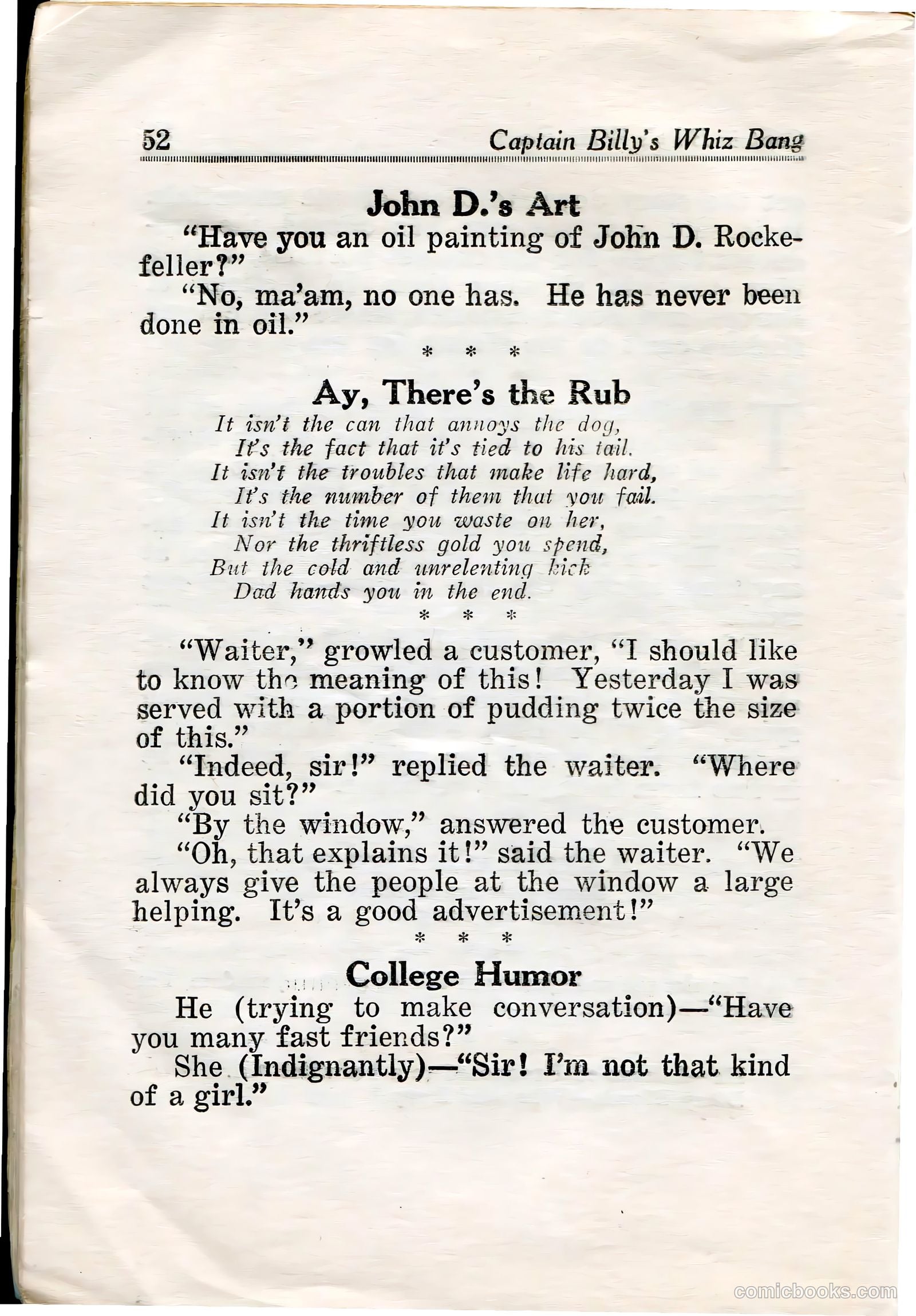
This page from *Captain Billy's Whiz Bang* contains three unrelated jokes: **"John D.'s Art"** mocks billionaire John D. Rockefeller with a pun: no oil painting exists of him because he's never been painted "in oil"—a play on his Standard Oil fortune. **"Ay, There's the Rub"** is a philosophical poem about life's frustrations, using an extended metaphor about a dog with a can tied to its tail. The final couplet suggests paternal punishment ("Dad hands you in the end"). **The waiter anecdote** satirizes restaurant deception: when a customer complains his pudding portion is smaller than yesterday's, the waiter admits they deliberately serve larger helpings to window-seat diners as "advertisement" for passersby—cynical commentary on manipulative business practices. **"College Humor"** features a misunderstanding: when a man asks about "fast friends," the woman indignantly interprets it as questioning her morality rather than the speed of friendship.
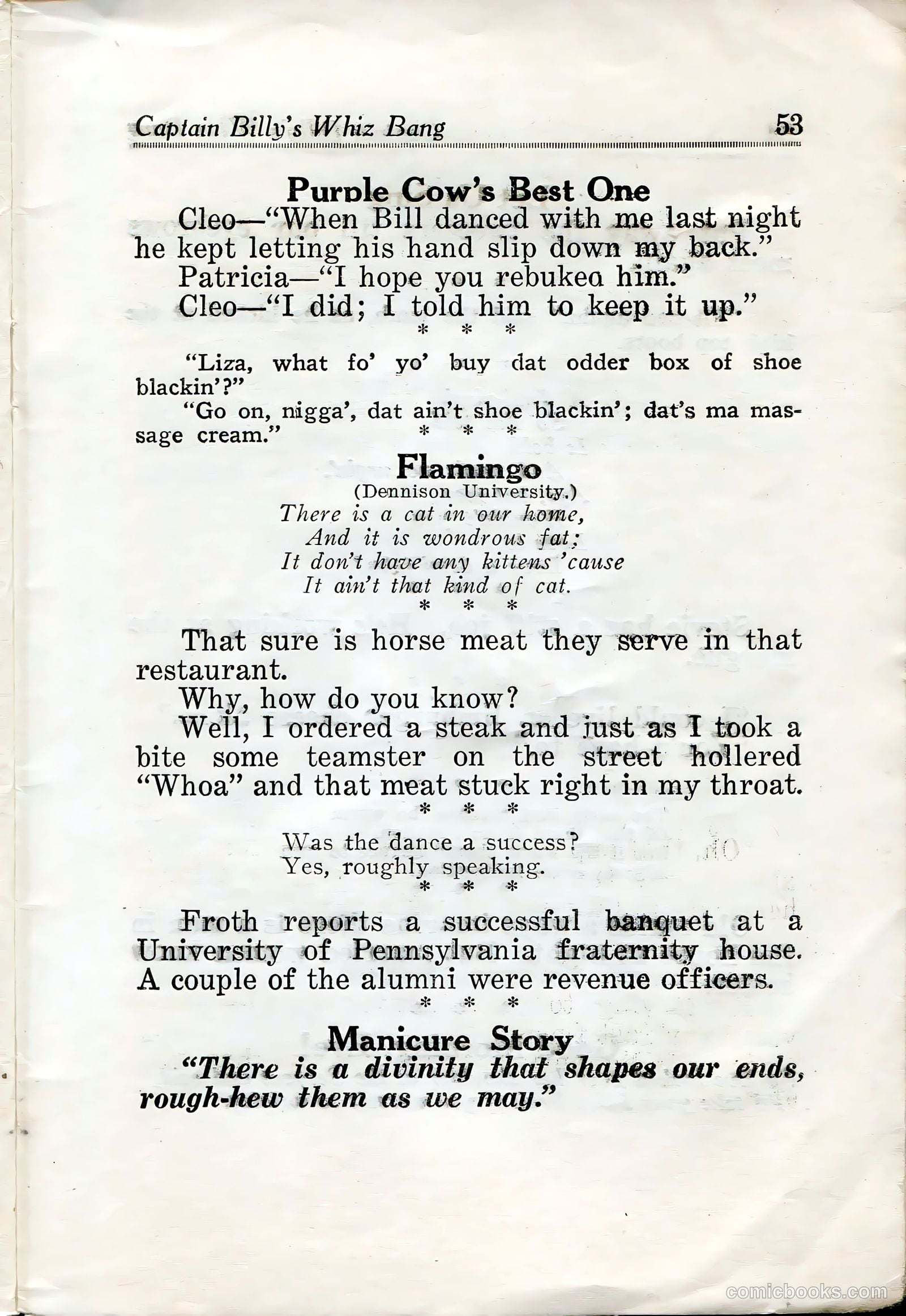
This page collects brief jokes typical of 1920s American humor magazines. Most rely on double entendres or wordplay: **"Purple Cow's Best One"**: A flirtation joke where Cleo's deadpan response ("keep it up") pretends to misunderstand Patricia's moral concern. **"Liza" joke**: Uses racial dialect stereotyping (common in era publications) for a crude joke about massage cream versus shoe polish. **"Flamingo"**: A college humor submission playing on the euphemism that the cat is sterile. **Restaurant/horse meat joke**: A slapstick bit where a teamster's command "Whoa" (to stop a horse) causes the diner's meat to stick in his throat—implying the restaurant serves horse meat. **Froth/Pennsylvania fraternity**: References Prohibition-era humor; "revenue officers" (federal agents enforcing alcohol laws) attending a banquet is ironic. **Manicure Story header**: Opens with a Shakespeare quote, likely setting up a joke that follows (not fully visible here). The page exemplifies lowbrow, pun-heavy humor targeting college readers and working-class audiences.
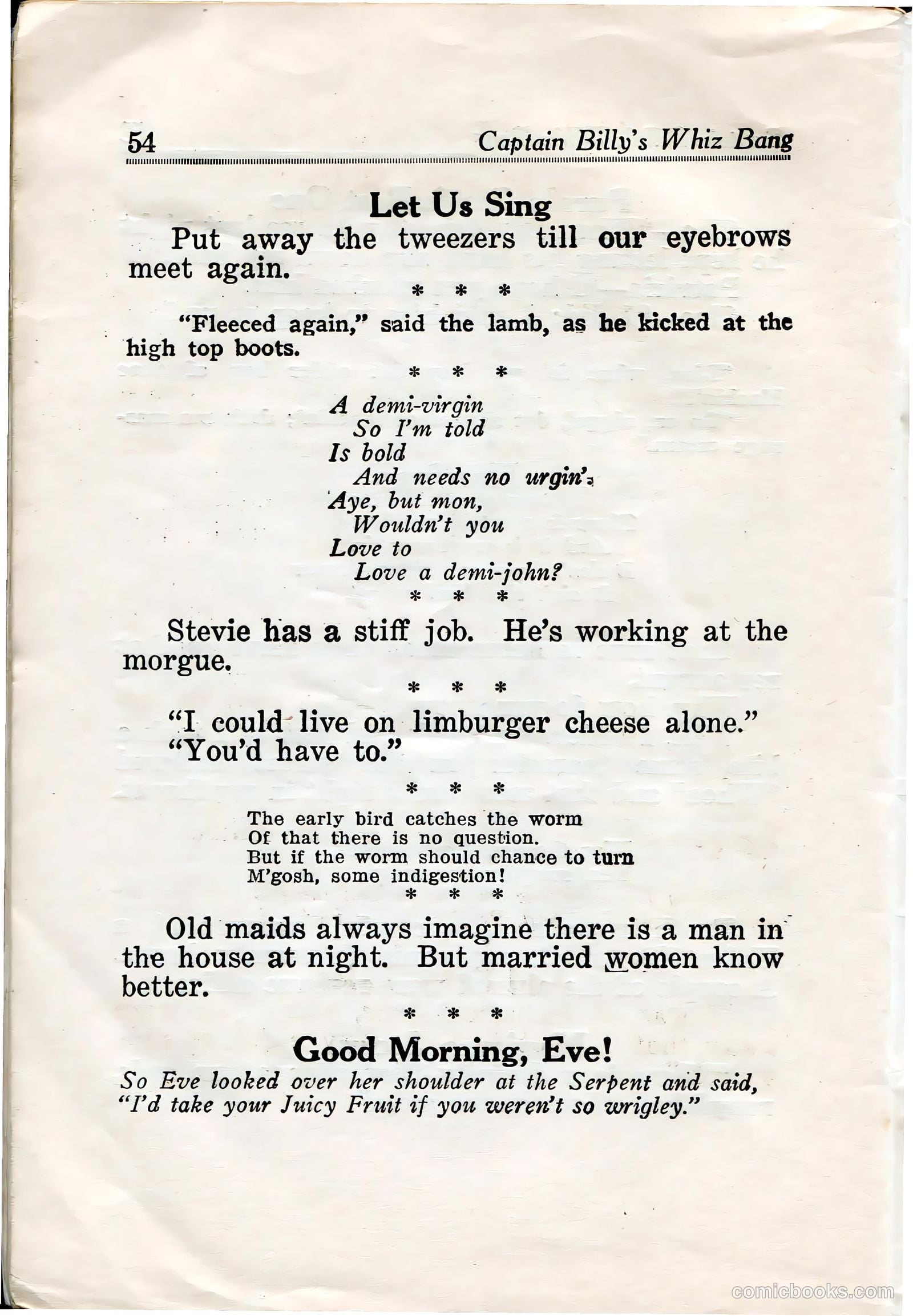
This page from *Captain Billy's Whiz Bang* (a bawdy humor magazine popular in the 1920s) contains a collection of short jokes and puns rather than illustrated cartoons. The humor relies on sexual innuendo and wordplay typical of the era: - "Demi-virgin" and "demi-john" (a large wine bottle) create a double entendre about sexual inexperience - "Limburger cheese" jokes play on the cheese's notorious smell - The "early bird catches the worm" verse subverts the proverb with dark humor about consequences - The final joke conflates "Juicy Fruit" gum with "wrigley" (wriggly), making an adult joke about the serpent's movements Social commentary appears in jabs at old maids versus married women, and cynical observations about work and relationships. The magazine's appeal lay in its risqué humor—risqué for the 1920s—delivered through puns and wordplay rather than explicit language.
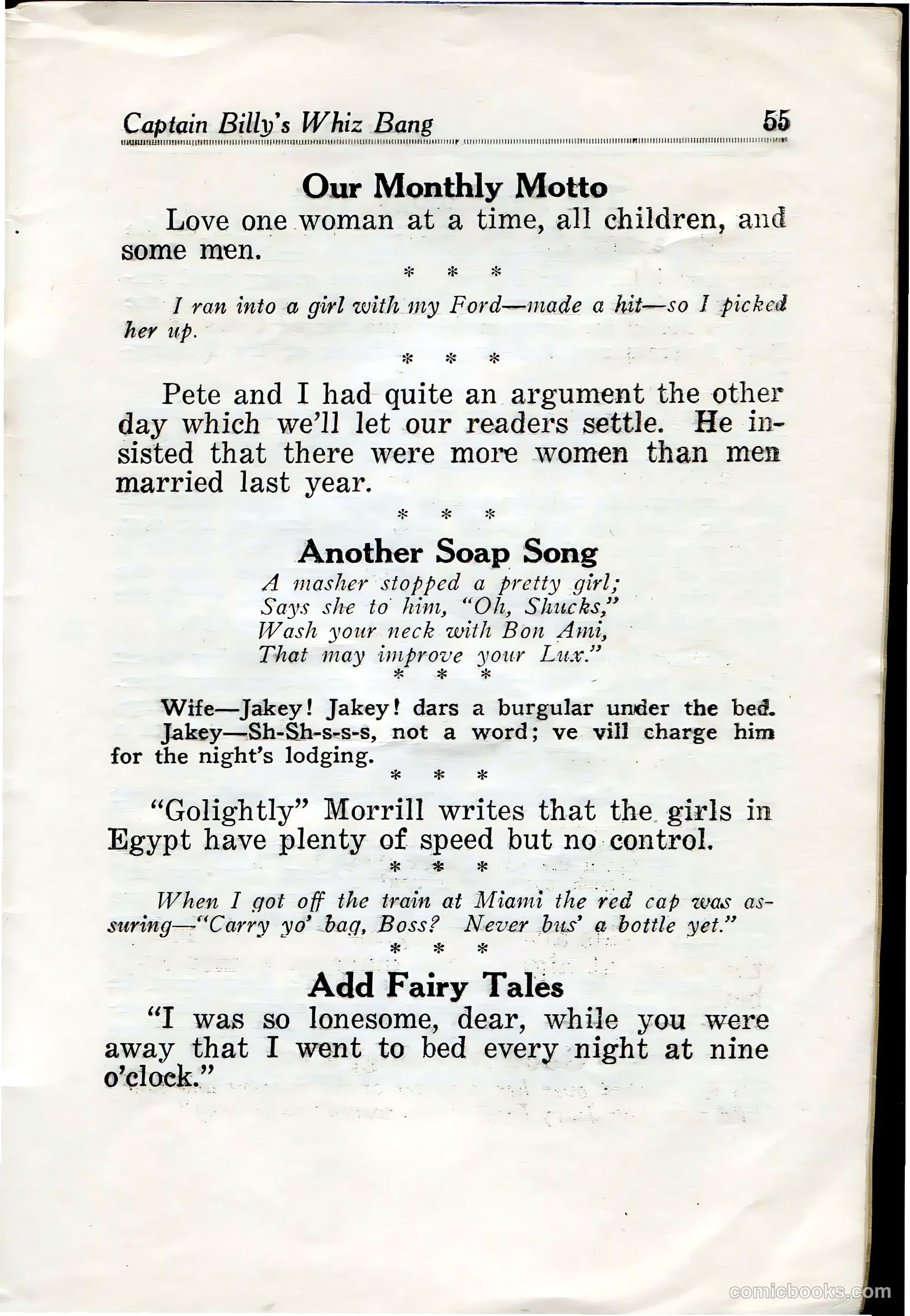
This page from the satirical magazine *Whiz Bang* contains brief humorous quips rather than cartoons. The jokes reflect post-WWI American attitudes: **Key themes:** - **Sexual/romantic humor**: The "monthly motto" and Ford joke play on casual flirtation; the masher sketch mocks aggressive men. - **Gender stereotypes**: References to women's "speed but no control" reflect era assumptions about female drivers and behavior. - **Class/ethnic humor**: The porter's dialect ("Carry yo' bag, Boss") and Jakey's Yiddish-inflected speech ("ve vill charge him") use stereotyped accents for comedic effect—common in 1920s humor but now read as offensive. - **Marriage commentary**: The debate about whether more women than men married mocks relationship dynamics. - **Domestic comedy**: The burglar sketch plays on marital situations. The "fairy tale" closing—claiming early bedtimes from loneliness—is clearly sarcastic, suggesting infidelity or dishonesty. Overall, this reflects *Whiz Bang's* formula of irreverent, brief jokes targeting contemporary social behavior.
This page presents absurdist "psychological test" questions—clearly satirical parodies of intelligence or personality assessments then gaining popularity. The questions are intentionally nonsensical, with answers relying on puns and wordplay rather than logic. The humor works through deliberate misunderstanding: Question 1 plays on "rattle" (snake) and "rattled" (disturbed). Question 2 answers the apple/policeman dilemma with a pun on "weigh" (scale). Question 3 relies on visual puns about "club" foot and "hole" pancake. The mock credibility—attributing this to "Prof. Ivan Awful Line" and promising medals for "irresponsibles"—amplifies the satire. Whiz Bang trafficked in lowbrow humor, and this likely mocks contemporary pseudo-scientific fads or dubious psychological methods gaining mainstream attention in the 1920s era. The jokes are deliberately stupid, which is precisely the point.
This page from a 1920s satirical magazine contains brief jokes and humorous snippets typical of the era's irreverent humor magazine style. The jokes rely on wordplay and social commentary: a girl who dances badly when unsupervised (mocking courtship customs), a wife's sharp retort to a complaining husband, a blonde joke about female intelligence, gambling references, and a military exchange about flowers (the "lieutenant" appears to be complimenting flowers placed by a superior officer—likely sarcastically). A pun equates a dental-manicure marriage with "fighting tooth and nail." The final items are filler: a proverb about listening more than talking, and a humorous lost-and-found notice where the finder brazenly invites the owner to reclaim the cigarette case "by calling again"—implying the finder will keep it unless the owner retrieves it personally. The magazine's crude humor reflects 1920s working-class sensibilities and casual sexism typical of the period.
This page from *Captain Billy's Whiz Bang* (a 1920s-30s satirical magazine) contains several short jokes rather than cartoons. The humor relies heavily on ethnic stereotypes common to the era: **"Ikey's Mental Race Track"** uses a Jewish character with exaggerated dialect ("Vy," "qvick," "mudder") to tell a joke about insurance fraud—the father supposedly kicked his mother during a train wreck to generate a lawsuit claim. This stereotypes Jewish people as shrewd, money-obsessed schemers. The remaining jokes are puns and domestic humor: women made from man's rib "someone pulled a bone" (sexual innuendo), wife's homebrewing rivals Milwaukee beer, "kneed the dough" (kneading/needing wordplay). **"The Punch Bowl"** section jokes that a "good girl" is one nobody knows anything about—implying gossip or scandalous reputations. The final exchange uses silence as marital discord humor. The content reflects period attitudes: casual ethnic mockery, sexual double entendres, and marital tension treated as comedy fodder.
This page from the satirical magazine contains several brief jokes and quips typical of early 20th-century American humor: **"Simple Arithmetic"** mocks large families and photography pricing—a photographer charges "$18 a dozen," making Deacon Jones's eleven children one short of a "dozen," so he can't afford the bulk rate. **"A Chafing Dish"** is an Irish-dialect joke playing on class aspiration: a chafing dish (a heating device for keeping food warm, associated with refined dining) is humorously defined as a "frying pan that's got into society"—suggesting upward mobility through mere pretense. **"The Bull Colossal"** appears to be poetic filler, referencing Taurus (the constellation/zodiac sign). The remaining items are brief one-liners about barber shops, billiards, and union membership—the last joke playing on "shavers" (barbers) and childhood. The humor is gentle, domestic, and reflects period anxieties about class, family size, and labor unions rather than sharp political satire.
This page from the satirical magazine contains several brief humorous sketches with no visible cartoons or illustrations—just text-based jokes. **"Animal Tales"** uses a dog anecdote to mock selective logic: a man defends his supposedly good rat dog by claiming the rats drinking from its bowl are *his* rats, while the dog will attack stranger rats. It's absurdist humor about rationalization. **The "grass widow" poem** plays on wordplay: a "grass widow" (a woman separated from her husband) married "A. Hopper," then divorced him—so she became a "grass-hopper." Pure pun-based humor. **"Old Stuff"** satirizes the medical specialization trend of the era by having characters claim they visit specialists for every ailment. Mrs. Wilkins's punchline mocks this by calling a barber a "tonsorial artist"—elevating common trades with pretentious language, reflecting 1920s anxiety about professional credentialism. These are gentle social observations typical of period humor magazines.
This is a humorous anecdote from *Captain Billy's Whiz Bang*, a popular American satirical magazine known for bawdy jokes and social commentary. The joke satirizes both rural life and the emerging tension between automobiles and traditional society. A farmer stands in the road planning to shoot his old, worthless dog at the river. A motorist hits the dog—an accident. The motorist, recalling he once paid damages for killing livestock, nervously offers $5 compensation, assuming the dog was valuable. The punchline's humor lies in the farmer's good fortune: he gets paid $5 to have the unwanted dog killed for him, eliminating a task he was about to do anyway. The satire mocks rural pragmatism and opportunism, while also gently poking fun at city drivers' anxiety about liability and their misunderstanding of country life.
This page from the satirical magazine contains several short jokes targeting gender relations and male behavior—common themes in 1920s humor. "Rubbing It In" mocks husbands' pretentious philosophizing: Smith waxes poetic about man's insignificance before nature, only to be deflated by his wife's blunt rejoinder. The kerosene lamp comparison is misogynistic wordplay: men are dim-witted, barely functioning, and unreliable. "Then Maw Used the Rolling Pin" jokes about infidelity through a child's innocent misunderstanding—the punchline suggests Mr. Hopkins complimented his stenographer's figure, implying an affair. The wife's violent response (rolling pin) was a stock comedic trope for angry wives. "Good Yarn" plays on homonyms: a young wife curses while discarding actual yarn for knitting, the pun implying she's frustrated with domestic work or her husband's lies. The "Proficiency" notice sarcastically suggests the town's amateur theater troupe are naturally skilled liars, reinforcing the magazine's cynical view of human nature.
This page from the satirical magazine contains three distinct pieces: **"Insurance Bull"** satirizes the false economy of avoiding insurance. A careful driver with an accident wins in court against his accuser but then pays $100 to his lawyer plus ongoing risk—defeating the purpose of his legal "victory." The satire targets overconfidence in litigation as a substitute for insurance protection. **"The Meat Boy's Love"** is a pun-heavy love poem using butcher/meat industry terminology ("sausage," "butcher," "liver," "ham-let," "cleaver") as romantic metaphors. It's lighthearted wordplay typical of the era's humor magazines. **Remaining items** include a brief observation about gender relations and a joke about "hives" (likely a skin condition) rhyming with "wives"—crude domestic humor suggesting marriage causes physical irritation. The page represents early 20th-century American satirical magazine content: practical social commentary mixed with puns and domestic humor.
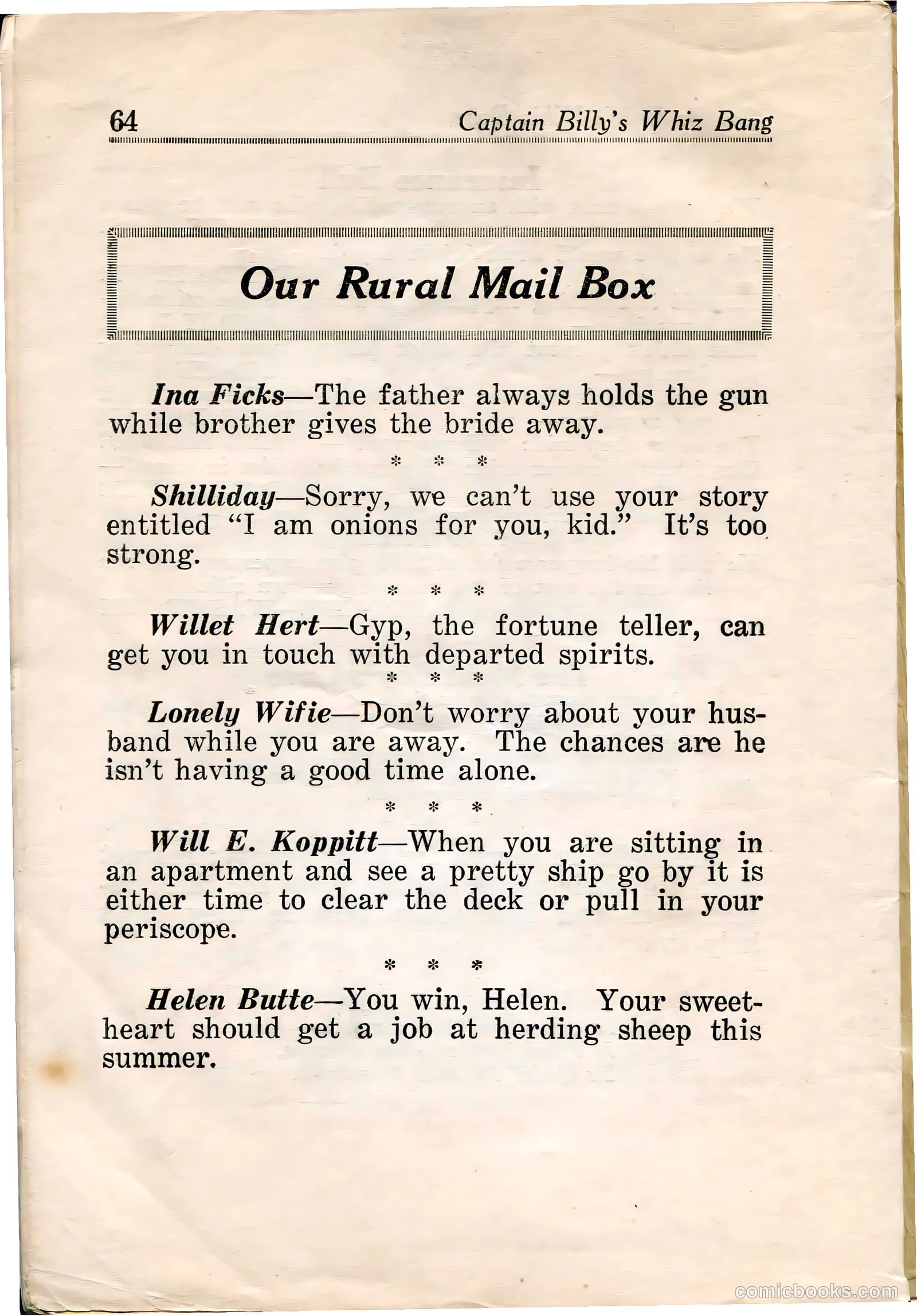
This is a humor column featuring brief, punchy jokes submitted by readers under pseudonyms (many names are obvious puns: "Ina Ficks," "Shilliday," "Will E. Koppitt," "Helen Butte"). The editor replies with quips. The jokes target domestic life and wartime anxieties: - **Ina Ficks**: Rural wedding customs (father with gun, brother giving bride away) — humor about rustic formality - **Shilliday**: Rejected sentimental story deemed "too strong" — editorial humor - **Lonely Wifie**: A wife's worry about her absent husband — likely WWI-era anxiety about soldiers - **Will E. Koppitt**: A double entendre about ship-watching from apartments, with "clear the deck" and "periscope" as sexual innuendo - **Helen Butte**: Suggesting a sweetheart herd sheep (implying he's a "sheep" or foolish) This represents *Whiz Bang*'s signature irreverent, bawdy humor aimed at ordinary Americans, mixing domestic comedy with subtle adult wordplay.
This is a **back-cover advertisement**, not a cartoon page. It promotes *Pedigreed Follies of 1921-22*, a compilation annual from *Captain Billy's Whiz Bang*, a satirical humor magazine published from Robbinsdale, Minnesota. The ad emphasizes the book's content—256 pages collecting "gems" from 25 earlier magazine issues, featuring "stories, toasts, poems, drippings and pot pourri" (miscellaneous humor). The urgent language ("Only a Few Left") creates artificial scarcity to drive sales. The coupon allows mail-order purchase for $1.00 via dollar bill, check, money order, or stamps—reflecting pre-digital commerce when direct-mail ordering was standard. This publication format was typical for humor magazines of the 1920s, which compiled previous issues into collectible annuals for the holiday gift market.
This is a **title/advertisement page** for *Whiz Bang*, an American satirical magazine. The page announces distribution channels and pricing information rather than presenting editorial content. The decorative element—a cartoon cow with exaggerated features—appears to be the publication's mascot or brand identifier. The cow's absurd, anthropomorphic style is typical of early-20th-century humorous illustration. The page itself functions as a **sales pitch**, emphasizing the magazine's widespread availability ("Everywhere!") at hotels, newsstands, and via direct subscription. Pricing details ($0.25 per issue, $2.50 annually, or $1 for a Winter Annual) reflect Depression-era magazine pricing. No specific political or social satire is evident on this page—it's primarily a circulation/marketing document showcasing the magazine's distribution reach and affordability.