
Captain Billy's Whiz Bang, April 1922 · page 35 of 67
Captain Billy's Whiz Bang #32 — page 35: what you’re looking at
What you’re looking at
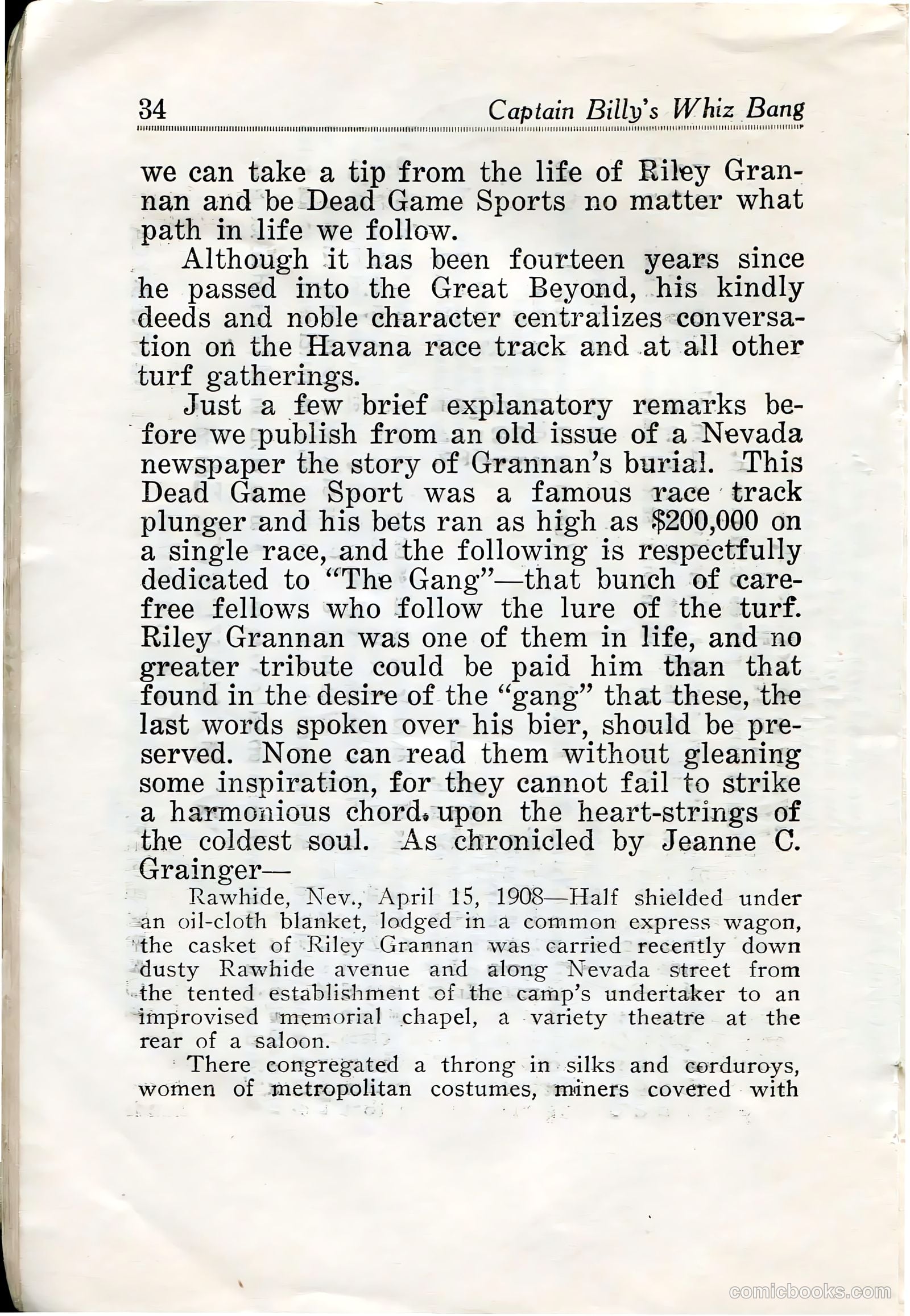
This page from *Captain Billy's Whiz Bang* is primarily **textual rather than a cartoon**—it's a tribute piece about Riley Grannan, a famous horse racing gambler who died fourteen years prior (approximately 1894, given the 1908 reference date). **Who/What This References:** Grannan was a legendary "turf plunger"—someone who placed enormous bets on horse races (up to $200,000 per race). The article lionizes him as a "Dead Game Sport," celebrating high-stakes gamblers and the horse-racing community. **The Social Context:** The piece romanticizes the racing world and its colorful characters—miners, socialites, and betting enthusiasts gathered in a Nevada mining town. It presents Grannan's funeral as a meaningful ceremony deserving preservation. **The Point:** The magazine is celebrating reckless gambling culture and the lifestyle of professional gamblers as noble and admirable, framing their deaths as occasions for sentimental remembrance rather than cautionary tales.
📄 Transcribed text from this page (OCR, searchable)
Machine-transcribed from the original scan — historical spelling and the odd misread are preserved.
34 Captain Billy's Whiz Bang we can take a tip from the life of Riley Gran- nan and be Dead Game Sports no matter what path in life we follow. Although it has been fourteen years since he passed into the Great Beyond, his kindly deeds and noble character centralizes conversa- tion on the Havana race track and at all other turf gatherings. Just a few brief explanatory remarks be- fore we publish from an old issue of a Nevada newspaper the story of Grannan's burial. This Dead Game Sport was a famous race track plunger and his bets ran as high as $200,000 on a single race, and the following is respectfully dedicated to “The Gang”—that bunch of care- free fellows who follow the lure of the turf. Riley Grannan was one of them in life, and no greater tribute could be paid him than that found in the desire of the “gang” that these, the last words spoken over his bier, should be pre- served. None can read them without gleaning some inspiration, for they cannot fail to strike a harmonious chord, upon the heart-strings of the coldest soul. As chronicled by Jeanne C. Grainger— Rawhide, Nev., April 15, 1908—Half shielded under an oil-cloth blanket, lodged in a common express wagon, the casket of Riley Grannan was carried recently down dusty Rawhide avenue and along Nevada street from the tented establishment of the camp's undertaker to an improvised memorial chapel, a variety theatre at the rear of a saloon. There congregated a throng in silks and corduroys, women of metropolitan costumes, miners covered with