
Captain Billy's Whiz Bang, April 1922 · page 8 of 67
Captain Billy's Whiz Bang #32 — page 8: what you’re looking at
What you’re looking at
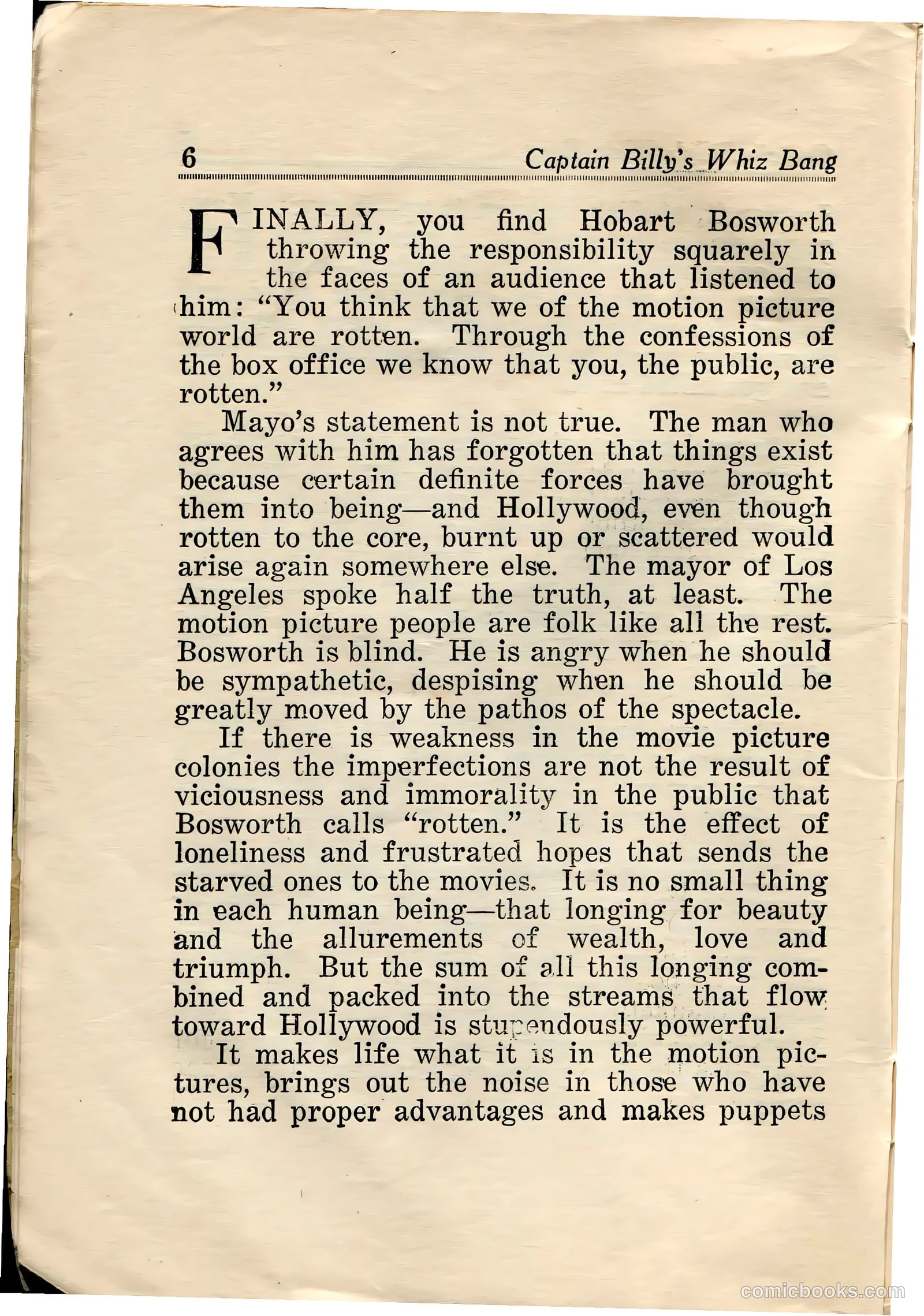
This page from *Captain Billy's Whiz Bang* critiques actor Hobart Bosworth's recent public statement blaming moviegoers for Hollywood's moral decay. Bosworth had accused audiences of being "rotten," claiming their box-office choices revealed their corruption. The author rebuts Bosworth harshly, calling him "blind" and emotionally misguided—angry where he should be sympathetic. The piece defends ordinary people, arguing that cinema attendance stems from loneliness and frustrated aspirations, not moral rot. It acknowledges Hollywood's weaknesses but frames them as inevitable human responses to desire for beauty, wealth, and love rather than proof of audience depravity. The satire targets Bosworth's hypocrisy: he profits from the industry yet condemns its consumers. The piece suggests Hollywood would regenerate regardless, implying the system's resilience depends on human yearning—not individual virtue. This reflects 1920s-era debates about mass culture, morality, and who bore responsibility for cinema's content.
📄 Transcribed text from this page (OCR, searchable)
Machine-transcribed from the original scan — historical spelling and the odd misread are preserved.
6 Captain Billy's Whiz Bang FINALLY, you find Hobart Bosworth throwing the responsibility squarely in the faces of an audience that listened to him: "You think that we of the motion picture world are rotten. Through the confessions of the box office we know that you, the public, are rotten." Mayo's statement is not true. The man who agrees with him has forgotten that things exist because certain definite forces have brought them into being—and Hollywood, even though rotten to the core, burnt up or scattered would arise again somewhere else. The mayor of Los Angeles spoke half the truth, at least. The motion picture people are folk like all the rest. Bosworth is blind. He is angry when he should be sympathetic, despising when he should be greatly moved by the pathos of the spectacle. If there is weakness in the movie picture colonies the imperfections are not the result of viciousness and immorality in the public that Bosworth calls "rotten." It is the effect of loneliness and frustrated hopes that sends the starved ones to the movies. It is no small thing in each human being—that longing for beauty and the allurements of wealth, love and triumph. But the sum of all this longing com- bined and packed into the streams that flow toward Hollywood is stupendously powerful. It makes life what it is in the motion pic- tures, brings out the noise in those who have not had proper advantages and makes puppets