
Captain Billy's Whiz Bang, April 1922 · page 47 of 67
Captain Billy's Whiz Bang #32 — page 47: what you’re looking at
What you’re looking at
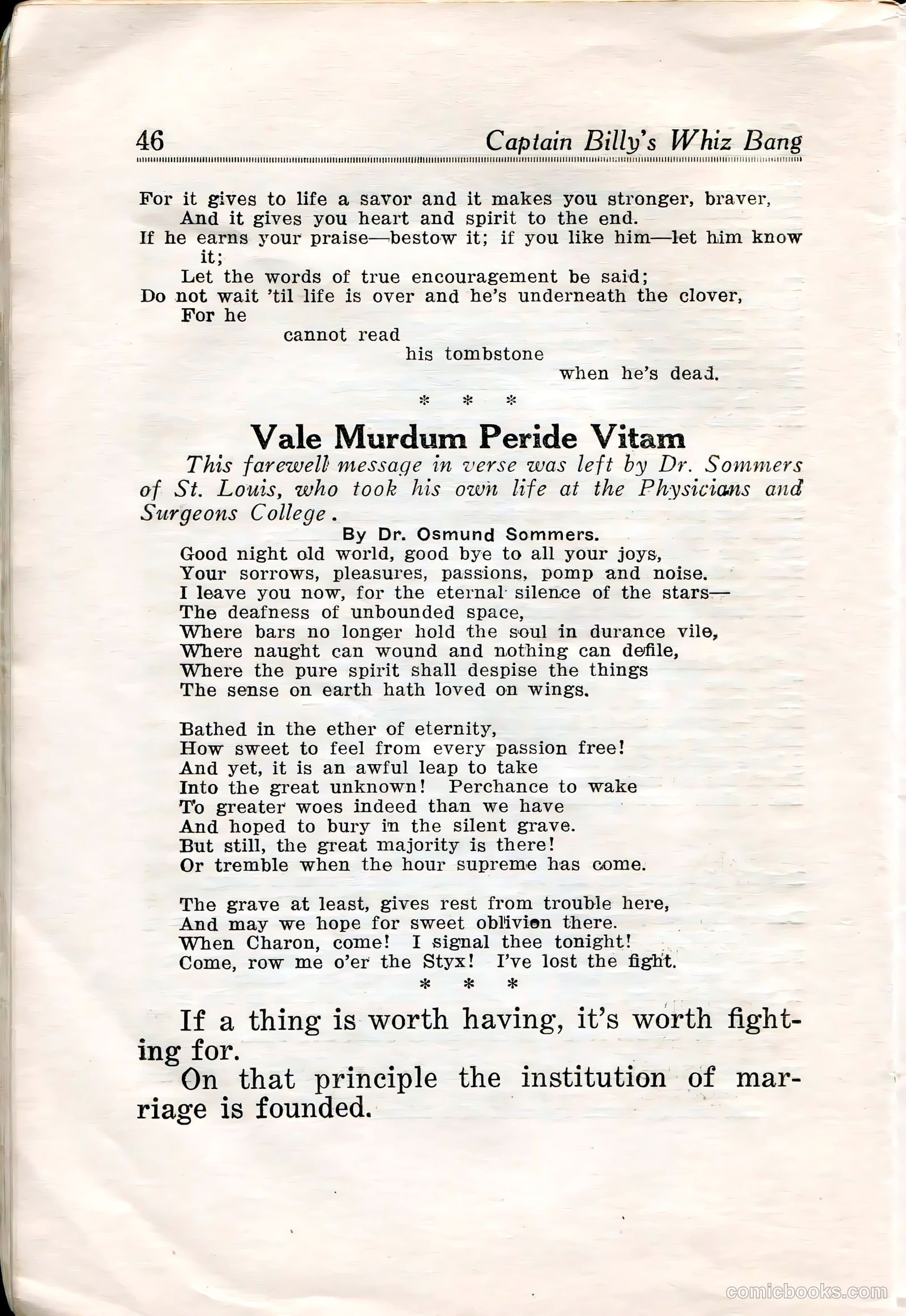
This page from *Captain Billy's Whiz Bang* (a 1920s-era satirical magazine) contains two distinct pieces: **First section**: A verse encouraging people to praise others while they're alive rather than waiting until death—a common morality poem about appreciating people in the present. **Second section**: The tragic suicide note of Dr. Osmund Sommers of St. Louis, who died by suicide at the Physicians and Surgeons College. The Latin title "Vale Murdum Peride Vitam" (roughly "farewell to a dead man's life") frames this as a literary farewell. The poem expresses philosophical despair about life's sufferings, references classical mythology (Charon, the Styx), and contemplates whether death offers escape or worse torment. **Final joke**: A cynical quip equating marriage with fighting—suggesting marriage requires the same commitment as "a thing worth having." The juxtaposition is notably dark: the magazine pairs genuine suicide content with flippant humor about marriage, reflecting the era's casual treatment of serious subjects in satirical publications.
📄 Transcribed text from this page (OCR, searchable)
Machine-transcribed from the original scan — historical spelling and the odd misread are preserved.
46 Captain Billy's Whiz Bang For it gives to life a savor and it makes you stronger, braver, And it gives you heart and spirit to the end. If he earns your praise—bestow it; if you like him—let him know it; Let the words of true encouragement be said; Do not wait 'til life is over and he's underneath the clover, For he cannot read his tombstone when he's dead. * * * Vale Murdum Peride Vitam This farewell message in verse was left by Dr. Sommers of St. Louis, who took his own life at the Physicians and Surgeons College. By Dr. Osmund Sommers. Good night old world, good bye to all your joys, Your sorrows, pleasures, passions, pomp and noise. I leave you now, for the eternal silence of the stars— The deafness of unbounded space, Where bars no longer hold the soul in durance vile, Where naught can wound and nothing can defile, Where the pure spirit shall despise the things The sense on earth hath loved on wings. Bathed in the ether of eternity, How sweet to feel from every passion free! And yet, it is an awful leap to take Into the great unknown! Perchance to wake To greater woes indeed than we have And hoped to bury in the silent grave. But still, the great majority is there! Or tremble when the hour supreme has come. The grave at least, gives rest from trouble here, And may we hope for sweet oblivion there. When Charon, come! I signal thee tonight! Come, row me o'er the Styx! I've lost the fight. * * * If a thing is worth having, it's worth fight- ing for. On that principle the institution of mar- riage is founded.