
Captain Billy's Whiz Bang, April 1922 · page 7 of 67
Captain Billy's Whiz Bang #32 — page 7: what you’re looking at
What you’re looking at
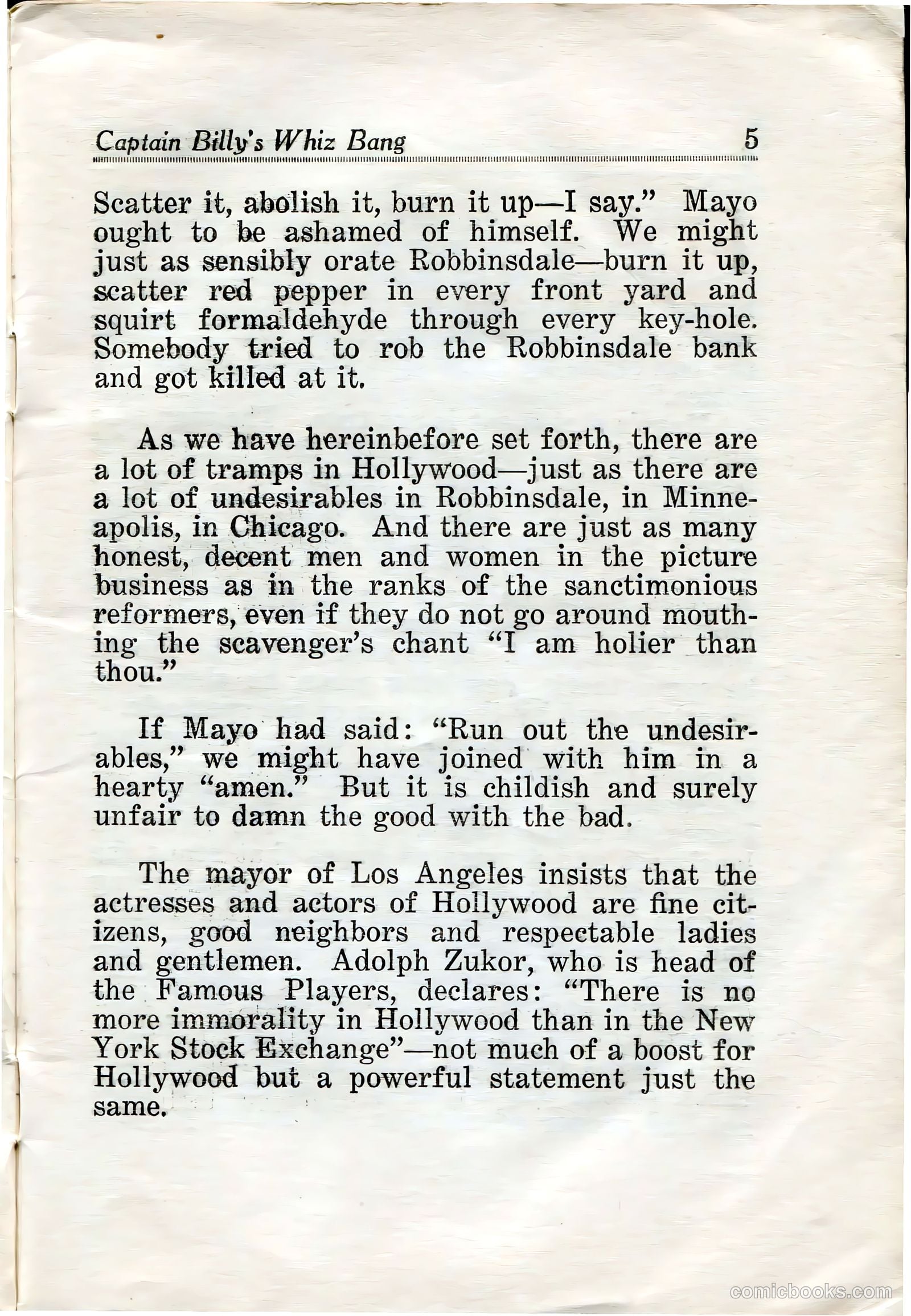
This page defends Hollywood against moral attacks, likely from the 1920s when the film industry faced intense criticism from reformers concerned about immorality. The text references "Mayo" (appears to be a public figure advocating to destroy Hollywood) and critiques his position as hypocritical and unfair. The author argues that condemning an entire industry because of some "undesirables" mirrors condemning entire cities like Robbinsdale or Minneapolis over isolated crimes. The defense cites Los Angeles's mayor and **Adolph Zukor**, head of Famous Players film studio, who argues Hollywood's morality matches the New York Stock Exchange—a backhanded compliment suggesting both institutions have similar ethical shortcomings, yet the comparison normalizes Hollywood against establishment institutions. The satire's point: reformers applying double standards to Hollywood while ignoring misconduct in respectable institutions like finance. The piece defends the film industry's reputation during an era of intense moral panic about cinema's influence.
📄 Transcribed text from this page (OCR, searchable)
Machine-transcribed from the original scan — historical spelling and the odd misread are preserved.
Captain Billy's Whiz Bang 5 Scatter it, abolish it, burn it up—I say.” Mayo ought to be ashamed of himself. We might just as sensibly orate Robbinsdale—burn it up, scatter red pepper in every front yard and squirt formaldehyde through every key-hole. Somebody tried to rob the Robbinsdale bank and got killed at it. As we have hereinbefore set forth, there are a lot of tramps in Hollywood—just as there are a lot of undesirables in Robbinsdale, in Minne- apolis, in Chicago. And there are just as many honest, decent men and women in the picture business as in the ranks of the sanctimonious reformers, even if they do not go around mouth- ing the scavenger’s chant “I am holier than thou.” If Mayo had said: “Run out the undesir- ables,” we might have joined with him in a hearty “amen.” But it is childish and surely unfair to damn the good with the bad. The mayor of Los Angeles insists that the actresses and actors of Hollywood are fine cit- izens, good neighbors and respectable ladies and gentlemen. Adolph Zukor, who is head of the Famous Players, declares: “There is no more immorality in Hollywood than in the New York Stock Exchange”—not much of a boost for Hollywood but a powerful statement just the same.