
Captain Billy's Whiz Bang, April 1922 · page 42 of 67
Captain Billy's Whiz Bang #32 — page 42: what you’re looking at
What you’re looking at
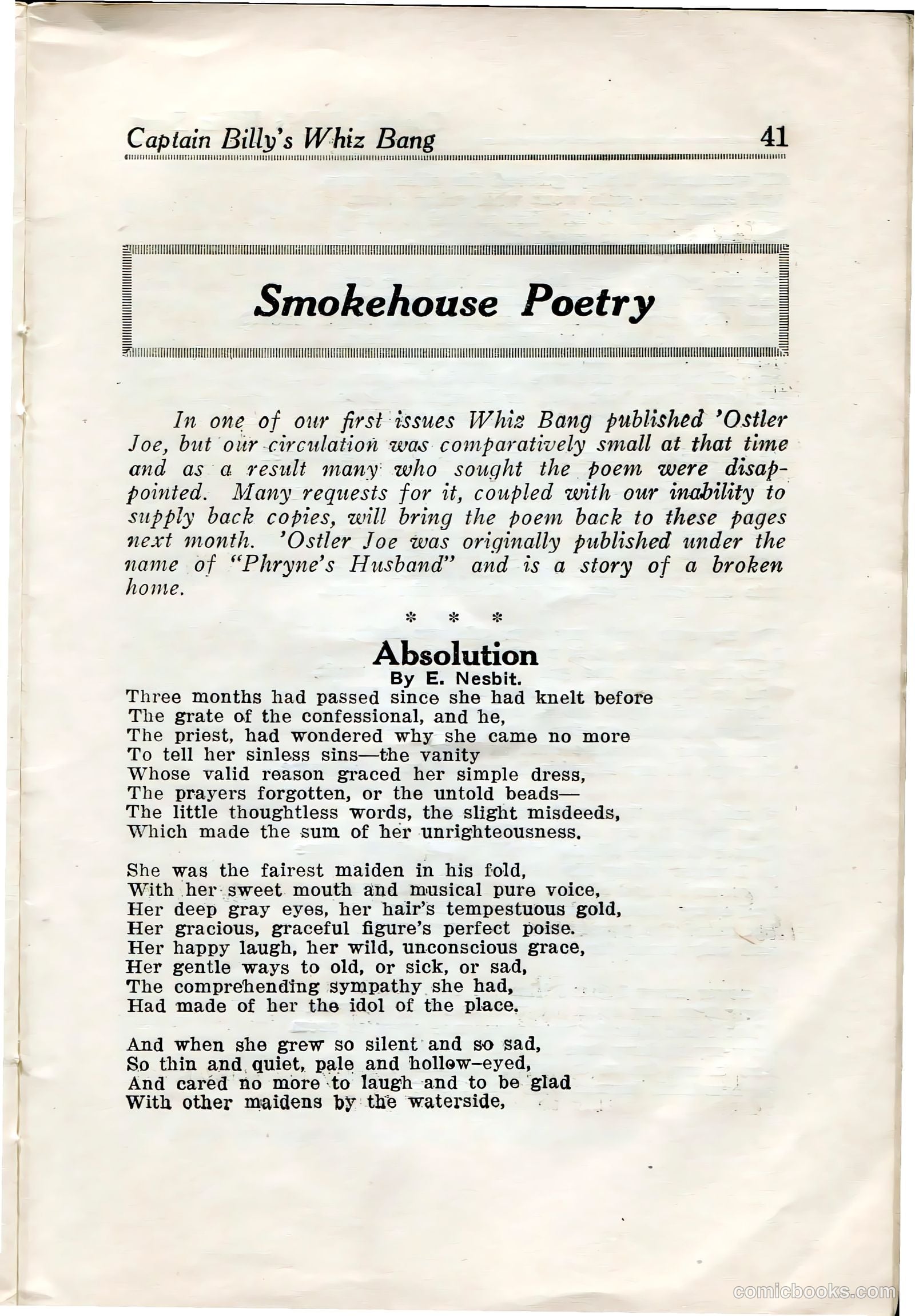
This page contains no cartoons or satirical illustrations—it's primarily literary content from *Captain Billy's Whiz Bang*, a humor magazine. The page reprints a poem titled "Absolution" by E. Nesbit (a well-known British author). The editorial note explains they're re-running a previously published poem called "Ostler Joe" (originally titled "Phryne's Husband") due to reader demand and limited back-copy availability. "Absolution" itself is a narrative poem about a young woman's confession to a priest. The poem explores themes of sin, penance, and the priest's unspoken attraction to his parishioner—suggesting tension between religious duty and human desire. The woman's withdrawal from church life and visible decline forms the poem's implied tragedy. This represents *Whiz Bang's* "Smokehouse Poetry" section: mildly risqué literary content that balanced the magazine's crude humor with more sophisticated material.
📄 Transcribed text from this page (OCR, searchable)
Machine-transcribed from the original scan — historical spelling and the odd misread are preserved.
Captain Billy's Whiz Bang 41 Smokehouse Poetry In one of our first issues Whiz Bang published 'Ostler Joe, but our circulation was comparatively small at that time and as a result many who sought the poem were disap-pointed. Many requests for it, coupled with our inability to supply back copies, will bring the poem back to these pages next month. 'Ostler Joe was originally published under the name of “Phryne's Husband” and is a story of a broken home. * * * Absolution By E. Nesbit. Three months had passed since she had knelt before The grate of the confessional, and he, The priest, had wondered why she came no more To tell her sinless sins—the vanity Whose valid reason graced her simple dress, The prayers forgotten, or the untold beads— The little thoughtless words, the slight misdeeds, Which made the sum of her unrighteousness. She was the fairest maiden in his fold, With her sweet mouth and musical pure voice, Her deep gray eyes, her hair's tempestuous gold, Her gracious, graceful figure's perfect poise. Her happy laugh, her wild, unconscious grace, Her gentle ways to old, or sick, or sad, The comprehending sympathy she had, Had made of her the idol of the place. And when she grew so silent and so sad, So thin and quiet, pale and hollow-eyed, And cared no more to laugh and to be glad With other maidens by the waterside,