
Captain Billy's Whiz Bang, April 1922 · page 43 of 67
Captain Billy's Whiz Bang #32 — page 43: what you’re looking at
What you’re looking at
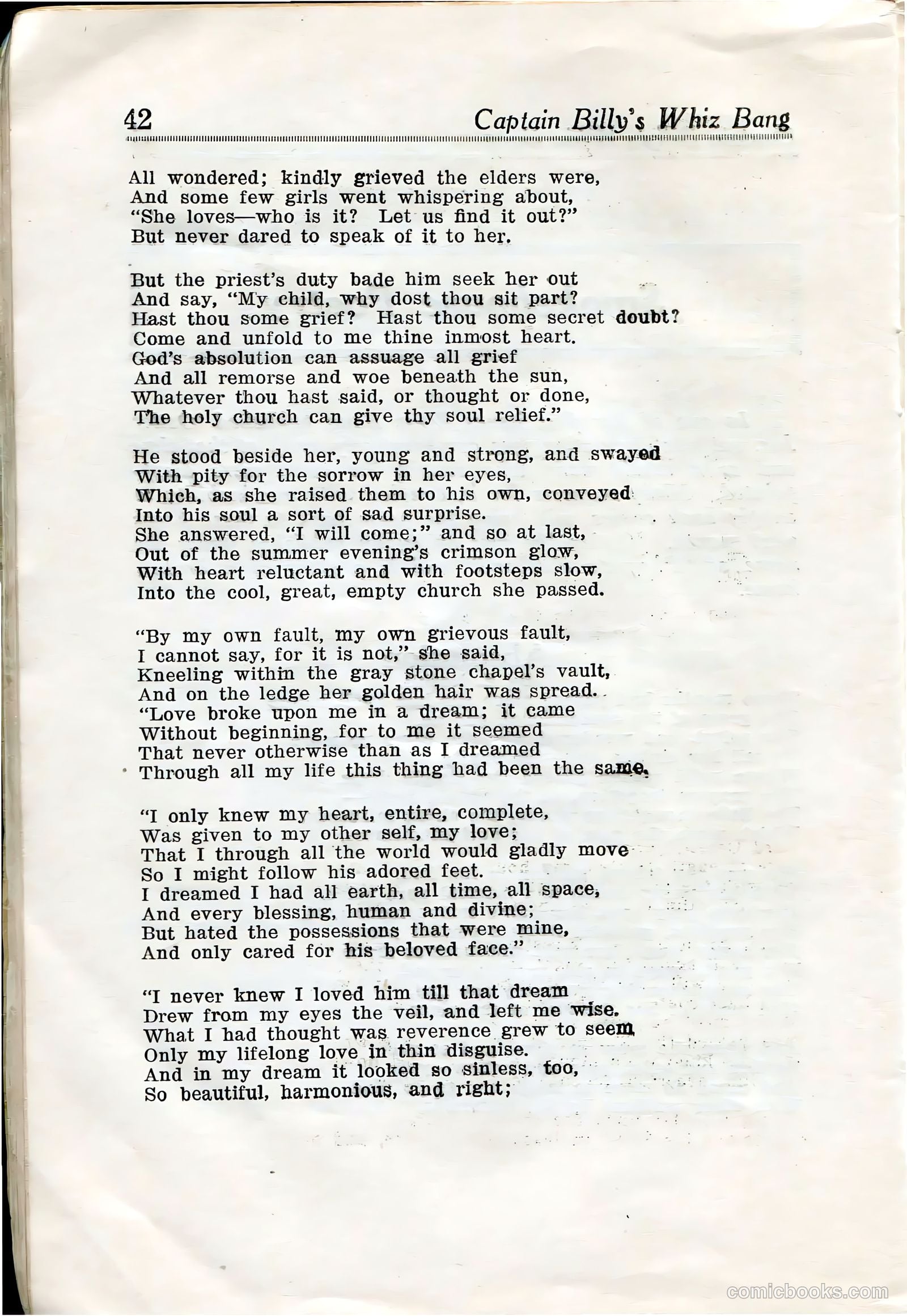
This page contains no political cartoon—it's a narrative poem about a young woman confessing to a priest that she has fallen in love. The work appears to be romantic/sentimental fiction rather than satire. The poem depicts a girl troubled by unrequited love who seeks spiritual counsel. She confesses to the priest that a dream revealed her lifelong, unspoken affection for an unnamed man. The narrative emphasizes her internal conflict: her love seemed "sinless" and "beautiful" in the dream, yet she carries guilt about it in waking life. *Whiz Bang* was primarily a humor magazine, so this earnest romantic poetry seems atypical for the publication. Without additional context about the issue's date or surrounding content, the satirical intent—if any—remains unclear. The poem may be straightforward sentimental content, or possibly parody of overwrought romantic literature popular at the time.
📄 Transcribed text from this page (OCR, searchable)
Machine-transcribed from the original scan — historical spelling and the odd misread are preserved.
42 Captain Billy's Whiz Bang All wondered; kindly grieved the elders were, And some few girls went whispering about, “She loves—who is it? Let us find it out?” But never dared to speak of it to her. But the priest’s duty bade him seek her out And say, “My child, why dost thou sit part? Hast thou some grief? Hast thou some secret doubt? Come and unfold to me thine inmost heart. God’s absolution can assuage all grief And all remorse and woe beneath the sun, Whatever thou hast said, or thought or done, The holy church can give thy soul relief.” He stood beside her, young and strong, and swayed With pity for the sorrow in her eyes, Which, as she raised them to his own, conveyed Into his soul a sort of sad surprise. She answered, “I will come;” and so at last, Out of the summer evening’s crimson glow, With heart reluctant and with footsteps slow, Into the cool, great, empty church she passed. “By my own fault, my own grievous fault, I cannot say, for it is not,” she said, Kneeling within the gray stone chapel’s vault, And on the ledge her golden hair was spread. “Love broke upon me in a dream; it came Without beginning, for to me it seemed That never otherwise than as I dreamed Through all my life this thing had been the same. “I only knew my heart, entire, complete, Was given to my other self, my love; That I through all the world would gladly move So I might follow his adored feet. I dreamed I had all earth, all time, all space, And every blessing, human and divine; But hated the possessions that were mine, And only cared for his beloved face.” “I never knew I loved him till that dream Drew from my eyes the veil, and left me wise. What I had thought was reverence grew to seem Only my lifelong love in thin disguise. And in my dream it looked so sinless, too, So beautiful, harmonious, and right;