
A complete issue · 52 pages · 1928
Life — November 9, 1928
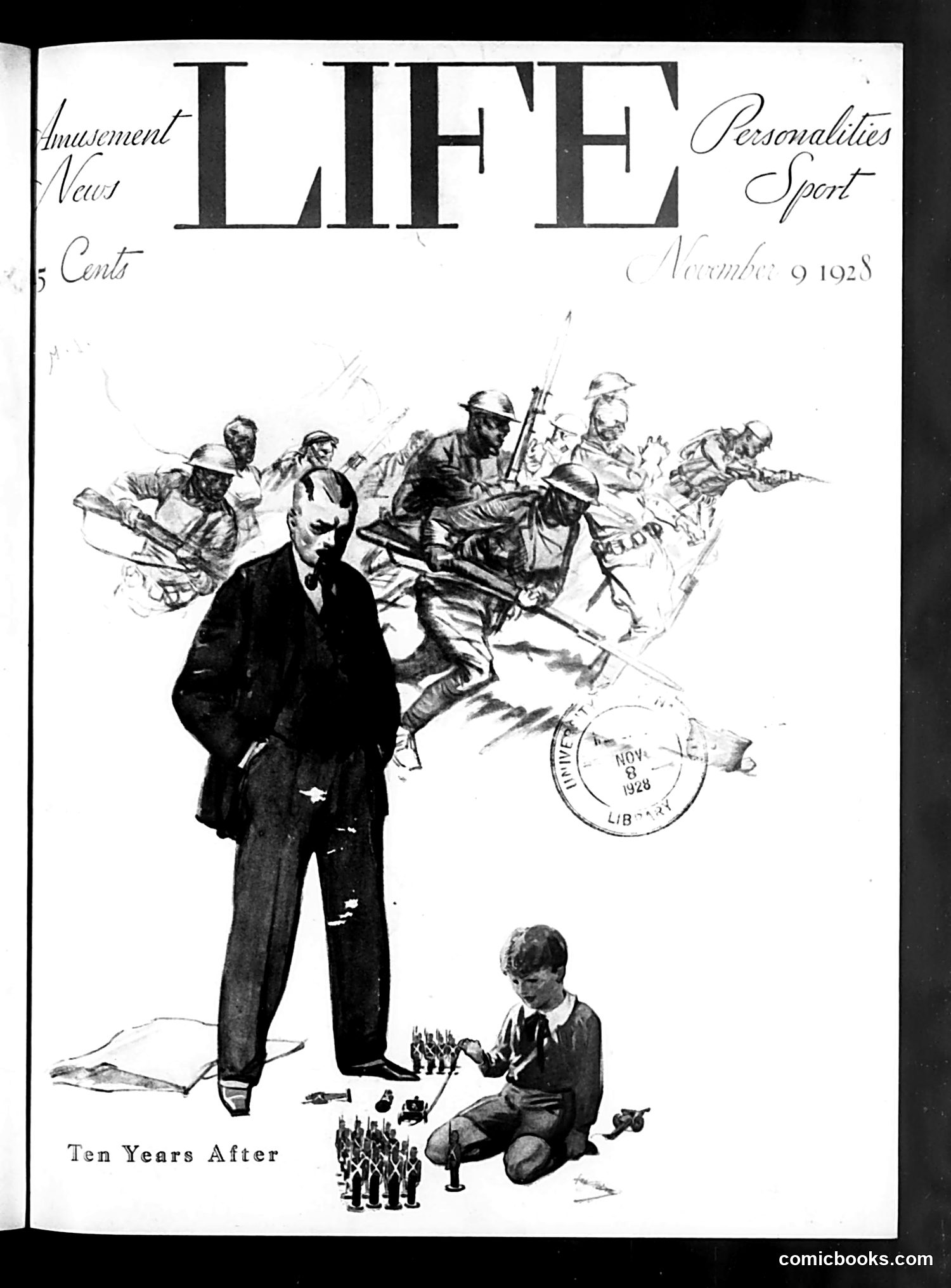
This cover depicts "Ten Years After" the end of World War I (1918). The central figure is an adult man in a business suit, appearing haunted or troubled, with WWI soldiers fighting in the background above him. Below him sits a young boy playing with toy soldiers and ammunition. The satire critiques the legacy of war: the grown man bears the psychological weight of combat ("shell shock" was a recognized condition), while the next generation—represented by the child—is already being conditioned toward militarism through war toys. The cartoon suggests that despite a decade of peace, war's trauma persists in survivors' minds, and society continues grooming children for future conflict rather than breaking cycles of violence. It's a commentary on failed post-war reconciliation and ongoing militarization.
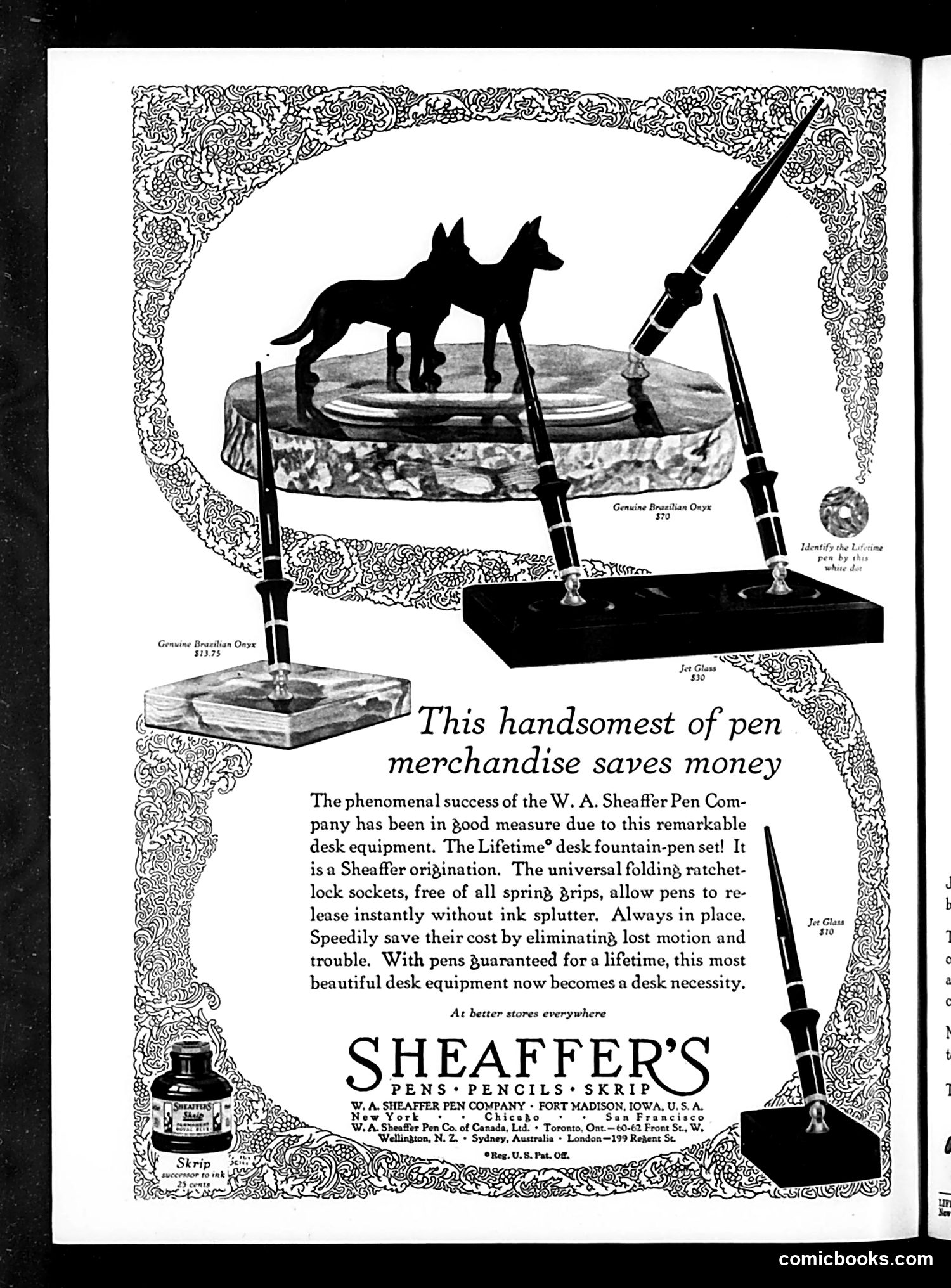
This is a **product advertisement**, not political satire. It promotes Sheaffer fountain pens and desk accessories from the W.A. Sheaffer Pen Company (Fort Madison, Iowa). The ad features decorative ornamental borders and illustrates their "Lifetime" desk fountain-pen set with various accessories—an onyx desk set, pen holders, and ink bottle—priced around $10-$75. Two silhouetted dogs stand on an oval platform, likely meant as decorative imagery symbolizing quality or loyalty. The copywriting emphasizes practical benefits: pens with "universal folding ratchet-lock sockets" prevent ink splatter, and lifetime guarantees reduce replacement costs. The ad targets office workers seeking reliable, attractive desk equipment as a business necessity rather than luxury.
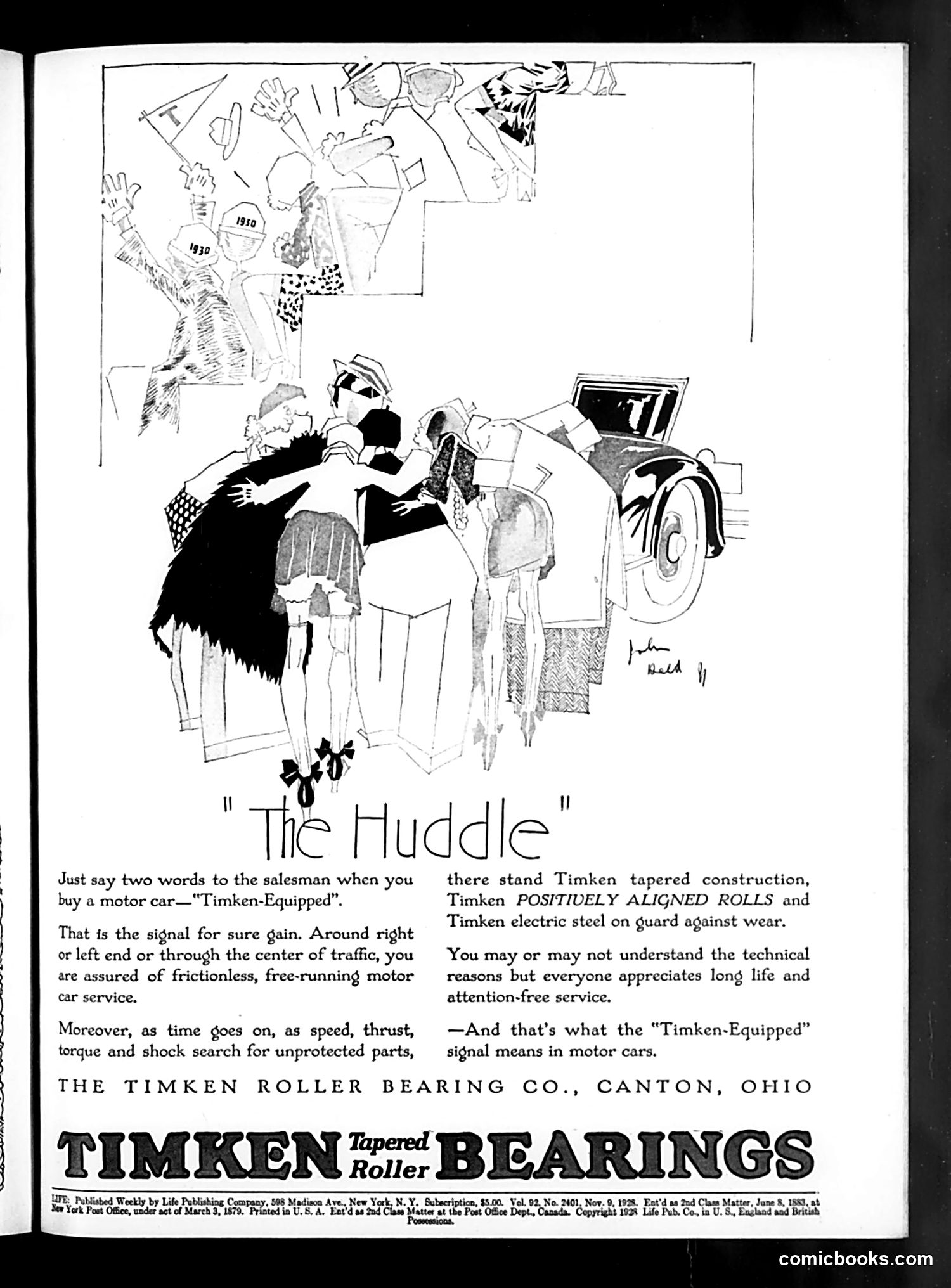
This is primarily a **product advertisement**, not political satire. The cartoon depicts a group of people (appearing to be a family or shoppers) huddled around a car, examining it together—hence the title "The Huddle." The ad promotes Timken tapered roller bearings by suggesting that saying "Timken-Equipped" to a car salesman guarantees quality. The illustration shows the collaborative decision-making process typical of 1920s-era car purchasing, where multiple family members would inspect the vehicle together. The humor is gentle and domestic rather than satirical. The ad emphasizes that Timken bearings provide durability and reliable performance over time, appealing to consumers' desires for long-lasting, maintenance-free vehicles—a significant selling point in early automotive marketing.
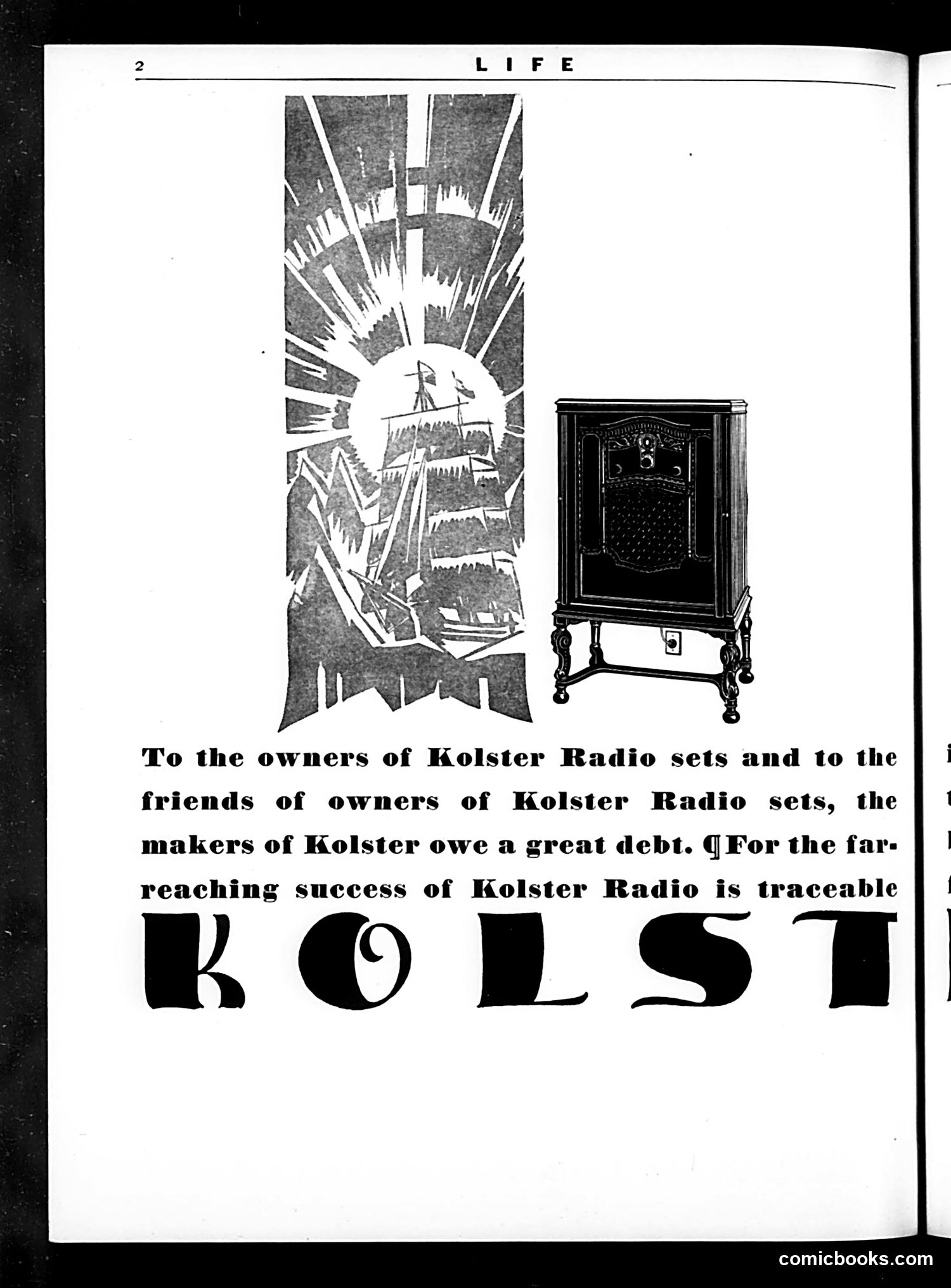
This page is primarily **advertising** for Kolster Radio sets, not political satire. The text credits "KOLST" (likely "Kolster") with the "far-reaching success of Kolster Radio," attributing it to the device's popularity among owners and their friends. The left image shows a stylized sunburst or radiating light pattern with what appears to be a ship or nautical vessel — likely representing radio's far-reaching broadcast capability, a common advertising motif of the early radio era. The right image displays a Kolster radio console set on decorative legs, a typical 1920s-era home radio receiver. This is a straightforward product advertisement from Life magazine's commercial pages, not a satirical cartoon.
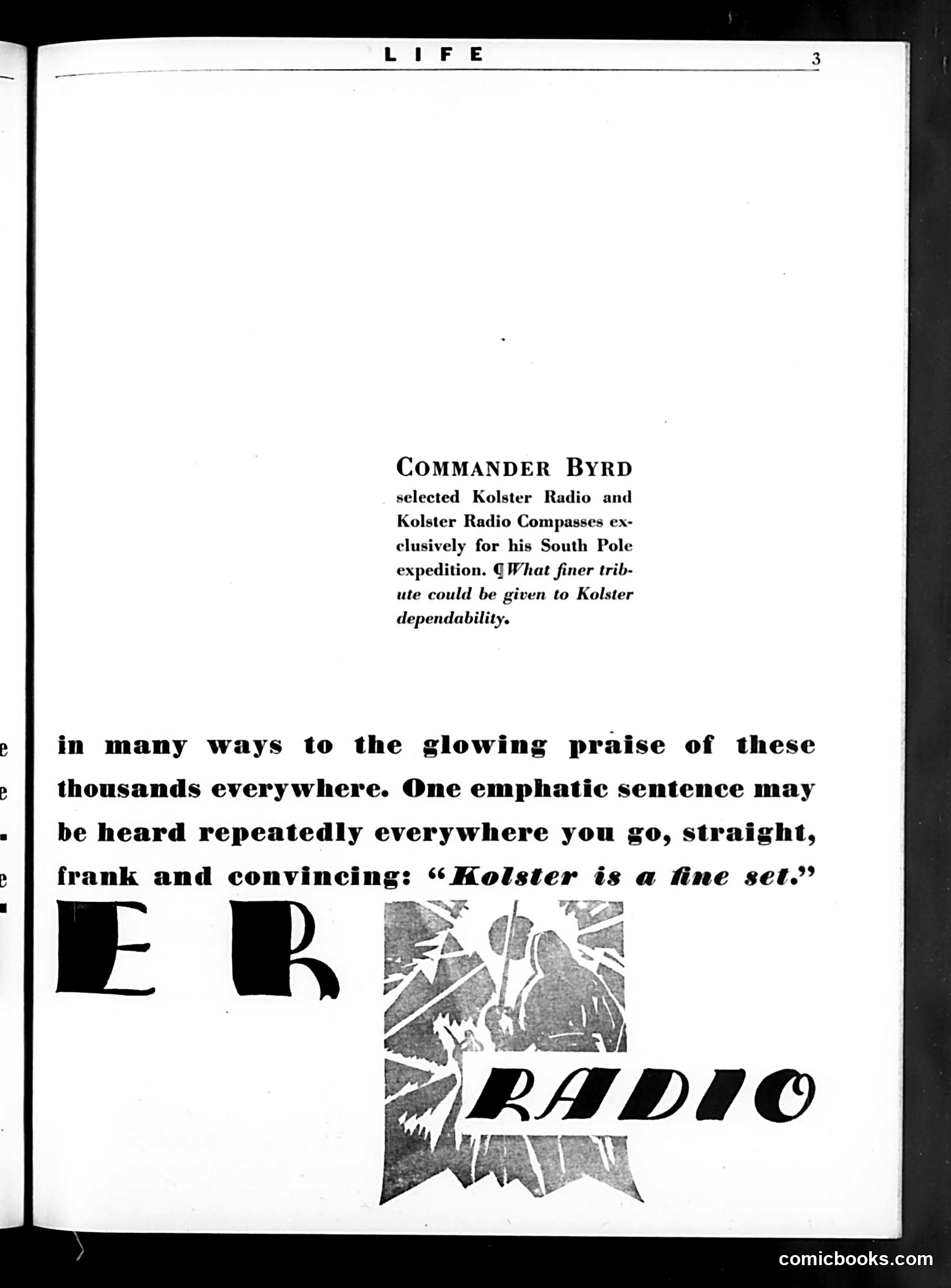
This page is primarily an **advertisement for Kolster Radio and Radio Compasses**, not political satire or editorial content. The advertisement references **Commander Byrd's South Pole expedition**, using his endorsement as a marketing tool. The text quotes Byrd praising Kolster equipment's "dependability" during this polar exploration—a significant contemporary achievement that would have impressed readers. The large "ER RADIO" text (with "KOLSTER" integrated into the design) and the eagle imagery are branding elements. The phrase "Kolster is a fine set" is presented as widespread praise the reader would "hear repeatedly everywhere." This represents **early 20th-century marketing strategy**: leveraging famous explorers' real equipment choices to build consumer trust in radio technology during the medium's rapid commercialization.
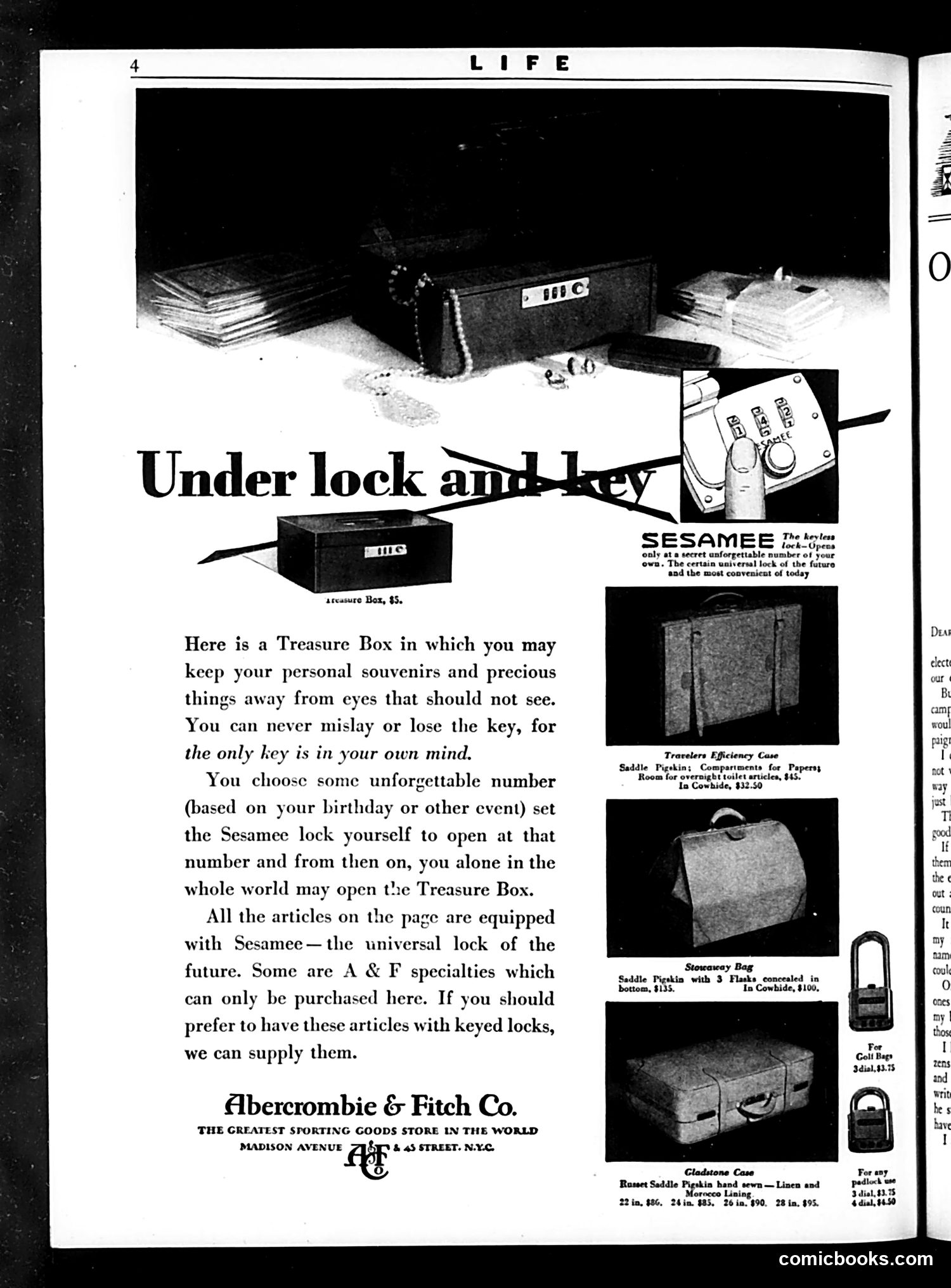
This page is **primarily advertising**, not satire or political commentary. It features a Sesamee brand advertisement from Abercrombie & Fitch Co. promoting various products equipped with combination locks. The headline "Under lock and key" is a straightforward marketing phrase, not a political reference. The advertisement showcases several items: a treasure box, desk organizer, stationery bag, and gladstone case—all featuring Sesamee locks that operate via memorable number combinations rather than traditional keys. The copy emphasizes that users can "choose some unforgettable number (based on your birthday or other event)" to secure the lock, positioning this as convenient and modern technology ("the universal lock of the future"). This is purely commercial content typical of early-to-mid twentieth-century *Life* magazine advertising.
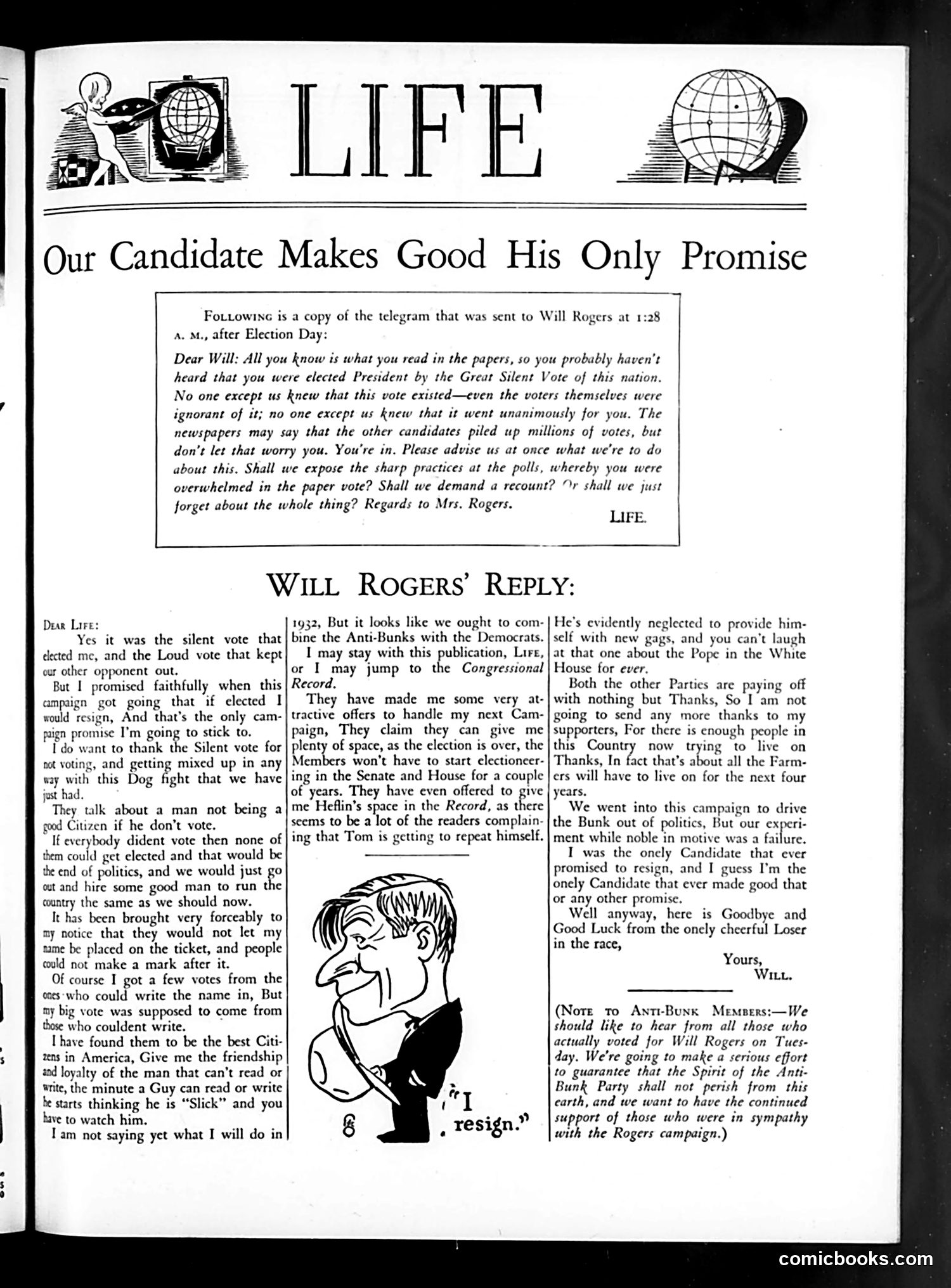
This Life magazine page satirizes Will Rogers' 1928 presidential election. LIFE sent Rogers a telegram asking whether he'd demand a recount, given his unexpectedly large "silent vote," or simply ignore irregularities. Rogers' reply is self-deprecating humor: he acknowledges receiving write-in votes but dismisses them as insignificant compared to the actual winner. He mocks both major parties for making him attractive campaign offers post-election, claiming they promised him prominent positions if he'd campaign for them. The cartoon caricature (center) appears to show Rogers in exaggerated form, emphasizing his folksy persona. Rogers' central point: **he made only one campaign promise—to resign if elected—and he's keeping it by remaining a private citizen rather than a politician.** The satire plays on Rogers' famous anti-establishment, humorous commentary on American politics and politicians.
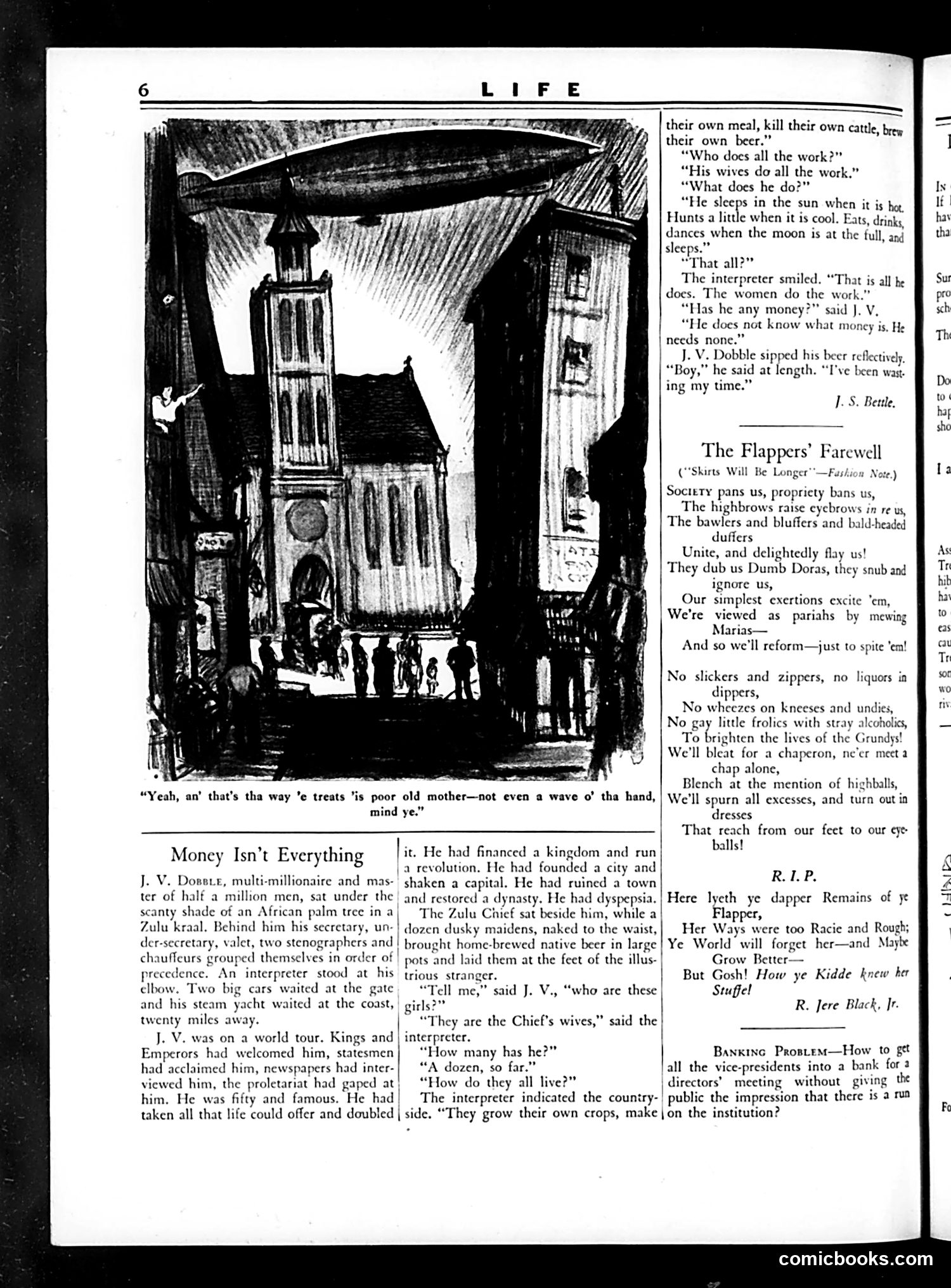
The main illustration depicts a zeppelin hovering over a European church and street scene, with the caption about treating "poor old mother" poorly. This references **World War I-era anti-German sentiment**, likely satirizing Germany's aerial bombing campaigns against civilian populations in Britain and France. The text article "Money Isn't Everything" features J.V. Dobble, described as a multi-millionaire who financed kingdoms and revolutions. The dialogue with African natives mocking his wealth suggests **satire of colonial exploitation and imperialism**—the joke being that despite massive financial power, the wealthy man commands no genuine respect from those outside his system. The additional poems ("The Flappers' Farewell," "R.I.P.") mock 1920s social trends and fashions, typical of Life's contemporary satirical commentary.
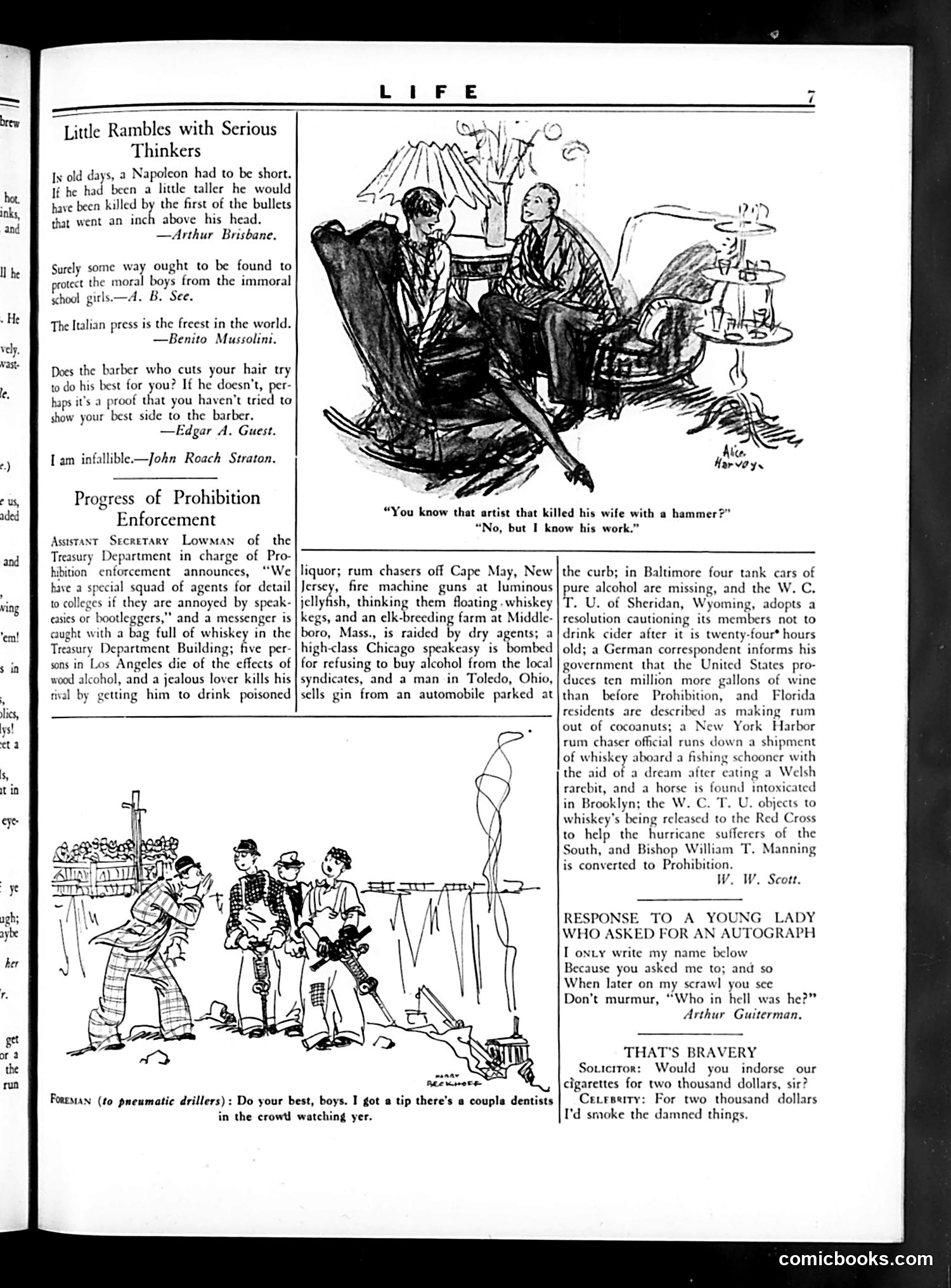
This page contains satirical commentary on Prohibition enforcement during the 1920s-early 1930s alcohol ban. **Top cartoon**: Two men in a car discuss an artist who "killed his wife with a hammer." The punchline—"No, but I know his work"—is a dark joke suggesting the artist's reputation matters more than morality, satirizing society's misplaced values. **"Progress of Prohibition Enforcement" section**: Reports absurd contradictions: government agents seizing liquor while enforcement remains ineffective. The accompanying cartoon shows enforcement officials discovering hidden alcohol, mocking the futility of Prohibition policies. **Bottom items**: Brief humorous pieces, including a solicitor's request for celebrity cigarette endorsements, satirizing commercialism. Overall, the page mocks Prohibition's failures and American society's priorities during this era of widespread alcohol smuggling and official hypocrisy.
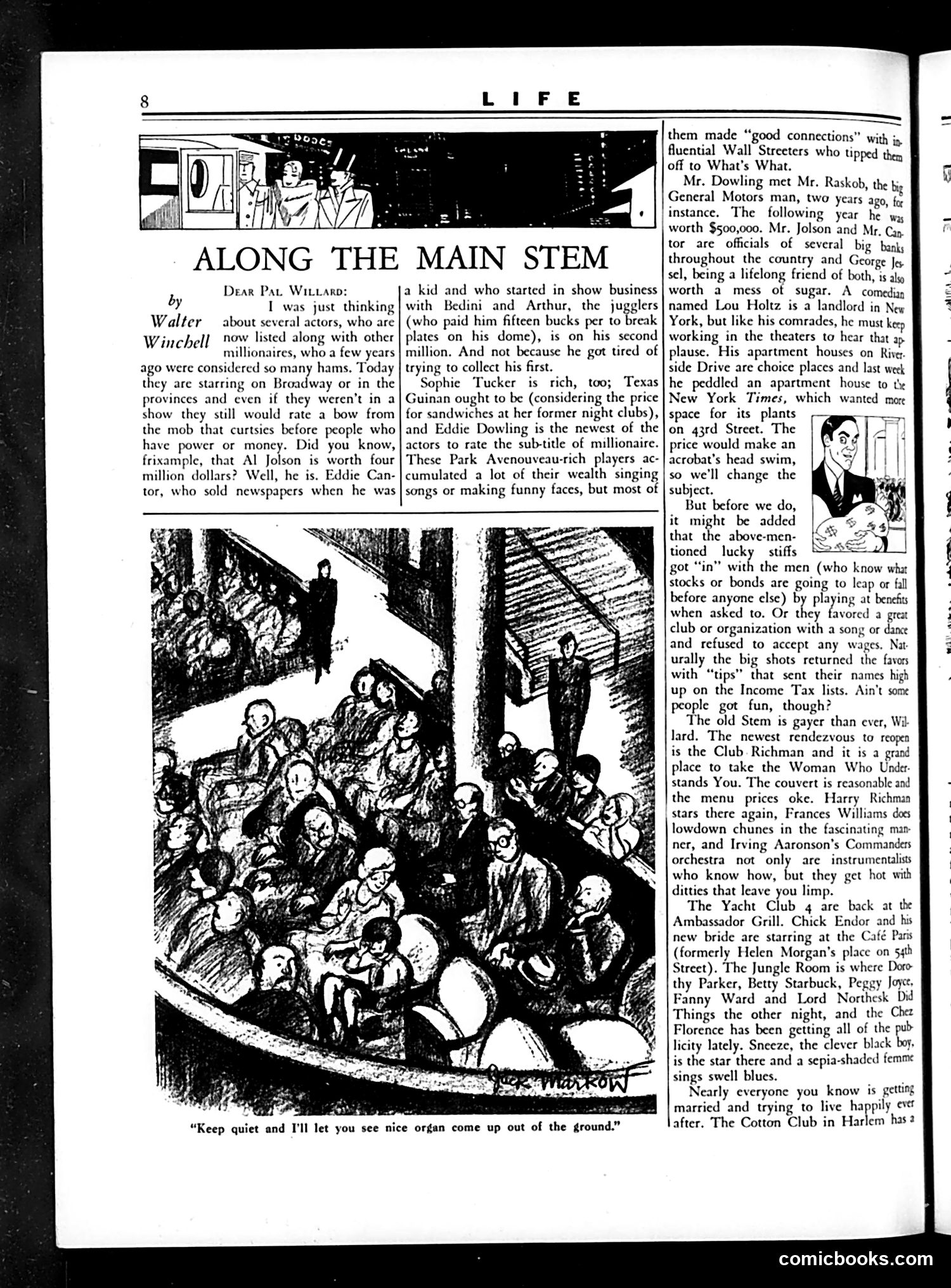
This is a society gossip column by Walter Winchell titled "Along the Main Stem," discussing Manhattan nightlife and celebrities. The two illustrations show speakeasy scenes—underground bars operating during Prohibition (when alcohol was illegally sold). The caption beneath the main illustration reads: "Keep quiet and I'll let you see nice organ come up out of the ground"—a joke about hidden speakeasy entrances and illegal operations. The column mentions wealthy figures, nightclub venues (Club Richman, Jungle Room, Cotton Club in Harlem), and entertainers like Frances Williams and Irving Aaronson. It gossips about marriages, social events, and the city's underground entertainment scene that flourished despite Prohibition laws. The satire targets both the hypocrisy of Prohibition enforcement and the glamorous criminal underworld it created.
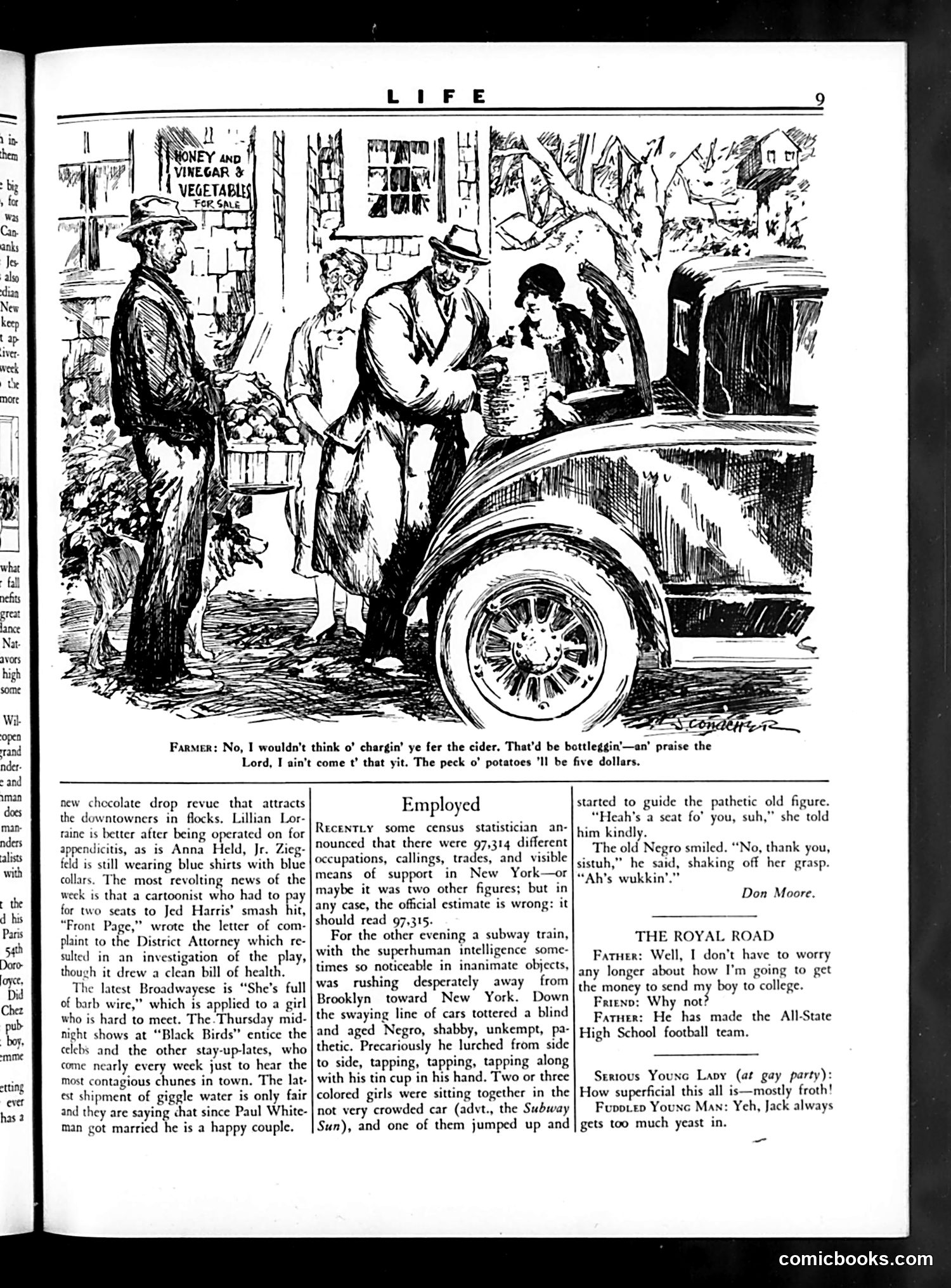
This page contains a satirical cartoon captioned with dialogue between a farmer and what appears to be a car salesman. The farmer refuses to buy cider, joking that the salesman should charge money instead—and notes that potatoes will cost five dollars. The cartoon satirizes rural economic hardship and the contrast between country and city commerce. The farmer's reluctance to purchase, combined with his specific price reference for potatoes, suggests Depression-era economic struggles when agricultural prices were depressed. The accompanying text discusses Broadway shows and social commentary. Without a visible date, the exact historical moment is unclear, but the overall tone reflects early-to-mid 20th century American life and the tension between rural and urban economic realities.
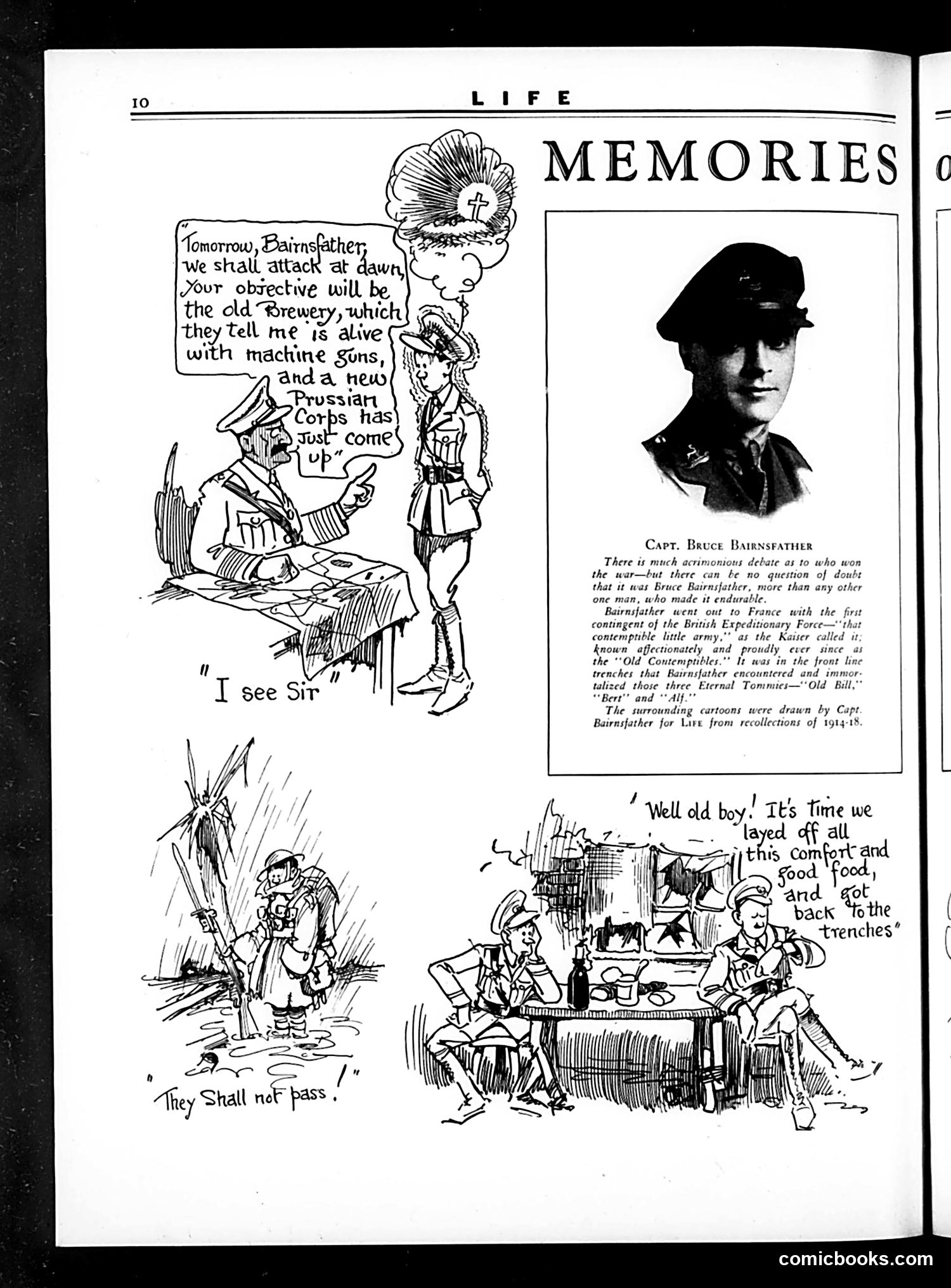
This page features a "Memories" section commemorating **Capt. Bruce Bairnsfather**, a British military figure shown in portrait. The cartoons illustrate his wartime experiences, likely from World War I based on the soldiers' uniforms and trench warfare depicted. The satirical drawings show: - A commanding officer briefing soldiers on attacking an old brewery - Combat scenes with explosions ("They shall not pass") - Soldiers relaxing with the quote about leaving "comfort and good food" to return to trenches The humor contrasts the military's grandiose orders with soldiers' weary reality. The cartoons appear drawn **by Bairnsfather himself** (per the text), suggesting he documented his own wartime observations in illustrated form—mixing military authority with soldier perspective in dark wartime satire.
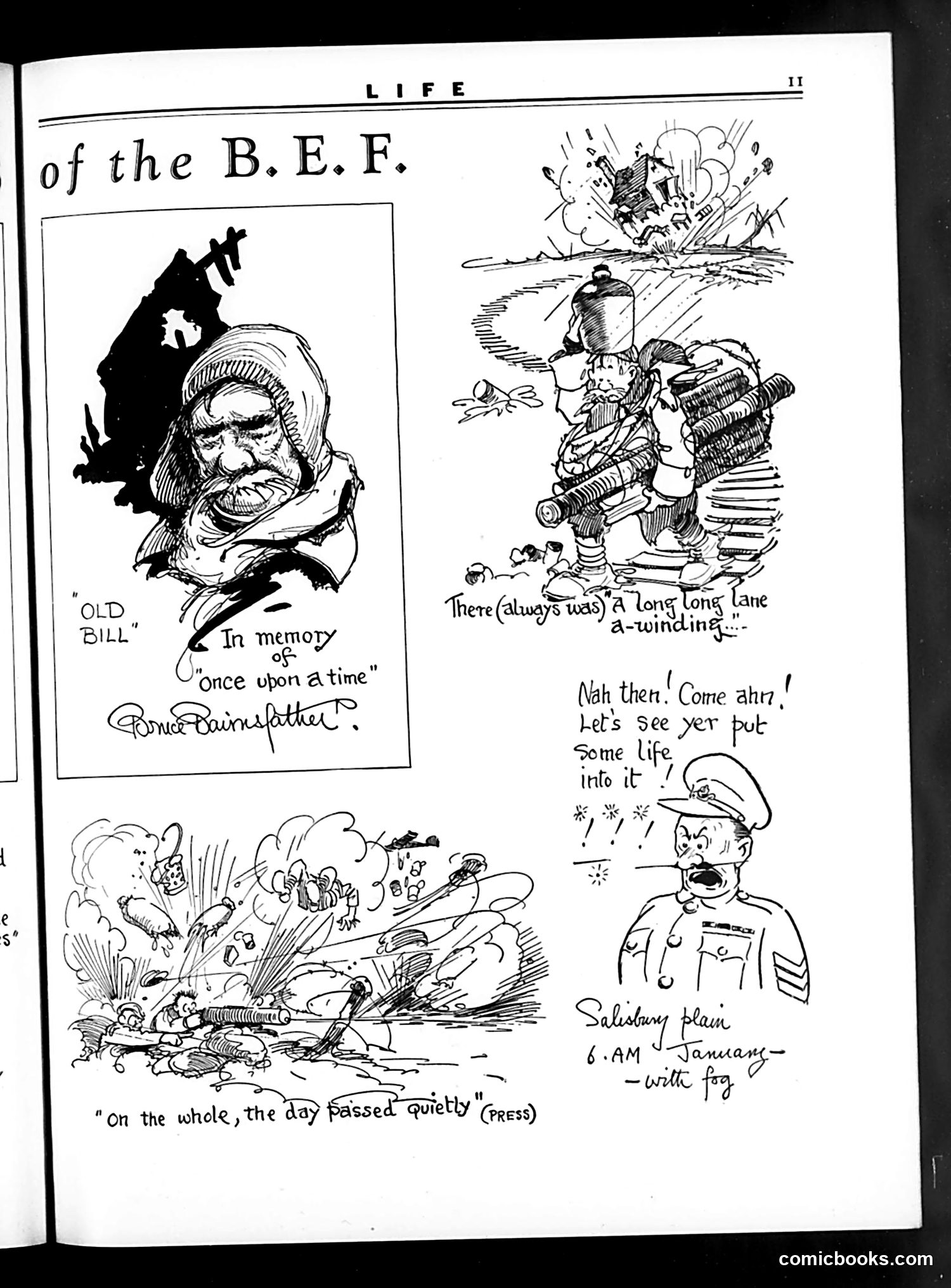
This page satirizes the British Expeditionary Force (B.E.F.) during World War I. The memorial to "Old Bill" — a bearded soldier character — references a famous WWI comic figure. The sketches depict soldiers' experiences: trenches with explosions, ammunition stockpiles, and the mundane reality of military life. The caption "On the whole, the day passed quietly (PRESS)" sarcastically contrasts official military press reports with actual combat conditions shown. The final panel shows a sergeant attempting to boost morale on "Salisbury plain" with fog, using forced enthusiasm ("Let's see yer put some life into it!"). The satire mocks both the disconnect between official narratives and soldiers' grim reality, and the absurdity of military cheerleading amid warfare.
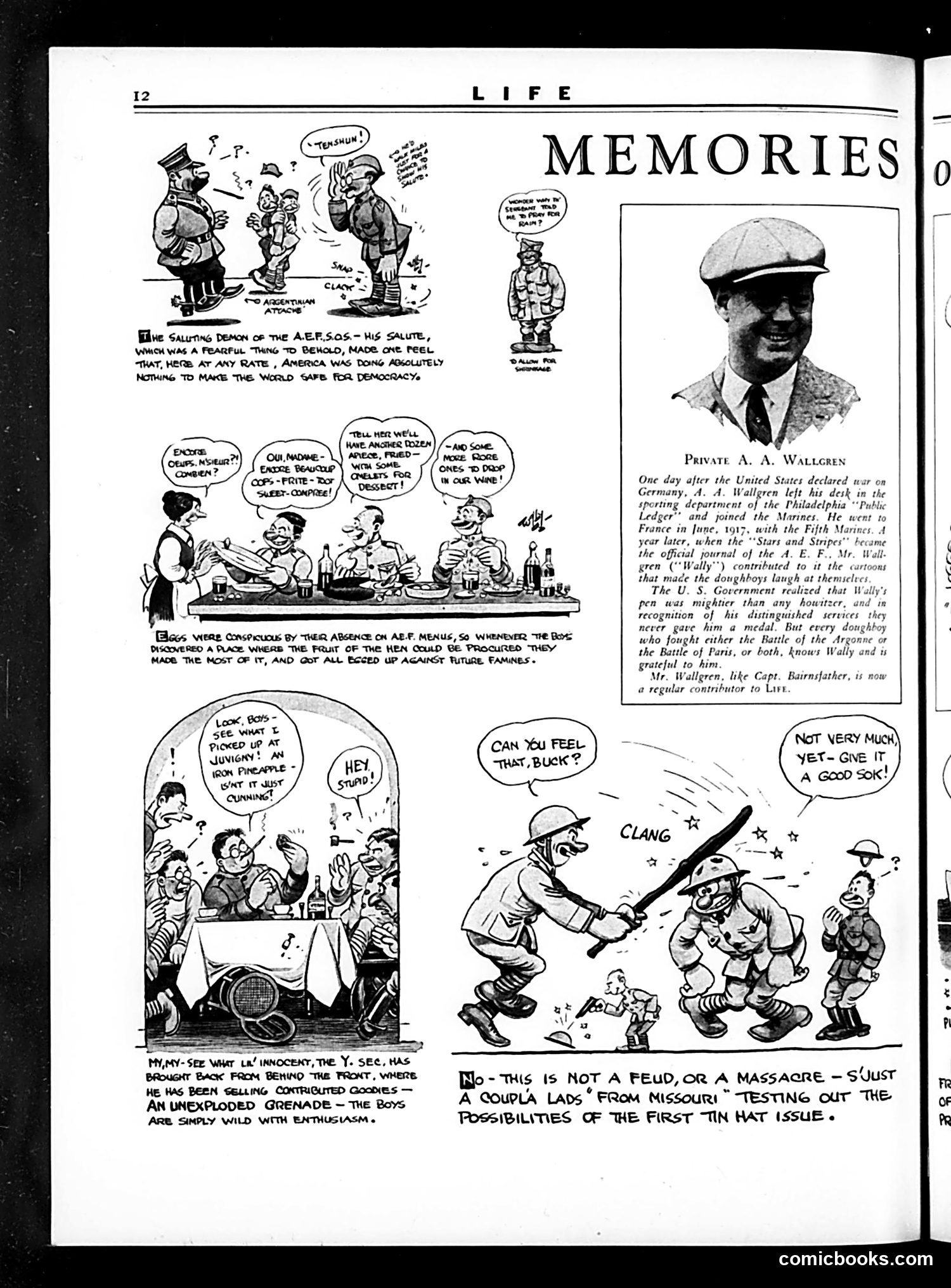
This page features military humor from WWI-era Life magazine. The top cartoon satirizes the A.E.F. (American Expeditionary Forces) salute as ineffective for democracy. Middle panels mock officers absent from A.E.F. meals, allowing enlisted men to misbehave with an unexploded grenade—depicting soldiers as reckless without supervision. The "Memories" section profiles Private A.A. Wallgren, a Philadelphia soldier whose contributions to Life's humor column earned him recognition despite the government initially denying him a medal. The bottom cartoon depicts two Missouri soldiers testing a tin hat's durability by striking it with a bayonet, captioned as "not a feud or massacre"—satirizing soldiers' crude experimentation and enthusiasm, likely poking fun at rural recruits' unfamiliarity with military equipment.
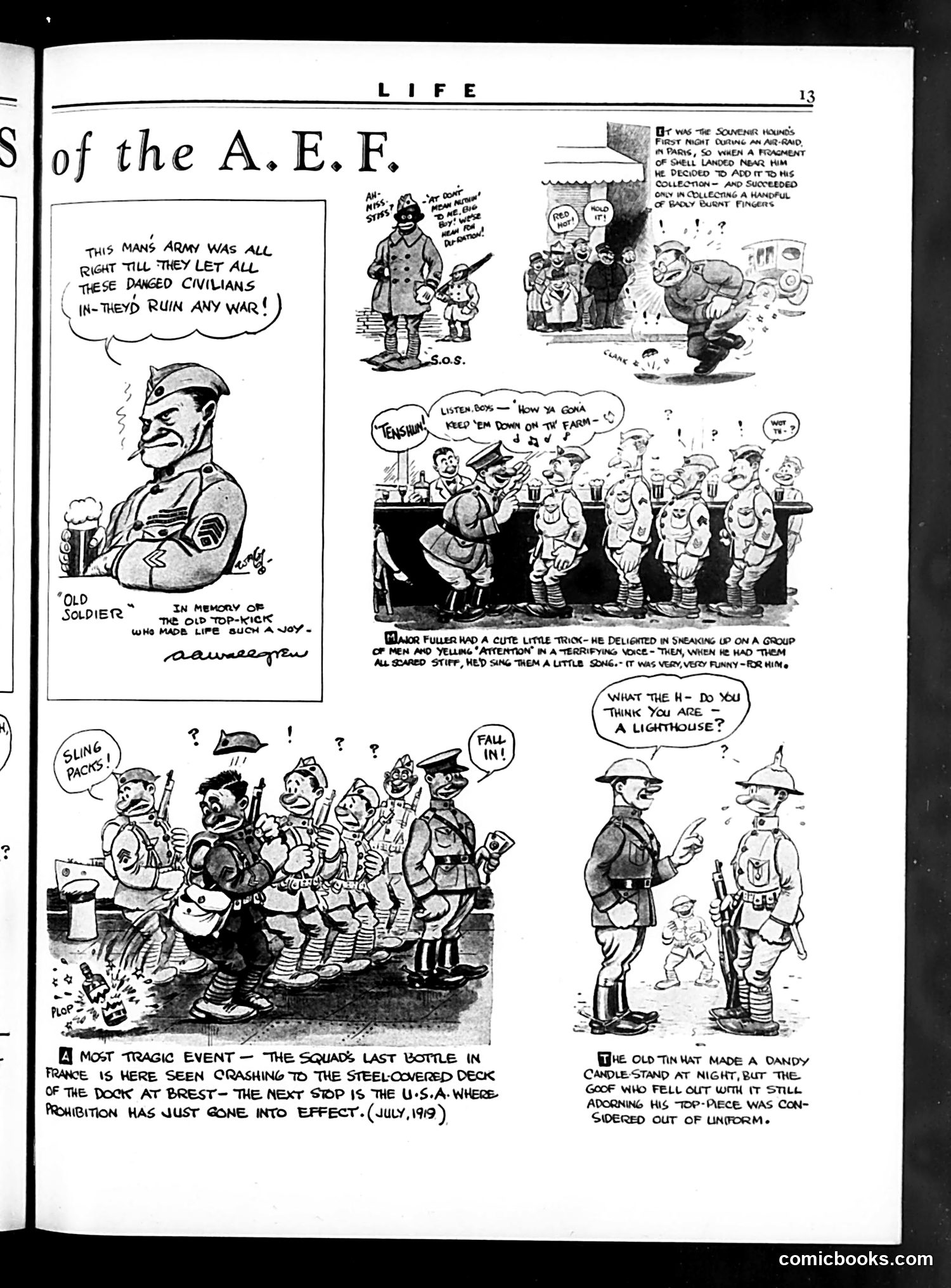
This page satirizes the American Expeditionary Forces (A.E.F.) in World War I. The top-left cartoon mocks military leadership's recklessness with civilian lives during wartime. The subsequent panels depict soldiers in various comedic scenarios—singing, drinking, and engaging in camp life—lampooning military discipline and morale. One caption references "Major Fuller," apparently a figure known for theatrical leadership style. The bottom section describes tragic historical events: the final battle in France at Brest (the ship's deck crash) and references U.S. prohibition going into effect in July 1919, creating darkly comic contrast between wartime sacrifice and domestic policy changes. The overall tone is cynical about military management and the war's human costs.
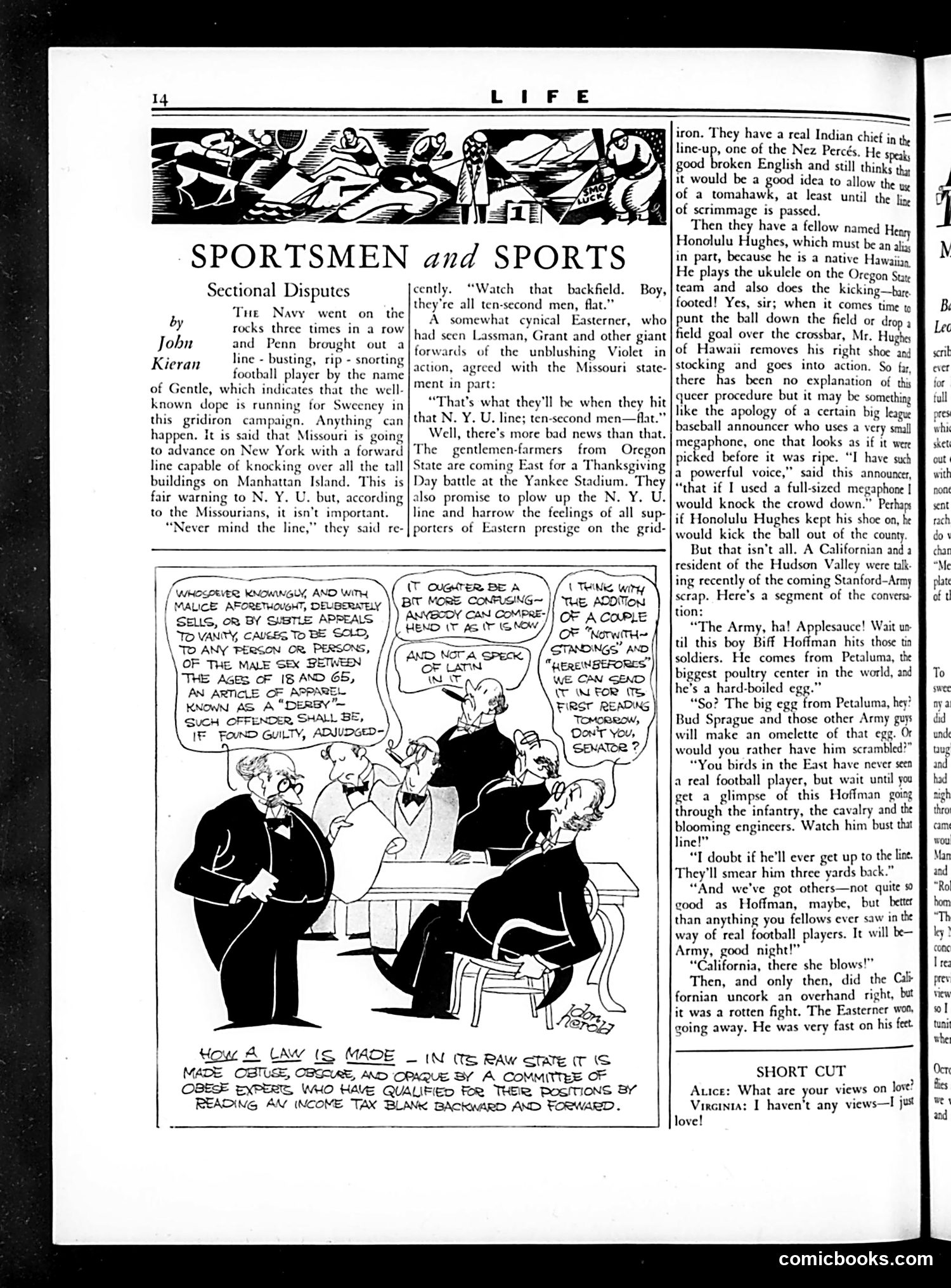
This page satirizes early 20th-century college football rivalries, specifically Navy-Penn versus Missouri football disputes. The main cartoon depicts lawyers or officials arguing about rules—a visual joke on how "sectional disputes" over football regulations become legalistic and overcomplicated. The text by John Kieran discusses Navy and Penn's football dominance and mocks their dismissal of Missouri's team, suggesting Eastern elites view themselves as superior. The cartoon's caption about "how a law is made" compares rule-making to bureaucratic absurdity, suggesting that football regulations become as convoluted as actual legislation. The humor targets regional snobbery in college sports and the pretentiousness of legal/institutional processes governing athletic competition.
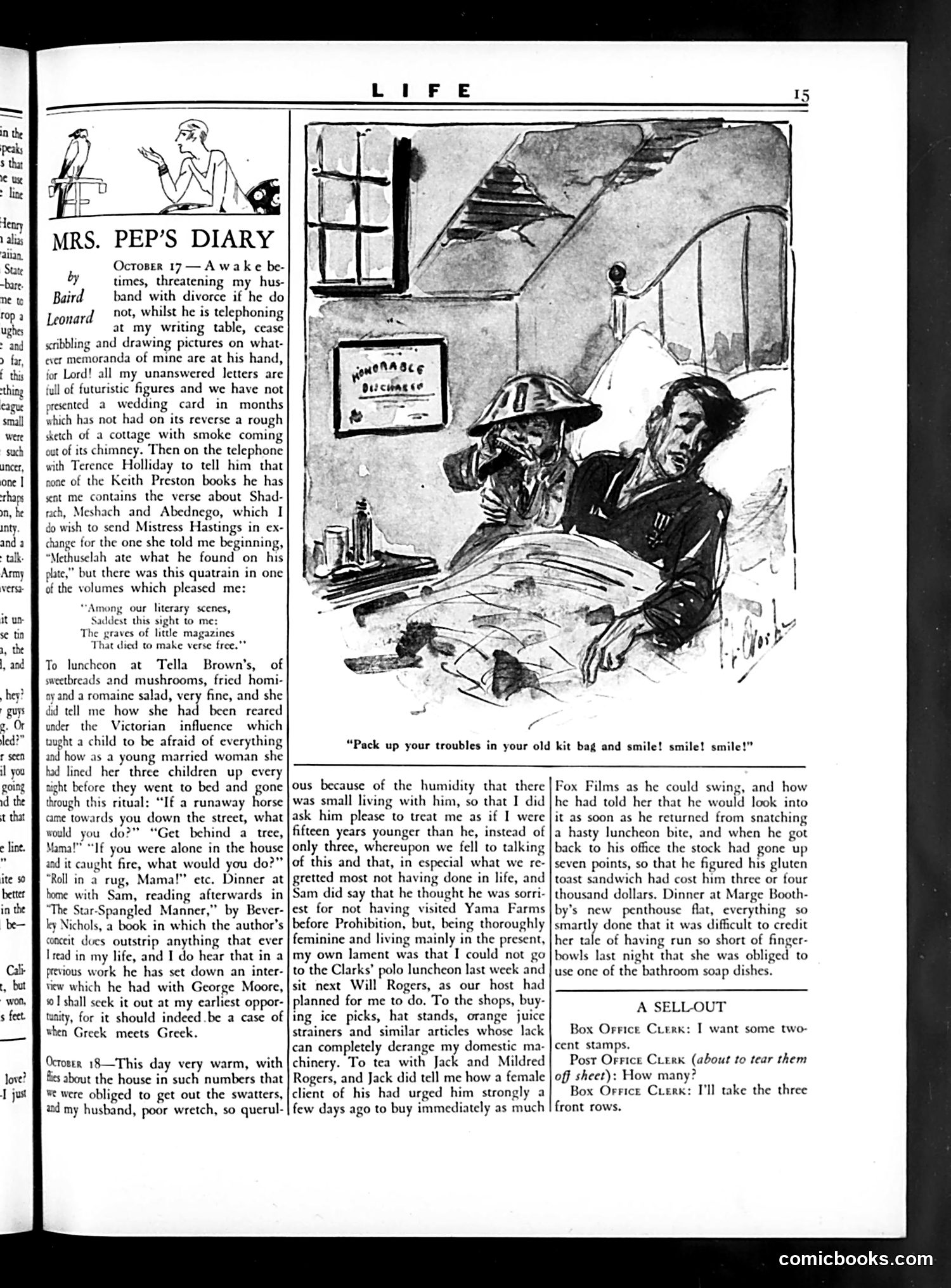
This page contains "Mrs. Pep's Diary," a humor column mixing domestic complaints with literary and social gossip. The main illustration shows a woman surrounded by scattered belongings and luggage, with the caption "Pack up your troubles in your old kit bag and smile! smile! smile!"—a reference to the WWI song. The diary entry satirizes upper-class married life: the husband threatens divorce while doodling, unanswered letters pile up, and social obligations (lunches, teas) dominate. The illustration's "packed troubles" humorously reflects the diary's complaints about marital discord and domestic chaos. A sidebar "Sell-Out" box depicts a minor exchange about postage stamps—likely satirizing penny-pinching practicality amid leisured complaint. The overall tone mocks affluent women's superficial concerns and marital discord.
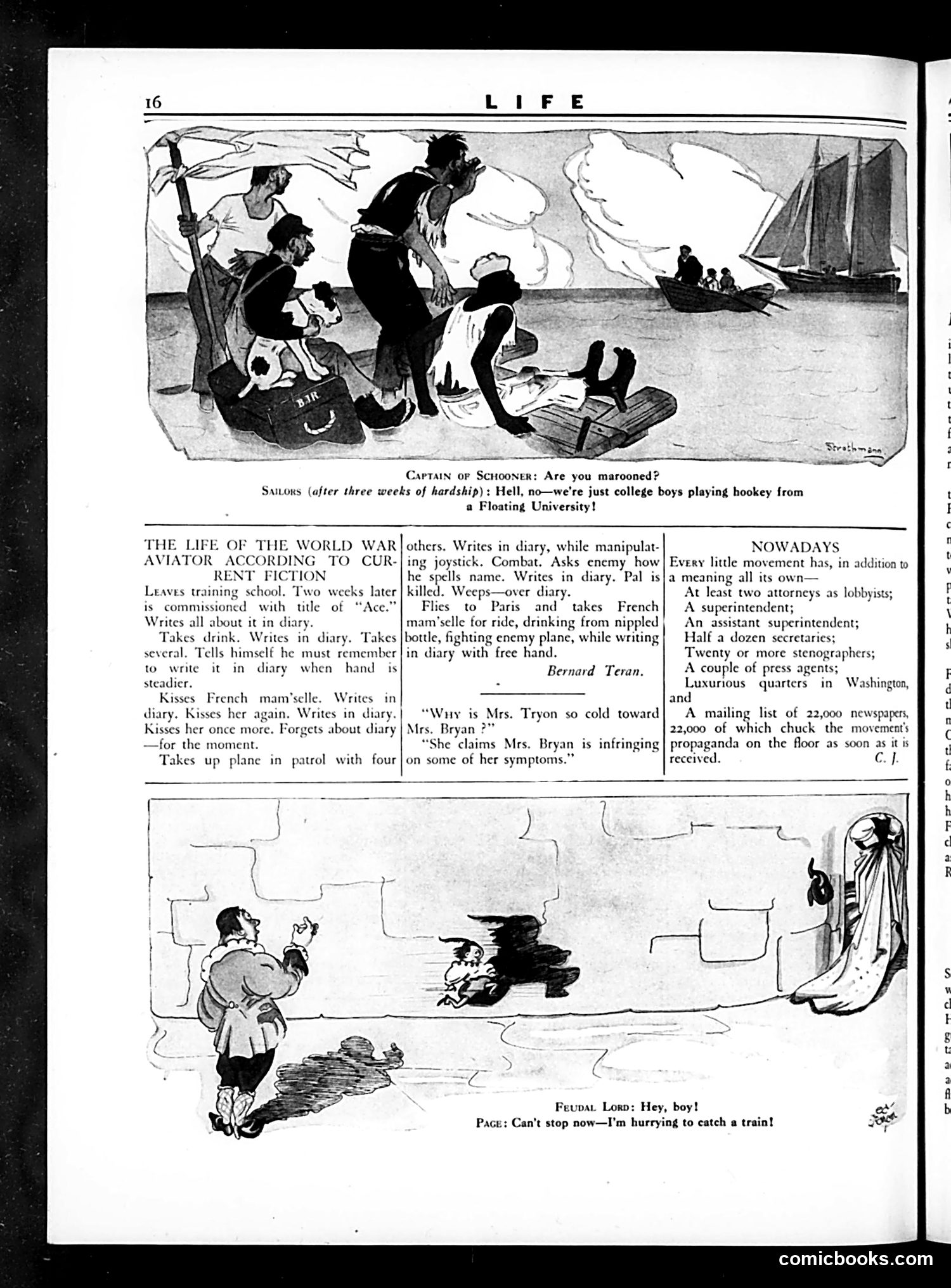
This page contains two satirical cartoons from *Life* magazine: **Top cartoon:** Shows sailors on a beach claiming to be "college boys playing hockey from a Floating University"—a joke mocking the World War I aviator training program described in the adjacent text. The humor lies in the implausibility of their excuse. **Bottom cartoon:** Depicts a feudal lord calling after a page who's running away, claiming he must "catch a train." The satire is anachronistic: a medieval feudal setting suddenly references modern train travel, highlighting the absurdity of mixing historical periods. This likely satirizes either outdated social hierarchies or confusion about historical progress. Both cartoons use visual incongruity and exaggeration as their primary comedic devices, typical of *Life* magazine's style during this era.
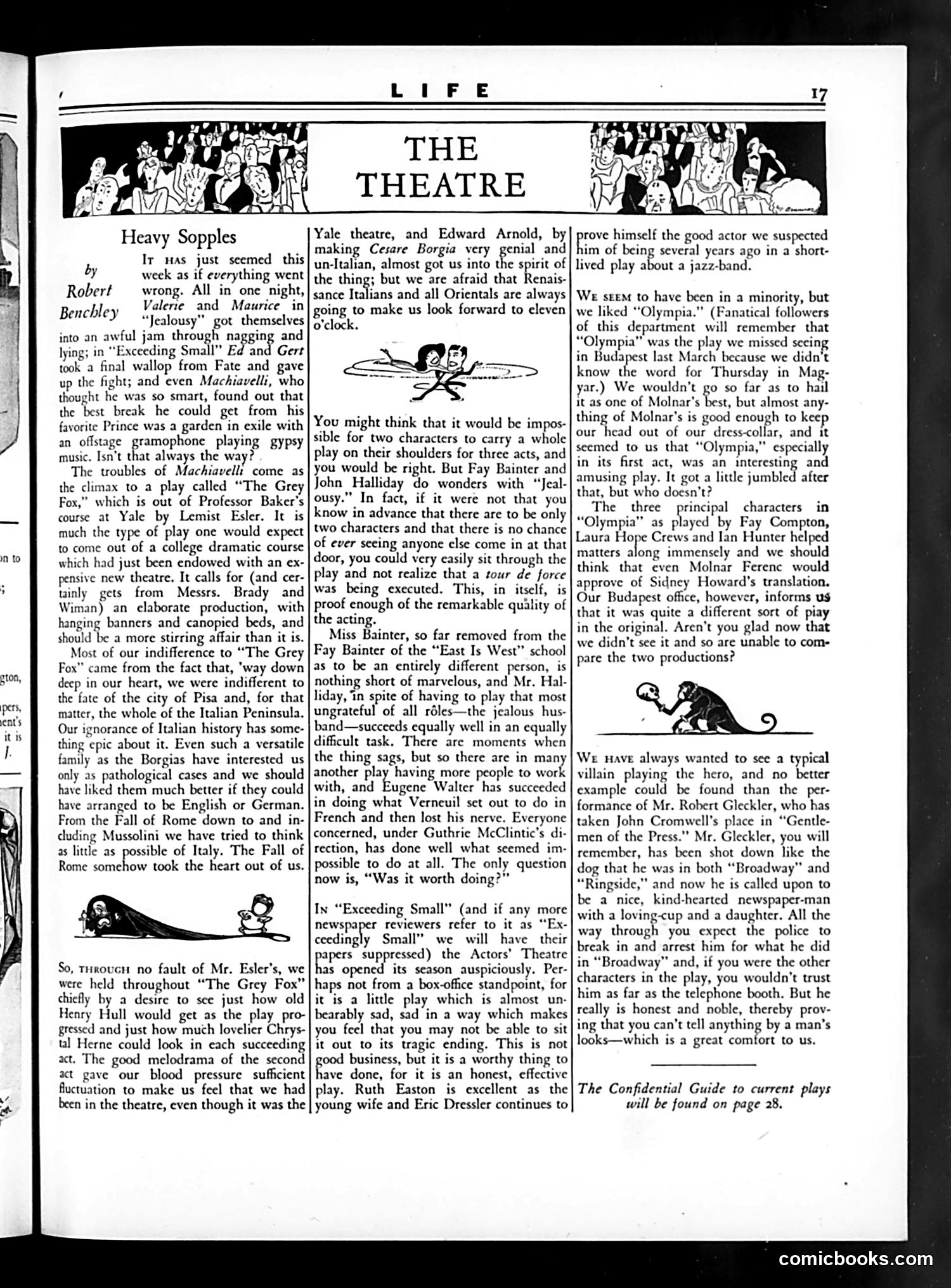
This is a theatre review column by Robert Benchley from Life magazine's arts section. The page discusses several Broadway productions, including "The Grey Fox" and "Exceeding Small." The small cartoons appear to be decorative flourishes typical of Life's satirical style—one shows figures in formal dress, another depicts what looks like a reclining figure. These aren't political cartoons but rather illustrative doodles accompanying theatre criticism. The column's satire is theatrical rather than political: Benchley humorously critiques acting performances, directorial choices, and production quality. He pokes fun at performers' limitations and notes when plays fail to justify their premises—standard arts criticism presented with wit rather than political commentary.
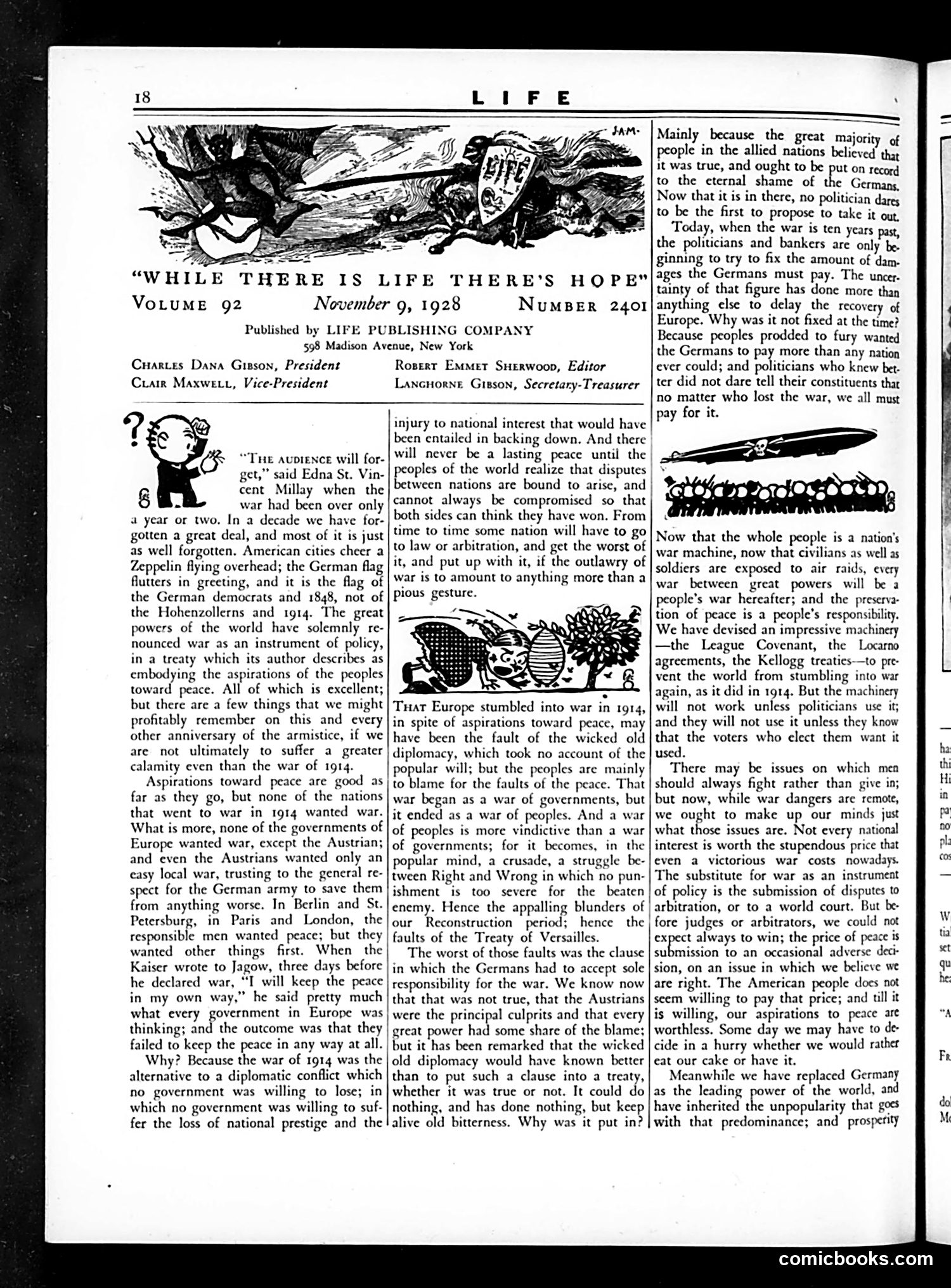
This *Life* magazine editorial argues that despite good intentions toward peace—symbolized by nations renouncing war and Germany's democratic flag now flying instead of imperial symbols—the world remains vulnerable to another catastrophic conflict. The author warns that WWI occurred not because nations *wanted* war, but because governments prioritized national prestige and refused diplomatic compromise. The key insight: peoples, not just governments, perpetuated the war's vindictiveness, leading to punitive peace terms like Germany's sole war-guilt clause in the Treaty of Versailles. The satirical point: the 1928 peace machinery (League of Covenant, Kellogg agreements) won't prevent future war unless ordinary citizens demand their leaders accept occasional diplomatic losses rather than fight for "honor." The cartoons' specific subjects are unclear from the image, but the text criticizes both old diplomacy and popular nationalism as enduring threats to lasting peace.
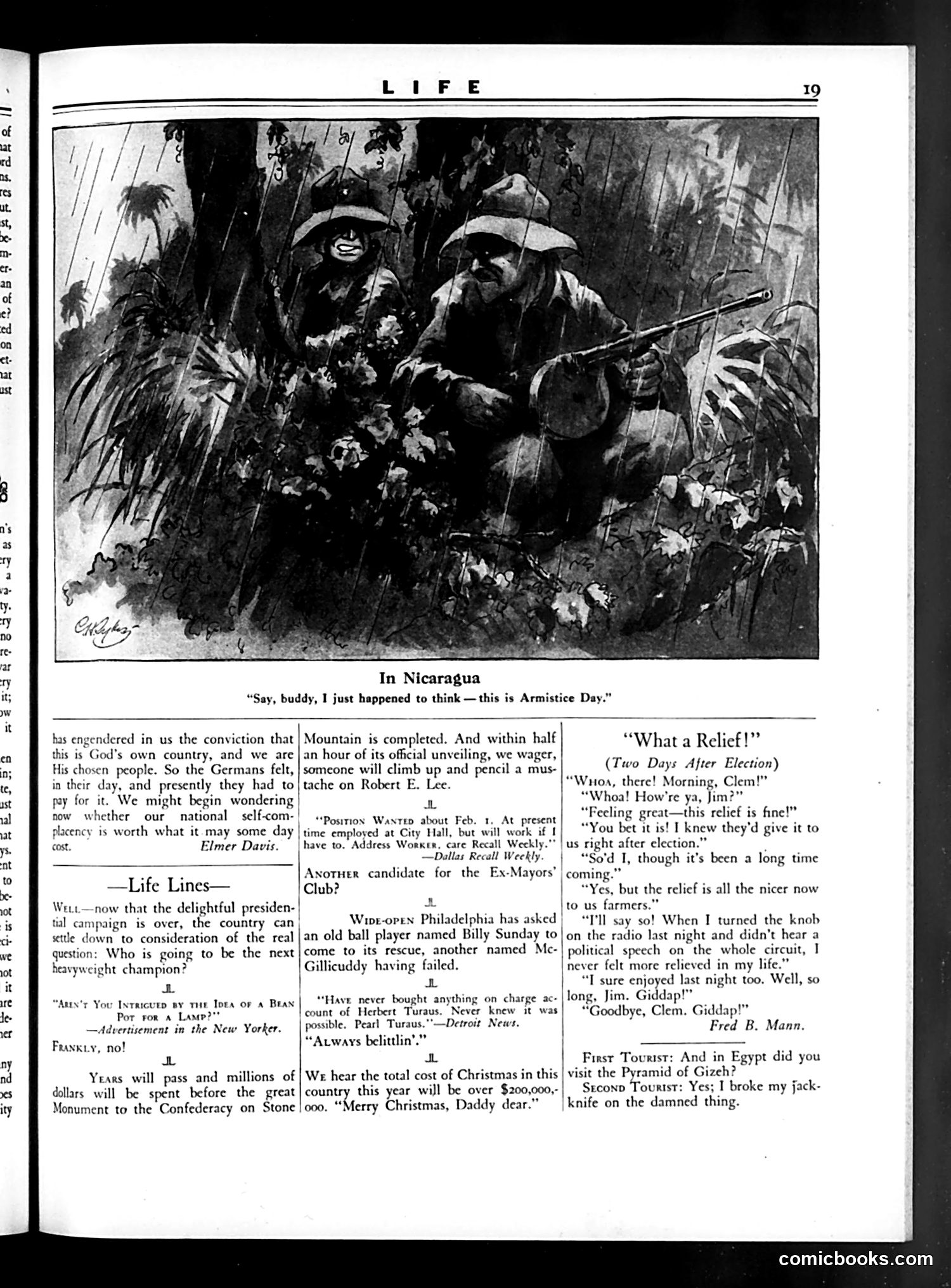
**Main Cartoon "In Nicaragua":** Two American soldiers in a tropical setting (identifiable by helmets and military gear) realize it's Armistice Day—November 11th, marking the WWI ceasefire. The satire targets American military intervention in Nicaragua, suggesting soldiers far from home are fighting in foreign conflicts while celebrating peace back in the U.S. The incongruity—observing a peace holiday while actively deployed—highlights the irony of America's imperial ambitions contradicting its pacifist rhetoric. **"What a Relief!" Section:** Rural farmers discuss post-election relief, likely referring to government agricultural assistance. The humor comes from farmers' joy that they won't hear political speeches on the radio anymore, suggesting campaign rhetoric was unbearable. This reflects post-WWI American fatigue with political messaging. **Supporting Items:** Brief satirical notes mock excess Christmas spending ($200 million), vandalism of public monuments, and hiring practices. The overall page critiques American militarism, political excess, and commercialism in the post-war period.
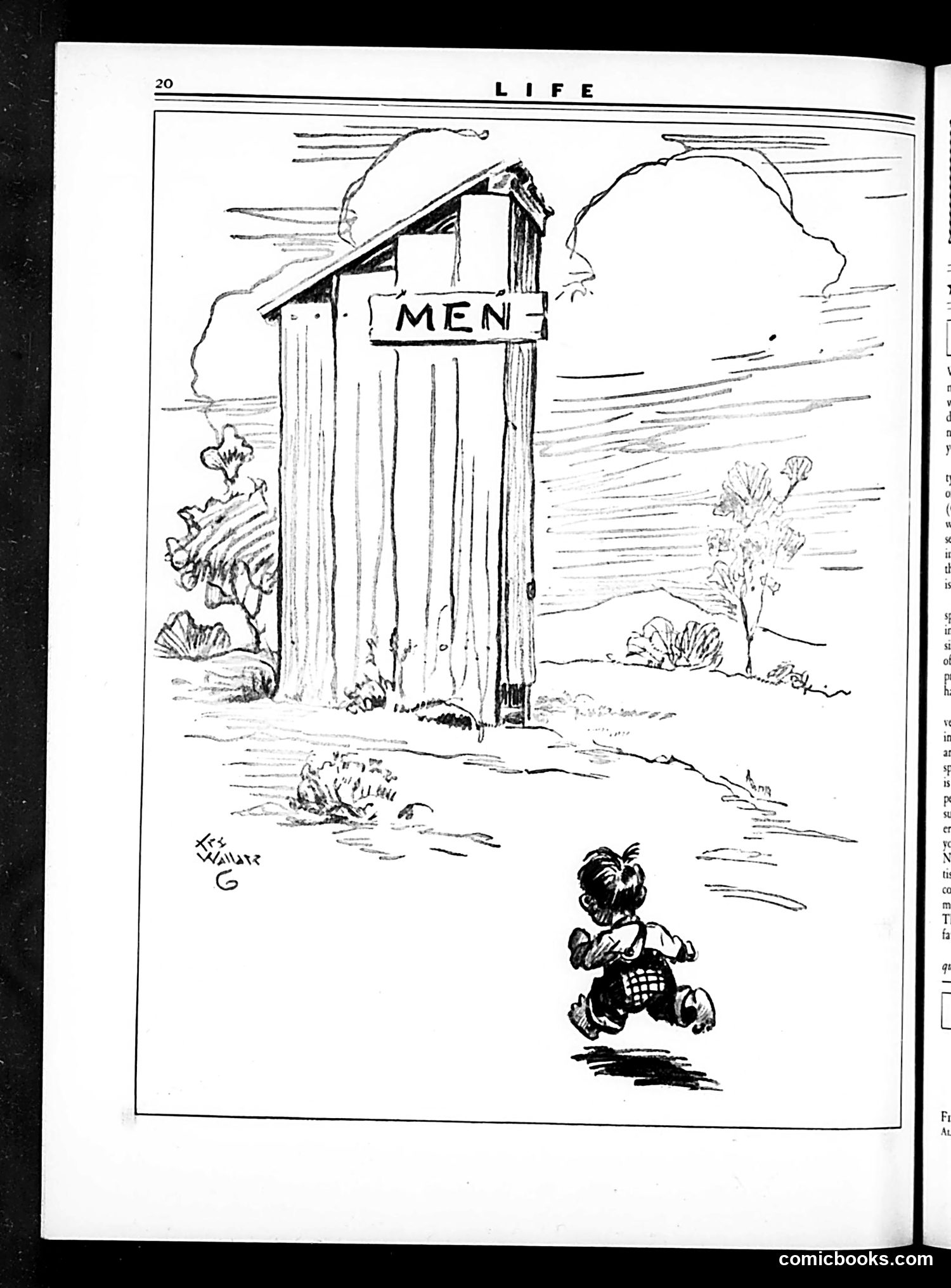
This is a single-panel cartoon from *Life* magazine (page 20) depicting a rural outhouse labeled "MEN" with a small child approaching it from the right. The drawing style is simple line-art with cross-hatching. The cartoon appears to be **bathroom humor** playing on the contrast between the child's size and the structure. The joke likely centers on the absurdity or difficulty of a small child using an adult-sized outdoor toilet facility—a common source of humor in early-to-mid 20th century American comics. The artist's signature appears in the lower left. Without additional context about the publication date, I cannot identify specific historical references, though the rural outhouse setting suggests this reflects American life during a period when such facilities were common.
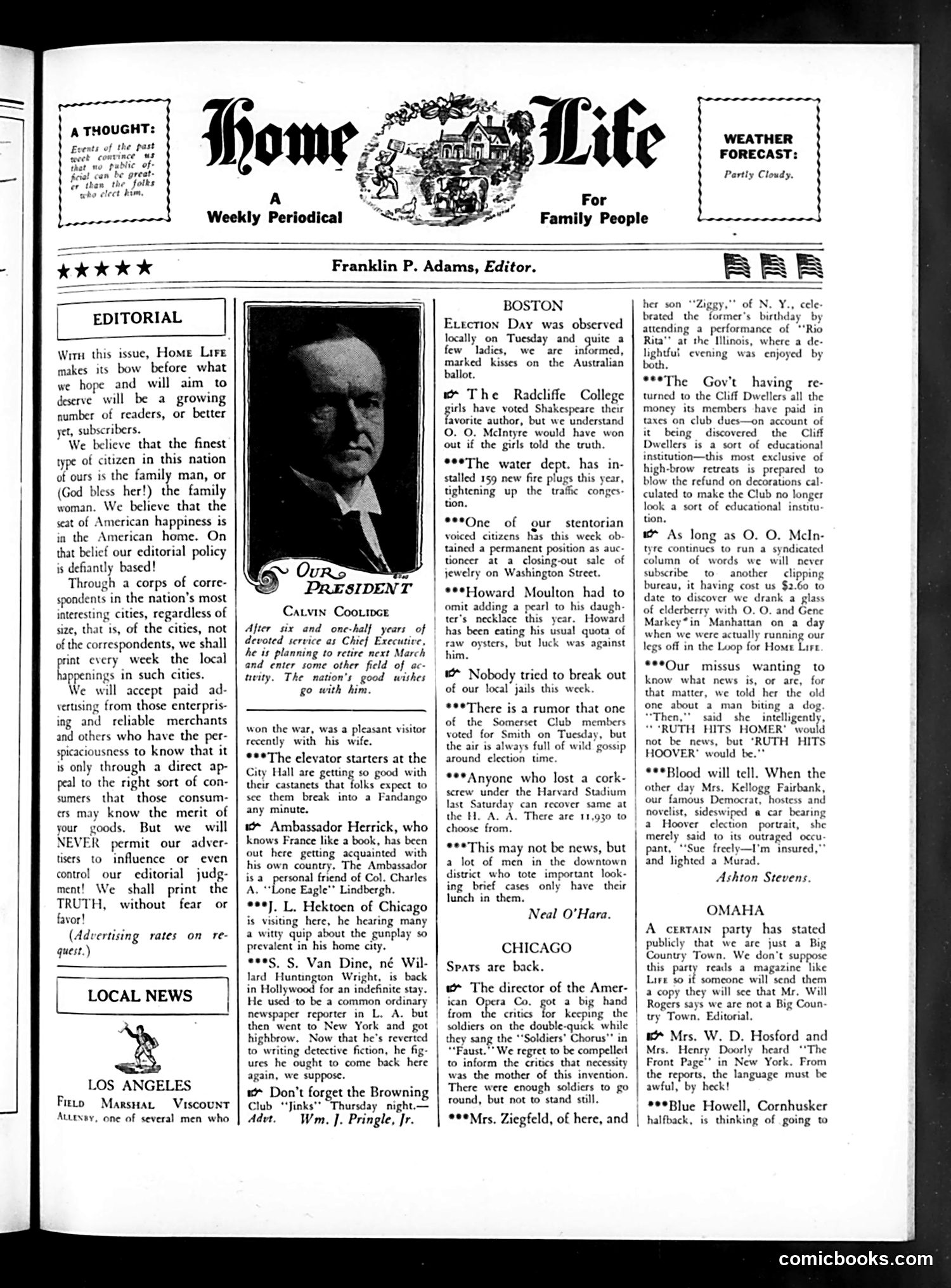
This is the inaugural issue of *Home Life*, a new weekly family magazine edited by Franklin P. Adams. The page features editorial content and local gossip columns rather than political cartoons. The editorial establishes the magazine's philosophy: celebrating the American family and family home as the ideal citizen. Adams promises coverage of happenings in major cities through local correspondents, while maintaining editorial independence from advertisers. The bulk of the page consists of humorous local gossip from Los Angeles, Boston, and Chicago—items about election day, elevator operators, socialites, and minor civic improvements. These are lighthearted observations rather than political satire; for example, one Boston item jests that Radcliffe College girls voted Shakespeare their favorite author, when O.O. McIntyre (a contemporary gossip columnist) should have won. The portrait labeled "Our President" shows Calvin Coolidge, noting his planned retirement after six-and-a-half years in office (accurate for 1928). The humor is gentle, domestic, and designed for family audiences rather than biting political commentary.
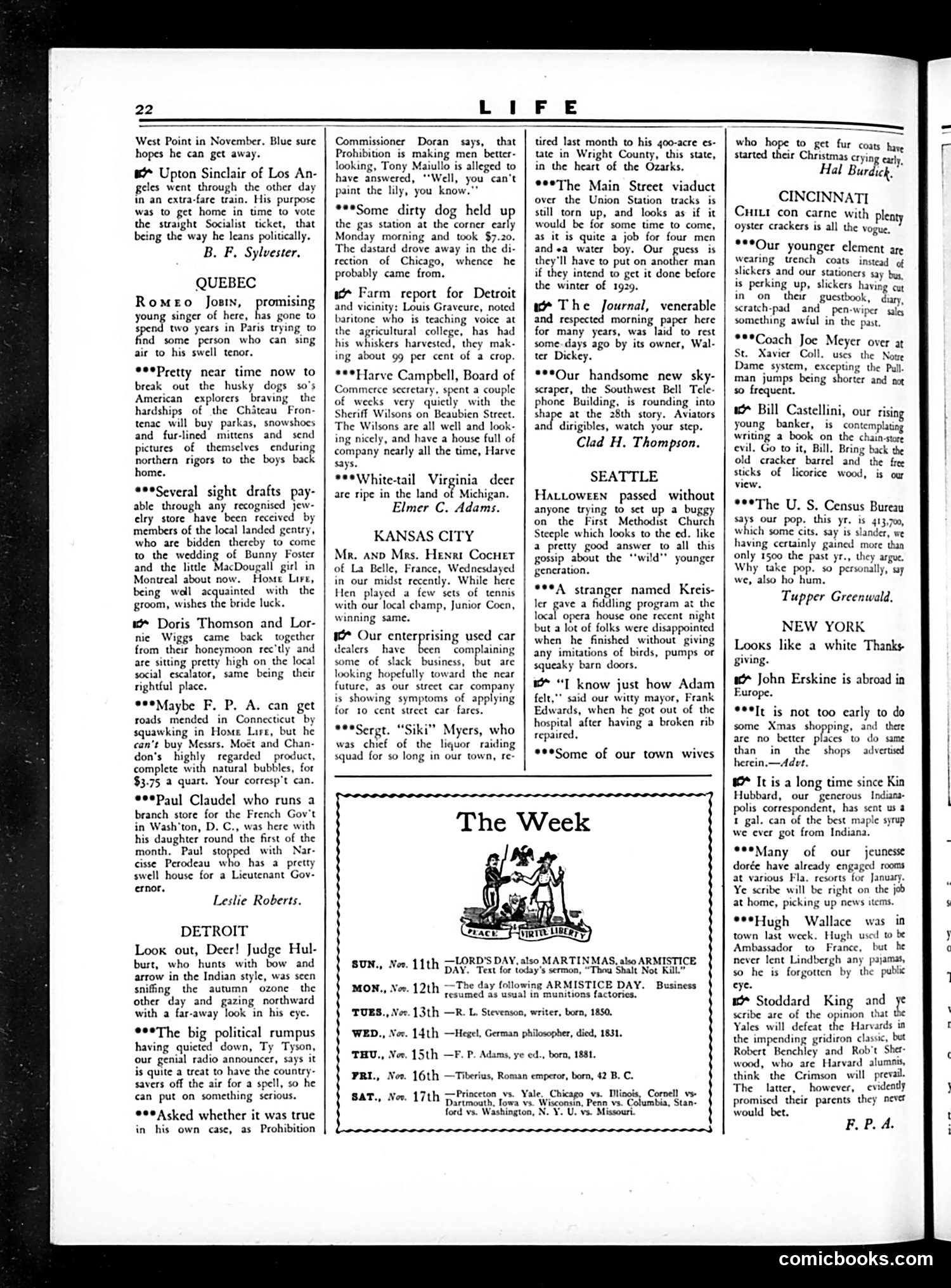
This page from Life contains regional gossip columns and a calendar of historical events ("The Week"). The main content consists of social notes from various cities—Quebec, Detroit, and Kansas City—typical of Life's satirical coverage of American life. Key satirical elements include: - **Upton Sinclair reference**: Notes the Socialist activist's visit to vote the "straight Socialist ticket," poking fun at his political extremism. - **Prohibition jokes**: References to Commissioner Doran's claim that Prohibition makes men "better-looking," with a local's witty rebuttal; also mentions a gas-station robbery attributed to someone heading toward Chicago (implying organized crime connections). - **Social climbing commentary**: Gossip about honeymoons, weddings, and social status ("sitting pretty high on the local social escalator") mocks middle-class pretensions. - **Historical calendar**: Lists dates including Lord's Day, Martinmas, and Armistice Day, anchoring the page temporally to November 11, 1928. The overall tone is lighthearted mockery of small-town life, social aspirations, and contemporary issues like Prohibition and radio.
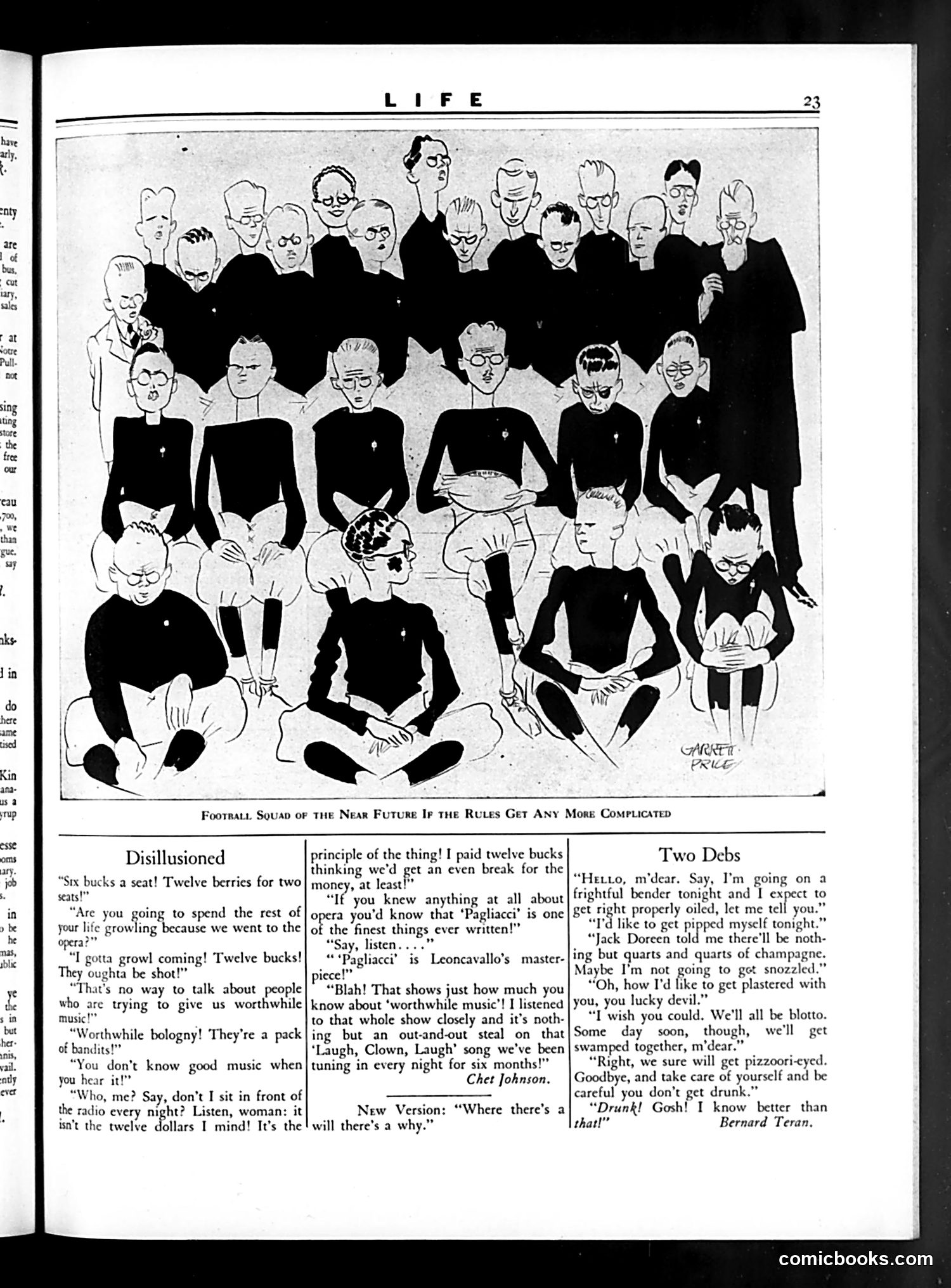
This page contains two separate satirical comic dialogues mocking social pretensions of the 1920s-30s era. **"Disillusioned"** satirizes opera appreciation and class conflict. A husband resents paying twelve dollars for opera seats, claiming the "worthwhile" opera *Pagliacci* is merely a theft of the popular radio song "Laugh, Clown, Laugh." His wife defends high culture; he dismisses her snobbery. The joke: the man's complaint about principle over cost exposes how people adopt cultural attitudes they don't genuinely hold to appear sophisticated. **"Two Debs"** mocks wealthy young women's affected speech and casual attitudes toward intoxication. The pair use slang terms for drunkenness ("pipped," "blotto," "plastered," "snozzled") while making vague promises to get drunk together. The final exchange—where one warns the other not to get drunk while saying she knows better—highlights their pretentious, contradictory behavior. Both pieces ridicule affectation and hypocrisy among different social classes during the Prohibition era.
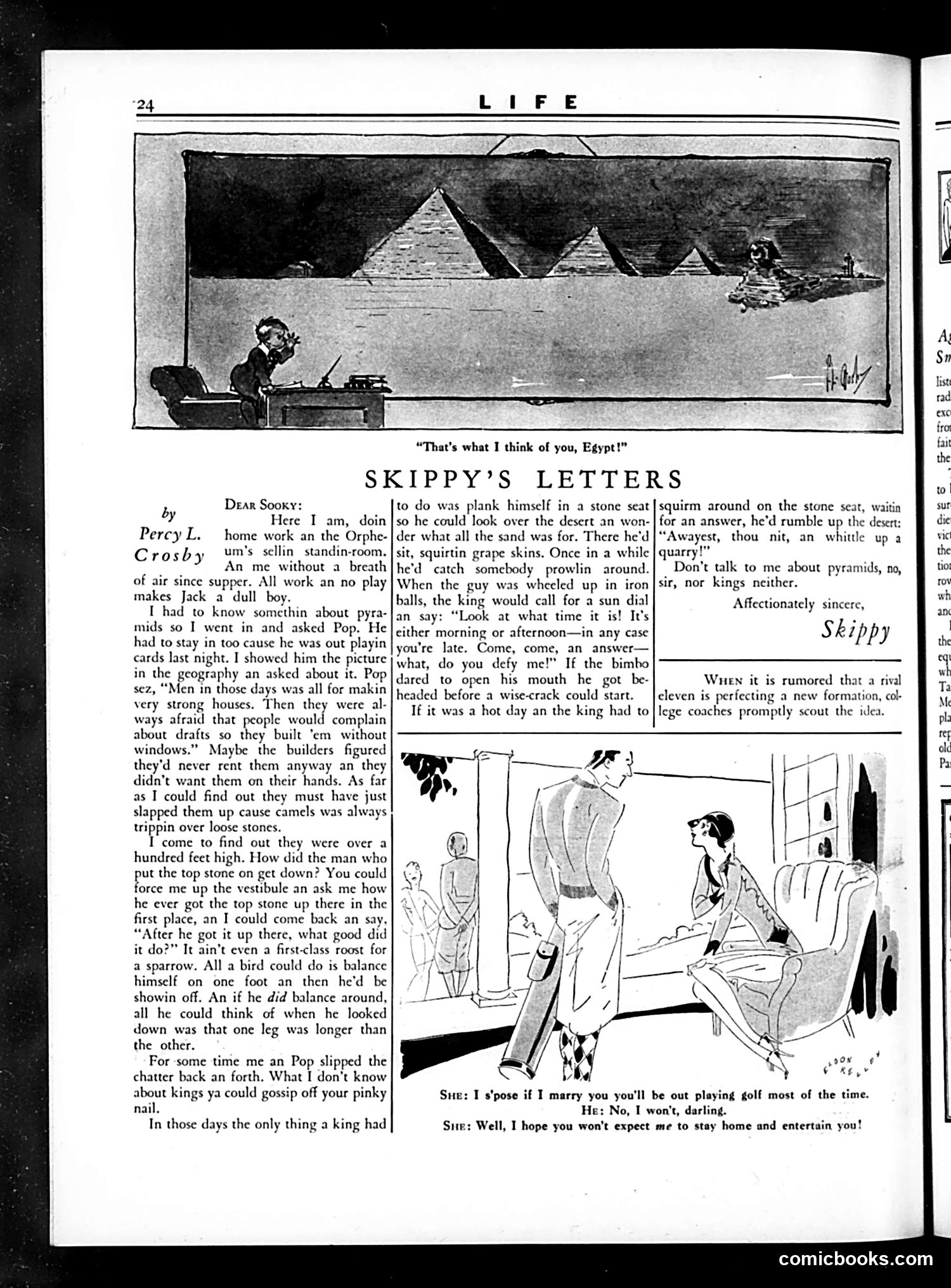
This page features "Skippy's Letters," a humorous column by Percy L. Crosby depicting a boy's irreverent observations about Egypt and ancient kings. The top cartoon shows Skippy at a desk with pyramids visible through a window—his dismissive caption, "That's what I think of you, Egypt!" sets the tone. The letter mocks both historical grandeur and parental authority. Skippy questions the pyramids' practical purpose (poor shelter, impractical construction) and satirizes ancient Egyptian kings as petty tyrants obsessed with time-telling and executing anyone who questions them. His father, Pop, offers equally absurd explanations for the pyramids' design. The lower cartoon depicts a domestic marital dispute about golf and home entertainment—a common 1920s-era joke about wives' expectations versus husbands' recreation priorities. The final italicized note about college football coaches scouting rival formations appears unrelated filler. The satire targets both inflated historical reverence and contemporary domestic tensions through a child's irreverent logic.
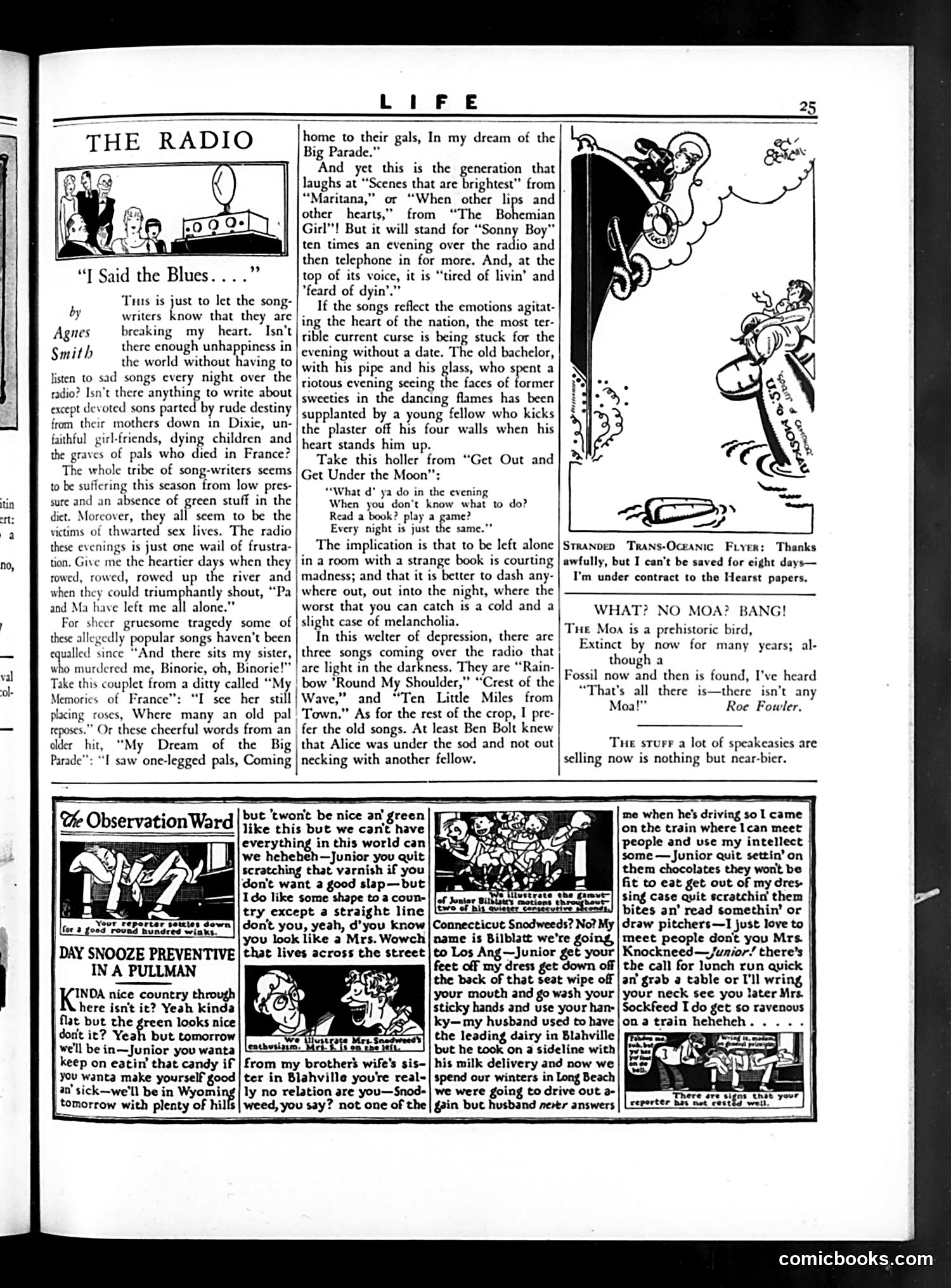
This page critiques 1920s popular radio songs for their excessive melancholy. Agnes Smith complains that radio broadcasts feature only depressing material—sentimental ballads about separated lovers, dead soldiers, and abandoned sweethearts—when listeners should prefer cheerier older songs. The satire targets both songwriters (whom Smith accuses of personal unhappiness and financial desperation) and modern listeners who paradoxically mock Victorian sentimentality while embracing equally maudlin contemporary hits like "Sonny Boy." Smith argues these sad songs reflect a generation obsessed with romantic failure, particularly young men abandoned by dates—a trivial concern compared to actual tragedies like wartime losses. The accompanying comics mock everyday annoyances: train travel discomfort, marital bickering, and spousal jealousy. The overall page humorously captures postwar American anxieties and changing entertainment tastes during the radio age.
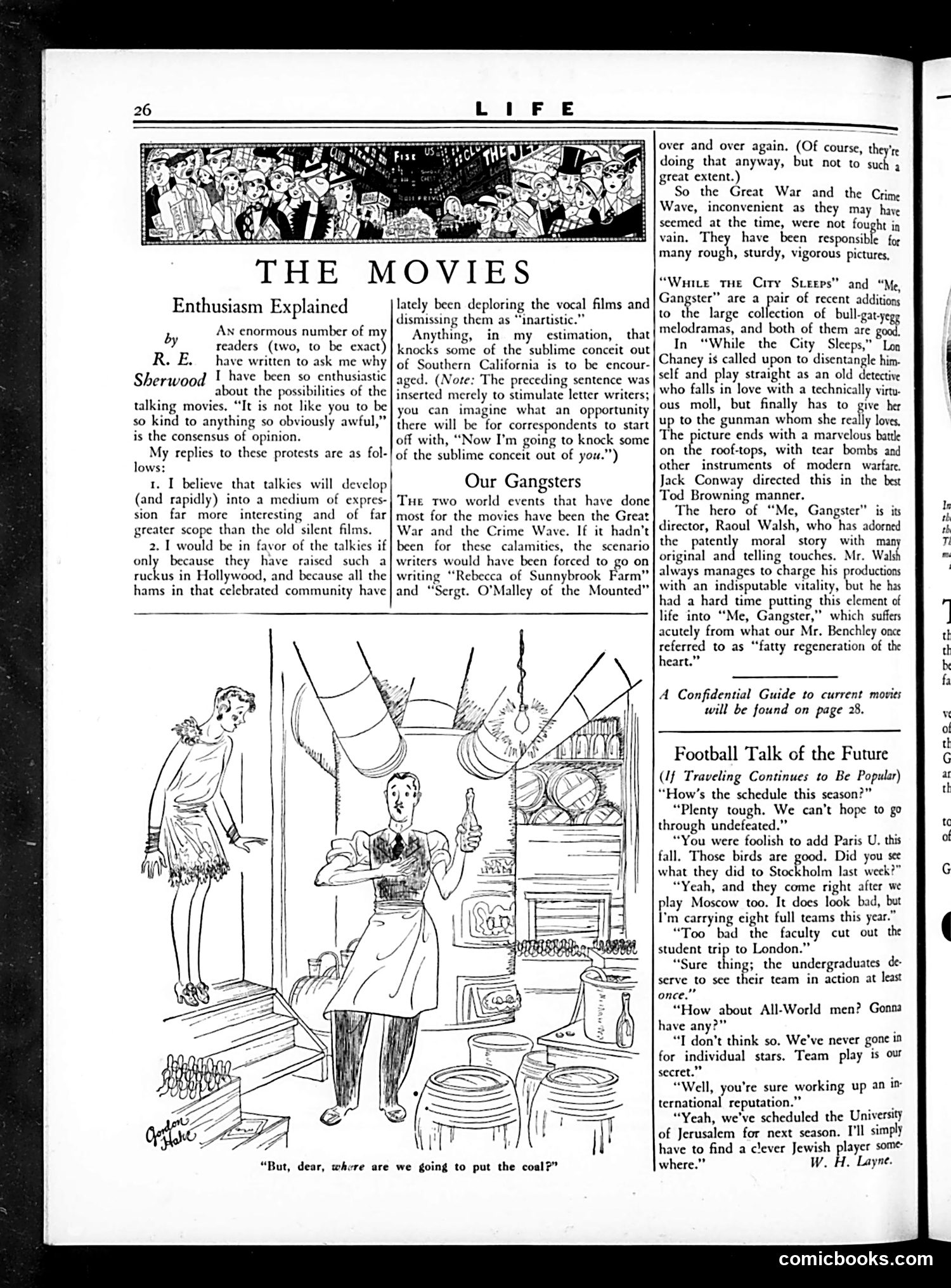
This page contains film criticism by R.E. Sherwood defending "talking pictures" (early sound films) against Hollywood skeptics who dismissed them as "inartistic." Sherwood argues talkies will develop into a superior medium and praises them partly because their existence has upset pretentious Southern California actors and writers. The cartoon illustrates this tension: a well-dressed woman asks a man (appearing to be a traditional theater/arts figure, surrounded by coal and domestic fixtures) "where are we going to put the coal?"—suggesting the conflict between old entertainment forms and new technology displacing established industries. The page reviews two gangster films: "While the City Sleeps" (featuring Lon Chaney) and "Me, Gangster" (directed by Raoul Walsh). The satire mocks how crime and war—real tragedies—have ironically revitalized Hollywood by providing dramatic material beyond tired rural comedies like "Rebecca of Sunnybrook Farm." The "Football Talk of the Future" section humorously predicts international university football competition, imagining teams traveling globally to play opponents in Moscow, Paris, and Jerusalem.
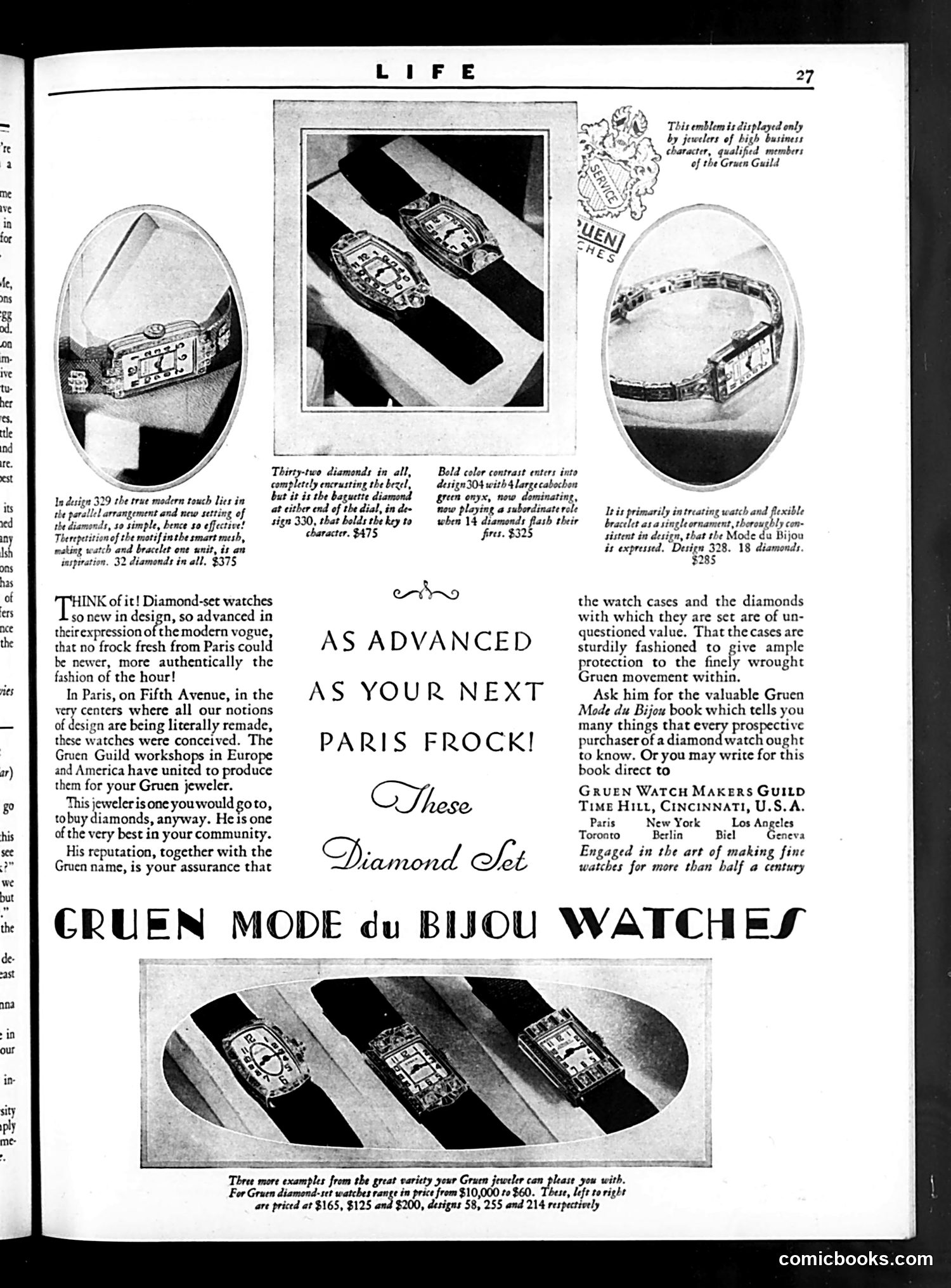
This is **not a cartoon or satire** — it's a luxury jewelry advertisement from Life magazine's advertising section. The page promotes Gruen's "Mode du Bijou" (Jewelry Fashion) diamond-set watches. The text positions these watches as cutting-edge fashion accessories, deliberately equating them with the latest Paris couture: "so new in design...that no frock fresh from Paris could be newer." Key selling points include: - Design innovation from Gruen Guild workshops in Europe and America - Watches framed as unified fashion statements (watch + bracelet as single ornament) - Association with high-status jewelers of "very best" community reputation - Pricing from $125-$10,000 The advertisement uses aspirational language about Paris fashion and Fifth Avenue design centers to market luxury timepieces to wealthy Americans. Multiple watch designs are displayed photographically to showcase variety and elegance. This reflects 1920s-30s consumer culture targeting affluent customers.
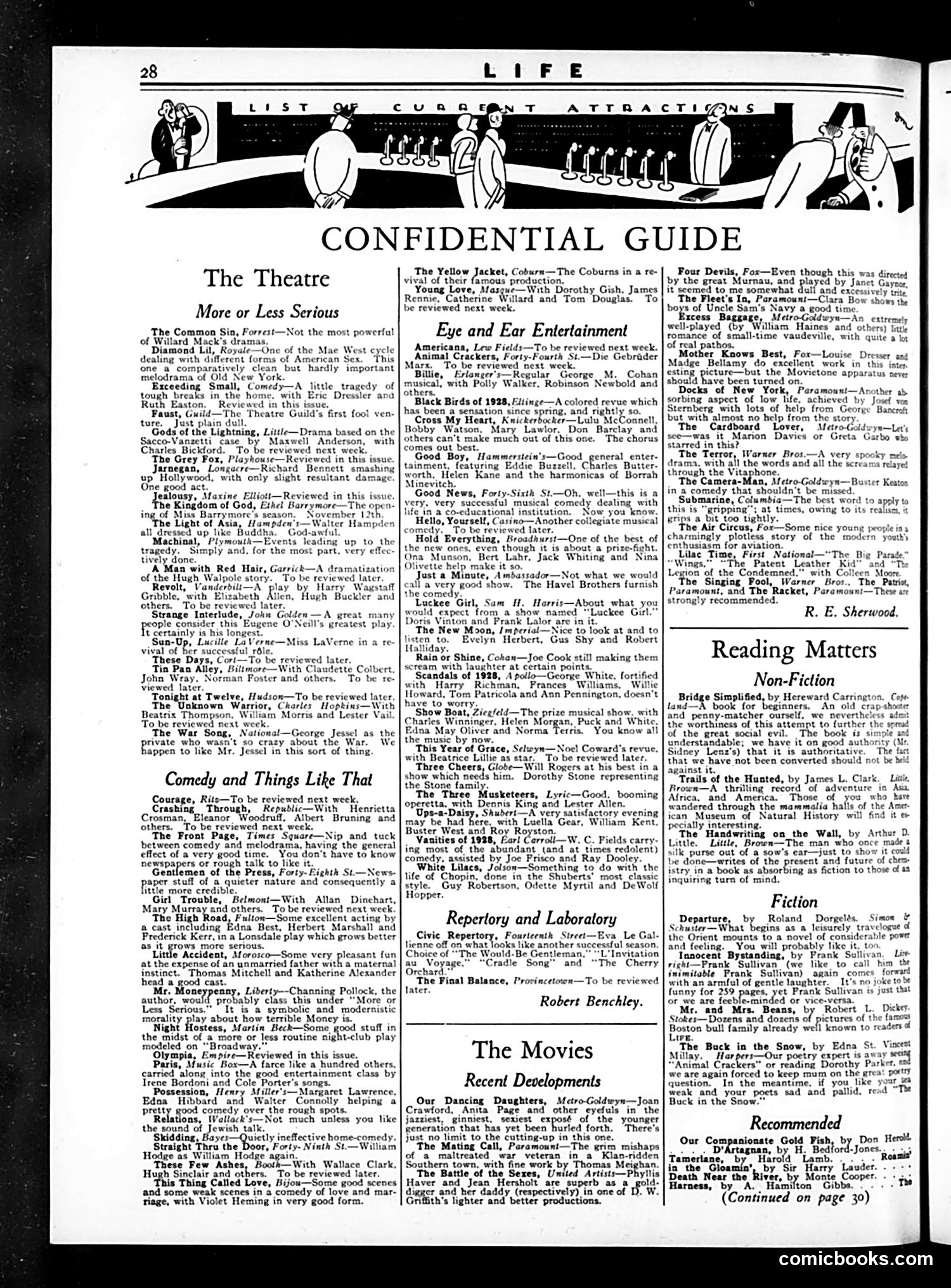
This page is a **theatre and movie review guide**, not a political cartoon. It's a "Confidential Guide" listing current Broadway productions and films with brief critical assessments—a regular feature helping readers decide what entertainment to see. The page reflects **1928 theatrical trends**: mentions of Mae West's "Diamond Lil" (risqué comedy), Eugene O'Neill's "Strange Interlude" (experimental drama), and the Sacco-Vanzetti case adaptation "Gods of the Lightning" (topical social drama). Notable is the prevalence of **literary adaptations and serious theatrical work** alongside lighter fare. The decorative header illustrates typical theatre-goers in evening dress, establishing this as entertainment coverage for a sophisticated urban audience. This represents Life magazine's role as a **cultural arbiter for middle and upper-class readers**, curating which shows were worth their time and money.
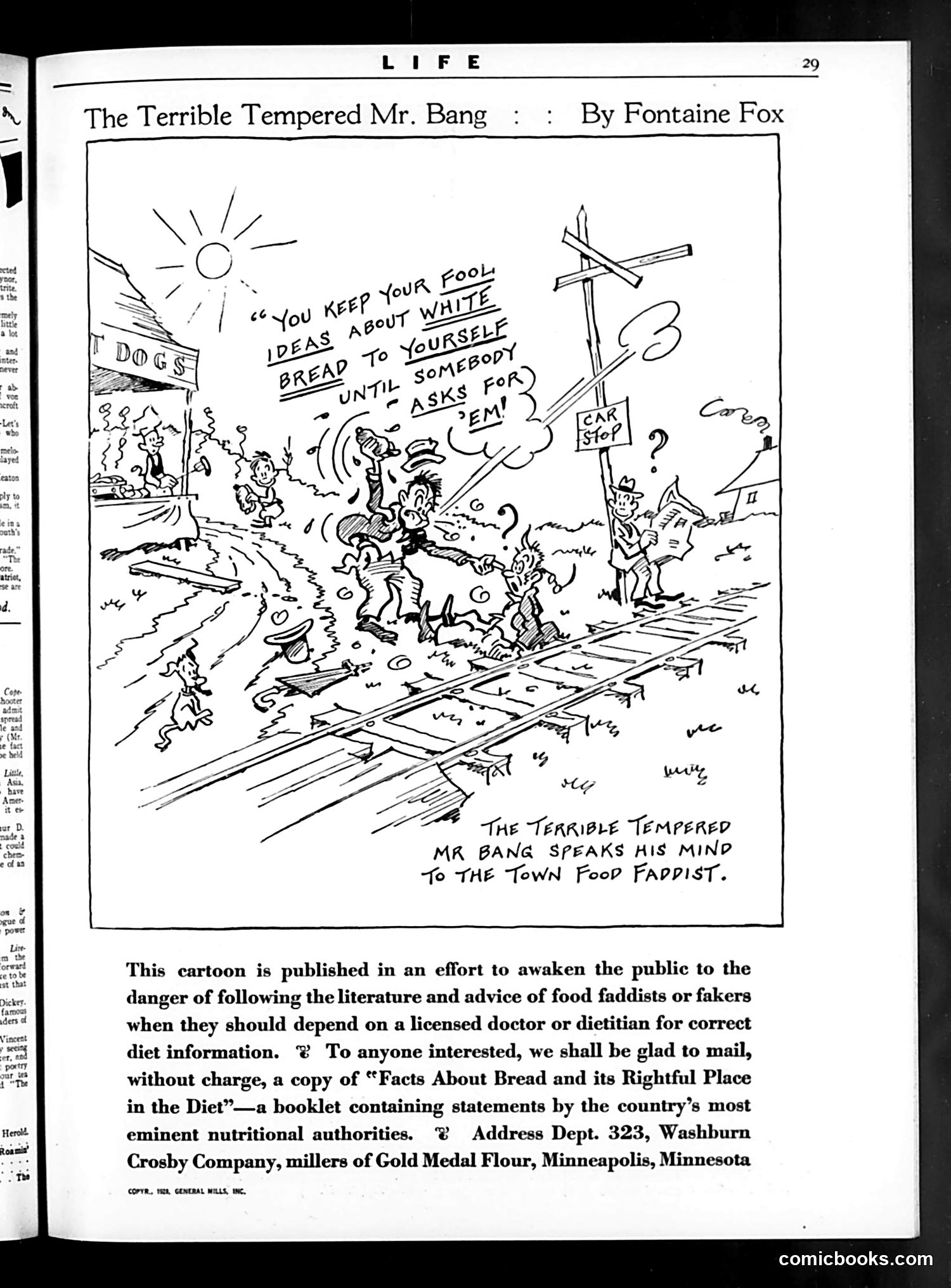
This is a **sponsored cartoon by Washburn Crosby Company** (Gold Medal Flour) attacking "food faddists"—people promoting alternative diet theories outside mainstream medicine. The cartoon shows an angry character ("Mr. Bang") confronting what appears to be a "food faddist" spreading dubious nutritional advice. The quote bubble emphasizes keeping "fool ideas about white bread" secret until someone asks—mocking fad dieters' evangelism. The accompanying text warns against following unqualified diet advice, urging reliance on licensed doctors instead. The company then offers a free booklet endorsing bread's nutritional value, positioning themselves as allied with medical authority. This reflects 1920s-30s tensions: rising distrust of processed foods and white bread (seen as less nutritious), versus established food industries defending their products through appeals to "scientific" authority and professional credentialing.
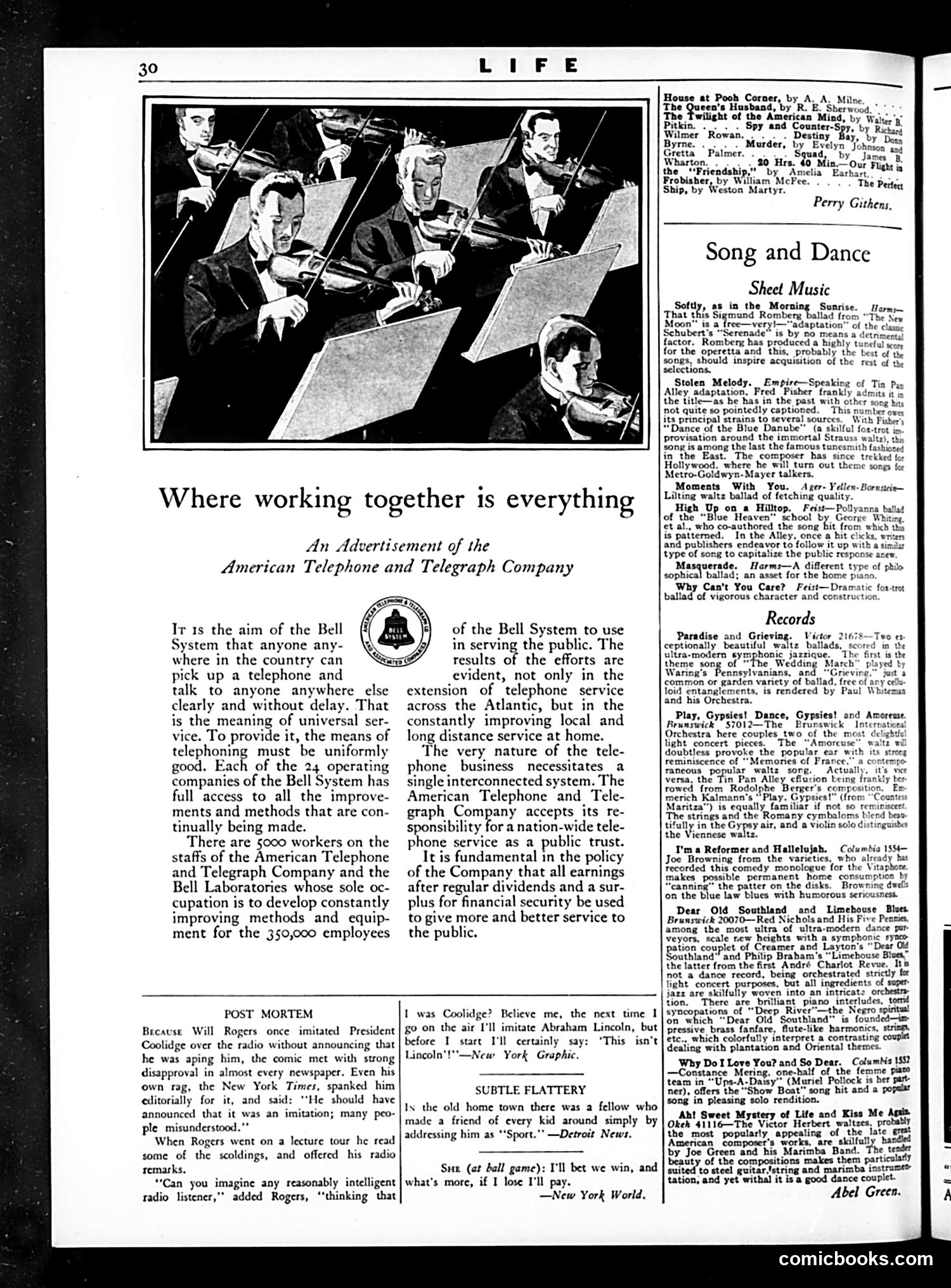
This page is primarily an **AT&T advertisement** touting the Bell System's infrastructure and service philosophy, accompanied by several unrelated shorter humor pieces and a "Song and Dance" (sheet music reviews) section. The main advertisement features an illustration of telephone operators at work, emphasizing that coordinated teamwork across the Bell System's 24 operating companies ensures reliable service nationwide. The copy stresses AT&T's commitment to universal service as a "public trust," with 5,000 workers dedicated to improving technology and methods for 350,000 employees. The humor section includes anecdotes about **Will Rogers' 1929 radio imitation of President Coolidge** (which caused controversy because listeners weren't told it was an imitation), with Rogers' wry response: if people couldn't tell the difference, why announce it? Other brief jokes involve childhood nicknames ("Sport") and betting at baseball games—all lighthearted Americana typical of Life magazine's satirical content from this era. The page reflects 1920s-era corporate messaging about technological progress and American business reliability.
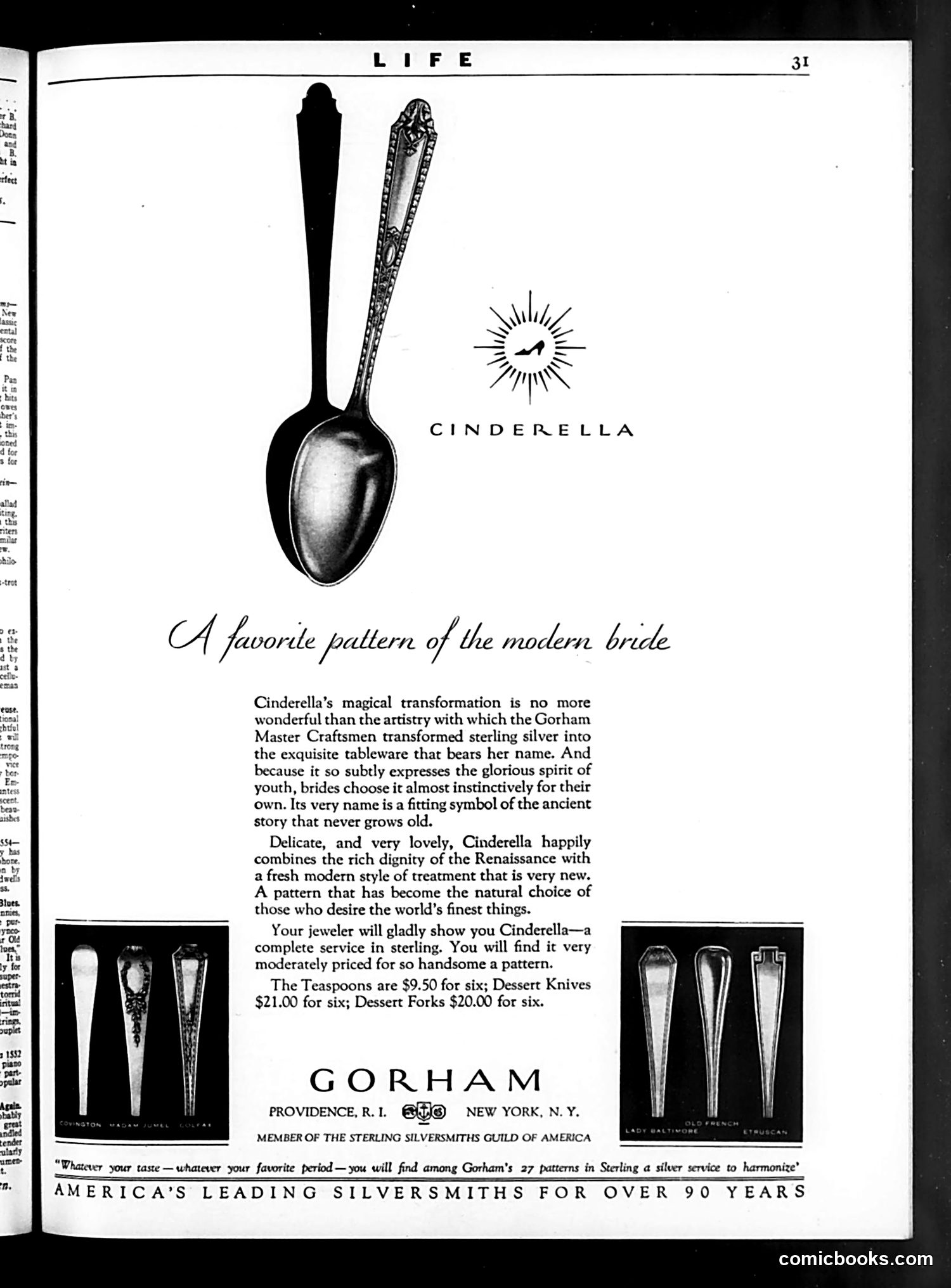
This page is a commercial advertisement for Gorham silverware, not political commentary or satire. It promotes the "Cinderella" pattern of sterling silver tableware, marketed specifically to brides. The ad uses the Cinderella fairy tale metaphorically—comparing the "magical transformation" of silver into elegant flatware to Cinderella's own transformation. The imagery shows decorative spoons and forks featuring ornamental handles. The appeal is aspirational: brides are told this pattern represents both "Renaissance dignity" and "modern style," positioning it as a prestigious yet reasonably priced choice for those wanting "the world's finest things." The Gorham company emphasizes its 90+ year heritage and guild membership to establish credibility. This reflects mid-20th century wedding culture, when elaborate silver flatware services were considered essential bridal registry items.
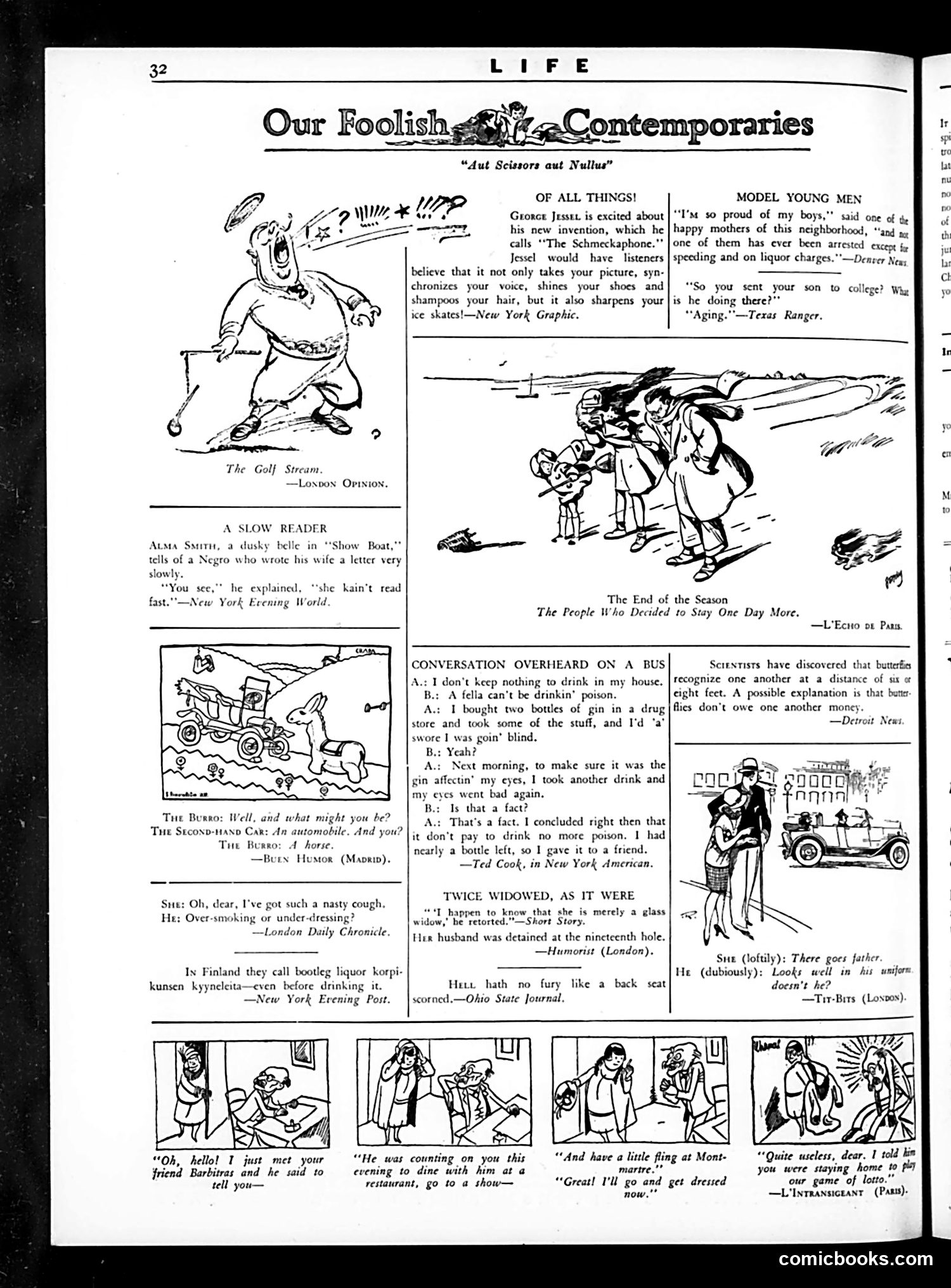
This is a humor compilation page satirizing modern life circa the 1920s-30s. The cartoons mock: **Social pretension and absurdity**: The "Model Young Men" joke ridicules mothers proud their sons avoid arrest except for speeding and liquor violations—normalizing minor crimes as acceptable. **Prohibition-era drinking**: Multiple jokes target bootleg gin's toxicity and people's reckless consumption despite obvious danger (the man who drank poison gin twice). **Marital discord**: "Twice Widowed" mocks wives whose husbands neglect them for golf ("detained at the nineteenth hole"), and a comic strip shows a woman ditching her husband's plan to stay home for cards. **Technological hype**: George Jessel's fictional "Schmeckaphone" parodies inflated claims about new inventions doing impossibly many things. **Absurdist observations**: The butterfly joke subverts scientific discovery with cynical humor about debt avoidance. Overall, the page reflects 1920s-30s anxieties about changing morality, prohibition's failure, and modern life's contradictions—presented through brief, snappy quips typical of Life's satirical format.
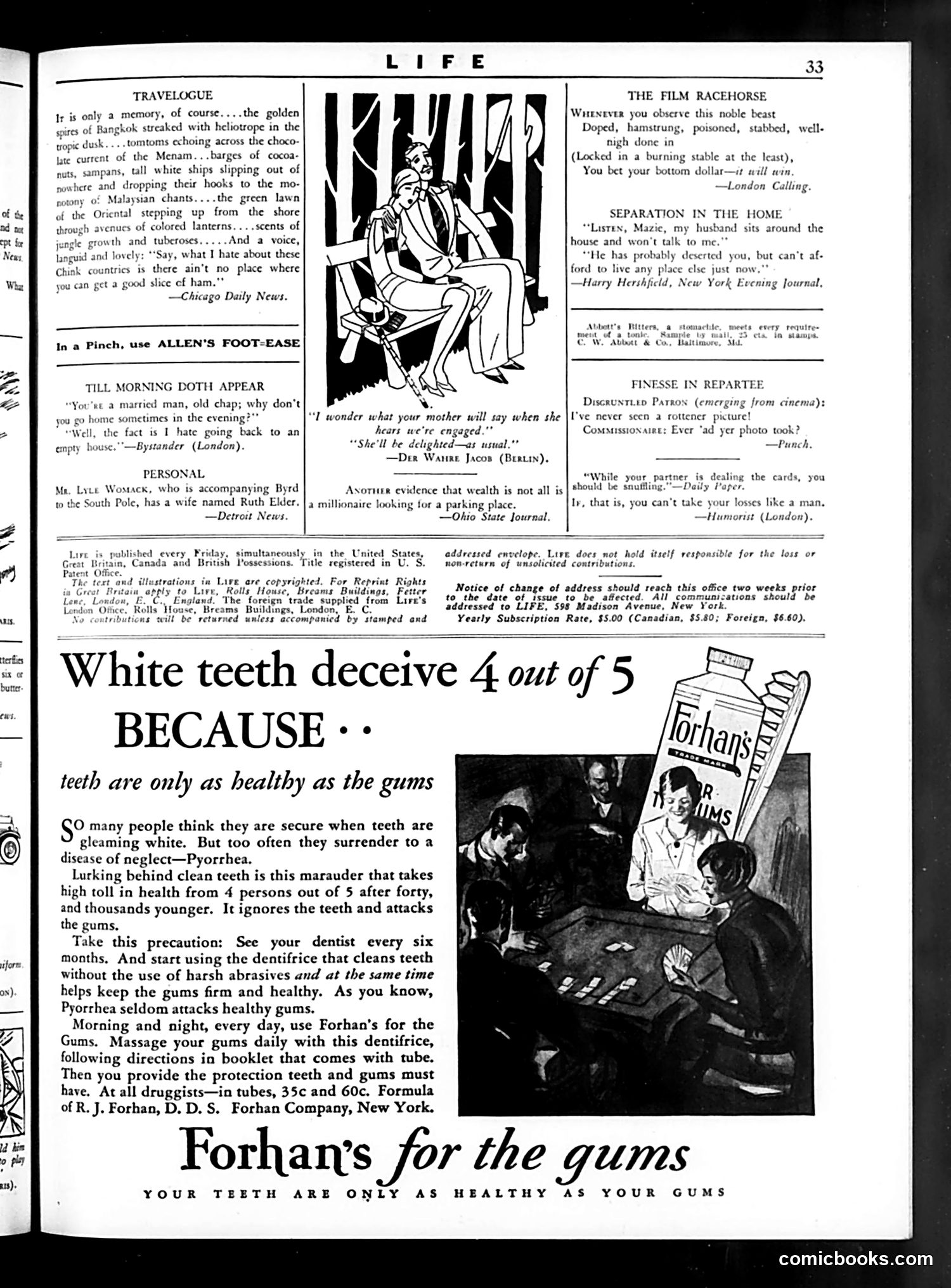
This page combines editorial humor with advertising. The upper section features brief satirical pieces mocking various social situations: a tourist's complaint about lacking American ham in Southeast Asia; a married man avoiding home; marital separation dressed as philosophy; and observations about wealth and parking. The central cartoon illustrates "The Film Racehorse"—a cynical joke about movie horses. It depicts a horse subjected to abuse (doping, poisoning, stabbing, burning) yet still expected to win races. The satire targets Hollywood's treatment of animals in films, suggesting studio indifference to animal welfare provided audiences get their spectacle. Below sits a full-page **Forhan's toothpaste advertisement** warning that "white teeth deceive 4 out of 5" because gum disease lurks beneath clean teeth. It pushes regular dental visits and their dentifrice for gum health. The image shows what appears to be a dental office scene. The page exemplifies 1920s-30s Life magazine: witty, urbane humor paired with period advertising promoting health anxiety to drive consumer purchases.
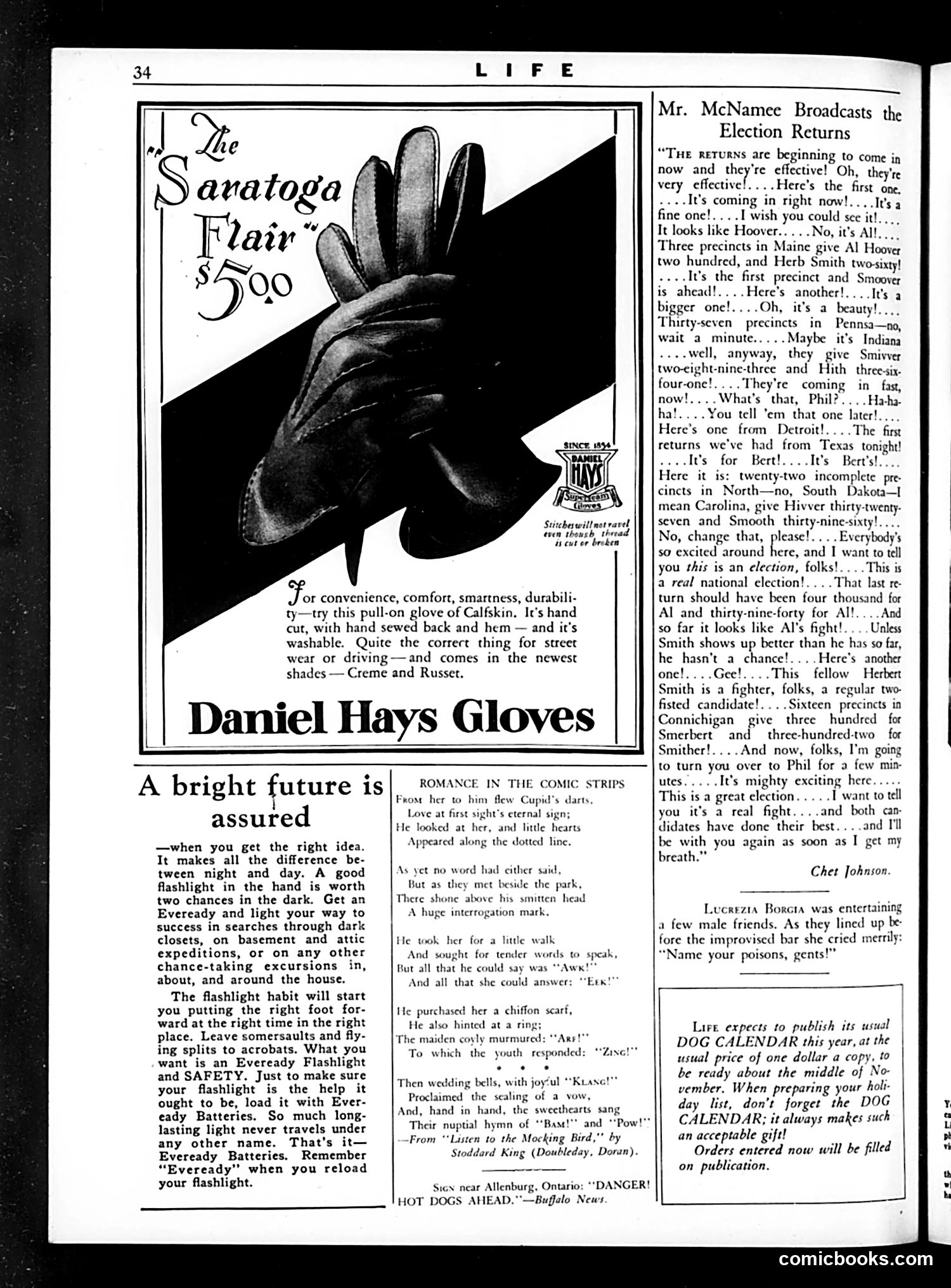
This page satirizes radio broadcaster Graham McNamee's breathless coverage of the 1928 U.S. presidential election returns between Republican Herbert Hoover and Democrat Al Smith. The satire mocks McNamee's overwrought, rapid-fire delivery—his breathless excitement, constant corrections ("No, change that, please!"), and garbled precinct numbers ("two-eight-nine-three"). The joke captures how early radio election coverage was chaotic and sensationalized, with commentators speaking so fast they made errors while trying to sound dramatic and authoritative. McNamee's actual delivery was famous for this breathless style, making him an easy target for parody. The exaggeration emphasizes how absurd such live, unscripted broadcasting could be—conveying no actual information while creating false urgency about electoral outcomes. The page also includes unrelated advertisements (Daniel Hays Gloves, Eveready Batteries) and comic-strip humor typical of *Life* magazine's format.
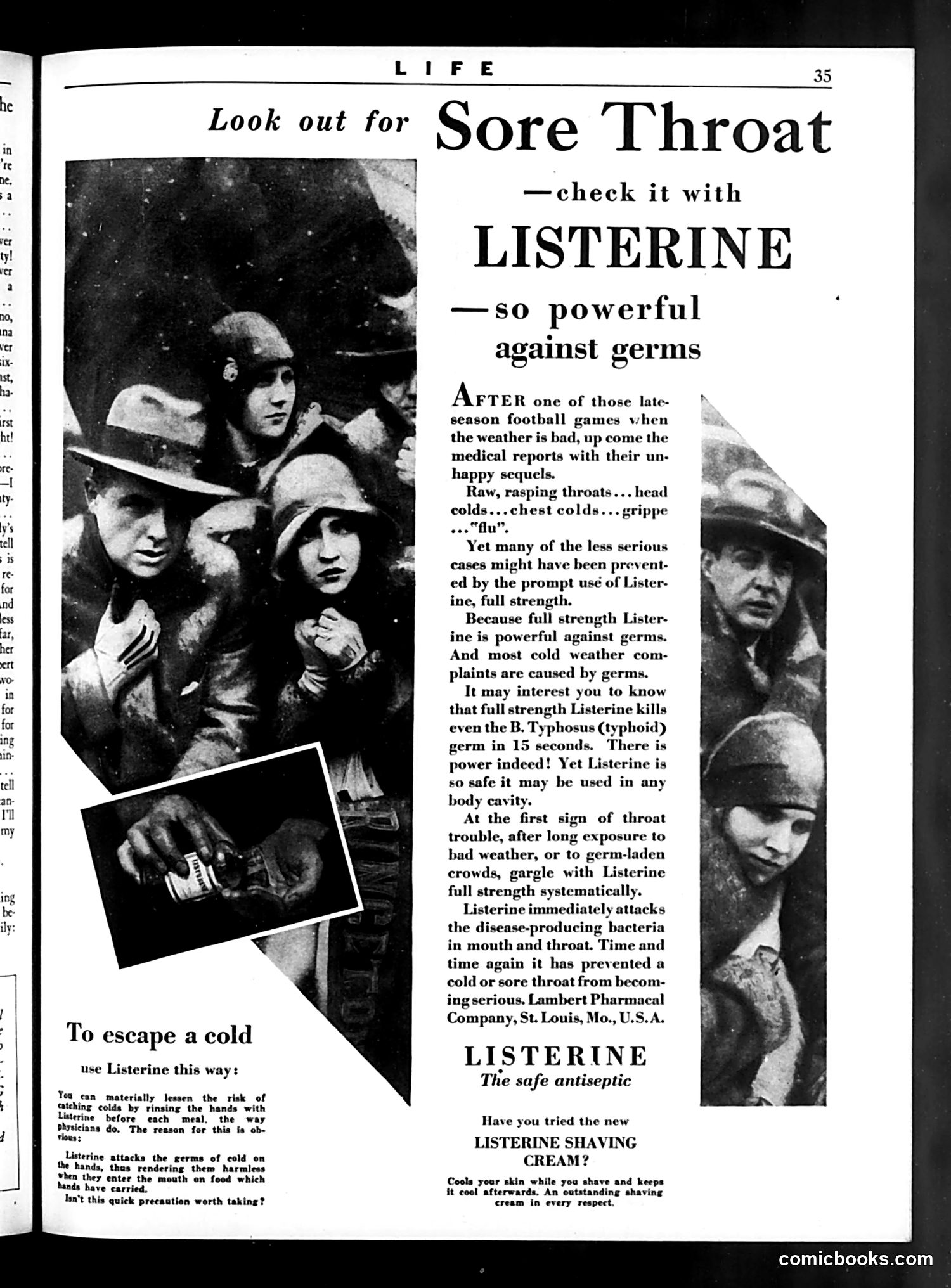
This page is **entirely an advertisement**, not editorial content or satire. It promotes Listerine mouthwash/antiseptic as a preventative for sore throats and colds, particularly following late-season football games played in bad weather. The images show people (appears to be from a football context based on the text) bundled against cold weather. The advertisement claims Listerine kills germs including typhoid bacteria in 15 seconds and recommends gargling with full-strength Listerine at the first sign of throat trouble. The ad also suggests rinsing hands with Listerine before meals to prevent catching colds—a practice it claims physicians endorsed. A secondary pitch advertises Listerine Shaving Cream as an additional product line. This reflects early 20th-century marketing that attributed colds and sore throats primarily to "germs" and promoted antiseptics as preventative medicine—claims that would face scrutiny today regarding effectiveness and safety.
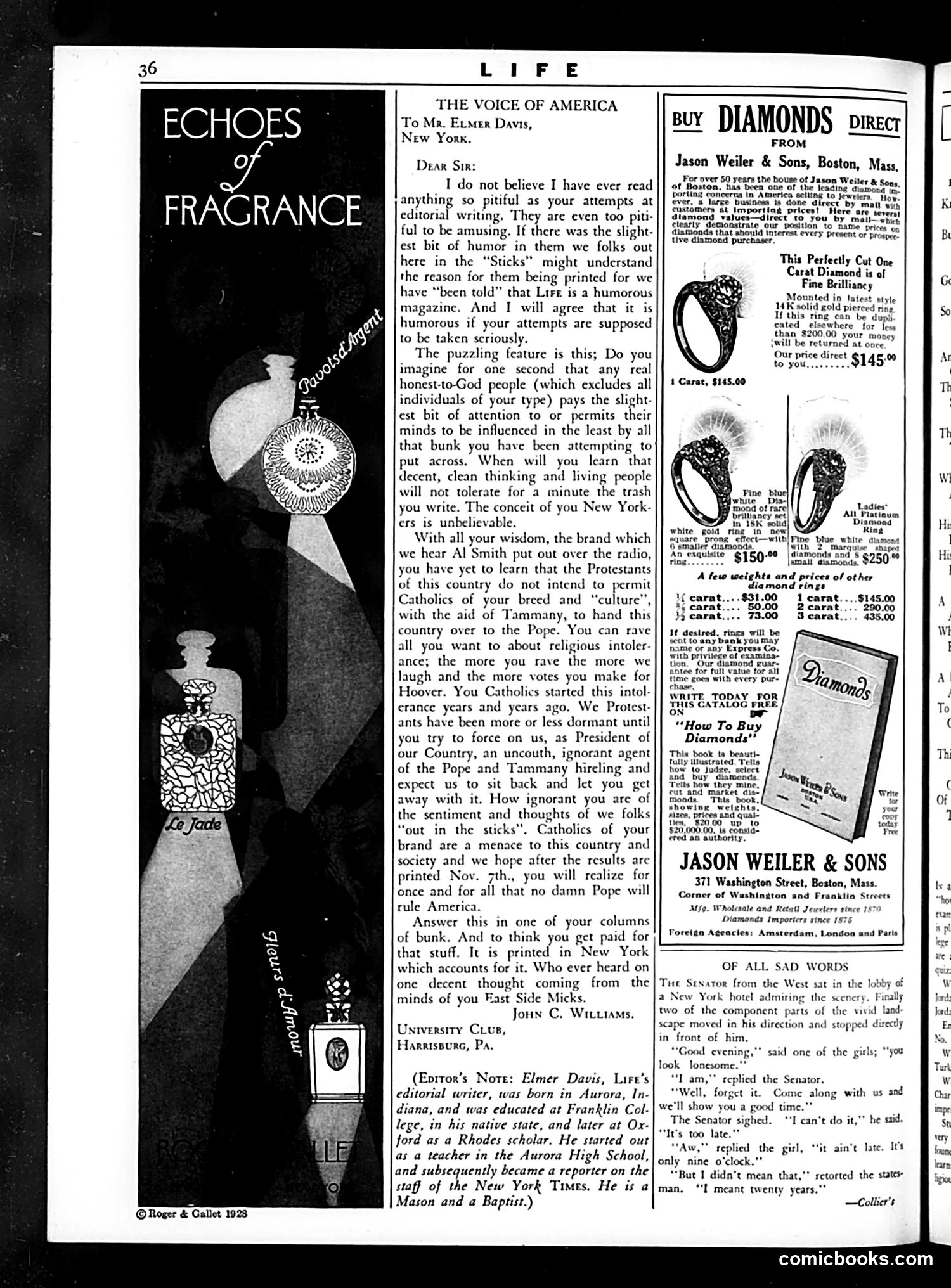
This page features a scathing letter to *Life* magazine's editorial writer Elmer Davis, published during the 1928 presidential election. The correspondent attacks Davis's editorials as vapid and accuses him of promoting Catholic interests. **The Political Context:** The letter reflects the intense religious and ethnic tensions of 1928, when Al Smith—a Catholic, Irish-American Democrat from New York's East Side—ran for president. The writer, from rural Pennsylvania ("the Sticks"), expresses deep Protestant anxiety about Catholic influence, papal authority, and what he sees as urban corruption (Tammany Hall). **The Satire:** *Life* publishes this intolerant letter with an editorial note establishing Davis's credentials (Rhodes scholar, Mason, Baptist)—a subtle rebuke. By printing the letter unedited with Davis's impressive biography appended, the magazine mocks the correspondent's bigotry and ignorance, exposing the irrational fears driving anti-Catholic sentiment during the Smith campaign. The letter inadvertently reveals the prejudice it claims to oppose.
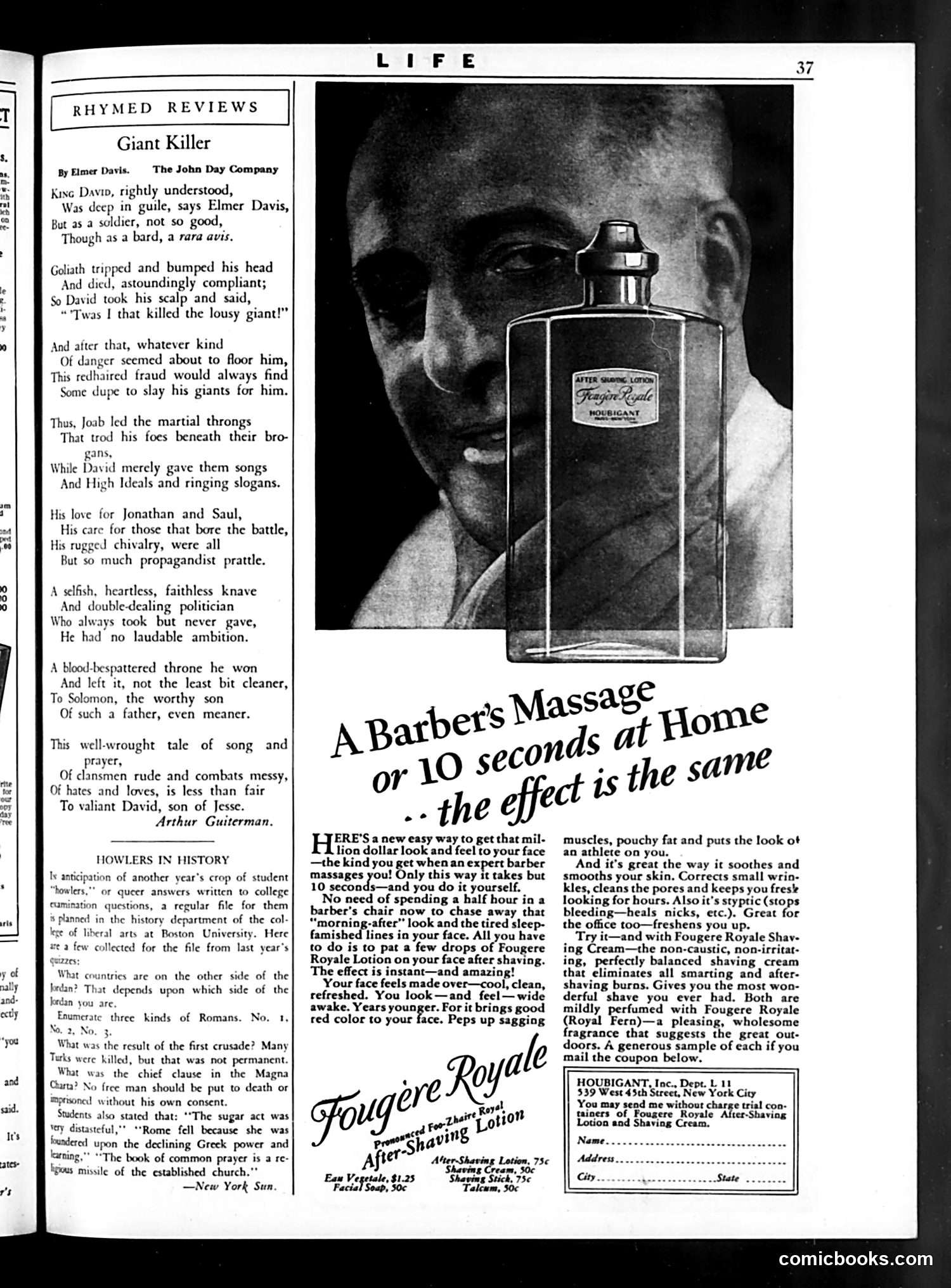
**Left Side - "Giant Killer" by Elmer Davis:** This is a satirical poem attacking King David of biblical fame. Davis portrays David as a cunning fraud and corrupt politician who took credit for killing Goliath but relied on others (like his general Joab) to fight his actual battles. David merely provided "songs / And High Ideals and ringing slogans"—propaganda rather than genuine leadership. The poem characterizes him as "selfish, heartless, faithless" and a "double-dealing politician / Who always took but never gave." The satire likely comments on contemporary political leaders who claim credit for military victories while avoiding personal sacrifice, using rhetoric and propaganda to manipulate the public. The biblical framing allowed Life magazine to critique such behavior through historical allegory. **Right Side:** A full-page advertisement for Fougère Royale after-shaving lotion, featuring a photograph of a man's face and the product bottle. This occupies most of the editorial space—typical of Life's advertising model.
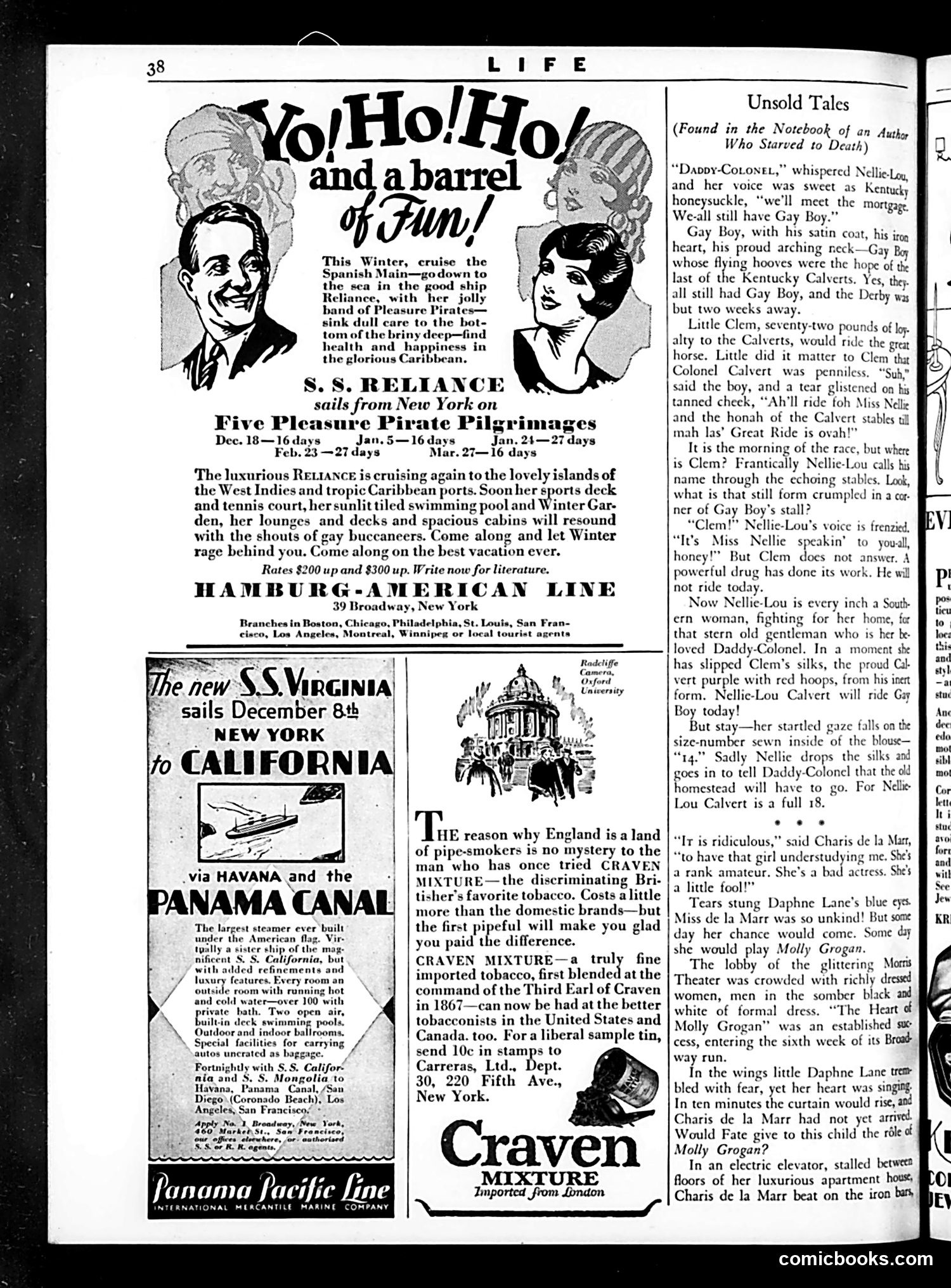
This page is primarily **advertisements** for luxury cruises and tobacco, with a satirical short story in the upper right. The story, "Unsold Tales (Found in the Notebook of an Author Who Starved to Death)," is **satire mocking sentimental melodrama**. It parodies overwrought Southern Gothic fiction with exaggerated dialect ("foh," "youall," "ovah") and melodramatic plot devices: a proud but bankrupt Southern family (the Calverts), a prized racehorse named Gay Boy, a Derby race, and an orphan boy (Clem) loyal unto death. The joke is in the title and framing—this is presented as an unpublished manuscript from a starving author, implying such purple prose couldn't sell. The absurd plot twist (the heroine disguises herself as the jockey when the boy is drugged) epitomizes overwrought storytelling that Life's readers would recognize as hackneyed. The advertisements emphasize **leisure and luxury** (cruise ships, imported tobacco), contrasting sharply with the starving author frame—suggesting only wealthy readers could afford such indulgences.
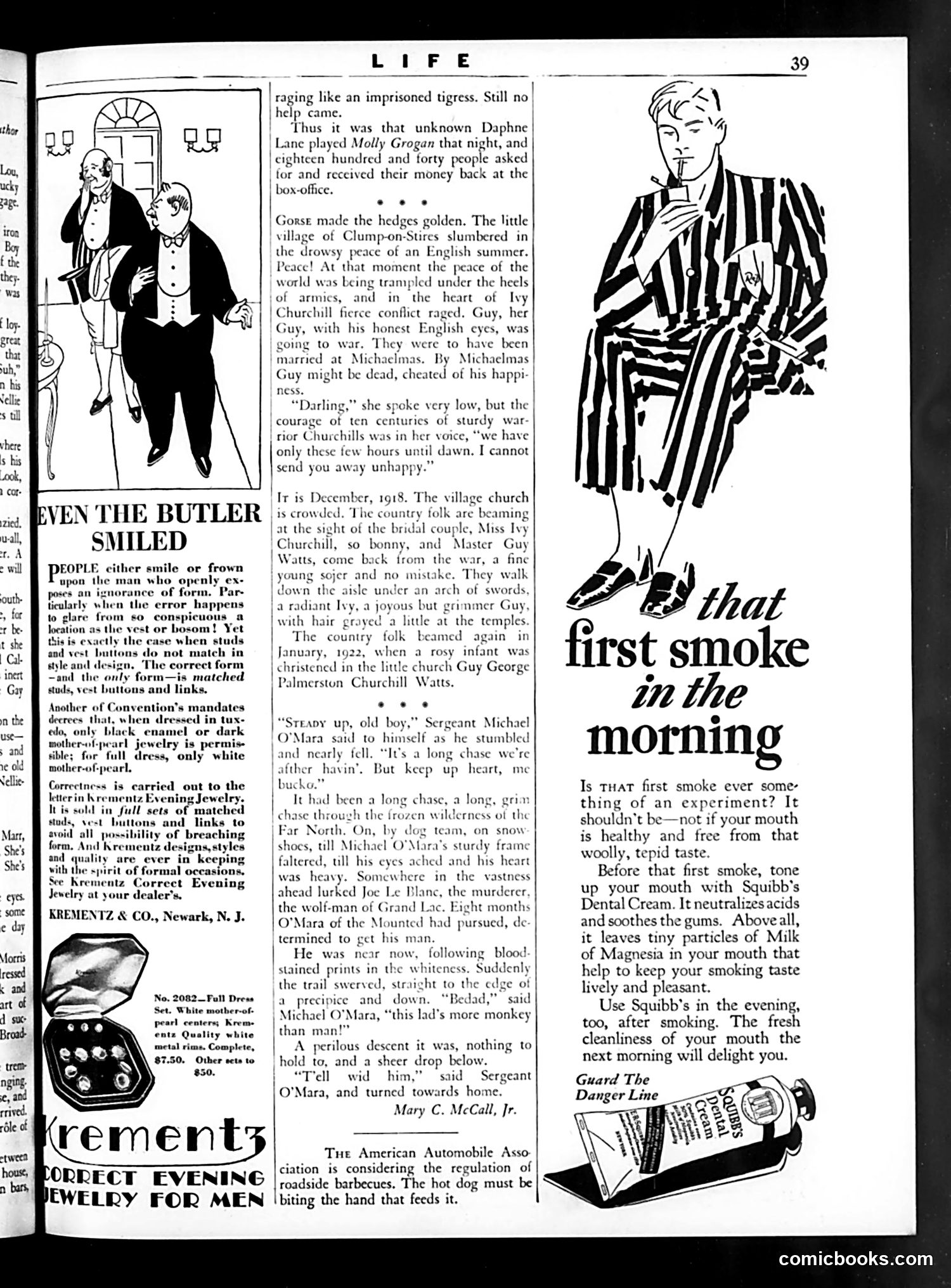
This *Life* magazine page (page 39) contains two distinct elements: **Left side:** A jewelry advertisement for Krementz & Co. promoting matched formal evening wear (studs, vest buttons, and cufflinks). The accompanying illustrations show two men in tuxedos, with text explaining etiquette rules about proper formal dress—a satirical dig at rigid social conventions about matching formal jewelry. **Center/Right:** Two serialized fiction stories. "Even the Butler Smiled" appears to be a romantic wartime narrative about Ivy Churchill and Guy Watts, separated by WWI but reunited by December 1918. The second story follows Sergeant Michael O'Mara pursuing a murderer through Arctic wilderness. Both are sentimental melodramas typical of period magazine fiction. **Right side:** An advertisement for Squibb's Dental Cream, promoting its use after smoking to neutralize mouth acids and maintain pleasant breath. The page primarily showcases *Life*'s mix of satirical advertising commentary, fashion/etiquette humor, and serialized popular fiction—reflecting early 20th-century magazine content aimed at middle-class readers.
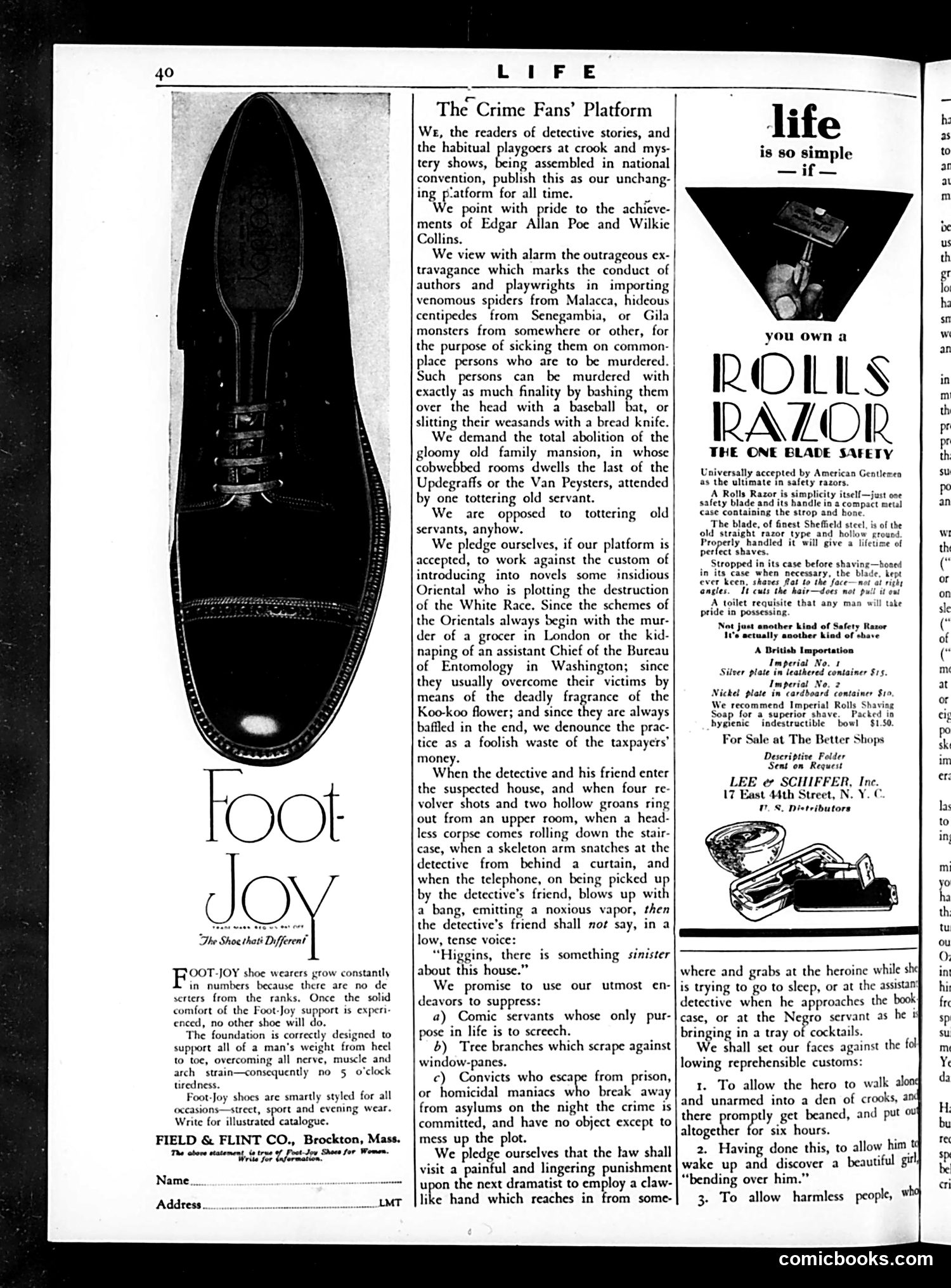
This satirical piece mocks the overwrought conventions of early 20th-century detective fiction and mystery plays. Written as a mock "platform" by readers of detective stories, it ridicules the genre's reliance on melodramatic clichés: **The satire targets:** - Exotic murder weapons (imported spiders, centipedes, Gila monsters) when simple methods work fine - Obligatory "gloomy old mansions" with ancient servants - Stock "Oriental villain" plots involving mysterious flowers and threats to White civilization - Absurd accumulating scares (headless corpses, skeleton arms, exploding phones) - Comic relief servants who only shriek - Coincidental escaped convicts/asylum patients that complicate plots pointlessly **The joke:** Rather than praising these beloved tropes, the "fans" comically demand their abolition, claiming they're wasteful, implausible, and tired. This inverts expectations—fans typically celebrate genre conventions, not condemn them. The piece lampoons both the stories' ridiculousness and readers' appetite for such material. The page also advertises Foot-Joy shoes and Rolls Razors.
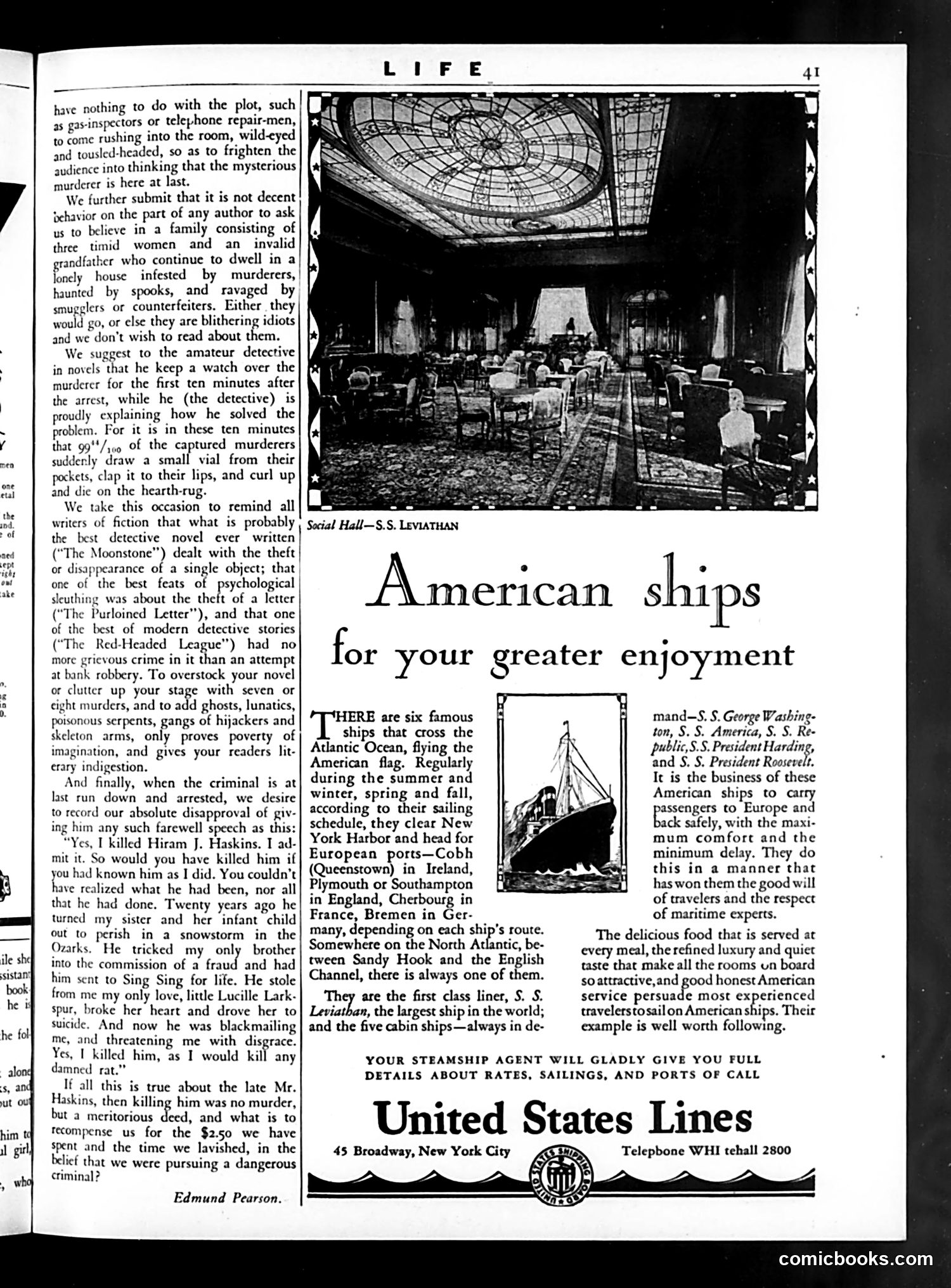
This page contains literary criticism and advertising, not political cartoons. **The Editorial Critique (left column):** Edmund Pearson satirizes melodramatic detective fiction conventions of the era. He ridicules overwrought mystery plots featuring incompetent families, excessive murders, ghosts, and poisoned protagonists who deliver lengthy confessional monologues justifying their crimes. Pearson argues such stories insult readers' intelligence and waste their money. He contrasts this with genuinely clever detective literature like *The Moonstone* and *The Purloined Letter*, which solve crimes based on single, plausible mysteries rather than sensational accumulation of horrors. **The Advertisement (right column):** United States Lines promotes six American ocean liners—the S.S. Leviathan (world's largest ship) and five cabin ships—crossing the Atlantic to European ports. The ad emphasizes comfortable first-class service, fine dining, and maritime professionalism to attract transatlantic travelers. Both sections represent typical Life magazine content from this period: sophisticated cultural commentary paired with luxury consumer advertising.
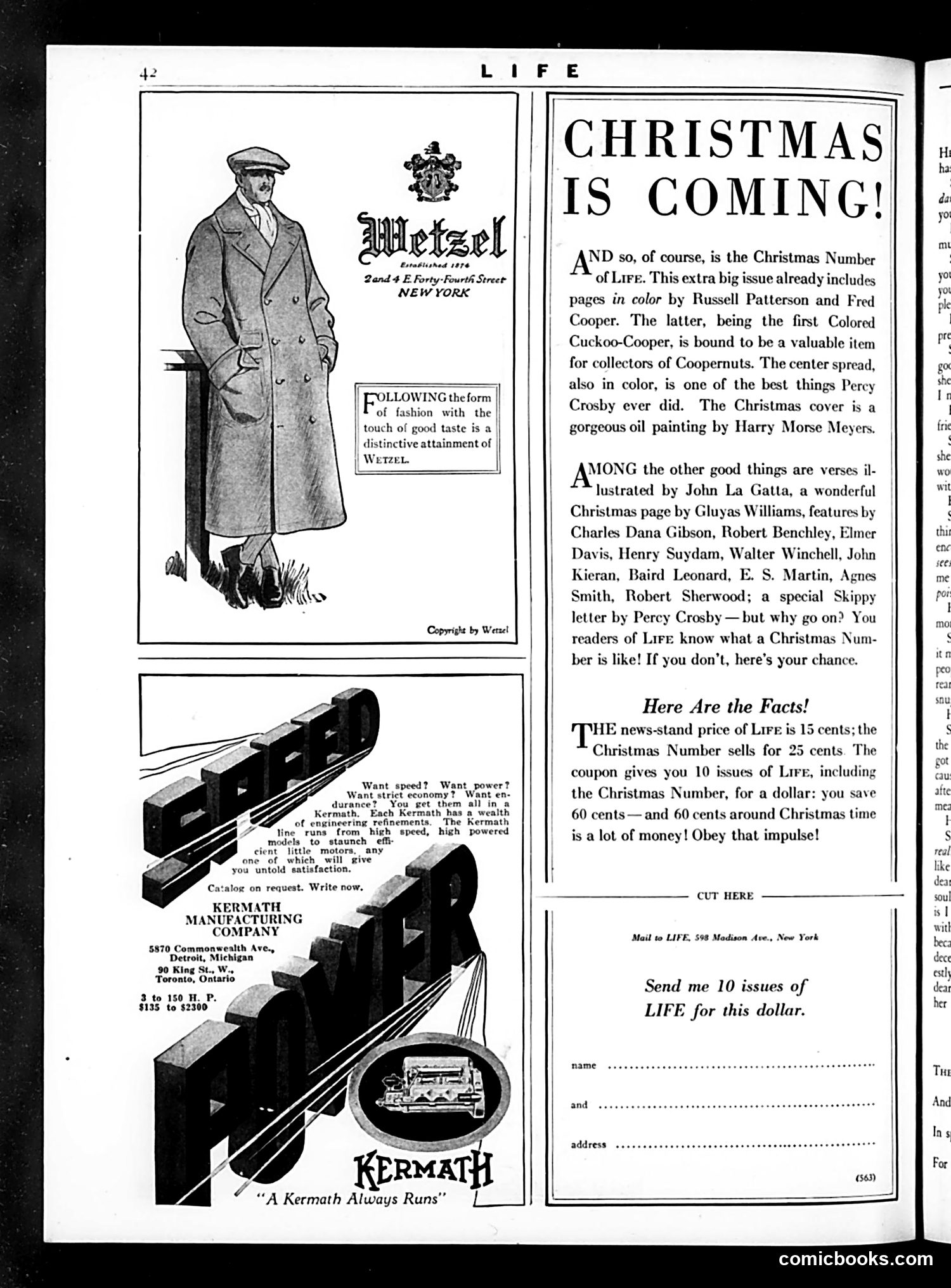
This page is primarily **promotional material** rather than editorial content. It contains: **Left side:** Two advertisements—one for Wetzel fashion house (established 1876, emphasizing "good taste") and one for Kermath Manufacturing Company, selling boat motors in various horsepower ratings. **Right side:** A self-promotional announcement for Life's upcoming Christmas issue. The text boasts of contributions from prominent writers and illustrators of the era (Charles Dana Gibson, Robert Benchley, Percy Crosby, etc.). **The sales pitch:** Life offers 10 issues including the Christmas Number for one dollar—a substantial 60-cent savings. The language ("Obey that impulse!") uses mild pressure to encourage subscriptions around the holiday season. **Historical context:** This reflects early 20th-century magazine culture, where Christmas issues were premium products and subscription offers were common revenue drivers. The named contributors represent Life's reputation as a prestigious satirical publication. No political satire or caricature appears on this particular page—it's essentially a business/advertising page.
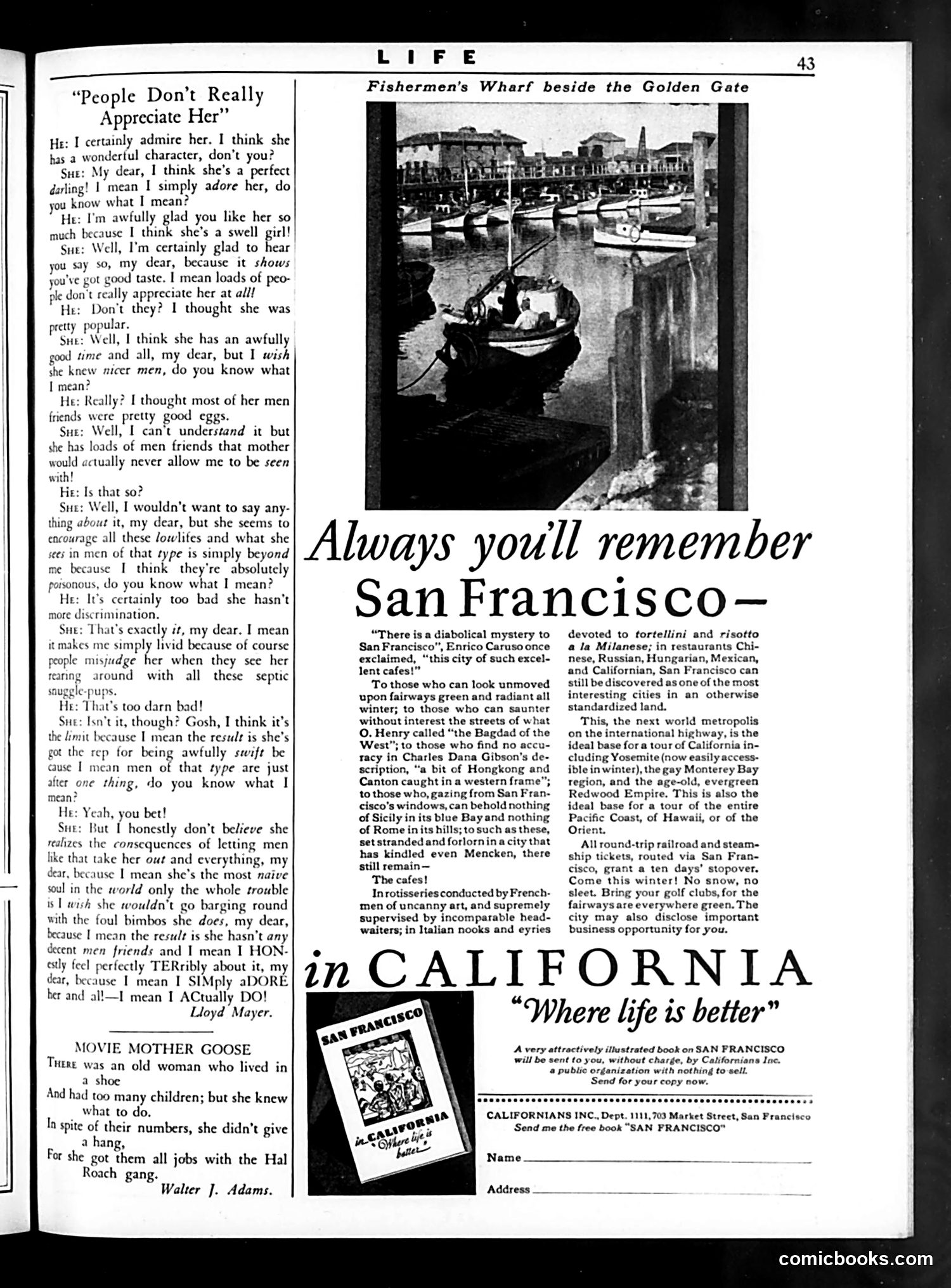
This page contains two distinct pieces of satire: **"People Don't Really Appreciate Her"** (dialogue by Lloyd Mayer): A witty sendup of backhanded compliments and social hypocrisy. Two speakers profess to *adore* a woman while simultaneously criticizing her for associating with "lowlifes" and men of "that type"—coded language suggesting men of lower social class. The satire exposes how people claim to appreciate someone while actively damaging her reputation through gossip, ultimately blaming *her* for the consequences of their own judgment. The repetitive, breathless delivery ("I mean," "do you know what I mean?") mocks affected upper-class speech patterns. **"Movie Mother Goose"** (by Walter J. Adams): A brief joke about Hal Roach, a prolific silent-film comedy producer known for churning out numerous short films. The gag updates the nursery rhyme to suggest Roach runs a factory-like operation employing vast numbers of performers—poking fun at Hollywood's industrial production methods. The San Francisco tourism advertisement fills the remainder of the page.
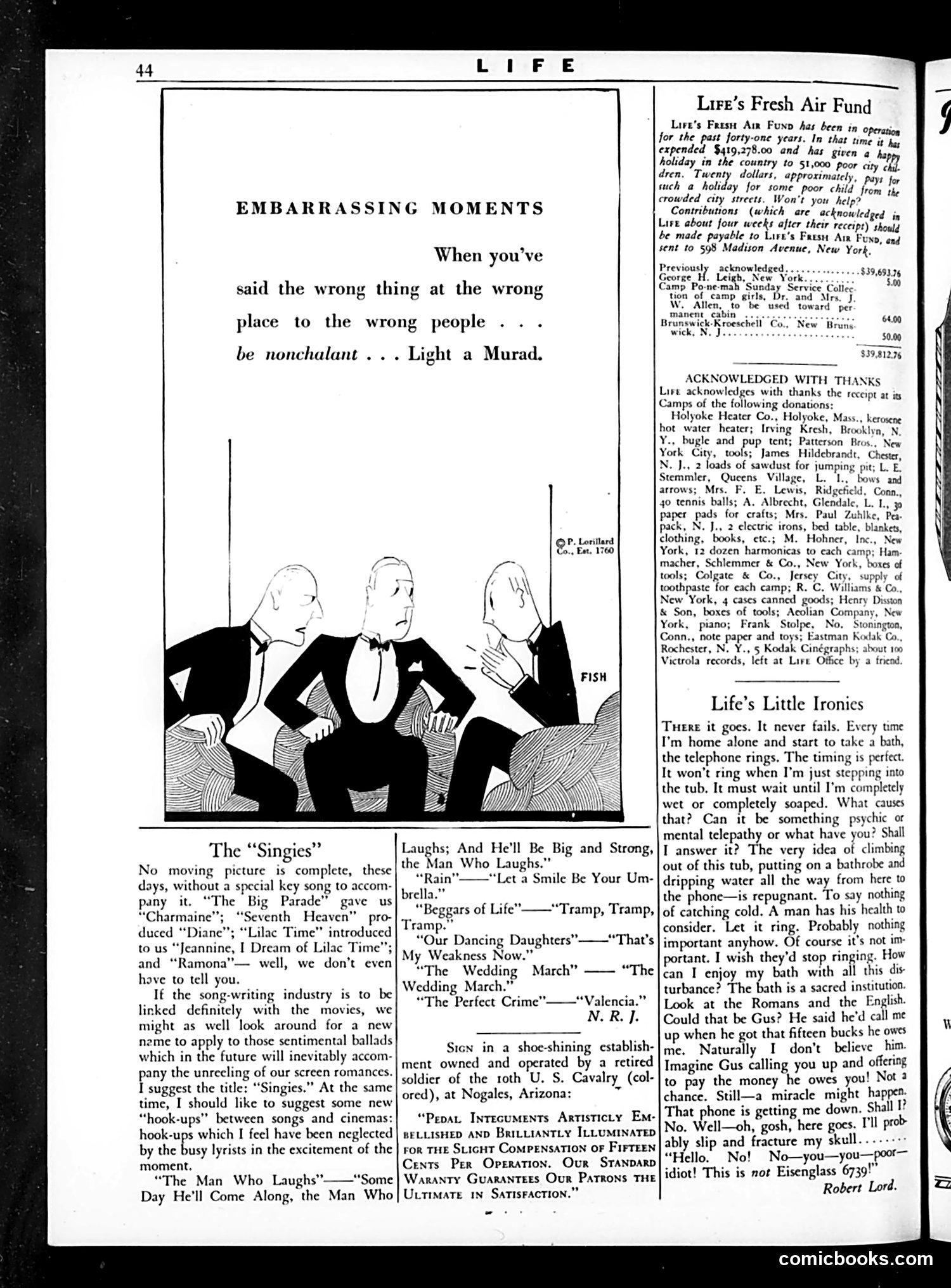
This page contains three distinct pieces: **"Embarrassing Moments" Cartoon**: A Murad cigarette advertisement disguised as editorial content. The cartoon depicts three men in formal wear who've clearly committed a social gaffe. The joke is that lighting a cigarette provides cover for awkwardness—appearing composed masks embarrassment. This was a common advertising format of the 1920s, embedding brand messages within humorous content. **"The Singies" Column**: Commentary on Hollywood's trend of writing theme songs for movies (then novel). The author proposes "Singies" as a term for these sentimental ballads and suggests better song-cinema pairings—mostly jokes playing on film titles versus actual song titles. **"Life's Little Ironies"**: A humorous column about the predictable inconvenience of telephone calls interrupting baths—a relatable domestic observation about timing and modern life. The page also includes charity fundraising for Life's Fresh Air Fund (providing country holidays for poor urban children) and reader acknowledgments of donations.
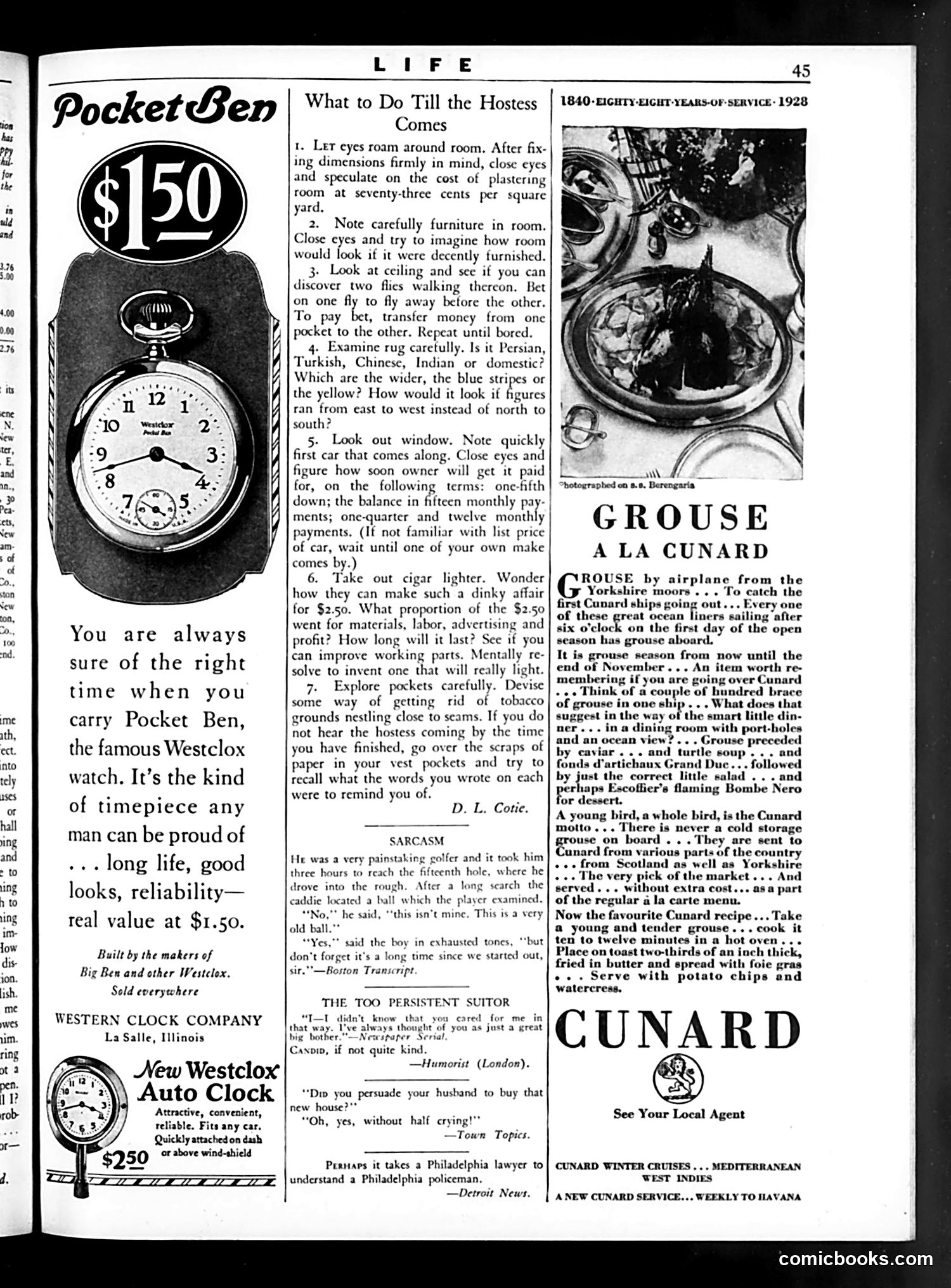
This page is primarily **advertisements and humor columns**, not political cartoons. **Left side:** Westclox pocket watch and auto clock ads emphasizing reliability and affordability ($1.50-$2.50). **Center:** "What to Do Till the Hostess Comes" is satirical advice for awkward social situations—poking fun at guests who are bored or uncomfortable waiting. Suggestions include: calculating plastering costs, imagining better furniture, betting on flies, analyzing rugs, and examining pocket lint. The humor targets both guests' anxiety and the tedium of social obligation. **Right side:** A Cunard cruise line advertisement featuring grouse (game birds) hunted on Yorkshire moors, then served aboard their ocean liners during hunting season—positioning luxury travel as sophisticated leisure for the wealthy. The short humorous quotes below mock sarcasm, persistent suitors, and Philadelphia police bureaucracy—typical period humor without specific topical reference. This is a snapshot of 1920s consumer culture, advertising, and light social satire.
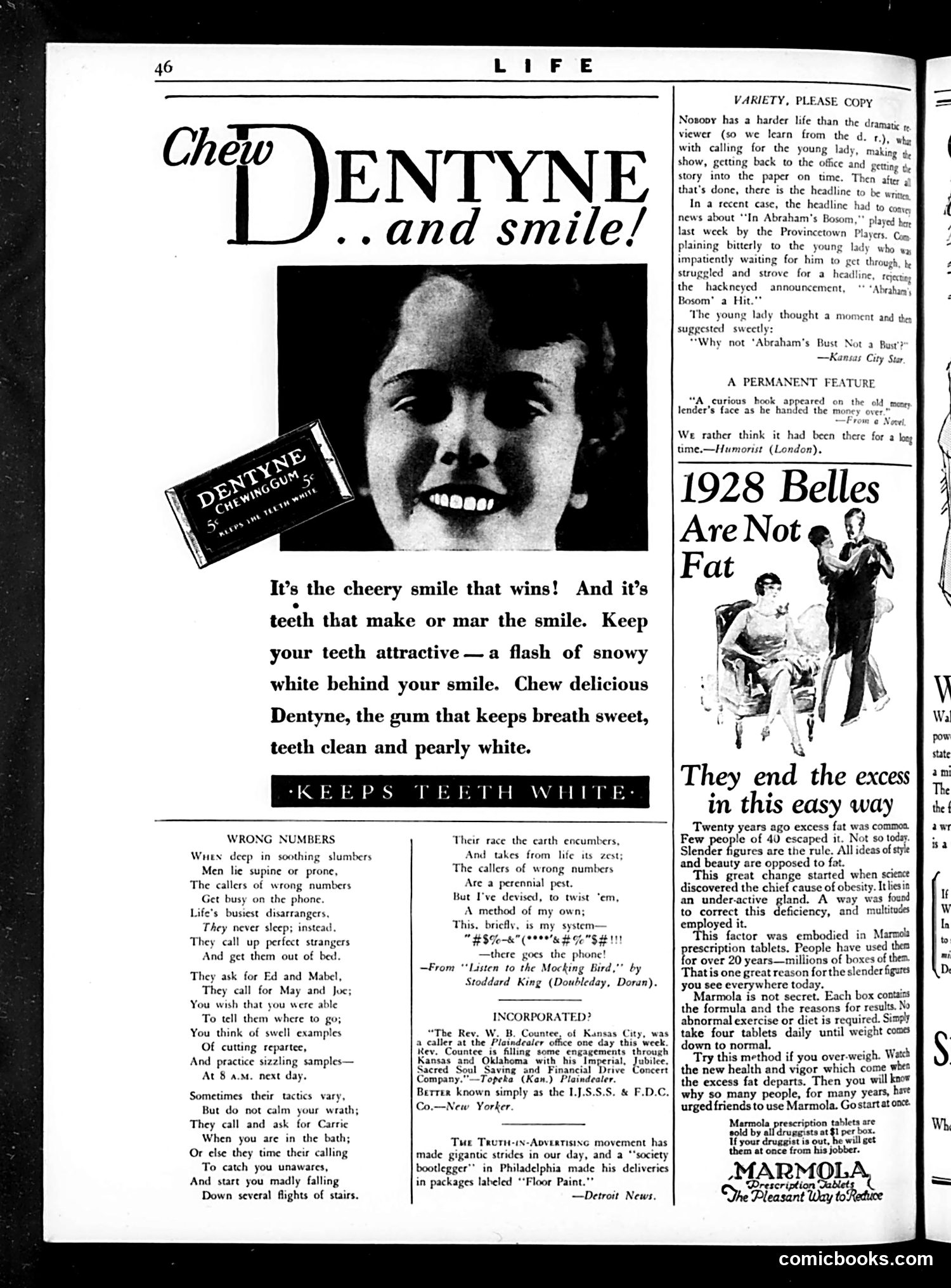
This is primarily an **advertising page** rather than political satire. The main content is a Dentyne chewing gum advertisement featuring a smiling man with the tagline "It's the cheery smile that wins!" The page includes several regular **humor columns** typical of Life magazine's format: - "Wrong Numbers": A comedic poem about the annoyance of misdialed telephone calls—a relatable 1920s complaint - "Variety, Please Copy": A short anecdote mocking newspaper drama critics struggling to write headlines, with a suggested pun on the play "Abraham's Bosom" - "Incorporated?": Satirical commentary on verbose church organization names and Prohibition-era bootleggers disguising illegal alcohol as "Floor Paint" The right column features a **Marmola diet advertisement** promoting weight loss pills, reflecting 1928 beauty standards favoring thinness over the "excess fat" common two decades prior. **No political cartoons appear.** The page reflects typical 1920s consumer culture, technology anxieties (telephone annoyances), Prohibition realities, and beauty industry marketing.
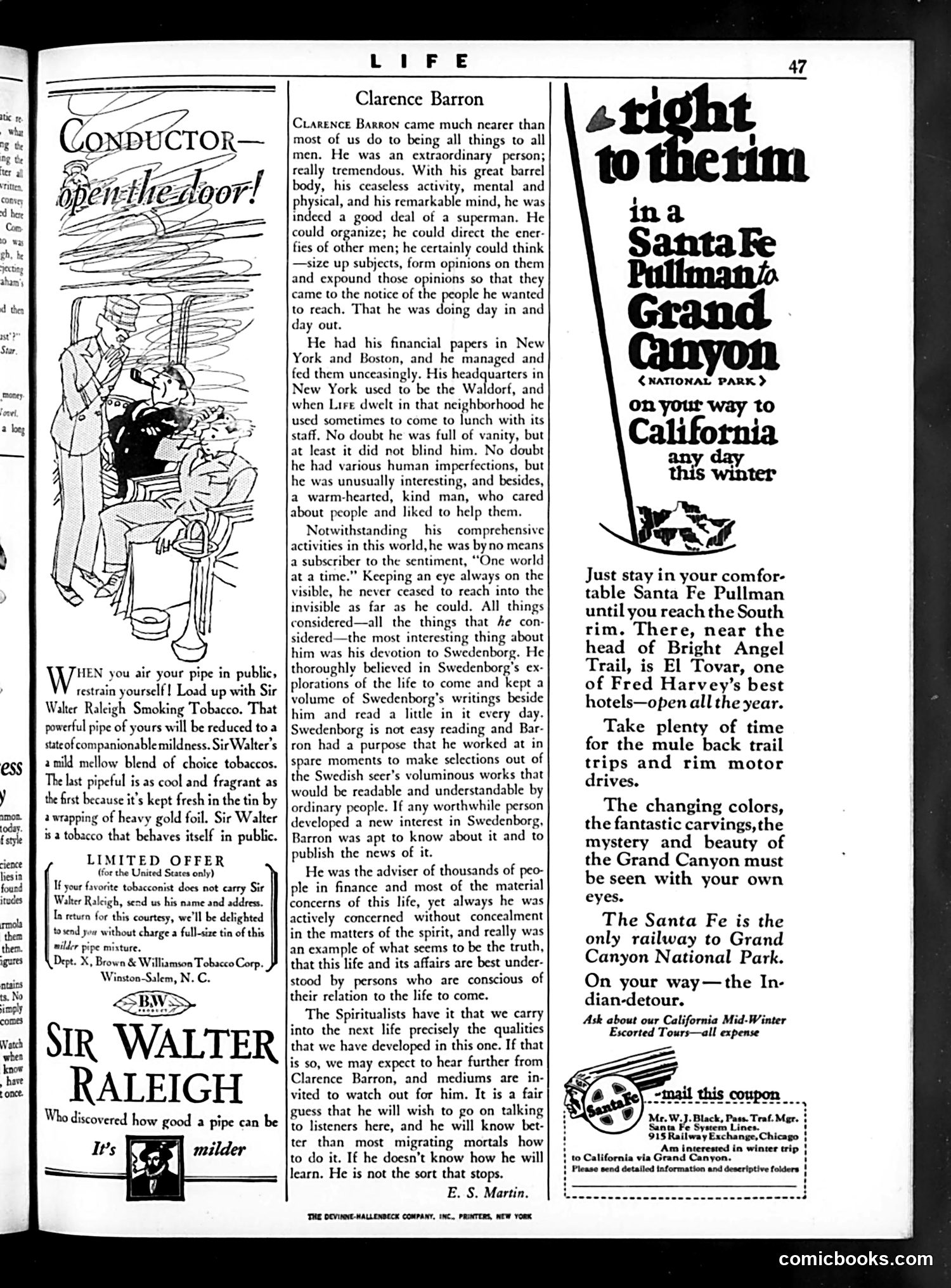
This page mixes editorial content with advertising. The main article (left and center) is a biographical tribute to **Clarence Barron**, a prominent financial newspaper publisher and advisor who recently died. The piece praises him as an unusually capable organizer and thinker who managed major financial publications in New York and Boston while maintaining deep spiritual interests—particularly his devotion to **Swedenborg**, an 18th-century mystic philosopher. The satire lies in the closing: the author humorously suggests that if Swedenborgianism is true (that souls carry their earthly qualities into the afterlife), Barron will likely continue "talking to listeners" from beyond the grave through mediums, and will probably figure out *how* to do it successfully. It's gentle mockery of both Barron's spiritual obsessions and spiritualist beliefs. The **"Conductor—open the door!"** cartoon (top left) and **Sir Walter Raleigh tobacco ad** are unrelated period advertising.
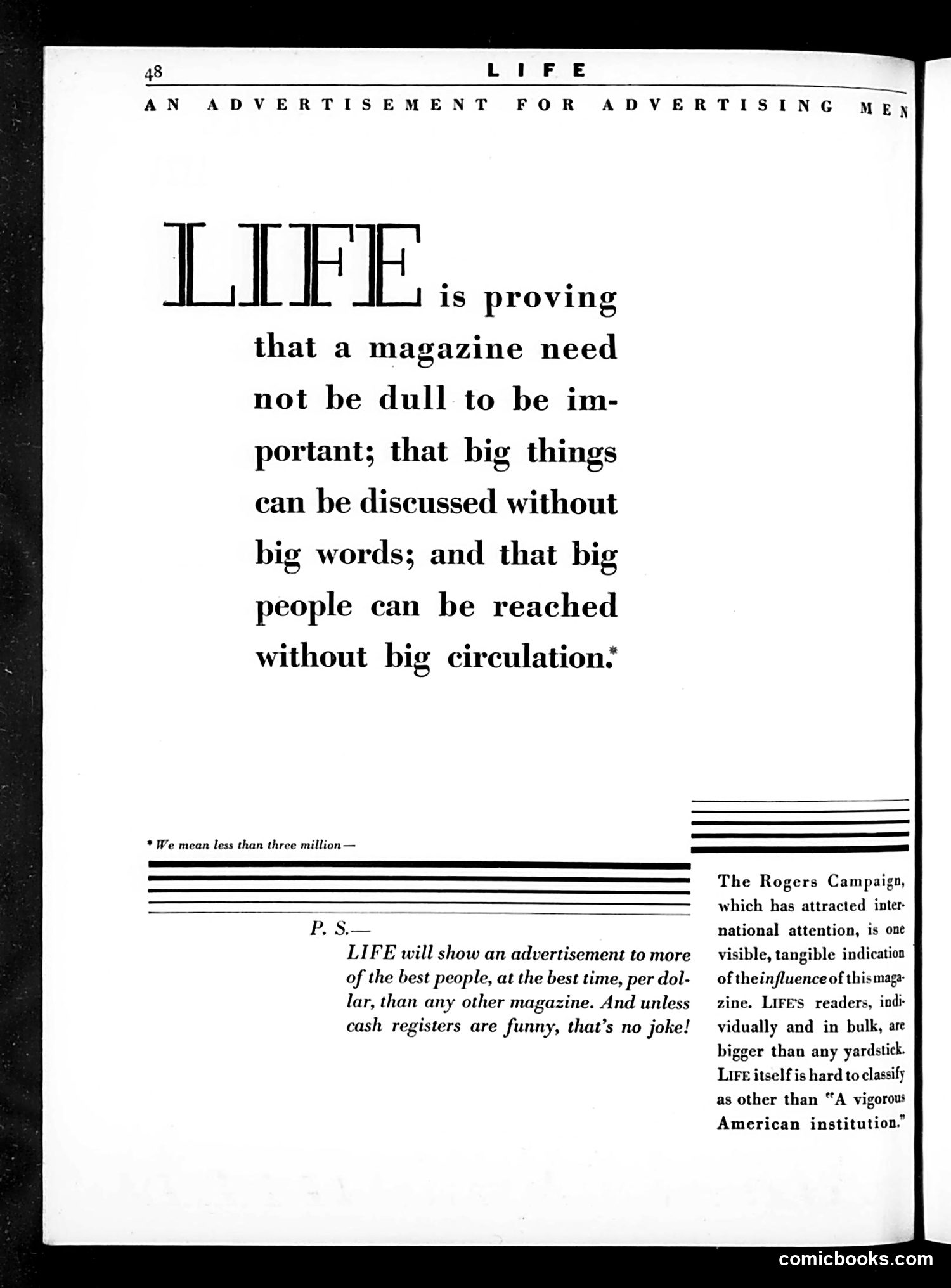
This is a **house advertisement** for *Life* magazine itself, targeting potential advertisers. The page makes no political satire; instead, it's a pitch to advertising professionals about *Life*'s value as an advertising medium. The key claims are: - *Life* reaches important people efficiently—"the best people, at the best time, per dollar" - The magazine proves a publication needn't have massive circulation to matter - It references "The Rogers Campaign" (likely a notable advertising success) as proof of *Life*'s influence - *Life*'s readers are individually influential and collectively significant—"bigger than any yardstick" - The final quip ("unless cash registers are funny, that's no joke!") uses humor to suggest advertising in *Life* generates actual sales The footnote "*We mean less than three million*" is self-deprecating humor: while three million readers seems large, *Life* positions quality over raw numbers. The advertisement essentially says: *Life* reaches influential audiences who matter to luxury or premium brands.
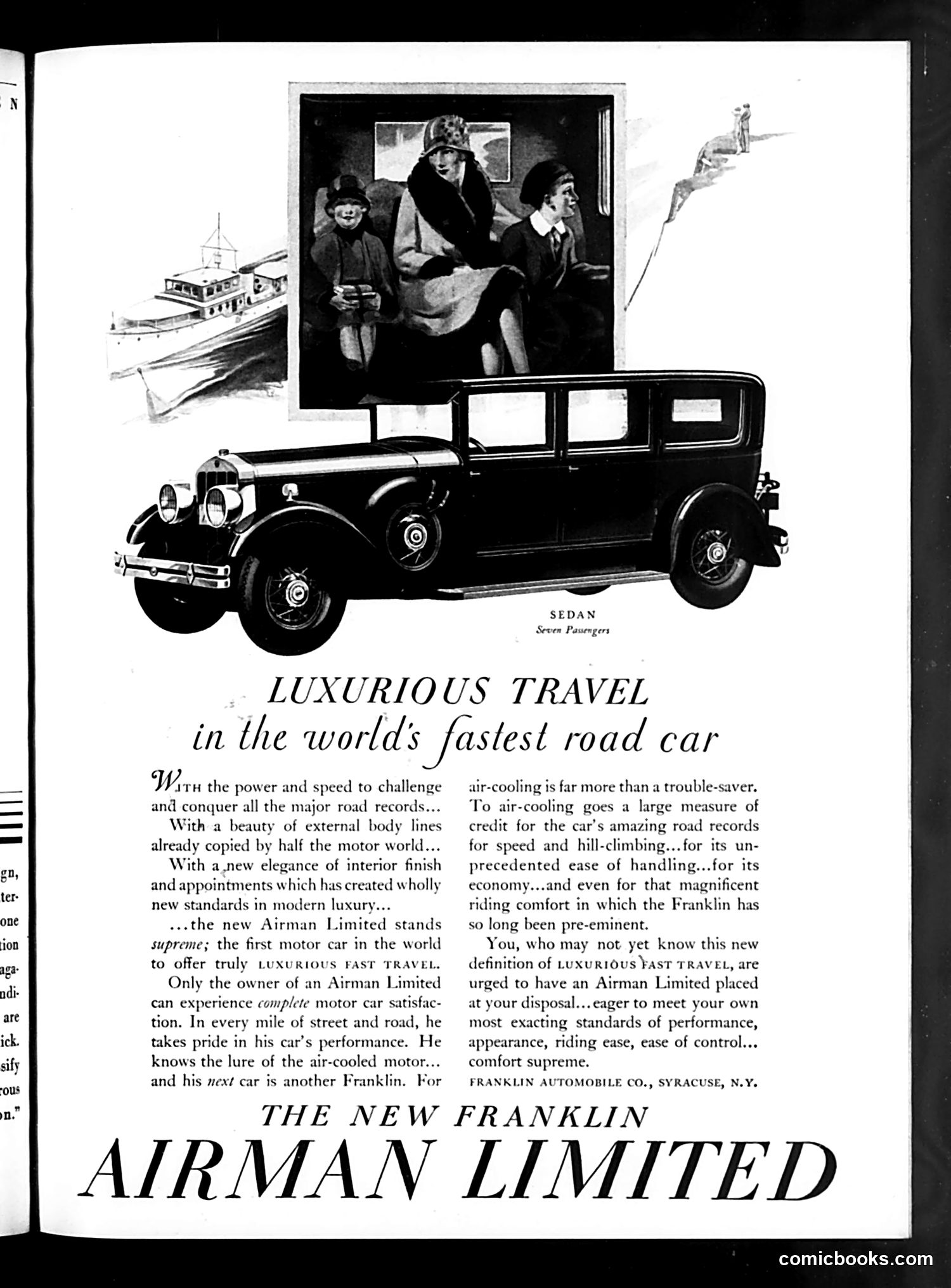
This is primarily a **car advertisement**, not political satire. It promotes the Franklin Airman Limited sedan, marketed as "the world's fastest road car." The page features a luxury automobile illustration alongside aspirational imagery: a well-dressed couple and well-groomed man in what appears to be a cabin or boat setting, suggesting wealth and leisure travel. The advertisement emphasizes the car's technical innovation (air-cooling system), speed, road records, and luxurious interior appointments. The text appeals to affluent buyers' pride in owning cutting-edge technology and superior performance. This reflects **1920s consumer culture**, when automobiles represented modernism, status, and personal achievement. The Franklin automobile company, based in Syracuse, New York, was a legitimate manufacturer known for air-cooled engines—a genuine technological distinction from competitors. There is **no apparent political satire or cartoon** on this page; it is straightforward promotional material typical of Life magazine's advertising content.
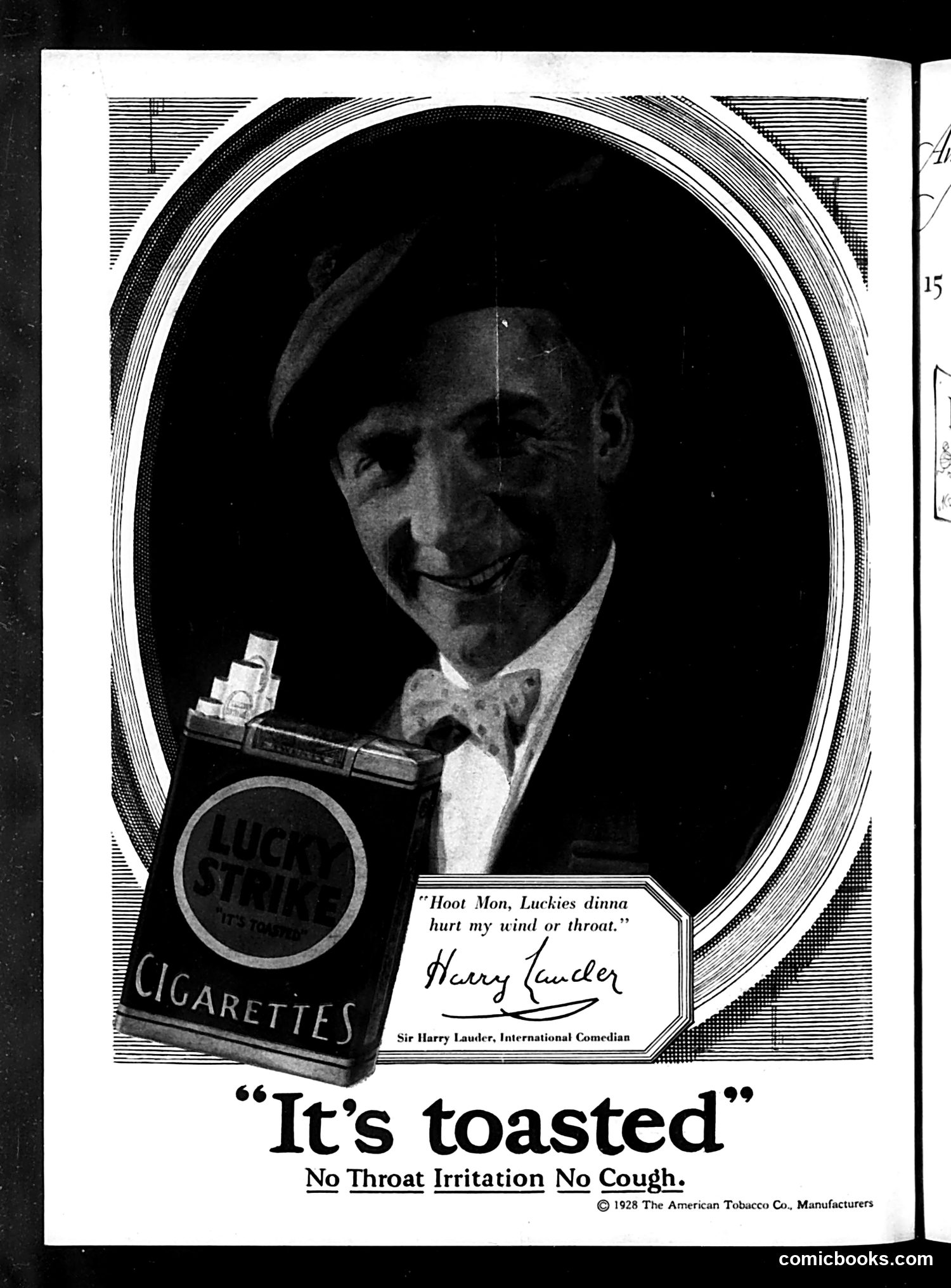
The page features Sir Harry Lauder, a famous Scottish music hall comedian of the early 20th century, endorsing Lucky Strike cigarettes. Lauder uses his characteristic Scottish dialect ("Hoot Mon, Luckies dinna hurt my wind or throat") to claim the cigarettes won't damage his vocal ability—crucial for a performer. The advertisement's central claim—"It's toasted" with "No Throat Irritation No Cough"—was Lucky Strike's signature marketing message in the 1920s, suggesting their toasting process made smoking safer. This reflects pre-FDA regulation advertising, when tobacco companies could make unsubstantiated health claims. The celebrity endorsement strategy was standard for cigarette marketing of this era.