
Life, 1928-11-09 · page 32 of 52
Life — November 9, 1928 — page 32: what you’re looking at
What you’re looking at
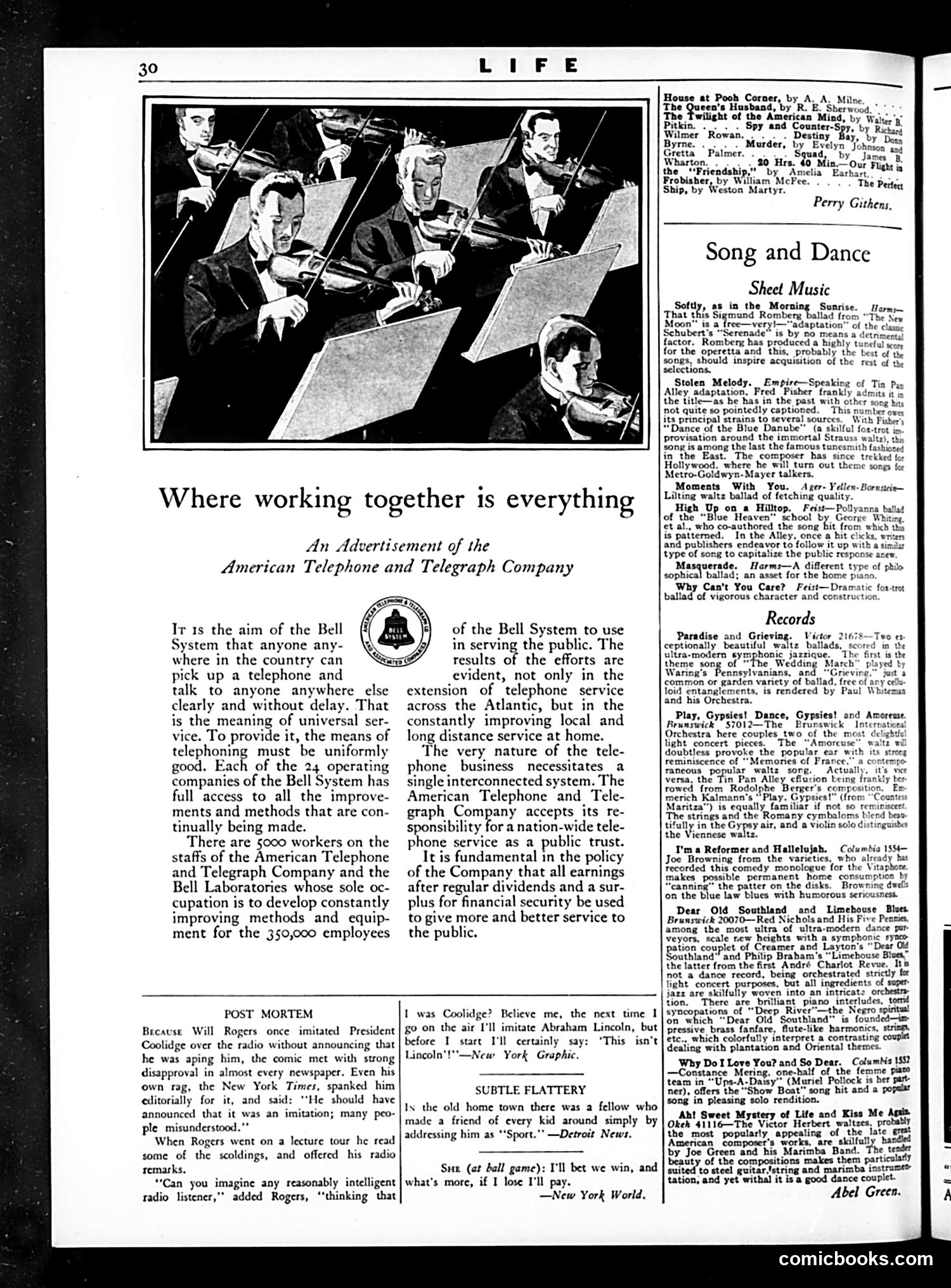
This page is primarily an **AT&T advertisement** touting the Bell System's infrastructure and service philosophy, accompanied by several unrelated shorter humor pieces and a "Song and Dance" (sheet music reviews) section. The main advertisement features an illustration of telephone operators at work, emphasizing that coordinated teamwork across the Bell System's 24 operating companies ensures reliable service nationwide. The copy stresses AT&T's commitment to universal service as a "public trust," with 5,000 workers dedicated to improving technology and methods for 350,000 employees. The humor section includes anecdotes about **Will Rogers' 1929 radio imitation of President Coolidge** (which caused controversy because listeners weren't told it was an imitation), with Rogers' wry response: if people couldn't tell the difference, why announce it? Other brief jokes involve childhood nicknames ("Sport") and betting at baseball games—all lighthearted Americana typical of Life magazine's satirical content from this era. The page reflects 1920s-era corporate messaging about technological progress and American business reliability.
📄 Transcribed text from this page (OCR, searchable)
Machine-transcribed from the original scan — historical spelling and the odd misread are preserved.
Where working together is everything An Advertisement of the American Telephone and Telegraph Company Ir 1s the aim of the Bell System that anyone any- where in the country can pick up a telephone and talk to anyone anywhere else clearly and without delay. That is the meaning of universal ser- vice. To provide it, the means of telephoning must be uniformly good. Each of the 24 operating companies of the Bell System has full access to all the improve- ments and methods that are con- tinually being made. There are 5000 workers on the staffs of the American Telephone and Telegraph Company and the Bell Laboratories whose sole oc- cupation is to develop constantly improving methods and equip- ment for the 350,000 employees POST MORTEM Because Will Rogers once imitated President Coolidge over the radio without announcing that he was aping him, the comic met with strong disapproval in almost every newspaper. Even his own rag, the New York Times, spanked him editorially for it, and said: ‘tHe should have announced that it was an imitation; many peo- ple misunderstood."* When Rogers went on a lecture tour he read some of the scoldings, and offered his radio remarks. “Can you imagine any reasonably intelligent radio listener," added Rogers, “thinking that of the Bell System to use in serving the public. The results of the efforts are evident, not only in the extension of telephone service across the Atlantic, but in the constantly improving local and long distance service at home. The very nature of the tele- phone business necessitates a single interconnected system. The American Telephone and Tele- graph Company accepts its re- sponsibility for a nation-wide tele- phone service as a public trust. It is fundamental in the policy of the Company that all earnings after regular dividends and a sur- plus for financial security be used to give more and better service to the public. I was Coolidge? Believe me, the next time I go on the air I'll imitate Abraham Lincoln, but before I start I'll certainly say: ‘This isn’t Lincoln'!"'—New York Graphic. SUBTLE FLATTERY Ix the old home town there was a fellow who made a friend of every kid around simply by addressing him as ‘*Sport."* —Detroit News. Sux (at ball game): I'll bet we win, and what's more, if I lose I'll pay —New York World. House at Pooh Corner, by A. A. Milne. The Hi by R. E. Sherwood. © The Twilig erican Mind, by W ar Spy and Counter-S; -. .. . Destiny Murder, by Evelyn Jt Se by. ton. 20 Hrs. 40 Mi the “Friendship,” by Amelia Frobisher, by William McPee. . Ship, by ter B y, by Reset ay, by Doss Byrne. Gretta Weston Martyr. Perry Githens, Song and Dance Sheet Music Soft in the Morning Sunrise. That the igmund Romberg ballad fr Moon” is a {ree—very!—"adaptation™ Schubert's “Serenade” is by no means a factor. Romberg has produced a highly tunclal sex for the operetta and this, probably the best of the songs, should inspire acquisition of the rest of the selections. Stolen Melody. Empire—Speaking of Tin Pas Alley adaptation, Fred Pisher frankly admits ita the title—as he has in the past with oth not quite so pointedly captioned. Thi: its principal strains to several sources “Dance of the Blue Danube" (a skilful fo provisation around the immortal Strauss walt: ‘song is among the last the famous tunesmith fash in the East. The composer has since trekked Hollywood, where he will turn out theme songs Metro-Goldwyn-Mayer talkers. Moments With You. Ager- Vellen- Bornstein Lilting waltz ballad of fetching quality. High Up on @ Hilltop. Feist—Pollyanna ballad of the “Blue Heaven" school by Georre Wb et al., who co-authored the song hit from whi is patterned. In the Alley. once a hit clicks, writen and publishers endeavor to follow it up with a type of song to capitalize the public response a: Masquerade. Harms—A different type of philo sophical ballad; an asset for the home piano. Why Can't You Care? Feist—Dramatic for-trt ballad of vigorous character and construction. Records Paradise and Grieving. Victor 21678—Two ex ceptionally beautiful waltz ballads, scored in the ultra-modern symphonic jazzique. “The first is the theme song of “The Wedding March” pl Waring’s Pennsylvanians, and “Grieving common or garden variety of ballad, free of ary cell loid entanglements, is rendered by Paul Whitemaa and his Orchestra. Harm: The New Play, Gypsies! Dance, Gypsies! and Amoresse. Brut ick $7012—The Brunswick Internatioral Orchestra here couples two of the most light concert pieces, The “Amoreuse” w doubtless provoke the popular ear wi reminiscence of "Memories of France,” a contempe raneous popular waltz sorg. Actually, it’s wee versa, the Tin Pan Alley efiusion being {ran rowed from Rodolphe Berger's composition. merich Kalmann’s “Play. Gypsies!” (from “Co Maritza") is equally familiar if not so reminiscert The strings and the Romany cymbaloms blend bese tifully in the Gypsy air, and a violin solo distinguishes the Viennese waltz. I'ma Reformer and Hallelujah. Columbia 1SS— Joe Browning from the varieties. who already bas Tecorded this comedy monologue for the Vitaphote makes possible permanent home consumption by “canning” the patter on the disks. Browning deels on the blue law blues with humorous seriousness. Dear Old Southland and Limehouse Blses Brunswick 20070—Red Nichols and His Five among the most ultra of ultra-modern dance per veyors, scale new heights with a symphonic sypco- tion ‘couplet of Creamer and Layton’s “Dear Ol Southland’rand Philip Braham's “Limehouse Bloes’ the latter from the first André Charlot Revue, Itis not a dance record, being orchestrated strictly fer light concert purposes, but all ingredients of super jazz are skilfully woven into an intricate orchestre- tion. There are brilliant piano interludes, tomd syncopations of “Deep River”—the Negro spiritual on which “Dear Old Southland” is founded—ie pressive brass fanfare, flute-like harmonics, string, ete., which colorf terpret a contrasting couplet dealing with plantation and Oriental themes. Why DoI Love You? and So Dear. Columbia 158? —Constance Mering. one-half of the femme pist team in “Ups-A-Daisy” (Muriel Pollock is her part: ner), offers the “Show Boat” song hit and a popalsr song in pleasing solo rendition. Ah! Sweet Mystery of Life and Kiss Me Ags Okeh 41116—The Victor Herbert waltzes, probably the most popularly appealing of the late grest American composer's works, are, skilfully handled by Joe Green and his Marimba Band. ‘he tender beauty of the compositions makes them particslaty suited to steel guitar,'string and marimba instrame? tation, and yet withal it is a good dance couplet Abel Green. 2 wil s stroeg, comicbooks.com