
Life, 1928-11-09 · page 20 of 52
Life — November 9, 1928 — page 20: what you’re looking at
What you’re looking at
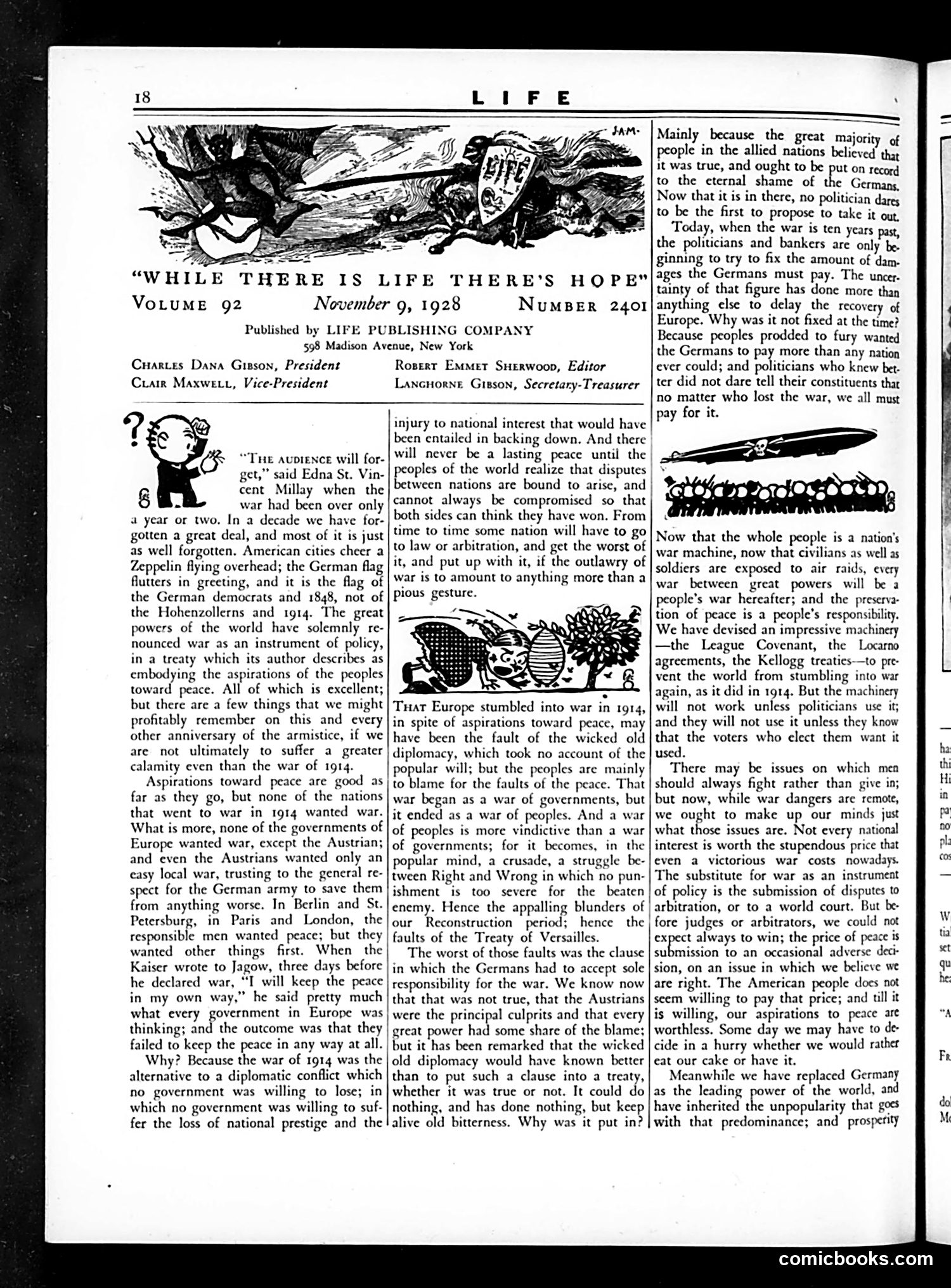
This *Life* magazine editorial argues that despite good intentions toward peace—symbolized by nations renouncing war and Germany's democratic flag now flying instead of imperial symbols—the world remains vulnerable to another catastrophic conflict. The author warns that WWI occurred not because nations *wanted* war, but because governments prioritized national prestige and refused diplomatic compromise. The key insight: peoples, not just governments, perpetuated the war's vindictiveness, leading to punitive peace terms like Germany's sole war-guilt clause in the Treaty of Versailles. The satirical point: the 1928 peace machinery (League of Covenant, Kellogg agreements) won't prevent future war unless ordinary citizens demand their leaders accept occasional diplomatic losses rather than fight for "honor." The cartoons' specific subjects are unclear from the image, but the text criticizes both old diplomacy and popular nationalism as enduring threats to lasting peace.
📄 Transcribed text from this page (OCR, searchable)
Machine-transcribed from the original scan — historical spelling and the odd misread are preserved.
“WHILE VoLUME 92 THERE IS LIFE THERE'S HOPE” November 9, 1928 NuMBER 2401 Published by LIFE PUBLISHING COMPANY 598 Madison Avenue, New York Cuarces Dana Greson, President Cairn Maxwett, Vice-President OF “Tue avotence will for- get,” said Edna St. Vin- g cent Millay when the - war had been over only a year or two. In a decade we have for- gotten a great deal, and most of it is just as well forgotten. American cities cheer a Zeppelin flying overhead; the German flag flutters in greeting, and it is the flag of the German democrats and 1848, not of the Hohenzollerns and 1914. The great powers of the world have solemnly re- nounced war as an instrument of policy, in a treaty which its author describes as embodying the aspirations of the peoples toward peace. All of which is excellent; but there are a few things that we might profitably remember on this and every other anniversary of the armistice, if we are not ultimately to suffer a greater calamity even than the war of 1914. Aspirations toward peace are good as far as they go, but none of the nations that went to war in 1914 wanted war. What is more, none of the governments of Europe wanted war, except the Austrian; and even the Austrians wanted only an easy local war, trusting to the general re- spect for the German army to save them from anything worse. In Berlin and St. Petersburg, in Paris and London, the responsible men wanted peace; but they wanted other things first. When the Kaiser wrote to Jagow, three days before he declared war, “I will keep the peace in my own way,” he said pretty much what every government in Europe was thinking; and the outcome was that they failed to keep the peace in any way at all. Why? Because the war of 1914 was the alternative to a diplomatic conflict which no government was willing to lose; in which no government was willing to suf- fer the loss of national prestige and the Rosert Emmet Suerwoop, Editor Lancuorne Gisson, Secretary-Treasurer injury to national interest that would have been entailed in backing down. And there will never be a lasting peace until the peoples of the world realize that disputes between nations are bound to arise, and | cannot always be compromised so that both sides can think they have won. From time to time some nation will have to go to law or arbitration, and get the worst of it, and put up with it, if the outlawry of war is to amount to anything more than a pious gesture. : Tuar Europe stumbled into war in 1914, in spite of aspirations toward peace, may have been the fault of the wicked old diplomacy, which took no account of the popular will; but the peoples are mainly to blame for the faults of the peace. That war began as a war of governments, but it ended as a war of peoples. And a war of peoples is more vindictive than a war of governments; for it becomes, in the popular mind, a crusade, a struggle be- tween Right and Wrong in which no pun- ishment is too severe for the beaten enemy. Hence the appalling blunders of our Reconstruction period; hence the faults of the Treaty of Versailles. The worst of those faults was the clause in which the Germans had to accept sole responsibility for the war. We know now that that was not true, that the Austrians were the principal culprits and that every great power had some share of the blame; but it has been remarked that the wicked old diplomacy would have known better than to put such a clause into a treaty, whether it was true or not. It could do nothing, and has done nothing, but keep alive old bitterness. Why was it put in? Mainly because the great Majority of people in the allied nations believed that it was true, and ought to be put on record to the eternal shame of the Germans, Now that it is in there, no politician dares to be the first to propose to take it out, Today, when the war is ten years past, the politicians and bankers are only be- ginning to try to fix the amount of dam- ages the Germans must pay. The uncer. tainty of that figure has done more than anything else to delay the recovery of Europe. Why was it not fixed at the time? Because peoples prodded to fury wanted the Germans to pay more than any nation ever could; and politicians who knew bet- ter did not dare tell their constituents that no matter who lost the war, we all must pay for it. a f Now that the whole people is a nation’s war machine, now that civilians as well as soldiers are exposed to air raids, every war between great powers will be a people’s war hereafter; and the preserva- tion of peace is a people’s responsibility. We have devised an impressive machinery —the League Covenant, the Locarno agreements, the Kellogg treaties—to pre- vent the world from stumbling into war again, as it did in 1914. But the machinery will not work unless politicians use it; and they will not use it unless they know that the voters who elect them want it used. There may be issues on which men should always fight rather than give in; but now, while war dangers are remote, we ought to make up our minds just what those issues are. Not every national interest is worth the stupendous price that even a victorious war costs nowadays. The substitute for war as an instrument of policy is the submission of disputes to arbitration, or to a world court. But be- fore judges or arbitrators, we could not expect always to win; the price of peace is sabenission to an occasional adverse deci- sion, on an issue in which we believe we are right. The American people does not seem willing to pay that price; and till it is willing, our aspirations to peace are worthless. Some day we may have to de- cide in a hurry whether we would rather eat our cake or have it. Meanwhile we have replaced Germany as the leading power of the world, and have inherited the unpopularity that gocs with that predominance; and prosperity comicbooks.com W Pre > 5