
Life, 1928-11-09 · page 19 of 52
Life — November 9, 1928 — page 19: what you’re looking at
What you’re looking at
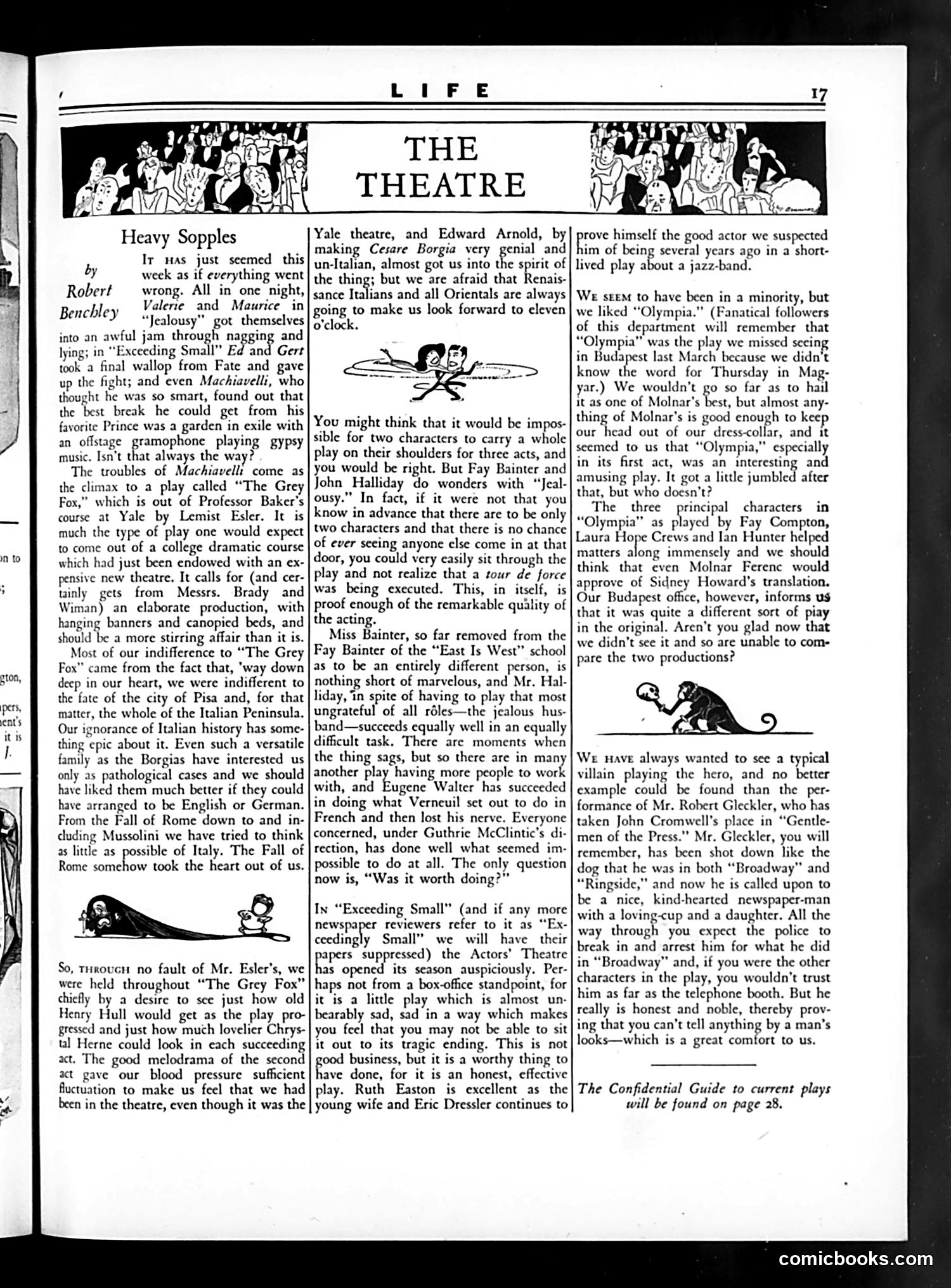
This is a theatre review column by Robert Benchley from Life magazine's arts section. The page discusses several Broadway productions, including "The Grey Fox" and "Exceeding Small." The small cartoons appear to be decorative flourishes typical of Life's satirical style—one shows figures in formal dress, another depicts what looks like a reclining figure. These aren't political cartoons but rather illustrative doodles accompanying theatre criticism. The column's satire is theatrical rather than political: Benchley humorously critiques acting performances, directorial choices, and production quality. He pokes fun at performers' limitations and notes when plays fail to justify their premises—standard arts criticism presented with wit rather than political commentary.
📄 Transcribed text from this page (OCR, searchable)
Machine-transcribed from the original scan — historical spelling and the odd misread are preserved.
Heavy Sopples Ir Has just seemed this week as if everything went wrong. All in one night, Valerie and Maurice in “Jealousy” got themselves into an awful jam through naggin and lying; in “Exceeding Small” Ed and Gert took a final wallop from Fate and gave up the fight; and even Machiavelli, who thought he was so smart, found out that the best break he could get from his favorite Prince was a garden in exile with an offstage gramophone playing gypsy music. Isn't that always the wat The troubles of Machiavelli come as the climax to a play called “The Grey Fox,” which is out of Professor Baker's course at Yale by Lemist Esler. It is much the type of play one would expect to come out of a college dramatic course which had just been endowed with an ex- pensive new theatre. It calls for (and cer- tainly gets from Messrs. Brady and Wiman) an elaborate production, with hanging banners and canopied beds, and should be a more stirring affair than it is. Most of our indifference to “The Grey Fox” came from the fact that, way down deep in our heart, we were indifferent to the fate of the city of Pisa and, for that matter, the whole of the Italian Peninsula. Our ignorance of Italian history has some- thing epic about it. Even such a versatile family as the Borgias have interested us only as pathological cases and we should have liked them much better if they could have arranged to be English or German. From the Fall of Rome down to and in- duding Mussolini we have tried to think as little as possible of Italy. The Fall of Rome soniehoW took the heart out of us. > ae So, tHroucn no fault of Mr. Esler’s, we were held throughout “The Grey Fox” chiefly by a desire to sce just how old Henry Hull would get as the play _pro- gressed and just how much lovelier Chrys- tal Herne could look in each succeeding act, The good melodrama of the second act gave our blood pressure sufficient fluctuation to make us feel that we had been in the theatre, even though it was the by Robert Benchley Yale theatre, and Edward Arnold, by making Cesare Borgia very ae and un-Italian, almost got us into the spirit of the thing; but we are afraid that Renais- sance Italians and all Orientals are always going to make us look forward to eleven o'clock. You might think that it would be impos- sible for two characters to carry a whole play on their shoulders for three acts, and you would be right. But Fay Bainter and John Halliday do wonders with “Jeal- ousy.” In fact, if it were not that you know in advance that there are to be only two characters and that there is no chance of ever seeing anyone else come in at that door, you could very casily sit through the play and not realize that a tour de force was being executed. This, in itself, is proof enough of the remarkable quality of the acting. Miss Bainter, so far removed from the Fay Bainter of the “East Is West” school as to be an entirely different person, is nothing short of marvelous, and Mr. Hal- liday, ‘in spite of having to play that most ungrateful of all réles—the jealous hus- band—succeeds equally well in an equally difficult task, There are moments when the thing sags, but so there are in many another play having more people to work with, and Eugene Walter has succeeded in doing what Verneuil set out to do in French and then lost his nerve. Everyone concerned, under Guthrie McClintic’s di- rection, has done well what seemed im- possible to do at all. The only question now is, “Was it worth doing?” In “Exceeding Small" (and if any more newspaper reviewers refer to it as “Ex- ceedingly Small” we will have their pees suppressed) the Actors’ Theatre as opened its season auspiciously. Per- haps not from a box-office standpoint, for it is a little play which is almost un- bearably sad, sad in a way which makes you feel that you may not be able to sit it out to its tragic ending. This is not ood business, but it is a worthy thing to ave done, for it is an honest, effective play. Ruth Easton is excellent as the young wife and Eric Dressler continues to prove himself the good actor we suspected im of being several years ago in a short- lived play about a jazz-band. We stem to have been in a minority, but we liked “Olympia.” (Fanatical followers of this department will remember that “Olympia” was the play we missed seein; in Budapest last March because we didn’t know the word for Thursday in Mag- yar.) We wouldn't go so far as to hail it as one of Molnar’s i but almost any- thing of Molnar’s is good enough to keep our head out of our dress-collar, and it seemed to us that “Olympia,” especially in its first act, was an interesting and amusing play. It got a little jumbled after that, but who doesn’t? The three principal characters in “Olympia” as played by Fay Compton, Laura Hope Crews and Ian Hunter helped matters along immensely and we should think that even Molnar Ferenc would approve of Sidney Howard's translation, Our Budapest office, however, informs us that it was quite a different sort of piay in the original. Aren’t you glad now that we didn’t see it and so are unable to com- pare the two productions? We nave always wanted to see a typical villain playing the hero, and no better example could be found than the per- formance of Mr. Robert Gleckler, who has taken John Cromwell's place in “Gentle- men of the Press.” Mr. Gleckler, you will remember, has been shot down like the dog that he was in both “Broadway” and “Ringside,” and now he is called upon to be a nice, kind-hearted newspaper-man with a loving-cup and a daughter. All the way through you expect the police to break in and arrest him for what he did in “Broadway” and, if you were the other characters in the play, you wouldn't trust him as far as the telephone booth. But he really is honest and noble, thereby prov- ing that you can’t tell anything by a man’s looks—which is a great comfort to us. The Confidential Guide to current plays will be found on page 28. comicbooks.com