
Life, 1928-11-09 · page 43 of 52
Life — November 9, 1928 — page 43: what you’re looking at
What you’re looking at
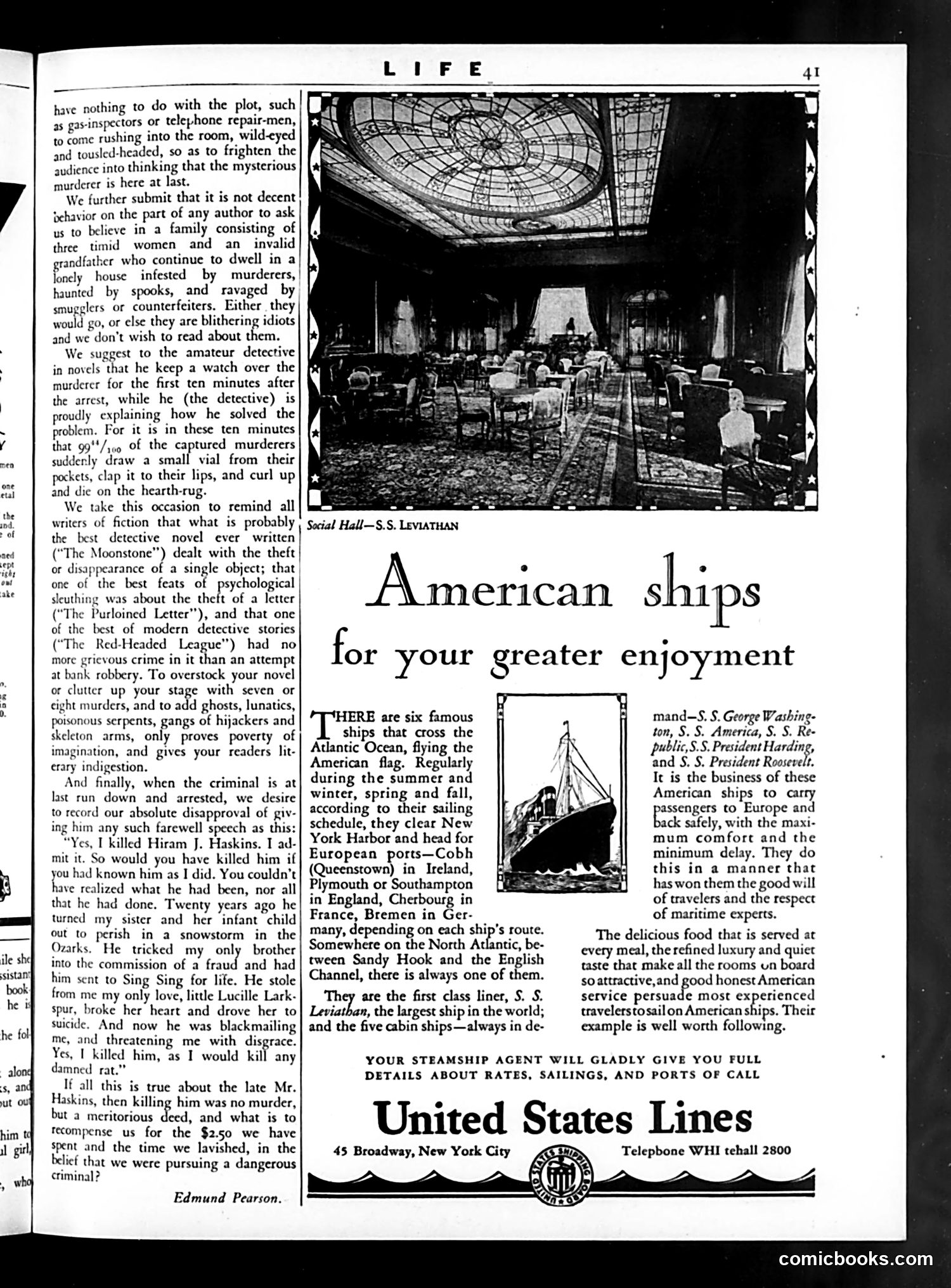
This page contains literary criticism and advertising, not political cartoons. **The Editorial Critique (left column):** Edmund Pearson satirizes melodramatic detective fiction conventions of the era. He ridicules overwrought mystery plots featuring incompetent families, excessive murders, ghosts, and poisoned protagonists who deliver lengthy confessional monologues justifying their crimes. Pearson argues such stories insult readers' intelligence and waste their money. He contrasts this with genuinely clever detective literature like *The Moonstone* and *The Purloined Letter*, which solve crimes based on single, plausible mysteries rather than sensational accumulation of horrors. **The Advertisement (right column):** United States Lines promotes six American ocean liners—the S.S. Leviathan (world's largest ship) and five cabin ships—crossing the Atlantic to European ports. The ad emphasizes comfortable first-class service, fine dining, and maritime professionalism to attract transatlantic travelers. Both sections represent typical Life magazine content from this period: sophisticated cultural commentary paired with luxury consumer advertising.
📄 Transcribed text from this page (OCR, searchable)
Machine-transcribed from the original scan — historical spelling and the odd misread are preserved.
have nothing to do with the plot, such as gas-inspectors or telephone repair-men, to come rushing into the room, wild-eyed and tousled-headed, so as to frighten the audience into thinking that the mysterious murderer is here at last. We further submit that it is not decent behavior on the part of any author to ask us to believe in a family consisting of three timid women and an_ invalid grandfather who continue to dwell in a Jonely house infested by murderers, haunted by spooks, and ravaged by smugglers or counterfeiters. Either they would go, or else they are blithering idiots and we don’t wish to read about them. We suggest to the amateur detective in novels that he keep a watch over the murderer for the first ten minutes after the arrest, while he (the detective) is proudly explaining how he solved the problem. For it is in these ten minutes that 99"'/,,9 of the captured murderers suddenly draw a small vial from their pockets, clap it to their lips, and curl up and die on the hearth-rug. We take this occasion to remind all writers of fiction that what is probably the best detective novel ever written (“The Moonstone”) dealt with the theft or disappearance of a single object; that one of the best feats of psychological sleuthing was about the thelt of a letter (“The Purloined Letter”), and that one of the best of modern detective stories (‘The Red-Headed League”) had no more grievous crime in it than an attempt at bank robbery. To overstock your novel or clutter up your stage with seven or cight murders, and to add ghosts, lunatics, poisonous serpents, gangs of hijackers and skeleton arms, only proves poverty of imagination, and gives your readers lit- erary indigestion. And finally, when the criminal is at last run down and arrested, we desire to record our absolute disapproval of giv- ing him any such farewell speech as this: “Yes, I killed Hiram J. Haskins. I ad- mit it. So would you have killed him if you had known him as I did. You couldn't have realized what he had been, nor all that he had done. Twenty years ago he turned my sister and her infant child out to perish in a snowstorm in the Ozarks, He tricked my only brother into the commission of a fraud and had him sent to Sing Sing for life. He stole from me my only love, little Lucille Lark- spur, broke her heart and drove her to suicide. And now he was blackmailing me, and threatening me with disgrace. Yes, I killed him, as I would kill any damned rat.” If all this is true about the late Mr. Haskins, then killing him was no murder, but a meritorious deed, and what is to fecompense us for the $2.50 we have Spent and the time we lavished, in the belief that we were pursuing a dangerous criminal ? Edmund Pearson. Social Hall—S.S. LevIATHAN American ships for your greater ls Tae are six famous ff ships that cross the Adantic Ocean, flying the American flag. Regularly during the summer and winter, spring and fall, according to their sailing schedule, they clear New York Harbor and head for European ports—Cobh (Queenstown) in Ireland, Plymouth or Southampton in England, Cherbourg in France, Bremen in Ger- many, depending on each ship's route. Somewhere on the North Atlantic, be- tween Sandy Hook and the English Channel, there is always one of them. They are the first class liner, S. S. Leviathan, the largest ship in the world; and the five cabin ships—always in de- enj oyment mand-S. S. George Washing- ton, S. S. America, S. S. Re- public,S.S. President Harding, and S. S. President Roosevelt. Ic is the business of these American ships to carry assengers to Europe and Back safely, with the maxi- mum comfort and the minimum delay. They do this in a manner that has won them the good will of travelers and the respect of maritime experts. The delicious food that is served at every meal, the refined luxury and quiet taste that make all the rooms un board soattractive,and good honest American service persuade most experienced travelerstosail on American ships. Their example is well worth following. YOUR STEAMSHIP AGENT WILL GLADLY GIVE YOU FULL DETAILS ABOUT RATES, SAILINGS, AND PORTS OF CALL United States Lines 45 Broadway, New York City comicbooks.com