
Life, 1928-11-09 · page 30 of 52
Life — November 9, 1928 — page 30: what you’re looking at
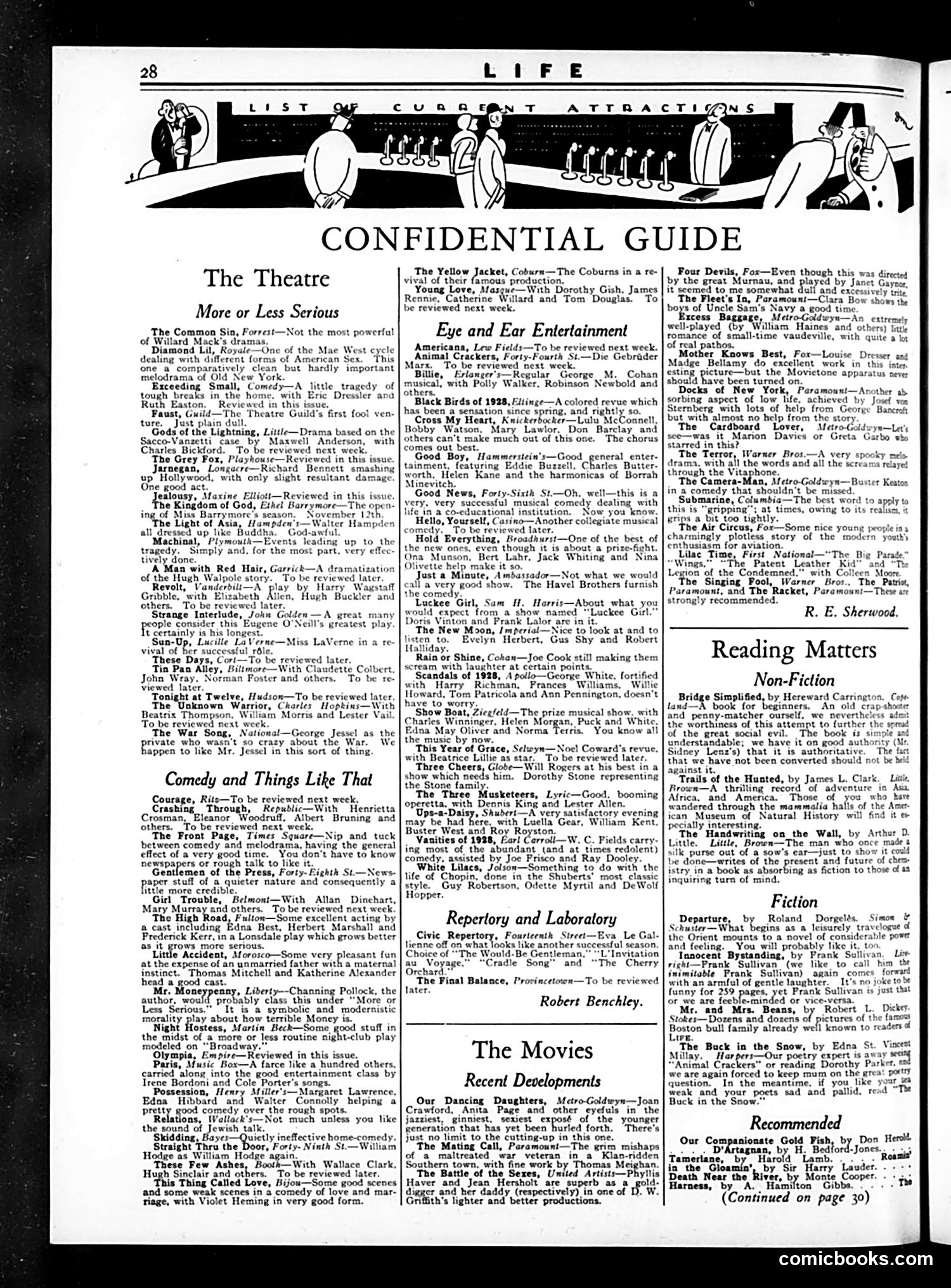
What you’re looking at
This page is a **theatre and movie review guide**, not a political cartoon. It's a "Confidential Guide" listing current Broadway productions and films with brief critical assessments—a regular feature helping readers decide what entertainment to see. The page reflects **1928 theatrical trends**: mentions of Mae West's "Diamond Lil" (risqué comedy), Eugene O'Neill's "Strange Interlude" (experimental drama), and the Sacco-Vanzetti case adaptation "Gods of the Lightning" (topical social drama). Notable is the prevalence of **literary adaptations and serious theatrical work** alongside lighter fare. The decorative header illustrates typical theatre-goers in evening dress, establishing this as entertainment coverage for a sophisticated urban audience. This represents Life magazine's role as a **cultural arbiter for middle and upper-class readers**, curating which shows were worth their time and money.
📄 Transcribed text from this page (OCR, searchable)
Machine-transcribed from the original scan — historical spelling and the odd misread are preserved.
CONFIDENTIAL GUIDE The Theatre More or Less Serious The Common Sin, Forrest—Not the most powerful of Willard Mack's dramas. Diamond Lil, Royale—One of the Mae West cycle dealing with different forms of American § his one a comparatively clean but hardly important melodrama of Old New York. Exceeding Small, Comedy—A tough breaks in the home, with E Ruth Easton, Reviewed in this issu Faust, Guild—The Theatre Guild’s first foo! ven- ture. Just plain dull. Gods of the Lightning, Little—Drama based on the Sacco-Vanzetti case by Maxwell Anderson, with Charles Bickford. To be reviewed next week. The Grey For, Playhouse—Reviewed in this issue. Jarnegan, Longacre—Richard Bennett smashing up Hollywood, with only slight resultant damage One good act. Jealousy, Maxine F tle tragedy of Dressler and —Reviewed in this issue. e Kingdom of God, Ethel Barrymore—The open: ing of Miss Barrymore's season, November | The Light of Asia, Hampden's— Walter Ham all dressed up like Buddh al. Machinal, Plymouth— s lead tragedy. Simply and, for the most part, tively done. A Man with Red Hai of the Hugh Walpole Revolt, Vand Gnibble, ‘with Gerrich— A dr: T - Strange Interlude, John Golden — A great le consider this ne O'Neill's greatest t certainly is his long Sun-Up, Lucille LaVerne—Miss LaVerne in a re- vival of her successful rdle, These Days, Cori—To be reviewed later Tin Pan Alley, Biltmore—With Claudette Colbert, John Wray, Norman Foster and others. To be re: Viewed later. Tonight at Twelve, Hudson—To be reviewed later. The Unknown Warrior, Charles Hopkins—With Beatrix Thompson, William Morris and Lester Vail. To be reviewed next week The War Song, National—George Jessel as the private who wasn't so crazy about the War. We happen to like Mr. Jessel in this sort of thing Comedy and Things Like That Courage, Rite—To be reviewed next week. Crashing Through, Repudlic—With Henrietta Crosman, Eleanor Woodruff, Albert Bruning and others. To be reviewed next week. The Front Page, Times Square—Nip and tuck between comedy and melodrama, having the general effect of a very good time. You don’t have to know newspapers or rough talk to like Gentlemen of the Press, Forty- Eighth St—News- paper stufl of a quieter nature and consequently a ttle more credible. Girl Trouble, Belmont—With Allan Dinch Mary Murray and others. To be reviewed next week oad, Fulton—Some excellent acting by a cast including Edna Best, Herbert Marshall and Frederick Kerr, in a Lonsdale play which grows better as it rows more serious. Little Accident, Morosco—Some very pleasant fun at the expense of an unmarried father with a maternal instinct. Thomas Mitchell and Katherine Alexander head a good cast. : Mr. Moneypenny, Liberty—-Channing Pollock, the author, would probably class this under “More or Less Serious.” It is a symbolic and modernistic morality play about how terrible Money is. Night Hostess, Martin Beck—Some good stuff in the midst of a more or less routine night-club play modeled on “Broadway. Oly mpi e—Reviewed in this issue. Paris, 3 jox—A farce like a hundred others, carried ‘along into the good entertainment class by Irene Bordoni and Cole Porter's songs. Possession, Henry Miller's—Margaret Lawrence Edna Hibbard and Walter Connolly helping a Pretty good comedy over the rough spots. Relations, IVellack’s—Not much unless you like the sound of Jewish talk. Skidding, Bayes—Quietly ineffecti or, Forty- Ninth St. iam Hodge’ again Few Ashes —With Wallace Clark, Hogh Sinelut and others To be reviewed later: ‘This Thing Called Love, Bijou—Some good scenes and some weak scenes in a comedy of love and mar- riage, with Violet Heming in very good form. The Yellow Jacket, Coburn—The Coburns in a re- vival of their famous production. Young Love, Masque—With Dorothy Gish, James Rennie, Catherine Willard and Tom Douglas. To be reviewed next week. Eye and Ear Entertainment Americana, Lew Fields—To be reviewed next week. Animal Crackers, Forty-Fourth St.—Die Gebrader Marx. To be reviewed next week. Billie, Erlanger's—Regular George M. Cohan musical, with Polly Walker, Robinson Newbold and others. Black Birds of 1928, Fl!inge—A colored revue which has been a sensation since spring, and rightly so. Cross My Heart, Knickerbocker—Lulu McConnell, Bobby Watson, Mary Lawlor, Don Barclay and others can't make much out of this one. The chorus comes out best. Good Boy, Hammerstein's—Good general_enter- tainment, featuring Buzzell, Charles Butter- worth, Helen Kane and the harmonicas of Borrah Minevitch. Good News, Forty-Sixth St.—Oh, well—this is a very, very successful musical comedy dealing with life in a co-educational institution. Now you know. Hello, Yourself, Casino—Another collegiate musical comedy. To be reviewed later. Hold Everything, Broadhurst—One of the best of the new ones, even though it is about a prize-fight. Ona Munson, Bert Lahr, Jack Whiting and Nina Olivette help make it $0. Just a Minute, Ambassador—Not what we would call a very good show. The Havel Brothers furnish the comedy. Luckee Girl, Sam I. Harris—About what you would expect from a “Luckee Girl.” Doris Vistow and Prank bstor are ia i The New Moon, Imperial—Nice to look at and to listen to. Evelyn Herbert, Gus Shy and Robert Halliday. Rain or Shine, Cohan—Joe Cook scream with lau Cook still making them ter at certain points. Scandals of 1928, A pollo—George White, fortific with Harry Richman, Frances. Williams, Wil Howard, Tom Patricola and Ann Pennington, doesn't have to worry. Show Boat, Zice/eld—The prize musical show. with Charles Winsinger, Helen Morgan, Puck and White. Edna May Oliver and Norma Terris. You know ali the music by now. This Year of Grace, Selixyn—Noel Coward's revue, with Beatrice Lillie as star. To be reviewed later. Three Cheers, Globe—Will Rogers at his best in a show which needs him. Dorothy Stone representing the Stone famil The Three Musketeers, Lyric—Good, booming operetta, with Dennis King and Lester Alien. Ups-a-Daisy, Shuberi—A very satisfactory evening may be had here, with Luella Gear, William Kent. Buster West and Roy Royston. Vanities of 1928, Far! Carroli—W. C. Pields carry- ing most of the abundant (and at times redolent) comedy, assisted by Joe Prisco and Ray Dooley. White Lilacs, Jolion—Something to do with the life of Chopin,’ done in the Shuberts’ most classic tiyle. Guy Robertson, 0 Myrtil and DeWolf lopper. Repertory and Laboratory Civie Repertory, Fourteenth Street—Eva Le Gal- lienne off what) looks like another sui sful season. Choice of uuld-Be Gentleman, “Invitation au Voyage. Cradle Song” and “The Cherry Orchard. The Final Balance, Provincetoron—To be reviewed later. Robert Benchley. The Movies Recent Developments Our Dancing Daughters, Metro-Goldwyn—Joan Crawford, Anita Page and other eyefuls in the jazziest, ginniest, sexiest exposé of the younger generation that has yet been hurled forth. There's just no limit to the cutting-up in this one. The Mating Call, Paramount—The grim mishaps of a maltreated war veteran in a Klan-ridden Southern town, with fine work by Thomas Meigha ttle of the Sexes, United Artists—Phyllis er and Jean Hersholt’ are superb as a gold- slayer and her daddy (respectively) in one of th’s lighter and better productions. Four Devils, Fox—Even though this was directed by the great Murnau, and played by Janet Gayesr, it seemed to me somewhat dull and excessively trite The Fleet's In, Paramount—Clara Bow shows boys of Uncle Sam's Navy a good time. xcess Baggage, Meiro-Goldwyn—An extremes well-played (by William Haines an romance of small-time vaudeville, with quite ak of real pathos. Mother Knows Best, For—Louise Dresser an Madge Bellamy do excellent work in this inter esting picture—but the Movietone apparatus never should have been turned on. Docks of New York, Paramoun!—Another ab sorbing aspect of low Iife, achieved by Joset toe Sternberg with lots of help from Ge Bancroft but with almost no help from the story The Cardboard Lover, Metro-Goldwyn—Let's see—was it Marion Davies or Greta Garbo who starred in this? The Terror, Warner Bros.— drama, with all the words and all the sc: through the Vitaphone. The Camera-Man, Metro-Goldwyn—Bu: in a comedy that shouldn't be missed Submarine, Columbia—The best word this is “gripping”; at times, owing to its grips a bit too tightly. he Air Circus, Fox—Some nice young peop! charmingly plotless story of the modern y enthusiasm for aviatio: Lilac Time, First “Wings.” “The Patent Legion of the Condemne: ¥ The Singing Fool, Warner Bros., The Patriot, Paramount, and The Racket, Paramount—These are strongly recommended. R. E. Sherwood. relayed Keaton to apply to realism, it Reading Matters Non-Fiction ge Simplified, by Herewand Carrington. Core book for beginners. An old crap-shoote and penny-matcher ourself, we nevertheless adsit the worthiness of this attempt to further ead of the great social evil. The book is s understandable; we have it on good authonty ( Sidney Lenz's)’ that it is authoritative. The that we have not been converted should not be beld against it. Trails of the Hunted, by James L. Clark. Littl, Rrown—A thrilling record of adventure in Asa Africa, and America. Those of you who have wandered through the mammalia halls of the Ame ican Museum of Natural History w y interesting. Handwriting on the Wall, by Ar Little. Little, Brown—The man who once made sill purse out of a sow's ear—just,to show it could be done—wnites of the present and future of ches: istry in a book as absorbing as fiction to those of «2 inquiring tara of mind, Fiction Departure, Roland Dorgelés. Simon & Schuster—What ig Oa ‘as a leisurely travelogue d the Orient mounts to a novel of consi ile power and feeling. You will probably like it. to Innocent Bystanding, by Frank Sullivan. List rvight—Prank Sullivan (we like to call him tht imimiteble Prank Sullivan) again comes forwar with an armful of gentle laughter. pike to be funny for 259 yet Prank Sullivan is just that or we are feeble-minded or ree; versa. Mr. and Mrs. Beans, by Robert L. Dickey. Stokes— Dozens and dozens of | gente of the famoss Boston bull family already well known to readers d Lire. ane Buck in the Snow, by Edna St Millay. Harpers—Our poetry expert is away sees oes neal Crackers” or reading Dorothy Parker, #m we are again forced to keep mum on the great potty question. In the meantime, if you like your weak and your poets sad and pal od Buck in the Snow.” Vincest Recommended nionate Gold Fish, by Don Herold gnan, bj jedtord-Jones.. 5 Wireta Sbambe by Sir Harry Lauder. . «+ Death Near the River, by Monte Cooper: - - 55 Harness, by A. Hamilton Gibbs. -.™ (Continued on page 30) Our Com D’ Tamerlane, b in the Gioamin’ comicbooks.com