
Life, 1928-11-09 · page 11 of 52
Life — November 9, 1928 — page 11: what you’re looking at
What you’re looking at
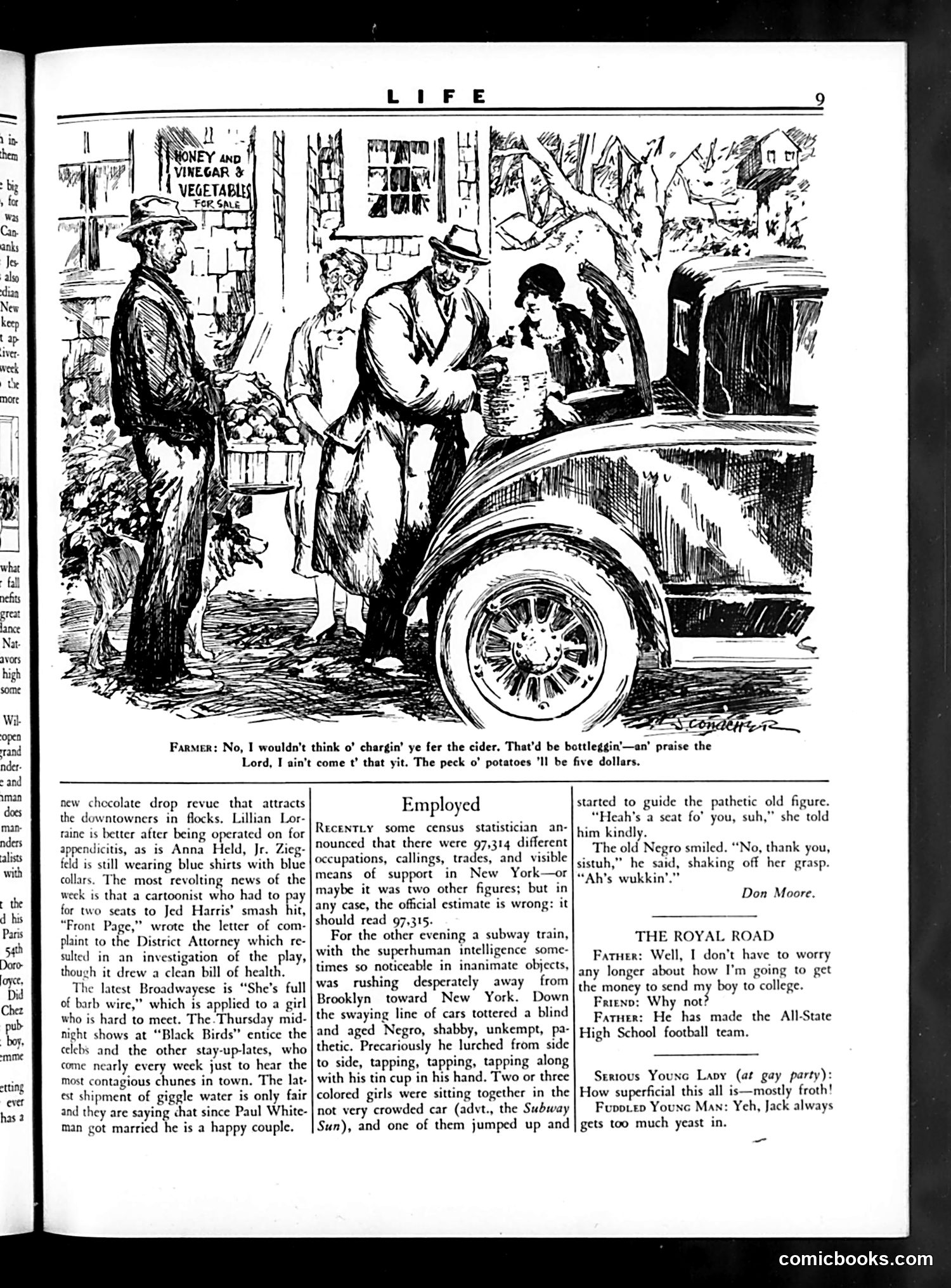
This page contains a satirical cartoon captioned with dialogue between a farmer and what appears to be a car salesman. The farmer refuses to buy cider, joking that the salesman should charge money instead—and notes that potatoes will cost five dollars. The cartoon satirizes rural economic hardship and the contrast between country and city commerce. The farmer's reluctance to purchase, combined with his specific price reference for potatoes, suggests Depression-era economic struggles when agricultural prices were depressed. The accompanying text discusses Broadway shows and social commentary. Without a visible date, the exact historical moment is unclear, but the overall tone reflects early-to-mid 20th century American life and the tension between rural and urban economic realities.
📄 Transcribed text from this page (OCR, searchable)
Machine-transcribed from the original scan — historical spelling and the odd misread are preserved.
Chez pub- ‘bon mme ctting ever has 2 VINEGAR & VEGETAB FOR SALE Farmer: No, I wouldn't think o’ chargin’ ye fer the cider. That'd be bottleggin’. in’ praise the Lord, I ain't come t’ that yit. The peck o’ potatoes ‘Il be five dollars. new checolate drop revue that attracts the downtowners in flocks. Lillian Lor- taine is better after being operated on for appendicitis, as is Anna Held, Jr. Zieg- feld is still wearing blue shirts with blue collars. The most revolting news of the week is that a cartoonist who had to pay for two seats to Jed Harris’ smash hit, “Front Page,” wrote the letter of com- plaint to the District Attorney which re- sulted in an investigation of the play, though it drew a clean bill of health. The latest Broadwayese is “She's full of barb wire,” which is applied to a girl who is hard to meet. The. Thursday mid- night shows at “Black Birds” entice the celebs and the other stay-up-lates, who come nearly every week just to hear the most contagious chunes in town. The lat- est shipment of giggle water is only fair and they are saying chat since Paul White- man got married he is a happy couple. Employed Recently some census statistician an- nounced that there were 97,314 different occupations, callings, trades, and visible means of support in New York—or maybe it was two other figures; but in any case, the official estimate is wrong: it should read 97,315. For the other evening a subway train, with the superhuman intelligence some- times so noticeable in inanimate objects, was rushing desperately away from Brooklyn toward New York. Down the swaying line of cars tottered a blind and aged Negro, shabby, unkempt, pa- thetic. Precariously he lurched from side to side, tapping, tapping, tapping along with his tin cup in his hand. Two or three colored girls were sitting together in the not very crowded car (advt., the Subway Sun), and one of them jumped up and started to guide the pathetic old figure. “Heah’s a seat fo’ you, suh,” she told him kindly. The old Negro smiled. ‘No, thank you, sistuh,” he said, shaking off her grasp. “Ah’s wukkin’.” Don Moore. THE ROYAL ROAD Fatner: Well, I don't have to worry any longer about how I'm going to get the money to send my boy to college. Frieno: Why not? Farner: He has made the All-State High School football team. Serious Youn Lapy (at gay party): How superficial this all is—mostly froth! Fupoten Younc Man: Yeh, Jack always gets too much yeast in. comicbooks.com