
A complete issue · 34 pages · 1928
Life — May 31, 1928
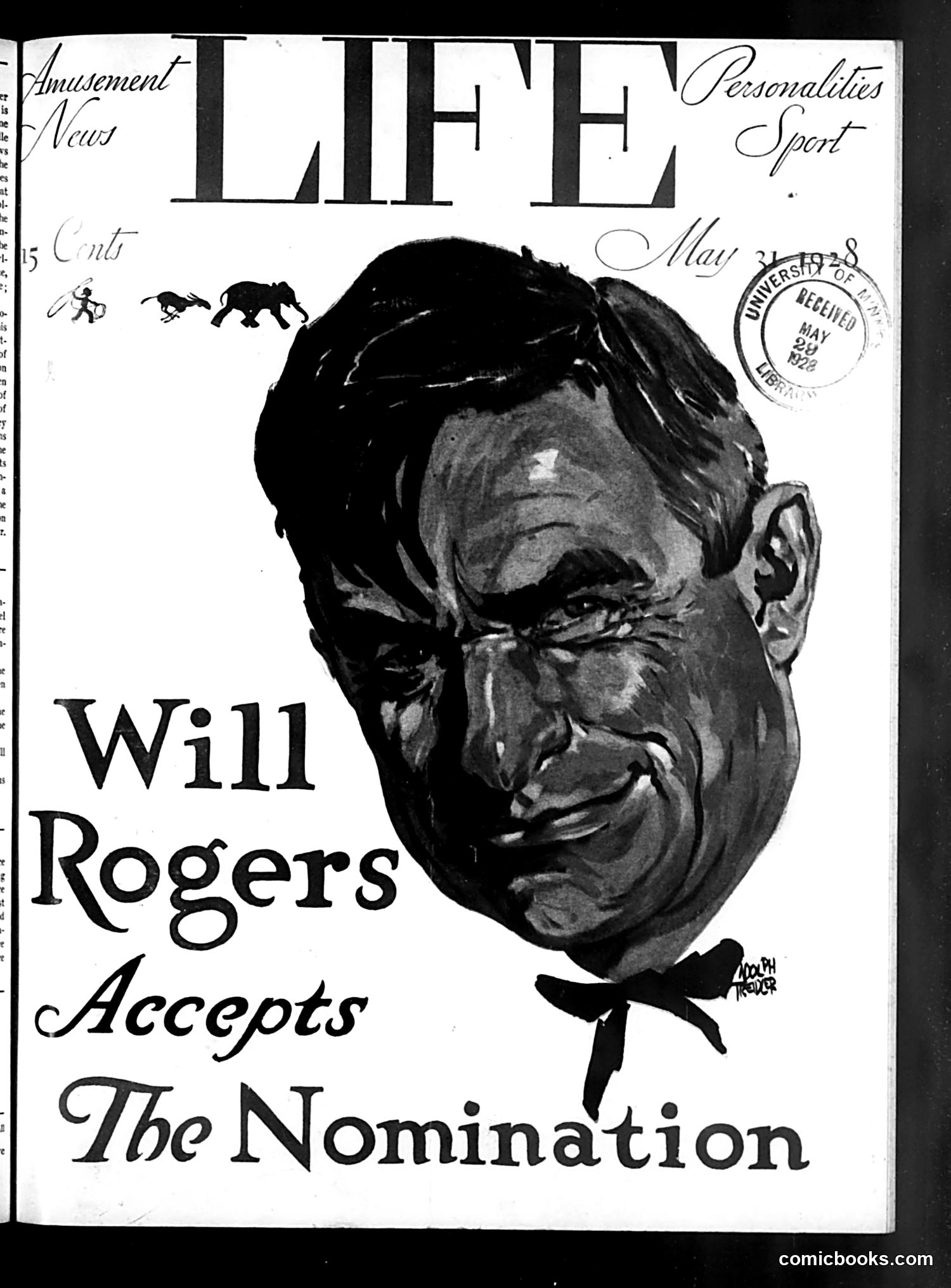
This is a **Life magazine cover from May 31, 1928** featuring a caricature of **Will Rogers**, the famous American humorist, actor, and social commentator. The headline "Will Rogers Accepts The Nomination" refers to a satirical or humorous context—likely Life's playful suggestion that Rogers should run for political office. The small cartoon vignettes above (man, dog, elephant, bull) appear to reference animals or political symbols, possibly alluding to party politics or Rogers's folksy commentary on current events. Rogers was known for sharp wit and political satire delivered through rope tricks and homespun observations, so Life's cover joke likely plays on his popularity and influence as a public figure who commented freely on politicians and current affairs—positioning him as a tongue-in-cheek alternative candidate.
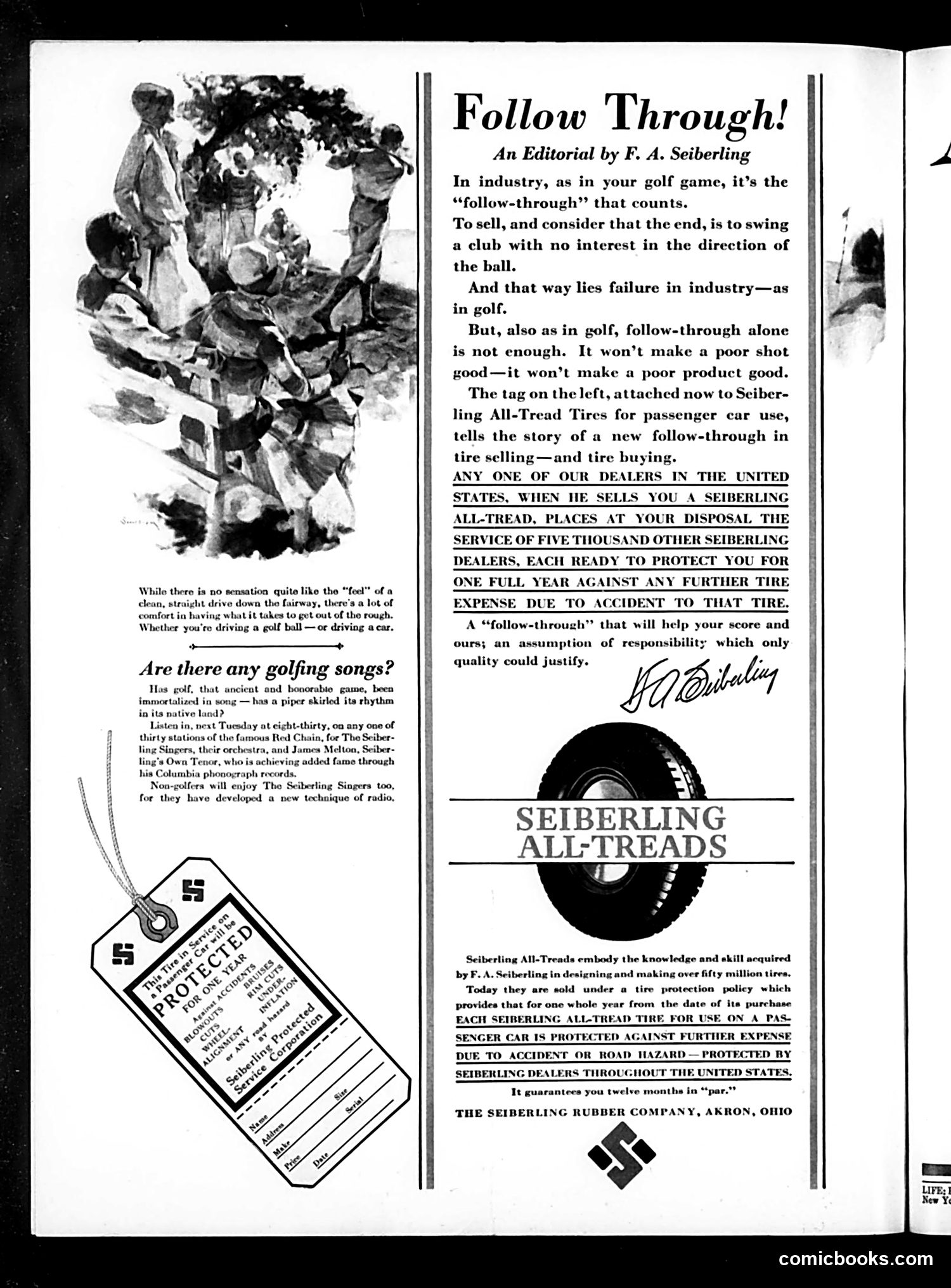
This page combines an editorial by F.A. Seiberling with advertising for Seiberling All-Tread Tires. **The Editorial Content:** The left side uses golf metaphors to discuss business philosophy—comparing a successful "follow-through" in golf to quality follow-through in industrial manufacturing and sales. It critiques businesses that lack commitment to their products' actual quality. **The Advertisement:** The right side promotes Seiberling All-Tread Tires, emphasizing a one-year protection guarantee against accidents or road hazards. The ad highlights that 5,000 Seiberling dealers nationwide will honor this warranty. **The Point:** Seiberling uses the editorial's golf metaphor to argue their tire company practices what it preaches—genuine follow-through via actual product protection and dealer support, positioning themselves as a quality-focused alternative in the tire market.

This is a **straightforward advertisement**, not satire or political commentary. The Atwater Kent Manufacturing Company is promoting their electric radio set in a 1928 Life magazine ad. The headline "The country has already 'gone Atwater Kent'" claims the radio's market dominance nationwide. The text emphasizes the set's reliability, lack of battery dependency, and superior reception—key selling points for late 1920s radios when the technology was still relatively new. The diamond-framed product image shows the radio's simple, elegant design. The ad appeals to consumers' desire for quality and convenience, promising that a home demonstration will showcase the product's superiority. The phrase "On the air—every Sunday night—Atwater Kent Hour—listen in!" indicates the company sponsored radio programming as part of their marketing strategy.
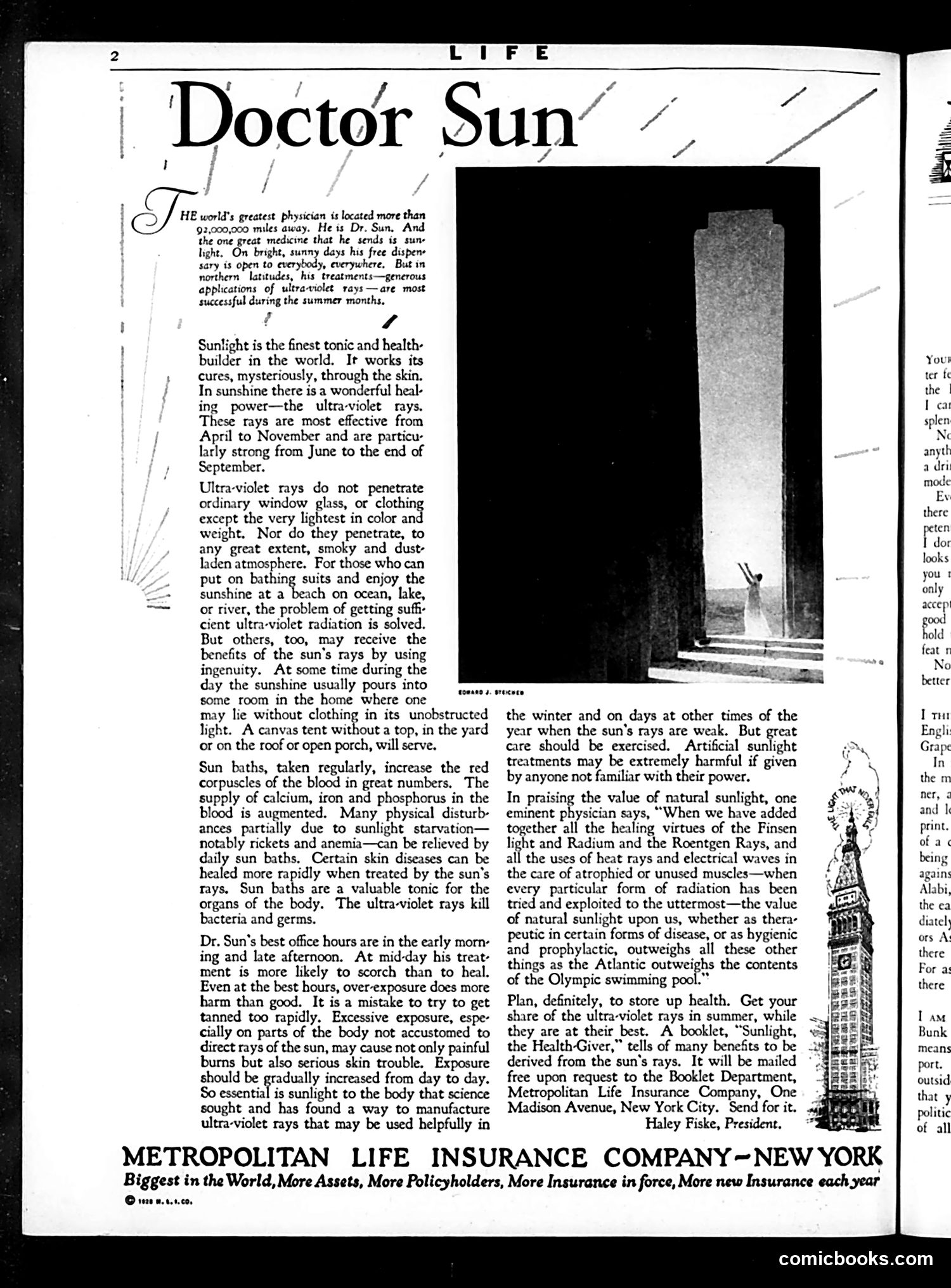
This page is primarily a **paid advertisement** for Metropolitan Life Insurance, not satirical content. The "Doctor Sun" article promotes the health benefits of sunlight and ultraviolet rays, positioning sunshine as a natural medicine. The piece discusses sun exposure's therapeutic effects—increased red blood cells, calcium absorption, and treatment of skin diseases. It warns against overexposure while recommending gradual summer sun exposure and indoor light during winter months. The small illustration shows a woman in a bathing suit receiving sunlight indoors through a window. This reflects 1920s-era health trends emphasizing heliotherapy (sun treatment) as legitimate medicine. The advertisement concludes by promoting a Metropolitan Life Insurance booklet called "Sunlight, the Health-Giver" available through their New York office. This is commercial content, not political satire.
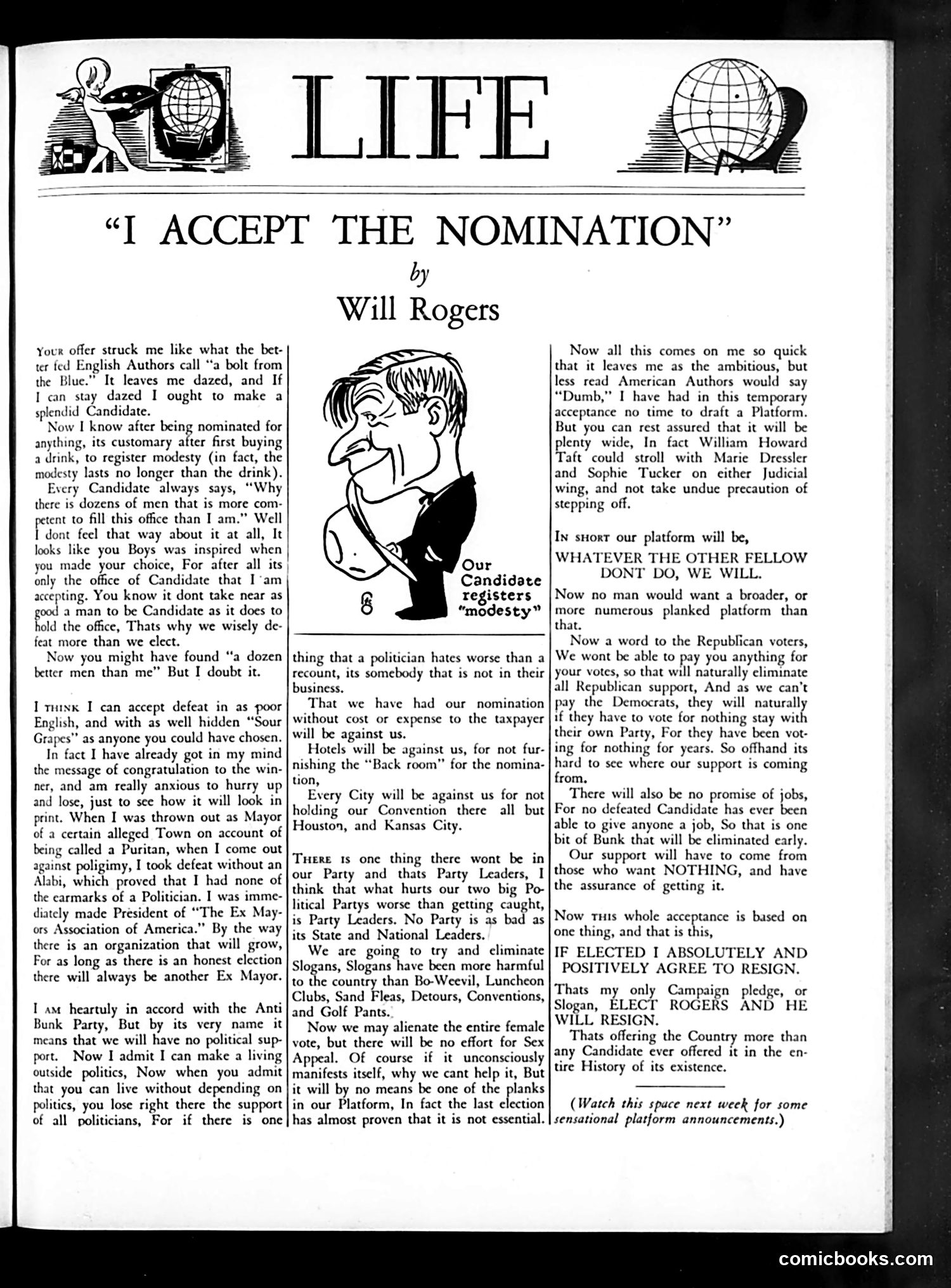
This is a satirical piece by humorist Will Rogers accepting a fictional presidential nomination. The cartoon's central figure appears to be Rogers himself, caricatured with exaggerated features. Rogers humorously critiques political campaigning by promising an anti-politics platform: eliminating slogans, holding no conventions outside Houston and Kansas City, making no job promises, and offering "nothing" to voters. He mocks politicians' tendency to make contradictory pledges and suggests the best candidate is one independent of traditional party structures. The satire targets early 20th-century electoral conventions—excessive spending, empty rhetoric, and strategic promises designed to win support from competing interest groups. Rogers's ironic "platform of nothing" suggests honest governance requires rejecting standard political theater entirely.
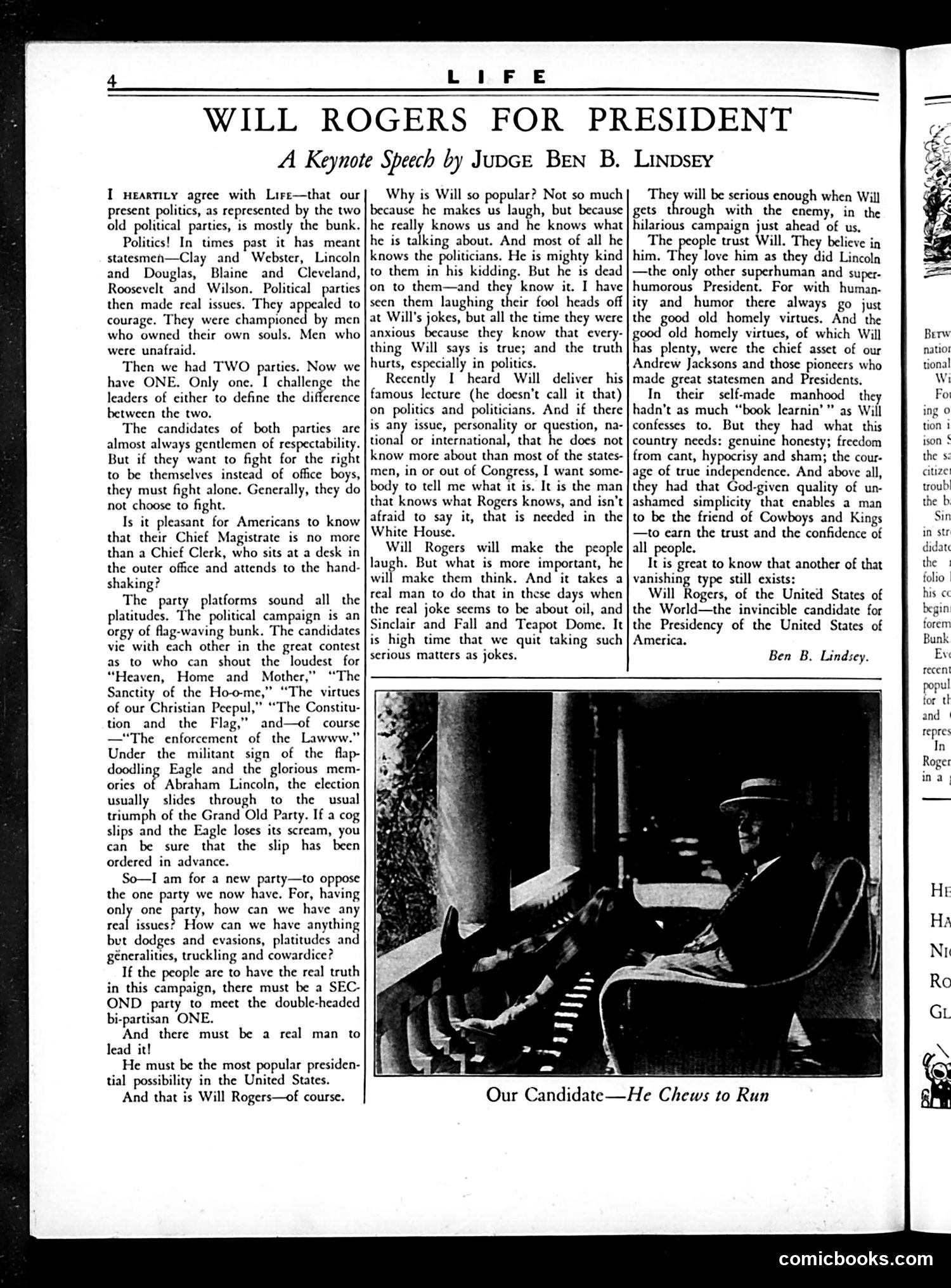
This is a satirical endorsement of humorist Will Rogers for president, written by Judge Ben B. Lindsey. The text argues Rogers is the ideal candidate because he's genuinely popular, understands common people, and speaks truth—unlike typical politicians. Lindsey proposes a new "second party" to oppose the existing two-party system's corruption and empty platitudes. The photograph caption reads "Our Candidate—He Chews to Run," a pun on the campaign phrase "run for president." The image shows Rogers chewing gum or tobacco, which aligns with the text's theme: Rogers is an everyman, unpretentious and authentic, making him more trustworthy than polished politicians. The satire suggests that a comedian-turned-candidate might be preferable to career politicians.
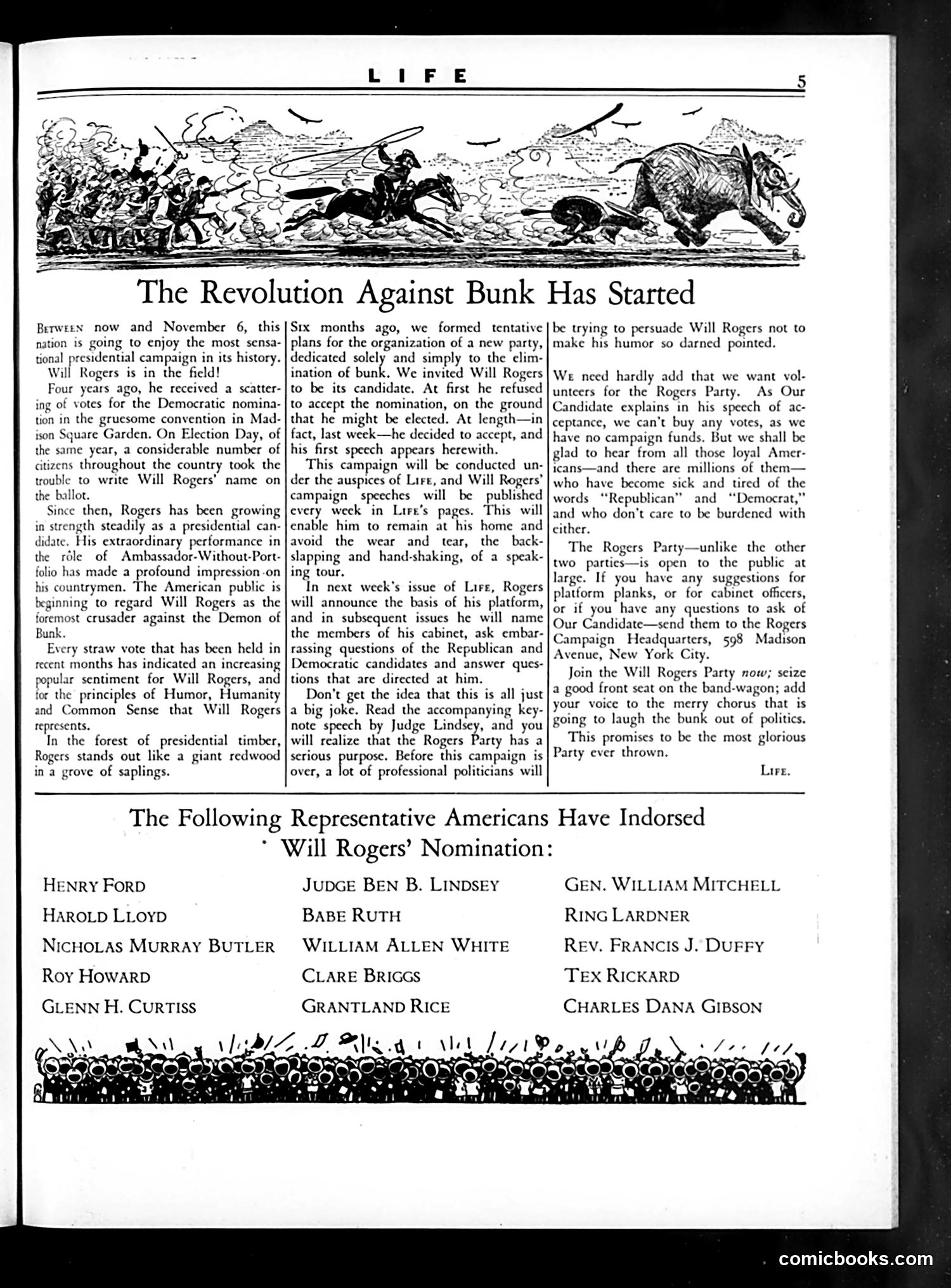
This Life magazine page announces a satirical presidential campaign for humorist Will Rogers, positioning him as an anti-corruption alternative to the major parties. The cartoon at top depicts Rogers on horseback, seemingly charging into political battle. The article frames this as "The Revolution Against Bunk"—a critique of professional politicians and establishment politics. The campaign promises to keep Rogers at home while publishing his speeches weekly in Life, avoiding the typical "wear and tear" of campaigning. The endorsement list includes prominent figures (Ford, Lloyd, Ruth, etc.), lending mock legitimacy. The satire's point: Rogers's common sense and humor represent a genuine alternative to the era's political establishment—a commentary on public frustration with professional politicians and perceived corruption in government.
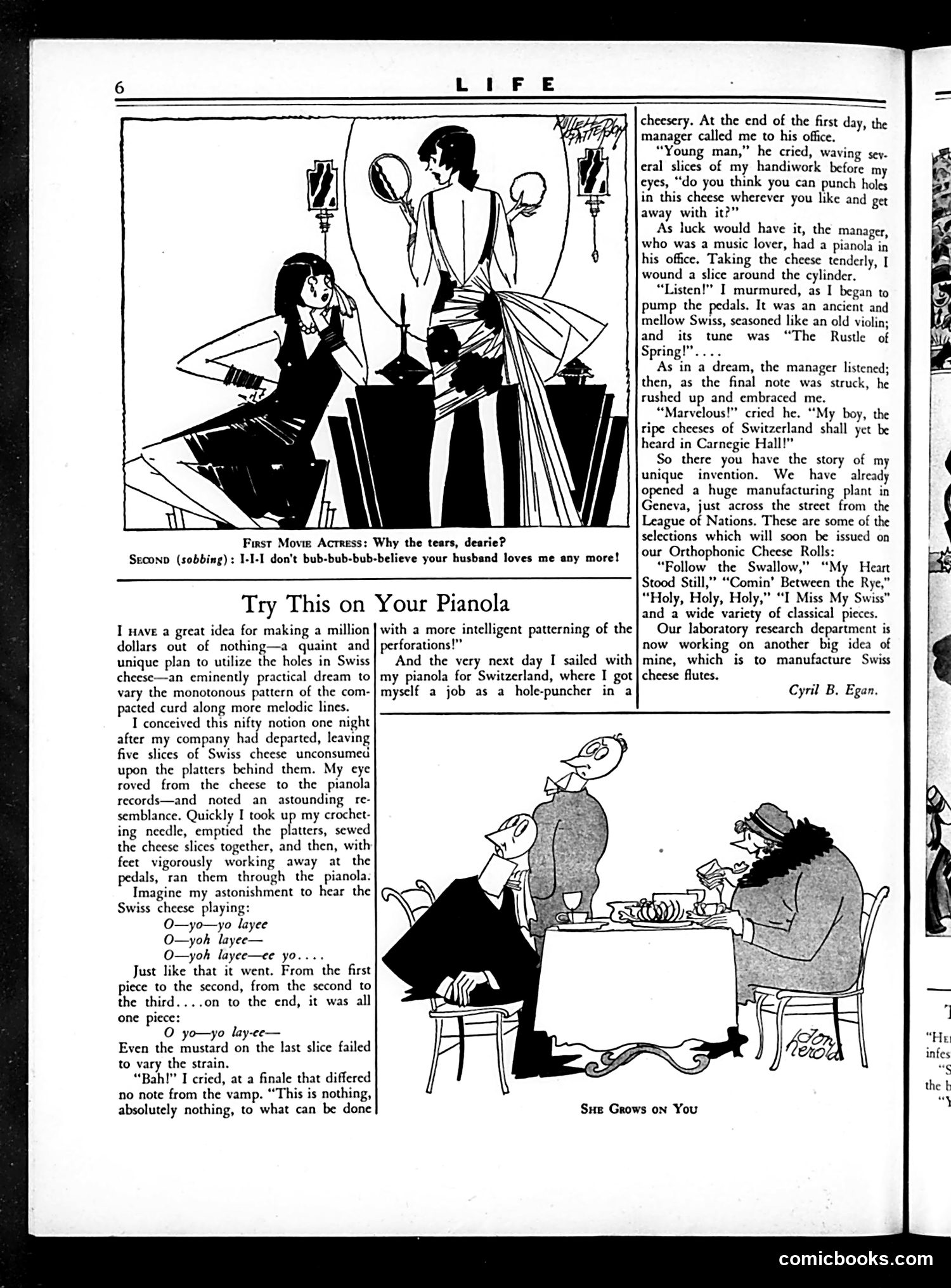
This page contains a humorous article titled "Try This on Your Pianola" by Cyril B. Egan, describing an absurd invention: using Swiss cheese holes as a punch-card system to play music on a player piano (a "Pianola"). The top cartoon shows a woman crying to her husband about infidelity, while in the background, a man operates a contraption involving cheese and a musical instrument—illustrating the article's comedic premise. The lower cartoon depicts the author's fictional successful test, with Swiss birds conducting the cheese-powered piano performance. The satire targets turn-of-the-century mechanization culture and the era's fascination with automated musical devices. It's absurdist humor exploiting the Pianola's then-contemporary popularity and the humorous juxtaposition of refined Swiss cheese with music-making machinery.
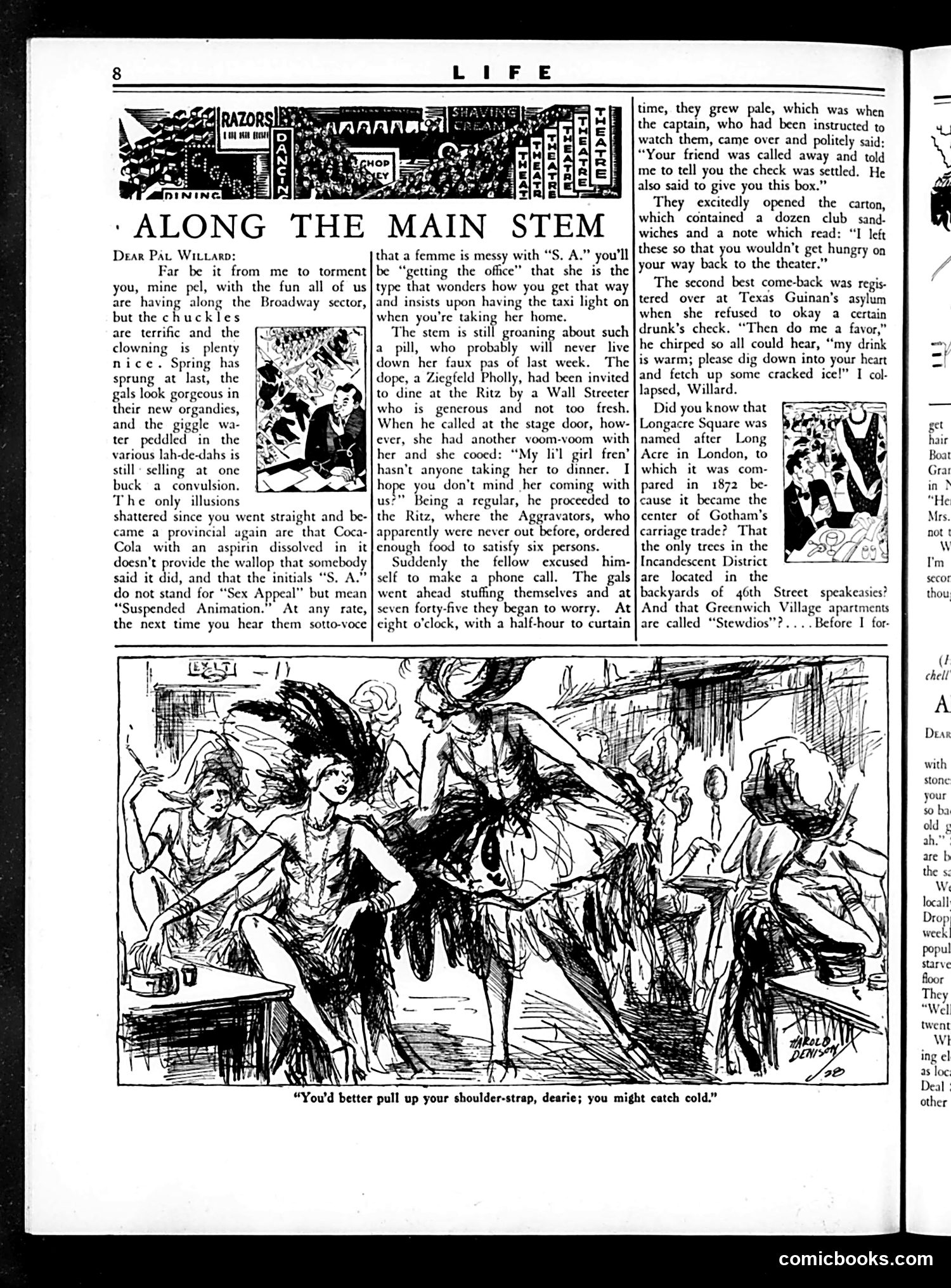
This is a humor column by Pal Willard commenting on Broadway theater district life. The top section mocks theatrical affectations—complaining about women who are "messy with 'S.A.'" (likely stage affectation), taxi-light romance, and overly dramatic types. It mentions specific venues like the Ritz and references taxi-dancers or escorts accompanying theater patrons. The large cartoon below depicts a lively cabaret or dance hall scene with women in revealing attire dancing energetically, with the caption: "You'd better pull up your shoulder-strap, dearie; you might catch cold." This satirizes 1920s speakeasy/cabaret culture during Prohibition, poking fun at loose morality, skimpy clothing, and the rowdy nightlife associated with Broadway's entertainment district.
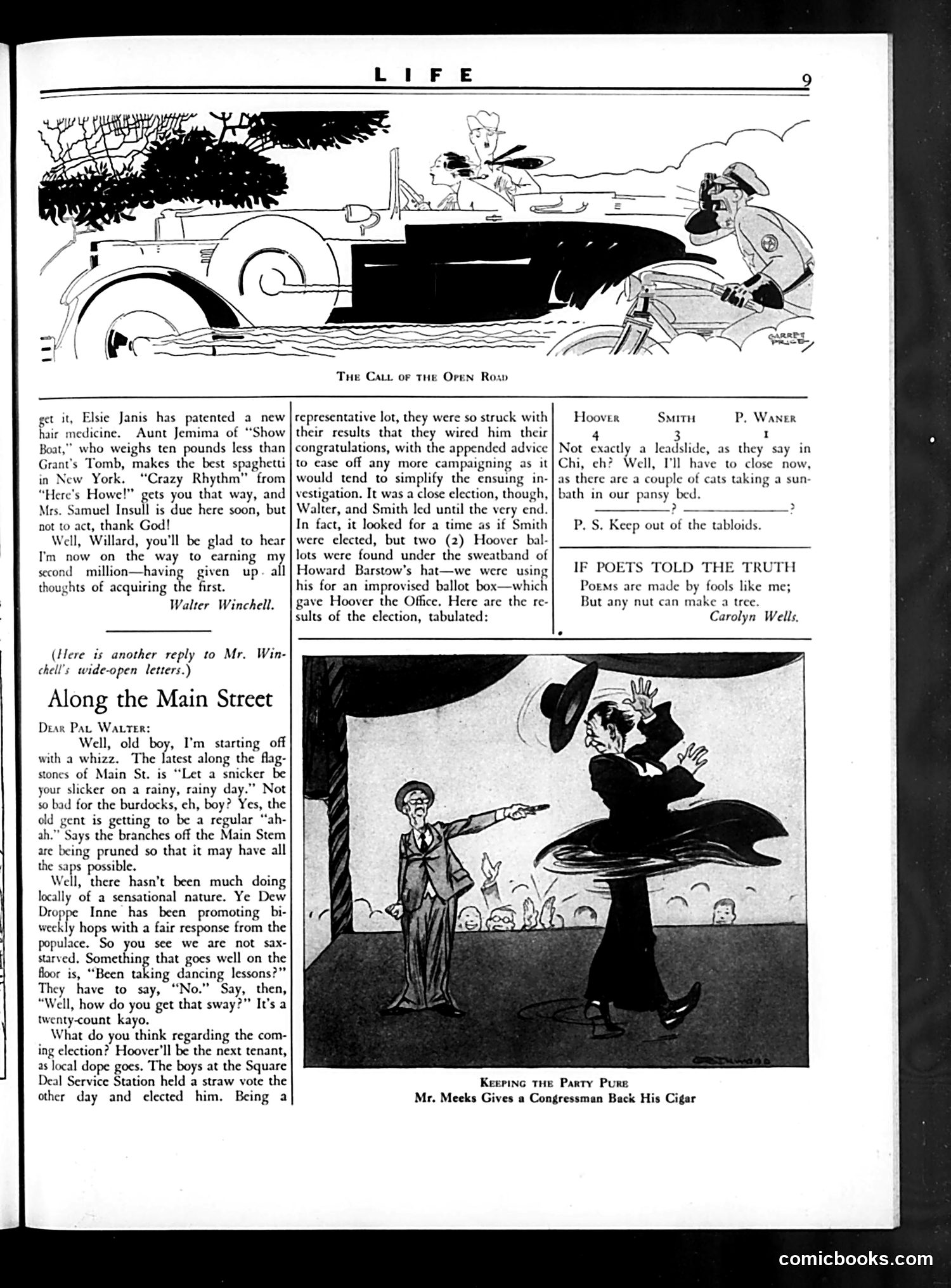
**"The Call of the Open Road"** (top cartoon) depicts an early automobile with passengers, satirizing the automobile craze and leisure travel emerging in early 20th-century America. The jovial mood captures optimism about modern transportation's freedom. **"Keeping the Party Pure: Mr. Meeks Gives a Congressman Back His Cigar"** (bottom cartoon) shows a magician or illusionist making a cigar disappear while a congressman watches in amazement. This appears to satirize political corruption or bribery—the "cigar" likely representing a bribe or improper gift. The joke suggests a magician can make illicit gifts vanish, keeping politics ostensibly "pure" while corruption continues invisibly. The cartoon critiques political hypocrisy regarding ethical standards.
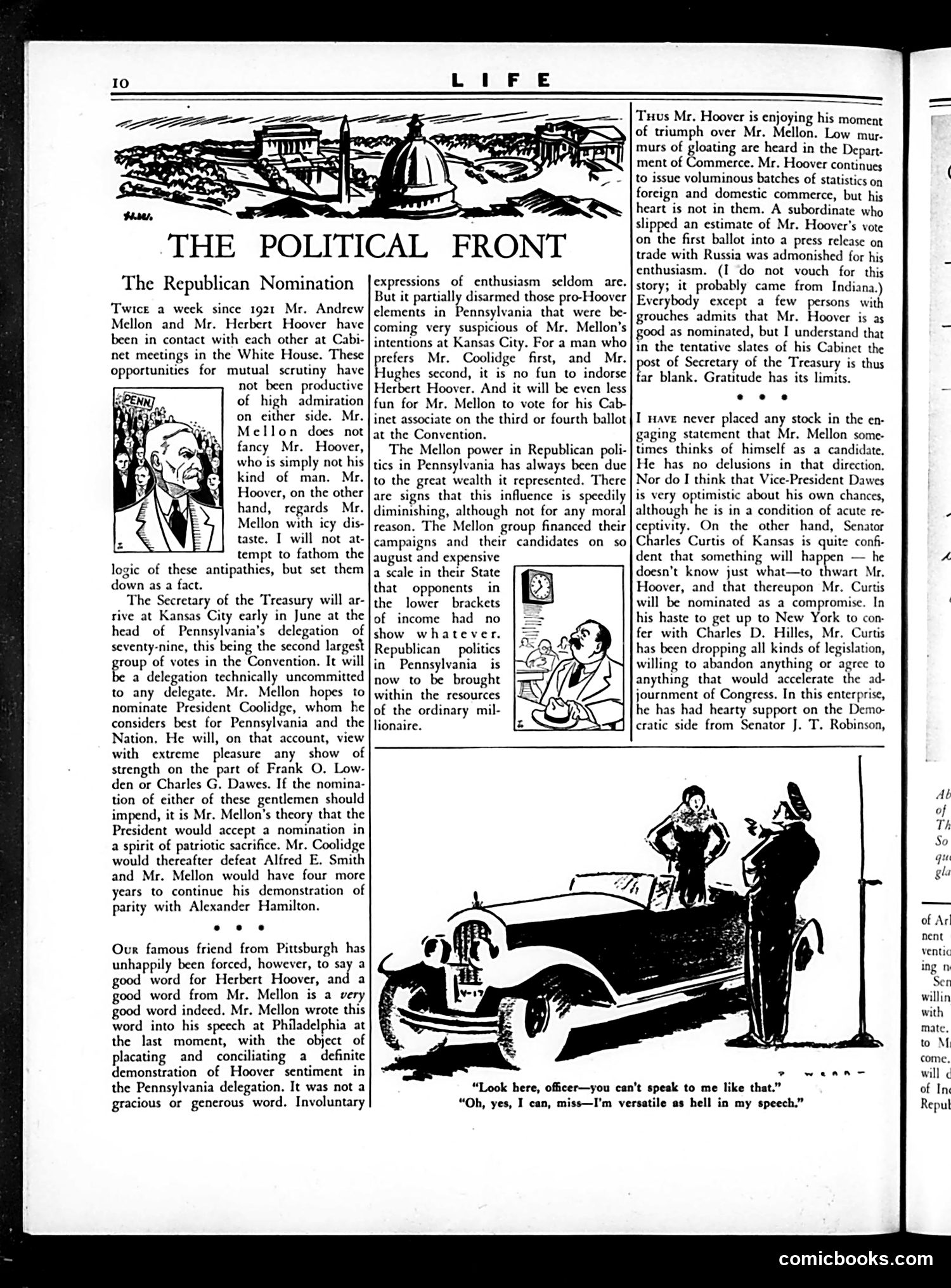
This page satirizes the 1924 Republican presidential nomination process. The main article discusses tensions between Treasury Secretary Andrew Mellon and Herbert Hoover, both seeking influence over the nomination. The cartoon at bottom depicts a speeding car with a woman and police officer. The woman (appearing to represent a political candidate or position) tells the officer: "Look here, officer—you can't speak to me like that." He responds: "Oh yes, I can, miss—I'm versatile as hell in my speech." The satire suggests political figures are opportunistically adaptable in their rhetoric—willing to say whatever necessary to different audiences. The car's speed implies reckless political maneuvering during the nomination race.
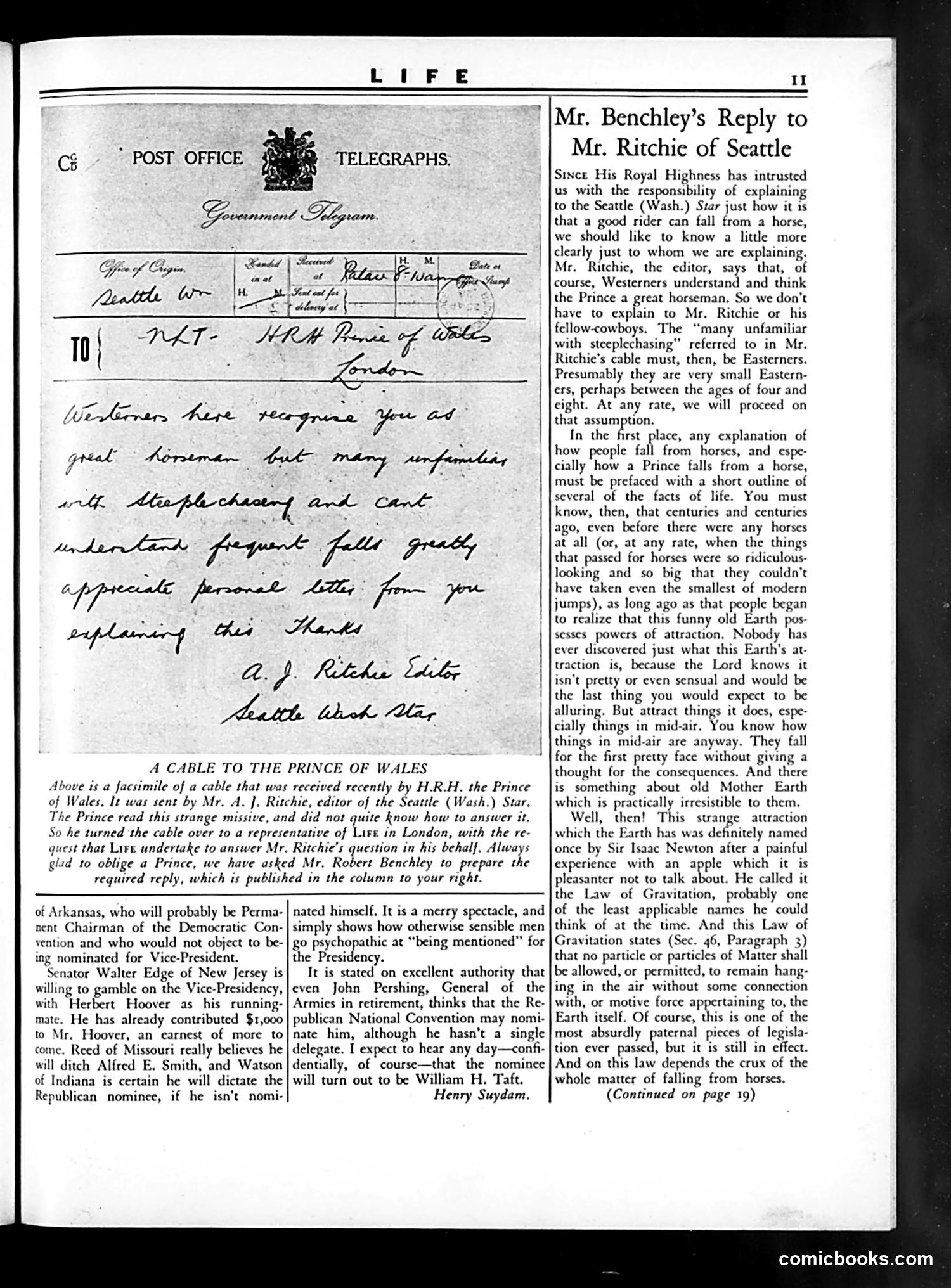
This page contains **two distinct items**: 1. **A facsimile of a government telegram** supposedly received by H.R.H. the Prince of Wales, purportedly from Mr. A.J. Ritchie (editor of the Seattle Star) asking how a good rider can fall from a horse. The Prince's representatives forwarded this to Life's Robert Benchley for explanation. The satire mocks both the absurdity of asking royalty such a question and the presumed naïveté of small-town editors. 2. **Benchley's humorous reply** explaining gravitational attraction using mock-scientific language, ultimately suggesting that falling from horses simply demonstrates Earth's gravitational pull—treating the question with exaggerated seriousness to highlight its fundamental silliness. The joke satirizes pretentious rural Americans questioning the Prince of Wales.
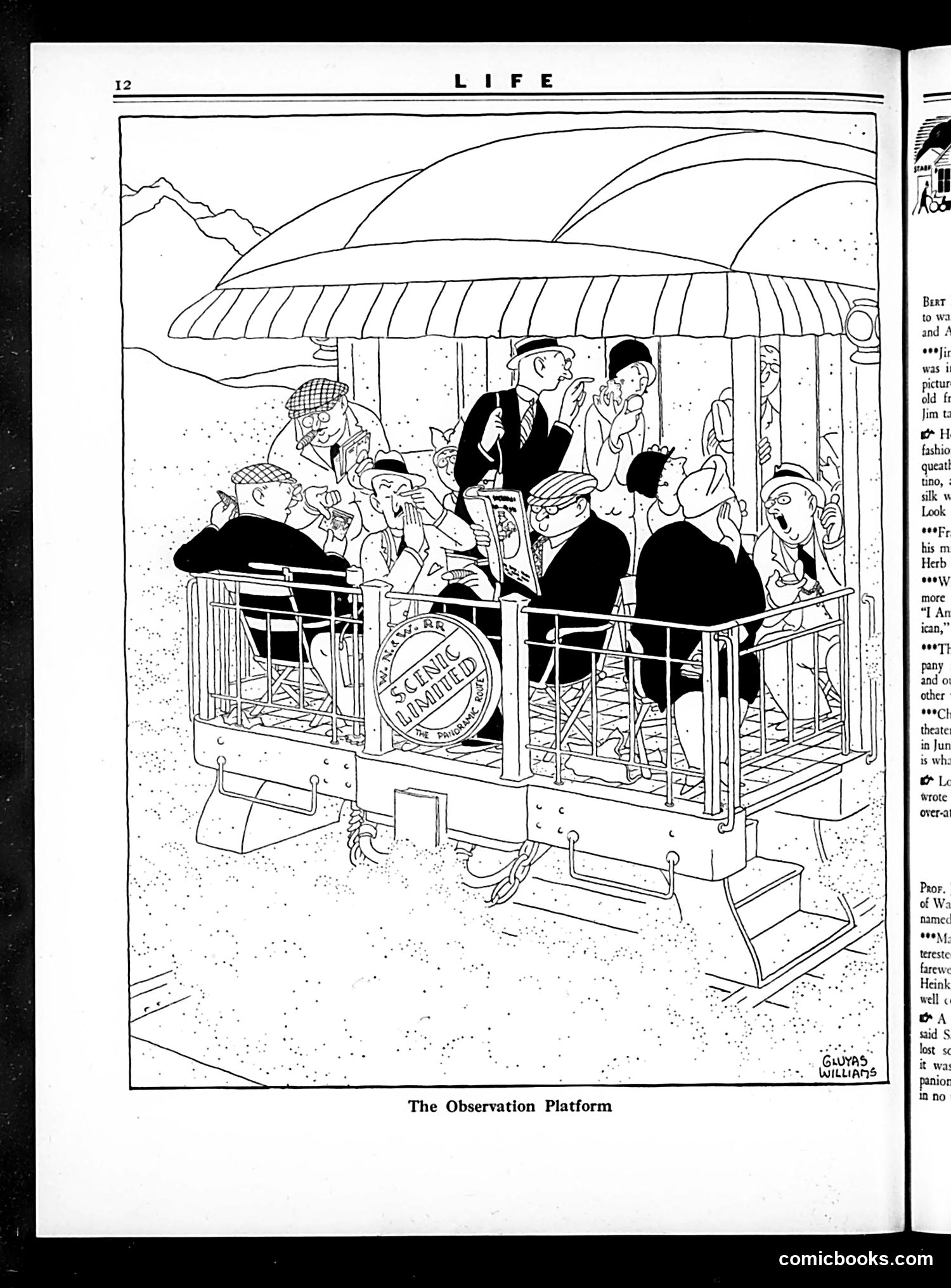
This cartoon depicts a crowded observation platform on what appears to be a luxury ocean liner (indicated by the "Titanic Limited" drum visible on the railing). Well-dressed passengers in formal attire and hats gather to view the scenery, with an awning overhead providing shade. The satire likely targets the leisure activities and social pretensions of wealthy travelers during the early 20th century. The "observation platform" suggests passengers gathering primarily to be seen and to observe others—a commentary on the performative nature of upper-class tourism and leisure. The specific vessel reference may contain contemporary political or social commentary, though the exact targets remain unclear without additional context from the issue. The artist is credited as Gluyas Williams.
This page is primarily a **gossip/humor column** rather than a political cartoon. It contains brief, humorous local anecdotes from various American cities (Baltimore, Indianapolis, Seattle, Toledo, and Boston). The content includes jokes about: - Local politicians and civic figures - Minor social mishaps (a young man at a pool hall during rain) - Weather complaints - New business initiatives - Church and community activities The cartoonish header illustrates a typical American neighborhood streetscape with various shops and businesses, setting the tone for the "neighborhood news" gossip column below. This appears to be **social humor** mocking everyday community life rather than serious political satire—typical of Life magazine's light, satirical approach to American society in this era.
This page contains **gossip and social commentary** from various American cities (Denver, Detroit, Omaha, Jacksonville, New York) rather than political cartoons. The content consists of brief, witty observations about local figures and events. Examples include: - A comment about Game Warden Charlie Jones releasing wild turkeys - Professor Kittredge at Harvard being "hard put to find a good place to eat" - Henry Ford's surplus inventory being reduced to fund new car production - References to local politicians, builders, and civic figures The humor derives from **satirizing everyday American life**: bureaucratic absurdities, economic conditions (Depression-era automobile production), social pretensions, and local personalities. The tone is lighthearted rather than sharply political, typical of Life's satirical approach to American society during this period.
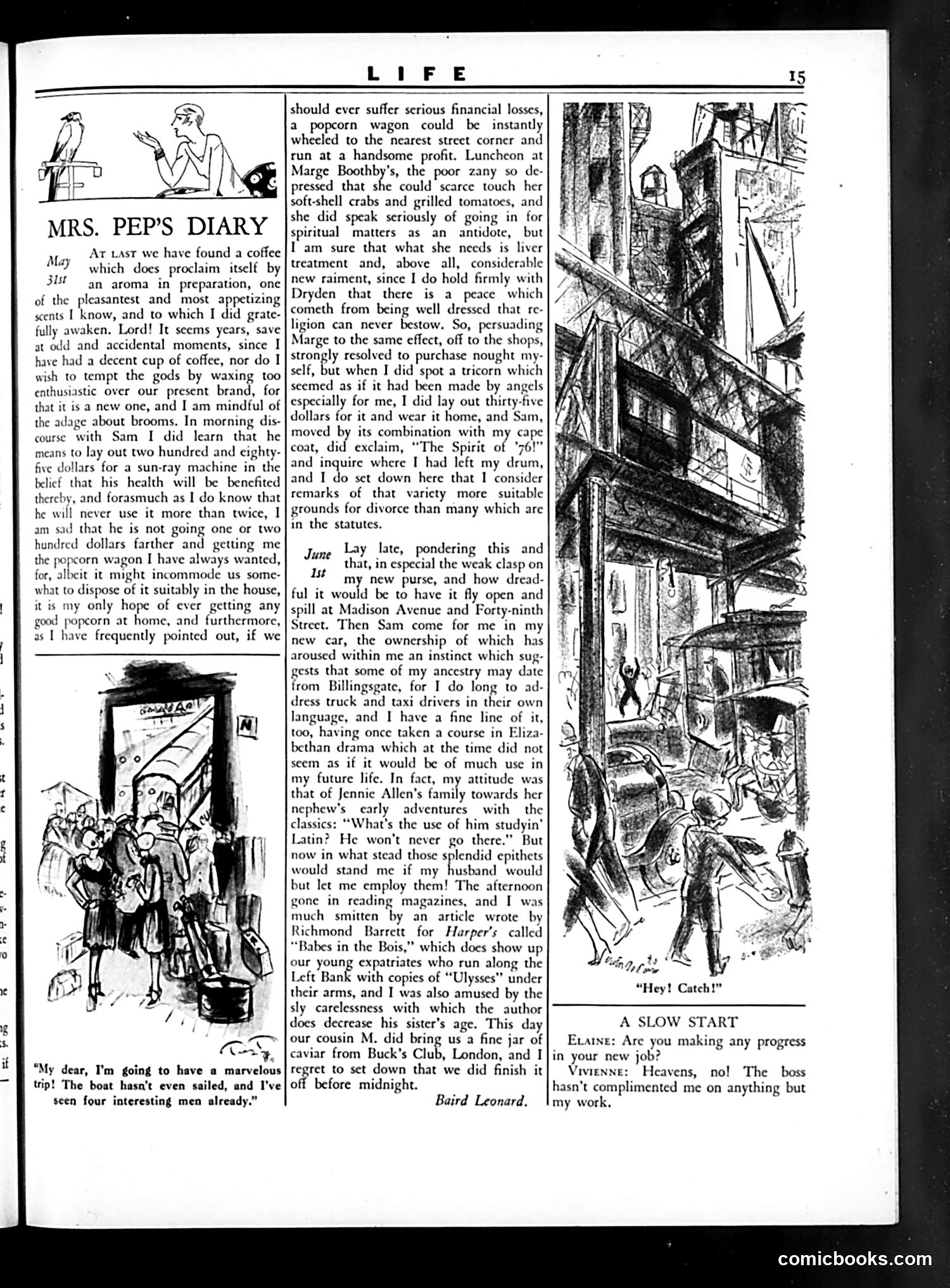
This page contains a humorous diary entry by "Mrs. Pep" dated May 31st, discussing her discovery of a new coffee with appealing aroma. The satirical humor centers on her enthusiastic but impractical response: rather than simply enjoying the coffee, she fantasizes about converting it into a profitable business venture—specifically, a popcorn wagon to be wheeled to street corners for quick profit. The accompanying illustrations show domestic scenes of her pitching this scheme. The satire mocks middle-class aspirational thinking and get-rich-quick schemes popular in early 20th-century America, where ordinary people constantly imagined entrepreneurial shortcuts to wealth rather than pursuing realistic employment. The bottom cartoon, "A Slow Start," continues this theme of workplace disappointment, contrasting optimistic job expectations with harsh reality.
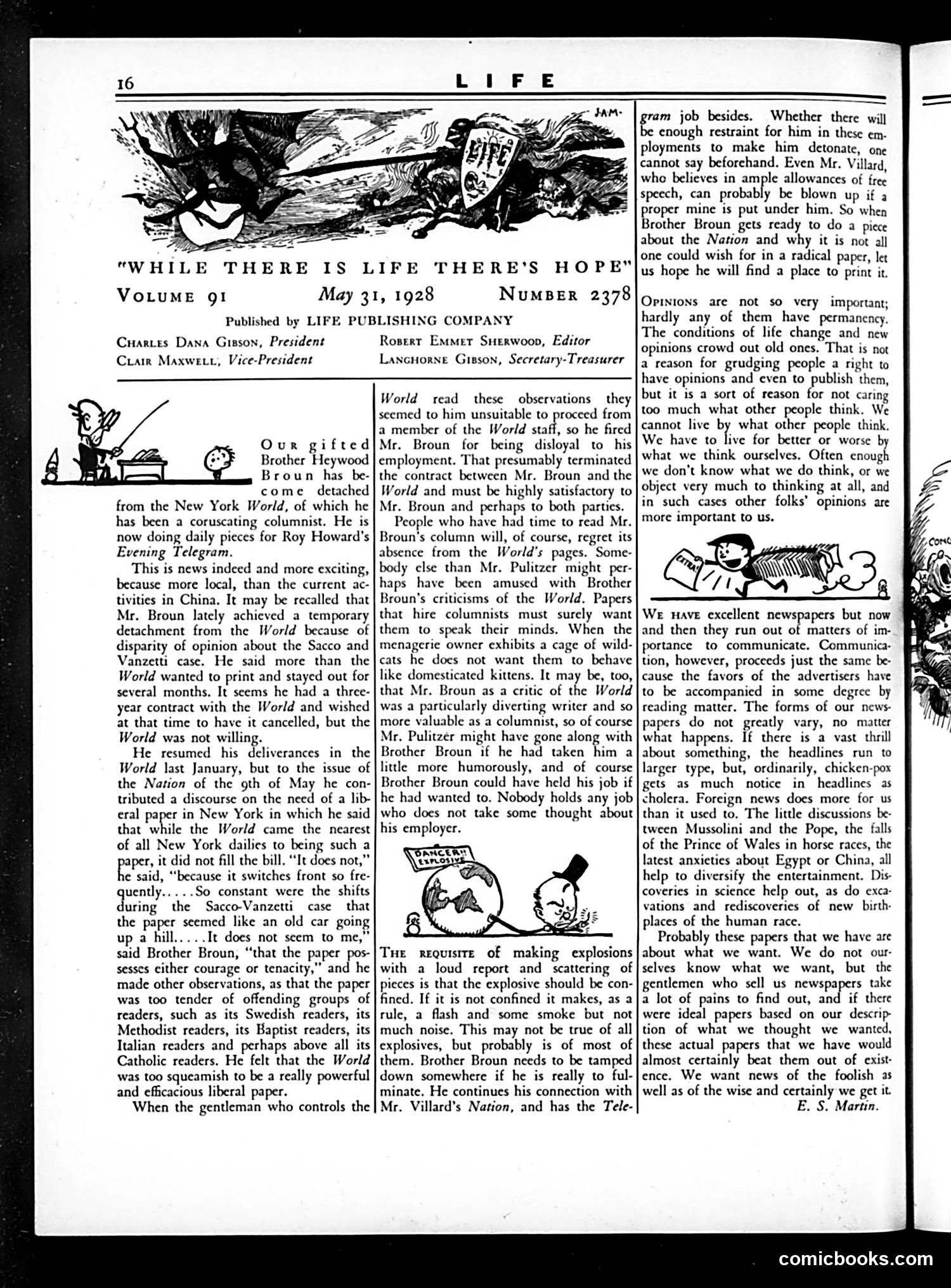
This page discusses **Heywood Broun**, a columnist recently fired from the *New York World* newspaper over his coverage of the Sacco-Vanzetti case (a controversial 1920s trial). The magazine's editors debate whether the *World* was right to dismiss him for his opinions. The cartoons appear to satirize **newspaper editorial control and free speech**. One cartoon shows figures in conflict, likely depicting the tension between Broun's controversial writing and his employer's desire for "respectable" content. The broader point critiques how newspapers claim to be liberal while actually suppressing columnists' genuine viewpoints—they want "domesticated kittens," not real journalists. The piece argues newspapers should embrace diverse opinions rather than caging writers' minds.
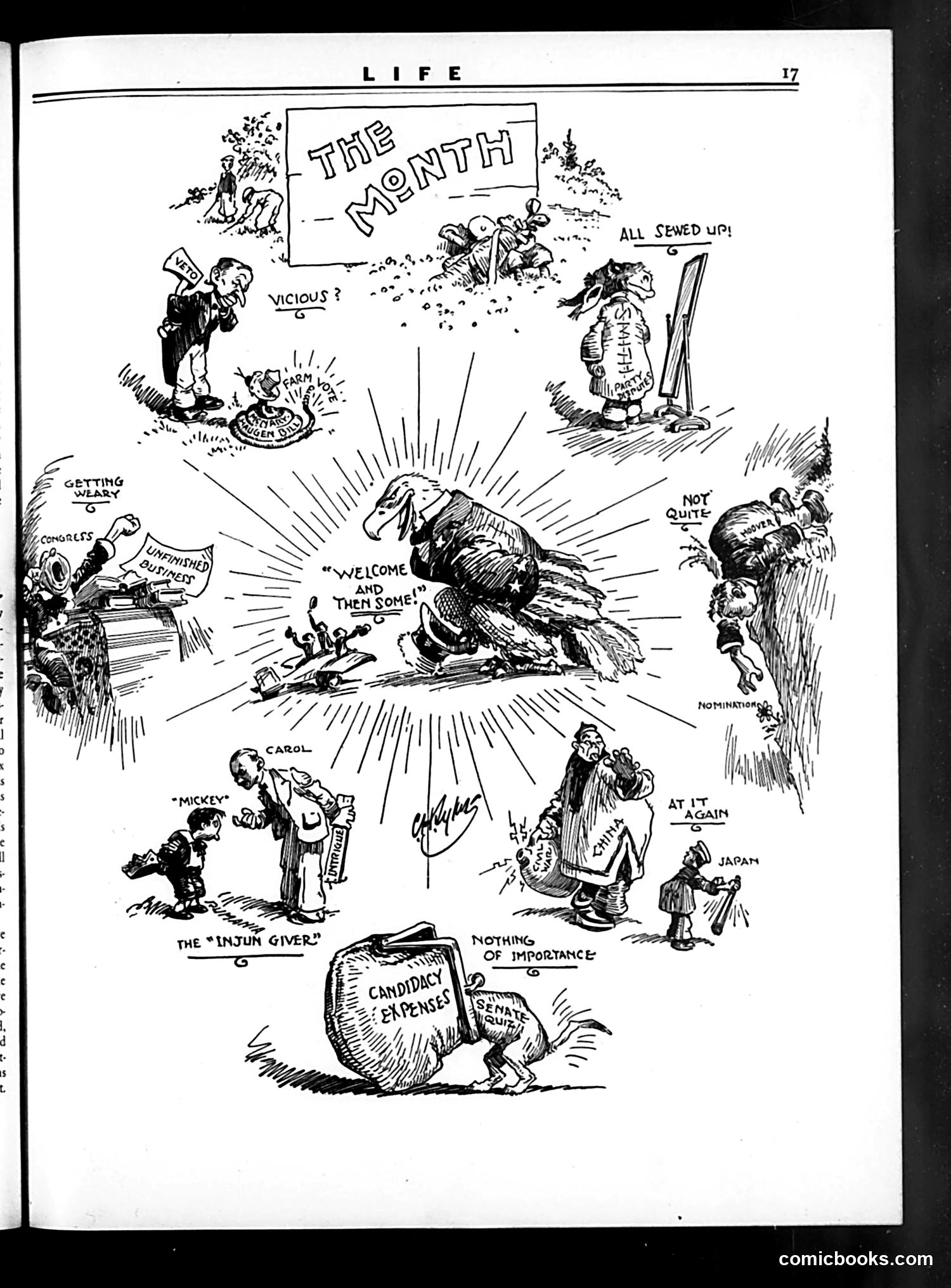
This satirical cartoon presents "The Month" as a wild horse surrounded by contemporary political and social issues. The central horse, labeled "Welcome and then some!", represents the chaotic month ahead. Around it are labeled vignettes: "Vicious?" (top left), "All sewed up!" (top right), "Getting weary" (Congress, left), "Not quite" (right), "Nomination" (far right), "At it again - Japan" (bottom right), "The Injun Giver" (involving Mickey, bottom left), "Nothing of importance" (center bottom), and "Candidacy Expenses" with "Senate Fruits" (bottom). The cartoon satirizes the month's political turmoil—Congressional disputes, nominations, Japanese affairs, and election-related expenses—suggesting 1920s American politics was turbulent and uncontrollable. The "injun giver" reference reflects period vernacular, though the specific political incident remains unclear.
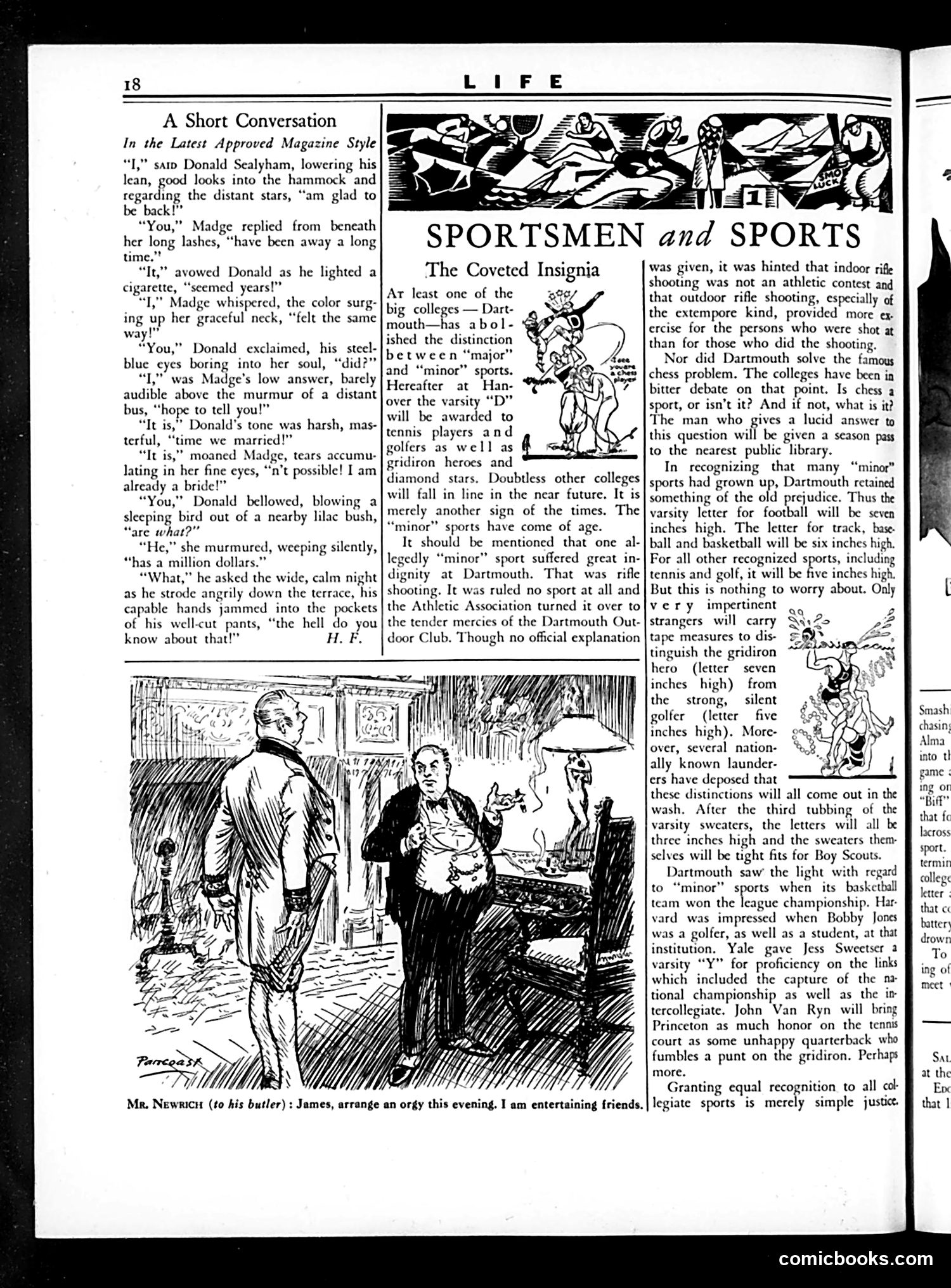
**"A Short Conversation"** (top left) satirizes overwrought romantic dialogue in contemporary magazine fiction. The joke is that every sentence begins with "I," "You," or "He/She"—parodying affected literary style. The dramatic reveal that the woman is already married for money (and the man's angry reaction) mocks the melodramatic plot twists typical of popular magazines of this era. **"The Coveted Insignia"** (right) discusses Dartmouth College's decision to grant varsity letters equally to all sports, not just "major" ones like football. The satire targets college snobbery: athletic distinctions were based on prestige, not actual athletic merit. The article mocks this hierarchy while joking that letter-size differences (seven inches vs. five inches) will wash away anyway—suggesting the whole distinction is trivial. The piece also notes rifle shooting was denied sport status entirely, and humorously questions whether chess qualifies as sport. **"Mr. Newrich"** (bottom left) is a brief caption joke about a wealthy man instructing his butler to arrange an "orgy"—likely meaning a lavish party, using pretentious language.
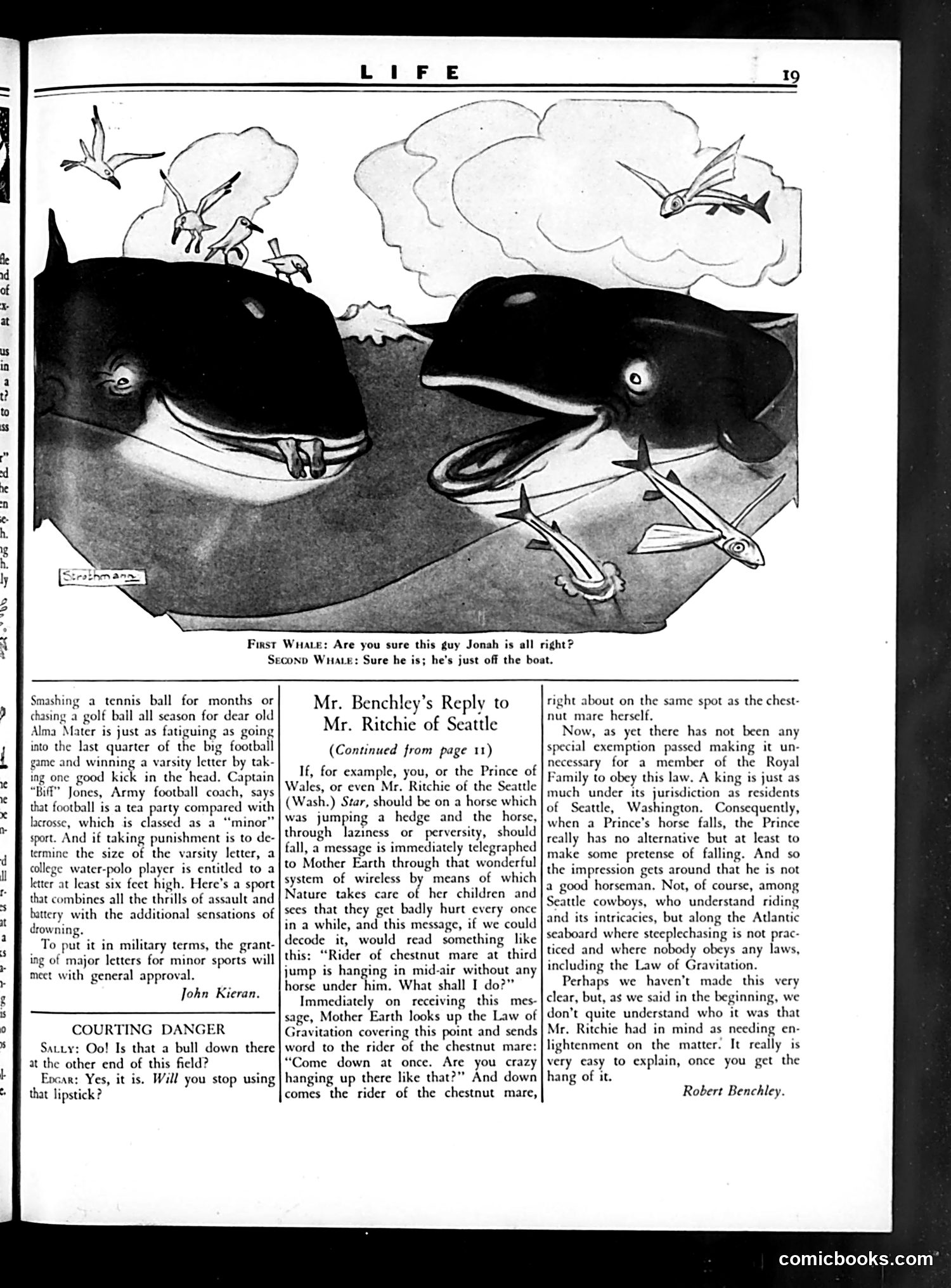
**Top Cartoon ("First Whale/Second Whale"):** Two whales in the ocean discuss a man in the water between them. The joke plays on the biblical story of Jonah being swallowed by a whale—one whale reassures the other that the man is "just off the boat," implying he's a recent immigrant. The humor derives from treating the immigrant as a foreign object that needs explanation, reflecting period attitudes toward newcomers. **Text Content:** The page features sports commentary by John Kieran arguing that lacrosse deserves varsity letter recognition despite being classified "minor," and a humorous essay by Robert Benchley responding to a Seattle newspaper editor's criticism about the Prince of Wales' poor horsemanship. Benchley satirizes the situation by invoking "Mother Earth" and the "Law of Gravitation" to absurdly explain why even royalty must fall when horses fail—gently mocking both the critic's nationalism and social pretension about class distinctions. **Minor Item ("Courting Danger"):** A brief joke about a couple's lipstick application interrupted by a bull.
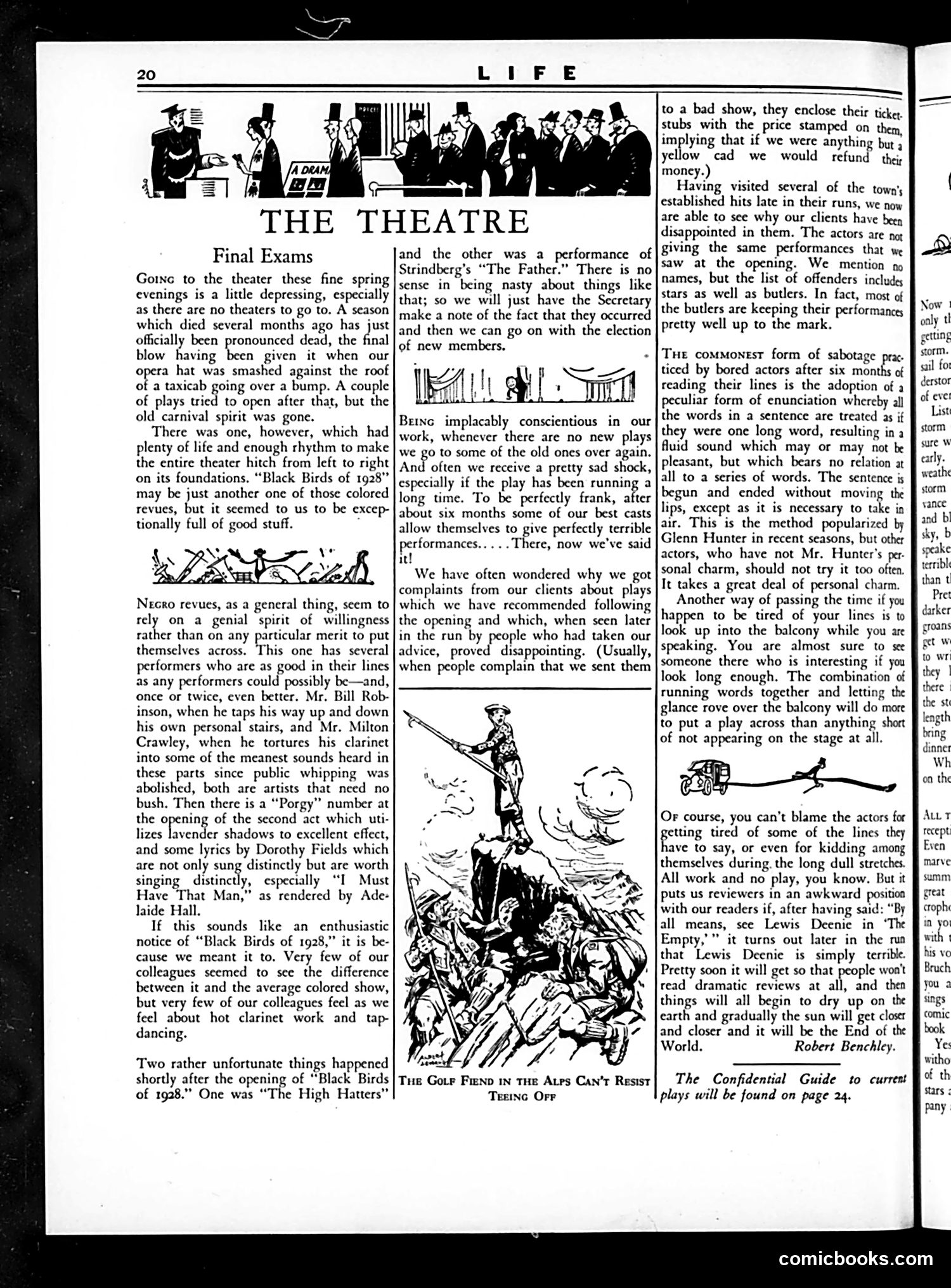
This page reviews Broadway productions, specifically praising the all-Black revue "Black Birds of 1928" while critiquing other shows. The critic celebrates performers like Bill Robinson (tap dancer) and Milton Crawley (clarinet player), calling them exceptional artists. The accompanying cartoon depicts a golfer whose ball has struck a cow in mountainous terrain—illustrating the article's broader complaint: established plays deteriorate during long runs because bored actors become careless and stop delivering quality performances. The satire targets two problems: (1) theaters promoting mediocre shows as hits, then blaming audiences when they're disappointed; and (2) veteran performers who phone in performances after opening night. The critic notes even star actors—not just supporting players—are guilty of this negligence, though ironically, many butlers (minor roles) maintain better standards.
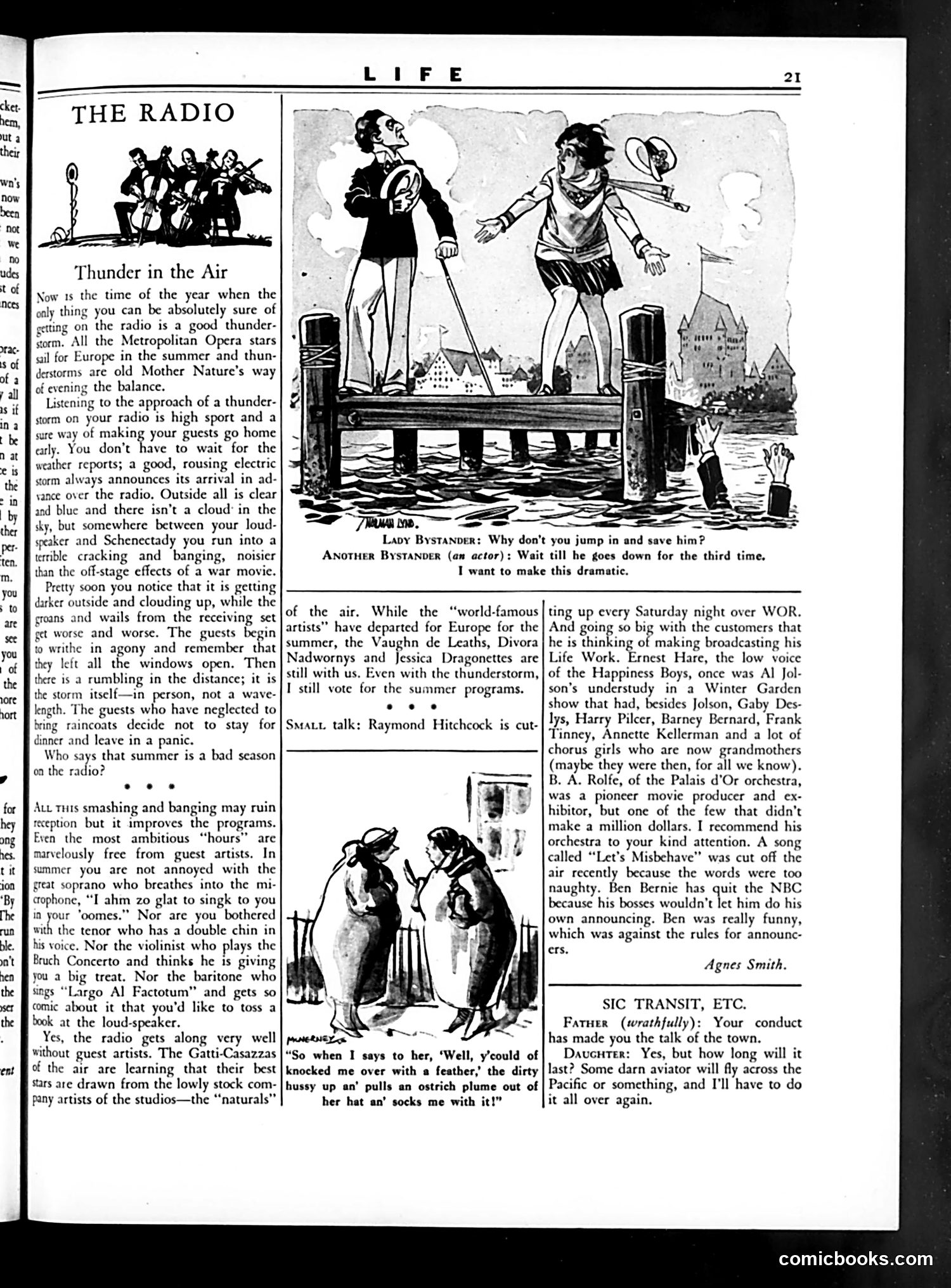
This page satirizes early radio broadcasting during summer months. The main article, "Thunder in the Air," jokes that thunderstorms provide better entertainment than the Metropolitan Opera stars who depart for Europe seasonally—nature "evens the balance." The cartoon depicts two actors on a bridge: one drowning while the other refuses to save him, wanting to wait for "the third time" to make it "dramatic." This mocks theatrical pretension and method acting. The article celebrates lesser-known radio "naturals" (studio performers like the Vaughn de Leaths and Jessica Dragonettes) over temperamental guest artists with affected accents. It notes that even thunderstorm interference improves programming by eliminating vain singers and musicians. The bottom anecdote references broadcaster Raymond Hitchcock and mentions performers like Ernest Hare and Ben Bernie—radio personalities who faced network censorship (one song was cut for being "too naughty"). The satire targets radio's growing professionalization and corporate control over creative content.
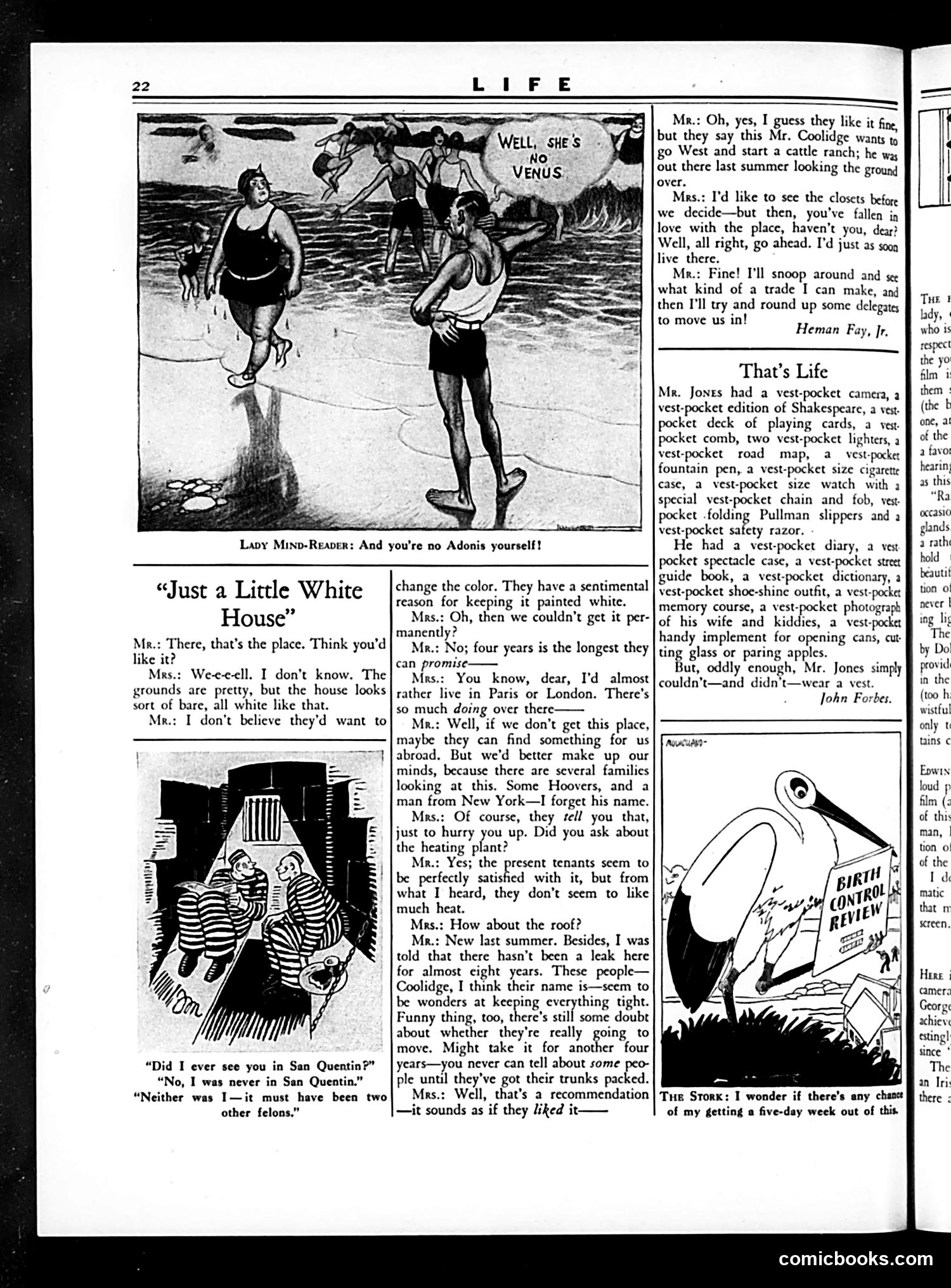
This cartoon satirizes the real estate market of the early 1920s through the lens of renting the **White House itself**. The couple viewing the property treats it like any ordinary home listing—noting the bare white exterior, questioning the lease terms (only "four years"), asking about heating and roof repairs. The satire targets President **Calvin Coolidge**, who is mentioned by name as the current tenant. The joke is that the White House is being shown like a modest rental with temporary occupancy, undermining its dignity. References to "Hoovers" (likely Herbert Hoover) and competing families viewing the property add absurdist humor—treating the presidency as a casual residential transaction. The final exchange where the husband mentions "round[ing] up some delegates to move us in" mocks the political process by equating presidential election to securing a real estate deal through negotiation. This reflects 1920s anxieties about housing, temporary living arrangements, and political uncertainty—all wrapped in irreverent satire typical of *Life* magazine's social commentary.
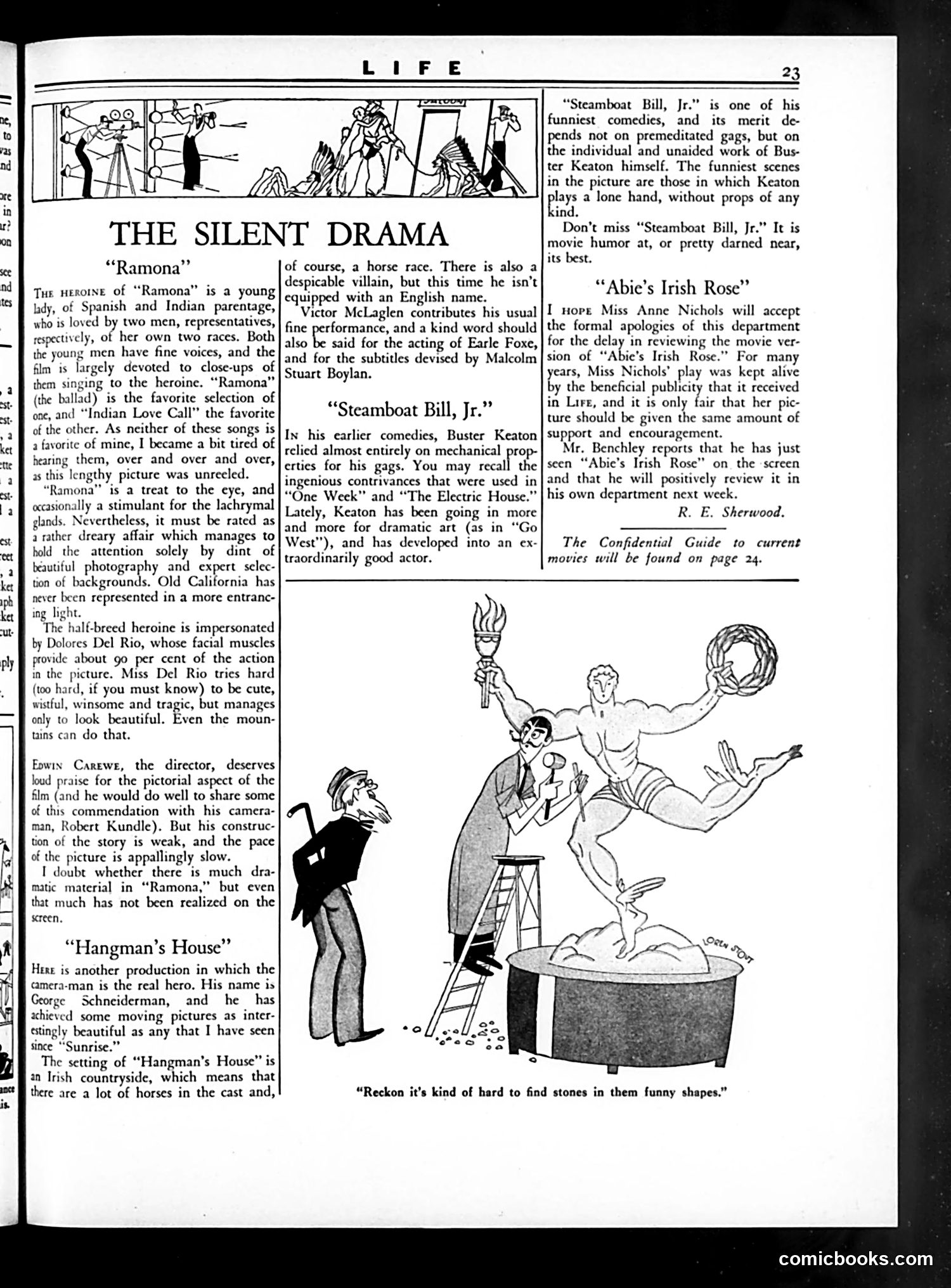
This page contains reviews of four silent films by what appears to be film critic R.E. Sherwood. The reviews assess recent movies: **"Ramona"** — criticized as visually beautiful but dramatically weak, with actress Dolores Del Rio relying too heavily on facial expressions rather than genuine acting ability. **"Hangman's House"** — praised for cinematography by George Schneiderman, featuring Irish countryside and horse racing, with actor Victor McLaglen delivering a strong performance. **"Steamboat Bill, Jr."** — enthusiastically recommended as Buster Keaton's funniest comedy, notable because its humor derives from Keaton's own physical performance rather than mechanical props, showing his growth as an actor. **"Abie's Irish Rose"** — mentioned briefly with a humorous apology for delayed review, referencing the play's long popularity and promising a full review in the next issue. The cartoon below depicts the filmmaker's work, playing on the difficulty of finding appropriately shaped stones for comic effect.
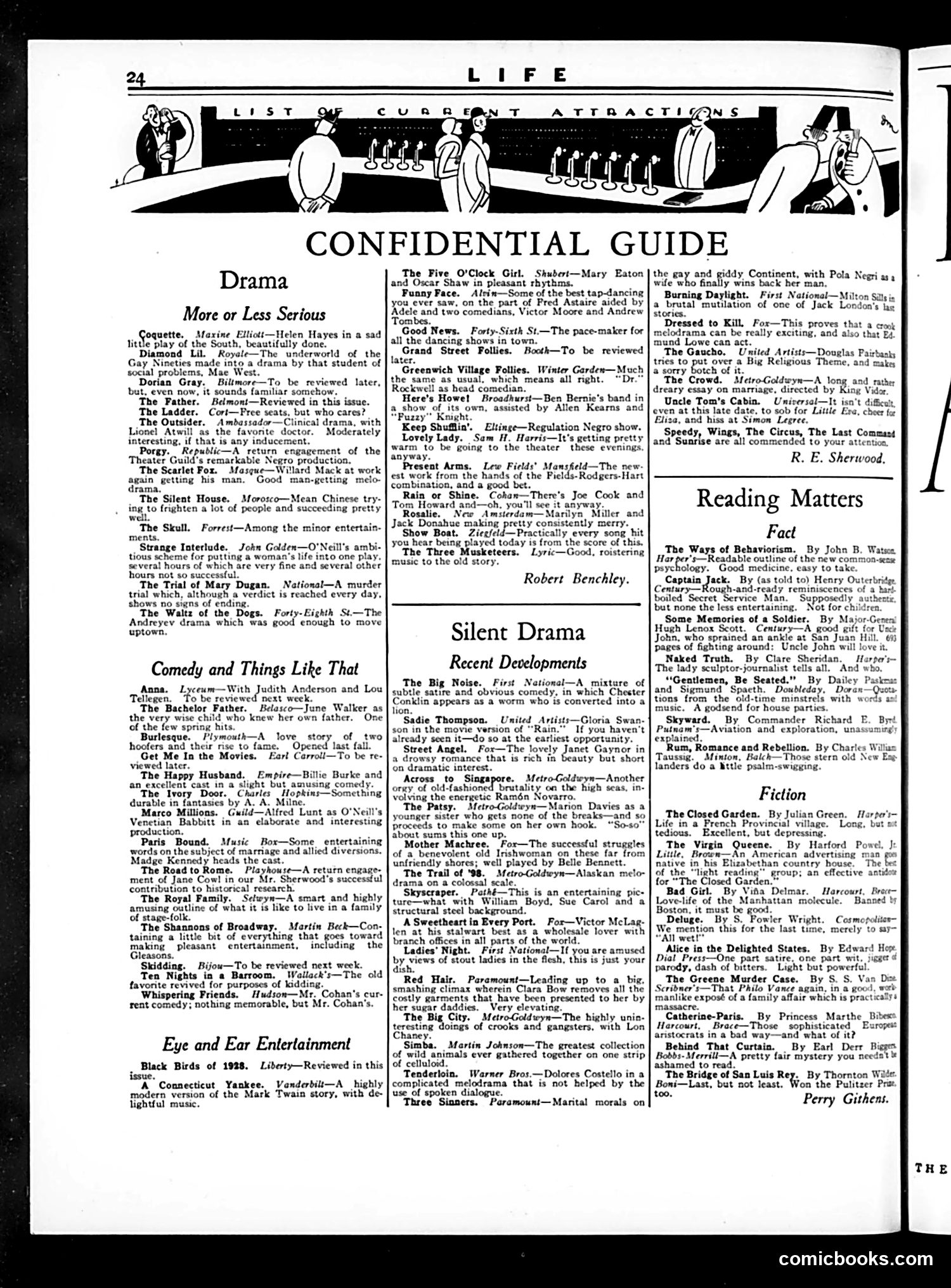
This page is a **theatre guide and review section**, not a political cartoon. It's a practical listing of Broadway shows currently playing, organized by genre: drama (serious and comedic), and musical entertainment. The content reflects 1920s New York theatre culture. Notable entries include Mae West's *Diamond Lil* (scandalous for depicting underworld life), Eugene O'Neill's *Strange Interlude* (experimental), and *Porgy* (described as a "Negro production" by the Theatre Guild—reflecting period racial terminology). The brief descriptions are typically witty and irreverent—characteristic of Life magazine's satirical voice. For example, *The Ladder* gets dismissed as "Free seats, but who cares?" and *The Trial of Mary Dugan* is mocked for its endless run despite nightly verdicts. This is primarily **reference material for theatre-goers**, not satire or commentary on political/social issues—just entertainment journalism reflecting 1920s Broadway tastes and attitudes.
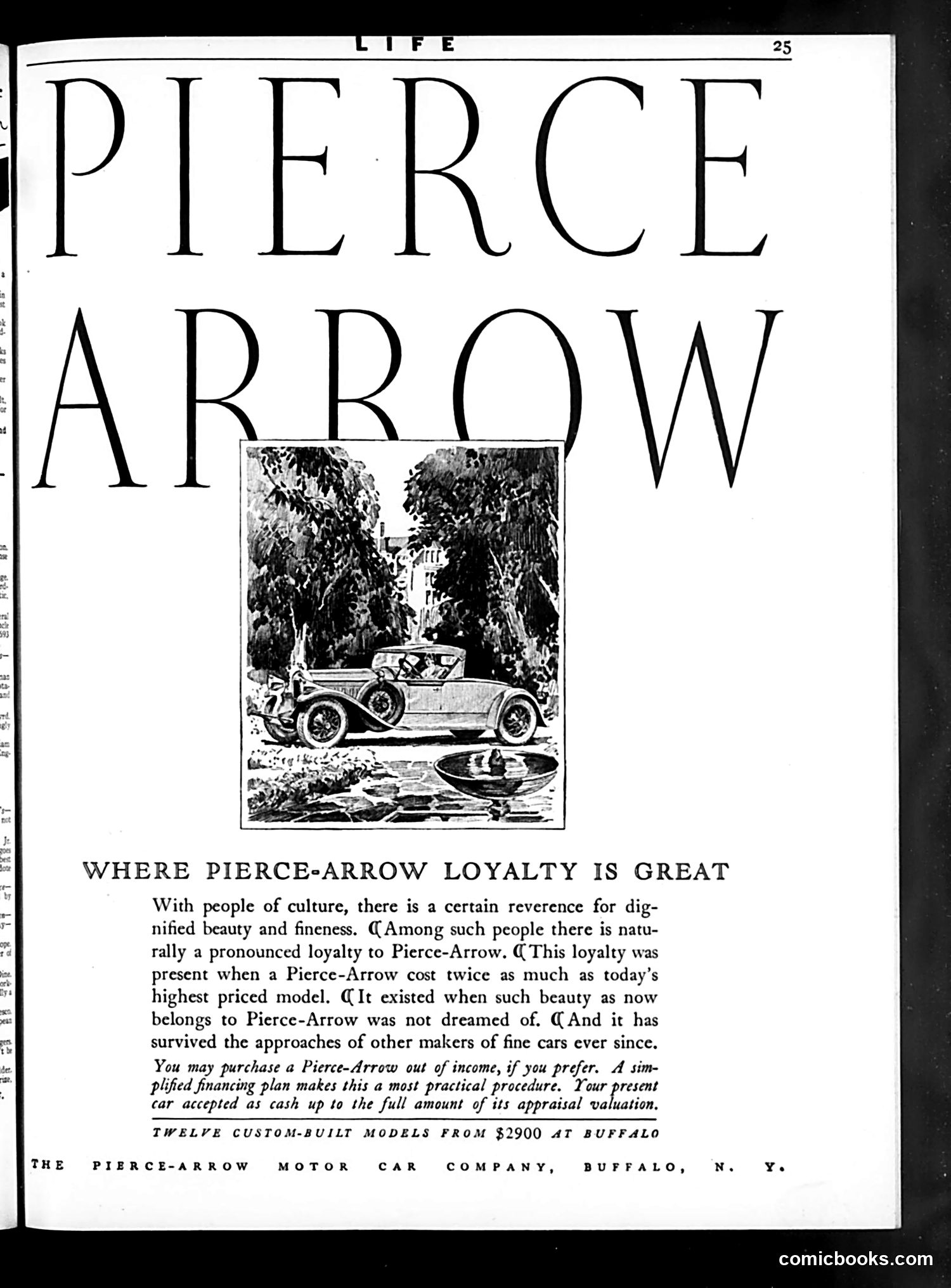
This page from *Life* is a Pierce-Arrow automobile advertisement, not a political cartoon or satirical content. It features a vintage illustration of an elegant car parked near a fountain in a landscaped setting, appealing to wealthy, cultured consumers. The ad argues that Pierce-Arrow vehicles command loyalty among "people of culture" due to their "dignified beauty and fineness." It emphasizes the brand's prestige by noting the car cost twice as much as competitors' highest-priced models, yet maintains customer devotion. The copy positions Pierce-Arrow as the choice for refined buyers while promoting a flexible financing plan and trade-in options. This represents typical luxury car marketing of the era—associating the product with status, taste, and exclusivity rather than practical features.
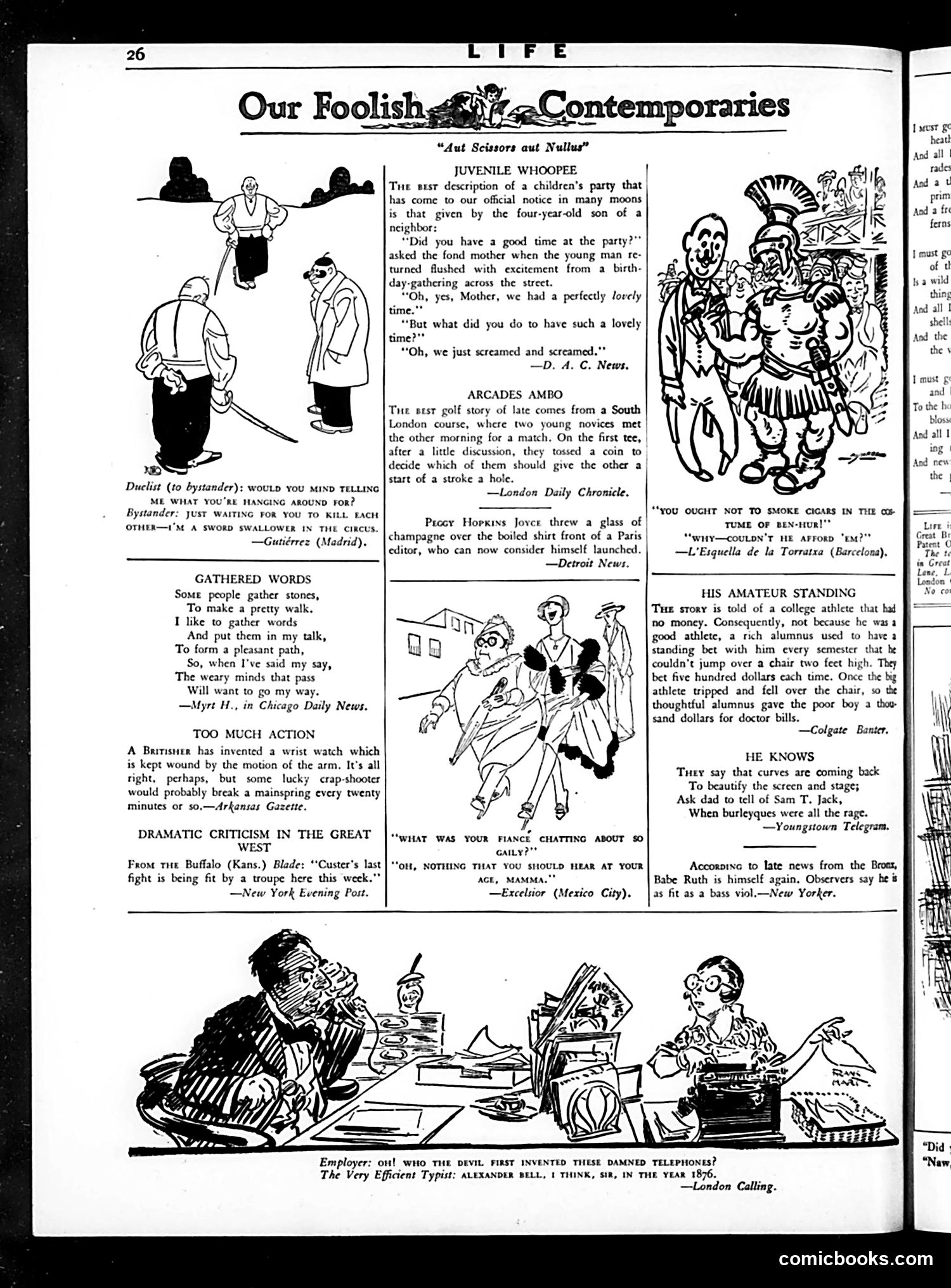
This page collects brief humorous anecdotes and cartoons mocking contemporary society. Key items include: **The Duelist cartoon**: A Spanish satirical jab at honor culture—a sword swallower waits for two duelists to kill each other so he can use their corpses for his circus act, highlighting the absurdity of deadly dueling traditions. **"Juvenile Whoopee"**: A child's innocent description of a birthday party as simply "screaming and screaming"—humor derived from the gap between parental expectations and chaotic reality. **Golf and Champagne anecdotes**: Gentle mockery of emerging leisure activities (golf) and celebrity scandals (Peggy Hopkins Joyce's infamous Paris incident). **The College Athlete story**: Satire of wealthy alumni exploiting poor students under the guise of generosity—betting money while the athlete risks injury. **The Telephone joke**: A typist correctly attributes the telephone's invention to Alexander Bell (1876), implying employers blame modern technology for workplace chaos. Overall, the page satirizes foolish contemporary behaviors across class, sport, and technology—typical of Life's light satirical approach to early 20th-century society.
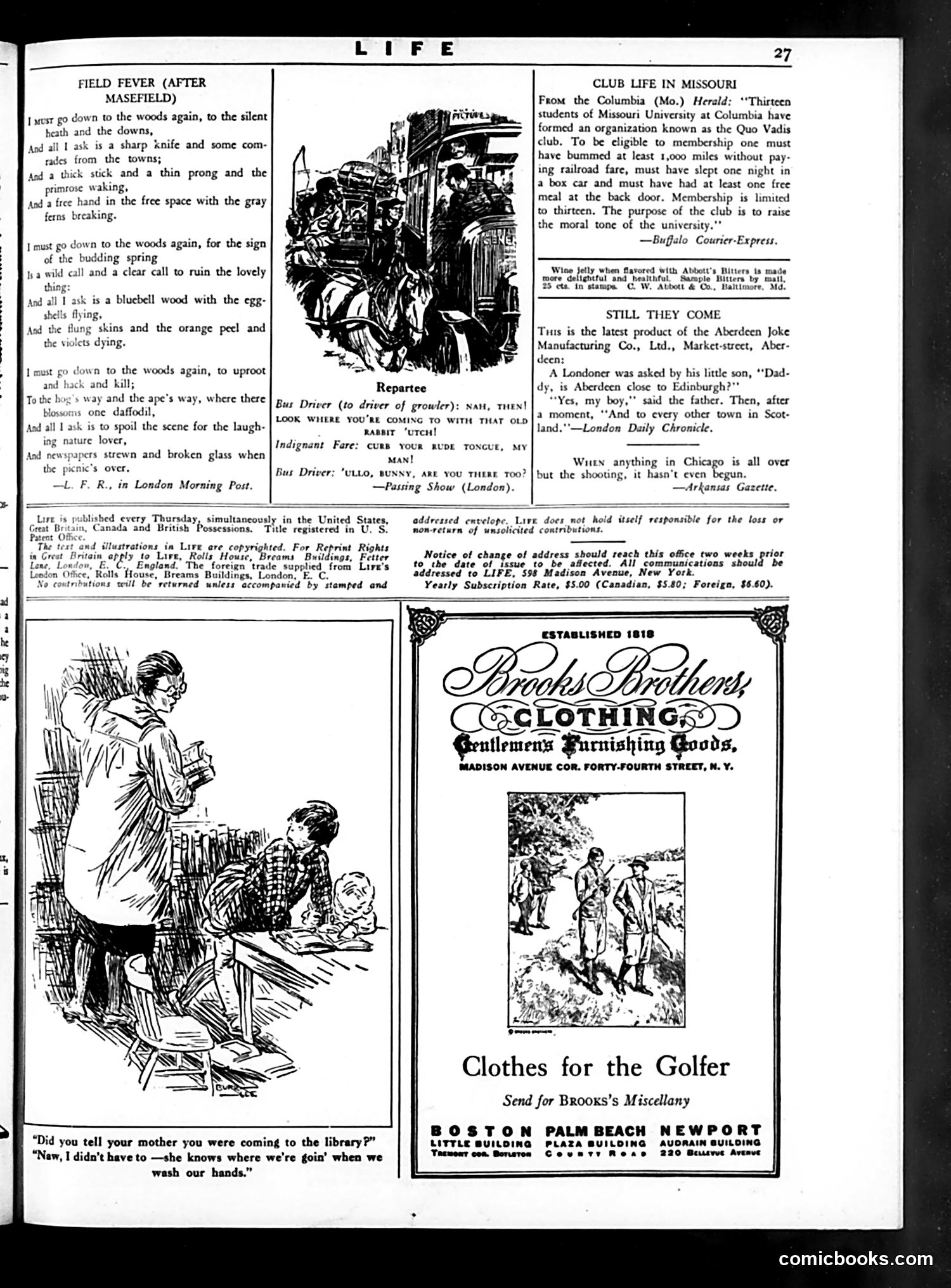
This page contains several satirical pieces targeting early 20th-century social behaviors: **"Field Fever (After Masefield)"** parodies poet John Masefield's romantic celebration of nature and adventure ("Sea Fever"). The satire inverts Masefield's noble sentiments, depicting picnickers as destructive vandals who litter forests with "newspapers strewn and broken glass," trample bluebells, and leave orange peels and eggshells. It mocks the gap between urbane tourists' pretensions about appreciating nature and their actual careless behavior. **The "Repartee" cartoon** shows a humorous London bus exchange: a driver confronts another driver about reckless driving with his "old rabbit hutch" (slang for a ramshackle vehicle), but the passenger insults him, prompting the driver's sarcastic comeback asking if the heckler is also present. **"Club Life in Missouri"** satirizes a university club whose membership requirements—hoboing 1,000 miles, sleeping in boxcars, begging meals—are presented ironically as promoting "moral tone." The joke is the contradiction between disreputable behavior and stated moral purposes. The page is primarily text-driven satire rather than visual cartooning.
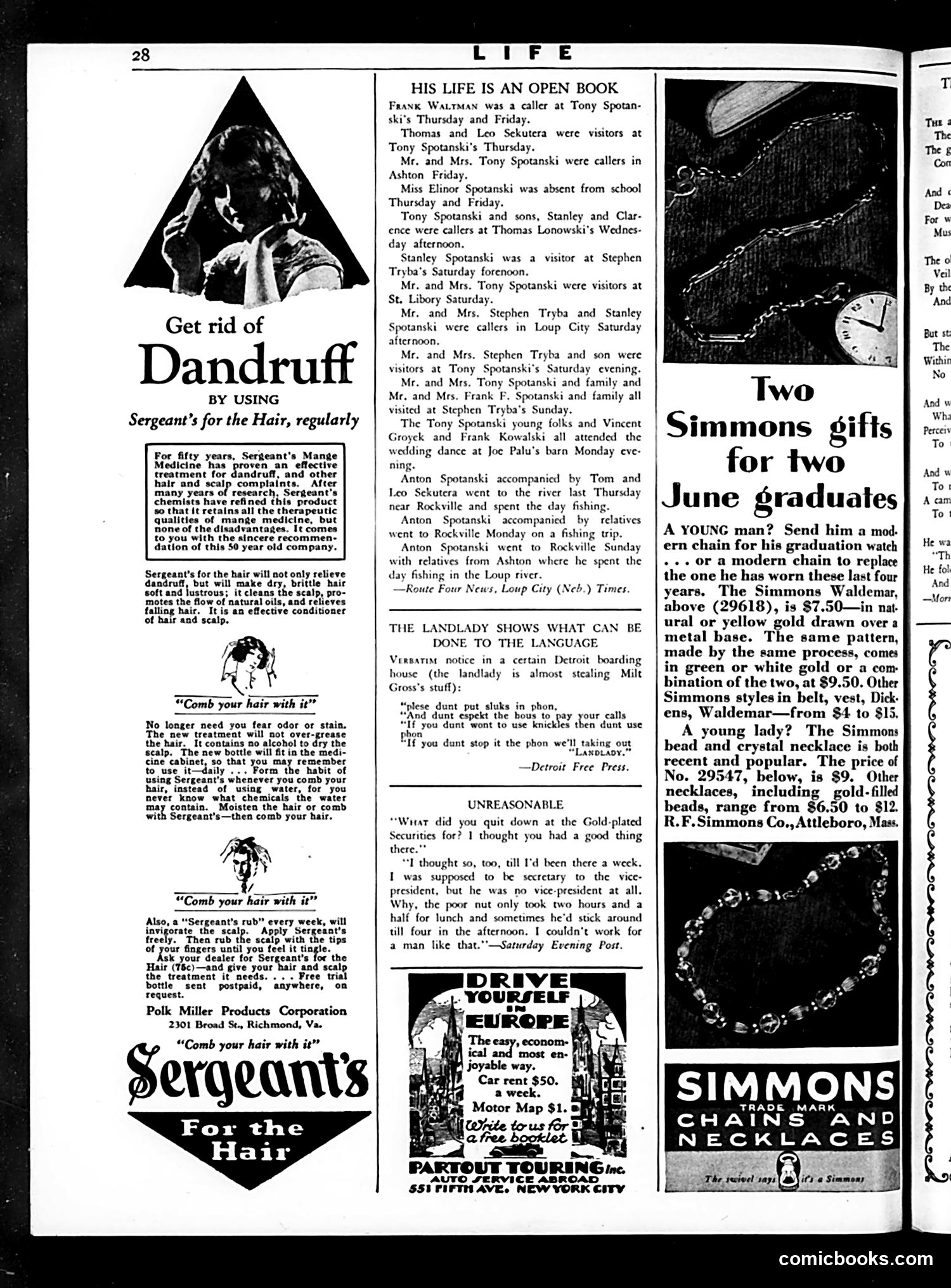
This page consists primarily of **advertisements and community news**, not political satire. The main content includes: 1. **Sergeant's Dandruff Treatment ads** - vintage hair-care marketing emphasizing the product relieves dandruff and conditions hair. The repetitive "Comb your hair with it" messaging is typical early 20th-century advertising. 2. **"His Life is an Open Book"** - a humorous small-town gossip column from Loup City, Nebraska, listing mundane social visits by the Spotanski and Tryba families. The satire is gentle: it mocks how small-town newspapers publish exhaustive details of neighbors' movements and visits, making everyone's private life public. 3. **"The Landlady" section** - mocks a boarding-house landlady's intentionally misspelled rules (mimicking comedian Milt Gross's style), satirizing working-class immigrants' or newcomers' struggles with English. 4. **"Unreasonable"** - a brief joke about an impatient employee quitting because his boss only worked 2.5-4 hours daily. The page reflects early 20th-century concerns: hygiene, small-town community culture, and labor relations.
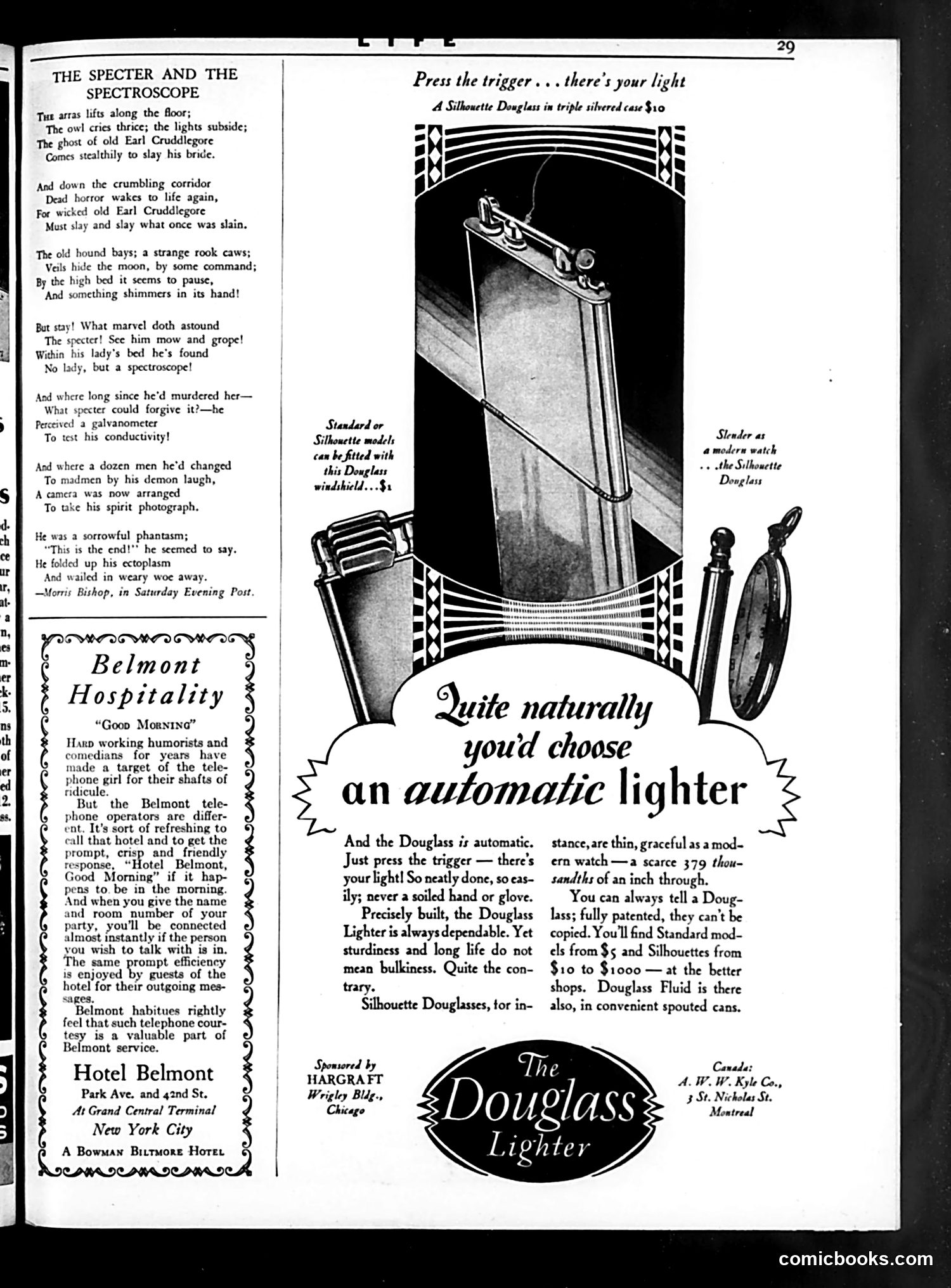
This page contains two distinct elements: a humorous poem and advertisements. **The Poem ("The Specter and the Spectroscope"):** A Gothic-style narrative parody by Morris Bishop mocks supernatural horror fiction. The ghost of "Earl Cruddlegore" returns to haunt and murder his bride, but discovers modern scientific instruments in her bed instead—a spectroscope, galvanometer, camera. The specter, confronted by rational science rather than romance, despairs and vanishes. The satire targets both melodramatic ghost stories and the era's faith in scientific rationalism as a replacement for superstition. **The Advertisements:** Two hotel and product ads occupy the lower portion. The "Belmont Hospitality" ad praises the hotel's telephone operators for exceptional courtesy—a gentle jab at the era's common jokes mocking telephone girls' rudeness. The dominant Douglass Lighter advertisement emphasizes automatic convenience: "just press the trigger—there's your light," highlighting the modern consumer desire for effortless functionality. The lighter's thinness ("scarce 379 thousandths of an inch") appeals to aesthetic sophistication. Together, the page reflects 1920s-30s preoccupations with technological progress, convenience, and modernity replacing tradition.
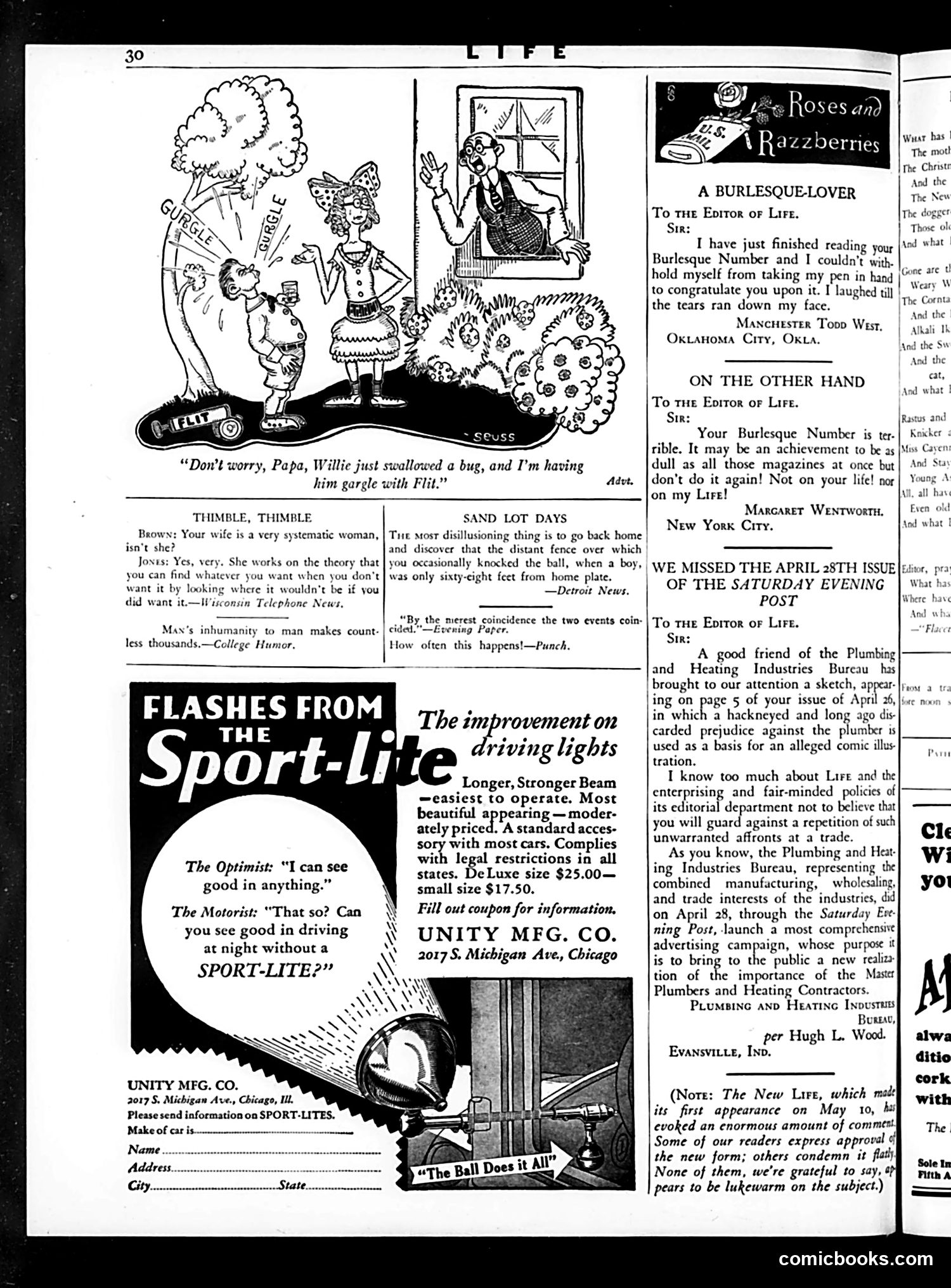
This page contains a humor magazine mixing short jokes, reader letters, and advertisements—typical of Life's satirical format. **The main cartoon** (top) shows a child reassuring her father that his son swallowed a bug but is gargling with "Flit" (an insecticide brand). The joke plays on parental anxiety: instead of being alarmed, the child treats the situation as a minor pest-control problem, humorously inverting normal concern. **The reader letters** debate Life's recent "Burlesque Number"—one reader loved it, another found it tedious. This reflects how Life's humor divided audiences. **Notable is the plumbing industry complaint**: A trade bureau protests that Life published a joke "prejudice against the plumber," requesting the magazine avoid such stereotypes. This reveals early professional PR efforts to control media representation of trades. **Advertisements** for "Sport-Lite" driving lights and other products fill the remaining space, typical of magazine monetization then. The page overall captures 1920s-era humor sensibilities and the emerging tension between satirical publications and industries seeking favorable media coverage.
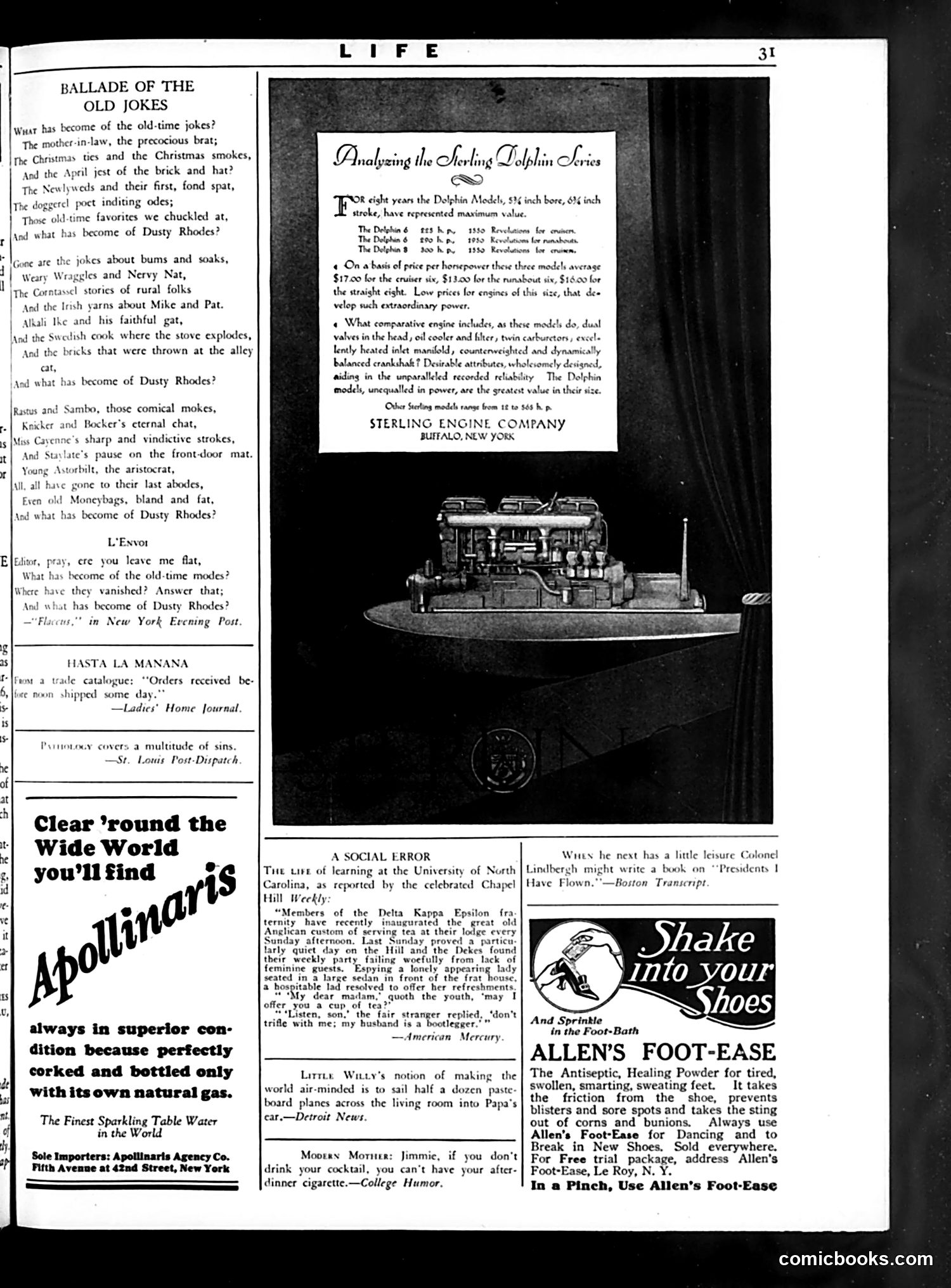
This page contains a satirical poem "Ballade of the Old Jokes" lamenting the disappearance of early 20th-century comedy stock characters: mother-in-law jokes, ethnic caricatures (Rastus, Sambo), and dated comic-strip figures (Alkali Ike, Young Astorbilt). The refrain "What has become of Dusty Rhodes?" appears to reference either a forgotten vaudeville character or perhaps a generic everymantype, emphasizing how quickly popular entertainment becomes obsolete. The poem mocks how rapidly comedy trends fade—the "old-time" jokes referenced were likely already considered stale when this was written. The repeated questioning suggests both nostalgia and irony: these weren't actually *good* jokes, yet their passing marks cultural change. The remaining page content consists primarily of period advertisements (Apollinaris water, Allen's Foot-Ease powder, Sterling engines) and brief humorous filler items about collegiate customs and modern absurdities—typical Life magazine format from the 1920s-30s era.
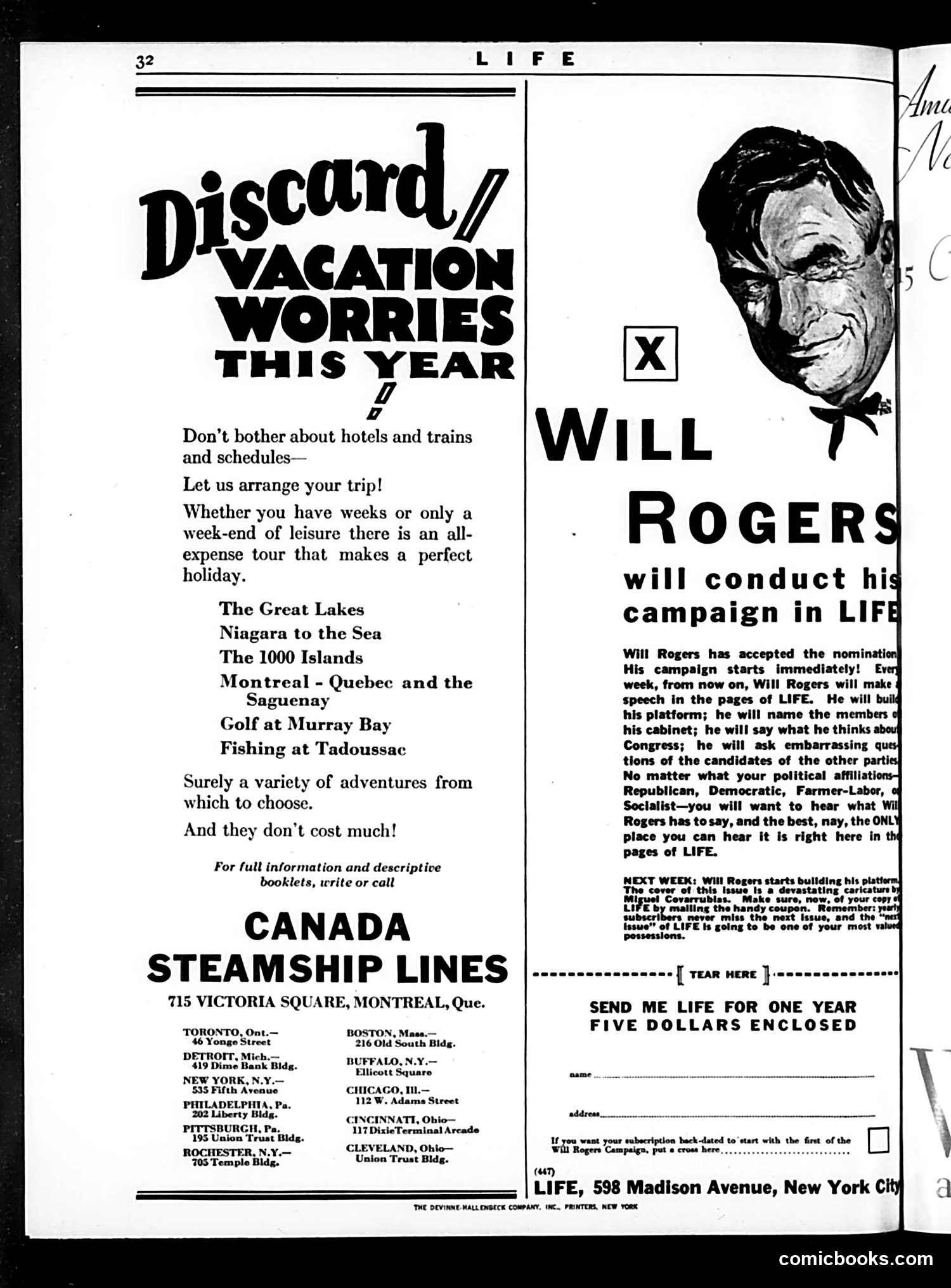
This page announces that humorist and entertainer **Will Rogers** has accepted a nomination to conduct a satirical political campaign exclusively in LIFE magazine. Rogers will publish weekly speeches building a mock platform, naming a fictional cabinet, and critiquing Congress and opposing candidates. The text emphasizes that readers of all political affiliations—Republican, Democratic, Farmer-Labor, Socialist—should read Rogers's commentary, framing LIFE as the *only* place to hear his views. A caricature by artist Miguel Covarrublas depicts Rogers. This is political satire through humor rather than a genuine candidacy. Rogers was a famous wit known for sharp social commentary. The campaign serves as LIFE's vehicle for political satire and social criticism during what appears to be a U.S. election year. The left page is a Canada Steamship Lines advertisement—typical of period magazine layout mixing editorial and advertising content.