
Life, 1928-05-31 · page 13 of 34
Life — May 31, 1928 — page 13: what you’re looking at
What you’re looking at
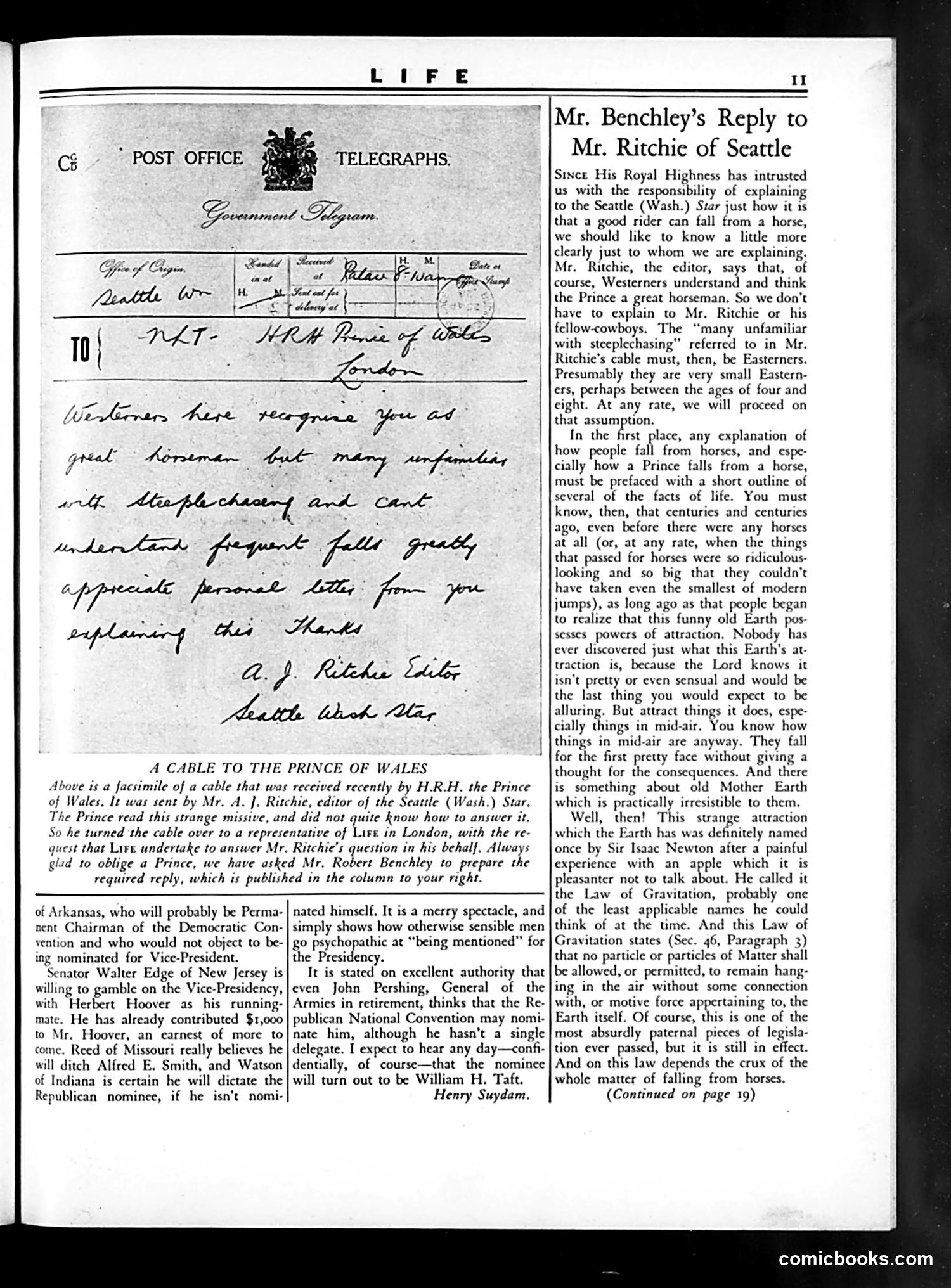
This page contains **two distinct items**: 1. **A facsimile of a government telegram** supposedly received by H.R.H. the Prince of Wales, purportedly from Mr. A.J. Ritchie (editor of the Seattle Star) asking how a good rider can fall from a horse. The Prince's representatives forwarded this to Life's Robert Benchley for explanation. The satire mocks both the absurdity of asking royalty such a question and the presumed naïveté of small-town editors. 2. **Benchley's humorous reply** explaining gravitational attraction using mock-scientific language, ultimately suggesting that falling from horses simply demonstrates Earth's gravitational pull—treating the question with exaggerated seriousness to highlight its fundamental silliness. The joke satirizes pretentious rural Americans questioning the Prince of Wales.
📄 Transcribed text from this page (OCR, searchable)
Machine-transcribed from the original scan — historical spelling and the odd misread are preserved.
LIFE II * POST OFFICE Be TELEGRAPHS: Government Lig lolegiarn. Kandel inet A CABLE TO THE PRINCE OF WALES Above is a facsimile of a cable that was received recently by H.R.H. the Prince of Wales, It was sent by Mr. A. ]. Ritchie, editor of the Seattle (Wash.) Star. The Prince read this strange missive, and did not quite know how to answer it. So he turned the cable over to a representative of Lire in London, with the re- quest that Lire undertake to answer Mr. Ritchie's question in his behalf. Always glad to oblige a Prince, we have asked Mr. Robert Benchley to prepare the required reply, which is published in the column to your right. of Arkansas, who will probably be Perma- nent Chairman of the Democratic Con- vention and who would not object to be- ing nominated for Vice-President. Senator Walter Edge of New Jersey is willing to gamble on the Vice-Presidency, with Herbert Hoover as his running- mate. He has already contributed $1,000 to Mr. Hoover, an earnest of more to come. Reed of Missouri really believes he will ditch Alfred E. Smith, and Watson of Indiana is certain he will dictate the Republican nominee, if he isn’t nomi- nated himself. It is a merry spectacle, and simply shows how otherwise sensible men go psychopathic at “being mentioned” for the Presidency. It is stated on excellent authority that even John Pershing, General of the Armies in retirement, thinks that the Re- publican National Convention may nomi- nate him, although he hasn’t a single delegate. I expect to hear any day—confi- dentially, of course—that the nominee will turn out to be William H. Taft. Henry Suydam. Mr. Benchley’s Reply to Mr. Ritchie of Seattle Stnce His Royal Highness has intrusted us with the responsibility of explaining to the Seattle (Wash.) Star just how it is that a good rider can fall from a horse, we should like to know a little more clearly just to whom we are explaining. Mr. Ritchie, the editor, says that, of course, Westerners understand and think the Prince a great horseman. So we don't have to explain to Mr. Ritchie or his fellow-cowboys. The “many unfamiliar with steeplechasing” referred to in Mr. Ritchie's cable must, then, be Easterners. Presumably they are very small Eastern- ers, perhaps between the ages of four and eight. At any rate, we will proceed on that assumption. In the first place, any explanation of how people fall from horses, and espe- cially how a Prince falls from a horse, must be prefaced with a short outline of several of the facts of life. You must know, then, that centuries and centuries ago, even before there were any horses at all (or, at any rate, when the things that passed for horses were so ridiculous- looking and so big that they couldn't have taken even the smallest of modern jumps), as long ago as that people began to realize that this funny old Earth pos- sesses powers of attraction. Nobody has ever discovered just what this Earth's at- traction is, because the Lord knows it isn’t pretty or even sensual and would be the last thing you would expect to be alluring. But attract things it does, espe- cially things in mid-air. You know how things in mid-air are anyway. They fall for the first pretty face without giving a thought for the consequences. And there is something about old Mother Earth which is practically irresistible to them. Well, then! This strange attraction which the Earth has was definitely named once by Sir Isaac Newton after a painful experience with an apple which it is pleasanter not to talk about. He called it the Law of Gravitation, probably one of the least applicable names he could think of at the time. And this Law of Gravitation states (Sec. 46, Paragraph 3) that no particle or particles of Matter shall be allowed, or permitted, to remain hang- ing in the air without some connection with, or motive force appertaining to, the Earth itself. Of course, this is one of the most absurdly paternal pices of legisla- tion ever passed, but it is still in effect. And on this law depends the crux of the whole matter of falling from horses. (Continued on page 19) comicbooks.com