
Life, 1928-05-31 · page 26 of 34
Life — May 31, 1928 — page 26: what you’re looking at
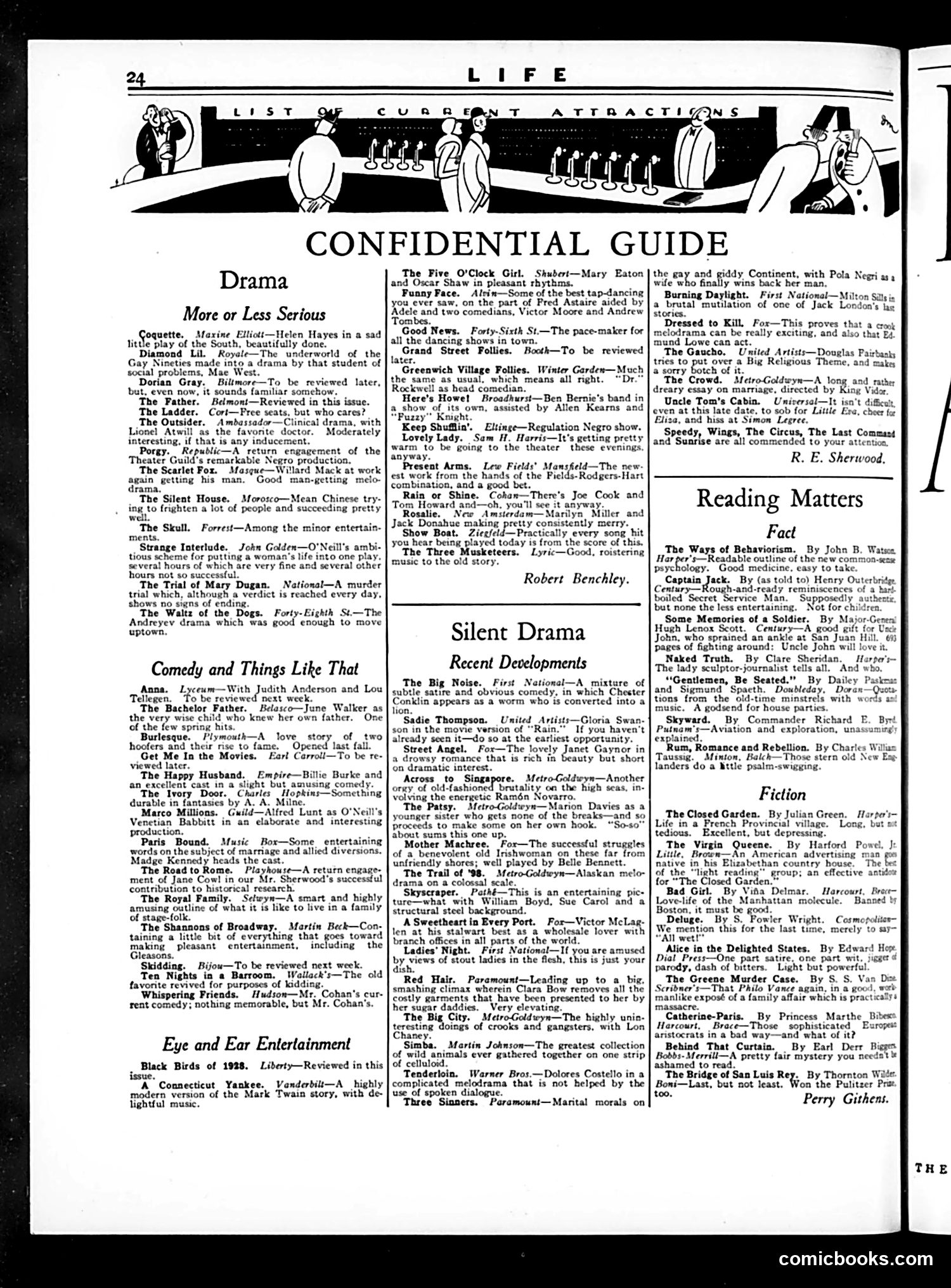
What you’re looking at
This page is a **theatre guide and review section**, not a political cartoon. It's a practical listing of Broadway shows currently playing, organized by genre: drama (serious and comedic), and musical entertainment. The content reflects 1920s New York theatre culture. Notable entries include Mae West's *Diamond Lil* (scandalous for depicting underworld life), Eugene O'Neill's *Strange Interlude* (experimental), and *Porgy* (described as a "Negro production" by the Theatre Guild—reflecting period racial terminology). The brief descriptions are typically witty and irreverent—characteristic of Life magazine's satirical voice. For example, *The Ladder* gets dismissed as "Free seats, but who cares?" and *The Trial of Mary Dugan* is mocked for its endless run despite nightly verdicts. This is primarily **reference material for theatre-goers**, not satire or commentary on political/social issues—just entertainment journalism reflecting 1920s Broadway tastes and attitudes.
📄 Transcribed text from this page (OCR, searchable)
Machine-transcribed from the original scan — historical spelling and the odd misread are preserved.
CONFIDENTIAL GUIDE Drama More or Less Serious Goauette,, Maxine Elliott Helen Hayes in a sad little play of the South, beautifully done. Diamond Lil. Koyele—The underworld of the Gay Nineties made into a drama by that student of social problems, Mae West. Dorian Gra: Bilimore—To be reviewed later, but, even now, it sounds familiar somehow The Father. Belmont—Reviewed in this issue. The Ladder. Cort—Pree seats, but who cares? The Outsider. Ambassador—Clinical drama, w Lionel Atwill as the favorite doctor. Moderately interesting, if that is any inducement. Porgy. Republic—A return engagement of the Theater Guild's remarkable Negro production. The Scarlet Fox. Masque—Willard Mack at work again getting his man. Good man-getting melo- drama. The Silent House. Morosco—Mean Chinese try- ing to frighten a lot of people and succeeding pretty well. The Skull. Forrest—Among the minor entertain- ments. Strange Interlude. John Galden—O'Neill’s ambi tious scheme for putting a woman's life into one pla’ several hours of which are very fine and several other hours not so successful. The Trial of Mary Dugan. National—A murder trial which, although a verdict is reached every day, shows no signs of ending. The Waltz of the Dogs. Forty-Eighth St—The Andreyey drama which was good enough to move uptown, Comedy and Things Like That Anna. Lyceum—With Judith Anderson and Lou Tellegen. o be reviewed next week. The Bachelor Father. Belasco—June Walker as the very wise child who knew her own father. One of the few spring hits Burlesque. Plymouth—A love story of two hoofers and ‘their rise to fame. Opened last fall. Get Me In the Movies. Earl Carroll—To be re- viewed later. The Happy Husband. Em an excellent cast in a slight but amusing comed The Ivory Door. Charles Hopkins—Something durable in fantasies by A. A. Milne. Marco Millions. Guild—Alfred Lunt as O'Neill's Venetian Babbitt in an elaborate and interesting production. Paris Bound. Music Bor—Some entertaining words on the subject of marriage and allied diversions. Madge Kennedy heads the cast. The Road to Rome. Playhouse—A return engage- ment of Jane Cow! in our Mr. Sherwood's successful contribution to historical research. The Royal Famil, Setwyn—A smart and highly amusing outline of what it is like to live in a family of stage-folk. The Shannons of Broadway. Martin Beck—Con- taining a little bit of everything that goes toward making pleasant entertainment, including the Gleasons. Skidding. Bijow—To be reviewed next week. Ten Nights in a Barroom. Wallack’s—The old favorite revived for purposes of kidding. Whispering Friends. Hudson—Mr. Cohan's cur- rent comedy; nothing memorable, but Mr. Cohan’s. ire—Billie Burke and Eye and Ear Entertainment Black Birds of 1928. Liberty—Reviewed in this issue, ‘A Connecticut Yankee. Vanderdilt—A highly modern version of the Mark Twain story, with de- lightful music. The Five O'Clock Girl. Shuberi—Mary Eaton and Oscar Shaw in pleasant rhythms. ; Funny Face. Alein—Some of the best tap-dancing you ever saw, on the part of Pred Astaire aided by Adele and two comedians, Victor Moore and Andrew Tombes. Good News. Forty-Sixth St.—The pace-maker for all the dancing shows in town. ; Stand Street Follies. Booth—To be reviewed ater. Greenwich Village Follies. Winter Garden—Much the same as usual, which means all right. “Dr.” Rockwell as head comedian. . Here's Howet Broadhurst—Ben Bernie's band in a show of its own, assisted by Allen Kearns and Fuzzy” Knight. Keep Shuflin’, Eltinge—Regulation Negro show. Lovely Lady. Sam H. Harris—It's getting pretty warm to be going to the theater these evenings. anyway, Present Arms. Lew Fields’ Mansfeld—The new- est work from the hands of the Pields-Rodgers-Hart combination, and a good bet. Rain or Shine. Cokan—There's Joe Cook and Tom Howard and—oh, you'll see it anyway. Rosalie. New Amsterdam—Marilyn Miller and Jack Donahue making pretty consistently merry. Show Boat. Zicgfeld—Practically every song hit you hear being played today is from the score of this. The Three Musketeers. Lyric—Good, roistering music to the old story. Robert Benchley. Silent Drama Recent Developments The Big Noise. First National—A mixture of subtle satire and obvious comedy, in which Chester Conklin appears as a worm who is converted into a Non. Sadie Thompson. United Artists—Gloria Swan- son in the movie version of “Rain.” If you haven't already seen it—do so at the earliest opportunity. Street Angel. Fox—The lovely Janet Gaynor in a drowsy romance that is rich in beauty but short on dramatic interest, Across to Singapore. Metro-Goldwyn—Another orgy of old-fashioned brutality on the high seas, in- volving the energetic Ramén Novarro. The Patsy. Metro-Goldwyn—Marion Davies as a younger sister who gets none of the breaks—and so proceeds to make some on her own hook. “So-so" about sums this one up. Mother Machree. Fox—The successful struggles of a benevolent old Irishwoman on these far from unfriendly shores; well played by Belle Bennett. The Trail of "98. AMfetro-Goldwyn—Alaskan drama on a colossal scal Skyscraper. Pothé—This is an entertaining pic- ture—what with William Boyd, Sue Carol and a structural steel background. A Sweetheart in Every Port. For—Victor McLag- len at his stalwart best as a wholesale lover with branch offices in all parts of the world. Ladies’ Night. First National—If you are amused by wiews of stout ladies in the flesh, this is just your dish. Red Hair, Paramount—Leading up to a big, smashing climax wherein Clara Bow removes all the costly garments that have been presented to her by her sugar daddies. Very elevating. The Big City. Metro-Goldwyn—The highly unie- teresting doings of crooks and gangsters, with Lon Chaney Simba. Martin Johnson—The greatest collection of wild animals ever gathered together on one strip of celluloid. Tenderloin. Warner Bros.—Dolores Costello in a complicated melodrama that is not helped by the use of spoken dialogue. Three Sinners. Paramount—Marital morals on the gay and giddy Continent, with Pola Negr wile who finally wins back ber man. ems Burning Daylight. First National—Milton a brutal ‘mutilation of one of Jack Lo Stories. Dressed to Kill, For—This proves th melodrama can be really exciting, and mund Lowe can act. The Gaucho, United Artists—Douglas Pairbasiy tries to put over a Big Religious Theme, an a sorry botch of it. The Crowd. MetroGoldwyn—A long and rather dreary essay on marriage, directed by Ring Vidor Uncle Tom's Cabin. Unisersal—It isn't diffu, even at this late date, to sob for Little Eva, cheer for Eliza, and hiss at Simon Legree, Speedy, Wings, The Circus, The Last Commant and Sunfise are all commended to your attention R. E. Sherwood, Reading Matters Fact The Ways of Behaviorism. By John B. Watse Har per's—Readable outline of the new common-sea psychology. Good medicine, easy to take. Captain Jack. By (as told to) Henry Outerbritge Century—Rough-and-ready reminiscences of a ba: boiled Secret Service Man. Supposedly but none the less entertaining. Not for c Some Memories of a Soldier. Hugh Lenox Scott. Century—A good gift fc John, who sprained an ankle at San Juan Hi pages of fighting around: Uncle John wil Naked Truth. By Clare Sheridan. ‘The lady sculptor-journalist tells all. An’ “Gentlemen, Be Seated.” By Dailey and Sigmund Spaeth. Doubleday, Doran—Quo tions from the old-time minstrels with words as music. A godsend for house parties. Skyward. By Commander Richard E. By Putnam’s—Aviation and exploration, unassuming explained, Rum, Romance and Rebellion. By Charles Will Taussig. Minton, Balch—Those stern old New E: landers do a Bittle psalm-swigging. Fiction The Closed Garden. By Julian Green. Harper’ Life in a Prench Provincial village. Long, bu! tedious. Excellent, but depressing. The Virgin Queene. By Harford Little, Brown—An American advertising native in his Elizabethan country house. of the “light reading" group; an effective an for “The Closed Garden.” Bad Girl. By Vifia Delmar. Harcourt, Broc- Love-life of the Manhattan molecule. Banned joston, it must be good. Deluge. By S. Powler Wright. Cosmop We mention this for the last time, merely AML wet!” Alice in the Delighted States. By Edwar: Dial Press—One part satire, one part wit parody, dash of bitters. Light but powerful The Greene Murder Case. By S. S. Van De Scribner’s—That Philo Vance again, in a goc manlike exposé of a family affair which is prac massacre. Catherine-Paris. By Princess Marthe Bibexs Harcourt, Brace—Those sophisticated Europes? aristocrats in a bad way—and what of it? Behind That Curtain. By Earl Derr Biggs Bobbs-Merrill—A pretty fair mystery you needat & ashamed to read. The Bridge of San Luis Rey. By Thornton Wie Boni—Last, but not least. Won the Pulitzer Praz fee Perry Githens. 0 sy Hoge. comicbooks.com THE