
Life, 1928-05-31 · page 23 of 34
Life — May 31, 1928 — page 23: what you’re looking at
What you’re looking at
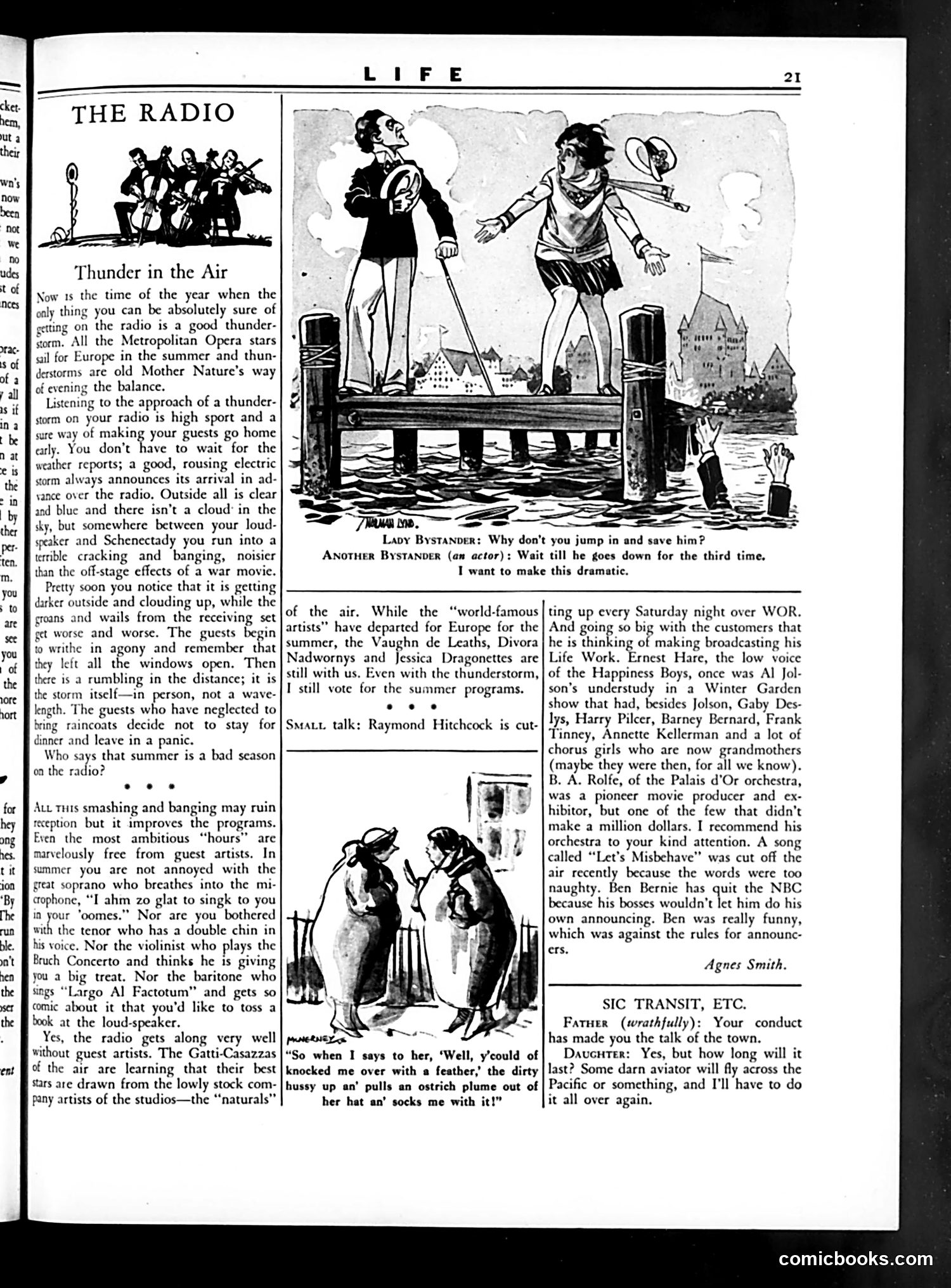
This page satirizes early radio broadcasting during summer months. The main article, "Thunder in the Air," jokes that thunderstorms provide better entertainment than the Metropolitan Opera stars who depart for Europe seasonally—nature "evens the balance." The cartoon depicts two actors on a bridge: one drowning while the other refuses to save him, wanting to wait for "the third time" to make it "dramatic." This mocks theatrical pretension and method acting. The article celebrates lesser-known radio "naturals" (studio performers like the Vaughn de Leaths and Jessica Dragonettes) over temperamental guest artists with affected accents. It notes that even thunderstorm interference improves programming by eliminating vain singers and musicians. The bottom anecdote references broadcaster Raymond Hitchcock and mentions performers like Ernest Hare and Ben Bernie—radio personalities who faced network censorship (one song was cut for being "too naughty"). The satire targets radio's growing professionalization and corporate control over creative content.
📄 Transcribed text from this page (OCR, searchable)
Machine-transcribed from the original scan — historical spelling and the odd misread are preserved.
RRSASE RS Es Thunder in the Air Now 1s the time of the year when the only thing you can be absolutely sure of getting on the radio is a good thunder- sorm. All the Metropolitan Opera stars ail for Europe in the summer and thun- derstorms are old Mother Nature’s way of evening the balance. Listening to the approach of a thunder- storm on your radio is high sport and a sure way of snakiOF your guests go home arly. You don’t have to wait for the weather reports; a good, rousing electric sorm always announces its arrival in ad- yance over the radio. Outside all is clear and blue and there isn’t a cloud: in the sky, but somewhere between your loud- speaker and Schenectady you run into a terrible cracking and banging, noisier than the off-stage effects of a war movie. Pretty soon you notice that it is getting darker outside and clouding up, while the groans and wails from the receiving set get worse and worse. The guests begin to writhe in agony and remember that they left all the windows open. Then there is a rumbling in the distance; it is the storm itselfi—in person, not a wave- length. The guests who have neglected to bring raincoats decide not to stay for dinner and leave in a panic. Who says that summer is a bad season oa the radio? eee Aut THIs smashing and banging may ruin reception but it improves the programs. Even the most ambitious “hours” are marvelously free from guest artists. In summer you are not annoyed with the great soprano who breathes into the mi- aophone, “I ahm zo glat to singk to you in pur ‘oomes.” Nor are you bothered with the tenor who has a double chin in his voice. Nor the violinist who plays the Bruch Concerto and thinks he is giving you a big treat. Nor the baritone who sings “Largo Al Factotum” and gets so comic about it that you'd like to toss a book at the loud-speaker. Yes, the radio gets along very well without guest artists. The Gatti-Casazzas of the air are learning that their best stars are drawn from the lowly stock com- pany artists of the studios—the “‘naturals” Lavy Bystanper: Why don’t you jump in and save him? ANOTHER BysTANDER (an actor): Wait till he goes down for the third time, I want to make this dramatic. of the air. While the ‘orld-famous artists” have departed for Europe for the summer, the Vaughn de Leaths, Divora Nadwornys and Jessica Dragonettes are still with us. Even with the thunderstorm, I still vote for the summer programs. eee Sat talk: Raymond Hitchcock is cut- “So when I says to her, ‘Well, y’could of knocked me over with a feather,’ the dirty hussy up an’ pulls an ostrich plume out of her hat an’ socks me with it!” ting up every Saturday night over WOR. And gi i so big with the customers that he is thinking of making broadcasting his Life Work. Ernest Hare, the low voice of the Happiness Boys, once was Al Jol- son’s understudy in a Winter Garden show that had, besides Jolson, Gaby Des- lys, Harry Pilcer, Barney Bernard, Frank Tinney, Annette Kellerman and a lot of chorus girls who are now grandmothers (maybe they were then, for all we know). B. A. Rolfe, of the Palais d’Or orchestra, was a pioneer movie producer and ex- hibitor, but one of the few that didn’t make a million dollars. I recommend his orchestra to your kind attention. A song called “Let's Misbehave’’ was cut off the air recently because the words were too naughty. Ben Bernie has quit the NBC because his bosses wouldn't let him do his own announcing. Ben was really funny, which was against the rules for announc- crs. Agnes Smith. SIC TRANSIT, ETC. Farner (swrathfully): Your conduct has made you the talk of the town. Davucuter: Yes, but how long will it last? Some darn aviator will fly across the Pacific or something, and I'll have to do it all over again. comicbooks.com