
Life, 1928-05-31 · page 18 of 34
Life — May 31, 1928 — page 18: what you’re looking at
What you’re looking at
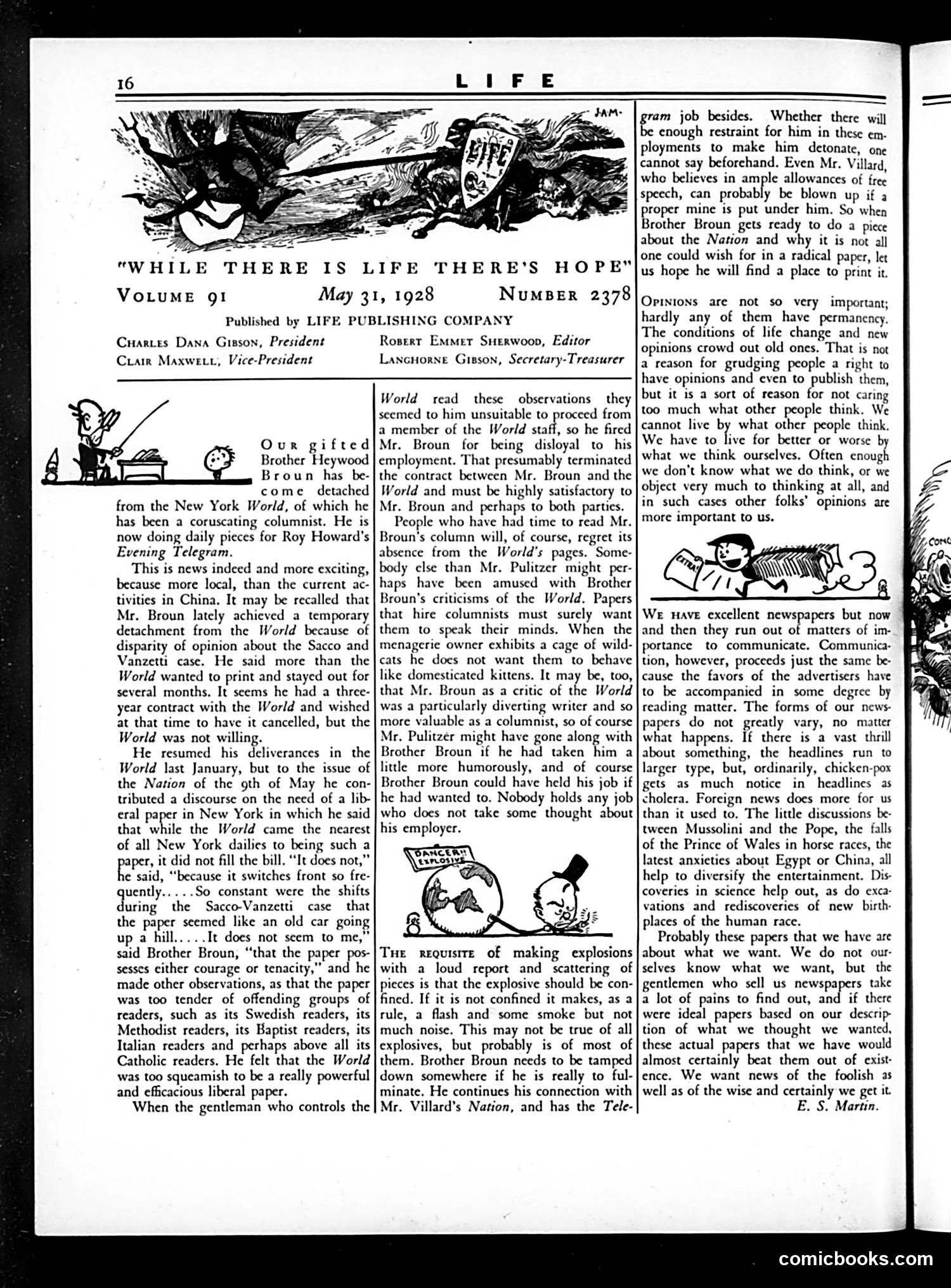
This page discusses **Heywood Broun**, a columnist recently fired from the *New York World* newspaper over his coverage of the Sacco-Vanzetti case (a controversial 1920s trial). The magazine's editors debate whether the *World* was right to dismiss him for his opinions. The cartoons appear to satirize **newspaper editorial control and free speech**. One cartoon shows figures in conflict, likely depicting the tension between Broun's controversial writing and his employer's desire for "respectable" content. The broader point critiques how newspapers claim to be liberal while actually suppressing columnists' genuine viewpoints—they want "domesticated kittens," not real journalists. The piece argues newspapers should embrace diverse opinions rather than caging writers' minds.
📄 Transcribed text from this page (OCR, searchable)
Machine-transcribed from the original scan — historical spelling and the odd misread are preserved.
I “WHILE THERE IS LIFE THERE’S HOPE" VOLUME 91 May 31, 1928 NuMBER 2378 Published by LIFE PUBLISHING COMPANY Cuarces Dana Gisson, President Crain Maxwetr, Vice-President Our gifted Brother Heywood Broun has be- come detached from the New York World, of which he has been a coruscating columnist. He is now doing daily pieces for Roy Howard's Evening Telegram. This is news indeed and more exciting, because more local, than the current ac- tivities in China. It may be recalled that Mr. Broun lately achieved a temporary detachment from the World because of disparity of opinion about the Sacco and Vanzetti case. He said more than the World wanted to print and stayed out for several months. It seems he had a three- year contract with the World and wished at that time to have it cancelled, but the World was not willing. He resumed his deliverances in the World last January, but to the issue of the Nation of the gth of May he con- tributed a discourse on the need of a lib- eral paper in New York in which he said that while the World came the nearest of all New York dailies to being such a paper, it did not fill the bill. ‘It does not,” ¢ said, “because it switches front so fre- .....So constant were the shifts uring the Sacco-Vanzetti case that the paper seemed like an old car going up a hill.....It does not seem to me,” said Brother Broun, “that the paper pos- sesses cither courage or tenacity,” and he made other observations, as that the paper was too tender of offending groups of readers, such as its Swedish readers, its Methodist readers, its Baptist readers, its Italian readers and perhaps above all its Catholic readers. He felt that the World was too squeamish to be a really powerful and efficacious liberal paper. When the gentleman who controls the Rosert Emmet Suerwoon, Editor LancHorne Gisson, Secretary-Treasurer World read these observations _ they seemed to him unsuitable to proceed from a member of the World staff, so he fired Mr. Broun for being disloyal to his employment. That presumably terminated the contract between Mr. Broun and the World and must be highly satisfactory to Mr. Broun and perhaps to both parties. People who have had time to read Mr. Broun’s column will, of course, regret its absence from the World’s pages. Some- body else than Mr. Pulitzer might per- haps have been amused with Brother Broun’s criticisms of the World. Papers that hire columnists must surely want them to speak their minds. When the menagerie owner exhibits a cage of wild- cats he does not want them to behave like domesticated kittens. It may be, too, that Mr. Broun as a critic of the World was a particularly diverting writer and so more valuable as a columnist, so of course Mr. Pulitzer might have gone along with Brother Broun if he had taken him a litle more humorously, and of course Brother Broun could have held his job if he had wanted to. Nobody holds any job who does not take some thought about his employer. Tue reguistre of making explosions with a loud report and scattering of pieces is that the explosive should be con- fined. If it is not confined it makes, as a rule, a flash and some smoke but not much noise. This may not be true of all explosives, but probably is of most of them. Brother Broun needs to be tamped down somewhere if he is really to ful- minate. He continues his connection with Mr. Villard’s Nation, and has the Tele- ee job besides. Whether there will enough restraint for him in these em. ployments to make him detonate, one cannot say beforehand. Even Mr. Villard, who believes in ample allowances of free speech, can probably be blown up if a proper mine is put under him. So when Brother Broun gets ready to do a Piece about the Nation and why it is not all one could wish for in a radical paper, let us hope he will find a place to print it. Opinions are not so very important; hardly any of them have permanency, The conditions of life change and new opinions crowd out old ones. That is not a reason for grudging people a right to have opinions and even to publish them, but it is a sort of reason for not caring too much what other people think. We cannot live by what other people think. We have to live for better or worse b what we think ourselves. Often enoug! we don’t know what we do think, or we object very much to thinking at all, and in such cases other folks’ opinions are more important to us. We nave excellent newspapers but now and then they run out oP matters of im- portance to communicate. Communica- tion, however, proceeds just the same be- cause the favors of the advertisers have to be accompanied in some degree by reading matter. The forms of our news- papers do not greatly vary, no matter what happens. If there is a vast thrill about something, the headlines run to larger type, but, ordinarily, chicken-pox gets as much notice in headlines as cholera. Foreign news does more for us than it used to, The little discussions be- tween Mussolini and the Pope, the falls of the Prince of Wales in horse races, the latest anxieties about Egypt or China, all help to diversify the entertainment. Dis- coveries in science help out, as do exca- vations and rediscoveries of new birth: places of the human race. Probably these papers that we have are about what we want. We do not our- selves know what we want, but the gentlemen who sell us newspapers take a lot of pains to find out, and if there were ideal papers based on our descrip tion of what we thought we wanted, these actual papers that we have would almost certainly beat them out of exist- ence. We want news of the foolish as well as of the wise and certainly we get it E. S. Martin. comicbooks.com