
Life, 1928-05-31 · page 12 of 34
Life — May 31, 1928 — page 12: what you’re looking at
What you’re looking at
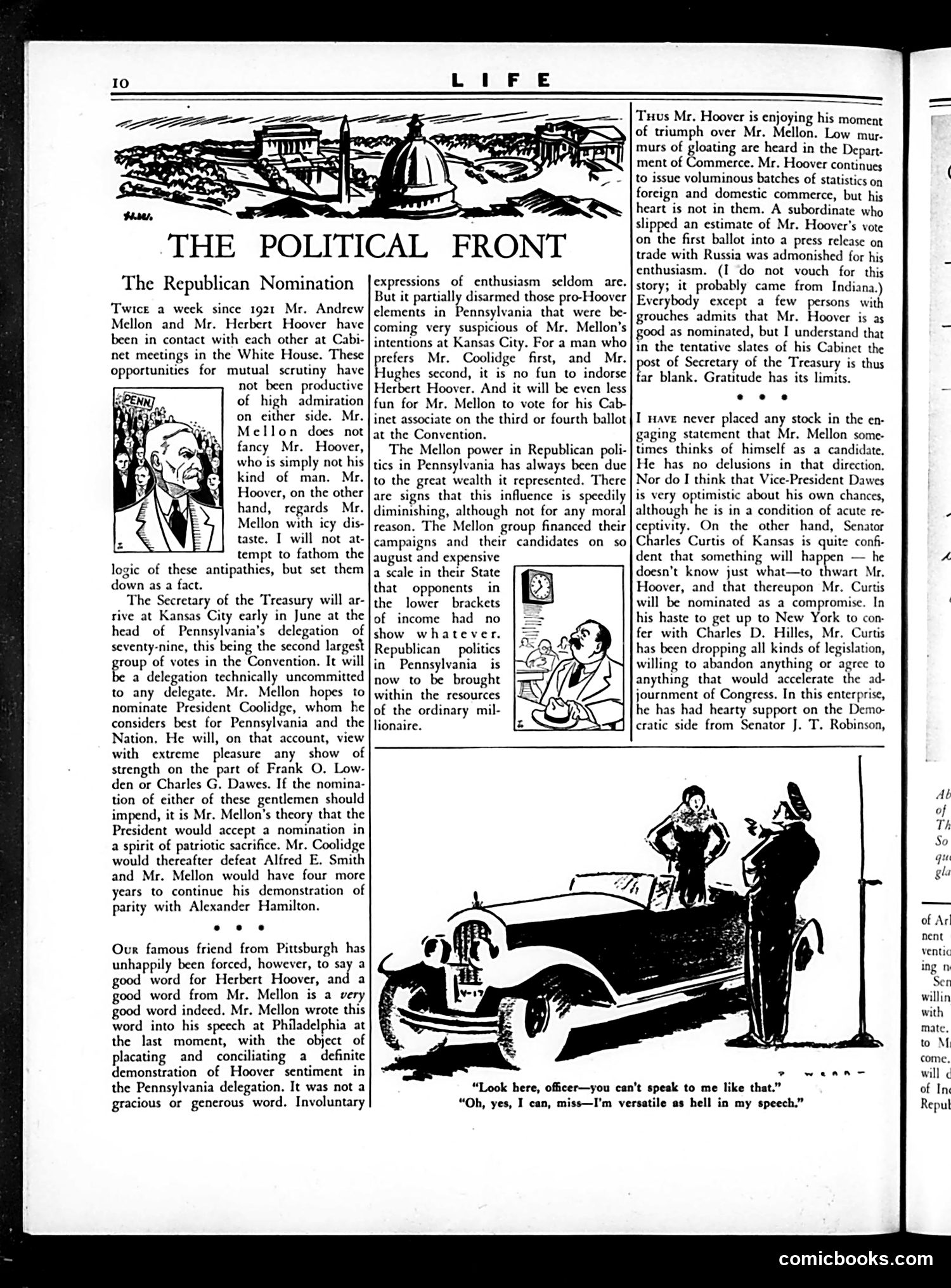
This page satirizes the 1924 Republican presidential nomination process. The main article discusses tensions between Treasury Secretary Andrew Mellon and Herbert Hoover, both seeking influence over the nomination. The cartoon at bottom depicts a speeding car with a woman and police officer. The woman (appearing to represent a political candidate or position) tells the officer: "Look here, officer—you can't speak to me like that." He responds: "Oh yes, I can, miss—I'm versatile as hell in my speech." The satire suggests political figures are opportunistically adaptable in their rhetoric—willing to say whatever necessary to different audiences. The car's speed implies reckless political maneuvering during the nomination race.
📄 Transcribed text from this page (OCR, searchable)
Machine-transcribed from the original scan — historical spelling and the odd misread are preserved.
Pe) Ww yo we, THE POLITI The Republican Nomination Twice a week since 1921 Mr. Andrew Mellon and Mr. Herbert Hoover have been in contact with each other at Cabi- net meetings in the White House. These Opportunities for mutual scrutiny have not been productive of high admiration on either side. Mr. Mellon does not fancy Mr. Hoover, who is simply not his kind of man. Mr. Hoover, on the other hand, regards Mr. Mellon with icy dis- taste. I will not at- tempt to fathom the logic of these antipathies, but set them down as a fact. The Secretary of the Treasury will ar- rive at Kansas City early in June at the head of Pennsylvania’s delegation of seventy-nine, this being the second largest roup of votes in the Convention. It will be a delegation technically uncommitted to any delegate. Mr. Mellon hopes to nominate President Coolidge, whom he considers best for Pennsylvania and the Nation. He will, on that account, view with extreme pleasure any show of strength on the part of Frank O. Low- den or Charles G. Dawes. If the nomina- tion of either of these gentlemen should impend, it is Mr. Mellon's theory that the President would accept a nomination in a spirit of patriotic sacrifice. Mr. Coolidge would thereafter defeat Alfred E. Smith and Mr. Mellon would have four more years to continue his demonstration of parity with Alexander Hamilton. Our famous friend from Pittsburgh has unhappily been forced, however, to say a good word for Herbert Hoover, and a good word from Mr. Mellon is a very good word indeed. Mr. Mellon wrote this word into his speech at Philadelphia at the last moment, with the object of placating and conciliating a definite demonstration of Hoover sentiment in the Pennsylvania delegation. It was not a gracious or generous word. Involuntary CAL FRONT expressions of enthusiasm seldom are. But it partially disarmed those pro-Hoover elements in Pennsylvania that were be- coming very suspicious of Mr. Mellon's intenuons at Kansas City. For a man who refers Mr. Coolidge first, and Mr. Frughes second, it is no fun to indorse Herbert Hoover. And it will be even less fun for Mr. Mellon to vote for his Cab- inet associate on the third or fourth ballot at the Convention. The Mellon power in Republican poli- tics in Pennsylvania has always been due to the great wealth it represented. There are signs that this influence is speedily diminishing, although not for any moral reason. The Mellon group financed their campaigns and their candidates on so august and expensive a scale in their State that opponents in the lower brackets of income had no show whatever. Republican _ politics in Pennsylvania is now to be brought within the resources of the ordinary mil- lionaire. Tuus Mr. Hoover is enjoying his moment of triumph over Mr. Mellon. Low mur- murs of gloating are heard in the Depart. ment of Commerce. Mr. Hoover continues to issue voluminous batches of statistics on foreign and domestic commerce, but his heart is not in them. A subordinate who slipped an estimate of Mr. Hoover's vote on the first ballot into a press release on trade with Russia was admonished for his enthusiasm. (I do not vouch for this story; it probably came from Indiana.) Everybody except a few persons with grouches admits that Mr. Hoover is as good as nominated, but I understand that in the tentative slates of his Cabinet the st of Secretary of the Treasury is thus far blank. Gratitude has its limits. eee I nave never placed any stock in the en- gaging statement that Mr. Mellon some- times thinks of himself as a candidate. He has no delusions in that direction, Nor do I think that Vice-President Dawes is very optimistic about his own chances, although he is in a condition of acute re- ceptivity. On the other hand, Senator Charles Curtis of Kansas is quite confi- dent that something will happen — he doesn't know just what—to thwart Mr, Hoover, and that thereupon Mr. Curtis will be nominated as a compromise. In his haste to get up to New York to con- fer with Charles D. Hilles, Mr. Curtis has been dropping all kinds of legislation, willing to abandon anything or agree to anything that would accelerate the ad- journment of Congress. In this enterprise, he has had hearty support on the Demo- cratic side from Senator J. T. Robinson, “Look here, officer—you can’t speak to me like that.” “Oh, yes, I can, miss—I'm versatile as hell in my speech.” 1\) nent ventic ing n Sen willin with mate, to M come. will ¢ of Ini Reput comicbooks.com