
Life, 1928-05-31 · page 25 of 34
Life — May 31, 1928 — page 25: what you’re looking at
What you’re looking at
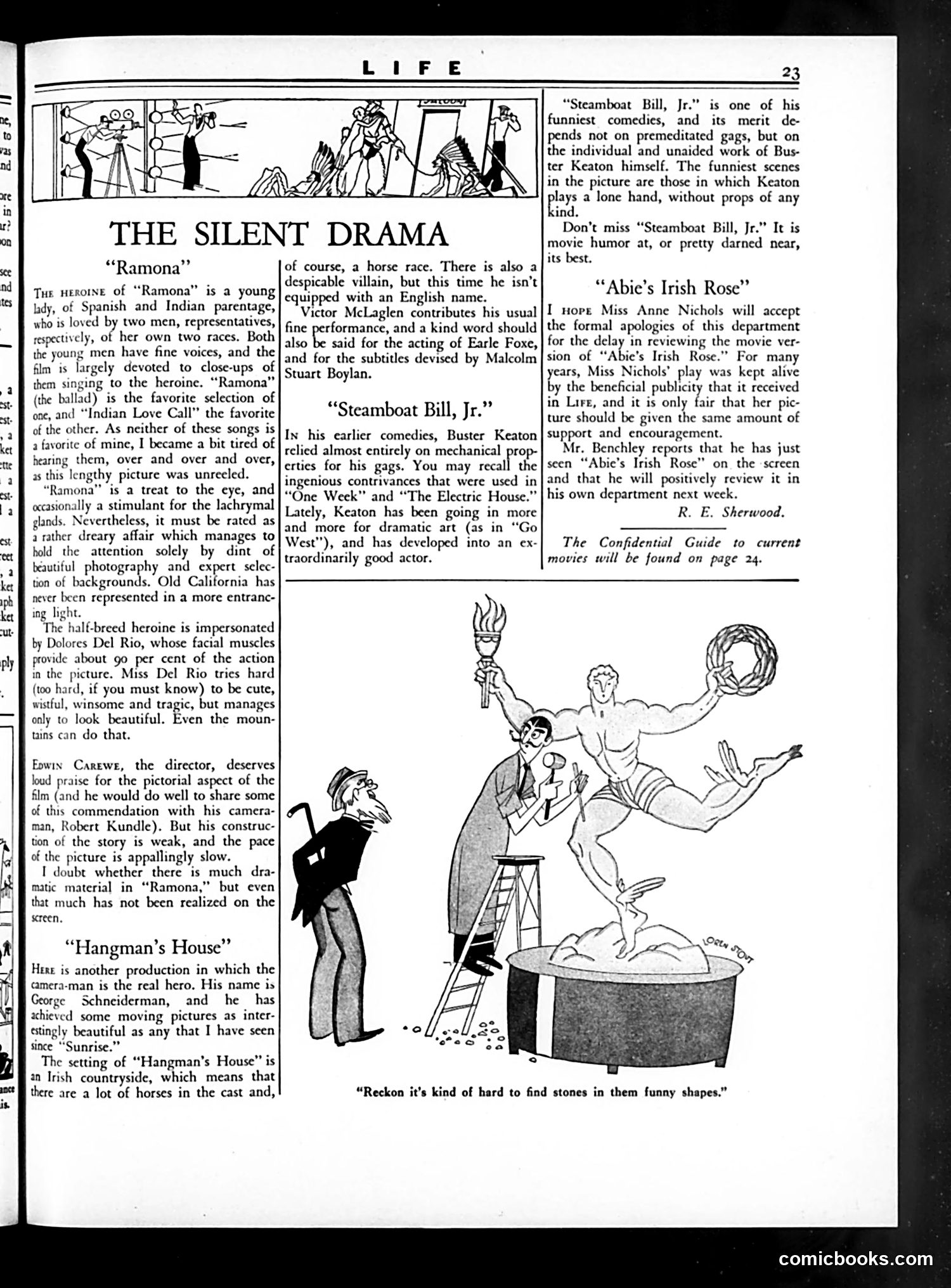
This page contains reviews of four silent films by what appears to be film critic R.E. Sherwood. The reviews assess recent movies: **"Ramona"** — criticized as visually beautiful but dramatically weak, with actress Dolores Del Rio relying too heavily on facial expressions rather than genuine acting ability. **"Hangman's House"** — praised for cinematography by George Schneiderman, featuring Irish countryside and horse racing, with actor Victor McLaglen delivering a strong performance. **"Steamboat Bill, Jr."** — enthusiastically recommended as Buster Keaton's funniest comedy, notable because its humor derives from Keaton's own physical performance rather than mechanical props, showing his growth as an actor. **"Abie's Irish Rose"** — mentioned briefly with a humorous apology for delayed review, referencing the play's long popularity and promising a full review in the next issue. The cartoon below depicts the filmmaker's work, playing on the difficulty of finding appropriately shaped stones for comic effect.
📄 Transcribed text from this page (OCR, searchable)
Machine-transcribed from the original scan — historical spelling and the odd misread are preserved.
RB BREA BRSH If ga 4, i 23 THE SILENT DRAMA “‘Ramona”’ Tur Hexotne of “Ramona” is a young hdy, of Spanish and Indian parentage, who is loved by two men, representatives, respectively, of her own two races. Both the young men have fine voices, and the film is largely devoted to close-ups of them singing to the heroine. “Ramona” (the ballad) is the favorite selection of one, and “Indian Love Call” the favorite of the other. As neither of these songs is a favorite of mine, I became a bit tired of hearing them, over and over and over, as this lengthy picture was unreeled. “Ramona” is a treat to the eye, and «casionally a stimulant for the lachrym: glands. Nevertheless, it must be rated as a rather dreary affair which manages to hold the attention solely by dint of beautiful photography and expert selec- tion of backgrounds. Old California has never been represented in a more entranc- ing light. The half-breed heroine is impersonated ty Dolores Del Rio, whose facial muscles provide about go per cent of the action in the picture. Miss Del Rio tries hard (too hard, if you must know) to be cute, wistful, winsome and tragic, but manages only to look beautiful. Even the moun- tains can do that. Eowin Carewe, the director, deserves loud praise for the pictorial aspect of the film (and he would do well to share some of this commendation with his camera- man, Robert Kundle). But his construc- tion of the story is weak, and the pace of the picture is appallingly slow. I doubt whether there is much dra- matic material in “Ramona,” but even that much has not been realized on the sxreen. “Hangman’s House” Hire is another production in which the mera-man is the real hero. His name is George Schneiderman, and he has achieved some moving pictures as inter- singly beautiful as any that I have seen sine “Sunrise.” The setting of “Hangman’s House” is an Irish countryside, which means that there are a lot of horses in the cast and, of course, a horse race. There is also a despicable villain, but this time he isn’t equipped with an English name. Victor McLaglen contributes his usual fine performance, and a kind word should also Re said for the acting of Earle Foxe, and for the subtitles devised by Malcolm Stuart Boylan. “Steamboat Bill, Jr.” In his earlier comedies, Buster Keaton relied almost entirely on mechanical prop- erties for his gags. You may recall the ingenious contrivances that were used in “One Week” and “The Electric House.” Lately, Keaton has been going in more and more for dramatic art (as in “Go West"), and has developed into an ex- traordinarily good actor. “Steamboat Bill, Jr.” is one of his funniest comedies, and its merit de- pends not on premeditated gags, but on the individual and unaided work of Bus- ter Keaton himself. The funniest scenes in the picture are those in which Keaton plays a lone hand, without props of any ind. Don’t miss “Steamboat Bill, Jr.” It is movie humor at, or pretty darned near, its best. “‘Abie’s Irish Rose” I nore Miss Anne Nichols will accept the formal apologies of this department for the delay in reviewing the movie ver- sion of “Abie’s Irish Rose.” For many years, Miss Nichols’ play was kept alive by the beneficial publicity that it received in Lire, and it is only fair that her pic- ture should be given the same amount of support and encouragement, Mr. Benchley reports that he has just seen “Abie’s Irish Rose” on the «screen and that he will positively review it in his own department next week. R. E. Sherwood. The Confidential Guide to current movies will be found on page 24. “Reckon it’s kind of hard to find stones in them funny shapes.” comicbooks.com