
Life, 1928-05-31 · page 22 of 34
Life — May 31, 1928 — page 22: what you’re looking at
What you’re looking at
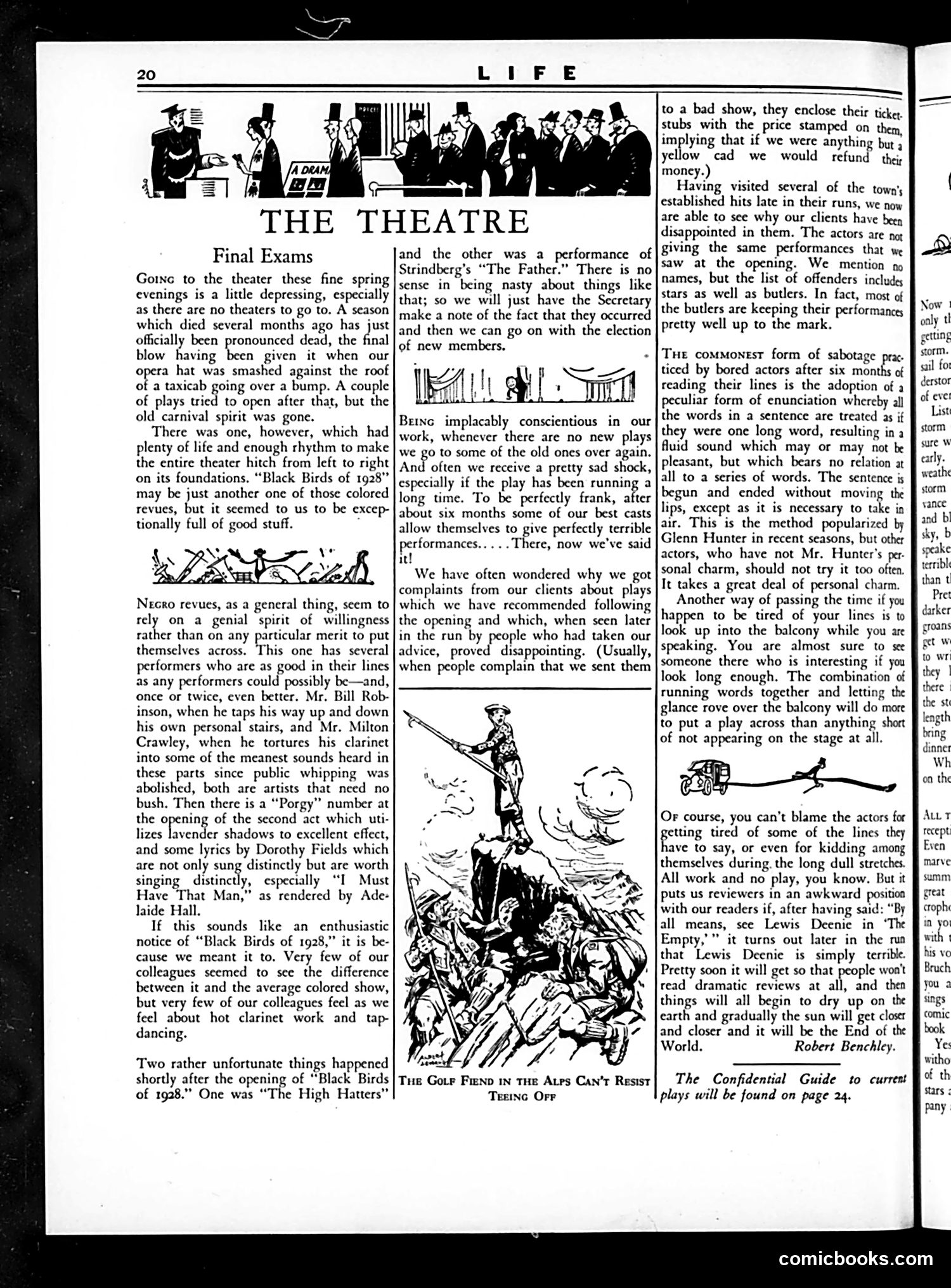
This page reviews Broadway productions, specifically praising the all-Black revue "Black Birds of 1928" while critiquing other shows. The critic celebrates performers like Bill Robinson (tap dancer) and Milton Crawley (clarinet player), calling them exceptional artists. The accompanying cartoon depicts a golfer whose ball has struck a cow in mountainous terrain—illustrating the article's broader complaint: established plays deteriorate during long runs because bored actors become careless and stop delivering quality performances. The satire targets two problems: (1) theaters promoting mediocre shows as hits, then blaming audiences when they're disappointed; and (2) veteran performers who phone in performances after opening night. The critic notes even star actors—not just supporting players—are guilty of this negligence, though ironically, many butlers (minor roles) maintain better standards.
📄 Transcribed text from this page (OCR, searchable)
Machine-transcribed from the original scan — historical spelling and the odd misread are preserved.
TH Final Exams Goinc to the theater these fine spring evenings is a little depressing, especially as there are no theaters to go to. A season which died several months ago has just officially been pronounced dead, the final blow having been given it when our opera hat was smashed against the roof of a taxicab going over a bump. A couple of plays tried to open after that, but the old carnival spirit was gone. There was one, however, which had plenty of life and enough rhythm to make the entire theater hitch from left to right on its foundations. “Black Birds of 1928” may be just another one of those colored revues, but it seemed to us to be excep- tionally full of good stuff. . Necro revues, as a general thing, seem to rely on a genial spirit of willingness rather than on any particular merit to put themselves across. This one has several performers who are as good in their lines as any performers could possibly be—and, once or twice, even better. Mr. Bill Rob- inson, when he taps his way up and down his own personal stairs, and Mr. Milton Crawley, when he tortures his clarinet into some of the meanest sounds heard in these parts since public whipping was abolished, both are artists that need no bush. Then there is a “Porgy” number at the opening of the second act which uti- lizes lavender shadows to excellent effect, and some lyrics by Dorothy Fields which are not only sung distinctly but are worth singing distinctly, especially “I Must Have That Man,” as rendered by Ade- laide Hall. If this sounds like an enthusiastic notice of “Black Birds of 1928,” it is be- cause we meant it to. Very few of our colleagues seemed to sce the difference between it and the average colored show, but very few of our colleagues feel as we feel about hot clarinet work and tap- dancing. Two rather unfortunate things happened shortly after the opening of “Black Birds of 1928." One was “The High Hatters” THEATRE and the other was a performance of Surindberg’s “The Father.” There is no sense in being nasty about things like that; so we will just have the Secretary make a note of the fact that they occurred and then we can go on with the election of new members, Beinc implacably conscientious in our work, whenever there are no new plays we go to some of the old ones over again. And. often we receive a pretty sad shock, especially if the play has been running a long time. To be perfectly frank, after about six months some of our best casts allow themselves to give perfectly terrible performances. ; ... There, now we've said at! We have often wondered why we got complaints from our clients about plays which we have recommended following the opening and which, when seen later in the run by people who had taken our advice, proved disappointing. (Usually, when people complain that we sent them Tue Gotr Fienp 1n tHe Atps Can’t Resist Teeinc Orr to a bad show, they enclose their ticket stubs with the price stamped on them, implying that if we were anything but 3 yellow cad we would refund ther money.) Having visited several of the town’s established hits late in their runs, we now are able to see why our clients have been disappointed in them. The actors are not giving the same performances that we saw at the opening. We mention no names, but the list of offenders includes stars as well as butlers. In fact, most of the butlers are keeping their performances pretty well up to the mark, Tue commonest form of sabotage ticed by bored actors after six months of reading their lines is the adoption of a peculiar form of enunciation whereby all the words in a sentence are treated as if they were one long word, resulting in a fluid sound which may or may not be pleasant, but which bears no relation at all to a series of words. The sentence is begun and ended without moving the lips, except as it is necessary to take in air. This is the method popularized by Glenn Hunter in recent seasons, but other actors, who have not Mr. Hunter's per- sonal charm, should not try it too often. It takes a great deal of personal charm. Another way of passing the time if you happen to be tired of your lines is to look up into the balcony while you are speaking. You are almost sure to se someone there who is interesting if you look long enough. The combination of running words together and letting the glance rove over the balcony will do more to put a play across than anything short of not appearing on the stage at all. <e_ --_ OF course, you can’t blame the actors for petting tired of some of the lines they ave to say, or even for kidding among themselves during. the long dull stretches. All work and no play, you know. But it puts us reviewers in an awkward position with our readers if, after having said: “By all means, see Lewis Deenie in ‘The Empty,’ it turns out later in the run that Lewis Deenie is simply terrible. Pretty soon it will get so that people won't read dramatic reviews at al end then things will all begin to dry up on the earth and gradually the sun will get closer and closer and it will be the End of the World. Robert Benchley. The Confidential Guide to current plays will be found on page 24. 2» Now | oaly getting orm. ail fo derstor of eve! List storm sure W arly. weathe storm vance and bI sky, b speake terrible than t Pret darker groans mt to wri they | there the st length bring dinner Wh on the ALL recept Even marve samm great crophe in yo with his vo Bruch you 2 sings comic book Ye: witho of th Stars ¢ pany comicbooks.com