
A complete issue · 80 pages · 1927
Life — December 1, 1927
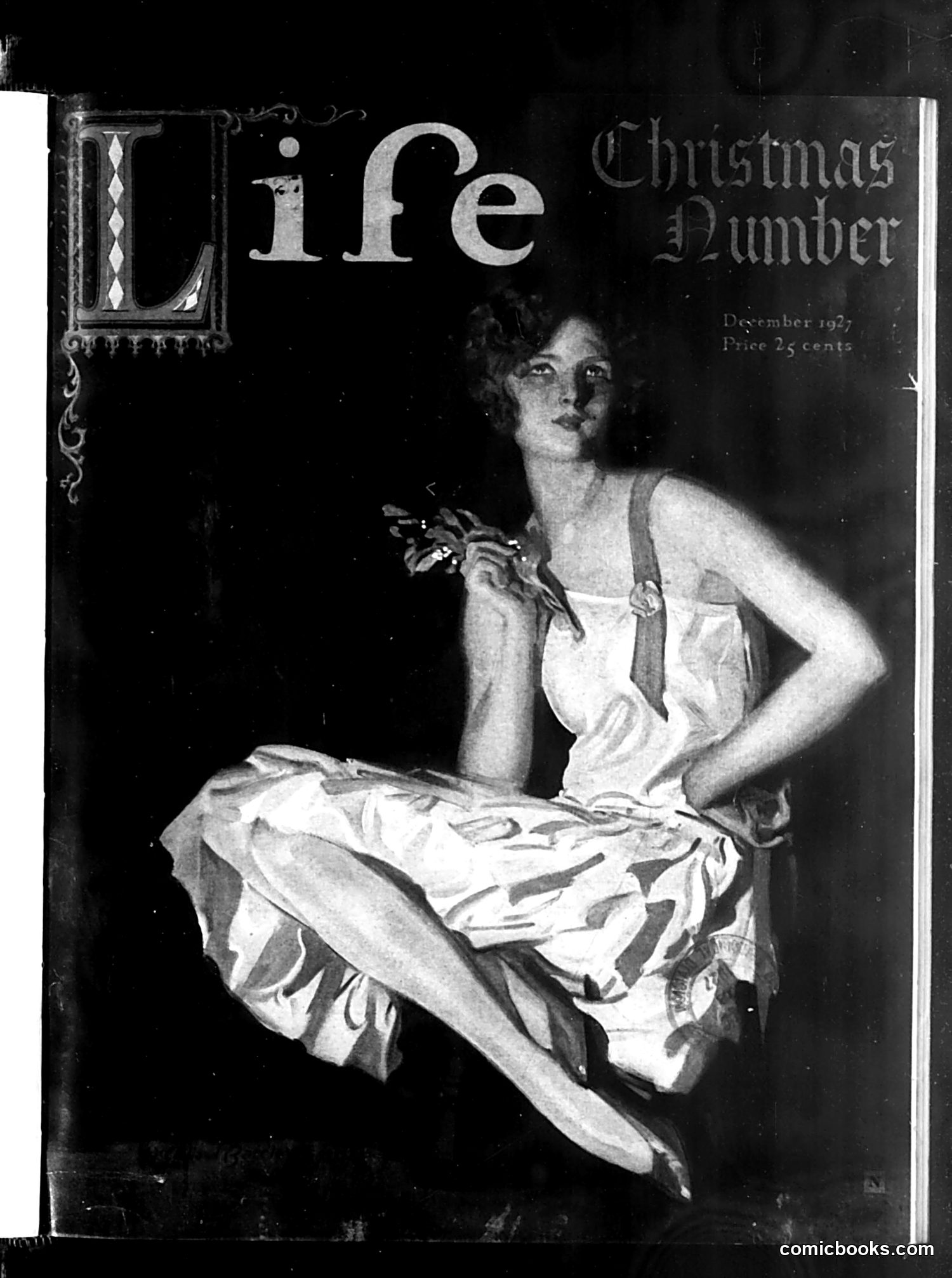
This is a **Life magazine cover** from December 1927 (price 25 cents), not a political cartoon. The image shows a stylized illustration of a woman in an elegant, flowing white dress with decorative details, posed in a theatrical manner against a dark background. She holds what appears to be holly or seasonal foliage. The cover is primarily a **fashion and lifestyle illustration** rather than political satire. It represents the aesthetic values of the 1920s—glamour, modernity, and elegance—aimed at the magazine's readers during the holiday season. The ornate "Life" masthead reflects the publication's established prestige as a satirical and cultural commentary magazine during the Jazz Age.
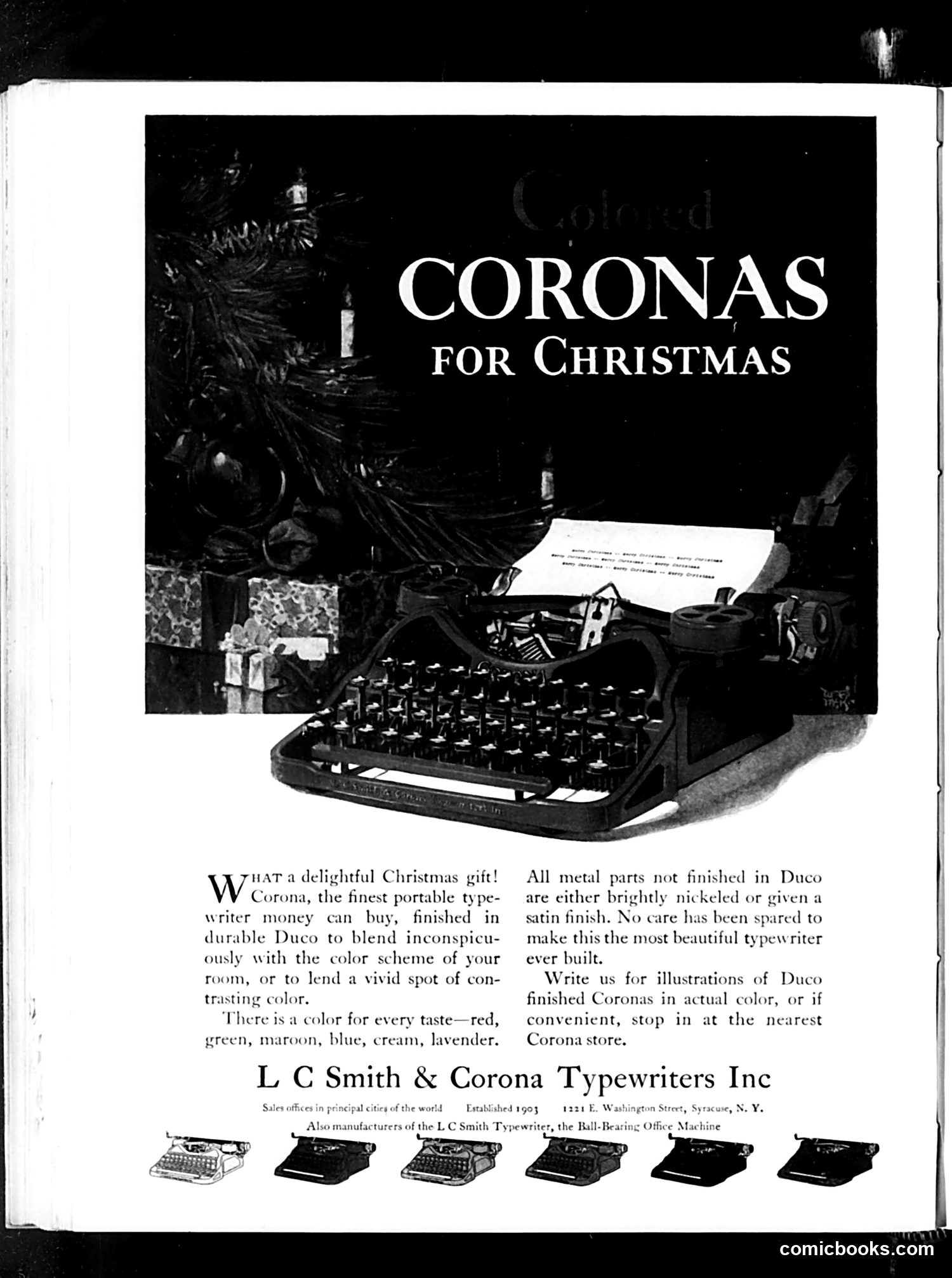
This is **not a satirical cartoon but a vintage advertisement** for Corona typewriters, circa early 20th century (the company was established 1903, per the text). The ad promotes the Corona as an ideal Christmas gift, emphasizing its portability and aesthetic appeal. It highlights available colors—red, green, maroon, blue, cream, lavender—to complement home décor. The festive staging shows the typewriter alongside wrapped gifts and holiday greenery. The text stresses durability ("finest portable typewriter") and craftsmanship (nickel and satin finishes), positioning the Corona as a luxury gift. The bottom shows multiple typewriter models manufactured by L.C. Smith & Corona Typewriters Inc. This is **straightforward product marketing**, not political or social satire. It reflects early 20th-century consumer culture and the typewriter's status as a desirable, prestigious possession.
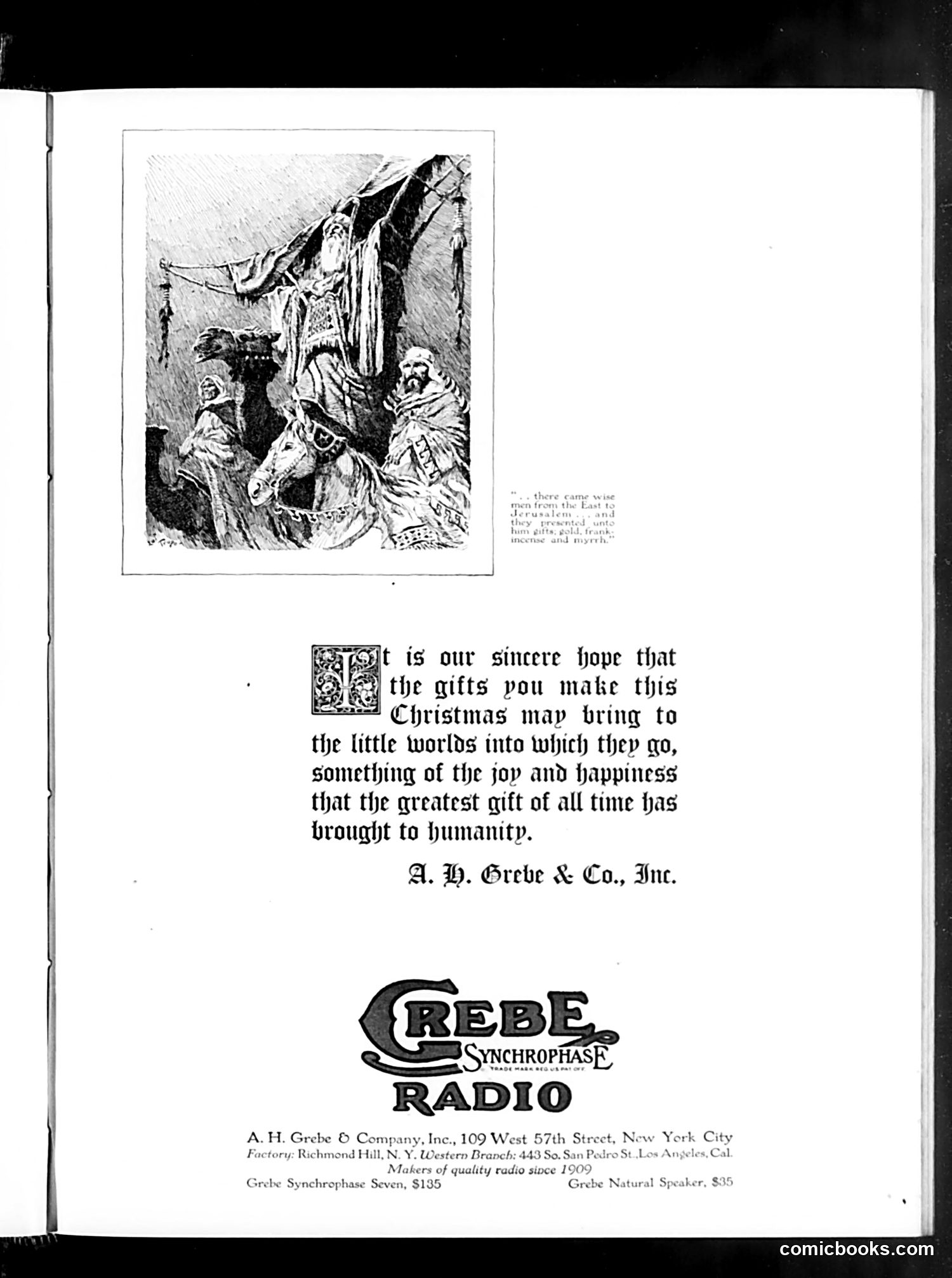
This page is primarily **advertising** rather than satirical content. The upper illustration depicts the biblical Nativity scene—the Magi (wise men) presenting gifts to the infant Jesus—with accompanying text quoting Matthew 2:11 about their gifts of gold, frankincense, and myrrh. The company, **A.H. Grebe & Co., Inc.**, uses this religious imagery for a Christmas marketing message: their radio gifts will bring joy comparable to Christianity's greatest gift to humanity. Below is a **product advertisement** for Grebe Synchrophase radios, listing models and prices ($135 and $35), with manufacturing locations in New York and Los Angeles. The "Makers of quality radio since 1909" tagline emphasizes the brand's established reputation. This represents **holiday consumer advertising** leveraging sacred religious imagery for commercial purposes.
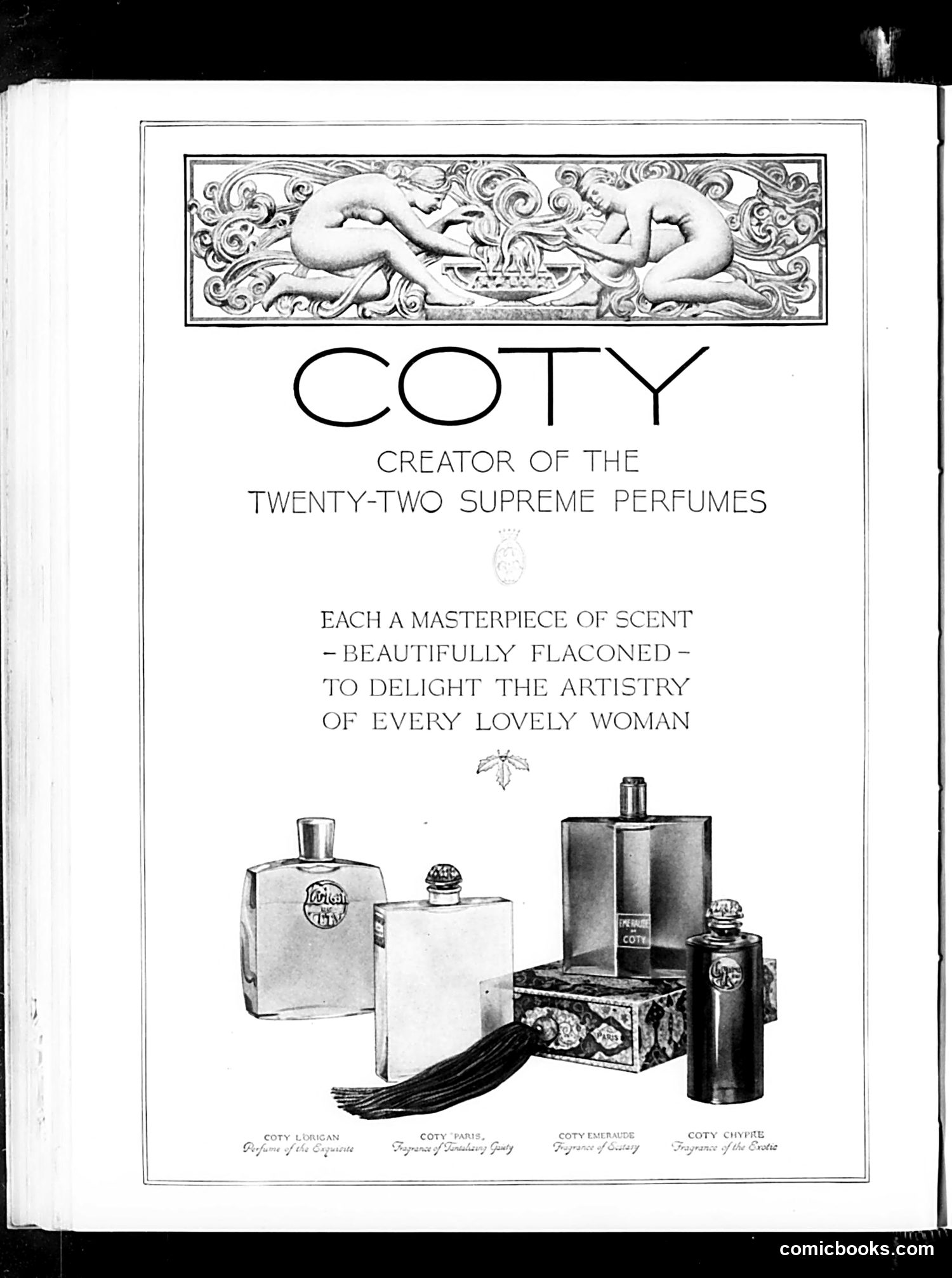
This is **not a political cartoon or satire**—it's a full-page advertisement for **Coty perfumes**. The page promotes "Coty" as "Creator of the Twenty-Two Supreme Perfumes," positioning their fragrances as luxury goods for women. The ornamental header features classical cherubs in a rococo style, establishing elegance and refinement. The advertisement emphasizes artistry and beauty, describing each perfume as "a masterpiece of scent—beautifully flaconed." The lower portion displays four specific Coty fragrances with their packaging: Coty Lisugan, Coty Paris, Coty Emeraude, and Coty Chypre. The ornate bottles and decorative presentation reinforce the luxury positioning typical of early-to-mid 20th-century high-end perfume marketing. This is straightforward commercial advertising rather than editorial content or satire.
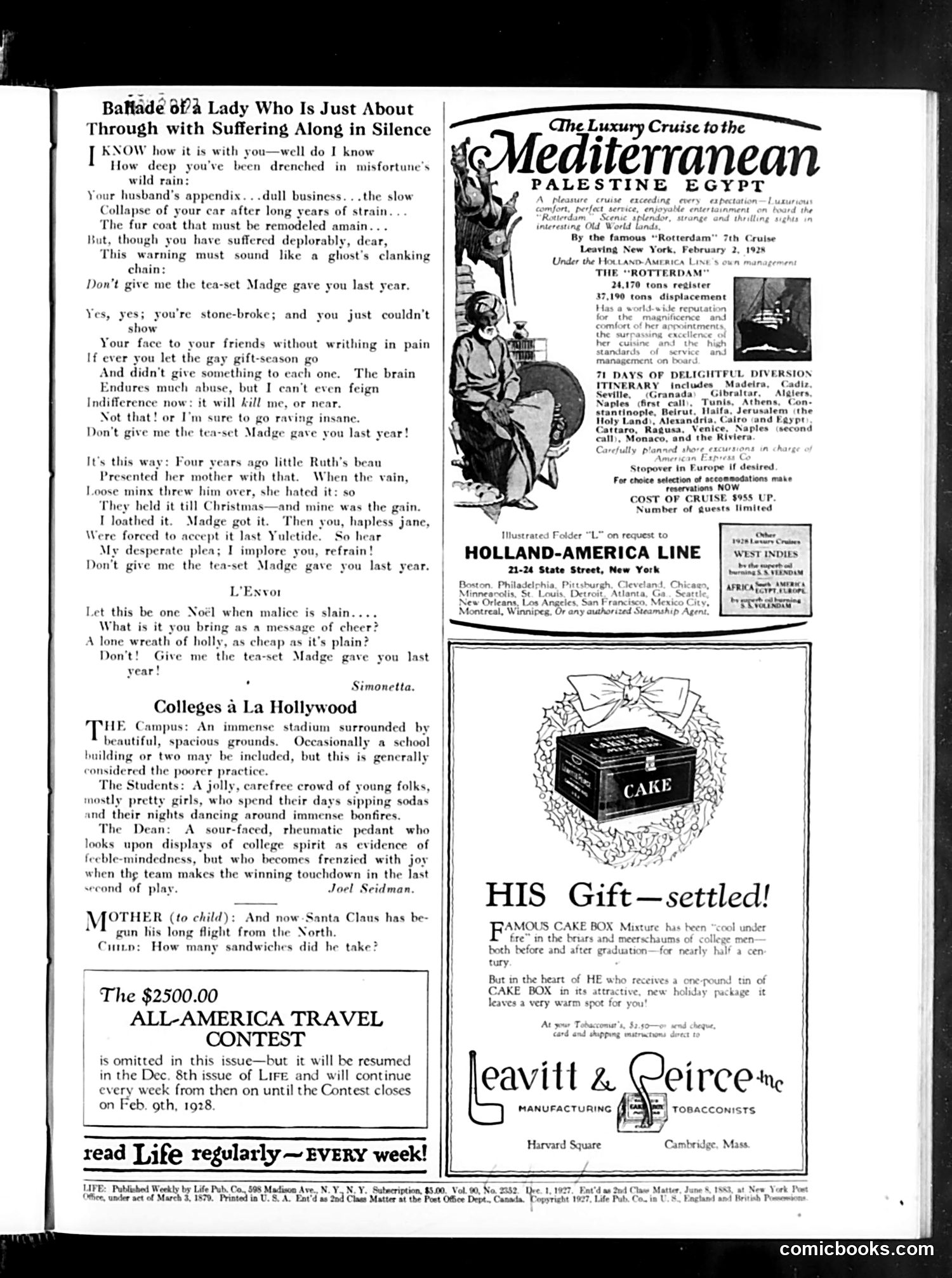
This page contains primarily **advertisements and light humor** rather than political satire. The main content includes: **Left side:** A humorous poem titled "Ballade of a Lady Who Is Just About Through with Suffering Along in Silence" — domestic satire about a financially struggling wife, mentioning her husband's failing business and suggesting she's tired of her situation. The tone is sympathetic but comedic. **Right side:** A cruise ship advertisement for Mediterranean travel and a cake box advertisement. **Bottom left:** A joke about Santa Claus and sandwiches (likely referencing holiday season). The page reflects **1920s-era domestic humor** and consumerism rather than sharp political commentary. The "lady's" financial struggles appear relatable to readers facing economic hardship, but the satire is gentle and domestic-focused rather than pointed social criticism.
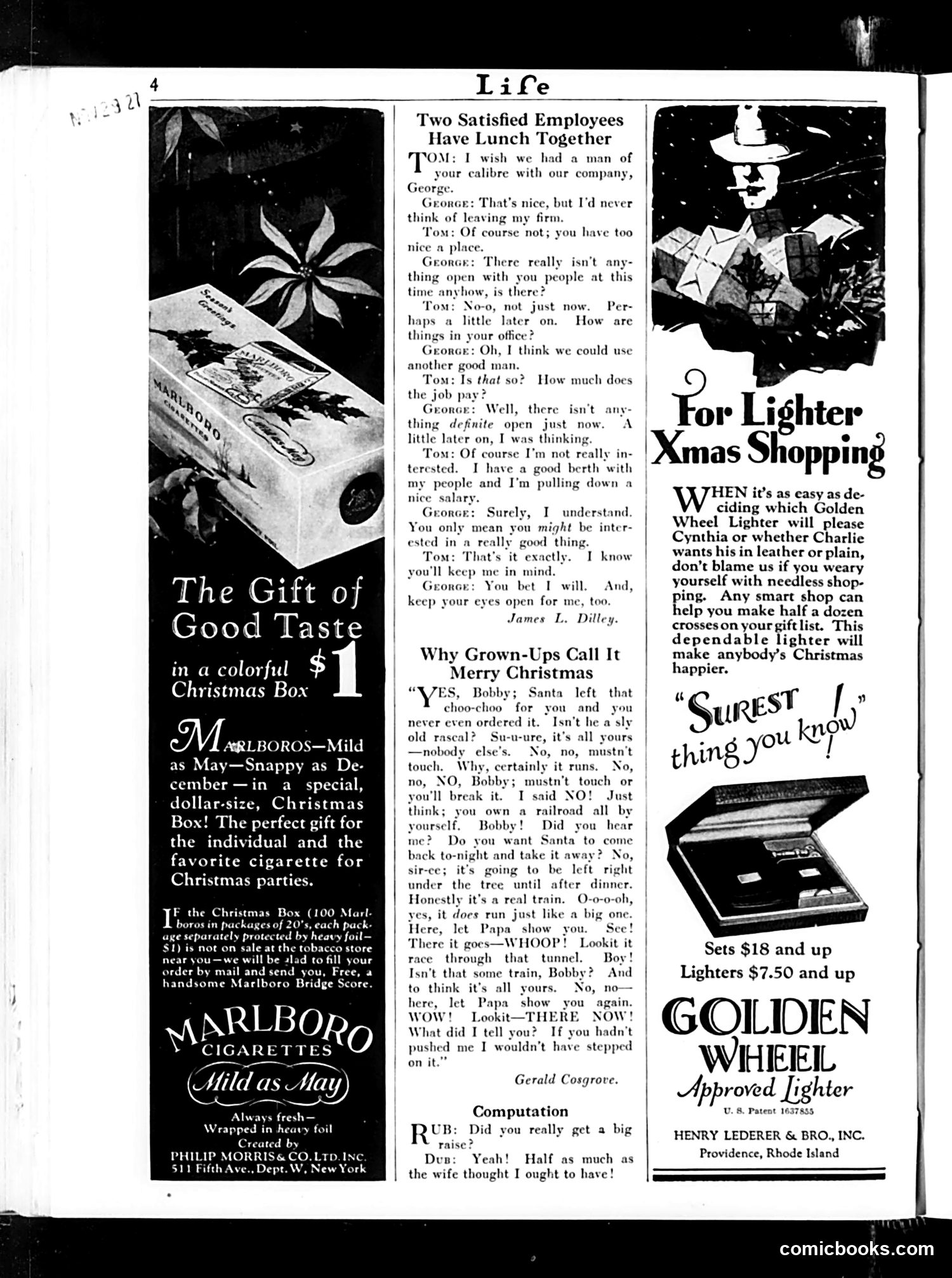
This page is primarily **advertising and light humor** rather than political satire. The main content includes: 1. **Marlboro Cigarettes ad** (left): Features a decorative Christmas box promoting cigarettes as holiday gifts—notable today as a historical artifact of tobacco marketing before modern restrictions. 2. **Golden Wheel Lighter ad** (right): Shows a cowboy figure advertising lighters, with Christmas shopping advice playing on gift-giving uncertainty. 3. **Humorous dialogues**: Three short comedic pieces featuring workplace banter and family interactions about Christmas gifts and trains—gentle, domestic humor typical of 1930s-40s Life magazine. The page reflects period attitudes toward smoking/drinking as acceptable gift items and depicts era-appropriate gender roles and class dynamics in casual conversation. No specific political figures or events are referenced.
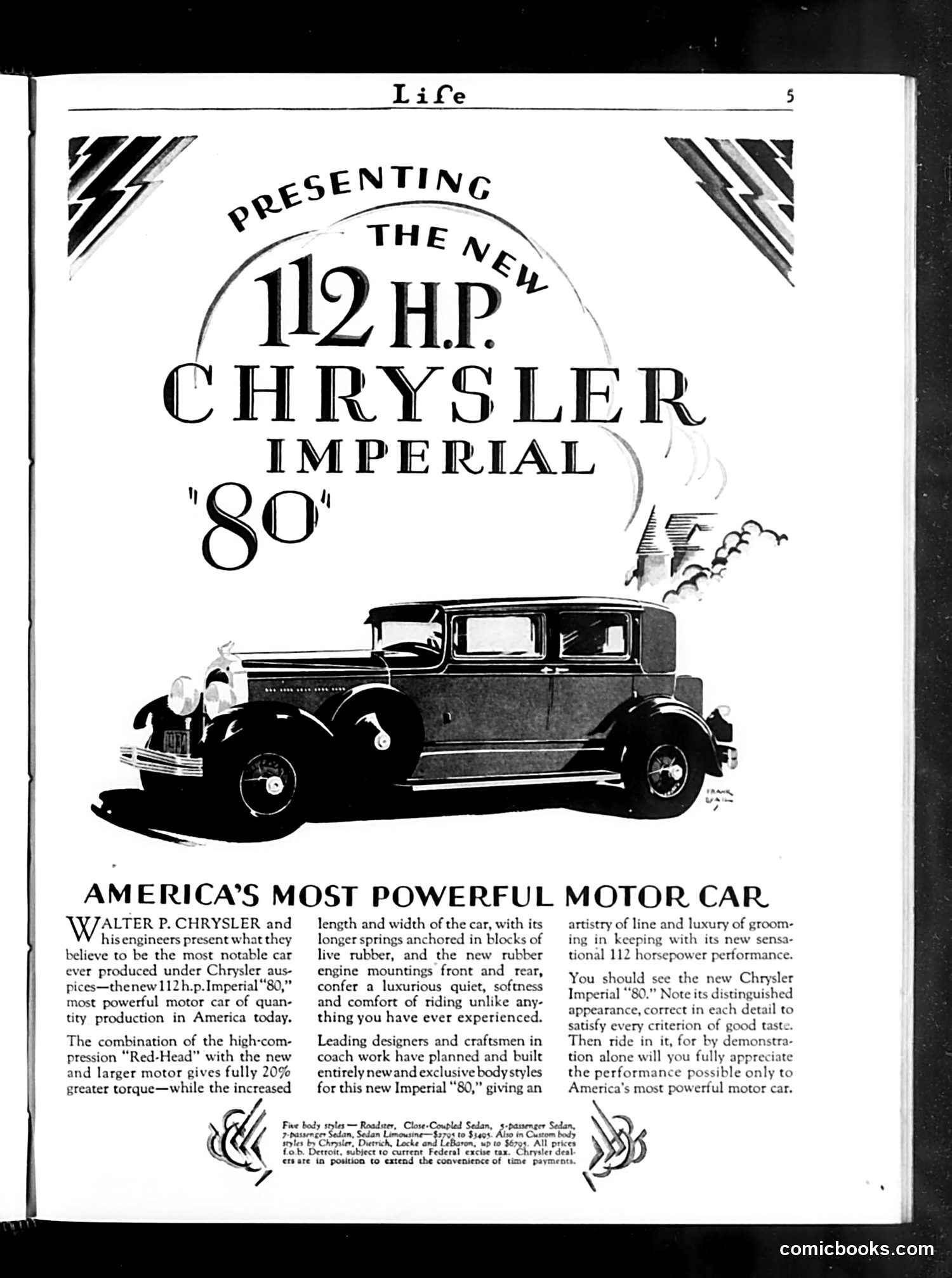
This is a **full-page advertisement**, not a political cartoon or satirical content. It presents the new 1928 Chrysler Imperial "80" automobile, promoting it as "America's Most Powerful Motor Car." The ad emphasizes the vehicle's 112 horsepower engine—notable as a significant technological achievement of the era—and highlights features like improved comfort, quietness, and performance. Walter P. Chrysler is credited as presenting this advancement. The text and imagery appeal to early 20th-century consumer values: power, luxury, engineering innovation, and exclusivity. The sleek automobile illustration and formal typography reflect 1920s advertising aesthetics. This represents straightforward commercial marketing rather than satire or political commentary.
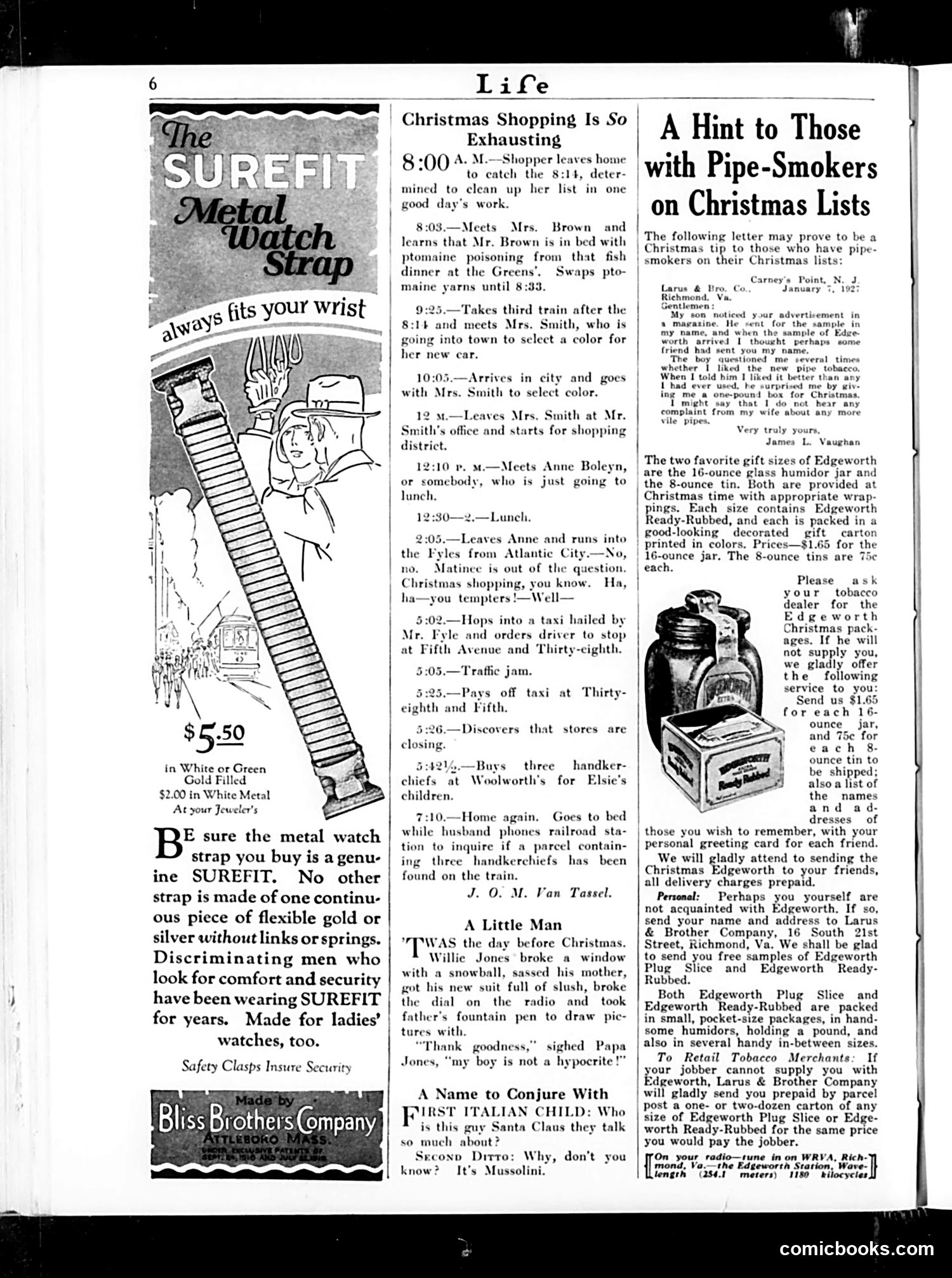
This page is primarily **advertising and lifestyle content**, not political satire. The left side advertises the "Surefit" metal watch strap by Bliss Brothers Company—a flexible metal band claiming superior comfort and durability ("no other strap is made of one continuous piece of flexible cold or silver"). The center column humorously chronicles a shopper's exhausting Christmas shopping day through timeline entries (8:00 AM through 7:10 PM), depicting the chaos of holiday retail. The right column addresses gift-giving for pipe-smokers, promoting Edgeworth pipe tobacco and accessories as Christmas gifts, with testimonial letters and product information. The cartoons are simple, functional illustrations supporting these consumer goods—not political commentary. This reflects Life magazine's mid-20th-century focus on satire mixed with advertising.
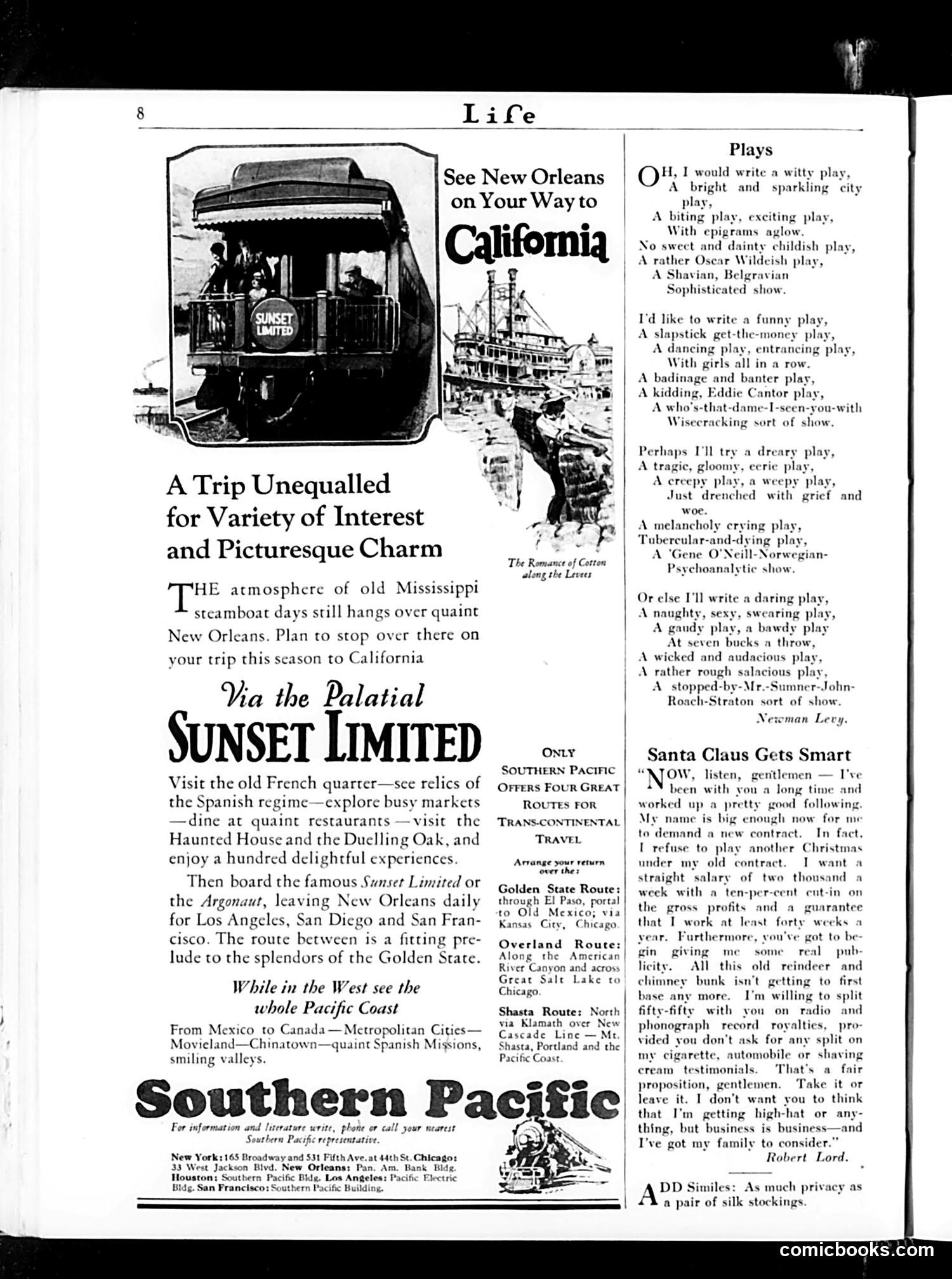
This page is primarily **advertising and light entertainment content**, not political satire. The main content includes: 1. **Train advertisement** for the "Sunset Limited" (Southern Pacific Railroad), promoting travel from New Orleans to California with appeals to romance and adventure. 2. **"Plays" column** - humorous poetry listing types of theatrical productions the author wishes to write, ranging from "witty" to "daring" to "creepy" plays. This is satirical commentary on theater trends and clichés, not political content. 3. **"Santa Claus Gets Smart"** - a brief comedic monologue where Santa demands better contract terms, higher salary, and job security. It's light satire about labor negotiations and commercialism, not serious political commentary. 4. **"Add Similes"** - a brief joke. The page reflects 1920s leisure culture, theatrical interests, and gentle social humor rather than pointed political criticism.
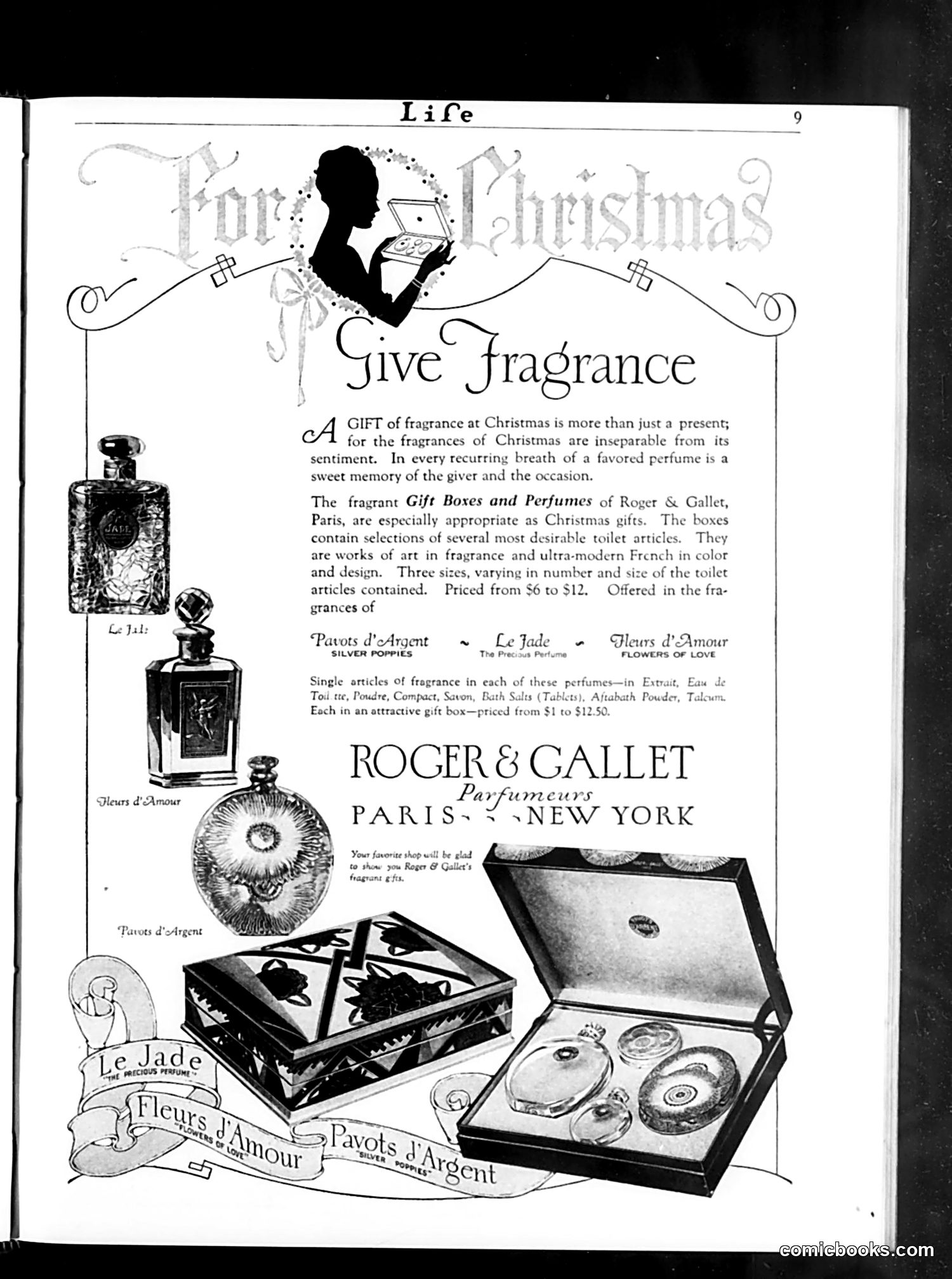
This page is **primarily an advertisement**, not satirical content. It promotes Roger & Gallet perfumes as Christmas gifts, emphasizing that fragrance gifts carry sentimental value beyond mere material exchange. The visual elements are product-focused: perfume bottles, gift boxes, and a silhouette of a woman examining a fragrance box. The decorative header reads "For Christmas / Give Fragrance." The ad highlights three perfume lines (Pavots d'Argent, Le Jade, Fleurs d'Amour) and gift sets priced $6-$12. It includes the tagline that favorite shops will display Roger & Gallet's fragrances. There is **no political or social satire** here—this is straightforward luxury goods advertising in *Life* magazine, targeting affluent readers seeking upscale Christmas presents.
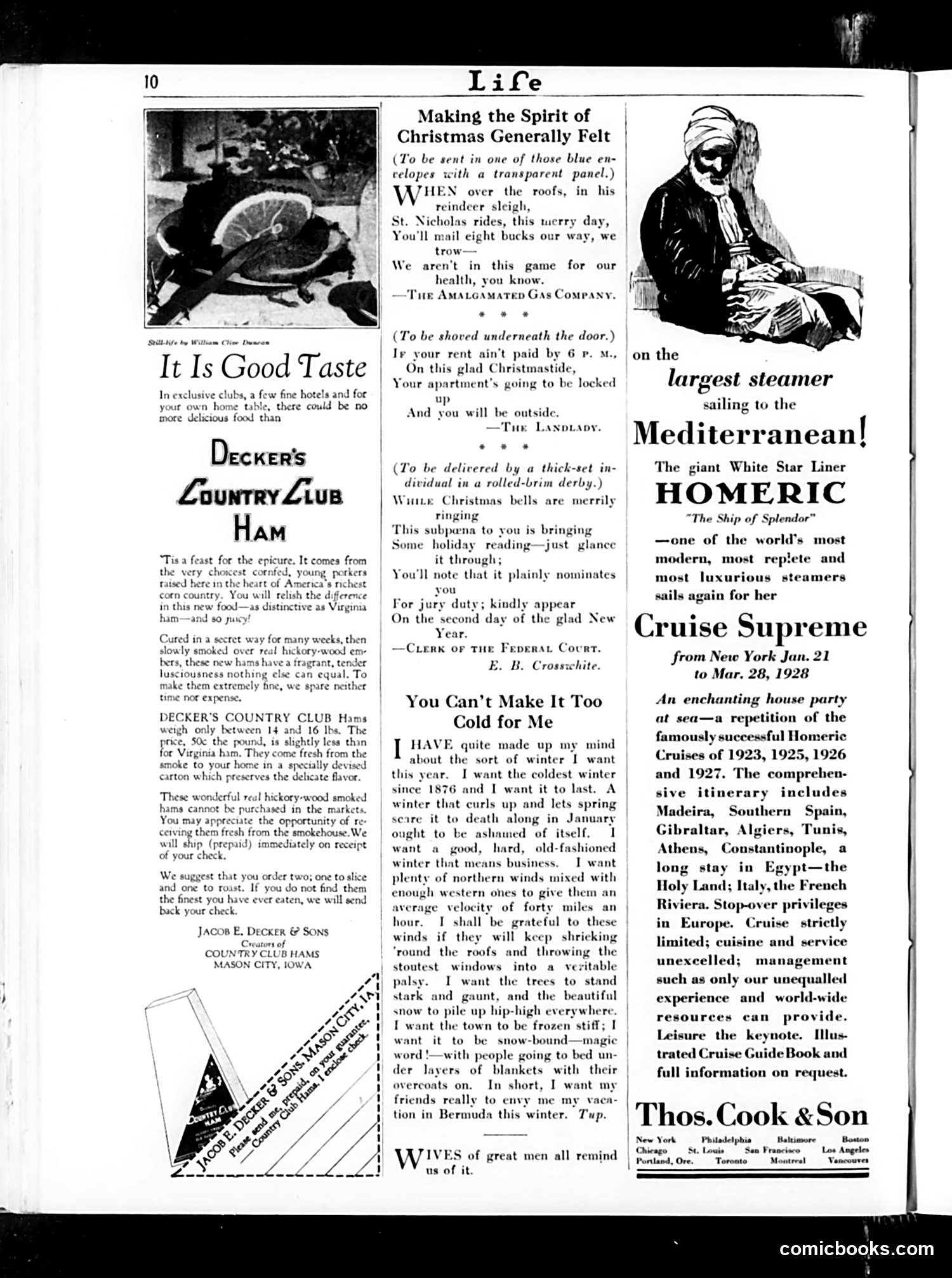
This page is primarily **advertising content** rather than political satire or editorial cartoons. The ads include: 1. **Decker's Country Club Ham** — promoting cured pork products from Iowa, emphasizing hickory-wood smoking and quality 2. **Homeric Cruise Line** — advertising Mediterranean luxury cruises departing January 21, 1928, with detailed itineraries 3. **Thos. Cook & Son** — travel agency services The upper section contains **humorous Christmas-themed verse** (appears to be reader submissions or staff-written holiday satire) mocking winter weather, holiday financial stress, and domestic situations — typical early-20th-century light humor. There are **no identifiable political cartoons or caricatures** on this page. The small illustration of Santa appears to be decorative rather than satirical. This represents a typical *Life* magazine page circa 1927-1928, mixing advertisement revenue with light seasonal humor.
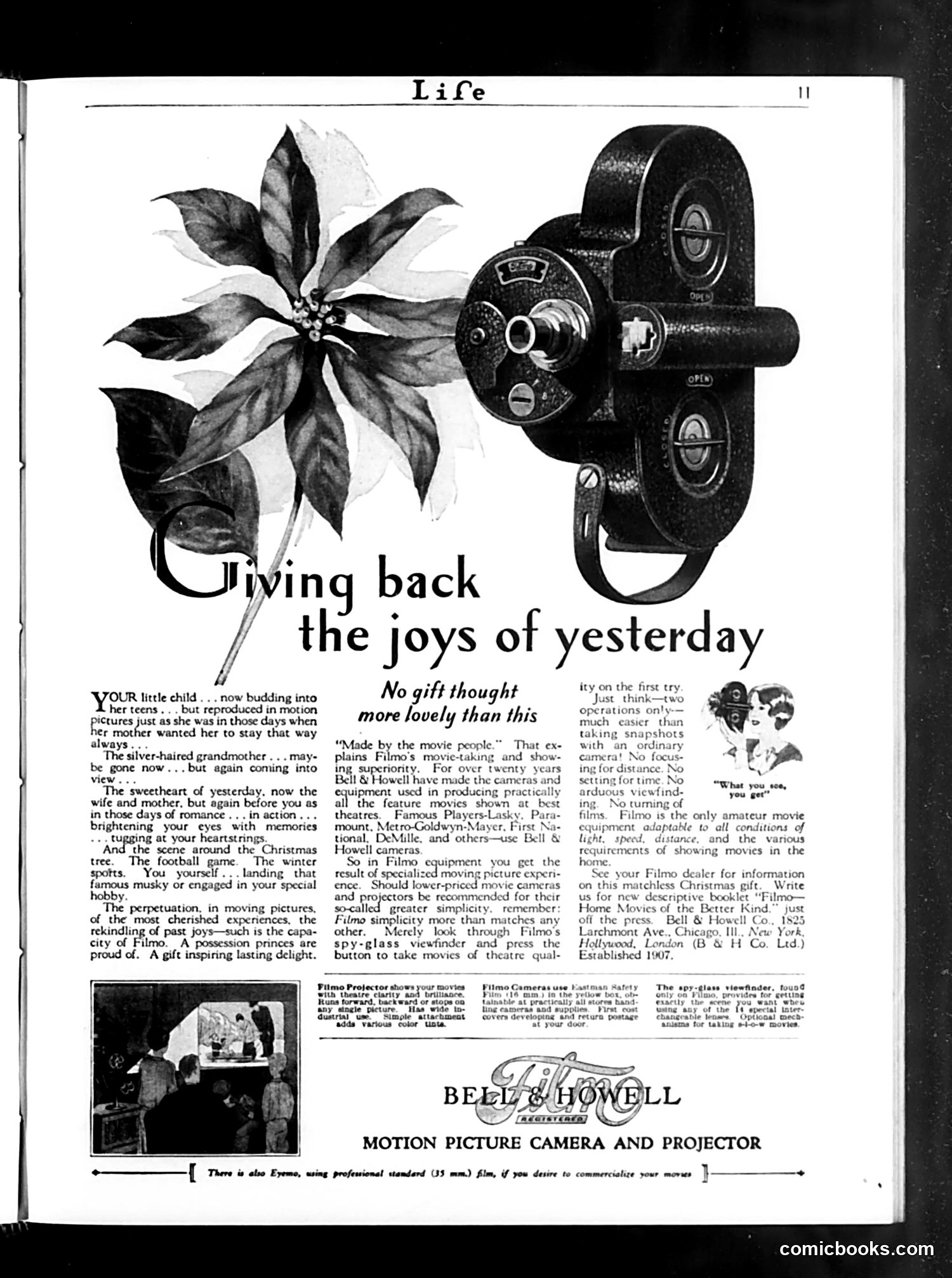
This page is primarily an **advertisement for Bell & Howell motion picture cameras and projectors**, not a political cartoon. The ad's headline—"Giving back the joys of yesterday"—appeals to nostalgia by showing a vintage flower alongside modern film equipment. The text emphasizes that home movie-making allows ordinary people to record family moments (children, grandparents, sweethearts) that previously only professional filmmakers could capture. It positions Bell & Howell cameras as democratizing technology, making cinema accessible to average consumers rather than just theatrical professionals. The small illustration shows a woman using the equipment. This is fundamentally a consumer advertisement celebrating the home movie trend of the 1920s era, not political satire.
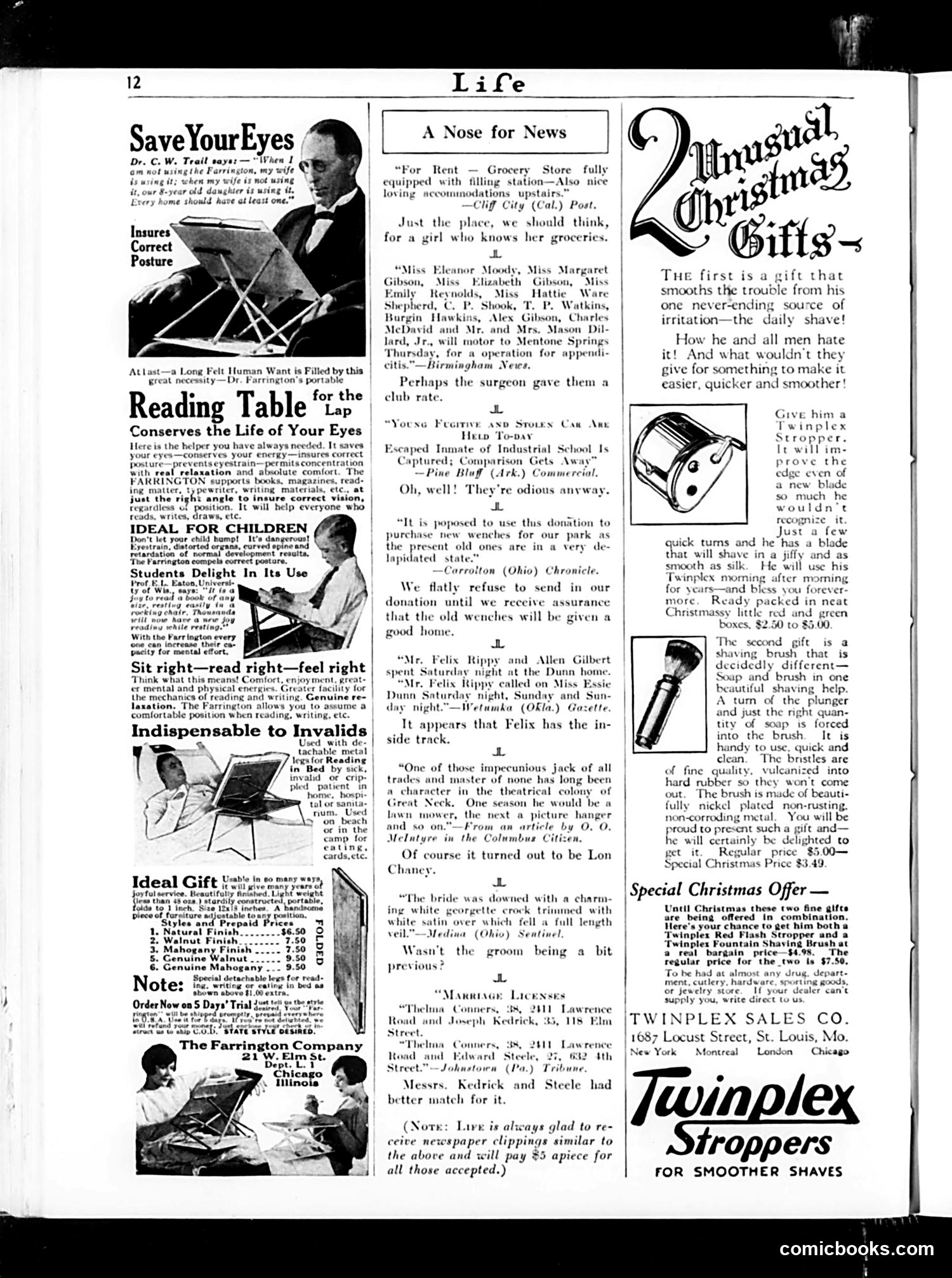
This page is primarily **advertising and advice columns** rather than political satire. The content includes: **Left side:** Advertisements for reading accessories (the Farrington reading table/lap desk) and an "Ideal Gift" product listing, emphasizing comfort and posture correction—concerns typical of early 20th-century consumer culture. **Center:** "A Nose for News"—a gossip/advice column featuring items from various newspapers about social events, engagements, and local happenings. **Right side:** "Unusual Christmas Gifts" promoting the Twinplex Stropper (a razor blade stropping device), with a special offer pricing two gifts at $7.50. The satirical element is minimal; this appears to be a standard issue mixing consumer advertising with light social commentary typical of *Life* magazine's format during this era.
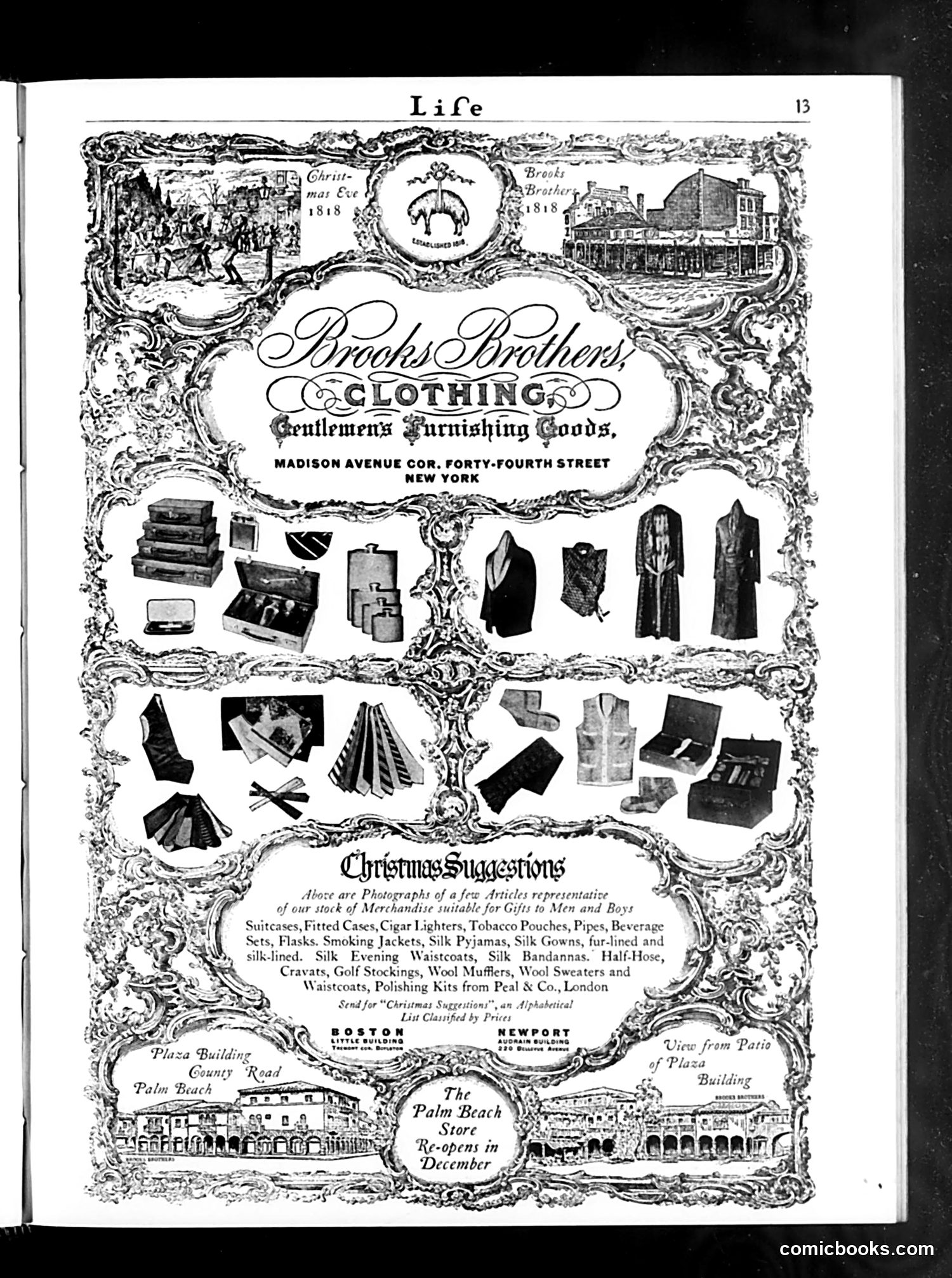
This is **not a cartoon or satirical content** — it's a full-page advertisement for Brooks Brothers clothing and furnishings, published in Life magazine around 1918 (based on the "Christmas Eve 1918" and "Brooks Brothers 1818" dates visible). The ornate decorative border frames product photographs of men's accessories and clothing (suitcases, ties, shirts, smoking jackets, etc.) alongside images of their Madison Avenue store location in New York and their Palm Beach location. The text emphasizes gift suggestions for men: suitcases, accessories, silk items, and smoking-related products. This reflects early 20th-century luxury retail marketing, where Life's affluent readership was the target audience for high-end menswear advertising.
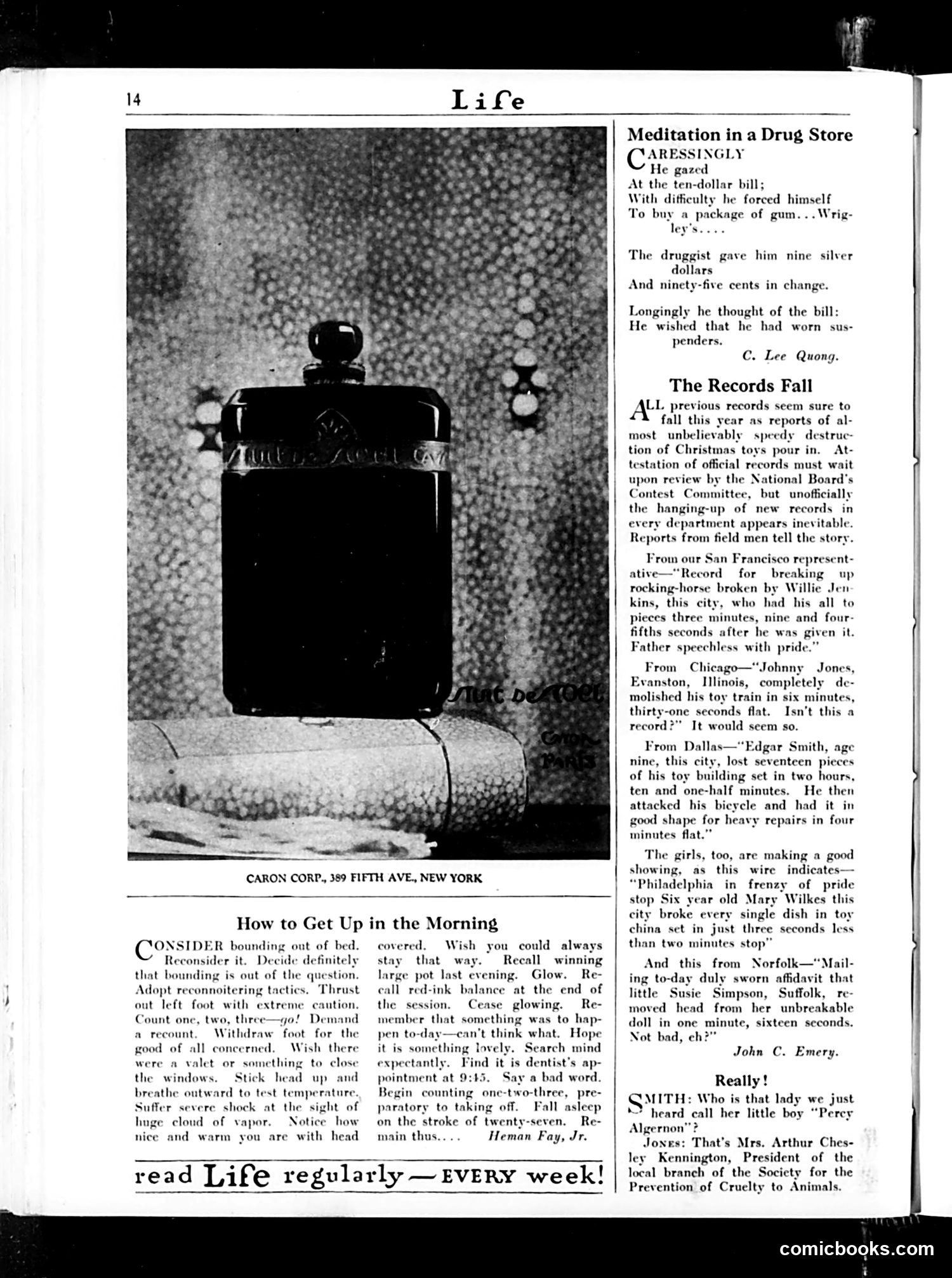
This page contains three distinct pieces: 1. **"Meditation in a Drug Store"** - A poem by C. Lee Quong about a man agonizing over a ten-dollar bill, struggling to afford chewing gum, and wishing he'd worn suspenders instead (implying financial hardship). 2. **"The Records Fall"** - A humorous article documenting children's destruction records across American cities. It lists instances of kids breaking toys and household items with remarkable speed—apparently a notable enough trend to warrant coverage, suggesting post-WWI economic prosperity and abundance of consumer goods. 3. **"How to Get Up in the Morning"** - Comedic advice by Herman Fag Jr. offering various tactics for morning routines. The main image shows a vintage Caron Corp. perfume bottle, functioning as product advertising rather than editorial cartooning.
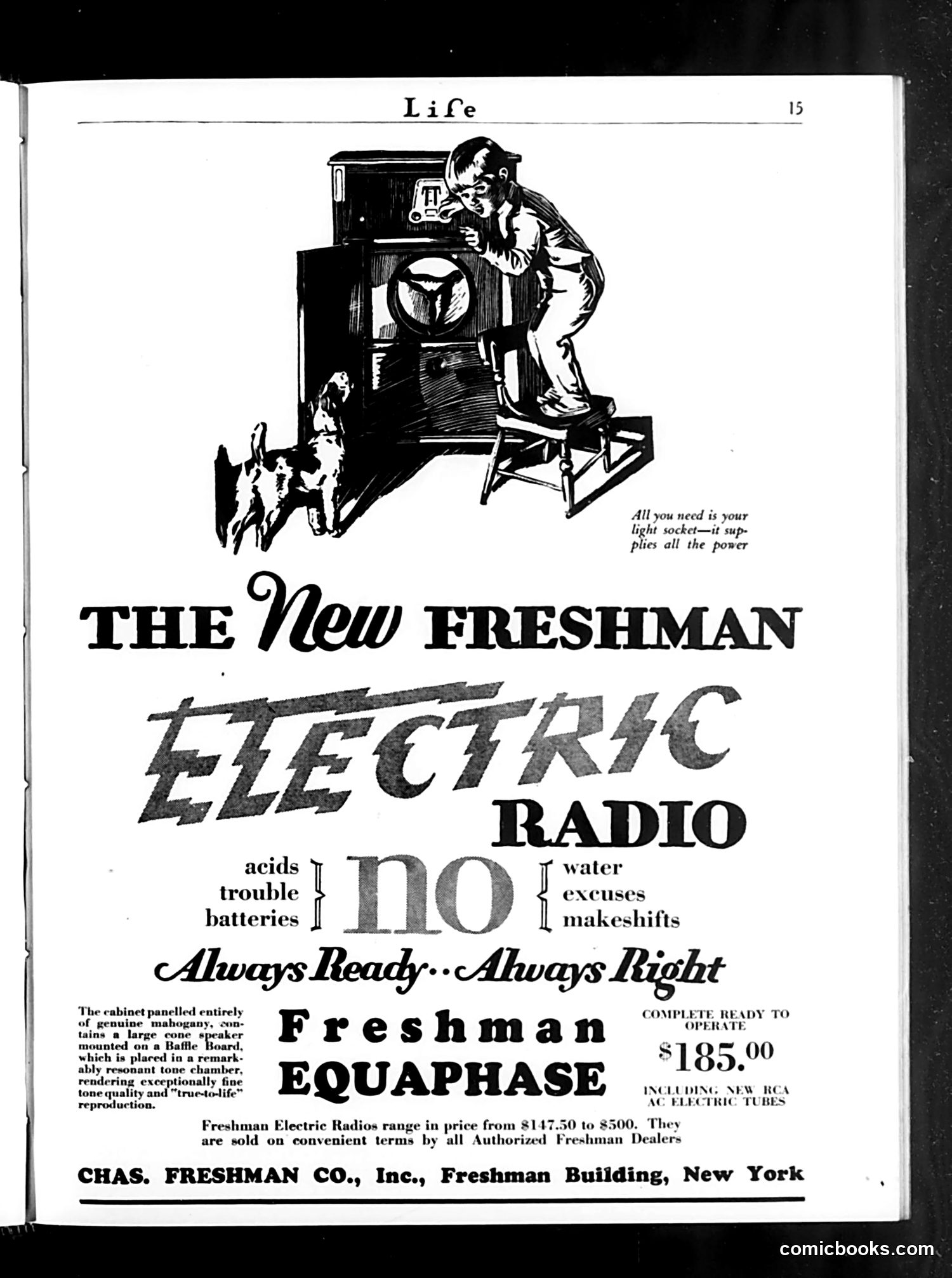
This is primarily a **product advertisement**, not editorial satire. It promotes the "Freshman Electric Radio," a consumer electronics product from the 1920s-1930s era. The illustration shows a man operating an early radio set while a dog sits nearby—a common domestic scene meant to convey accessibility and ease of use. The tagline "All you need is your light socket—it supplies all the power" emphasizes a key selling point: this radio required only standard household electricity, eliminating the need for separate batteries or water-powered equipment that earlier radio models demanded. The phrase "Always Ready—Always Right" promises reliability. The advertisement highlights that the model "EQUAPHASE" costs $185.00 complete and requires "NO" acid batteries, water excuses, or makeshift solutions—innovations that would appeal to ordinary consumers seeking convenient home entertainment technology.
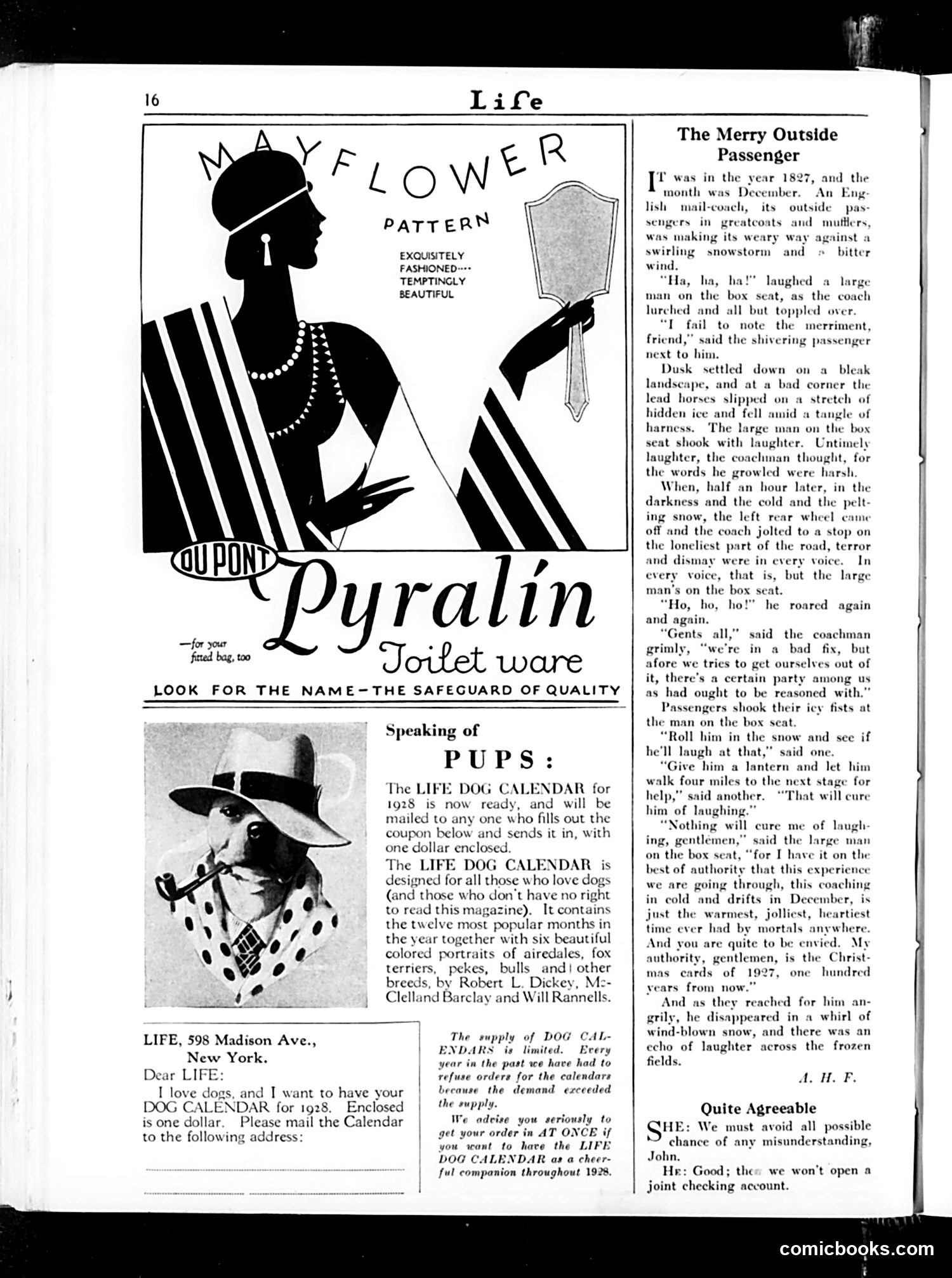
**Left Side - Advertisement**: A fashion advertisement for DuPont Pyralin toilet ware, featuring an art deco silhouette of an elegant woman with a "Mayflower Pattern" mirror. The ad emphasizes quality and beauty—typical 1920s luxury goods marketing. **Right Side - Story**: "The Merry Outside Passenger" is a humorous short story set in 1827 about an English mail-coach accident during a snowstorm. A large man on the coach box laughs hysterically while passengers and coachmen are terrified and struggling. The joke centers on his inappropriate, uncontrollable laughter despite the genuine danger—he finds dark humor in the crisis while others panic. It's a character sketch exploring human psychology during adversity. **Bottom Left - Advertisement**: Promotes the "Life Dog Calendar" for 1928, featuring dog breed illustrations by Robert L. Dickey.
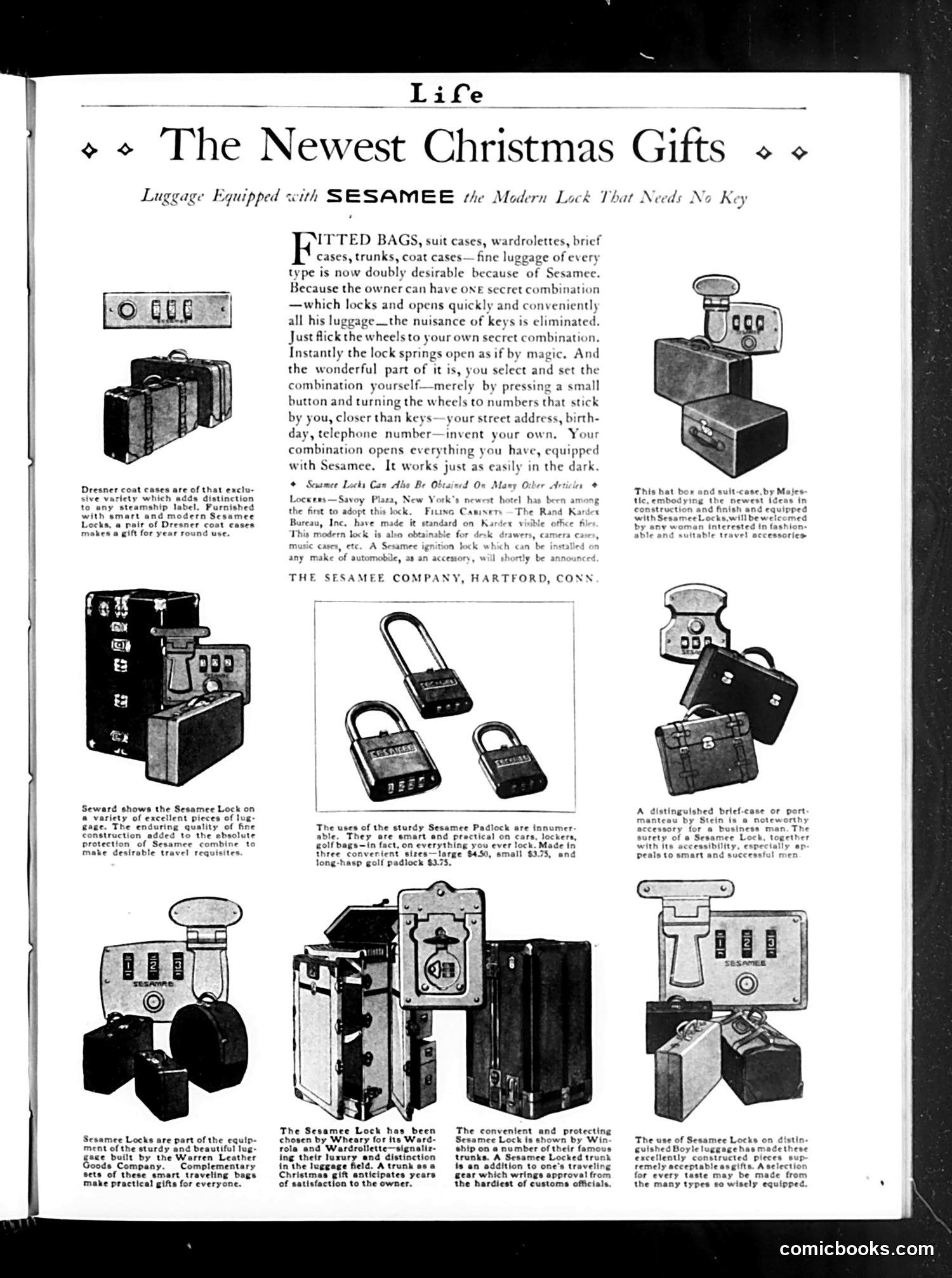
This is a **product advertisement, not satire or political commentary**. The page promotes Sesame luggage locks—a keyless locking system marketed as a modern Christmas gift. The "newest" feature being advertised is the combination lock mechanism using numbered wheels instead of traditional keys. Users could set their own secret combination by pressing a button and turning wheels to memorable numbers (addresses, birthdays, phone numbers). The page shows various Sesame Lock applications on different luggage types—suitcases, trunks, briefcases, and padlocks—emphasizing convenience for travelers. The manufacturer, The Sesame Company of Hartford, Connecticut, positioned this as innovative security technology eliminating the "nuisance of keys." This reflects early 20th-century consumer culture celebrating technological convenience as a luxury gift.
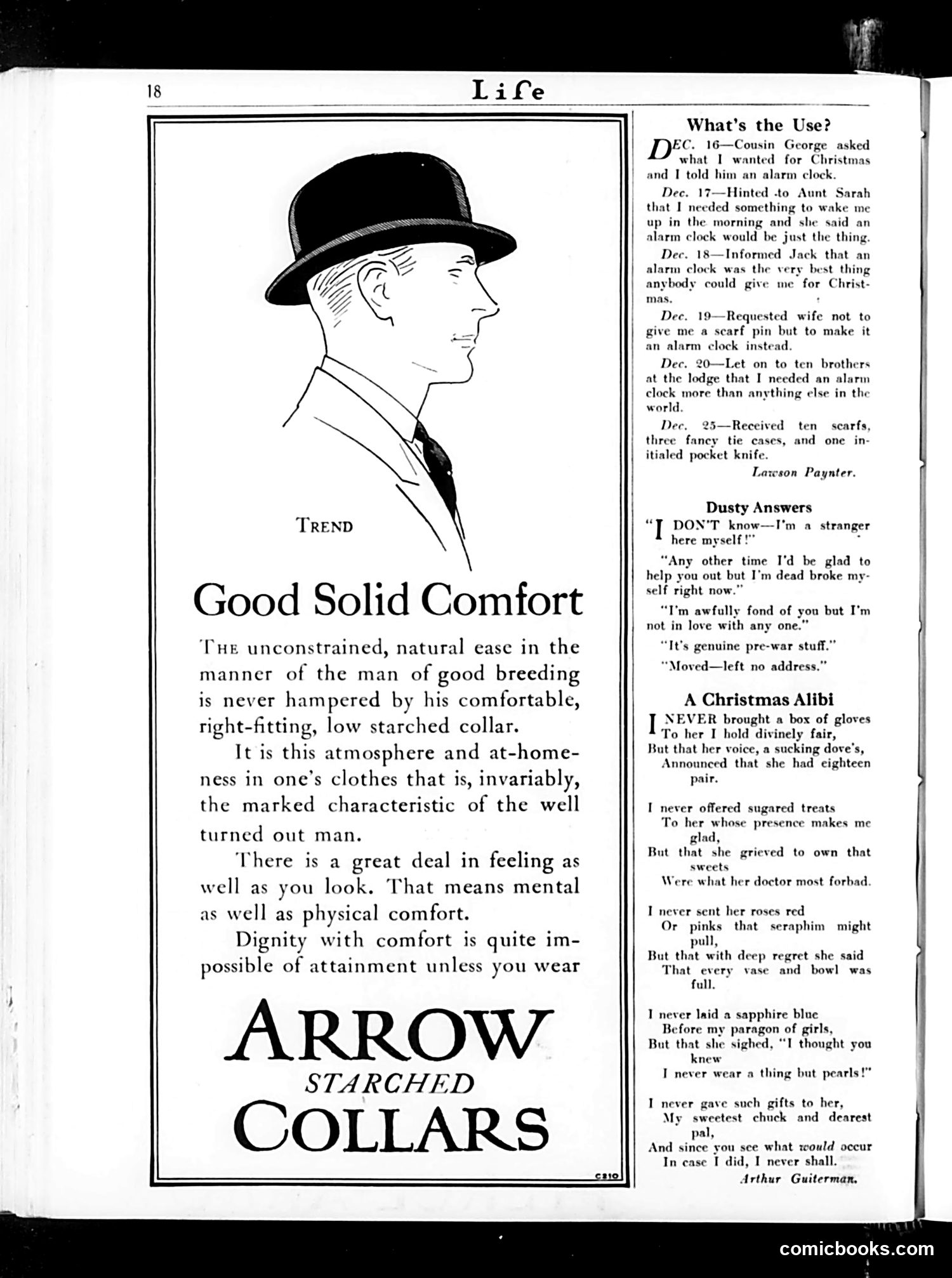
This page combines **advertising and humor content** typical of early 20th-century Life magazine. **The Advertisement (Left):** Arrow Collars promotes "Good Solid Comfort" through a profile illustration of a well-dressed man. The pitch emphasizes that proper grooming—specifically a low-starched collar—conveys both physical comfort and mental confidence, marking a man of "good breeding." This reflects period anxieties about masculinity and social status through clothing. **The Humor Sections (Right):** - **"What's the Use?"** satirizes gift-giving futility: a man repeatedly hints he wants an alarm clock for Christmas but receives scarves, tie cases, and a knife instead—mocking both miscommunication and excessive gift-giving. - **"Dusty Answers"** collects absurd excuses and deflections (claims of being broke, not in love, etc.)—likely responses to unwanted requests. - **"A Christmas Alibi"** is poet Arthur Guiterman's comic verse about a man who never gives gifts to his beloved because every gift he *might* give, she claims to already own or cannot accept—a humorous exploration of romantic futility.
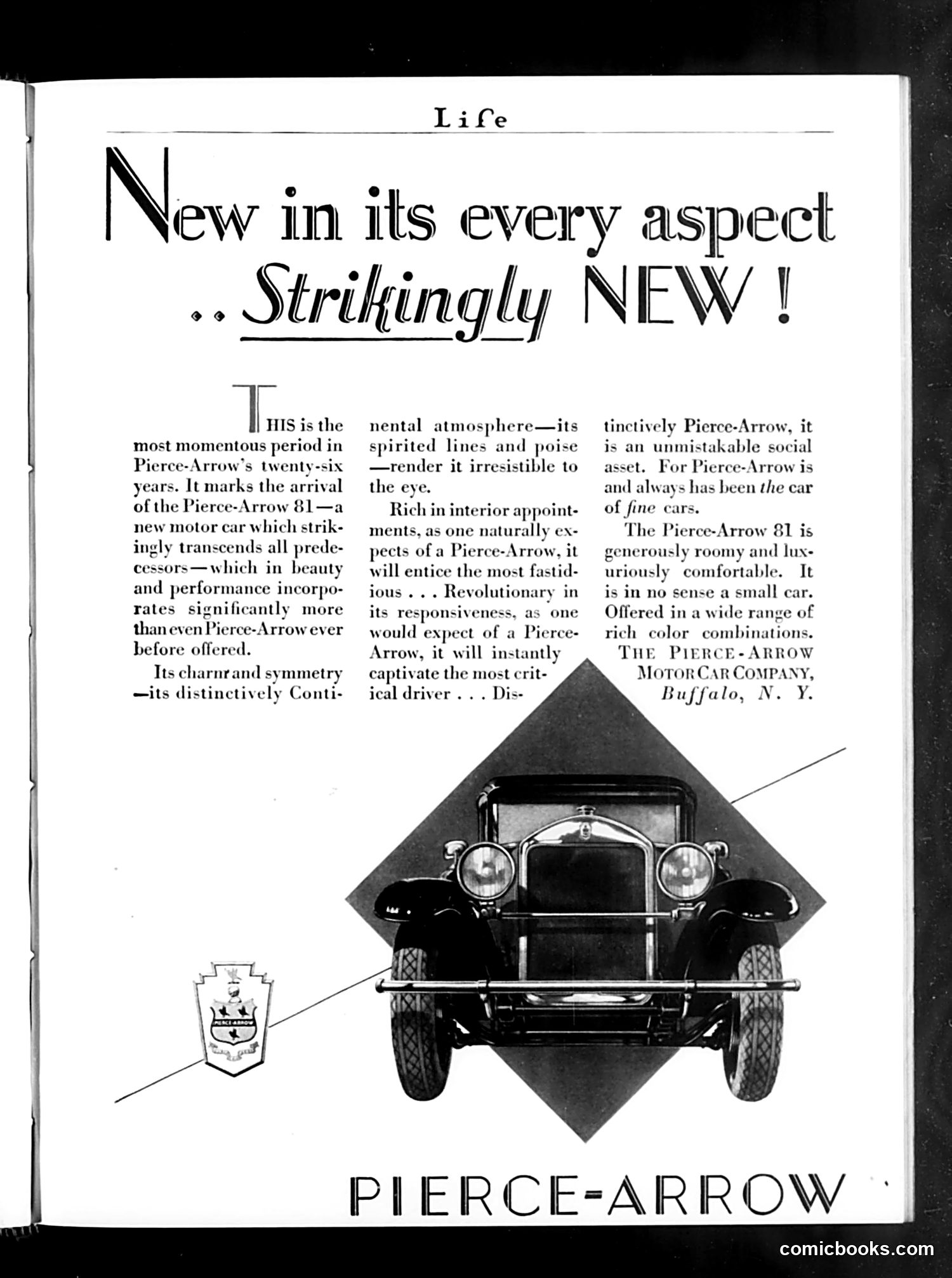
This is a **automobile advertisement**, not political satire. It's a Pierce-Arrow Motor Company advertisement promoting their new Model 81, published in *Life* magazine (which, despite its satirical reputation, carried substantial advertising). The page uses typical 1920s luxury car marketing rhetoric: emphasizing the vehicle as a "social asset" for the wealthy, highlighting "beauty and performance," "Continental atmosphere," and "rich interior appointments." The diamond-shaped composition frames the car as a prestige object. The exclamation "Strikingly NEW!" is standard advertising hyperbole of the era. The brand positioning as "the car of fine cars" targets affluent buyers who viewed automobiles as status symbols. There is no political satire or caricature present—this is straightforward commercial promotion using design principles common to interwar advertising.
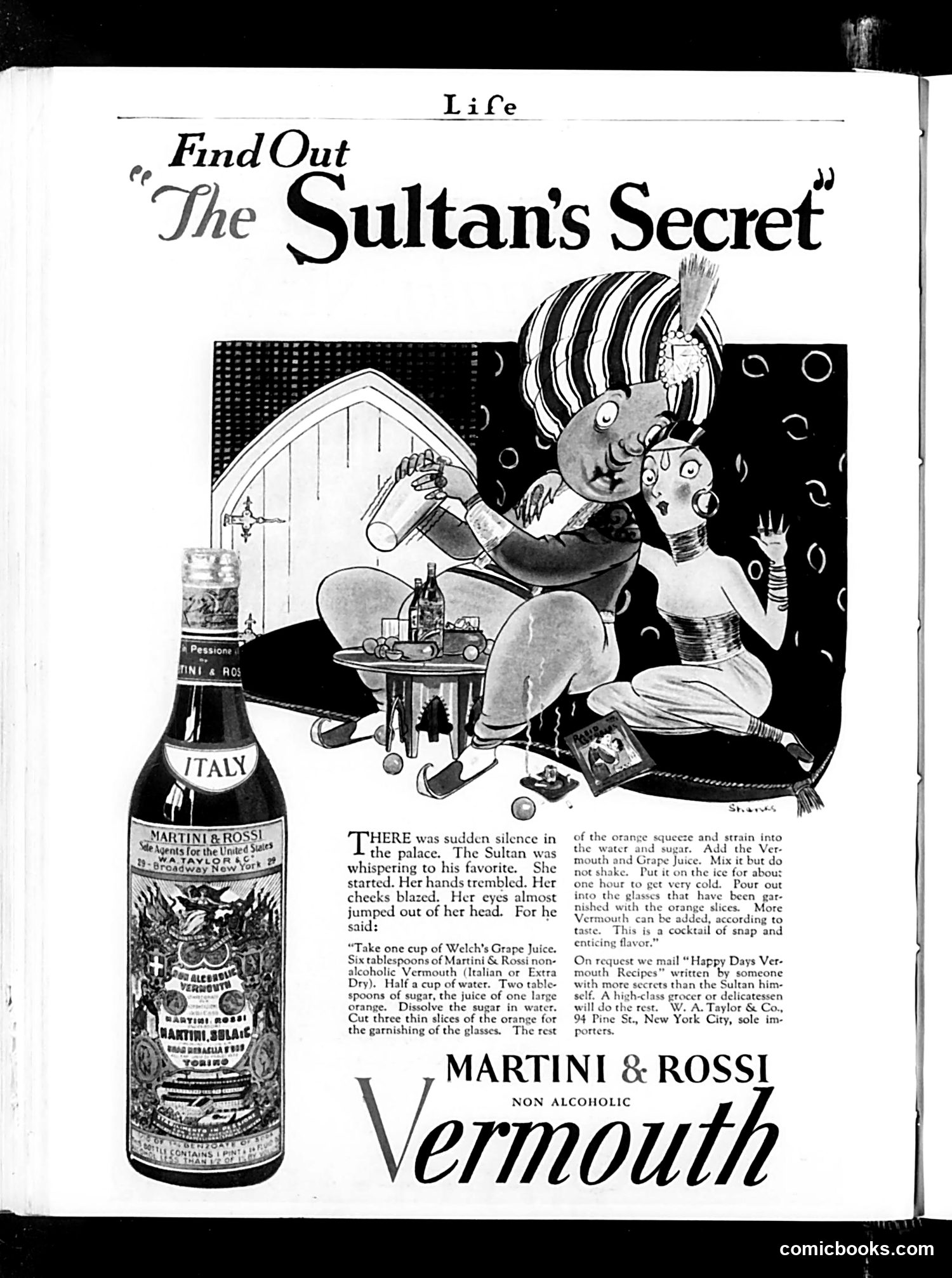
This is primarily a **product advertisement**, not political satire. It uses an Orientalist fantasy scenario—a sultan whispering to a woman in his palace—as exotic framing for a cocktail recipe. The "secret" being dramatically revealed is simply instructions for mixing a vermouth-based drink with grape juice, water, sugar, and orange. The joke relies on early 20th-century stereotypes about harems and "exotic" Middle Eastern settings as inherently sensual and mysterious. By contrast, the actual "secret" is mundane: a beverage recipe. The ad promotes **Martini & Rossi non-alcoholic vermouth**, emphasizing it's Italian, and offers to mail recipes to interested consumers. The humor derives from the disconnect between the melodramatic setup and the ordinary culinary payoff—treating a cocktail recipe with exaggerated intrigue.
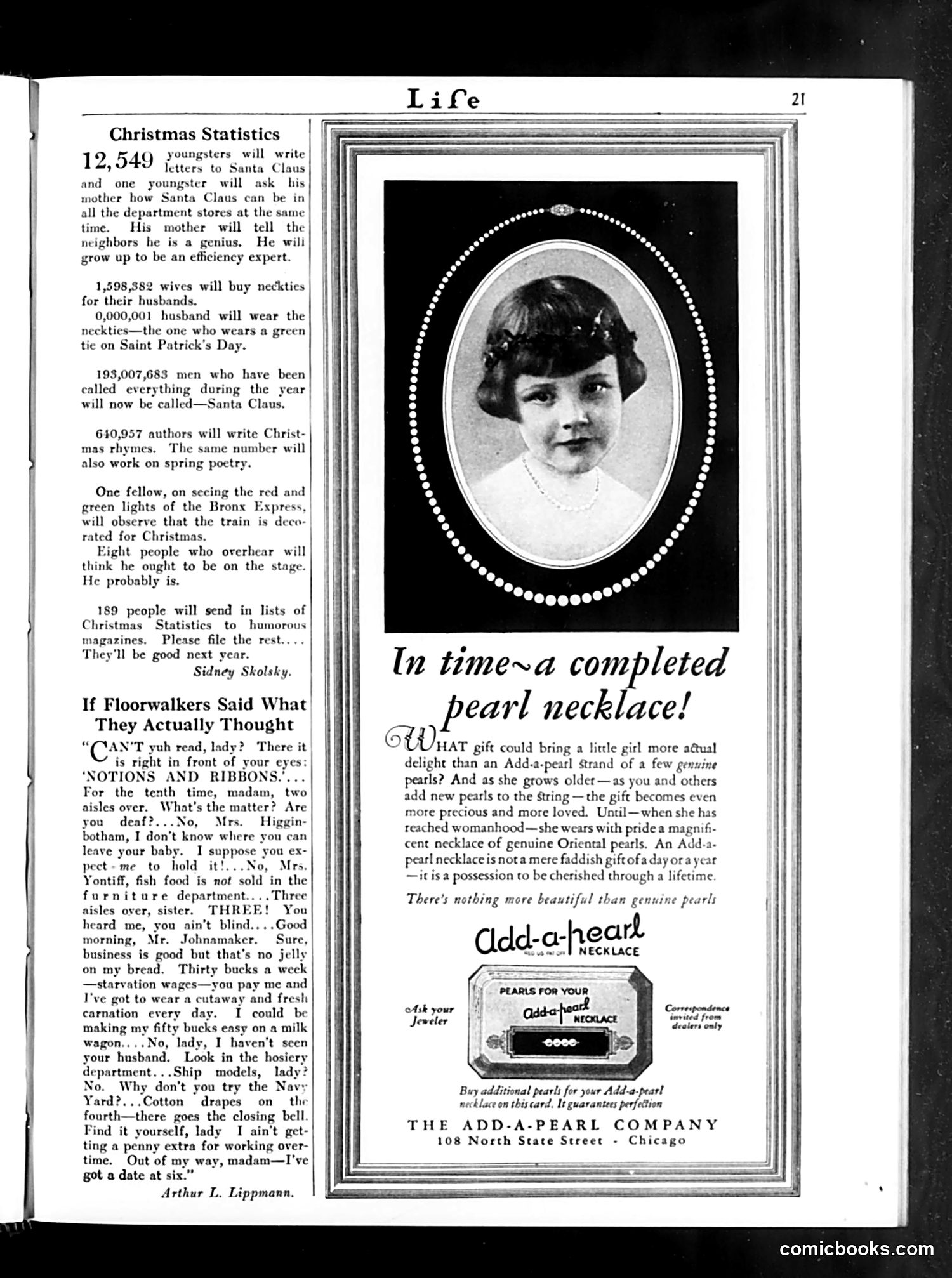
**Left side:** Two satirical humor pieces typical of Life magazine's style: 1. **"Christmas Statistics"** by Sidney Skolsky: Mock statistical humor about the holiday season—12,549 children write Santa, one will ask how he's in all stores simultaneously (destined to become an "efficiency expert"), 1.5 million wives buy neckties for husbands, etc. The joke is the absurdist specificity of completely made-up numbers presented as fact. 2. **"If Floorwalkers Said What They Actually Thought"** by Arthur L. Lippmann: A monologue imagining department store employees saying what they *really* think about customers—revealing frustration, exhaustion, low wages, and contempt for shoppers' questions. The satire mocks both the workers' mistreatment and customer obliviousness during busy shopping season. **Right side:** A full-page advertisement for Add-a-Pearl necklaces—a marketing gimmick where parents buy an initial pearl necklace for a girl, then add pearls as she grows older, eventually becoming a complete strand by adulthood. The advertisement presents this as a sentimental investment in her future.
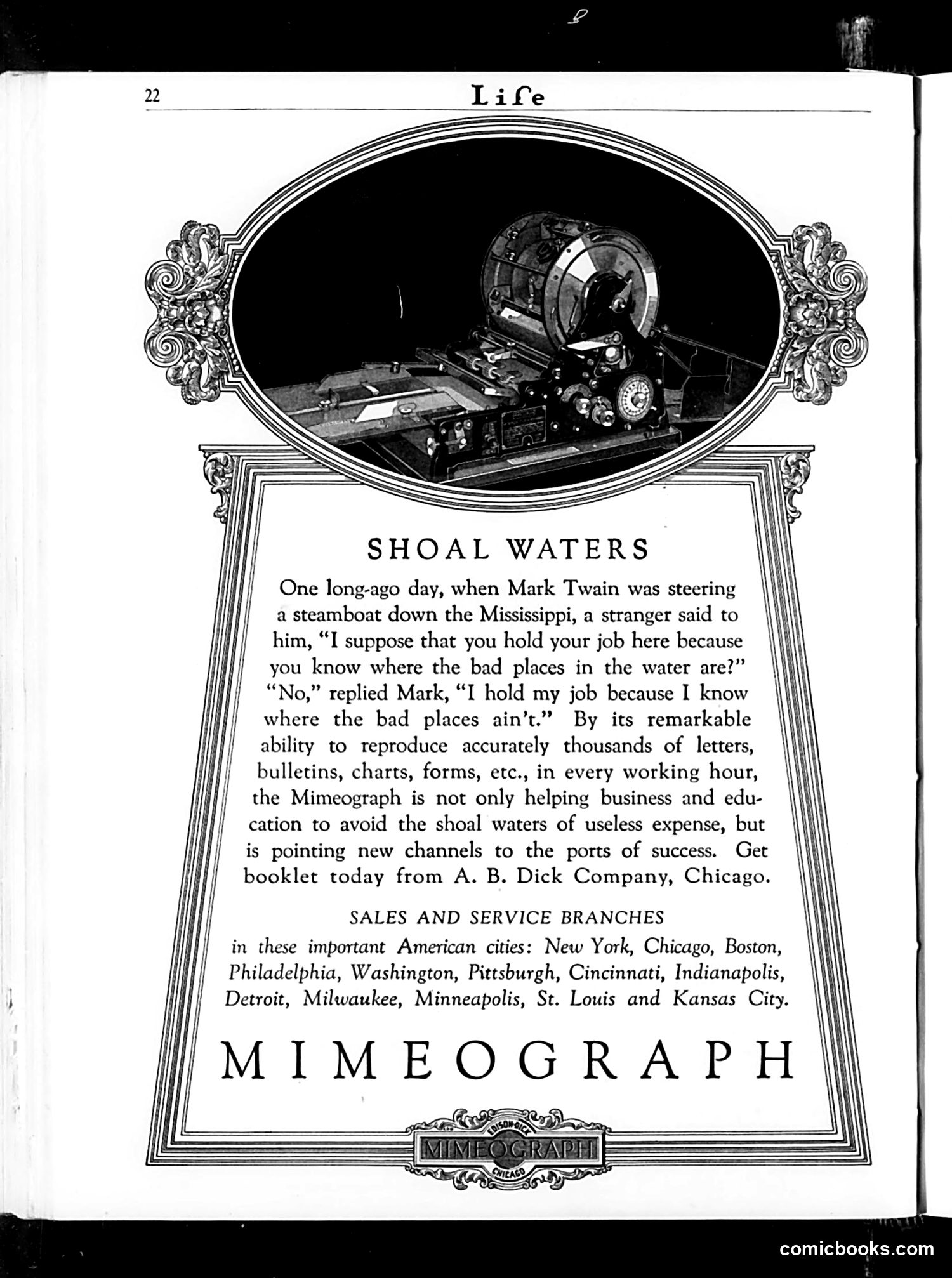
This is a **full-page advertisement** for the Mimeograph machine, manufactured by A.B. Dick Company. It's not satire, but rather branded content using humor and a famous literary reference. The ad employs a **Mark Twain anecdote** about riverboat piloting to sell copying technology. Twain's witty reply—that he succeeds by knowing what to *avoid* rather than what to seek—becomes a metaphor for business efficiency. The "shoal waters" (shallow, dangerous parts of rivers) symbolize wasted expense and inefficiency. The pitch: Mimeographs help companies avoid costly mistakes by accurately reproducing documents in volume, thereby navigating toward "ports of success." The elaborate ornamental border and steamboat illustration in the oval frame evoke early-1900s prestige advertising. This represents how **office technology companies positioned themselves as enabling progress and business success** during the mechanical reproduction era.
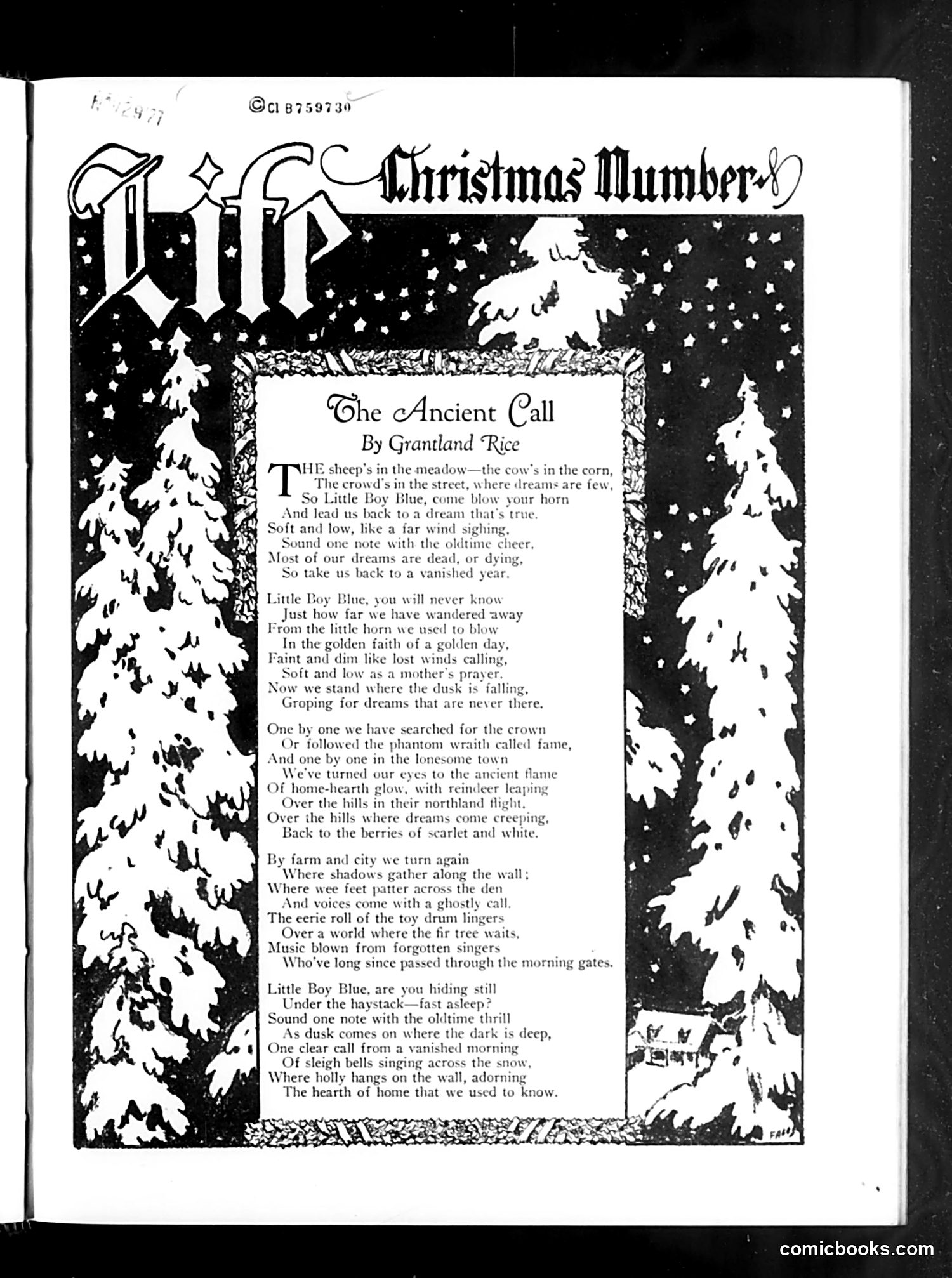
This is not political satire but nostalgic poetry for a Christmas issue. The piece uses the nursery rhyme "Little Boy Blue" as a framework to lament the loss of innocent childhood wonder and simpler times. The poem addresses an idealized past—a "golden day" of pastoral simplicity ("the meadow," "the corn," "home-hearth glow")—contrasting it with modern adult disillusionment. References to abandoned dreams, the pursuit of fame and crowns, and spiritual emptiness suggest post-WWI American melancholy. "Little Boy Blue" represents lost innocence, asked to summon readers back to authentic values through the "ancient flame" of home and hearth. The decorative winter border with snow-laden trees reinforces the Christmas theme of familial return and redemption through memory. This reflects 1920s-era romanticism about pre-industrial rural life rather than political commentary.
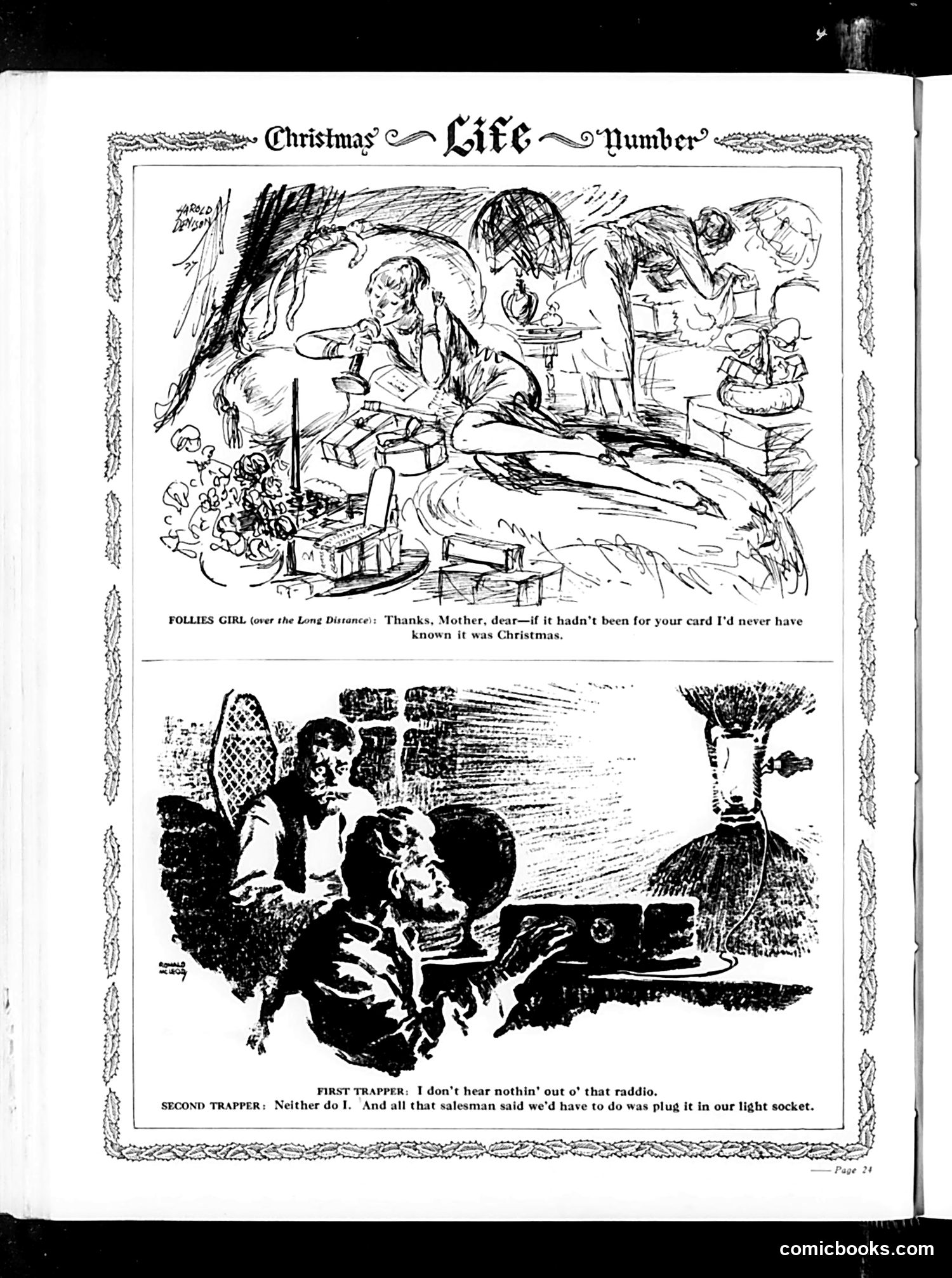
This page contains two separate satirical cartoons: **Top cartoon:** A "Follies Girl" (likely a stage performer or entertainer) receives a Christmas card from her mother while working far from home. The joke is dark humor about her profession—she's so disconnected from normal life that without the card, she wouldn't have realized it was Christmas at all, suggesting her lifestyle is isolating or morally compromised. **Bottom cartoon:** Two trappers attempt to use a radio they've purchased. The salesman promised it would work simply by plugging into a light socket, but it doesn't function. The trappers' confusion and disappointment satirize both fraudulent sales practices and the gap between commercial promises and reality—a common complaint during this era of emerging consumer technology. Both comics mock either social disconnection or consumer deception, typical targets of Life magazine's satirical humor.
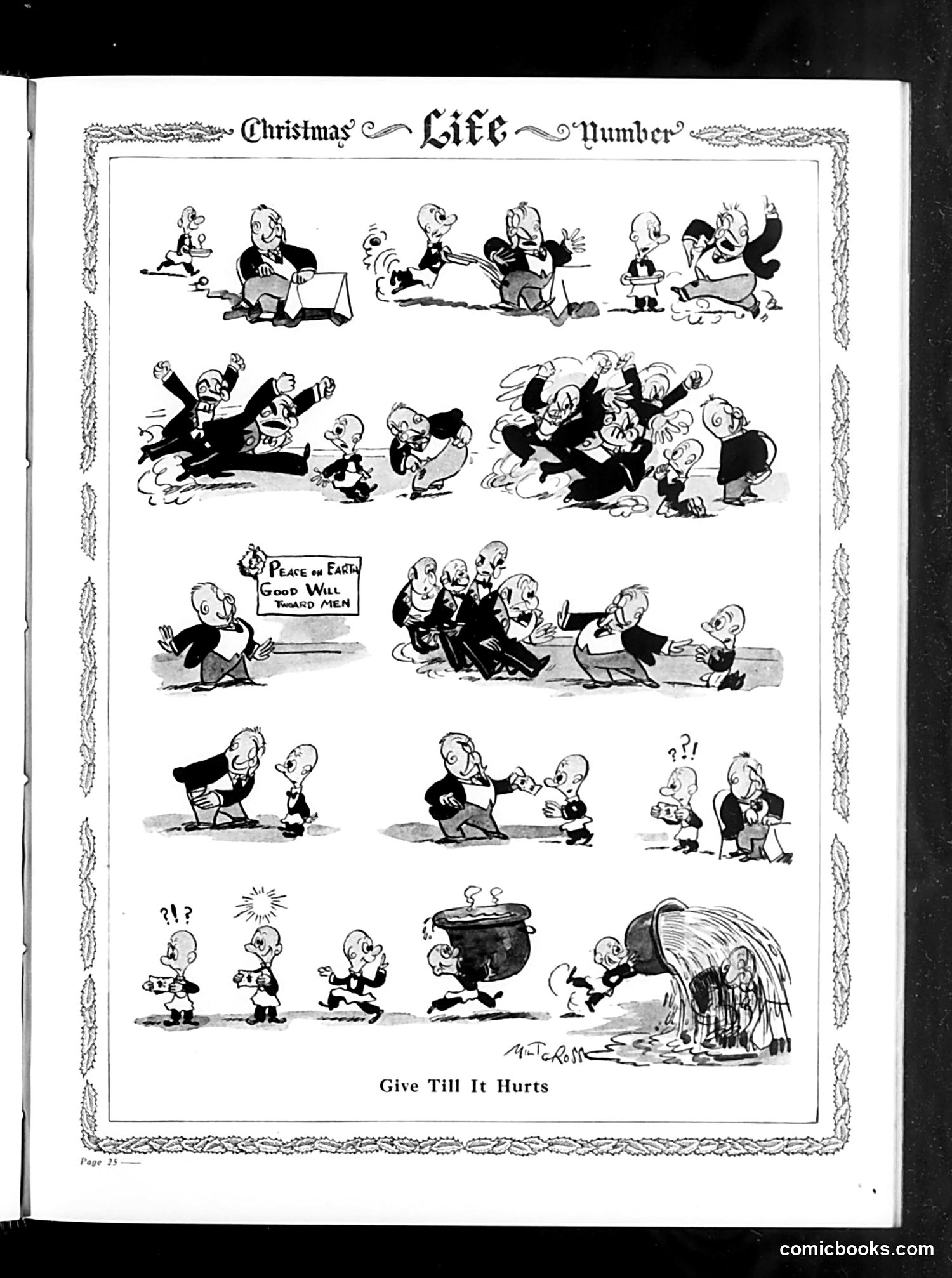
This satirical cartoon page, titled "Give Till It Hurts," depicts Christmas charity campaigns through sequential comic panels. The cartoons mock the pressure and manipulation surrounding holiday fundraising appeals. The sequence shows increasingly aggressive tactics to extract donations: adults appeal to children, crowds mob donors, a sign reads "Peace on Earth / Good Will Toward Men" (ironic given the chaos), and ultimately depicts money literally being poured or wrung from reluctant givers—the final image shows coins cascading from a figure like water from a pitcher. The satire critiques how seasonal charity, while nominally about goodwill, becomes a coercive enterprise. The phrase "Give Till It Hurts" captures the bitter joke: charitable giving has become painful obligation rather than voluntary generosity. This reflects early 20th-century satirical commentary on commercialized Christmas traditions.
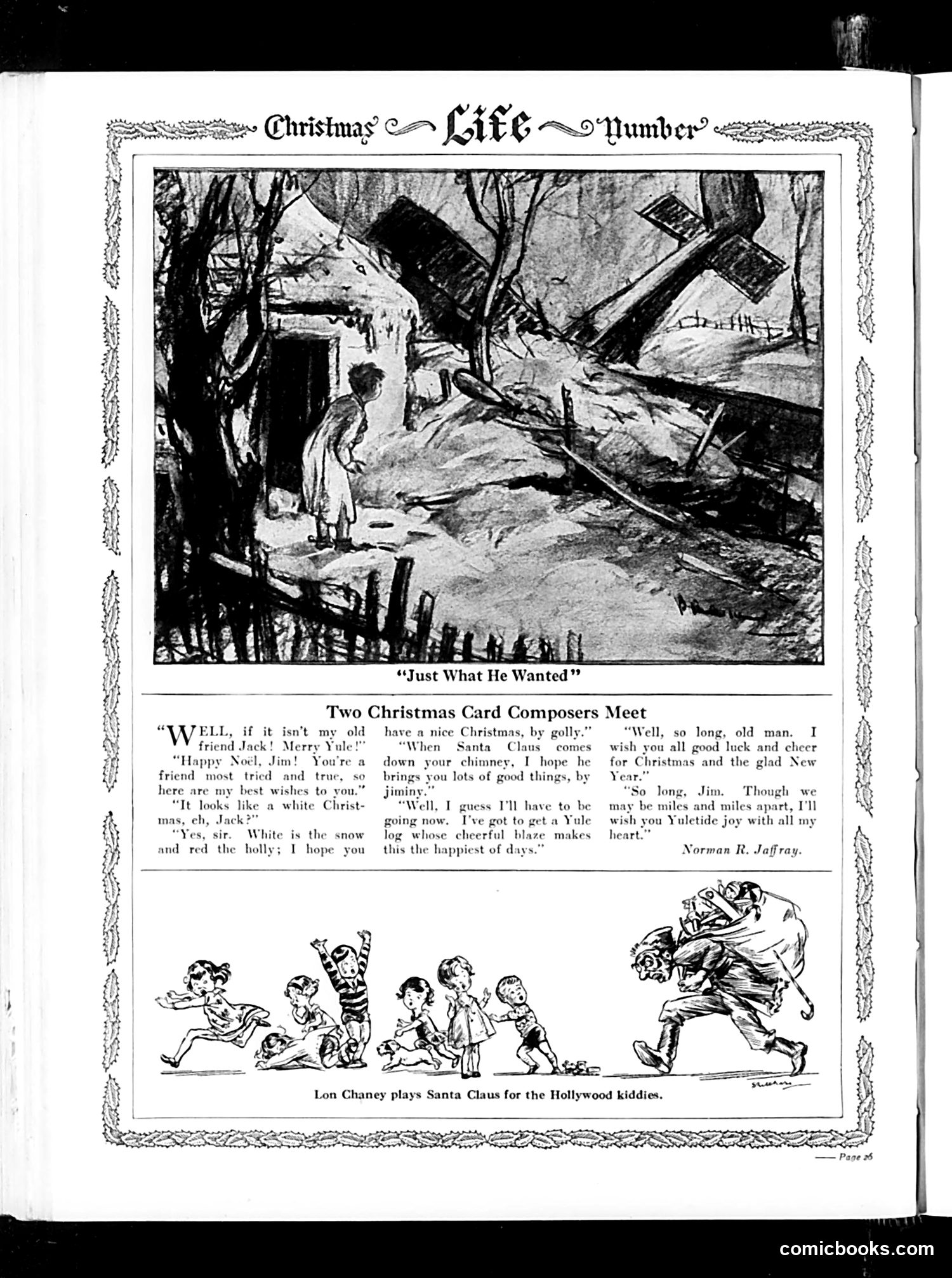
This page satirizes the saccharine sentimentality of Christmas greeting cards. Two composers—Jack and Jim—meet and exchange exaggerated, clichéd Christmas wishes filled with generic holiday imagery: "white Christmas," "red holly," "Santa Claus," "Yule log," and promises of cheer despite distance. The joke is that these professional card writers are so steeped in hackneyed Christmas sentiment that their actual conversation mimics the overwrought language they compose for mass-market greeting cards. They're parodying both the greeting card industry's relentless sentimentalism and the disconnect between genuine emotion and commercial holiday messaging. The bottom panel shows Lon Chaney (a famous silent-film actor) playing Santa Claus for Hollywood children—adding a layer about manufactured Christmas experiences for entertainment industry families.
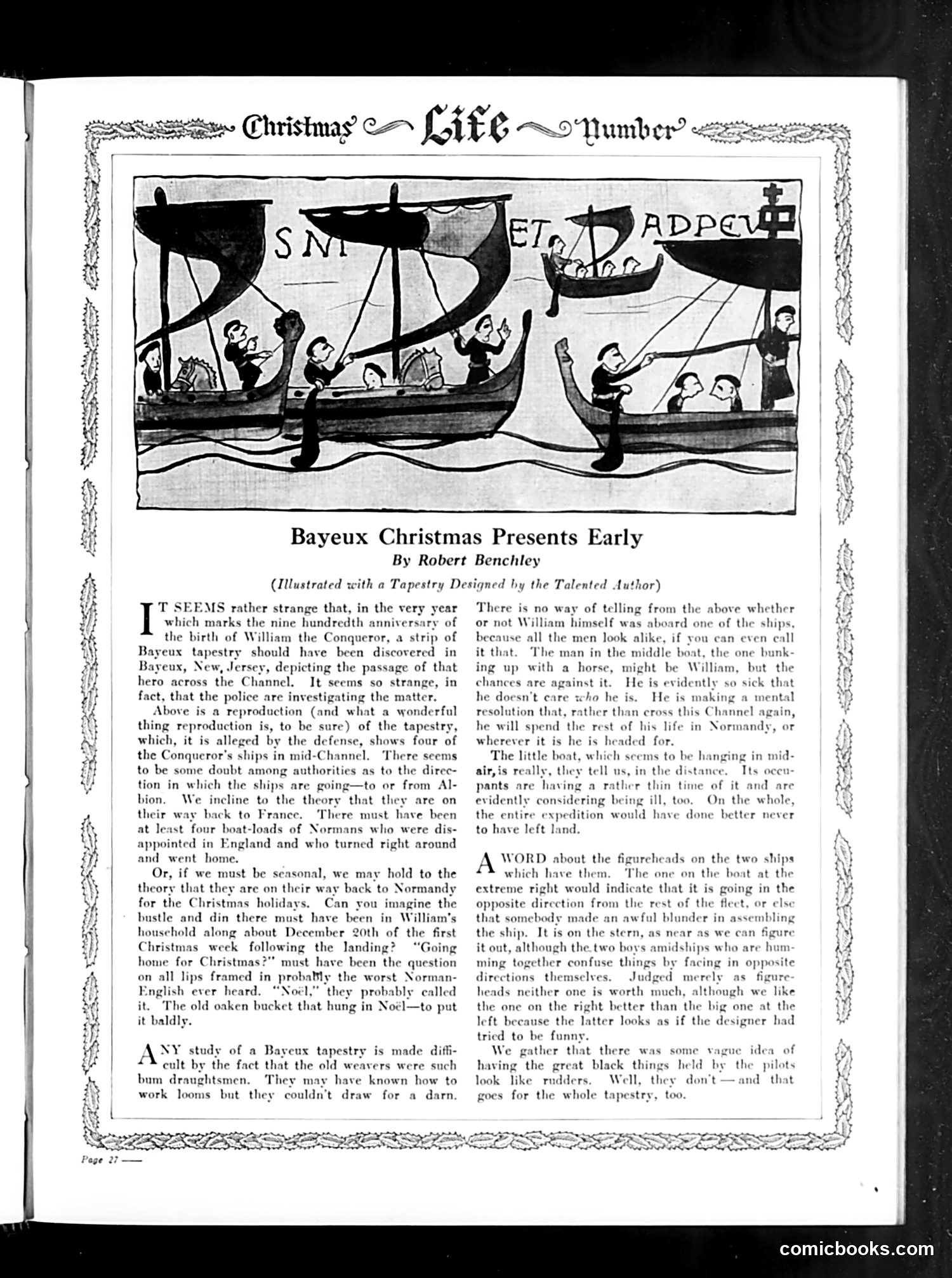
This is a humorous essay by Robert Benchley, illustrated with a mock-medieval tapestry. The satire works on multiple levels: **The Setup:** Benchley imagines that a "Bayeux tapestry" depicting William the Conqueror has been discovered in Bayeux, *New Jersey*, prompting a police investigation—absurdly treating this anachronistic "find" as a serious matter. **The Jokes:** - He speculates William's ships are returning to France because the Normans were "disappointed in England" - Or they're headed home for Christmas—imagining medieval soldiers homesick for the holidays - He mocks the tapestry's poor draftsmanship: the figures look identical, directions are unclear, and the "figureheads" are incomprehensible - He notes one ship's occupant (possibly William) is so seasick he's indifferent to his own identity **The Satire:** This parodies both scholarly reverence for historical artifacts and American provincial pride (a New Jersey "discovery"). Benchley presents historical events as mundane human situations—soldiers wanting to go home—deflating their grandiosity.
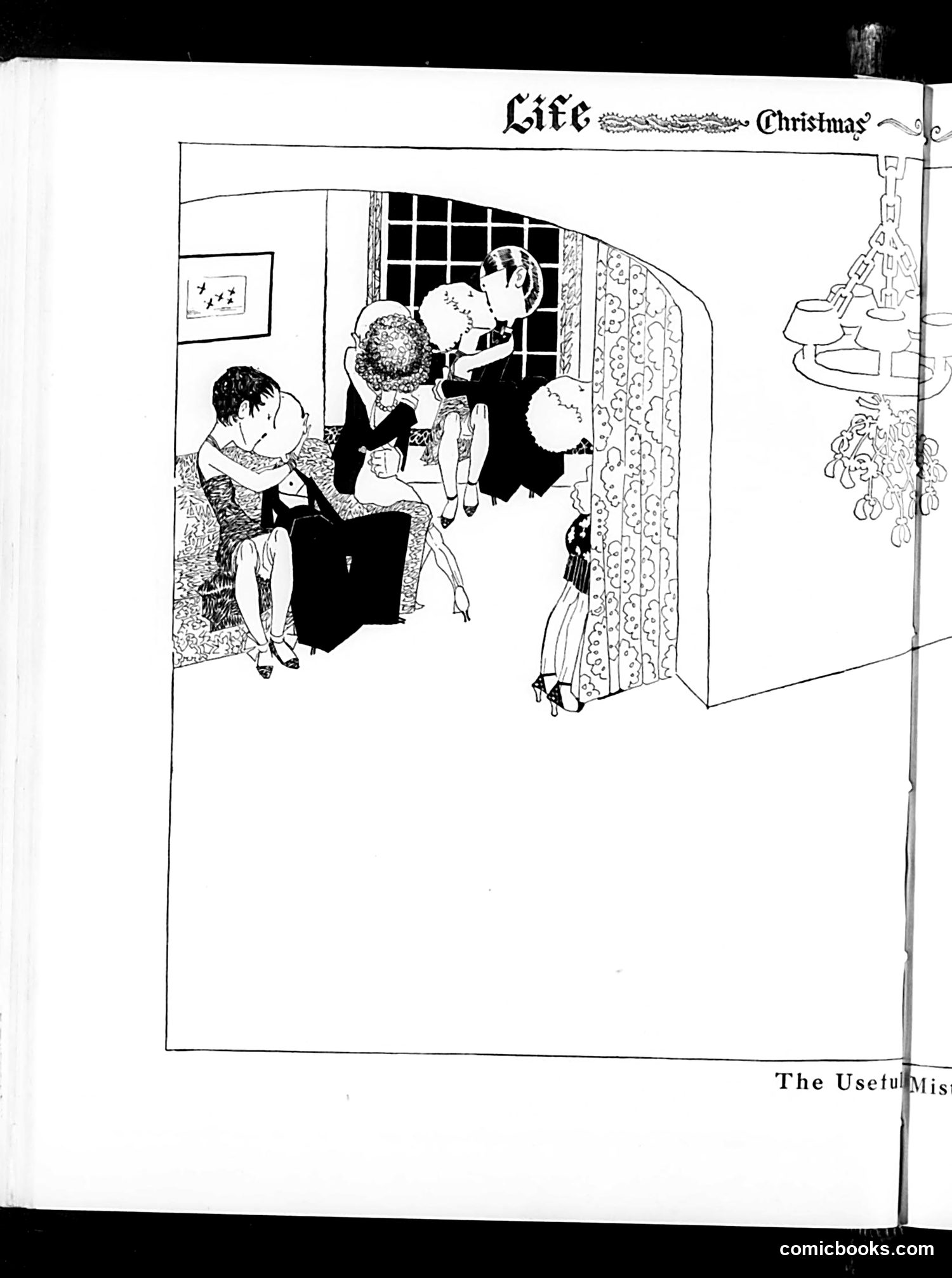
This is a Life magazine Christmas illustration showing a domestic holiday scene. The drawing depicts several figures gathered indoors during what appears to be a Christmas visit or party. There's a window with curtains visible, and holiday decorations including what looks like mistletoe hanging above. The figures are dressed in early-20th-century attire. The caption reads "The Useful Mis[...]" (text is cut off), suggesting this cartoon satirizes gift-giving or holiday traditions. Without the complete caption, the specific satire is unclear, but the scene appears to mock some aspect of Christmas entertaining or social etiquette of the era—possibly critiquing overly formal or awkward holiday gatherings among the upper classes. The illustration style and context indicate this is from Life's heyday as a satirical humor publication.
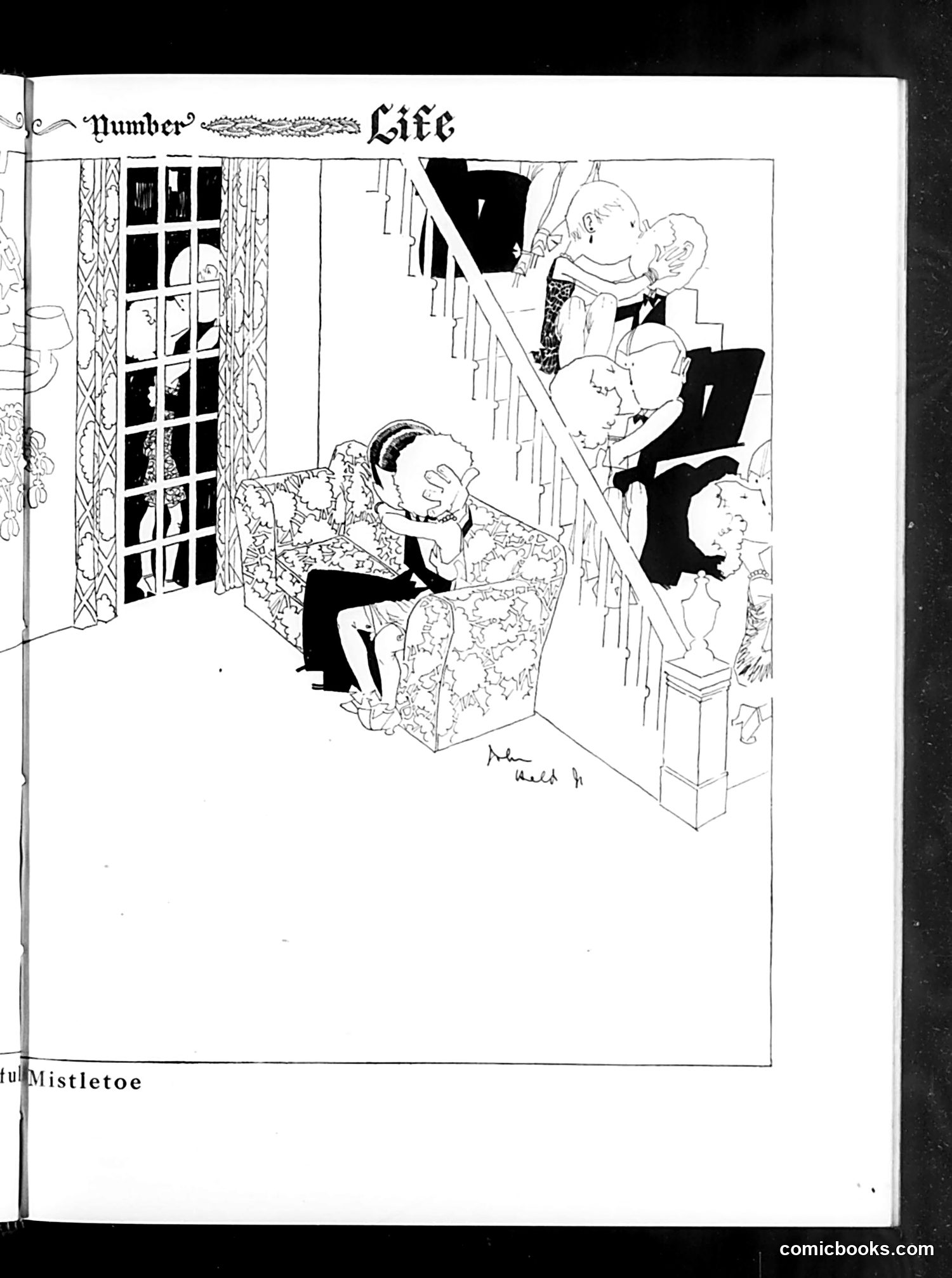
This is a satirical cartoon from *Life* magazine depicting a social scene under mistletoe during the Christmas season. The setting shows a well-dressed gathering in an elegant interior, with a man seated on a patterned sofa appearing uncomfortable or evasive while others around him—particularly women—seem to be engaging in the traditional mistletoe kissing custom. The humor appears to target social awkwardness around holiday romance rituals. The man's defensive posture and the title's cryptic "Number?" suggests the satire concerns dating customs or romantic entanglements—possibly poking fun at men's reluctance or confusion about romantic expectations during festive occasions. The cartoon mockingly documents this recognizable social dynamic of the era.
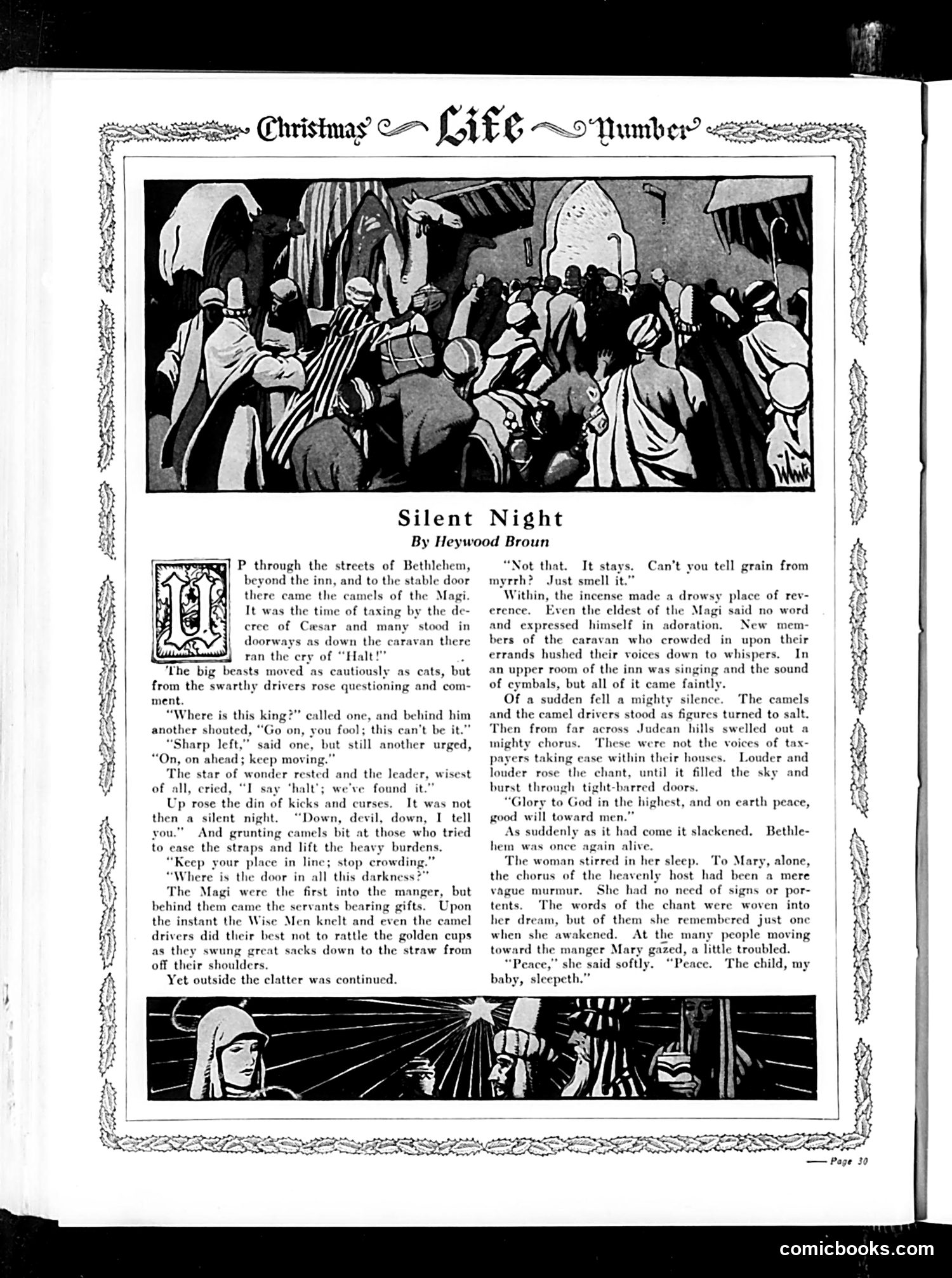
This is a Christmas story rather than political satire. Broun retells the Nativity with realistic, unglamorous detail: the Magi's arrival in Bethlehem occurs during a Roman census, their caravan is noisy and difficult to manage, servants jostle with golden gifts, and the stable scene is crowded and chaotic. The narrative's point appears to be contrasting **earthly commotion with spiritual peace**. Outside the manger, there's clamor—tax collectors, crowds, struggling animals. Inside, the Wise Men kneel in silent reverence. The angels' chorus breaks through, but Mary alone hears it as mere murmur, finding peace in her child's sleep. The story emphasizes how sacred moments exist amid ordinary, messy reality—a meditation on finding tranquility within chaos rather than political commentary.
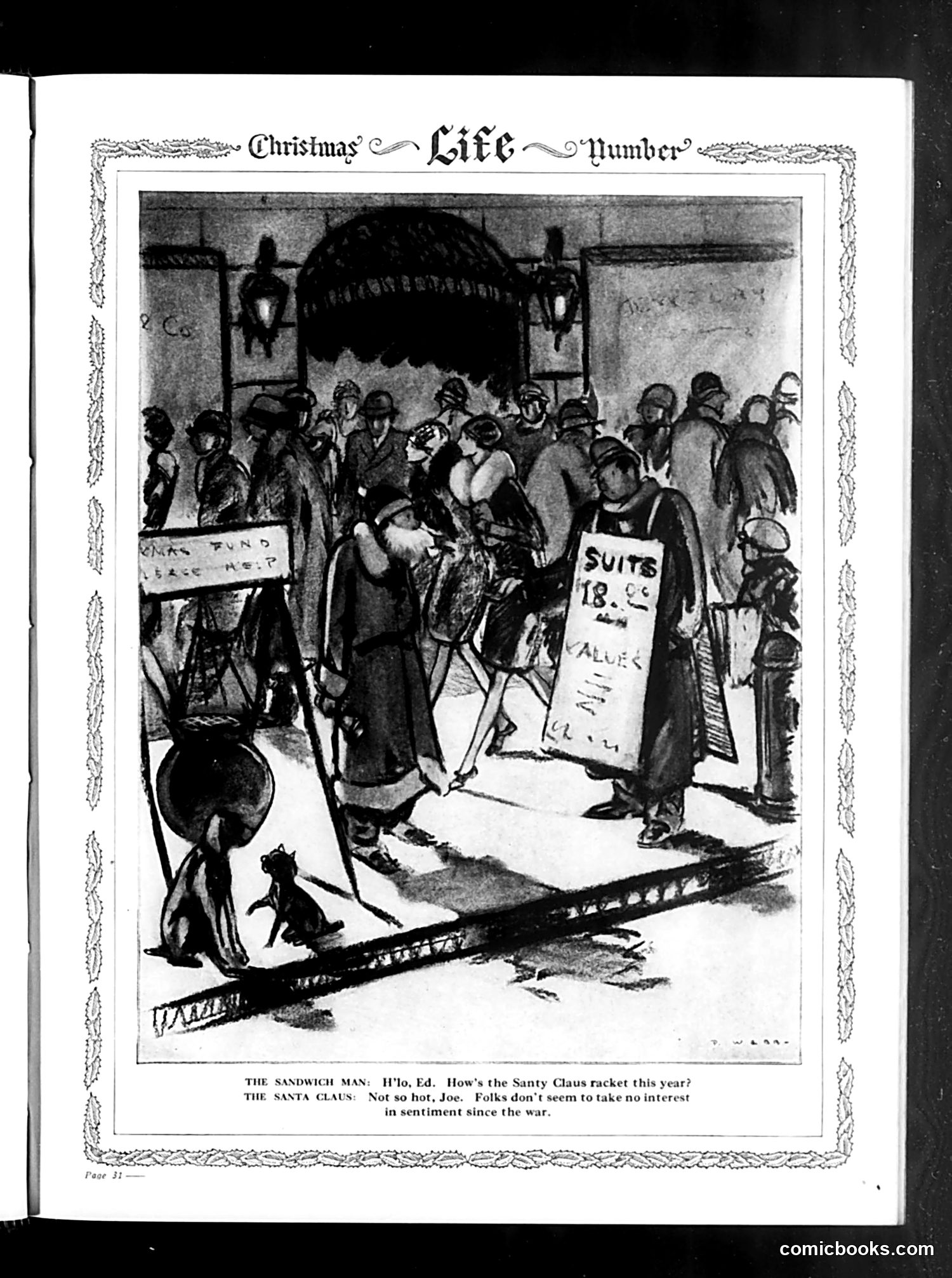
This satirical cartoon depicts post-World War I commercial decline. A "sandwich man" (street advertiser carrying promotional signs) encounters a struggling Santa Claus figure at what appears to be a Christmas market or street fair. The Santa laments poor business, attributing it to lost public sentiment following the war. The satire critiques how WWI dampened American Christmas spirit and consumer enthusiasm. Visible price signs (suits at 18.95, other goods) emphasize the commercial context. The cartoon suggests the war fundamentally altered American attitudes toward holiday sentiment and spending—people were too scarred or economically affected to engage in traditional Christmas festivities and consumption. This reflects actual post-war economic and psychological displacement in 1920s America.
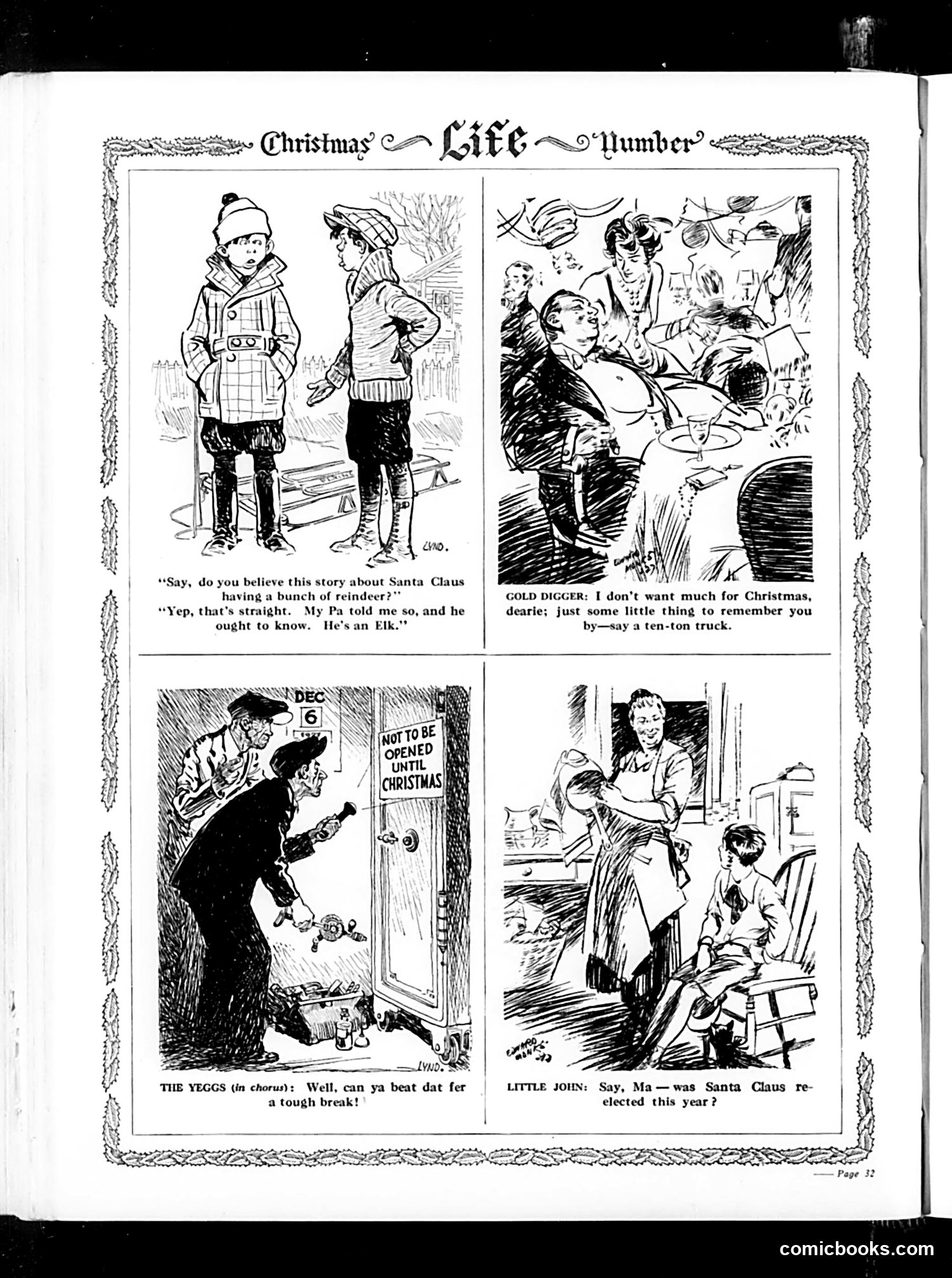
This page contains four separate gag comics satirizing Christmas and contemporary life: 1. **Top left**: Children debate Santa's reindeer. One claims his father, an Elk (fraternal organization member), vouches for it—mocking how adults uncritically accept lodge gossip as authority. 2. **Top right**: "Gold Digger" joke about a woman requesting a ten-ton truck as a Christmas gift from her lover—satirizing materialism and transactional romance. 3. **Bottom left**: "The Yeggs" (criminal slang for burglars) are caught mid-heist discovering a locked safe marked "Not to be opened until Christmas," lamenting bad timing—dark humor about criminals' misfortune. 4. **Bottom right**: A child asks if "Santa Claus" was "re-elected"—likely referencing recent political elections, conflating Santa with political figures or satirizing how children view authority figures. The humor relies on deflating Christmas sentimentality through cynicism about materialism, crime, gullibility, and politics.
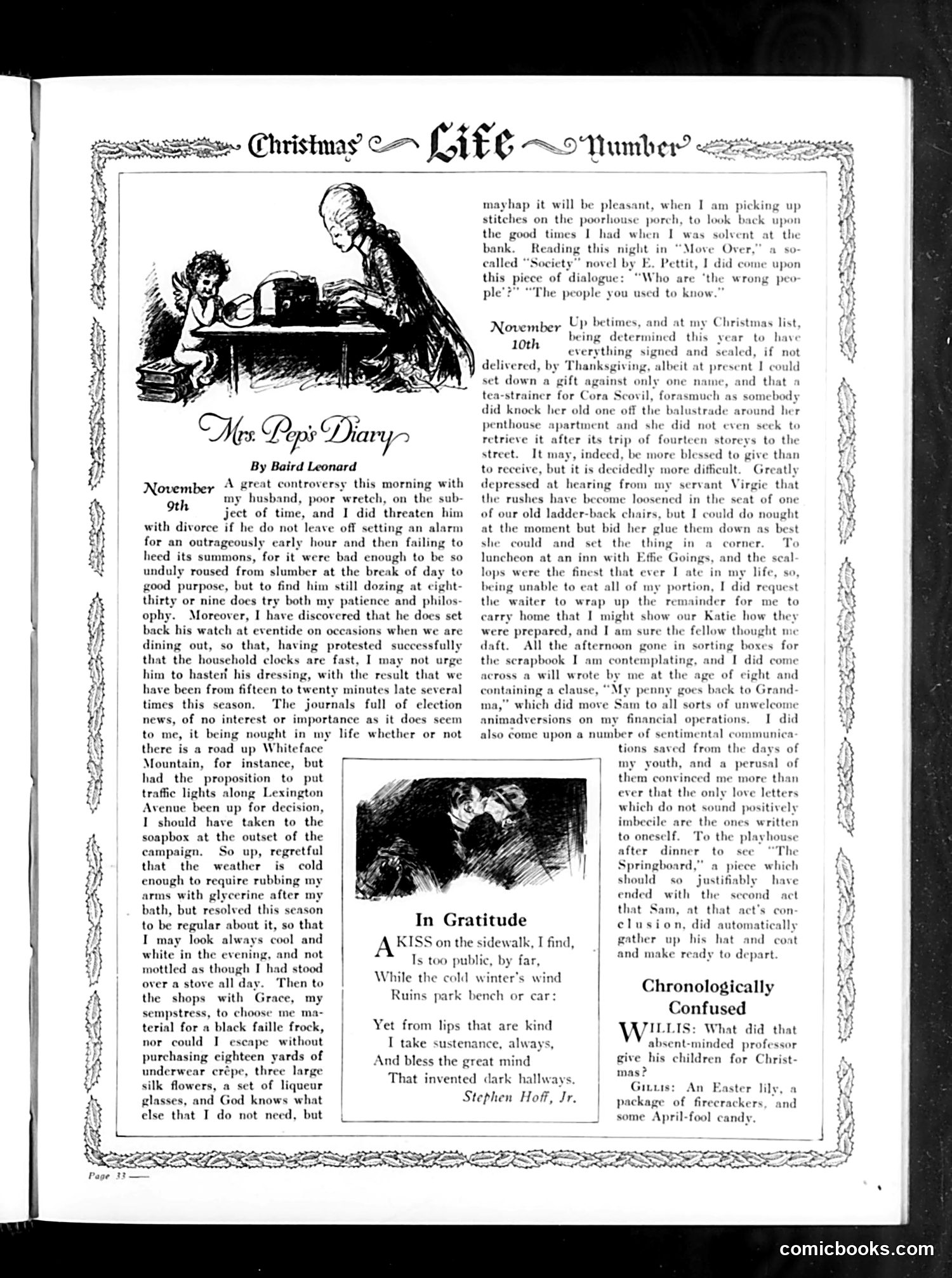
This page presents "Mrs. Pep's Diary" by Baird Leonard, a humorous domestic narrative satirizing upper-middle-class married life and consumer culture in early 20th-century America. The diarist complains about her husband's shabby habits—setting alarms he ignores, manipulating clocks to avoid dressing promptly for social engagements. The satire mocks marital friction over trivial matters while revealing the wife's own contradictions: she threatens divorce over punctuality yet permits herself endless shopping, acquiring unnecessary items (silk flowers, liqueur glasses, underwear crepe) she doesn't need. The diary format allows gentle mockery of both spouses' vanities and the leisured class's preoccupations—election news is dismissed as unimportant while traffic light policy obsesses her. References to servants (Virgie), penthouse living, and casual gift-giving (a tea-strainer to replace a broken balustrade item) reinforce the satire of wealthy, self-absorbed domesticity. The accompanying poem "In Gratitude" by Stephen Hoff Jr. offers social commentary on public displays of affection versus private kindness.
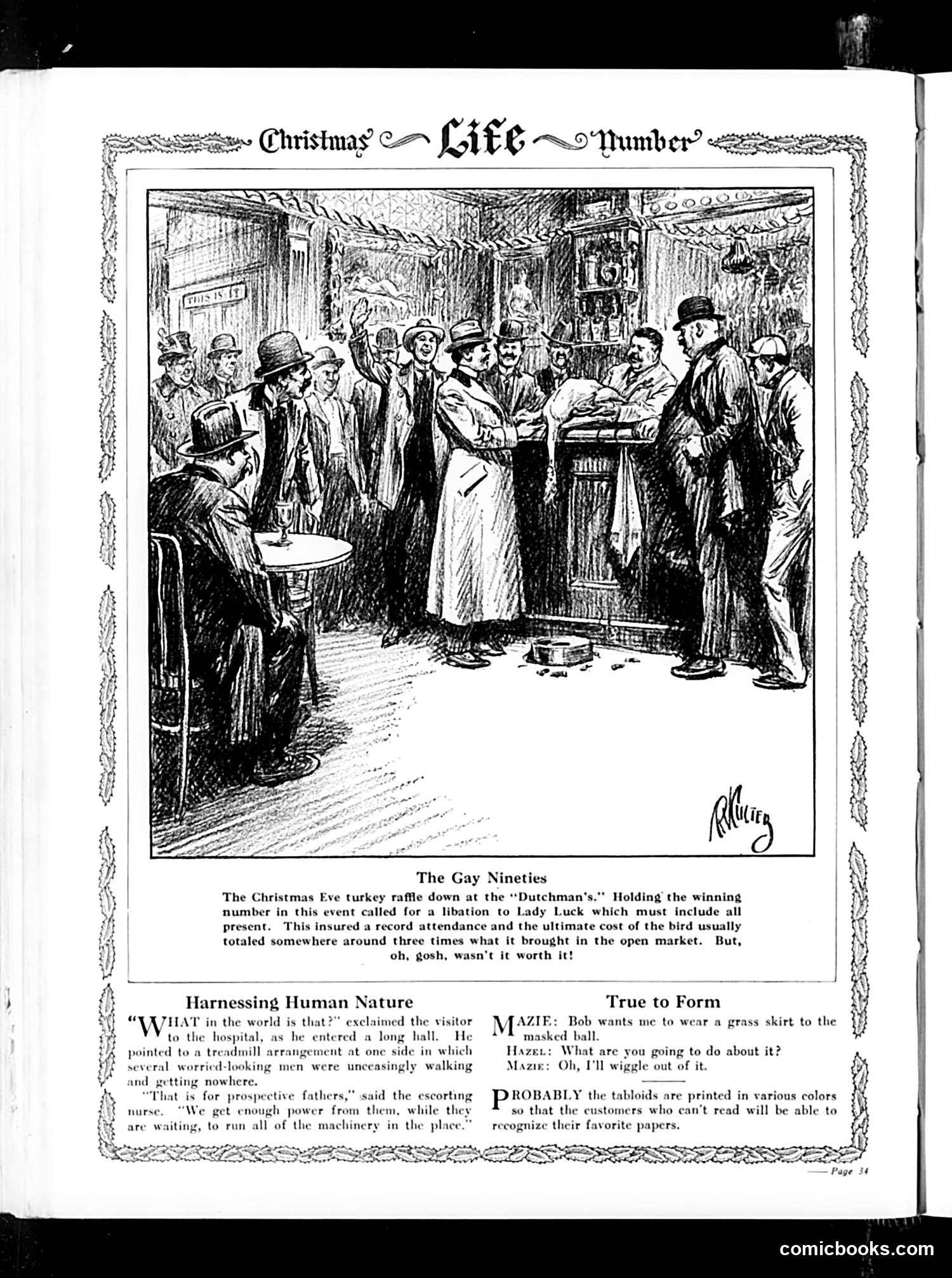
This page from *Life* magazine contains three satirical pieces from the 1890s era ("The Gay Nineties"): **"The Gay Nineties"** (main illustration): A humorous scene depicting a Christmas Eve turkey raffle at a bar called "The Dutchman's." The joke satirizes how celebratory drinking inflates the actual cost of the prize—the bird supposedly costs three times its market value once everyone toasts the winner. It's gentle mockery of working-class holiday traditions and the economic irrationality of festive excess. **"Harnessing Human Nature"**: A hospital visitor observes men on treadmills. The nurse explains these are "prospective fathers" whose physical exertion powers the hospital's machinery—dark humor about exploiting men's anxieties regarding fatherhood. **"True to Form"**: A brief comic dialogue where a woman agrees to wear a grass skirt to a masked ball, then jokes she'll "wiggle out of it"—a pun on both the garment and escaping obligation. The final paragraph humorously notes tabloids print in different colors so illiterate readers can identify their favorite papers by color rather than content.
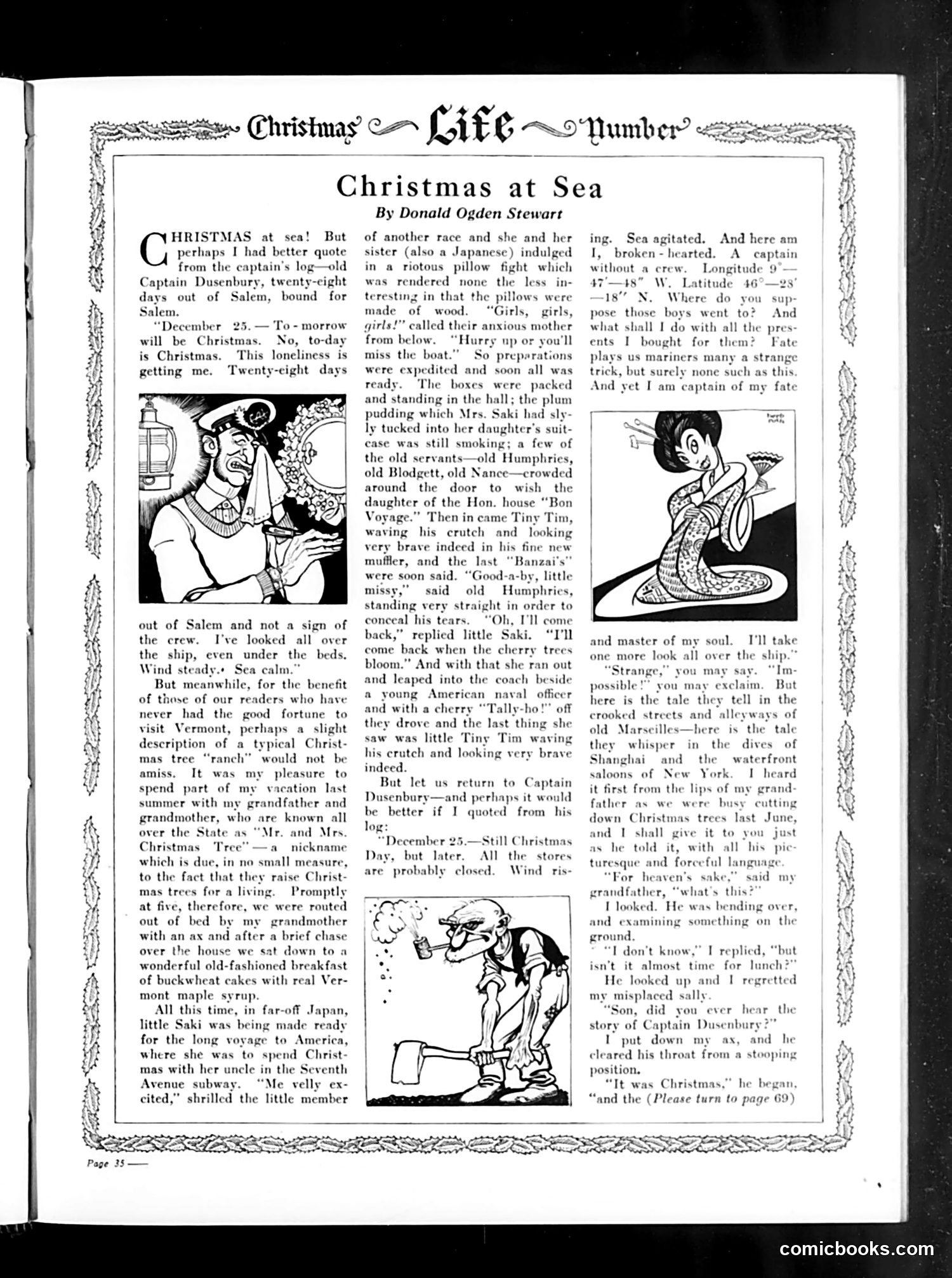
This is a humorous short story by Donald Ogden Stewart in *Life* magazine, not primarily a political cartoon. The page contains two small illustrations supporting the narrative. The story satirizes overwrought adventure fiction by juxtaposing absurdly melodramatic elements: a lonely sea captain on Christmas, a Japanese family traveling to America, and sentimental Victorian tropes (Tiny Tim with a crutch, weeping servants). The humor lies in the contradictions—pillows "made of wood," a child traveling to "the Seventh Avenue subway" for Christmas, and the narrator's grandfather who runs a Christmas tree "ranch" in Vermont. The author mocks both sentimental Christmas narratives and exotic Oriental adventure tales popular in the era, piling improbable details into an increasingly ridiculous setup that culminates with the captain's crew mysteriously vanishing. It's gentle satire of literary pretension rather than political commentary.
This is the editorial/opinion section (not a cartoon page), titled "Christmas" by E.S. Martin. The piece debates Christmas's cultural significance while raising provocative historical questions. The main argument contrasts Christmas's commercial importance with deeper philosophical questions: What makes Christianity valuable to Western civilization? Martin presents contrary views through cited writers—Edward Lucas White sees Christianity's rise as crucial to destroying paganism; Owen Wister questions whether Christianity adds anything beyond "pity"; and a writer called "Publius" ironically questions whether Charles Martel's 732 victory stopping Moorish invasion into Spain was beneficial, given that Islamic civilization brought learning and infrastructure (algebra, street lights, paved streets in Córdoba). The satire suggests Western triumphalism about Christian civilization is simplistic—medieval Islamic Spain was arguably more advanced than contemporary Europe. This reflects 1920s intellectual debates about progress, tradition, and cultural relativism.
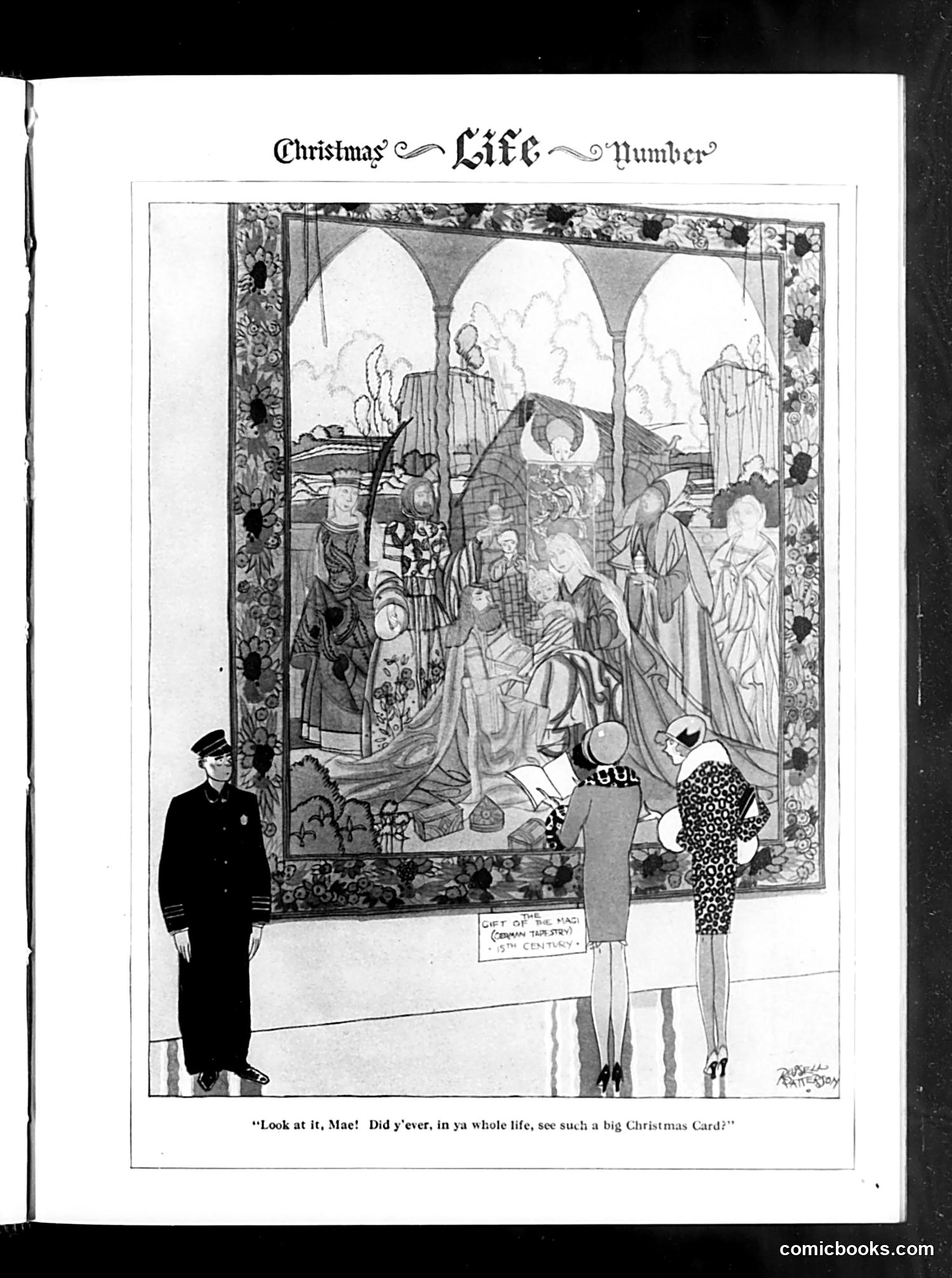
This is a satirical cartoon from Life magazine's Christmas issue. It shows two working-class visitors (a uniformed doorman and two women in 1920s-30s fashion) admiring an enormous, ornate medieval-style tapestry or artwork displayed in what appears to be a museum or gallery. The humor lies in the contrast between the speakers' casual, colloquial dialect ("Did y'ever, in ya whole life") and their awe at viewing high art. The joke satirizes class differences: ordinary people expressing wonder at elite cultural institutions. The massive scale of the artwork amplifies the effect—even a "big Christmas card" seems small compared to this elaborate display. The cartoon gently mocks both the pretentiousness of fine art and the earnest appreciation of common visitors encountering it.
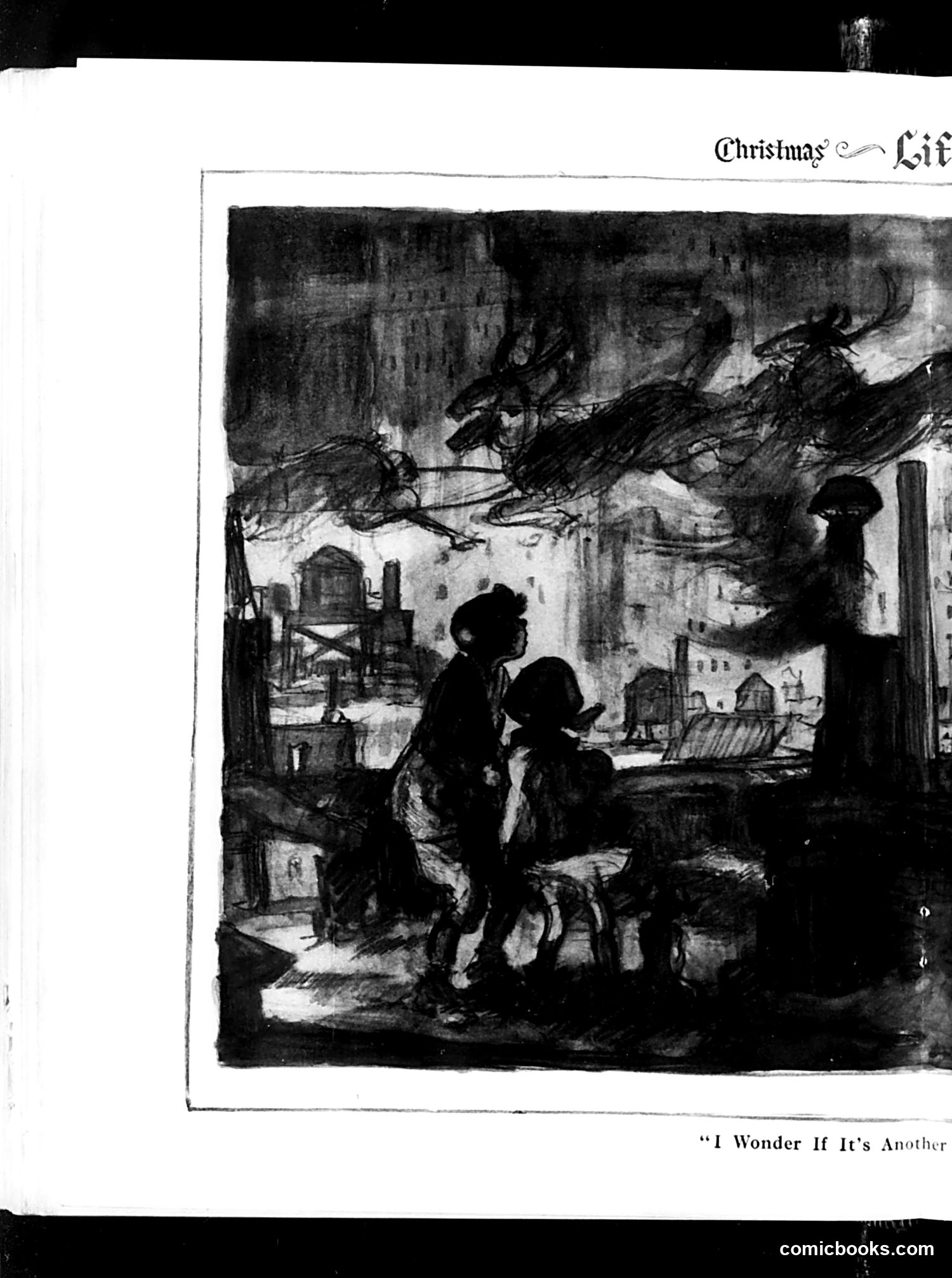
This appears to be a Christmas-themed illustration from *Life* magazine. The image shows silhouetted figures (appearing to be children) looking upward in wonder at flying reindeer pulling a sleigh across a nighttime city skyline. The caption reads "I Wonder If It's Another..." The cartoon depicts the classic Christmas Eve scene of children witnessing Santa's arrival. The artistic style—dramatic black silhouettes against a lighter background—emphasizes the magical, wondrous quality of the moment. The incomplete caption suggests either skepticism about Santa's existence or a humorous comment about repeated annual visits. Without the complete text or publication date visible, the specific satirical point remains unclear, though it likely plays on childhood wonder versus adult skepticism about Christmas mythology.
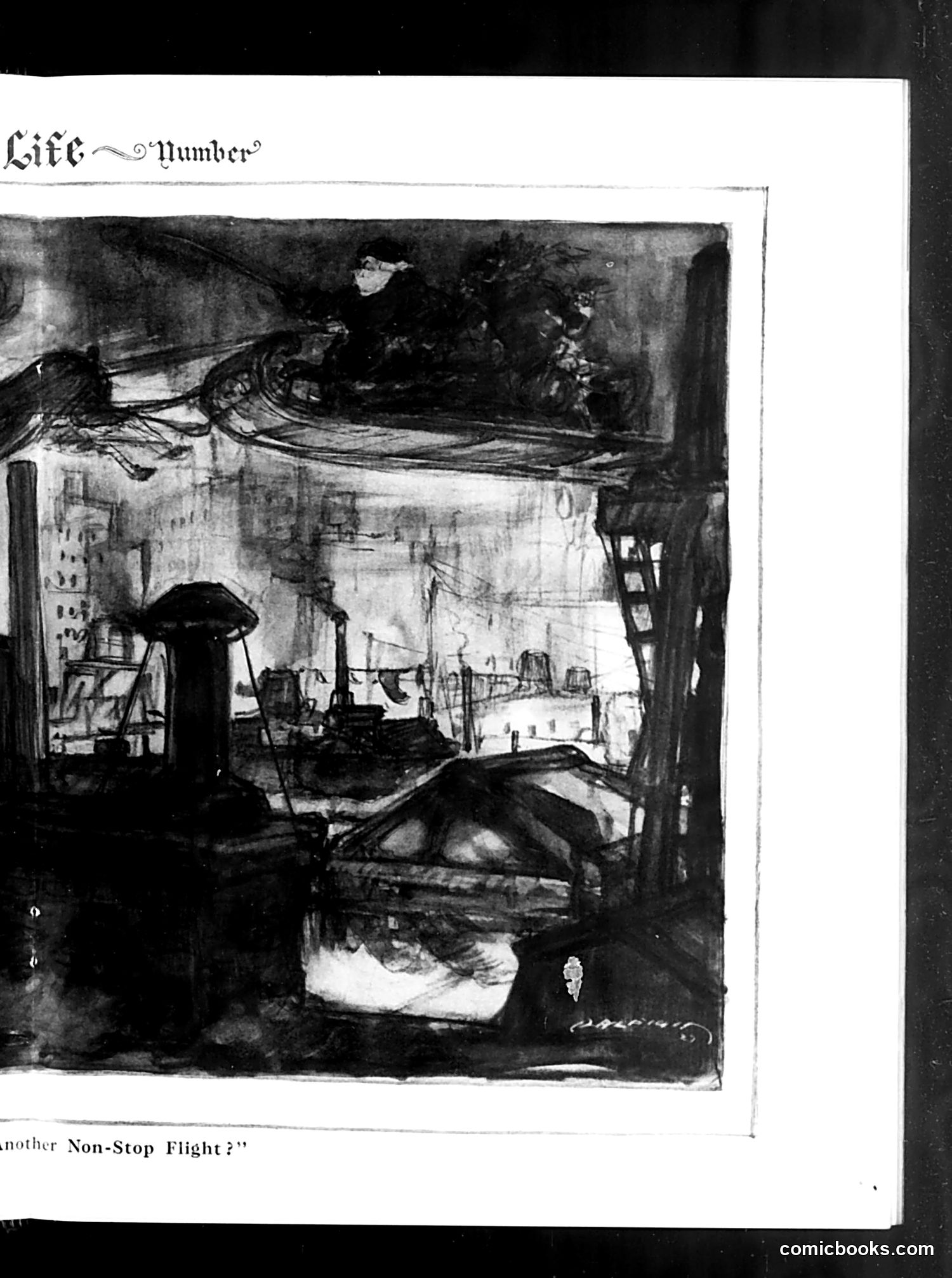
This appears to be a satirical cartoon from Life magazine titled "Another Non-Stop Flight?" The image depicts an interior scene—likely an airplane cabin or bedroom—with figures and architectural elements rendered in dark, expressionistic style. The cartoon appears to reference early aviation's "non-stop flight" phenomenon, which was a major news story in the 1920s-1930s. The satirical point likely mocks either: - The obsession with aviation records and endurance flights - The conditions or chaos aboard such flights - Contemporary anxieties about air travel The domestic interior setting suggests satire about modern life's frenetic pace. Without clearer identification of specific figures or the exact publication date, the precise political or social target remains unclear, though the tone is critical of contemporary behavior or aspirations.
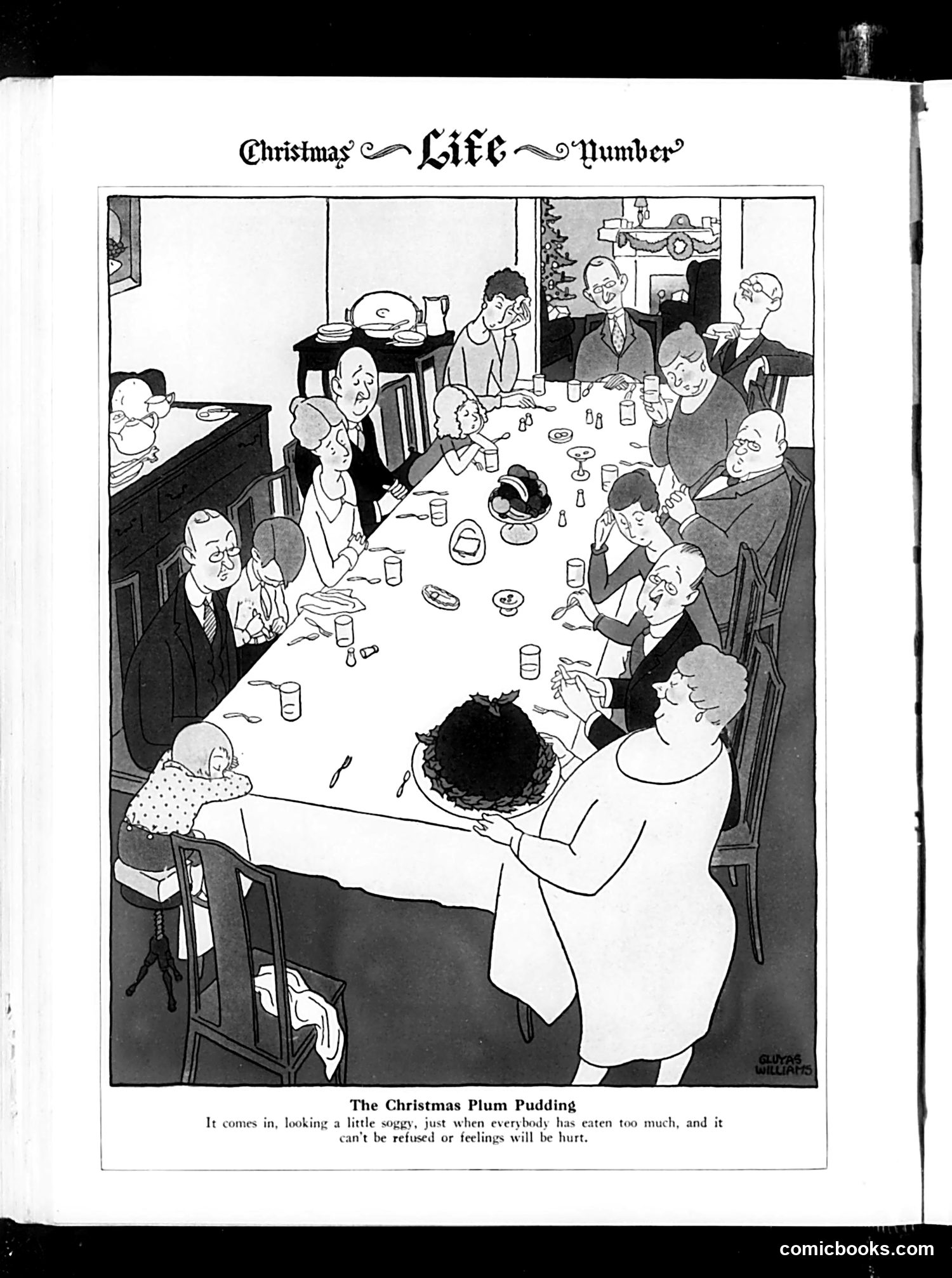
This cartoon satirizes the social awkwardness of Christmas dinner etiquette. The scene shows a formal family meal where a large plum pudding is being served to guests who are visibly overstuffed and uncomfortable after eating too much already. The joke targets the obligatory politeness of holiday entertaining: the pudding "can't be refused or feelings will be hurt," forcing guests to consume more food despite their discomfort. The pudding's "soggy" appearance and poor timing—arriving when everyone is already too full—adds to the satirical critique of traditional holiday excess and the social pressures that compel people to participate in uncomfortable customs regardless of their actual desires or physical capacity. The cartoon mocks both the rigidity of holiday traditions and guests' inability to honestly decline, even when it would be more comfortable to do so.
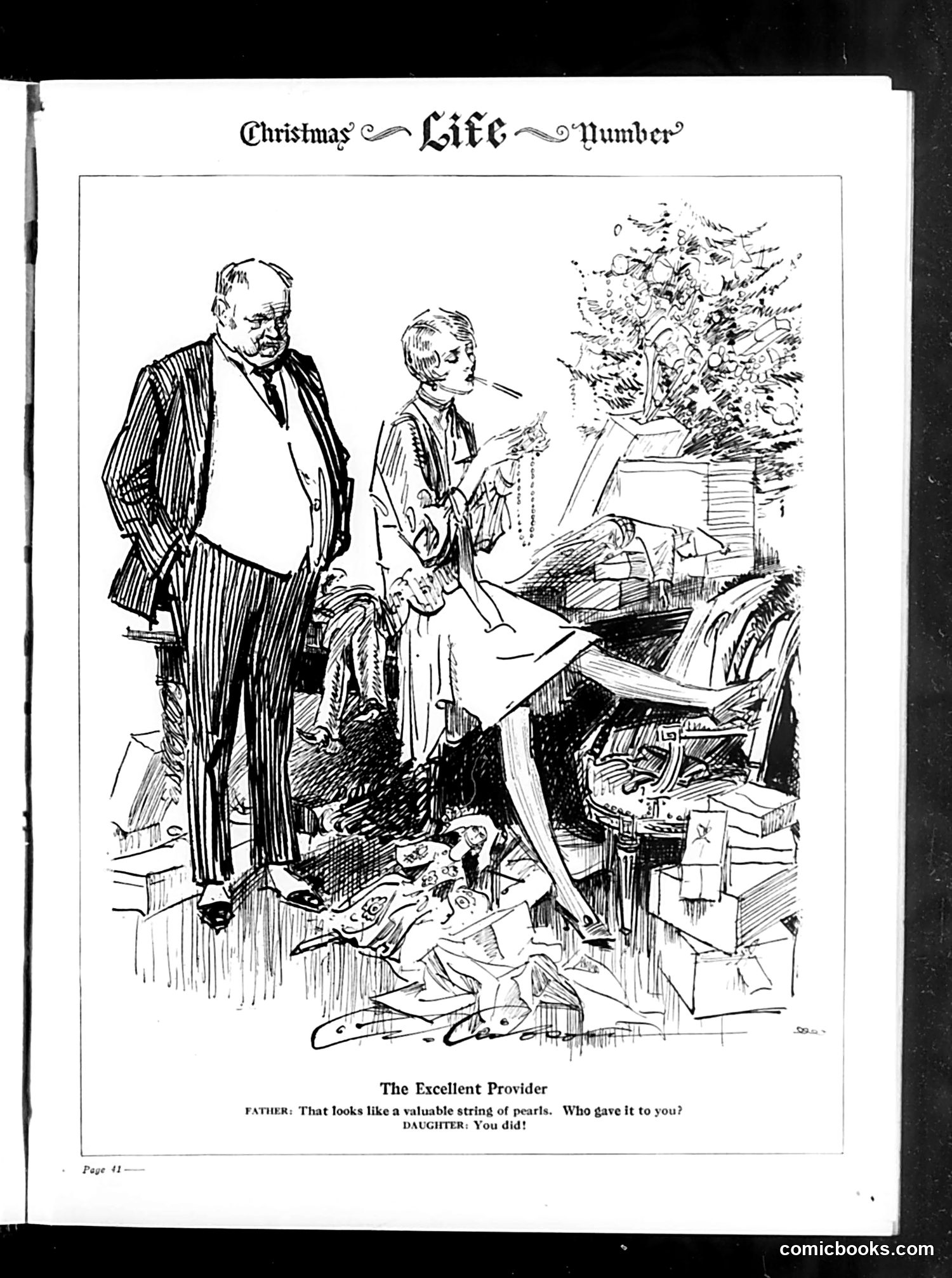
This cartoon satirizes paternal generosity and gift-giving. A well-dressed father examines what appears to be an expensive pearl necklace his daughter is wearing, asking who gave it to her. Her reply—"You did!"—delivers the joke: the father has apparently been so lavish with gifts that he doesn't remember giving her this valuable present himself. The satire targets wealthy fathers of the era who indulged their daughters' materialism without tracking their own spending, or who were so generous they lost account of their own gifts. The title "The Excellent Provider" is ironic—while he provides excellently, his generosity is so excessive it borders on absurdity. The cartoon likely critiques both paternal indulgence and the consumerism of privileged families.
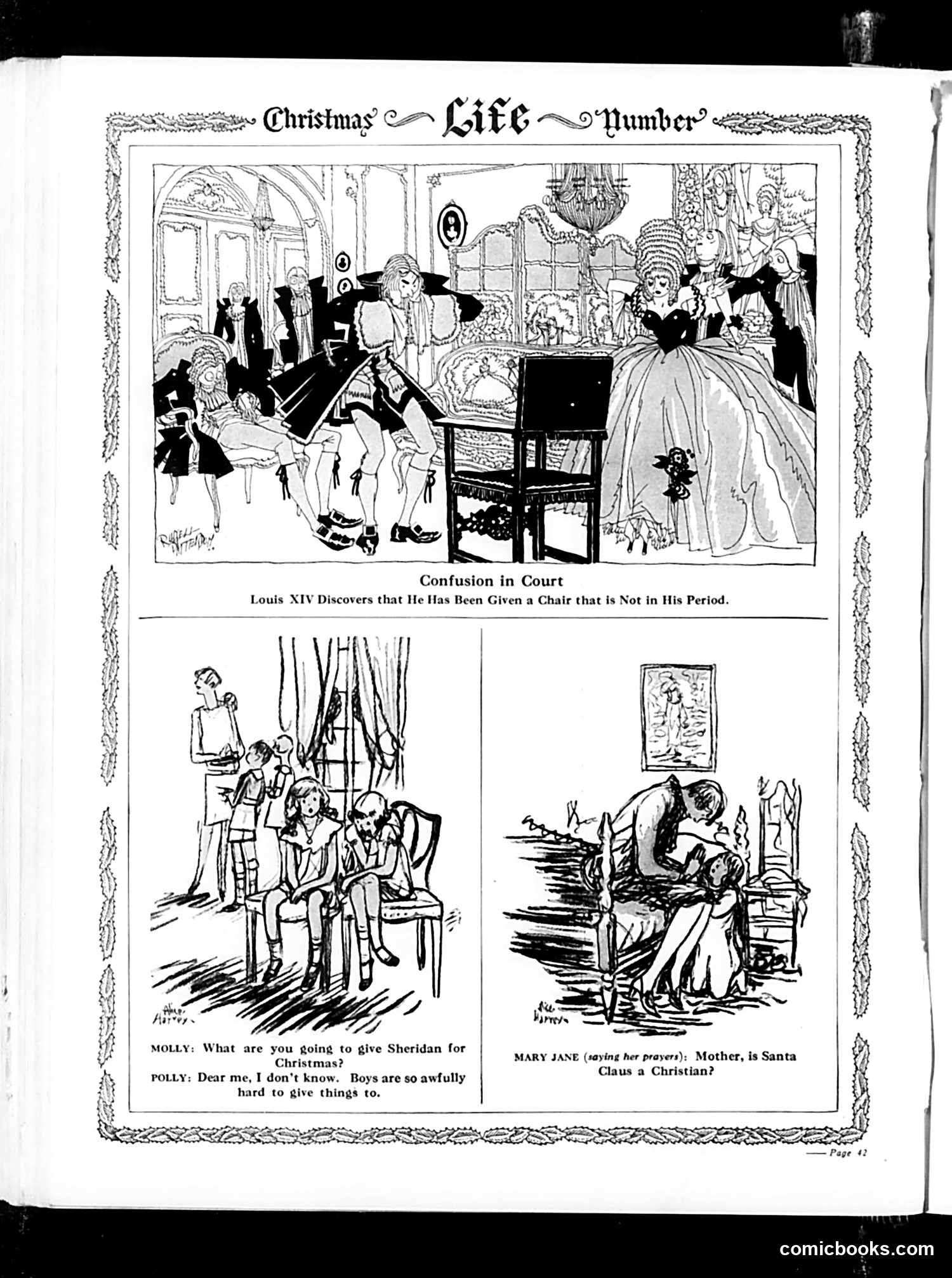
This page contains three separate humorous pieces: **Top cartoon**: "Confusion in Court" satirizes a formal royal setting where Louis XIV discovers he's been given an anachronistic chair—one not matching his historical period. The joke mocks either museum curators' incompetence or pedantic historical accuracy obsession. **Bottom left**: Two women (Molly and Polly) discuss Christmas gift-giving for boys, with Polly lamenting that "boys are so awfully hard to give things to." This reflects common early-20th-century domestic humor about gender differences and holiday shopping challenges. **Bottom right**: Mary Jane asks her mother if Santa Claus is Christian, apparently saying prayers. This gentle comedy likely plays on children's religious confusion or the tension between secular Santa mythology and Christian Christmas meaning. The page exemplifies Life magazine's satirical approach: mixing high-society mockery with domestic humor and children's innocent observations for a middle-class readership.
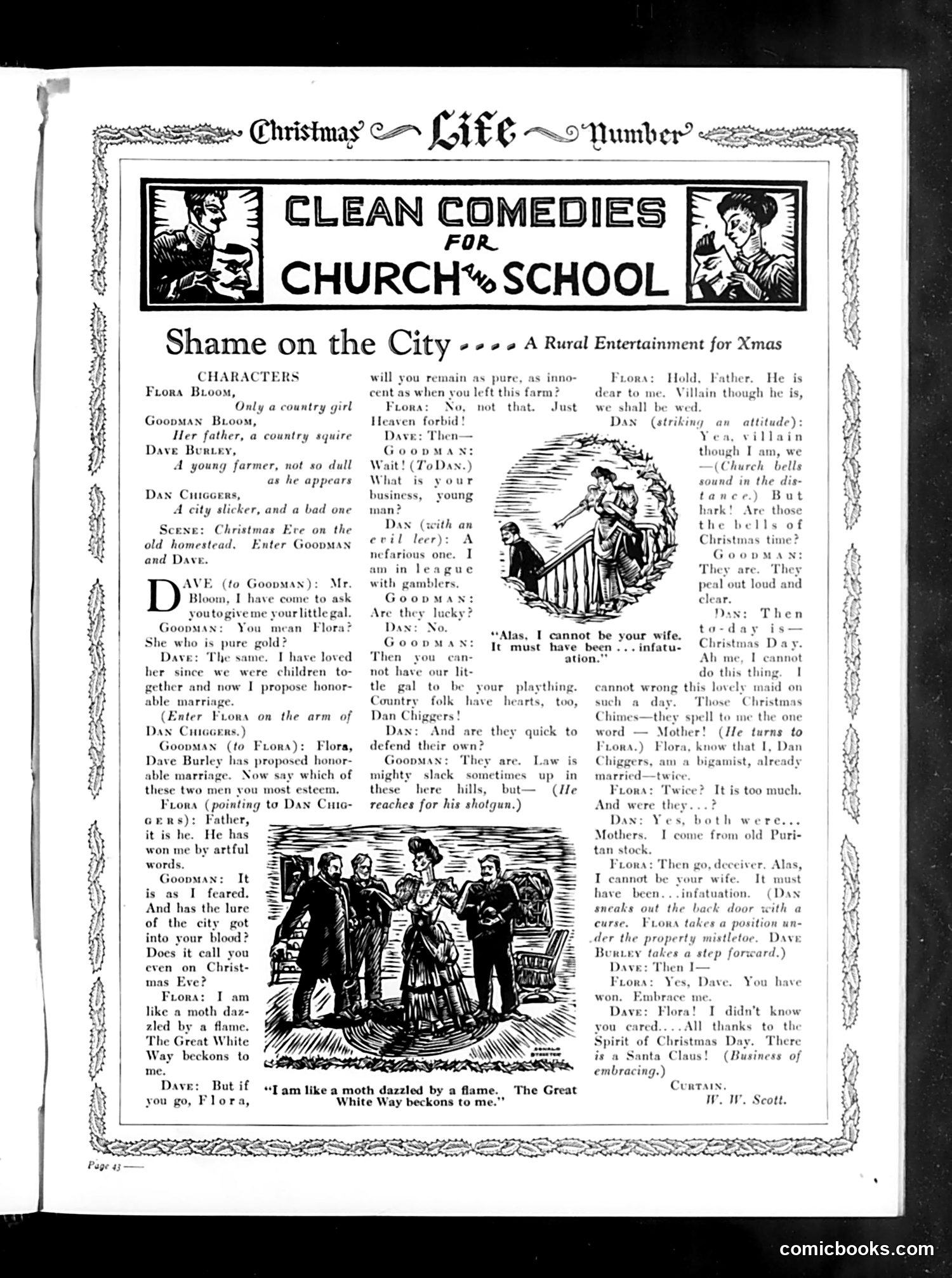
This is a Christmas comedy sketch contrasting innocent country life with corrupting city influences. The plot: Flora Bloom, a pure farm girl, is courted by two men—Dave Burley, an honest farmer, and Dan Chiggers, a smooth "city slicker" involved in gambling schemes. Flora initially chooses Dan, dazzled by urban sophistication (the "Great White Way" reference). However, Dan's conscience awakens when Christmas bells ring, reminding him of maternal virtue and moral duty. He renounces his seduction attempt, and Flora returns to Dave. The satire targets early-1900s anxieties about urbanization: cities corrupt youth through gambling and false sophistication, while rural communities preserve honest values and Christian morality. The sketch's resolution—redemption through Christmas sentiment—reinforces traditional values. It's a morality play marketed as "clean" entertainment suitable for churches and schools, reflecting period anxieties about modernity threatening pastoral wholesomeness.
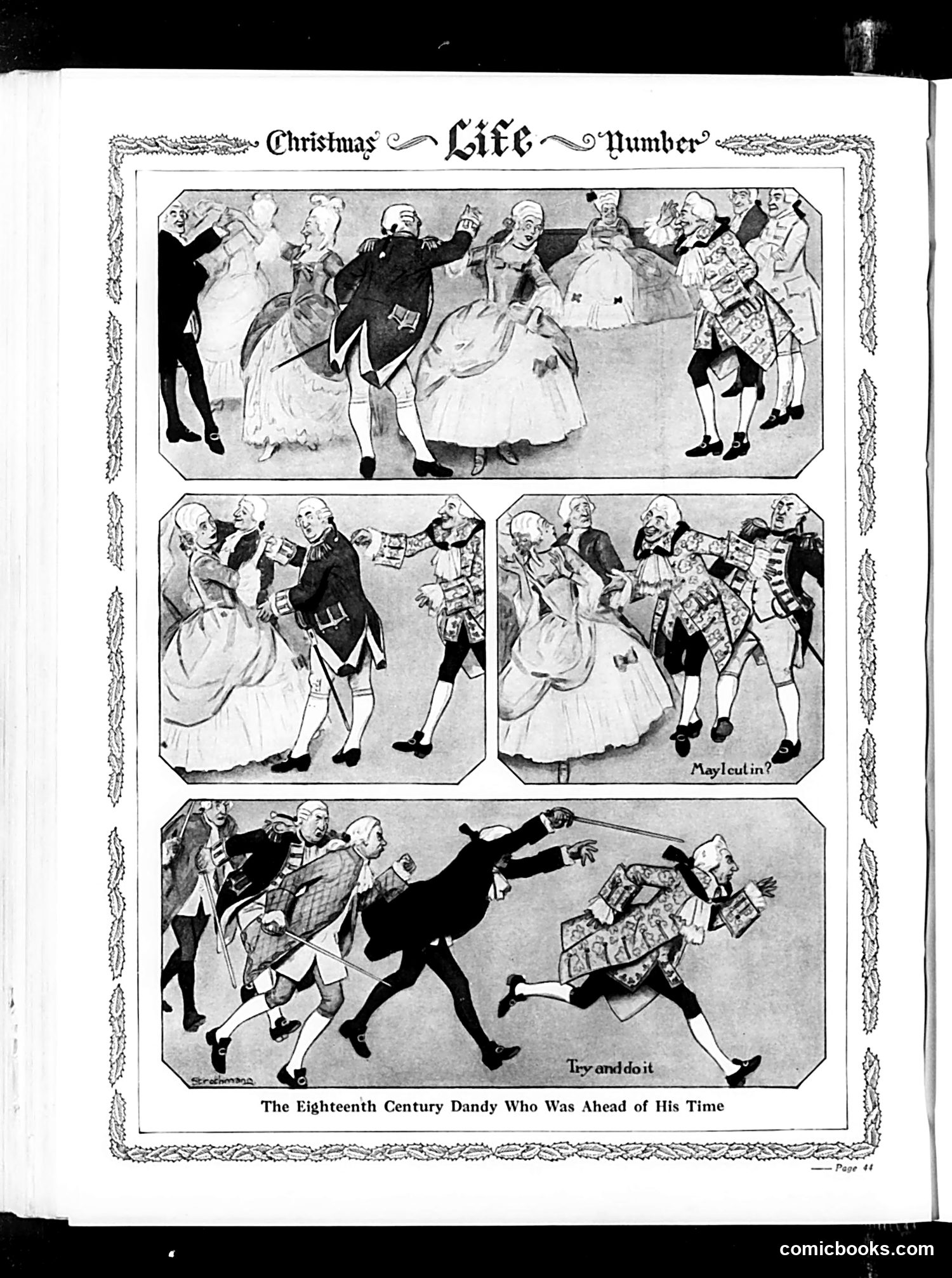
This satirical comic strip depicts an 18th-century fashionable man (a "dandy") whose exaggerated behavior and appearance make him comically anachronistic. The sequential panels show him at a Christmas party displaying theatrical, effeminate mannerisms—dramatic gestures, flamboyant movements—that would be considered outlandish for his era but perhaps more acceptable in the magazine's contemporary period (early 20th century). The humor plays on the contrast between historical propriety and the dandy's forward-thinking affectations. His extravagant clothing (heavily patterned coat) and exaggerated poses ("Try and do it") satirize both historical fashion excess and modern performance of masculinity. The joke suggests he's so ahead of his time that even his contemporaries find him ridiculous—a gentle jab at contemporary fashion trends and social pretension.
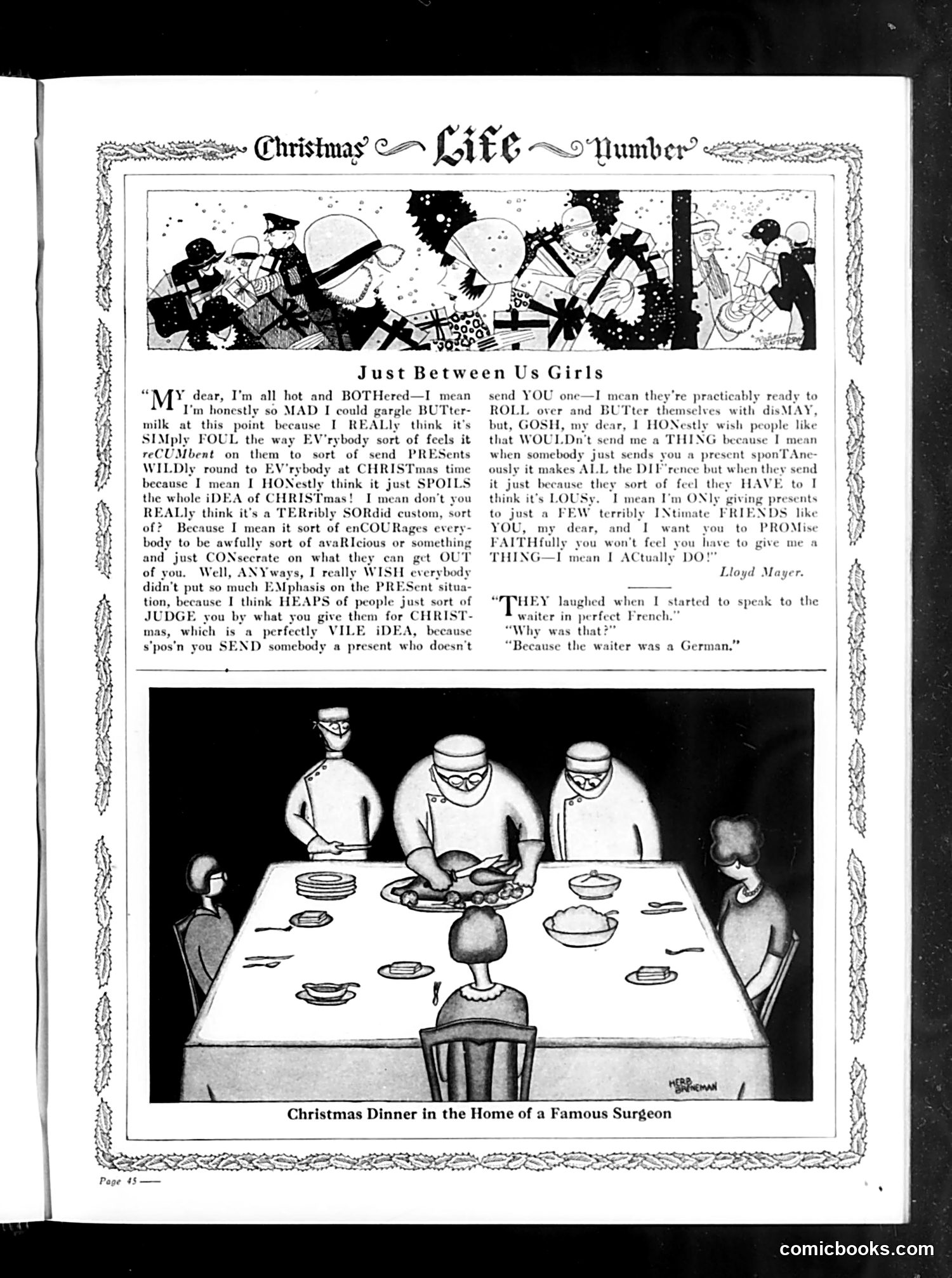
This page from *Life* magazine satirizes two social behaviors: **"Just Between Us Girls"** mocks upper-class women's hypocritical attitudes about Christmas gift-giving. The writer complains that exchanging presents is vulgar and commercial, yet simultaneously reveals she's carefully curating her own gift list. The exaggerated capitalization of random words mimics breathless, affected speech—satirizing the pretentious way wealthy women spoke about "proper" behavior while being transparently selfish. The satire targets the contradiction: condemning gift-giving as crass while judging others by what they receive. **The cartoon below** depicts a dinner party where a woman, attempting to impress by speaking French to a waiter, mispronounces something. When guests laugh, she's told the waiter is German—implying he didn't understand her "perfect French" anyway. This satirizes social pretension and the foolishness of showing off in foreign languages without genuine competence. Both pieces mock middle-to-upper-class affectation and the gap between professed values and actual behavior.
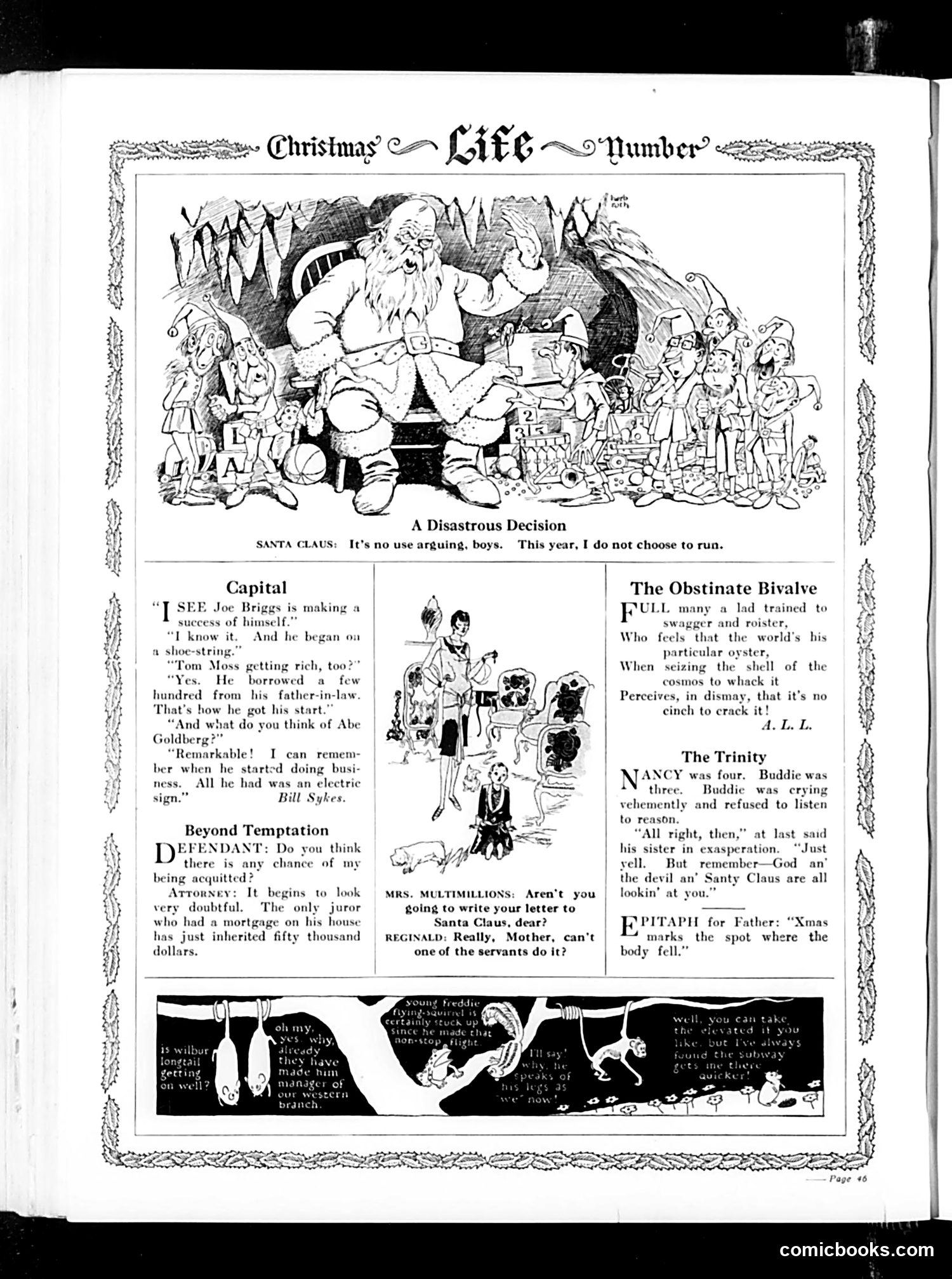
This Christmas issue of *Life* magazine contains several short humorous pieces satirizing American society circa early 1900s: **"Capital"** mocks how wealth accumulation is celebrated regardless of method—borrowing from relatives or relying on electric signs receives equal admiration. **"Beyond Temptation"** jokes darkly about jury corruption: a defendant's only hope of acquittal vanishes when the one potentially sympathetic juror (with mortgage troubles) inherits money, removing his financial desperation. **"Mrs. Multimillions"** satirizes wealthy laziness—a spoiled child won't even write his own Santa letter, expecting servants to do it. **"The Obstinate Bivalve"** uses the oyster as metaphor for ambitious young men who overestimate their ability to "crack" the world's opportunities. **"The Trinity"** and **"Epitaph"** offer dark holiday humor about childhood religion and marital death. The top cartoon shows Santa rejecting a political candidacy, likely referencing contemporary election speculation. Overall, the page targets class pretension, moral compromise, and American materialism.
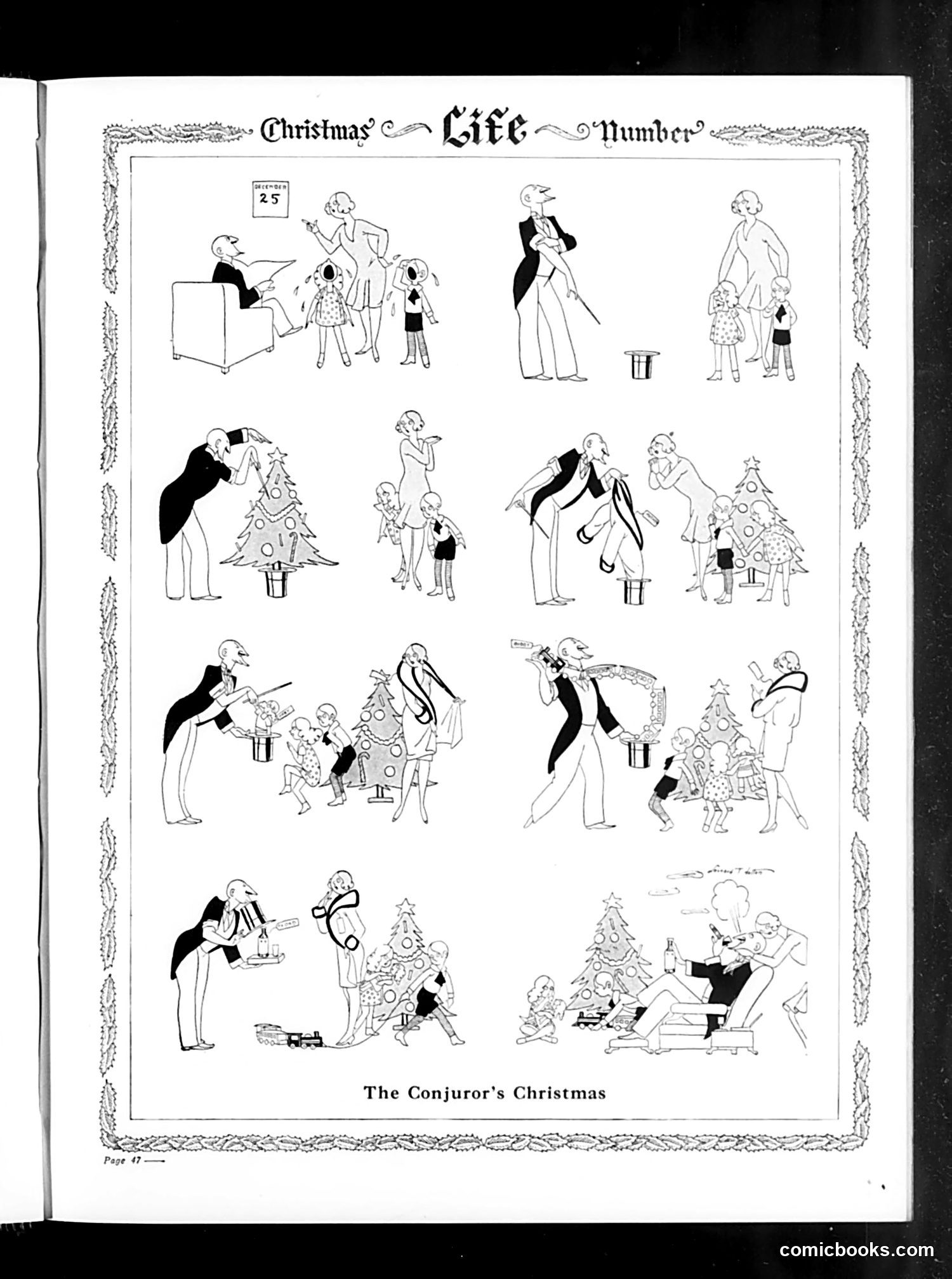
This satirical comic strip depicts a magician performing increasingly elaborate Christmas tricks for a family. The humor relies on visual gags showing the conjuror producing presents, Christmas trees, and other holiday items through sleight-of-hand illusions. The title "The Conjuror's Christmas" suggests social satire about consumerism and gift-giving expectations during the holiday season. The magician's repeated production of material goods—trees, presents, decorations—may be commenting on how Christmas has become about magical commercial abundance rather than spiritual meaning. The strip's comedy works through physical slapstick and the contrast between the conjuror's impressive magical abilities and ordinary family scenarios, typical of Life magazine's humor style. Without additional context, the specific political or social critique remains unclear, though the general theme appears to mock materialistic holiday celebration.
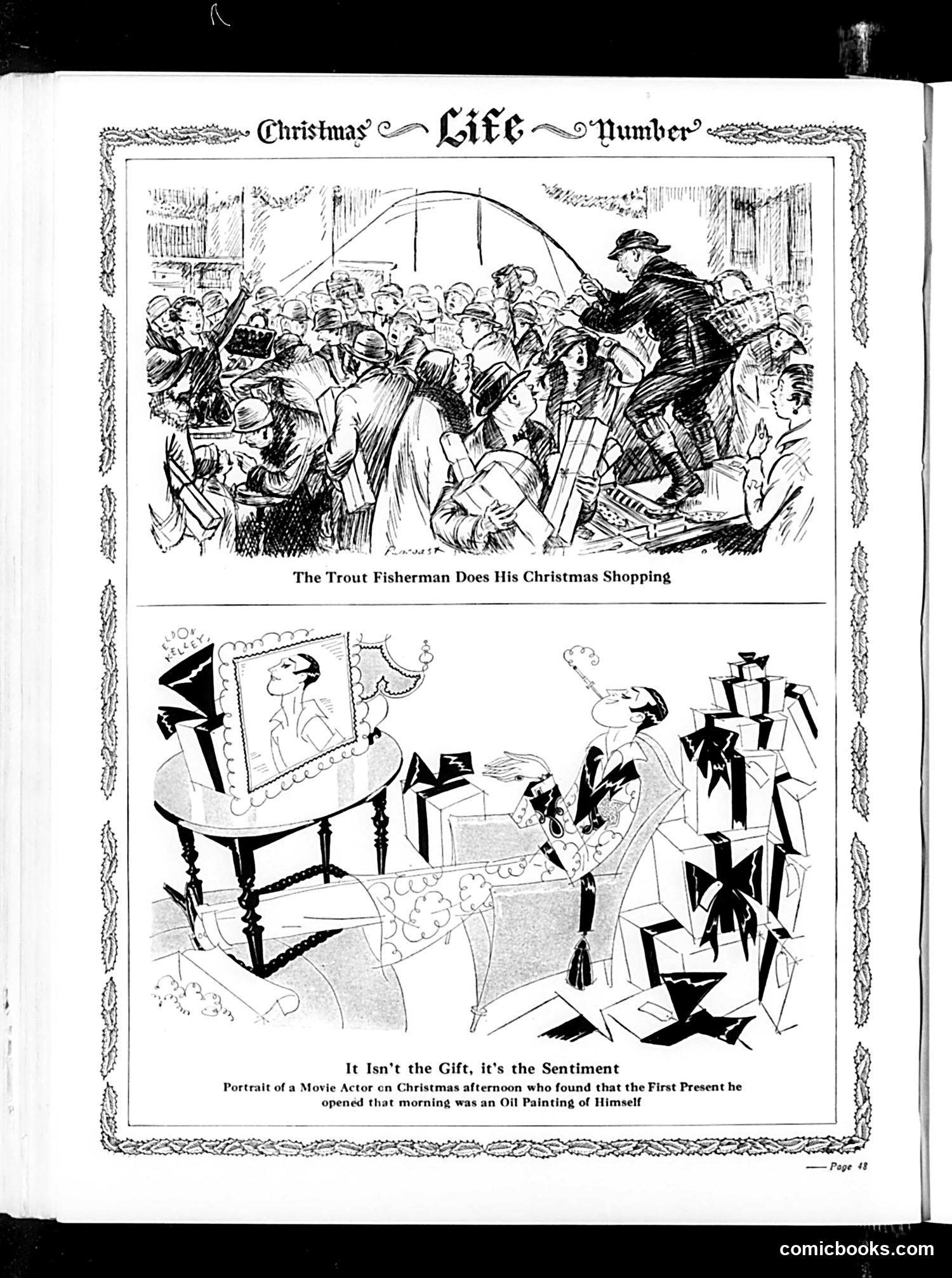
This page contains two satirical cartoons about Christmas gift-giving in early 20th-century America. **Top cartoon**: "The Trout Fisherman Does His Christmas Shopping" depicts a crowded, chaotic marketplace where a fisherman (presumably more accustomed to solitary outdoor pursuits) navigates urban holiday shopping. The satire targets the contrast between simple, rural life and frenzied urban commercialism. **Bottom cartoon**: "It Isn't the Gift, it's the Sentiment" mocks vanity in Hollywood. A movie actor receives an oil painting of himself as his Christmas gift—the ultimate self-absorbed present. The joke satirizes both celebrity narcissism and the hollow sentimentality of gift-giving, suggesting that the actor's own image is presented as a touching personal gesture, when it's actually the opposite. Both cartoons critique American consumer culture and social pretension during the Christmas season.
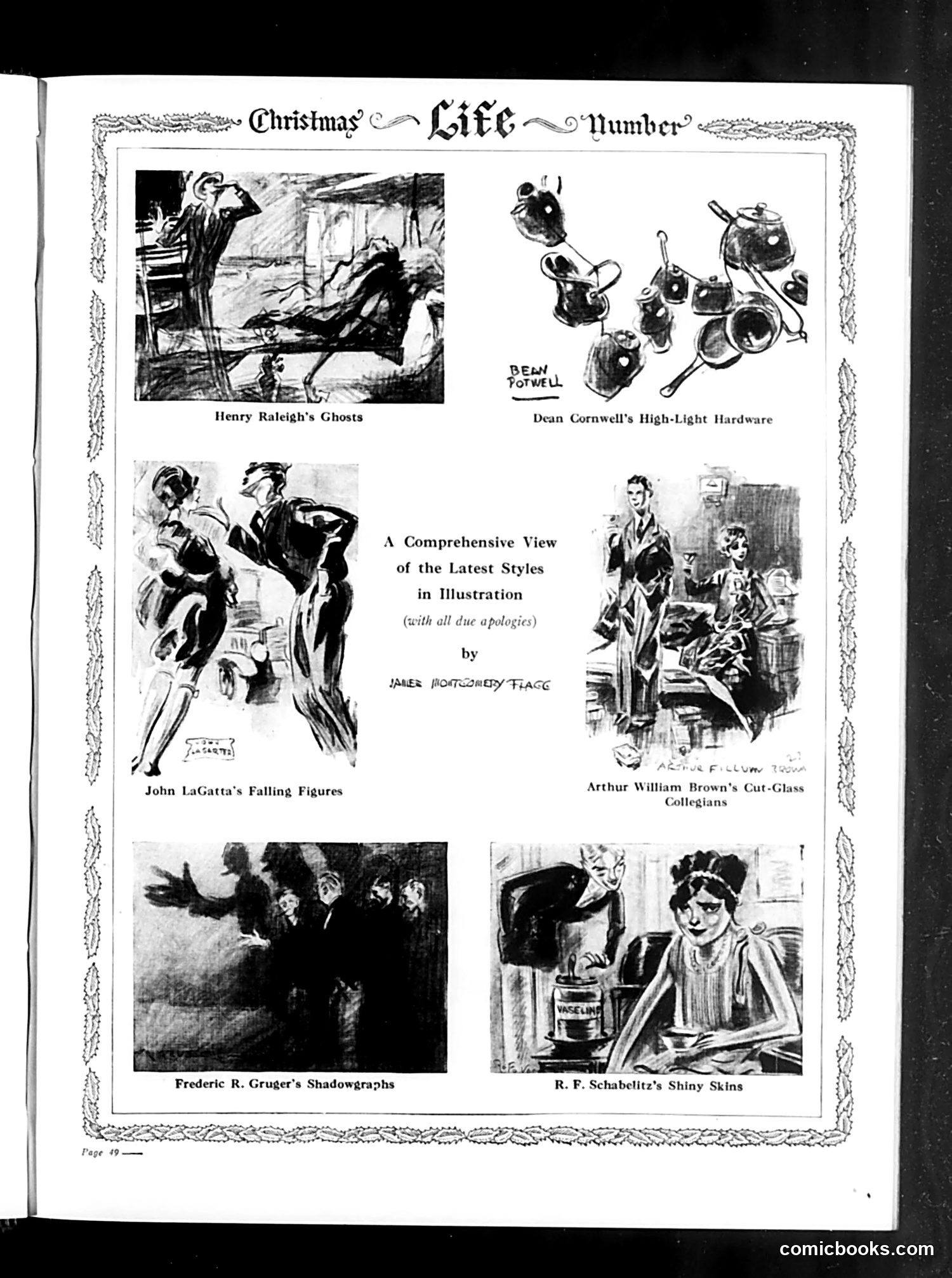
This page from *Life* magazine presents a humorous survey of contemporary illustration styles, credited to James Montgomery Flagg. Rather than a political cartoon, it's a satirical critique of popular illustrators' distinctive techniques. Each panel showcases a named artist's recognizable style: Henry Raleigh's dramatic ghostly scenes, Dean Cornwell's shiny hardware, John LaGatta's dynamic falling figures, Arthur William Brown's fashionable collegians, Frederic R. Gruger's shadowgraphs, and R.F. Schabelitz's shiny-skinned subjects. The subtitle's "(with all due apologies)" signals tongue-in-cheek mockery of these artists' mannerisms and their prevalence in contemporary magazine illustration. This is primarily *Life*'s in-house commentary on the illustration industry—gently roasting fellow professionals' recurring stylistic tropes that readers would recognize from the magazine's own pages and competitors'.
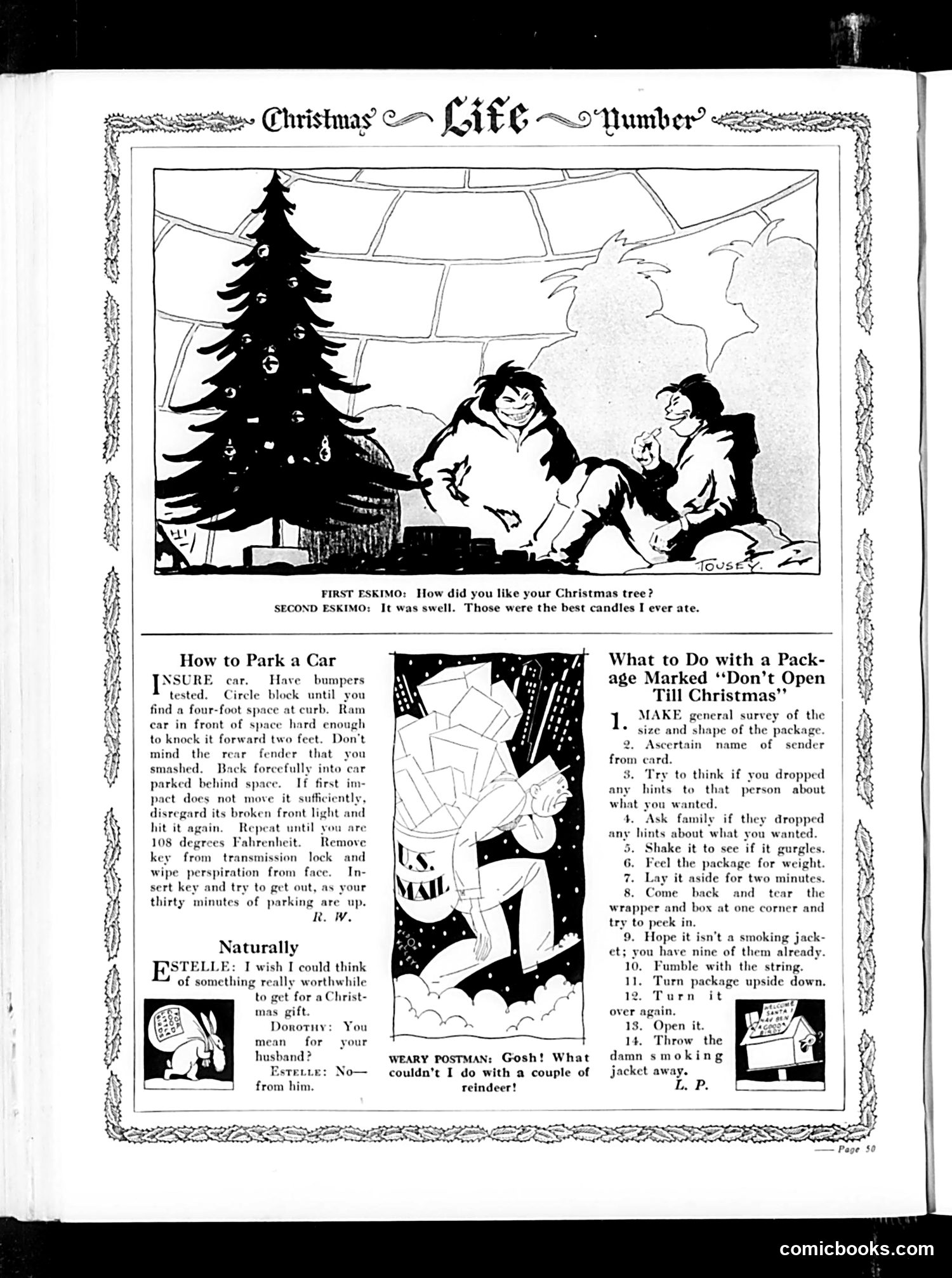
This page contains several humorous sketches mocking Christmas customs and urban life: **The Eskimo joke** plays on literal interpretation—Eskimos eating Christmas tree candles as food, treating decorative items as sustenance. **"How to Park a Car"** satirizes aggressive urban driving behavior, describing deliberate bumping and ramming of other vehicles as normal procedure. It's social commentary on inconsiderate drivers and traffic congestion in American cities. **The gift-exchange dialogue** between Dorothy and Estelle mocks marital dynamics—wives hoping husbands give them meaningful gifts rather than receiving gifts from their spouses, suggesting limited romantic sentiment in marriage. **The postman cartoon** humorously contrasts the postman's exhaustion during Christmas (busiest mail season) with Santa's reindeer, suggesting he could use supernatural help managing holiday workload. **"What to Do with a Package"** satirizes gift-opening anticipation, particularly the running joke about receiving unwanted smoking jackets repeatedly—likely referencing stereotypical, impersonal men's gifts of that era. All sketches employ gentle, relatable humor about holiday frustrations and social conventions.
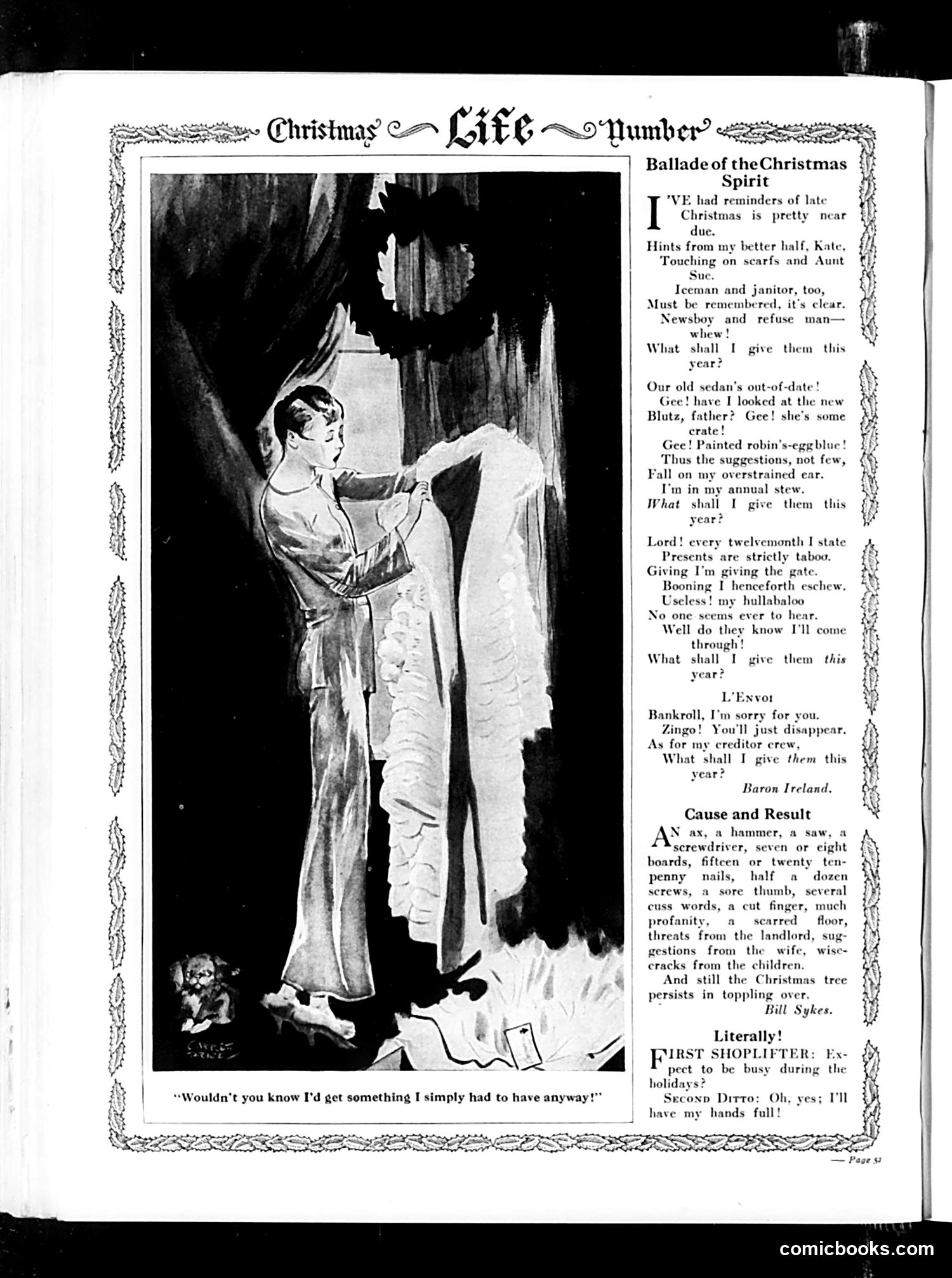
This Christmas-themed page from *Life* magazine satirizes the commercialized burden of holiday gift-giving. The main illustration shows a woman displaying linens or fabrics, with the caption "Wouldn't you know I'd get something I simply had to have anyway?" — mocking how gift-givers inevitably purchase items the recipient already owns or doesn't need. The "Ballade of the Christmas Spirit" poem by Baron Ireland humorously catalogs the speaker's annual dilemma: endless gift-giving demands from family, staff (iceman, janitor, newsboy), and acquaintances, despite yearly vows to stop. He laments his shrinking bankroll while creditors circle. Secondary pieces include "Cause and Result" (tools + frustration = a fallen Christmas tree) and "Literally!" — a shoplifter joke playing on holiday shopping frenzy. The satire targets American consumerism, the obligation-driven holidays, and the gap between gift-givers' good intentions and exhausting financial reality.
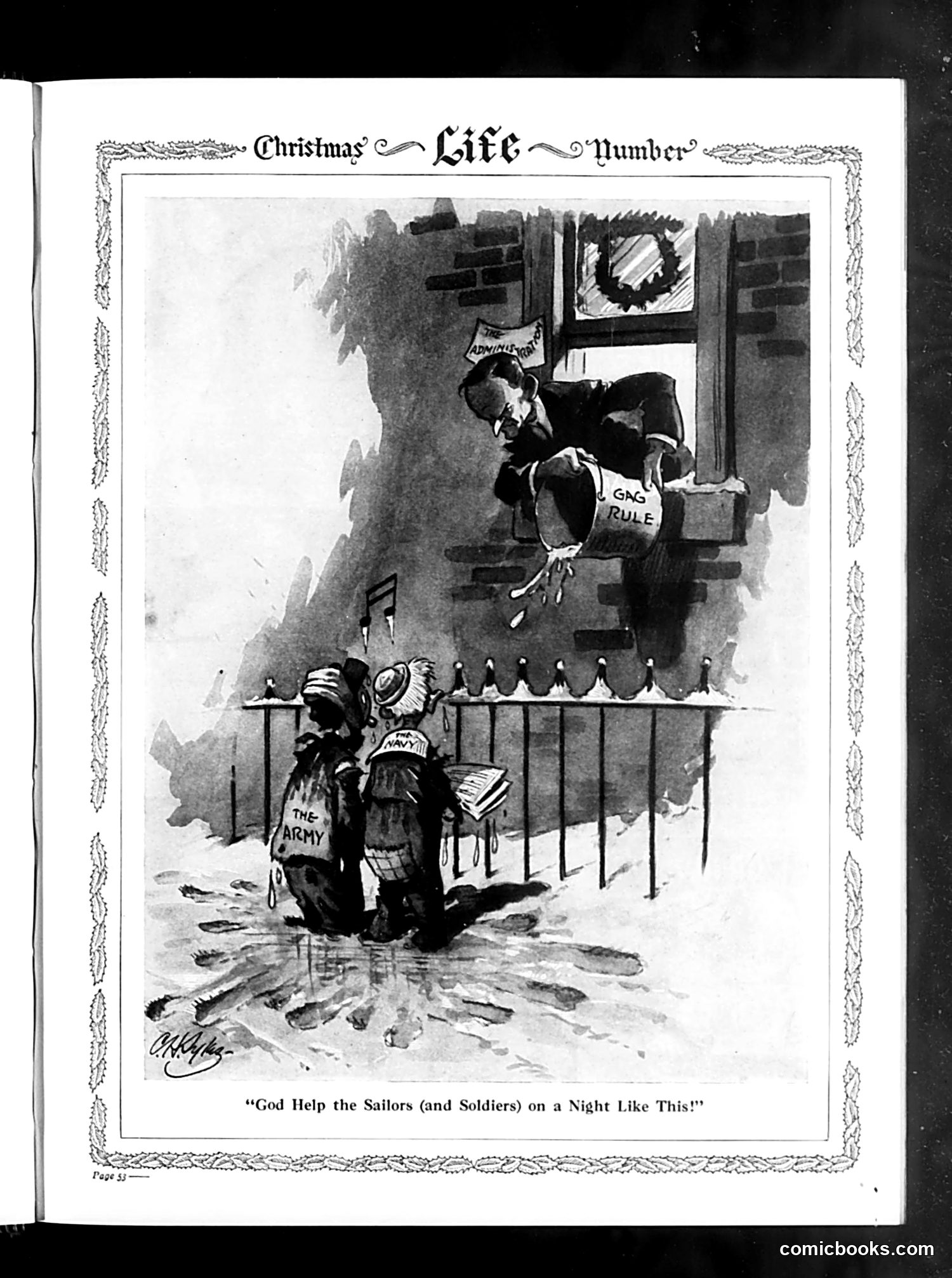
This is a Christmas-themed political cartoon from *Life* magazine satirizing wartime conditions. Two figures labeled "THE ARMY" stand outside in snow, looking up at a window where an official sits comfortably indoors with a wreath and "GUN RULE" document visible—suggesting military bureaucracy or command. The cartoon critiques the contrast between soldiers suffering in harsh winter weather and comfortable officials sheltered inside making decisions that affect them. The caption's plea for divine help emphasizes the soldiers' difficult circumstances during what should be a peaceful holiday season. The satire targets military leadership's disconnect from enlisted personnel's hardship, a common complaint during wartime. The exact historical context (which war, which year) is unclear without additional publication information.
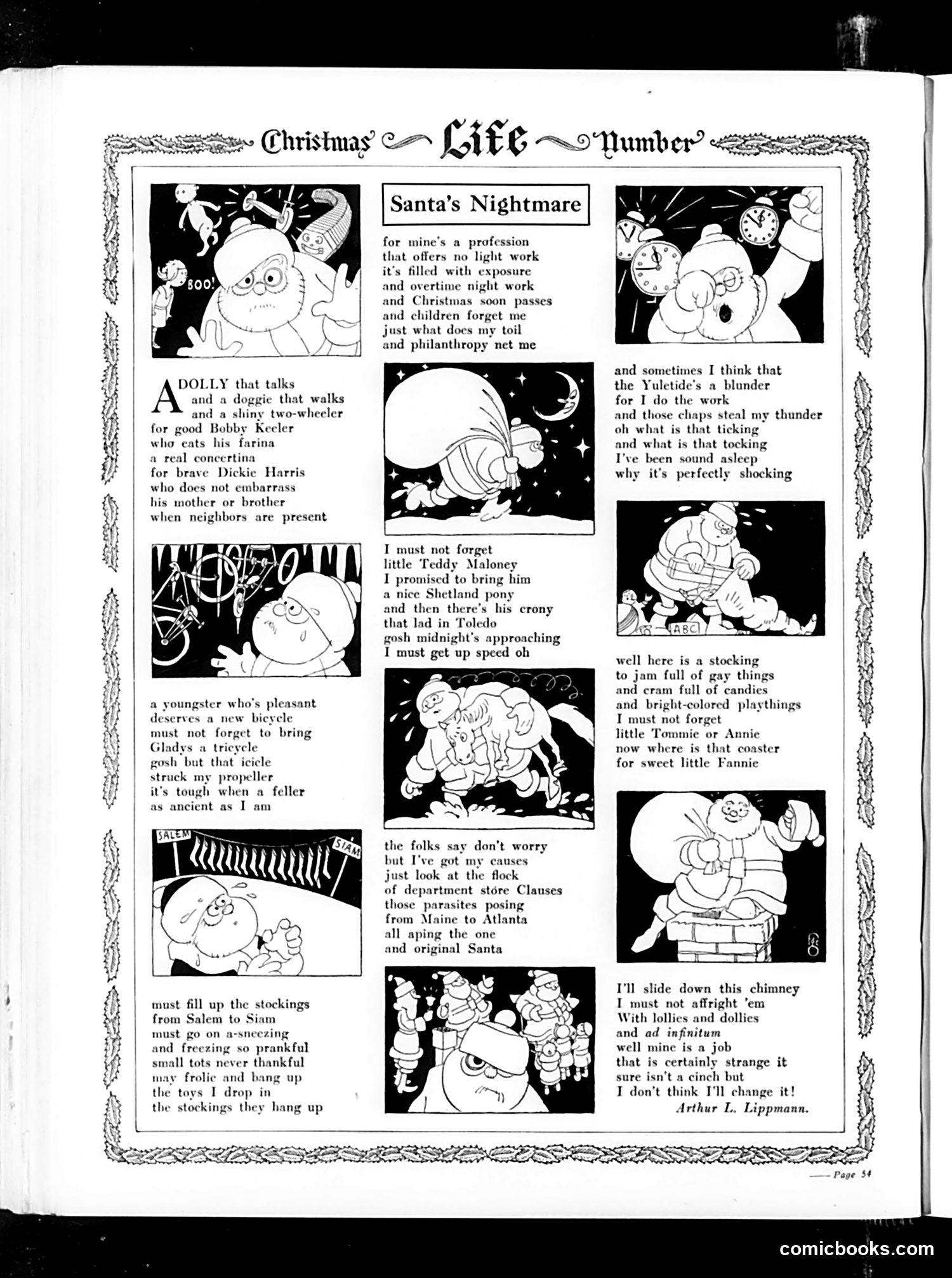
This satirical piece by Arthur L. Lippmann presents Santa Claus as an exhausted, unappreciated laborer complaining about his Christmas profession. The cartoon critiques several early 20th-century concerns: **The central complaint**: Santa does all the actual work—exposure, overtime, dangerous chimney descents—yet receives no recognition or gratitude from children who quickly forget him. **Social satire**: The piece mocks "department store Clauses"—cheap impostors hired by retailers who "steal [his] thunder" and profit from his original concept without doing the genuine labor. **Labor themes**: Santa's monologue echoes working-class grievances: unfair compensation, endless obligations ("stockings from Salem to Siam"), and lack of appreciation despite sacrifice. **The irony**: Despite legitimate complaints, Santa concludes resignedly—"I don't think I'll change it!"—capturing the trapped acceptance of underpaid workers. The cartoons illustrate Santa's frantic, exhausting night, reinforcing the theme that Christmas magic masks genuine hardship.
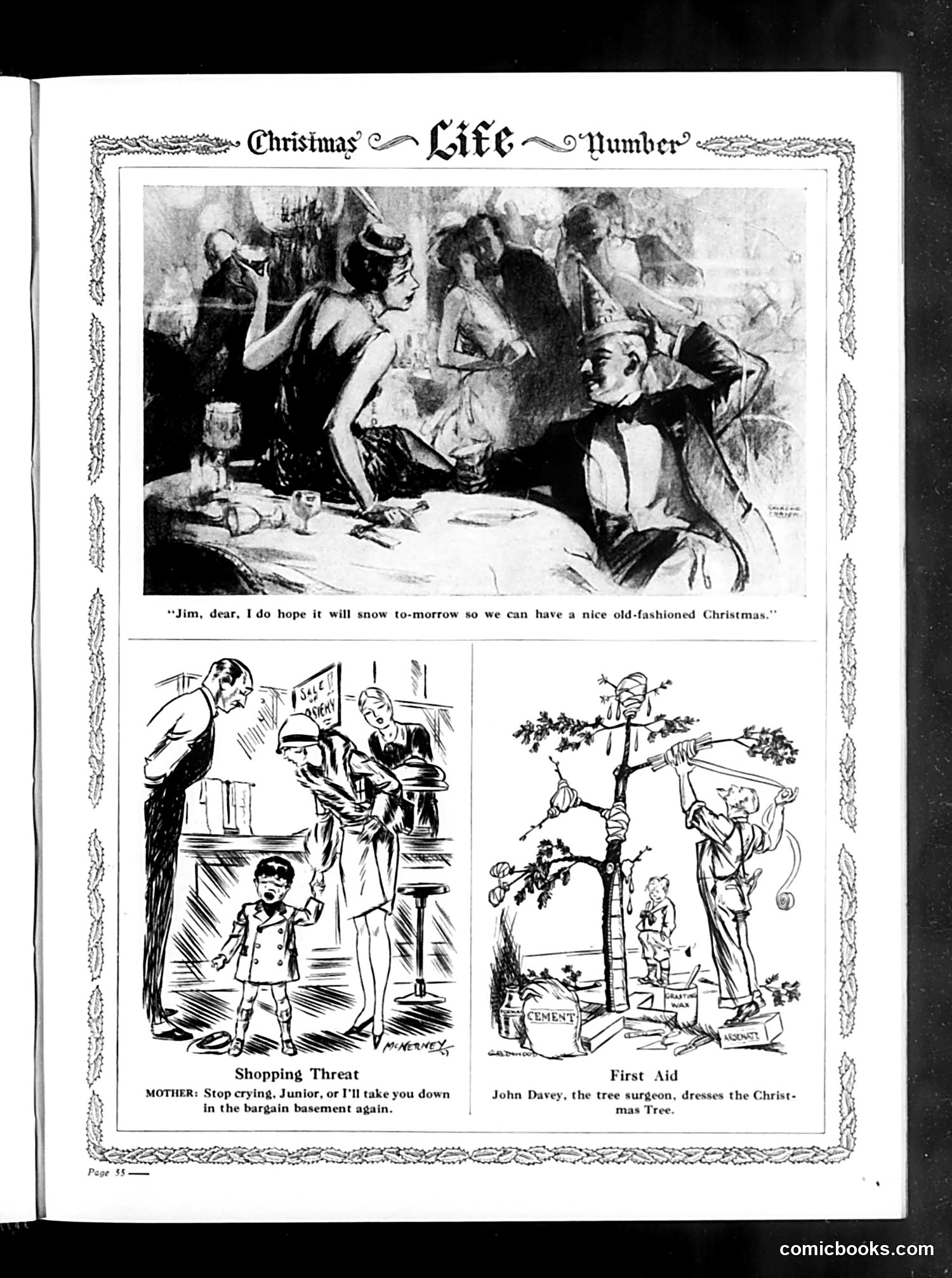
This page contains three satirical cartoons about Christmas shopping and traditions. The top illustration depicts a lively party scene with the caption referencing hopes for snow to enable "a nice old-fashioned Christmas"—likely satirizing how modern Christmas had become commercialized rather than traditional. "Shopping Threat" shows a mother threatening to take her crying child to the "bargain basement" again—mocking both parental discipline tactics and the era's aggressive retail culture around Christmas shopping. "First Aid" depicts "John Davey, the tree surgeon" decorating a Christmas tree using repair materials (cement, tools). This appears to be wordplay humor: treating the tree like an injured patient needing medical attention, likely poking fun at either overly elaborate Christmas decorating or the artificiality of store-bought Christmas trees. The cartoons collectively satirize commercialism, parental anxieties, and the gap between idealized and actual modern Christmas celebration.
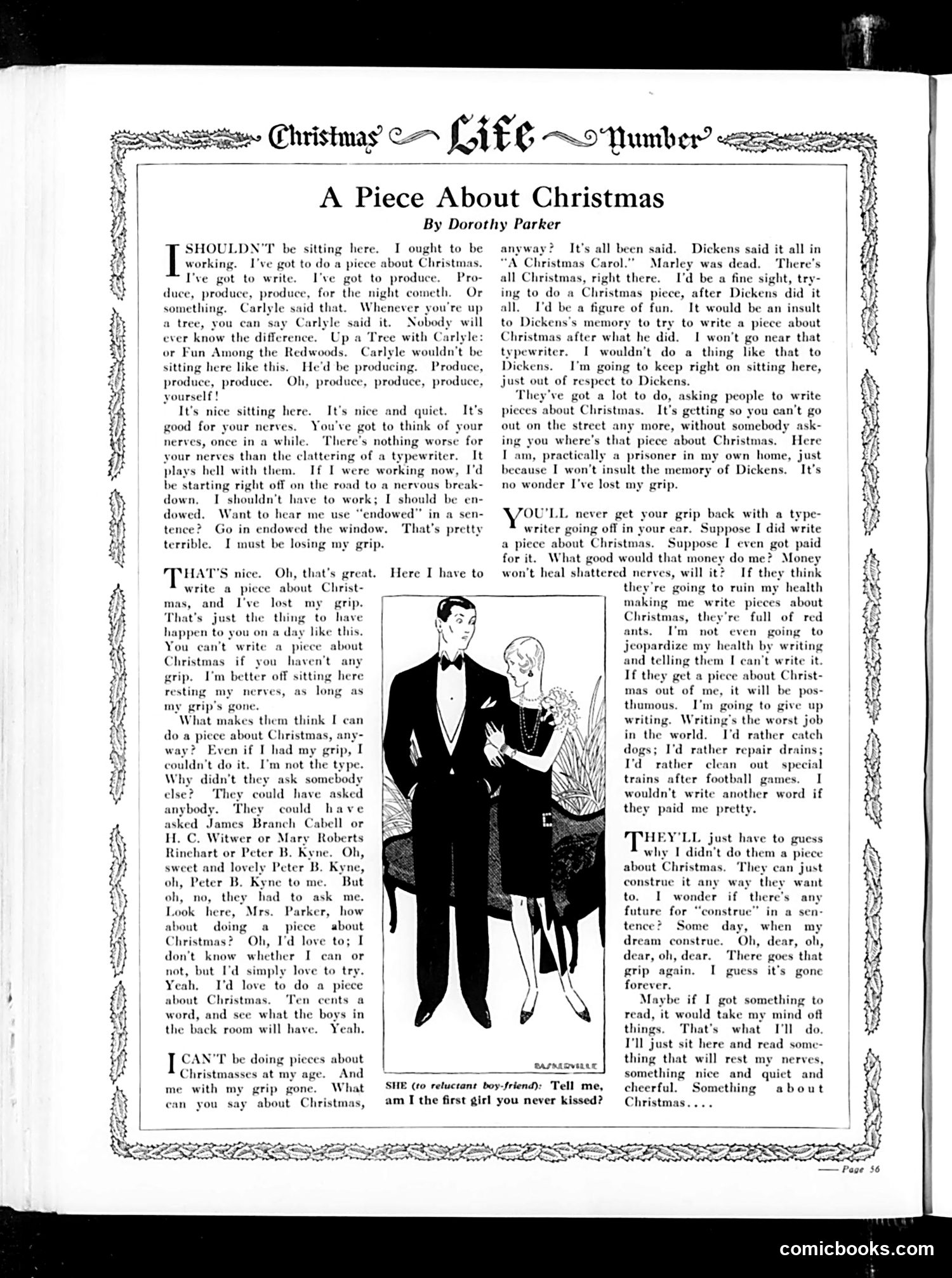
This is a humorous essay with accompanying illustration about writer's block and reluctance. Dorothy Parker, a celebrated wit and columnist, complains about being assigned to write a Christmas piece—a task she views as impossible since Charles Dickens already perfected the genre with "A Christmas Carol." Parker's satire targets: - **The demands on professional writers** to constantly produce work - **The cliché of Christmas writing** in popular magazines - **Procrastination and self-sabotage** as creative strategies - **Editorial pressure**: editors asking her to do assignments she claims to dread The illustration shows a couple in formal dress—likely representing Parker with an editor or publisher—in the act of this editorial negotiation. Parker's tongue-in-cheek complaint that she'll lose her "grip" (mental sharpness) from typewriter noise, and her exaggerated claims she'd rather catch dogs than write, exemplify her sardonic humor. The piece is quintessential Parker: witty deflection masking genuine frustration with commercial writing demands.
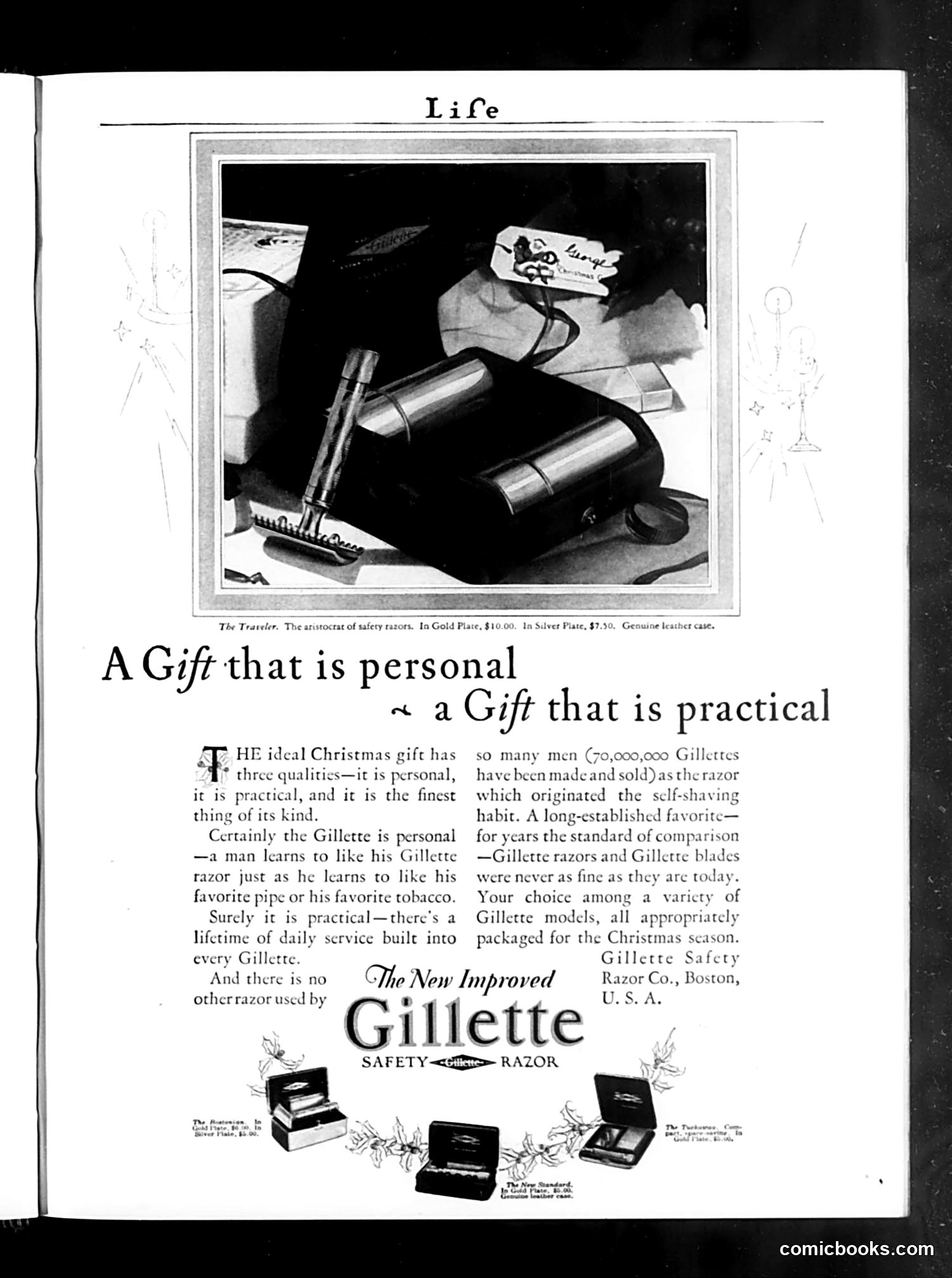
This is **not a cartoon or satire page**, but rather a **vintage advertisement** for Gillette Safety Razors, positioned as a Christmas gift recommendation in Life magazine. The page argues that Gillette razors make ideal Christmas presents because they are "personal, practical, and fine." The text emphasizes that 70 million Gillettes have been sold and that the razor "originated the self-shaving habit"—suggesting it's an established, trusted product. The advertisement claims Gillette razors are superior to competitors and notes they're "packaged for the Christmas season." The upper photograph shows "The Traveler," a decorated gift set containing razors and accessories in a leather case, priced at $10 (gold plate) or $7.30 (silver plate). This is straightforward commercial advertising typical of early-20th-century Life magazine, which carried substantial advertising revenue alongside editorial content. There is no political satire or social commentary intended.
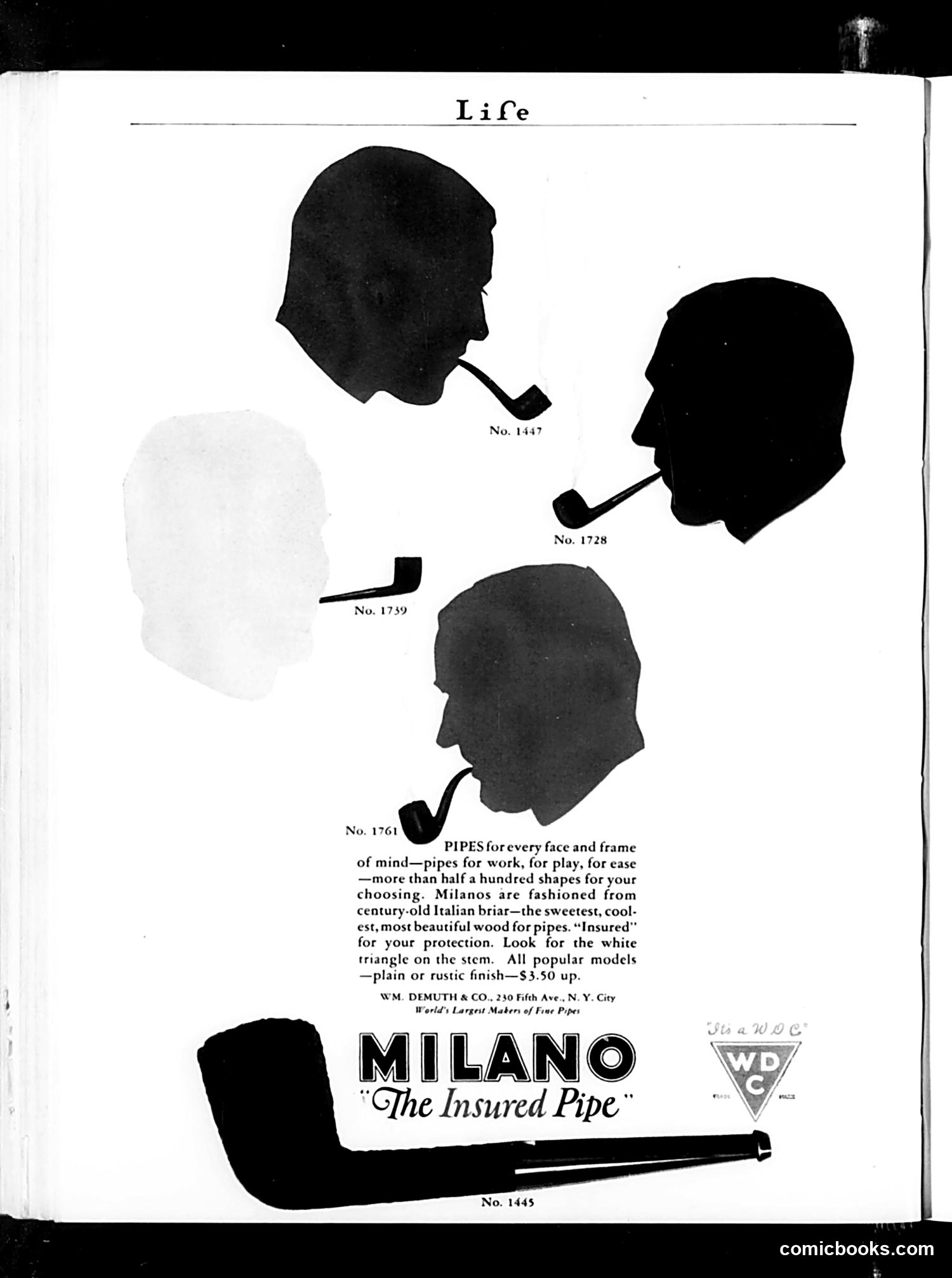
This is a **product advertisement**, not political satire. The page promotes Milano pipes, manufactured by WM. Demuth & Co., a New York pipe maker. The design features silhouettes of four different male head profiles (numbered 1447, 1728, 1739, 1761), each with a pipe, illustrating the variety of pipe styles available. The advertisement's message is that Milano offers "more than half a hundred shapes for your choosing"—pipes suited to different face types and lifestyles (work, play, ease). The marketing emphasizes quality Italian briar wood and an "Insured" guarantee (identifiable by a white triangle on the stem). Prices start at $3.50 for plain or rustic finishes. This reflects early-to-mid 20th-century consumer advertising that used visual variety and pseudo-scientific appeals (matching pipes to facial types) to promote products. The silhouette technique was common in period advertising for showing product range.
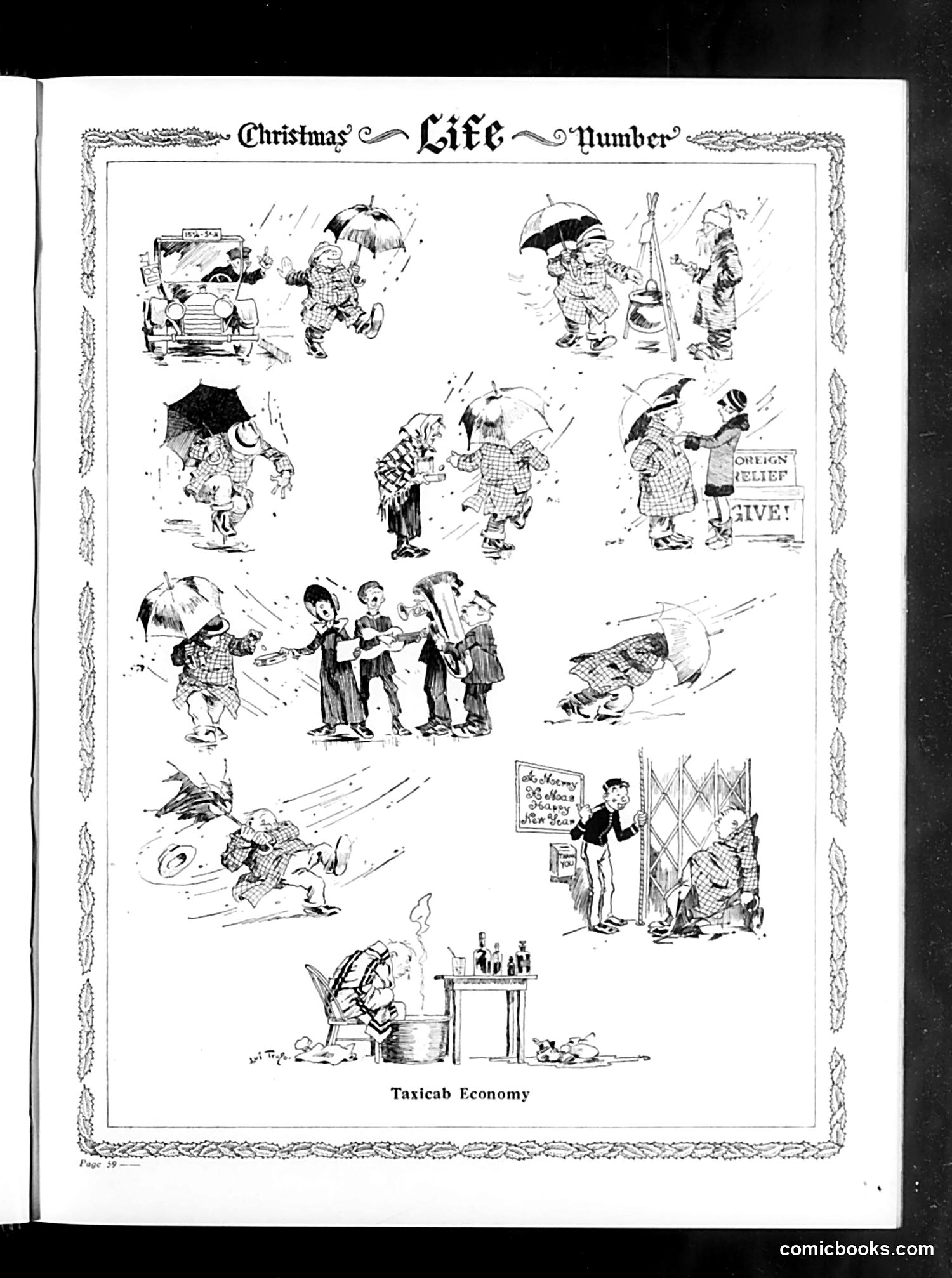
This satirical page depicts various scenes of people struggling in rainy weather with umbrellas and inadequate clothing, apparently representing economic hardship during the Christmas season. The title "Taxicab Economy" suggests commentary on inflated costs—likely referring to expensive taxi fares or general price increases affecting ordinary people during the holidays. The repeated imagery of people getting soaked, losing belongings, and dealing with weather difficulties serves as visual metaphor for financial strain. One panel shows what appears to be a "Foreign Relief" donation request, possibly satirizing the contrast between charitable giving abroad while citizens face domestic economic troubles. The overall message critiques how economic pressures force people to economize during what should be a festive season, turning Christmas into a struggle for survival rather than celebration.
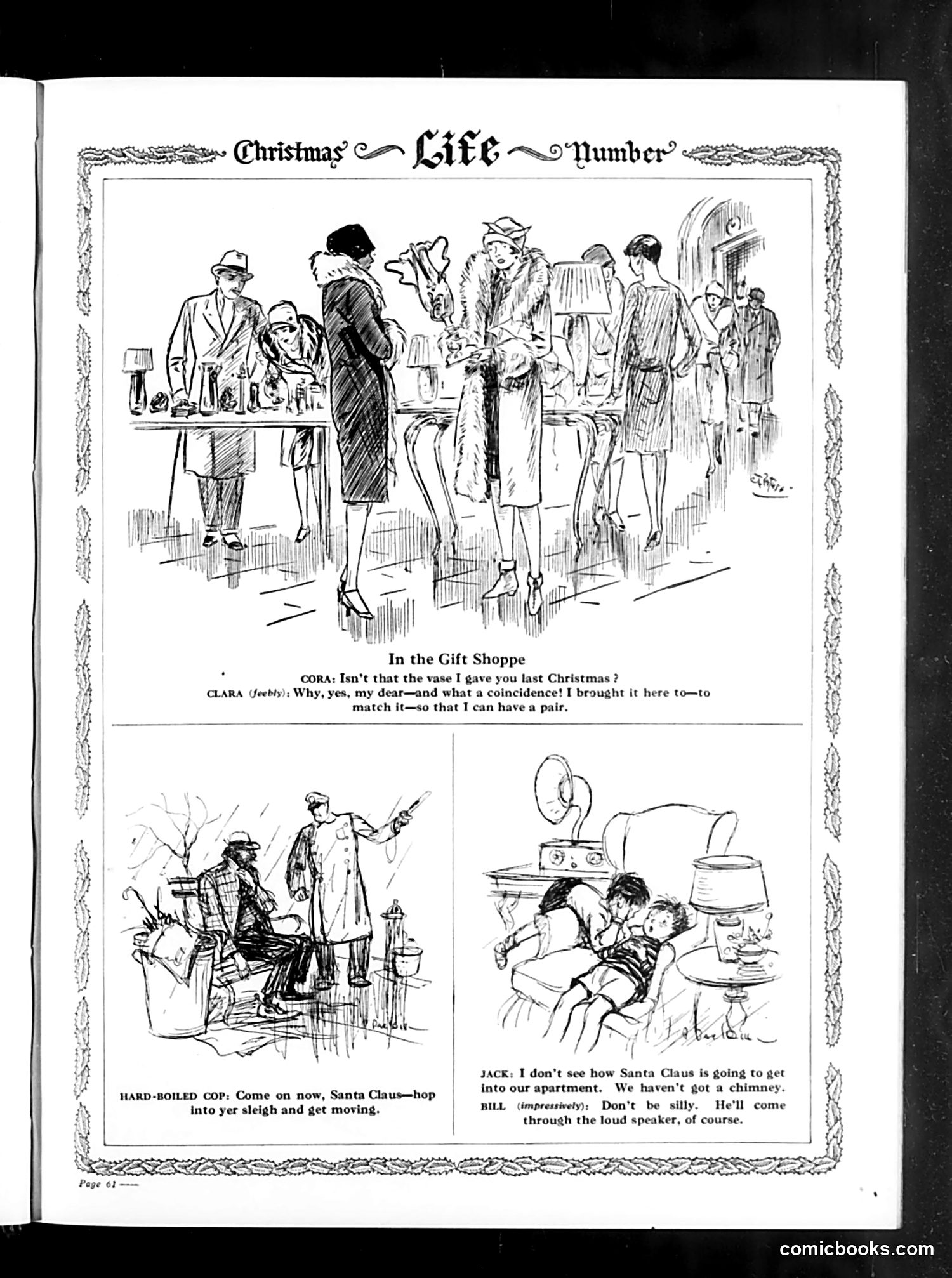
This page contains three separate satirical comic strips about Christmas gift-giving and Santa Claus traditions. The top panel mocks the awkwardness of re-gifting: Clara is caught returning to a gift shop the very vase that her friend Cora gave her last Christmas, attempting to buy a matching piece as cover for the embarrassing fact she's regifting it. The bottom left strip jokes about urban Christmas logistics: a "hard-boiled cop" encounters someone dressed as Santa Claus and orders him into a sleigh, commenting that their apartment building lacks a chimney—suggesting Santa's traditional method won't work in modern city living. The bottom right strip satirizes modern technology replacing tradition: children discuss how Santa will deliver presents without a chimney, with one confidently asserting "He'll come through the loud speaker, of course"—a joke about radios becoming ubiquitous household technology in this era.
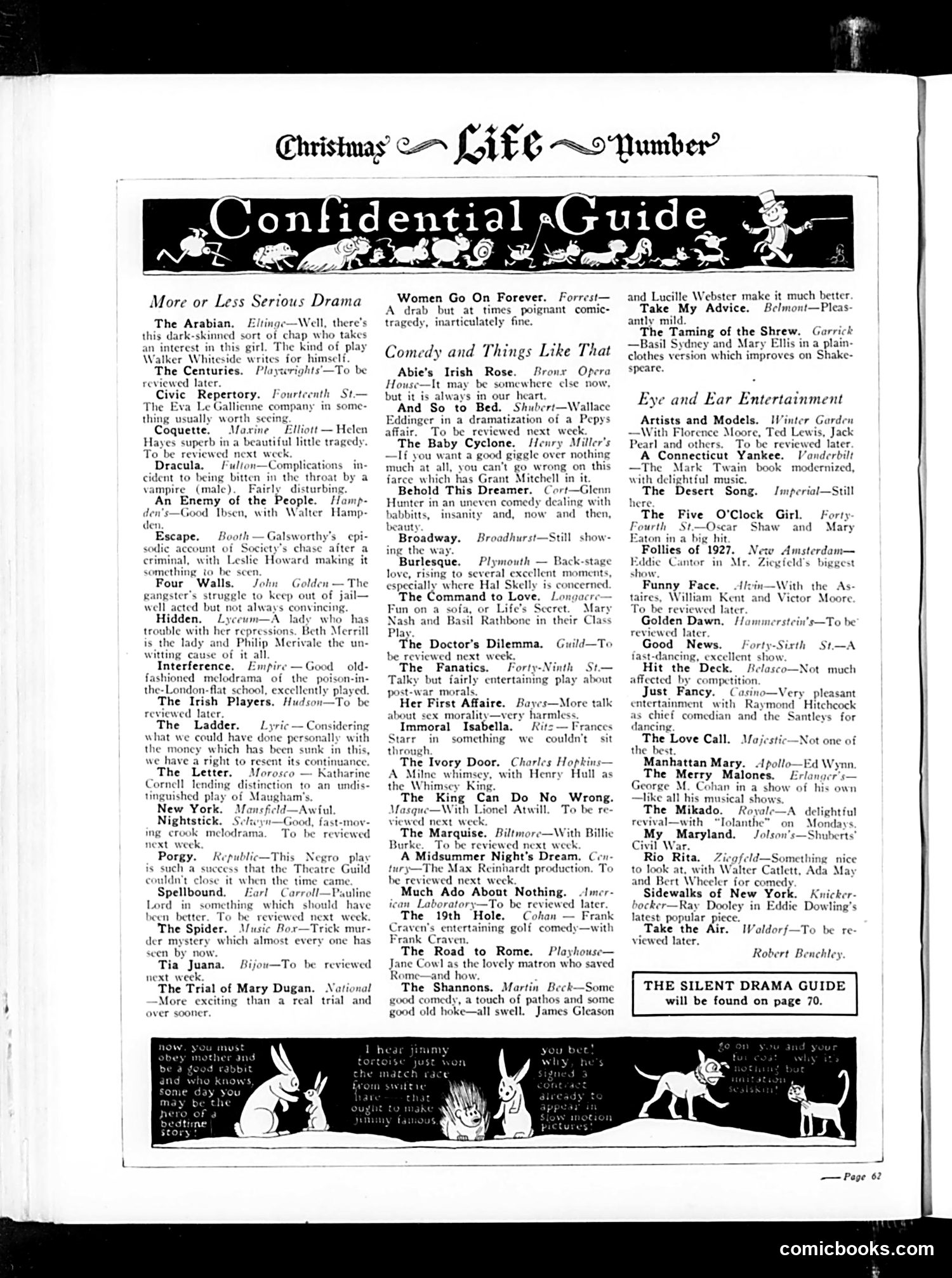
This page is a theater review guide, not a political cartoon. It catalogs current Broadway productions with brief, witty critiques—the magazine's signature satirical style applied to drama and comedy. The reviews use dry humor to describe plots and performances. For example, *Dracula* is summarized as "Complications incident to being bitten in the throat by a vampire (male). Fairly disturbing." *The Ladder* quips that given the money invested, "we have a right to resent its continuance." Notable mentions include Helen Hayes in *Coquette*, Lionel Atwill in *The King Can Do No Wrong*, and the Max Reinhardt production of *A Midsummer Night's Dream*. *Porgy* at the Republic Theatre is flagged as unusually successful for a Theatre Guild production. The bottom cartoon (partially visible) appears unrelated editorial humor. This is primarily a theater-going guide for sophisticated readers.
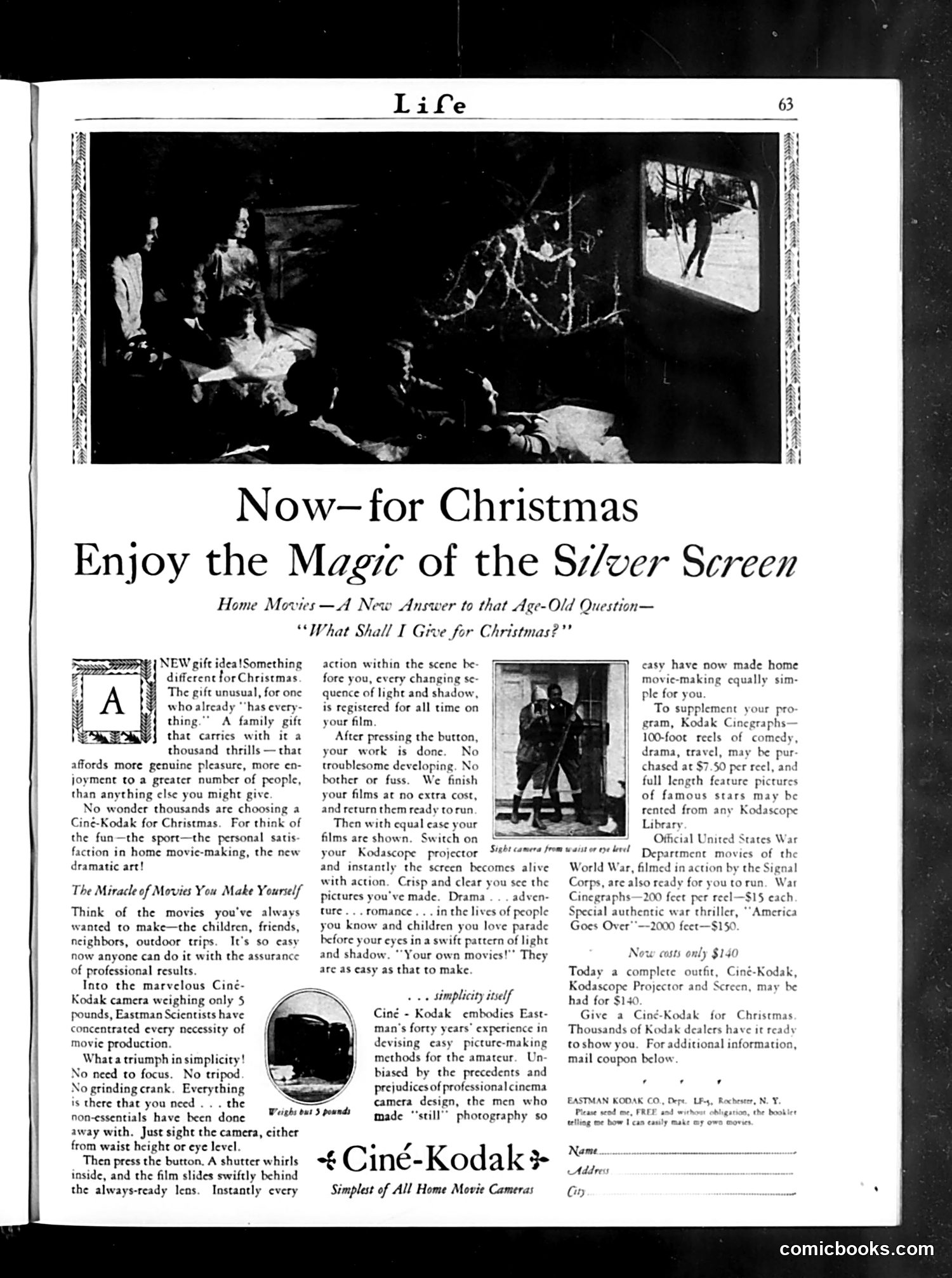
This is primarily **advertising, not satire or cartoon content**. The page promotes Kodak's new Ciné-Kodak home movie camera as a Christmas gift solution. **What it reveals about 1920s culture:** The ad targets middle-class families seeking novel entertainment and "the new dramatic art" of home moviemaking. It emphasizes simplicity—"no need to focus," "no tripod," "no grinding crank"—appealing to amateur users intimidated by professional equipment. The promotional photograph at top shows a family gathered around a projection screen, establishing the social pleasure of viewing homemade films together—a revolutionary domestic activity at the time. **Historical significance:** This represents early consumer technology democratization. Rather than passive cinema attendance, families could now create their own content. The price ($140 for complete outfit) and marketing language ("thousands are choosing") indicate this was becoming accessible to affluent American households in the 1920s-1930s era. The inclusion of war films available for purchase references recent WWI footage, suggesting how newsreel content shaped popular understanding of current events.
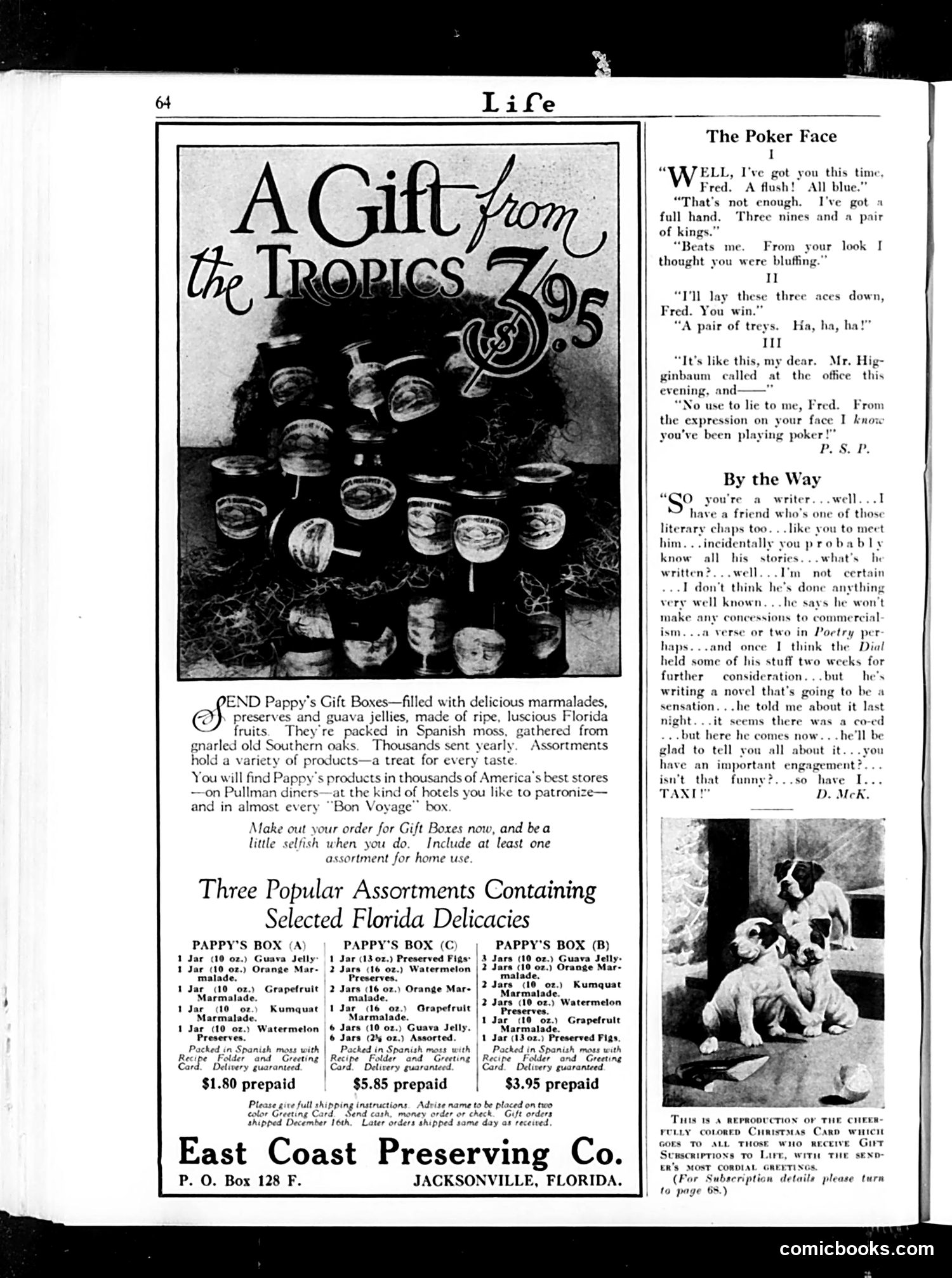
This page contains two satirical humor pieces typical of Life magazine's social commentary: **"The Poker Face"** (top) is a three-panel joke about a husband caught lying. In panel I, Fred claims a poker victory with his hand. Panel II shows him bluffing about playing cards. Panel III reveals the real deception: he's lying about where he was—he tells his wife Mr. Higginbaum called at the office, but she reads his guilty expression and knows he's been playing poker. The satire mocks both male deception and the assumed wife's shrewd ability to detect it. **"By the Way"** (right) satirizes pretentious literary culture. A character describes a friend who's an unsuccessful writer—unpublished except for brief Dial magazine acceptance, dismissive of commercial success, yet claims his novel-in-progress will be a "sensation." The joke targets the self-important obscurity of struggling modernist writers who reject popular success while producing little of note. Both pieces use period vernacular and casual dialogue to mock middle-class masculine behavior and artistic pretension.
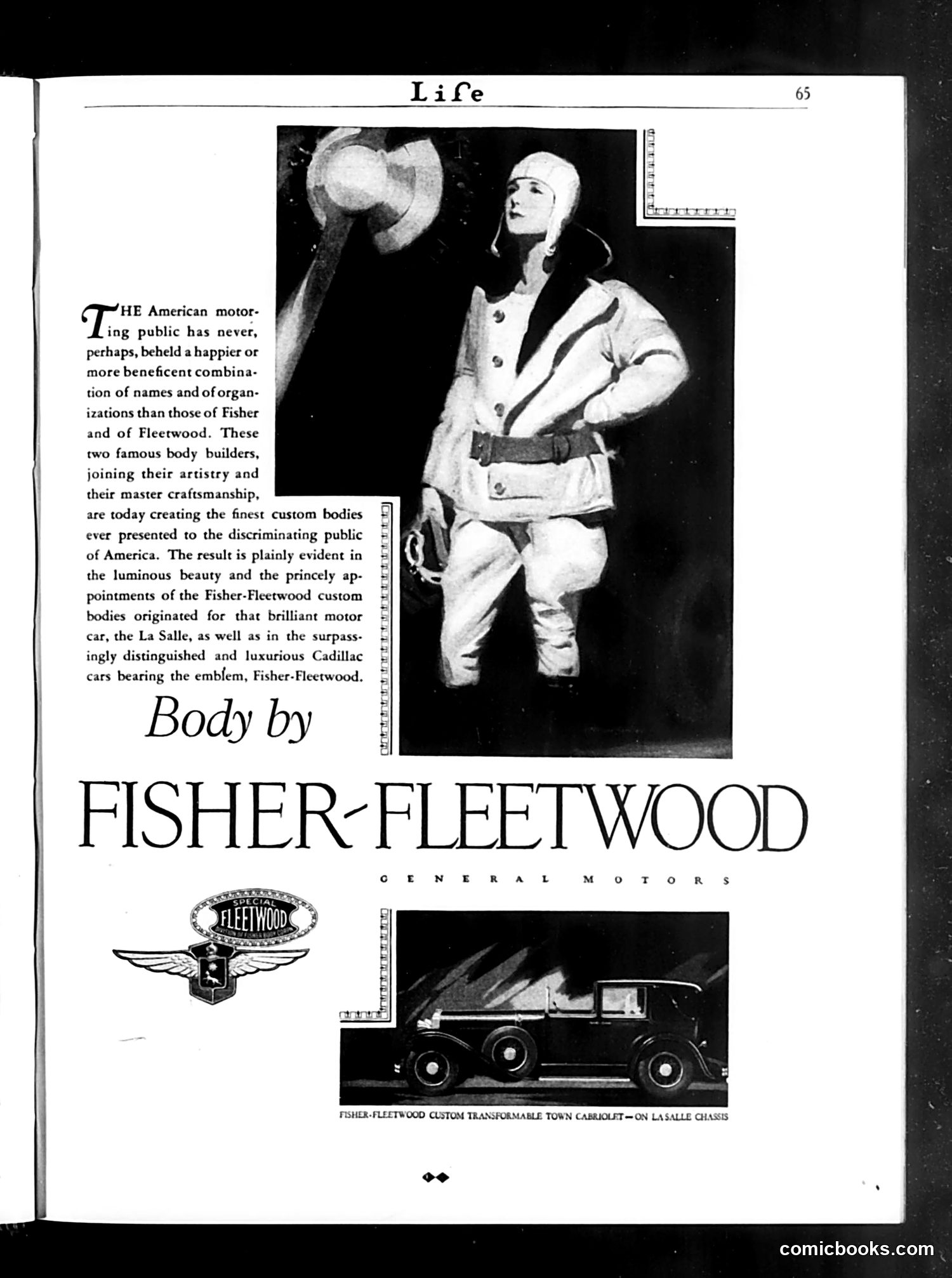
This is **not a cartoon or satire** — it's a straightforward **advertisement** for Fisher-Fleetwood, a General Motors automotive body manufacturer. The page appears in Life magazine's advertising section (page 65). The content celebrates the partnership between Fisher and Fleetwood, two renowned coachbuilders who merged their expertise to create custom automobile bodies. The upper photograph shows a model in 1920s attire displaying craftsmanship; the lower image depicts their "Custom Transformable Town Cabriolet" on a La Salle chassis. The text emphasizes luxury and exclusivity, targeting wealthy Americans who could afford custom-built bodies for premium vehicles like Cadillacs and La Salles. This represents Depression-era aspirational marketing aimed at "the discriminating public of America" — essentially promoting high-end automobiles to affluent readers. There is no satirical content or political commentary here.
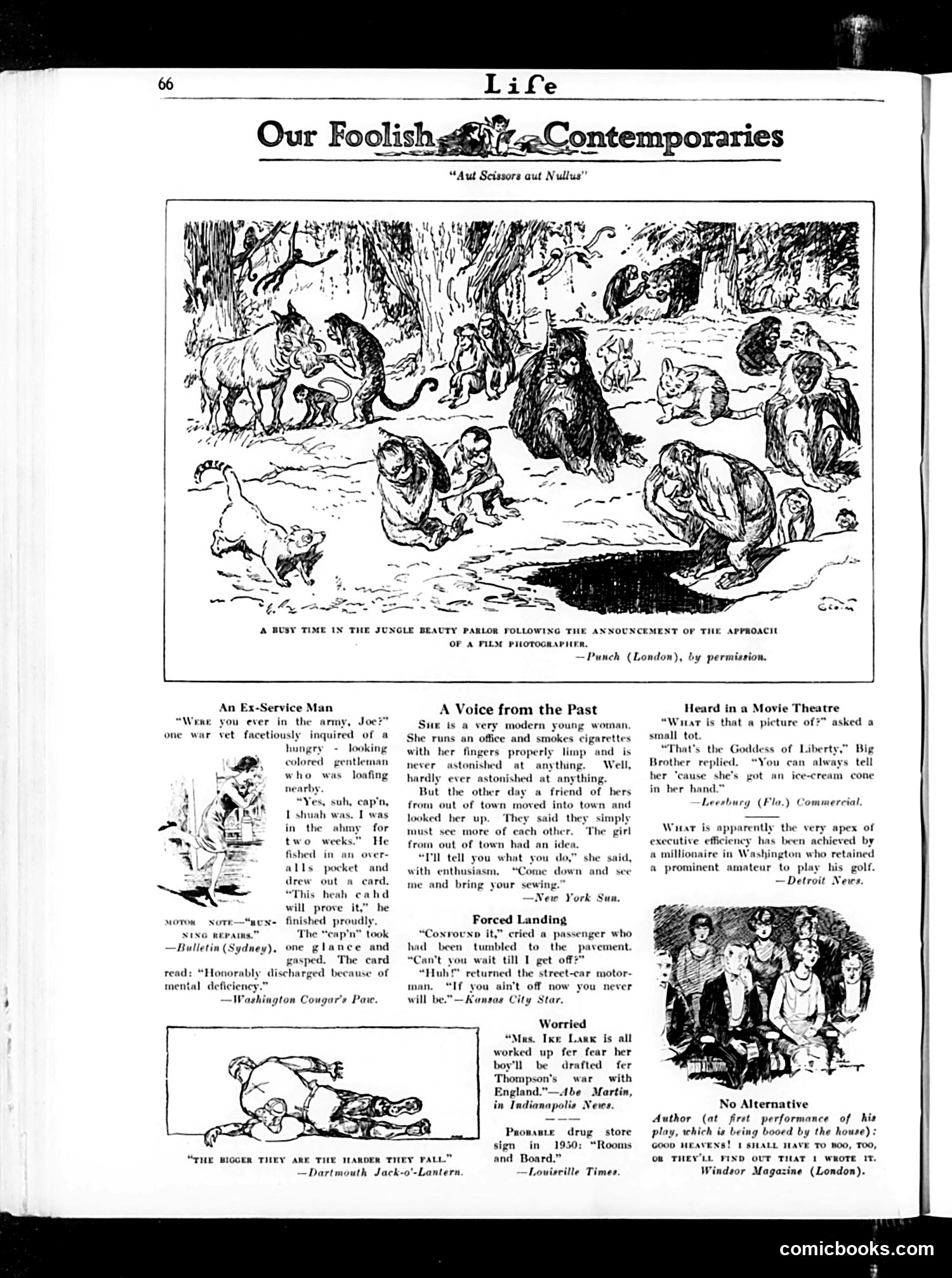
This page collects brief satirical jokes and anecdotes targeting contemporary American society, circa 1920s-1930s. **Main cartoon** (top): A jungle scene where animals mimic human vanity—apes groom themselves after hearing a film photographer is coming. This mocks societal obsession with appearance and media attention. **Key jokes satirize:** - **Military bureaucracy**: A discharged soldier's "honorable discharge" card lists "mental deficiency" as the reason—absurdist humor about military incompetence. - **Modern women**: A countrified visitor expects her sophisticated friend to be interested in old-fashioned activities like sewing, but the modern woman dismisses such notions. - **Class anxiety**: A millionaire hires someone else to play golf for him—ridicule of the wealthy's performative leisure. - **Author's desperation**: A playwright at a booed premiere realizes if the audience discovers he wrote it, they'll boo him too—self-deprecating humor about artistic failure. The satire targets pretension, bureaucratic absurdity, and social climbing—typical Life magazine concerns of the era.
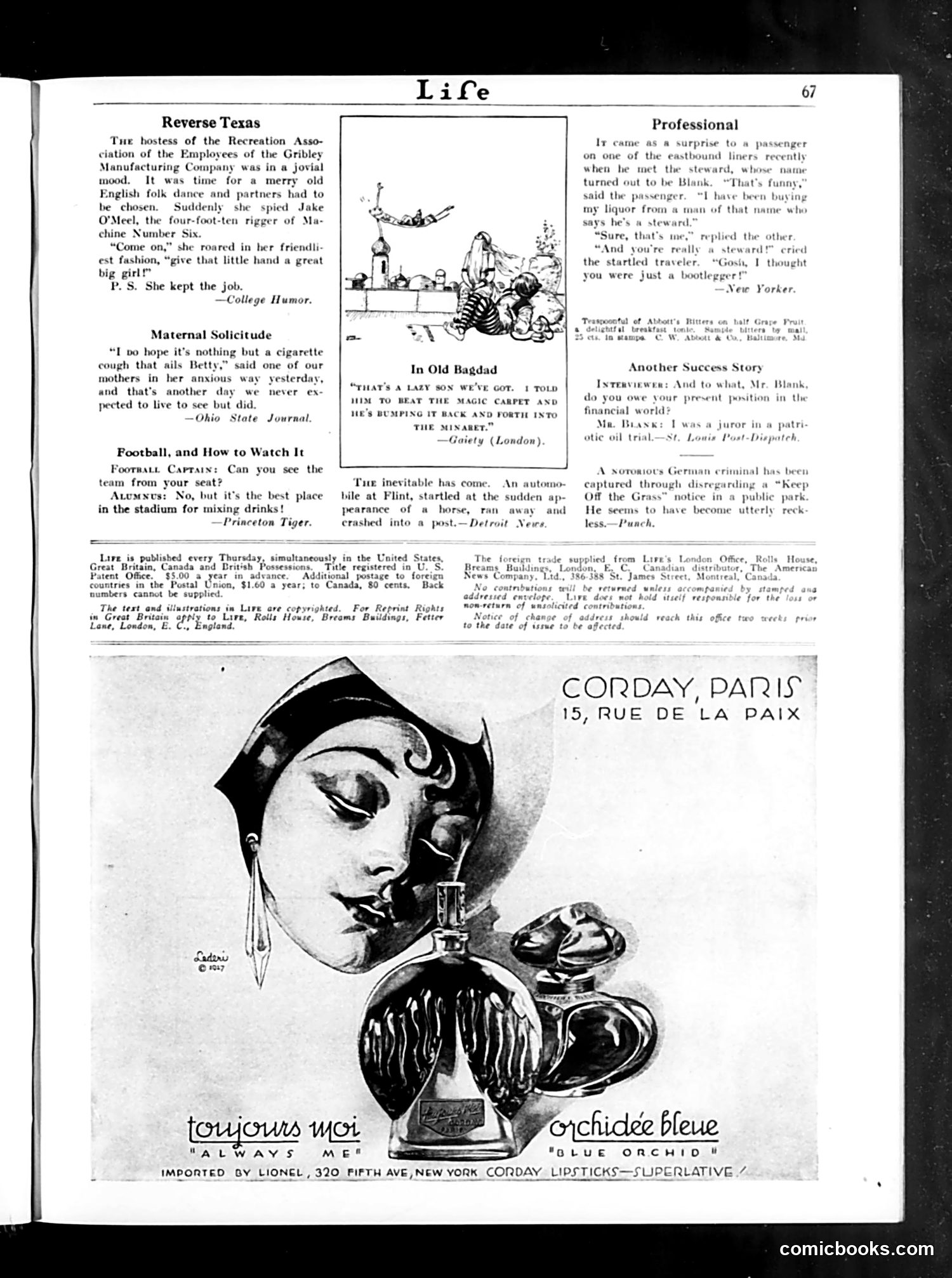
This page contains several brief humorous anecdotes and advertisements typical of 1920s satirical magazine content. **The jokes** mock Prohibition-era hypocrisy: "Professional" features a passenger shocked to learn a ship's steward is actually legitimate, having assumed anyone with that name must be a bootlegger—reflecting widespread illegal alcohol trade during the Prohibition years. Another quip jokes that a football stadium's best feature for viewing isn't the field but access to mixing drinks. **The cartoons** are gentler humor: "Reverse Texas" depicts a factory hostess choosing a diminutive coworker for a folk dance in unexpectedly friendly fashion. "In Old Bagdad" shows someone being scolded for abusing a magic carpet. "Another Success Story" punches at criminal justice, noting a German criminal was caught because he carelessly ignored a "Keep Off the Grass" sign. **The advertisement** at bottom promotes Corday perfume from Paris, featuring an Art Deco–styled female profile—typical luxury product marketing of the era. The overall tone is light domestic satire with topical Prohibition references.
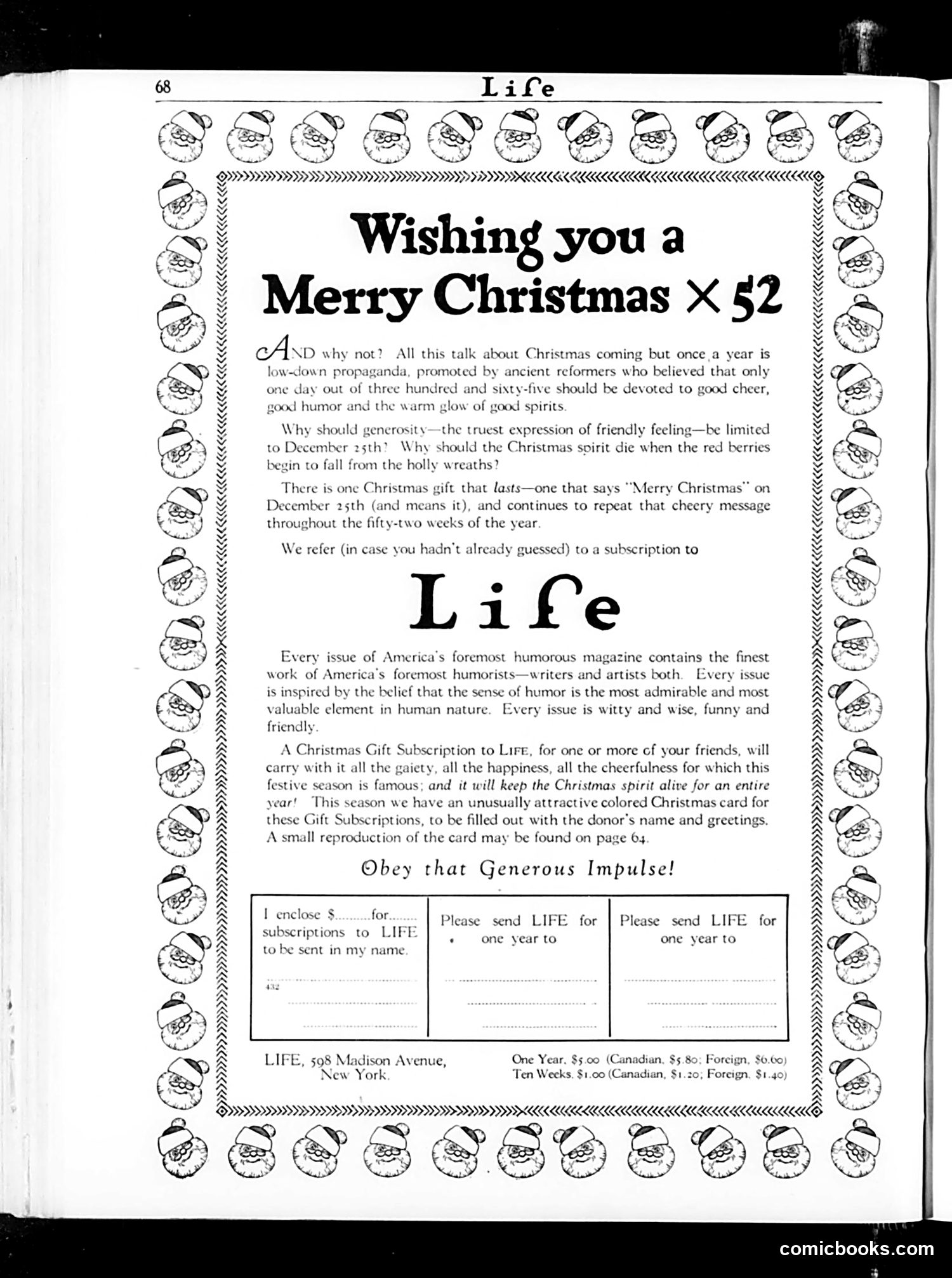
This is primarily a **Christmas gift subscription advertisement** for *Life* magazine, not a political cartoon. The page is bordered with repeated Santa face illustrations. The ad argues that Christmas spirit shouldn't be confined to December 25th alone—a satirical jab at historical "reformers" who supposedly limited celebration to one day yearly. The writer proposes that a year-long *Life* subscription is the perfect gift because it delivers "Merry Christmas" repeatedly throughout all 52 weeks, keeping holiday cheer alive continuously. The pitch emphasizes *Life*'s role as "America's foremost humorous magazine," claiming humor is humanity's "most admirable and most valuable element." The ad includes tear-out subscription cards for multiple gift recipients. **No specific political figures or events are referenced**—this is straightforward commercial messaging using gentle satire about American consumer culture and gift-giving customs to promote magazine subscriptions during the holiday season.
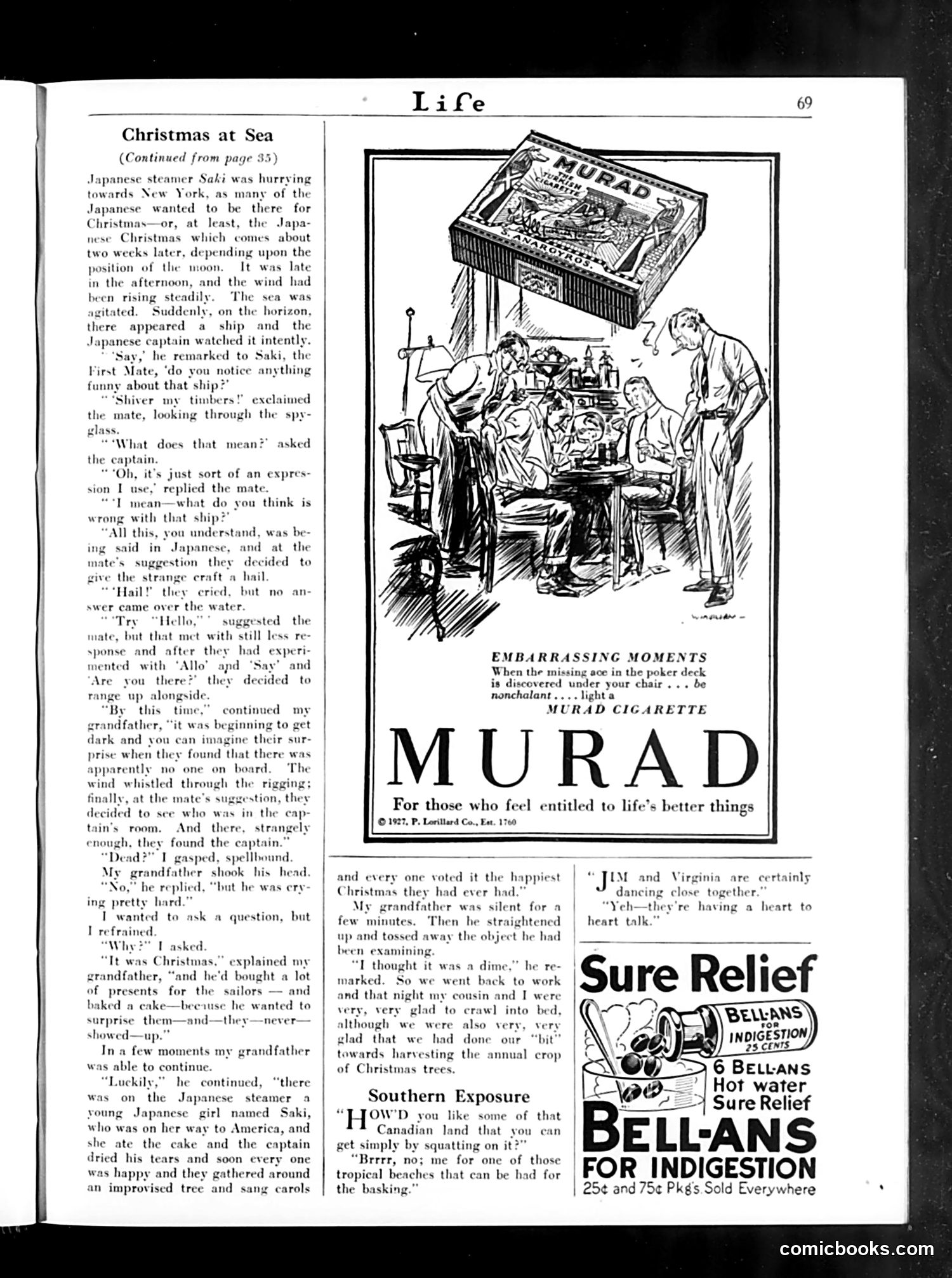
This page contains a serialized humorous story rather than political cartoons. The main narrative follows a grandfather recounting a Christmas tale aboard a Japanese steamer named *Saki* heading to New York. **The Story's Point:** The humor derives from cultural misunderstanding and sentimentality. Japanese sailors attempt to greet a mysteriously silent ship using progressively absurd phrases ("Shiver my timbers," "Hello," "Allo"). They discover the captain weeping alone—he'd prepared Christmas presents and a cake for sailors who never arrived, representing a touching but comedic failure of holiday expectations. A young Japanese passenger named Saki saves the day by eating the cake, allowing everyone to celebrate together. **Social Context:** This reflects 1920s American attitudes toward Japan as exotic and "other," while treating cross-cultural Christmas as charmingly sentimental. The story plays on American stereotypes about Japanese formality meeting Western holiday tradition. **Advertisements:** The page also features a Murad cigarette ad and a Bellans indigestion remedy ad—typical period magazine content unrelated to the narrative.
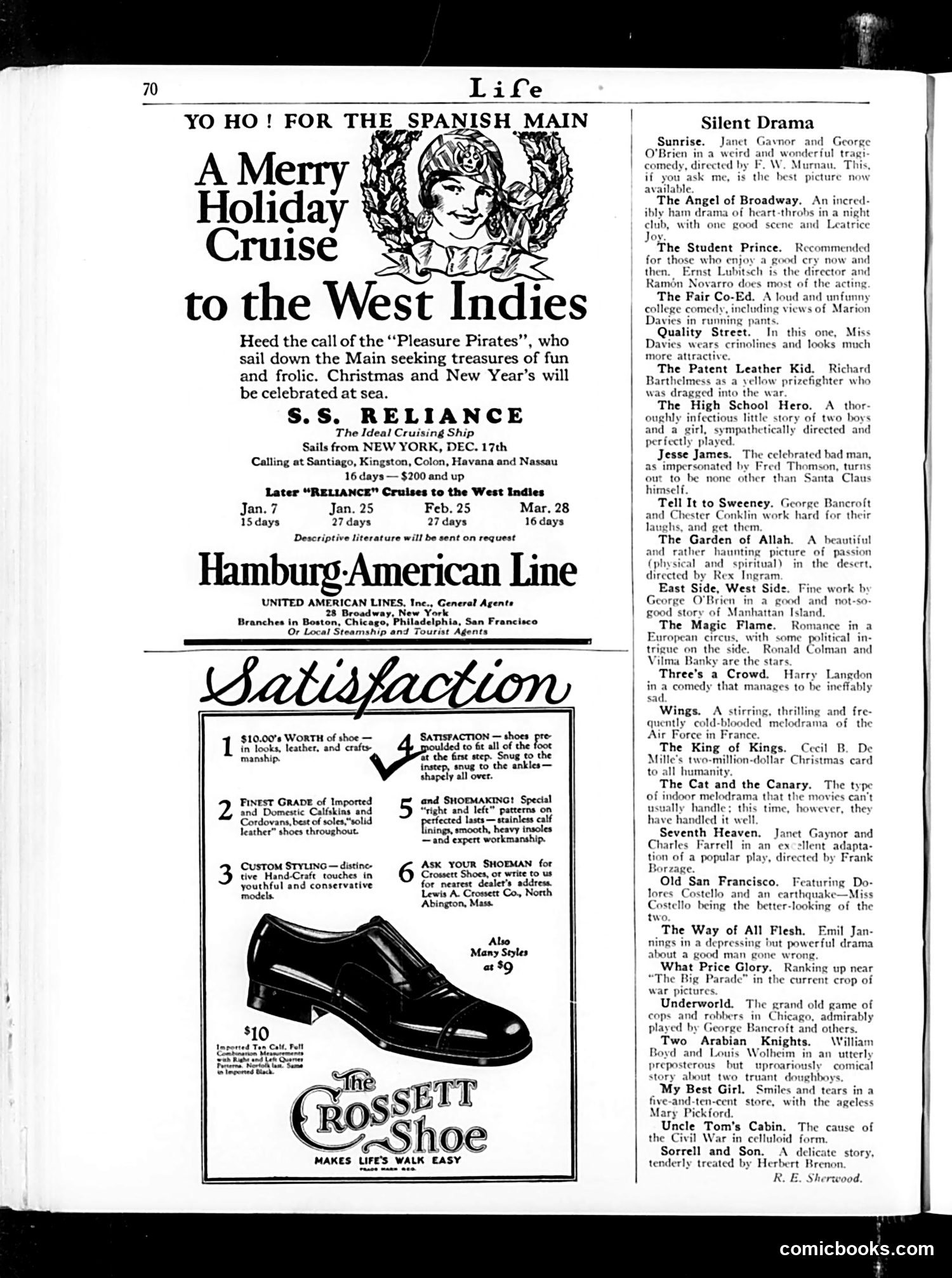
This page is primarily **advertising and entertainment reviews**, not political satire. The main content consists of: 1. **Cruise ship advertisement** for the S.S. Reliance to the West Indies, with a playful "Pleasure Pirates" theme—a straightforward holiday travel pitch. 2. **Shipping line advertisement** for Hamburg-American Line. 3. **Shoe advertisements** for Crossett Shoes and another brand, emphasizing craftsmanship and quality. 4. **Film reviews** under "Silent Drama"—brief critical assessments of contemporary movies (Sunrise, The Student Prince, Wings, The King of Kings, etc.), typical of Life magazine's entertainment coverage. There is **no political cartoon or satire here**. The page reflects 1920s consumer culture and the silent film era, but contains no caricatures, political commentary, or satirical commentary requiring historical context beyond understanding this was an era of cruise tourism, quality shoe manufacturing, and silent cinema.
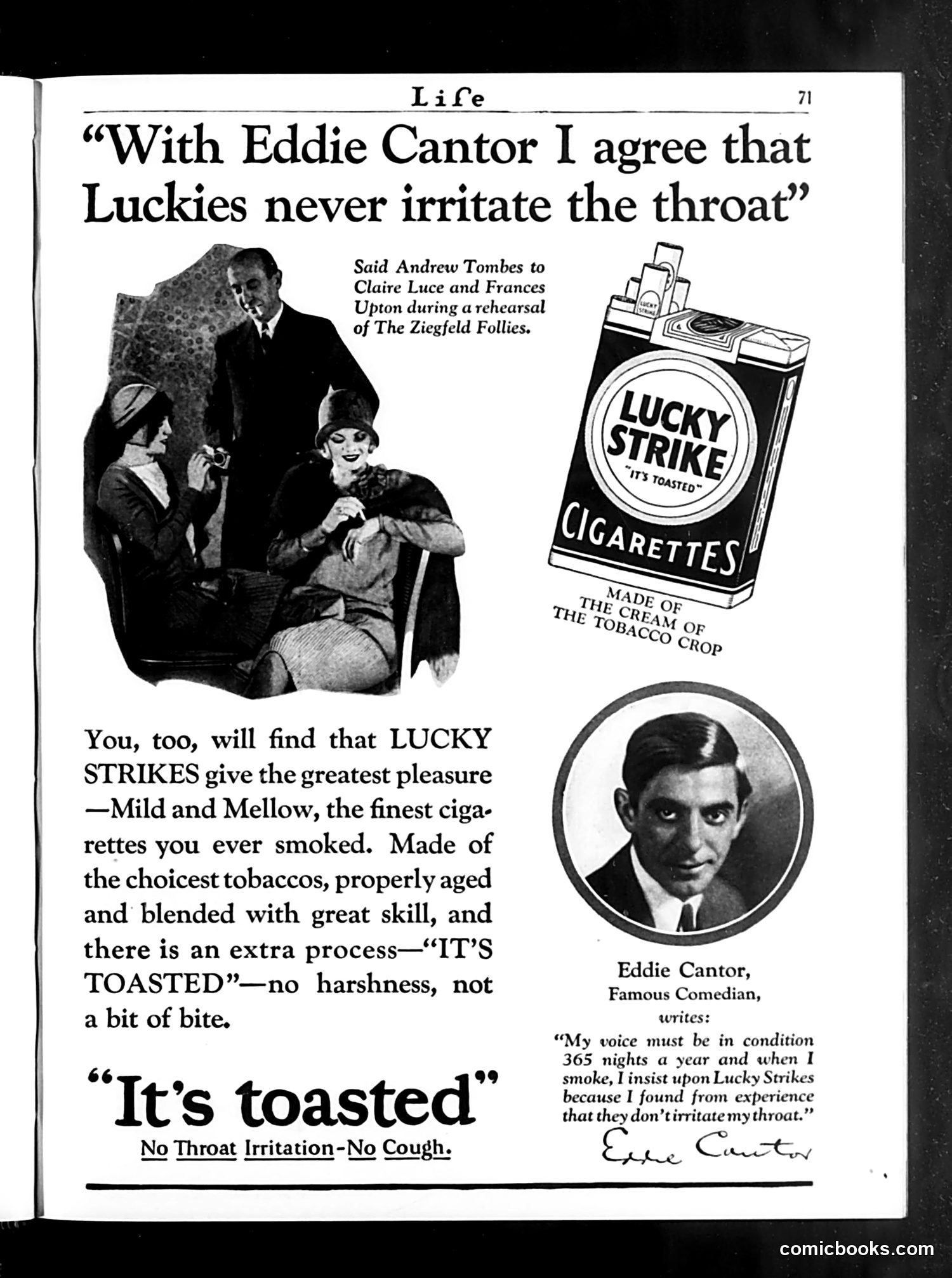
This is a **cigarette advertisement**, not satire. It features entertainer **Eddie Cantor** (identified by photograph and signature) endorsing Lucky Strike cigarettes to other performers—Andrew Tombes, Claire Luce, and Frances Upton—during a *Ziegfeld Follies* rehearsal. The ad promotes Lucky Strikes' "toasting" process as eliminating throat irritation, a key selling point for performers who used their voices professionally. Cantor's testimonial claims he smokes daily without throat damage, positioning the product as safe for constant use. This represents **mid-20th century advertising norms**: celebrity endorsements were common and unregulated; health claims were made without scientific substantiation; and smoking was advertised without health warnings. Modern readers would recognize this as both a period artifact and an example of how corporations marketed harmful products using trusted public figures.
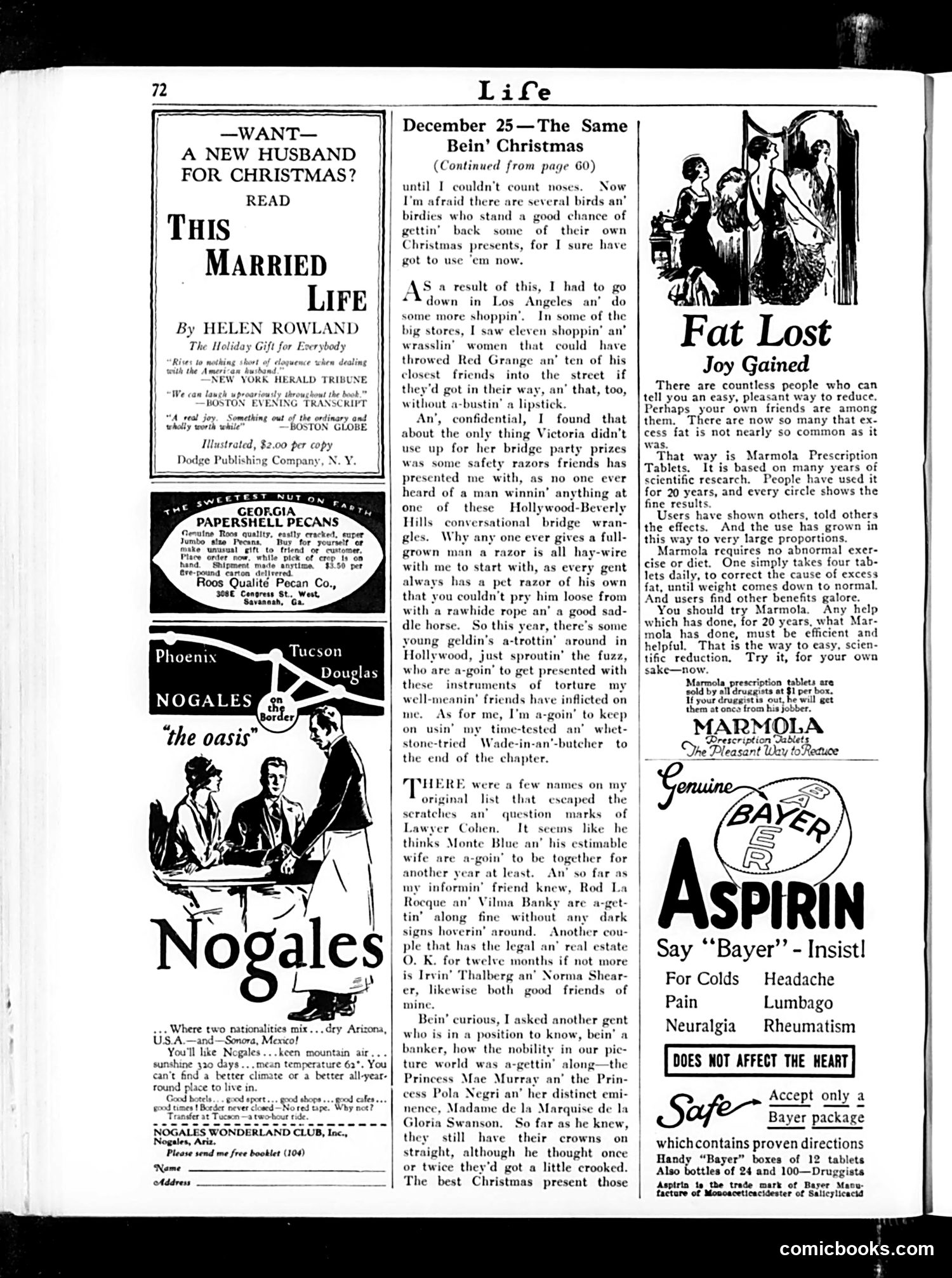
This Life magazine page from December 25 (circa 1920s) contains satirical commentary on Hollywood marriages and consumer culture. **The Main Article:** Helen Rowland's "This Married Life" column uses biting humor about marital instability among Hollywood celebrities—specifically mentioning Monte Blue, Rod La Rocque, Vilma Banky, and Norma Shearer. The satire targets the apparent disposability of marriages in the film industry, where couples separate and reunite casually. **The Advertisement Satire:** The juxtaposition of marriage instability commentary with prominent weight-loss and aspirin advertisements is itself satirical—Life positions consumerism (diet pills, razors, medicine) as solutions to modern dissatisfaction, including romantic unhappiness. **The Humor:** Rowland's folksy narrator describes shopping chaos in Los Angeles department stores and women fighting over goods, while also commenting on the casual infidelity and divorce among Hollywood's elite—contrasting working-class Christmas desperation with celebrity disposability. The overall message critiques both Hollywood's moral laxity and America's growing consumer culture as answers to life's problems.
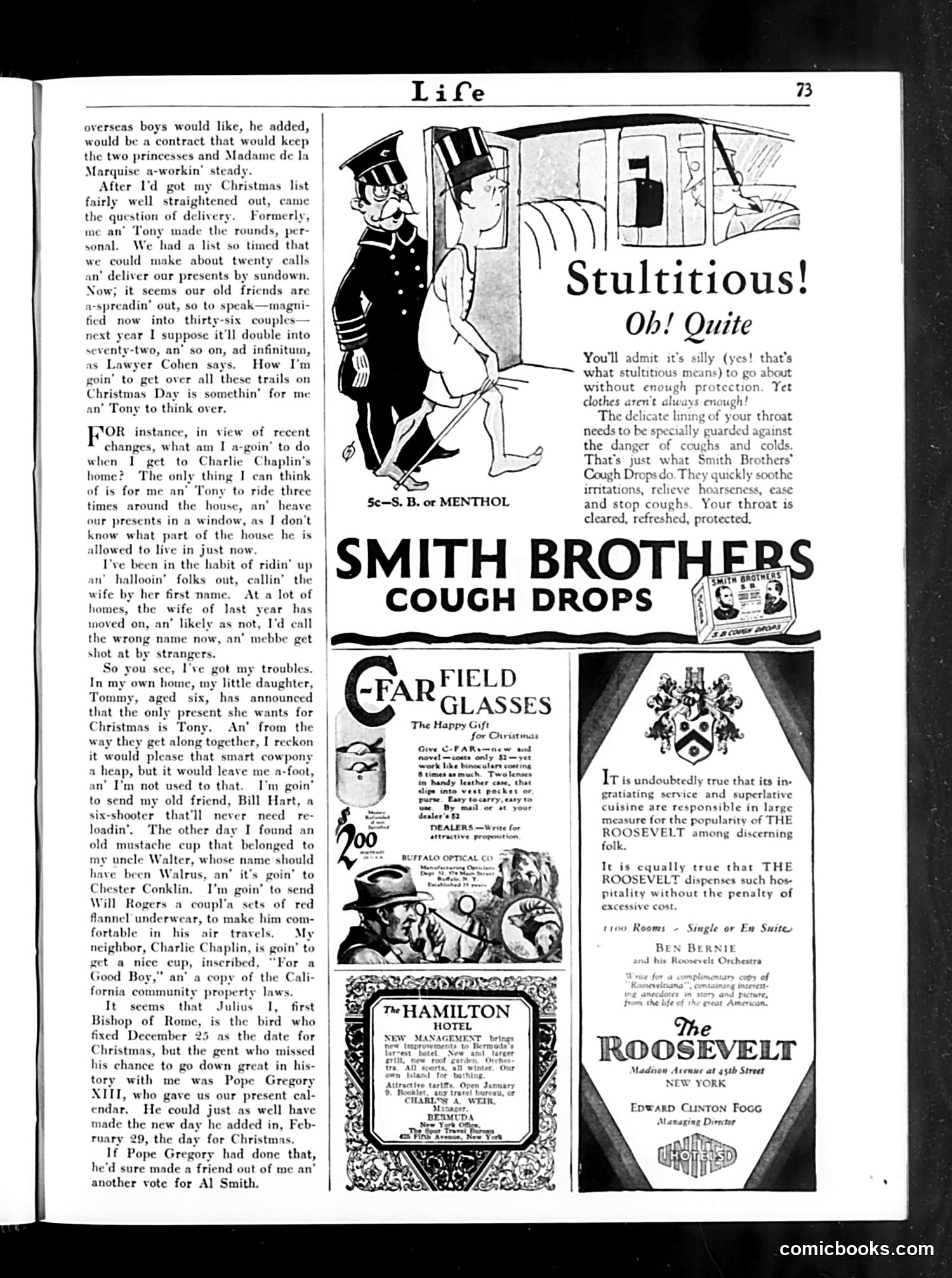
This page is primarily **advertising and lifestyle content** from Life magazine, with minimal political cartoons. The main text is a humorous personal essay about Christmas gift-giving challenges—the author notes that celebrity friends (Charlie Chaplin, Chester Conklin, Will Rogers) have become so dispersed that traditional house-to-house present delivery is now impractical. The sole political reference appears at the end: the author jokes that Pope Gregory XIII (who added February 29 to the calendar) missed an opportunity to make Christmas fall on leap day—which would have earned him "another vote for Al Smith," likely referring to **Al Smith, a 1928 Democratic presidential candidate**. This is a lighthearted jab at calendar reform. The page is otherwise dominated by vintage advertisements for cough drops, eyeglasses, a hotel, and entertainment—typical of Life's mixed editorial-advertising format.
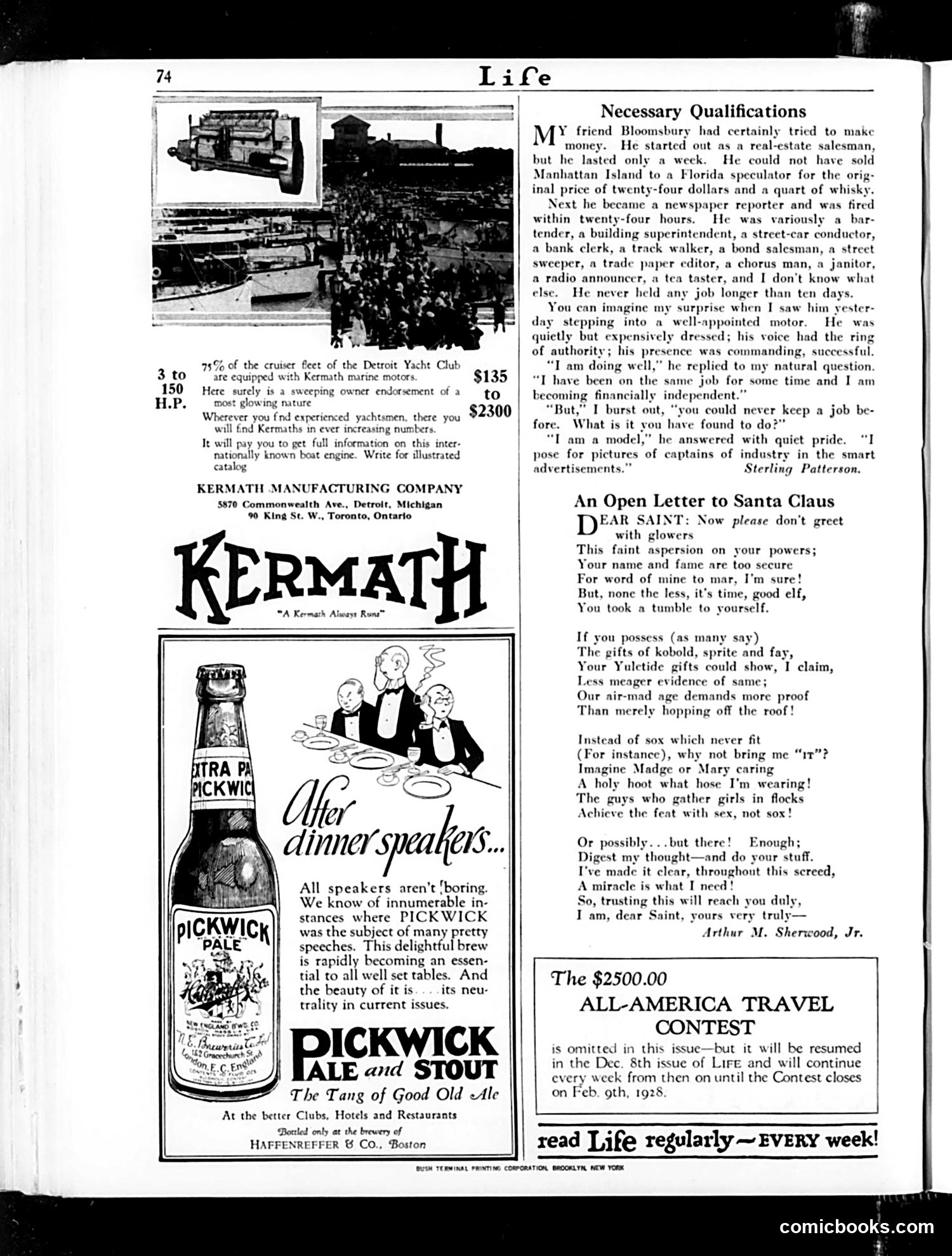
This page is primarily **advertising** with two humorous pieces interspersed. **The Main Content:** The dominant feature is a Pickwick Ale advertisement using satire: it jokes that while speakers are "boring," Pickwick beer has been the subject of "pretty speeches"—implying the drink itself makes for better conversation topics than most speakers. **The Humor Pieces:** 1. **"Necessary Qualifications"** by Sterling Patterson satirizes a perpetually unemployed man (Bloomsbury) who finally succeeds as a commercial model posing as an industrialist in advertisements. The joke: he succeeds not through actual business skill but by *looking* successful for ads—commentary on 1920s advertising's image-over-substance culture. 2. **"An Open Letter to Santa Claus"** by Arthur M. Sherwood, Jr. humorously complains that Santa's gifts (socks) are useless compared to the real magic needed in modern life. The closing couplet about "sex, not sox" is cheeky 1920s humor about what actually attracts women. Both pieces mock modern consumer culture and commercial values typical of Life's satirical approach.
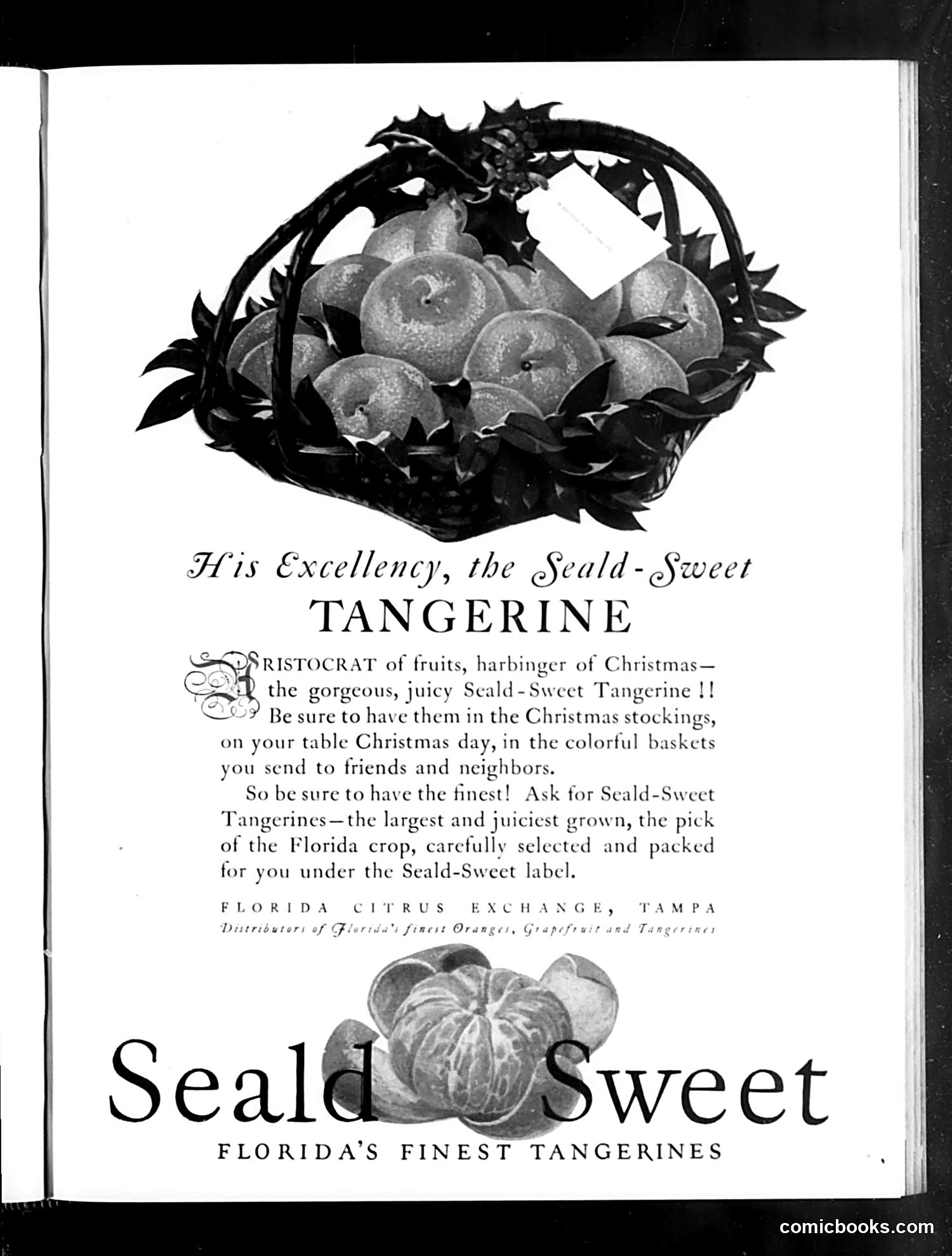
This page is **not a political cartoon or satire** — it's a straightforward **advertisement** for Seald-Sweet tangerines from the Florida Citrus Exchange (Tampa). The ad uses aristocratic language ("His Excellency," "Aristocrat of fruits") to humorously elevate tangerines to noble status, marketing them as premium Christmas gifts. The decorative basket illustration and elegant typography emphasize luxury and seasonal appeal. The only notable element is the pun calling tangerines an "Aristocrat of fruits" — a light, playful marketing device rather than social commentary. This appears in a magazine (Life) known for satire, but this particular page is purely commercial advertising, likely from the 1920s-1930s based on the design style and typography.
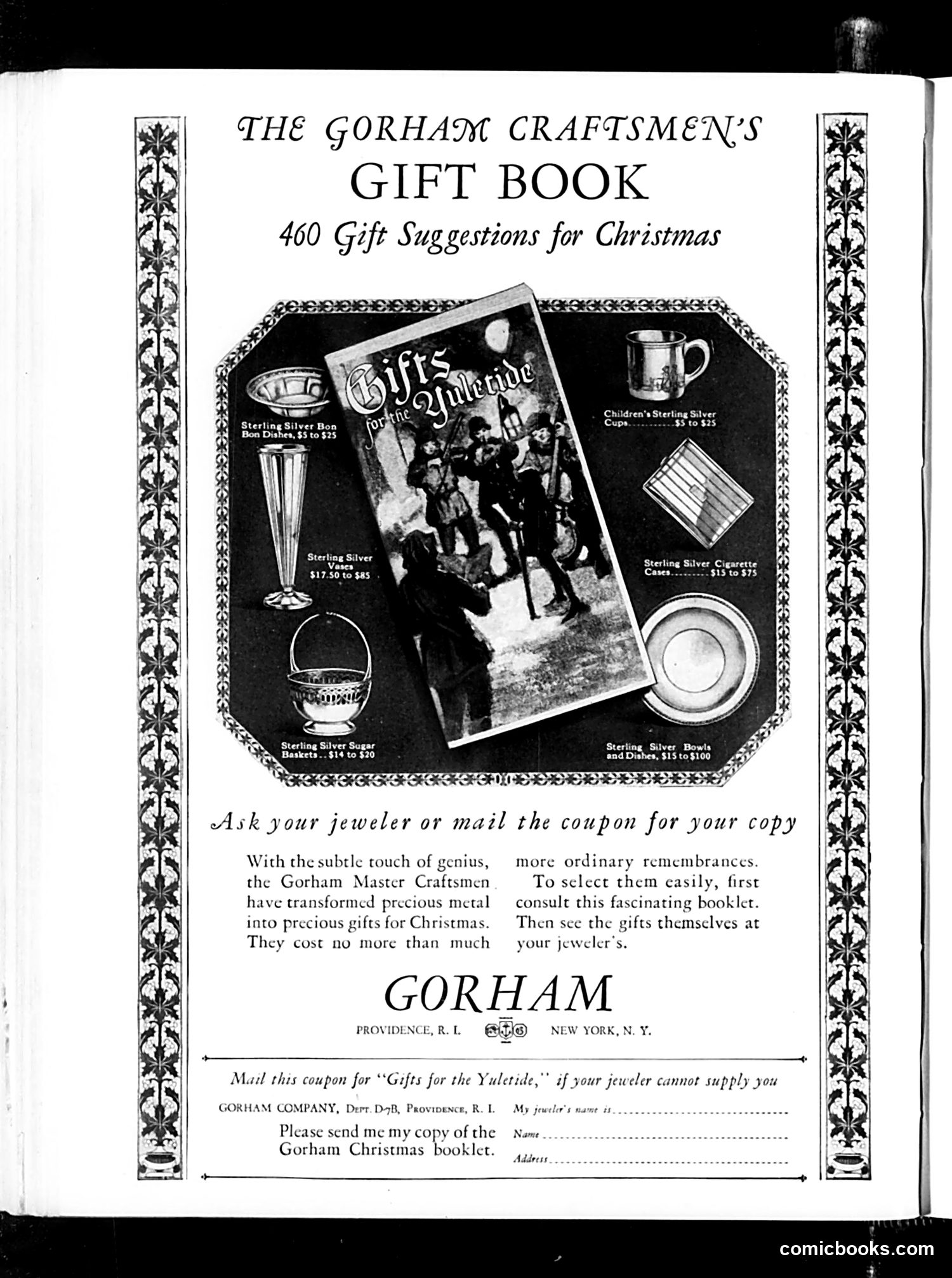
This is a full-page **advertisement**, not a cartoon or satirical piece. It promotes Gorham Company's sterling silver gift items for Christmas shopping. The ad features product photography of luxury goods—silver bowls, vases, cigarette cases, sugar baskets, and children's cups—with prices ranging from $3 to $100. The copy emphasizes that these precious metal gifts are affordable ("cost no more than much") and positions them as sophisticated alternatives to "ordinary remembrances." The central image shows what appears to be a Yuletide or holiday gathering scene, used to evoke festive sentiment and aspirational gift-giving. Readers are invited to request a 460-page gift suggestion booklet via coupon, either through their jeweler or by mail. The ad targets middle-to-upper-class consumers seeking tasteful, impressive Christmas presents during what was likely the pre-Depression or early 1930s era.
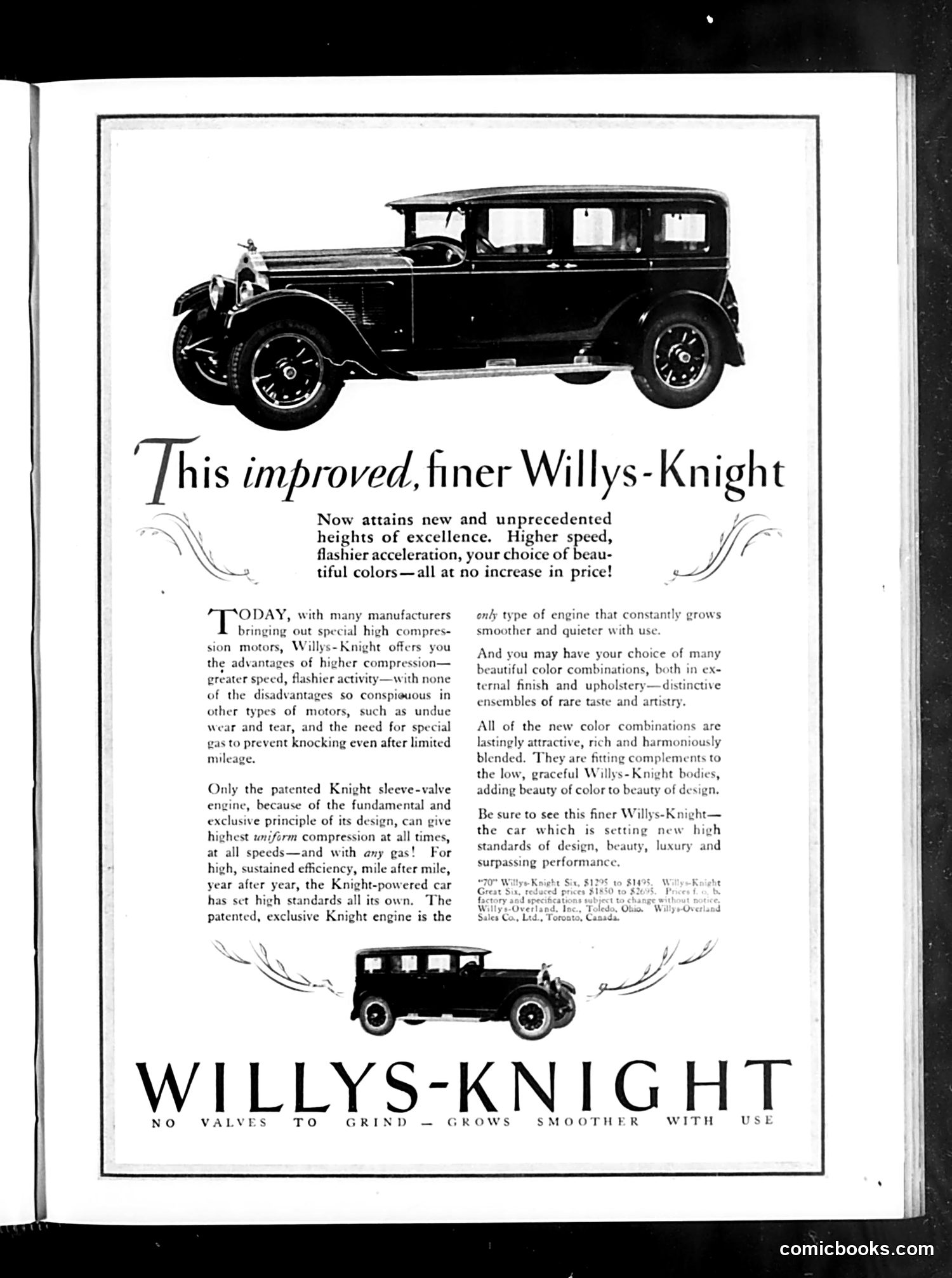
This is **not a cartoon or satire**—it's a straightforward automobile advertisement for the Willys-Knight car company. The page promotes an "improved, finer Willys-Knight" with marketing claims about its patented sleeve-valve engine, emphasizing advantages like higher speed, smoother acceleration, and no increase in price. The ad highlights the engine's unique ability to run on any gasoline without knocking, and grow "smoother and quieter with use." Two black-and-white illustrations show the vehicle from the side. The tagline "No Valves to Grind—Grows Smoother with Use" emphasizes the engine's durability. This appears in *Life* magazine, which during this era (likely 1920s-early 1930s) published substantial advertising alongside editorial content. The page represents early automotive marketing targeting middle-class consumers with technical specifications and aesthetic appeals—standard advertising strategy of the period.
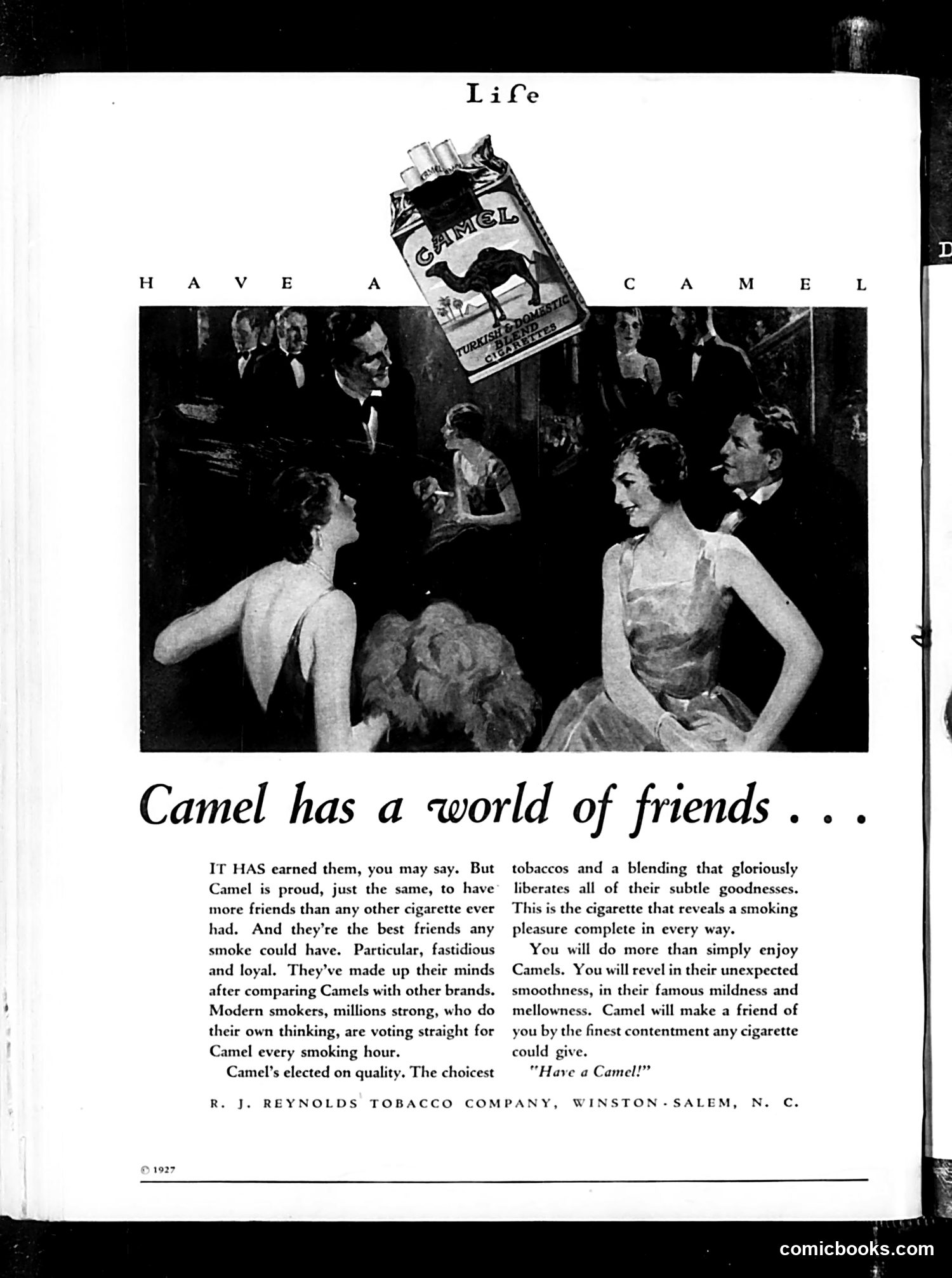
This is a **1927 Camel cigarette advertisement**, not satire or political commentary. The page uses the heading "Life" (the magazine's masthead) above a glamorous party scene showing well-dressed men and women in evening wear. The ad employs early 20th-century marketing rhetoric: Camel cigarettes have "earned" friends through superior quality and "choicest tobaccos." The language appeals to modern, independent-thinking smokers who make rational comparisons between brands. It emphasizes "smoothness," "mildness," and "contentment." The social context: smoking was then universally normalized and heavily advertised. The elegant party setting associates the product with sophistication and social success—a standard advertising technique of the era. For modern readers, this is notably a straightforward ad (not satire), showcasing pre-1930s advertising practices before cigarette health warnings existed and tobacco marketing freely targeted broad audiences in mainstream magazines.