
Life, 1927-12-01 · page 38 of 80
Life — December 1, 1927 — page 38: what you’re looking at
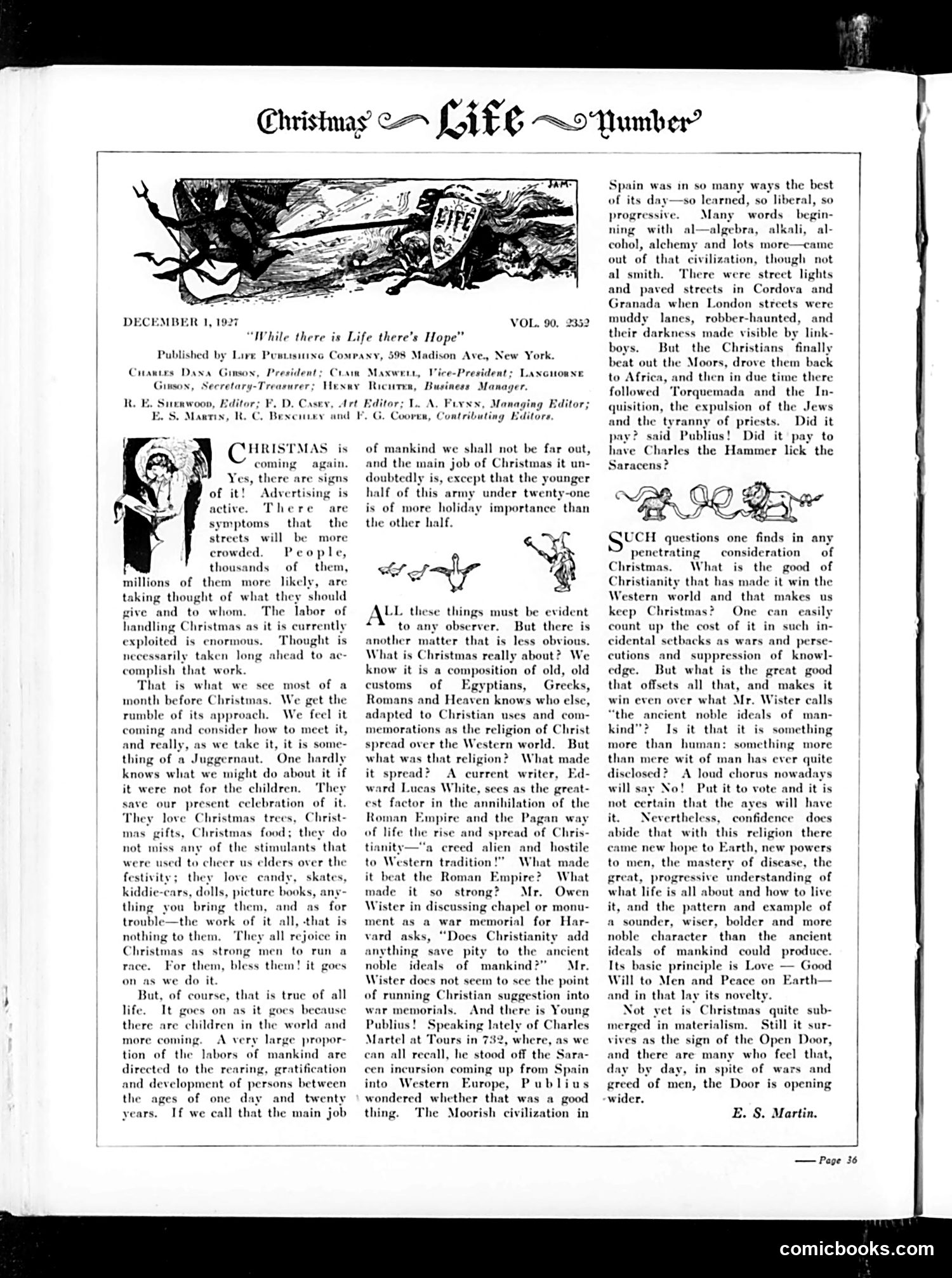
What you’re looking at
This is the editorial/opinion section (not a cartoon page), titled "Christmas" by E.S. Martin. The piece debates Christmas's cultural significance while raising provocative historical questions. The main argument contrasts Christmas's commercial importance with deeper philosophical questions: What makes Christianity valuable to Western civilization? Martin presents contrary views through cited writers—Edward Lucas White sees Christianity's rise as crucial to destroying paganism; Owen Wister questions whether Christianity adds anything beyond "pity"; and a writer called "Publius" ironically questions whether Charles Martel's 732 victory stopping Moorish invasion into Spain was beneficial, given that Islamic civilization brought learning and infrastructure (algebra, street lights, paved streets in Córdoba). The satire suggests Western triumphalism about Christian civilization is simplistic—medieval Islamic Spain was arguably more advanced than contemporary Europe. This reflects 1920s intellectual debates about progress, tradition, and cultural relativism.
📄 Transcribed text from this page (OCR, searchable)
Machine-transcribed from the original scan — historical spelling and the odd misread are preserved.
Christmas CA Lite ~OPumber? DECEMBER 1, 1927 VOL. 90. 2352 “While there is Life there's Hope” Published by Lire Pusttsiine Company, Crantes Dawa Ginsox, President: Crain Ginson, Secretary-Treasurer; Wexay K. F. D. Casey, Art S. Maatin, R. CHRIST LAS is coming again. Yes, there of it! Advertising is active. There are symptoms that the streets will be more crowded. People, thousands of — them, millions of them more likely, are taking thought of what they should give and to whom. The labor of andling Christmas as it is currently exploited is enormous. Thought is necessarily taken long ahead to ac- complish that work. That is what we see month before Christmas. We get the rumble of its approach. We feel it nd consider how to meet it, and really, as we take it, it is some- thing of a Juggernaut. One hardly knows what we might do about it if it were not for the children. They save our present celebration of it. They love Christmas trees, Christ- mas gifts, Christmas food; they do not miss any of the stimulants that were used to cheer us elders over the festivity; they love candy, skates, are signs most of a coming kiddie-cars, dolls, picture books, any- thin ou bring them, and as for trouble—the work of it all, -that is nothing to them. ‘They all rejoice in Christmas as strong men to run a race. For them, bless them! on as we do it. But, of course, that is true of all life. It goes on as it goes because there are children in the world and more coming. A very large propor- tion of the labors of mankind are directed to the rearing, gratification and development of persons between the ages of one day and twenty rs. If we call that the main job it goes C. Bexcurey and F, 598 Madison Ave., New York. e-President; Laxcuowxe Business: Manager. A. Fuysx, Mane G. Cooren, Contributing E Maxwent, 1 Ricurer, Editor; 1. 9g Editor; tore of mankind we shall not be far out, and the main job of Christmas it un- doubtedly is, except that the younger f of this army under twenty is of more holiday importance than the other half. ety ALL these things must be evident £2 to any observer. But there is another matter that is less obvious. What is Christmas really about? We know it is a composition of old, old customs of Egyptians, Greeks, Romans and Heaven knows who else, adapted to Christian uses and com- memorations as the religion of Christ spread over the Western world. But what was that religion? What made it spread? A current writer, Ed- ward Lucas White, sees as the great- est factor in the annihilation of the Roman Empire and the Pagan way of life the rise and spread of Chris- Y creed alien and hostile to Western tradition it beat the Roman made it so_ stron Wister in discussing chapel or monu- ment as a war mei morial for Har- vard asks, “Does Christianit dd anything save pity to the i noble ideals of mankind? Mr. Wister does not seem to see the point of running Christian suggestion into war memorials. And there is Young Publius! Speaking lately of Charles Martel at Tours in 732, where, as we can all recall, he stood off the S: cen incursion coming up from Spain into Western Europe, Publius wondered whether that a good thing. The Moorish civil one ara- Spain was in so many ways the best of its day—so learned, so liber: progressive. Many words begin- ning with al—algebra, alkali, al- cohol, alchemy and lots more—came out of that civilization, though not al smith. There were street lights and paved streets in Cordova and ada when London streets were lanes, robber-haunted, and their darkness made visible by link- boys. But the Christians finally beat out the Moors, drove them back to Africa, and then in due time there followed ‘Torquemada and the In- quisition, the expulsion of the Jews and the tyranny of priests. Did it ? said Publius! Did it pa have Charles the Hammer li Saracens? GF u @) > GF QUCH questions one finds in any penetrating consideration of Christmas. What is the good of Christianity that has made it win the Western world and that makes us keep Christmas? One can easily count up the cost of it in such in- cidental setbacks as wars and perse- cutions and suppression of knowl- edge. But what is the great good that offsets all that, and makes it win even over what Mr. Wister calls “the ancient noble ideals of m: kind"? Is it that it is something more than human: something more than mere wit of man has ever quite disclosed? A loud chorus nowadays will say No! Put it to vote and it is not certain that the ayes will have Nevertheless, confidence does abide that with this religion there came new hope to Earth, new powers to men, the mastery of disease, the great, progressive understanding of what life is all about and how to live ind the pattern and example of a sounder, wiser, bolder and more noble character than the ancient ideals of mankind could produce. Its basic principle is Love — Good Will to Men and Peace on Earth— and in that lay its novelty. Not yet is Christmas quite sub- merged in materialism. Still it sur- vives as the sign of the Open Door, and there are many who feel that, day by day, in spite of wars and greed of men, the Door is opening wider. E. §. Martin. — Page 36 comicbooks.com