
A complete issue · 56 pages · 1920
Life — July 1, 1920
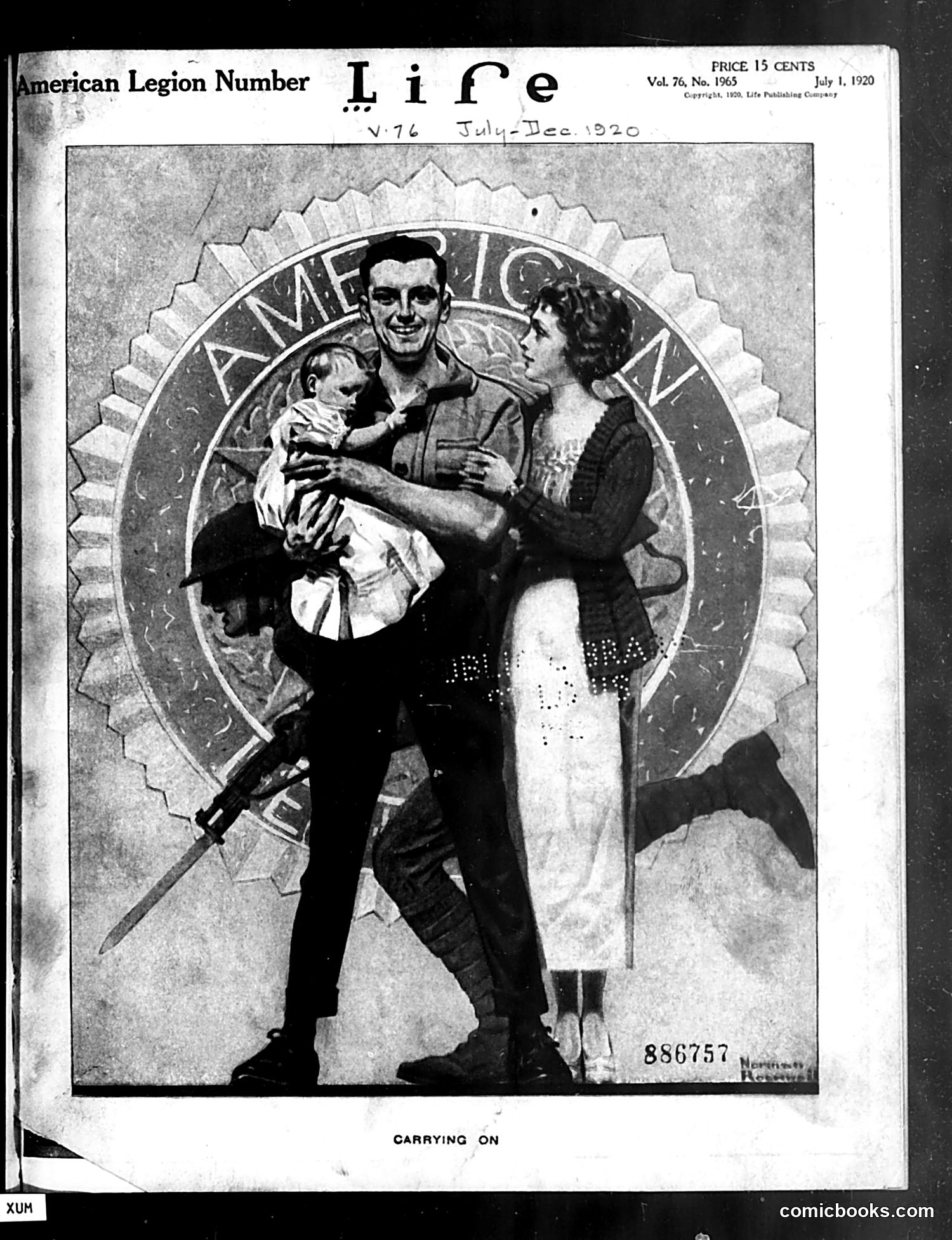
This is the cover of *Life* magazine from July 1, 1920, titled "CARRYING ON." The illustration depicts a soldier in military uniform holding a baby, standing beside a woman. Behind them is a large gear or mechanical symbol marked "AMERICA" and "NATION." The image appears to celebrate post-WWI domestic life and the transition from wartime to peacetime. The soldier represents returning veterans, the baby symbolizes the future generation, and the woman likely represents either a wife or the nation itself. The gear suggests industrial/national machinery continuing forward. The title "Carrying On" suggests resilience and progress—the nation and its people moving ahead after World War I, with veterans reintegrating into civilian life and family responsibilities. This reflects optimistic post-war sentiment of 1920.
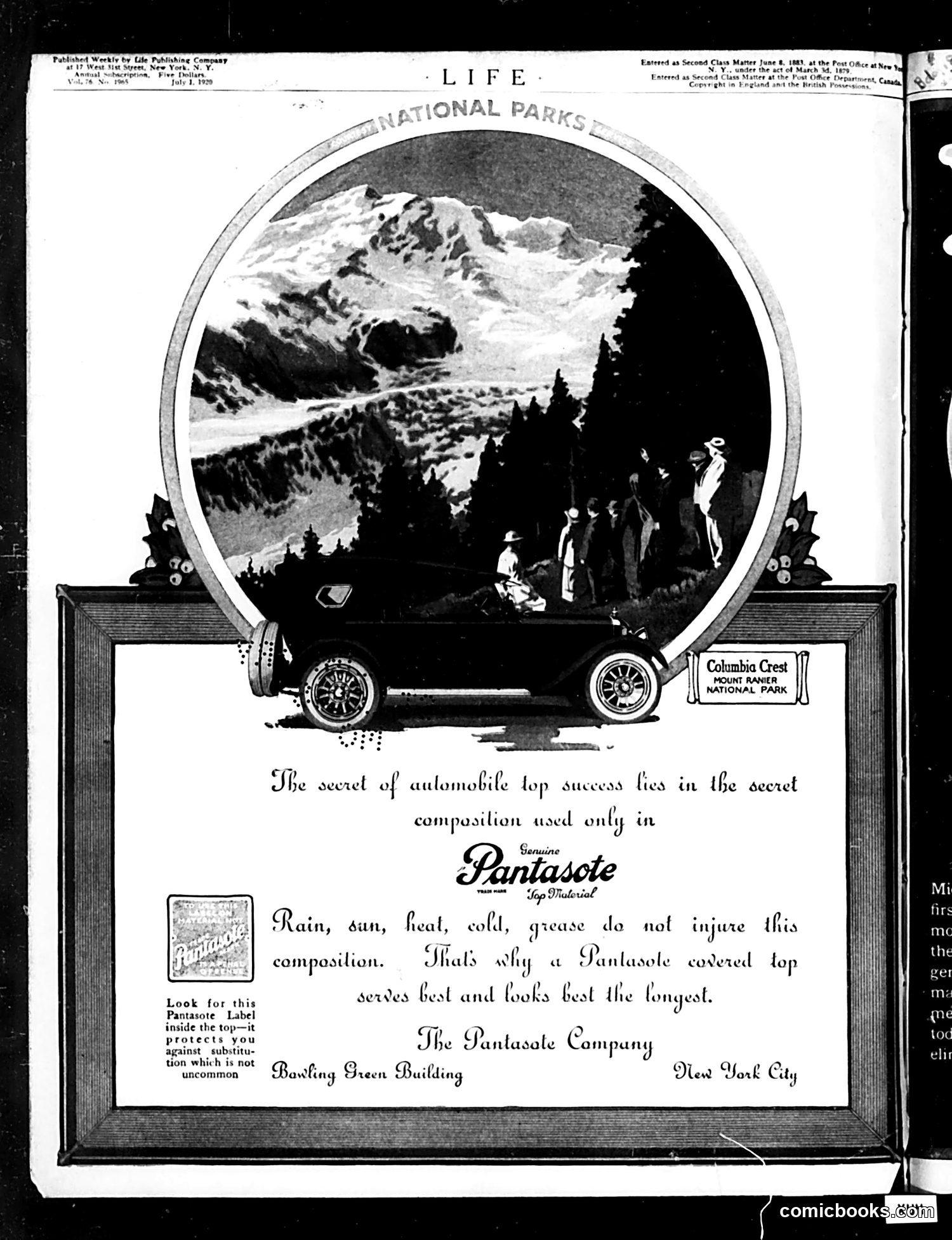
This page is **primarily an advertisement**, not political satire. It's a Pantasote automobile top material ad from The Pantasote Company (New York City). The imagery shows a scenic mountain landscape (labeled "Columbia Crest, Mount Rainier National Park") with tourists, framed as if viewed through an automobile's convertible top. The ad's message is straightforward product marketing: Pantasote's composition resists weather damage ("Rain, sun, heat, cold, grease do not injure this composition"), making it durable for long-term use. The framing device—presenting the national park vista through the car—is clever advertising that associates the product with leisure travel and outdoor adventure, appealing to early-20th-century automobile owners. There is no satirical or political content here; this is commercial promotion.
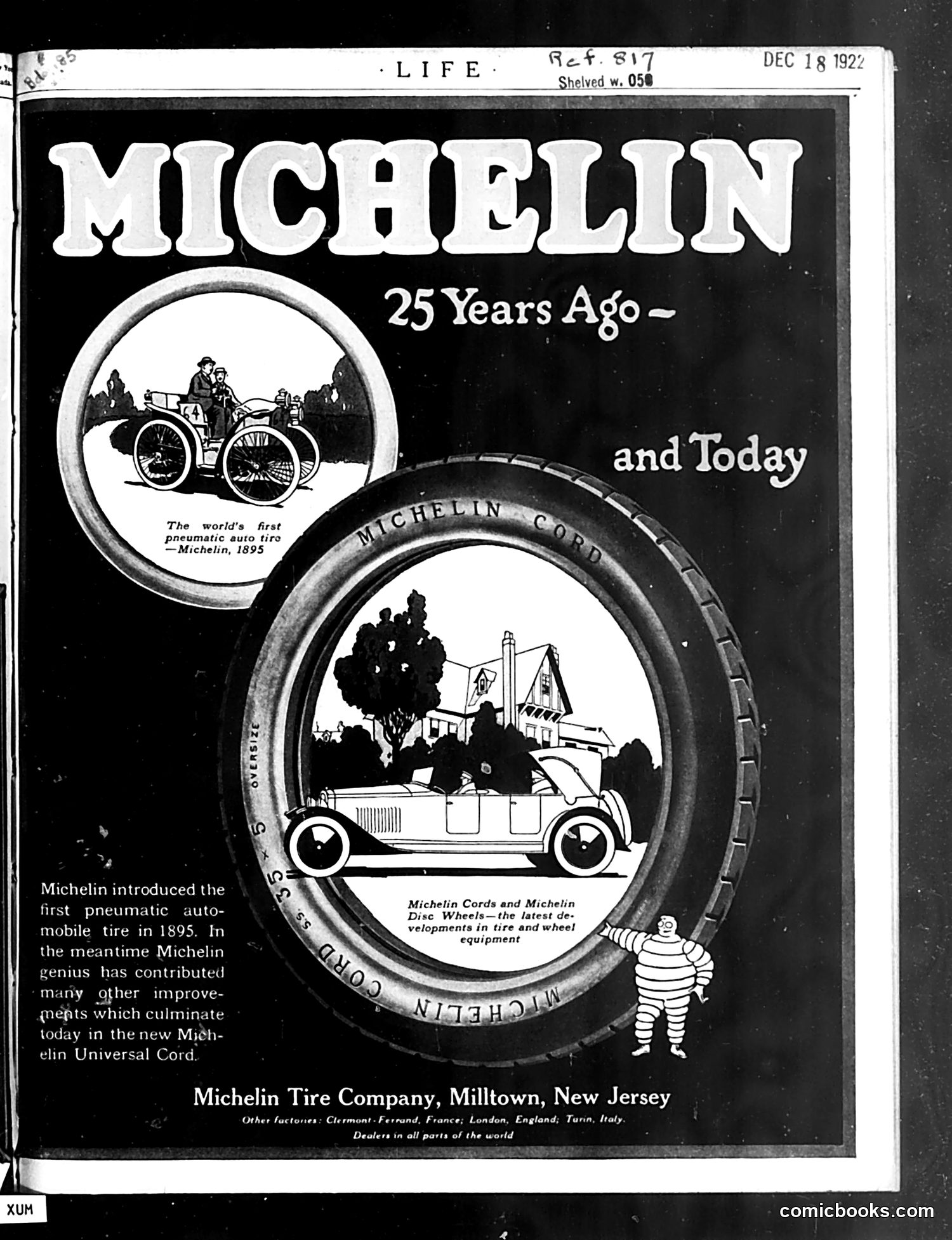
This is a **Michelin tire advertisement**, not political satire. The page celebrates Michelin's 25-year history (dating from 1895, when they introduced the first pneumatic automobile tire). The layout contrasts past and present: a small circular image shows an early 1895 auto with pneumatic tires, while a large modern tire dominates the lower half, featuring a contemporary 1920s car with passengers and the famous **Michelin Man** (the bibendum mascot, visible as the white figure). The text emphasizes Michelin's innovation and ongoing product improvements. This is corporate marketing, leveraging their genuine historical achievement—inventing pneumatic tires—to establish brand prestige in the 1922 automotive market.
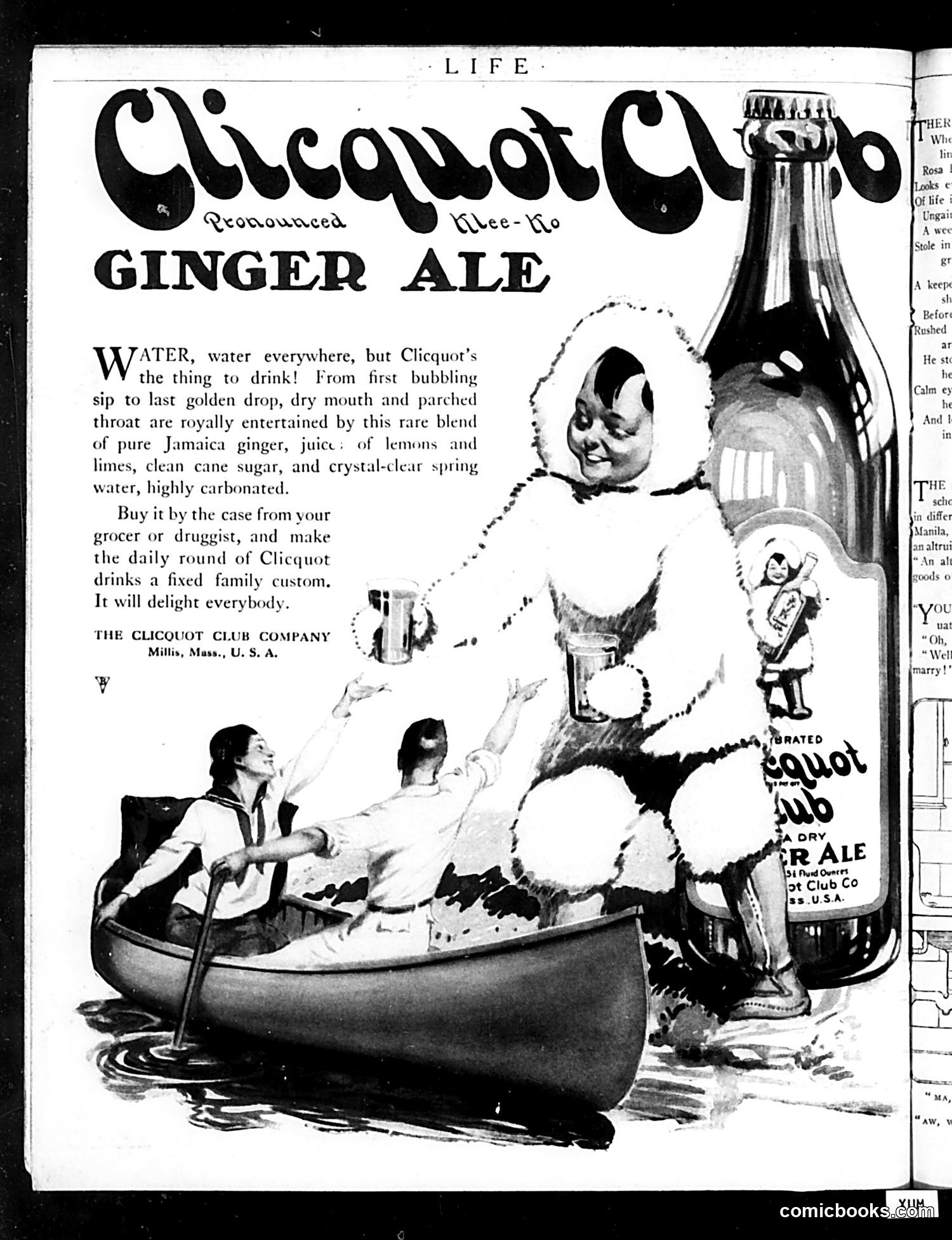
This is primarily a **commercial advertisement**, not political satire. It promotes Clicquot Club Ginger Ale, manufactured by The Clicquot Club Company in Millis, Massachusetts. The ad depicts a whimsical anthropomorphic polar bear character surrounded by children in a canoe, presenting the product as wholesome family entertainment. The text emphasizes the drink's ingredients (Jamaica ginger, lemon, lime juice, cane sugar, carbonated spring water) and urges consumers to "buy it by the case" to establish "a fixed family custom." The cartoon's playful tone—using an oversized bear mascot to appeal to children—reflects early 20th-century advertising strategies emphasizing family wholesomeness. This represents typical period marketing rather than social commentary or satire.
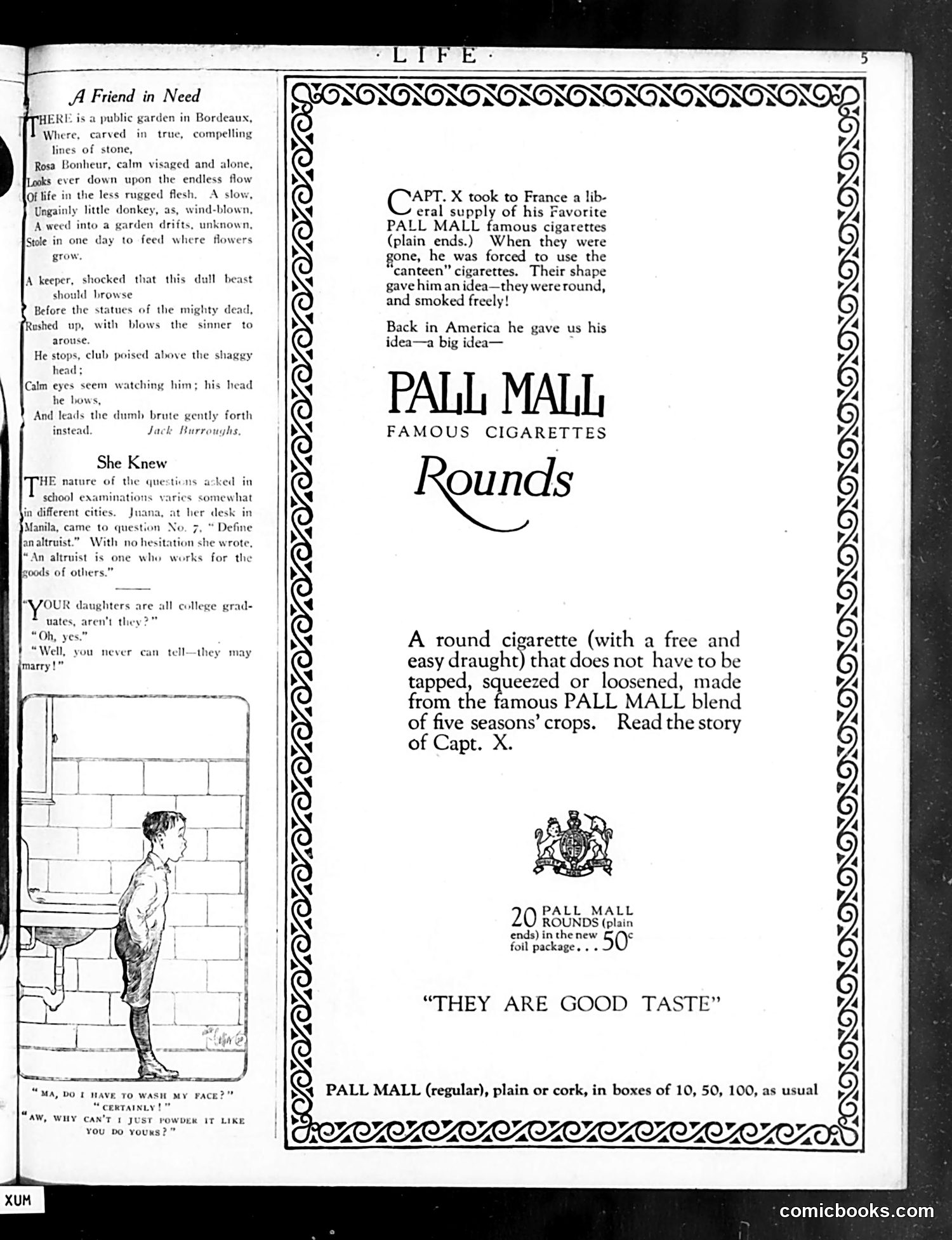
This page contains primarily **advertising content** rather than political satire or editorial cartoons. The right side features a full-page advertisement for **Pall Mall cigarettes**, specifically their round "Rounds" product. The ad includes a narrative about "Capt. X" who brought the idea back from France after being forced to smoke inferior "canteen" cigarettes during wartime—likely referencing World War I. The round shape is presented as an innovation allowing easy dragging without tapping or squeezing. The left side contains two unrelated items: a brief poem titled "A Friend in Need" by Jack Burroughs, and a small satirical dialogue titled "She Knew" about school examinations—minor social humor rather than political commentary. The page reflects **early 20th-century magazine layout**, mixing literary content with substantial advertising.
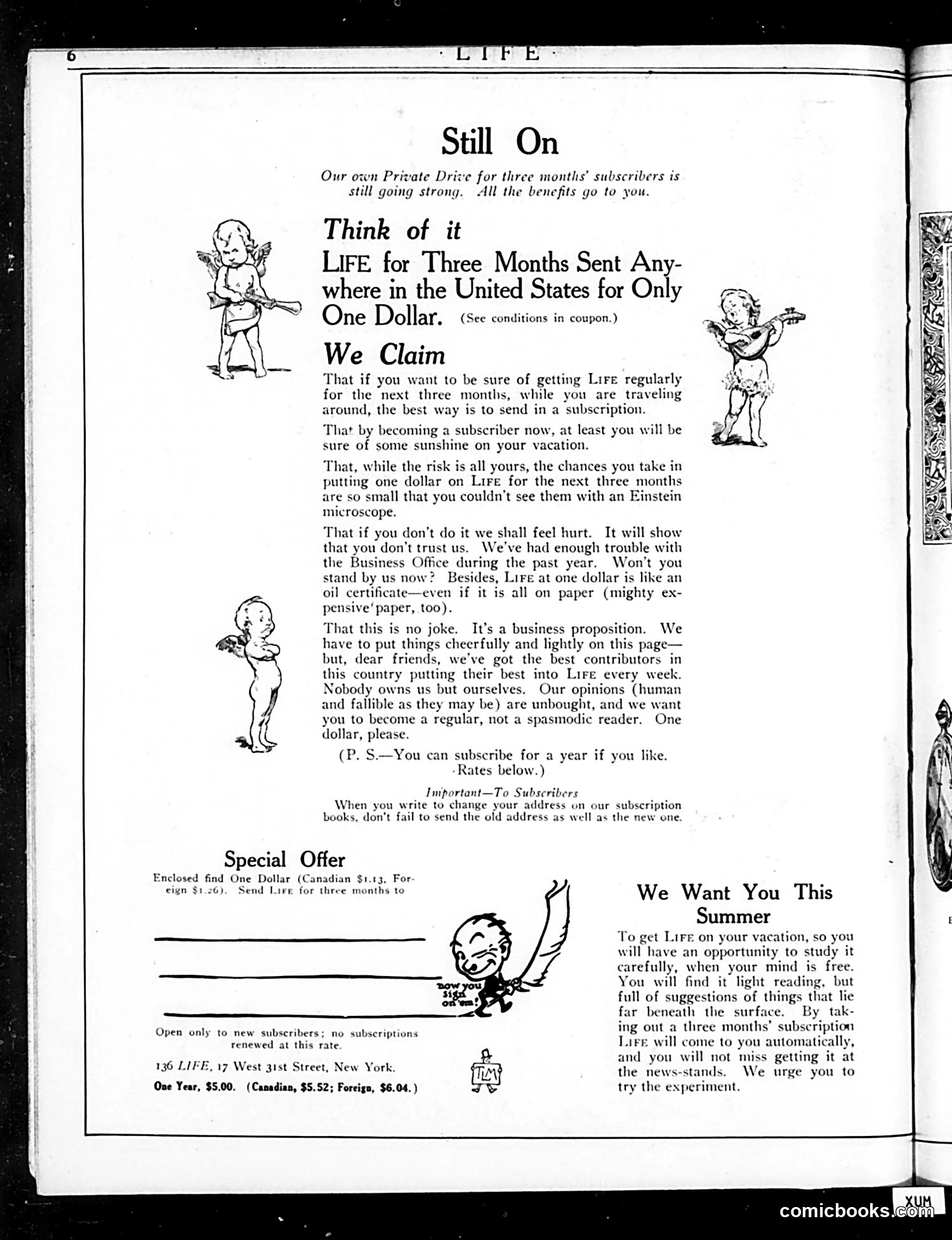
This page is primarily a **subscription advertisement** for *Life* magazine itself, not political commentary. The content uses lighthearted satire directed at *readers* rather than public figures. The repeated cherub illustrations are decorative, not caricatures of specific people. The "joke" is *self-deprecating*: Life humorously pressures subscribers to renew, claiming the magazine's business office had "trouble" the past year and asking readers to "stand by us now." The satire is gentle and commercial—comparing a one-dollar subscription to "an oil certificate" and joking that skipping subscription renewal will "hurt" the magazine. The tone suggests Life was soliciting subscribers during difficult economic times, using humor to make the pitch feel friendly rather than desperate.
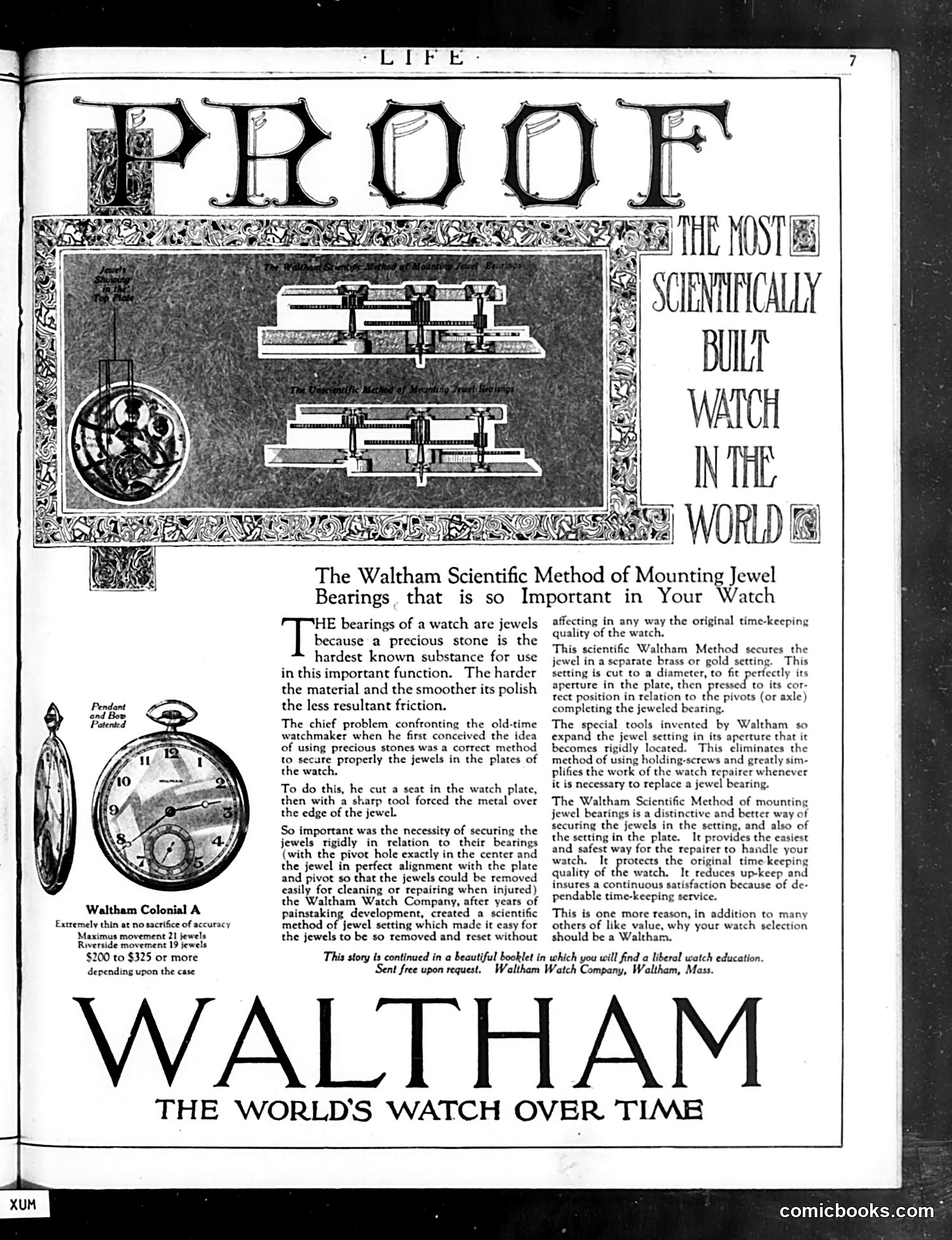
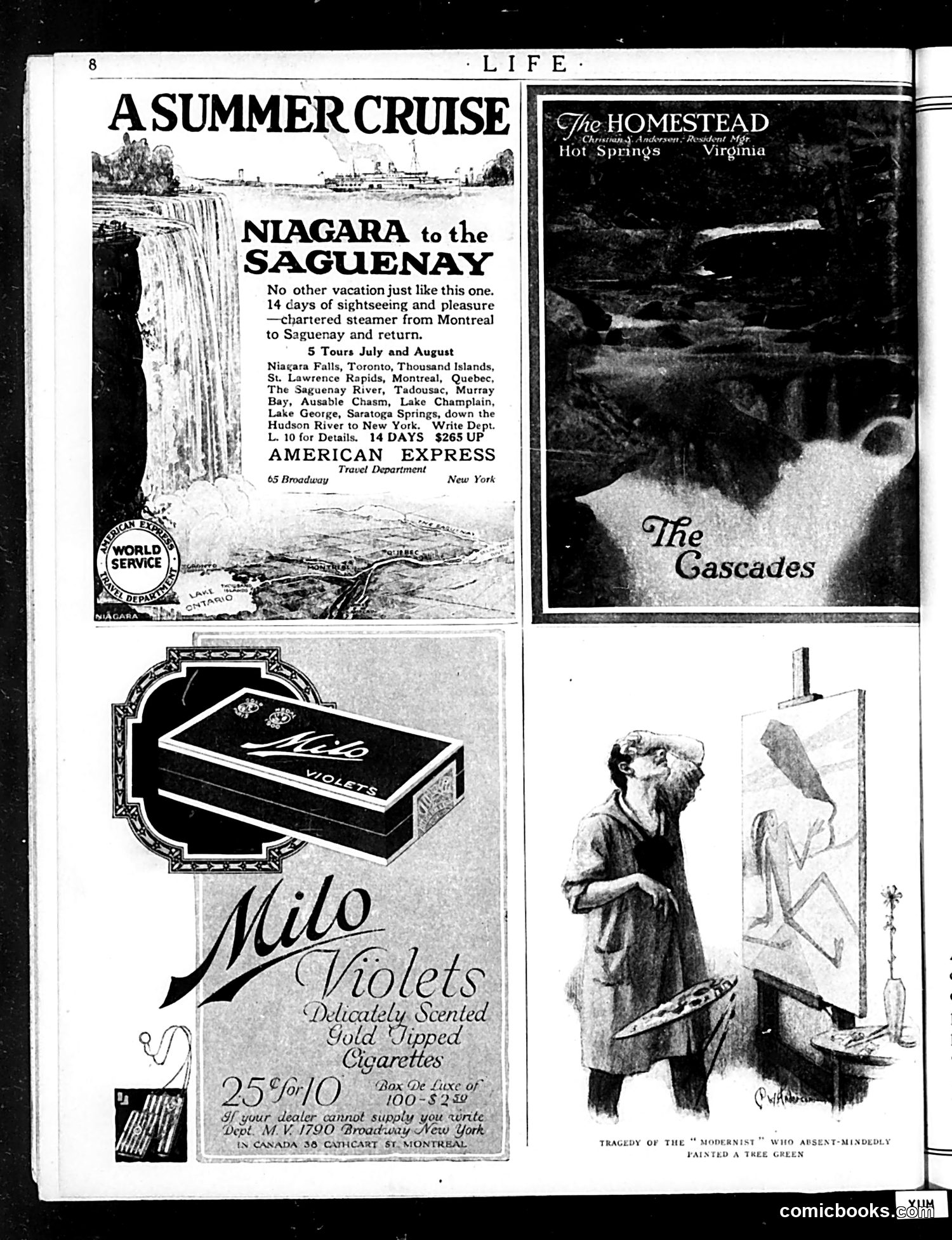
This is primarily an **advertising page** from Life magazine, not a satirical cartoon section. The page contains three distinct advertisements: 1. **"A Summer Cruise"** — American Express promotes a 14-day Niagara-to-Saguenay river cruise 2. **"The Homestead"** — advertisement for Hot Springs, Virginia resort, featuring scenic photographs 3. **"Milo Violets"** — scented gold-tipped cigarettes priced at 25¢ for 10 The only image with potential satirical content is the small cartoon at bottom right, captioned **"Tragedy of the 'Modernist' Who Absent-Mindedly Painted a Tree Green."** This appears to mock modernist/abstract art by depicting someone who ironically created realistic artwork (green tree) when abstraction was fashionable—a gentle jab at artistic pretension of the era.
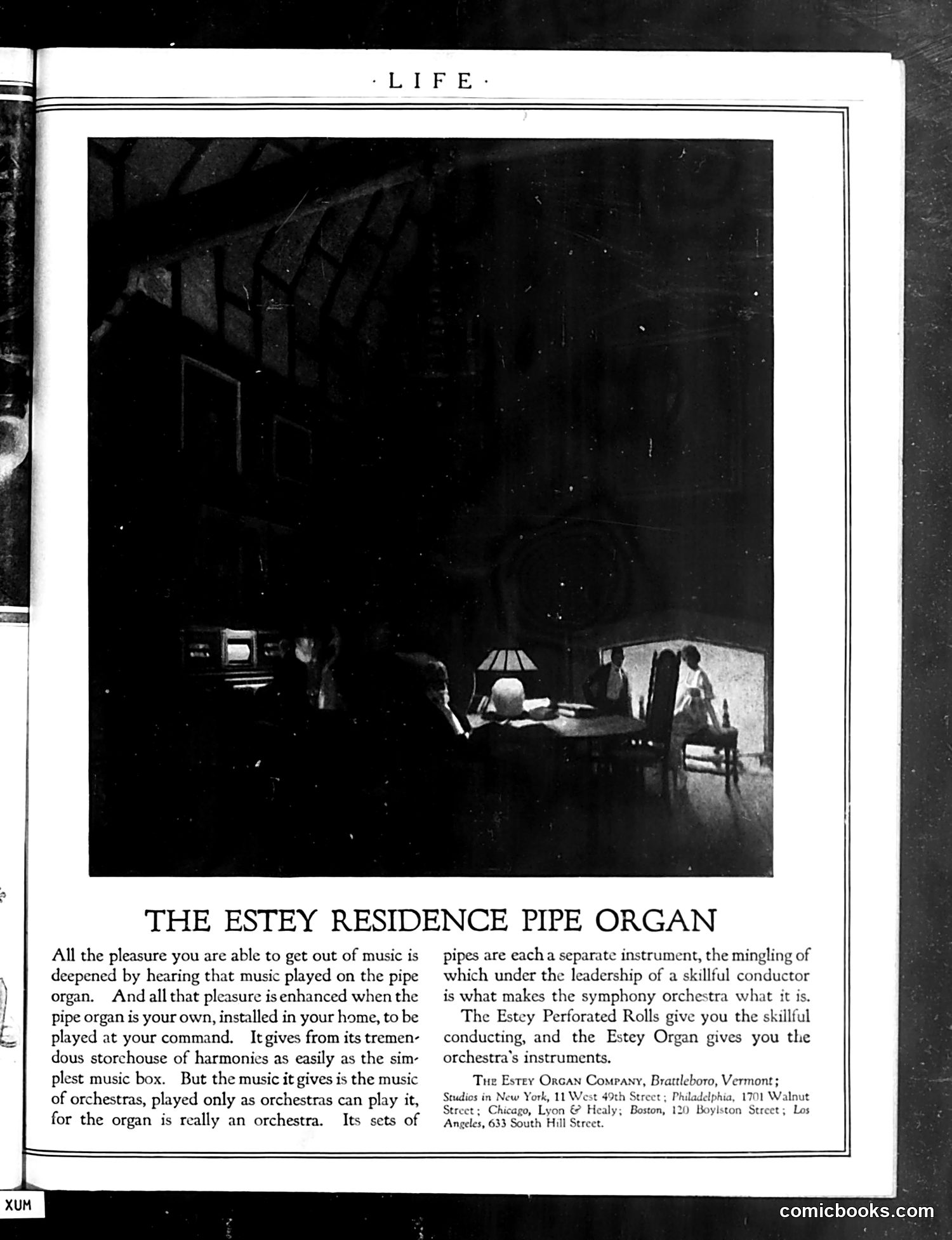
This page is primarily **advertising, not satire or political commentary**. It promotes the Estey Organ Company's residential pipe organ product. The advertisement uses evocative imagery: a darkened living room with figures silhouetted around a glowing pipe organ, creating an atmosphere of refined home entertainment. The text argues that a pipe organ brings orchestral music into the home, claiming it provides "the music of orchestras, played only as orchestras can play it." The pitch emphasizes luxury and cultural sophistication—positioning organ ownership as aspirational for middle to upper-class households. The Estey company lists multiple locations (Vermont, New York, Philadelphia, Chicago, Boston, Los Angeles), suggesting national reach during the early 20th century when such organs were status symbols for affluent homes.
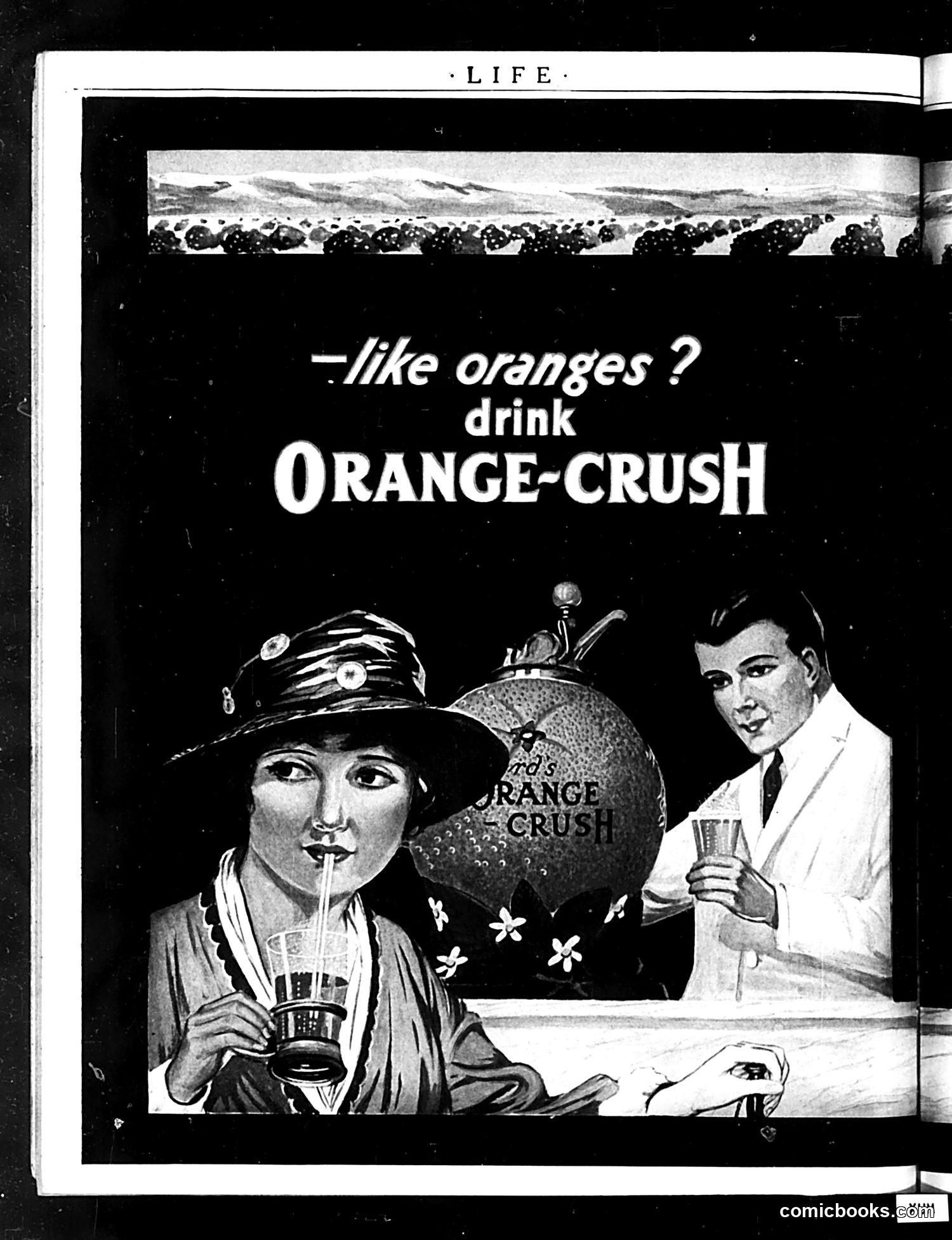
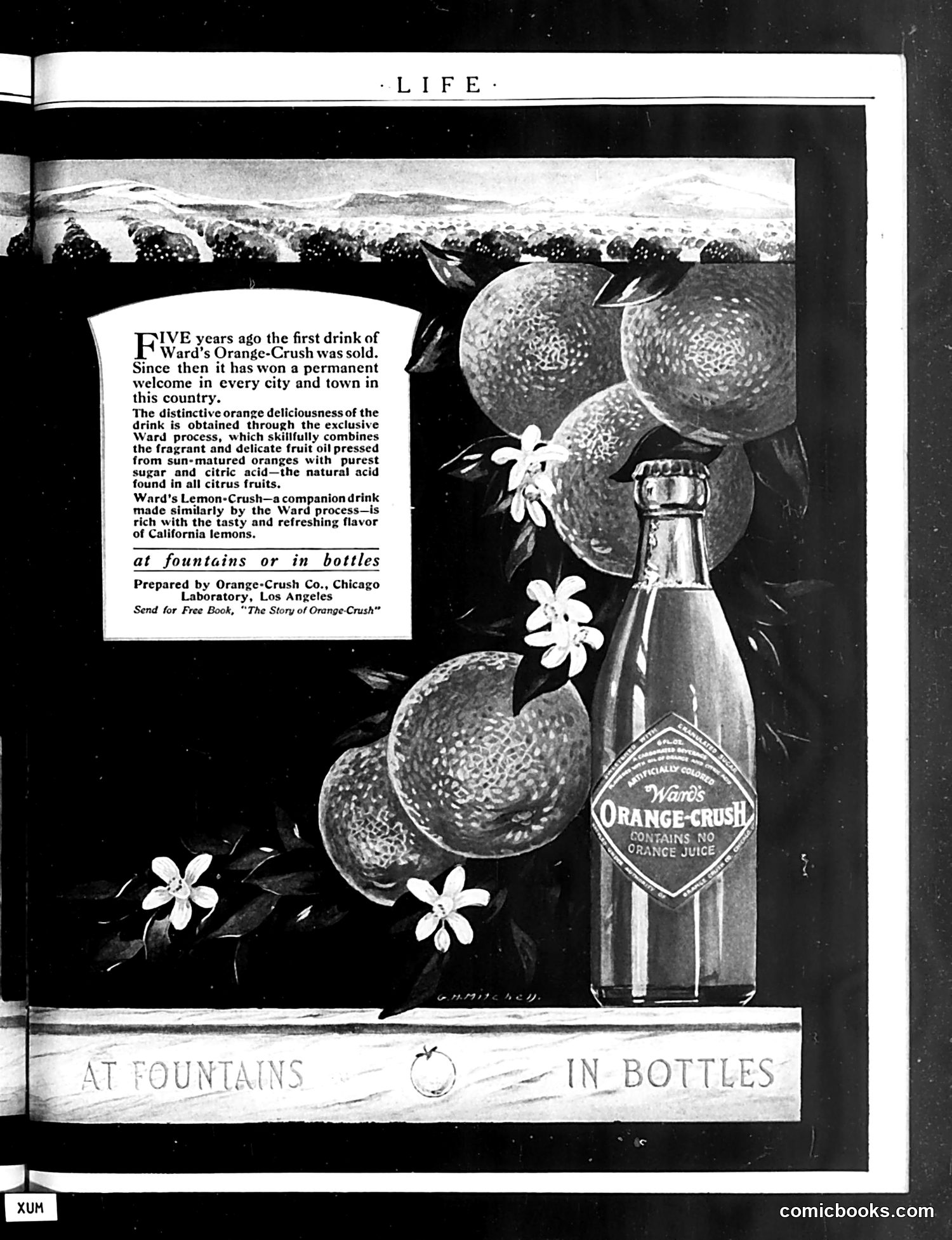
This is a **commercial advertisement**, not political satire. It promotes Ward's Orange-Crush beverage, which the text states was introduced five years prior and has achieved widespread popularity. The ad emphasizes the drink's distinctive taste, claiming it results from Ward's exclusive process combining orange oil with pure cane sugar. It also advertises a companion product, Ward's Lemon-Crush. The visual design features fresh oranges, decorative white blossoms, and a bottle of the product. The tagline "at fountains or in bottles" indicates the drink was available both at soda fountains (common gathering spots in early 20th-century America) and for home purchase. The ad directs readers to request a free booklet about Orange-Crush, a typical promotional technique of the era.
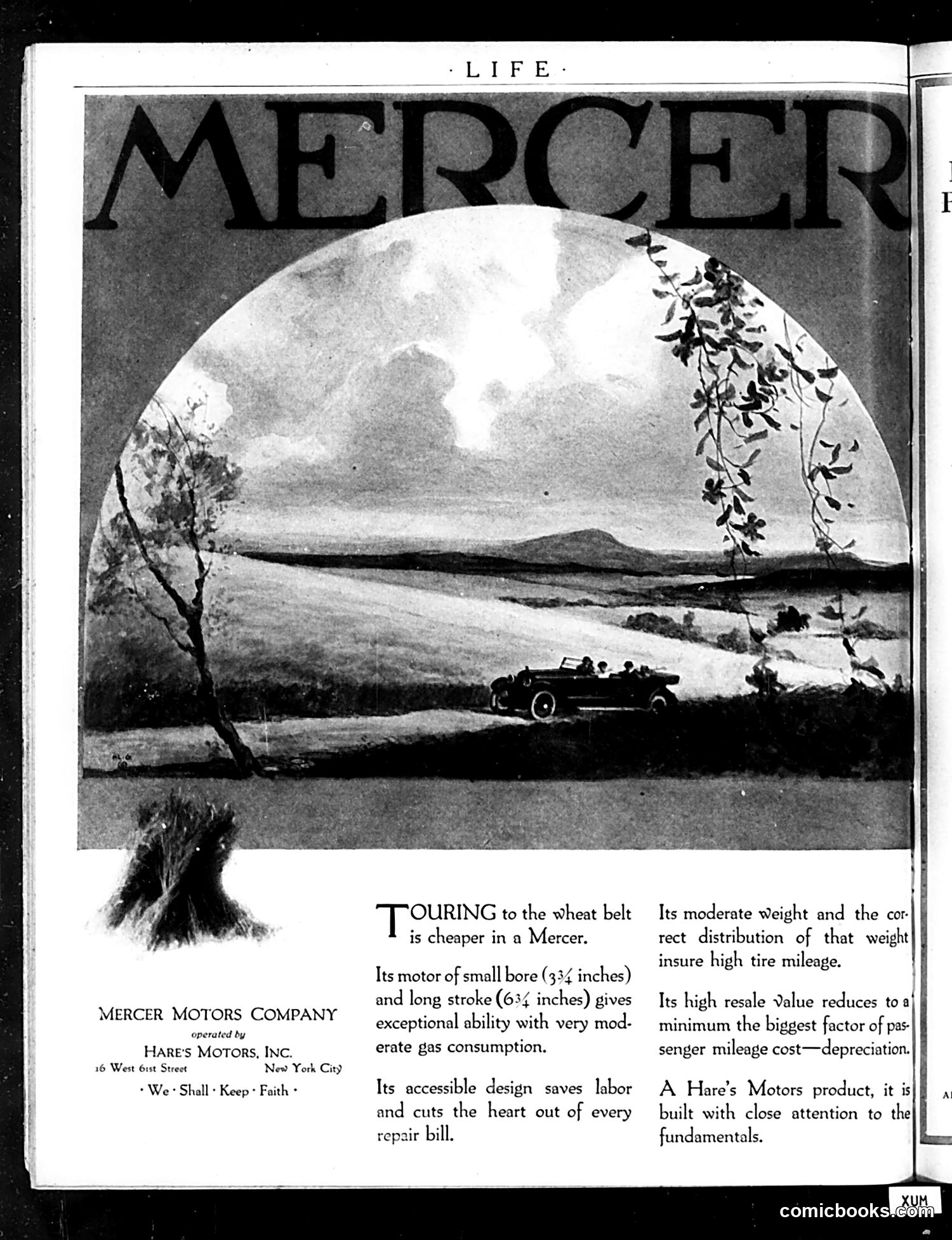
This is **advertising content**, not satire or a political cartoon. It's a full-page advertisement for Mercer automobiles, operated by Hare's Motors, Inc. in New York City. The image shows a Mercer car positioned in a scenic landscape with trees framing the view, conveying aspirational leisure travel. The ad targets touring enthusiasts, particularly those traveling to America's wheat belt (agricultural regions). The copy emphasizes practical benefits: the car's small engine (3¾ inches bore, 6½ inches stroke) provides fuel efficiency and reliable performance; its accessible design reduces maintenance costs; moderate weight ensures tire longevity; and high resale value minimizes depreciation—the largest passenger mileage expense. This represents typical early-20th-century automotive marketing: combining landscape imagery with technical specifications and economic arguments to appeal to middle-class buyers.
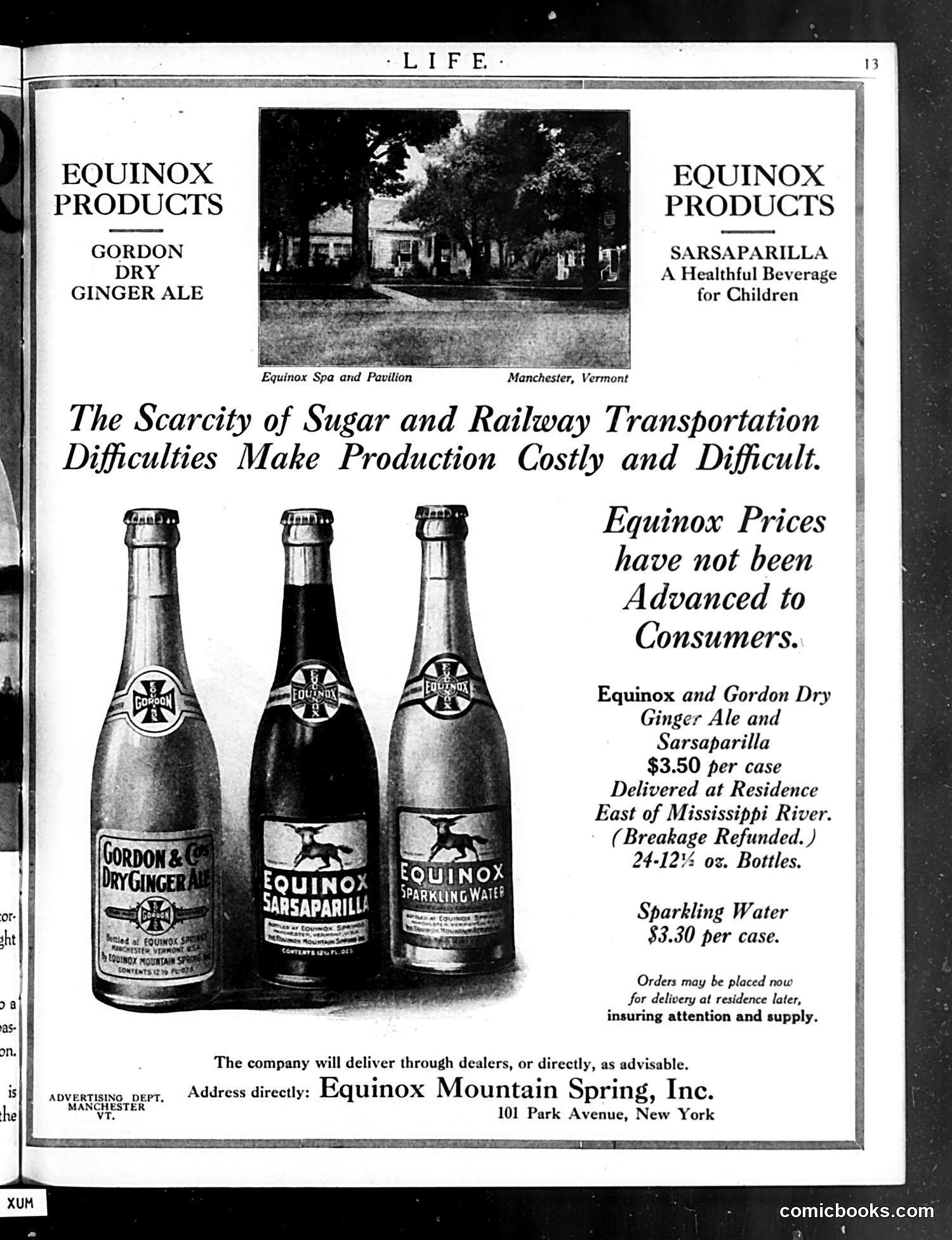
This page is primarily an advertisement for Equinox Mountain Spring, Inc., a beverage company based in New York. The ad promotes three products: Gordon Dry Ginger Ale, Equinox Sarsaparilla, and Equinox Sparkling Water. The central claim addresses wartime economic conditions: "The Scarcity of Sugar and Railway Transportation Difficulties Make Production Costly and Difficult." The company assures consumers that despite these constraints, "Equinox Prices have not been Advanced to Consumers"—a competitive selling point during what appears to be World War I or a similar period of rationing and inflation. The advertisement also includes a photograph of Equinox Spa and Pavilion in Manchester, Vermont, establishing the company's legitimacy through its physical location and facilities. The ad emphasizes direct ordering and prompt delivery.
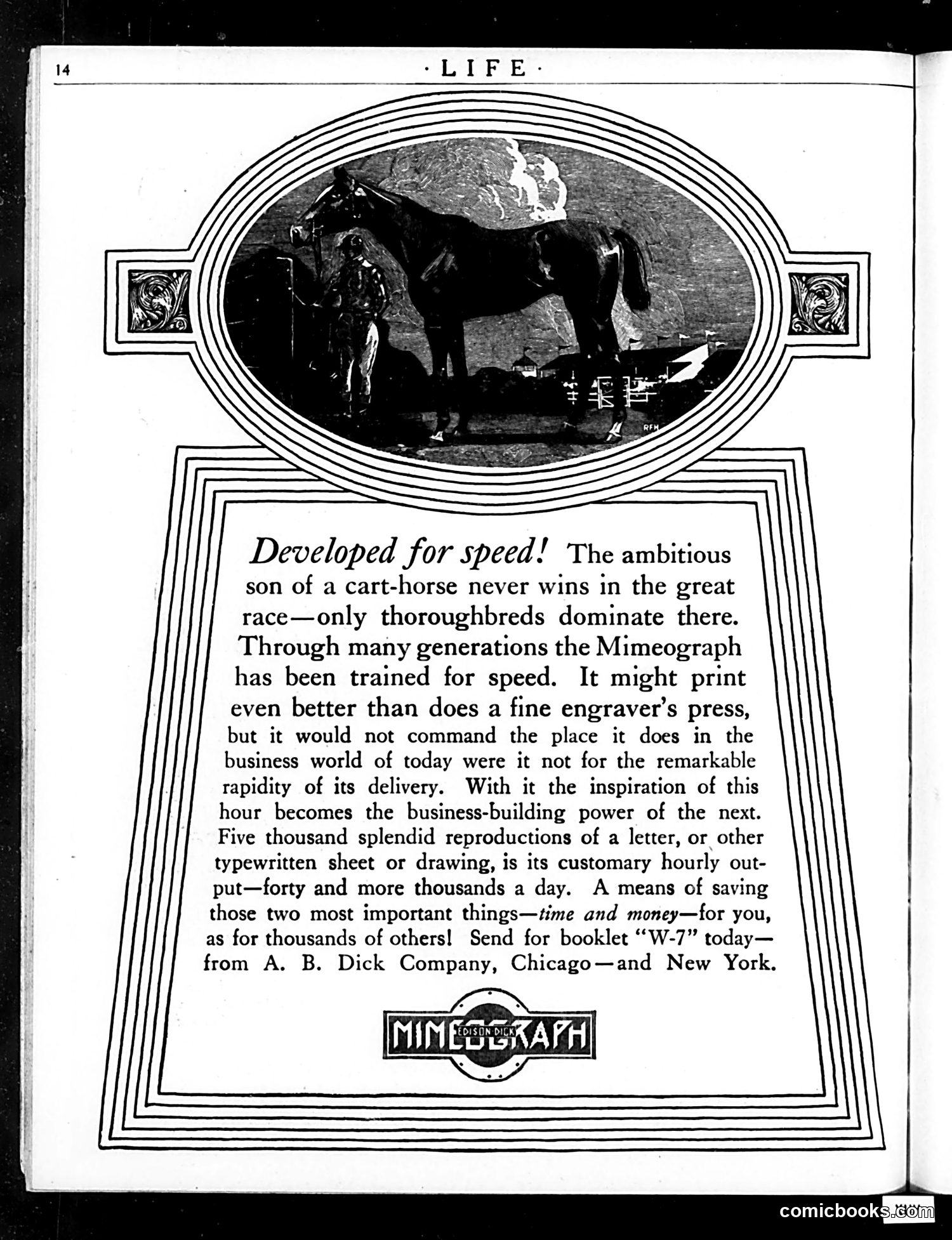
This is a **commercial advertisement**, not a cartoon or satire. It promotes the Mimeograph, a printing technology by A.B. Dick Company. The ad uses a **horse-racing metaphor** to sell the machine's speed advantage. The image shows a horse (the "Mimeograph") outpacing competitors in a race, with the headline "Developed for speed!" The text compares the machine to a cart-horse that "never wins in the great race"—implying inferior competitors cannot match the Mimeograph's performance. The core sales pitch emphasizes **speed and cost-efficiency**: the machine can produce 5,000 reproductions hourly, saving businesses both "time and money." This appeals to early 20th-century business efficiency concerns. The ad directs readers to request promotional booklet "W-7."
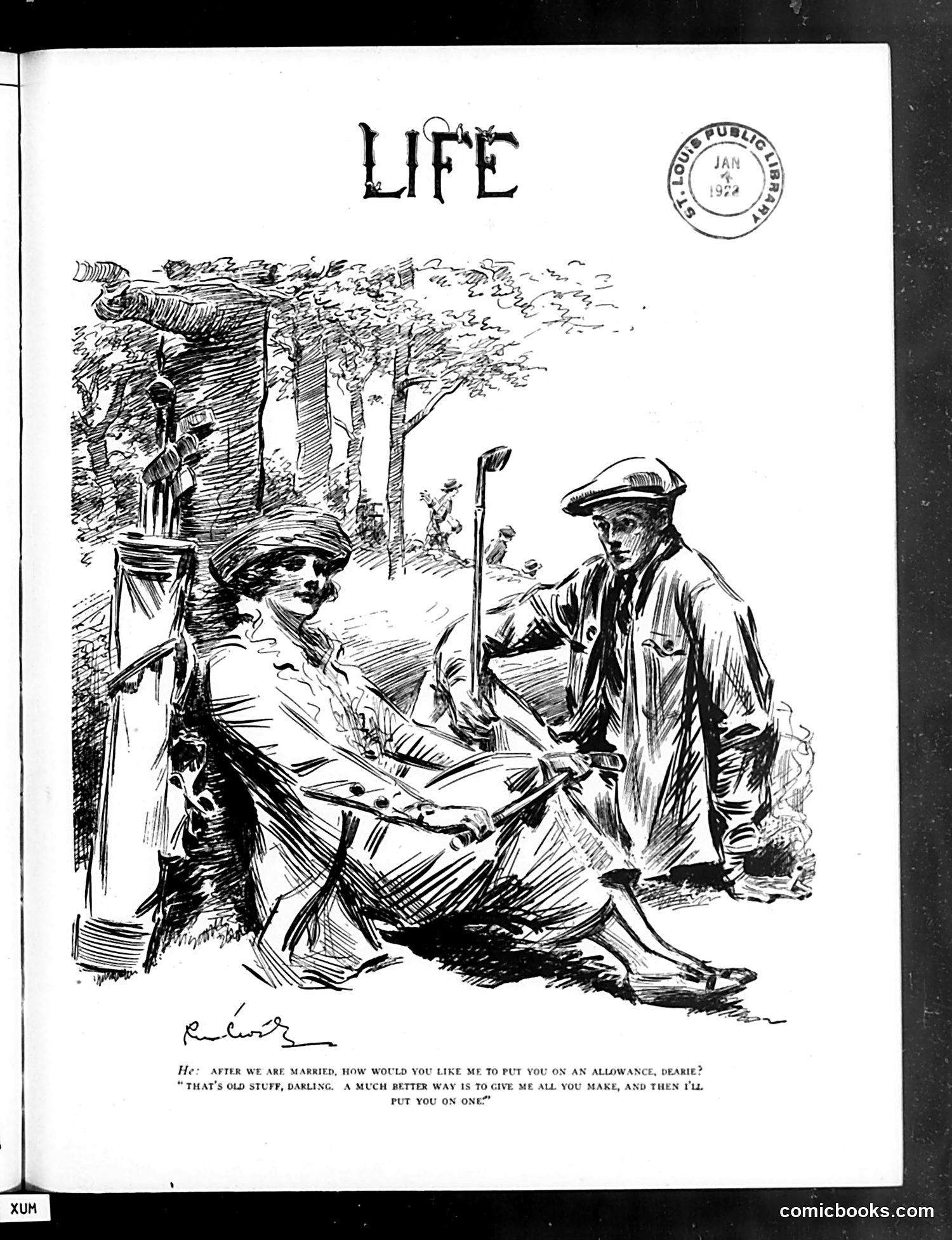
This is a satirical cartoon about post-marriage financial arrangements. The illustration shows a man proposing a marital contract to a woman, suggesting he'll give her an allowance rather than simply providing for her needs as "old stuff." The joke targets early 20th-century debates about women's financial independence within marriage. The man's proposal to "put you on an allowance" and "give me all you make" reflects anxieties about wives' economic autonomy—a contentious issue as women increasingly entered the workforce and demanded more control over household finances. The satire critiques husbands' reluctance to share financial power, framing the "allowance system" as self-serving rather than generous. The woman's uncertain expression suggests the proposal's true nature: control disguised as modernity.
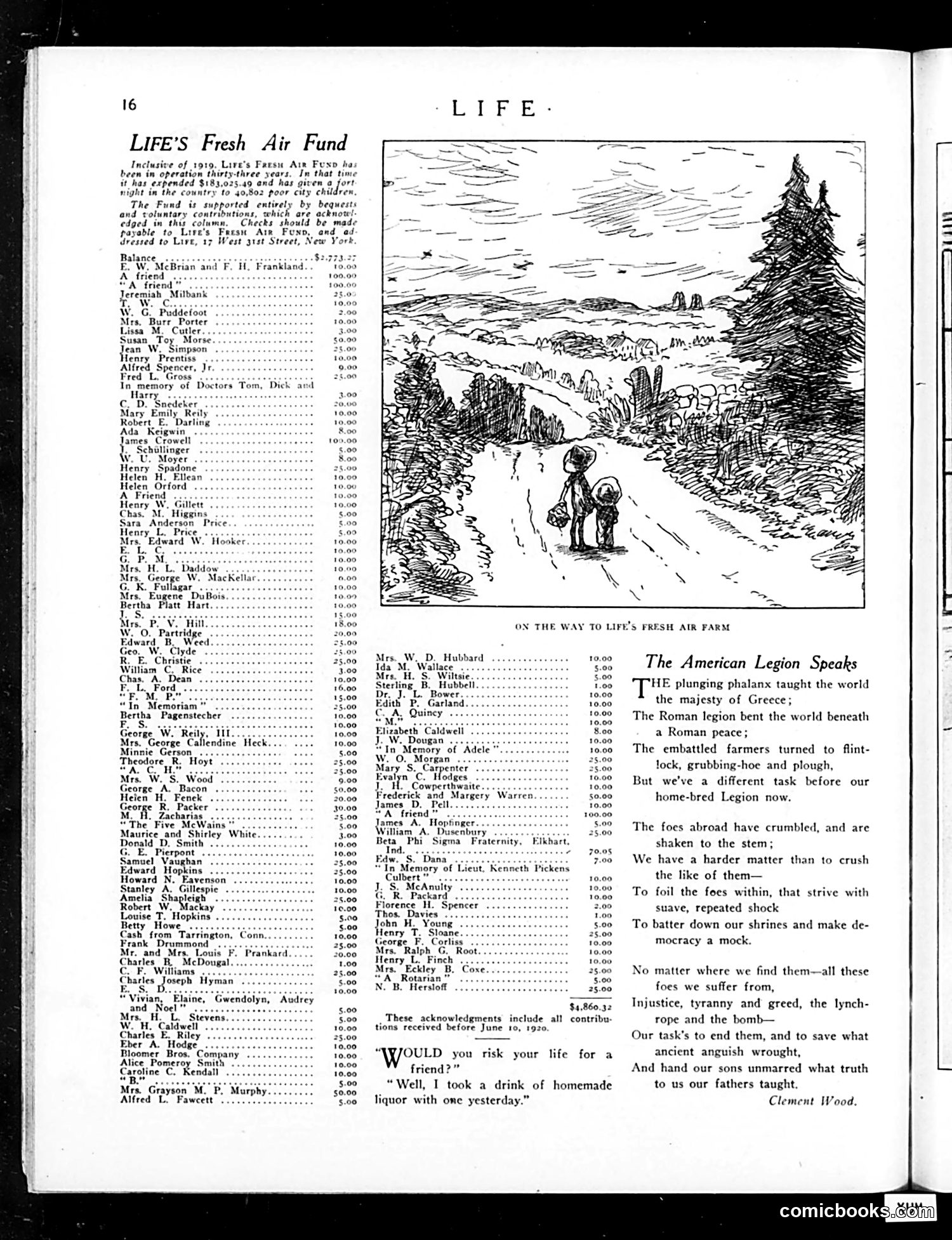
This page documents **Life magazine's charitable fundraising** for its Fresh Air Fund, which had operated for 33 years by the publication date. The fund sends poor urban children to countryside retreats. The illustration shows **two children on a rural road** with farmland and evergreen trees—depicting the wholesome, restorative nature of the program's mission. The left column lists **donors and contribution amounts**, ranging from small gifts ($2-5) to larger donations ($100), showing broad public support from named individuals. The right side features **"The American Legion Speaks,"** a poem about hardship and sacrifice, connecting the Fresh Air Fund's humanitarian work to post-war American values and civic responsibility—likely published during the interwar period when such charitable causes gained prominence.
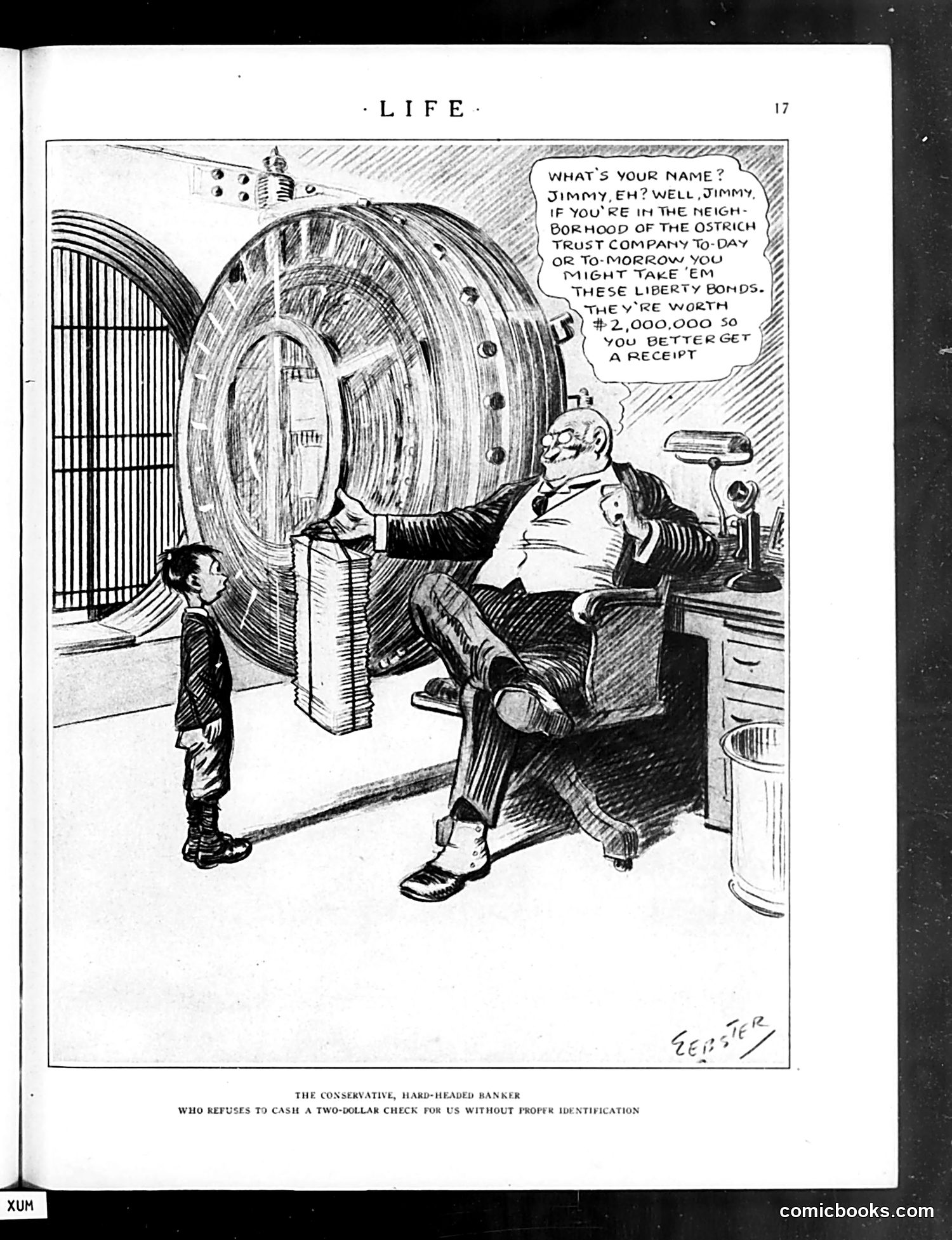
This satirical cartoon critiques banking hypocrisy during World War I. A stern banker refuses to cash a small two-dollar check without identification, yet casually instructs a child to deliver $2 million in Liberty Bonds (government war bonds) to the "Ostrich Trust Company" without any verification or receipt. The joke exposes the contradiction: banks demand rigorous documentation for ordinary transactions but show reckless indifference regarding massive government securities. The "ostrich" reference likely suggests the banks' willingness to ignore risk when profits are involved—burying their heads like ostriches. The cartoon mocks conservative bankers' selective application of caution, suggesting they use strict identification policies as obstacles for ordinary citizens while eagerly handling war bonds for patriotic (and profitable) purposes.
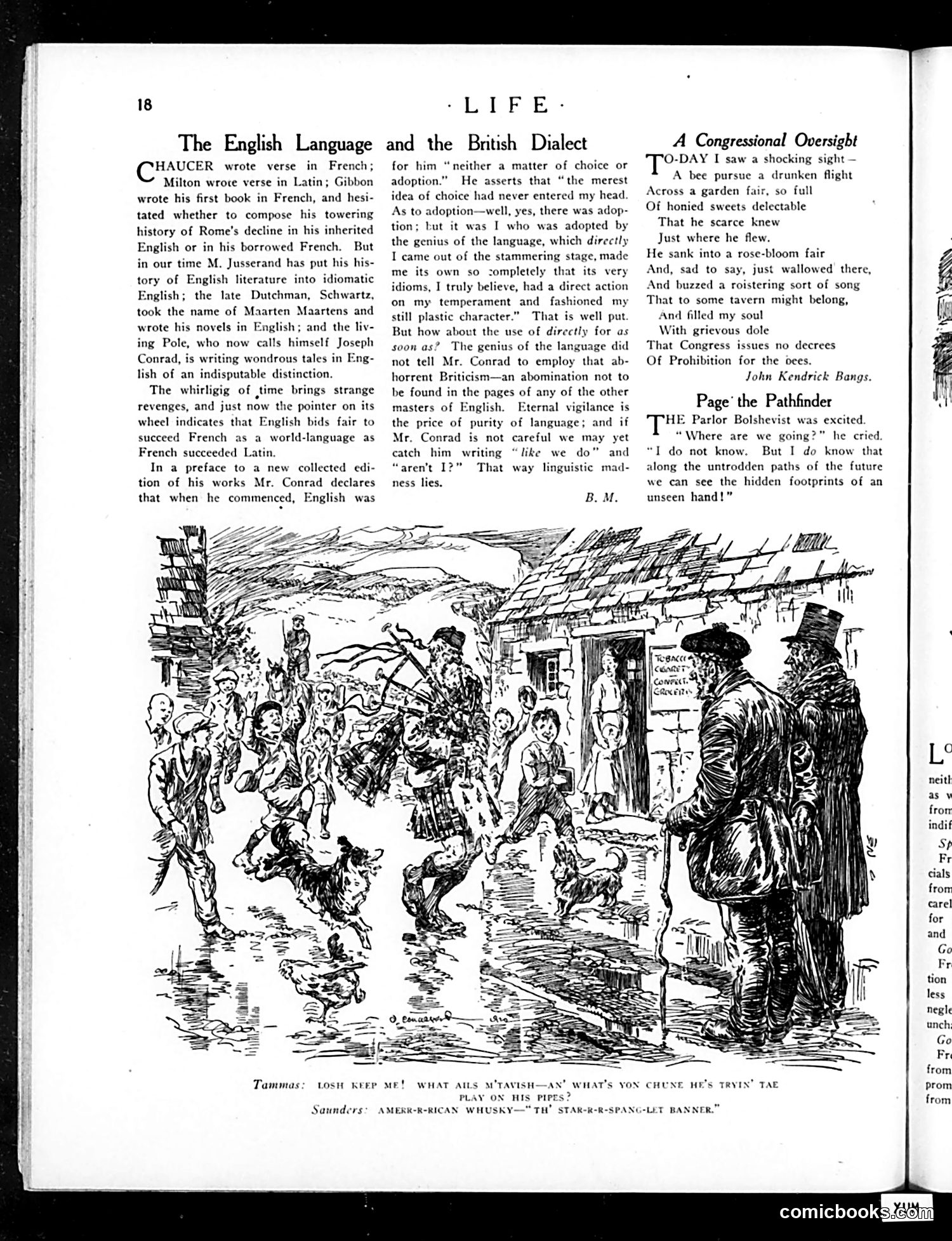
This page contains three distinct pieces of satirical content: **"The English Language"** (left column): A serious essay discussing how English, rather than French, is becoming the world's dominant language. It praises foreign writers like Joseph Conrad who adopted English, though it humorously criticizes Conrad for using the British expression "directly" (meaning "as soon as") instead of proper American English. The piece warns against linguistic corruption. **"A Congressional Oversight"** (right column, poem by John Kendrick Bangs): A humorous poem lamenting that Congress hasn't passed Prohibition laws for bees, who are depicted as getting drunk on flower nectar and behaving rowdily. This is satirical commentary on Prohibition debates of the era. **Cartoon below**: Depicts Scottish characters (indicated by dialect and pipes) in what appears to be a village setting. The caption reveals they're discussing American whisky being passed off as "The Star-Spangled Banner"—mocking both Scottish drinking culture and American patriotic symbols simultaneously. The page reflects early 20th-century American cultural anxieties about language purity, alcohol regulation, and national identity.
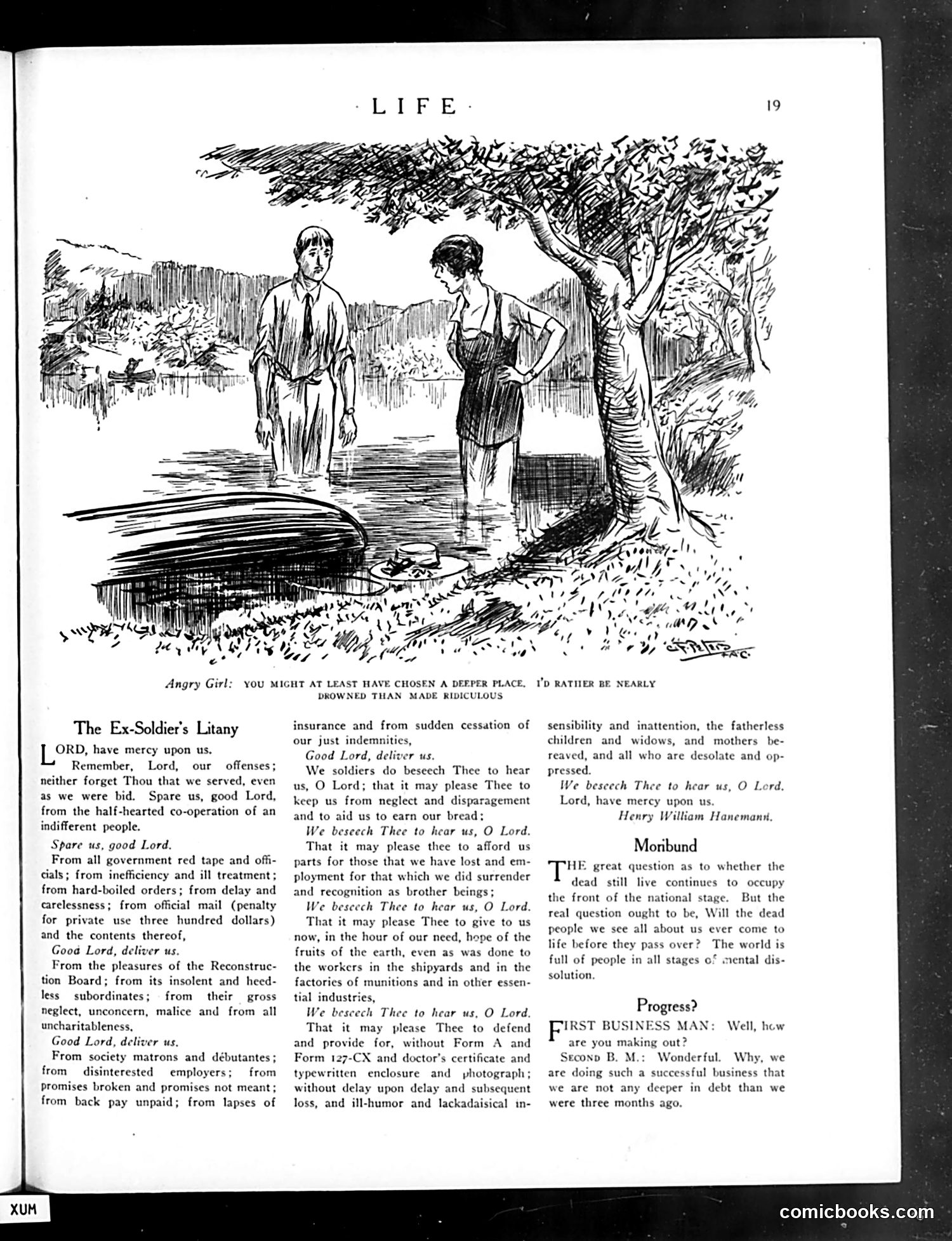
The cartoon depicts a young woman about to drown herself in a river, being stopped by a man. The "Angry Girl's" caption suggests she's choosing suicide over humiliation—likely referencing post-WWI social anxieties about women's behavior and reputation. The main text, "The Ex-Soldier's Litany," is a bitter parody of Christian prayer mocking the U.S. government's failure to support returning WWI soldiers. It satirizes bureaucratic red tape (referencing specific forms), broken promises of employment, inadequate pensions, and widespread social indifference to veterans' suffering—from society elites to employers. The "Progress?" section below presents dark humor about economic stagnation: businessmen celebrate merely staying afloat financially rather than improving, suggesting post-war economic uncertainty and deflated expectations. Together, these pieces reflect early 1920s American disillusionment: failed government support for soldiers, women's desperation, and economic malaise following World War I.
This editorial critiques the American Legion, the veterans' organization formed after World War I. The author argues that while the Legion claims to represent all servicemen, only about 11 percent actually belong to it—meaning its positions don't necessarily reflect veterans' true desires or character. The piece distinguishes between an organization's material aims (survival, political power) and the spiritual values of those it represents. The Legion, the author suggests, has pursued a "bonus plan" appealing to self-interest, yet most servicemen possess greater capacity for selfless action than their organization demonstrates. The underlying criticism: post-war America, including veterans' groups, has retreated into selfish interests rather than maintaining wartime unity and patriotism. The editorial suggests the Legion represents institutional self-preservation more than veterans' authentic needs or ideals.
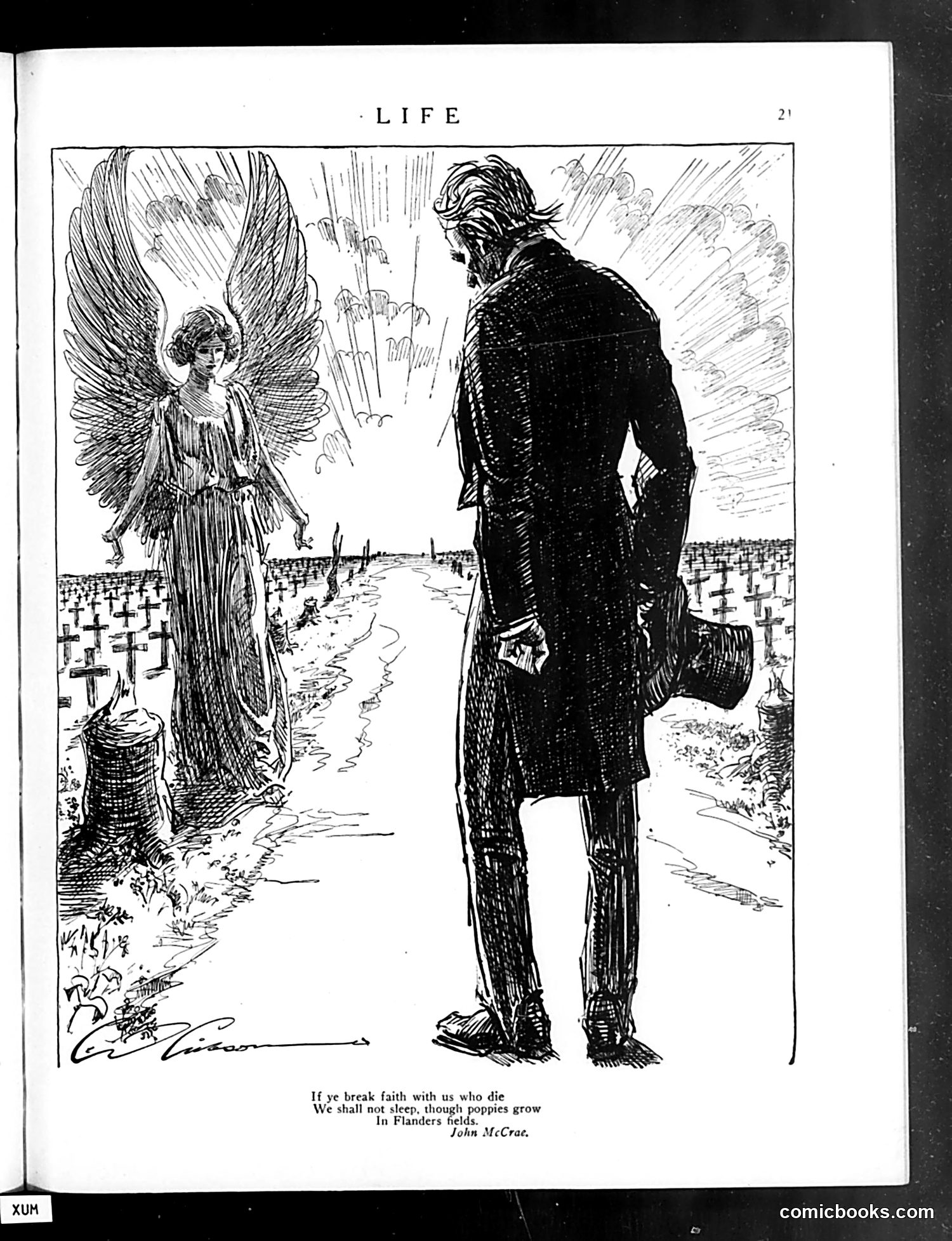
This is a memorial illustration referencing John McCrae's famous World War I poem "In Flanders Fields." The image shows a soldier in military uniform confronting an angel in a cemetery filled with white crosses—likely representing the Flanders battlefields where thousands died. The quoted text beneath is from McCrae's poem: "If ye break faith with us who die / We shall not sleep, though poppies grow / In Flanders fields." This appears to be a patriotic or commemorative piece urging readers not to forget the sacrifice of fallen soldiers. The angel suggests spiritual or heavenly judgment, while the soldier's confrontation with it implies accountability for honoring the war dead's memory. Published in *Life* magazine, this likely served as wartime or post-war morale messaging.
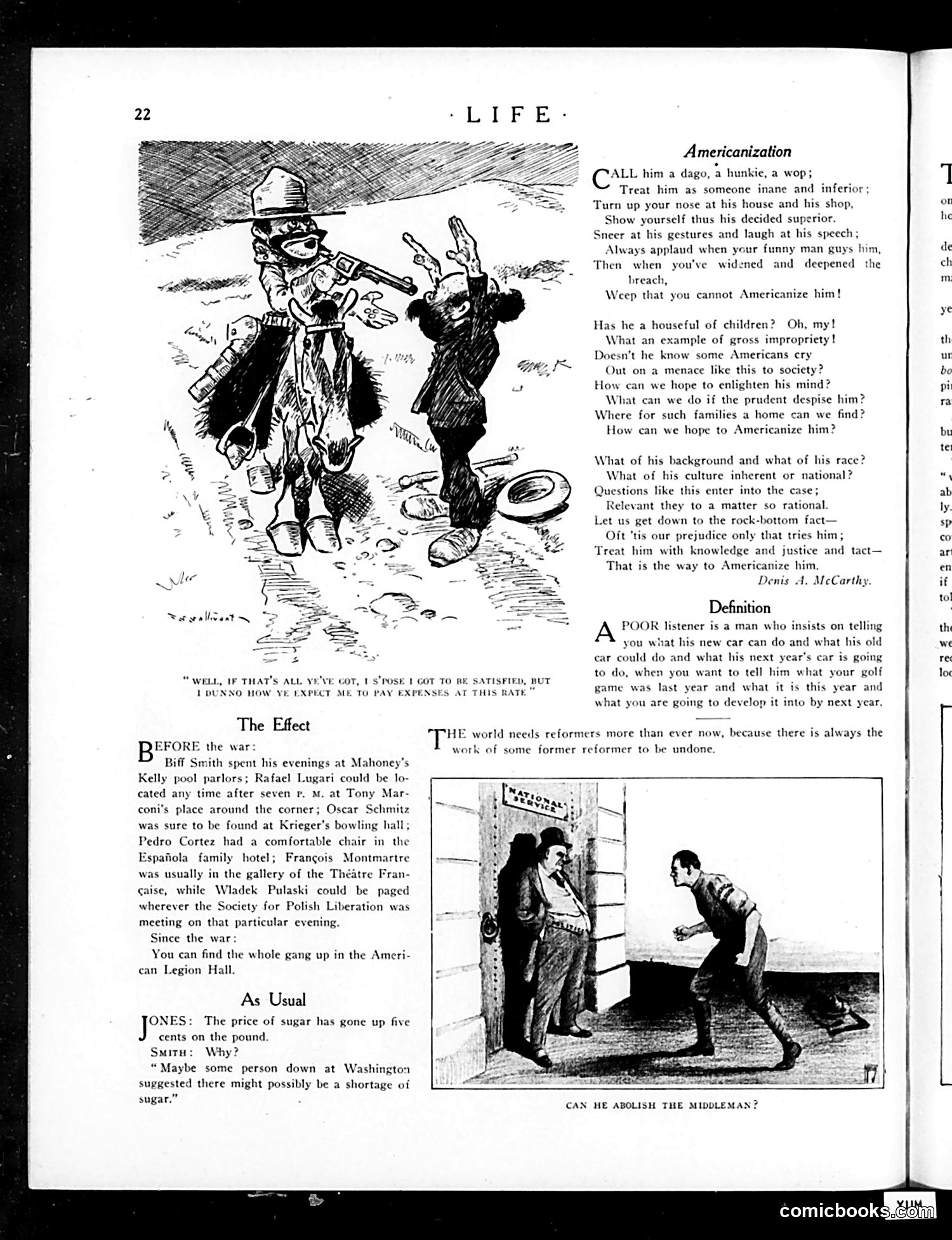
This page from *Life* magazine contains three pieces of social satire: **The main poem "Americanization"** mocks hypocritical assimilation attitudes. It depicts Americans calling immigrants (using period slurs: "dago," "hunkie," "wop") inferior while simultaneously blaming *them* for not assimilating. The satire exposes the contradiction: Americans deliberately disparage immigrants through prejudice and mockery, then lament their failure to "Americanize." The poem argues that prejudice—not the immigrants themselves—is the real barrier. **The cartoon** (top left) shows a stereotypically dressed immigrant being confronted aggressively by a native American, visualizing this contemptuous treatment. **"The Effect"** describes how immigrant men (named to suggest Italian, Spanish, and Eastern European origins) frequented ethnic community spaces before the war, but now gather at the American Legion—suggesting forced assimilation through wartime patriotic pressure rather than genuine integration. Together, these pieces critique nativist attitudes disguised as progressive "Americanization" efforts.
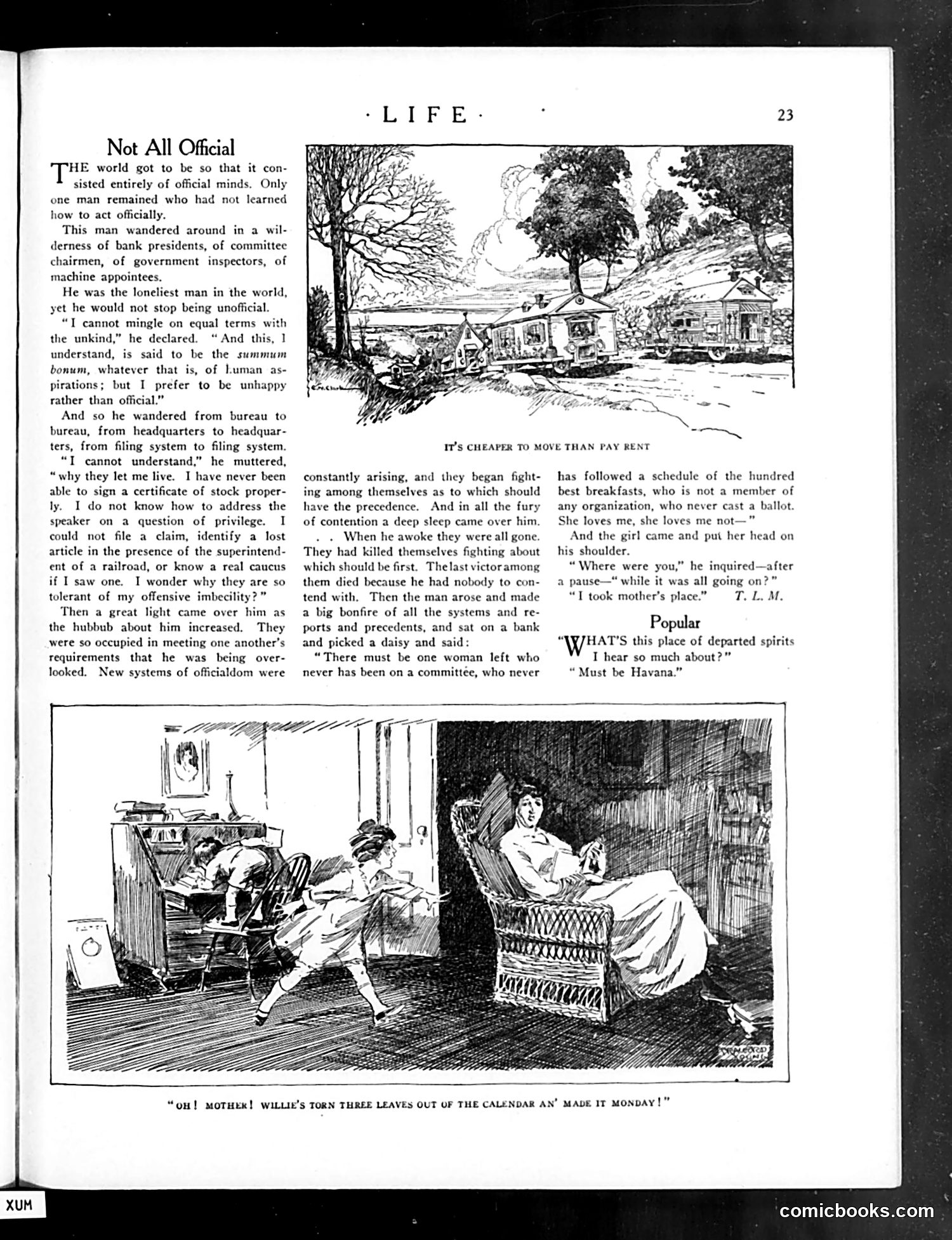
This Life magazine page contains two satirical pieces critiquing early 20th-century American bureaucracy and social conformity. **"Not All Official"** tells of a man unable to navigate official procedures—signing stock certificates, addressing speakers properly, filing claims. As bureaucratic systems multiply and fight for precedence, they destroy each other. The lone "unofficial" man survives, ultimately finding an equally unconventional woman who avoided committees, organizations, and ballots. The satire mocks the era's obsessive systematization and officialdom, suggesting authenticity survives only outside institutional structures. **The cartoon below** depicts a domestic scene where a child (Willie) has torn calendar pages to make Monday repeat—presumably to extend the weekend or avoid school. The mother's exasperated reaction satirizes parental struggles with children's logic and the constraints of the rigid weekly schedule governing modern life. Both pieces share a theme: resistance to imposed systems and schedules that govern behavior.
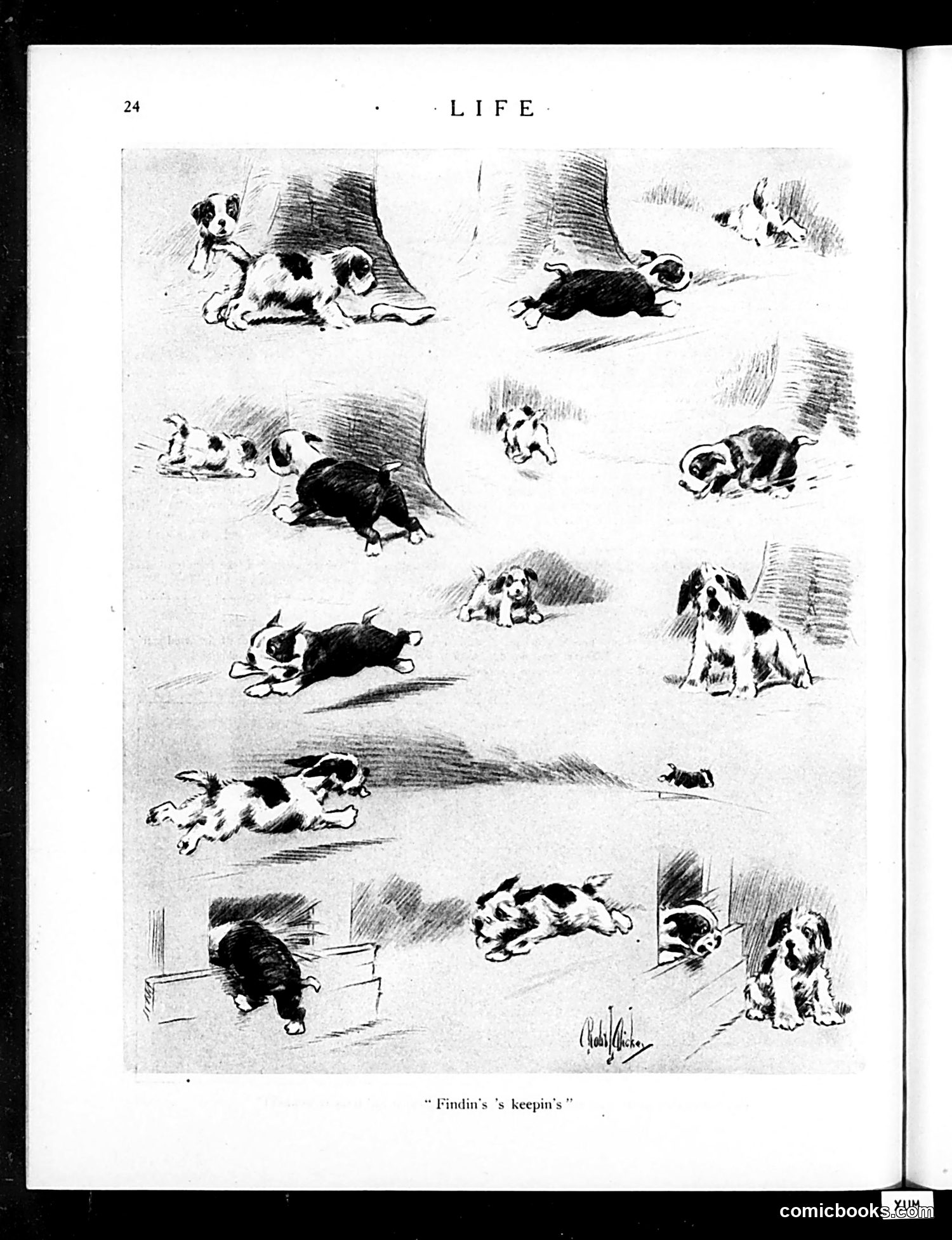
This is a series of sketches depicting small dogs and puppies in various situations around what appears to be a tree or large object. The title—a play on the children's saying "finders keepers"—suggests a humorous narrative about possession and ownership. The drawings show dogs finding, pursuing, or claiming things, with the visual progression implying a story about the adage that whoever finds something gets to keep it. The sketches capture dogs in characteristic poses: playing, running, sniffing, and resting. Without additional context or publication date visible, the specific satirical target remains unclear, though the work appears to be lighthearted social commentary using animal behavior as a metaphor for human behavior around ownership and discovery.
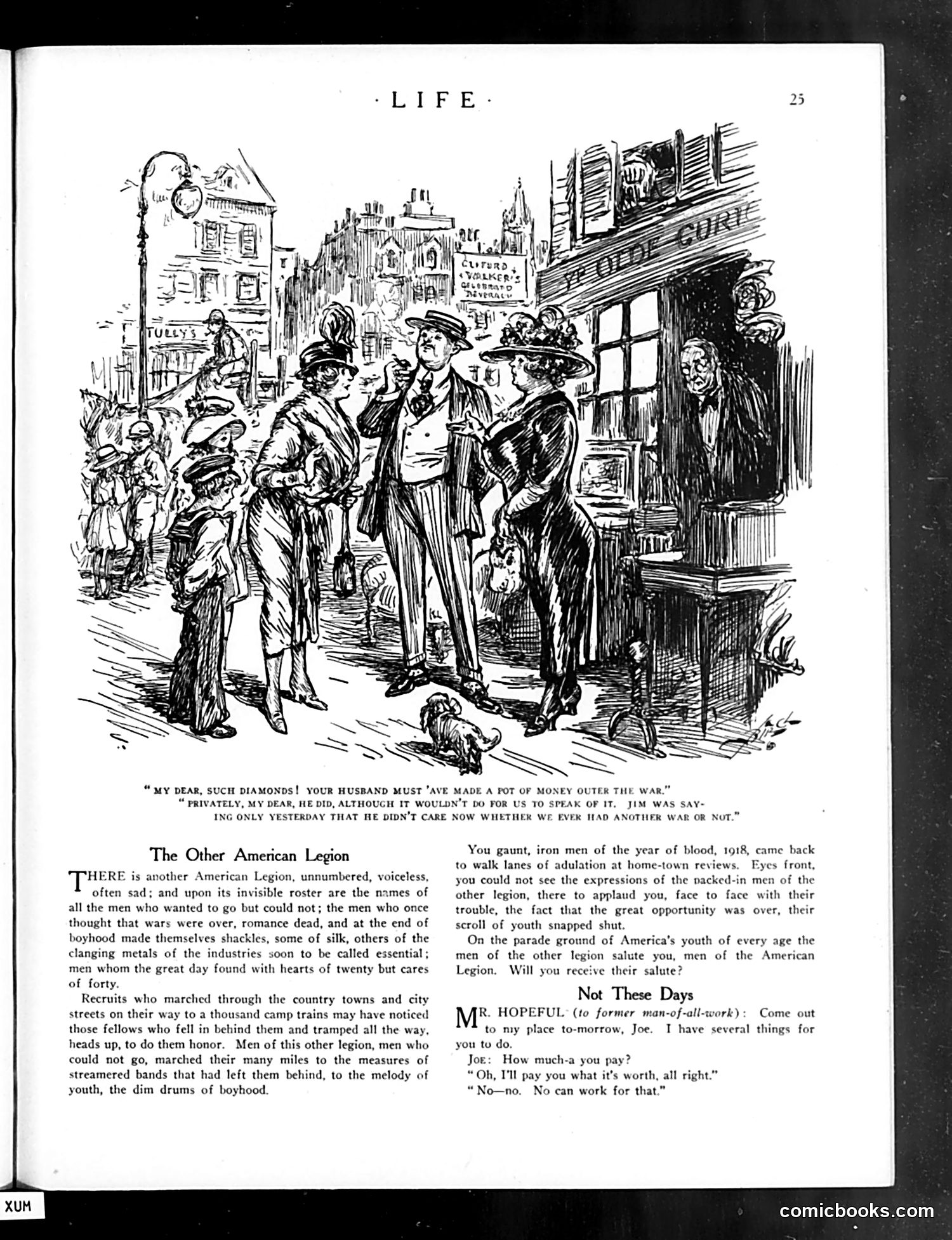
The top illustration satirizes war profiteering: a woman boasts of her husband's wartime wealth ("made a pot of money"), while he cynically admits he no longer cares if there's another war—implying he's indifferent to human suffering if it means profit. The main article, "The Other American Legion," addresses a social tragedy specific to 1918-1920s America. It describes men who *couldn't* serve in WWI because they had family obligations or industrial work deemed "essential" to the war effort. While combat veterans returned as celebrated heroes, these men faced permanent exclusion from that honor and camaraderie, their "scroll of youth snapped shut." The brief dialogue "Not These Days" reflects post-war labor dynamics: an employer offers vague wages ("what it's worth"), but the worker refuses—likely indicating workers gained negotiating power after the war and would no longer accept such exploitative terms. Together, these pieces critique wartime inequality: some profited enormously, veterans received glory, yet many ordinary workers sacrificed without recognition or fair compensation.
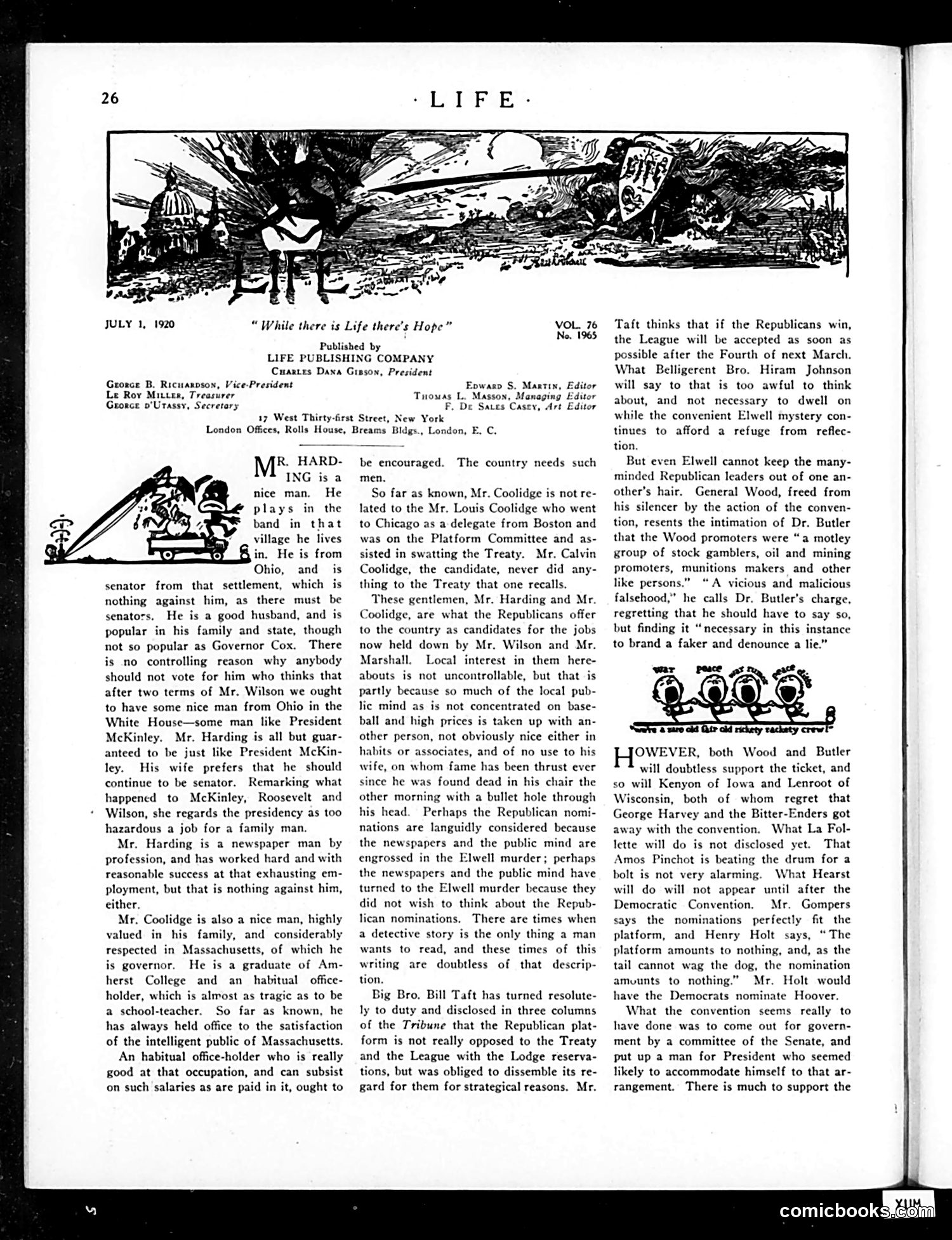
This is a satirical editorial from *Life* magazine (July 1, 1920) assessing Republican presidential and vice-presidential candidates Warren G. Harding and Calvin Coolidge ahead of the 1920 election. The piece uses backhanded compliments to mock both candidates as mediocre "nice men" from Ohio and Massachusetts respectively. It sarcastically praises Harding as a newspaper man and popular husband, while noting he's "all but guaranteed to be just like President McKinley"—implying uninspiring ordinariness. Coolidge receives similar faint praise for being a habitual office-holder. The commentary then pivots to noting that public attention is consumed by the sensational Elwell murder case, suggesting Americans care more about detective stories than Republican nominations. It concludes with references to the League of Nations debate and William Howard Taft's recent defense of the Republican platform position on the Treaty. The underlying satire: these "nice" candidates lack compelling vision or distinction.
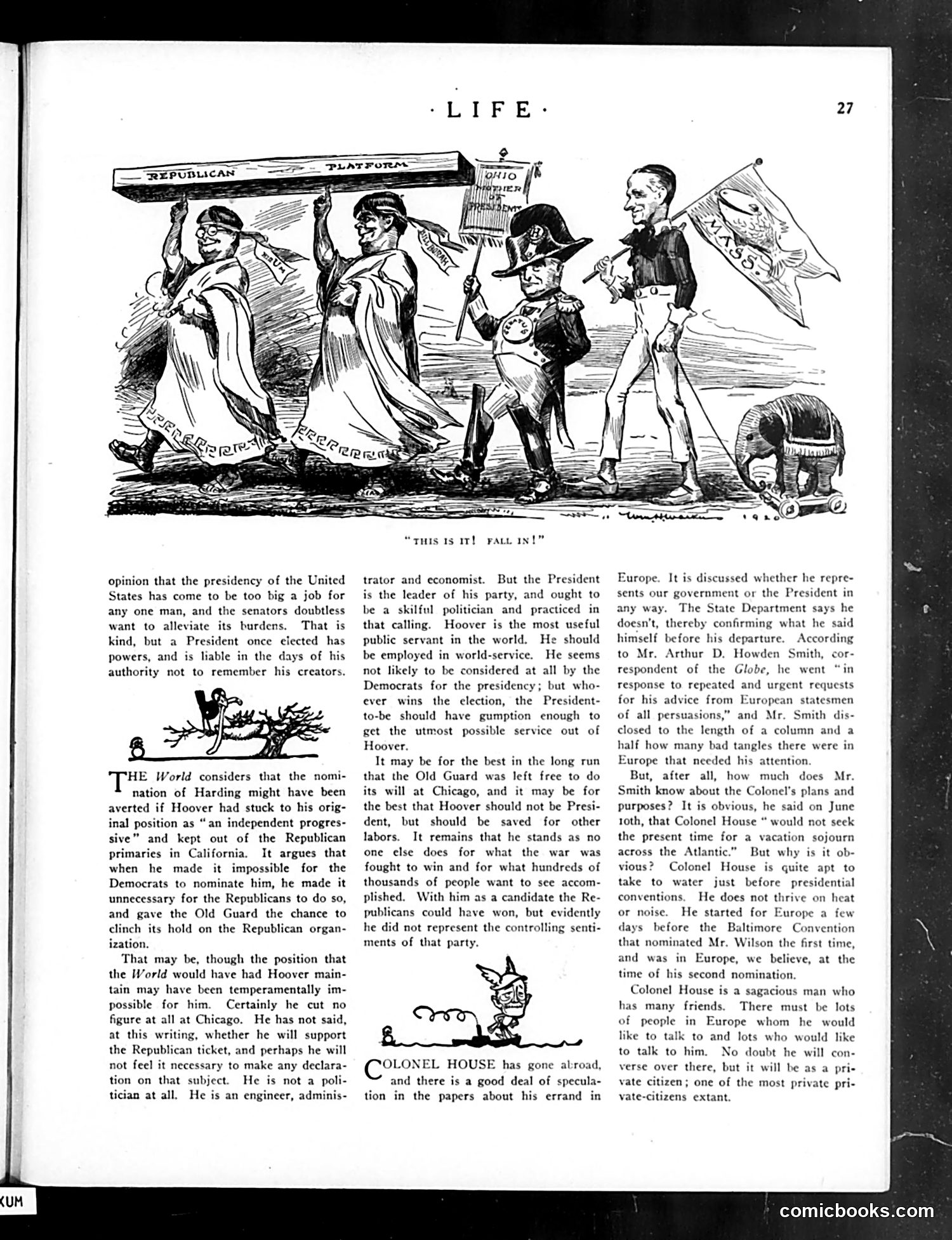
This 1920 Life magazine cartoon satirizes the Republican Party's nomination of Warren G. Harding for president. The image depicts two figures in classical robes (representing the Republican Party and Old Guard) hoisting a wooden plank labeled "Republican Platform" while smaller figures, including what appears to be Herbert Hoover, are told to "fall in" behind it. The accompanying text critiques how Hoover, a respected engineer and administrator, failed to stop Harding's nomination by withdrawing from the California primaries as an "independent progressive." The satire suggests the GOP's Old Guard manipulated the process, and that Hoover—who would have been a stronger candidate—sacrificed his position, allowing a weaker nominee to emerge. The cartoon's point: the Republican establishment steamrolled over more qualified candidates to maintain their control of the party machinery.
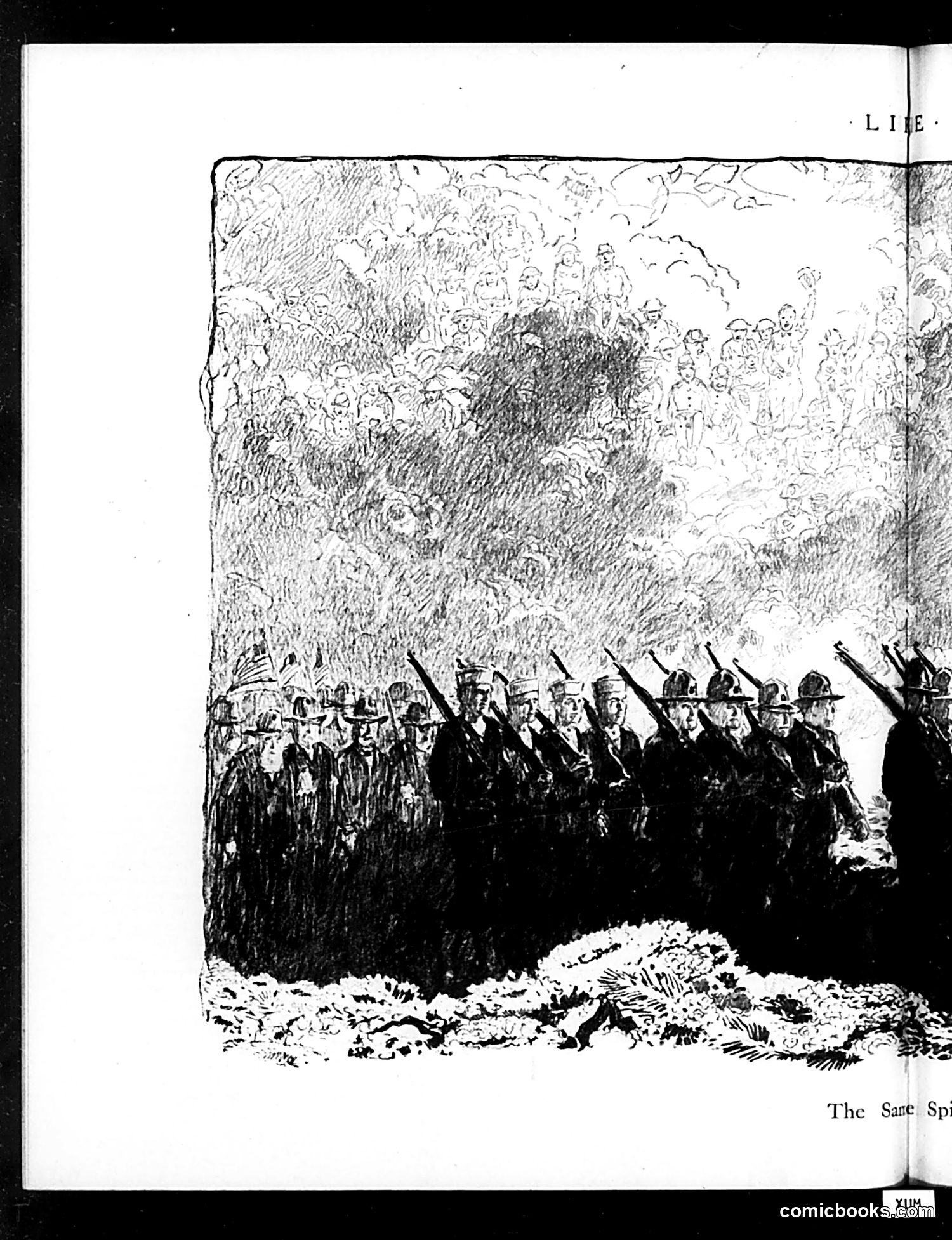
This page shows a dramatic illustration depicting armed soldiers or military figures lined up in formation at the bottom, facing a large crowd of civilians above them on what appears to be a hillside or elevated terrain. The composition suggests confrontation or conflict between military authority and civilian population. The partial caption reads "The Sane Spi[rit]" (likely "The Sane Spirit"), though the full title is cut off. Without the complete text and date, I cannot definitively identify the specific historical event being satirized. However, the imagery suggests commentary on militarization, civil unrest, or government response to civilian protests—themes common to Life magazine's satirical content during various periods of American social tension. The stark contrast between the dark, unified military force and the scattered civilian crowd emphasizes the power differential.
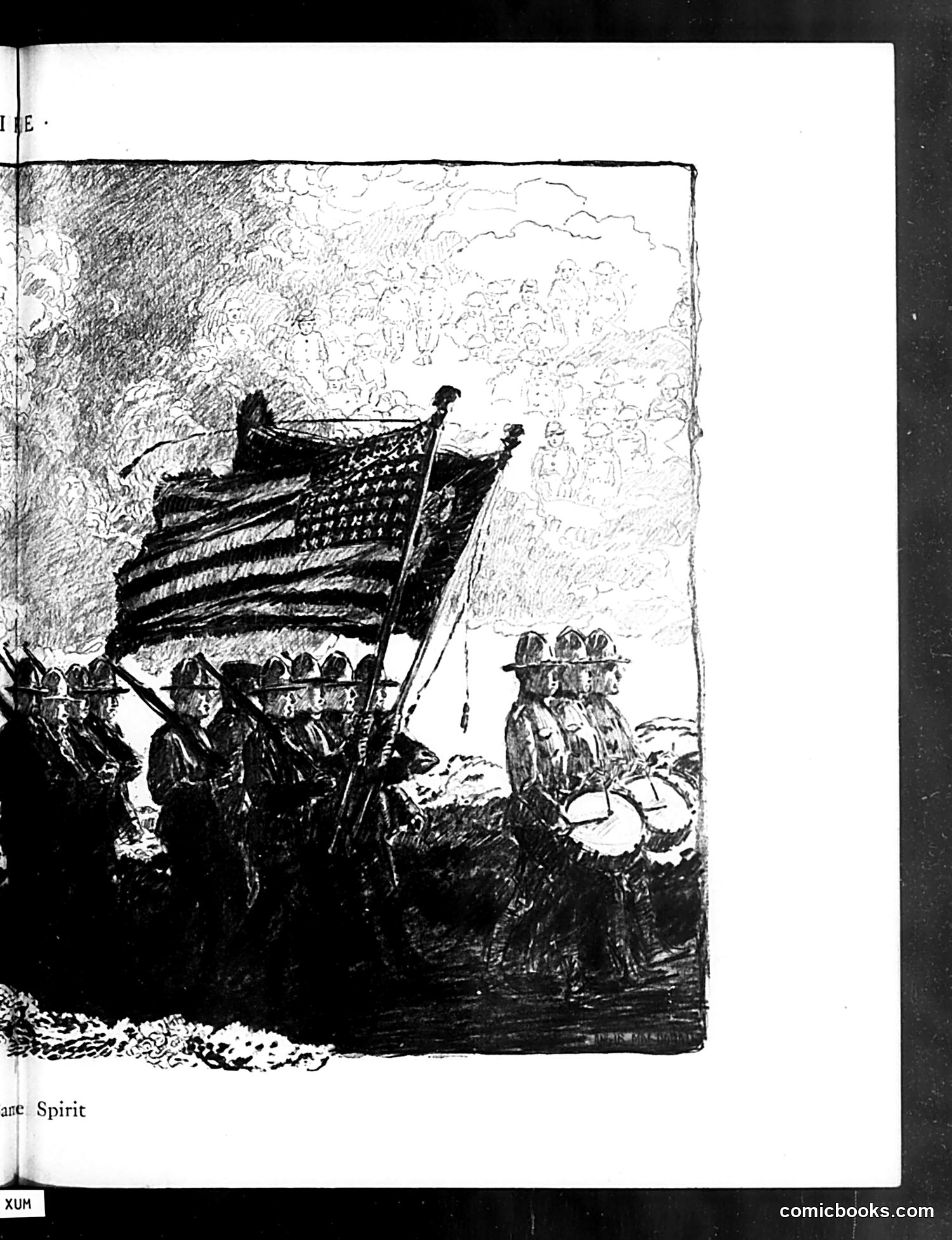
This appears to be a patriotic illustration showing soldiers or military figures gathered around an American flag. The soldiers wear what look like military uniforms and helmets, depicted in a bold, dramatic style typical of early-to-mid 20th century American editorial illustration. The phrase "Spirit" in the visible text likely refers to national spirit or patriotic fervor. Without more context from surrounding pages, the specific satirical point is unclear—this could be celebrating American military resolve, or conversely, satirizing militarism or nationalism depending on Life magazine's editorial stance at the time of publication. The sketchy, energetic linework emphasizes dramatic action and emotional intensity rather than realistic detail, common in propaganda and patriotic imagery of the era.
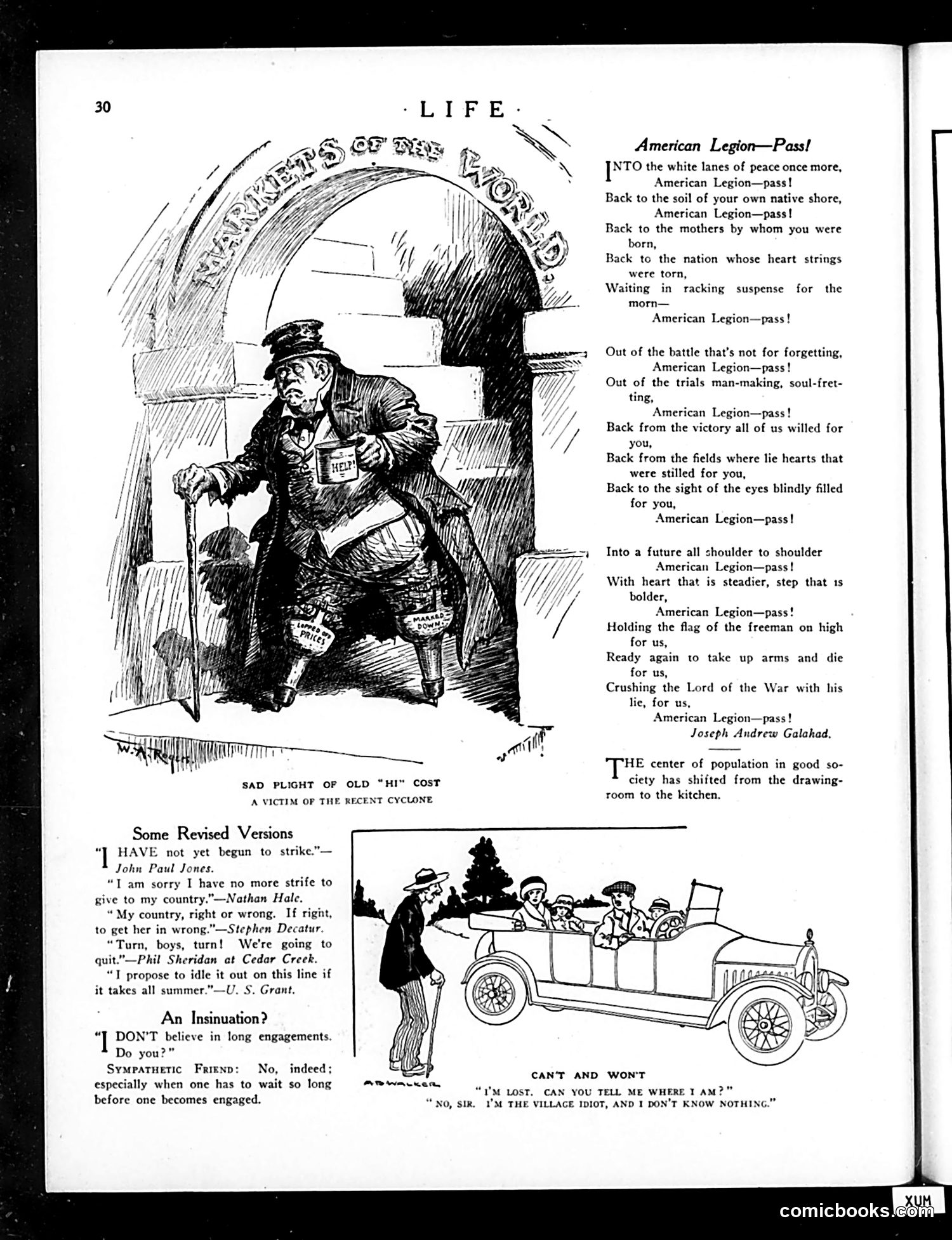
This page addresses returning World War I soldiers. The centerpiece is a poem by Joseph Andrew Galahad welcoming the American Legion home ("pass!" meaning proceed/go forward). The poem balances patriotic sentiment with acknowledgment of sacrifice—soldiers should return to families and nation while remaining ready to defend freedom. Below are satirical "Revised Versions" of famous military quotes, rewritten as pacifist or defeatist statements (e.g., Grant's famous resolve recast as idleness). This likely mocks anti-war sentiment or isolationism emerging post-WWI. The cartoon shows a wealthy man lost in his automobile, apparently undone by recent economic hardship ("recent cyclone," likely referencing economic disruption). A separate joke about engagement rings appears unrelated to the Legion theme. The overall page reflects American society grappling with returning veterans' reintegration and post-war social upheaval.
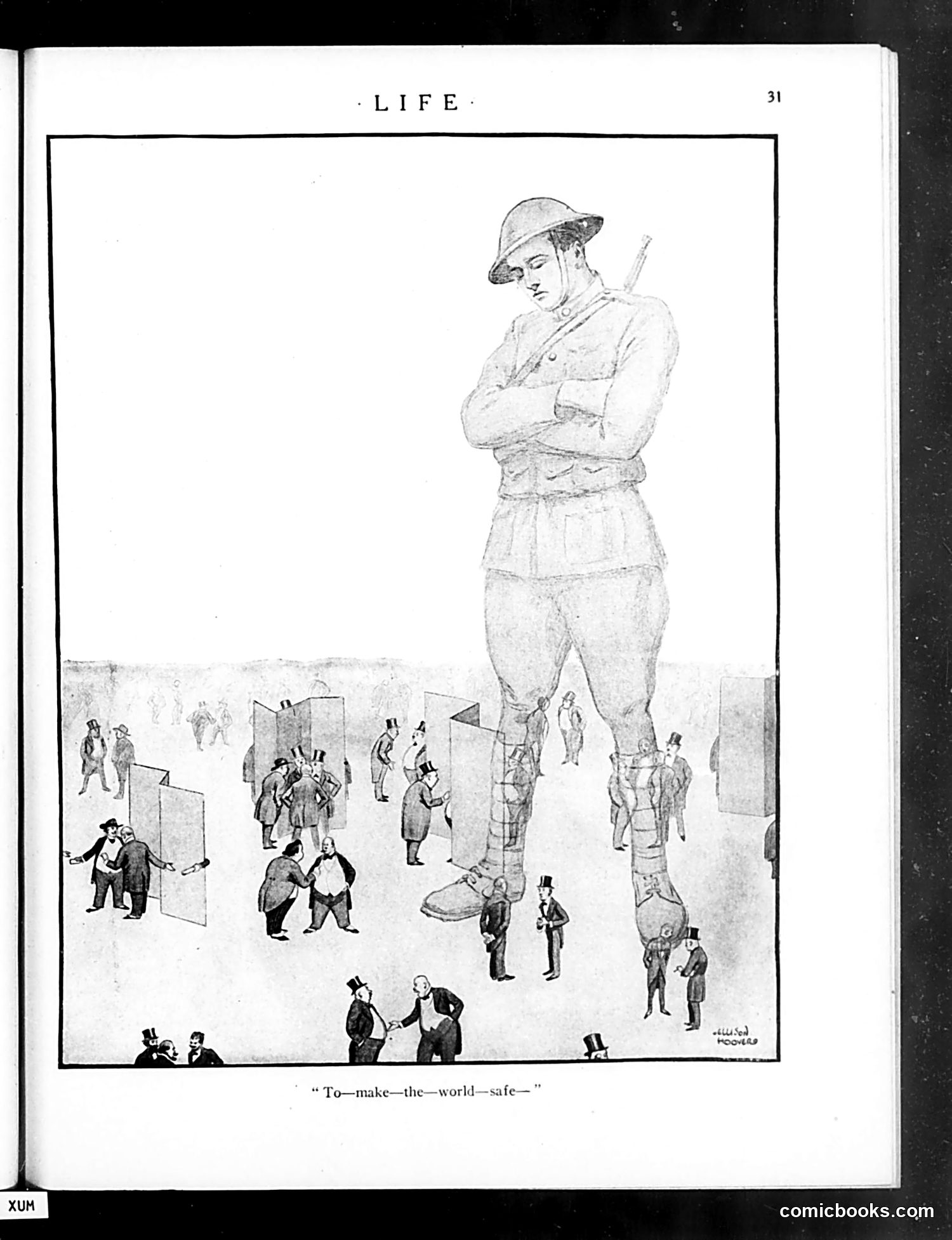
This Life magazine cartoon depicts a giant soldier in WWI-era military uniform, arms crossed, towering over tiny civilian figures below. The caption reads "To—make—the—world—safe—," which references President Woodrow Wilson's famous 1917 justification for American entry into World War I: to "make the world safe for democracy." The satire is cutting: the enormous soldier dwarfs the ordinary people—businessmen, civilians in top hats—scattered at his feet like insignificant pawns. This suggests the cartoon critiques how the grand idealistic rhetoric of making the world "safe" actually empowers militarism and subordinates ordinary citizens to military authority and interests. The cartoon appears skeptical of Wilson's stated noble war aims, implying instead that military mobilization serves militaristic expansion rather than democratic protection.
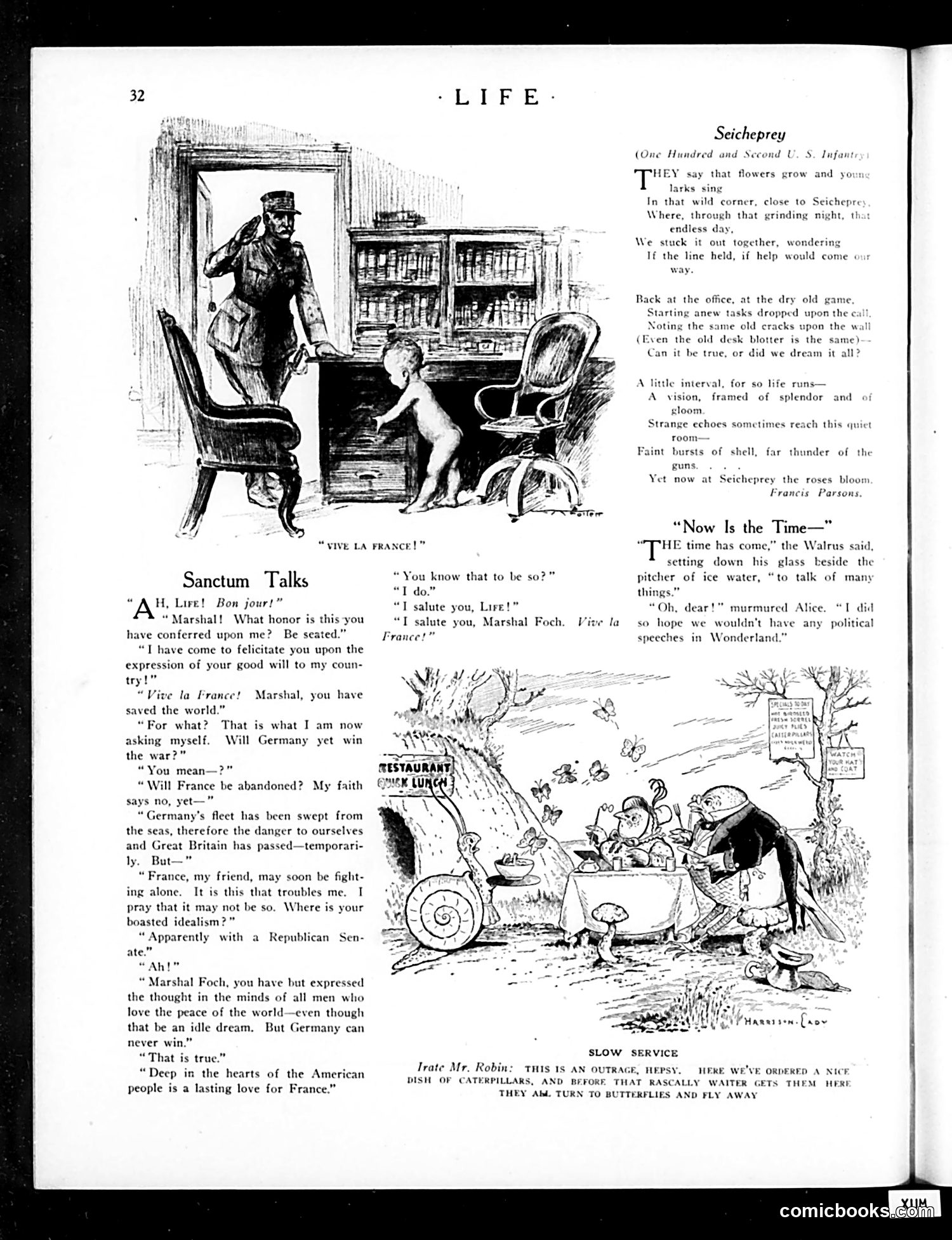
This *Life* magazine page contains WWI-era content. The top poem "Seicheprey" references the 102nd U.S. Infantry's experience at that French village, contrasting battlefield trauma with mundane office routine back home. The "Sanctum Talks" dialog satirizes anxieties about Allied victory. A character (likely representing American leadership) meets with Marshal Foch, the French military commander, discussing whether France will be abandoned if Germany survives. The satire targets American isolationist sentiment and Republican senators' reluctance toward foreign entanglement—a major 1918 political debate. The "Slow Service" cartoon at bottom uses *Alice in Wonderland* references to mock restaurant incompetence: a diner orders caterpillars, but they transform into butterflies and fly away before being served. It's a straightforward complaint about poor service, unrelated to the political content above.
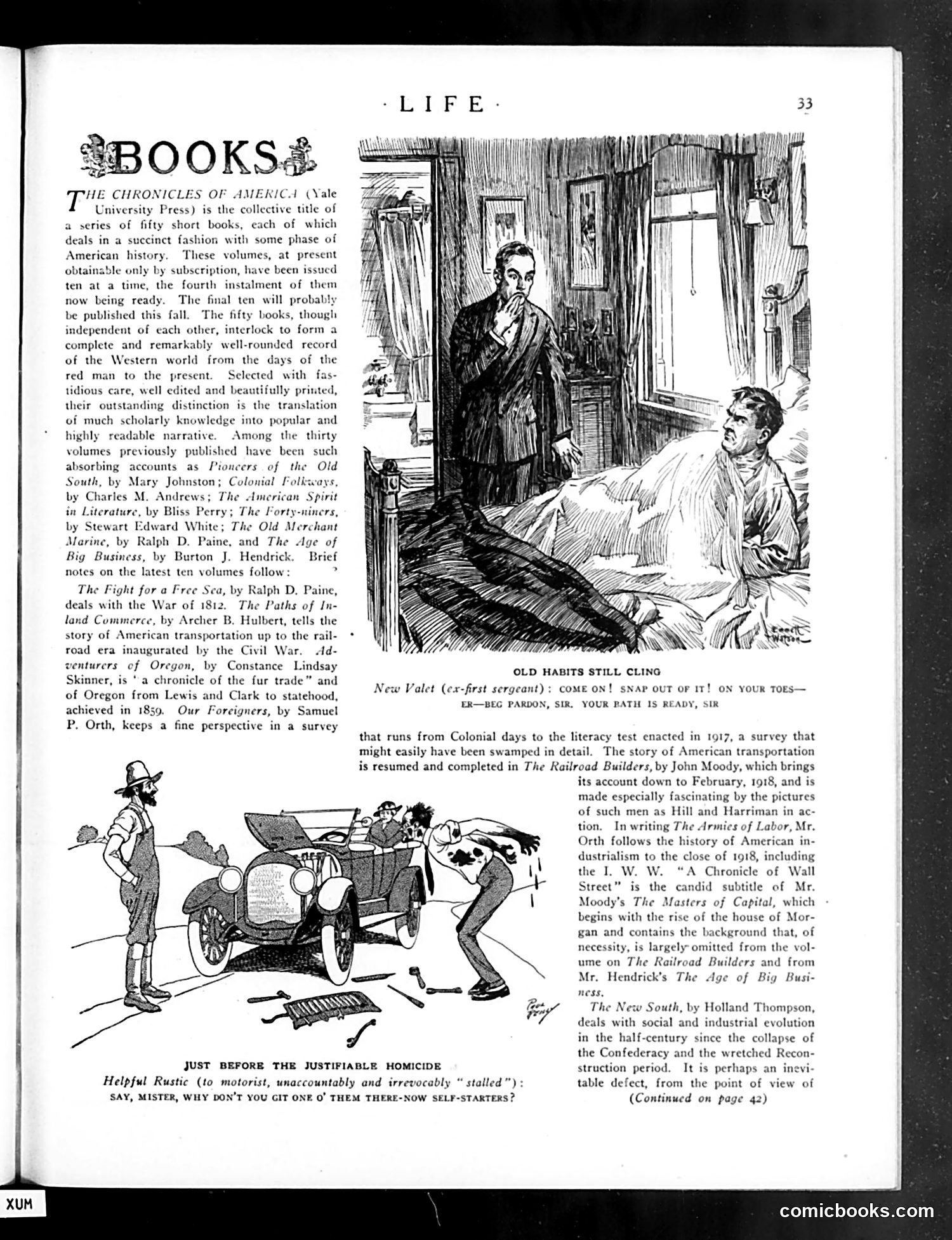
This page contains two cartoon jokes satirizing early automotive technology and military demobilization. **"Just Before the Justifiable Homicide"** (bottom): A rural man offers unsolicited advice to a stranded motorist whose car has broken down. The humor plays on the frustration of unreliable early automobiles—the "self-starter" was a new innovation meant to eliminate hand-cranking. The rustic's tone suggests the motorist deserves his predicament for trusting newfangled technology, reflecting common rural skepticism toward modern cars. **"Old Habits Still Cling"** (top): A former military sergeant, now working as a valet, barks orders at his employer with military formality ("snap out of it," "on your toes"), then catches himself and apologizes. This satirizes the difficulty WWI veterans faced transitioning to civilian life—they retained military bearing and speech patterns unsuited to civilian employment. The cartoon reflects post-1918 concerns about readjusting soldiers. The page's main content reviews Yale University Press's "Chronicles of America" historical book series.
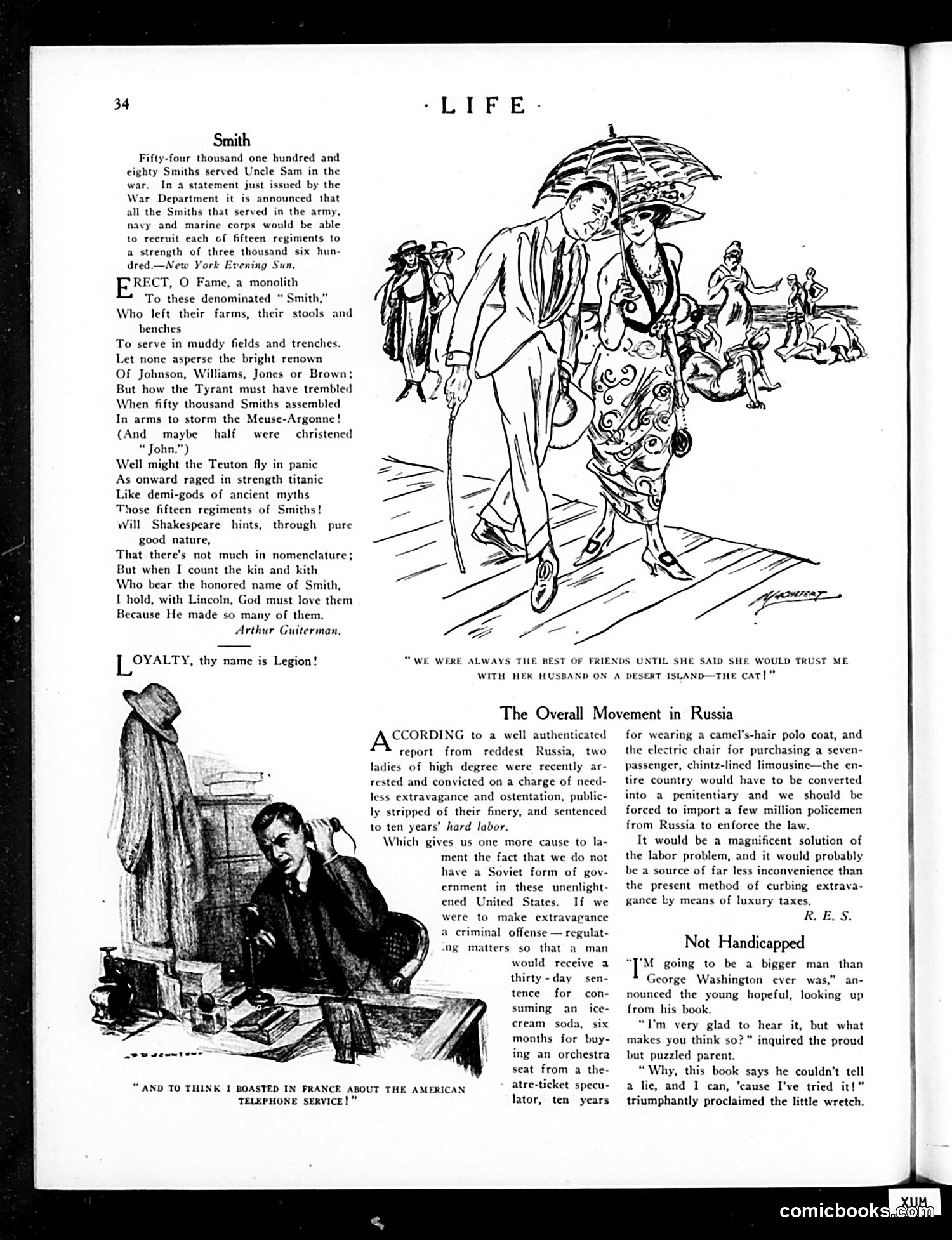
This page contains three satirical pieces from post-WWI Life magazine: **"Smith"** (top): A humorous poem celebrating that 54,180 Smiths served in WWI. The satire mocks the ordinary commonness of the name—suggesting these thousands of identical "Smiths" could theoretically form entire regiments. The joke plays on the name's ubiquity, with a dig that even half might be named "John." **"Loyalty, thy name is Legion!"** (bottom left): A cartoon shows a woman standing over a seated man, captioned about boasting in France regarding American telephone service. The satire targets post-war American arrogance—soldiers returning home to brag about American superiority, which the woman's presence undercuts (likely implying infidelity or betrayal while abroad). **"The Overall Movement in Russia"** (right): Satirical commentary on Soviet Russia's arrest of aristocratic women for extravagance. The author mockingly suggests America should adopt similar communist penalties for consumer excess—ice cream sodas, theater tickets, expensive cars—reducing the country to a police state. This is cold-war-era satire mocking both Soviet authoritarianism and American consumerism.
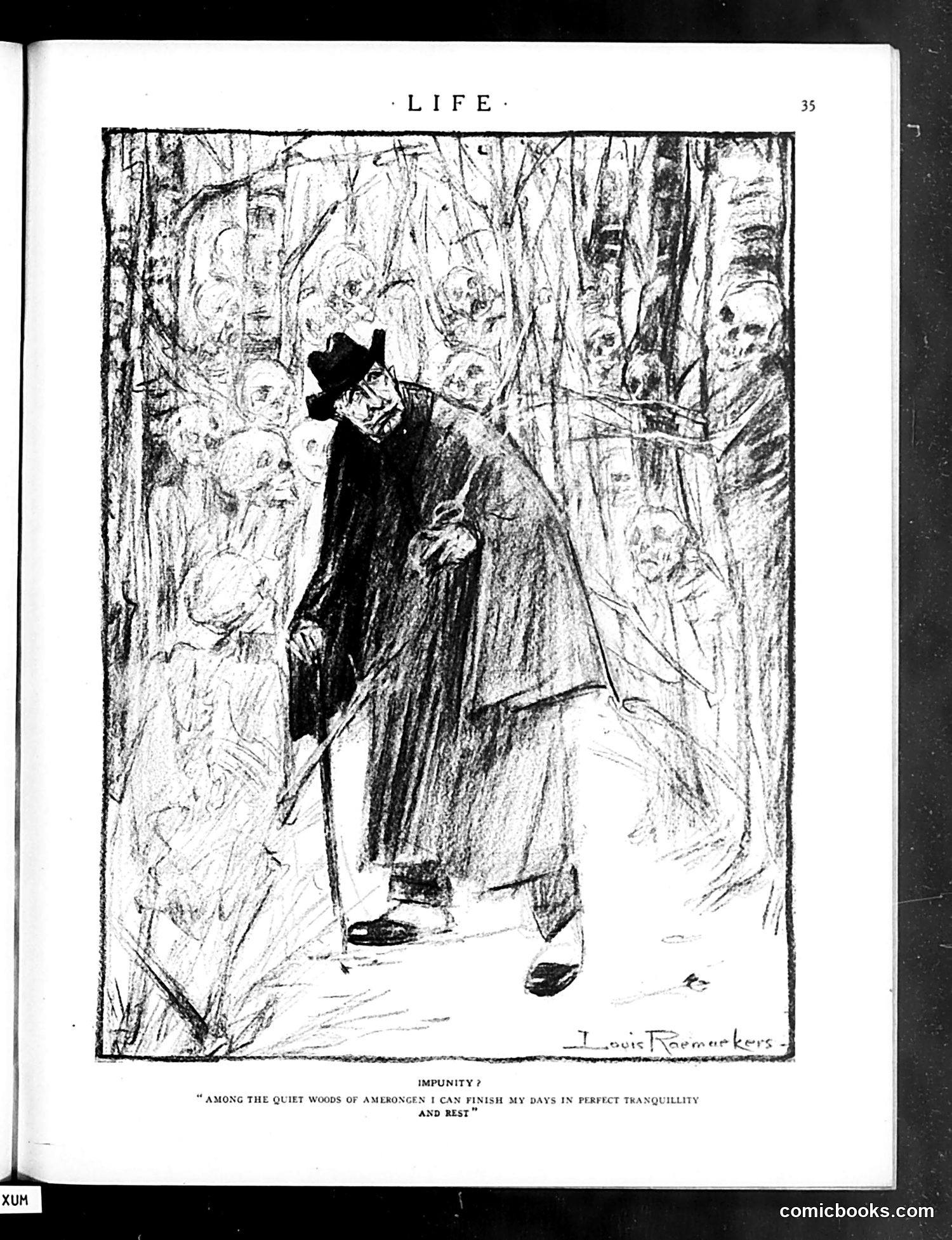
This cartoon depicts a well-dressed man in dark clothing and hat walking through a forest of birch trees. The caption reads: "Among the quiet woods of Amerogen I can finish my days in perfect tranquility and rest." The title "Impunity" suggests the cartoon satirizes a wealthy or prominent figure seeking refuge and escape from consequences—likely someone fleeing legal trouble, scandal, or accountability. The contrast between civilized dress and wilderness setting emphasizes the figure's attempt to hide or disappear. The artist is Louis Raemakers, a political cartoonist known for satirizing privilege and corruption. Without additional context about the publication date, the specific identity remains unclear, but the message critiques how wealth and status enable escape from justice.
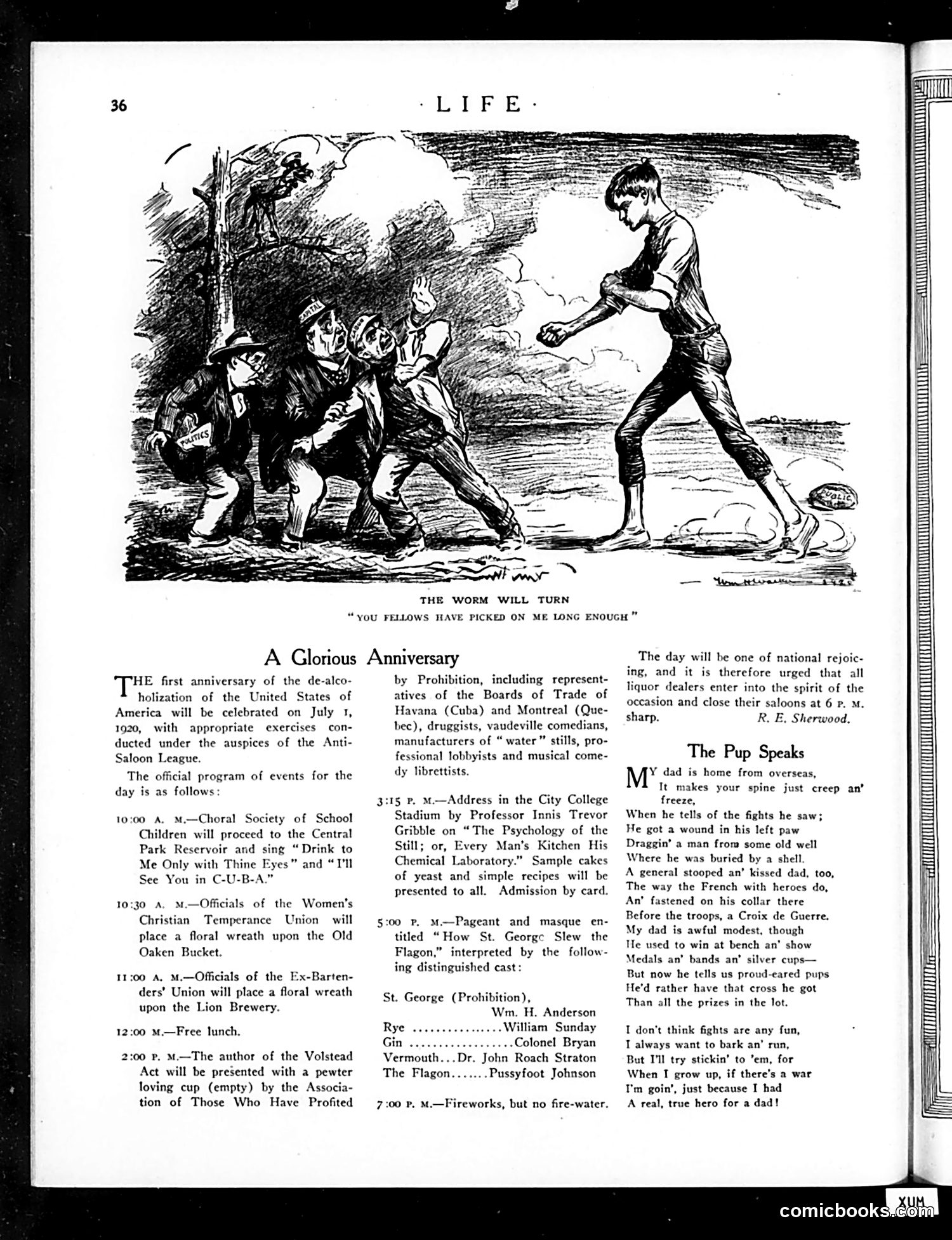
The cartoon "The Worm Will Turn" depicts a small figure (representing the common person or "the worm") finally standing up to larger figures ganging up on him—a visual metaphor for ordinary citizens rebelling against oppression. The accompanying text is **satirical mock-celebration** of Prohibition's first anniversary (July 1, 1920). Rather than genuinely praising alcohol's ban, it exposes the hypocrisy and unintended consequences: the schedule lists events honoring temperance while simultaneously noting who profits from Prohibition—Cuban rum traders, Montreal whiskey sellers, drug manufacturers, and "professional lobbyists." The staged "pageant" where "St. George" (Prohibition) defeats "The Flagon" further mocks the crusade's moral posturing. The instruction that liquor dealers should "close their saloons at 6 p.m. sharp" is darkly ironic, implying they'll reopen later. The overall point: **Prohibition created organized crime and corruption while enriching smugglers and black-market operators**—the stated goal of eliminating alcohol abuse masked actual social damage.
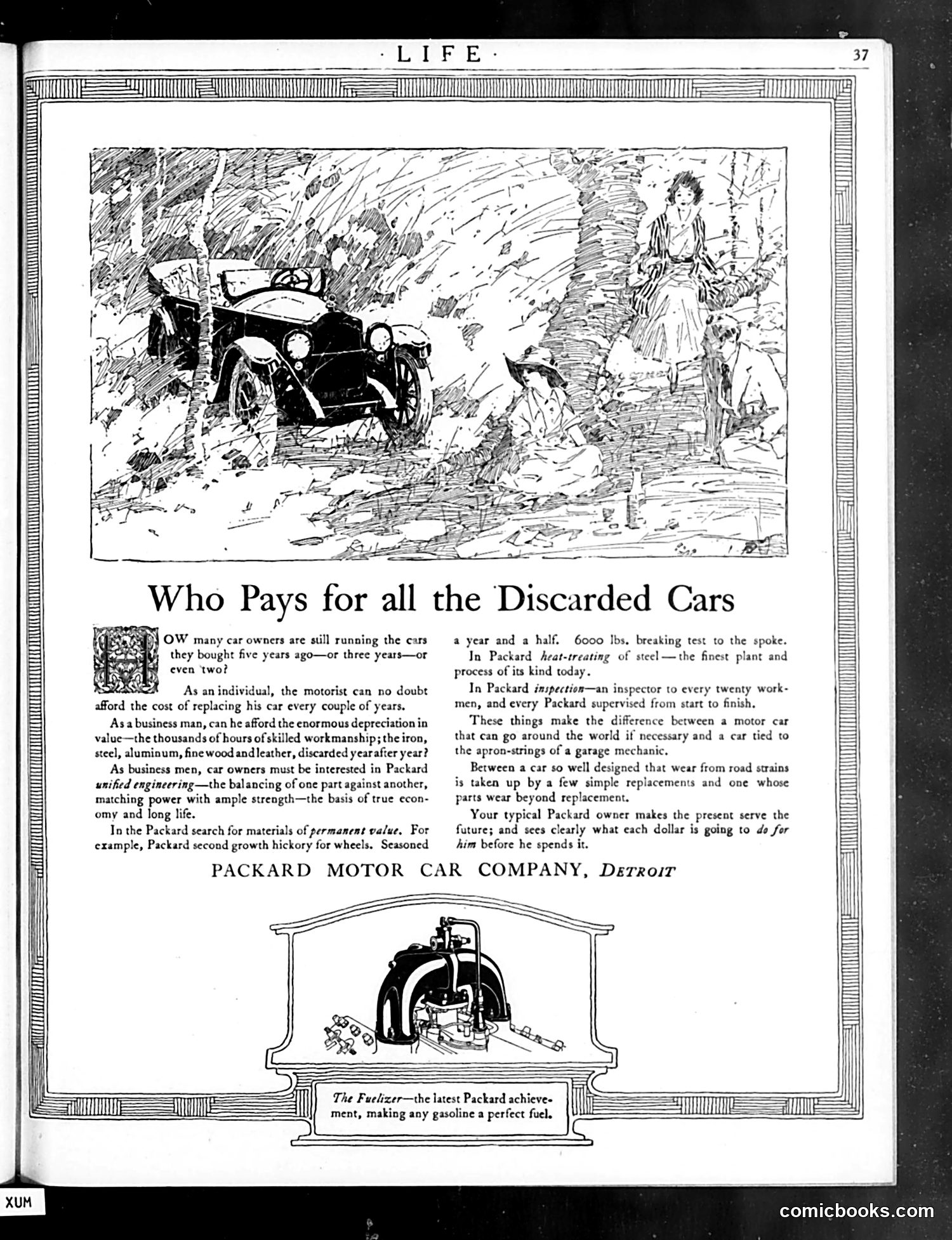
This is primarily a **Packard automobile advertisement**, not political satire. The headline "Who Pays for all the Discarded Cars" uses a rhetorical question to frame the ad's argument about car durability and value. The illustration shows an abandoned, broken-down automobile on a roadside while well-dressed people pass by—a visual representation of cars being "discarded" after brief ownership (five years, three years, or even two years). The ad's pitch: Packard cars represent superior engineering and materials that last longer, reducing depreciation and total ownership costs. The text argues that while individual motorists may afford frequent replacements, "as business men" they should recognize the waste. Features like hickory wheels (seasoned 1.5 years), heat-treated steel, and rigorous inspection justify the Packard's premium price through longevity. The satirical edge is gentle—mocking wasteful consumer culture rather than any specific political target. This reflects 1920s-era advertising that positioned quality products as rational business investments rather than mere luxury purchases.
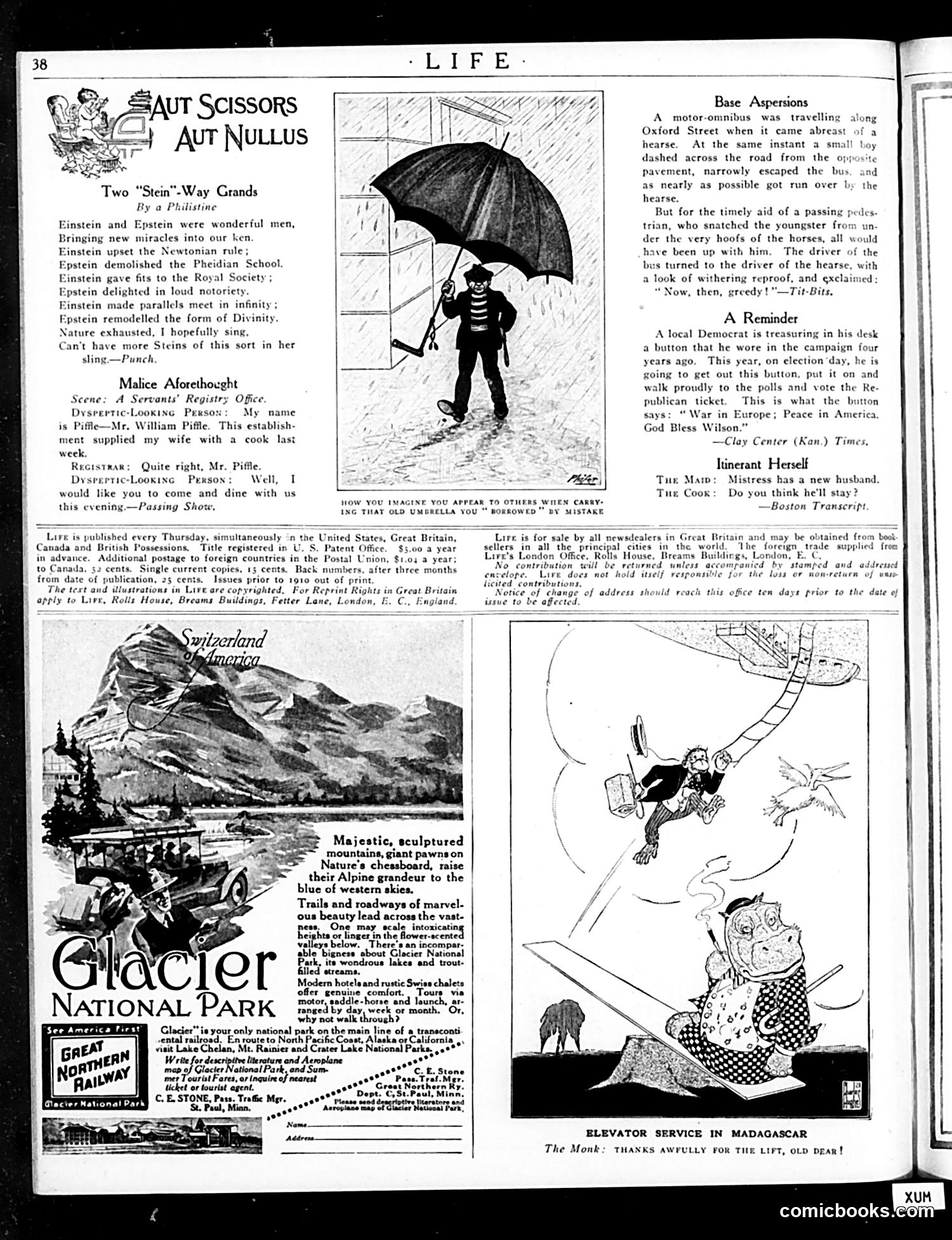
This page contains satirical humor typical of early 20th-century Life magazine: **"Two Stein-Way Grands"** mocks the celebrity status of physicist Albert Einstein and sculptor Jacob Epstein by lumping them together as interchangeable famous figures with the surname "Stein," suggesting public fascination with them is superficial rather than substantive. **"Malice Aforethought"** is a short comic sketch about a man complaining to an employment agency that the cook they provided last week didn't work out—a mundane domestic complaint. **"Base Aspersions"** describes a traffic incident where a bus nearly hit a child who darted in front of a hearse; the bus driver sarcastically blames the hearse driver, suggesting absurd mutual recrimination. **"A Reminder"** references the 1916 U.S. presidential campaign, mocking a Democrat who proudly wore a "Wilson" button four years ago but plans to vote Republican despite the slogan's endorsement of Wilson's peace policies. The bottom cartoon "Elevator Service in Madagascar" humorously depicts an improbable elevator scenario in the remote island nation, suggesting primitive conditions there.
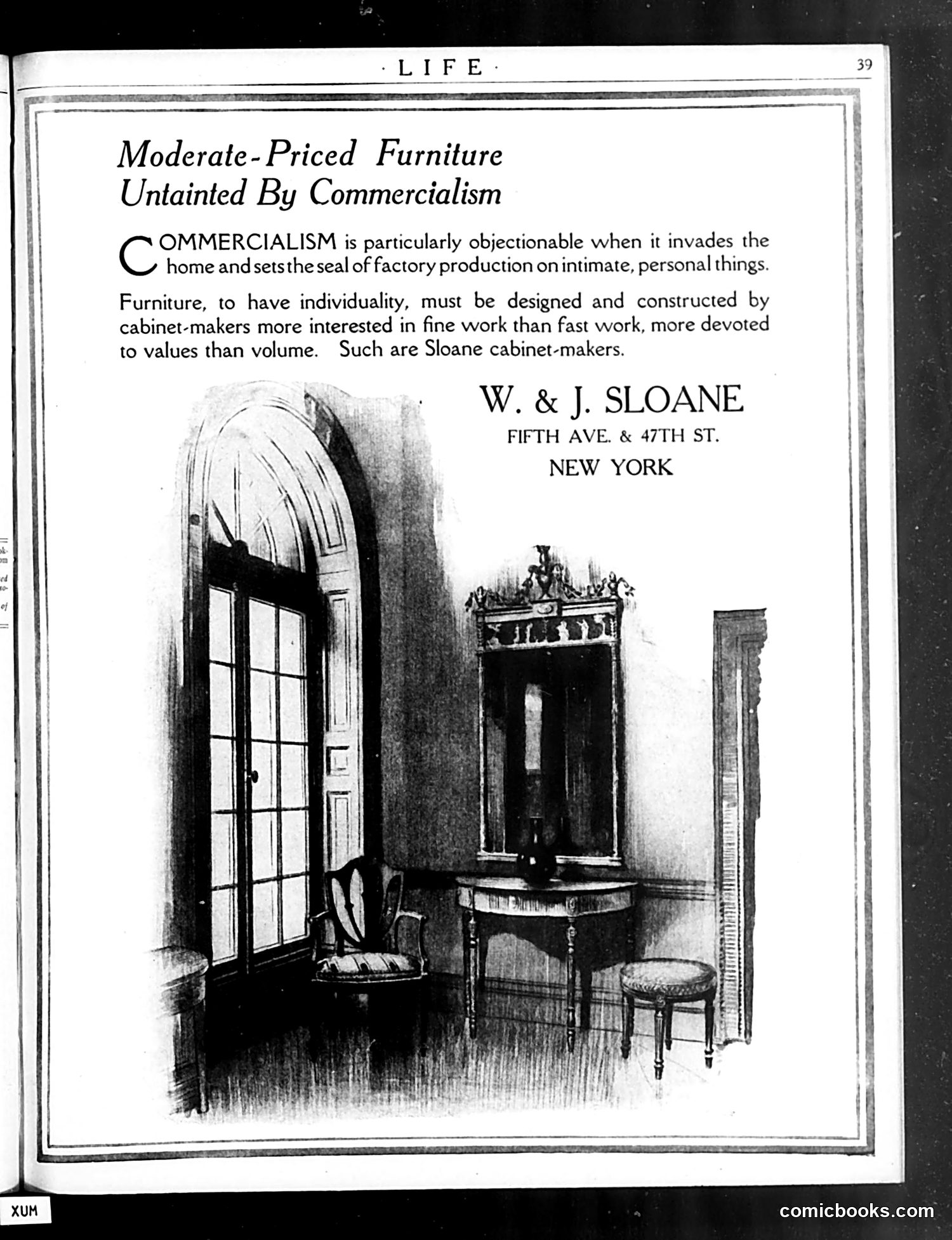
This is a **furniture advertisement**, not a political cartoon. The page promotes W. & J. Sloane, a New York furniture maker, positioned at Fifth Avenue and 47th Street. The "satire" is **self-directed irony**: the ad attacks "commercialism" and mass production while simultaneously being a commercial advertisement. It argues that quality furniture requires individual craftsmanship rather than factory volume production—a pitch that ironically *commercializes* the very anti-commercial values it espouses. The accompanying illustration shows an elegant interior with period furniture (a curved glass door, decorative mirror, and chair), meant to exemplify the refined, individualized aesthetic that Sloane claims to offer—contrasting with cheaper, mass-produced alternatives. This reflects early 20th-century luxury marketing that sold handcrafted goods by positioning them against industrial mass production, appealing to middle/upper-class consumers seeking distinction.
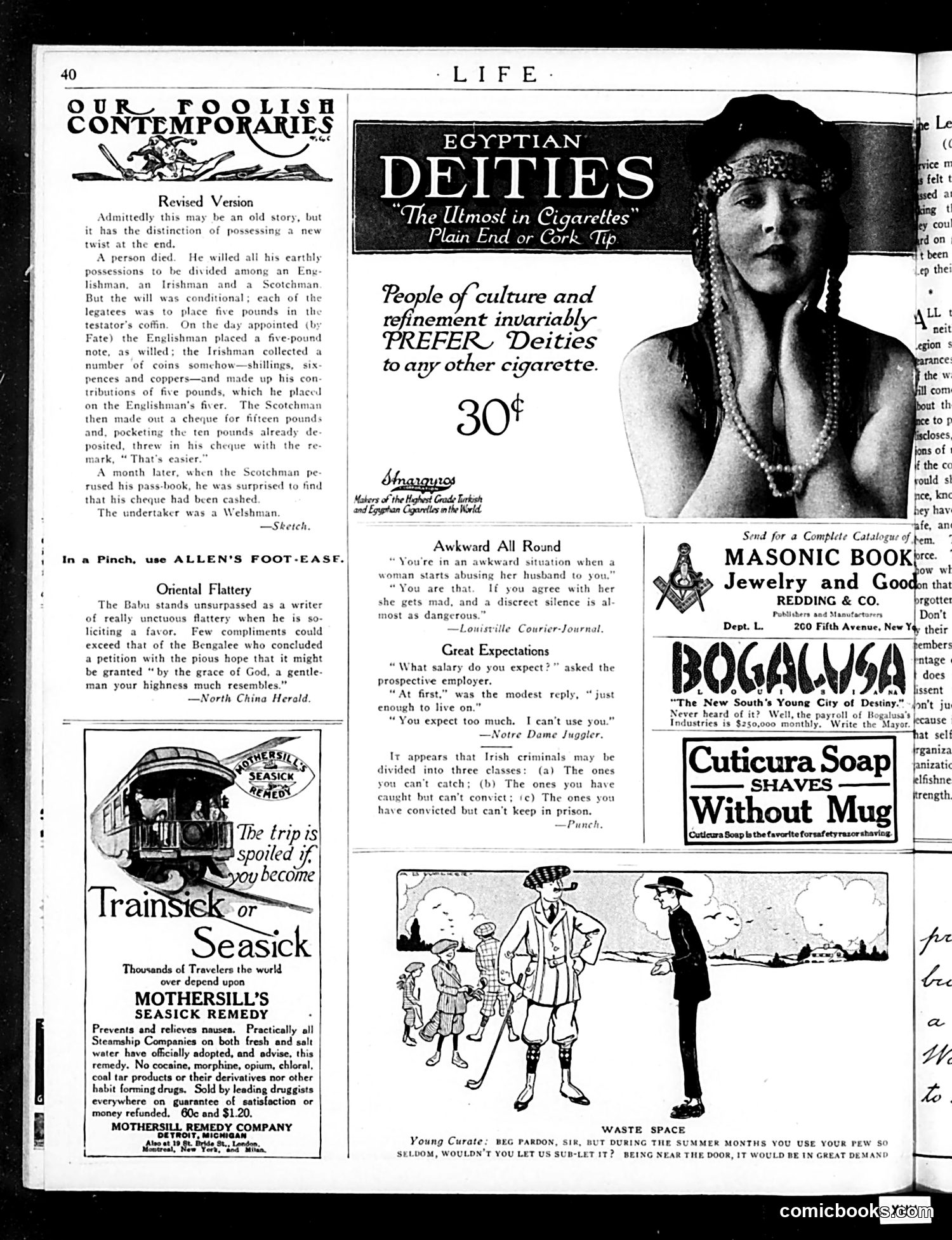
This page combines humor columns with period advertisements (circa 1920s). The main satirical content includes: **"Our Foolish Contemporaries"** presents three ethnic jokes standard to the era: an Englishman, Irishman, and Scotsman dividing an inheritance (playing on national stereotypes about financial practicality); observations on Irish criminal classifications; and commentary on awkward social situations. **The bottom cartoon** depicts a young clergyman being asked by a parishioner to rent out his pew during summer months when the priest doesn't use it—satirizing the commercialization of church space and suggesting the cleric's neglect of duties. **Advertisements** include Egyptian Deities cigarettes (featuring a woman in orientalist styling), Mothersill's seasick remedy, and other period products. The humor relies entirely on ethnic stereotypes and class-based observations typical of 1920s American satire. Modern readers would find the racial/national caricatures offensive, though the economic humor about the inheritance and church pew remains comprehensible if dated.
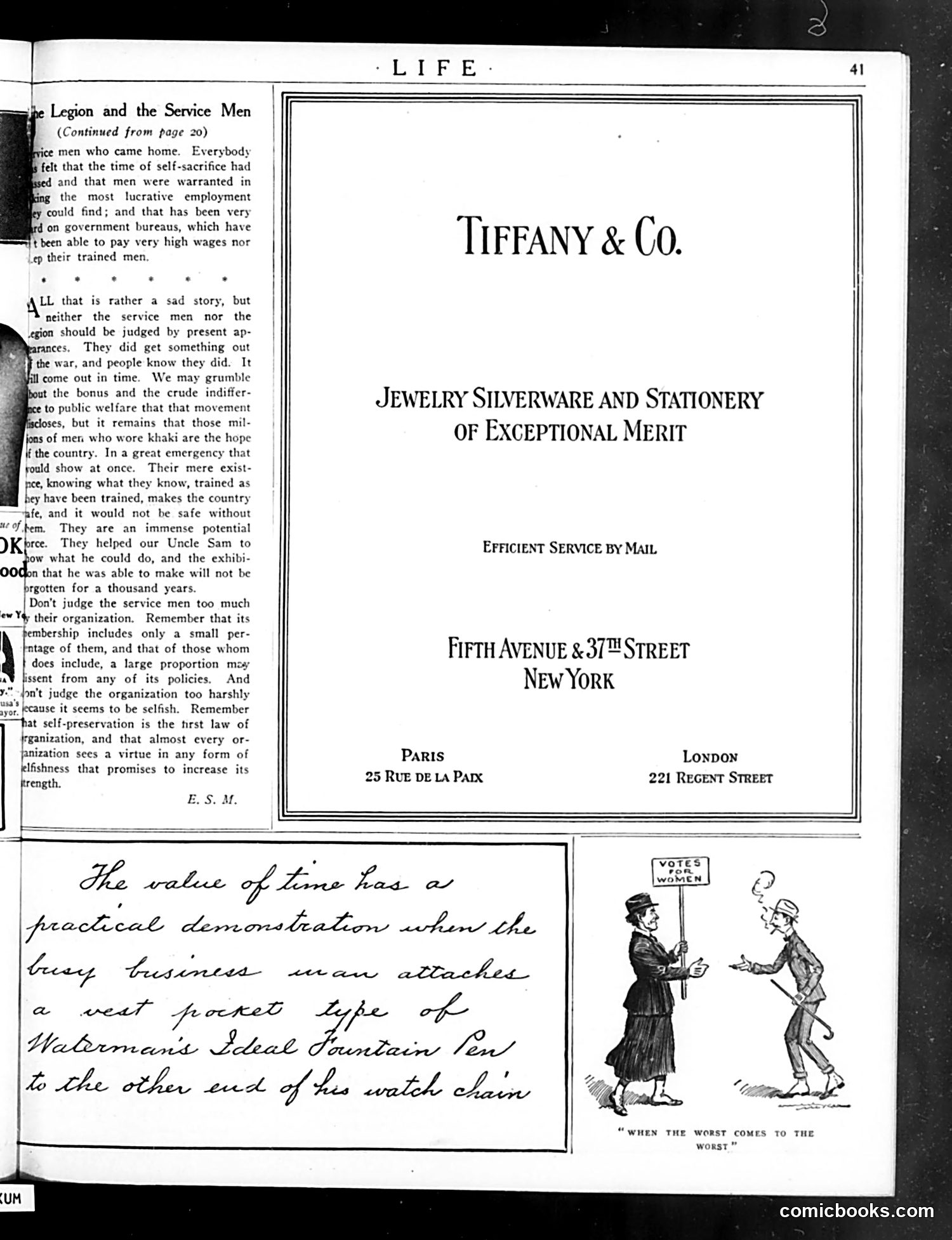
This page contains a serious editorial essay alongside period advertising and a political cartoon. The **article** discusses WWI veterans returning home, defending the American Legion against criticism. The author argues service members deserve well-paying jobs and shouldn't be judged harshly for their organization's apparent selfishness, since "self-preservation is the first law of organization." The **cartoon** titled "When the Worst Comes to the Worst" shows two figures: a woman on the left holding a "Votes for Women" banner, and a man on the right in disheveled clothing. The joke appears to satirize women's suffrage advocates by suggesting that even in desperate times, they persist in demanding voting rights—implying this is an inconvenient or misplaced priority compared to other social concerns (possibly post-war recovery). The **advertisement** for Tiffany & Co. occupies the upper portion, emphasizing luxury jewelry and stationery sold through mail order from their Fifth Avenue location.
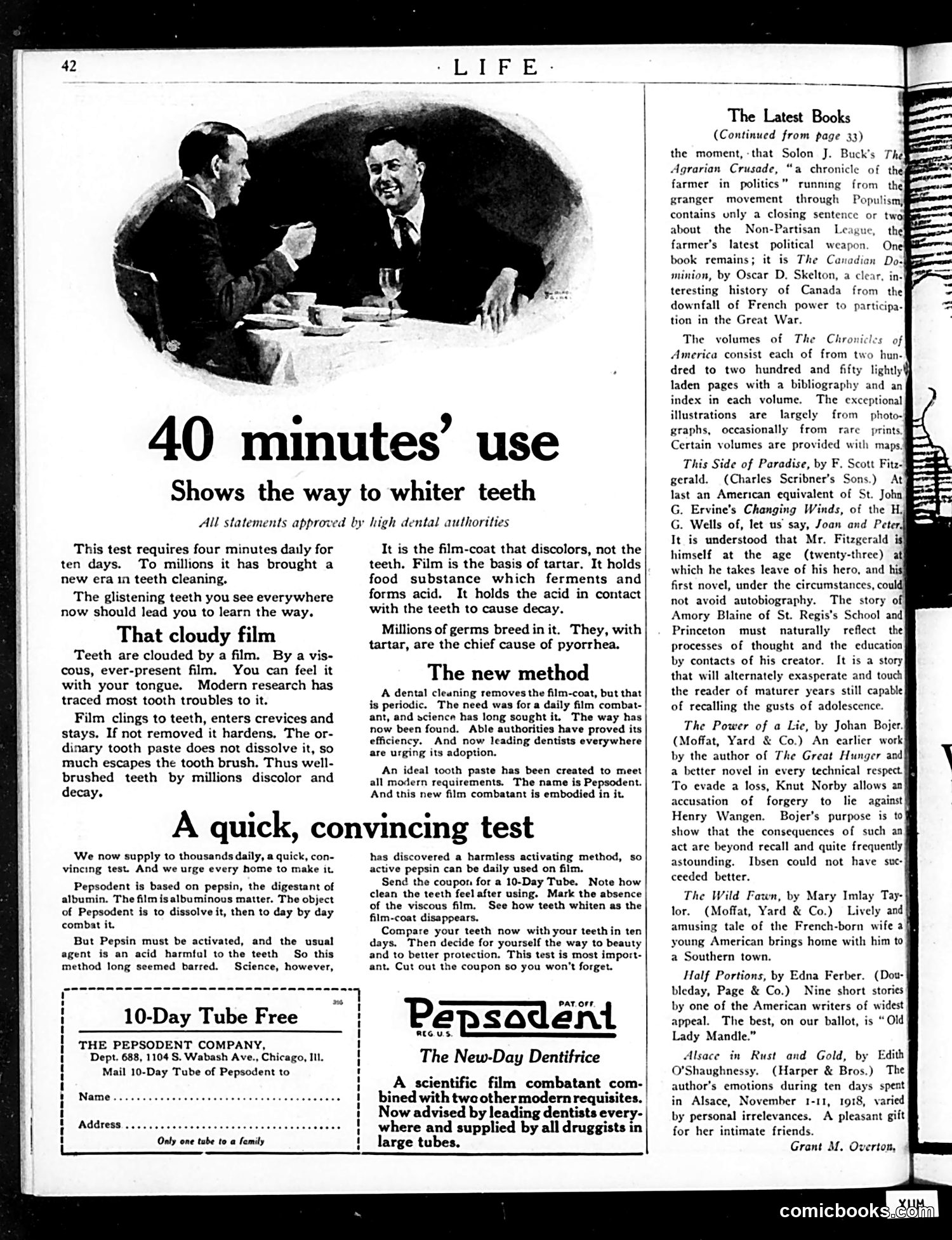
This page is primarily a **Pepsodent toothpaste advertisement**, not political satire. The illustration shows two men in conversation at a table—likely meant to represent everyday men discussing dental hygiene rather than specific political figures. The advertisement promotes Pepsodent as a revolutionary "film combatant" toothpaste based on pepsin (a digestive enzyme). It claims to remove the film coating teeth that causes discoloration and decay. The ad offers a free 10-day trial tube and emphasizes endorsement by "leading dentists everywhere." The right column contains book reviews unrelated to the advertisement, discussing works on American agrarian movements and Canadian history. **No political satire is evident here.** This is straightforward early-20th-century product advertising using pseudo-scientific language and testimonial appeal—typical marketing strategy of the era.
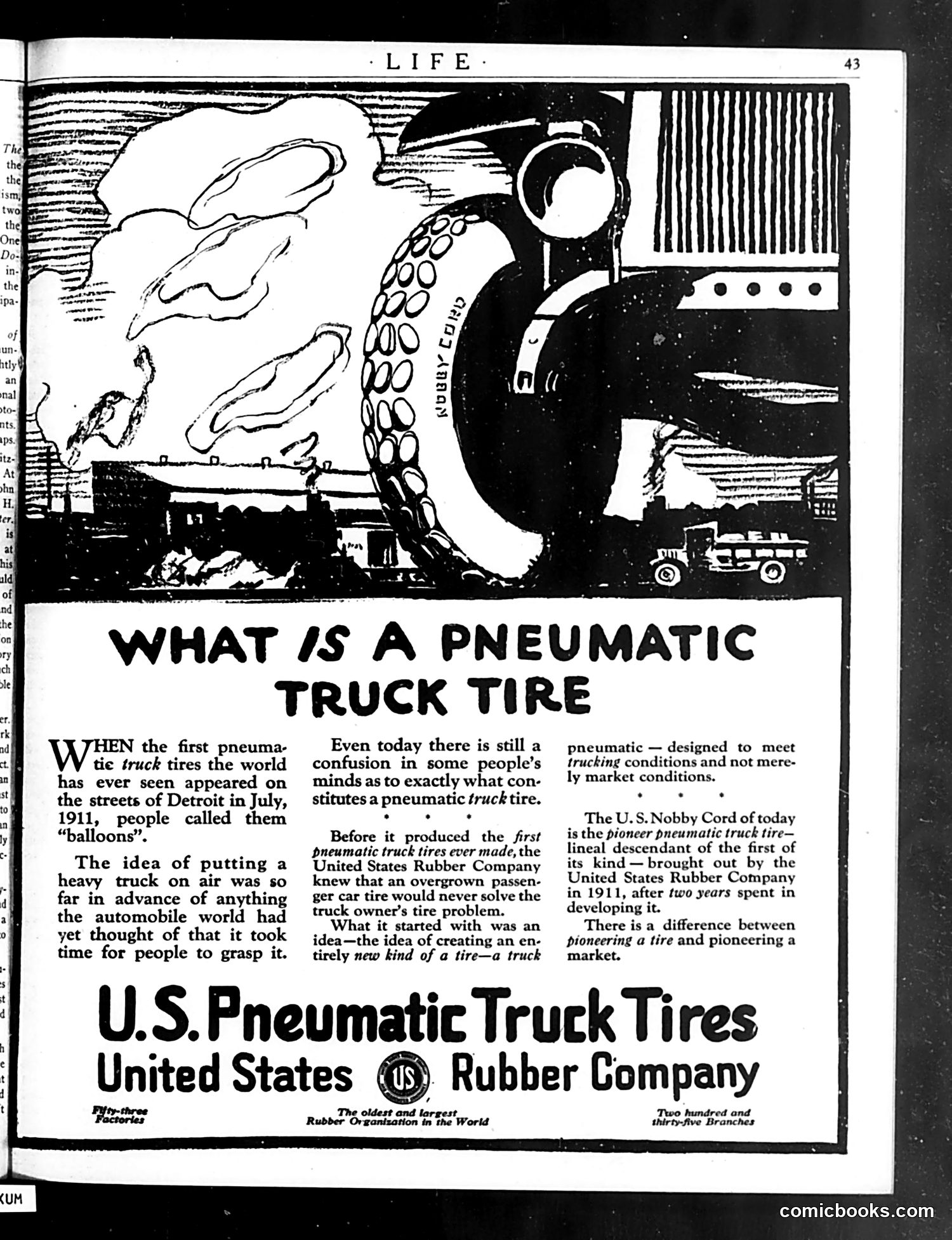
This is primarily **advertising content**, not satire or political commentary. The page features a historical narrative advertisement for U.S. Pneumatic Truck Tires by United States Rubber Company. **The "cartoon" is illustrative**: It depicts the 1911 introduction of pneumatic (air-filled) truck tires, showing the massive tire alongside early automobiles and trucks—visualizing how revolutionary and oversized this innovation appeared to the public. **The historical point**: When pneumatic truck tires debuted in Detroit in 1911, observers called them "balloons" because the technology seemed absurdly impractical. The ad emphasizes that U.S. Rubber Company spent two years developing tires specifically engineered for trucking—not simply enlarging passenger car tires. **For modern readers**: This illustrates how unfamiliar pneumatic tires were to early-20th-century people. The ad positions the company as innovative pioneers, distinguishing between "pioneering a tire" versus merely "pioneering a market"—claiming technical superiority over competitors.
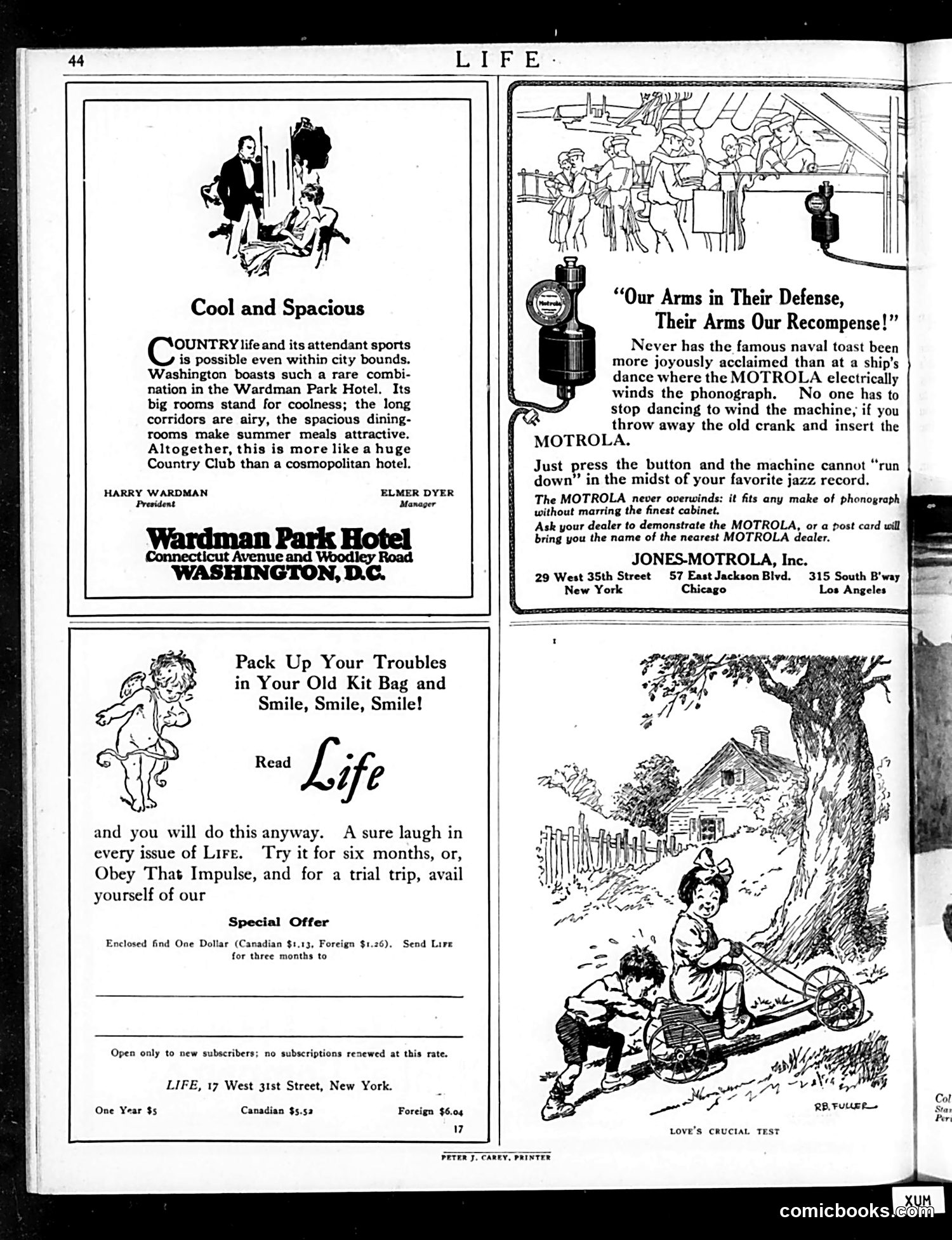
This is primarily an **advertising and subscription page** from Life magazine, with limited satirical content. The main cartoon, "Love's Crucial Test" (bottom right), depicts two children on a seesaw beneath a large tree—a simple domestic scene illustrating childhood play and innocence. The page's notable satirical element appears in the **subscription pitch** (lower left), which references the WWI-era song "Pack Up Your Troubles in Your Old Kit Bag." This repurposes military morale language to encourage magazine subscriptions, suggesting Life offers comic relief and escapism—"a sure laugh in every issue." The other content comprises hotel and phonograph advertisements. The Motrola ad includes a naval toast reference ("Our Arms in Their Defense, Their Arms Our Recompense"), likely patriotic rhetoric from the WWI period. The page reflects Life's position as a humor magazine offering respite from contemporary anxieties through entertainment and satire.
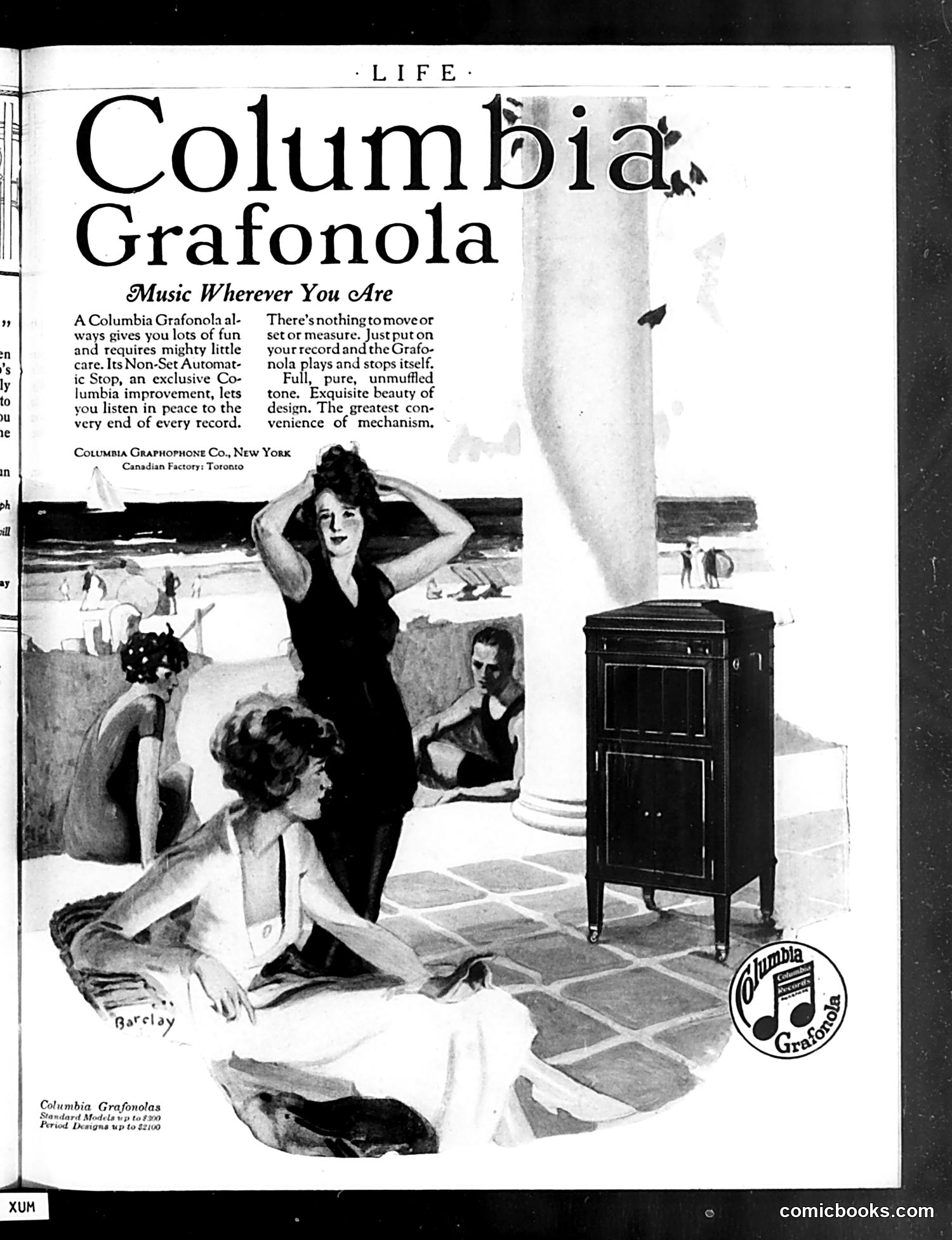
This is a **product advertisement**, not political satire. It promotes Columbia's Grafonola phonograph, emphasizing its "Non-Set Automatic Stop" feature—a convenience innovation that lets records play and stop without manual adjustment. The illustration depicts an idealized leisure scene: well-dressed people enjoying music together on a beach or seaside setting, with the cabinet-style phonograph as the focal point. This reflects 1920s aspirational marketing: the product enables social entertainment and relaxation "wherever you are." The tagline "Music Wherever You Are" emphasizes portability and accessibility. For modern readers: this represents early consumer electronics marketed as lifestyle enhancers—similar to how smartphones are advertised today. The emphasis on ease-of-use and aesthetic design ("Exquisite beauty of design") positions the expensive device as both functional and fashionable.
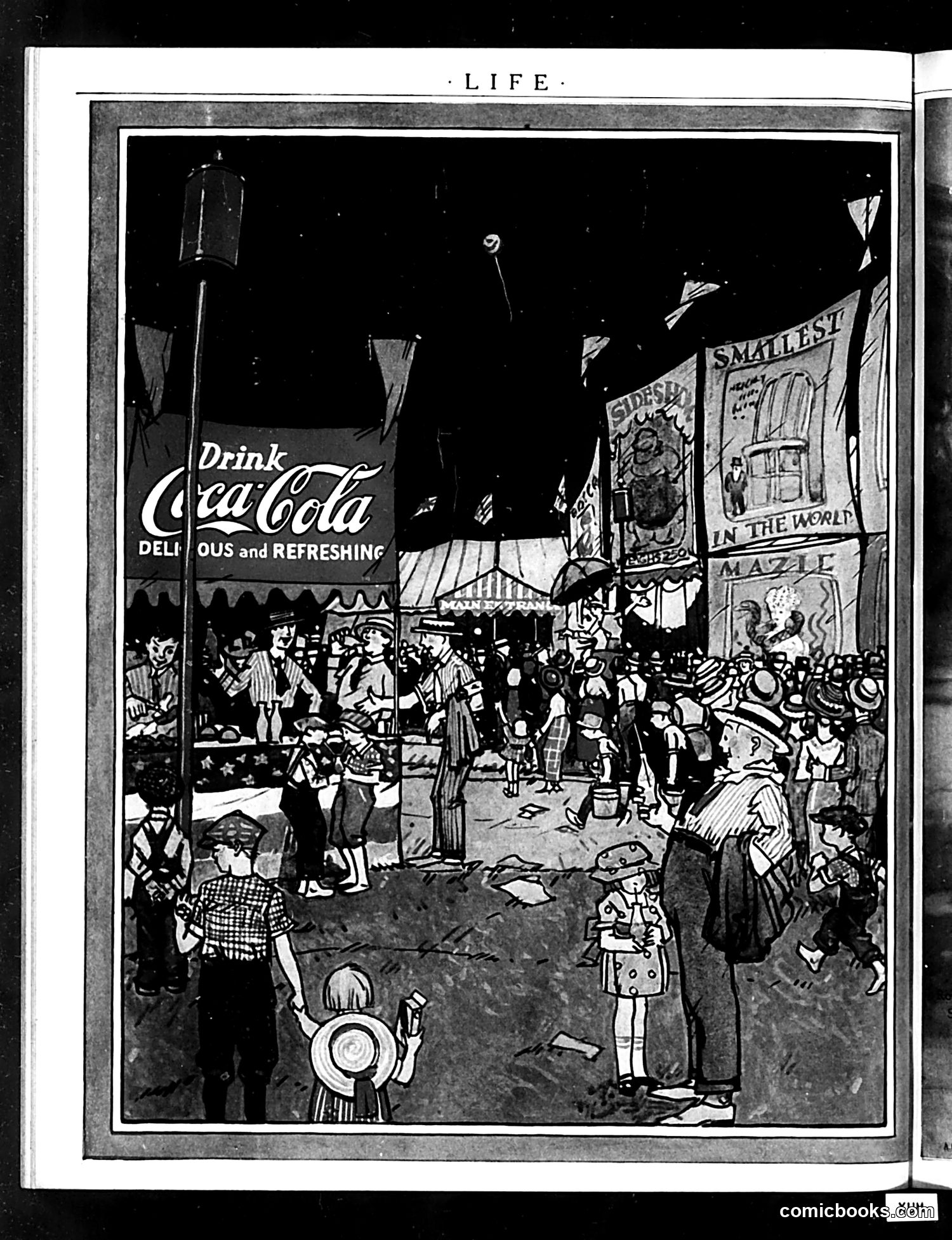
This is a carnival or fair scene prominently featuring a **Coca-Cola advertisement banner** ("Drink Coca-Cola—Delicious and Refreshing") alongside other carnival attractions with signs reading "Smallest" and "Maze" visible. The illustration satirizes **early 20th-century American consumer culture and commercialization**. The scene depicts crowds gathered at what appears to be a public fair or carnival, where corporate advertising (Coca-Cola) has become as central an attraction as traditional carnival entertainment. The satire likely critiques how commercial brands have infiltrated public spaces and entertainment—transforming what were once community gatherings into opportunities for corporate product promotion. The casual mixing of advertising with crowds of families suggests the normalization of consumerism in American life.
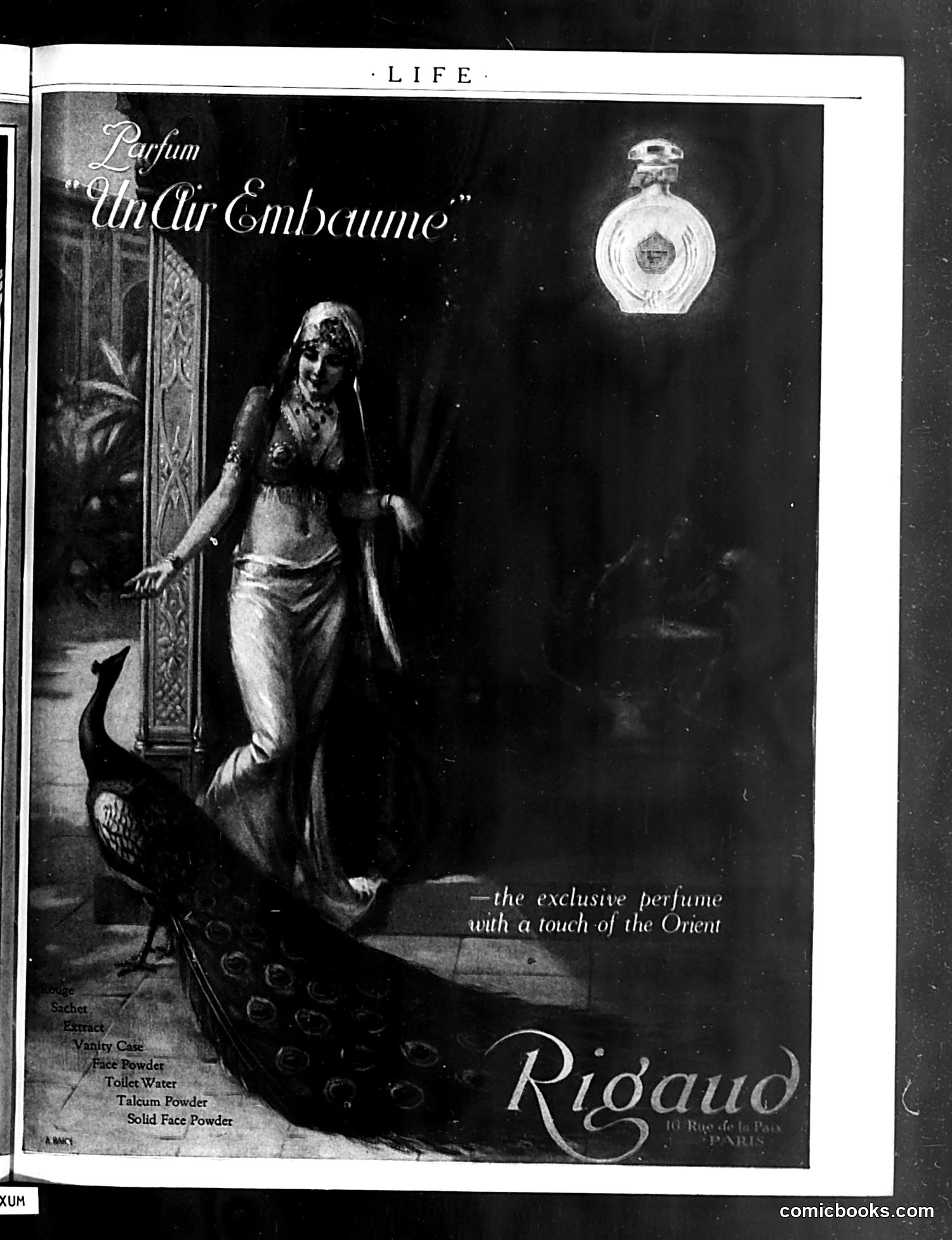
This is primarily a **full-page advertisement**, not political satire or a cartoon. It advertises "Un Air Embaumé," an exclusive perfume by Rigaud of Paris. The ad features an orientalist illustration of a woman in exotic dress with peacocks, styled to evoke "the Orient" as the tagline indicates. This reflects early-20th-century Western luxury marketing that associated exotic, non-Western aesthetics with exclusivity and desirability. The left margin lists other Rigaud products (sachets, vanity case, face powder, etc.), typical of period cosmetics advertising. There is no political commentary or satire present—this is straightforward commercial advertising using orientalist imagery popular in that era's high-end perfume marketing.
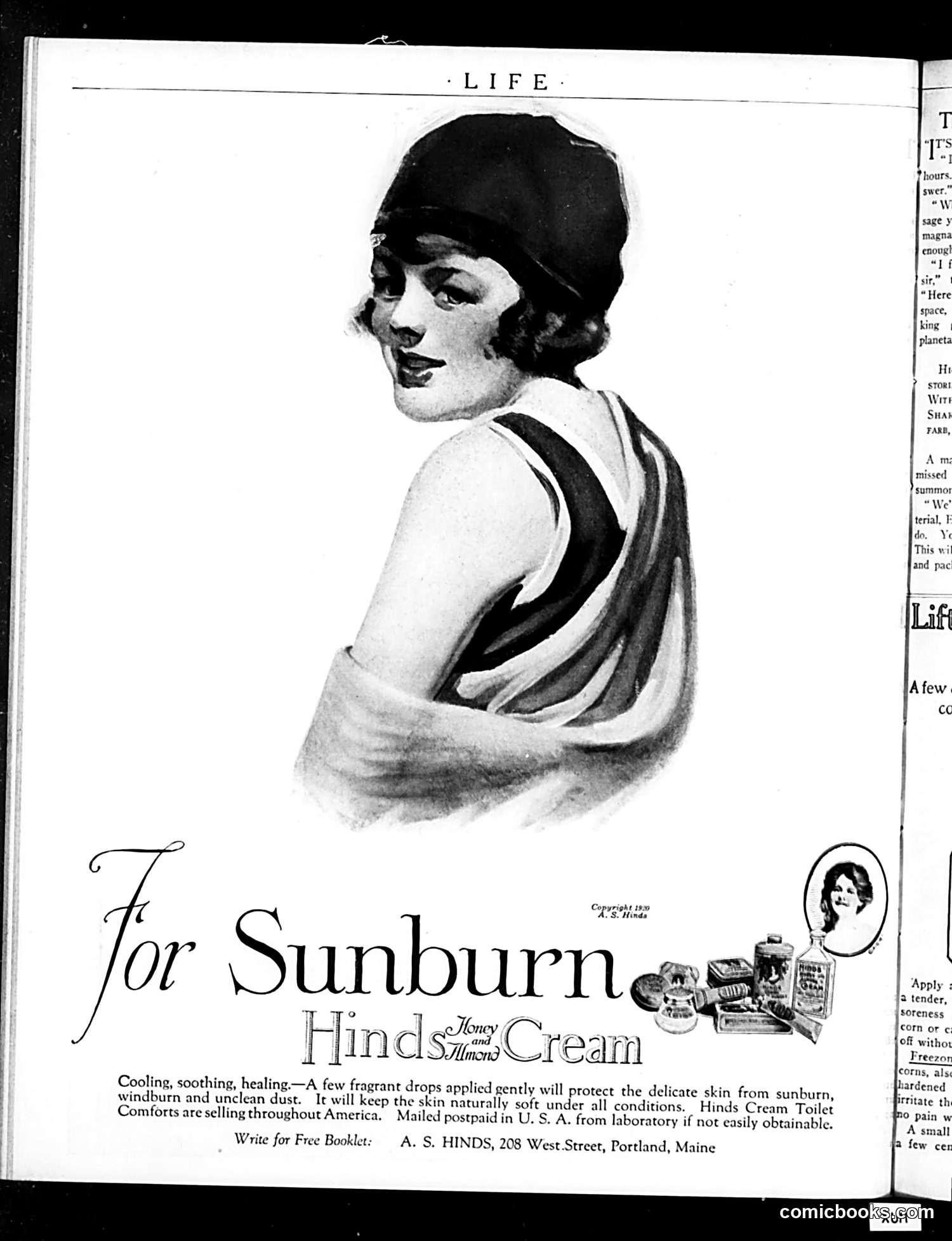
This page is primarily a **product advertisement**, not political satire or comics content. It features a full-page ad for Hinds Honey and Almond Cream, a skincare product marketed for sunburn relief. The image shows a fashionable woman in 1920s style (cloche hat, sleeveless dress) gazing over her shoulder—a typical advertising pose of the era. The ad copy emphasizes the product's moisturizing and protective properties: "cooling, soothing, healing." The small product illustration in the bottom right shows various Hinds cream containers, establishing this as legitimate product promotion rather than editorial content or satire. The Portland, Maine address confirms it's a genuine manufacturer's advertisement. **The historical context**: This represents how Life magazine—known for satire and humor—also carried conventional advertisements to support operations. There is no joke or political message here; it's straightforward early-20th-century cosmetics marketing.
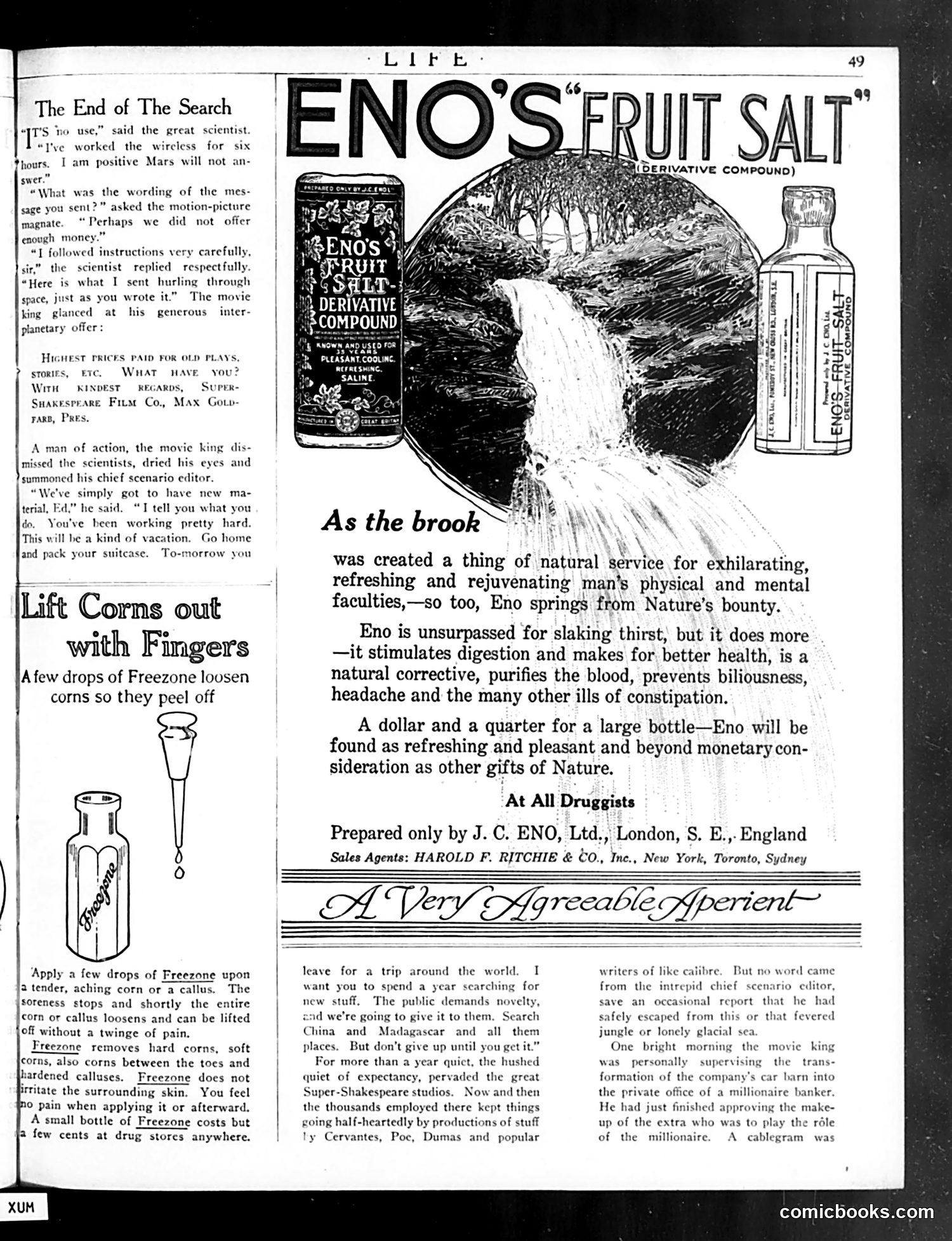
This cartoon mocks early Hollywood's obsession with acquiring source material and its cynical approach to storytelling. A movie mogul, frustrated that scientists won't respond to his wireless message to Mars, instructs his scenario editor to search the globe for new stories because "the public demands novelty." The satire works on multiple levels: the absurdity of contacting Mars for scripts, the studio's willingness to send employees on year-long wild-goose chases, and the punchline—after all that expense and effort, the studio simply produces derivative adaptations of classic literature (Cervantes, Poe, Dumas) anyway. The implied critique: Hollywood claims to seek originality while actually mining existing works, and filmmakers will go to ridiculous lengths (literally planetary outreach) to justify recycling old material. The editor's journey around the world yields nothing new; the studio defaults to proven classics, revealing the entire enterprise as performative rather than genuinely creative.
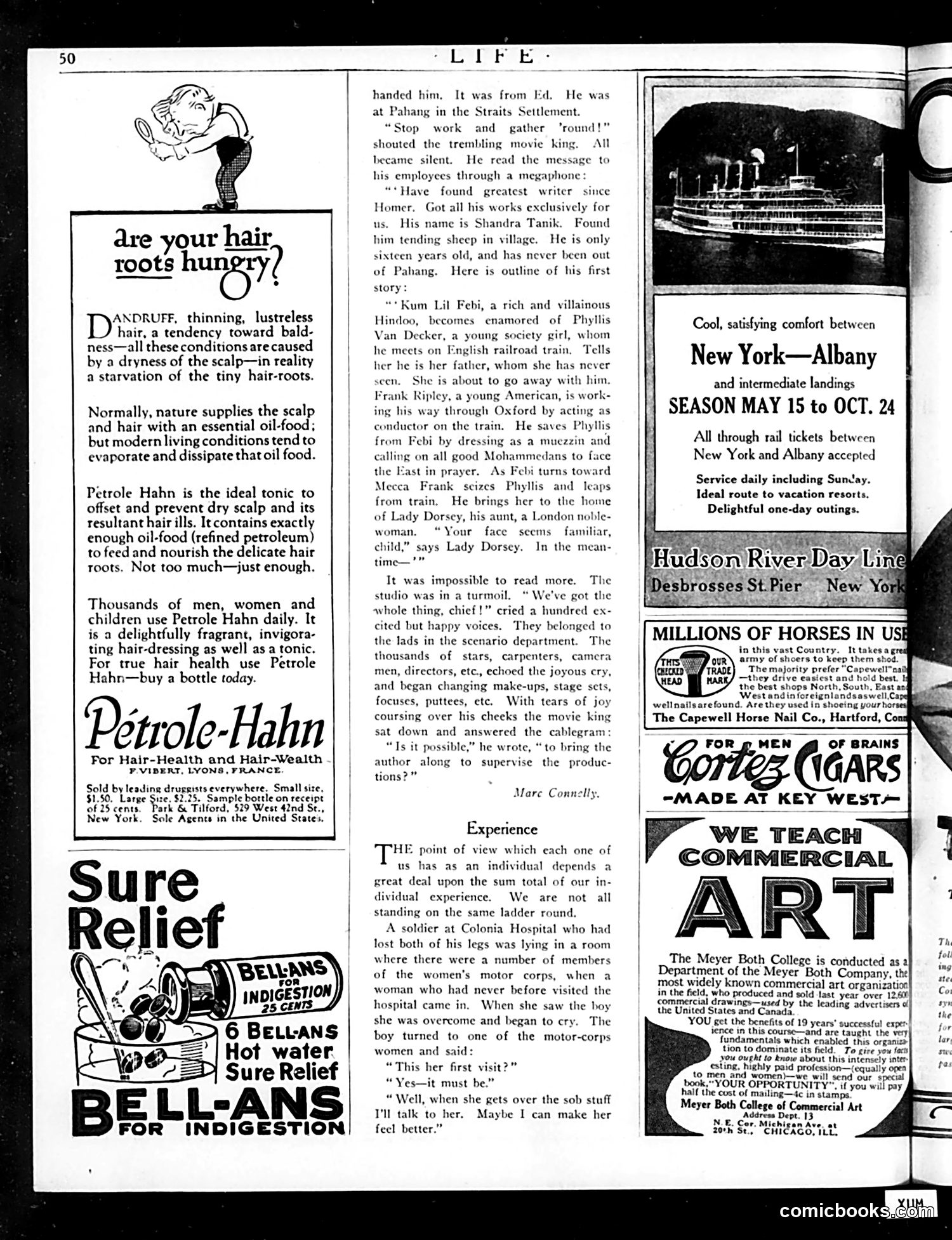
This page is primarily **advertisements** interspersed with a brief **satirical story excerpt** about Hollywood's movie industry. The cartoon/story mocks **early 1920s film studio desperation**: A movie producer receives news of discovering a supposedly great unknown writer named "Shandra Tanik" from a remote Malaysian village—a sixteen-year-old herding sheep who's written a wildly implausible melodrama. The plot parodies overwrought silent-film scenarios: mysterious villains, unlikely coincidences, and absurd plot devices (a man disguising himself as a muezzin to save a girl). The satire targets the film industry's hunger for "exotic" foreign talent and sensational stories, no matter how contrived. The studio staff's hysterical excitement over this obviously mediocre plot emphasizes how profit-driven and uncritical the system was. The surrounding ads (Petrole Hahn hair tonic, Bellans indigestion remedy, steamship service, horse nails, and commercial art schools) represent typical early-20th-century magazine advertising aimed at middle-class readers.
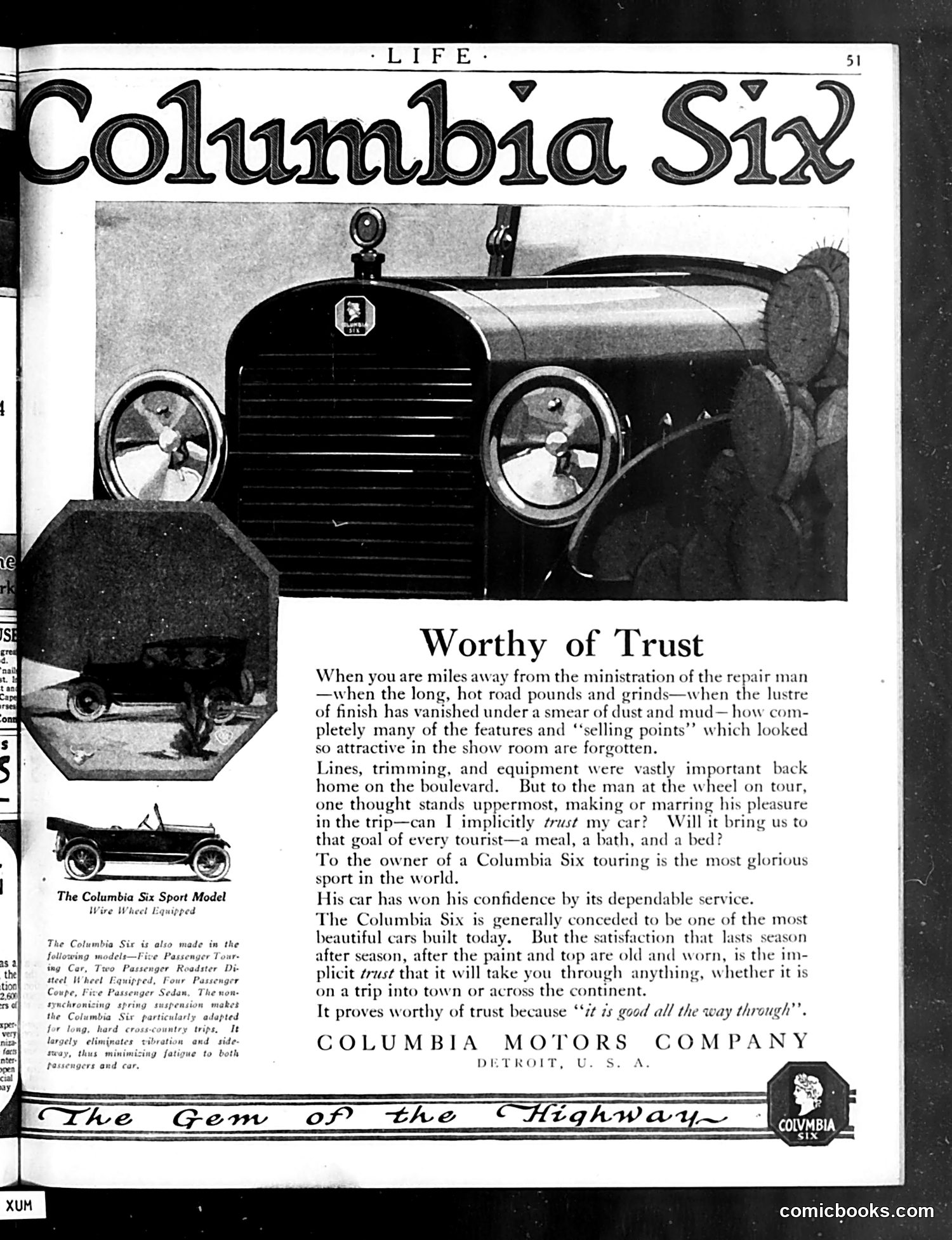
This is **not a political cartoon or satire** — it's a straightforward automobile advertisement from Life magazine's advertising section (page 51). The ad promotes the Columbia Six, a touring car manufactured by Columbia Motors Company in Detroit. Rather than emphasizing showroom aesthetics ("lines, trimming, and equipment"), the ad targets **long-distance travelers** by emphasizing reliability and dependability. The sales pitch reflects early 1900s automotive concerns: roads were poor, repair shops distant, and mechanical failure during cross-country travel posed real hardships. The ad's emotional appeal focuses on trust — that the car will reliably deliver tourists to meals, baths, and beds. The small illustration shows the sport model; another image depicts the car on a dusty road, visually reinforcing the "real-world conditions" messaging. The phrase "good all the way through" encapsulates the durability claim. This represents typical Life magazine automotive advertising from the era when car touring was becoming popular leisure activity.
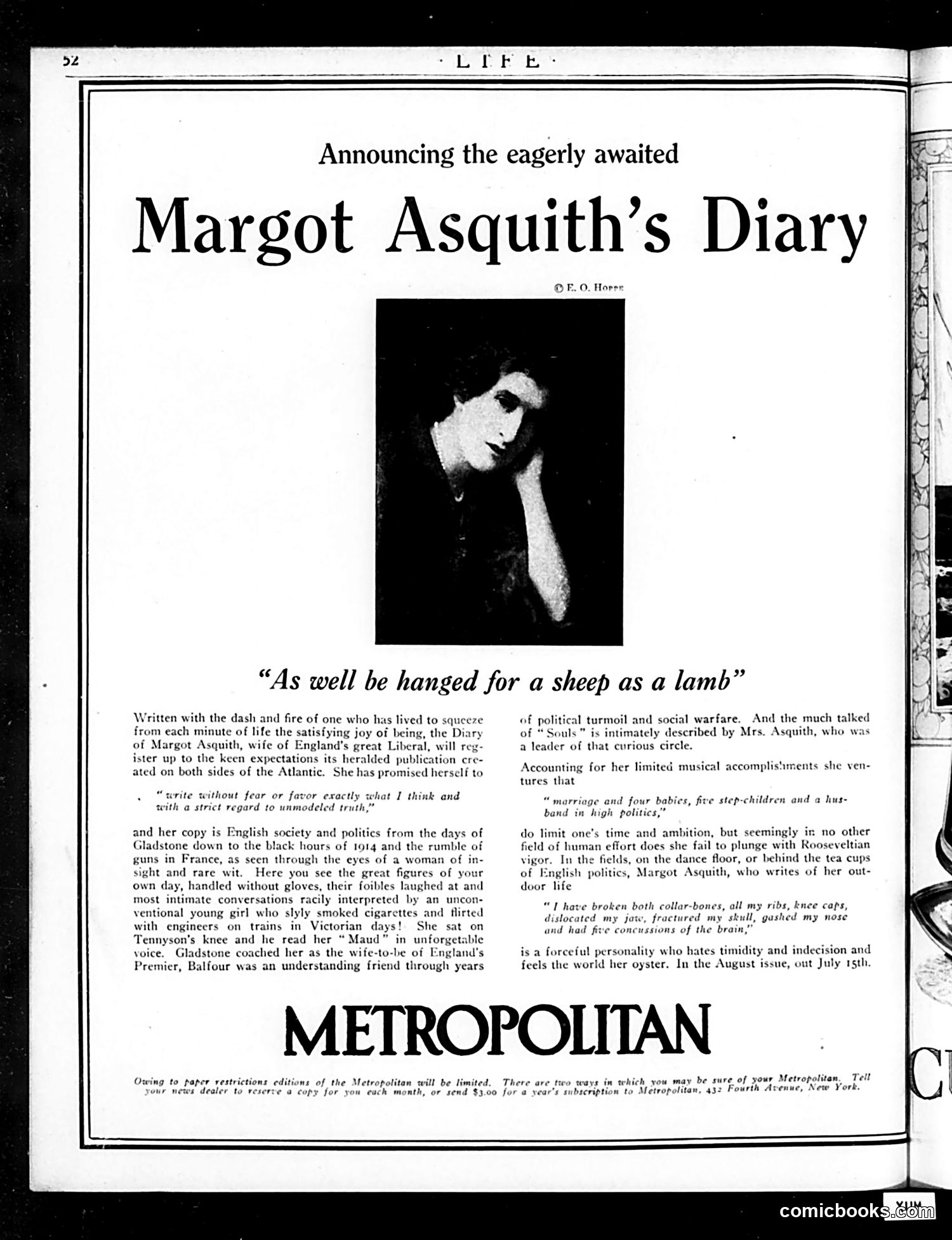
This is primarily an advertisement for the publication of Margot Asquith's memoir/diary in *Metropolitan* magazine. Margot was the wife of British Prime Minister H.H. Asquith, prominent in early 20th-century English society and politics. The ad promotes her diary as a forthright, witty insider account of British political and social life from the Gladstone era through World War I. The photograph shows a contemplative portrait. The epigraph "As well be hanged for a sheep as a lamb" suggests her promised candid revelations about prominent figures—implying she'll face criticism either way, so she might as well be thorough. The text emphasizes her unconventional personality: physically adventurous (broken bones, concussions), socially prominent (mentored by Gladstone, friend of Balfour), and politically engaged through her husband's career. The ad positions her diary as essential reading for understanding English society's inner workings during a transformative historical period.
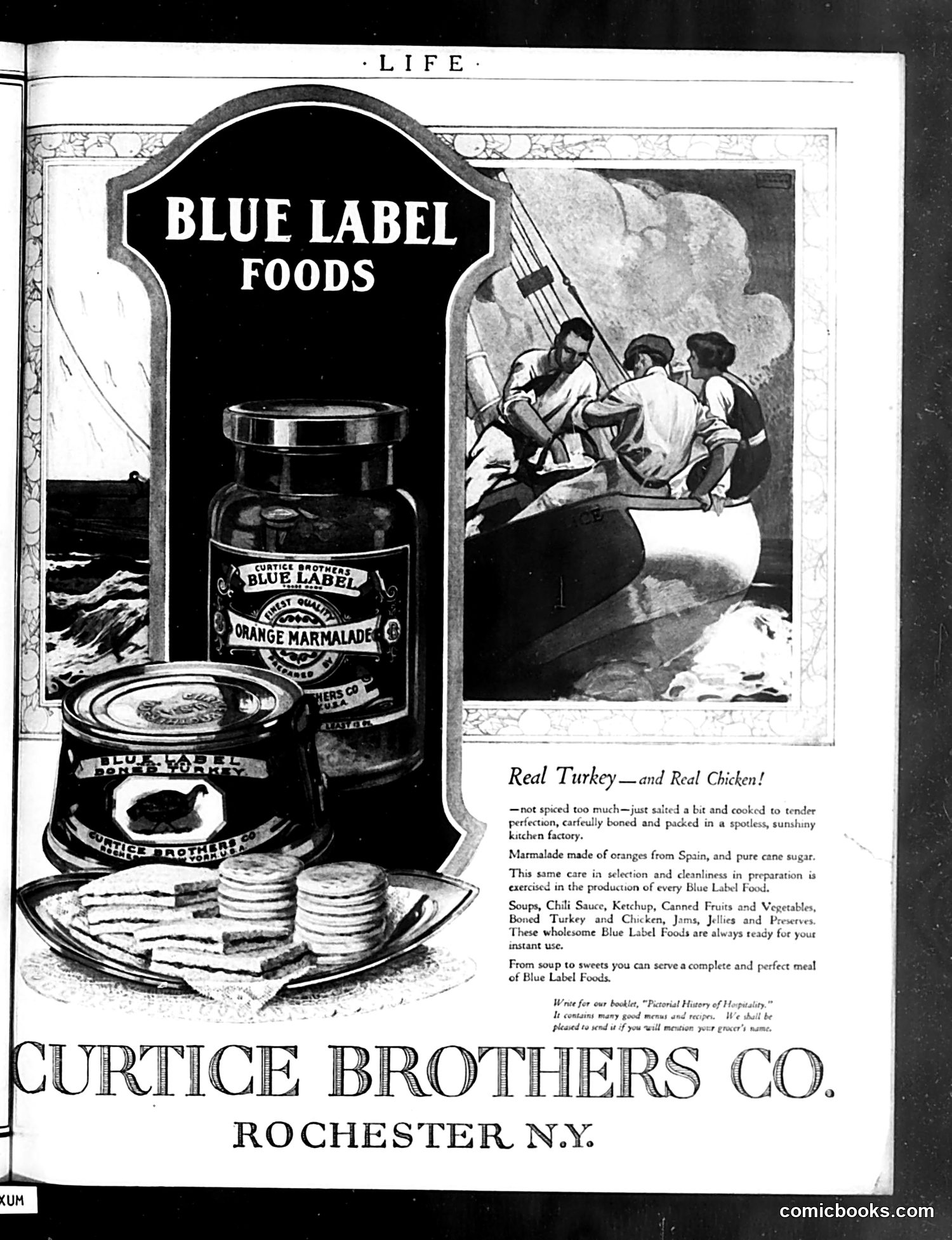
This is a straightforward **food product advertisement**, not political satire. Curtice Brothers Company of Rochester, New York promotes their Blue Label Foods line through this Life magazine page. The ad emphasizes **food safety and quality control**—highlighting "spotless, sunshiny kitchen factory" conditions and careful selection of ingredients (Spanish oranges, pure cane sugar). This messaging reflects early 20th-century consumer anxieties about food purity following scandals like those exposed in Upton Sinclair's *The Jungle*. The image shows canned goods (marmalade, turkey, chicken) and a scene of workers preparing food, meant to assure buyers of wholesome production. The ad promises convenience ("always ready for your instant use") and variety ("from soup to sweets"). There is **no political cartoon or satire here**—it's commercial advertising aimed at homemakers seeking reliable, safe canned foods.
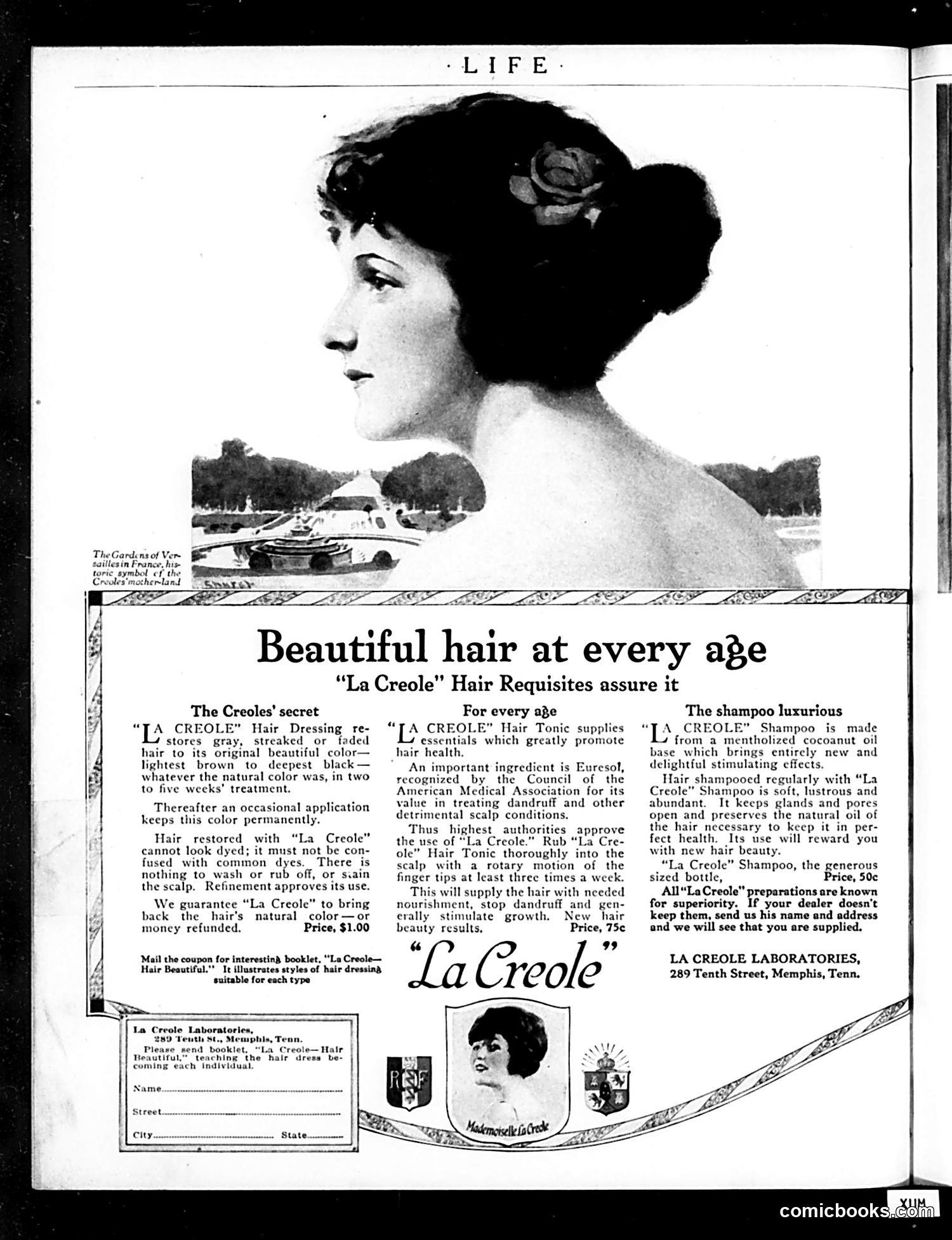
This is a **straightforward advertisement**, not political satire. It promotes "La Creole" hair products—a hair dressing, tonic, and shampoo marketed by La Creole Laboratories in Memphis, Tennessee. The page features a profile portrait of a woman with styled dark hair adorned with a decorative rose, positioned above the product copy. A smaller photograph of another woman appears at the bottom center. **Key sales claims:** - The hair dressing restores gray or faded hair to "original" color (lightest brown to deepest black) in 2-5 weeks - The tonic treats dandruff and stimulates growth - The shampoo conditions hair using mentholized coconut oil **Historical context:** The appeal to "Creole" in the product name, combined with references to restoring hair's "natural color," suggests marketing to African American customers during the early 20th century. The mention of the American Medical Association's endorsement was a common credibility strategy of the era. This is period advertising, not editorial commentary.
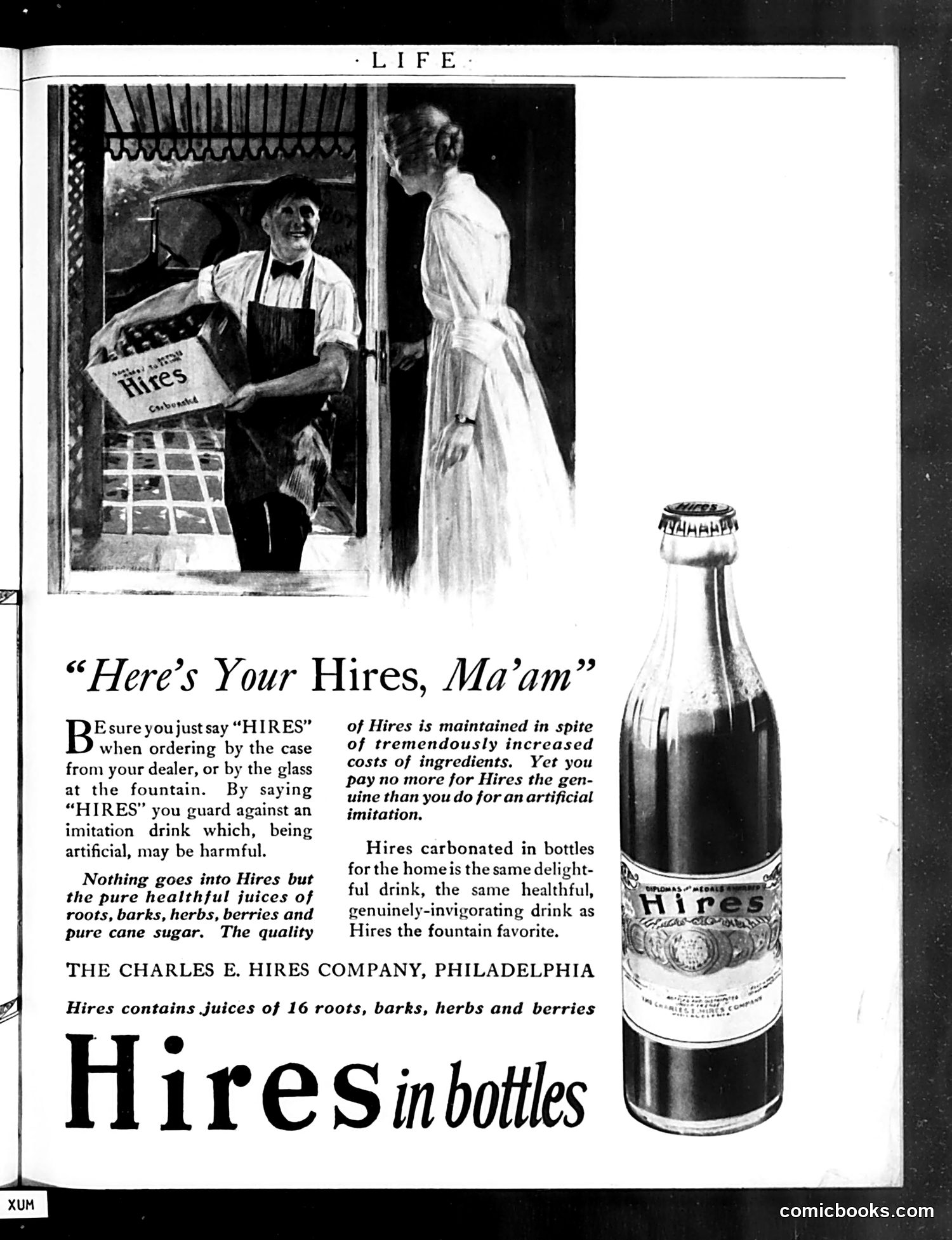
This is primarily a **product advertisement** for Hires root beer, not satire or political commentary. The page depicts a delivery man bringing a case of bottled Hires to a housewife, illustrating convenient home consumption. The advertisement's central argument addresses consumer concerns about **counterfeit beverages**—a real problem in early 20th-century America when regulation was minimal. The text warns buyers to specifically request "Hires" by name to avoid harmful imitations. It emphasizes Hires' authenticity: made from "pure healthful juices of roots, barks, herbs, berries and pure cane sugar," not artificial ingredients. The appeal to a female householder reflects marketing strategies of the era, positioning the product as safe and wholesome for family consumption. The bottle shown on the right serves as product identification. This is straightforward advertising rather than satirical content—Life magazine included advertisements alongside its editorial cartoons and humor pieces.
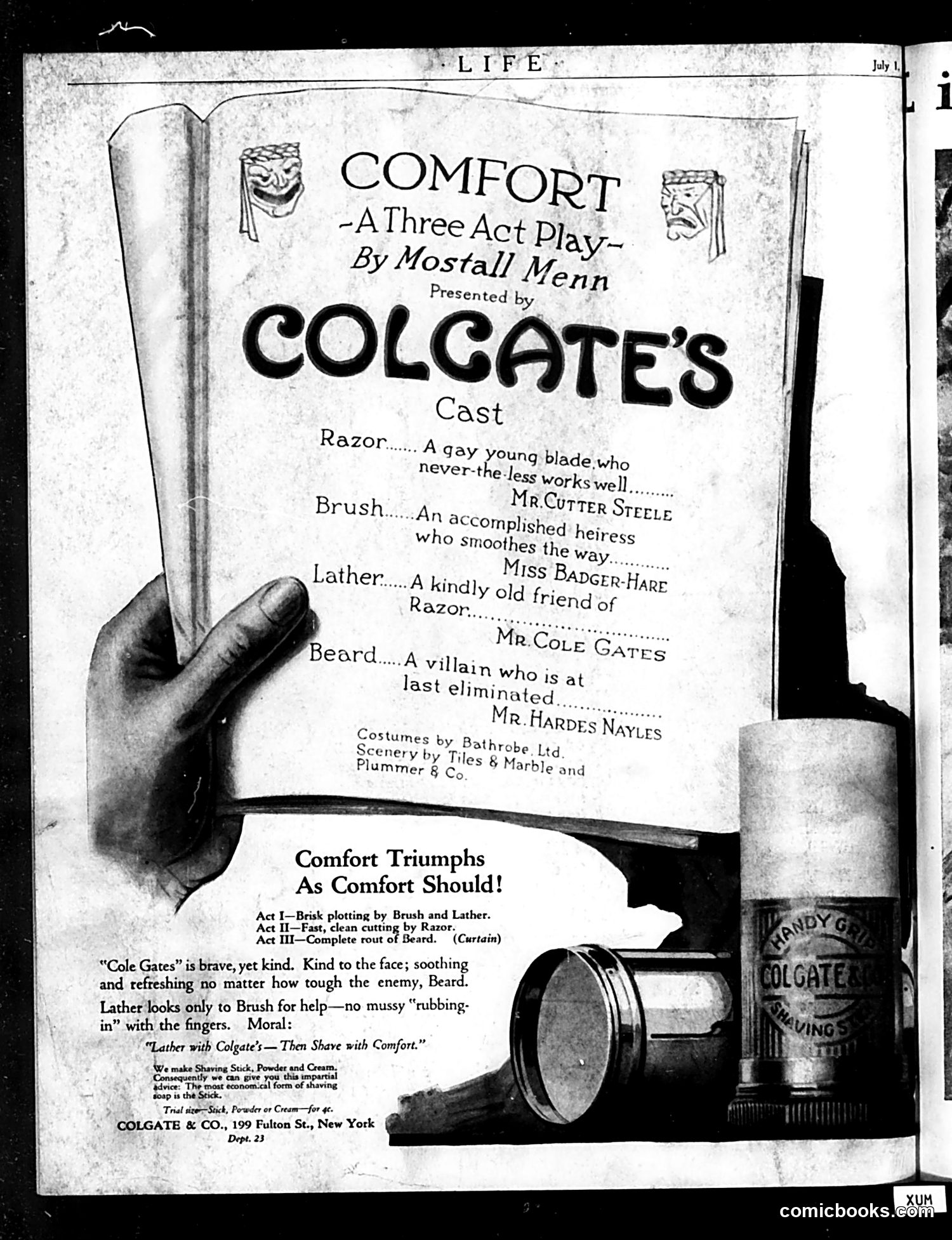
This is a **Colgate's shaving products advertisement** disguised as theatrical entertainment—not political satire. The "play" uses personified shaving implements as characters: **Razor** (the lead), **Brush** and **Lather** (supporting roles), and **Beard** (the antagonist). The plot is simply the shaving process itself—a three-act narrative where lather and brush prepare the face, the razor cuts cleanly, and beard is defeated. The humor is mild and whimsical: naming the razor "Cole Gates" (a pun on "Colgate"), characterizing lather as dependent on brush, and framing shaving as a heroic battle. The ad emphasizes that Colgate's stick form is economical and requires minimal "rubbing-in." There is **no political or social commentary** here—this is pure product marketing using theatrical framing to make a mundane grooming routine entertaining to magazine readers. The "satire" is gentle and commercial, typical of early 20th-century advertising's attempt to engage readers beyond straightforward product claims.