
Life, 1920-07-01 · page 26 of 56
Life — July 1, 1920 — page 26: what you’re looking at
What you’re looking at
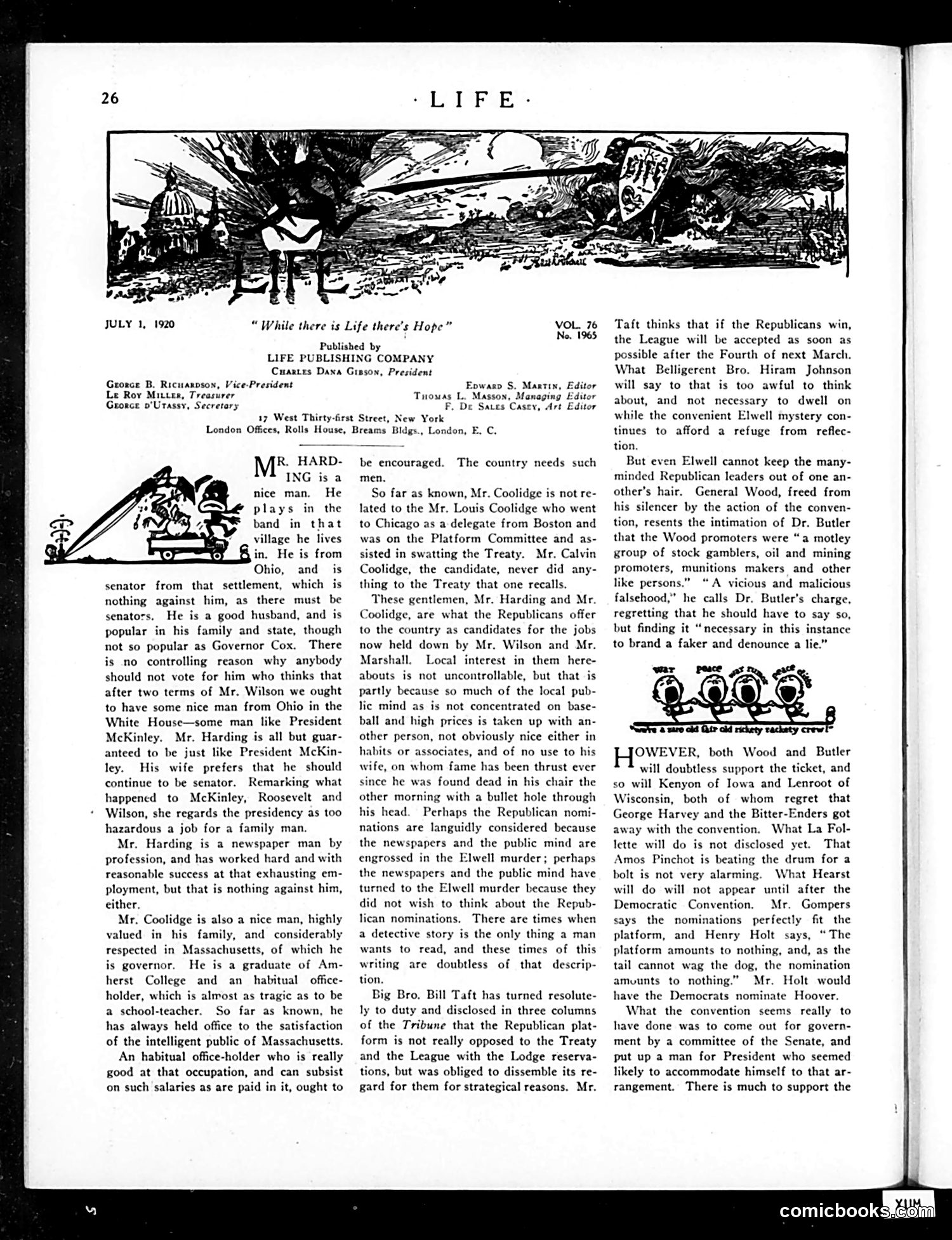
This is a satirical editorial from *Life* magazine (July 1, 1920) assessing Republican presidential and vice-presidential candidates Warren G. Harding and Calvin Coolidge ahead of the 1920 election. The piece uses backhanded compliments to mock both candidates as mediocre "nice men" from Ohio and Massachusetts respectively. It sarcastically praises Harding as a newspaper man and popular husband, while noting he's "all but guaranteed to be just like President McKinley"—implying uninspiring ordinariness. Coolidge receives similar faint praise for being a habitual office-holder. The commentary then pivots to noting that public attention is consumed by the sensational Elwell murder case, suggesting Americans care more about detective stories than Republican nominations. It concludes with references to the League of Nations debate and William Howard Taft's recent defense of the Republican platform position on the Treaty. The underlying satire: these "nice" candidates lack compelling vision or distinction.
📄 Transcribed text from this page (OCR, searchable)
Machine-transcribed from the original scan — historical spelling and the odd misread are preserved.
1920 “While there is Life there’s Hope” Published by LIFE PUBLISHING COMPANY Cuartes Dana Gipson, President Grorce B. Ricuarpson, Vice-President Le Roy Mitte, Treasurer Grorce v'Urassy, Secretary Eowarp S. Martin, Editor Tnosas L. Masson, Managing Editor F, De Sates Casey, Art Editor 17 West Thirty-first Street, New York London Offices, Rolls House, Breams Bldgs., R. HARD- ING is a nice man. He plays in the band in that village he lives He is from Ohio, and is senator from that settlement, which is nothing against him, as there must be senators. He is a good husband, and is popular in his family and state, though not so popular as Governor Cox. There is no controlling reason why anybody should not vote for him who thinks that after two terms of Mr. Wilson we ought to have some nice man from Ohio in the White House—some man like President McKinley. Mr. Harding is all but guar- anteed to be just like President McKin- ley. His wife prefers that he should continue to be senator. Remarking what happened to McKinley, Roosevelt and Wilson, she regards the presidency as too hazardous a job for a family man. Mr. Harding is a newspaper man by profession, and has worked hard and with reasonable success at that exhausting em- ployment, but that is nothing against him, either. Mr. Coolidge is also a nice man, highly valued in his family, and considerably respected in Massachusetts, of which he is governor. He is a graduate of Am- herst College and an habitual office- holder, which is almost as tragic as to be a school-teacher. So far as known, he has always held office to the satisfaction of the intelligent public of Massachusetts. An habitual office-holder who is really good at that occupation, and can subsist on such salaries as are paid in it, ought to London, E. C. be encouraged. men. So far as known, Mr. Coolidge is not re- lated to the Mr. Louis Coolidge who went to Chicago as a delegate from Boston and was on the Platform Committee and as- sisted in swatting the Treaty. Mr. Calvin Coolidge, the candidate, never did any- thing to the Treaty that one recalls. These gentlemen, Mr. Harding and Mr. Coolidge, are what the Republicans offer to the country as candidates for the jobs now held down by Mr. Wilson and Mr. Marshall. Local interest in them here- abouts is not uncontrollable, but that is partly because so much of the local pub- lic mind as is not concentrated on base- ball and high prices is taken up with an- other person, not obviously nice either in habits or associates, and of no use to his wife, on whom fame has been thrust ever since he was found dead in his chair the other morning with a bullet hole through his head. Perhaps the Republican nomi- nations are languidly considered because the newspapers and the public mind are engrossed in the Elwell murder; perhaps the newspapers and the public mind have turned to the Elwell murder because they did not wish to think about the Repub- lican nominations. There are times when a detective story is the only thing a man wants to read, and these times of this writing are doubtless of that descrip- tion. Big Bro. Bill Taft has turned resolute- ly to duty and disclosed in three columns of the Tribune that the Republican plat- form is not really opposed to the Treaty and the League with the Lodge reserva- tions, but was obliged to dissemble its re- gard for them for strategical reasons. Mr. The country needs such Taft thinks that if the Republicans win, the League will be accepted as soon as possible after the Fourth of next March. What Belligerent Bro, Hiram Johnson will say to that is too awful to think about, and not necessary to dwell on while the convenient Elwell mystery con- tinues to afford a refuge from reflec- tion. But even Elwell cannot keep the many- minded Republican leaders out of one an- other’s hair. General Wood, freed from his silencer by the action of the conven- tion, resents the intimation of Dr. Butler that the Wood promoters were “a motley group of stock gamblers, oil and mining promoters, munitions makers and other like persons.” “A vicious and malicious falsehood,” he calls Dr. Butler’s charge, regretting that he should have to say so, but finding it “necessary in this instance to brand a faker and denounce a lie.” OWEVER, both Wood and Butler will doubtless support the ticket, and so will Kenyon of Iowa and Lenroot of Wisconsin, both of whom regret that George Harvey and the Bitter-Enders got away with the convention. What La Fol- lette will do is not disclosed yet. That Amos Pinchot is beating the drum for a bolt is not very alarming. What Hearst will do will not appear until after the Democratic Convention. Mr. Gompers says the nominations perfectly fit the platform, and Henry Holt says, “The platform amounts to nothing, and, as the tail cannot wag the dog, the nomination amvunts to nothing.” Mr. Holt would have the Democrats nominate Hoover. What the convention seems really to have done was to come out for govern- ment by a committee of the Senate, and put up a man for President who seemed likely to accommodate himself to that ar- rangement. There is much to support the comicbookSen |