
Life, 1920-07-01 · page 42 of 56
Life — July 1, 1920 — page 42: what you’re looking at
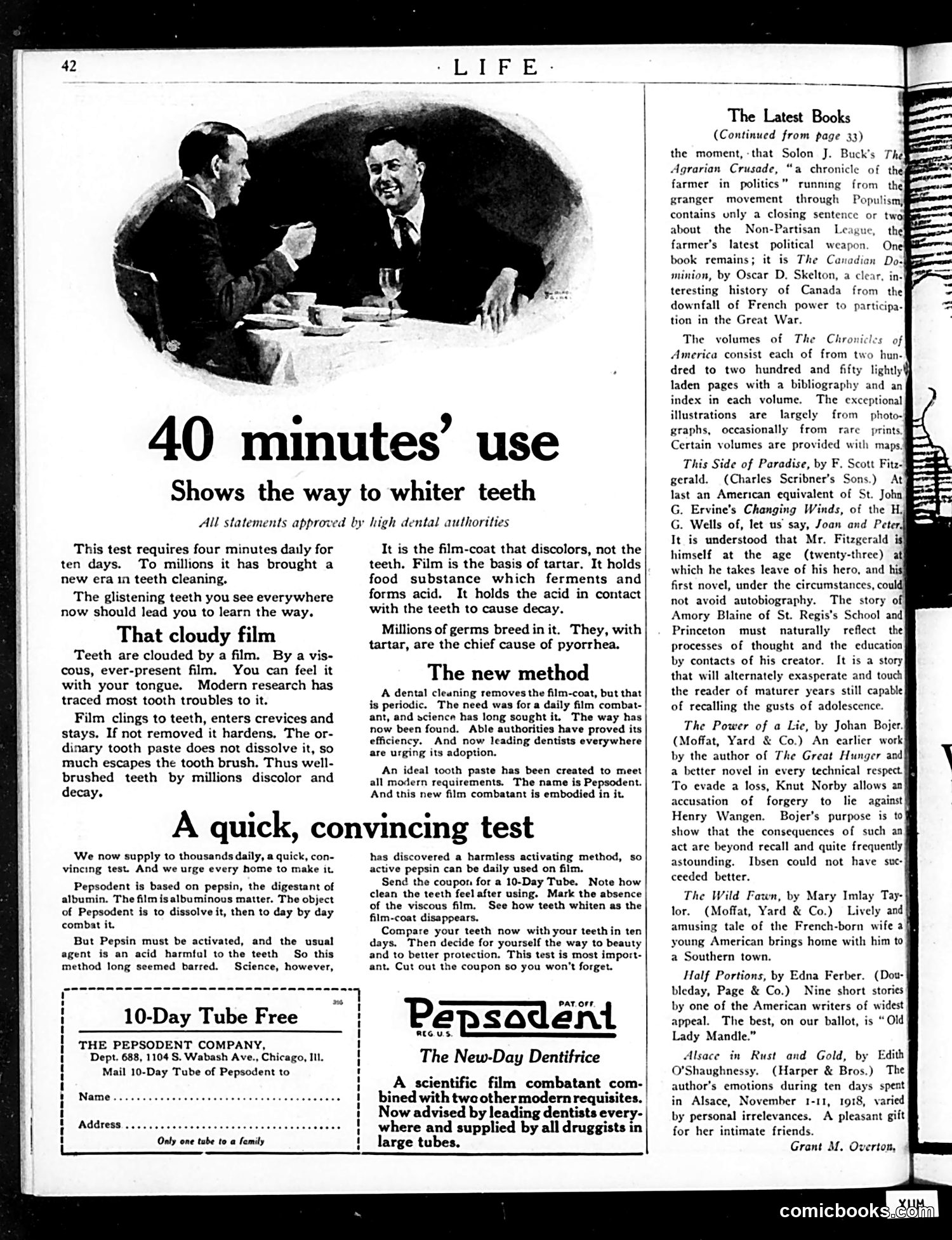
What you’re looking at
This page is primarily a **Pepsodent toothpaste advertisement**, not political satire. The illustration shows two men in conversation at a table—likely meant to represent everyday men discussing dental hygiene rather than specific political figures. The advertisement promotes Pepsodent as a revolutionary "film combatant" toothpaste based on pepsin (a digestive enzyme). It claims to remove the film coating teeth that causes discoloration and decay. The ad offers a free 10-day trial tube and emphasizes endorsement by "leading dentists everywhere." The right column contains book reviews unrelated to the advertisement, discussing works on American agrarian movements and Canadian history. **No political satire is evident here.** This is straightforward early-20th-century product advertising using pseudo-scientific language and testimonial appeal—typical marketing strategy of the era.
📄 Transcribed text from this page (OCR, searchable)
Machine-transcribed from the original scan — historical spelling and the odd misread are preserved.
40 minutes’ use Shows the way to whiter teeth All statements approved by high dental authorities This test requires four minutes daily for ten days. To millions it has brought a new era in teeth cleaning. The glistening teeth you see everywhere now should lead you to learn the way. That cloudy film Teeth are clouded by a film. By a vis- cous, ever-present film. You can feel it with your tongue. Modern research has traced most tooth troubles to it. Film clings to teeth, enters crevices and stays. If not removed it hardens. The or- dinary tooth paste does not dissolve it, so much escapes the tooth brush. Thus well- brushed teeth by millions discolor and decay. It is the film-coat that discolors, not the teeth. Film is the basis of tartar. It holds food substance which ferments and forms acid. It holds the acid in contact with the teeth to cause decay. Millions of germs breed in it. They, with tartar, are the chief cause of pyorrhea. The new method A dental cleaning removes the film-coat, but that is periodic. The need was for a daily film combat- ant, and science has long sought it. The way has now been found. Able authorities have proved its efficiency. And now leading dentists everywhere are urging its adoption. An ideal tooth paste has been created to meet all modern requirements. The name is Pepsodent. And this new film combatant is embodied in it. A quick, convincing test ‘We now supply to thousands daily, a quick, con- vincing test. And we urge every home to make it Pepsodent is based on pepsin, the digestant of albumin. The film isalbuminous matter. The object of Pepsodent is to dissolve it, then to day by day combat it, But Pepsin must be activated, and the usual agent is an acid harmfal to the teeth So this method long seemed barred. Science, however, a6 10-Day Tube Free THE PEPSODENT COMPANY, Dept. 688, 1104 S, Wabash Ave., Chicago, Ill. Mail 10-Day Tube of Pepsodent to has discovered a harmless activating method, so active pepsin can be daily used on film. Send the coupon for a 10-Day Tube. Note how clean the teeth feel after using. Mark the absence of the viscous film. See how teeth whiten as the film-coat disappears. Compare your teeth now with your teeth in ten days, Then decide for yourself the way to beauty and to better protection. This test is most import- ant. Cut out the coupon so you won't forget. Pepsadéent The New-Day Dentifrice A scientific film combatant com- bined with two othermodern requisites. Now advised by leading dentists every- where and supplied by all druggists in large tubes. The Latest Books (Continued from page 33) the moment, -that Solon J. Buck's The Agrarian Crusade, “a chronicle of the farmer in politics” running from the! granger movement through Populism) contains unly a closing sentence or tw about the Non-Partisan League, farmer’s latest political weapon. minion, by Oscar D. Skelton, a clear, in- teresting history of Canada from the downfall of French power to participa- tion in the Great War. The volumes of The Chronicles of America consist each of from two hun- dred to two hundred and fifty lightly’ laden pages with a bibliography and an index in each volume. The exceptional illustrations are largely from photo- graphs, occasionally from rare prints Certain volumes are provided with maps. This Side of Paradise, by F. Scott Fitz- gerald. (Charles Scribner’s Sons.) At last an American equivalent of St. John a G. Ervine’s Changing Winds, of the Hl G. Wells of, let us say, Joan and Peter iia It is understood that Mr. Fitzgerald ig himself at the age (twenty-three) at! which he takes leave of his hero, and hi first novel, under the circumstances, could] not avoid autobiography. The story of] Amory Blaine of St. Regis’s School and Princeton must naturally reflect the processes of thought and the education by contacts of his creator. It is a story that will alternately exasperate and touch the reader of maturer years still capable of recalling the gusts of adolescence. The Power of a Lie, by Johan Bojer. (Moffat, Yard & Co.) An earlier work by the author of The Great Hunger and a better novel in every technical respect. 7 To evade a loss, Knut Norby allows an accusation of forgery to lie against Henry Wangen. Bojer’s purpose is to show that the consequences of such an act are beyond recall and quite frequently astounding. Ibsen could not have suc- ceeded better. The Wild Fawn, by Mary Imlay Tay- lor. (Moffat, Yard & Co.) Lively andj amusing tale of the French-born wife a young American brings home with him to a Southern town, Half Portions, by Edna Ferber. (Dow bleday, Page & Co.) Nine short stories by one of the American writers of widest appeal. The best, on our ballot, is “Old Lady Mandle.” Alsace in Rust and Gold, by Edith O'Shaughnessy. (Harper & Bros.) The author’s emotions during ten days spent in Alsace, November 1-11, 1918, i by personal irrelevances. A pleasant for her intimate friends. Grant M. Overton, comicbookfeoml