
Life, 1920-07-01 · page 27 of 56
Life — July 1, 1920 — page 27: what you’re looking at
What you’re looking at
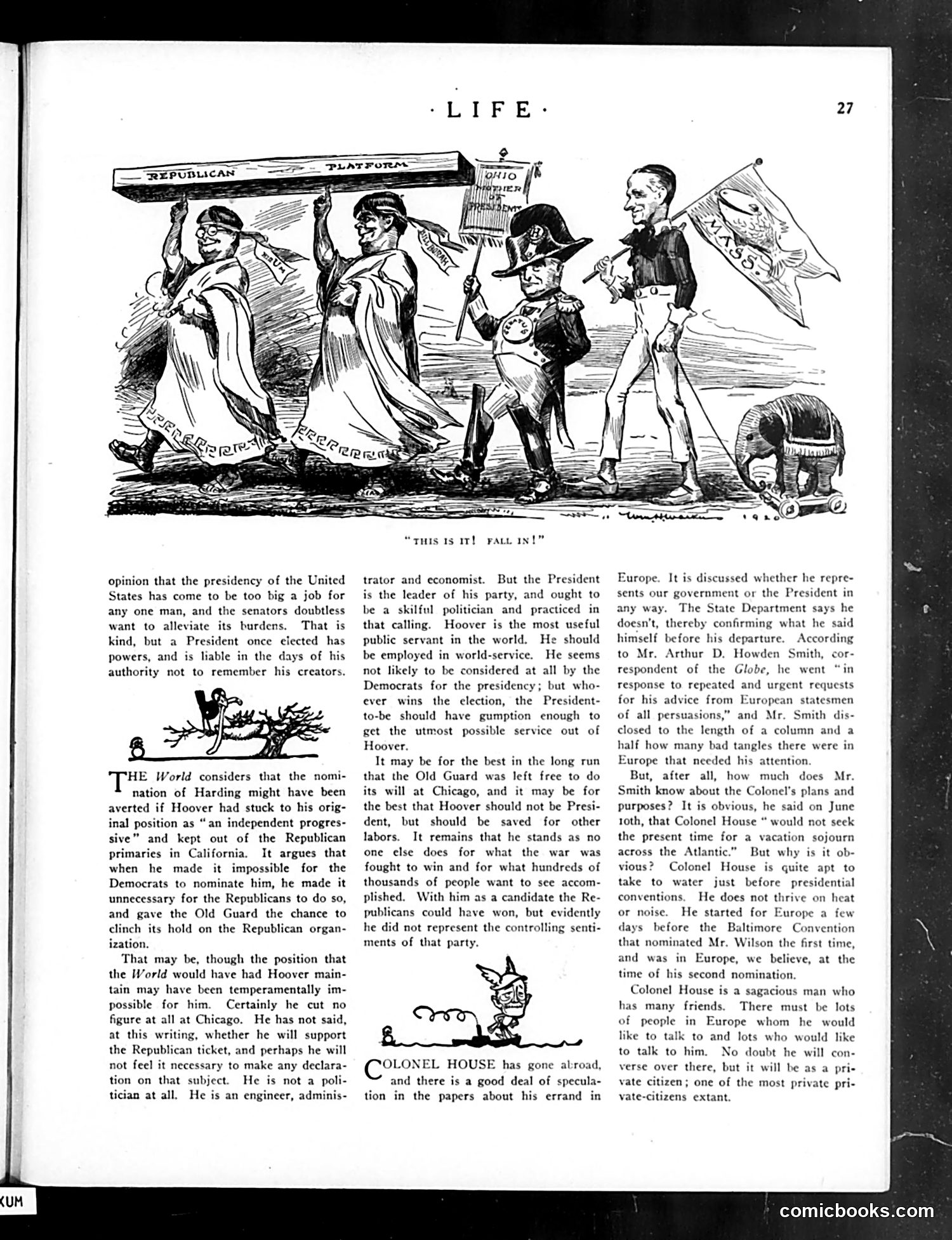
This 1920 Life magazine cartoon satirizes the Republican Party's nomination of Warren G. Harding for president. The image depicts two figures in classical robes (representing the Republican Party and Old Guard) hoisting a wooden plank labeled "Republican Platform" while smaller figures, including what appears to be Herbert Hoover, are told to "fall in" behind it. The accompanying text critiques how Hoover, a respected engineer and administrator, failed to stop Harding's nomination by withdrawing from the California primaries as an "independent progressive." The satire suggests the GOP's Old Guard manipulated the process, and that Hoover—who would have been a stronger candidate—sacrificed his position, allowing a weaker nominee to emerge. The cartoon's point: the Republican establishment steamrolled over more qualified candidates to maintain their control of the party machinery.
📄 Transcribed text from this page (OCR, searchable)
Machine-transcribed from the original scan — historical spelling and the odd misread are preserved.
opinion that the presidency of the United States has come to be too big a job for any one man, and the senators doubtless want to alleviate its burdens. That is kind, but a President once elected has powers, and is liable in the days of his authority not to remember his creators. HE World considers that the nomi- nation of Harding might have been averted if Hoover had stuck to his orig- inal position as “an independent progres- sive” and kept out of the Republican primaries in California. It argues that when he made it impossible for the Democrats to nominate him, he made it unnecessary for the Republicans to do so, and gave the Old Guard the chance to clinch its hold on the Republican organ- ization. That may be, though the position that the World would have had Hoover main- tain may have been temperamentally im- possible for him. Certainly he cut no figure at all at Chicago. He has not said, at this writing, whether he will support the Republican ticket, and perhaps he will not feel it necessary to make any declara- tion on that subject. He is not a poli- tician at all, He is an engineer, adminis- “quis 1s IT! PALL IN trator and economist. But the President is the leader of his party, and ought to be a skilful politician and practiced in that calling. Hoover is the most useful public servant in the world. He should be employed in world-service. He seems not likely to be considered at all by the Democrats for the presidency; but who- ever wins the election, the President- to-be should have gumption enough to get the utmost possible service out of Hoover. It may be for the best in the long run that the Old Guard was left free to do its will at Chicago, and it may be for the best that Hoover should not be Presi- dent, but should be saved for other labors. It remains that he stands as no one else does for what the war was fought to win and for what hundreds of thousands of people want to see accom- plished. With him as a candidate the Re- publicans could have won, but evidently he did not represent the controlling senti- ments of that party. OLO HOUSE has gone abroad, and there is a good deal of specula- tion in the papers about his errand in Europe. It is discussed whether he repre- sents our government or the President in any way. The State Department says he doesn’t, thereby confirming what he said himself before his departure. According to Mr. Arthur D. Howden nith, cor- respondent of the Globe, he went “in response to repeated and urgent requests for his advice from European statesmen of all persuasions,” and Mr. Smith dis- closed to the length of a column and a half how many bad tangles there were in Europe that needed his attention. But, after all, how much does Mr. Smith know about the Colonel's plans and purposes? It is obvious, he said on June 1oth, that Colonel House “ would not seek the present time for a vacation sojourn across the Atlantic.” But why is it ob- vious? Colonel House is quite apt to take to water just before presidential conventions, He does not thrive on heat or noise. He started for Europe a few before the Baltimore Convention that nominated Mr. Wilson the first time, and was in Europe, we believe, at the time of his second nomination. Colonel House is a sagacious man who has many friends. There must be lots of people in Europe whom he would like to talk to and lots who would like to talk to him. No doubt he will con- verse over there, but it will be as a pri- vate citizen; one of the most private pri- vate-citizens extant. days comicbooks.com