
Life, 1920-07-01 · page 33 of 56
Life — July 1, 1920 — page 33: what you’re looking at
What you’re looking at
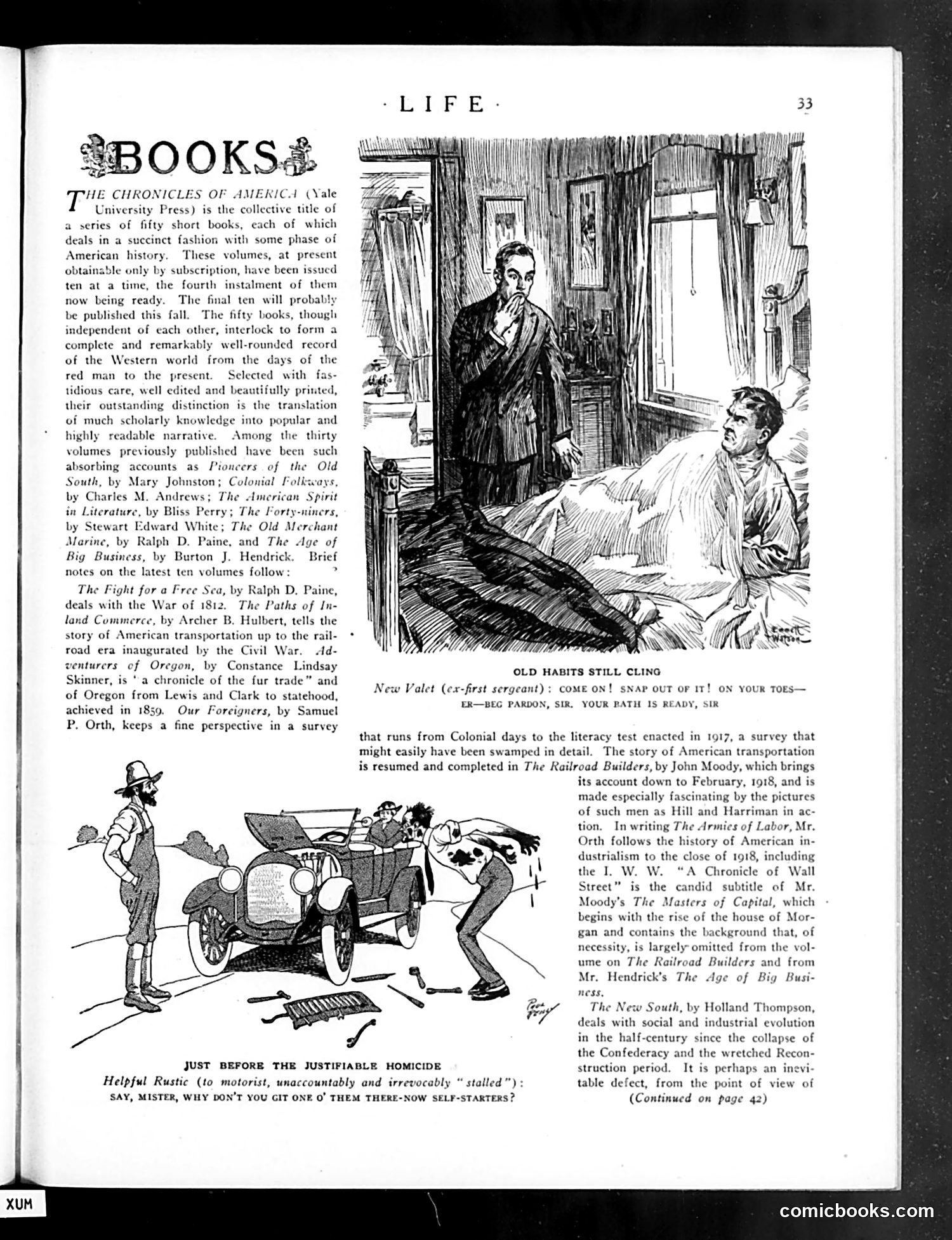
This page contains two cartoon jokes satirizing early automotive technology and military demobilization. **"Just Before the Justifiable Homicide"** (bottom): A rural man offers unsolicited advice to a stranded motorist whose car has broken down. The humor plays on the frustration of unreliable early automobiles—the "self-starter" was a new innovation meant to eliminate hand-cranking. The rustic's tone suggests the motorist deserves his predicament for trusting newfangled technology, reflecting common rural skepticism toward modern cars. **"Old Habits Still Cling"** (top): A former military sergeant, now working as a valet, barks orders at his employer with military formality ("snap out of it," "on your toes"), then catches himself and apologizes. This satirizes the difficulty WWI veterans faced transitioning to civilian life—they retained military bearing and speech patterns unsuited to civilian employment. The cartoon reflects post-1918 concerns about readjusting soldiers. The page's main content reviews Yale University Press's "Chronicles of America" historical book series.
📄 Transcribed text from this page (OCR, searchable)
Machine-transcribed from the original scan — historical spelling and the odd misread are preserved.
33 , ‘ye aN Nga . fost ecl f j An laud HE CHRONICLES OF AMERICA (Yale University Press) is the collective title of a series of fifty short books, each of which deals in a succinct fashion with some phase of American history. These volumes, at present obtainable only by subscription, have been issued ten at a time, the fourth instalment of them now being ready. The final ten will probal be published this fall. The fifty books, though independent of each other, interlock to form a complete and remarkably well-rounded record of the Western world from the days of the red man to the present. Selected with fas- tidious care, well edited and beautifully printed, their outstanding distinction is the translation of much scholarly knowledge into popular and highly readable narrative. Among the thirty volumes previously published have been such absorbing accounts as Pioncers of the Old South, by Mary Johnston; Colonial Folisways, by Charles M. Andrews; The American Spirit in Literature, by Bliss Peri The Forty-niners, by Stewart Edward White; The Old Merchant Marine, by Ralph D. Paine, and The Age of Big Business, by Burton J. Hendrick. Brief notes on the latest ten volumes follow: = The Fight for a Free Sea, by Ralph D, Paine, deals with the War of 1812. The Paths of In- land Commerce, by Archer B. Hulbert, tells the story of American transportation up to the rail- road era inaugurated by the Civil War. Ad- venturers of Oregon, by Constance Lindsay Skinner, is ‘a chronicle of the fur trade” and of Oregon from Lewis and Clark to statehood, achieved in 1859. Our Foreigners, by Samuel P. Orth, keeps a fine perspective in a survey OLD HABITS STILL CLING New Valet (ex-first sergeant): come on! SNAP OUT oF IT! ON YOUR TOES— ER—BEG PARDON, SIR. YOUR PATH IS READY, SIR that runs from Colonial days to the literacy test enacted in 1917, a survey that might easily have been swamped in detail. The story of American transportation is resumed and completed in The Railroad Builders, by John Moody, which brings its account down to February, 1918, and is made especially fascinating by the pictures of such men as Hill and Harriman in ac- tion. In writing The Armies of Labor, Mr. Orth follows the history of American in- dustrialism to the close of 1918, including the I. W. W. “A Chronicle of Wall Street” is the candid subtitle of Mr. Moody's The Masters of Capital, which begins with the rise of the house of Mor- gan and contains the background that, of necessity, is largely omitted from the vol- ume on The Railroad Builders and from Mr. Hendrick’s The Age of Big Busi- ness. The New South, by Holland Thompson, deals with social and industrial evolution in the half-century since the collapse of the Confederacy and the wretched Recon- JUST BEFORE THE JUSTIFIABLE HOMICIDE struction period. It is perhaps a vi- Helpful Rustic (to motorist, unaccountably and irrevocably “ stalled”): table defect, from the point of view of SAY, MISTER, WHY DON’T YOU GIT ONE 0’ THEM THERE-NOW SELF-STARTERS ? (Continued on page 42) comicbooks.com