
Life, 1920-07-01 · page 23 of 56
Life — July 1, 1920 — page 23: what you’re looking at
What you’re looking at
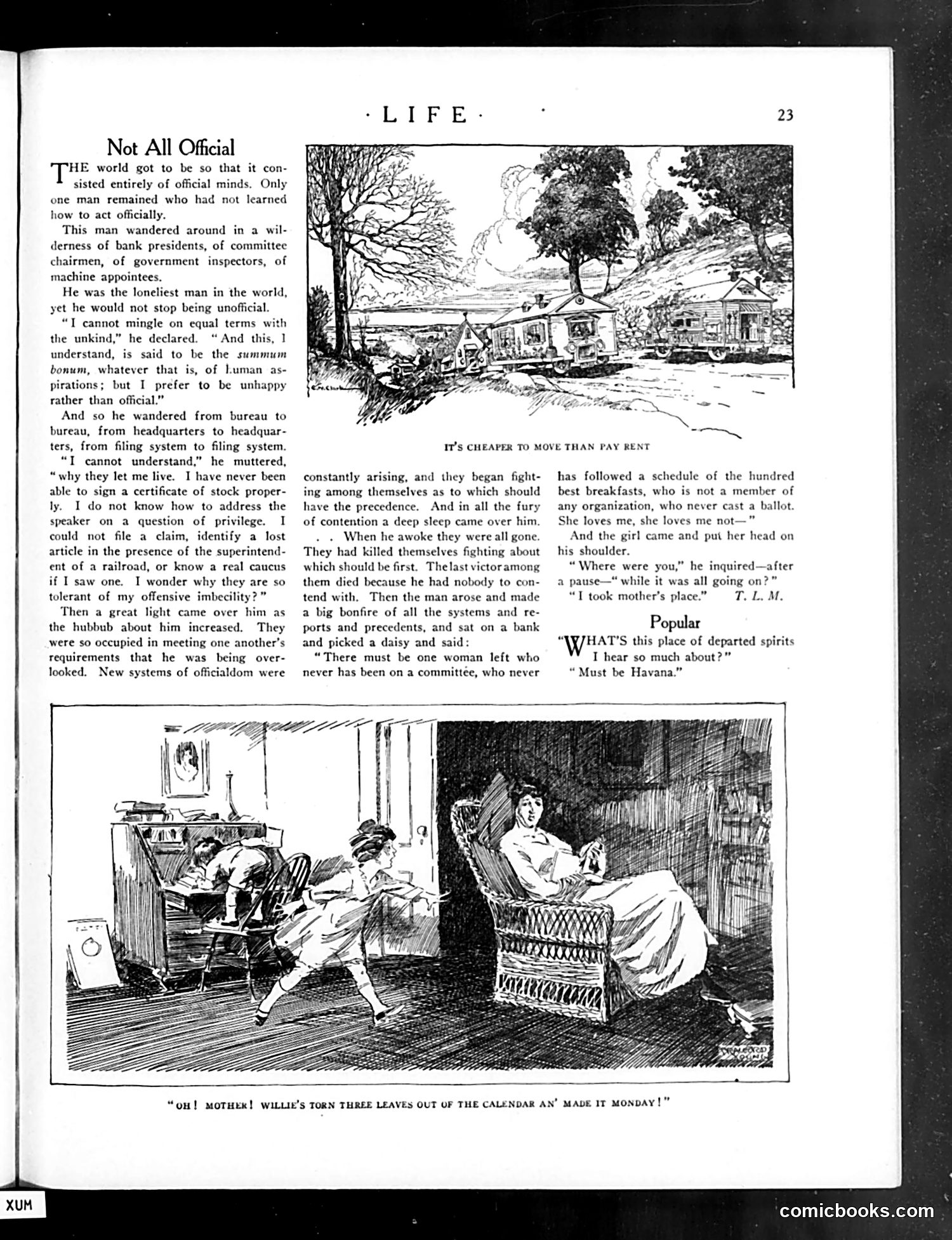
This Life magazine page contains two satirical pieces critiquing early 20th-century American bureaucracy and social conformity. **"Not All Official"** tells of a man unable to navigate official procedures—signing stock certificates, addressing speakers properly, filing claims. As bureaucratic systems multiply and fight for precedence, they destroy each other. The lone "unofficial" man survives, ultimately finding an equally unconventional woman who avoided committees, organizations, and ballots. The satire mocks the era's obsessive systematization and officialdom, suggesting authenticity survives only outside institutional structures. **The cartoon below** depicts a domestic scene where a child (Willie) has torn calendar pages to make Monday repeat—presumably to extend the weekend or avoid school. The mother's exasperated reaction satirizes parental struggles with children's logic and the constraints of the rigid weekly schedule governing modern life. Both pieces share a theme: resistance to imposed systems and schedules that govern behavior.
📄 Transcribed text from this page (OCR, searchable)
Machine-transcribed from the original scan — historical spelling and the odd misread are preserved.
Not All Official 'HE world got to be so that it con- sisted entirely of official minds. Only one man remained who had not learned how to act officially. This man wandered around in a wil- derness of bank presidents, of committee chairmen, of government inspectors, of machine appointees. He was the loneliest man in the world, yet he would not stop being unofficial. “T cannot mingle on equal terms with the unkind,” he declared. “And this, 1 understand, is said to be the summum bonum, whatever that is, of luman as- pirations; but I prefer to be unhappy rather than official.” And so he wandered from bureau to bureau, from headquarters to headquar- ters, from filing system to filing system. “I cannot understand,” he muttered, “why they let me live. I have never been able to sign a certificate of stock proper- ly. I do not know how to address the speaker on a question of privilege. I could not file a claim, identify a lost article in the presence of the superintend- ent of a railroad, or know a real caucus if I saw one. I wonder why they are so tolerant of my offensive imbecility?” Then a great light came over him as the hubbub about him increased. They were so occupied in meeting one another's requirements that he was being over- looked. New systems of officialdom were IT’S CHEAPER TO MOVE THAN PAY RENT constantly arising, and they began fight- ing among themselves as to which should have the precedence. And in all the fury of contention a deep sleep came over him. When he awoke they were all gone. They had killed themselves fighting about which should be first. Thelast victoramong them died because he had nobody to con- tend with, Then the man arose and made a big bonfire of all the systems and re- ports and precedents, and sat on a bank and picked a daisy and said: “There must be one woman left who never has been on a committee, who never has followed a schedule of the hundred best breakfasts, who is not a member of any organization, who never cast a ballot. She loves me, she loves me not—” And the girl came and put her head on his shoulder. “Where were you,” he inquired—after a pause—“ while it was all going on?” “T took mother’s place.” T. L. M. Popular be HAT’S this place of departed spirits I hear so much about?” “Must be Havana.” “oH! MOTHER! WILLIE’S TORN THREE LEAVES OUT OF THE CALENDAR AN’ MADE IT MONDAY!” comicbooks.com