
Life, 1920-07-01 · page 18 of 56
Life — July 1, 1920 — page 18: what you’re looking at
What you’re looking at
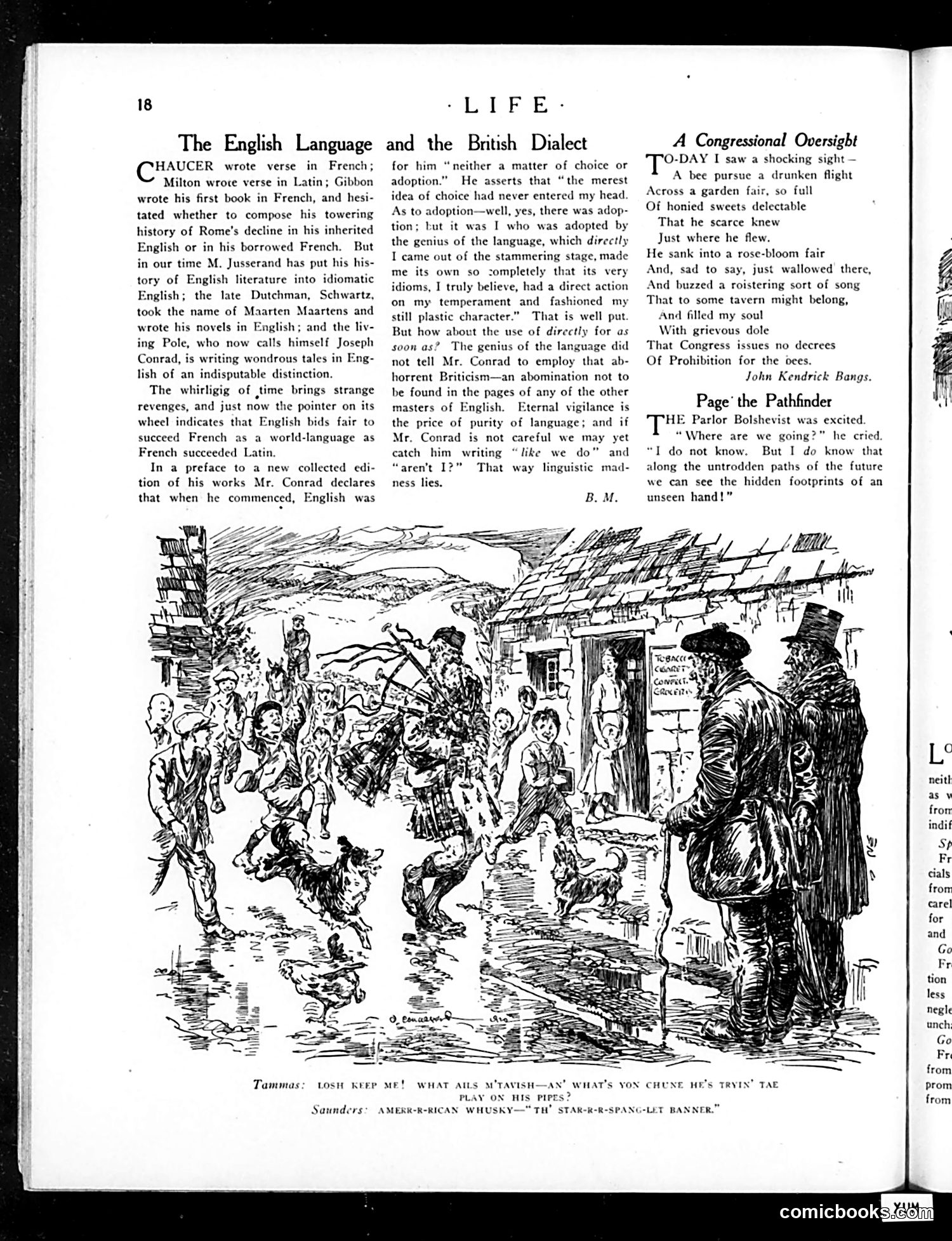
This page contains three distinct pieces of satirical content: **"The English Language"** (left column): A serious essay discussing how English, rather than French, is becoming the world's dominant language. It praises foreign writers like Joseph Conrad who adopted English, though it humorously criticizes Conrad for using the British expression "directly" (meaning "as soon as") instead of proper American English. The piece warns against linguistic corruption. **"A Congressional Oversight"** (right column, poem by John Kendrick Bangs): A humorous poem lamenting that Congress hasn't passed Prohibition laws for bees, who are depicted as getting drunk on flower nectar and behaving rowdily. This is satirical commentary on Prohibition debates of the era. **Cartoon below**: Depicts Scottish characters (indicated by dialect and pipes) in what appears to be a village setting. The caption reveals they're discussing American whisky being passed off as "The Star-Spangled Banner"—mocking both Scottish drinking culture and American patriotic symbols simultaneously. The page reflects early 20th-century American cultural anxieties about language purity, alcohol regulation, and national identity.
📄 Transcribed text from this page (OCR, searchable)
Machine-transcribed from the original scan — historical spelling and the odd misread are preserved.
The English Language HAUCER wrote verse in French; Milton wrote verse in Latin; Gibbon wrote his first book in French, and hesi- tated whether to compose his towering history of Rome's decline in his inherited English or in his borrowed French. But in our time M. Jusserand has put his his- tory of English literature into idiomatic English; the late Dutchman, Schwartz, took the name of Maarten Maartens and wrote his novels in English; and the liv- ing Pole, who now calls himself Joseph Conrad, is writing wondrous tales in Eng- lish of an indisputable distinction. The whirligig of ,time brings strange revenges, and just now the pointer on its wheel indicates that English bids fair to succeed French as a world-language as French succeeded Latin. In a preface to a new collected edi- tion of his works Mr. Conrad declares that when he commenced, English was Tammas: Losi Keer Saunders -LIFE- and the Bnitish Dialect for him “neither a matter of choice or adoption.” He asserts that “the merest idea of choice had never entered my head. As to adoption—well, yes, there was adop- tion; but it was I who was adopted by the genius of the language, which directly I came out of the stammering stage, made me its own so zompletely that its very idioms, I truly believe, had a direct action on my temperament and fashioned my still plastic character.” That is well put. But how about the use of directly for as soon as? The genius of the language did not tell Mr. Conrad to employ that ab- horrent Briticism—an abomination not to be found in the pages of any of the other masters of English. Eternal vigilance is the price of purity of language; and if Mr. Conrad is not careful we may yet catch him writing “like we do” and “aren't 1?” That way linguistic mad- ness lies. ME! WHAT AILS M'TAVISH- PLAY ON HIS PIPES? A Congressional Oversight (0-DAY I saw a shocking sight — A bee pursue a drunken flight Across a garden fair, so full Of honied sweets delectable That he scarce knew Just where he flew. He sank into a rose-bloom fair And, sad to say, just wallowed there, And buzzed a roistering sort of song That to some tavern might belong, And filled my soul With grievous dole That Congress issues no decrees Of Prohibition for the dees. John Kendrick Bangs. Page’ the Pathfinder HE Parlor Bolshevist was excited. “Where are we going?” he cried. “I do not know. But I do know that along the untrodden paths of the future we can see the hidden footprints of an unseen hand!” AN’ WHAT'S YON CHUNE HE'S TRYIN’ TAE AMERR-R-RICAN WHUSKY—" TH" STAR-R-R-SPANG-LET BANNER.” comicbookSeom