
Life, 1920-07-01 · page 37 of 56
Life — July 1, 1920 — page 37: what you’re looking at
What you’re looking at
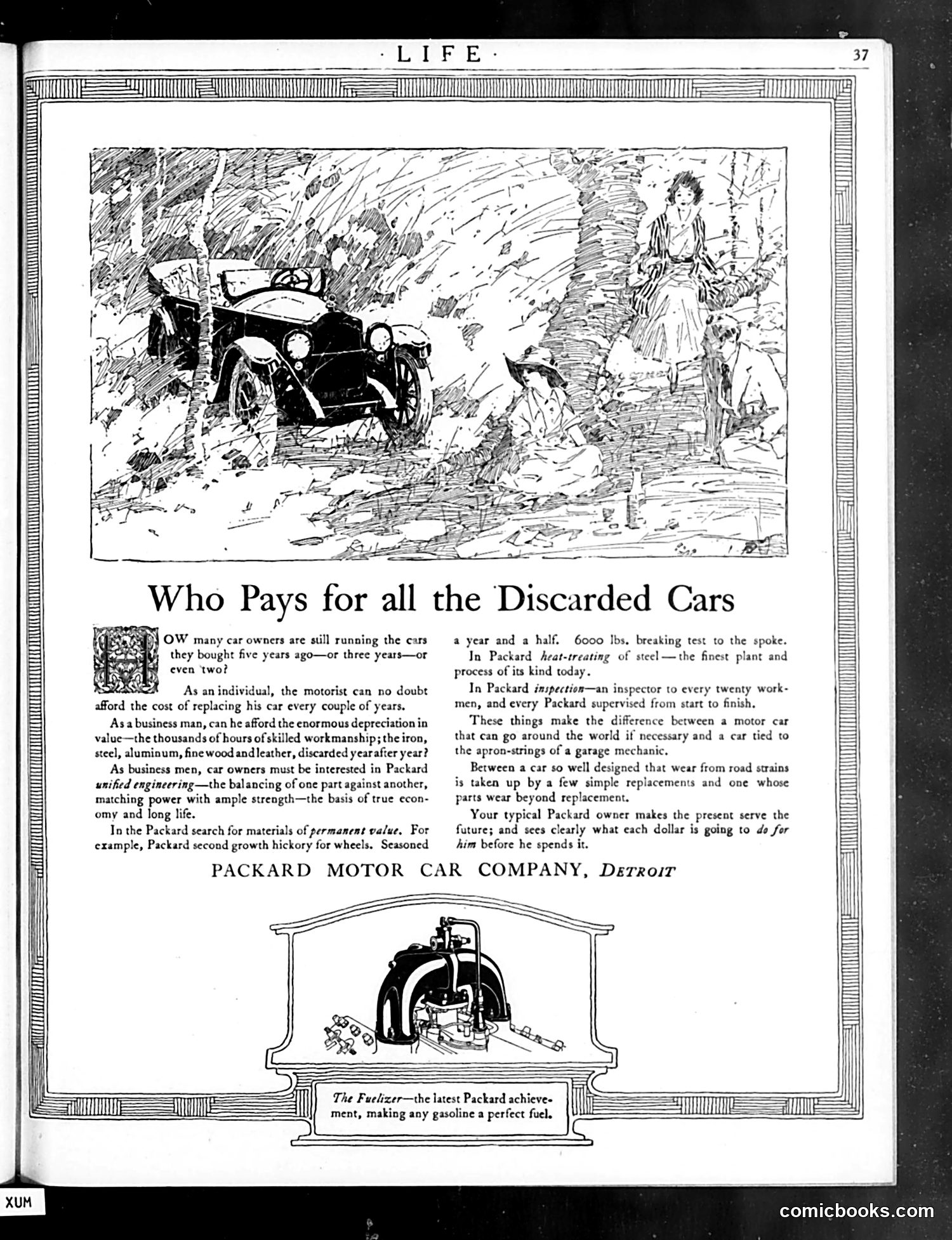
This is primarily a **Packard automobile advertisement**, not political satire. The headline "Who Pays for all the Discarded Cars" uses a rhetorical question to frame the ad's argument about car durability and value. The illustration shows an abandoned, broken-down automobile on a roadside while well-dressed people pass by—a visual representation of cars being "discarded" after brief ownership (five years, three years, or even two years). The ad's pitch: Packard cars represent superior engineering and materials that last longer, reducing depreciation and total ownership costs. The text argues that while individual motorists may afford frequent replacements, "as business men" they should recognize the waste. Features like hickory wheels (seasoned 1.5 years), heat-treated steel, and rigorous inspection justify the Packard's premium price through longevity. The satirical edge is gentle—mocking wasteful consumer culture rather than any specific political target. This reflects 1920s-era advertising that positioned quality products as rational business investments rather than mere luxury purchases.
📄 Transcribed text from this page (OCR, searchable)
Machine-transcribed from the original scan — historical spelling and the odd misread are preserved.
they bought five years ago—or three years—or # even two? As an individual, the motorist can no doubt afford the cost of replacing his car every couple of years. Asa business man, can he afford the enormous depreciation in value—the thousands of hours of skilled workmanship; the iron, steel, aluminum, fine wood and leather, discarded yearafter year? As business men, car owners must be interested in Packard unified engineering—the balancing of one part against another, matching power with ample strength—the basis of true econ- omy and long life. In the Packard search for materials of permanent value, For example, Packard second growth hickory for wheels. Seasoned a year and a half. 6000 Ibs. breaking test to the spoke. In Packard Acat-treating of steel—the finest plant and process of its kind today. In Packard énspection—an inspector to every twenty work- men, and every Packard supervised from start to finish, These things make the difference between a motor car that can go around the world if necessary and a car tied to the apron-strings of a garage mechanic. Between a car so well designed that wear from road strains is taken up by a few simple replacements and one whose parts wear beyond replacement. Your typical Packard owner makes the present serve the future; and sees clearly what each dollar is going to do for him before he spends it. PACKARD MOTOR CAR COMPANY, Dsrroir The Fuelizer—the latest Packard achieve- ment, making any gasoline a perfect fuel. comicbooks.com