
A complete issue · 92 pages · 1917
Life — December 6, 1917
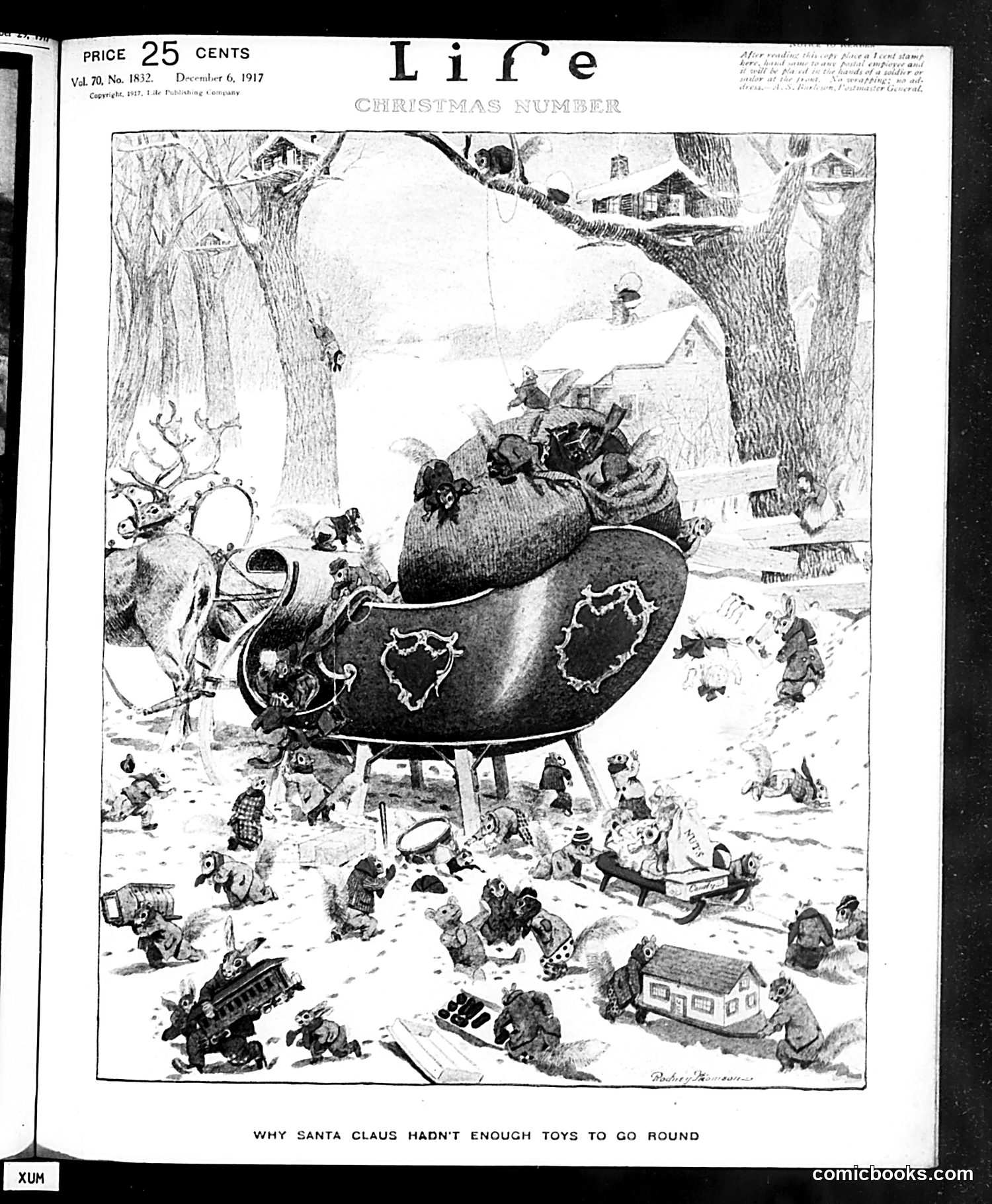
This is the cover of Life's Christmas Number from 1917, during World War I. The cartoon depicts Santa Claus in an oversized sleigh that appears to be a military vessel or aircraft, struggling to deliver toys to children below. The caption reads: "WHY SANTA CLAUS HADN'T ENOUGH TOYS TO GO ROUND." The satire comments on wartime toy shortages caused by industrial resources being diverted to military production. The overflowing sleigh symbolizes the gap between Santa's traditional abundance and actual scarcity facing American families during WWI. Children scattered across the snowy landscape represent disappointed youngsters unable to receive adequate Christmas gifts due to the war effort's economic demands on manufacturing and supply chains.
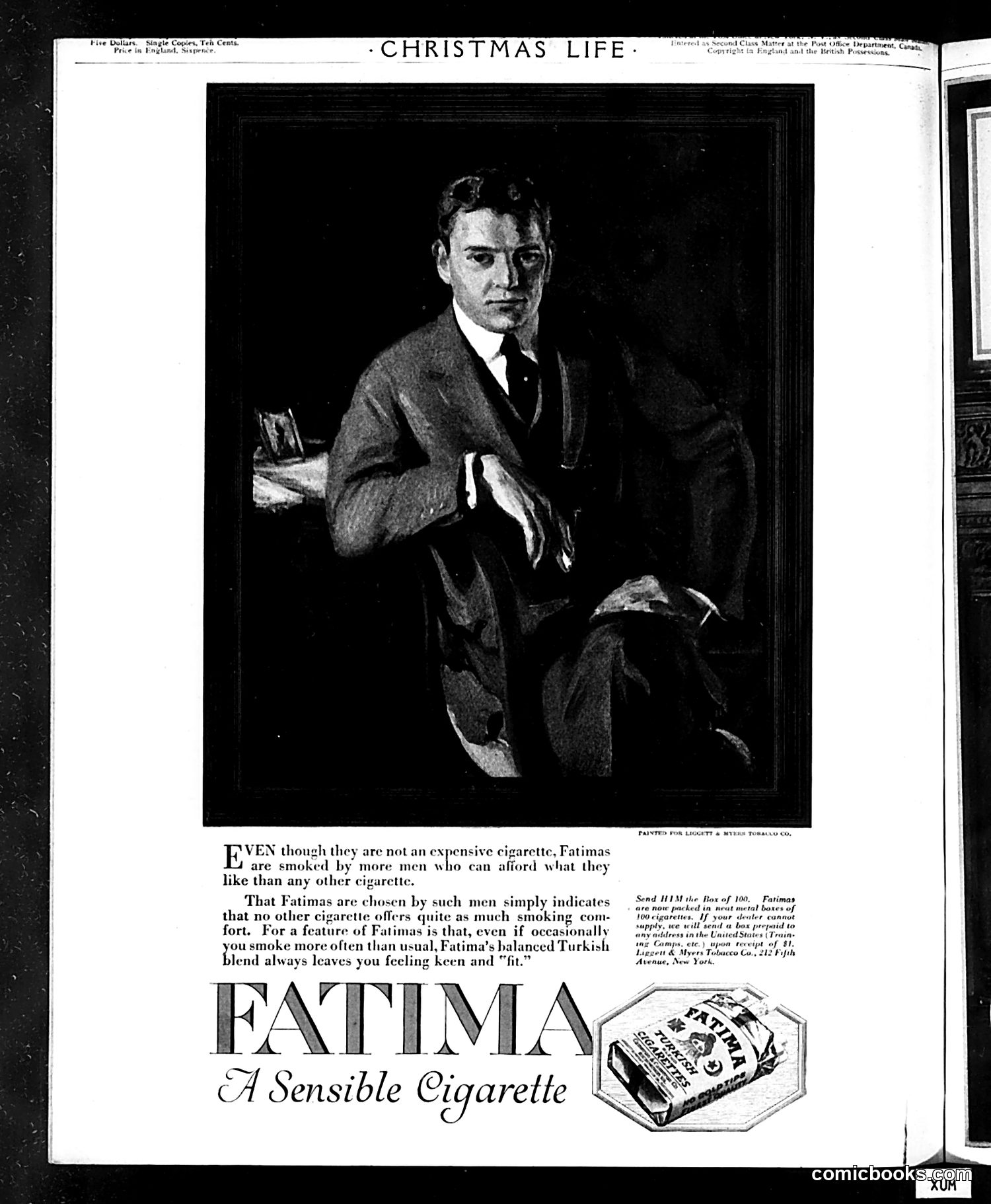
This page is primarily a **cigarette advertisement** for Fatima brand cigarettes, not political satire. The image shows a well-dressed man in formal attire holding a cigarette, posed as a portrait. The advertisement's text argues that Fatimas are "smoked by more men who can afford what they like than any other cigarette," positioning the brand as a luxury product chosen by wealthy, discerning men. The ad emphasizes that Fatimas provide smoking comfort through their "balanced Turkish blend." This represents **early 20th-century advertising strategy**: using an aspirational image of a distinguished gentleman to market cigarettes to affluent male consumers. There is no political cartoon or satire present on this page—it is straightforward commercial promotion typical of Life magazine's revenue model during this period.
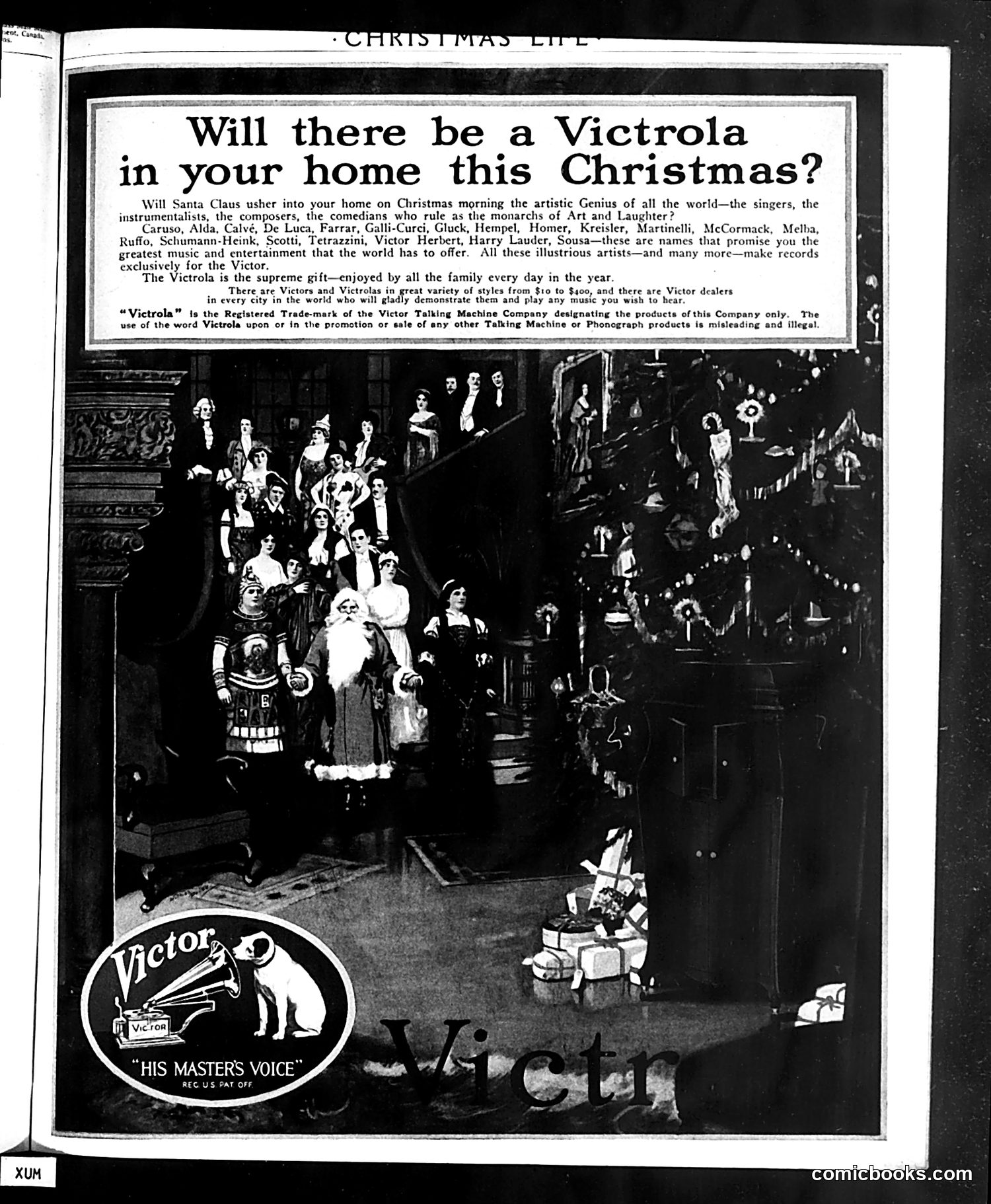
This is primarily a **Victor Victrola advertisement**, not political satire. The full-page ad asks "Will there be a Victrola in your home this Christmas?" The image depicts an elaborate Christmas scene with wealthy people in formal dress gathered around a decorated home, with Santa Claus and gifts visible. The ad promotes Victrola phonographs as luxury Christmas gifts, listing famous opera singers and classical musicians whose recordings are "exclusively for the Victor." The Victor dog logo ("His Master's Voice") appears at the bottom. The accompanying text emphasizes that Victrolas range from $10 to $200 and are available through Victor dealers worldwide. **This is consumer marketing**, positioning the phonograph as a sophisticated, aspirational Christmas purchase for affluent households—not political commentary.
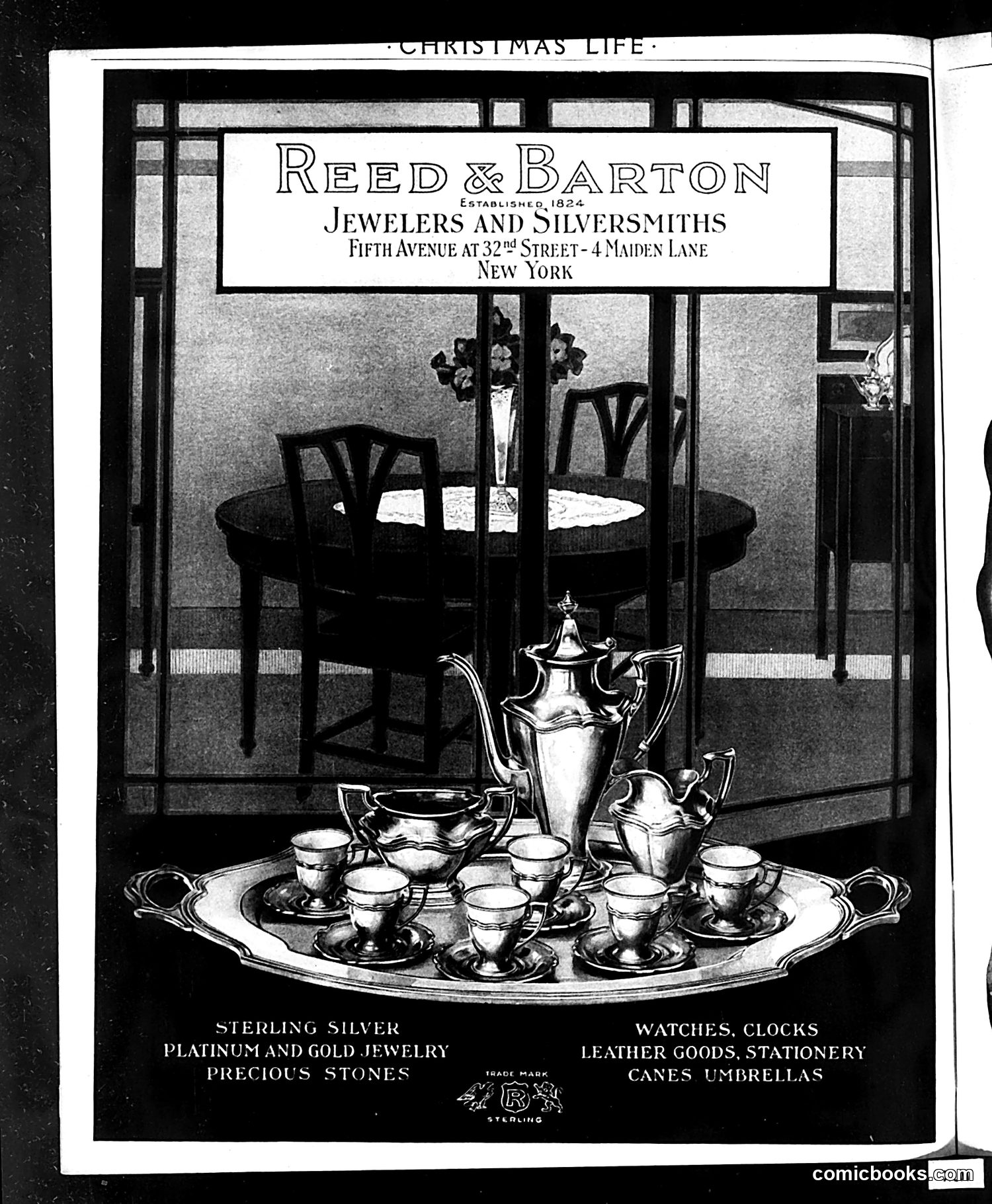
This page is primarily a **Christmas advertisement**, not political satire. It showcases Reed & Barton, a prestigious jewelry and silversmith company established in 1824, located on Fifth Avenue in New York. The ad displays an elegant tea service—a teapot, creamer, sugar bowl, and teacups arranged on a decorative tray—exemplifying luxury gift options for wealthy holiday shoppers. The storefront illustration behind the service suggests the company's upscale retail location. The text lists their product categories: sterling silver, platinum and gold jewelry, precious stones, watches, clocks, leather goods, stationery, canes, and umbrellas. This represents typical high-end gift merchandise marketed to affluent consumers during the Christmas shopping season.
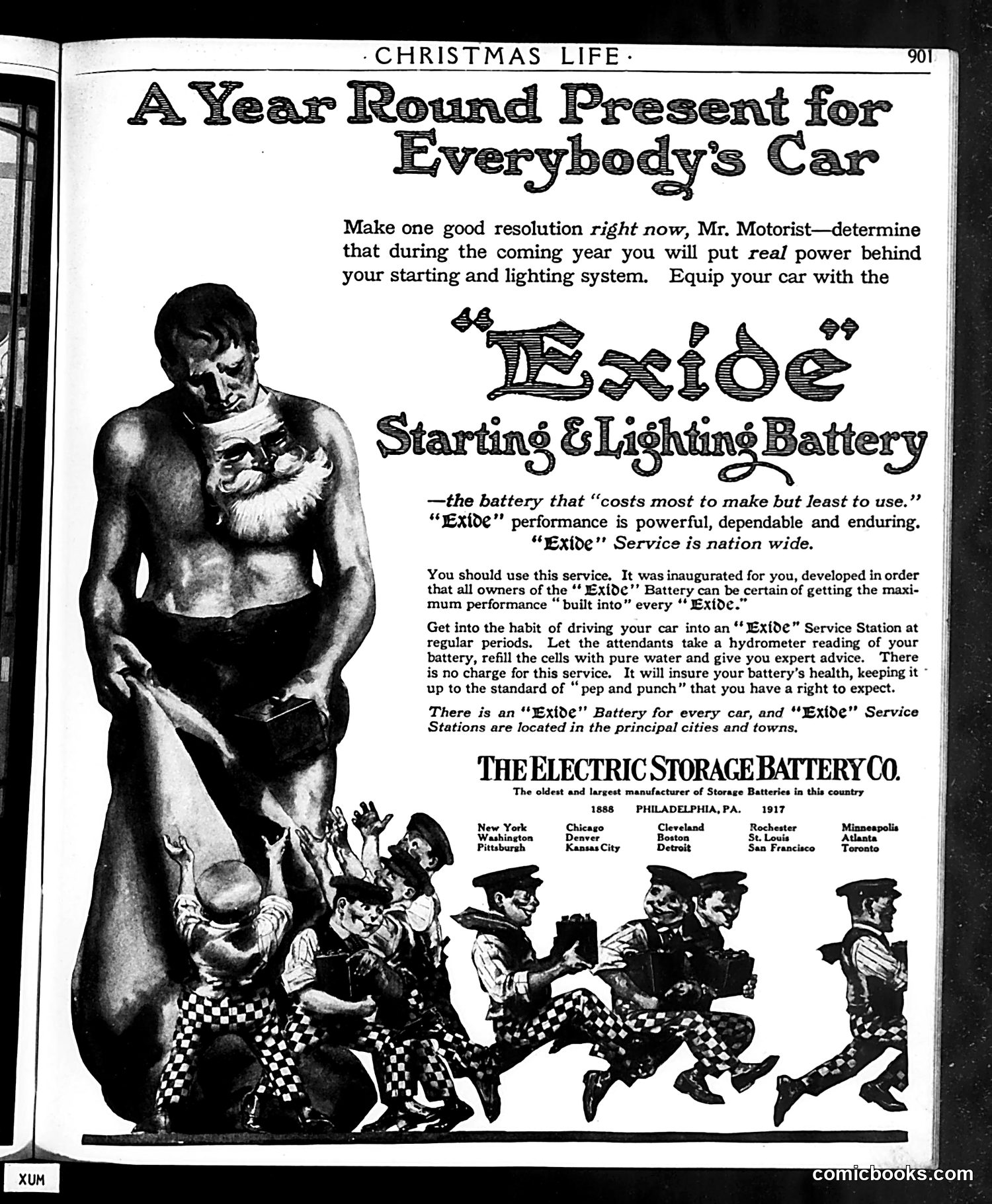
This is primarily a **commercial advertisement**, not satire or political commentary. The Electric Storage Battery Company promotes its "Exide" brand car battery as a Christmas gift for motorists. The imagery uses an unusual visual strategy: a large male figure (appearing classical or allegorical in style) holds small, cartoonish characters dressed as elves or Christmas sprites in checkered clothing. These figures appear playful rather than meaningful—likely just decorative holiday imagery to associate the product with Christmas gift-giving. The ad emphasizes the battery's reliability and promotes the company's nationwide service network. The classical male figure seems intended to convey strength and dependability rather than represent any specific historical or political figure. This is straightforward early 20th-century product advertising leveraging holiday themes, not editorial satire.
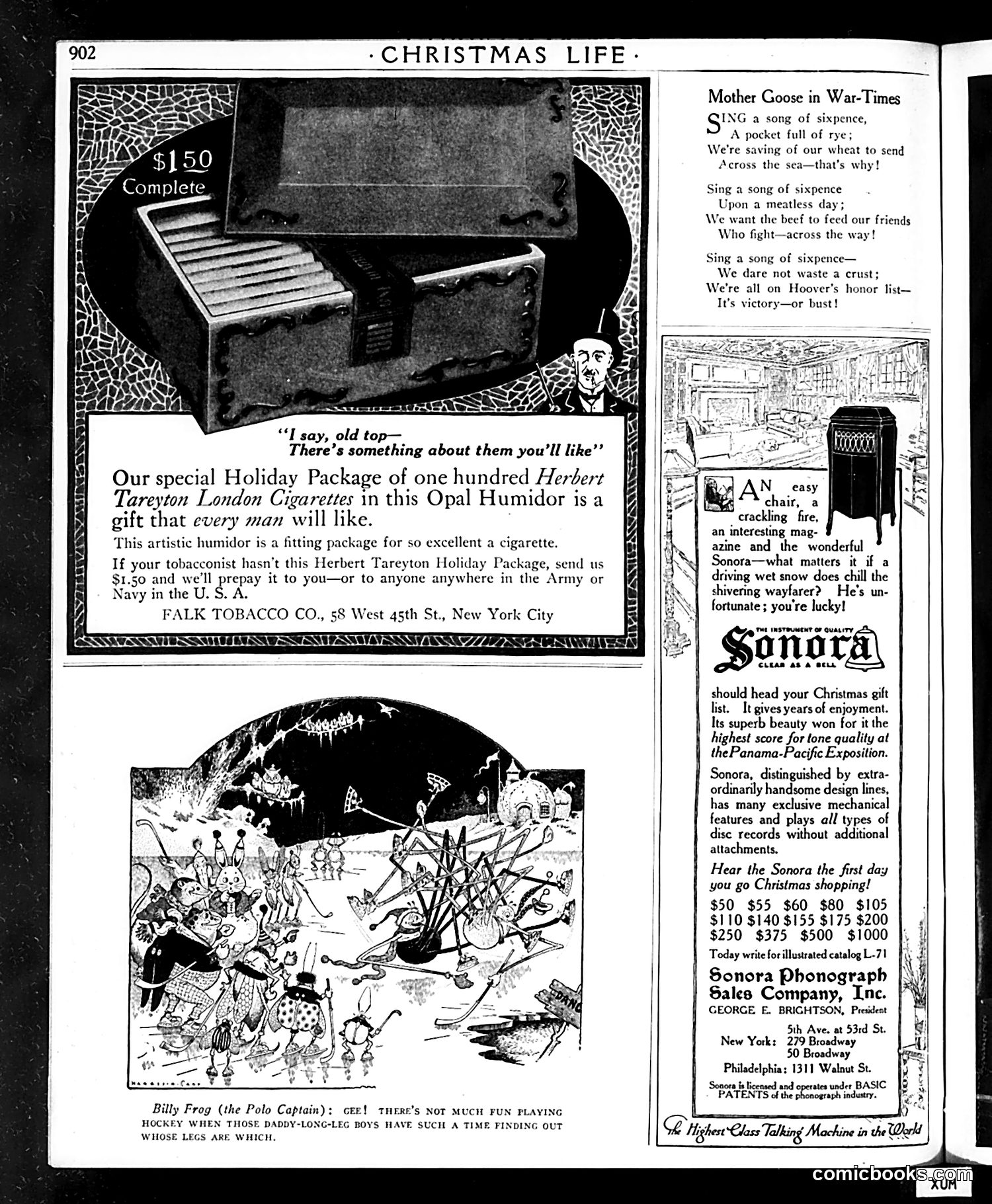
This page is primarily **advertising content** rather than political satire. The top advertisement promotes Herbert Tareyton London Cigarettes in an Opal Humidor ($1.50), marketed as a holiday gift with special appeal to military personnel serving in WWI ("Army or Navy in the U.S.A."). The bottom cartoon titled "Billy Frog (the Polo Captain)" depicts an anthropomorphic frog character finding hockey challenging because of his anatomical leg structure—a simple visual pun rather than political commentary. The right side advertises Sonora phonographs, emphasizing quality and listing various price points ($50-$1000). The "Mother Goose in War-Times" poem on the upper right reflects WWI-era rationing themes (saving wheat, Hoover honor list), showing homefront sacrifice messaging typical of 1917-1918.
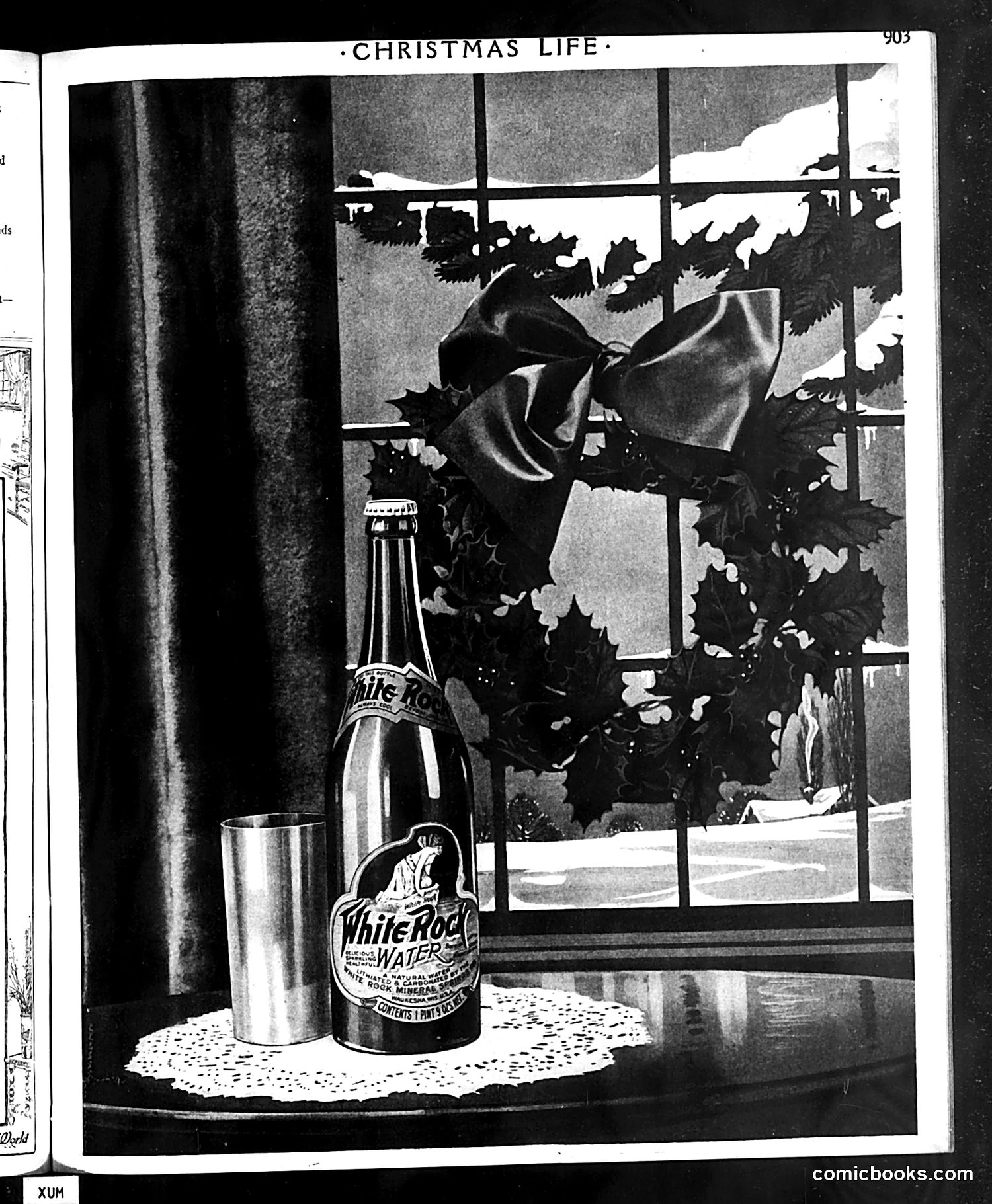
This is a Christmas-themed advertisement for White Rock Water, a beverage brand. The image shows a festive window display featuring a bottle of White Rock Water alongside a glass, positioned beneath holiday decorations including evergreen garland and a large bow. The advertisement appears designed to position the product as an elegant, refined choice for holiday entertaining—note the polished presentation with the decorative doily and the view of a snowy winter landscape through the window behind it. This represents early 20th-century marketing that associated branded products with sophistication and seasonal celebration, appealing to middle-class consumers during the Christmas shopping season. The "Christmas Life" header indicates this page appeared during the holiday gift-giving period.
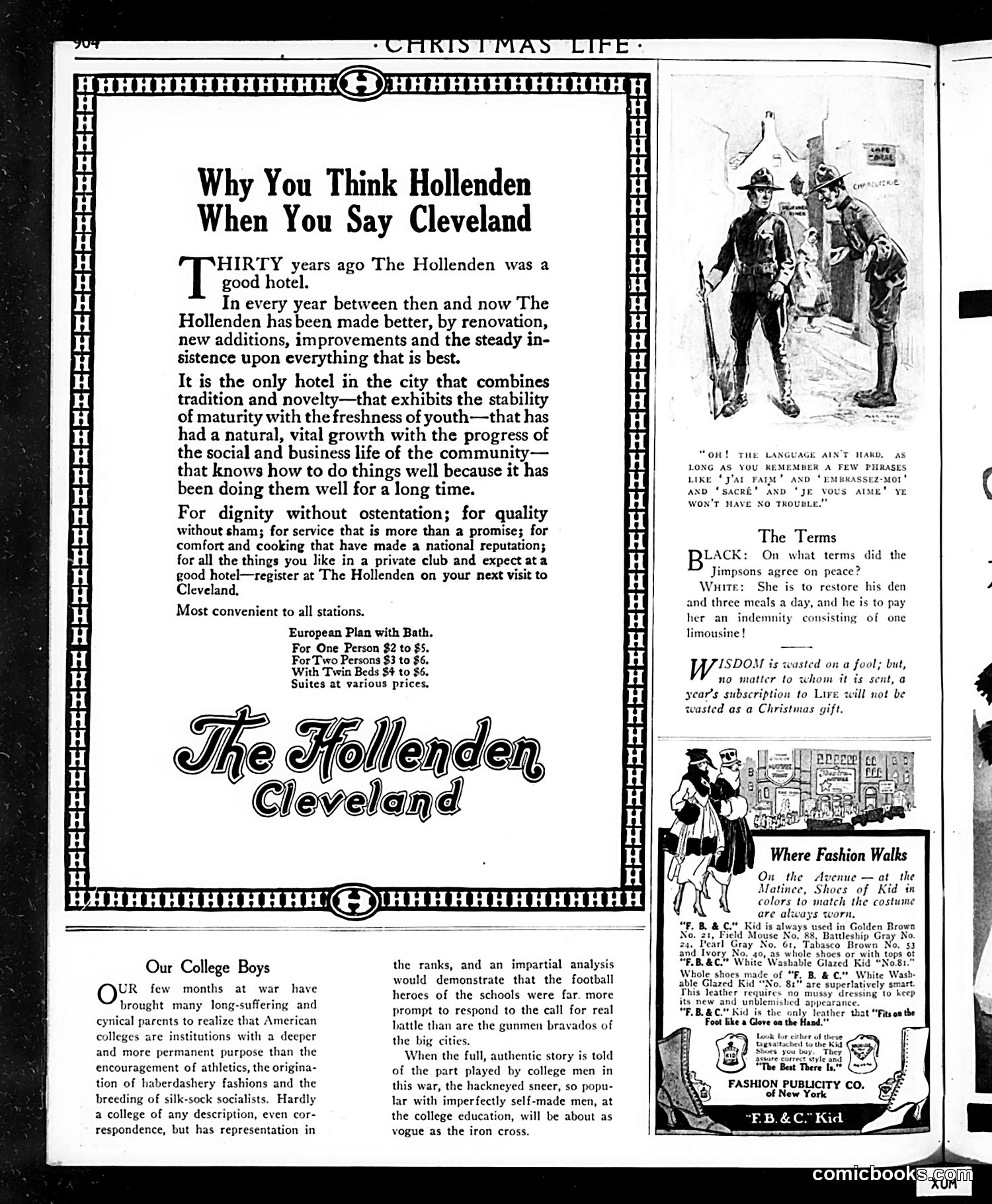
This page contains primarily **advertisements and feature articles** rather than political satire. The main content includes: 1. **The Hollenden Hotel ad** (left): A straightforward hotel advertisement emphasizing the establishment's 30-year reputation, combining "tradition and novelty." 2. **"The Terms" section** (right): A humorous dialogue, apparently from a comic strip or cartoon, depicting negotiations between characters named "Black" and "White" regarding peace terms—likely satirizing post-WWI peace negotiations, with absurdist humor about payment (a limousine and meals). 3. **"Our College Boys"** (bottom): An article discussing college men's roles in WWI, arguing that educational institutions should receive more recognition for their patriotic contributions. 4. **Fashion advertisement** (right): A "Where Fashion Walks" ad for F.B. & C. Kid leather shoes. The page reflects early 20th-century concerns: wartime patriotism, hotel commerce, and fashion marketing.
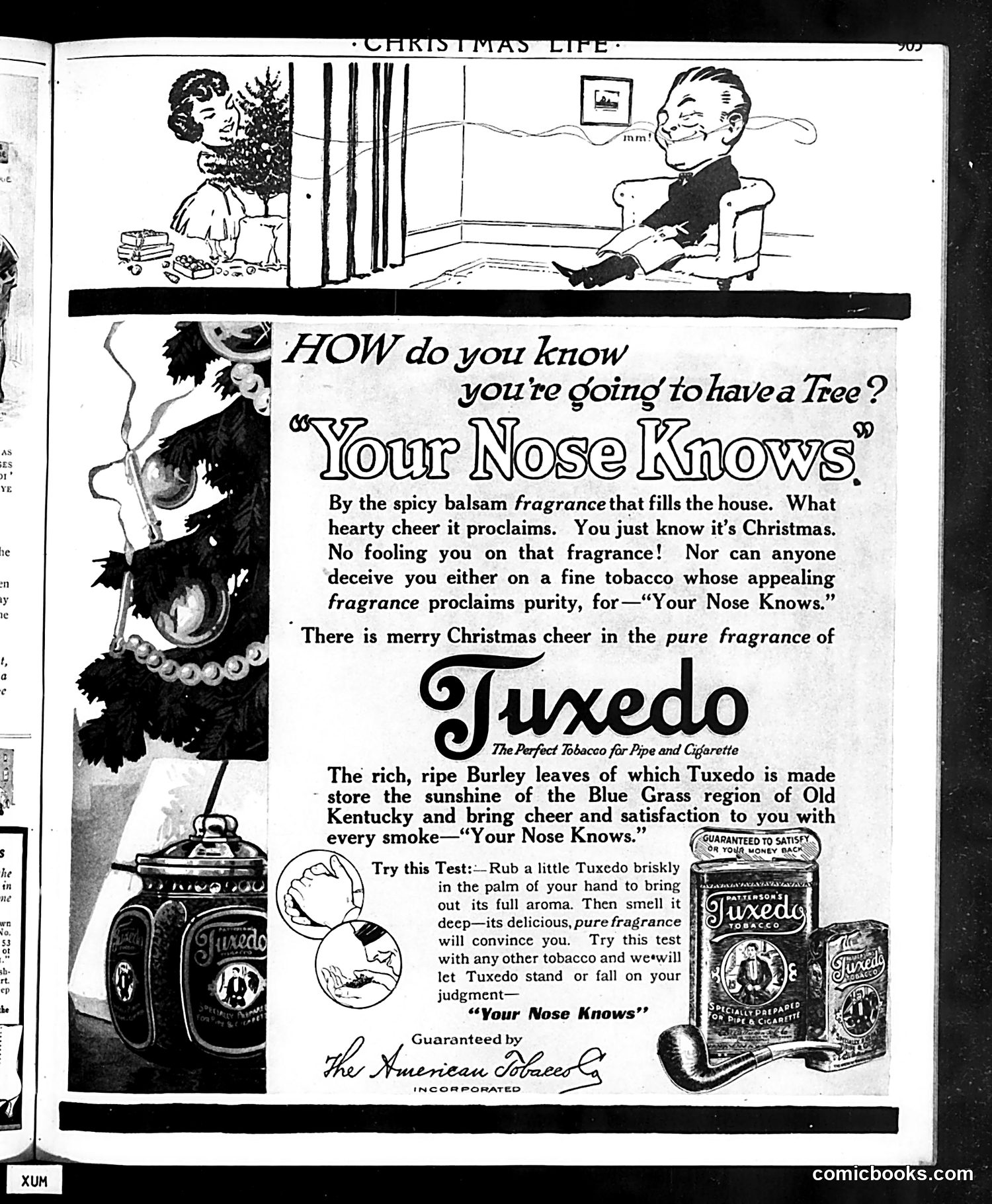
This page is **primarily an advertisement for Tuxedo tobacco**, not political satire. The top panel shows a domestic Christmas scene with a couple—the woman decorating a tree, the man relaxing in a chair—illustrating the tagline "Your Nose Knows." The ad's central claim is that Tuxedo's distinctive fragrance reliably signals Christmas cheer and quality. It contrasts this "pure fragrance" against cheaper tobacco brands that might deceive consumers. The dramatic illustration on the left shows a fashionably dressed woman in evening wear, reinforcing the product's association with sophistication and refined taste. The bottom includes a "Try this Test" section encouraging consumers to compare Tuxedo's aroma against competitors, guaranteeing their nose will recognize its superiority. It's endorsed by "The American Tobacco Co., Incorporated." This reflects early 20th-century advertising's emphasis on sensory experience and brand reputation.
This is a **title/advertisement page** for *Life* magazine's coming issues rather than a cartoon. The ornate border features cherubs and Christmas imagery, establishing a holiday theme. The page announces three upcoming special issues: New Year's Number, Aviation Number, and "Our Boys' Number" (likely referring to American soldiers, given the 1917 date during World War I). The text promises that *Life* will "represent the most advanced patriotic American thought"—a pointed statement suggesting the magazine positioned itself as a serious voice on national affairs during wartime. The subscription offer ($5 annually) and note that *Life* makes "the best possible Christmas gift" indicate this was promotional material aimed at holiday gift-giving. The date "1917" at bottom confirms this was published during America's active involvement in WWI.
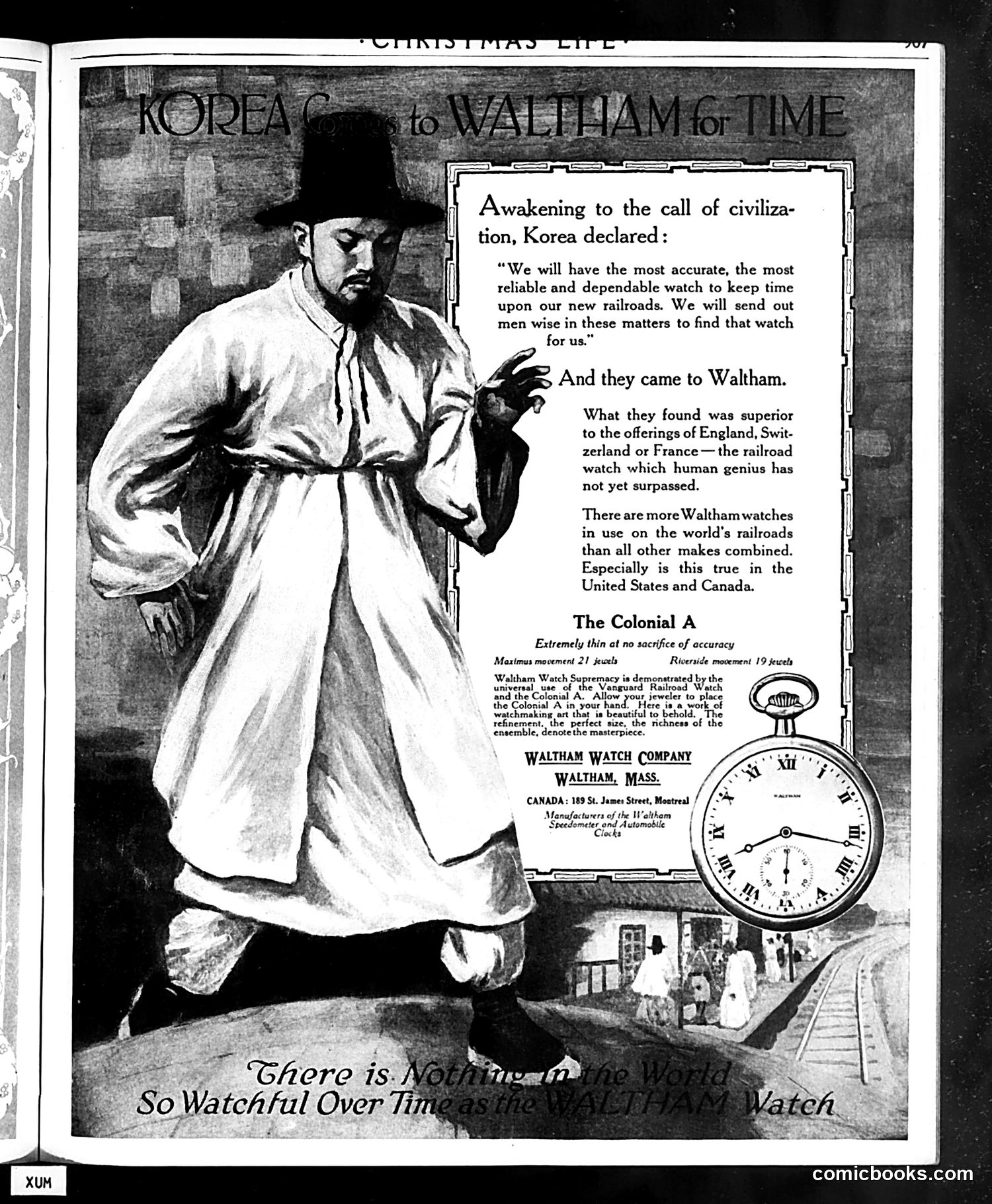
This is primarily **an advertisement for Waltham watches**, not satire or political commentary. The image depicts an Asian man (likely Korean, given the headline "Korea Goes to Waltham for Time") in traditional dress, presenting a watch as a symbol of modernization. The narrative claims Korea sought the world's most accurate railroad watches and discovered Waltham's superior quality. The advertisement uses **orientalist imagery**—the exotic figure in traditional clothing represents a "civilized" nation adopting Western technology. The subtext appeals to American readers' sense of technological superiority and commercial dominance. The "Colonial A" watch is highlighted as proof of Waltham's engineering excellence. The bottom line—"There is Nothing in the World So Watchful Over Time as the Waltham Watch"—is a straightforward commercial slogan, not satire.
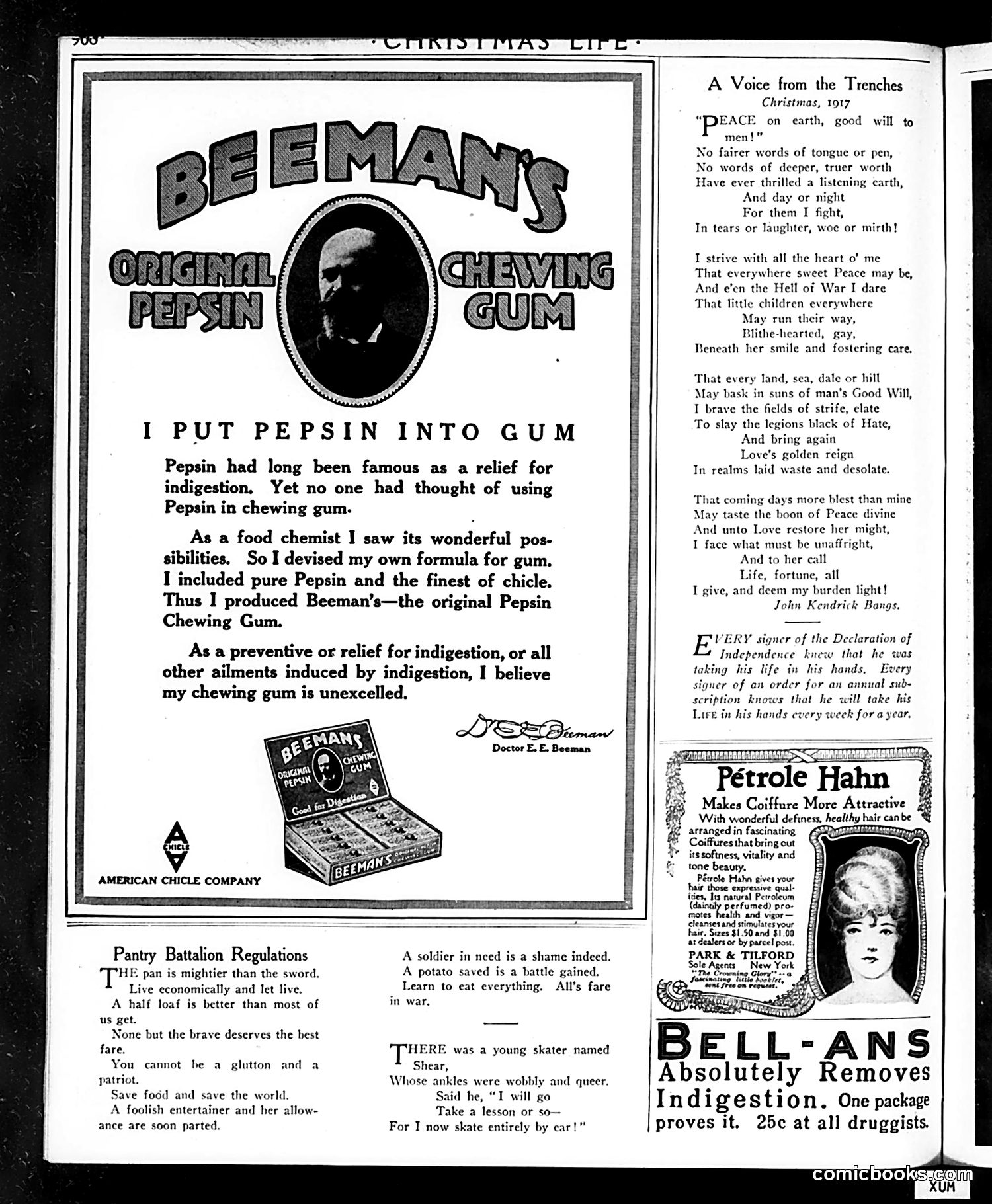
This page is primarily **advertising content**, not political satire. The main feature is a Beeman's chewing gum advertisement claiming the product aids digestion through added pepsin (a digestive enzyme). The creator, "Doctor E.E. Beeman," asserts that pepsin has long been used medicinally for indigestion, and he's innovatively combined it with chewing gum. The ad positions the gum as preventative medicine for digestive ailments. The side panel contains unrelated patriotic WWI poetry ("A Voice from the Trenches") and advertisements for hair products and digestive remedies—typical period marketing that exploited health anxieties. This reflects early 20th-century marketing where medicinal claims were largely unregulated, and adding pharmaceutical ingredients to consumer products was common advertising strategy.
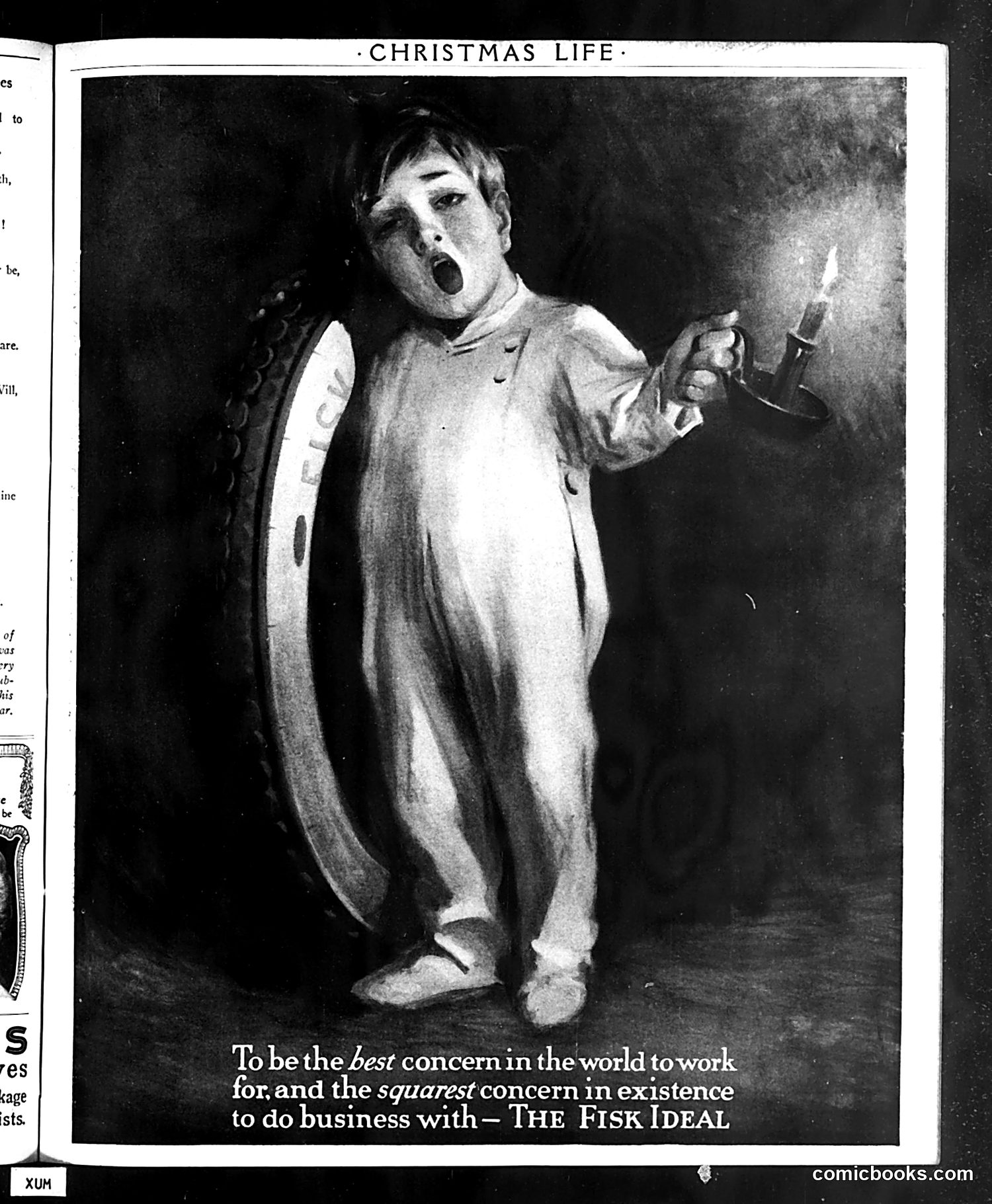
This is a satirical illustration titled "Christmas Life" depicting a rotund, cherubic figure in a white nightgown or robe, holding what appears to be a cigar or pipe, with an expression of surprise or indignation. The caption reads: "To be the *best* concern in the world to work for, and the *squarest* concern in existence to do business with — THE FISK IDEAL" This appears to be an advertisement or satire about the Fisk Tire Company, using ironic language. The figure likely represents the Fisk company mascot or the company personified. The "Fisk Ideal" references the company's branding. The satire likely critiques the gap between Fisk's public claims about being an ethical employer and business partner versus actual practices—a common target of Life magazine's social commentary during the early-to-mid 20th century.
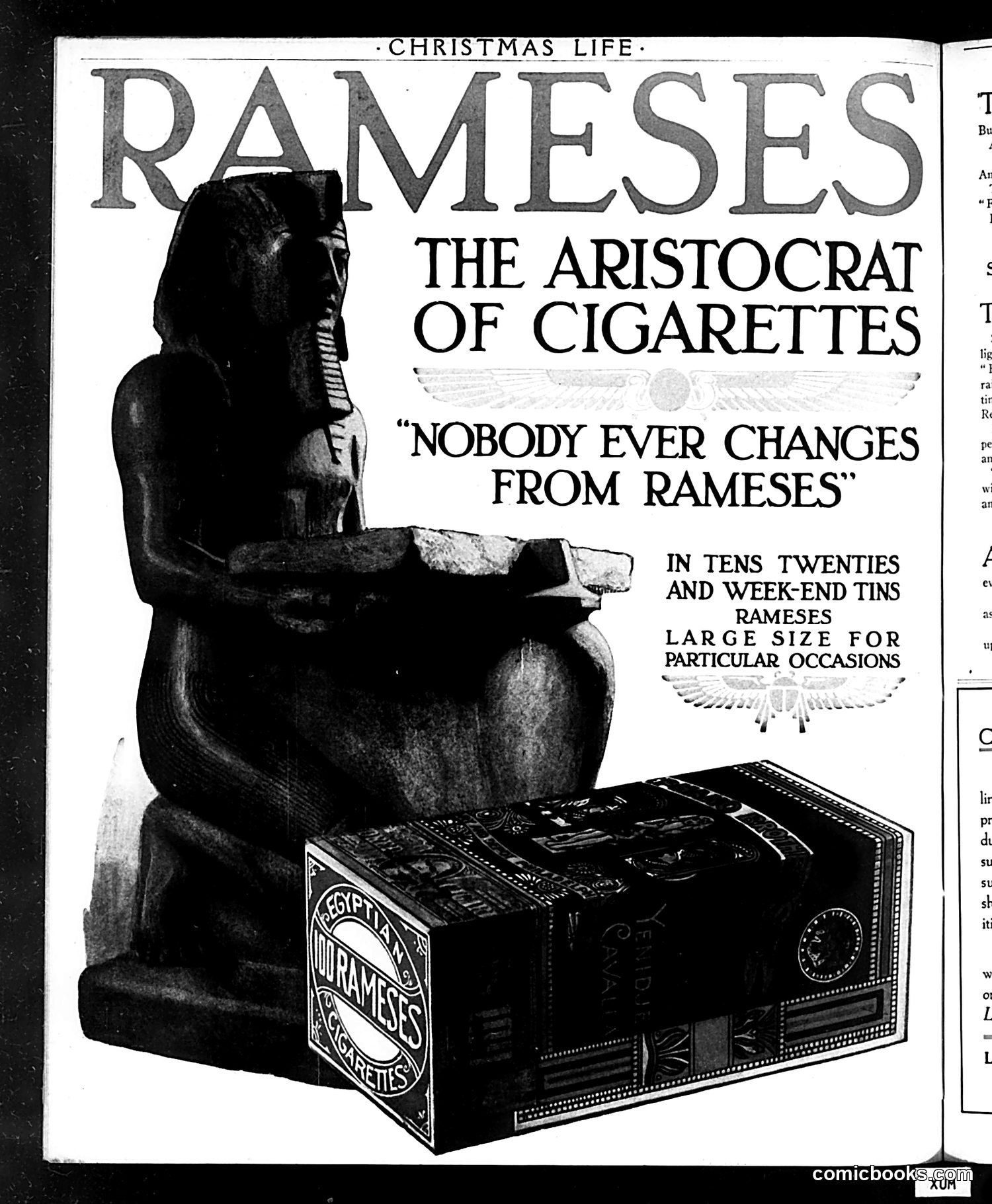
This is a **cigarette advertisement**, not political satire. It's a "Christmas Life" magazine advertisement for Rameses cigarettes. The ad features an Egyptian statue (likely referencing Rameses, the ancient pharaoh) and uses the tagline **"Nobody ever changes from Rameses,"** suggesting brand loyalty and consistency as selling points. The copy advertises product varieties: "tens twenties and week-end tins" plus "large size for particular occasions." **What modern readers should know:** This represents early 20th-century tobacco marketing that freely used aspirational imagery (ancient Egypt's prestige) and made implicit health/lifestyle claims. Such direct cigarette advertising to general audiences became prohibited in many countries by the late 20th century. The casual Christmas framing of tobacco products would be unthinkable in contemporary advertising.
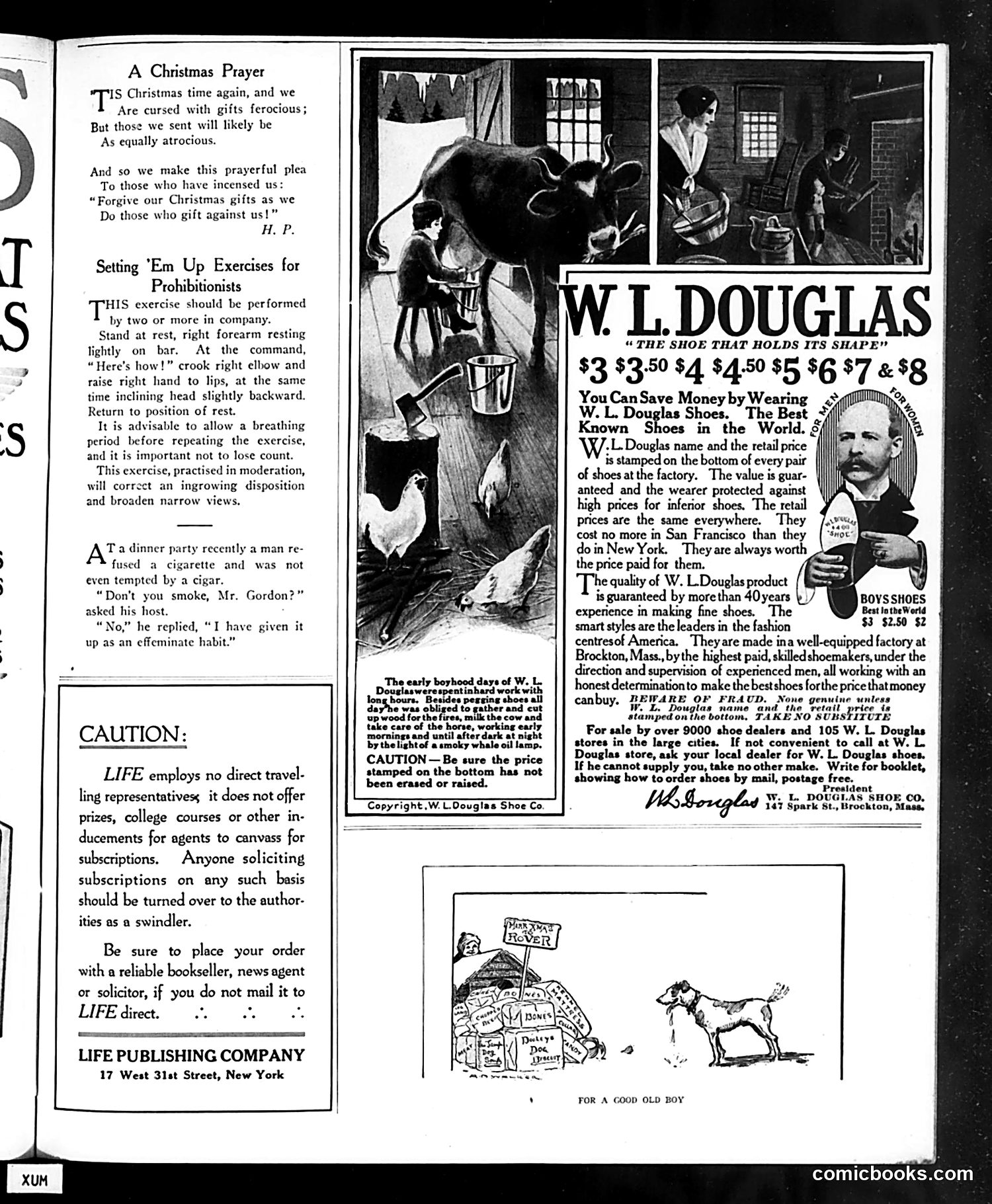
This page is primarily **advertising**, dominated by a W.L. Douglas shoe company ad. The advertisement features illustrations of shoe manufacturing and a portrait of what appears to be the company founder or spokesman, emphasizing quality craftsmanship and value ("The Shoe That Holds Its Shape," priced $3-$8). The left side contains **satirical content**: "A Christmas Prayer" mocking excessive gift-giving, and "Setting 'Em Up Exercises for Prohibitionists"—humor about Prohibition-era abstinence. The latter piece ridicules those giving up alcohol, suggesting physical exercises as substitute activities. A small anecdote mocks a man refusing cigarettes as an "effeminate habit," reflecting early 20th-century attitudes about masculinity. The page reflects the magazine's satirical approach to contemporary social issues like Prohibition and changing social customs.
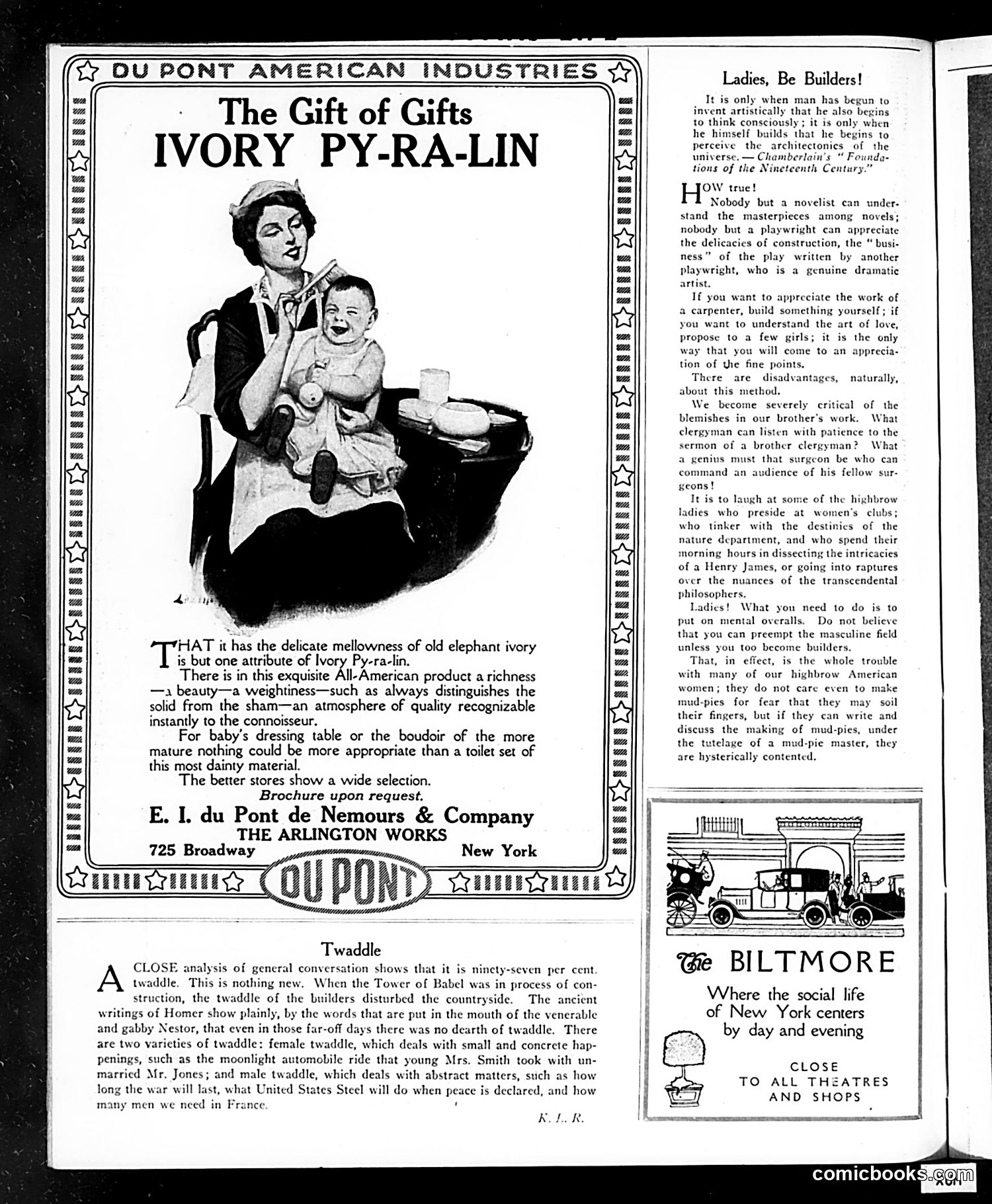
This page contains two distinct pieces: **Left side:** A Du Pont advertisement for "Ivory Py-ra-lin" (celluloid products), featuring an illustration of a woman with a child. The ad emphasizes the material's quality and elegance for toiletries. **Right side:** An editorial titled "Ladies, Be Builders!" This is satirical social commentary criticizing educated, upper-class women who engage in intellectual pursuits (analyzing Henry James, attending women's clubs) without practical accomplishment. The author argues women should "build" things—literally or metaphorically—to truly understand craftsmanship and life, rather than merely discussing abstract ideas. The piece mocks "highbrow" women for being impractical dilettantes afraid to get their hands dirty. **Below:** A brief article called "Twaddle" noting that conversation is 97% trivial, with examples of "female twaddle" (gossip about romance) versus "male twaddle" (speculation about war and business). The content reflects early 20th-century gender attitudes—simultaneously encouraging women's intellectual engagement while disdaining their actual participation in serious discourse.
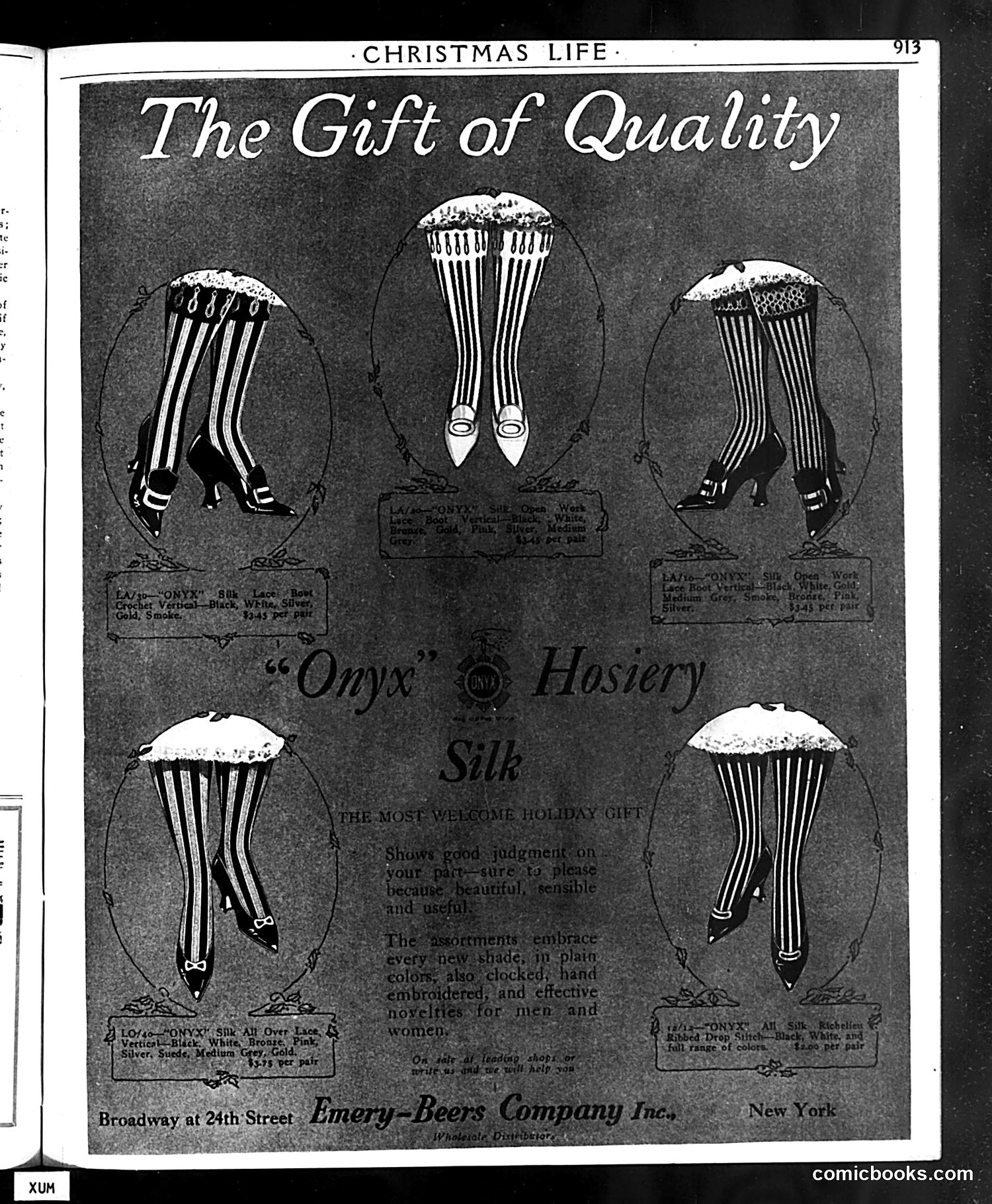
This is a **straightforward advertisement, not satire or political commentary**. The page promotes "Onyx" brand silk hosiery as a Christmas gift option. The layout displays five different women's stockings in various styles and colors (described in small text beneath each illustration). The central messaging emphasizes that quality hosiery makes "the most welcome holiday gift" and appeals to gift-givers' judgment by suggesting it's "beautiful, sensible and useful." The ad highlights multiple shade options and styles available, including options for both men and women. The Emery-Beers Company (New York) is identified as the distributor. This represents typical early-20th-century women's fashion advertising, where hosiery was a common, acceptable luxury gift item.
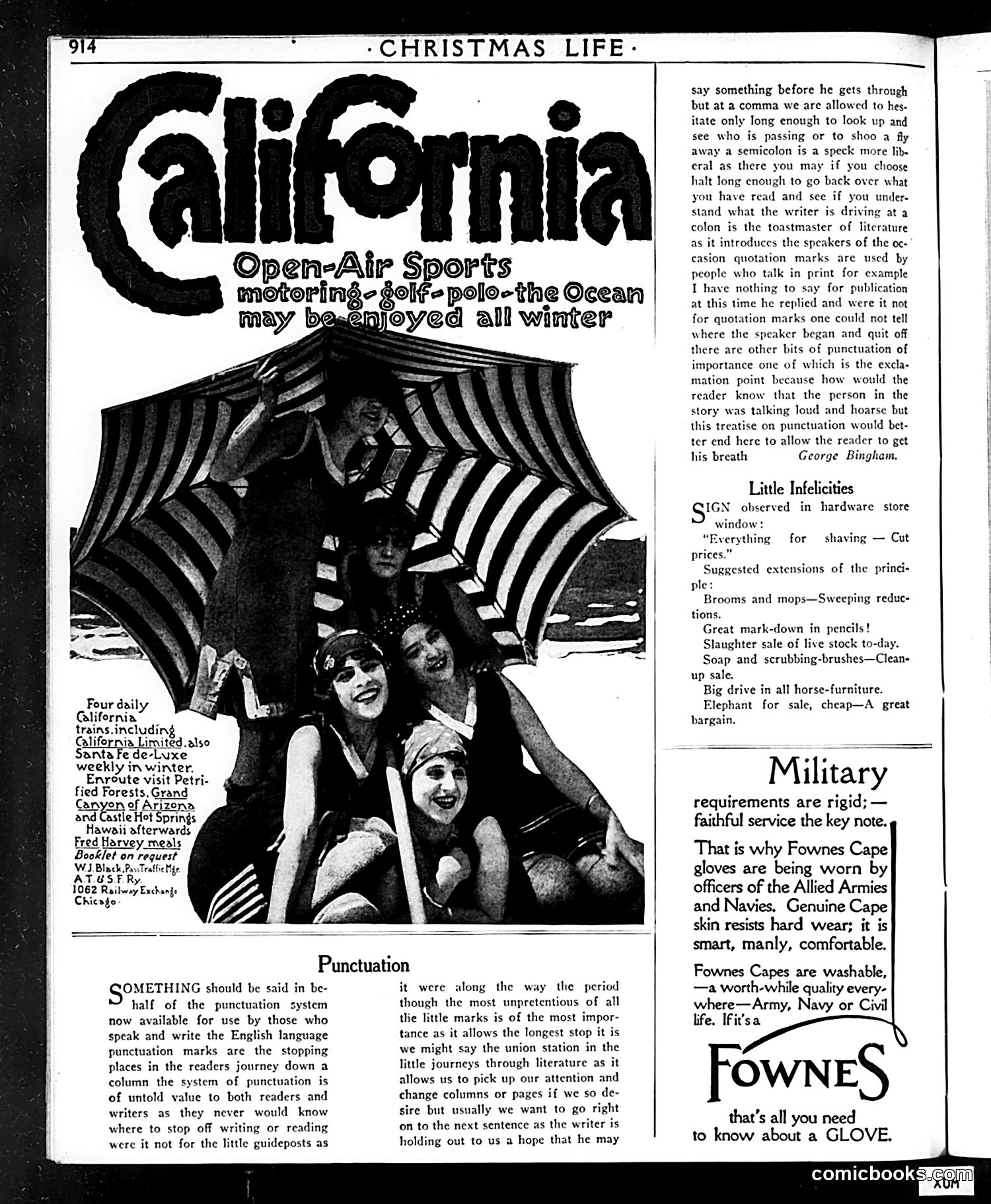
This page combines advertising, humor, and editorial content typical of early 20th-century Life magazine. **Main Content:** The large "California" advertisement promotes Santa Fe Railway trains and winter tourism to Arizona and Hawaii—appealing to wealthy readers seeking warm-weather escape. **"Punctuation" Essay** by George Bingham is a humorous, deliberately unpunctuated treatise mocking overly-earnest grammar instruction. The irony is deliberate: an essay *about* punctuation that flagrantly violates punctuation rules demonstrates the author's satirical point about pedantry. **"Little Infelicities"** mocks absurd hardware store window signage. The humor lies in hardware stores using retail terminology ("mark-down," "sale," "drive") for items where such language is incongruous—you don't have a "sweeping reduction" on brooms; you have a broom sale. It satirizes commercial copywriting clichés. **Fownes Gloves Advertisement** uses wartime patriotism (referencing "Allied Armies and Navies") to market luxury gloves, emphasizing durability and masculine respectability—typical WWI-era advertising strategy. The page reflects Life's mix of satirical commentary on language, commerce, and contemporary culture.
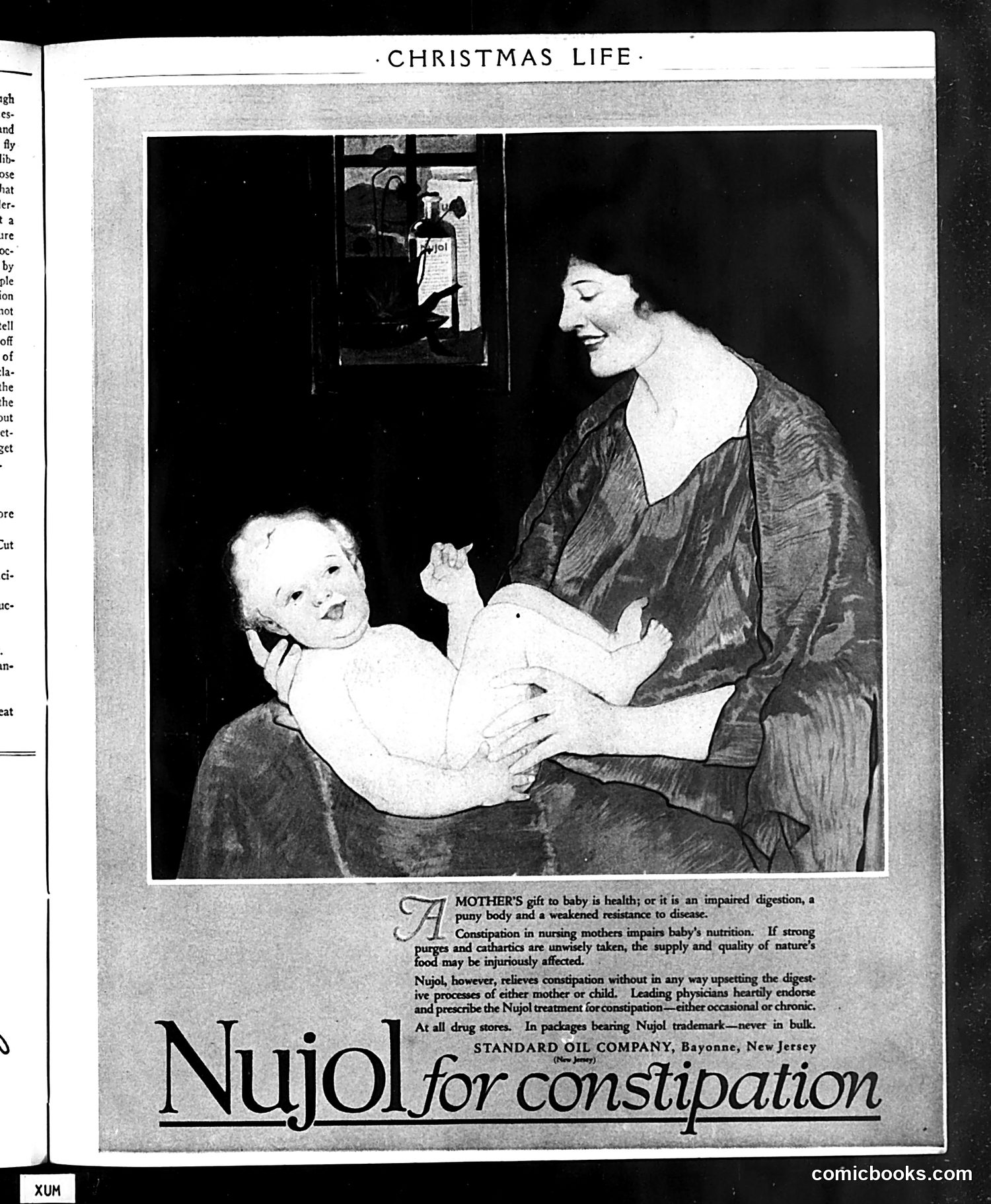
This is a **pharmaceutical advertisement**, not political satire or a cartoon. The page advertises **Nujol**, a laxative product by Standard Oil Company (Bayonne, New Jersey), positioned as a Christmas gift recommendation. The image shows a mother holding a healthy, happy infant. The accompanying text argues that a mother's best gift is a child's health, which depends on proper digestion. It claims constipation in nursing mothers impairs babies' nutrition, and recommends Nujol as a safe treatment that won't upset digestive processes. This reflects early-20th-century patent medicine marketing: normalizing medicinal products for everyday use and targeting parents' anxieties about child health. Modern readers would find the casual recommendation to medicate infants striking and the implied connection between a laxative and Christmas gift-giving incongruous by today's standards.
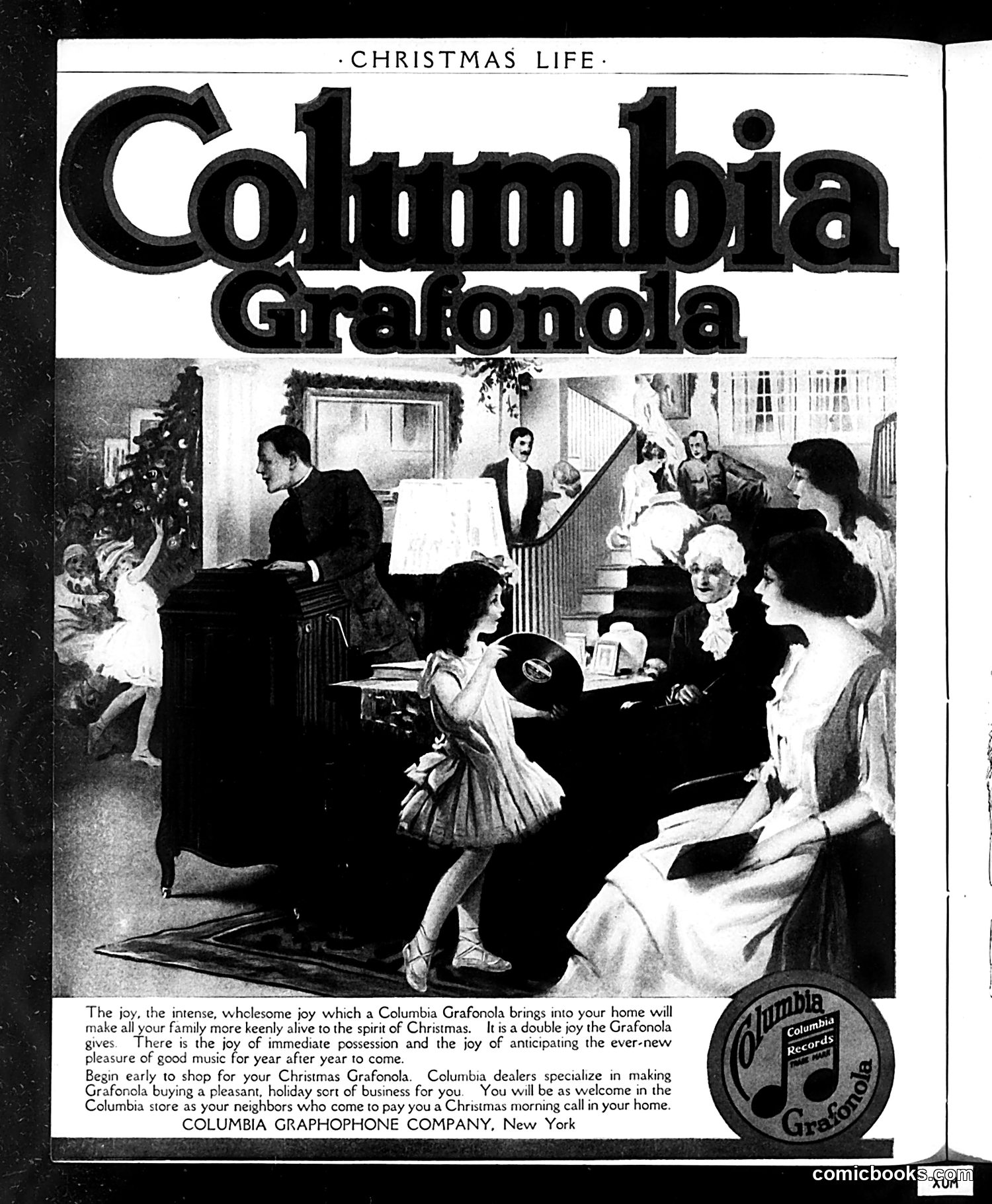
This is a **full-page advertisement**, not satire or political commentary. It promotes Columbia Grafonolas (early phonographs/record players) as Christmas gifts. The image depicts an idealized middle-class family gathering around a piano and phonograph during the holidays. Multiple generations—children, adults, and elderly relatives—are shown enjoying music together in an elegant home decorated with garland. The advertisement's appeal relies on **nostalgia and family values**: it frames the Grafonola as delivering "wholesome joy" and facilitating togetherness across generations. The pitch emphasizes both immediate pleasure ("possession") and lasting satisfaction ("year after year"). This reflects early 20th-century consumer marketing strategy: positioning modern technology (the phonograph) as enhancing rather than replacing traditional family rituals like Christmas celebrations. The copy reassures potential buyers that Columbia dealers make purchasing "a pleasant, holiday sort of business." The page represents how Life magazine's pages mixed editorial content with advertising during this era.
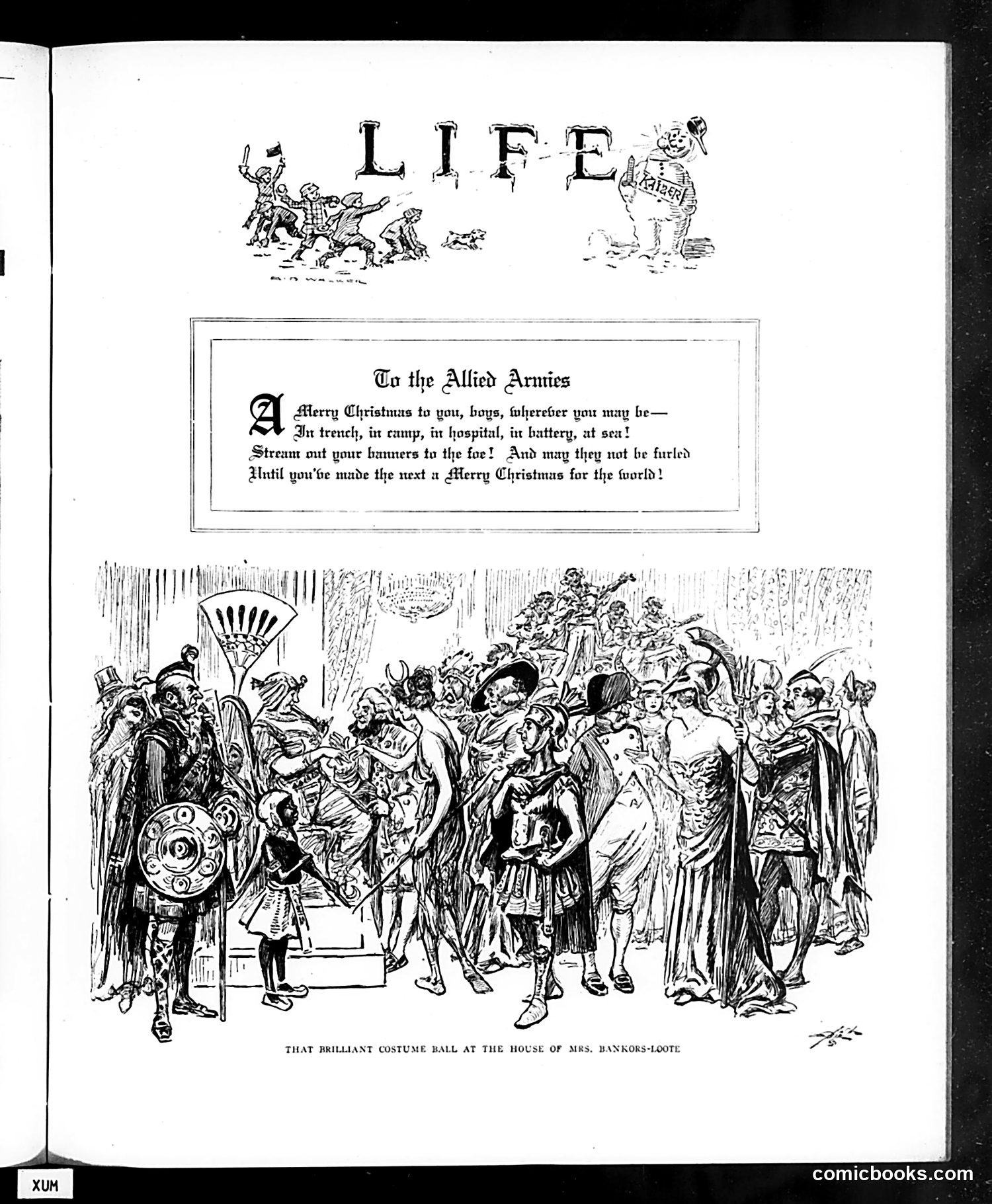
This is a WWI-era Christmas greeting from *Life* magazine to Allied soldiers. The text at top, "To the Allied Armies," offers holiday wishes to troops across all combat zones ("in trench, in camp, in hospital, in battery, at sea"). The greeting carries military exhortation: soldiers should "stream out your banners to the foe" and fight until they've secured a peaceful world where the *next* Christmas can be truly merry—implying victory is necessary for lasting peace. The illustration below shows a costumed ball at Mrs. Bankors-Loote's house, depicting civilians in elaborate dress at a festive gathering. The juxtaposition appears ironic: while soldiers suffer in trenches and hospitals, the home front enjoys luxury entertainments. This likely critiques the disconnect between soldiers' sacrifice and civilian comfort during wartime.
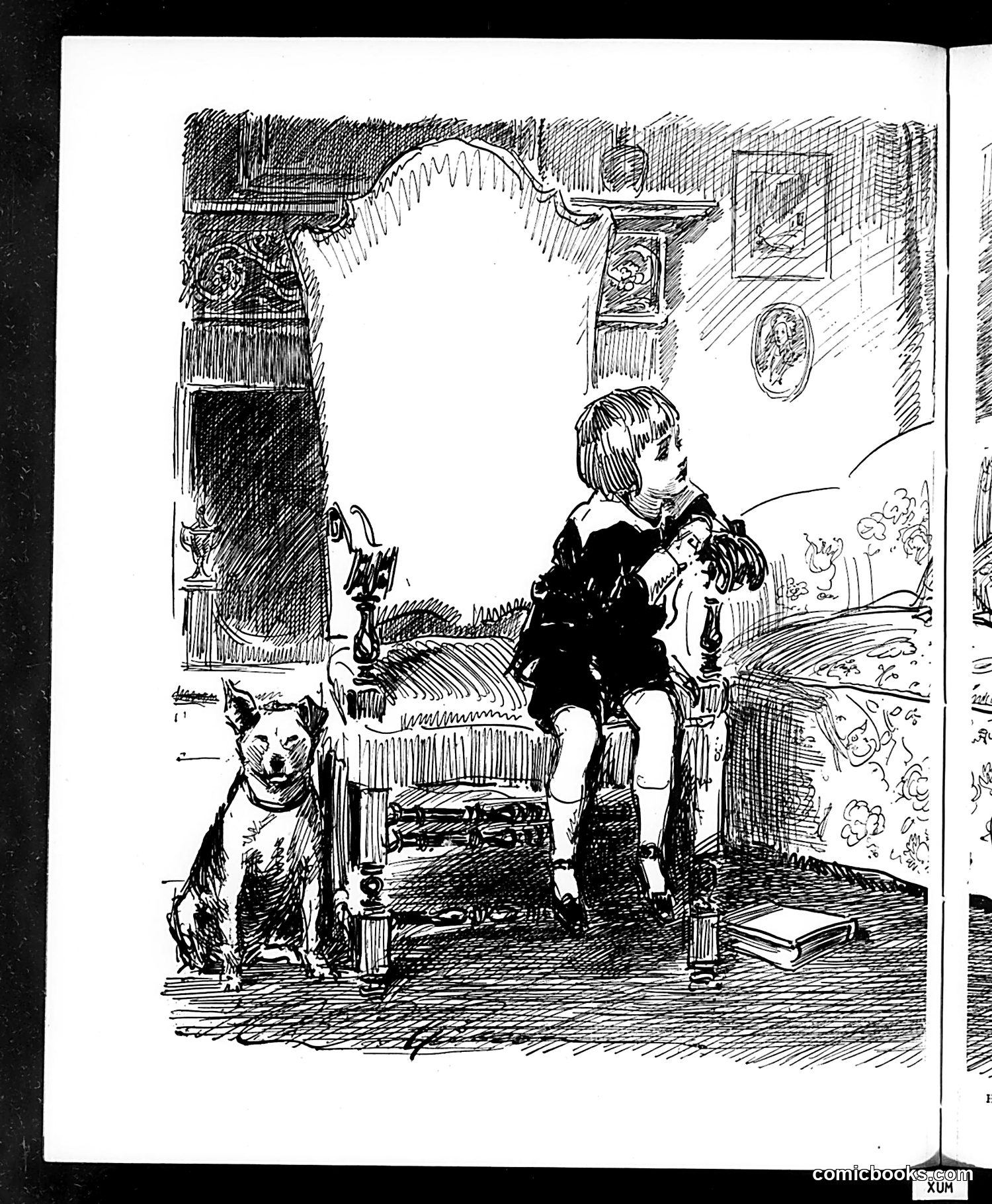
I can see this is a black and white sketch from *Life* magazine showing an interior domestic scene. A well-dressed woman sits on a bench holding two small children, while a dog sits attentively nearby. The room features ornate architectural details, framed pictures on walls, and decorative elements suggesting a wealthy household. However, the OCR text provided ("RESO OI SERS NN RZ TY BHR") appears corrupted and doesn't provide readable context. Without legible accompanying text, I cannot reliably identify the specific satirical point, the figures being caricatured, or what social/political issue this cartoon addresses. The image alone suggests domestic life commentary, but determining the intended satire would require readable text or additional context I cannot assert from the visual alone.
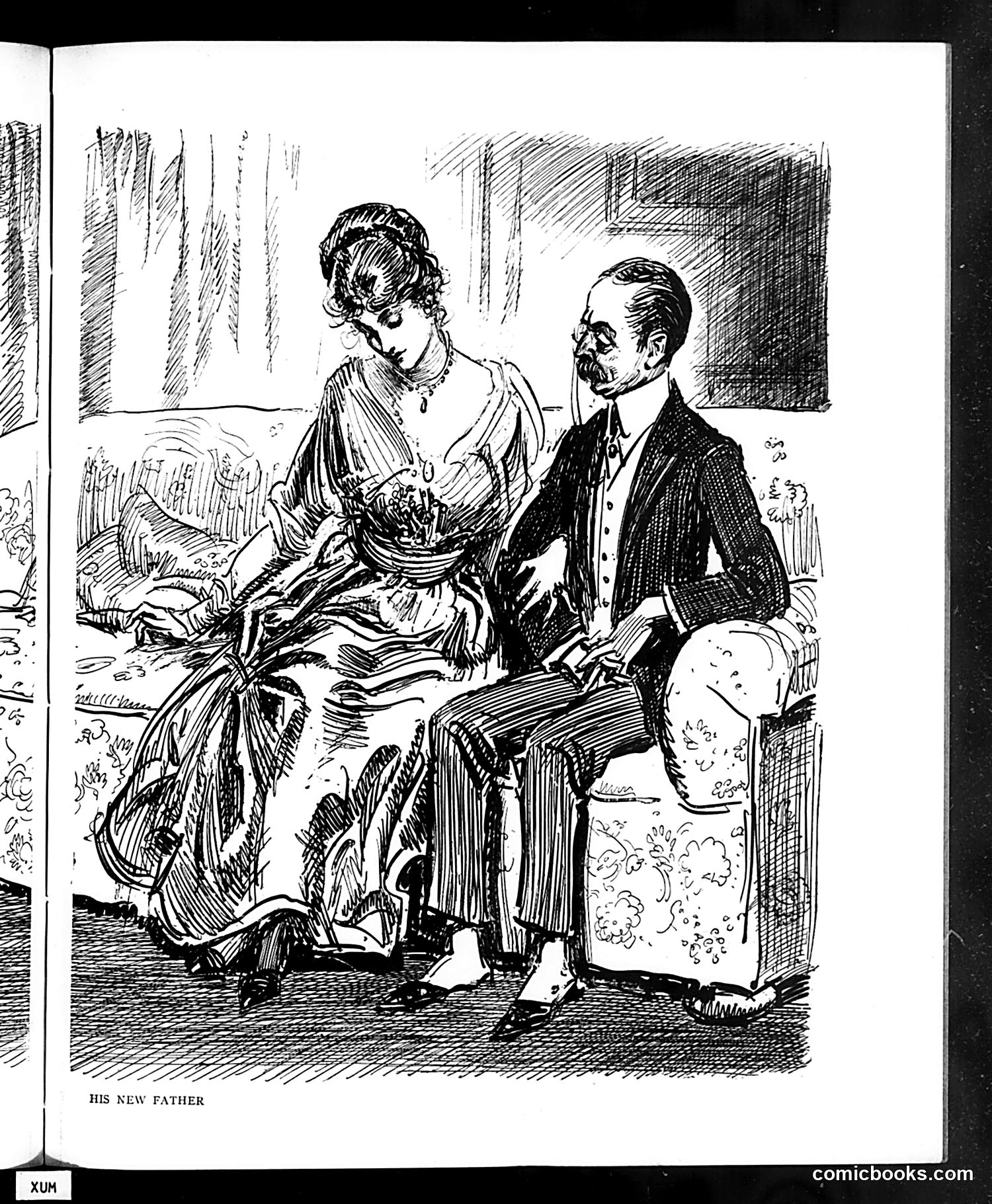
This satirical illustration depicts a domestic scene with a woman and man seated together, captioned "His New Father." The sketch style is characteristic of late 19th-century American satirical magazine illustration. The cartoon appears to comment on remarriage or a change in paternal authority—likely mocking either a stepfather figure or a shift in family dynamics. The woman's elaborate dress and the man's formal attire suggest middle-class subjects. Without additional context from the magazine's publication date or surrounding articles, the specific political or social target remains unclear, though the title's emphasis on "new" suggests the joke concerns replacing an original father figure. The OCR text provides no legible caption or article to clarify the reference.
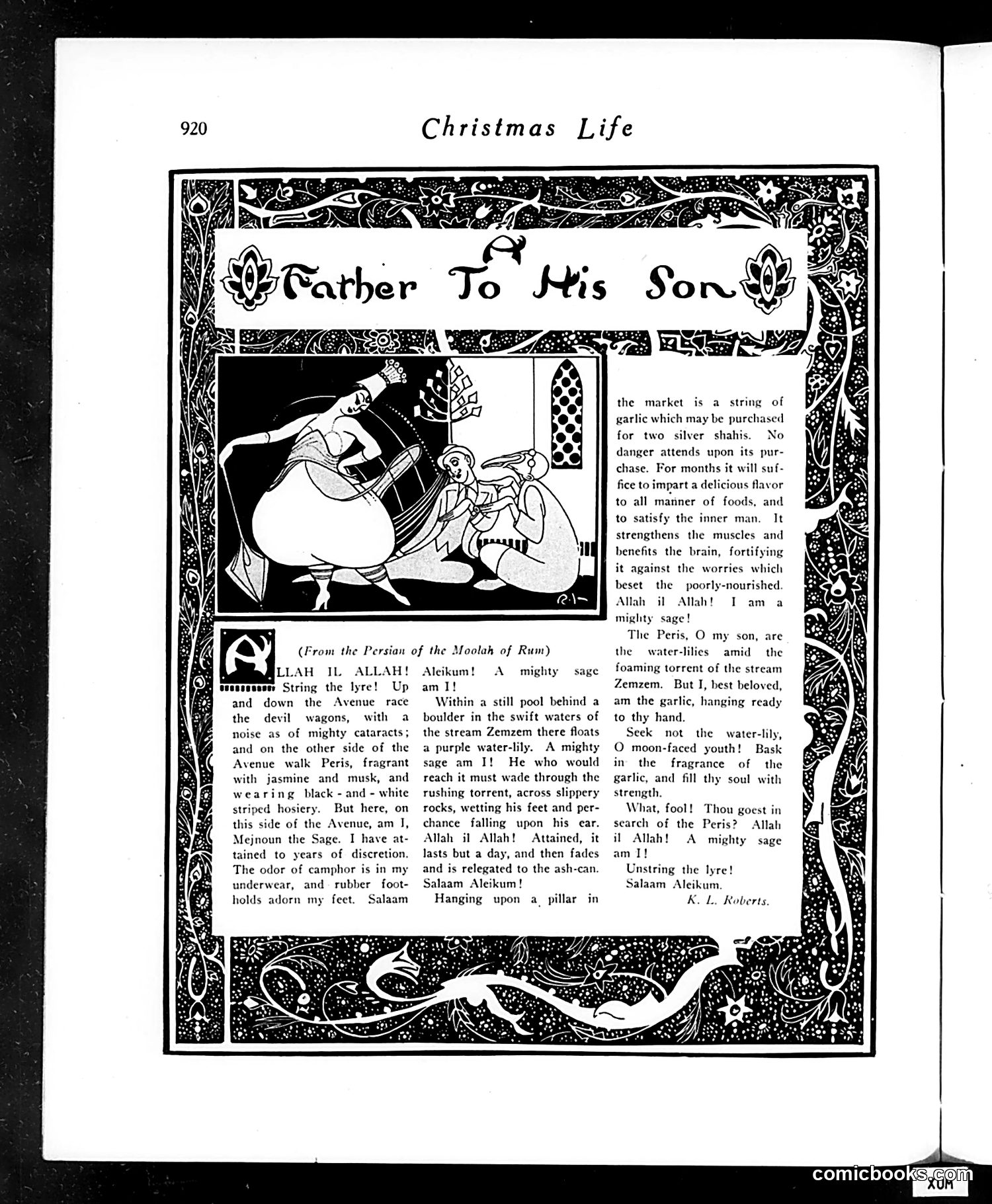
This piece mocks the contrast between elaborate Eastern philosophical pretension and mundane practicality. A supposed Persian sage ("Mejnoun the Sage") delivers grandiose spiritual advice in flowery, pseudo-Oriental language, comparing life's pursuits to difficult quests (wading through torrents for fleeting water-lilies). The satire's punchline: his actual wisdom reduces to garlic—cheap, unglamorous, and genuinely useful. The illustration shows him addressing his son with exaggerated posturing while holding this humble vegetable. The humor targets Westerners' romanticization of "Eastern wisdom" as mysterious and elevated, when practical advice about basic sustenance is more valuable. The constant exclamations ("Allah il Allah!") and ornate prose parody how such philosophy often obscures rather than clarifies. The credited author is K.L. Roberts.
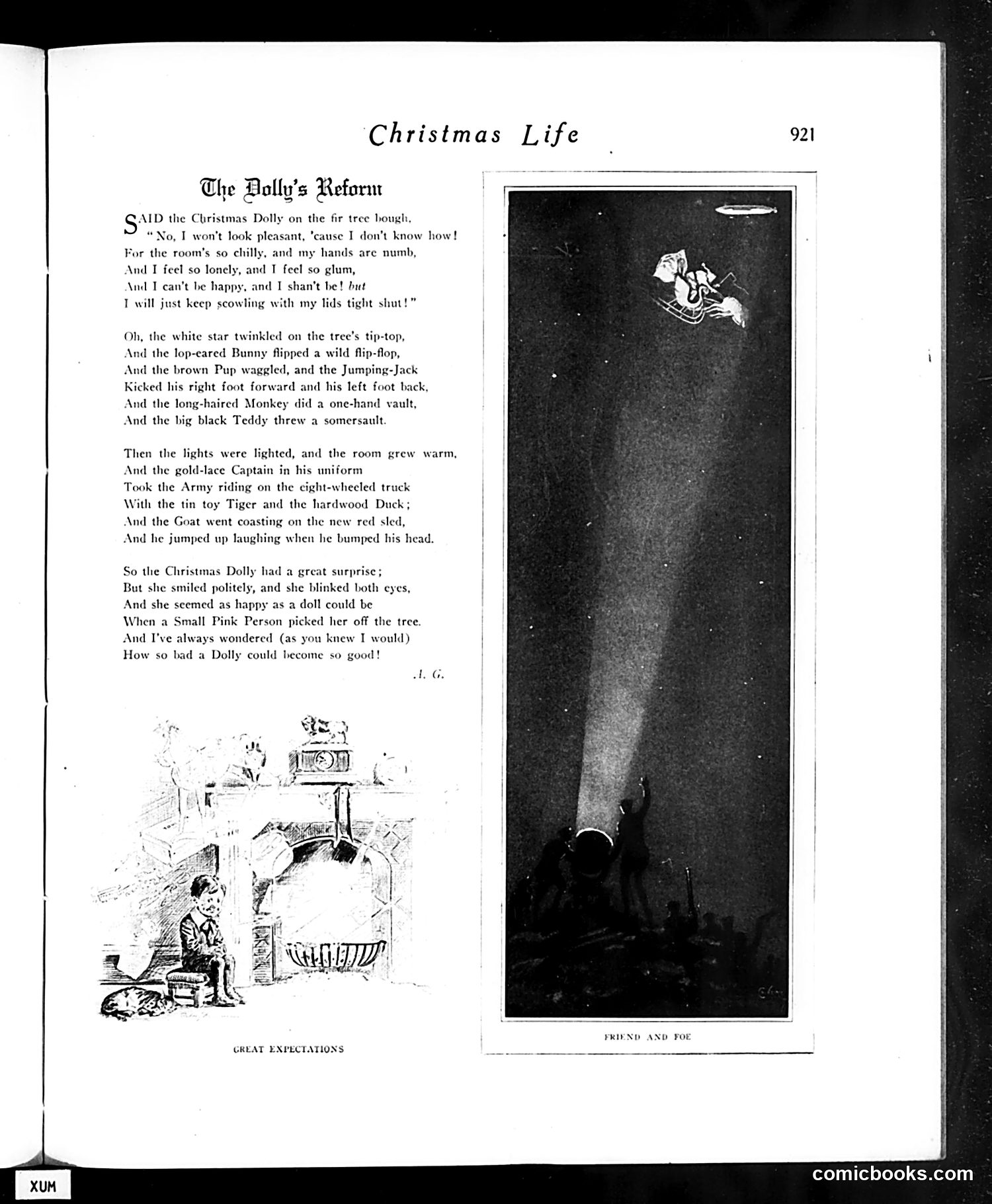
This is a children's poem with gentle moral instruction, not political satire. A Christmas doll on a tree refuses to look pleasant, complaining of cold and loneliness. When the room warms and other toys animate—a bunny, pup, jumping-jack, monkey, teddy bear, toy captain, tiger, duck, and goat—the doll's attitude transforms. She becomes happy when a "Small Pink Person" (a child) takes her from the tree. The satire targets not politics but childhood behavior: the sulky doll represents an unhappy child who, exposed to warmth, companionship, and attention, reforms her disposition. The poem's ironic title and closing question—"How so bad a Dolly could become so good!"—gently mock how quickly children's moods shift when circumstances improve and they receive affection. It's sentimental Victorian-era advice wrapped in whimsy.
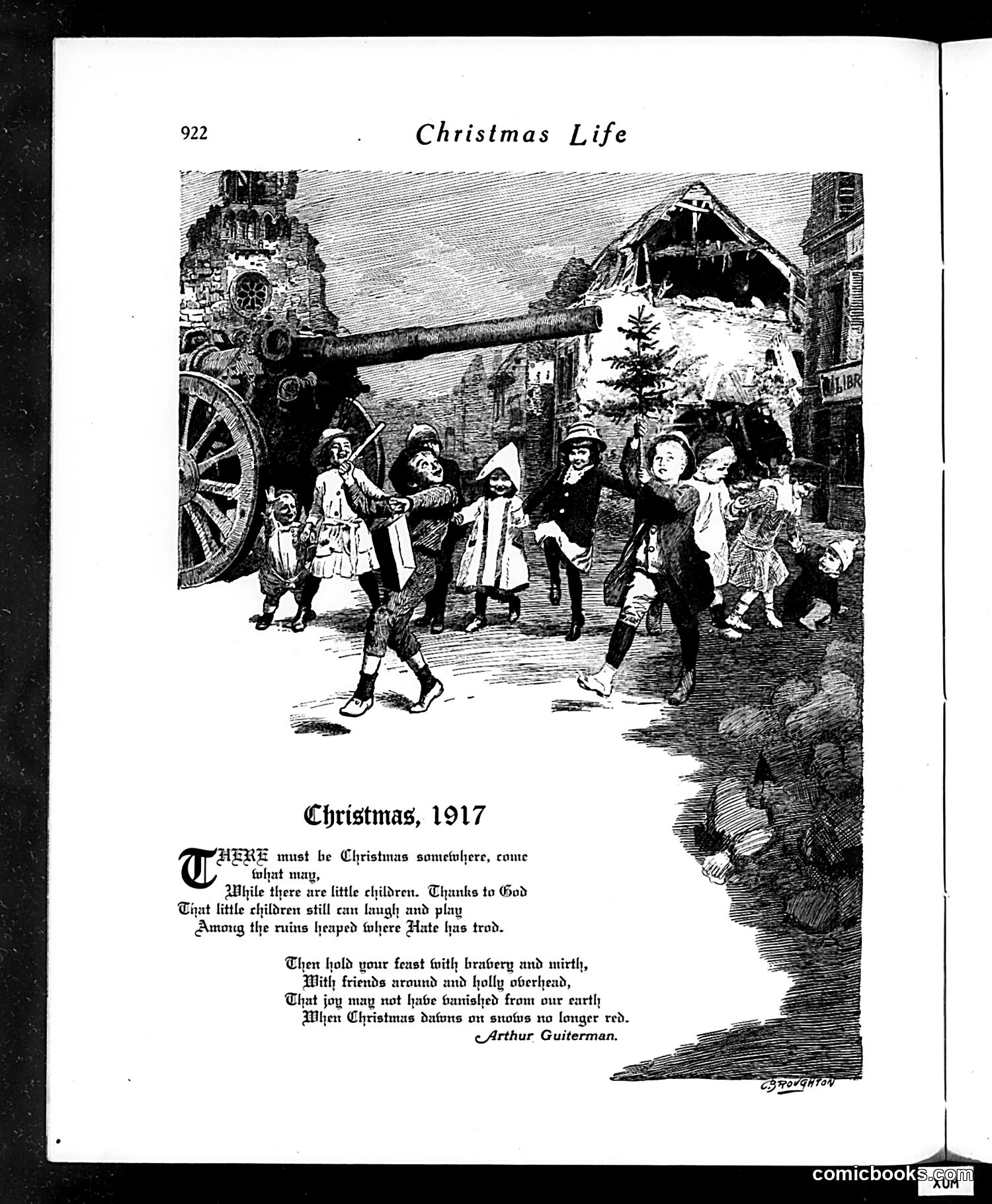
This is a 1917 Christmas greeting rather than political satire. The illustration depicts children playing amid war ruins—a bombed building and a large military cannon—suggesting the European theater of World War I, which America had recently entered (April 1917). The poem by Arthur Guiterman addresses the contrast between childhood innocence and wartime devastation. It expresses gratitude that children can still laugh despite the destruction ("ruins heaped where Hate has trod"), and encourages celebrating Christmas with "bravery and mirth" even as "Christmas daubs on snows no longer red"—a reference to blood staining the snow. The message is patriotic and morale-boosting: despite warfare's horrors abroad, Americans should maintain holiday joy and remember that hope persists through children's resilience. The tone is somber but ultimately hopeful about preserving civilian spirits during wartime.
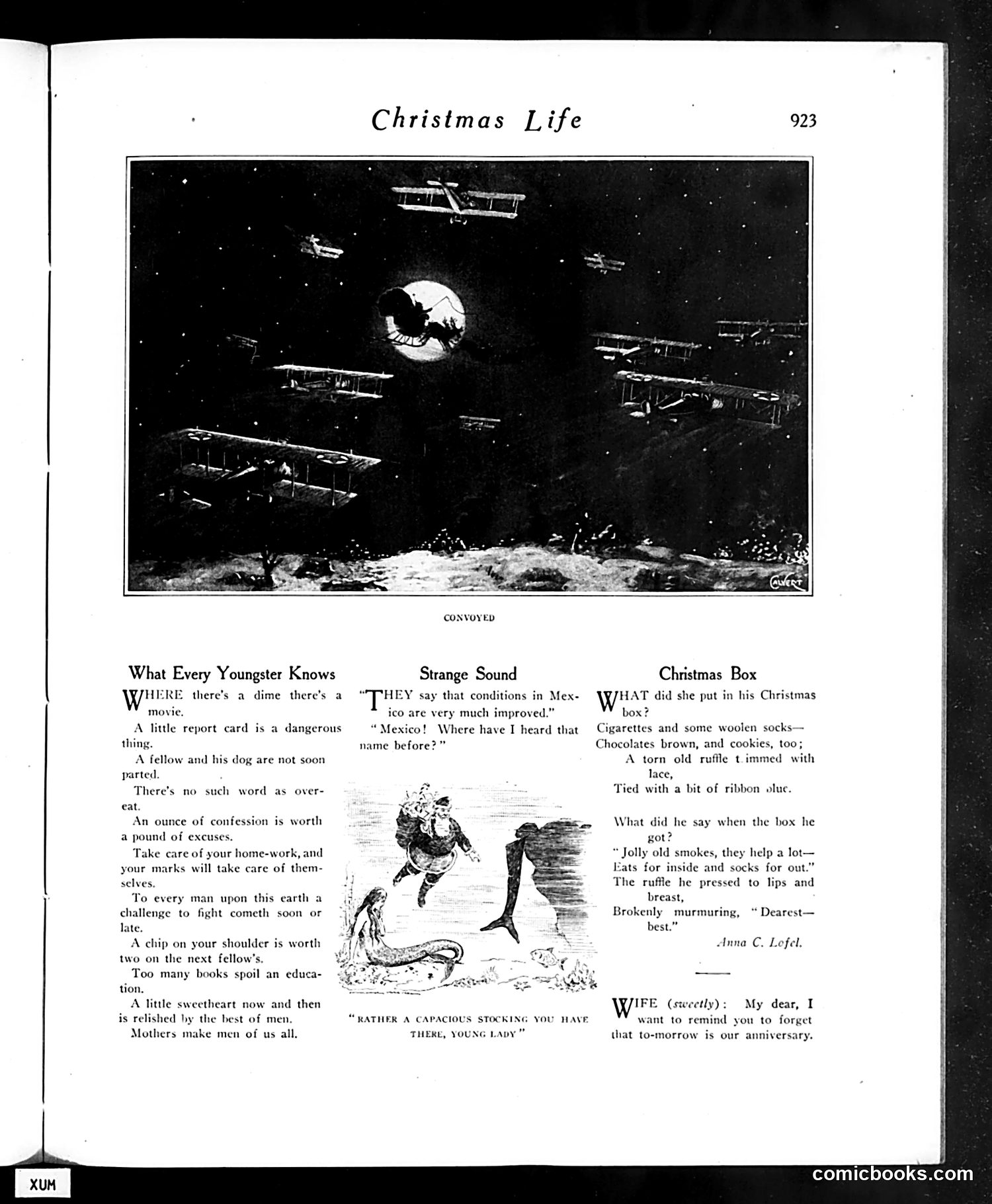
This is a Christmas-themed humor page from *Life* magazine featuring three satirical pieces: 1. **"What Every Youngster Knows"**: A list of mock-serious "life lessons" for boys—sardonic observations about school, romance, and behavior (report cards are dangerous, too many books spoil education, mothers shape men). 2. **"Strange Sound"**: A brief joke about someone unfamiliar with Mexico, playing on period ignorance. 3. **"Christmas Box"**: A sentimental romantic sketch where a young man receives cigarettes, socks, and chocolates from his girlfriend, but is most moved by a delicate ruffle she included—suggesting emotional/romantic significance beneath practical gifts. 4. **"WIFE" joke**: A final gag where a wife reminds her husband he should forget (meaning ignore/not expect to celebrate) their upcoming anniversary—a common domesticity humor trope. The cartoonish illustration shows a woman with an oversized stocking, supporting the comedy about gift-giving expectations. The humor relies on early 20th-century gender roles and romantic conventions now largely dated.
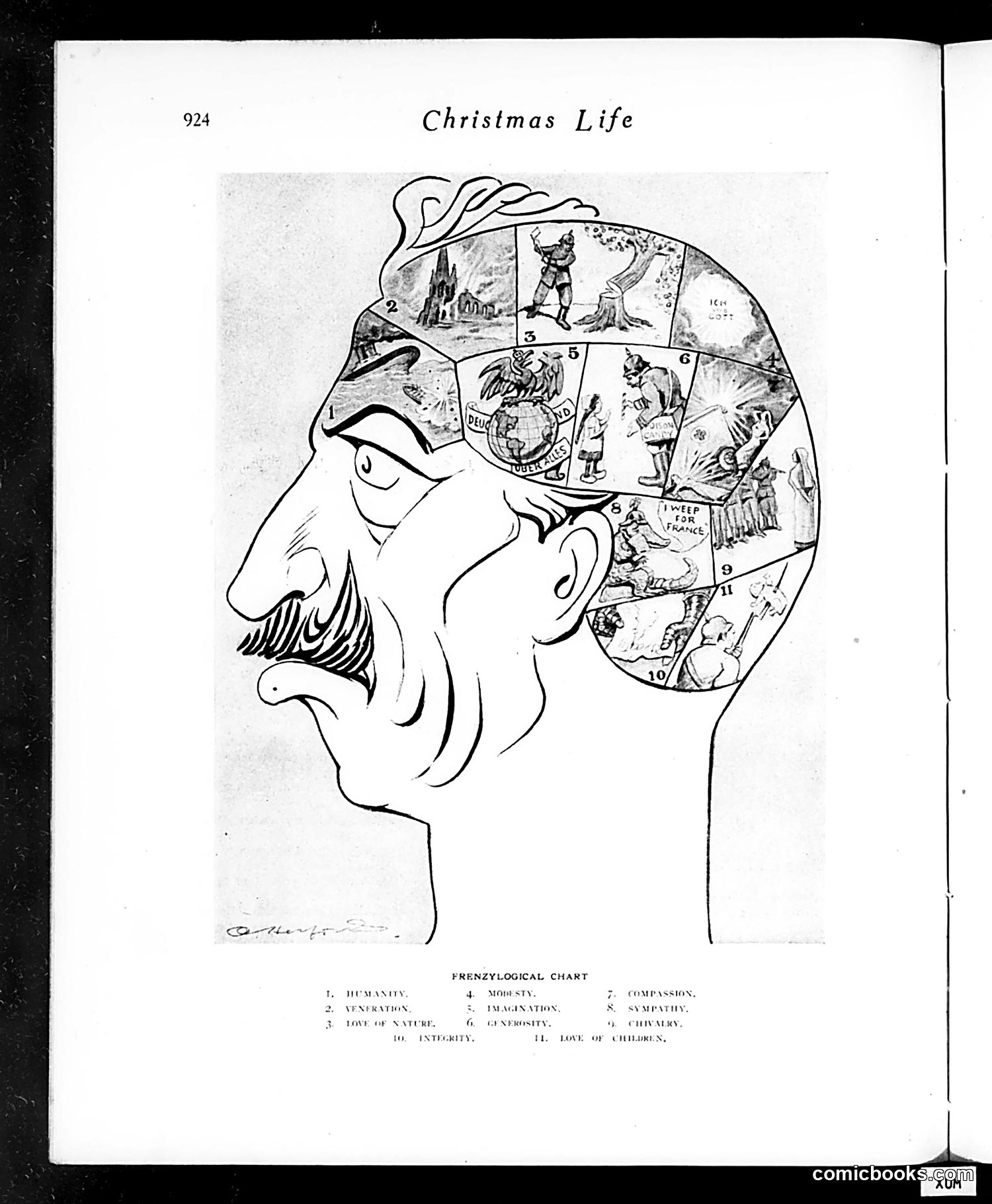
This is a "phrenological chart"—a satirical take on phrenology, the pseudoscience claiming skull bumps revealed character traits. The image shows a profile head divided into numbered sections, each labeled with Christmas-related virtues (Humanity, Veneration, Love of Nature, Modesty, Imagination, Generosity, Compassion, Sympathy, Chivalry, Integrity, Love of Children). Inside each cranial section are small illustrated scenes depicting Christmas activities and traditions—gift-giving, caroling, family gatherings, charitable acts. The satire mocks phrenology while humorously suggesting that Christmas spirit activates all these noble human faculties simultaneously. It's a lighthearted commentary on Christmas's supposed moral elevation of human nature, presented through the framework of a then-discredited but still culturally familiar pseudoscience.
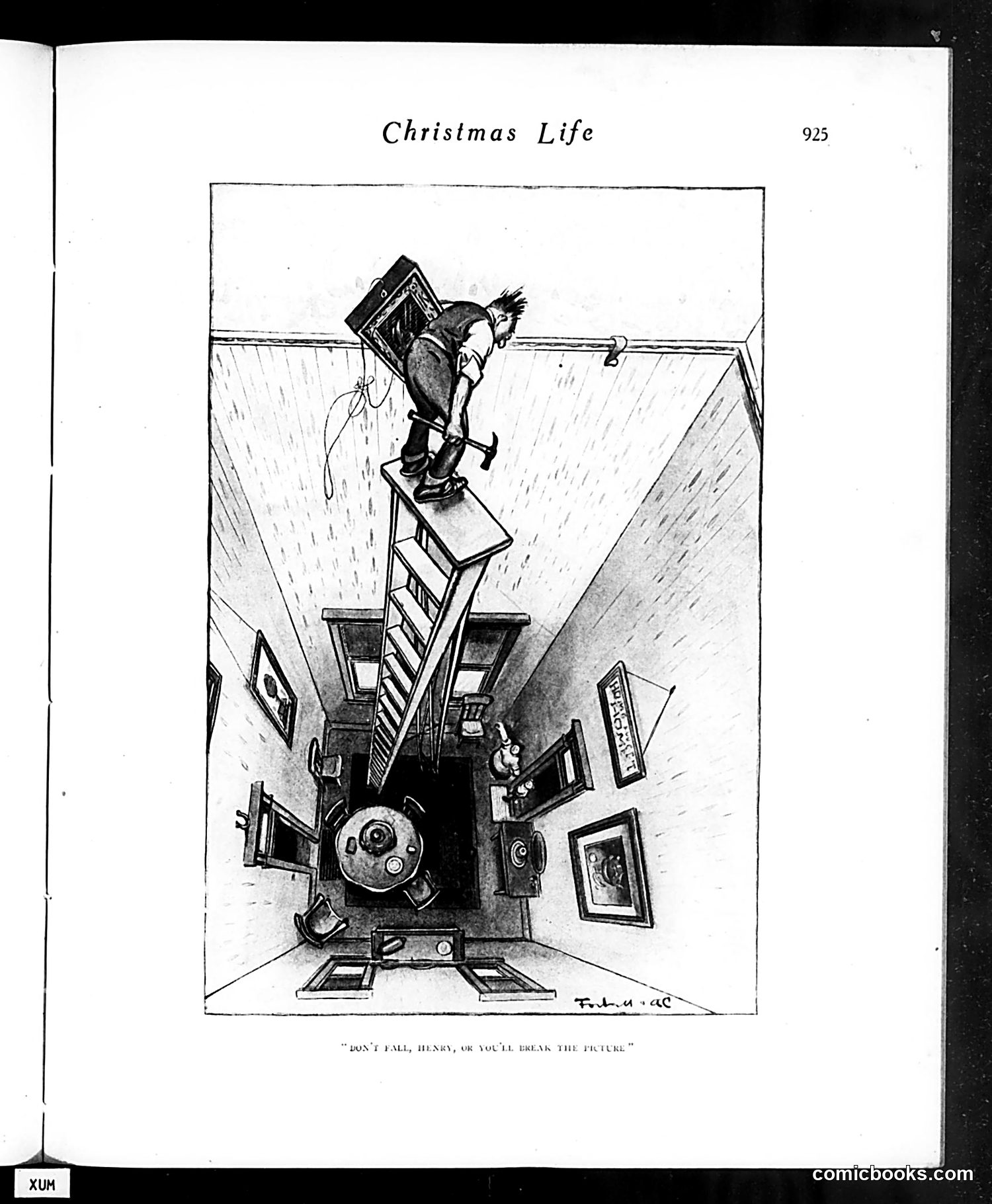
This is a single cartoon titled "DON'T FALL, HENRY, OR YOU'LL BREAK THE PICTURE" (page 925 of Life magazine). The image shows a man precariously balanced on a ladder atop a chair, reaching upward while holding what appears to be a hammer or tool. He's in a narrow interior space with framed pictures on the walls and various household items visible. The joke plays on domestic hazard: someone (apparently named Henry) is engaged in a risky home repair or decoration task—likely hanging a picture or decoration—at an unsafe height. The caption's warning is darkly humorous, suggesting that if Henry falls, the picture will break (rather than expressing primary concern for Henry's safety). This satirizes either careless home handymen or the relative value homeowners place on possessions versus personal safety. Without additional context about whether "Henry" references a specific public figure, the cartoon appears to be general domestic humor rather than political satire.
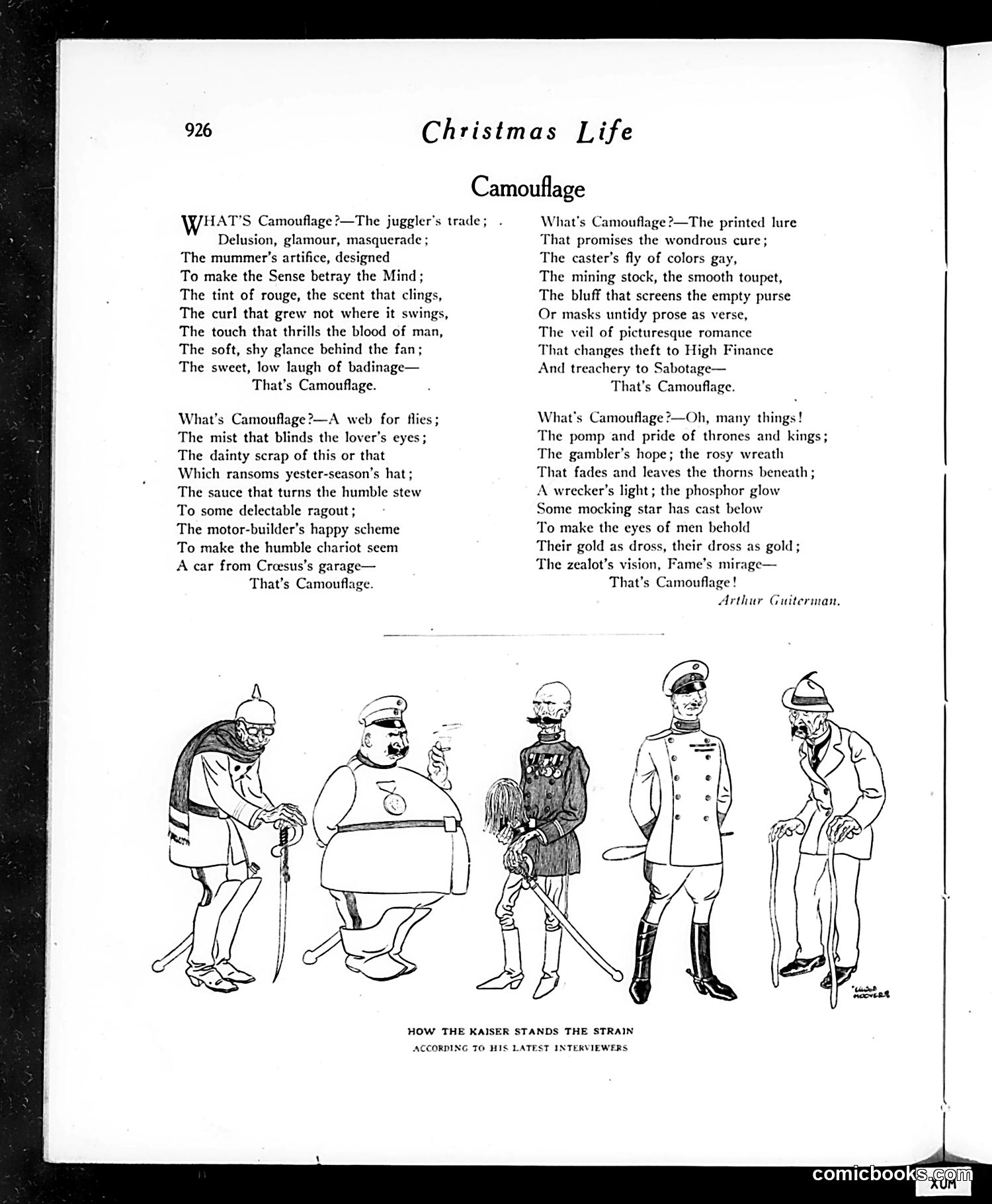
This page presents Arthur Guiterman's poem defining "camouflage"—a concept newly relevant during World War I. The poem catalogs camouflage's uses across society: romantic deception (makeup, false curls), commercial fraud (fake cures, inflated stock schemes), and literary pretense (bad prose disguised as verse). The cartoon below depicts **the German Kaiser** in five different poses, each supposedly showing how he "stands the strain" of war according to recent interviews. This is political satire mocking either the Kaiser's actual public statements or press reports about his condition. The multiple contrasting poses suggest his accounts are contradictory or fabricated—another form of camouflage. The pairing is purposeful: the poem's final stanza explicitly lists deception used by those in power ("thrones and kings"), making the Kaiser cartoon a visual demonstration of governmental camouflage during wartime.
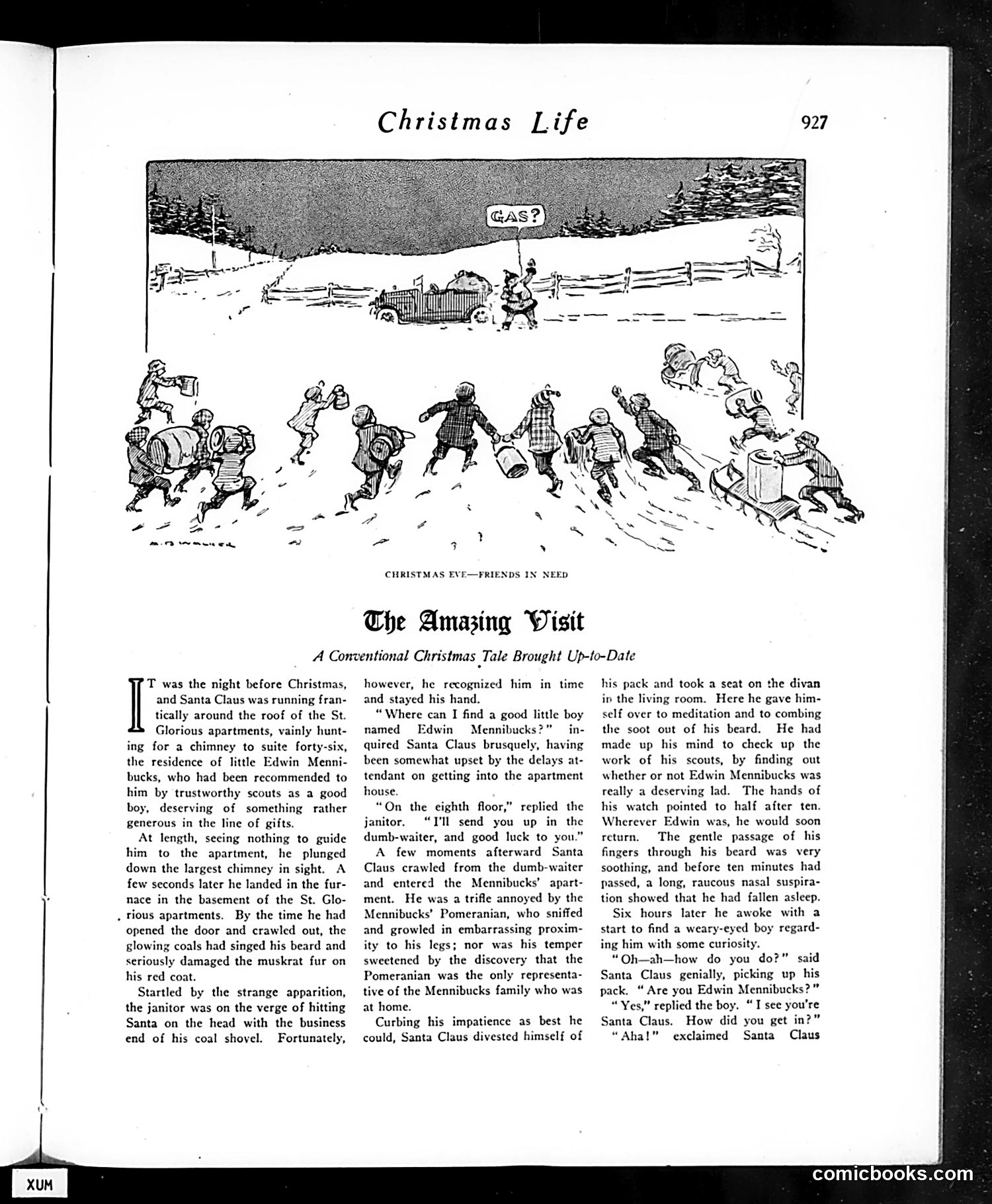
This page contains a satirical Christmas story that mocks modern apartment living. The cartoon above illustrates children playing in snow; the story below parodies traditional Santa tales. The satire targets early 20th-century urban apartment buildings ("St. Glorious apartments"), which lacked chimneys—rendering Santa's conventional method of entry obsolete. Santa encounters absurd obstacles: he lands in a basement furnace, nearly gets attacked by a janitor, travels via dumb-waiter, and is growled at by a Pomeranian dog. When he finally finds young Edwin Mennibucks, the boy arrives home at 4 AM, implying modern children keep late hours. The joke is that Santa's traditional Christmas magic cannot adapt to contemporary city life and its complications. The story presents this collision between nostalgic holiday convention and modern urban reality as inherently comic, suggesting readers would recognize how thoroughly industrial apartment living has disrupted time-honored customs.
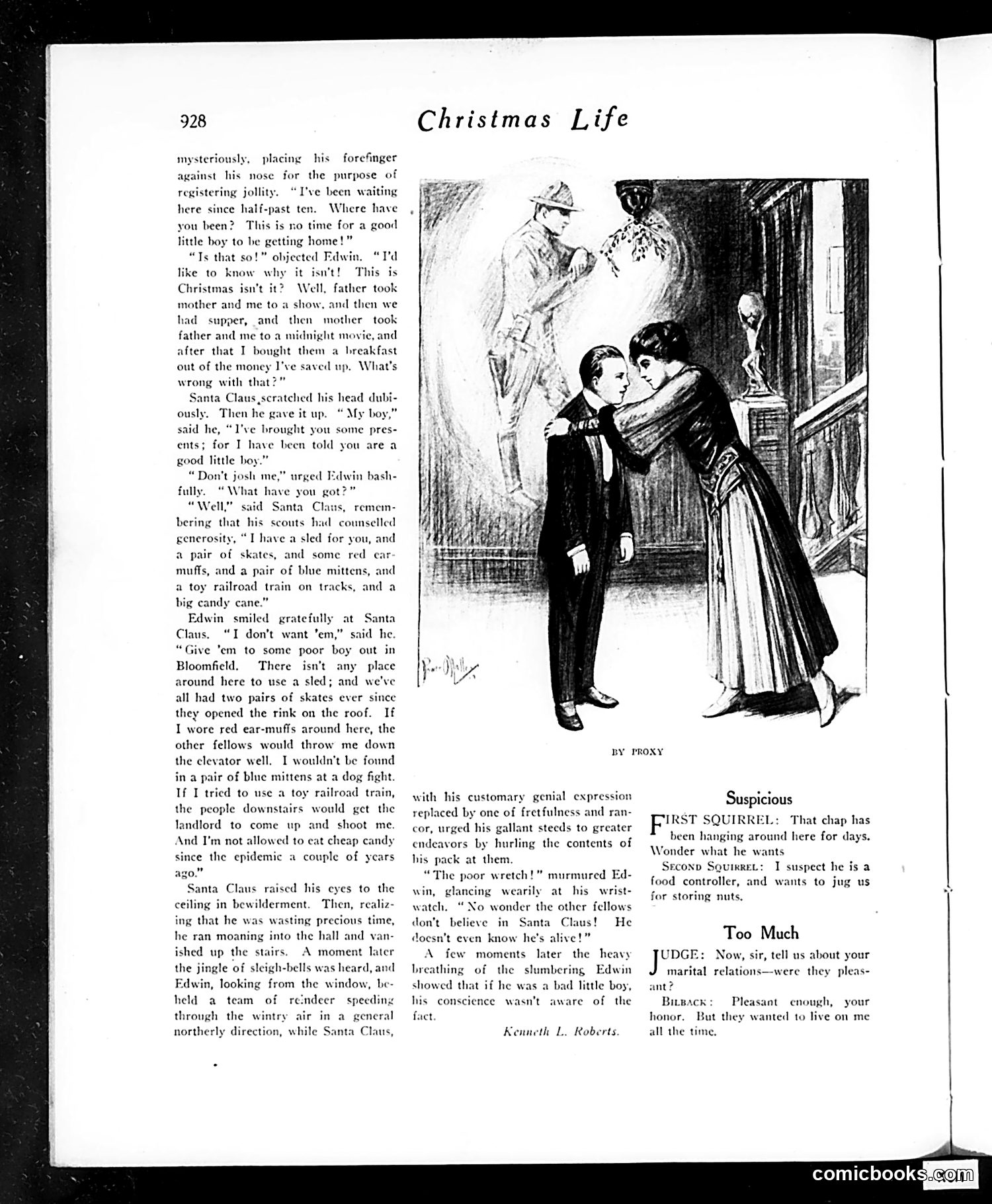
This page contains two distinct satirical pieces: **"Christmas Life by Proxy"** (main story with illustration): A boy named Edwin encounters Santa Claus on Christmas Eve but rejects all traditional gifts—a sled, skates, mittens, toy train, and candy—citing modern urban apartment living as incompatible with these items. He sarcastically suggests Santa give them to poor boys in Bloomfield instead. The satire mocks how wealth and modern city life have made traditional Christmas gifts obsolete for privileged children, and how even Santa's generosity becomes absurd in this context. Edwin's entitled dismissal of Santa's efforts—despite his own extravagant evening of shows and restaurants—critiques both childhood ingratitude and the commercialization of Christmas. **Two brief joke items** appear at page bottom: - "Suspicious": Squirrels worry a "food controller" wants to prosecute them for storing nuts (likely referencing WWI food rationing) - "Too Much": A judge questions a man about his marriage; the reply jokes that his wife wanted to live off him entirely The page satirizes modern consumer culture, entitlement, and wartime regulations.
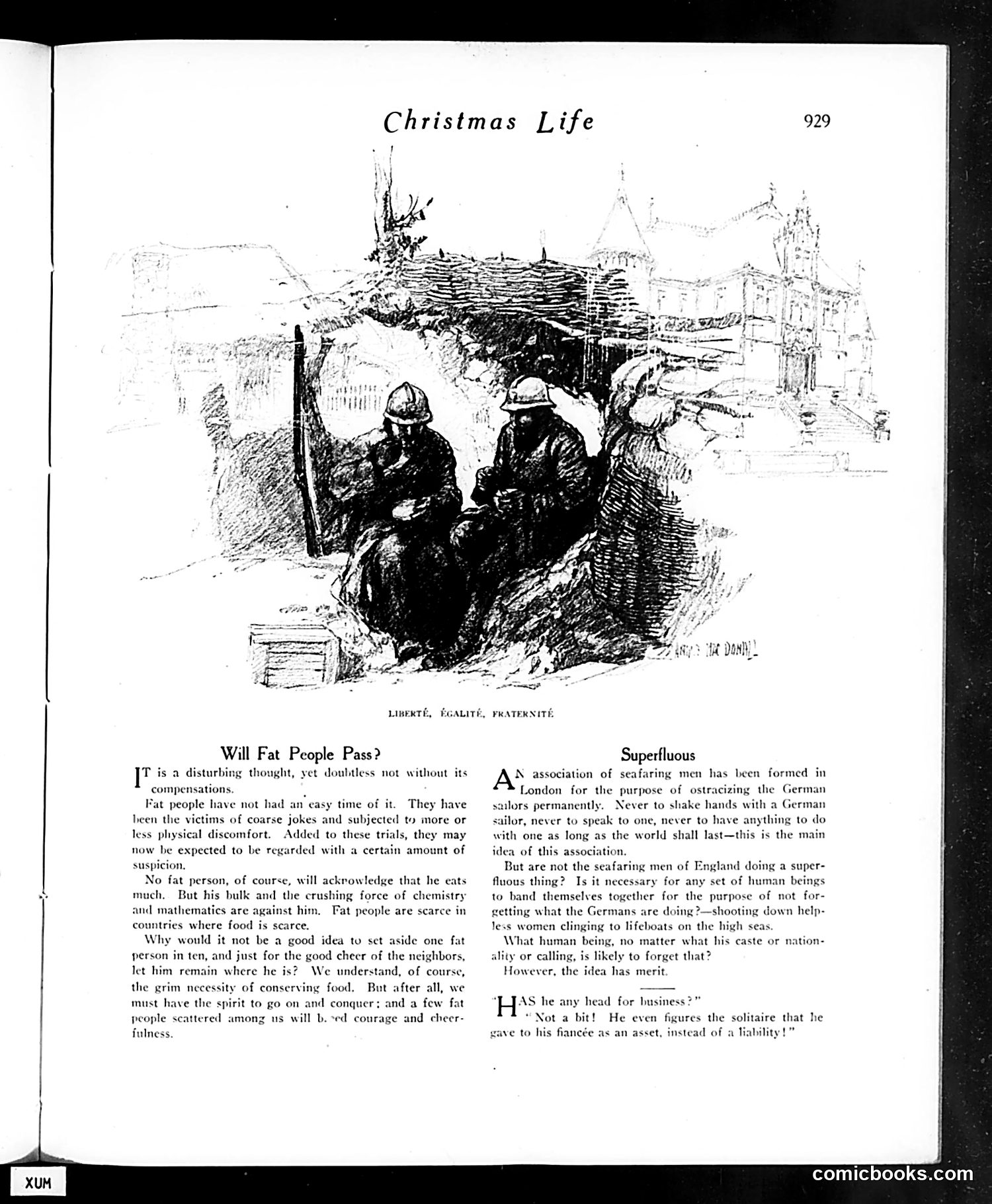
This page contains three wartime satirical pieces, likely from World War I: **"Will Fat People Pass?"** questions whether overweight people will face suspicion during food rationing. The satire suggests that fat people, by existing, "prove" they eat too much—making them targets for public scrutiny during scarcity. The piece advocates keeping a few fat people around for morale, presenting the absurdity of blaming individuals for systemic food conservation needs. **"Superfluous"** mocks a newly-formed British sailors' association pledging never to interact with Germans, as protest against German naval atrocities (shooting civilians from lifeboats). Life satirizes the pledge as unnecessary—who could forget such horrors?—yet acknowledges the impulse has "merit." **The final joke** is a quip about a man calling a diamond solitaire an "asset" rather than "liability" when giving it to his fiancée—implying wives are financial burdens. The sketch depicts working-class figures, consistent with wartime themes of rationing and social cohesion.
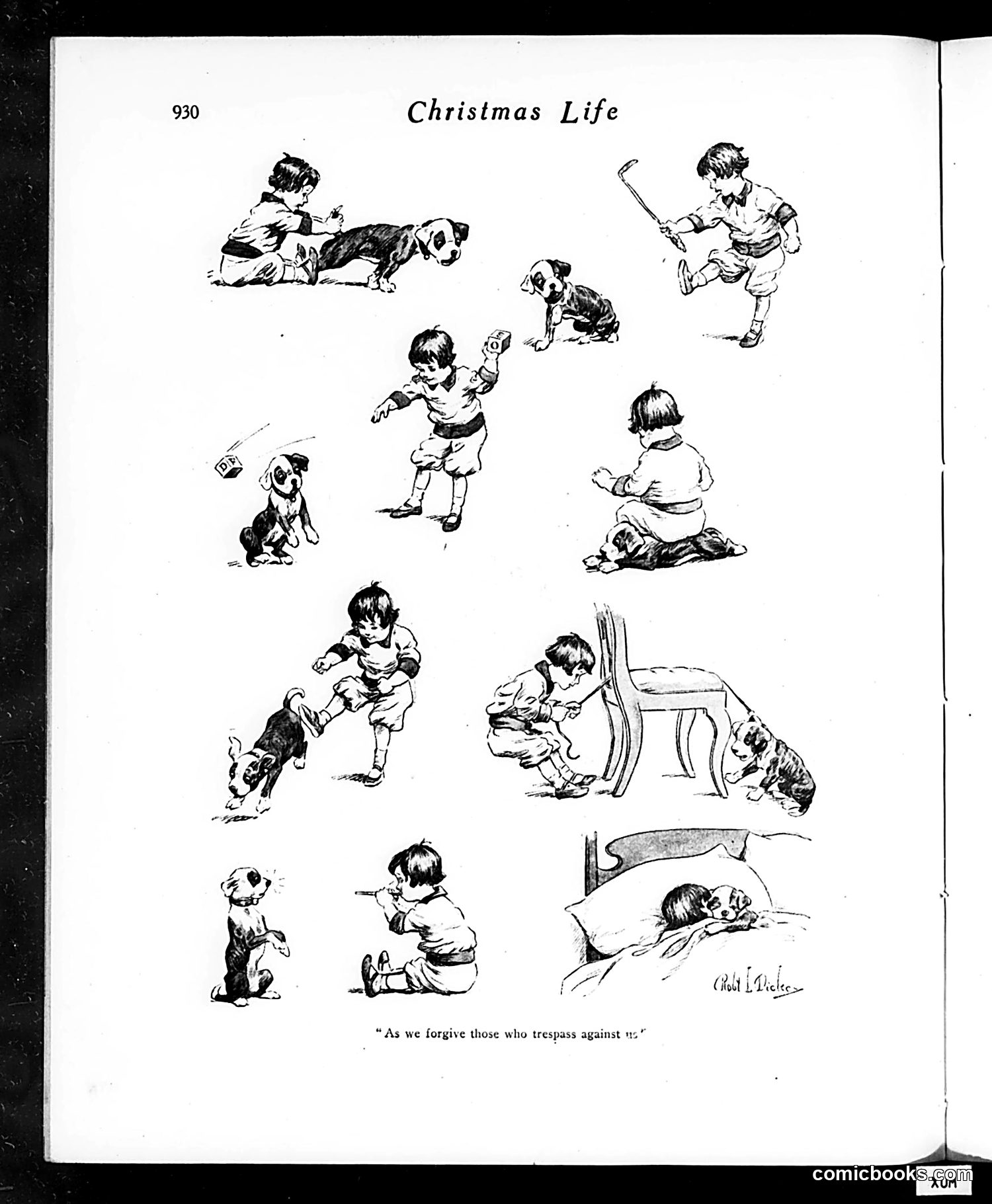
This is a charming illustration series depicting children and dogs in various playful activities—playing, running, fighting, hiding, and sleeping together. The caption quotes the Lord's Prayer: "As we forgive those who trespass against us." The satire appears gentle and moralistic rather than political. The cartoonist (signed "Cesare L. Maccari") uses children's innocent interactions with each other and their pets to illustrate Christian forgiveness during the Christmas season. The various scenes show children in conflict (fighting, chasing) alongside moments of affection and rest, suggesting that even in mischief and trespassing, forgiveness—particularly at Christmas—should prevail. It's likely this advocated for gentleness and charitable attitudes during the holiday period.
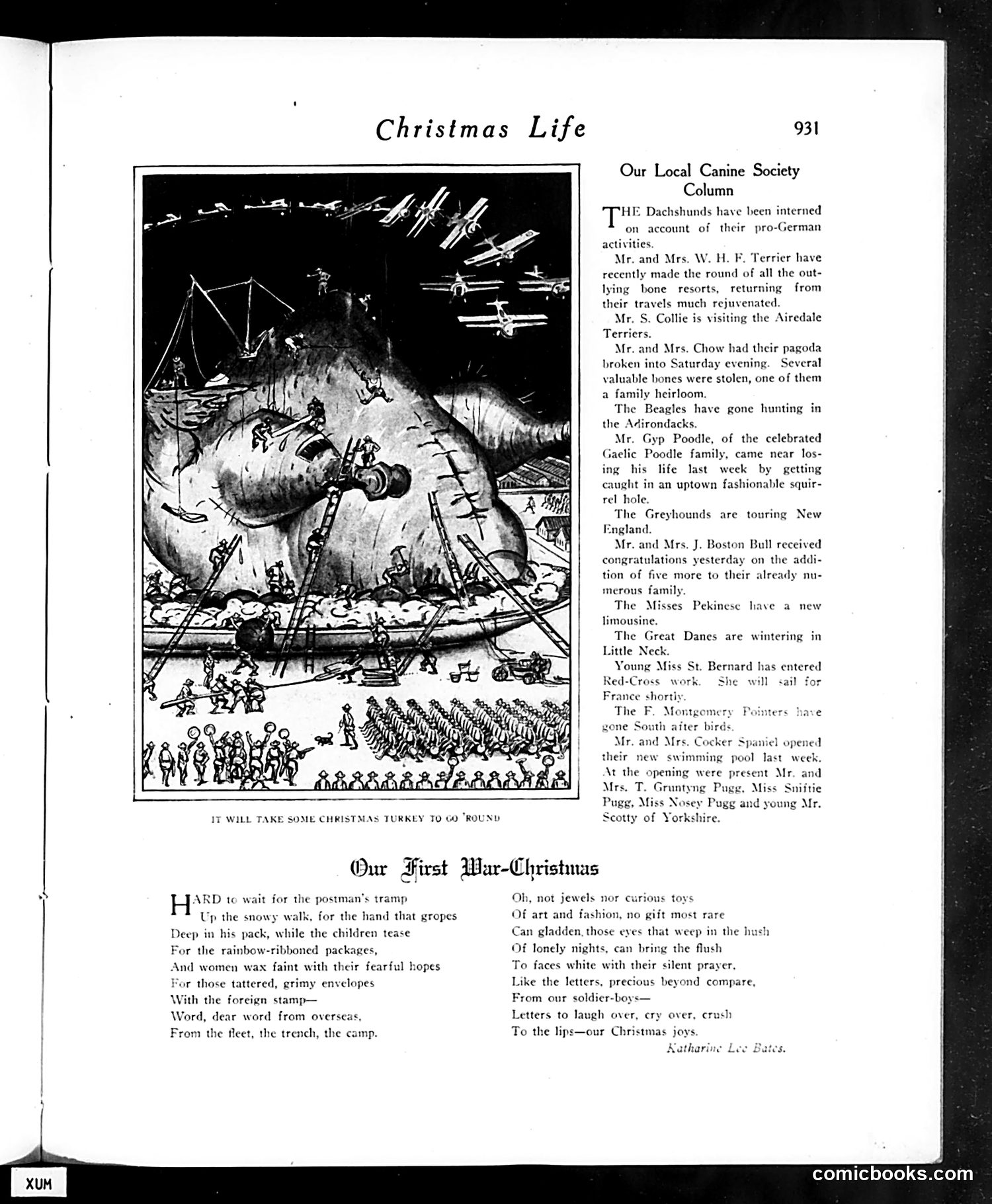
This page from *Life* magazine (page 931) contains two distinct pieces reflecting World War I-era American attitudes: **The "Local Canine Society" Column** is satirical social commentary using dog breeds as stand-ins for human society types. The opening line—"Dachshunds have been interned on account of their pro-German activities"—references the actual internment of German immigrants and German-Americans during WWI. Other entries humorously report on various dog "families" (Boston Bulls, Pekingese, etc.), mimicking society column gossip while subtly mocking wartime xenophobia and the absurdity of treating pets as enemy sympathizers. **"Our First War-Christmas"** is a sentimental poem about soldiers overseas. It contrasts material gifts with the emotional value of letters from troops at "the fleet, the trench, the camp," emphasizing that correspondence from soldiers is more precious than luxury items. The illustration shows a massive Christmas turkey, captioned "It will take some Christmas turkey to go 'round," likely alluding to rationing or food scarcity during wartime. Both pieces reflect American homefront experience during WWI's early years.
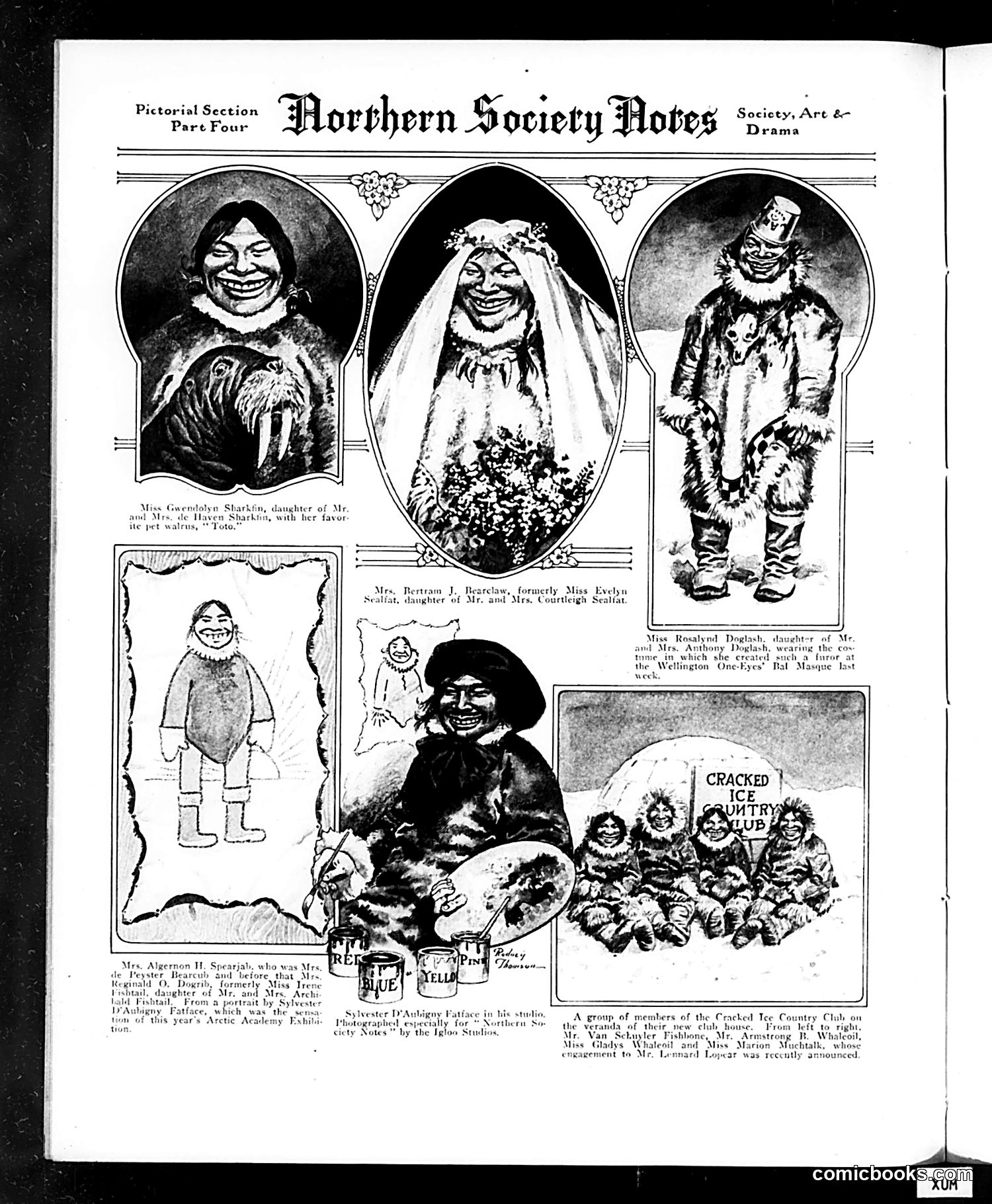
This is a **society/gossip page** from Life magazine featuring photographs of prominent Northern families at social events. The page documents members of what appears to be the "Cracked Ice Country Club," showing people in elaborate costumes at what the OCR suggests is an Arctic-themed or winter-themed social gathering or theatrical production. The images show individuals in exaggerated makeup and period costumes—likely depicting Inuit or Arctic explorer personas for entertainment purposes. This reflects **early 20th-century attitudes** where such racial caricature and "ethnic costume" entertainment was socially acceptable among wealthy circles. The page's function is to chronicle the social activities and engagements of the Northern elite, typical of Life's society coverage. The satire lies in Life's documentation of these figures' self-important social performances, mocking high-society pretension through straightforward reportage of their activities.
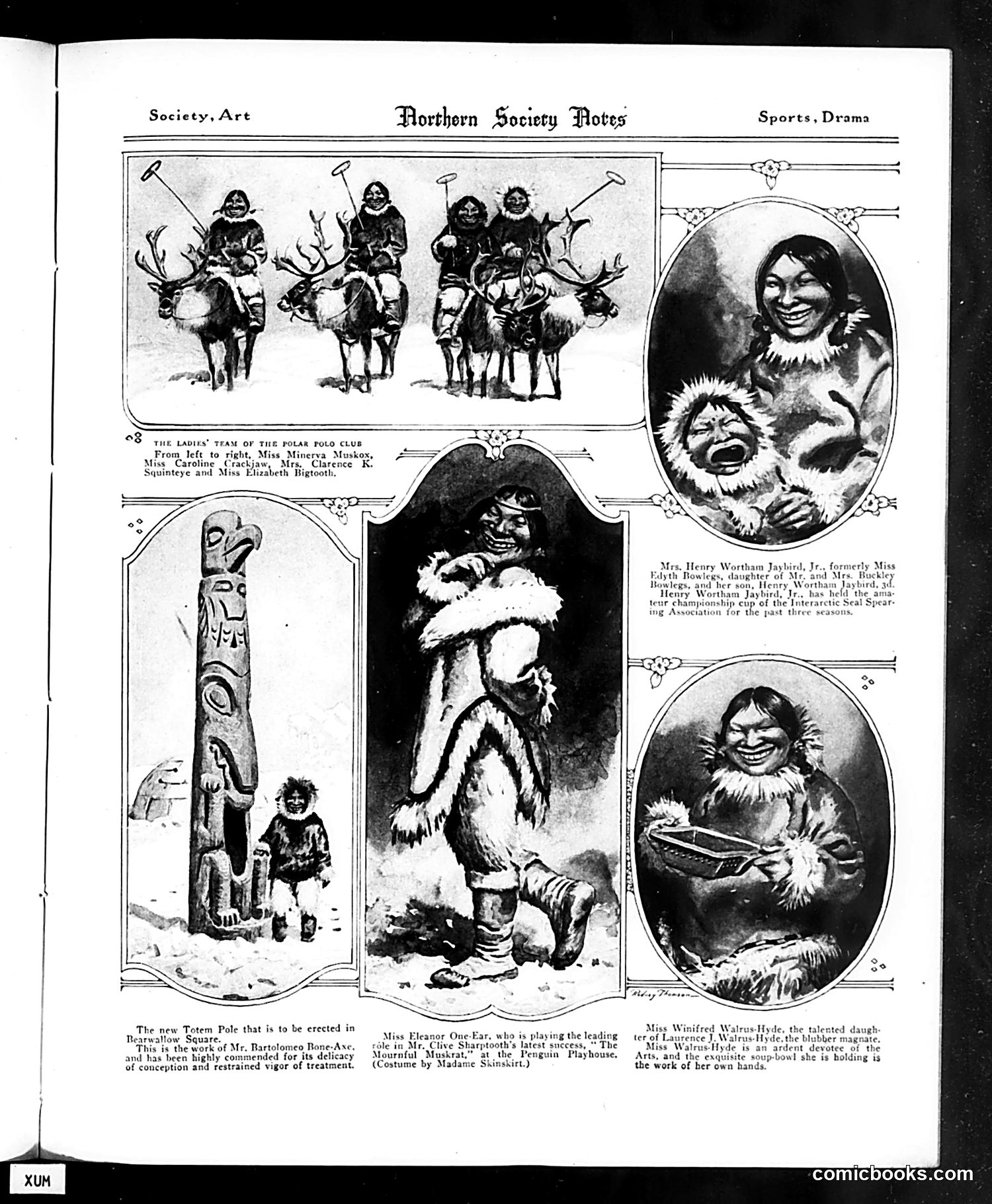
This page from *Life* magazine features satirical content mocking Arctic/Indigenous themes that were popular novelty subjects in early 20th-century society entertainment. **The content includes:** - **"Ladies' Team of the Polar Polo Club"**: A joke about wealthy women adopting exaggerated Arctic personas with absurd names (Muskox, Crackjaw, Bigtooth)—mocking both the fashionable fascination with polar exploration and high-society ladies' recreational clubs. - **The Totem Pole**: References a newly erected artwork in "Rearwallow Square" by an artist with a comedic "Native" name (Bartolomeo Bone-Axe), satirizing both artistic pretension and the era's stereotyping of Indigenous art. - **Portrait subjects**: Women posed with Arctic animals and props, celebrating their participation in fashionable Arctic-themed entertainment and amateur arts. The satire targets the superficial adoption of exotic themes by privileged society figures who played at Arctic culture as entertainment while actual Indigenous peoples faced marginalization. Modern readers should recognize this reflects deeply problematic racial attitudes common to the period.
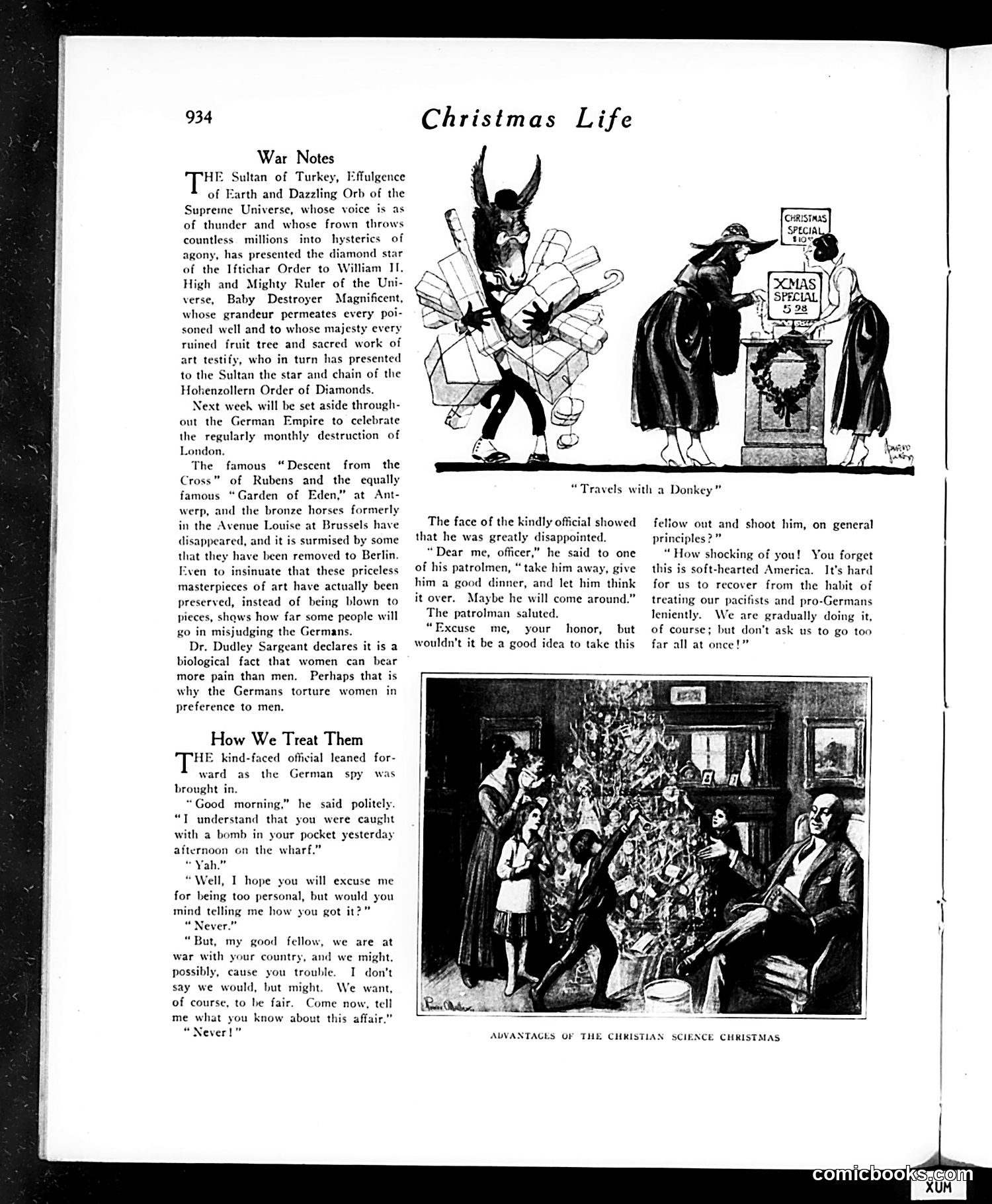
This page contains two distinct satirical pieces mocking wartime attitudes: **"War Notes"** opens with mock-heroic language praising the Ottoman Sultan and German Kaiser, sarcastically celebrating their mutual decoration and Germany's "regularly monthly destruction of London." The satire bites hardest regarding stolen European artworks (Rubens paintings, Brussels bronze horses), suggesting Germans either destroyed or removed these masterpieces to Berlin—then sarcastically implying anyone believing they were *preserved* is naive about German conduct. **"How We Treat Them"** satirizes American leniency toward enemy agents. A captured German spy refuses interrogation. Rather than harsh punishment, the kindly American official offers dinner and time to reconsider. When a patrolman suggests execution, the official protests that "soft-hearted America" treats pacifists and pro-Germans leniently—though "gradually" improving. The satire critiques American restraint as excessive weakness during wartime. Both pieces mock conflicting American attitudes: exaggerated criticism of German brutality versus reluctance to match their harshness.
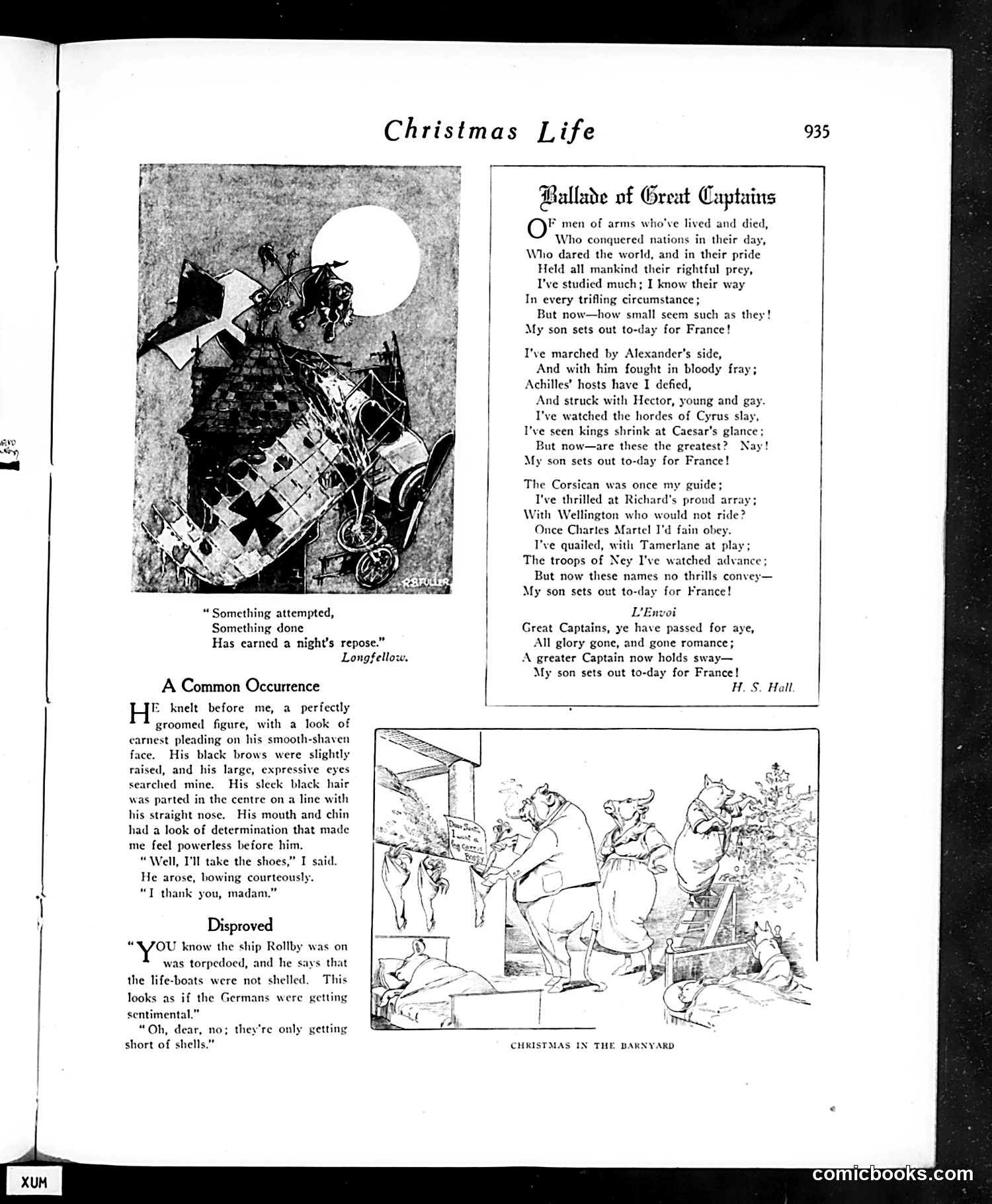
This **Christmas 1917 Life magazine page** reflects American concerns during World War I: **"Ballade of Great Captains"** (poem by H.S. Hall): A father contrasts history's greatest military leaders—Alexander, Caesar, Napoleon, Wellington—with his own son now departing for France as a soldier. The refrain "My son sets out to-day for France!" transforms these legendary commanders into footnotes; his ordinary son becomes the true "Captain" worthy of pride. This emotionally inverts military hierarchy, celebrating the common soldier's sacrifice over historical glory. **"A Common Occurrence"** (story): A well-dressed man persuades a woman to buy shoes through earnest, determined pleading—depicting consumer manipulation or wartime salesmanship. **"Disproved"** (dialogue): Dark humor about German U-boat attacks. A ship wasn't attacked with shells, suggesting Germans showed mercy. The punchline—"they're only getting short of shells"—reveals the joke: Germans weren't sentimental; they simply lacked ammunition. This mocks German restraint claims while acknowledging real wartime shortages. **"Christmas in the Barnyard"** (illustration): Unclear without caption, likely holiday farm humor. The page emphasizes wartime sacrifice and maintains patriotic, anti-German sentiment.
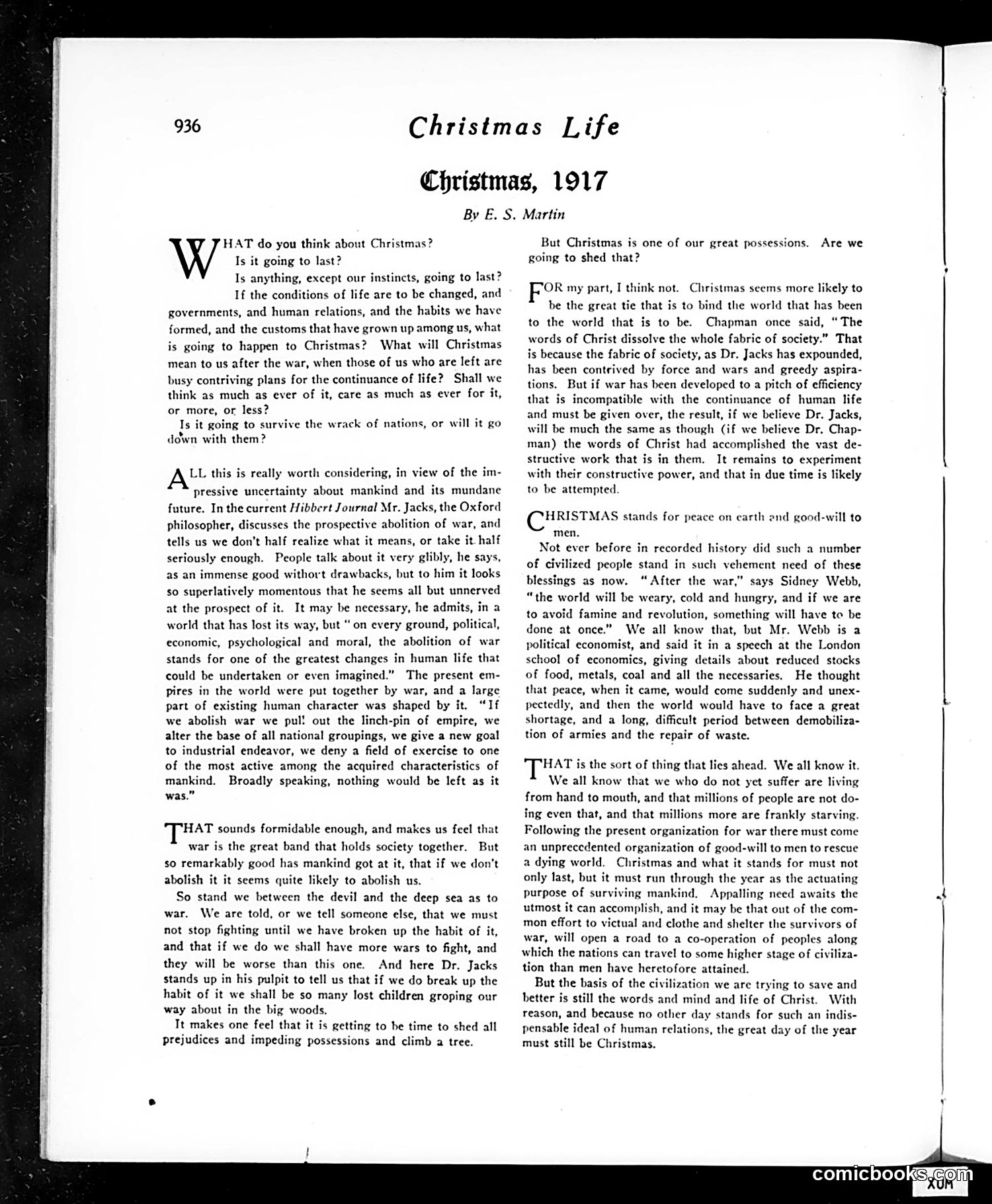
This is a philosophical essay, not a cartoon. Written during World War I, it addresses whether Christmas will survive post-war society's transformation. Martin references Oxford philosopher Mr. Jacks, who argues that abolishing war—society's historical organizing principle—will fundamentally reshape human character and civilization. This prospect deeply unsettles Jacks. Martin presents a paradox: war may destroy humanity if continued, yet ending it leaves society unmoored without war's cohesive force. He proposes Christmas as the solution—the "great tie" binding old world to new. Unlike war, which operates through force, Christ's teachings offer constructive power to rebuild civilization on peace and goodwill. The essay reflects 1917 anxieties about post-WWI reconstruction and whether traditional values (Christianity) could replace militarism as society's foundation.
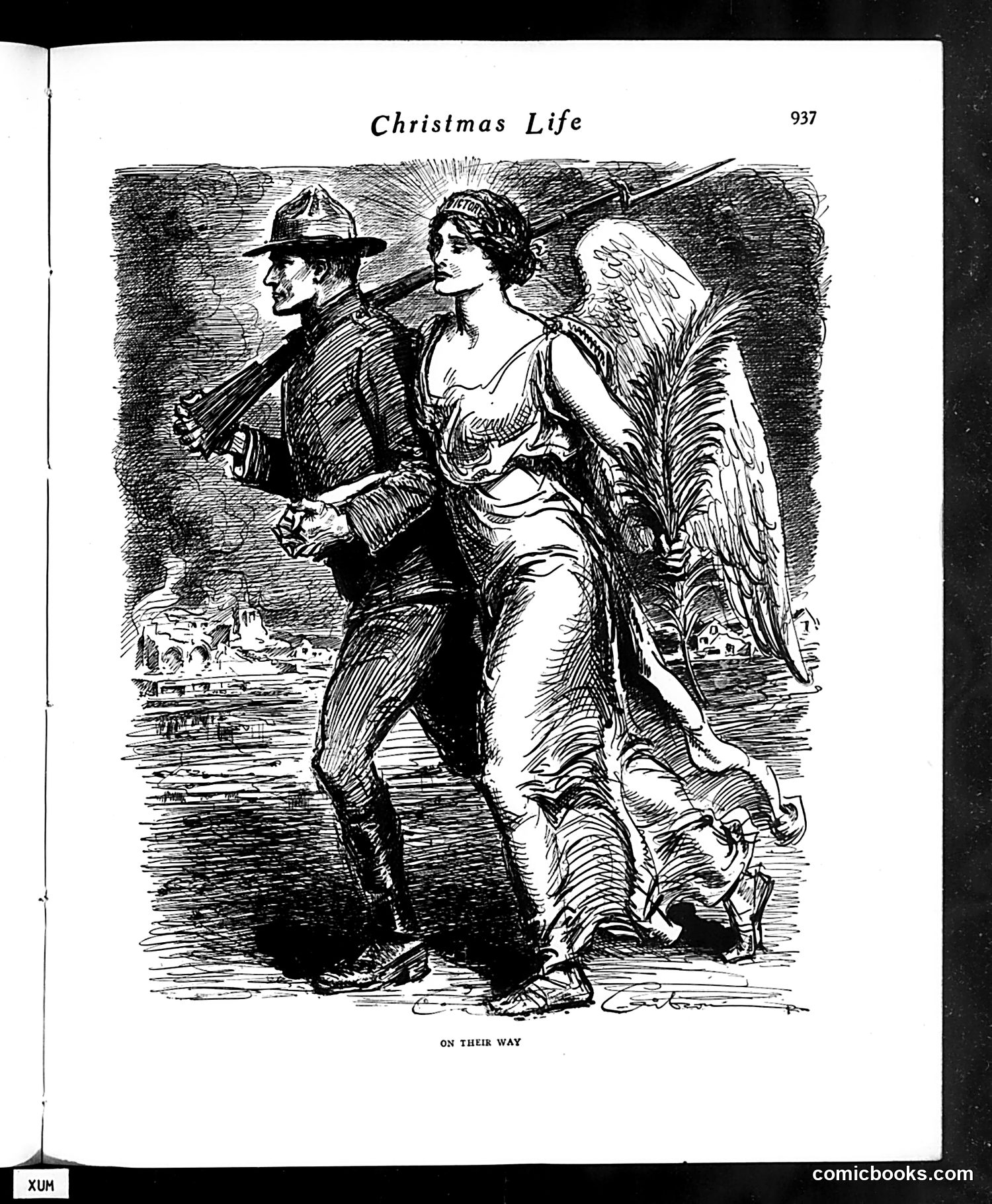
This is a satirical illustration titled "On Their Way" from Life magazine's Christmas section (page 937). The image depicts three figures: a soldier in military uniform and helmet on the left, a woman in the center wearing a crown or tiara, and an angel on the right with large wings. The satire appears to comment on wartime romance or courtship—likely referencing World War I era social dynamics. The soldier, woman, and angel together suggest a commentary on idealized love and departure during wartime, with the angel possibly representing either divine blessing, fate, or ironic commentary on the romanticization of military service. The specific historical context and intended targets remain unclear without additional publication date confirmation and contemporary commentary.
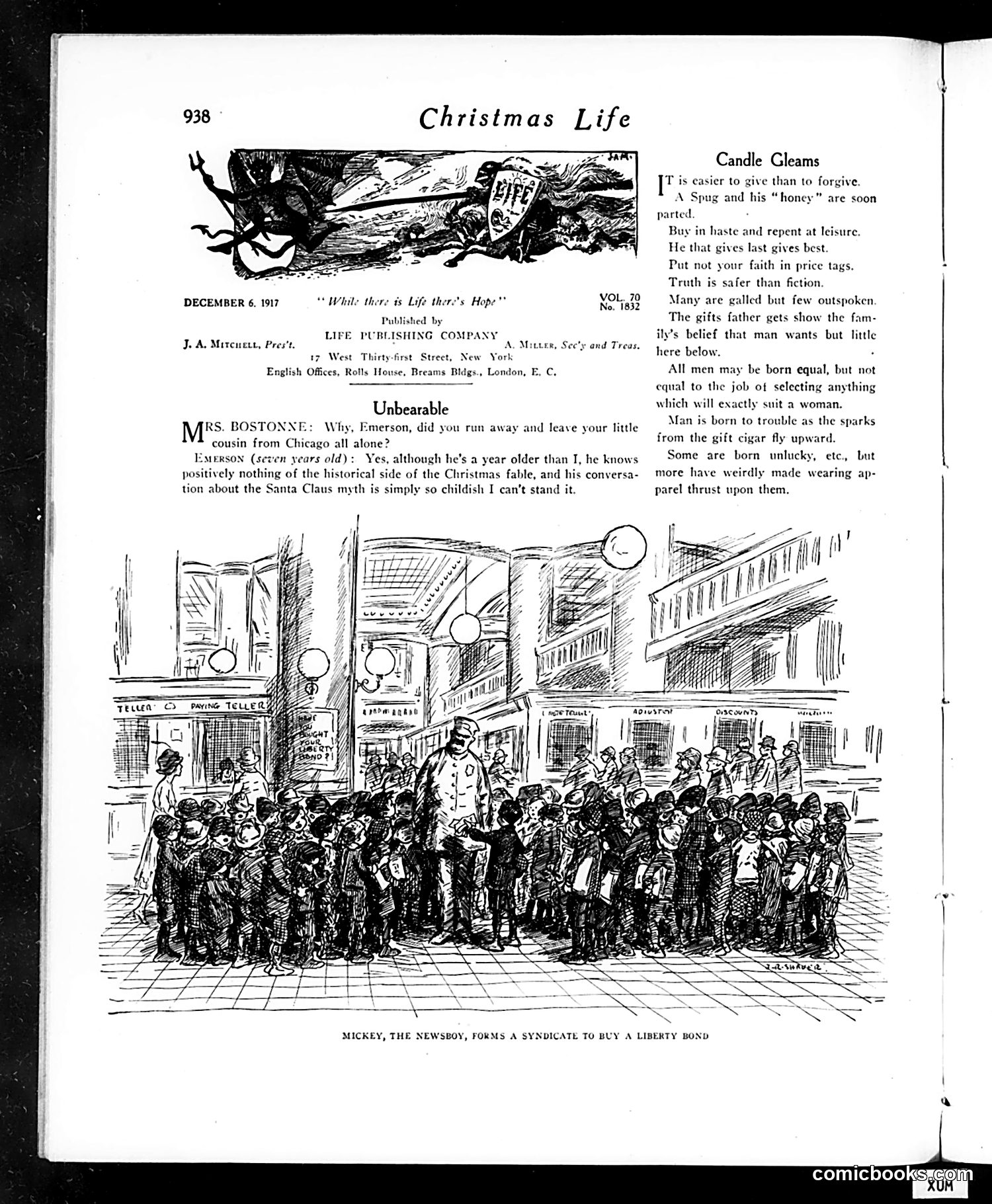
This page contains two distinct pieces of Christmas-themed satire: **"Unbearable"**: A brief dialogue joke mocking precocious children. A seven-year-old dismisses his older cousin for believing in Santa Claus, considering such belief beneath his intellectual sophistication. The humor targets both the child's pretentious superiority and the absurdity of a seven-year-old's self-importance. **Main Cartoon**: Shows "Mickey, the Newsboy" organizing street children into a syndicate to collectively purchase a Liberty Bond. Published during WWI (December 1917), Liberty Bonds were government war bonds. The cartoon praises children's patriotic initiative while satirizing the aggressive marketing of war bonds to Americans. The crowded scene suggests both grassroots support and the pervasiveness of bond-selling campaigns. **"Candle Gleams"**: Brief satirical aphorisms about gift-giving, materialism, and Christmas consumerism—poking fun at the commercialization of the holiday and the impossibility of selecting perfect gifts. The overall theme: Christmas commercialism and wartime patriotic messaging intersecting.
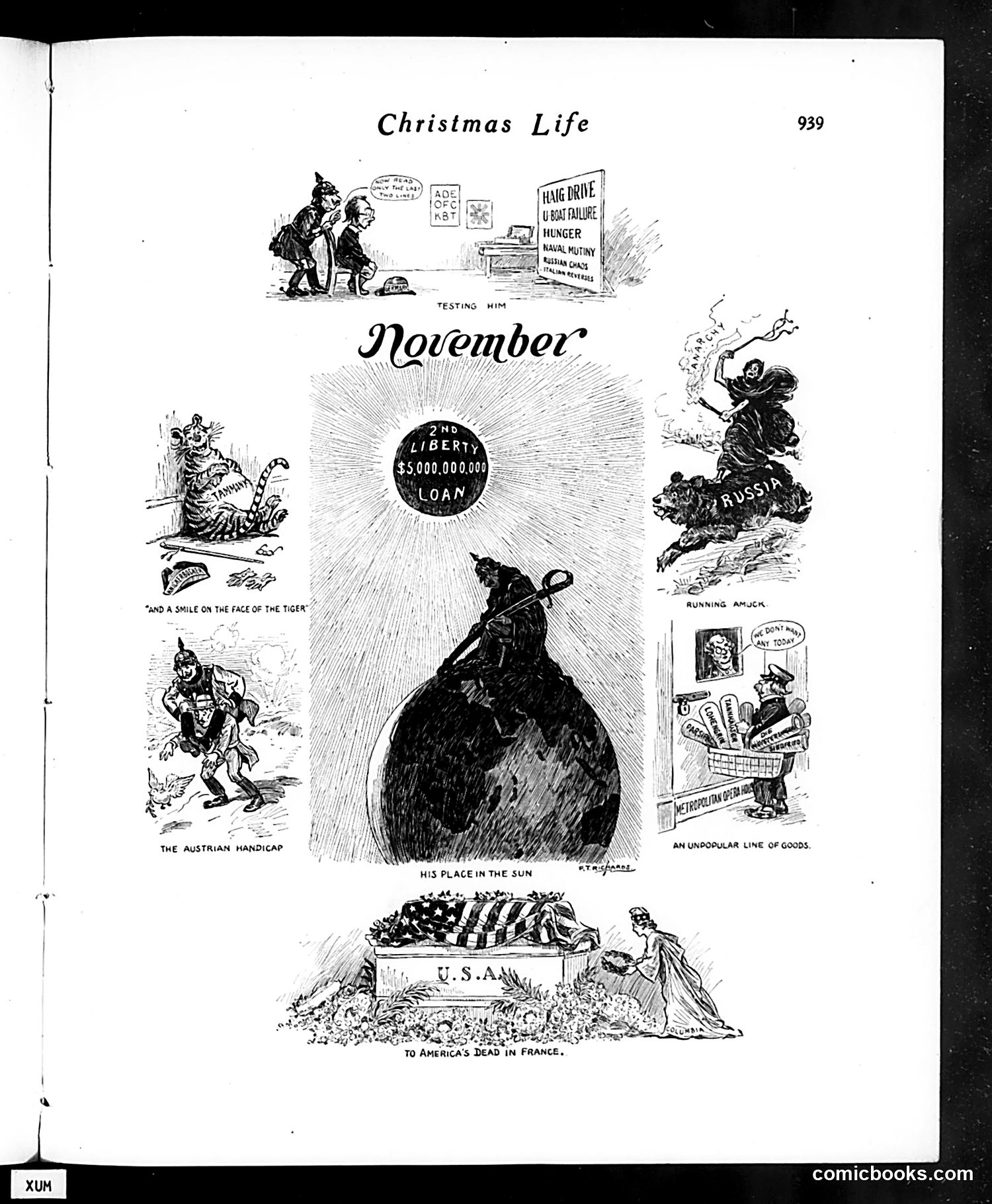
This Life magazine page satirizes November 1918 events during World War I's final month. The central image shows a dark sphere labeled "2ND LIBERTY $9,000,000,000 LOAN"—referencing America's massive war bond drive. Surrounding vignettes depict wartime anxieties: "Testing Him" shows officials scrutinizing a conscript; "The Austrian Handicap" and "Running Amuck" reference Austria-Hungary's military collapse; "A Smile on the Face of the Tiger" appears to mock enemy morale. The bottom panel, "To America's Dead in France," shows a coffin draped with the American flag and mourning figure—a somber reminder of war casualties as armistice neared. The cartoons blend dark humor about the war's human and financial costs with commentary on America's continued financial commitment even as victory approached.
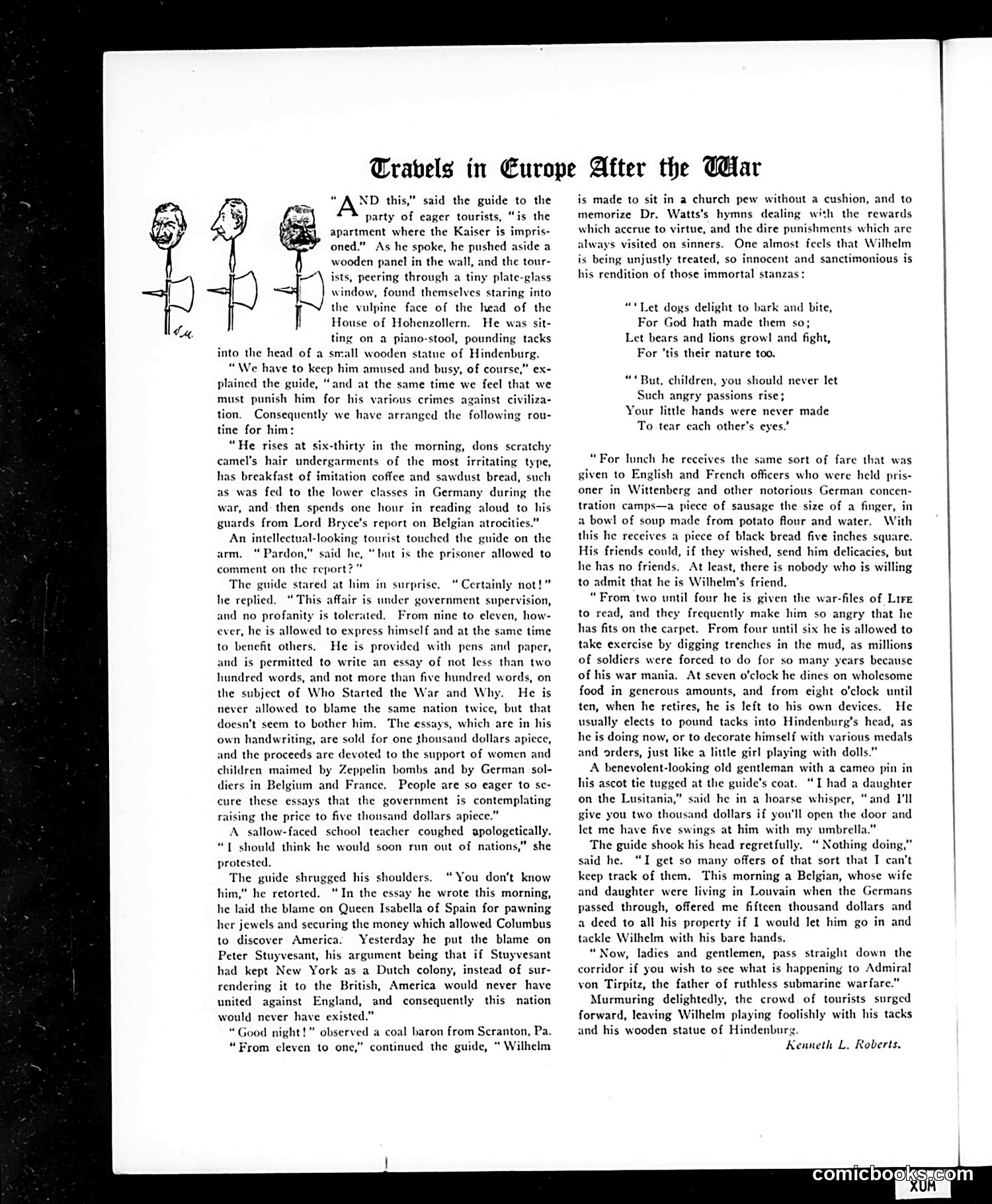
This satirical piece mocks post-WWI tourism and the fate of Kaiser Wilhelm II. The cartoon shows three caricatured tourists peering through a small window at the imprisoned Kaiser, depicted with a sharp, fox-like face. The satire works on multiple levels: it presents Wilhelm's deliberately harsh imprisonment (scratchy underwear, sawdust bread, forced essay-writing) as tourist entertainment. The absurdist humor escalates—Wilhelm blames increasingly ridiculous historical figures (Queen Isabella, Peter Stuyvesant) for starting the war, and his essays sell for thousands of dollars to benefit war victims. The joke targets both American attitudes toward German war guilt and post-war tourism culture. By framing Wilhelm's punishment as a public spectacle with admission-like elements, the piece satirizes how Americans were processing their victory and the enemy leader's downfall. The intellectually-dressed tourists represent the era's tendency to make even serious historical events into consumable entertainment.
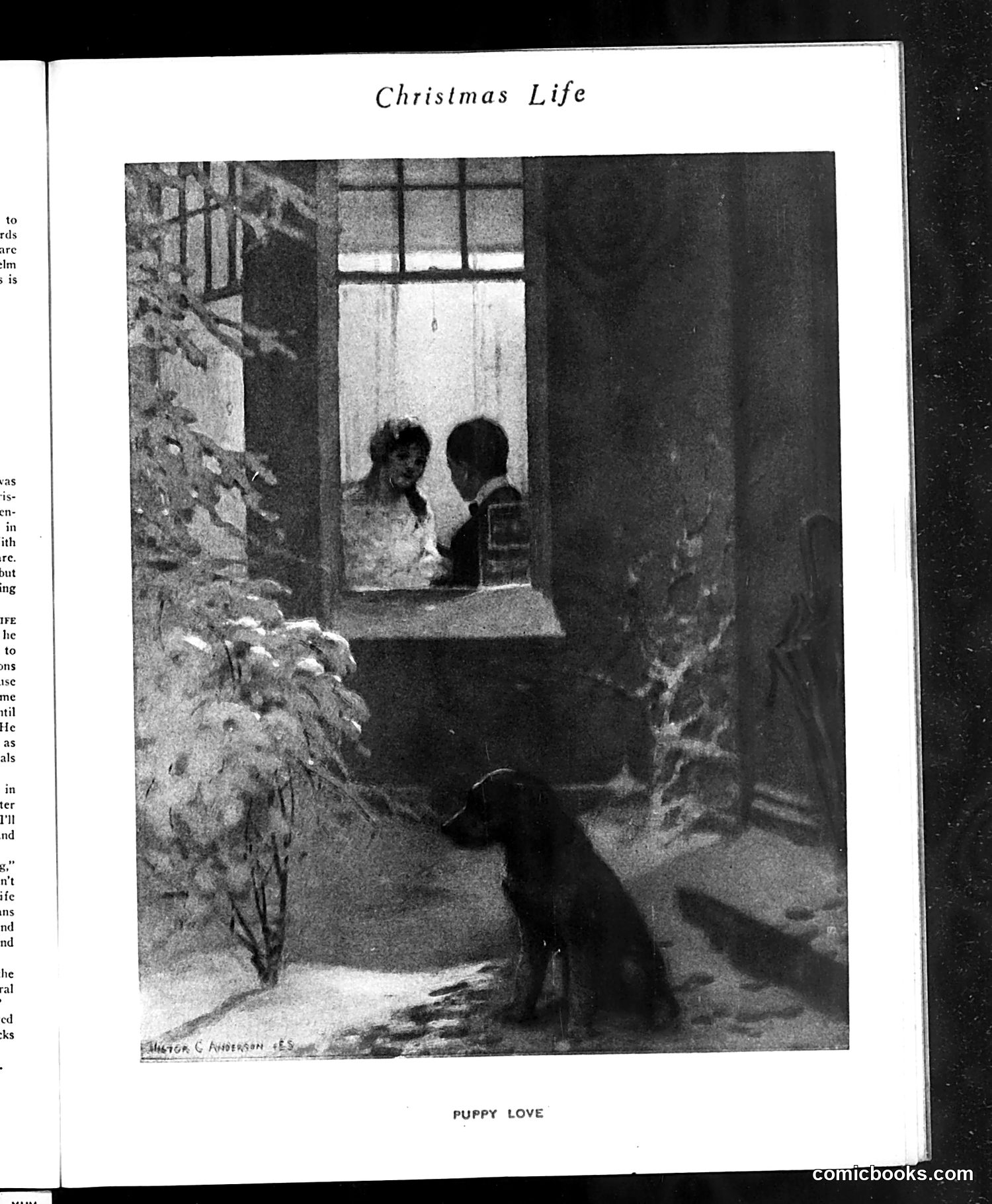
This is a straightforward sentimental illustration titled "Puppy Love" rather than political satire. The image shows two figures visible through a window—appearing to be a young couple—while a dog sits in the snowy foreground looking up at the window. The title plays on the double meaning of "puppy love" (romantic affection between young people) and the literal presence of a puppy. The composition creates a touching scene where the excluded dog gazes longingly at the couple inside, suggesting the dog's own form of devotion or longing. This appears to be Christmas-themed content (based on the page header "Christmas Life"), using a gentle, humorous approach to depict romance and sentiment rather than satire or social commentary.
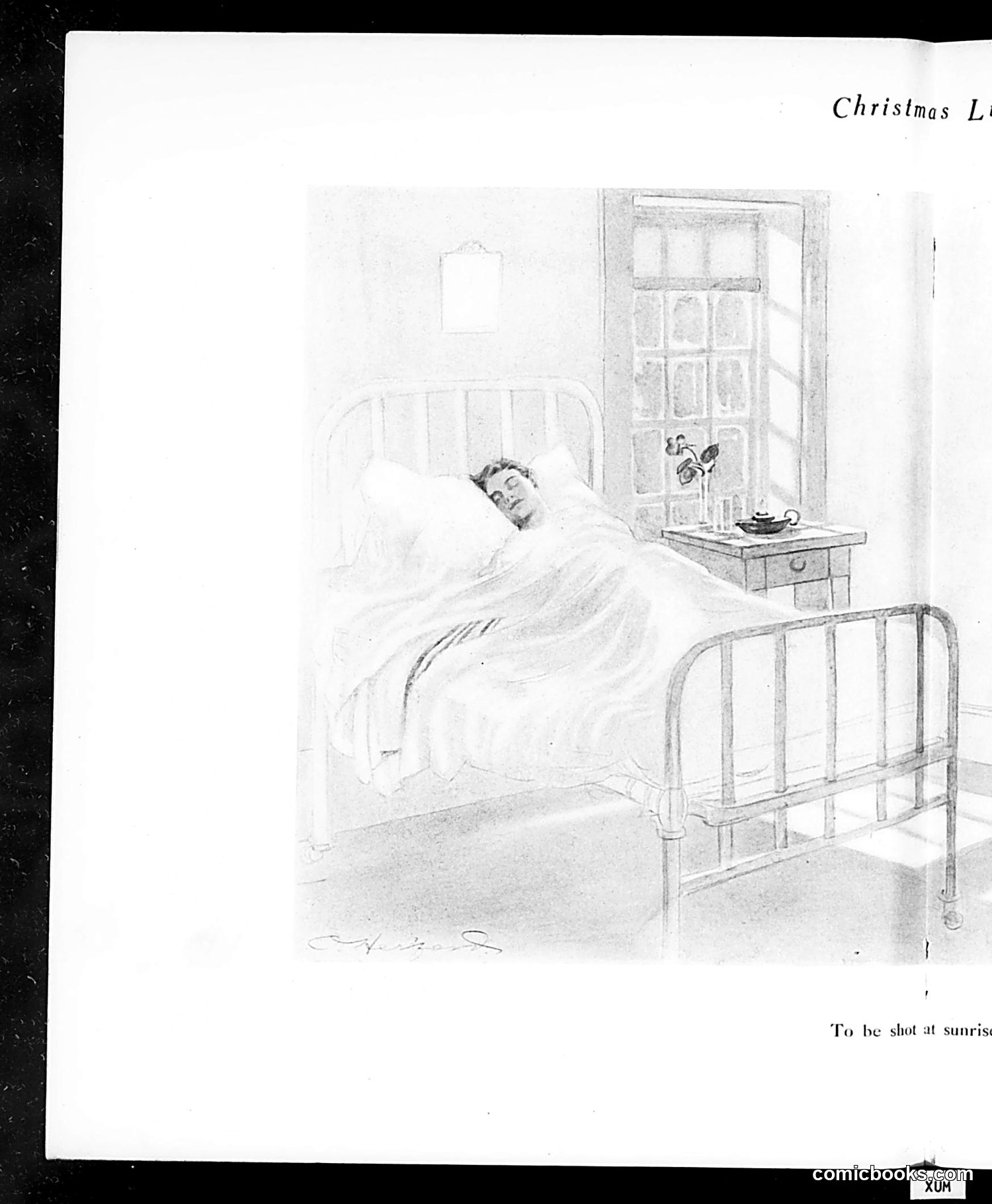
This appears to be a satirical illustration from *Life* magazine showing a figure in bed, apparently ill or dying, with a window and nightstand visible. The caption "To be shot at sunrise" suggests dark humor about execution or a dire fate. The OCR text is heavily corrupted and largely unreadable, making it difficult to identify the specific political or social reference. The "Christmas" reference in the header and the ominous caption suggest this may be commentary on a contemporary news event—possibly involving a condemned prisoner or political figure—but without legible text identifying who the figure represents or what event is referenced, I cannot specify the satire's target or meaning with confidence. The illustration's style is consistent with early-to-mid 20th century *Life* magazine work.
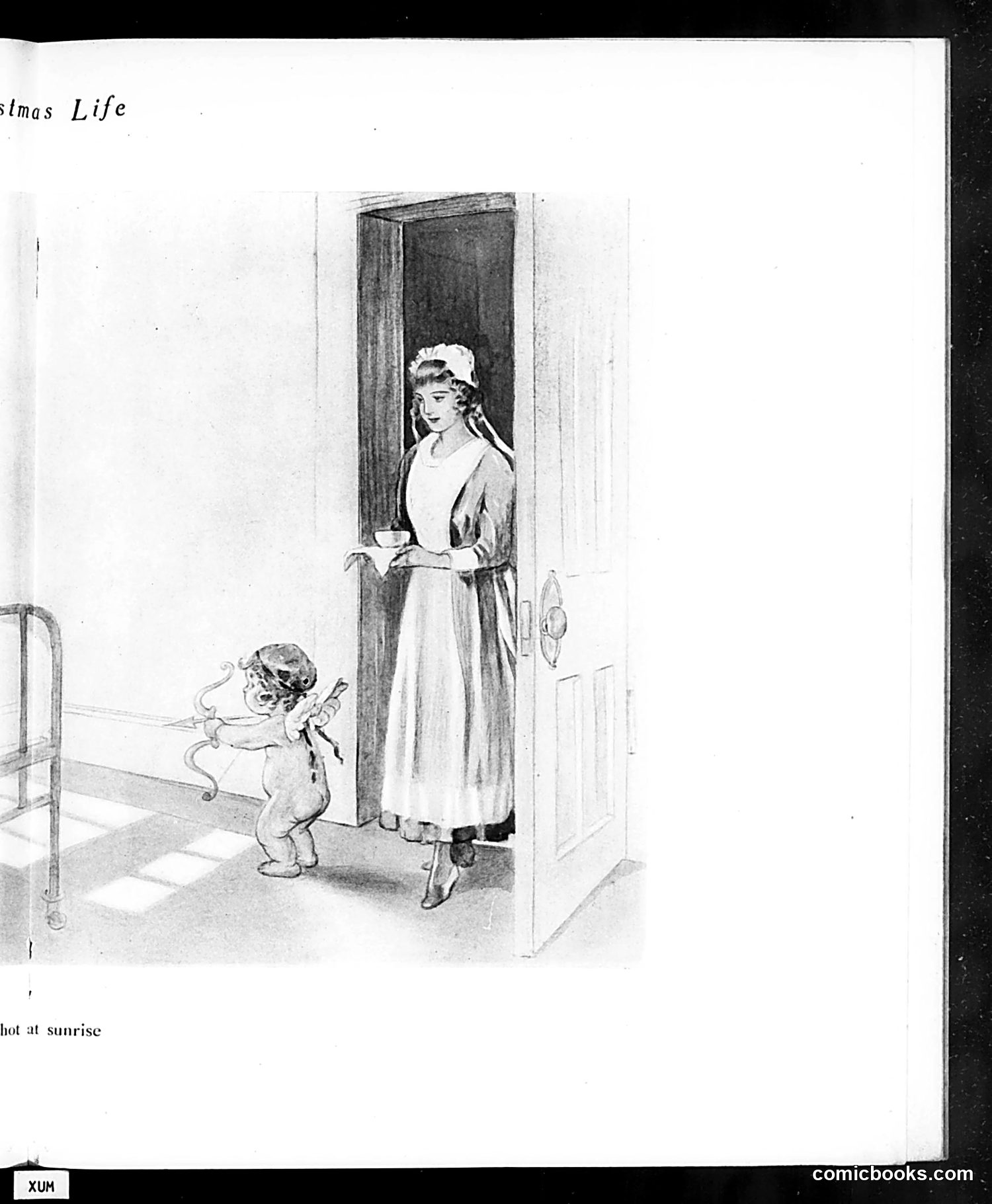
This illustration depicts a domestic Christmas morning scene with satirical intent. A woman in a white apron and cap (appearing to be a maid or housewife) stands in a doorway holding a tray, while a small cherub or cupid figure tugs playfully at her skirt. The caption reads "hot at sunrise," suggesting a double entendre about morning activities or romantic encounters. The satire likely mocks early 20th-century domestic life and servants, playing on the contrast between proper Victorian household roles and hidden romantic or sexual dynamics. The cherub figure emphasizes the humorous, flirtatious tone. The page header "Christmas Life" suggests this appeared in *Life* magazine's holiday issue, using holiday imagery to satirize household relationships and social expectations.
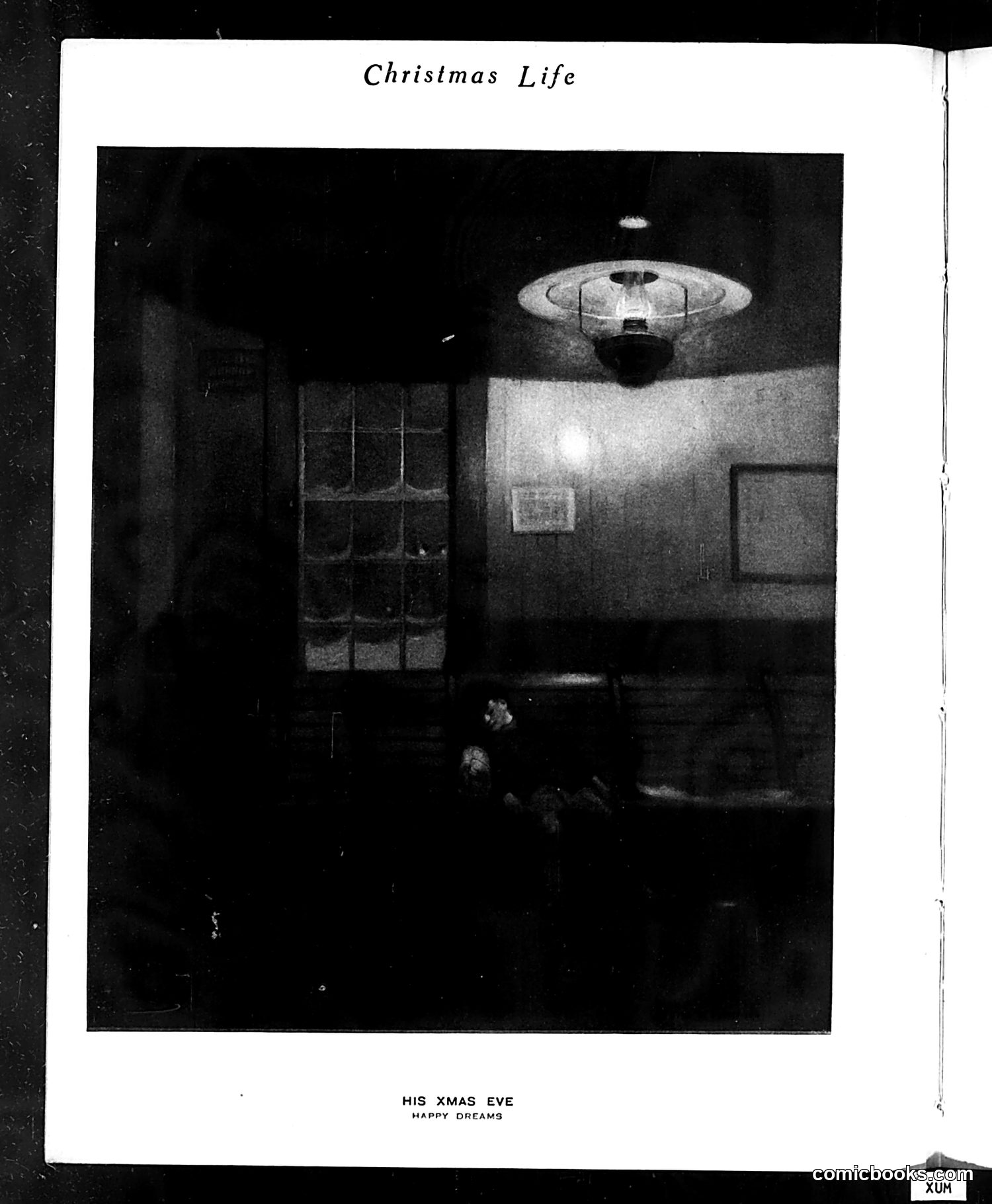
This page from *Life* magazine shows a darkened interior scene with a figure sitting alone, gazing upward at a glowing circular light fixture on the ceiling. The image is titled "His Xmas Eve Happy Dreams," suggesting the person is contemplating or daydreaming on Christmas Eve. The satirical point appears to be about loneliness or isolation during the holiday season—a time typically associated with family gathering and warmth. The solitary figure and sparse, dim setting contrast sharply with conventional Christmas cheer. The ceiling fixture's glow might represent false hope or the person's aspirations for happier circumstances. The satire likely critiques the disconnect between Christmas's idealized promise and the reality of loneliness some experience during holidays.
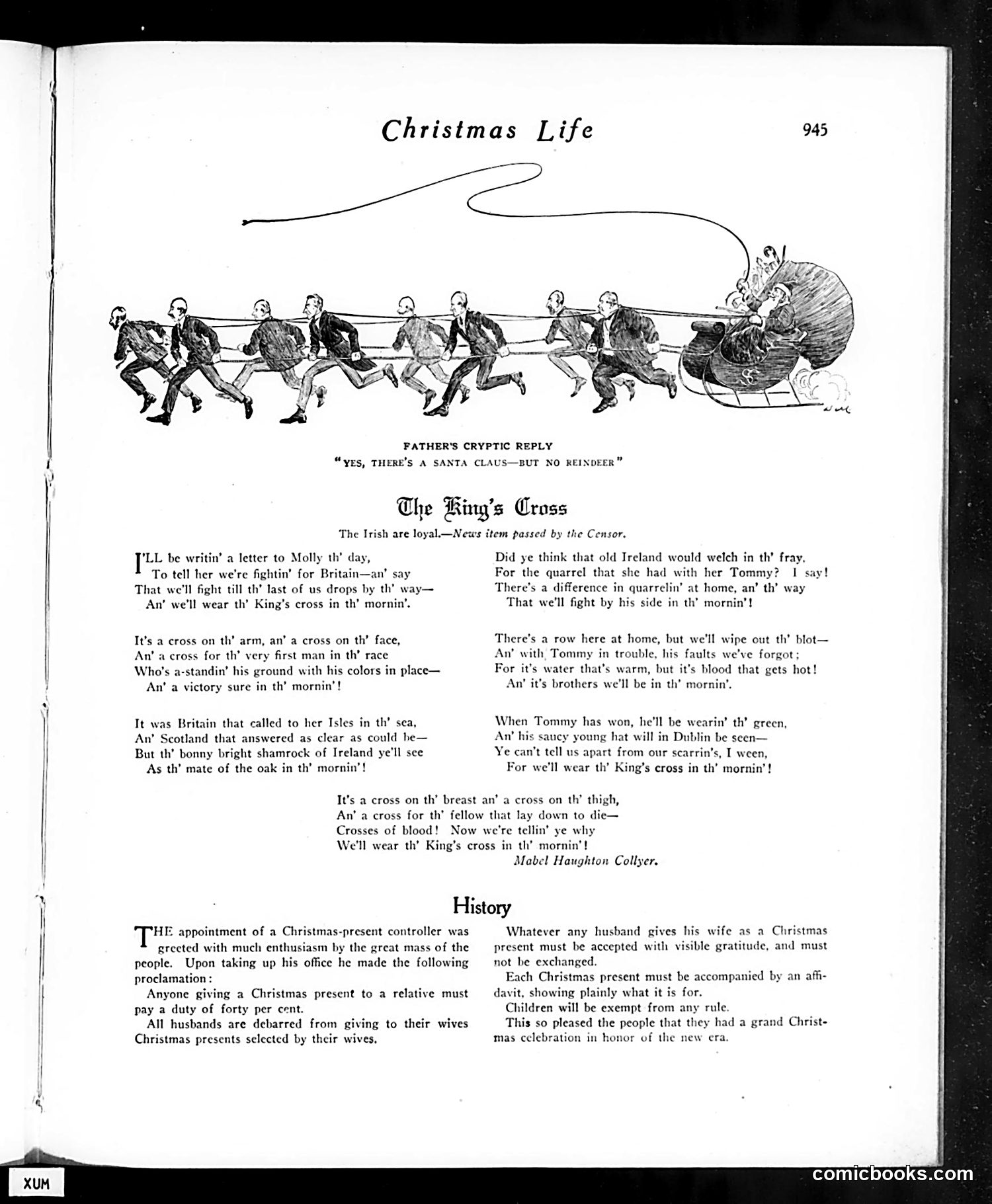
**Top Cartoon**: "Father's Cryptic Reply" satirizes wartime confusion about Santa Claus. A father tells his child there's a Santa but "no reindeer"—likely a joke about wartime rationing and resource scarcity affecting even Christmas traditions. **"The King's Cross" poem**: This appears to reference WWI-era Irish recruitment. The text celebrates Irish soldiers fighting for Britain despite historical tensions ("There's a row here at home"). The "King's cross" refers to war wounds—scars on breast and thigh marking fallen soldiers. It emphasizes Irish-British solidarity during the war, presenting wounds as badges of honor and brotherhood. **"History" section**: Satirizes wartime bureaucracy through an absurdist "Christmas-present controller" who imposes duties and regulations on gift-giving, requiring affidavits and banning wives from selecting their own presents. The joke is that despite these absurd restrictions, people celebrate—mocking both wartime regulation and public acceptance of government overreach. All three pieces use humor to address wartime anxieties and restrictions.
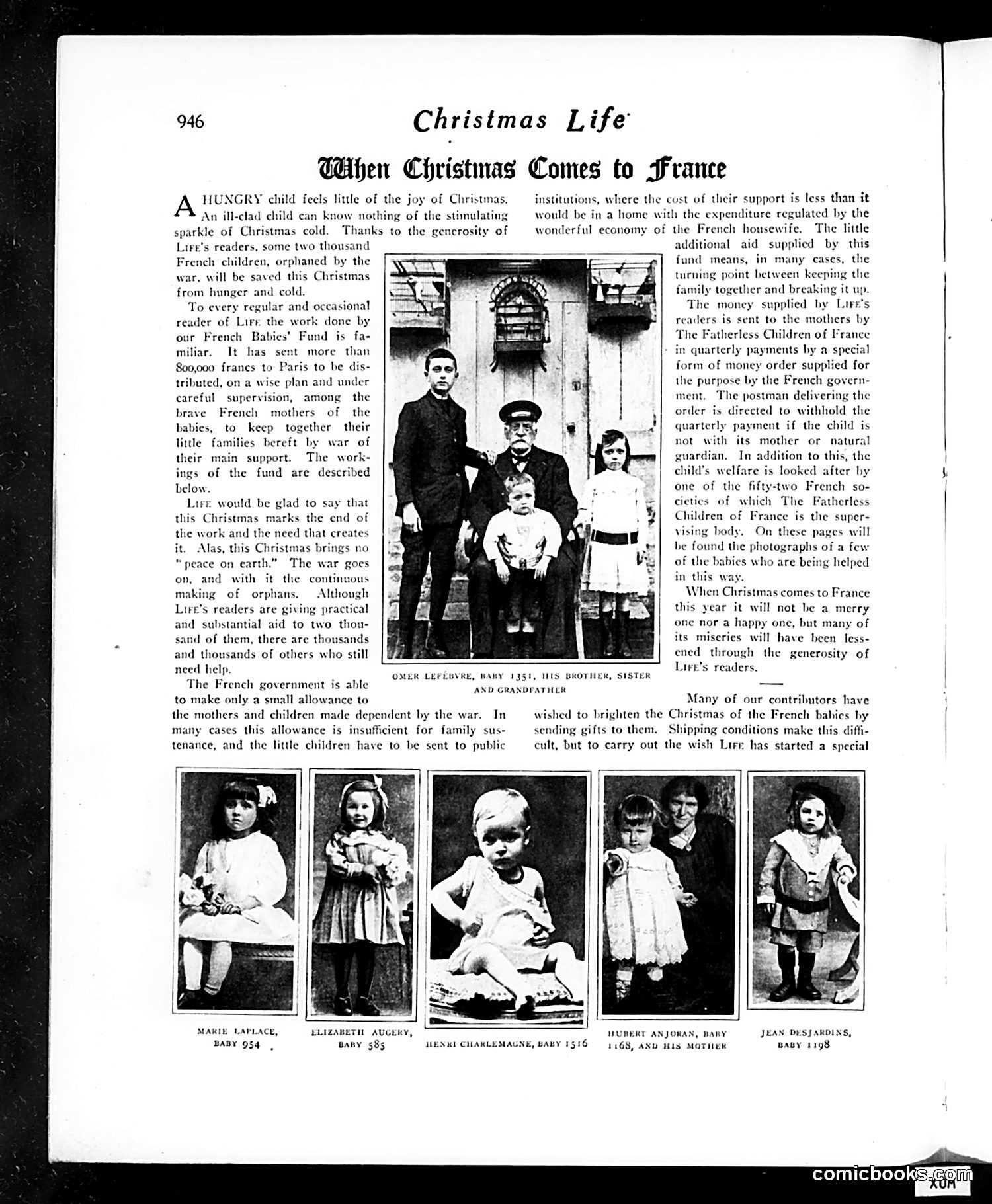
This is not a cartoon but a humanitarian appeal. The page describes Life magazine's "French Babies' Fund," which aids orphaned children in France during World War I. The article explains that hungry, poorly-clothed French war orphans experience little Christmas joy. Life's readers have contributed over 800,000 francs to support roughly 2,000 children through "The Fatherless Children of France," a supervisory organization that distributes quarterly payments to mothers, ensuring children remain with their families rather than being institutionalized. The photographs show specific beneficiary children (identified by number rather than name), making the appeal personal and concrete for American donors. The text emphasizes that while the fund has helped thousands, many more orphans still need assistance as the war continues. This is essentially a fundraising piece leveraging Christmas sentiment to support vulnerable civilian populations affected by WWI.
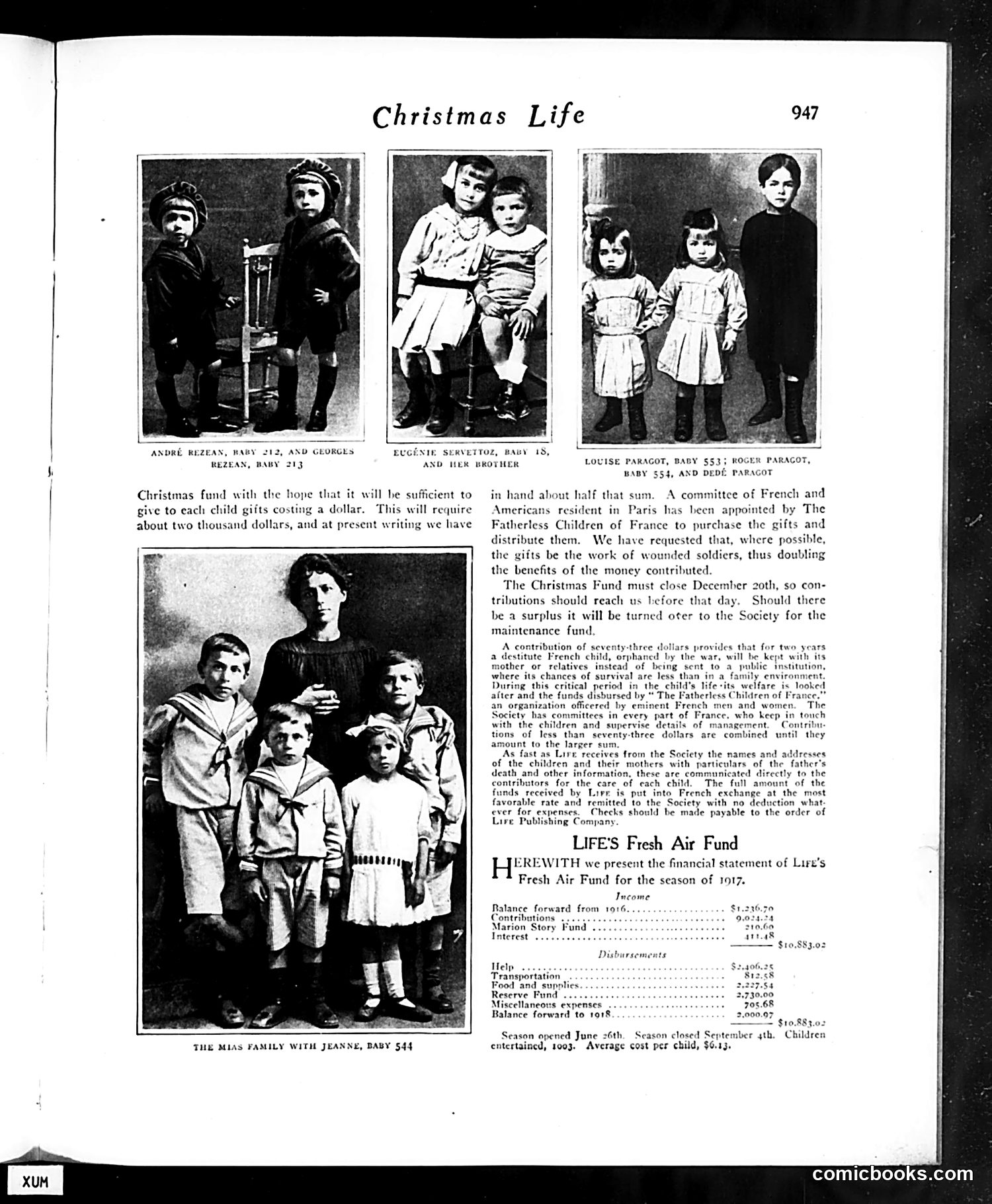
This page presents **charitable fundraising appeals**, not satire. It documents Life magazine's wartime philanthropy during World War I (circa 1917). The top section shows **photographs of French war orphans** with their names and identification numbers—children whose fathers died in the war. Life solicited dollar donations to provide Christmas gifts, with a committee of French and American residents in Paris distributing them. Notably, Life requested gifts be made by wounded soldiers, thus providing employment and dignity to the disabled. The lower section announces Life's **Fresh Air Fund**, a summer camp program that entertained 1,003 children in 1917 at an average cost of $6.13 per child. Both initiatives reflect Progressive-era American magazine activism on behalf of vulnerable populations—war orphans and urban children—positioning Life as a socially conscious publication mobilizing reader contributions for humanitarian causes.
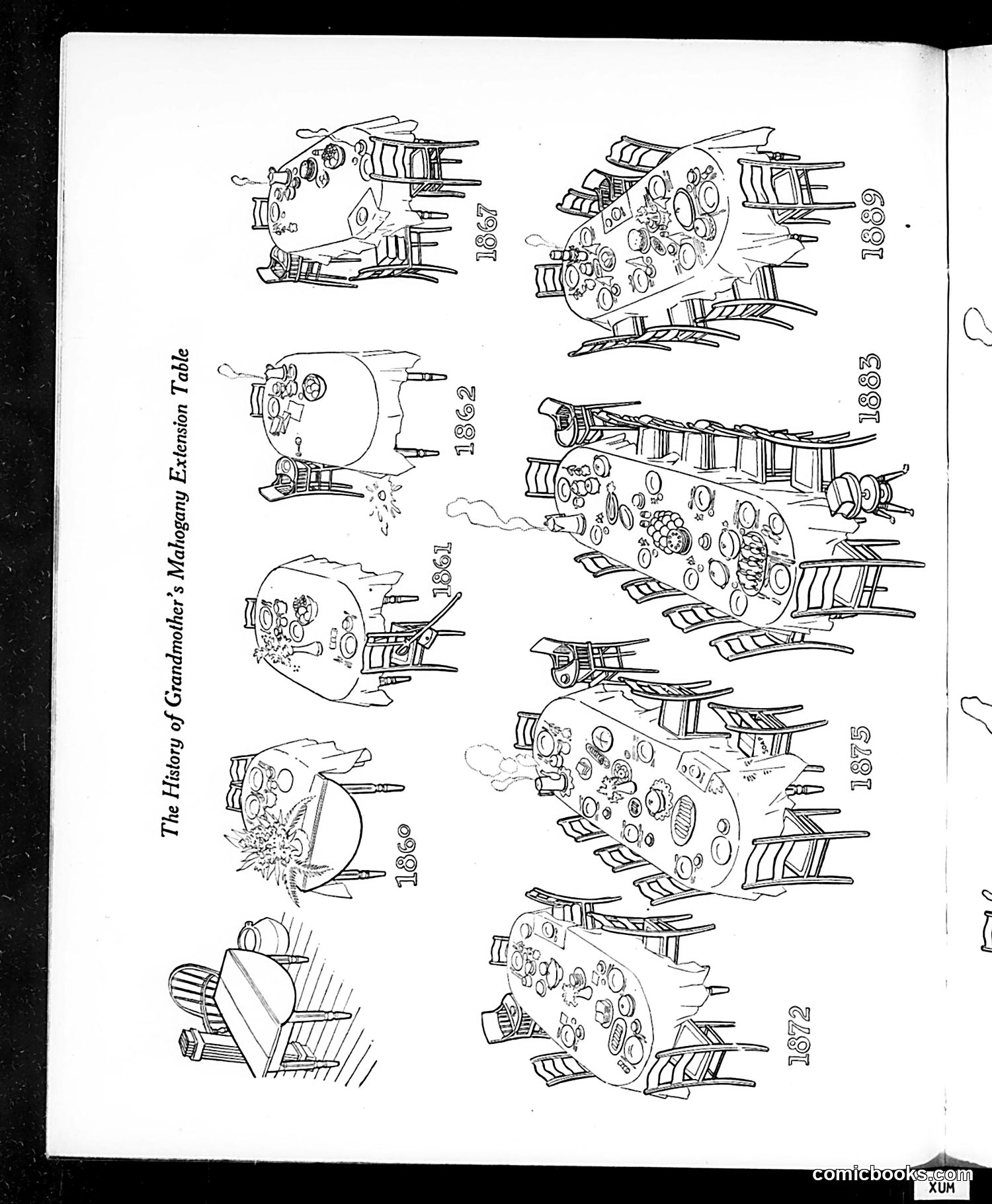
This page titled "The History of Grandfather's Macabre Extension Table" appears to be a technical or instructional illustration rather than political satire. The drawings show mechanical designs for what seems to be an expandable or extending table mechanism, depicted from various angles and cross-sections. Each illustration is numbered (1862, 1863, 1869, 1872, 1875, 1879, 1883, 1889) suggesting a chronological progression of design iterations. The OCR text is largely corrupted/illegible, preventing clear identification of the specific purpose or context. Without readable accompanying text, I cannot determine whether this is satire, instruction, or something else entirely. The mechanical nature of the drawings suggests this may be documenting the evolution of furniture design rather than making a political or social commentary.
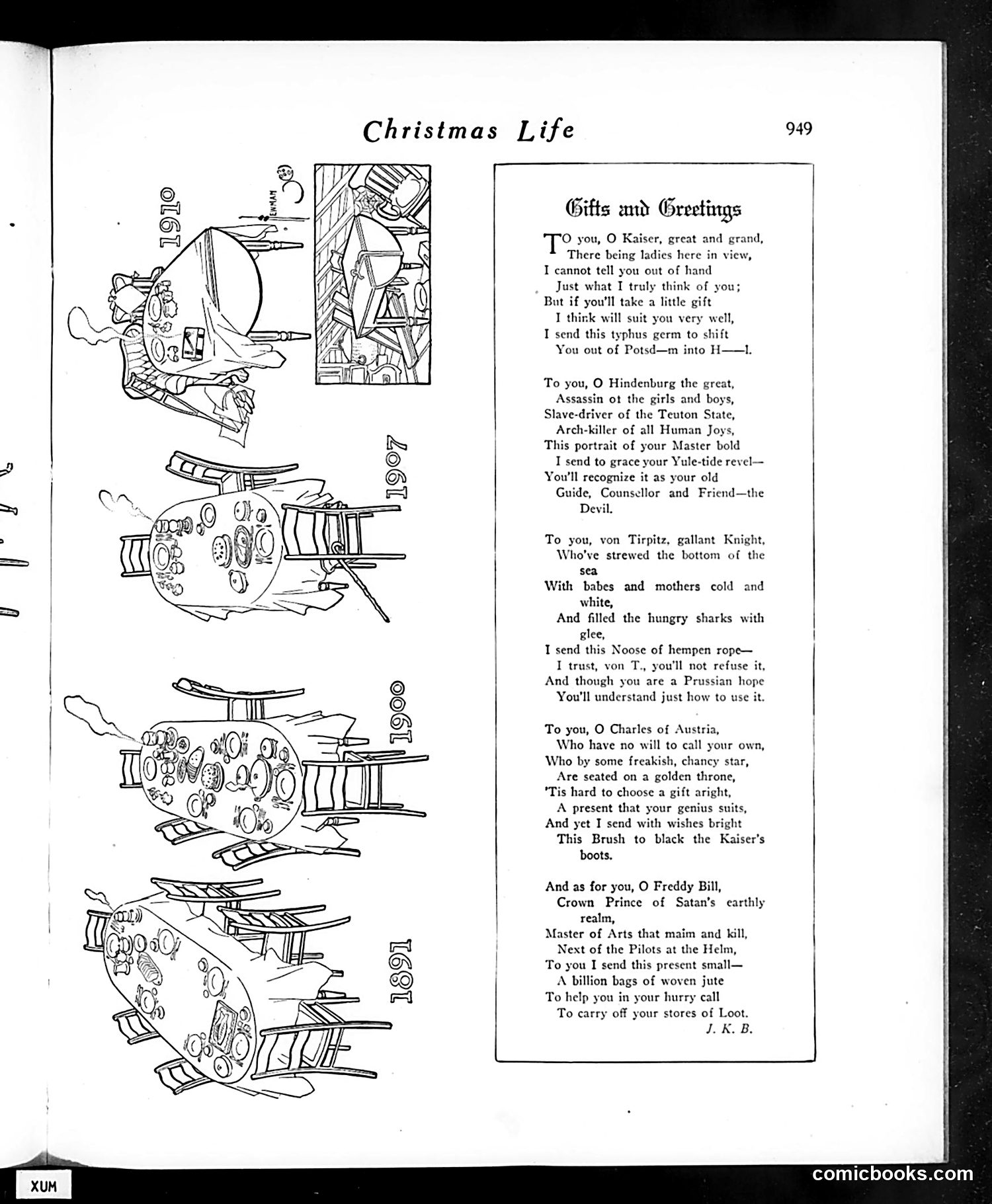
This is a wartime satire from Life magazine (dated 1920 based on the header) offering mock "Christmas gifts" to German and Austro-Hungarian leaders during or immediately after World War I. The targets are: - **The Kaiser** (Wilhelm II): offered a typhus germ - **Hindenburg**: a portrait of "the Devil" - **Von Tirpitz** (German admiral): a noose, mocking his naval warfare that killed civilians - **Charles of Austria**: a boot-blackening brush (suggesting servility) - **The Crown Prince** ("Freddy Bill"): bags of jute to carry looted goods The satire works by presenting "gifts" matching each figure's alleged crimes—biological warfare, mass killing, naval atrocities, lack of autonomy, and looting. The cartoons on the left appear to show military weapons or machinery, reinforcing the warfare theme. This reflects bitter American/Allied sentiment toward Central Powers leadership, using dark humor typical of Life's satirical approach. Signed J.K.B.
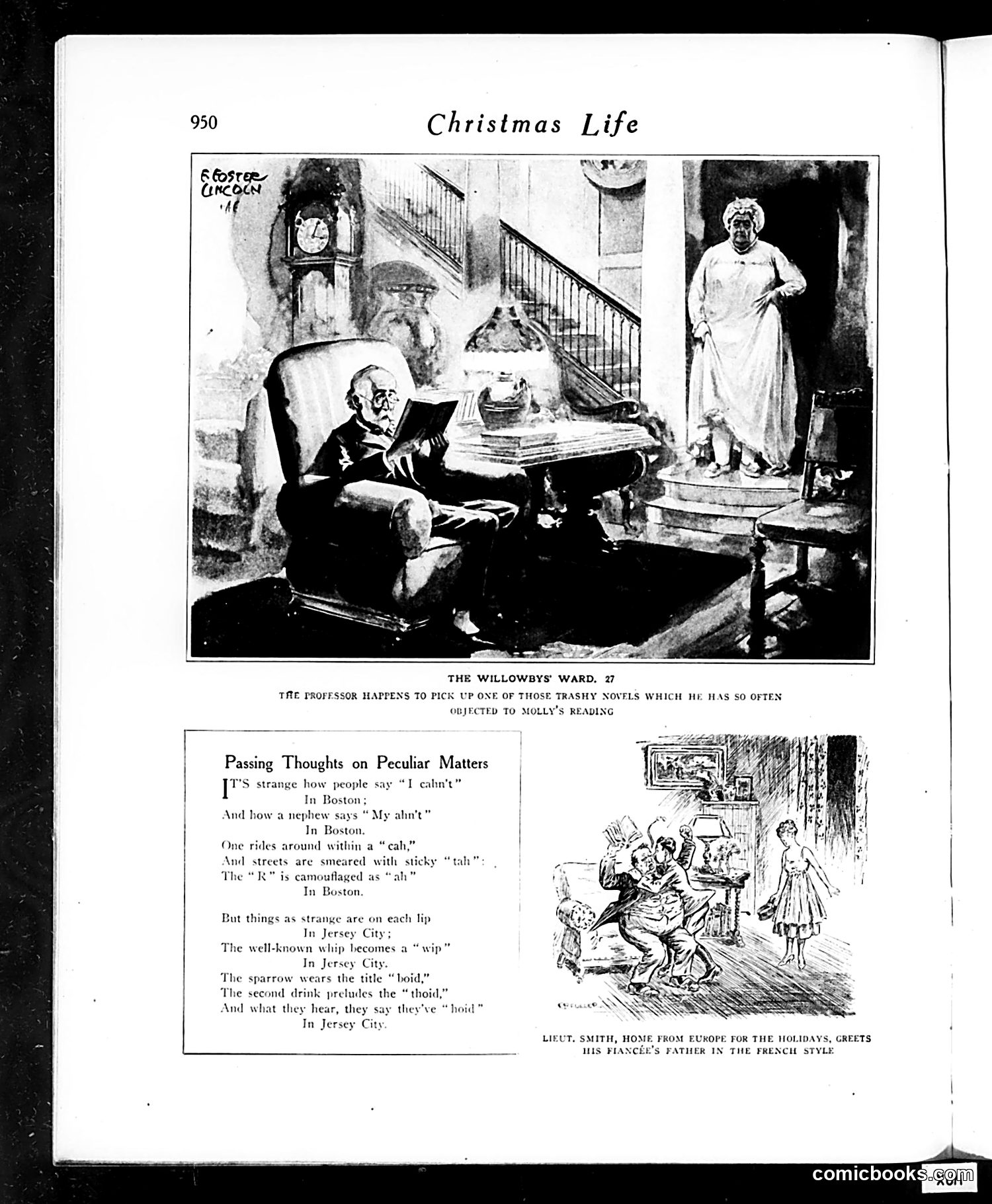
**The Willowbys' Ward (top image):** A domestic comedy scene where Professor Willowby—who has previously objected to his ward Molly reading "trashy novels"—is caught hypocritically reading one himself. The humor lies in his moral disapproval being exposed as mere prudishness. **Passing Thoughts on Peculiar Matters (bottom left):** A humorous poem mocking regional American dialects, specifically Boston and Jersey City accents. It catalogs pronunciation differences ("cahn't" for "can't," "cah" for "car," "hoid" for "heard"), poking fun at how locals pronounce words distinctly from standard English. **Lieutenant Smith greeting (bottom right):** A satirical scene of an American soldier returning from Europe who greets his fiancée's father in an exaggerated "French style"—likely a pretentious or awkward gesture meant as sophisticated but appearing ridiculous to American eyes. The satire targets post-WWI affectation and cultural pretension among returning soldiers.
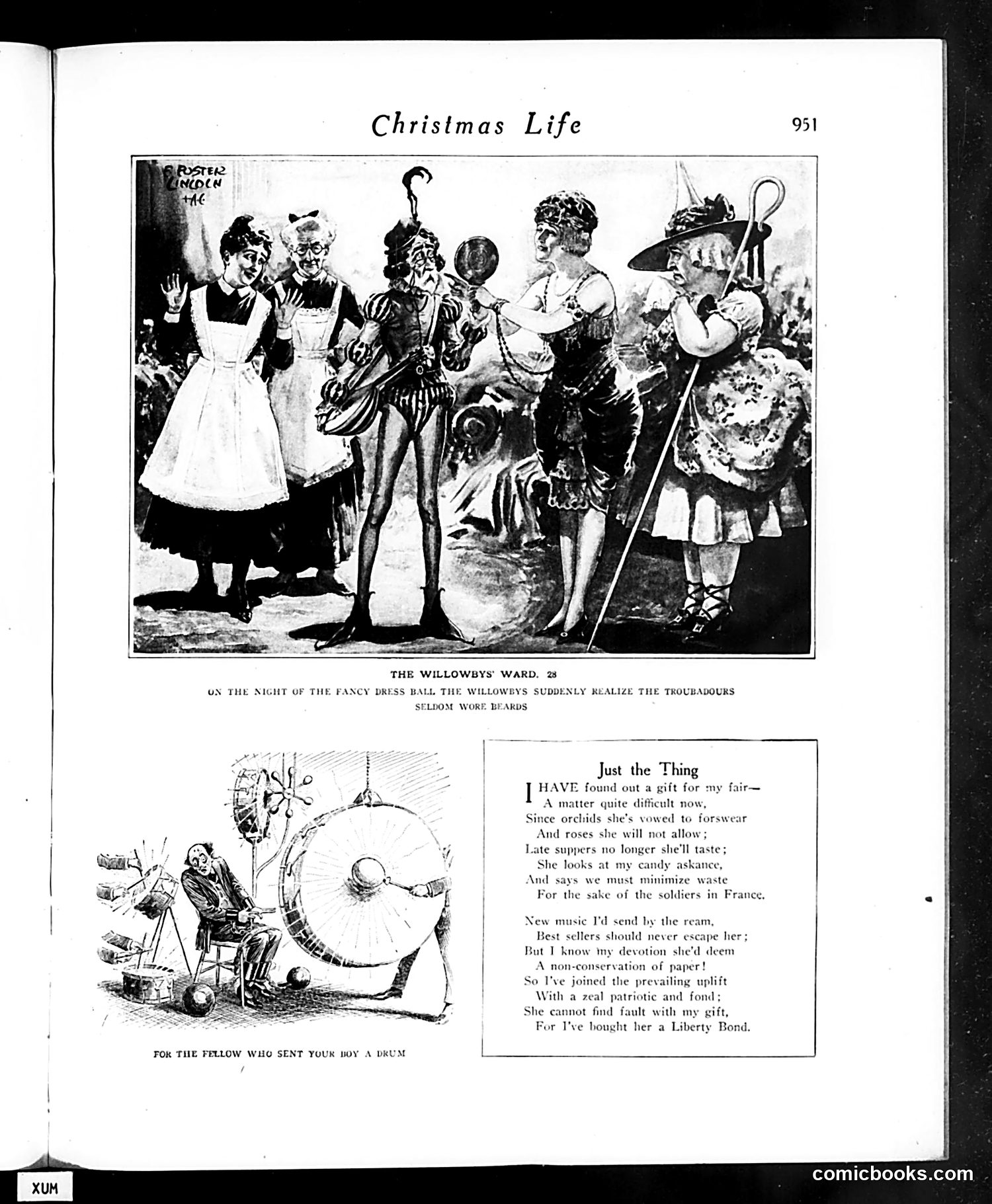
This page contains two satirical pieces about wartime gift-giving during World War I (referenced by "soldiers in France"). **Top cartoon:** "The Willowbys' Ward" depicts a fancy dress ball where the hosts realize their hired troubadours (traveling musicians) rarely wear beards—apparently essential to their costume authenticity. It's a simple visual gag about theatrical performance expectations. **Bottom section:** "Just the Thing" is a poem mocking the difficulty of gift-giving during wartime rationing. A suitor struggles to find an appropriate present for his sweetheart, as she's renounced luxuries like orchids, roses, late suppers, and new music—all to conserve resources for the war effort. His solution: a Liberty Bond (a government war loan). The satire targets the tension between romance and patriotic self-sacrifice, suggesting wartime austerity has made even courtship obligatory and joyless. The accompanying drum illustration reinforces the patriotic, militaristic tone.
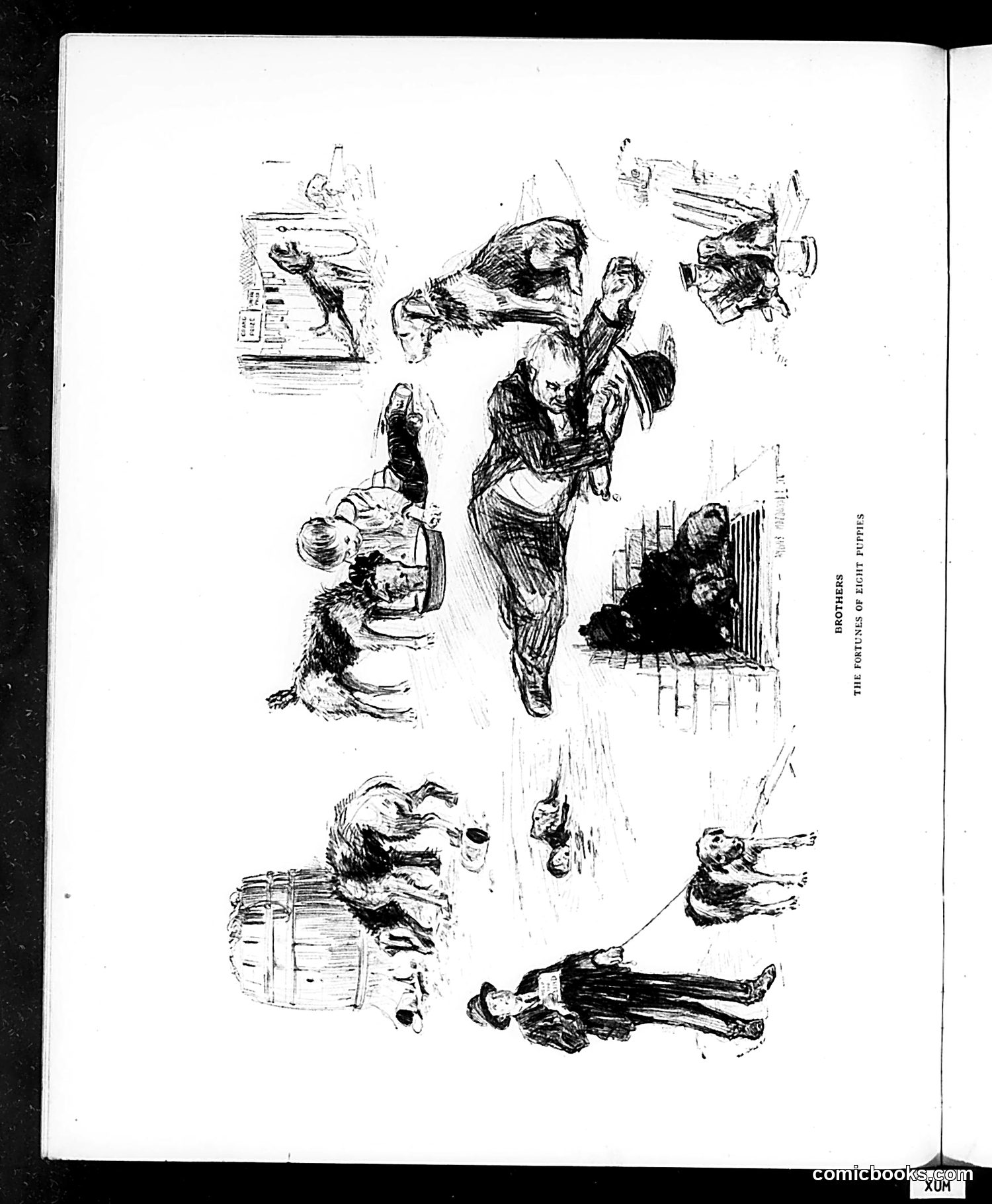
The OCR text provided is illegible—it appears to be corrupted technical data rather than readable content. However, the image shows a page titled "BROTHER" (visible on the right margin) containing multiple ink sketch illustrations in what appears to be a satirical or humorous style characteristic of early-to-mid 20th century *Life* magazine. The sketches depict various figures in different scenarios, rendered in loose, expressive linework typical of editorial cartooning. Without legible text explaining the cartoons' context, subjects, or satirical targets, I cannot reliably identify the specific political or social references, historical figures depicted, or the intended jokes. To provide accurate analysis rather than speculation, I would need either clearer OCR text or additional contextual information about the publication date and issue.
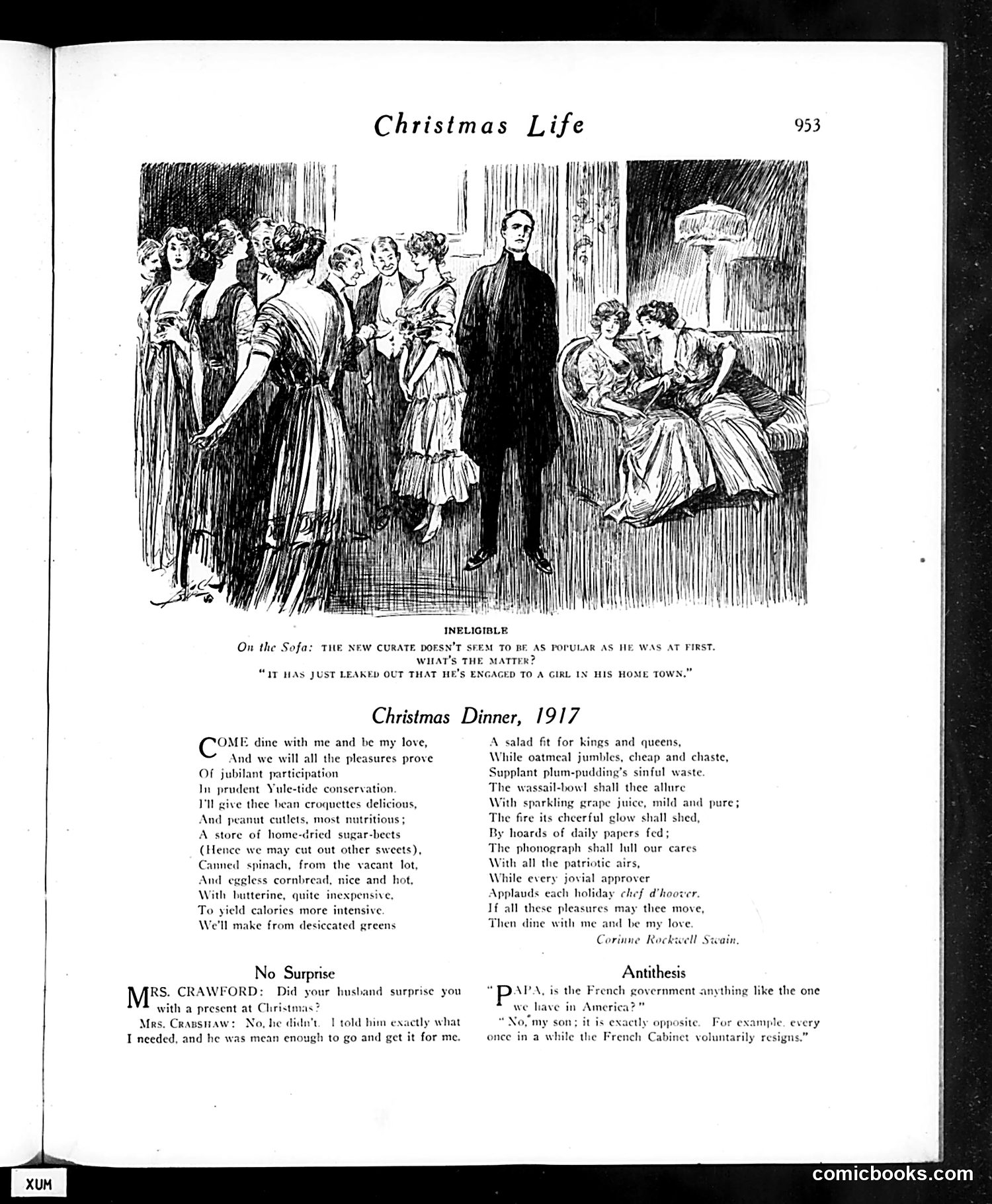
This page satirizes American home-front sacrifice during World War I. The main poem "Christmas Dinner, 1917" mocks wartime rationing and substitution—replacing real food with inferior alternatives like "peanut cutlets," "home-dried sugar-beets," and "butterine" (margarine). The phrase "chef d'hoover" references Herbert Hoover's Food Administration, which promoted voluntary conservation through rationing. The cartoon above depicts a social gathering where a man's popularity has mysteriously declined. The caption reveals it's because he's "engaged to a girl in his home town"—implying infidelity or divided attention was more socially acceptable than commitment. The two brief jokes below ("No Surprise" and "Antithesis") offer domestic humor unrelated to war themes. The overall tone is ironic: the poem pretends wartime austerity is festive and patriotic while clearly depicting deprivation. This reflects public frustration with civilian sacrifice during the war.
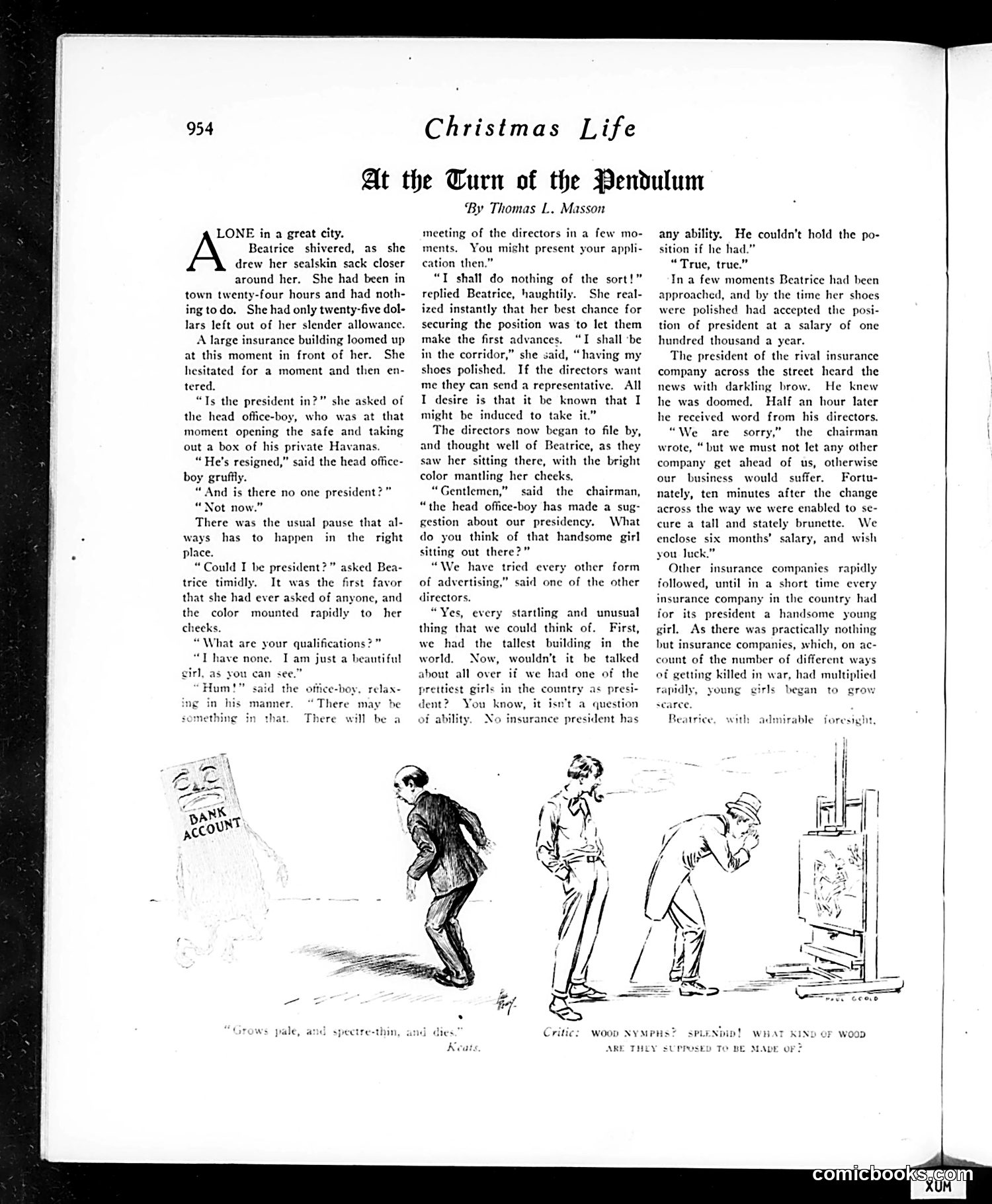
This is a satirical story by Thomas L. Masson about hiring practices and corporate absurdity. A poor young woman named Beatrice walks into an insurance company with no qualifications except beauty. She's hired as president at $100,000 annually—purely for advertising value, as the directors explicitly state: "it isn't a question of ability." The satire escalates when rival insurance companies, hearing this, immediately hire beautiful women as their own presidents to compete. Soon, every insurance company in the country follows suit, having replaced capable leadership with attractive women. The accompanying cartoons illustrate the corporate logic: businessmen examining candidates based on physical appearance rather than competence. The joke exposes how companies prioritize marketing gimmicks (beauty as advertisement) over actual qualified management—a pointed critique of early 20th-century business practices and attitudes toward women in professional settings.
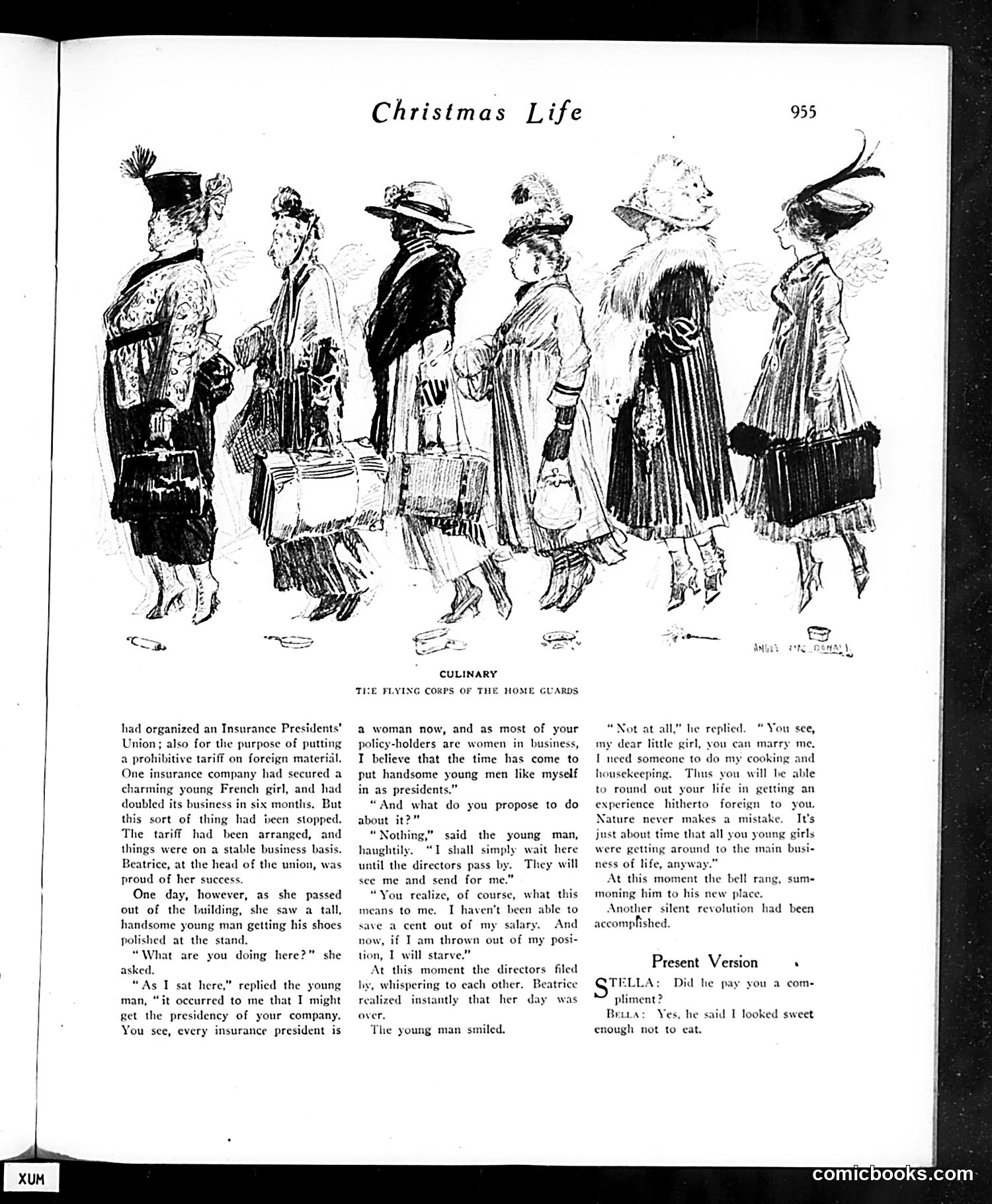
This satirical story mocks the emerging threat of female economic independence. Beatrice, a woman who has successfully organized an Insurance Presidents' Union and secured the company presidency, represents the "New Woman" of the early 20th century—professionally ambitious and economically powerful. The young man's strategy exposes the satire's target: despite women's actual business success, traditional gender roles remain socially dominant. He needs do nothing but appear attractive; the male directors automatically prefer him, and he assumes Beatrice's "natural" role is domestic service as his wife. The joke's bitter irony: a woman's hard-won professional achievement evaporates instantly when confronted with conventional sexism dressed as "nature." The "silent revolution" reversed is that patriarchal assumptions overpower women's genuine accomplishments. The "Present Version" coda—where a man compliments a woman by saying she looks good enough to eat—reinforces that women are valued primarily as objects, not professionals.
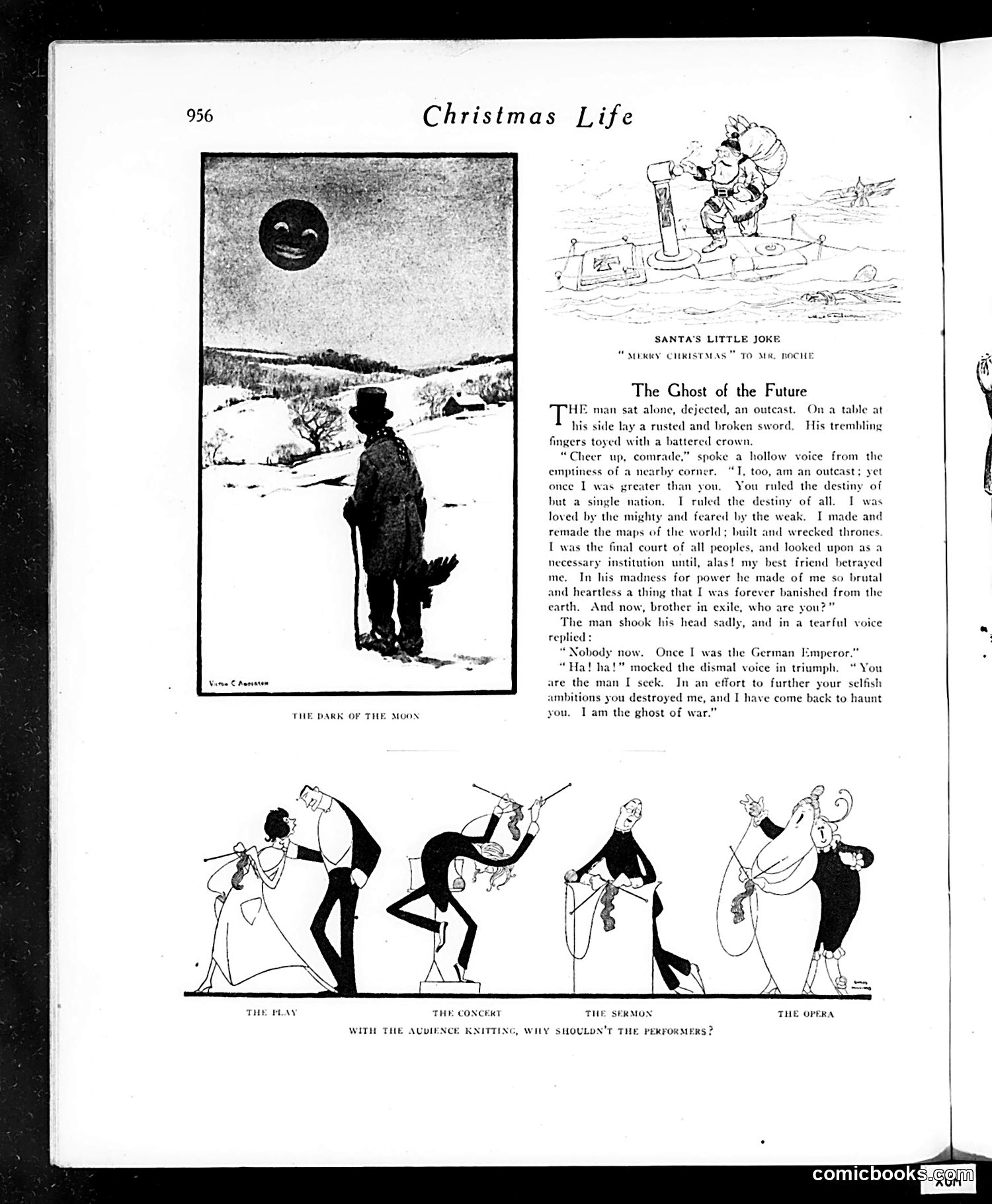
**Main Story: "The Ghost of the Future"** This allegorical tale depicts a fallen German Emperor visited by the personified "Ghost of War." The emperor, once powerful, is now dejected and powerless. War—itself banished from earth after being weaponized by the emperor's ambitions—returns to haunt him. The moral: the emperor's selfish use of war destroyed both nations and the institution itself. This appears to be post-WWI commentary on Kaiser Wilhelm II's downfall, presenting war as a corrupted tool that ultimately consumed its user. **Bottom Cartoon: "With the Audience Knitting, Why Shouldn't the Performers?"** Four vignettes satirize audience inattention during performances (play, concert, sermon, opera). The joke: if audiences knit during shows, performers should be equally casual/distracted. It mocks both audience rudeness and theatrical pretension during the period. **"Santa's Little Joke"** Brief caption referencing "Mr. Roche"—context unclear without additional information.
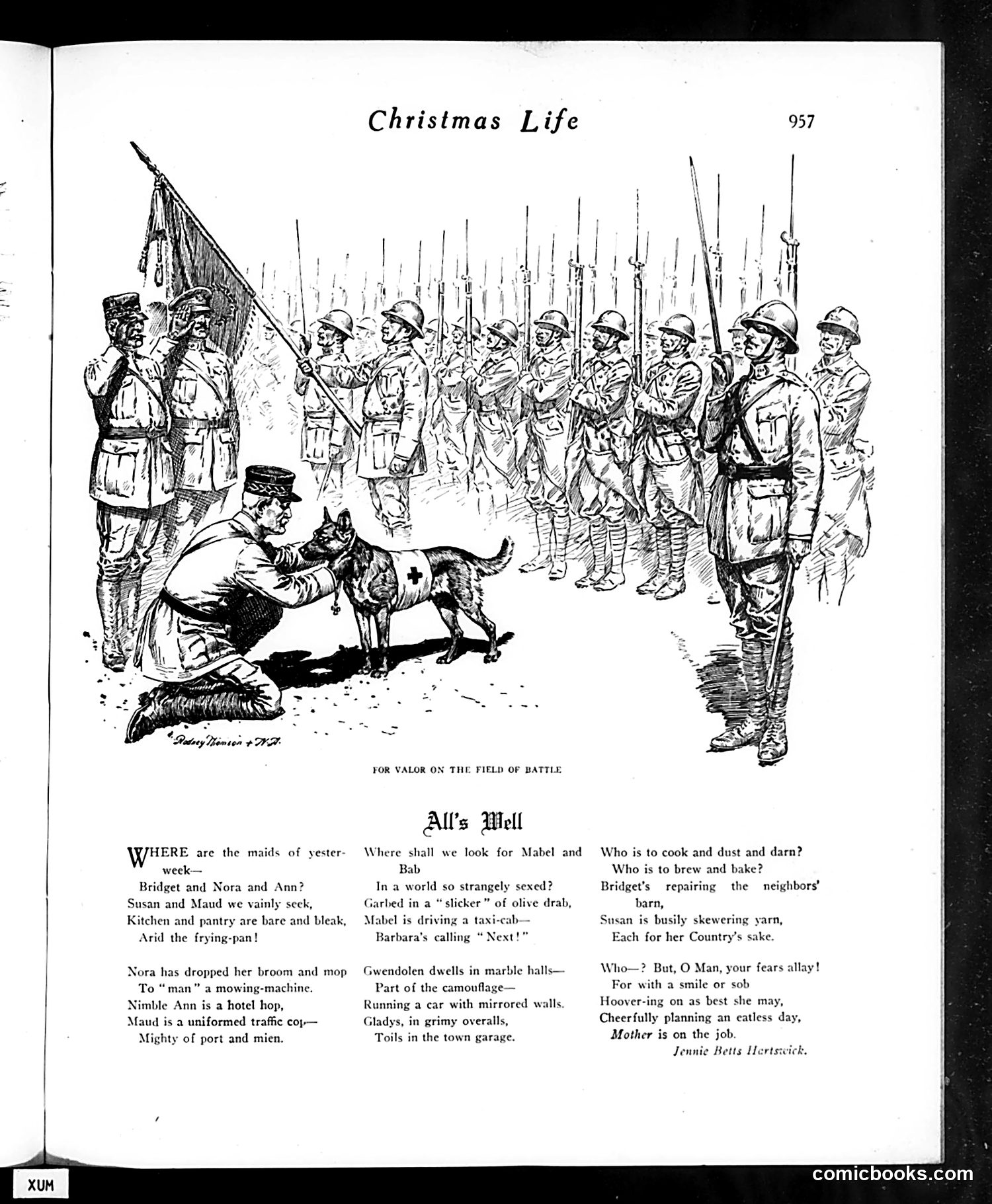
This poem satirizes the dramatic social upheaval caused by women entering the workforce during World War I. **The Setup:** The speaker laments that traditional domestic servants—Bridget, Nora, Ann, Susan, Maud—have vanished from kitchens and pantries. **The Joke:** These working-class women haven't disappeared; they've taken on wartime jobs: operating farm machinery, working as hotel staff, serving as traffic police. Similarly, upper-class women (Mabel, Barbara, Gwendolen, Gladys) have abandoned leisure to drive ambulances, work in garages, and take industrial jobs. **The Reassurance:** The final stanza provides comic relief: despite this unprecedented female workforce participation, "Mother" remains home managing rationing ("eatless day," likely referencing Hoover's food-conservation program) and domestic duties. **The Satire:** The poem acknowledges radical wartime changes to gender roles while ultimately suggesting traditional motherhood persists as society's stabilizing anchor—a somewhat patronizing reassurance to anxious readers about fundamental social order.
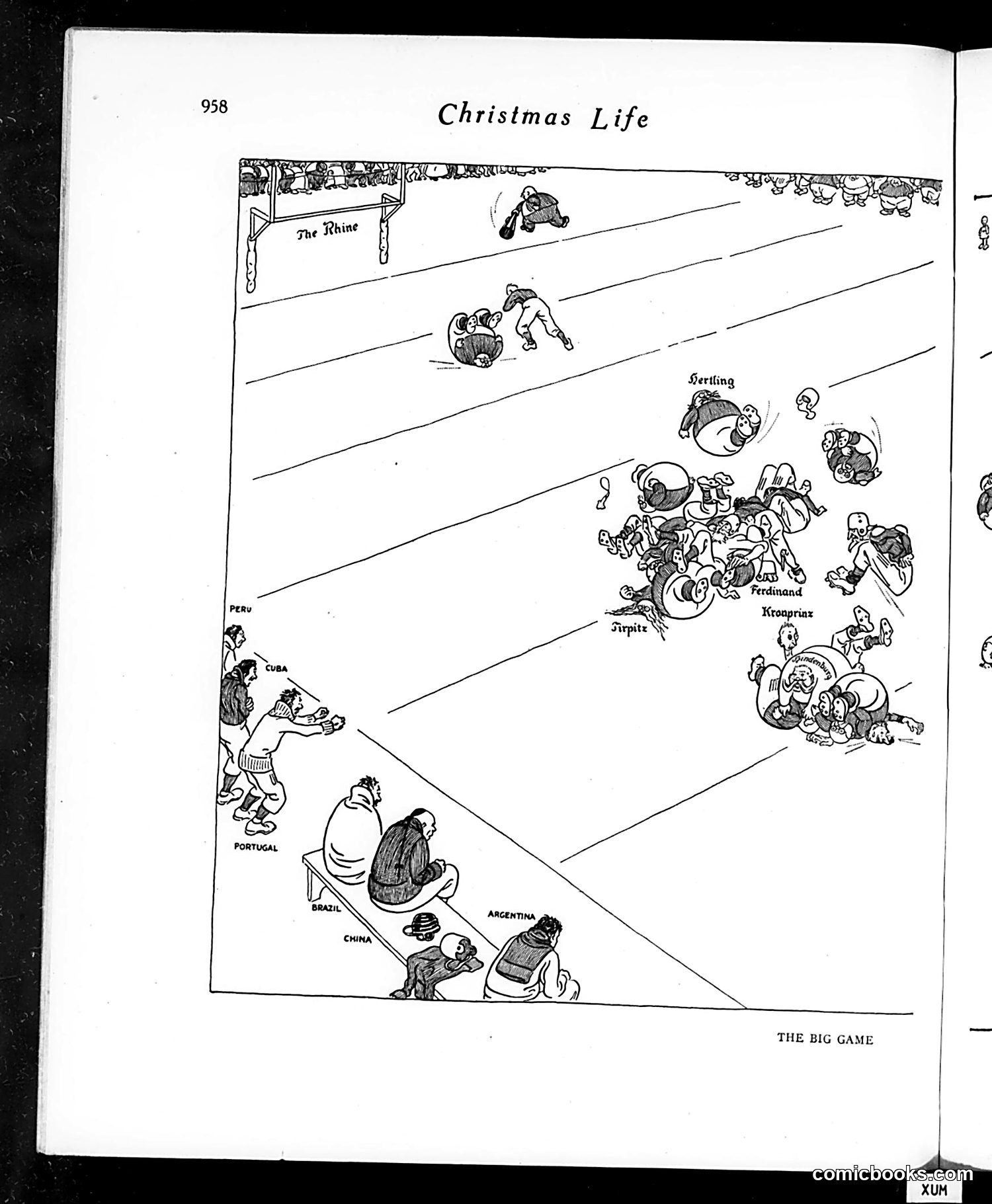
This satirical cartoon depicts international relations as a chaotic football game. Country labels identify the players: Peru, Cuba, Portugal, Brazil, China, and Argentina occupy the lower left sidelines, while nations like Berling (likely Berlin), Ferdinand, Kronprinz, and Sirpitz engage in the main action on the field. The satire suggests that global diplomacy and military posturing resemble a rough, uncontrolled sporting event rather than orderly governance. The crowded, tumultuous pile-up of figures illustrates how various nations—particularly European powers and colonial territories—jostle for position and advantage. This appears to be early 20th-century commentary on imperial competition and geopolitical tensions, presented as chaotic "sport" rather than serious statecraft.
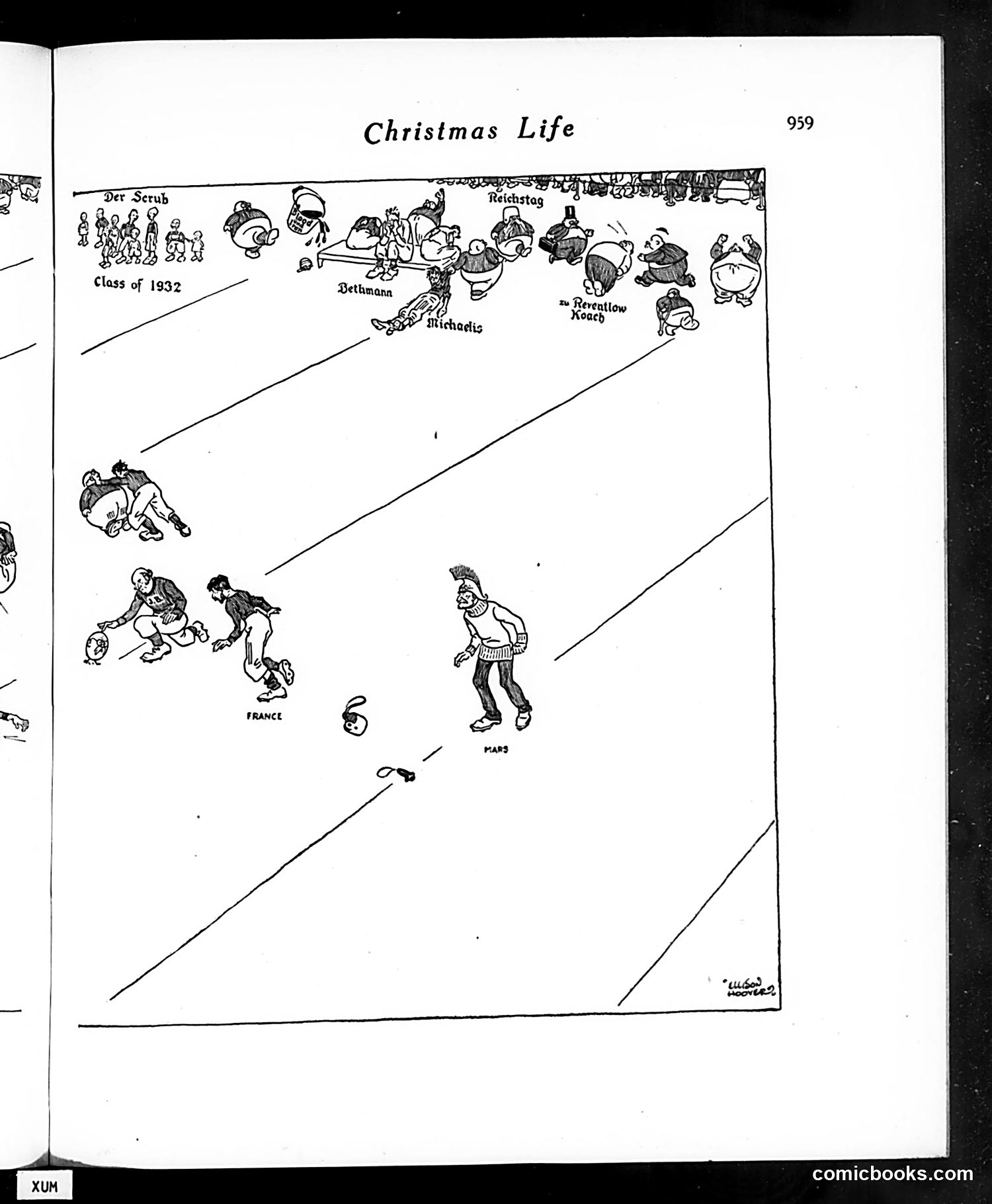
This is a satirical cartoon map depicting Christmas activities across Europe, circa 1932. The labeled locations include "Der Scrub" (Germany), "Reichstag" (German parliament), "Bethmann," "Michaelis," "The Swallow Xoast," and cities like "France" and "Paris." The cartoon appears to be commentary on European political figures and institutions during the Weimar period. The "Class of 1932" label and various illustrated figures suggest mockery of German political leadership. The Reichstag reference is particularly significant given Germany's political turmoil in 1932—the year before Hitler's rise to power. The scattered, chaotic arrangement of figures and activities implies satirical criticism of European political confusion and instability during this tense historical moment.
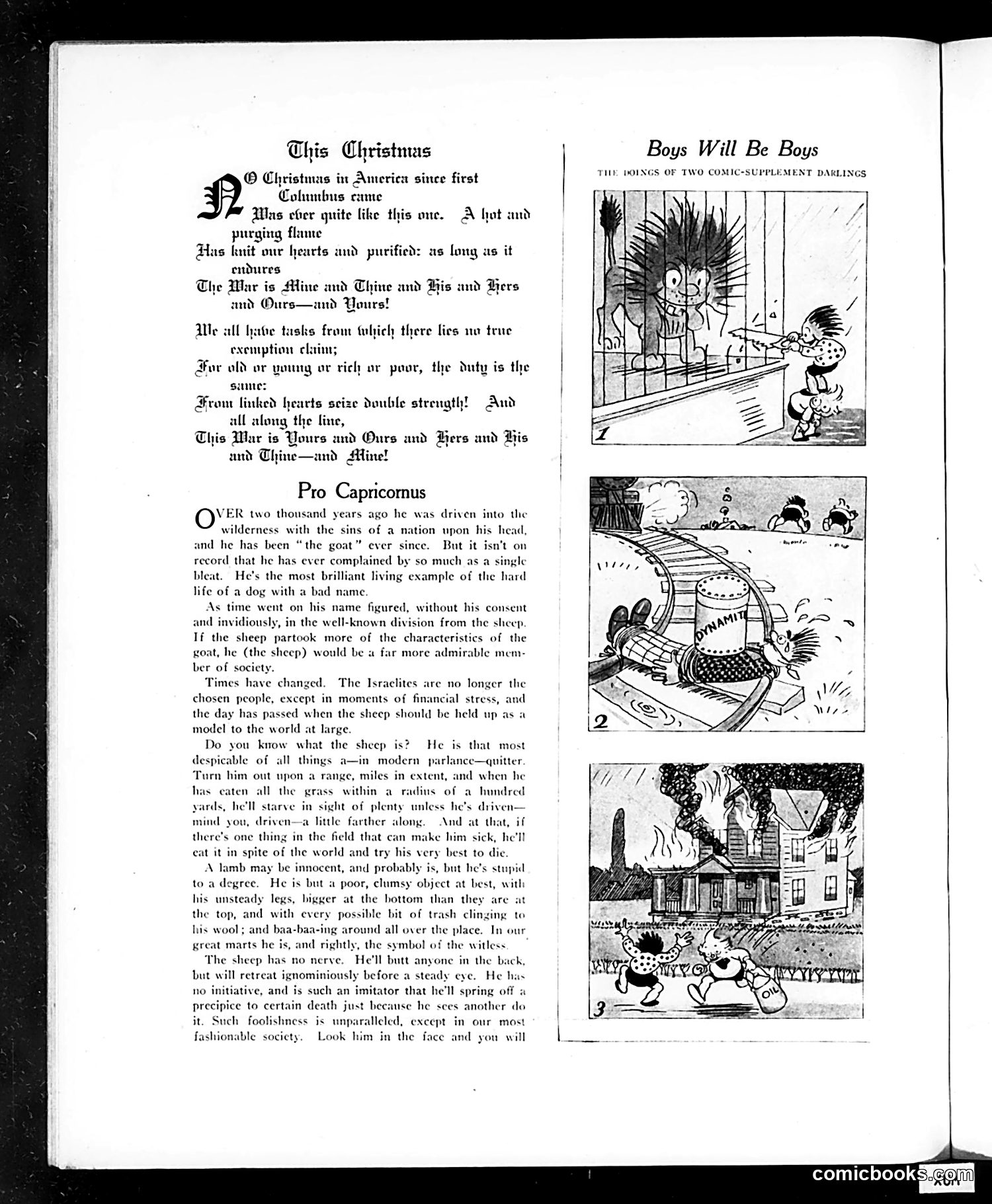
**Left side:** A patriotic Christmas poem asserting that WWI (likely 1917-1918) unites all Americans—"The War is Yours and Ours and Hers and His"—dissolving class distinctions through shared duty. **"Pro Capricornus" essay:** A scathing social critique using the scapegoat metaphor. The author argues that sheep (representing society's masses) are inferior to goats—stupid, helpless, requiring constant direction, prone to following others blindly even toward self-destruction. This appears to be satirizing either the public's passive acceptance of war or broader critiques of mob mentality and the working class as mindless followers. **Right side:** "Boys Will Be Boys" shows three comic strips depicting mischievous children—common entertainment content for the era. This juxtaposes light humor against the page's heavier patriotic and social commentary. The page blends propaganda (unity through war), social satire (criticizing public conformity), and lighthearted comics—typical of Life's varied editorial approach.
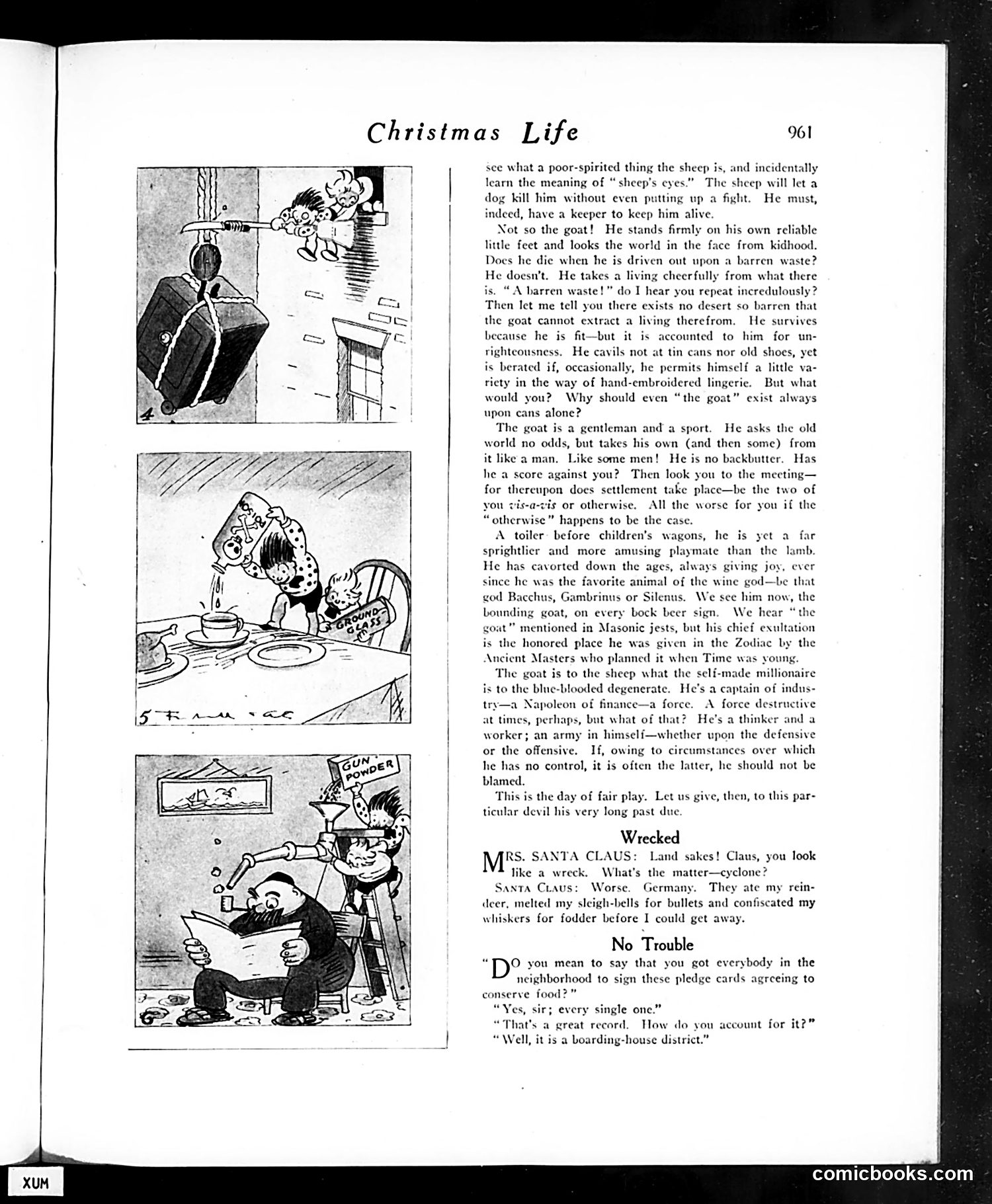
This Christmas-themed page contains philosophical commentary on goats versus sheep (likely metaphorical for independent versus dependent people), followed by three satirical cartoons related to World War I. **"Wrecked"** depicts Santa Claus telling Mrs. Santa that Germany has destroyed his operation—eating his reindeer, melting sleigh-bells for bullets, and confiscating his beard for soldier's fodder. This references wartime shortages and Germany's total mobilization for WWI. **"No Trouble"** satirizes food conservation pledges during wartime rationing. A official congratulates someone on getting unanimous neighborhood agreement to conserve food, attributing this to it being a "boarding-house district"—the joke being that boarding-house residents have no control over their meals anyway, so pledging conservation requires no actual sacrifice on their part. Both cartoons mock American home-front experiences during the Great War, specifically resource scarcity and the gap between official patriotic messaging and actual civilian hardship or indifference.
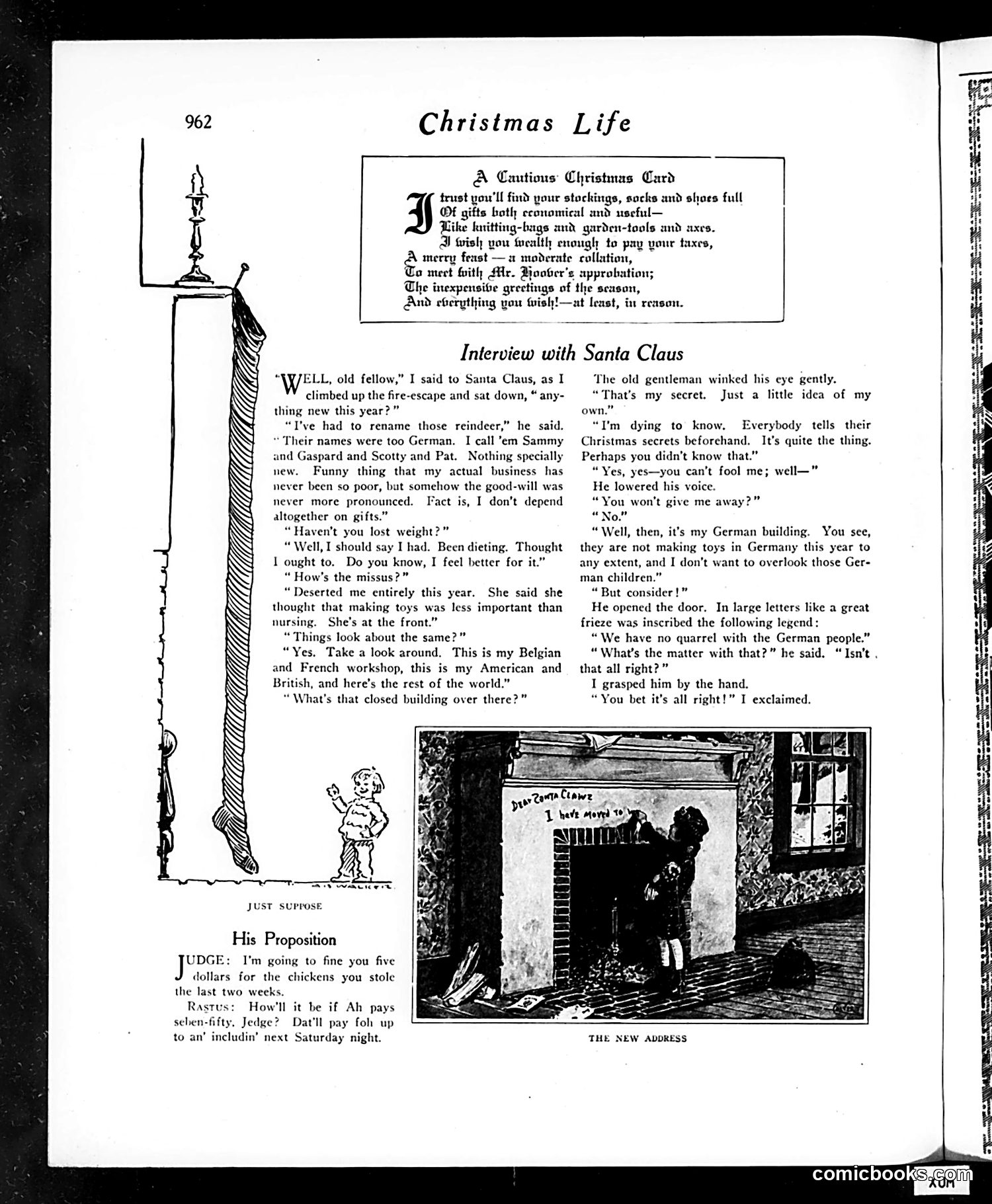
This page satirizes Christmas during World War I, likely 1914-1918. The "Interview with Santa Claus" is the main piece, presenting Santa as pragmatically adapting to wartime conditions. **Key satirical points:** - Santa has renamed his reindeer from German names (Donder, Blitzen, etc.) to Allied names: Sammy, Gaspard, Scotty, Pat—reflecting anti-German sentiment and national allegiances. - His wife has left toy-making to nurse wounded soldiers, suggesting civilian sacrifice for the war effort. - Most pointedly, Santa maintains a German workshop "to not overlook German children," inscribed with "We have no quarrel with the German people"—a humanistic counterpoint to wartime hatred, suggesting children shouldn't suffer for adult conflicts. **The "Cautious Christmas Card"** ironically promises practical gifts (tools, axes) and "inexpensive greetings," mocking economic hardship during wartime. The lower cartoon and "His Proposition" appear unrelated to the war theme—humor filler typical of the era.
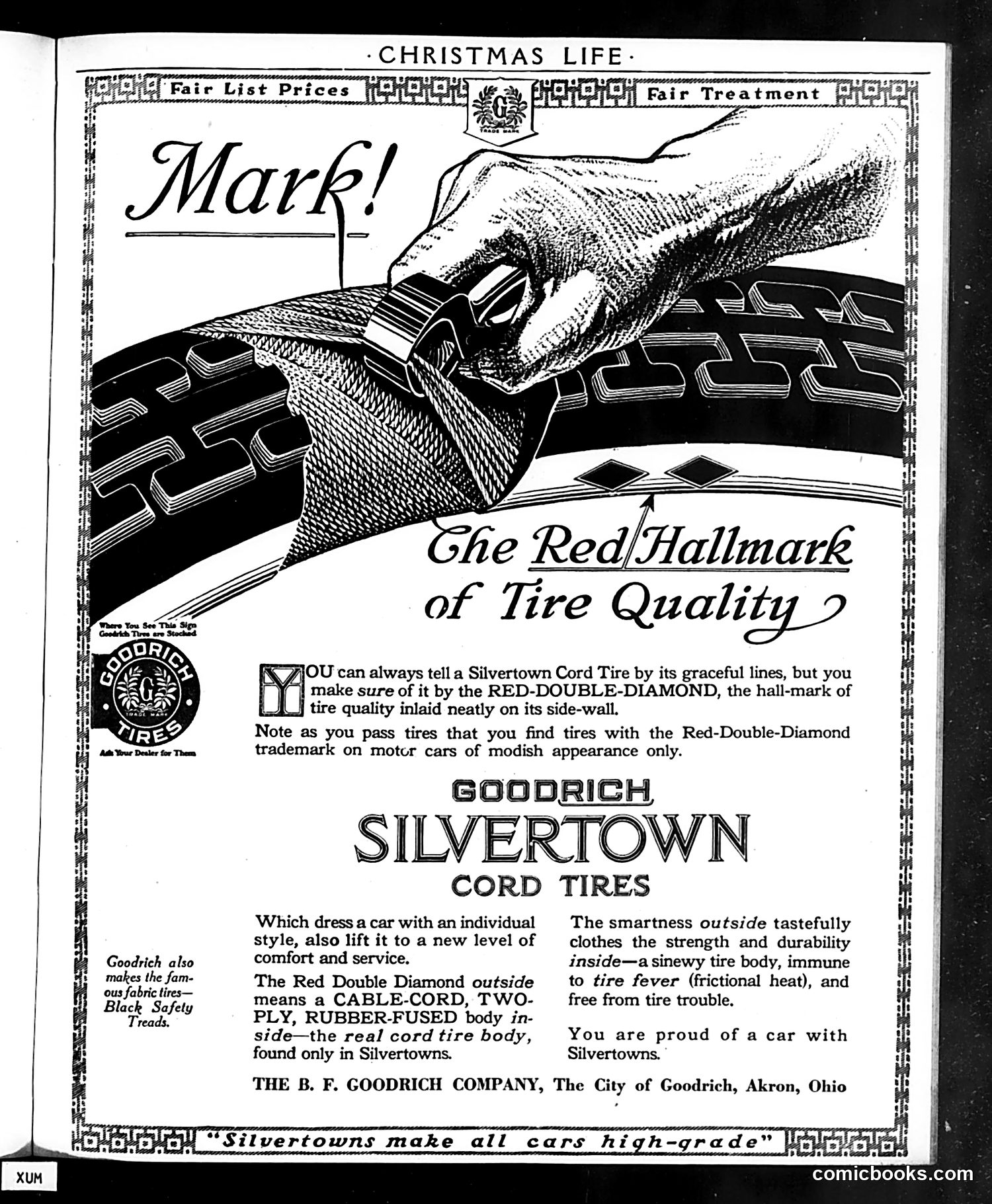
This is primarily a **tire advertisement**, not political satire. It's a B.F. Goodrich Company ad for Silvertown Cord Tires, published in *Christmas Life* magazine. The single illustration shows a hand marking or stamping the Red-Double-Diamond trademark onto a tire's sidewall. The visual metaphor emphasizes quality assurance—the act of "marking" signals authenticity and superior craftsmanship. The ad's key selling points are: - The Red-Double-Diamond trademark identifies genuine Silvertown tires - Cable-cord, two-ply rubber-fused construction provides durability - Resistance to "tire fever" (frictional heat damage) - Association with "modish" (fashionable) automobiles The tagline "Silvertowns make all cars high-grade" suggests that quality tires elevate a vehicle's status and performance. This reflects early-20th-century consumer culture, when tire quality significantly affected driving experience and car prestige. No political or social satire is evident—this is straightforward commercial messaging dressed in period advertising style.
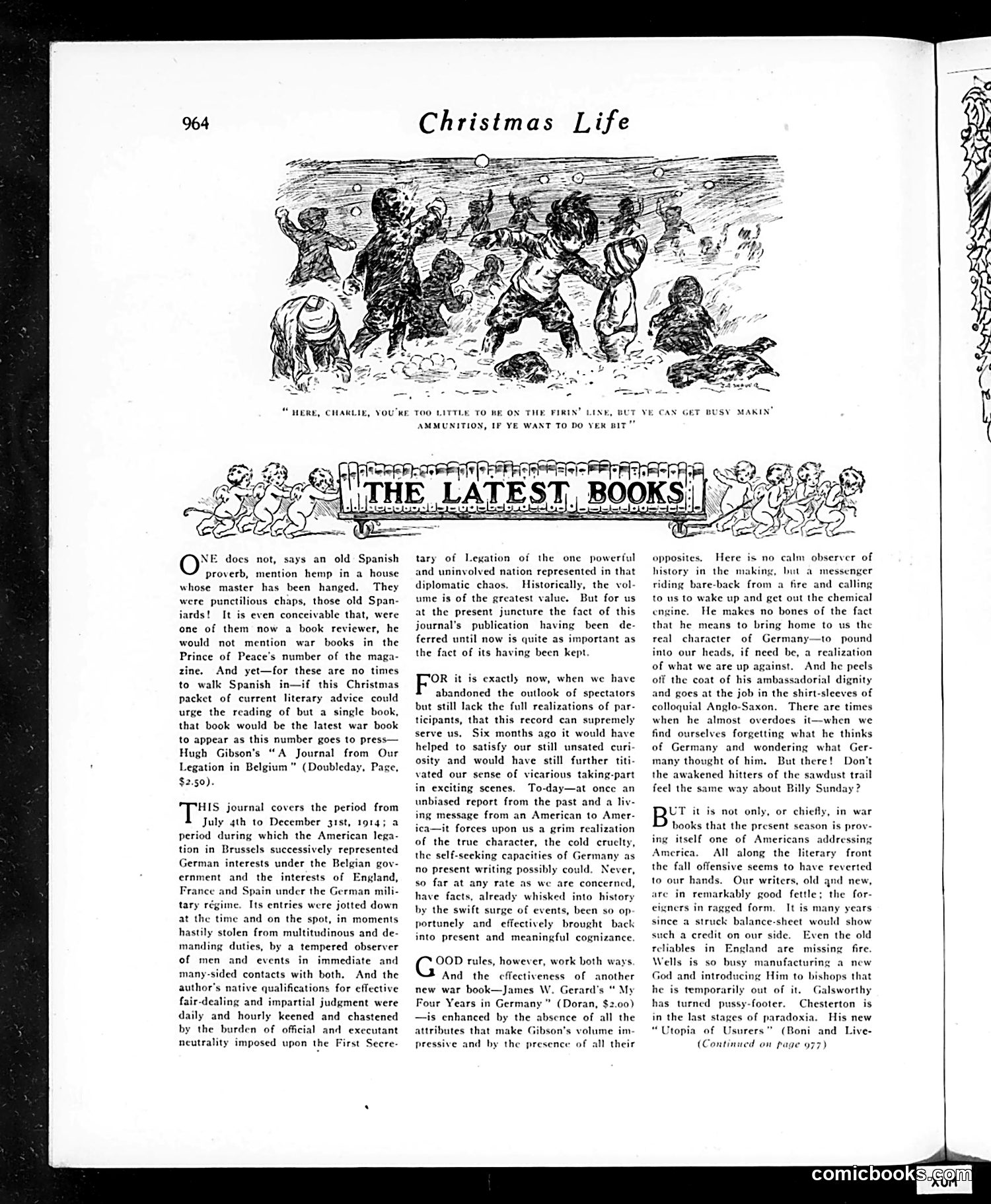
The cartoon shows children playing soldiers in snow, with one adult telling "Charlie" he's too small for the front lines but can help make ammunition—a dark joke reflecting WWI's escalating American involvement. The page reviews two wartime books: Hugh Gibson's "A Journal from Our Legation in Belgium" and James Gerard's "My Four Years in Germany." Both document German conduct during the war. The reviewer argues Gibson's firsthand diplomatic account is timely now that America has abandoned neutrality but hasn't yet fully grasped what war means. Gerard's book, by contrast, directly hammers home Germany's "cold cruelty" without diplomatic restraint. The satire is grim: children are being taught to think of war as a game, while adults debate which book most effectively converts Americans to see Germany as an enemy. The publication timing—after America entered WWI—makes these testimonies propaganda tools rather than mere history.
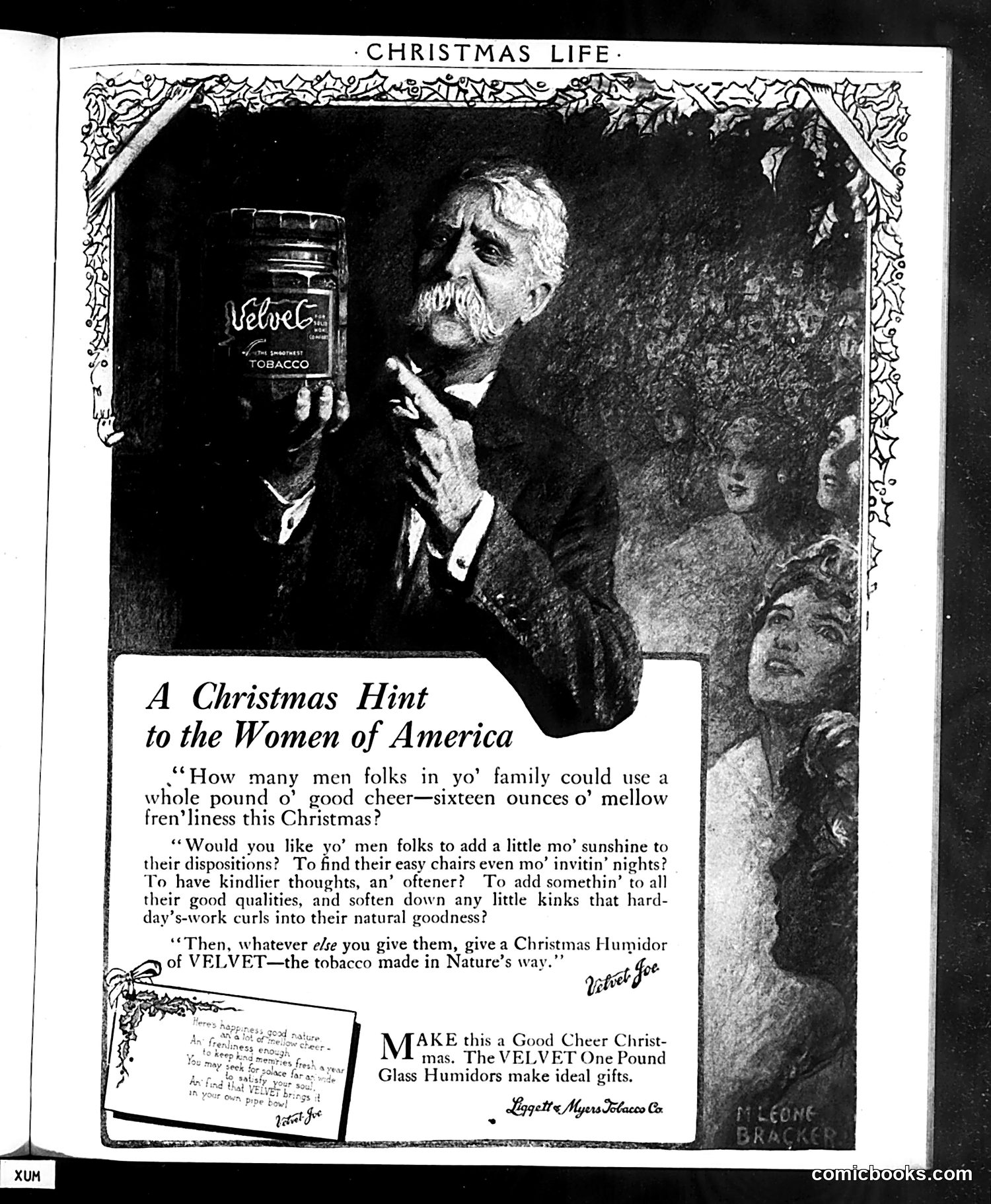
This is a **tobacco advertisement** disguised as Christmas advice, not a political cartoon. The ad uses patronizing dialect ("yo' family," "fren'liness") to address American women, suggesting they should buy tobacco humidors for male relatives as gifts. The pitch relies on stereotypes: men need "cheer" and "sunshine" to their dispositions; tobacco will make them kinder, more relaxed, and better-natured. The illustration shows an older man with a prominent mustache holding a Velvet tobacco container, positioned as though he's a satisfied customer or gift recipient. **Modern context:** This reflects early 20th-century advertising that: - Marketed tobacco as a character-improvement product - Used condescending ethnic/folk dialect - Assumed women's primary role was improving men's moods - Made no health warnings (pre-1960s regulation) The "Good Cheer Christmas" slogan connects tobacco consumption to holiday happiness and family harmony—messaging now recognized as deceptive marketing.
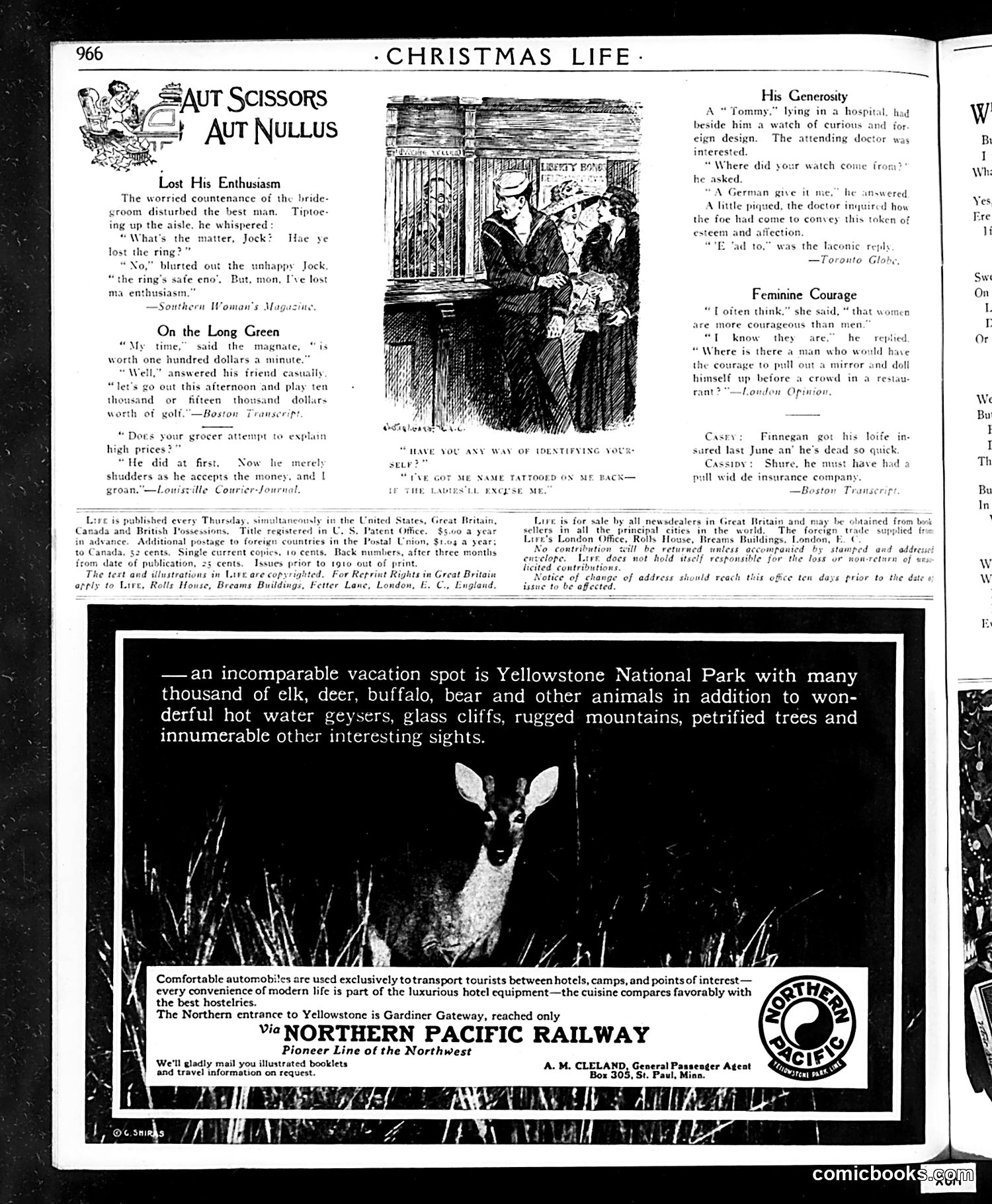
This page contains several short humorous anecdotes typical of Life magazine's satirical style, plus a full-page Northern Pacific Railway advertisement. The jokes mock various social situations: a bridegroom losing enthusiasm about marriage, a magician's inflated hourly rate, a grocer's excuses for high prices, and a woman's observation that men lack the courage to primp in public. One piece features Irish dialect humor about a man securing life insurance just before dying. The central illustration shows two men in what appears to be a hospital or formal setting, accompanying a story about "His Generosity"—likely about a wounded soldier receiving a watch from a German adversary, reflecting post-WWI reconciliation sentiment. The large advertisement dominates the lower half, promoting Yellowstone National Park as a vacation destination accessible via Northern Pacific Railway, emphasizing modern automobile transport and luxury hotel amenities—typical early 20th-century tourism marketing.
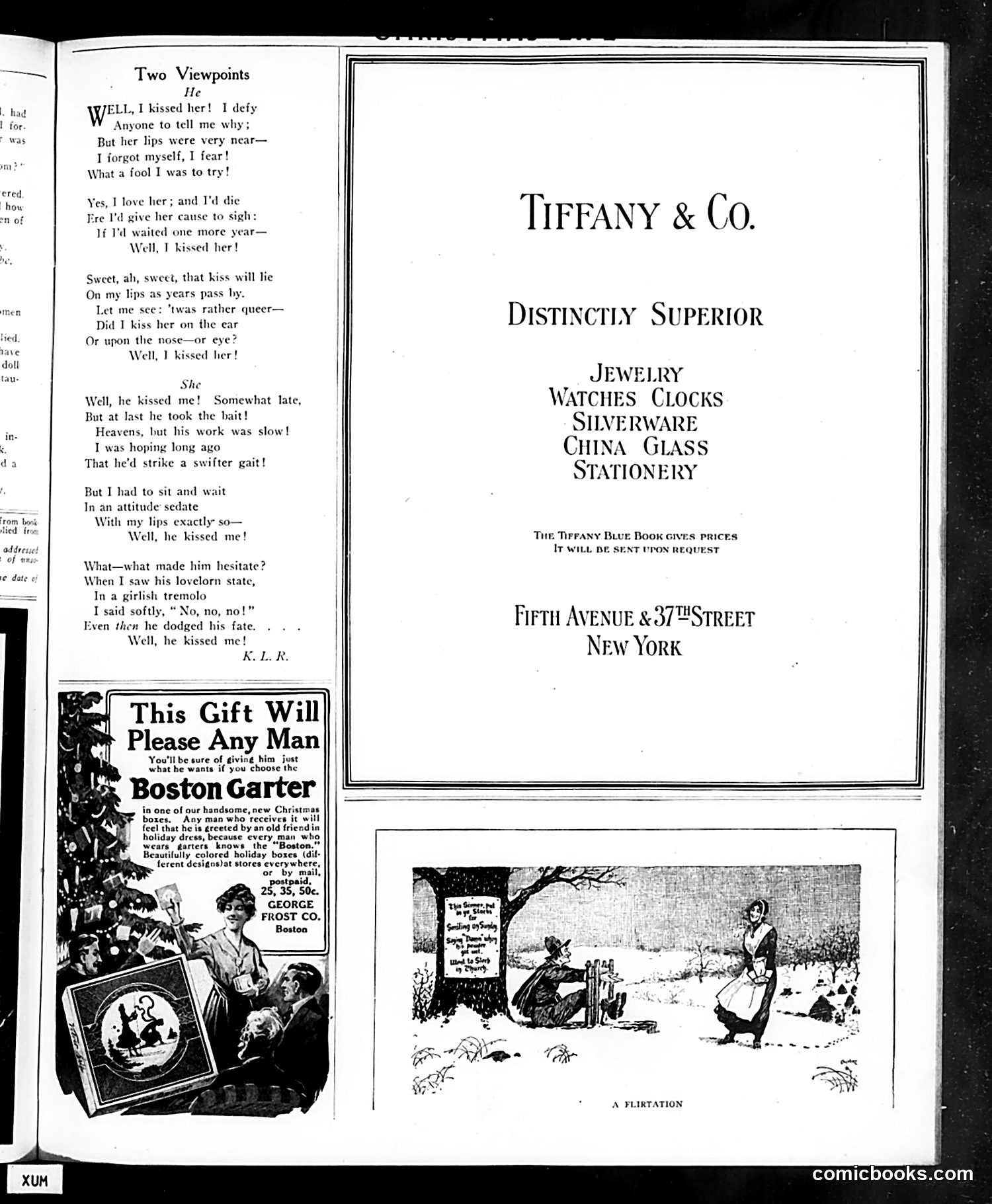
This page features a humorous poem contrasting male and female perspectives on the same kiss. **He** recalls the moment romantically and self-consciously ("What a fool I was to try!"), wrestling with guilt and wondering where exactly he kissed her. **She** views the same event pragmatically and with mild frustration—he took too long to act ("his work was slow"), and she had to orchestrate the moment herself, strategically saying "No, no, no!" to prompt him into action. The satire targets gender stereotypes: the man as hesitant and emotionally overwrought; the woman as patient manipulator, orchestrating romance while maintaining composure ("lips exactly so"). The cartoon below reinforces this dynamic—a woman actively flirting while the man appears passive or uncertain. This reflects early 20th-century comedic conventions where women were portrayed as calculating romantic strategists while men were bumbling romantics.
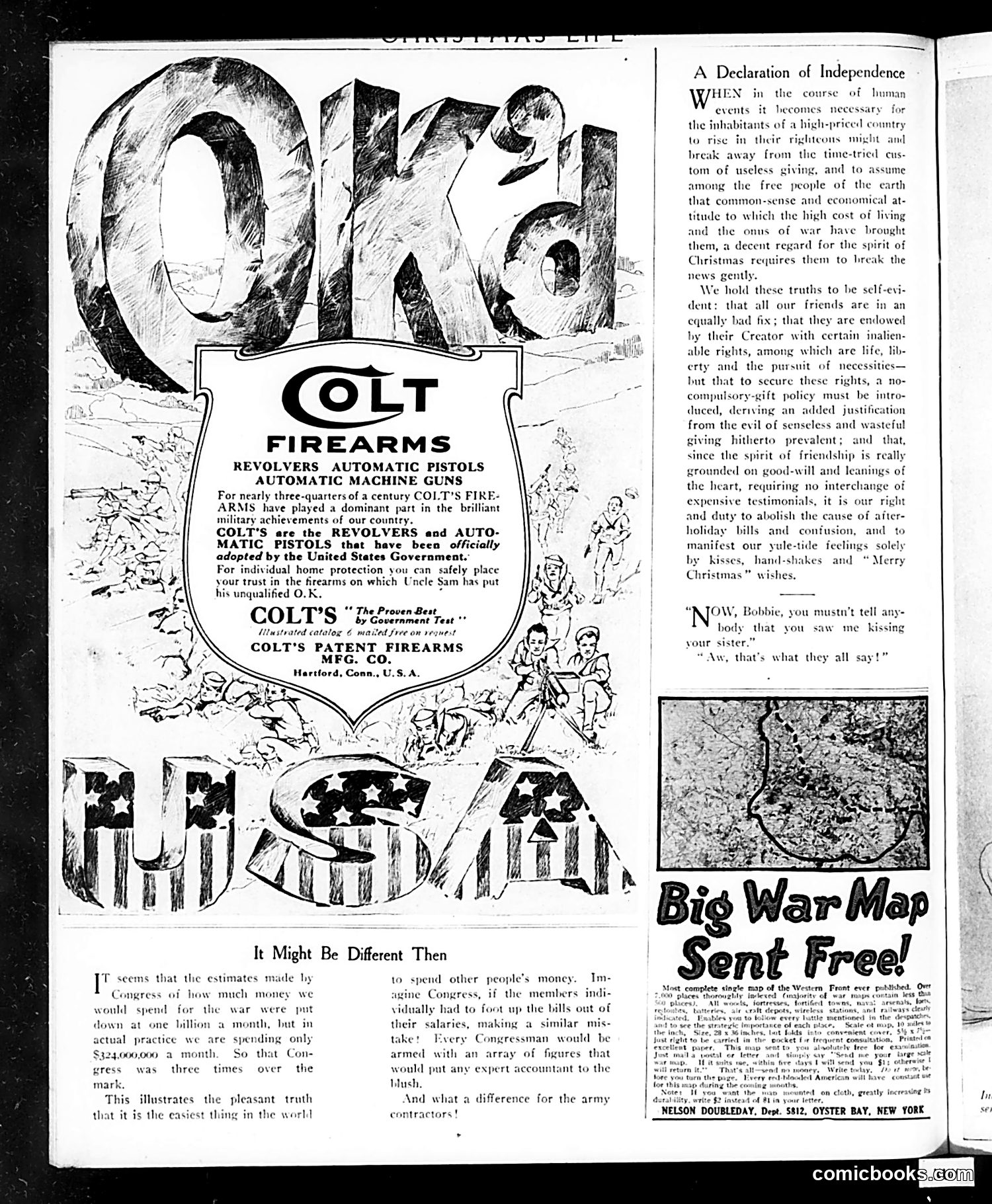
This Life magazine page contains two distinct pieces of satire: **Left side - "It Might Be Different Then":** A commentary on Congressional budget mismanagement during World War I. The piece satirizes how Congress estimated war spending at $1 billion monthly but actual costs reached $324 million—three times the estimate. The joke imagines if Congress members personally had to pay these bills from their own pockets, they'd suddenly become fiscally responsible, unlike when spending "other people's money." **Right side - "A Declaration of Independence":** A humorous mock-serious parody of the Declaration of Independence, written in 1918 as wartime satire. It presents a "declaration" about the high cost of living during the war, arguing that citizens should abandon expensive gift-giving traditions. The piece ironically frames frugality as a patriotic duty, using grandiose founding-document language to justify not buying Christmas presents—a darkly comic comment on economic hardship. Both satirize wartime financial strain on ordinary Americans.
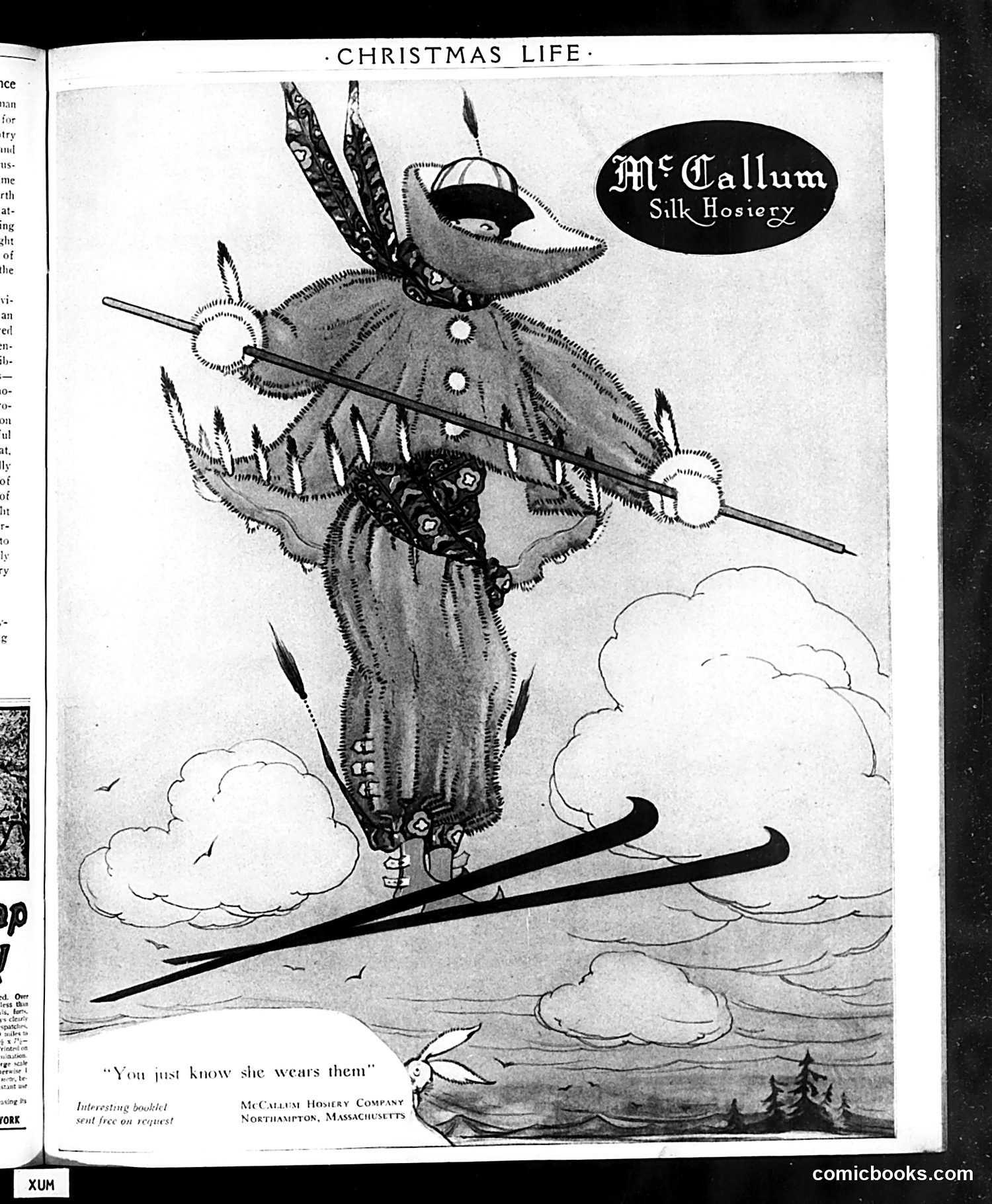
This is a **Christmas advertisement** for McCallum Silk Hosiery, not political satire. The illustration depicts a whimsical anthropomorphic figure—resembling a furry creature or character in elaborate dress—flying through clouds on what appears to be a large needle or pin. The figure wears feathered headpiece and decorative clothing. The tagline "You just know she wears them" is a sales pitch suggesting that fashionable women wear McCallum hosiery. The ad plays on fantasy and aspiration typical of 1920s-1930s advertising, presenting hosiery as a desirable luxury item. The surreal, cloud-filled imagery aims to create an appealing, dreamlike context for the product—making silk stockings seem magical and essential to a woman's elegant appearance.
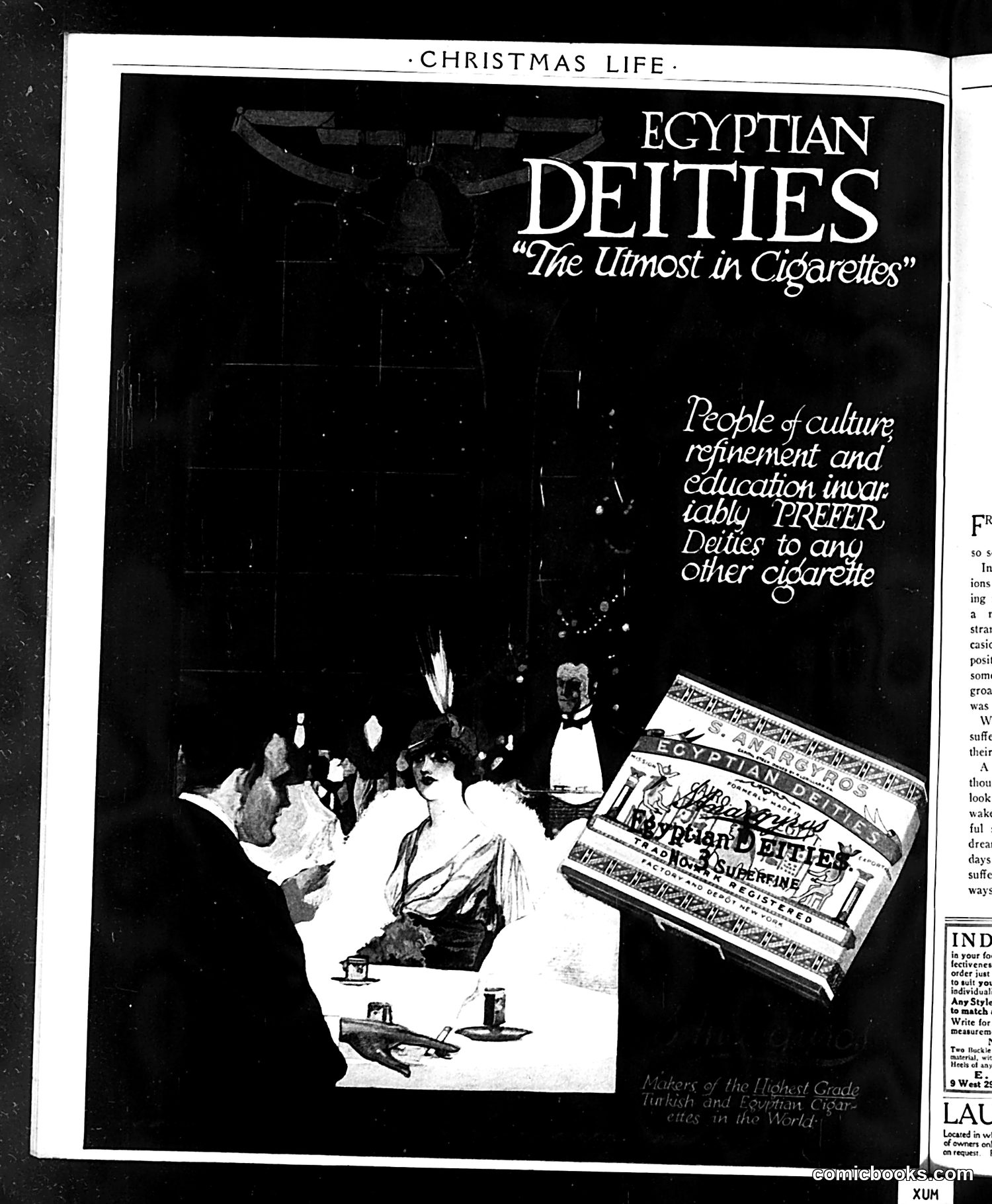
This is a **cigarette advertisement** from Life magazine, not political satire. It promotes "Egyptian Deities" brand cigarettes as "The Utmost in Cigarettes." The ad uses an **orientalist visual theme**: a luxurious dinner scene with Egyptian hieroglyphic imagery and classical Egyptian aesthetic elements (visible in the background design). A well-dressed woman is shown smoking, surrounded by elegant companions and cigarette packages prominently displayed. The tagline claims cultured, educated people "PREFER Deities to any other cigarette"—a common advertising strategy appealing to aspirational consumers by associating the product with sophistication and refinement. This reflects early-to-mid 20th century marketing practices: using exotic imagery and appeals to class status to sell cigarettes, before modern health warnings existed.
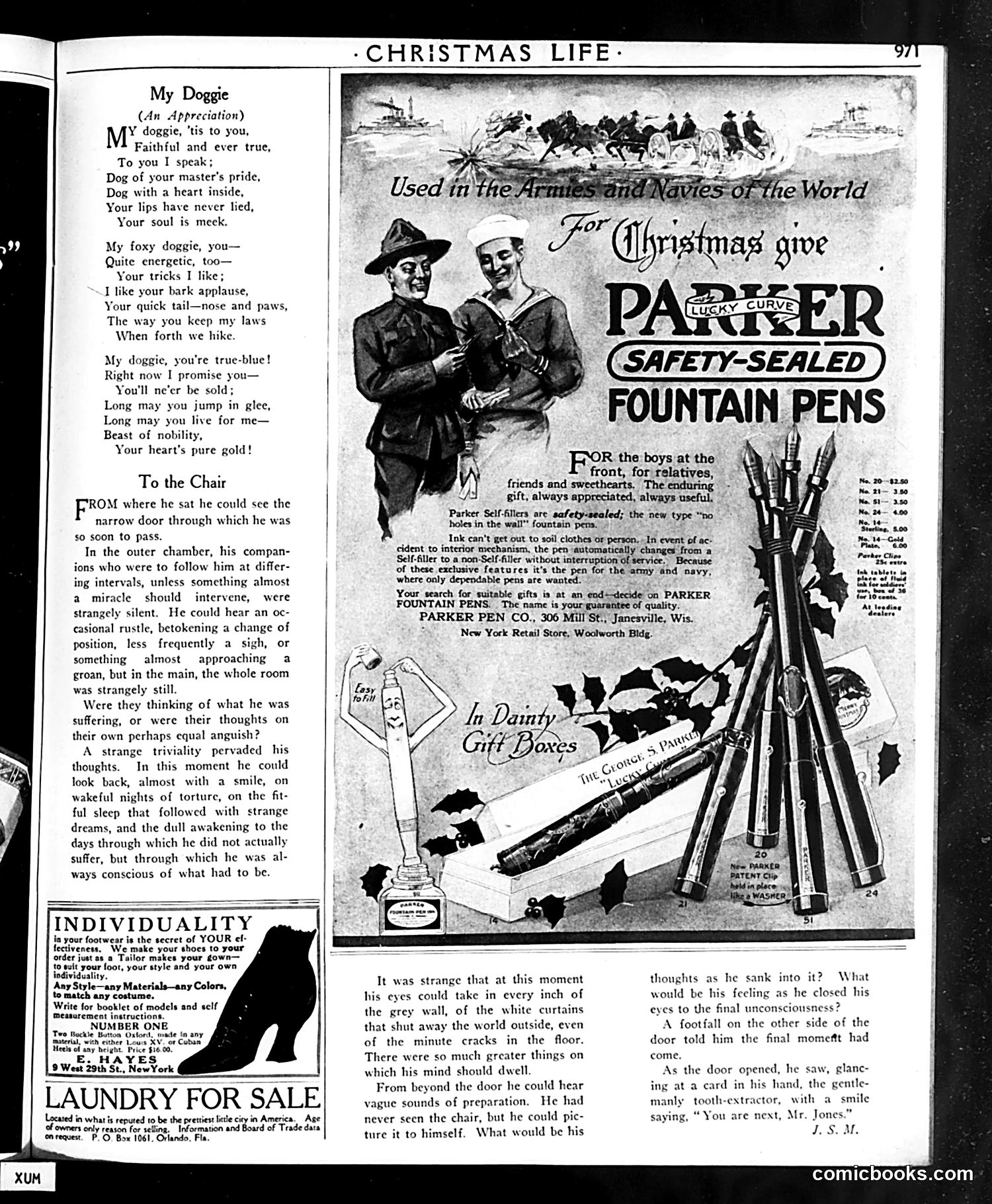
This page contains **mixed editorial and advertising content**, not political cartoons. The left side features poetry: "My Doggie" (sentimental verses praising a dog's loyalty) and "To the Chair" (a dramatic narrative about a man awaiting execution—though the twist ending reveals he's actually in a **dentist's office**, not facing capital punishment). The humor relies on misdirection; readers expecting tragedy discover mundane dental anxiety instead. The right side is dominated by a **Parker Fountain Pen advertisement** targeting military gift-givers during wartime, emphasizing the pens' reliability and safety-sealed design to prevent ink leaks on uniforms. Lower advertisements include tailored shoes, laundry services for sale, and an "Individuality" clothing service. There are **no political cartoons or caricatures** on this page. The content reflects early-20th-century Life magazine's mix of light satirical writing and commercial advertising.
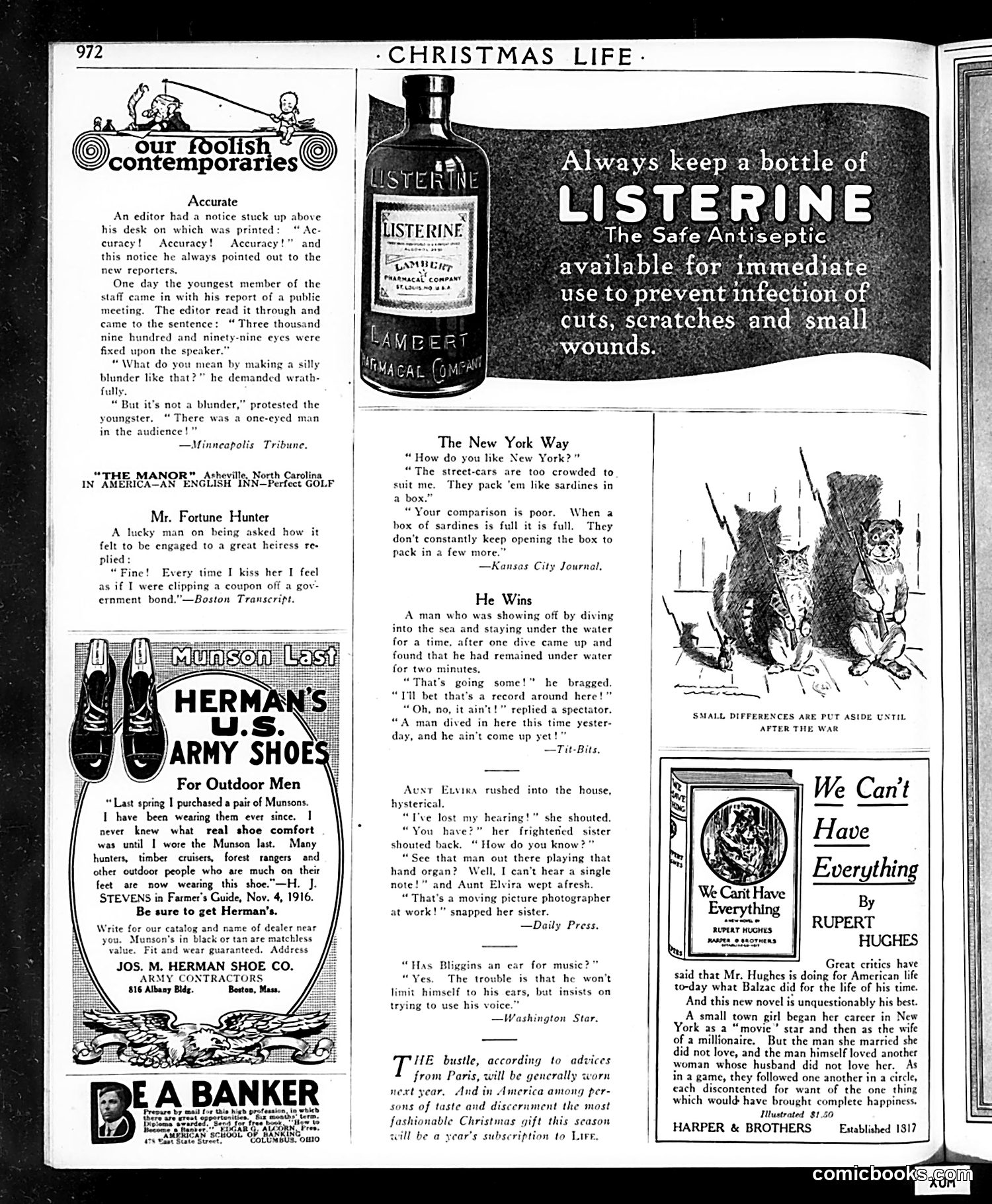
This is primarily a **humor and advertising page** from Life magazine's Christmas issue. The content consists of short jokes and advertisements rather than political cartoons. The humor pieces are genteel workplace and domestic comedy: an editor corrects a reporter's math (the "silly blunder" being the report of 3,999 eyes from an audience with one one-eyed man), jokes about New York subway crowding, a diving contest mishap, and a woman who thinks she's lost her hearing near a street organ player. The advertisements feature **Listerine antiseptic**, **Munson work boots** for outdoor laborers, and promote **Rupert Hughes' novel "We Can't Have Everything."** No political satire or caricature appears on this page. The "Our Foolish Contemporaries" section simply reprints jokes from other newspapers. This is a light entertainment and commercial page typical of Life's mixed format—humor pieces interspersed with period advertisements for consumer products.
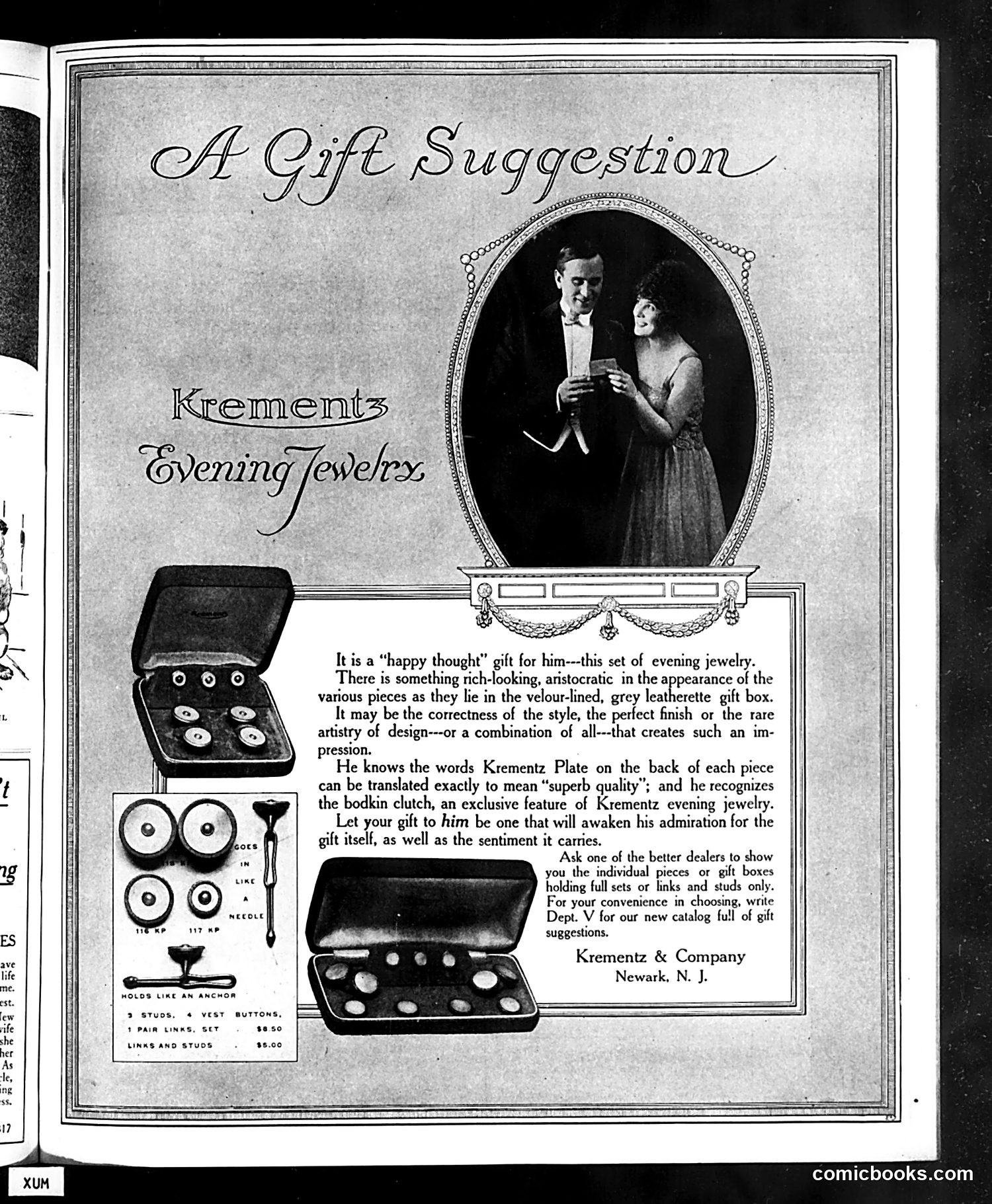
This is **not a cartoon or satire page**—it's a vintage **advertisement** for Krementz & Company evening jewelry, likely from the early 20th century. The page features a romantic illustration of a man and woman (the woman presenting jewelry to the man) paired with product photography showing cufflinks, studs, and buttons in display cases. The text is purely promotional copy emphasizing quality ("superb quality," "aristocratic appearance," "perfect finish"). The rhetorical strategy appeals to gift-giving sentiment ("happy thought" gift) and male vanity, suggesting the jewelry will earn "admiration" and impress the recipient. The exclusive "bodkin clutch" feature is highlighted as a selling point. There is no political content, satire, or social commentary—this is straightforward commercial advertising for formal evening wear accessories aimed at affluent male consumers.
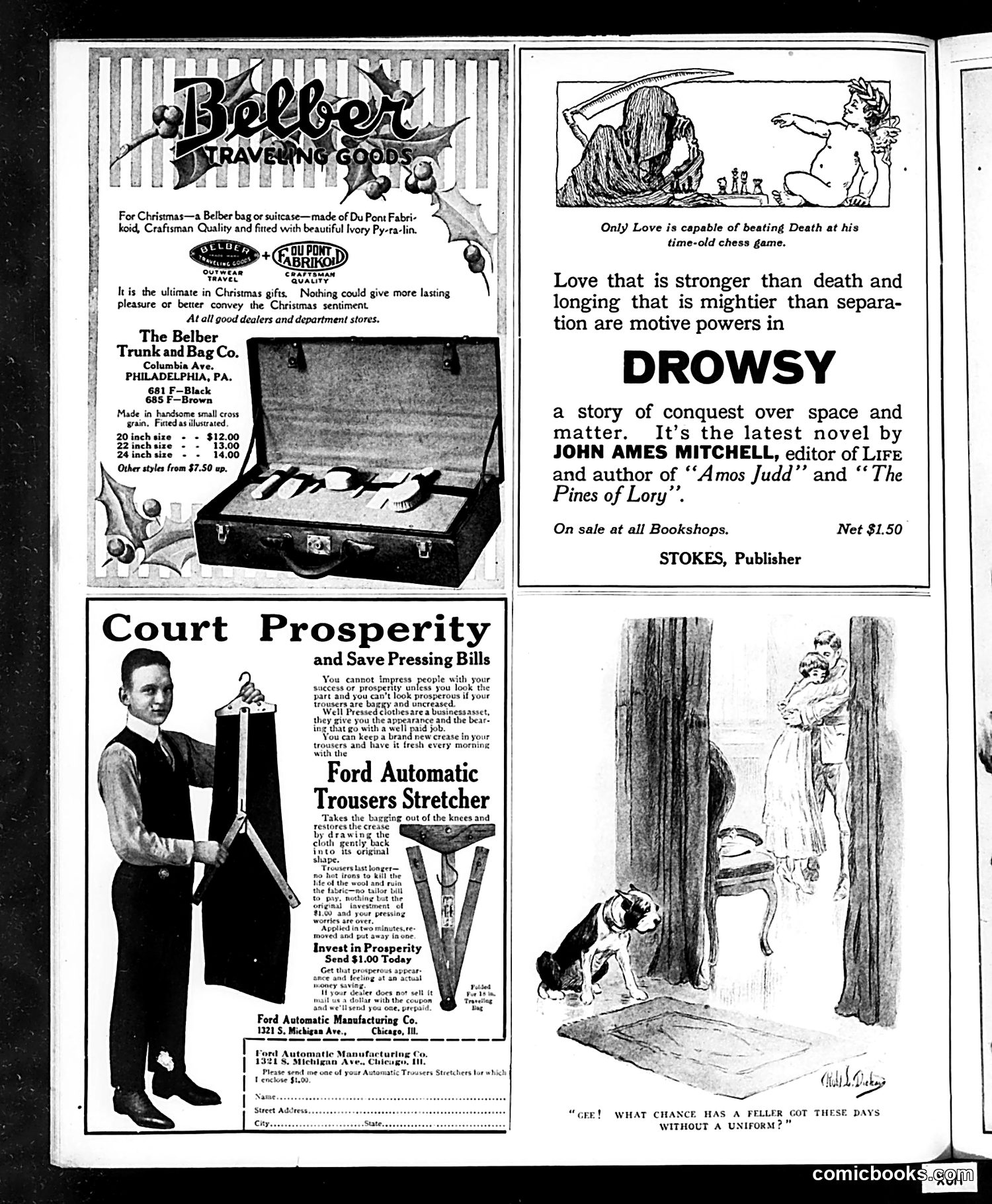
This page combines advertisements with one cartoon. The ads promote Christmas gifts (Belber luggage), a trouser-pressing device, and a novel called *Drowsy* by John Ames Mitchell. The cartoon at bottom right depicts a dog in military uniform speaking to a woman, with the caption: "Gee! What chance has a feller got these days without a uniform?" **The satire:** This appears to reference post-World War I social anxiety about civilian prospects. The joke conflates a dog's romantic/social prospects with broader concerns about whether non-uniformed men could compete or succeed in the postwar period—suggesting that wearing a military uniform had become a social asset or necessity for male status. The absurdity of asking a *dog* this question heightens the satirical commentary on society's apparent overvaluation of military credentials and uniform-wearing. It mocks both the desperation men felt and society's fixation on military identity as a marker of worth.
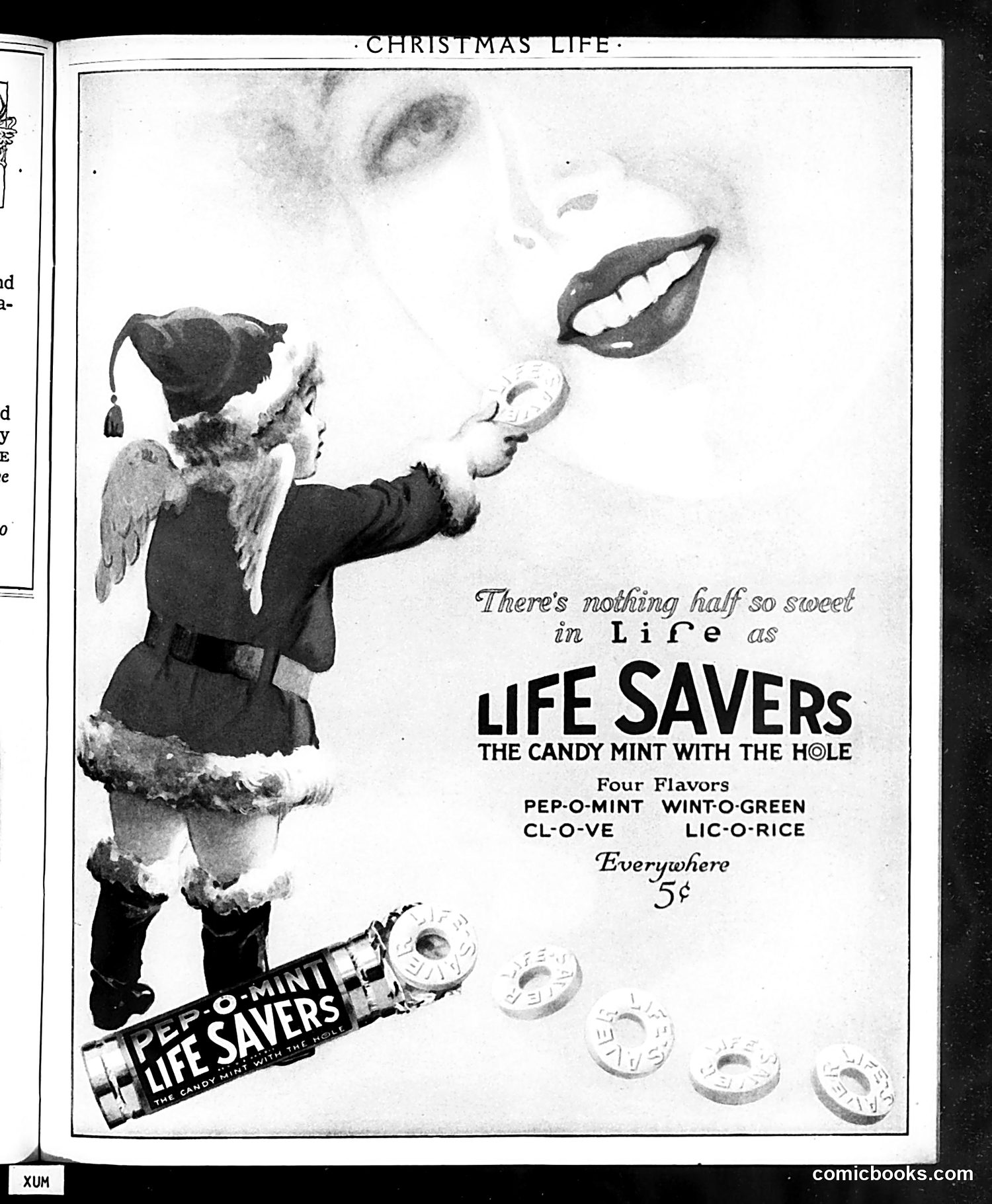
This is a **Life Savers candy advertisement**, not political satire. The page features a Christmas-themed ad showing a cherub or cupid-like figure offering the iconic ring-shaped candies to a smiling woman's face. The ad's wordplay—"There's nothing half so sweet in life as LIFE SAVERS"—plays on the product name while emphasizing the candy's defining feature: the hole in the middle. The cherub reinforces the romantic/gift-giving Christmas theme. Four flavors are listed: Pep-O-Mint, Wint-O-Green, Cl-O-Ve, and Lic-O-Rice. The price was 5¢ everywhere. This is straightforward vintage advertising using sentimental holiday imagery and clever branding, with no political commentary or social satire present.
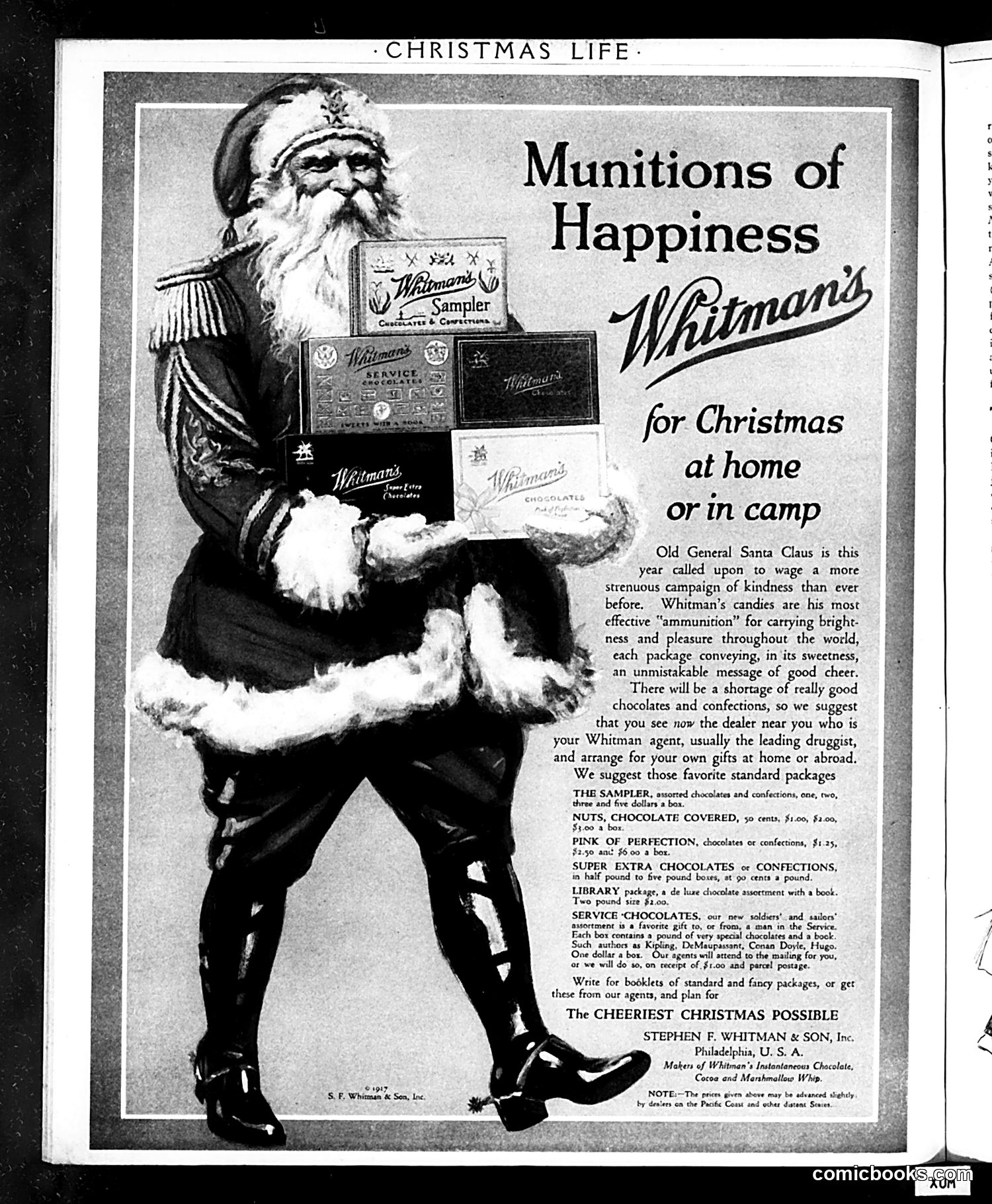
This is primarily a **Whitman's chocolate advertisement** rather than a political cartoon. The page uses wartime imagery to sell candy as Christmas gifts. **The Figure & Context:** Santa Claus is depicted as a military general holding boxes of Whitman's chocolates as "munitions of happiness." This militaristic framing reflects the **World War I era** (likely 1917-1918, based on references to soldiers, sailors, and camp). **The Satire/Point:** The ad cleverly exploits wartime conditions—noting a "shortage of really good chocolates"—to market candy as both a patriotic gift and morale booster for troops overseas and those at home. The playful language ("munitions," "campaign of kindness") equates candy with military supplies, a humorous but strategic appeal during rationing. **What We'd Miss Today:** Modern readers might not immediately recognize this as tapping into specific WWI anxieties about scarcity and soldiers' welfare, or understand how chocolate functioned as both luxury item and patriotic gesture during the war.
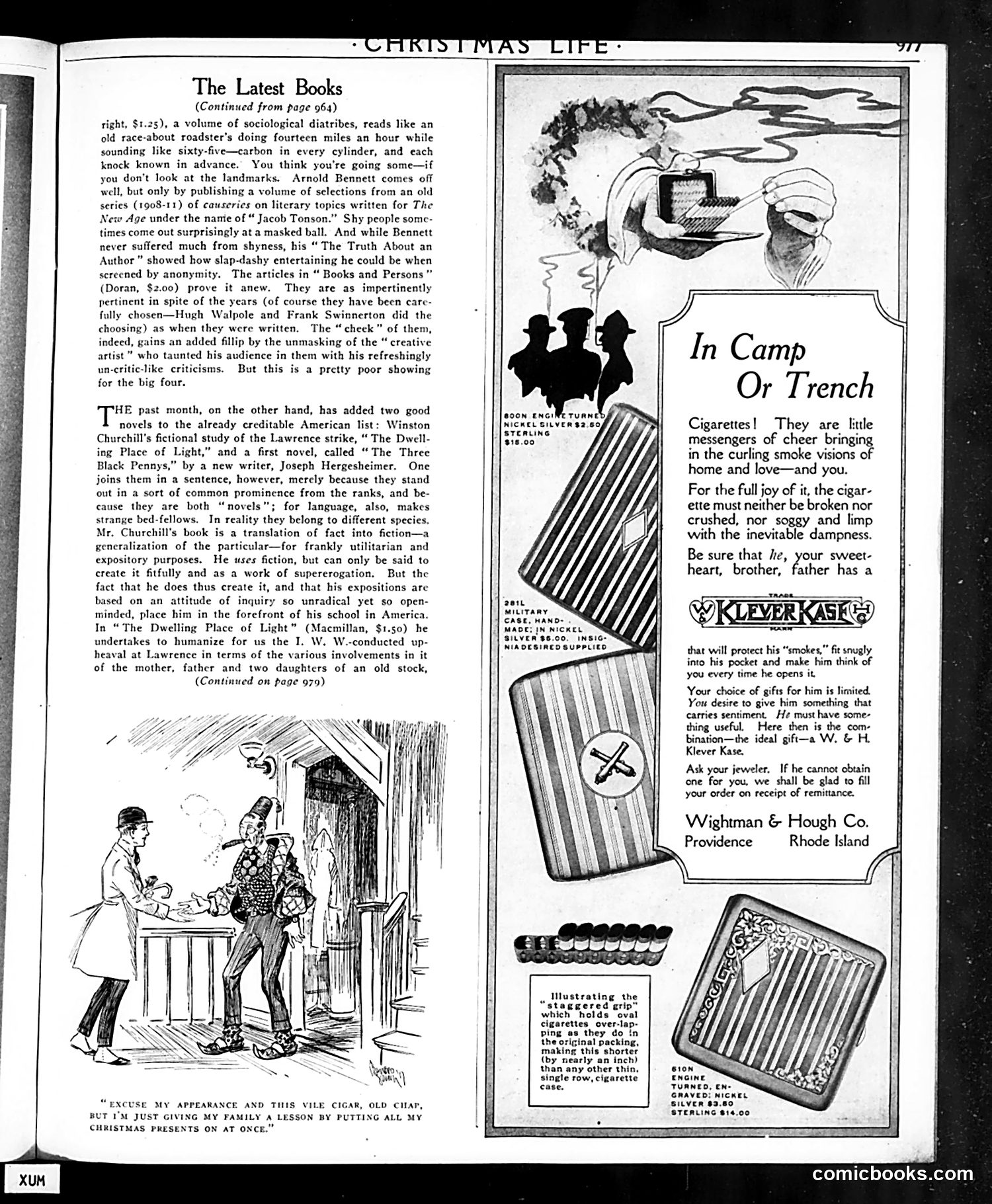
This page combines a book review with wartime advertising. The left column discusses recent American novels, praising works by Winston Churchill and Joseph Hergesheimer while critiquing others. The cartoon at bottom-left depicts a soldier showing off his uniform and gifts to a woman, joking that he's "putting all my Christmas presents on at once"—a satirical comment on military excess or perhaps the soldier's eagerness to display his newfound status. The right side is a Klever Kase cigarette case advertisement, directly addressing soldiers ("In Camp Or Trench"). It emphasizes how the case protects cigarettes—described as "little messengers of cheer"—from dampness and damage. The ad's emotional appeal targets men separated from loved ones, suggesting the gift as a way for sweethearts, brothers, and fathers to remain connected through this practical luxury item. The page's combination of literary criticism and soldier-focused advertising reflects America's WWI-era concerns: intellectual discourse alongside the omnipresent reality of military life and soldier welfare.
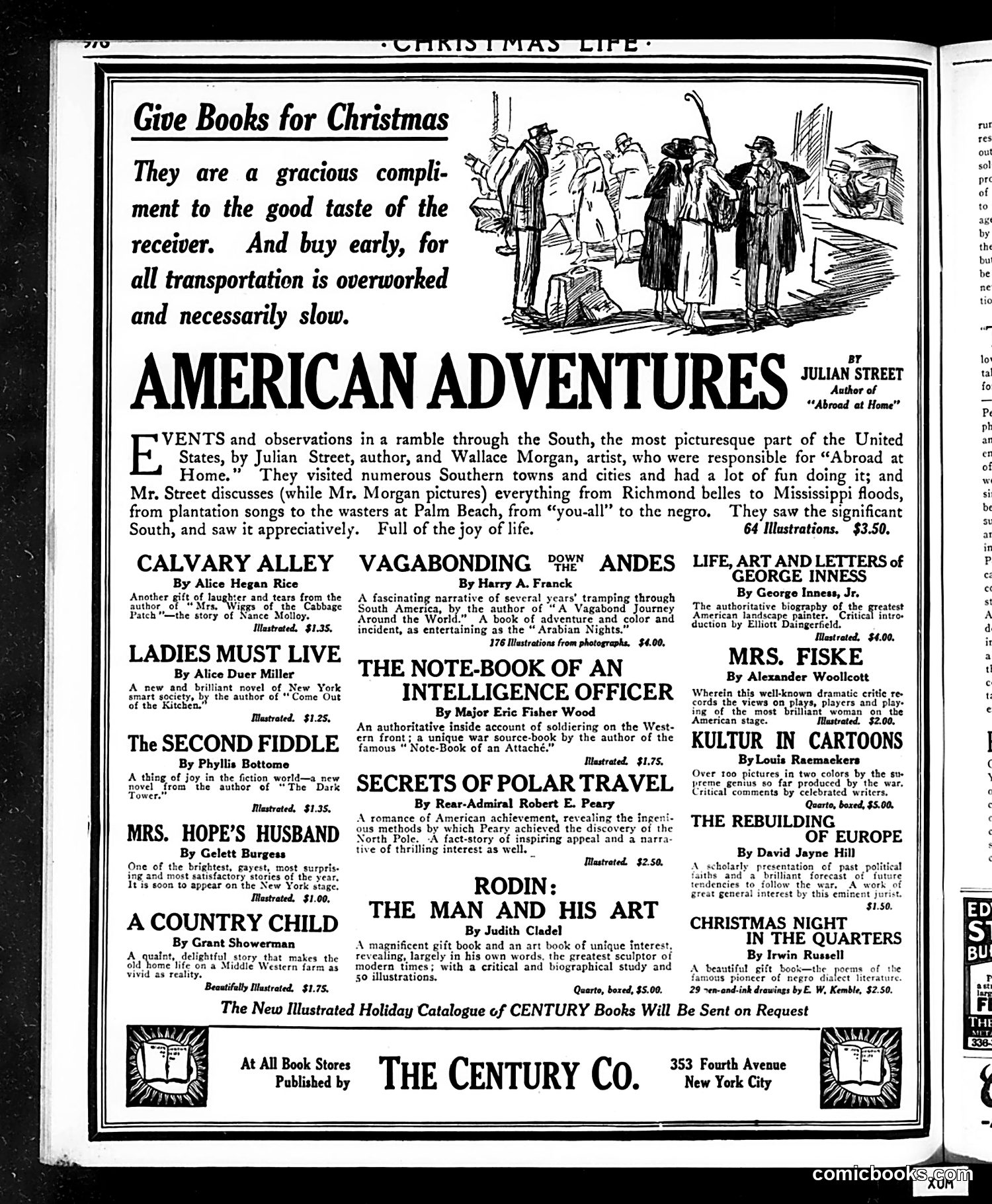
This is a **book advertisement page** from *Life* magazine, not a political cartoon. It promotes Christmas gift books published by The Century Company, located at 353 Fourth Avenue, New York City. The illustrated header shows a crowd of well-dressed people in winter clothing, establishing a festive shopping atmosphere. The page advises buying books early because "all transportation is overworked and necessarily slow"—a reference to wartime supply-chain constraints (likely WWI era, given mentions of war books like "The Note-Book of an Intelligence Officer"). The advertisements highlight diverse titles: travel narratives (*American Adventures* in the South), novels by popular authors (*Ladies Must Live*, *Mrs. Hope's Husband*), military memoirs, art books, and war-related works. Several titles explicitly reference the South and race (*"you-all" to the negro*), reflecting early 20th-century attitudes. **No satire is present here**—it's straightforward commercial advertising presenting books as sophisticated Christmas gifts for genteel readers.
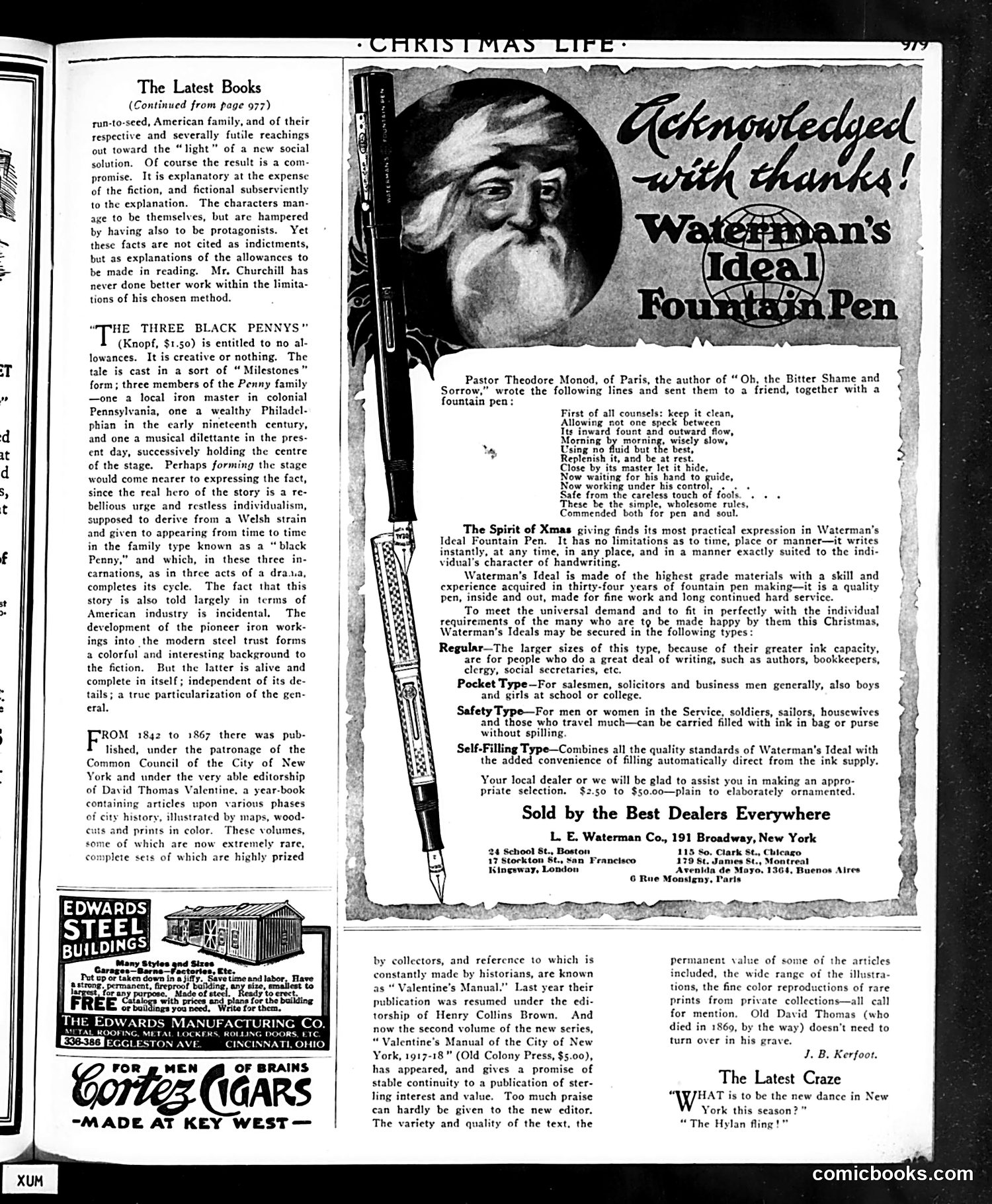
This is primarily an **advertising and book review page**, not a political cartoon. The main content includes: **Book Reviews** (left column): Discussion of contemporary novels by authors like Winston Churchill and Joseph Hergesheimer, focusing on literary merit and social themes relevant to post-WWI American readers. **Major Advertisement** (center/right): A **Waterman's Ideal Fountain Pen** ad featuring an illustrated Santa Claus figure and a poem by Pastor Theodore Monod of Paris about maintaining fountain pens. The ad positions the pen as an ideal Christmas gift—practical and sophisticated. **Secondary Ads**: Steel buildings, Edwards Manufacturing, and Correa cigars (made in Key West). **Historical Context**: This appears to be from the 1920s based on typography and references. The fountain pen advertisement reflects the era when quality writing instruments were prestigious gift items. The literary discussions engage with serious contemporary fiction addressing American social concerns. The page contains **no political satire or caricature**—it's a straightforward mix of book criticism and commercial advertising typical of Life magazine's era.
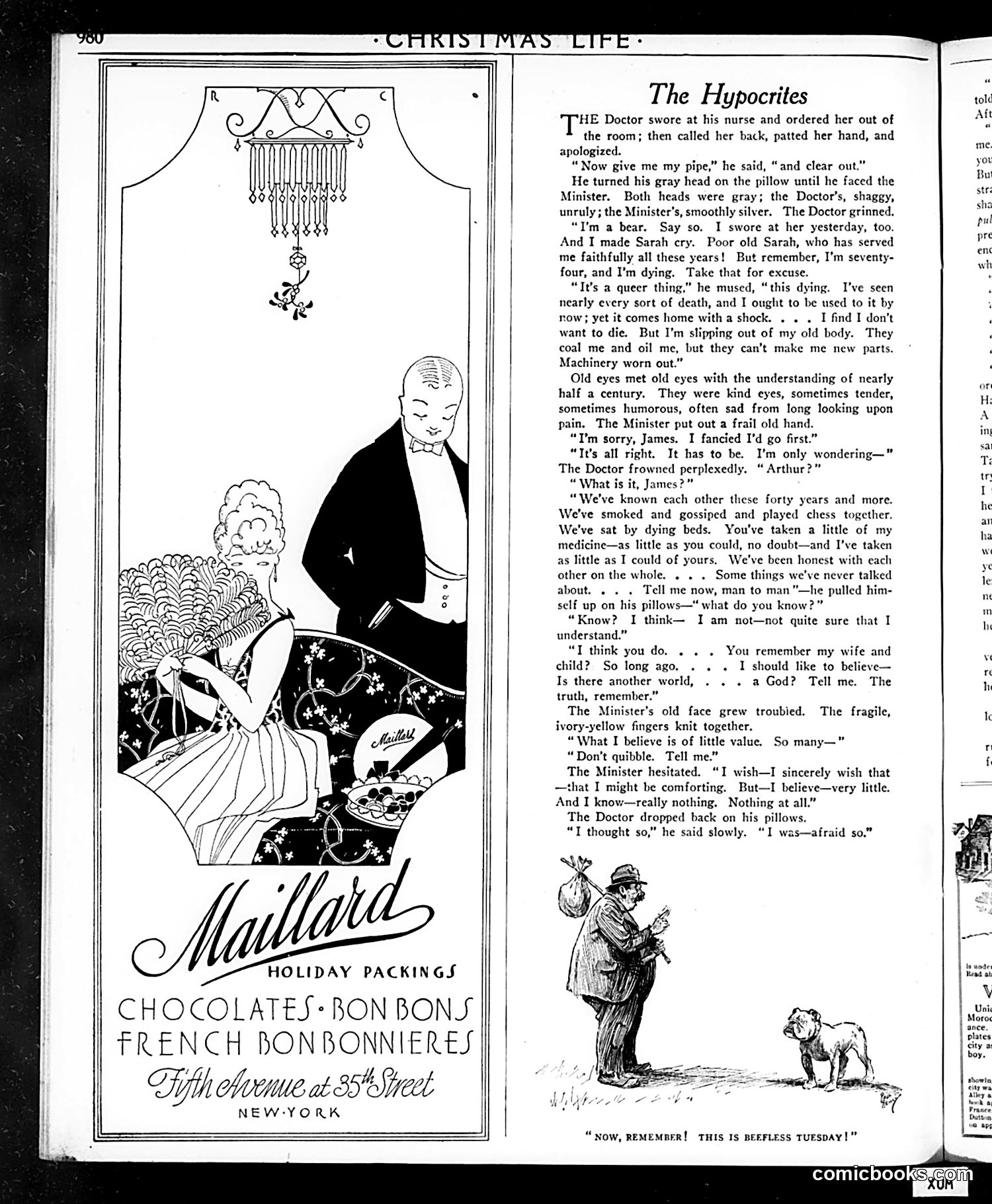
This is a satirical short story about two elderly men—a dying Doctor and a Minister—who have known each other for forty years. The satire targets religious hypocrisy and institutional faith. The Doctor, facing death, finally asks the Minister the ultimate question: Is there an afterlife? A God? The Minister—representing organized religion—cannot answer honestly. He admits he believes "very little" and knows "really nothing at all." The title's point: The Minister has spent decades dispensing spiritual comfort while privately holding no genuine faith. The Doctor, despite his admitted bearish rudeness to his nurse, has been more honest throughout life than the clergyman. The Maillard chocolate advertisement above is unrelated—typical of Life magazine's mixed editorial and advertising content.
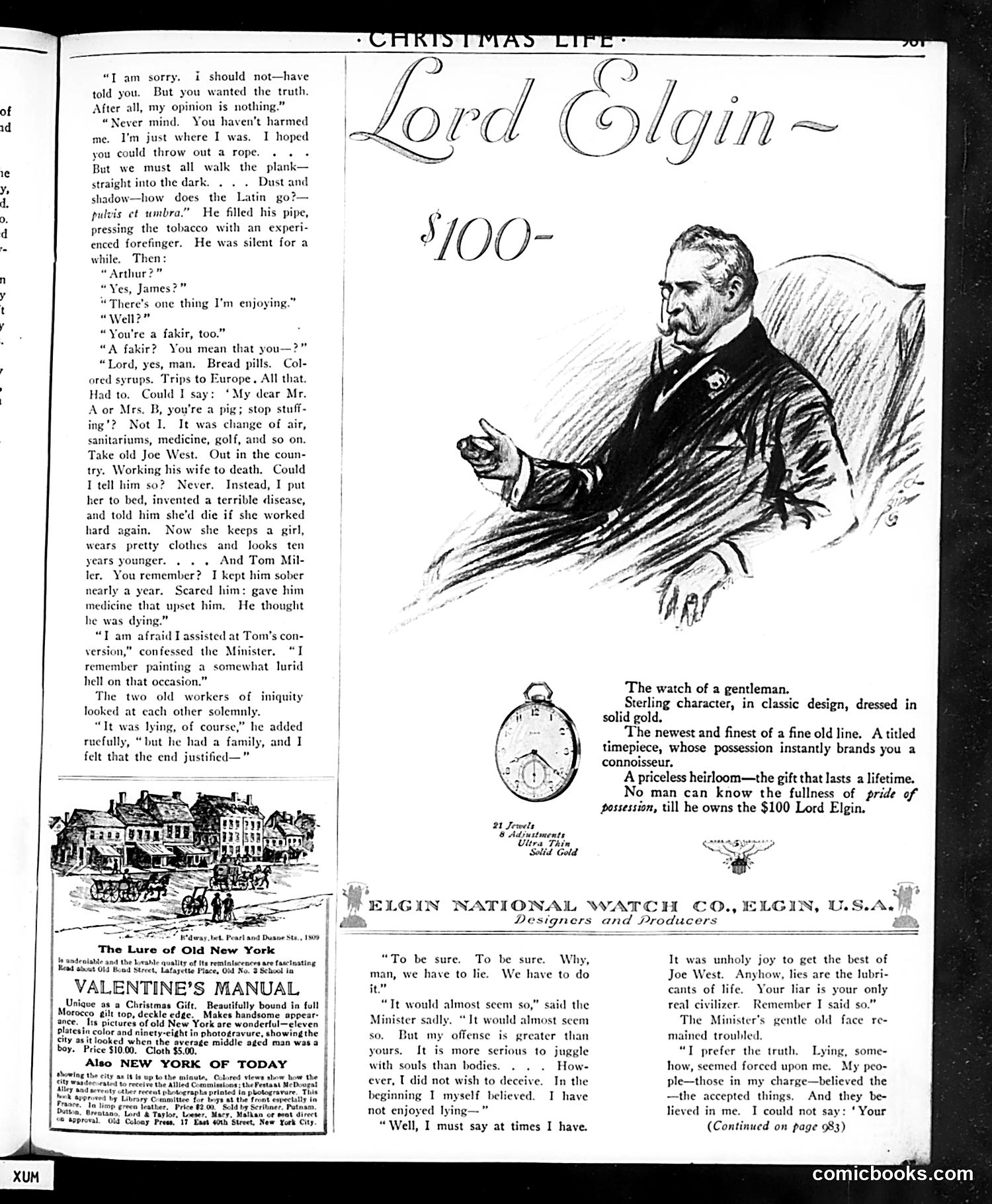
This page combines a short story with advertising. The narrative depicts two elderly men—a doctor and a minister—having a philosophical conversation about deception in their professions. **The Story's Point:** Both professionals admit to being "fakirs" who use lies for what they believe are good ends. The doctor prescribes fake medicines and invented diseases to improve patients' lives (giving them rest, financial relief). The minister used fear-based religious imagery to reform sinners. They justify their deceptions as necessary "lubricants of life"—the doctor even claims the liar is "your only real civilizer." **The Satire:** Life magazine is critiquing professional hypocrisy and self-deception. Both respected authority figures rationalize dishonesty as benevolent, suggesting that institutional deception was normalized and morally justified by those in power, even as they claim to serve others. The page also features a Lord Elgin pocket watch advertisement, typical for this era's Life magazine, which mixed satirical content with luxury goods marketing.
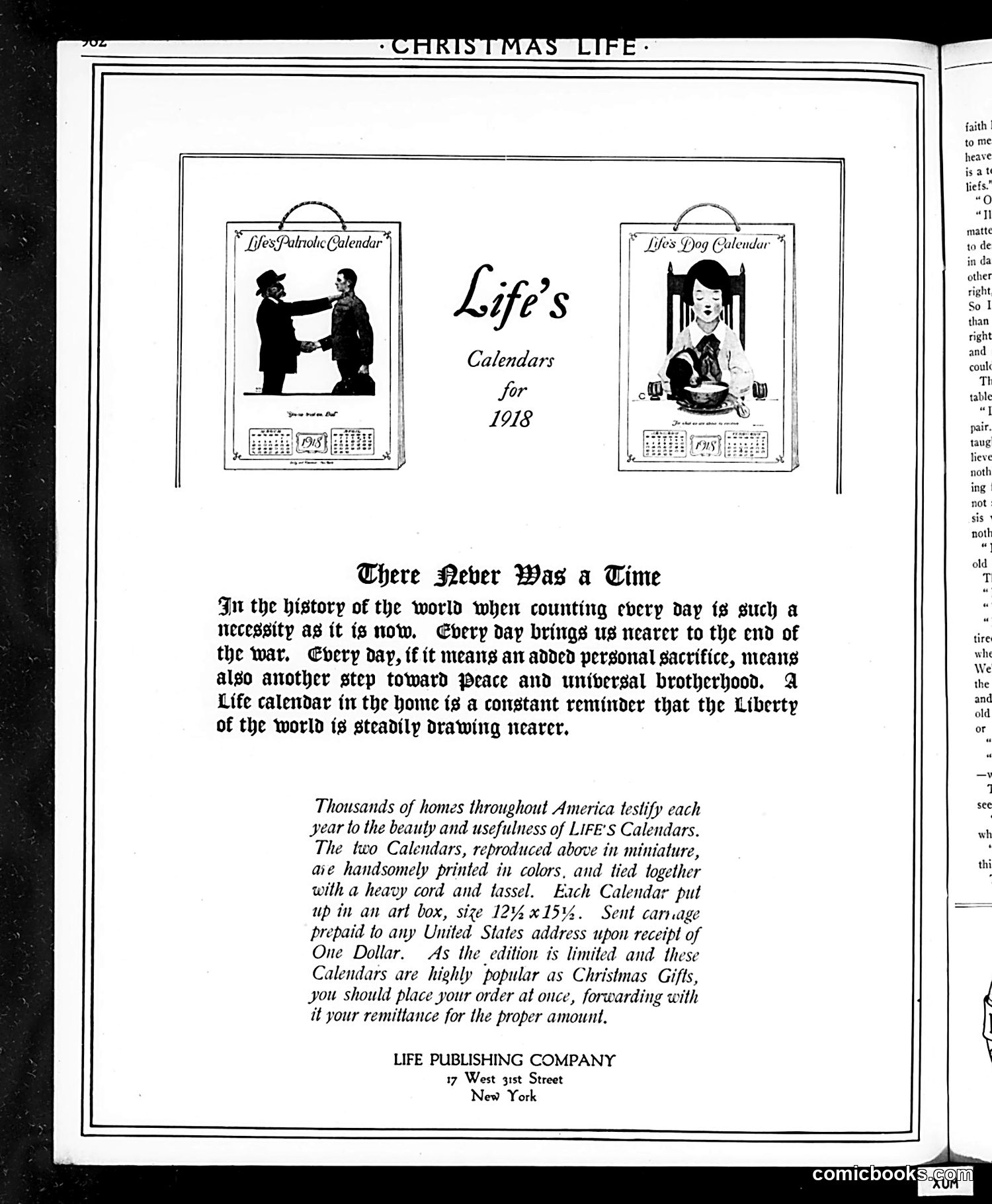
This is primarily an advertisement for "Life's Calendars for 1918," not a political cartoon. The page promotes two calendar products: "Life's Catholic Calendar" (showing two men shaking hands) and "Life's Dog Calendar" (depicting a woman with a dog). The advertising text frames these calendars within World War I patriotic sentiment. It argues that counting days during wartime is necessary because "every day brings us nearer to the end of the war" and represents "personal sacrifice" toward "peace and universal brotherhood." The calendars serve as "constant reminders" of liberty's advancement. This reflects how American advertisers of 1918 marketed consumer goods by connecting them to wartime themes and sacrifice—using patriotic messaging to sell Christmas gifts. The Life Publishing Company offered both calendars together for one dollar, emphasizing limited availability to encourage immediate orders.
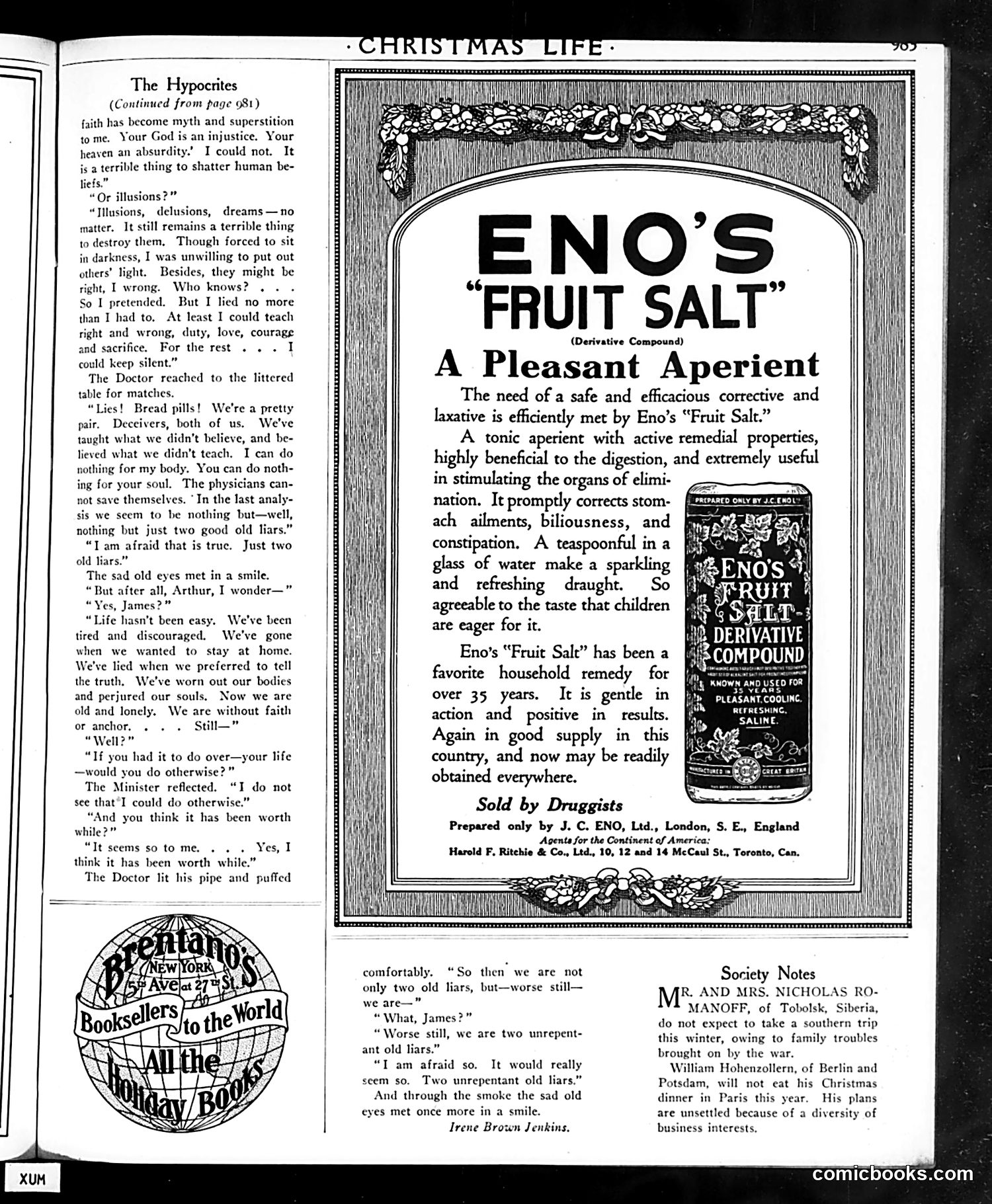
This page contains a short story conclusion rather than a political cartoon. "The Hypocrites" depicts two elderly men—a doctor and a minister—in honest conversation about their lives of compromise and deception. The satire targets religious and medical hypocrisy: both men admit they taught beliefs they didn't hold and prescribed remedies they didn't trust, yet ask themselves if their lives were worthwhile despite this moral failure. The story's dark humor lies in their conclusion that they are "unrepentant old liars"—they would make the same choices again. The "Society Notes" section below uses similar satire, listing prominent figures like the Russian Tsar and German Kaiser during wartime with deadpan observations about their cancelled holiday plans, mocking the absurdity of royalty's suffering during WWI. The Eno's Fruit Salt advertisement is period commercial copy, unrelated to the editorial content.
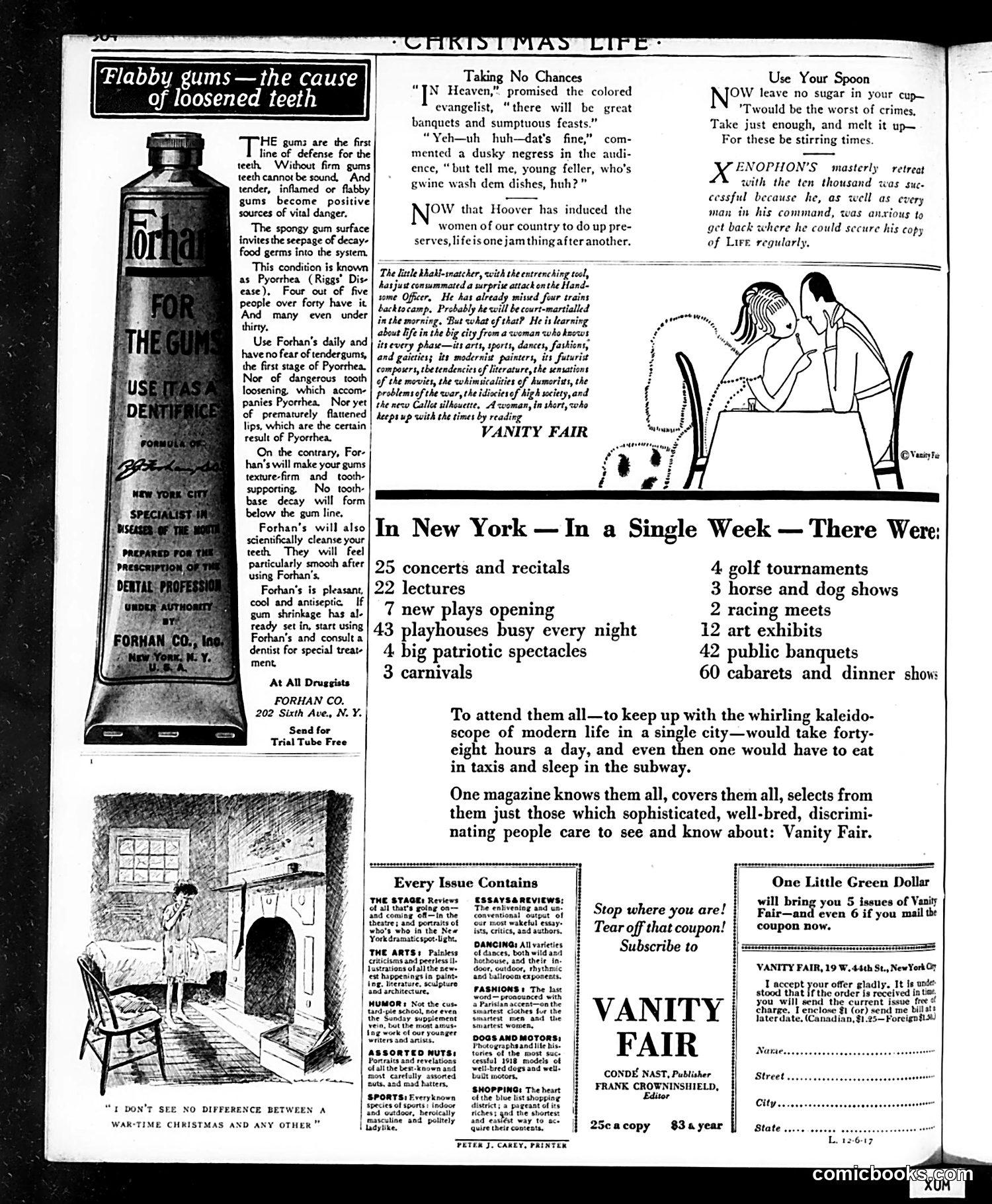
This page contains primarily **advertisements and magazine promotion**, with minimal satirical cartooning. The main satirical content appears in two brief pieces: 1. **The "Flabby Gums" Advertisement**: While ostensibly promoting Forhan's toothpaste, the ad uses exaggerated health warnings typical of early 20th-century patent medicine marketing—claiming pyorrhea affects "four out of five people over forty" and causes "prematurely flattened lips." This reflects satirical critique of overblown medical advertising claims. 2. **A racist joke** (bottom left cartoon): A brief dialogue mocking Black Americans, with a woman responding to a preacher's promise of "banquets in Heaven" by asking who will wash the dishes—stereotyping Black domestic labor. 3. **A wartime domestic joke**: References Herbert Hoover's food preservation campaign, joking that women now spend all their time "doing up preserves." The page is largely devoted to **promoting Vanity Fair magazine** through detailed descriptions of its content (theater, fashion, society, sports, etc.), positioning it as essential reading for "sophisticated, well-bred, discriminating people."
This is a **Prudential Insurance advertisement**, not a satirical cartoon. The page header reads "CHRISTMAS LIFE," suggesting this ran in Life magazine during the holiday season. The advertisement features a young woman in elegant dress holding knitting needles and yarn, smiling warmly. The headline "FOR THEIR PROTECTION" and the Prudential Insurance Company branding below indicate this is promoting life insurance as a Christmas gift or holiday messaging angle. The appeal is emotional and gendered: the image of a wholesome woman engaged in domestic handwork (knitting) suggests that insurance protects families and loved ones. This represents early 20th-century insurance marketing that targeted breadwinners by emphasizing their responsibility to dependents—particularly wives and children—presenting insurance as an expression of care and protection. This reflects the era's social values linking masculinity to financial provision and femininity to domestic contentment.
This is an advertisement for Omar Turkish Cigarettes, not a political cartoon. The page appears in a "Christmas Life" section of the magazine. The ad promotes Omar cigarettes as suitable for any occasion, including Christmas, emphasizing their "pure aroma" and "assured content." A small holly decoration underscores the holiday theme. The product is shown in its packaging at 15 cents. The advertisement uses poetic language typical of early 20th-century tobacco marketing to position the cigarettes as a quality luxury good appropriate for seasonal gift-giving. There is no satire or political commentary visible—this is straightforward commercial promotion.
This is **not a cartoon or satire**—it's a straight advertisement for Chase Plush Motor Car Robes, published in *Christmas Life* (a holiday issue of Life magazine). The page shows a woman modeling a luxurious fur robe, positioned as a high-end Christmas gift suggestion. The ad emphasizes the robe's qualities: beautiful colors, comfort comparable to natural fur, durability, and cleanliness (the smooth hair supposedly resists dust). The tagline "Make a Warm Friend by Presenting a Chase Robe" uses the period's sentimental gift-giving language. L.C. Chase & Co., headquartered in New York, Boston, and Chicago, marketed these as premium products made by Sanford Mills since 1847. This reflects early-20th-century luxury consumer culture and gender marketing conventions—positioning expensive robes as desirable gifts for women.
This is a **Kodak advertisement**, not political satire. It depicts a father and daughter at Christmas, with the caption "Oh Dad—How Did You Know?" suggesting he's given her a camera. The ad's appeal is to **parental sentiment and manipulation**: the father knowingly gives his daughter a Kodak camera partly to receive photographs from her while she's away at boarding school. The text calls him "the wily old rascal," acknowledging this self-interested motive with gentle humor. The pitch to parents emphasizes **wholesome family bonding** through photography—from kindergarten onward—and positions Christmas as the ideal time to introduce children to picture-taking. A decorated Christmas tree is visible in the background. This reflects **1920s-era advertising strategy**: appealing to emotion and family values to sell consumer goods, while subtly acknowledging that even "fond parents" have selfish motivations. The boarding school detail suggests an affluent, upper-class audience.