
Life, 1917-12-06 · page 40 of 92
Life — December 6, 1917 — page 40: what you’re looking at
What you’re looking at
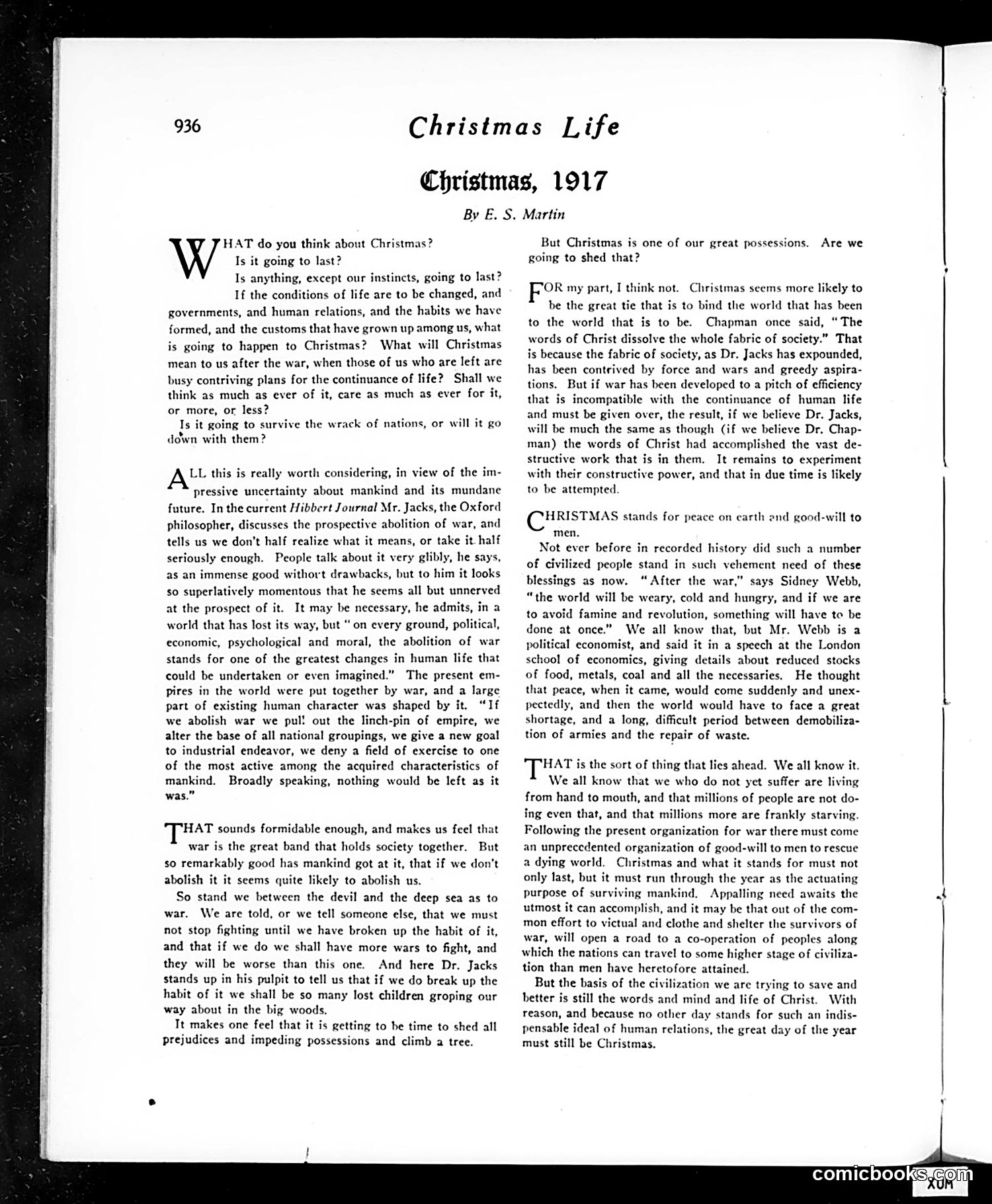
This is a philosophical essay, not a cartoon. Written during World War I, it addresses whether Christmas will survive post-war society's transformation. Martin references Oxford philosopher Mr. Jacks, who argues that abolishing war—society's historical organizing principle—will fundamentally reshape human character and civilization. This prospect deeply unsettles Jacks. Martin presents a paradox: war may destroy humanity if continued, yet ending it leaves society unmoored without war's cohesive force. He proposes Christmas as the solution—the "great tie" binding old world to new. Unlike war, which operates through force, Christ's teachings offer constructive power to rebuild civilization on peace and goodwill. The essay reflects 1917 anxieties about post-WWI reconstruction and whether traditional values (Christianity) could replace militarism as society's foundation.
📄 Transcribed text from this page (OCR, searchable)
Machine-transcribed from the original scan — historical spelling and the odd misread are preserved.
HAT do you think about Christmas? Is it going to last? Is anything, except our instincts, going to last? If the conditions of life are to be changed, and governments, and human relations, and the habits we have formed, and the customs that have grown up among us, what is going to happen to Christmas? What will Christmas mean to us after the war, when those of us who are left are busy contriving plans for the continuance of life? Shall we think as much as ever of it, care as much as ever for it, or more, or less? Is it going to survive the wra down with them? ck of nations, or will it go LL this is really worth considering, in view of the im- pressive uncertainty about mankind and its mundane future. In the current Hibbert Journal Mr. Jacks, the Oxford philosopher, discusses the prospective abolition of war, and tells us we don’t half realize what it means, or take it half seriously enough. People talk about it very glibly, he says, as an immense good withort drawbacks, but to him it looks so superlatively momentous that he seems all but unnerved at the prospect of it. It may be necessary, he admits, in a world that has lost way, but “on every ground, political, economic, psychological and moral, the abolition of war stands for one of the greatest changes in human life that could be undertaken or even imagined.” The present em- pires in the world were put together by war, and a large part of existing human character was shaped by it. “If we abolish war we pul! out the linch-pin of empire, we alter the base of all national groupings, we give a new goal to industrial endeavor, we deny a field of exercise to one of the most active among the acquired characteristics of mankind. Broadly speaking, nothing would be left as it was.” 'HAT sounds formidable enough, and makes us feel that war is the great band that holds society together. But so remarkably good has mankind got at it, that if we don't abolish it it seems quite likely to abolish us. So stand we between the devil and the deep sea as to war. We are told, or we tell someone else, that we must not stop fighting until we have broken up the habit of it, and that if we do we shall have more wars to fight, and they will be worse than this one. And here Dr. Jacks stands up in his pulpit to tell us that if we do break up the habit of it we shall be so many lost children groping our way about in the big woods. Tt makes one feel that it is getting to be time to shed all prejudices and impeding possessions and climb a tree. Christmas Life Christmas, 1917 By E. S. Martin But Christmas is one of our great possessions. Are we going to shed that? For my part, I think not. Christmas seems more likely to be the great tie that is to bind the world that has been to the world that is to be. Chapman once said, “The words of Christ dissolve the whole fabric of society.” That is because the fabric of society, as Dr. Jacks has expounded, has been contrived by force and wars and greedy aspira- tions. But if war has been developed to a pitch of efficiency that is incompatible with the continuance of human life and must be given over, the result, if we believe Dr. Jacks, will be much the same as though (if we believe Dr. Chap- man) the words of Christ had accomplished the vast de- structive work that is in them. It remains to experiment with their constructive power, and that in due time is likely to be attempted. GBRST™MAS stands for peace on earth end good-will to men. Not ever before in recorded history did such a number of civilized people stand in such vehement need of these blessings as now. “After the war,” says Sidney Webb, “the world will be weary, cold and hungry, and if we are to avoid famine and revolution, something will have to be done at once.” We all know that, but Mr. Webb is a political economist, and said it in a speech at the London school of economics, giving details about reduced stocks of food, metals, coal and all the necessaries. He thought that peace, when it came, would come suddenly and unex- pectedly, and then the world would have to face a great shortage, and a long, difficult period between demobiliza- tion of armies and the repair of waste. HAT is the sort of thing that lies ahead. We all know it. We all know that we who do not yet suffer are living from hand to mouth, and that millions of people are not do- ing even that, and that millions more are frankly starving. Following the present organization for war there must come an unprecedented organization of good-will to men to rescue a dying world. Christmas and what it stands for must not only last, but it must run through the year as the actuating purpose of surviving mankind. Appalling need awaits the utmost it can accomplish, and it may be that out of the com- mon effort to victual and clothe and shelter the survivors of war, will open a road to a co-operation of peoples along which the nations can travel to some higher stage of civiliza- tion than men have heretofore attained. But the basis of the civilization we are trying to save and better is still the words and mind and life of Christ. With reason, and because no other day stands for such an indis- pensable ideal of human relations, the great day of the year must still be Christmas. comicboo!