
Life, 1917-12-06 · page 84 of 92
Life — December 6, 1917 — page 84: what you’re looking at
What you’re looking at
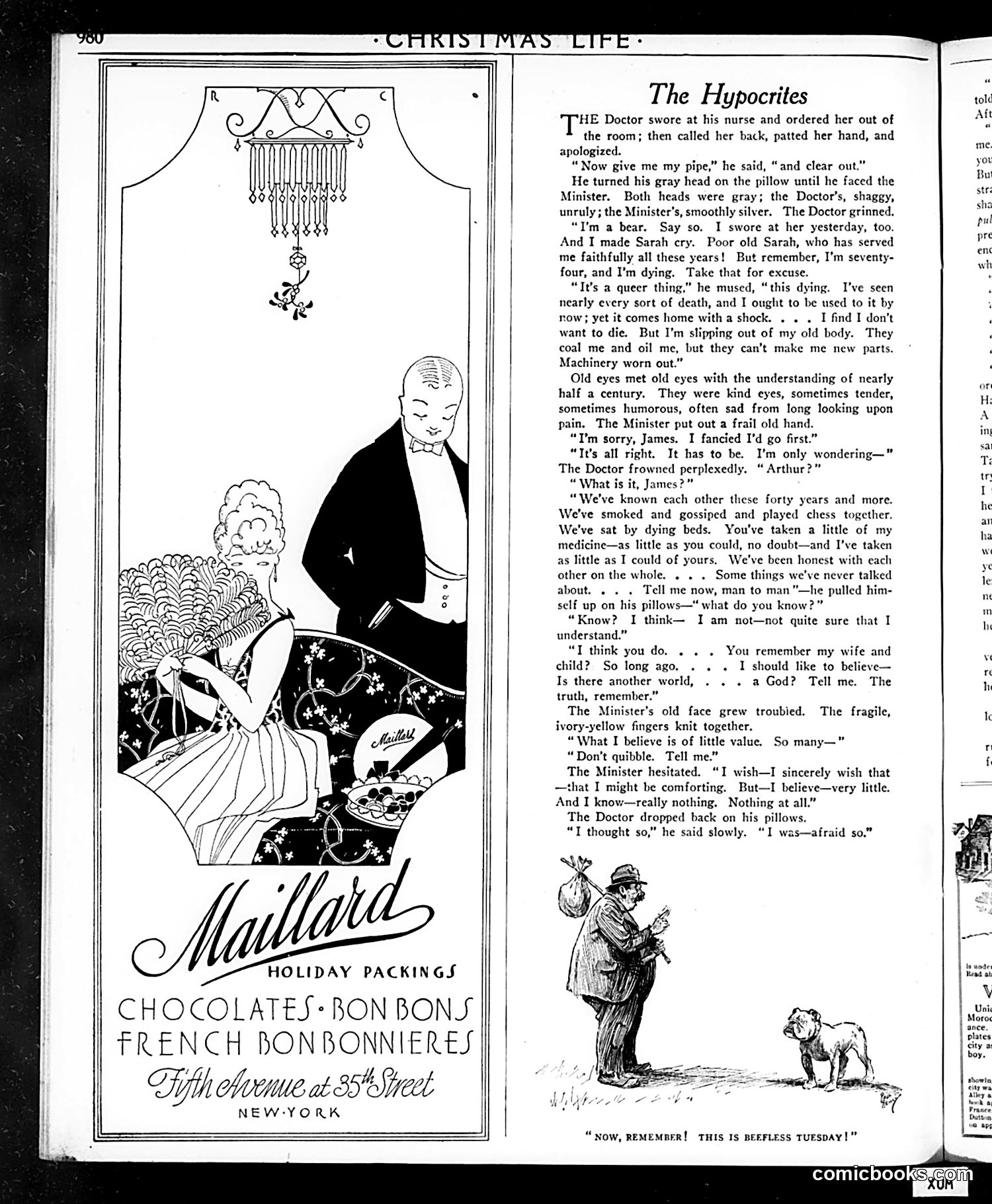
This is a satirical short story about two elderly men—a dying Doctor and a Minister—who have known each other for forty years. The satire targets religious hypocrisy and institutional faith. The Doctor, facing death, finally asks the Minister the ultimate question: Is there an afterlife? A God? The Minister—representing organized religion—cannot answer honestly. He admits he believes "very little" and knows "really nothing at all." The title's point: The Minister has spent decades dispensing spiritual comfort while privately holding no genuine faith. The Doctor, despite his admitted bearish rudeness to his nurse, has been more honest throughout life than the clergyman. The Maillard chocolate advertisement above is unrelated—typical of Life magazine's mixed editorial and advertising content.
📄 Transcribed text from this page (OCR, searchable)
Machine-transcribed from the original scan — historical spelling and the odd misread are preserved.
HOLIDAY PACKINGS CHOCOLATES: BON BONS FRENCH BONBONNIERES Tiyth obuemue a BSC The Hypocrites 'HE Doctor swore at his nurse and ordered her out of the room; then called her back, patted her hand, and apologized. “Now give me my pipe,” he said, “and clear out.” He turned his gray head on the pillow until he faced the Minister. Both heads were gray; the Doctor’s, shaggy, unruly ; the Minister's, smoothly silver. The Doctor grinned. “I'm a bear. Say so. I swore at her yesterday, too. And I made Sarah cry. Poor old Sarah, who has served me faithfully all these years! But remember, I'm seventy- four, and I’m dying. Take that for excuse. “It's a queer thing,” he mused, “this dying. I’ve seen nearly every sort of death, and I ought to be used to it by now ; yet it comes home with a shock. . . . I find I don't want to die. But I’m slipping out of my old body. They coal me and oil me, but they can’t make me new parts. Machinery worn out.” Old eyes met old eyes with the understanding of nearly half a century. They were kind eyes, sometimes tender, sometimes humorous, often sad from long looking upon pain. The Minister put out a frail old hand. “T'm sorry, James. I fancied I'd go first.” “It's all right. It has to be. I’m only wondering—” The Doctor frowned perplexedly. “ Arthur?” “What is it, James?” “We've known cach other these forty years and more. We've smoked and gossiped and played chess together. We've sat by dying beds. You've taken a little of my medicine—as little as you could, no doubt—and I’ve taken as little as I could of yours, We've been honest with each other on the whole, . . . Some things we've never talked about. . . . Tell me now, man to man”—he pulled him- self up on his pillows—“ what do you know?” “Know? I think— I am not—not quite sure that I understand.” “TI think you do. . . . You remember my wife and child? So long ago. . . . I should like to believe— Is there another world, . . . a God? Tell me. The truth, remember.” The Minister's old face grew troubied. The fragile, ivory-yellow fingers knit together. “What I believe is of little value. So many—” “Don't quibble. Tell me.” The Minister hesitated. “I wish—I sincerely wish that —that I might be comforting. But—I believe—very little. And I know—really nothing. Nothing at all.” The Doctor dropped back on his pillows. “TI thought so,” he said slowly. “I was—afraid so.”