
Life, 1917-12-06 · page 44 of 92
Life — December 6, 1917 — page 44: what you’re looking at
What you’re looking at
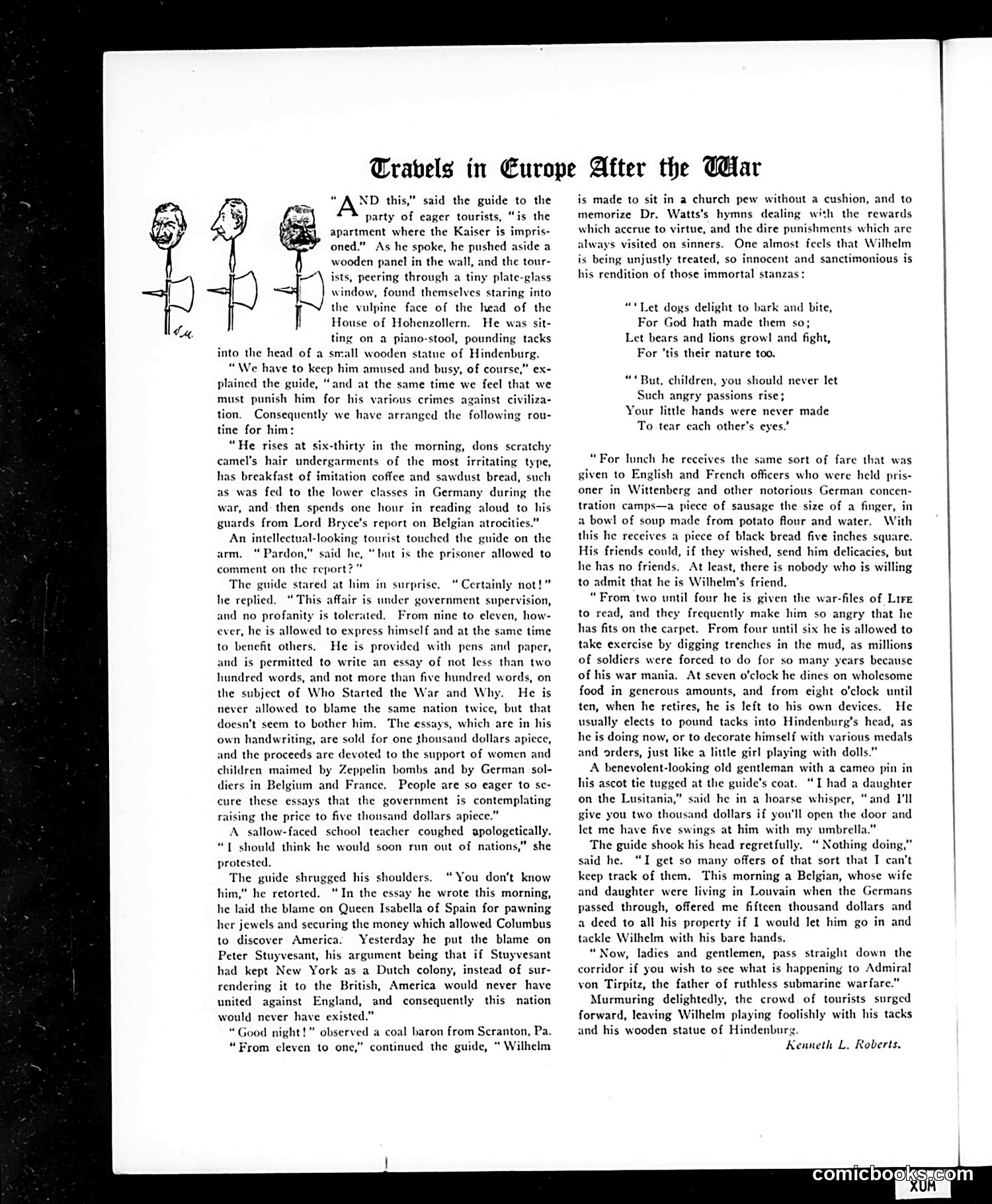
This satirical piece mocks post-WWI tourism and the fate of Kaiser Wilhelm II. The cartoon shows three caricatured tourists peering through a small window at the imprisoned Kaiser, depicted with a sharp, fox-like face. The satire works on multiple levels: it presents Wilhelm's deliberately harsh imprisonment (scratchy underwear, sawdust bread, forced essay-writing) as tourist entertainment. The absurdist humor escalates—Wilhelm blames increasingly ridiculous historical figures (Queen Isabella, Peter Stuyvesant) for starting the war, and his essays sell for thousands of dollars to benefit war victims. The joke targets both American attitudes toward German war guilt and post-war tourism culture. By framing Wilhelm's punishment as a public spectacle with admission-like elements, the piece satirizes how Americans were processing their victory and the enemy leader's downfall. The intellectually-dressed tourists represent the era's tendency to make even serious historical events into consumable entertainment.
📄 Transcribed text from this page (OCR, searchable)
Machine-transcribed from the original scan — historical spelling and the odd misread are preserved.
Travels in Europe After the War = ND this,” said the guide to the party of eager tourists, “is the apartment where the Kaiser is impris- oned.” As he spoke, he pushed aside a wooden panel in the wall, and the tour- ists, peering through a tiny plate-glass window, found themselves staring into the vulpine face of the head of the House of Hohenzollern. He was sit- ting on a piano-stool, pounding tacks into the head of a small wooden statue of Hindenburg. “We have to keep him amused and busy, of course,” ex- plained the guide, “and at the same time we feel that we must punish him for his various crimes against civiliza- tion. Consequently we have arranged the following rou- tine for him: “He rises at six-thirty in the morning, dons scratchy camel's hair undergarments of the most irritating type, has breakfast of imitation coffee and sawdust bread, such as was fed to the lower classes in Germany during the war, and then spends one hour in reading aloud to his guards from Lord Bryce’s report on Belgia : An intellectual-looking tourist touched the guide on the arm. “Pardon,” said he, “but is the prisoner allowed to comment on the report?” The ¢ “Certainly not!” he replied. “ This affair is under government supervision, and no profanity is tolerated. From nine to eleven, how- ever, he is allowed to express himself and at the same time to benefit others. He is provided with pens and paper, and is permitted to write an essay of not less than two hundred words, and not more than five hundred words, on the subject of Who Started the War and Why. He is never allowed to blame the same nation twice, but that doesn’t seem to bother him. The essays, which are in his own handwriting, are sold for one thousand dollars apicce, and the proceeds are devoted to the support of women and children maimed by Zeppelin bombs and by German sol- diers in Belgium and France. People are so eager to cure these essays that the government is contemplating raising the price to five thousand dollars apiece.” A sallow-faced school teacher coughed apologetically. “T should think he would soon run out of nations,” she protested. The guide shrugged his shoulders. “You don't know him,” he retorted. “In the essay he wrote this morning, he laid the blame on Queen Isabella of Spain for pawning her jewels and securing the money which allowed Columbus to discover America. Yesterday he put the blame on Peter Stuy nt, his argument being that if Stuyvesant had kept New York as a Dutch colony, instead of sur- rendering it to the British, America would never have united against England, and consequently this nation would never have existed.” “Good night!” observed a coal baron from Scranton, Pa. “From cleven to one,” continued the guide, “ Wilhelm ide stared at him in surprise. is made to sit in a church pew without a cushion, and to memorize Dr. Watts'’s hymns dealing with the rewards which accrue to virtue, and the dire punishments which are 's visited on sinners. One almost feels that Wilhelm is being unjustly treated, so innocent and sanctimonious is his rendition of those immortal stanz: aly “*Let dogs delight to bark and bite, For God hath made them so; Let bears and lions growl and fight, For 'tis their nature too. “*But, children, you should never let Such angry passions rise; Your little hands were never made To tear each other's eyes.’ “For lunch he receives the same sort of fare that was given to English and French officers who were held pris- oner in Wittenberg and other notorious German concen- tration camps—a piece of sausage the size of a finger, in a bowl of soup made from potato flour and water. With this he receives a piece of black bread five inches square. His friends could, if they wished, send him delicacies, but he has no friends. At least, there is nobody who is willing to admit that he is Wilhelm’s friend. ‘om two until four he is given the war-files of Lire to read, and they frequently make him so angry that he has fits on the carpet. From four until six he is allowed to take exercise by digging trenches in the mud, as millions of soldiers were forced to do for so many years because of his war mania. At seven o'clock he dines on wholesome food in generous amounts, and from eight o'clock until ten, when he retires, he is left to his own devices. He usually elects to pound tacks into Hindenburg’s head, as he is doing now, or to decorate himself with various medals and orders, just like a little girl playing with dolls.” A benevolent-looking old gentleman with a cameo pin in his ascot tie tugged at the guide's coat. “I had a daughter on the Lusitania,” said he in a hoarse whisper, “and I'll give you two thousand dollars if you'll open the door and Ict me have five swings at him with my umbrella.” The guide shook his head regretfully. “ Nothing doing,” said he. “I get so many offers of that sort that I can’t keep track of them, This morning a Belgian, whose wife and daughter were living in Louvain when the Germans passed through, offered me fifteen thousand dollars and a deed to all his property if I would let him go in and tackle Wilhelm with his bare hands. “Now, ladies and gentlemen, pass straight down the corridor if you wish to see what is happening to Admiral von Tirpitz, the father of ruthless submarine warfare.” Murmuring delightedly, the crowd of tourists surged forward, leaving Wilhelm playing foolishly with his tacks and his wooden statue of Hindenburg. Kenneth L, Roberts. comicbook« m