
Life, 1917-12-06 · page 68 of 92
Life — December 6, 1917 — page 68: what you’re looking at
What you’re looking at
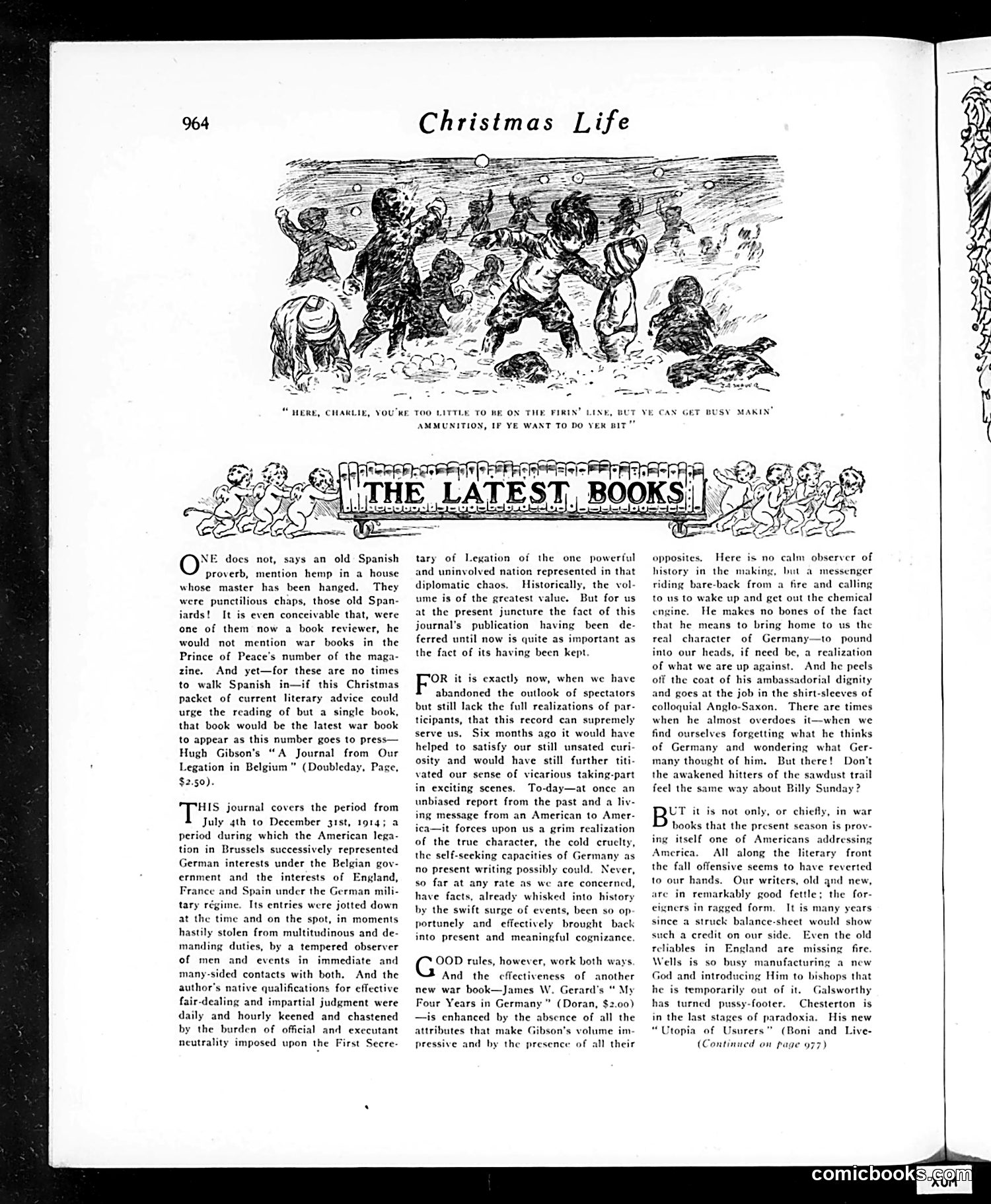
The cartoon shows children playing soldiers in snow, with one adult telling "Charlie" he's too small for the front lines but can help make ammunition—a dark joke reflecting WWI's escalating American involvement. The page reviews two wartime books: Hugh Gibson's "A Journal from Our Legation in Belgium" and James Gerard's "My Four Years in Germany." Both document German conduct during the war. The reviewer argues Gibson's firsthand diplomatic account is timely now that America has abandoned neutrality but hasn't yet fully grasped what war means. Gerard's book, by contrast, directly hammers home Germany's "cold cruelty" without diplomatic restraint. The satire is grim: children are being taught to think of war as a game, while adults debate which book most effectively converts Americans to see Germany as an enemy. The publication timing—after America entered WWI—makes these testimonies propaganda tools rather than mere history.
📄 Transcribed text from this page (OCR, searchable)
Machine-transcribed from the original scan — historical spelling and the odd misread are preserved.
“MERE, CHARLIE, YOU'RE TOO LITTLE TO RE ON THE FIRIN’ LINE, BUT VE CAN GET BUSY MAK Christmas Life AMMUNITION, IP YE WANT To DO YER BIT" NE docs not, says an old Spanish proverb, mention hemp in a house whose master has been hanged. They were punctilious chaps, those old Span- iards! It is even conceivable that, were one of them now a book reviewer, he would not mention war books in the Prince of Peace’s number of the maga- zine. And yet—for these are no times to walk Spanish in—if this Christmas packet of current literary advice could urge the reading of but a single book, that book would be the latest war book to appear as this number goes to press— Hugh Gibson's “A Journal from Our Legation in Belgium” (Doubleday, Page, $2.50). HIS journal covers the period from July 4th to December 31st, 19145 a period during which the American lega- tion in Brussels successively represented German interests under the Belgian gov- ernment and the interests of England, France and Spain under the German mili- tary régime. Its entries were jotted down at the time and on the spot, in moments hastily stolen from multitudinous and de- manding duties, by a tempered observer of men and events in immediate and many-sided contacts with both. And the author's native qualifications for effective fair-dealing and impartial judgment were daily and hourly keened and chastened by the burden of official and executant neutrality imposed upon the First Secre- tary of Legation of the one powerful and uninvolved nation represented in that diplomatic chaos. Historically, the vol- ume is of the greatest value, But for us at the present juncture the fact of this journal's publication having been de- ferred until now is quite as important as the fact of its having been kept ‘OR it is exactly now, when we have abandoned the outlook of spectators but still lack the full realizations of par- ticipants, that this record can supremely serve us. Six months ago it would have helped to satisfy our still unsated curi- osity and would have still further titi- vated our sense of vicarious taking-part in exciting scenes. To-day—at once an unbiased report from the past and a li ing message from an American to Amer- ica—it forces upon us a grim realization of the true character, the cold cruclty, the self-seeking capacities of Germany no present writing possibly could. Never, so far at any rate as we are concerned, have facts, already whisked into history by the swift surge of events, been so op: portunely and effectively brought back into present and meaningful cognizance. OOD rules, however, work both ways And the effectiveness of another new war book—James W. Gerard's “ My Four Years in Germany ” (Doran, $2.00) —is enhanced by the absence of all the attributes that make Gibson’s volume im- pressive and by the presence of all their alm observer of , but a messenger opposites. Here is no history in the 1 riding bare-back from a fire and calling to us to wake up and get out the chemical engine. He makes no bones of the fact that he means to bring home to us the real character of Germany—to pound into our heads, if need be, a realization of what we are up against. And he peels off the coat of his ambassadorial dignity and goes at the job in the shirt-sleeves of colloquial Anglo-Saxon. There are times when he almost overdoes it—when we find ourselves forgetting what he thinks of Germany and wondering w many thought of him. But there! Don't the awakened hitters of the sawdust trai feel the same way about Billy Sunday? UT it is not only, or chiefly, in war books that the present season is prov- ing itself one of Americans addressing America. All along the literary front the fall offensive seems to have reverted to our hands, Our writers, old and new, are in remarkably good fettle; the for- cigners in ed form. It is many years since a struck balance-sheet would show such a credit on our side. Even the old reliables in England are missing fire Wells is so busy manufacturing a new God and introducing Him to bishops that he is temporarily out of it. Galsworthy has turned pussy-footer. Chesterton is in the last stages of paradoxia, His new “Utopia of Usurers” (Boni and Live- (Continued on page 077 comicbook#ieeg