
Life, 1917-12-06 · page 83 of 92
Life — December 6, 1917 — page 83: what you’re looking at
What you’re looking at
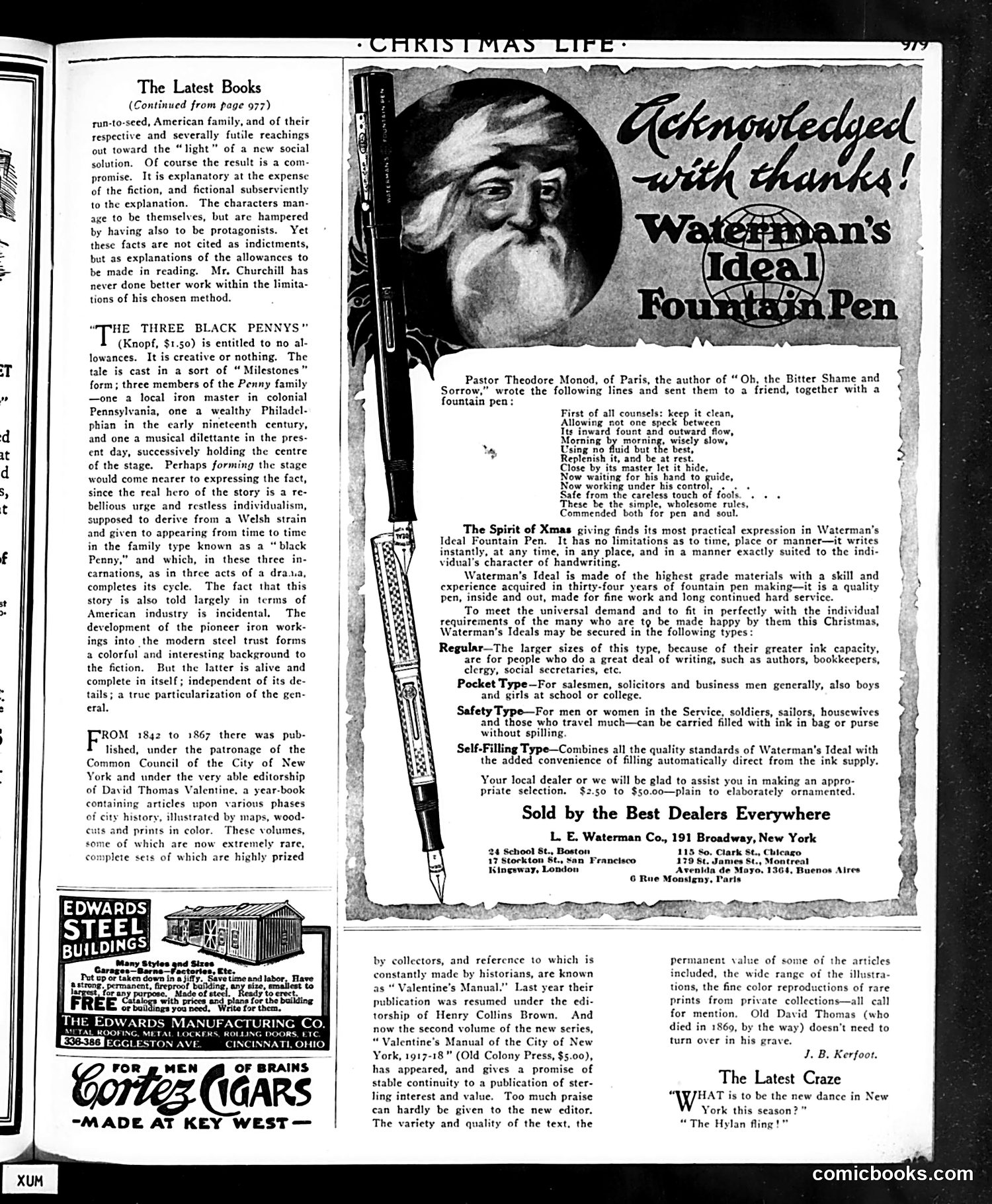
This is primarily an **advertising and book review page**, not a political cartoon. The main content includes: **Book Reviews** (left column): Discussion of contemporary novels by authors like Winston Churchill and Joseph Hergesheimer, focusing on literary merit and social themes relevant to post-WWI American readers. **Major Advertisement** (center/right): A **Waterman's Ideal Fountain Pen** ad featuring an illustrated Santa Claus figure and a poem by Pastor Theodore Monod of Paris about maintaining fountain pens. The ad positions the pen as an ideal Christmas gift—practical and sophisticated. **Secondary Ads**: Steel buildings, Edwards Manufacturing, and Correa cigars (made in Key West). **Historical Context**: This appears to be from the 1920s based on typography and references. The fountain pen advertisement reflects the era when quality writing instruments were prestigious gift items. The literary discussions engage with serious contemporary fiction addressing American social concerns. The page contains **no political satire or caricature**—it's a straightforward mix of book criticism and commercial advertising typical of Life magazine's era.
📄 Transcribed text from this page (OCR, searchable)
Machine-transcribed from the original scan — historical spelling and the odd misread are preserved.
The Latest Books (Continued from page 977) run-to-seed, American family, and of their respective and severally futile reachings out toward the “light” of a new social solution. Of course the result is a com- promise. It is explanatory at the expense of the fiction, and fictional subserviently to the explanation. The characters man- age to be themselves, but are hampered by having also to be protagonists. Yet these facts are not cited as indictments, but as explanations of the allowances to be made in reading. Mr. Churchill has never done better work within the limita- tions of his chosen method. “PTHE THREE BLACK PENNYS” (Knopf, $1.30) is entitled to no al- lowances. It is creative or nothing. The tale is cast in a sort of “ Milestones” form; three members of the Penny family —one a local iron master in colonial Pennsylvania, one a wealthy Philadel- phian in the early nineteenth century, and one a musical dilettante in the pres- ent day, successively holding the centre of the stage. Perhaps forming the stage would come nearer to expressing the fact, since the real hero of the story is a re- bellious urge and restless individualism, supposed to derive from a Welsh strain and given to appearing from time to time in the family type known as a “ black and which, in these three in- carnations, as in three acts of a dra.ua, completes its cycle. The fact that this story is also told largely in terms of American industry is incidental, The development of the pioneer iron work- ings into the modern steel trust forms a colorful and interesting background to the fiction. But the latter is alive and complete in itself; independent of its de- tails; a true particularization of the gen- eral. ROM 1842 to 1867 there was pub- lished, under the patronage of the Common Council of the City of New York and under the very able editorship of David Thomas Valentine, a year-book containing articles upon various phases of city history, illustrated by maps, wood- cuts and prints in color. These volumes, some of which are now extremely rare, plete sets of which are highly prized EGGLESTON AVE. ond Sizes tortes, Ete, 7 (en down in a jiffy. Save time and labor, Have Bstrong, permanent, fireproof building, any size, emallest to for any parpose. Made of steel. ‘toerect, with prices and plans for the building aR eee ere EDWARDS MANUFACTURING CO, KOOFING. METAL LOCKERS, ROLLING DOORS, ETC OF BRAINS (GARS “MADE AT KEY WEST— FoR MEN CINNATI. OHIO Pastor Theodore Monod, of Paris, the author of “Oh, the Bitter Shame and Sorrow,” wrote the following lines and sent them to a friend, together with a fountain pen: First of all counsels: keep it clean, Allowing not one speck between Its inward fount and outward flow, Morning by morning, wisely slow, Using no fluid but the best, Replenish it, and be at rest. Close by its’ master let it hide, Now waiting for his hand to guide, Now working under his control." « Safe from the careless touch of fools... These be the simple, wholesome rules, Commended both for pen and soul. The Spirit of Xmas giving finds its most practical expression in Waterman's Ideal Fountain Pen. It has no limitations as to time, place or manner—it writes instantly, at any time, in any place, and in a manner exactly suited to the indi- vidual’s character of handwriting. Waterman's Ideal is made of the highest grade materials with a skill and experience acquired in thirty-four years of fountain pen making—it is a quality pen, inside and out, made for fine work and long continued hard service. To meet the universal demand and to fit in perfectly with the individual requirements of the many who are to be made happy by them this Christmas, Waterman's Ideals may be secured in the following types: Regular—The larger sizes of this type, because of their greater ink capacity, are for people who do a great deal of writing, such as authors, bookkeepers, clergy, social secretaries, etc. Pocket Type—For salesmen, solicitors and business men generally, also boys and girls at school or college. Safety Type—For men or women in the Service, soldiers, sailors, housewives and those who travel much—can be carried filled with ink in bag or purse without spilling. Self-Filling Type—Combines all the quality standards of Waterman's Ideal with the added convenience of filling automatically direct from the ink supply. Your local dealer or we will be glad to assist you in making an appro- priate selection. $2.50 to $50.00—plain to elaborately ornamented. Sold by the Best Dealers Everywhere L. E. Waterman Co., 191 Broadway, New York 24 School St., Boston 115 & Chicago ‘San Francisco 179 St. James St., Montreal Kingsway, London Avenida de Moyo. 1364, Buenos Aires 6 Rue Monsigny, Paris TE permanent value of some of the articles included, the wide range of the illustra- tions, the fine color reproductions of rare prints from private collections—all call for mention. Old David Thomas (who died in 1869, by the way) doesn’t need to turn over in his grave. by collectors, and reference to which is constantly made by historians, are known as “ Valentine's Manual.” Last year their publication was resumed under the edi- torship of Henry Collins Brown. And now the second volume of the new series, “Valentine's Manual of the City of New York, 1917-18" (Old Colony Press, $5.00), has appeared, and gives a promise of stable continuity to a publication of ster- ling interest and value. Too much praise can hardly be given to the new editor. The variety and quality of the text, the J.B. Kerfoot. The Latest Craze * HAT is to be the new dance in New York this season? “The Hylan flin; comicbooks.com