
Life, 1917-12-06 · page 18 of 92
Life — December 6, 1917 — page 18: what you’re looking at
What you’re looking at
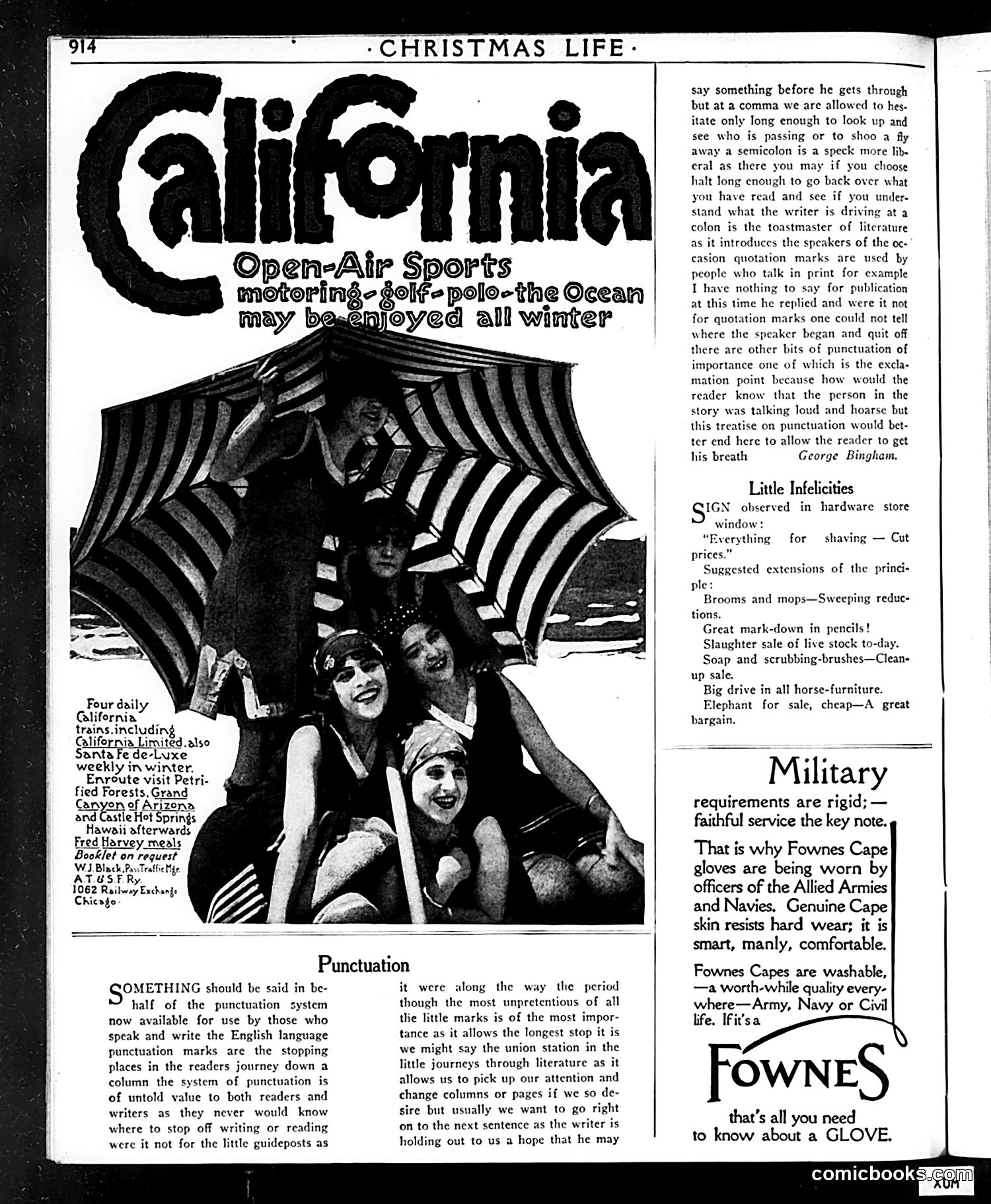
This page combines advertising, humor, and editorial content typical of early 20th-century Life magazine. **Main Content:** The large "California" advertisement promotes Santa Fe Railway trains and winter tourism to Arizona and Hawaii—appealing to wealthy readers seeking warm-weather escape. **"Punctuation" Essay** by George Bingham is a humorous, deliberately unpunctuated treatise mocking overly-earnest grammar instruction. The irony is deliberate: an essay *about* punctuation that flagrantly violates punctuation rules demonstrates the author's satirical point about pedantry. **"Little Infelicities"** mocks absurd hardware store window signage. The humor lies in hardware stores using retail terminology ("mark-down," "sale," "drive") for items where such language is incongruous—you don't have a "sweeping reduction" on brooms; you have a broom sale. It satirizes commercial copywriting clichés. **Fownes Gloves Advertisement** uses wartime patriotism (referencing "Allied Armies and Navies") to market luxury gloves, emphasizing durability and masculine respectability—typical WWI-era advertising strategy. The page reflects Life's mix of satirical commentary on language, commerce, and contemporary culture.
📄 Transcribed text from this page (OCR, searchable)
Machine-transcribed from the original scan — historical spelling and the odd misread are preserved.
Four daily Glifornia trains.includiny California Limited.also Santa Fe de-Luxe weekly in winter, Enroute visit Petri- fied Forests,Grand Canyon of Arizona ‘astle Hot Springs Hawaii afterwards Fred Harvey meals Booklet on request WJ Black PossTraffietyy AT.USF Ry. 1062 Railwoy Exchange Chicago: -CHRISTMAS LIFE- Open-Ai motoring om may if- polo-the Ocean joyed all winter Punctuation OMETHING should be said in be- half of the punctuation system now available for use by those who speak and write the English language punctuation marks are the stopping places in the readers journey down a column the system of punctuation is of untold value to both readers and writers as they never would know where to stop off writing or reading were it not for the little guideposts as it were along the way the period though the most unpretentious of all tlie little marks is of the most impor- tance as it allows the longest stop it is we might say the union station in the little journeys through literature as it allows us to pick up our attention and change columns or pages if we so de- sire but usually we want to go right on to the next sentence as the writer is holding out to us a hope that he may — say something before he gets through but at a comma we are allowed to hes- itate only long enough to look up and see who is passing or to shoo a fly away a semicolon is a speck more lib- eral as there you may if you choose halt long enough to go back over what you have read and see if you under stand what the writer is driving at a colon is the toastmaster of literature as it introduces the speakers of the oc- casion quotation marks are used by people who talk in print for example I have nothing to say for publication at this time he replied and were it not for quotation marks one could not tell where the speaker began and quit off there are other bits of punctuation of importance one of which is the excla- mation point because how would the reader know that the person in the story was talking loud and hoarse but this treatise on punctuation would bet- ter end here to allow the reader to get his breath George Bingham. Little Infelicities IGN observed in hardware store window: “Everything — for prices.” Suggested extensions of the princi- ple: Brooms and mops—Sweeping reduc- tions. Great mark-down in pencils! Slaughter sale of live stock to-day. Soap and scrubbing-brushes—Clean- up sale. Big drive in all horse-furniture. Elephant for sale, cheap—A great bargain. shaving — Cut Military requirements are rigid; — faithful service the key note. That is why Fownes Cape gloves are being worn by officers of the Allied Armies and Navies. Genuine Cape skin resists hard wear; it is smart, manly, comfortable. Fownes Capes are washable, —a worth-while quality every- where—Army, Navy or Civil life. Ifit'sa TOwnES that’s all you need to know about a GLOVE. comicbookssser