
Life, 1917-12-06 · page 65 of 92
Life — December 6, 1917 — page 65: what you’re looking at
What you’re looking at
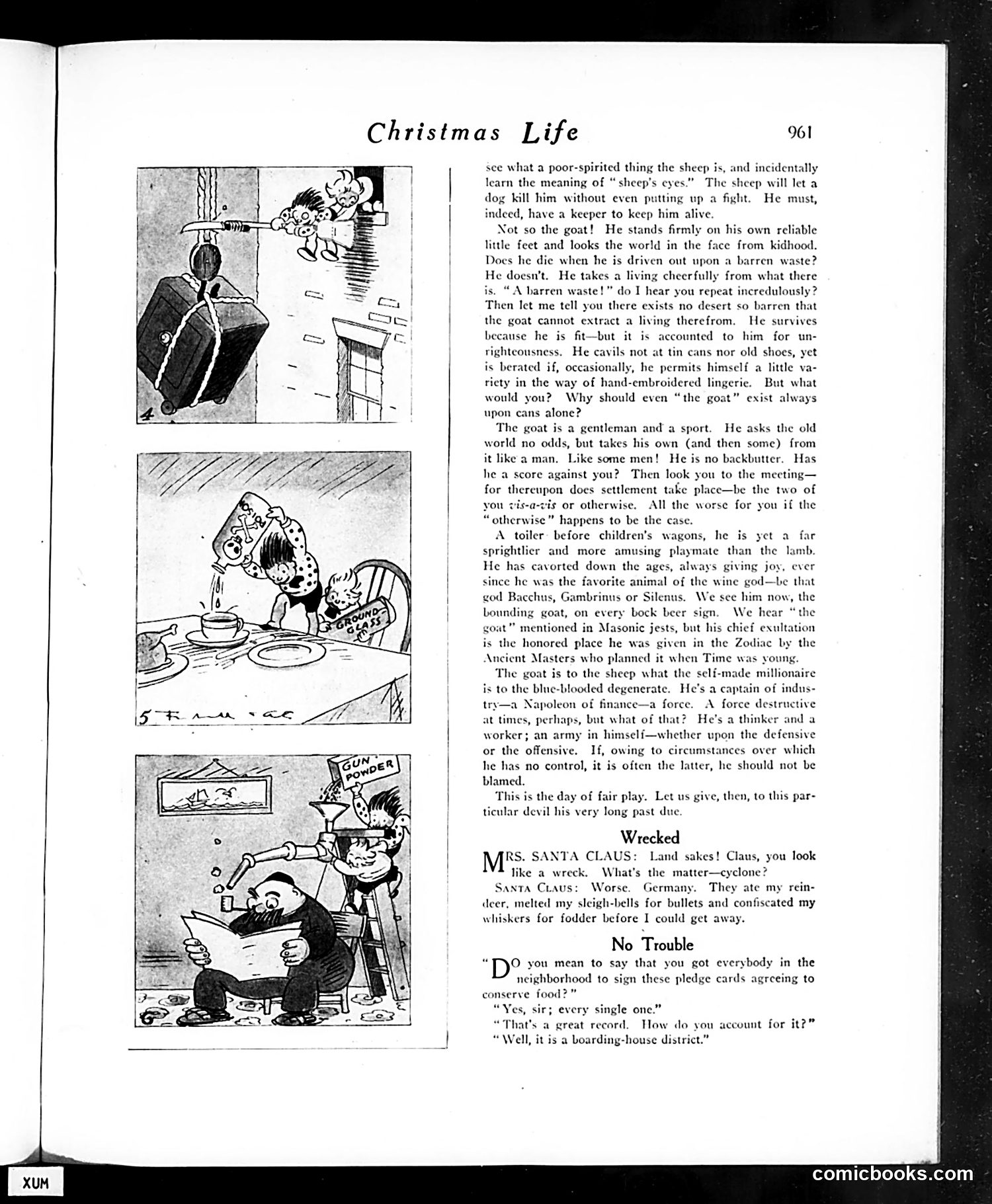
This Christmas-themed page contains philosophical commentary on goats versus sheep (likely metaphorical for independent versus dependent people), followed by three satirical cartoons related to World War I. **"Wrecked"** depicts Santa Claus telling Mrs. Santa that Germany has destroyed his operation—eating his reindeer, melting sleigh-bells for bullets, and confiscating his beard for soldier's fodder. This references wartime shortages and Germany's total mobilization for WWI. **"No Trouble"** satirizes food conservation pledges during wartime rationing. A official congratulates someone on getting unanimous neighborhood agreement to conserve food, attributing this to it being a "boarding-house district"—the joke being that boarding-house residents have no control over their meals anyway, so pledging conservation requires no actual sacrifice on their part. Both cartoons mock American home-front experiences during the Great War, specifically resource scarcity and the gap between official patriotic messaging and actual civilian hardship or indifference.
📄 Transcribed text from this page (OCR, searchable)
Machine-transcribed from the original scan — historical spelling and the odd misread are preserved.
Christmas Life 961 sce what a poor-spirited thing the sheep is, and incidentally learn the meaning of “ sheep's eyes.” The sheep will let a dog kill him without even putting up a fight. He must, indeed, have a keeper to keep him alive. ot so the goat! He stands firmly on his own reliable little feet and looks the world in the face from kidhood. Does he die when he is driven out upon a barren waste? He doesn’t. He takes a living cheerfully from what there is. “A barren waste!" do I hear you repeat incredulously? Then let me tell you there exists no desert so barren that | the goat cannot extract a living therefrom. He survives because he is fit—but it is accounted to him for un- righteousness. He cavils not at tin cans nor old shoes, yet is berated if, occasionally, he permits himself a little va- | riety in the way of hand-embroidered lingerie. But what would you? Why should even “the goat” exist always upon cans alone? The goat is a gentleman and a sport. He asks the old world no odds, but takes his own (and then some) from it lik he a score aman. Like some men! He is no backbutter. Has ainst you? Then look you to the meeting— for thereupon does settlement take place—be the two of you ‘is or otherwise. All the worse for you if the “otherwise” happens to be the A toiler- before children’s wagons, he is yet a far sprightlier and more amusing playmate than the lamb. He has cavorted down the ages, always giving joy, ever | since he was the favorite animal of the wine god—be that | god Bacchus, Gambrinus or Silenus. We see him now, the bounding goat, on every bock beer sign. We hear “the goat" mentioned in Masonic jests, but his chief exultation the case, is the honored place he was given in the Zodiac by Ancient Masters who planned it when Time was young. The goat is to the sheep what the self-made millionaire is to the bluc-blooded degenerate. He's a captain of indus- try—a Napoleon of finance—a force. A force destructive at times, perhaps, but what of that? He's a thinker and a worker; an army in himseli—whether upon the defensive or the offensive. If, owing to circumstances over which he has no control, it is often the latter, he should not be blamed. This is the day of fair play. Let us give, then, to this par- ticular devil his very long past duc Wrecked RS. SANTA CLAU. Land sakes! Clau: like a wreck. What's the matter— Santa Ctaus: Worse. Germany. They ate my rein- deer, melted my sleigh-bells for bullets and confiscated my whiskers for fodder before I could get aws No Trouble “T)O you mean to say that you got everybody in the n these pledge cards agreeing to neighborhood to sig conserve food?” “Yes, sir; every single one.” “That's a great record, How do you account for it?” | “Well, it is a boarding-house district.” comicbooks.com