
A complete issue · 42 pages · 1917
Life — March 15, 1917
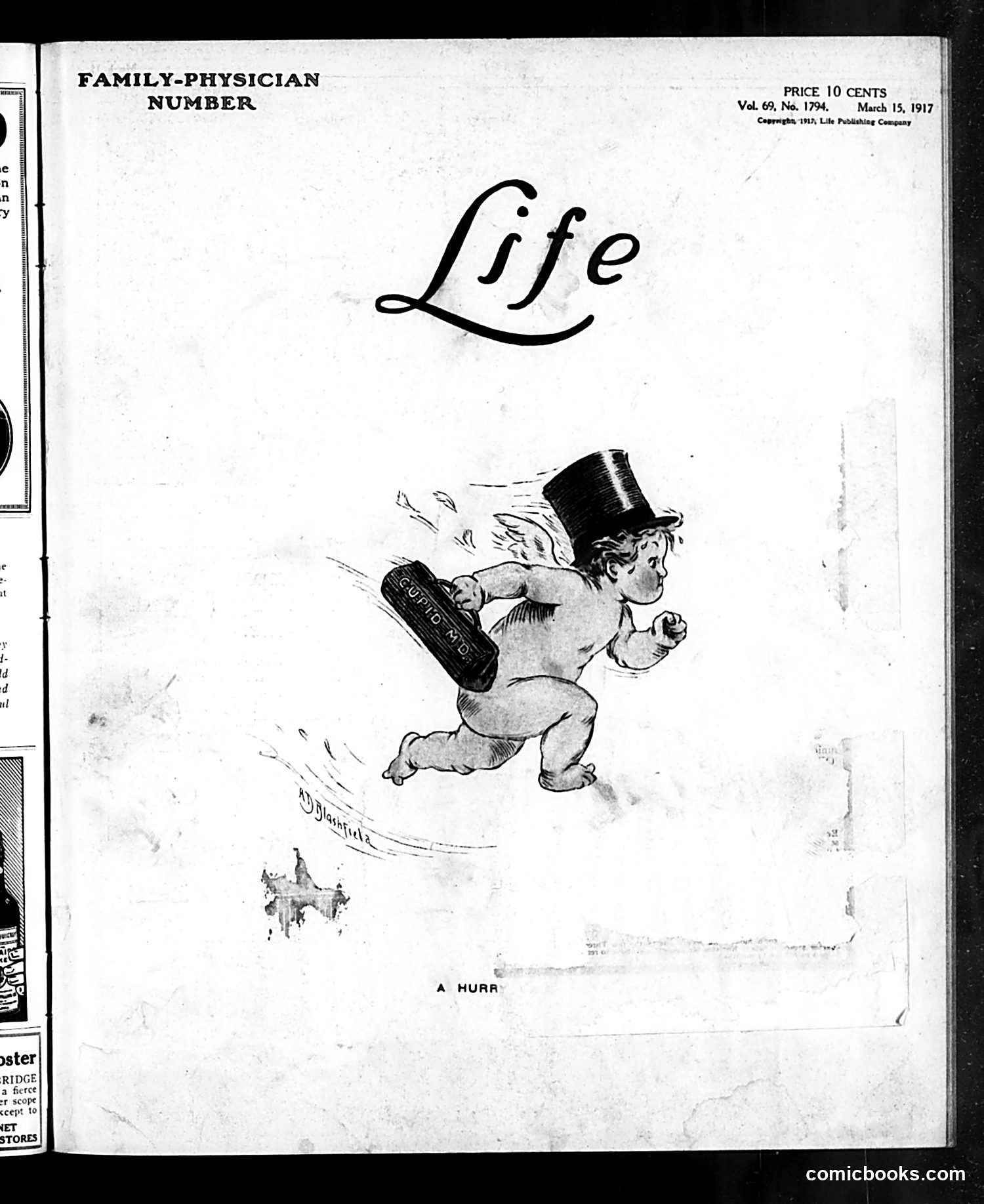
This is the cover of Life magazine's "Family-Physician Number" (Vol. 69, No. 1794). The central illustration, credited to artist A. Hurr, depicts a cherub or cupid figure in a top hat carrying what appears to be a medicine bottle or medical package labeled "Cupid's" on its back. The satirical point appears to be a play on "Love as Medicine"—suggesting romantic love or matchmaking as a cure or remedy. Given the magazine's "Family-Physician" theme, this likely jokes about love's restorative properties for health and family wellbeing. The cherub, traditionally associated with love and romance, is humorously dressed as a doctor or medicine deliverer, creating a visual pun linking Cupid (love) with medical care.
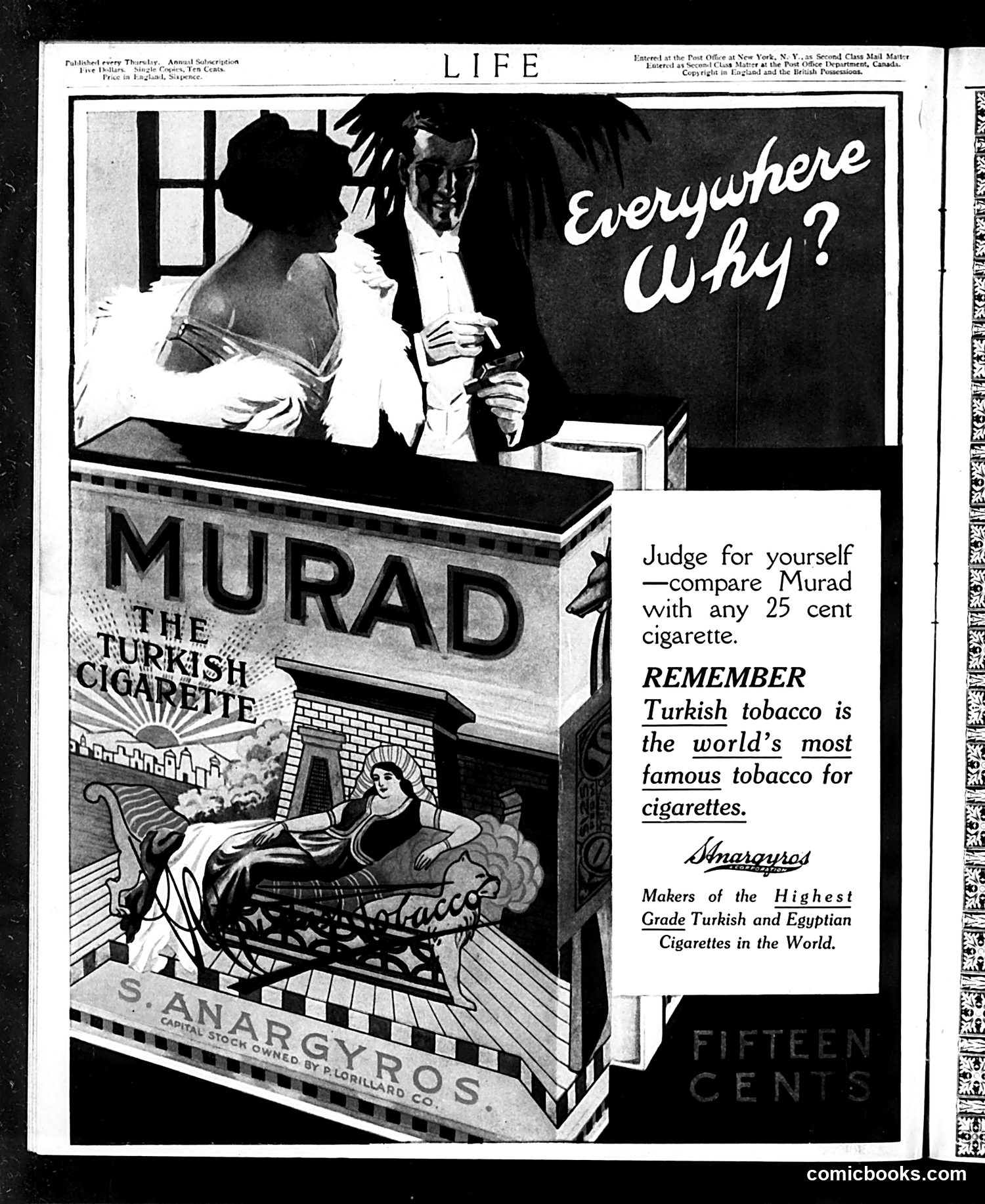
This page is primarily a **cigarette advertisement**, not political satire. It promotes Murad brand Turkish cigarettes, made by Anargyros. The top image shows a scene titled "Everywhere Why?" depicting a man in formal attire (possibly representing Death or a skeletal figure based on the visual style) confronting a woman, suggesting cigarette smoking's consequences or appeal despite dangers. The lower section displays the Murad cigarette package with Ottoman-inspired decorative artwork, emphasizing the product's Turkish heritage. The advertisement claims Turkish tobacco is "the world's most famous tobacco for cigarettes" and that Murad makes "the Highest Grade Turkish and Egyptian Cigarettes in the World." The price is listed as fifteen cents. This represents early 20th-century cigarette marketing before health warnings were required.
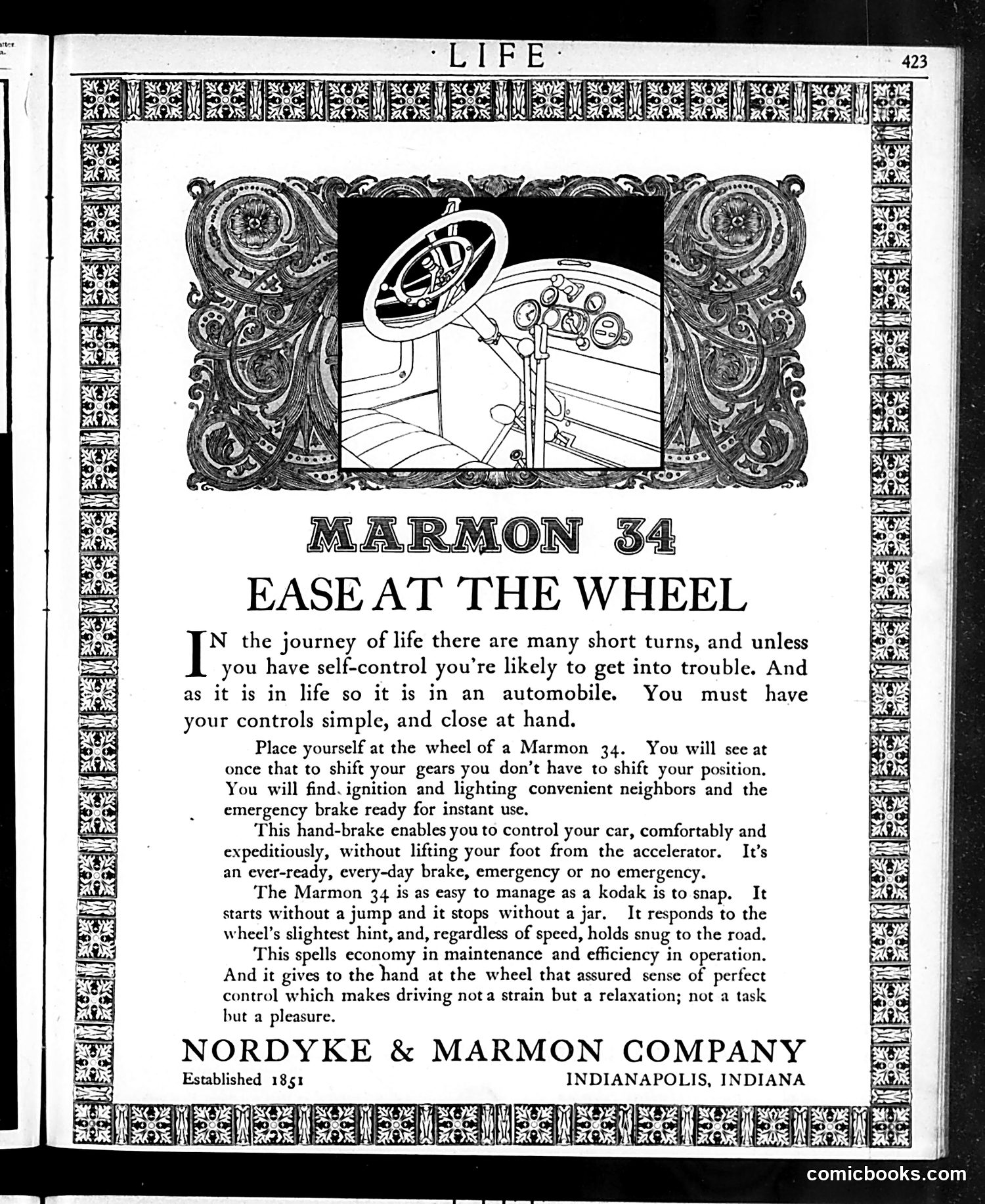
This page is primarily **advertising, not satire or political commentary**. It's a full-page advertisement for the Marmon 34 automobile, published by Nordyke & Marmon Company of Indianapolis, Indiana (established 1851). The ad uses metaphorical language comparing driving to "the journey of life," emphasizing the car's ease of control and safety features (hand-brake, convenient ignition/lighting, emergency brake). The illustration shows a simplified car interior with steering wheel and dashboard. The appeal is to comfort and reliability rather than speed or luxury—the car is described as "easy to manage as a kodak is to snap" and enables driving "comfortably and expeditiously" without strain. This reflects early automotive marketing emphasizing practical, everyday utility for middle-class buyers.
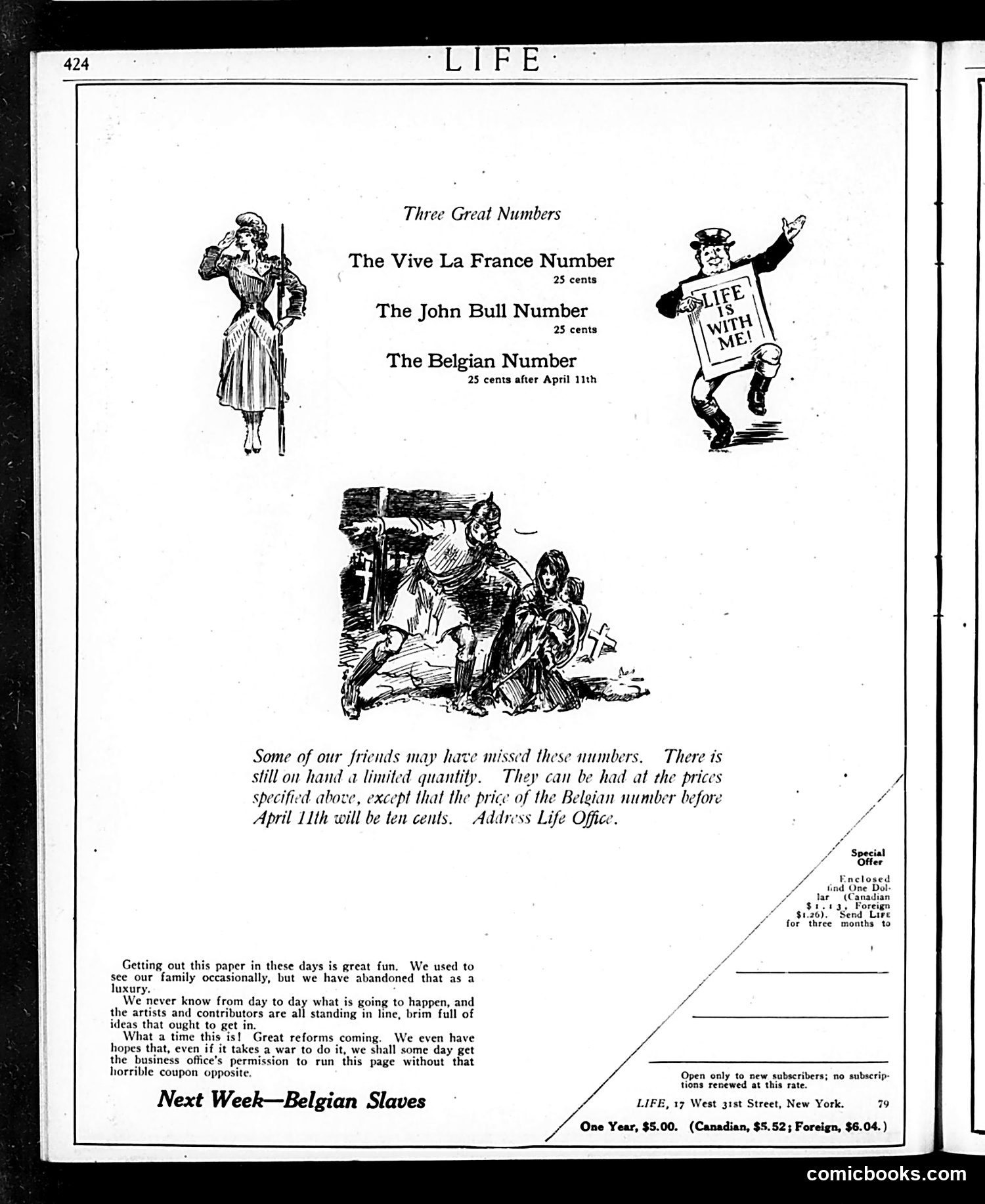
This page advertises three special "numbers" (issues) of Life magazine, each priced at 25 cents: 1. **"The Vive La France Number"** - celebrates France, likely during World War I 2. **"The John Bull Number"** - represents Britain (John Bull is the personification of Britain) 3. **"The Belgian Number"** - supports Belgium, priced at 10 cents before April 11th, then 25 cents The illustrations show allegorical female figures representing these nations. The bottom image depicts the destruction and suffering in Belgium, with figures among ruins and crosses—referencing Belgian civilian casualties during the German invasion (1914). The accompanying text emphasizes that these special issues address "great reforms" and suggests the magazine's editorial mission involves patriotic support for Allied nations during WWI.
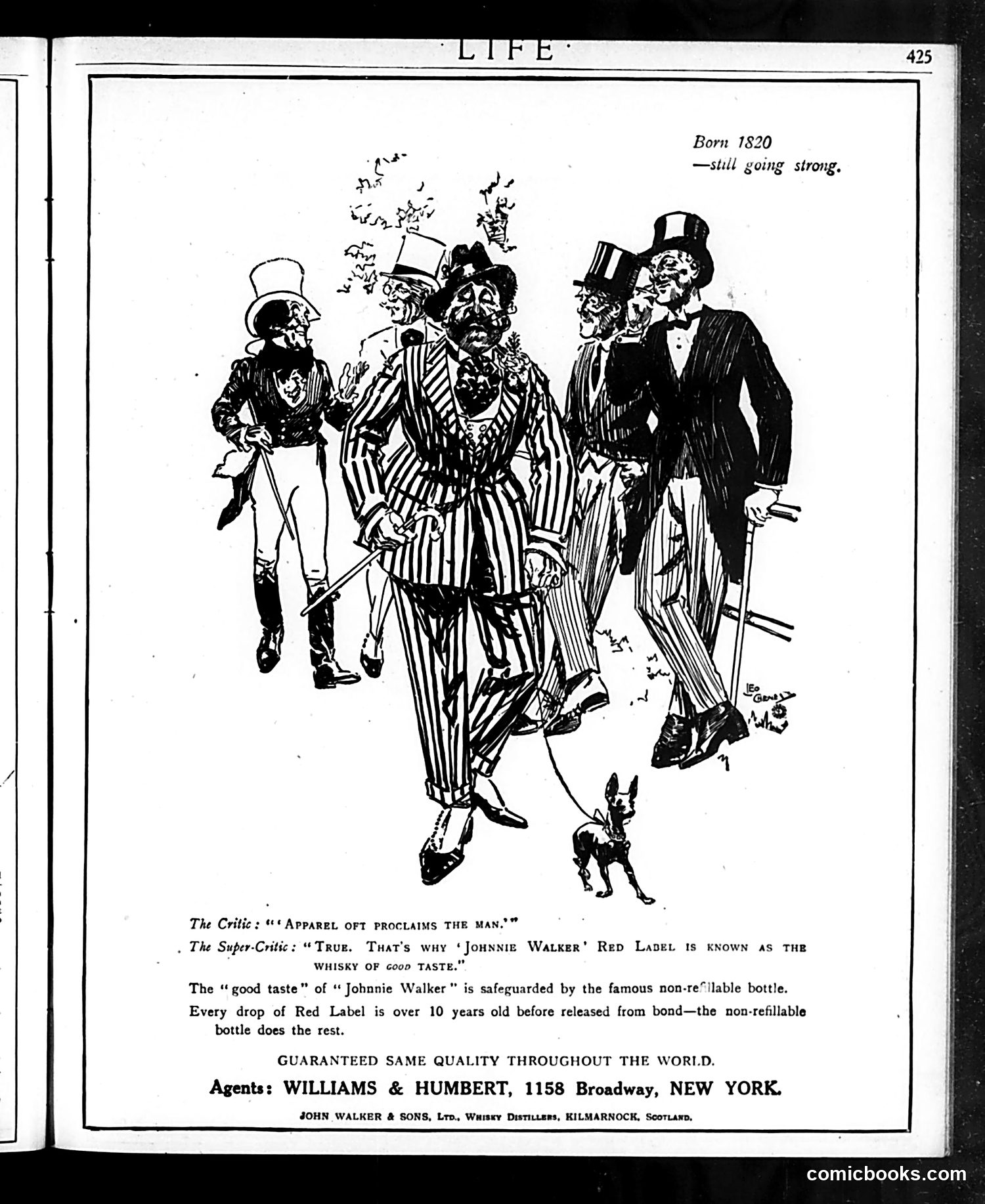
This is primarily a **Johnnie Walker whisky advertisement** disguised as satirical content. The cartoon depicts four caricatured gentlemen in top hats—appearing to represent critics or society figures—discussing whisky quality. The dialogue contrasts "The Critic" (who proclaims that "apparel oft proclaims the man") with "The Super-Critic," who pragmatically notes that Johnnie Walker Red Label is known for its "whisky of good taste." The joke plays on the tension between appearance and substance: while fancy dress and pretension matter to some, true connoisseurs recognize quality regardless of presentation. The small dog at bottom adds whimsical humor. The advertisement emphasizes the product's reliability—aged over 10 years in non-refillable bottles—and guarantees "same quality throughout the world." It's aimed at affluent readers who valued both sophistication and practical assurance.
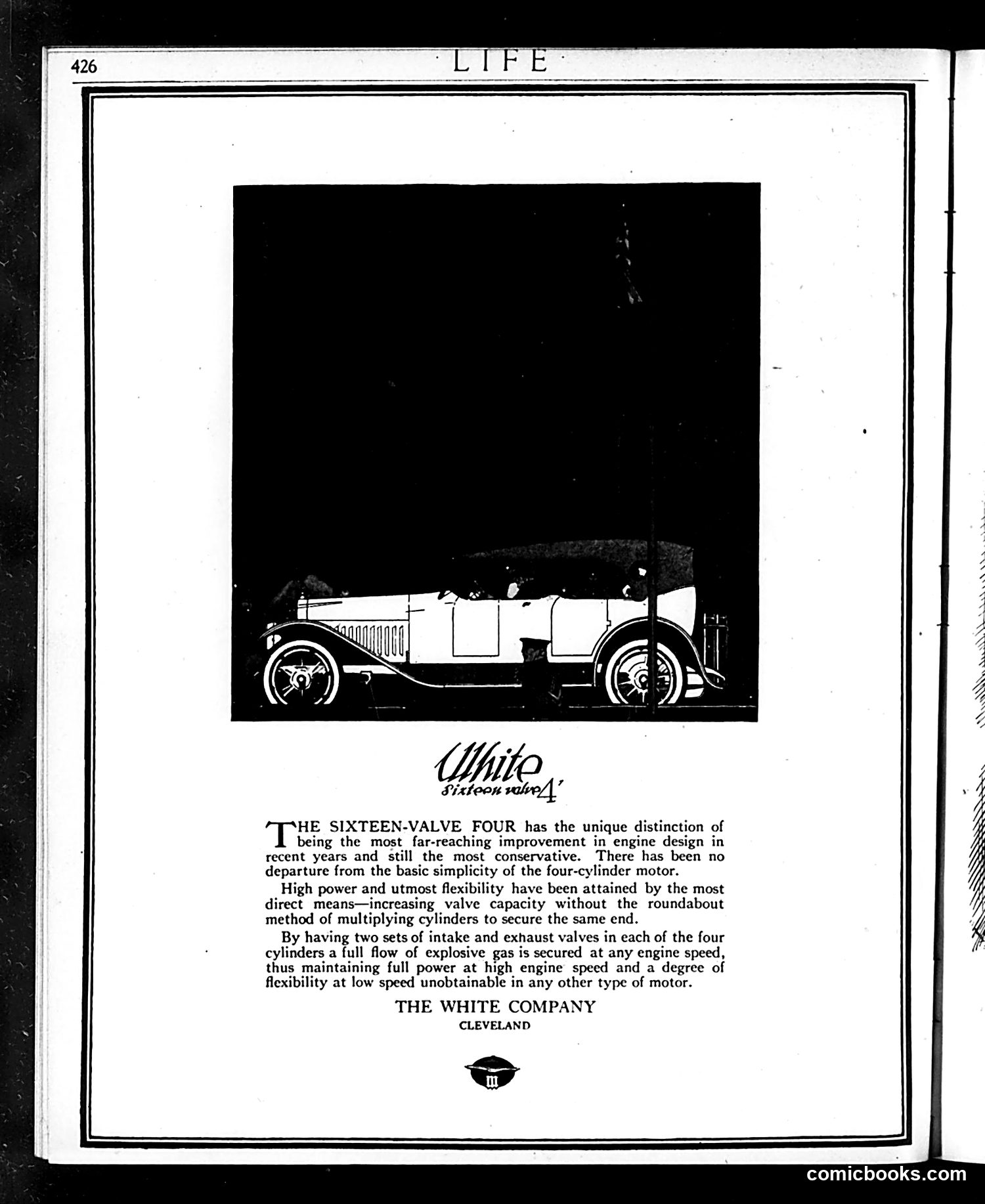
This page is **primarily advertising, not satire or political commentary**. It's a full-page advertisement for the White Company's "White Sixteen-Valve" automobile, published in *Life* magazine. The image shows a side-profile illustration of an open-air touring car from the early 20th century. The accompanying text emphasizes the vehicle's technical innovation: a sixteen-valve four-cylinder engine that supposedly achieved high power while maintaining engine simplicity. The advertisement highlights the car's "flexibility at low speed" and "full power at high engine speed." There is no cartoon, caricature, or satirical commentary present. This is straightforward automotive marketing aimed at *Life*'s affluent readership during the automobile boom era.
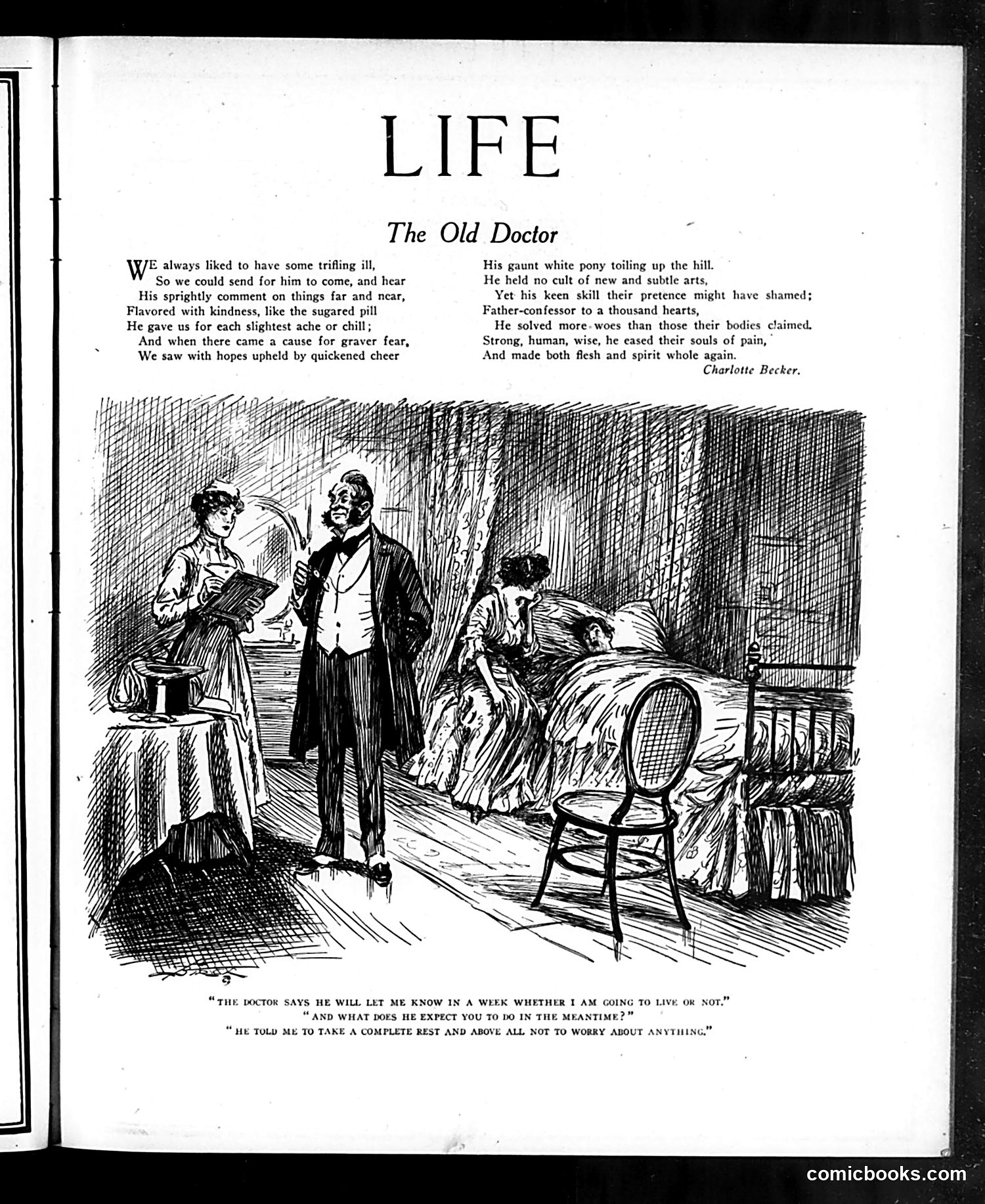
This page presents a sentimental poem by Charlotte Becker about a beloved family physician, accompanied by an illustration showing a doctor visiting a sick patient at home. The scene depicts a Victorian-era house call: an elderly doctor stands conversing with a young woman (likely a family member), while a patient lies ill in bed. The accompanying verse celebrates the doctor as a compassionate healer who brings comfort through his presence and expertise, easing "both flesh and spirit whole again." This reflects a historical moment when doctors made home visits as standard practice. The content idealizes the family physician as a trusted, intimate part of household life—a figure of wisdom and reassurance during medical crises. The satirical magazine chose to run this earnest tribute, likely celebrating traditional medical virtue.
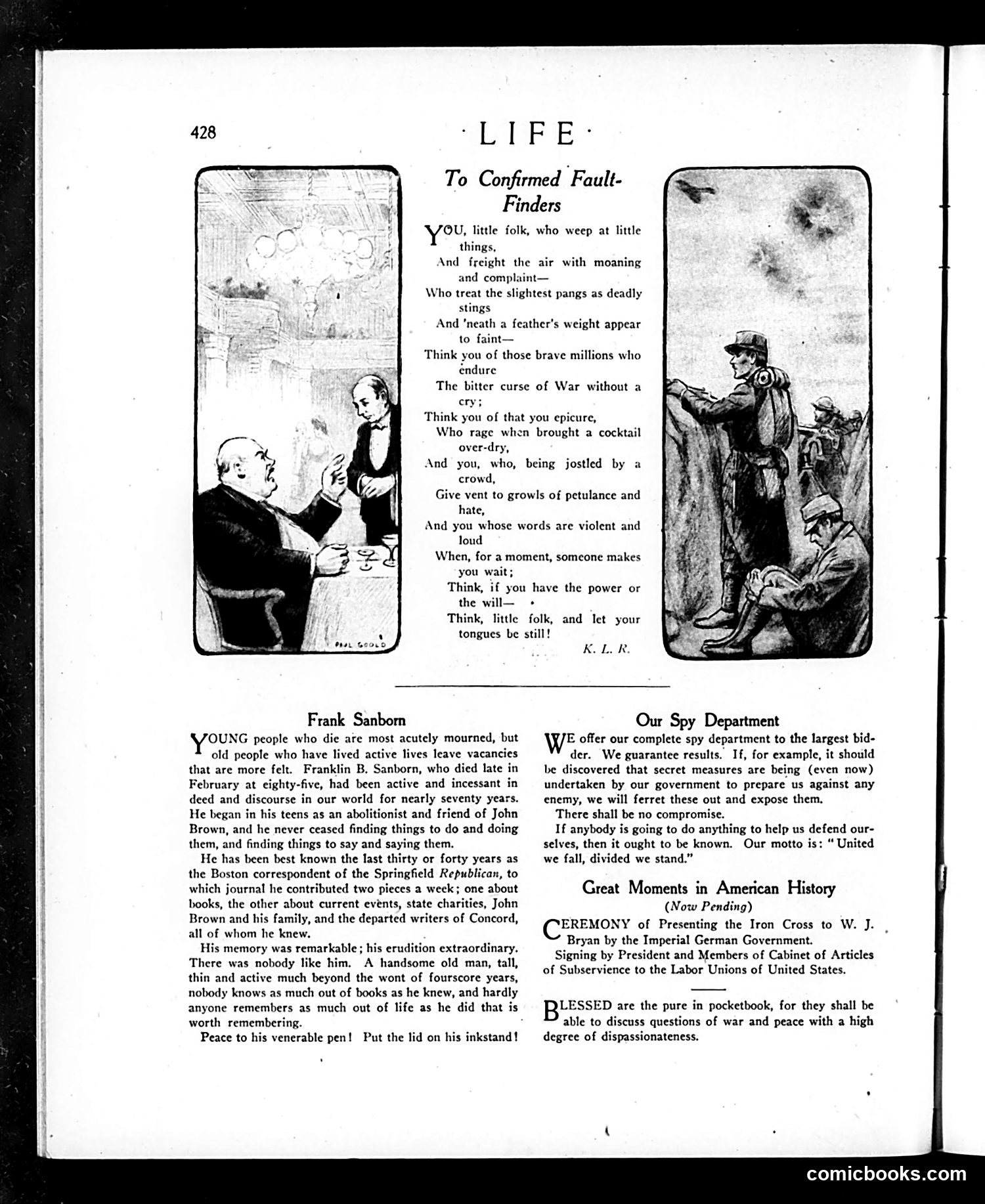
**"To Confirmed Fault-Finders"** (poem by K.L.K.): A satirical verse mocking people who complain excessively about minor grievances while soldiers endure the horrors of World War I. It contrasts trivial complaints—cocktails served warm, being jostled in crowds—with soldiers' suffering and death. The message urges complainers to maintain composure and perspective during wartime. **Left cartoon**: Shows two men in formal dress at what appears to be a social gathering, likely depicting the type of petty socialite the poem criticizes. **Right cartoon**: Depicts soldiers in a trench or military setting, illustrating the stark contrast between civilians' comfort and soldiers' reality. **"Frank Sanborn" obituary**: Notes his death and decades-long journalism career. **"Our Spy Department"**: Satirical advertisement humorously offering espionage services. The page's overarching theme: wartime social criticism encouraging civilian restraint and gratitude.
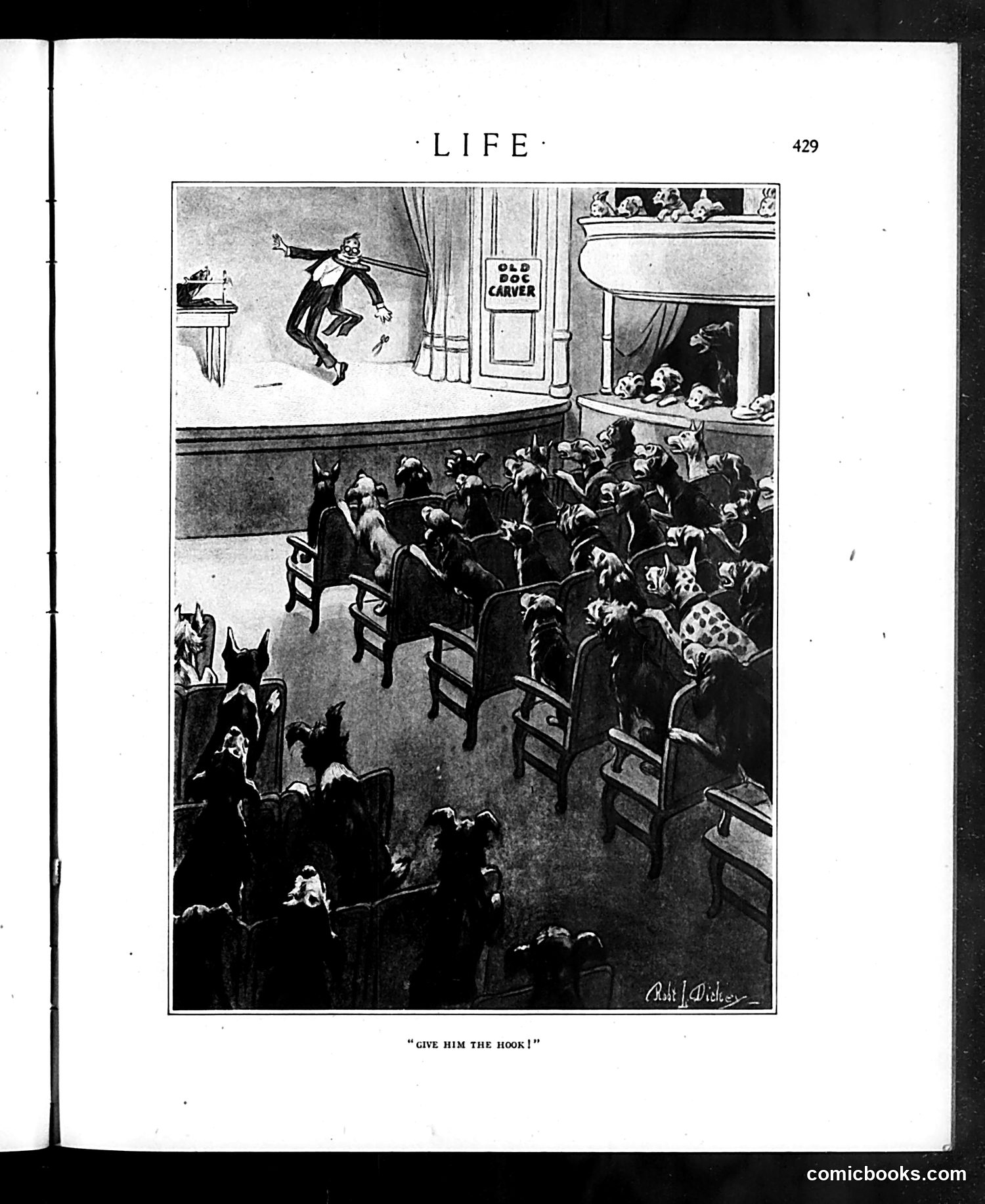
This cartoon depicts a theatrical performance where an acrobat or performer is actively performing on stage while an audience of devils watches from seats below. The sign reading "OLD TIME CARVER" visible in the upper portion suggests a reference to a specific public figure or personality of the era. The caption "Give Him the Hook!" refers to the vaudeville practice of using a hook to pull failed performers off stage. This cartoon likely satirizes a contemporary public figure—possibly a politician or entertainer—whose performance the cartoonist believed deserved removal. The devilish audience suggests moral disapproval or suggests the performer is appealing to base instincts rather than worthy pursuits. Without more specific dating or attribution, the exact target remains unclear.
This page is primarily text-based editorial content with no visible cartoons. The article discusses German organizational culture, arguing that while Germans developed organizational systems effectively, over-organization threatens individual liberty and family life. The piece critiques excessive bureaucratization—suggesting organizations like the telephone, typewriter, and office work have created a "hotbed growth" of organizational excess. It warns that superorganization makes life "destructive to everything that makes life worth living." The satirical point appears to be that German efficiency, while impressive, comes at the cost of personal freedom—a timely concern given the article references Bismarck and industrial organization. The final section includes an unrelated joke ("A Low Trick") about borrowed umbrellas.
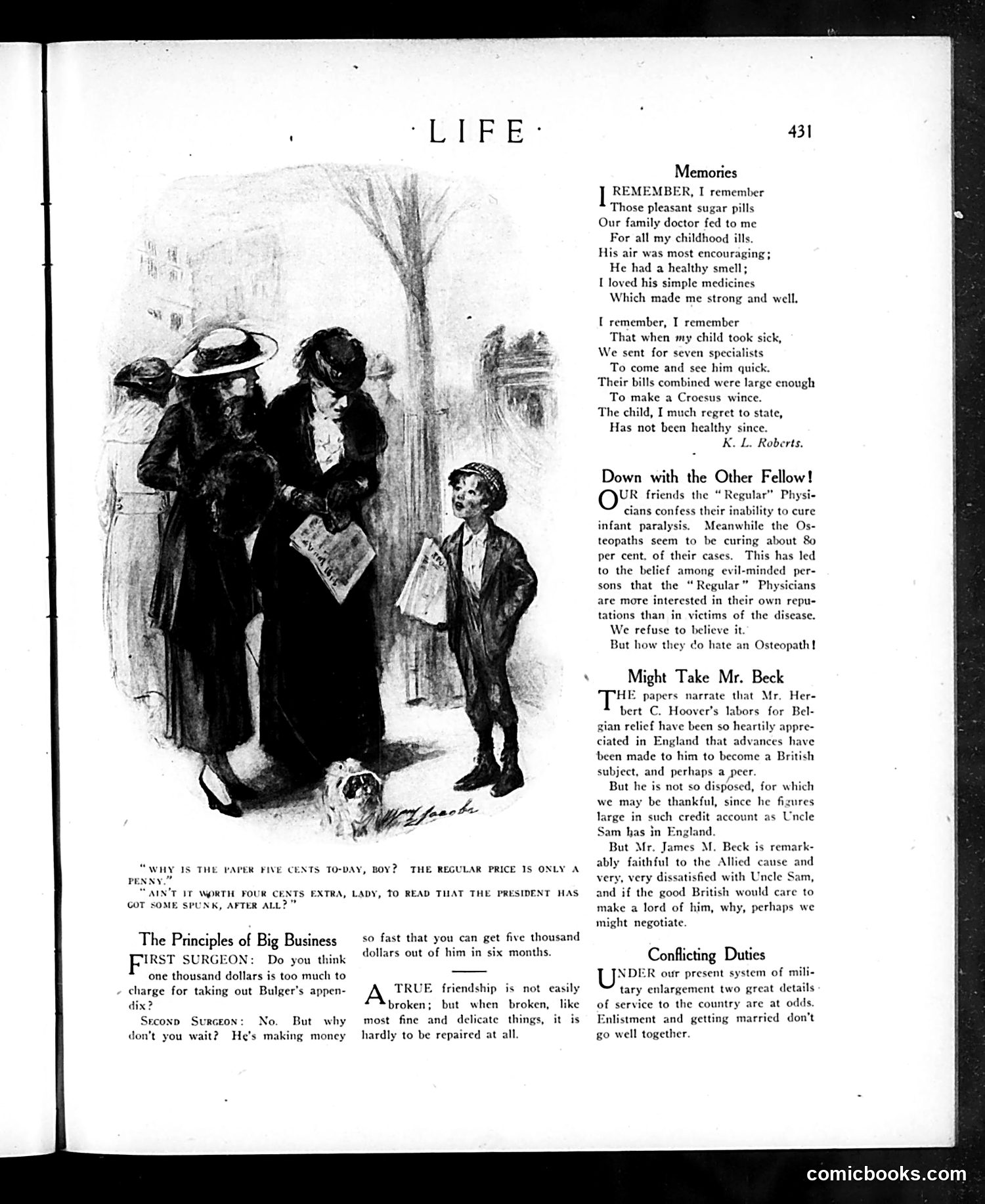
The main illustration depicts a street scene where a woman and child approach an elegantly dressed couple. The caption quotes the child asking why paper costs five cents when "the Regular price is only a penny," and notes the president "got some spunk, after all." This appears to reference **price inflation during wartime or economic crisis**—likely WWI era, given Life's publication period. The "Regular" price suggests price controls or standard rates, while the inflated "five cents" reflects market manipulation. The child's innocent question highlights how ordinary citizens notice price gouging, while the adults' fashionable dress suggests wealthy merchants profiting from scarcity. The satire mocks both commercial greed and apparent government action ("got some spunk") to address it, though ineffectively.
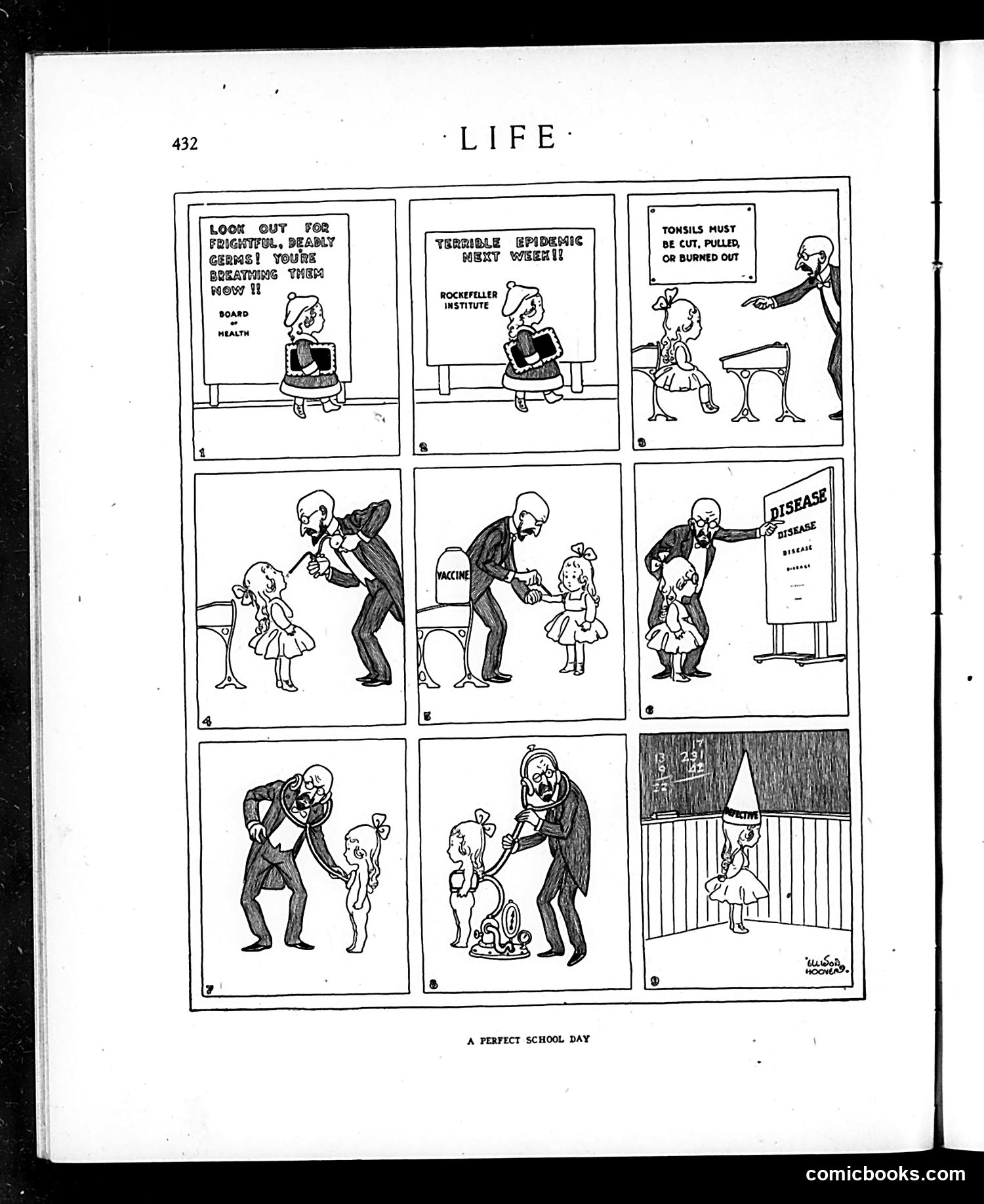
This nine-panel comic satirizes early 20th-century public health campaigns targeting children. The sequence depicts: 1. A health board warning about germs 2. A "Terribah Epidemic" from the Rockefeller Institute 3. Forced tonsil removal (a common medical practice then) 4-6. A doctor aggressively pursuing the child with various interventions 7-9. The child being shielded from all disease threats The satire mocks the era's increasingly aggressive medicalization of childhood and the fear-based public health messaging promoted by institutions like the Rockefeller Institute. It suggests these well-intentioned health measures became oppressive and paranoid—turning a school day into a gauntlet of medical interventions and disease anxiety. The humor critiques how institutional health campaigns created an almost totalitarian environment around disease prevention.
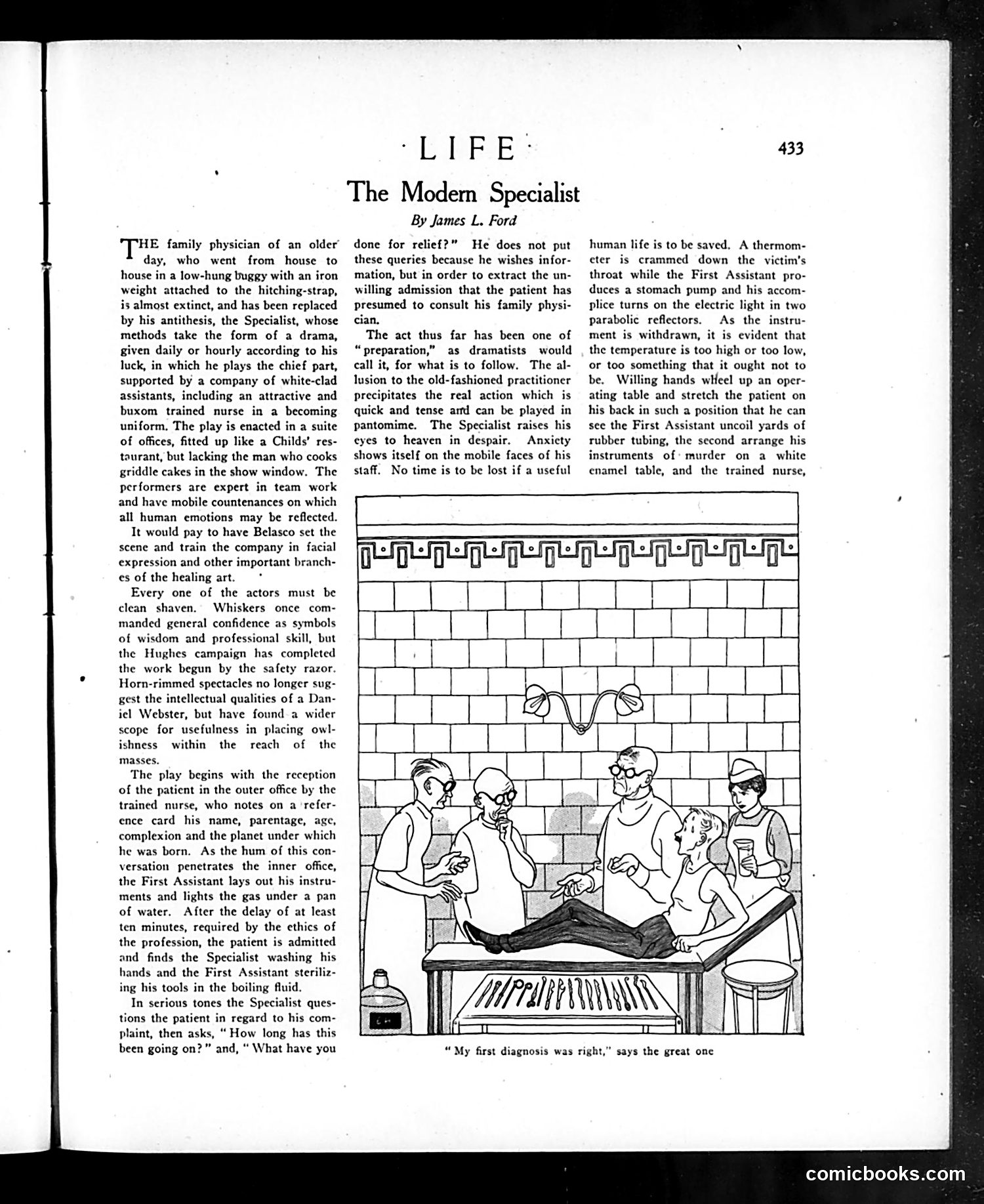
This satirical piece mocks the pretentiousness of medical specialists in the early 20th century. The cartoon depicts a patient on an examination table surrounded by multiple doctors in what appears to be an unnecessarily theatrical medical setting—complete with dramatic lighting and elaborate instruments. The text criticizes how specialists treat medical consultations like theatrical performances, emphasizing style over substance. The joke centers on one doctor's boast: "My first diagnosis was right," suggesting that specialists rely on showmanship and confidence rather than genuine expertise. Ford satirizes how the medical profession had adopted theatrical elements and overly complex procedures to impress patients and justify high fees, replacing the simpler competence of traditional family physicians.
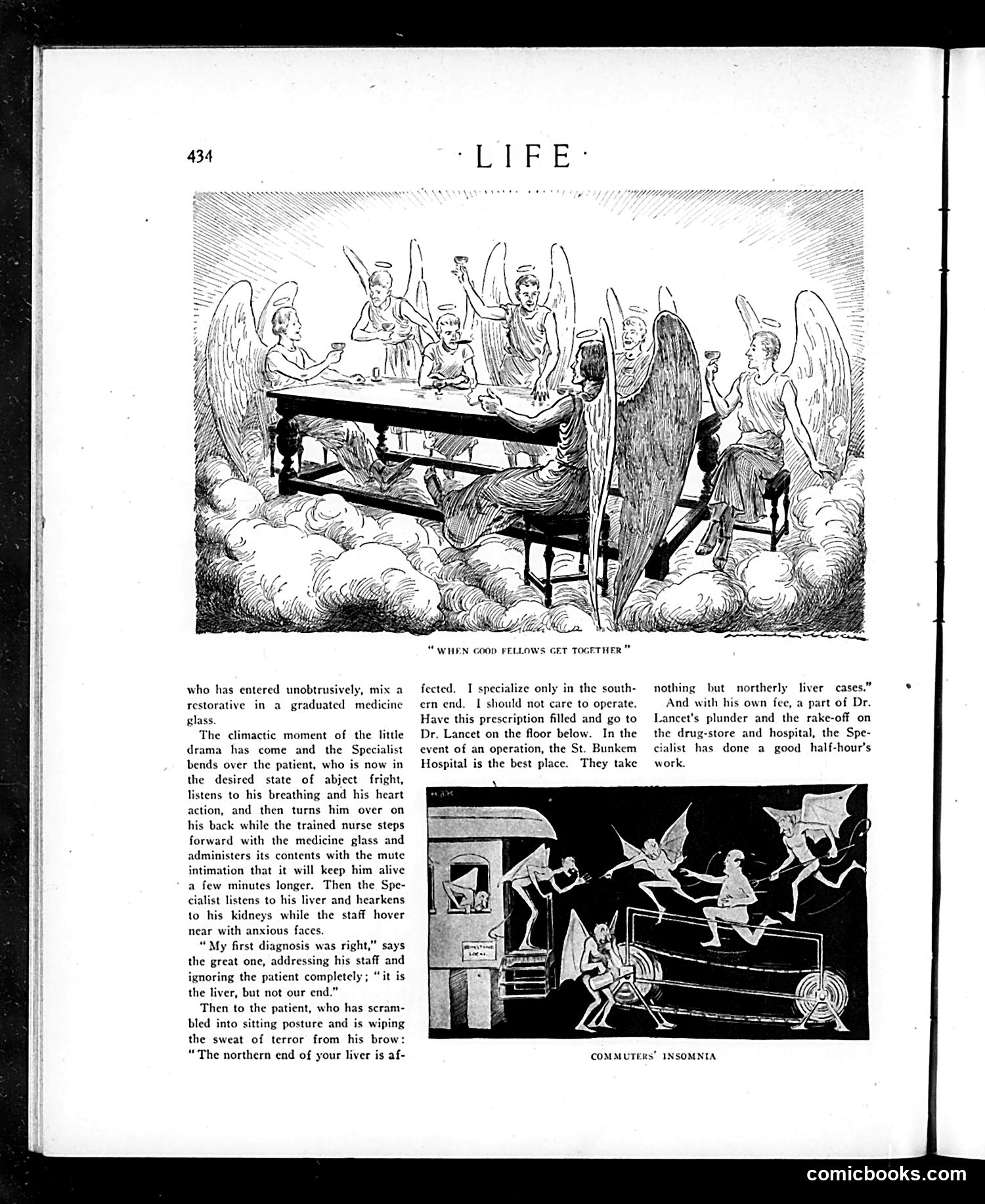
The top illustration, titled "When Good Fellows Get Together," depicts angels gathered around a piano in heaven, playing music together—a lighthearted afterlife scene suggesting camaraderie and fellowship. Below, the text discusses medical diagnosis and treatment, mentioning a doctor (Dr. Lance) examining a patient, likely addressing liver disease. The phrase "the northern end of your liver is affected" appears to be either genuine medical discussion or satirical commentary on contemporary medical practice. The bottom illustration, "Commuters' Insomnia," shows figures in contorted, energetic poses—likely satirizing the sleep deprivation and stress experienced by commuting workers, a social concern of the era. The page combines genteel humor with social observation about turn-of-the-century American life.
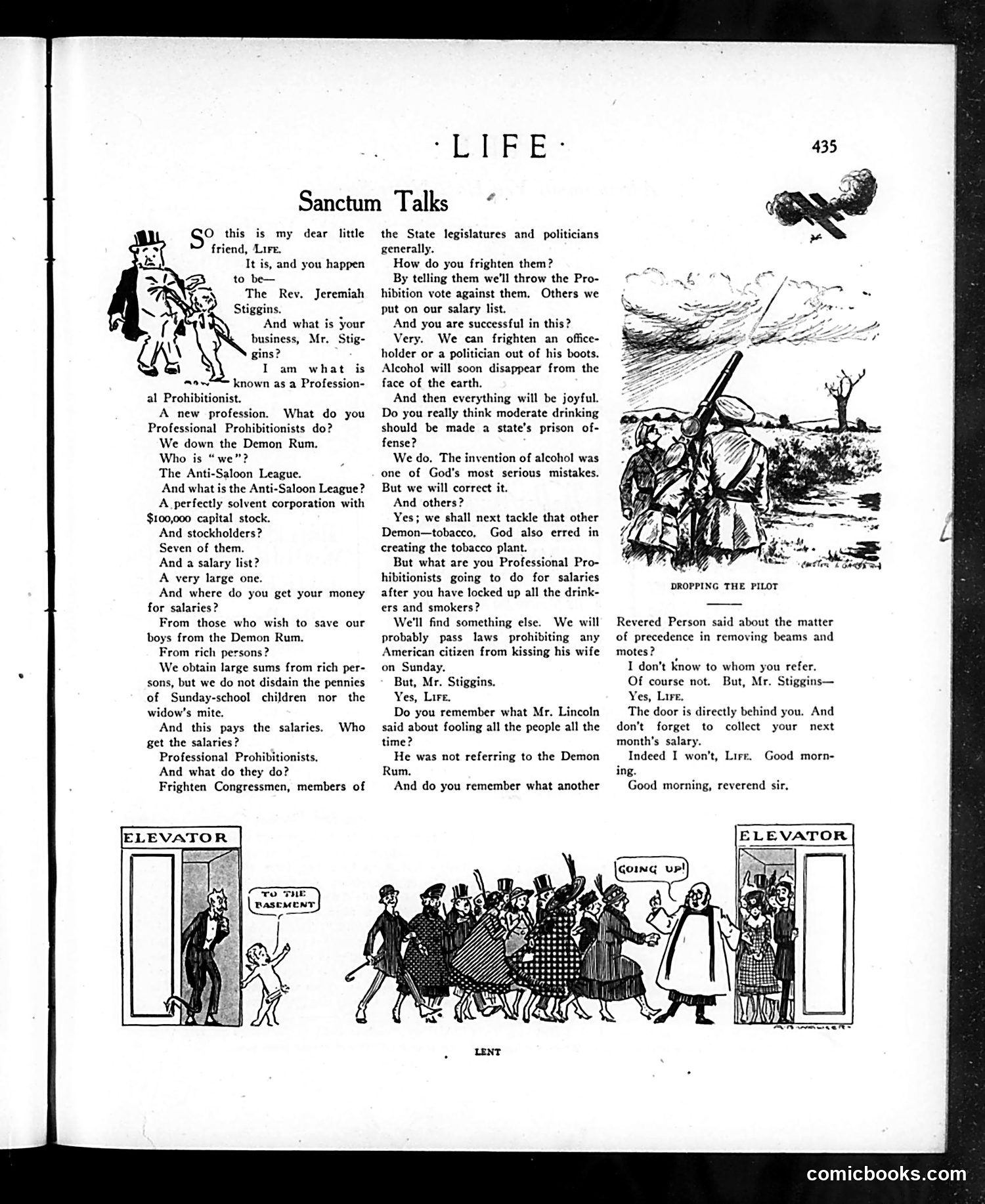
This page satirizes **Professional Prohibitionists**—activists pushing alcohol bans through legislation. The main dialogue features Rev. Jeremiah Stiggins (a character type representing stern temperance advocates) discussing their movement's tactics with "Life" magazine's editor. The satire targets their methods: intimidating politicians, compiling "salary lists" of opponents, and threatening electoral consequences. The text mocks their hypocrisy—claiming moral superiority while using aggressive political pressure and funded campaigns ($100,000 stock mentioned). The bottom cartoon shows crowded elevators labeled "Going Up" and "To the Basement," likely representing the prohibition movement's rise in political power and influence. The piece ridicules temperance activists as sanctimonious zealots using modern corporate and political machinery—not genuine moral persuasion—to enforce their agenda.
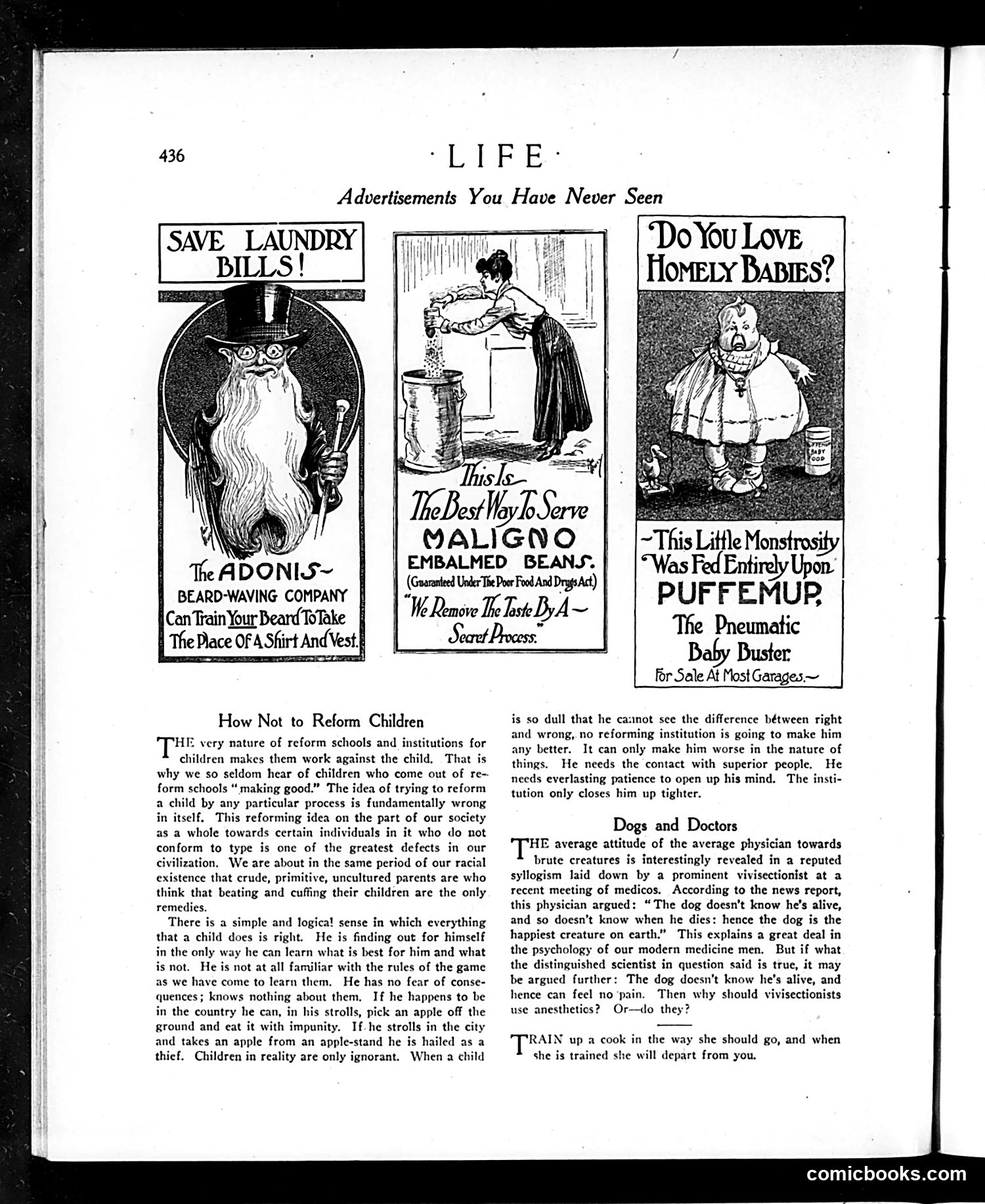
This page contains three fake "advertisements" mocking absurd products and services: 1. **Adonis Beard-Waving Company**: Satirizes male grooming vanity by suggesting facial hair can replace proper clothing—a jab at unnecessary cosmetic concerns. 2. **Maligno Embalmed Beans**: A grotesque product name that appears to mock both questionable food preservation methods and possibly fraudulent patent medicines of the era (note the reference to the "Pure Food and Drug Act"). 3. **Puffemup Pneumatic Baby Buster**: The cruel humor targets both homely infants and absurd mechanical gadgets, likely mocking both eugenics-adjacent attitudes toward appearance and the era's faith in technological "solutions" to human problems. The page's articles—on reforming children and physician attitudes toward animals—continue the satirical theme: critiquing society's misguided institutional approaches and medical ethics. The overall message lampoons early 20th-century attitudes toward progress, beauty standards, and expert authority.
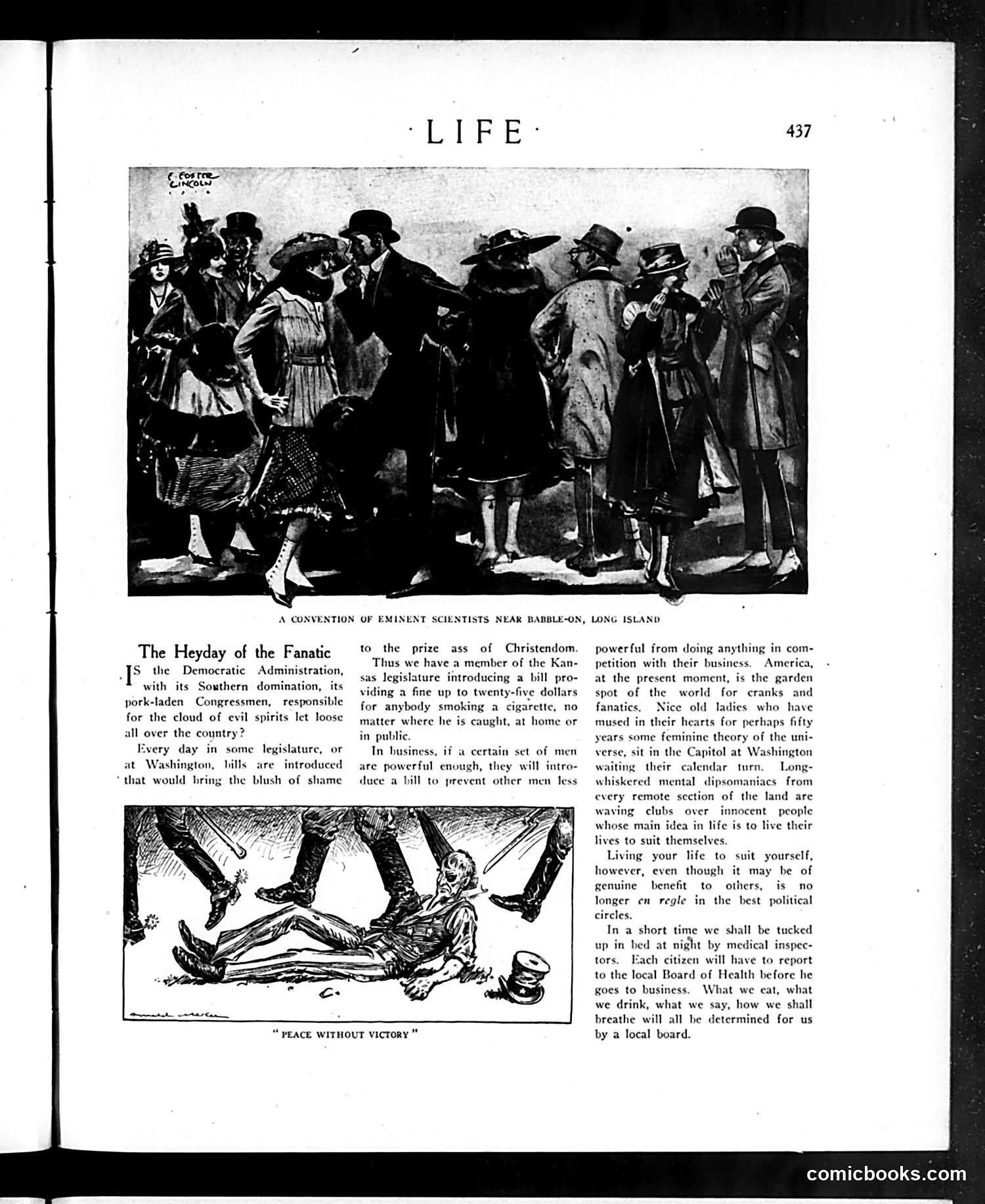
This *Life* magazine page satirizes American legislative overreach and moral busybodiness during the Progressive Era. The top cartoon depicts "a convention of eminent scientists near Babble-on, Long Island"—a fictional gathering mocking self-appointed experts and reformers. The article criticizes what it calls "fanatics" pushing intrusive laws: it references a Kansas legislator's bill fining cigarette smokers $25 and warns of coming medical inspectors dictating citizens' diets, speech, and breathing. The author attacks both the Democratic Administration (Southern-dominated Congress) and business monopolists who use legislation to crush competition. The lower cartoon titled "Peace Without Victory" depicts a dead figure beneath bureaucrats' feet—likely satirizing the idea that achieving "peace" through excessive regulation amounts to crushing individual liberty. The satire's point: well-intentioned reformers and busybodies, hiding behind science and morality, are destroying personal freedom through government intrusion into private life.
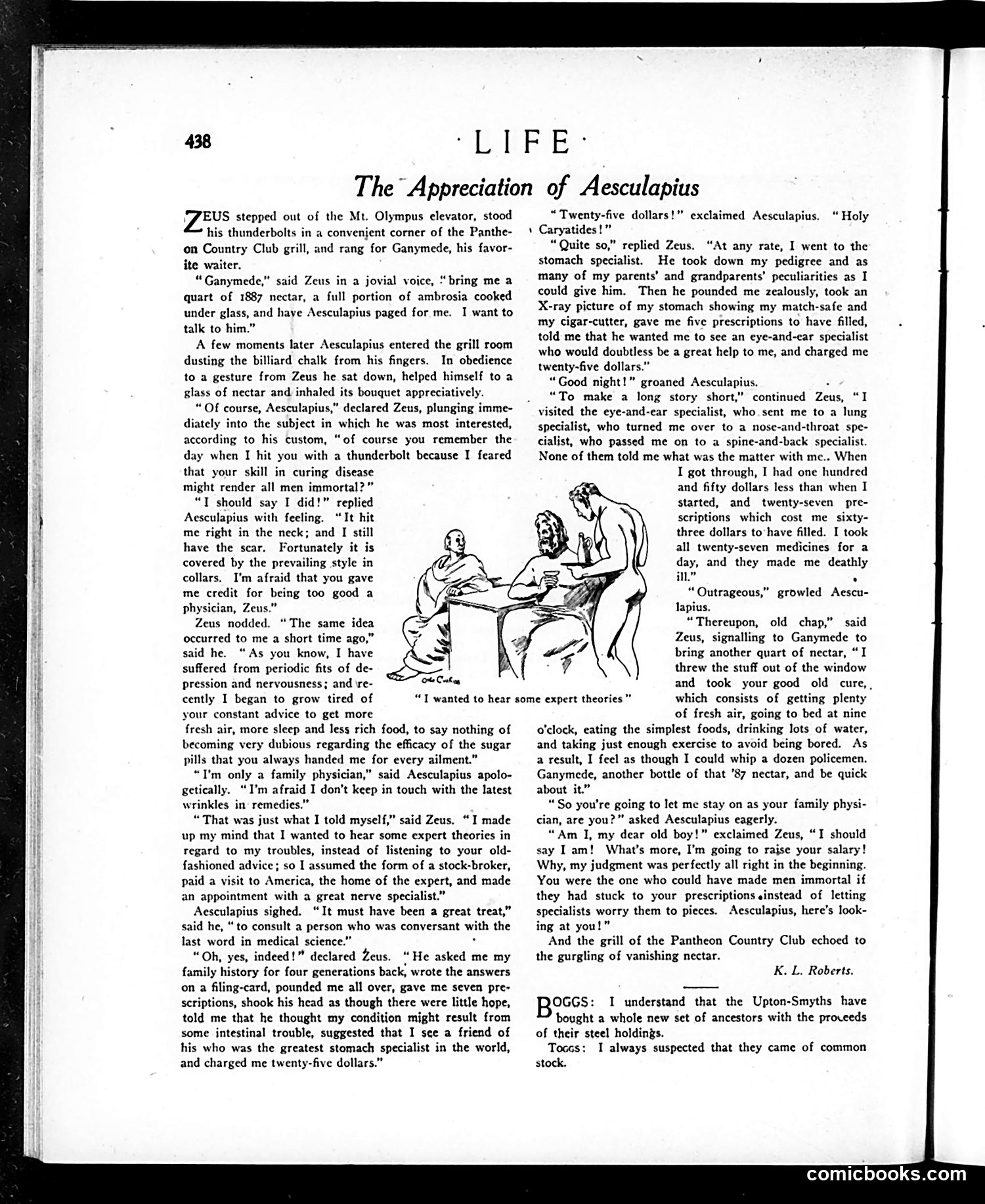
This satirical dialogue mocks modern American medical specialization. Zeus (king of the gods) consults a "nerve specialist" in America instead of trusting Aesculapius (the classical god of medicine) and his old-fashioned advice about rest, sleep, and diet. The joke: The modern specialist charges $25, demands extensive paperwork, performs unnecessary tests (X-rays), prescribes multiple medications, and—crucially—refers Zeus to other specialists (eye, ear, lung, nose-throat, spine specialists) without actually diagnosing anything. Each charges another $25. The satire attacks 1920s American medical practice: the proliferation of narrow specialists, excessive testing and fees, and the irony that despite all this "expert" intervention, no one actually helps the patient. The classical physician's simple wisdom (exercise, nutrition, rest) is abandoned for profitable medical bureaucracy. Aesculapius represents pre-modern, holistic medicine; modern America represents fragmented, expensive, ineffective specialization.
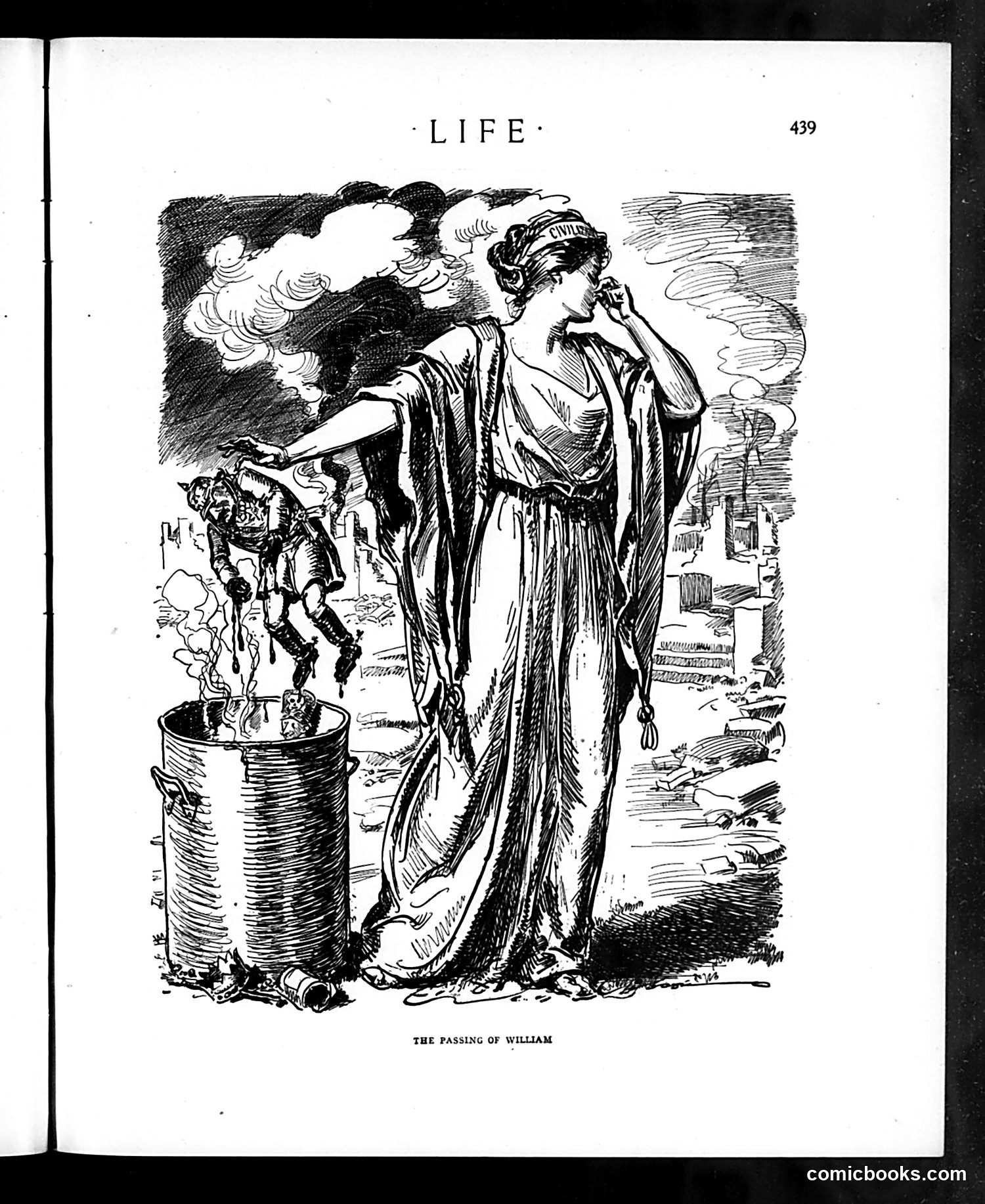
This satirical illustration depicts a classical female figure (likely representing Britannia or a personification of Britain) standing in contemplative pose, with her hand to her face in a gesture of mourning or concern. She observes smoke or flames rising from a cauldron below containing small figures—apparently soldiers or military personnel. The title "The Passing of William" likely refers to a significant death or departure affecting British politics or military affairs. The imagery suggests loss, sacrifice, or the end of an era. The allegorical woman's sorrowful demeanor emphasizes the gravity of the event being satirized. Without additional context about the publication date, the specific "William" referenced remains unclear—it could refer to a political figure, military leader, or monarch whose passing had notable implications for Britain.
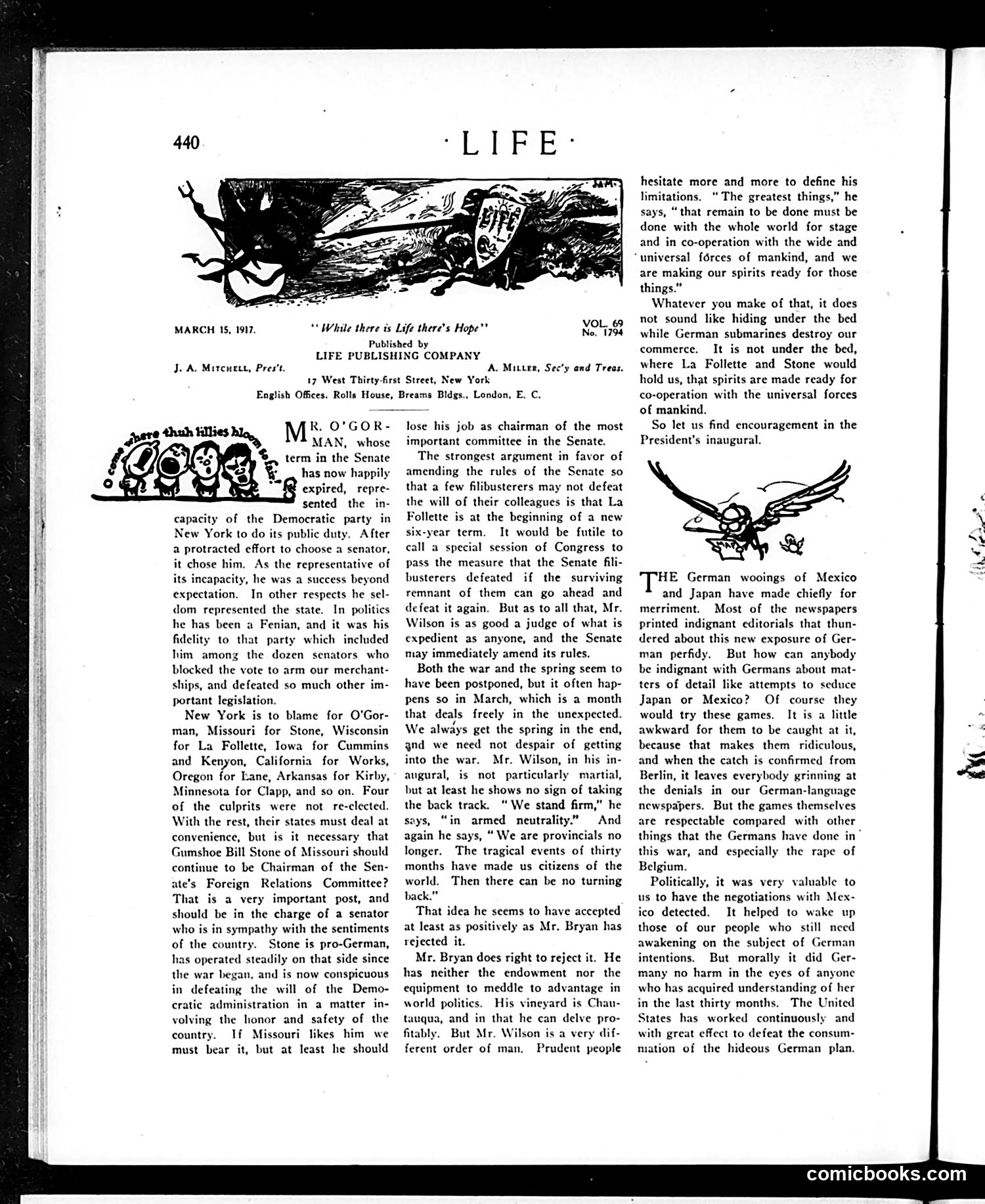
This page attacks several Democratic senators opposed to President Wilson's military preparedness agenda, published as America edged toward World War I entry. The main target is **Senator James O'Gorman of New York**, criticized as incompetent and obstructionist. The text names other senators—Stone (Missouri), La Follette (Wisconsin), Cummins, Kenyon, Works, Lane, Kirby, and Clapp—who blocked the arming of merchant ships and opposed Wilson's policies. The **key grievance**: Senator Stone chairs the Foreign Relations Committee despite being "pro-German" and undermining administration war efforts. The article argues Senate rules should be changed to prevent filibusters from defeating Wilson's will. The cartoon's imagery (unclear without clearer detail) likely caricatures these obstruction-minded senators. The editorial voice supports Wilson's shift from "armed neutrality" toward world involvement, dismissing **William Jennings Bryan's** pacifism as suitable only for Chautauqua lectures, not statecraft. The overall message: these senators are unpatriotic obstacles to necessary wartime leadership.
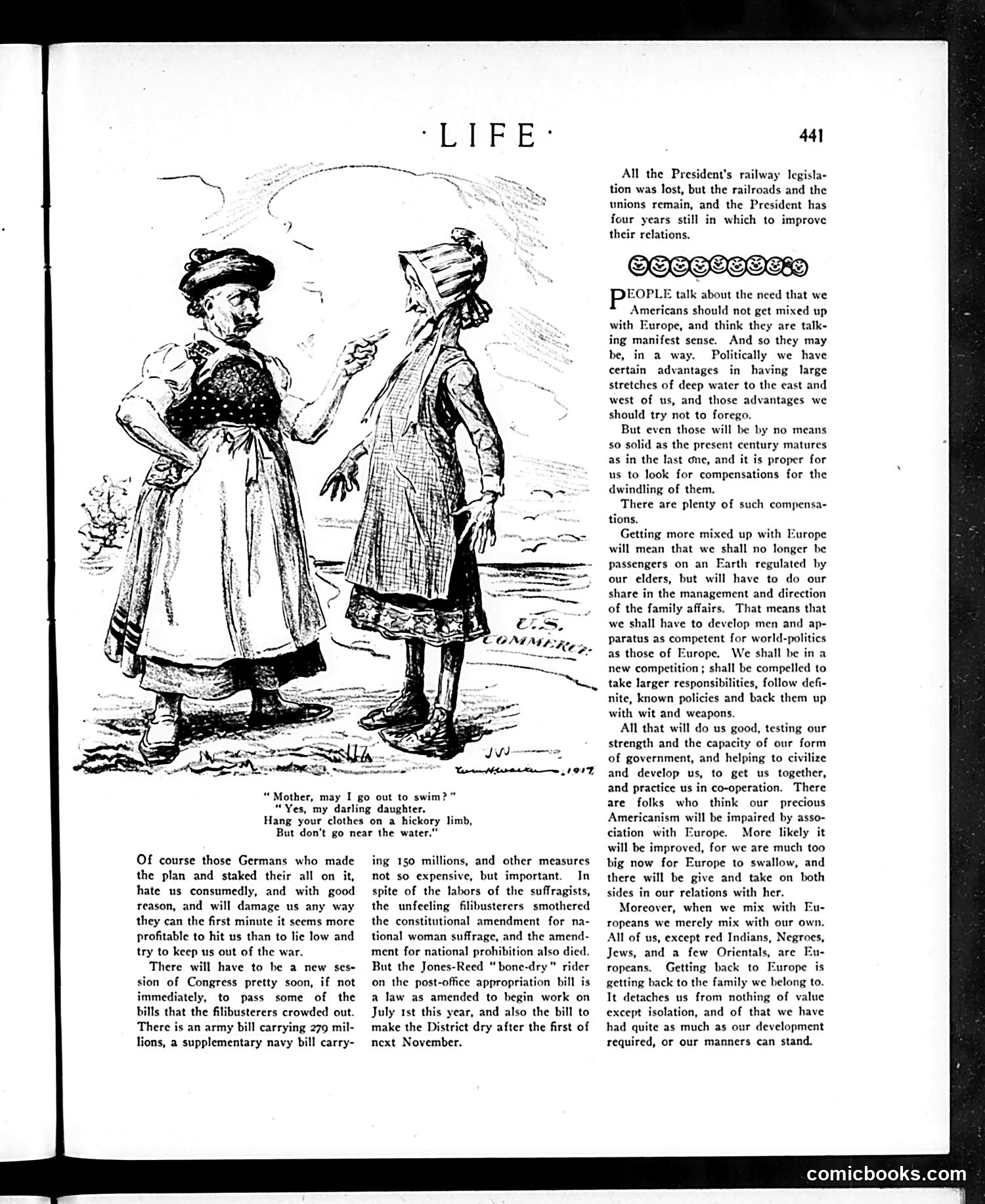
The cartoon depicts two women in conversation, illustrating the nursery rhyme "Mother, may I go out to swim?" with the cautionary response about not going near water—a metaphor for America's isolationist debate during the World War I era. The accompanying essay argues against American isolationism, contending that increased European engagement is inevitable and beneficial. The author asserts Americans share European heritage (dismissively excepting "red Indians, Negroes, Jews, and a few Orientals") and that isolation is no longer viable or desirable. The text also references congressional gridlock: filibusterers blocked woman suffrage and national prohibition amendments, though a "bone-dry" rider passed and military appropriations bills remain pending. The piece suggests President Wilson's legislative agenda suffered significant defeats, requiring a new congressional session. The overall message frames growing American-European entanglement as natural, strengthening, and civilizing—a pro-interventionist position characteristic of 1917 discourse.
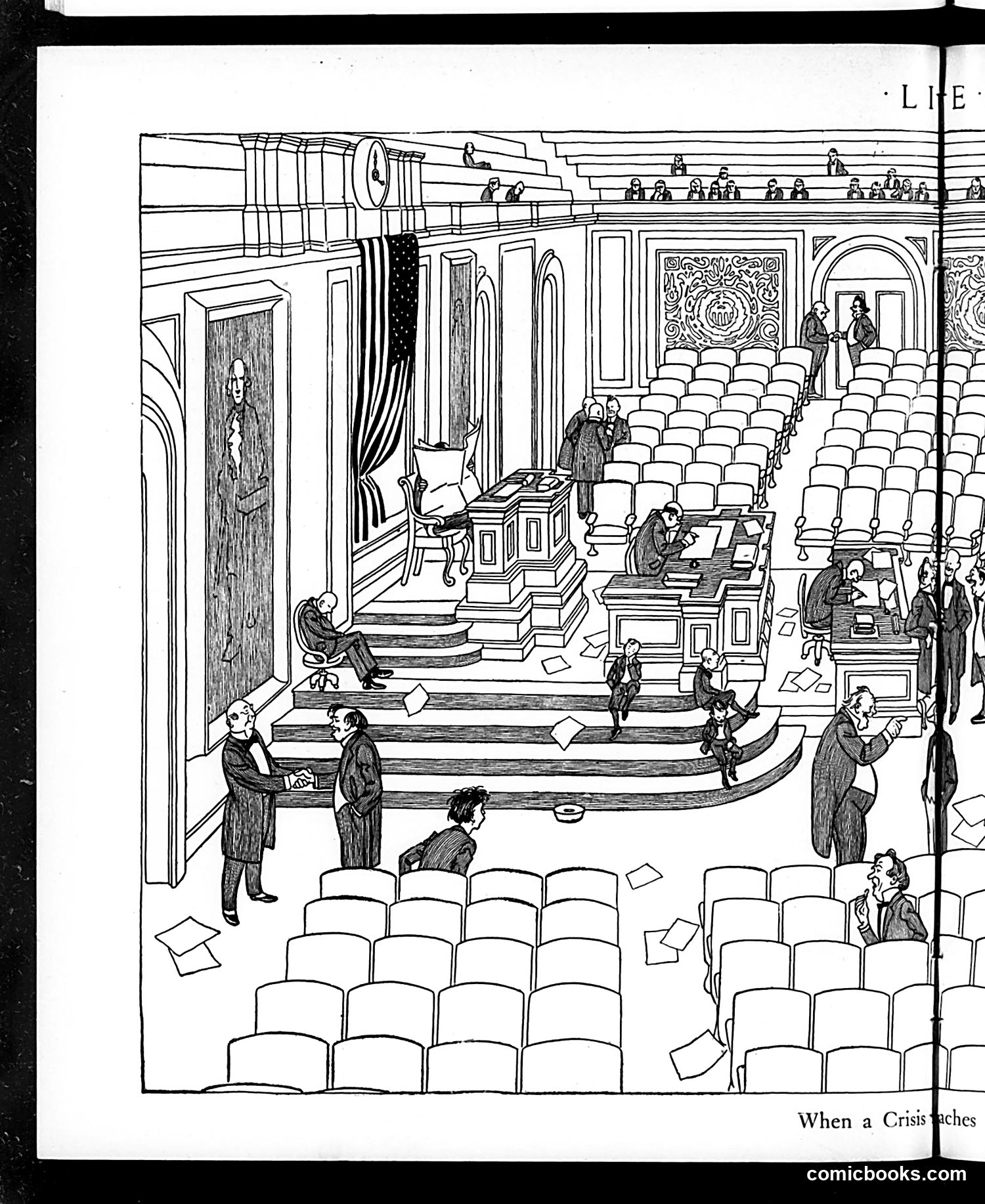
This satirical cartoon depicts the interior of a theater or legislative chamber during what the caption suggests is a moment of crisis. The image shows formally-dressed men in various states of distress or activity—some sitting at desks appearing to work frantically, others standing in conversation, scattered papers on the floor. The ornate architecture with balconies above suggests an important institutional setting. The title "When a Crisis Aches" implies commentary on how institutional leaders respond to emergencies—likely depicting bureaucratic chaos, inefficiency, or panic among officials. Without a specific date visible, the exact crisis referenced is unclear, though the formal setting suggests political or governmental commentary typical of Life magazine's satirical approach to American institutions and leadership.
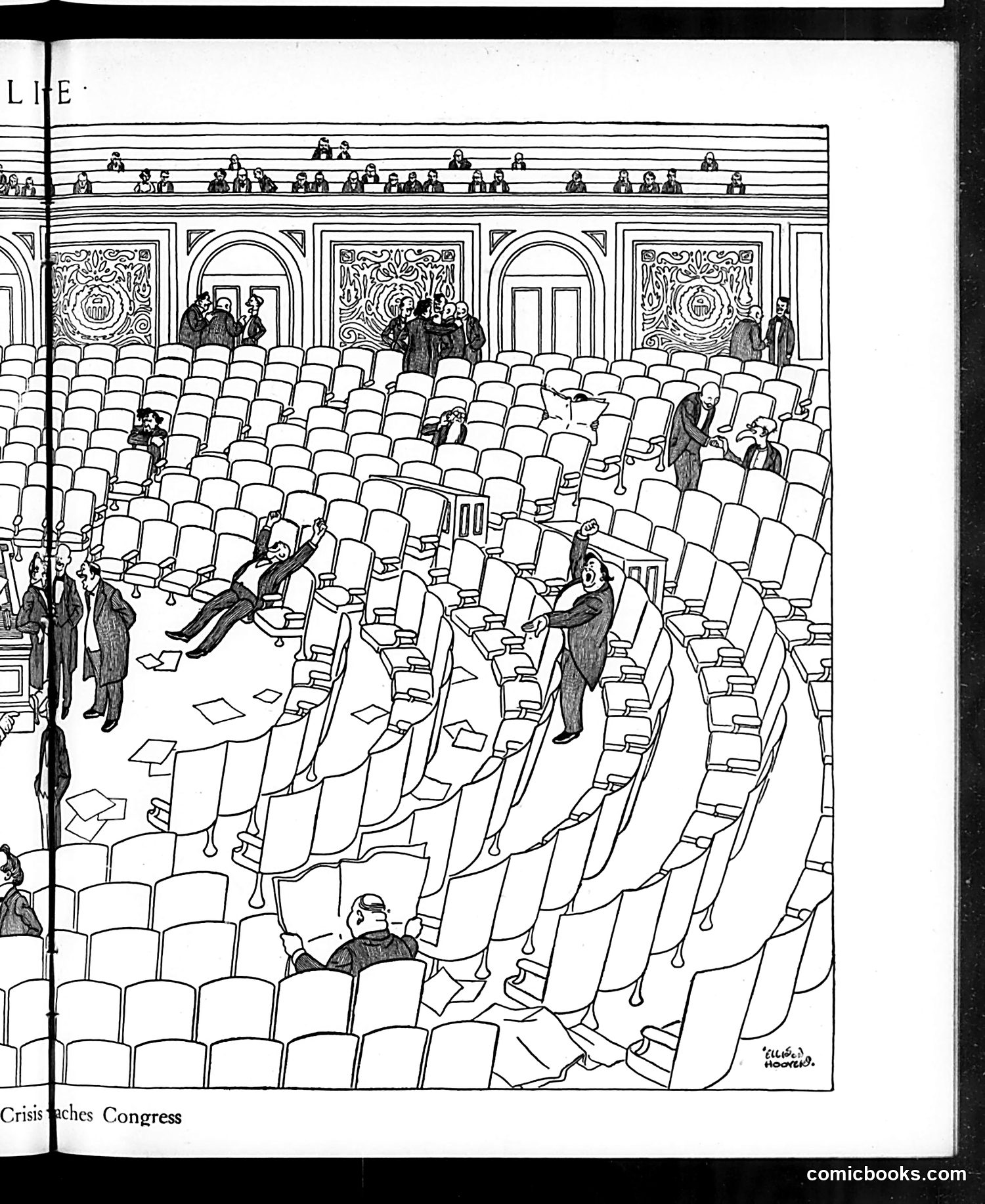
This cartoon depicts an nearly empty auditorium or theater with rows of seats, most unoccupied. A few scattered figures sit or stand among the empty chairs, with papers strewn on the floor. The caption reads "Crisis Aches Congress." The satire appears to criticize Congress for poor attendance or lack of engagement during a period of national crisis. By showing an mostly empty assembly hall with only a handful of representatives present, the cartoonist suggests governmental negligence—that Congress is not adequately addressing urgent national problems. The abandoned seats emphasize the absence of leadership and collective action when the country needs it most. The specific crisis referenced is unclear without additional context, though the drawing style suggests early-to-mid 20th century.
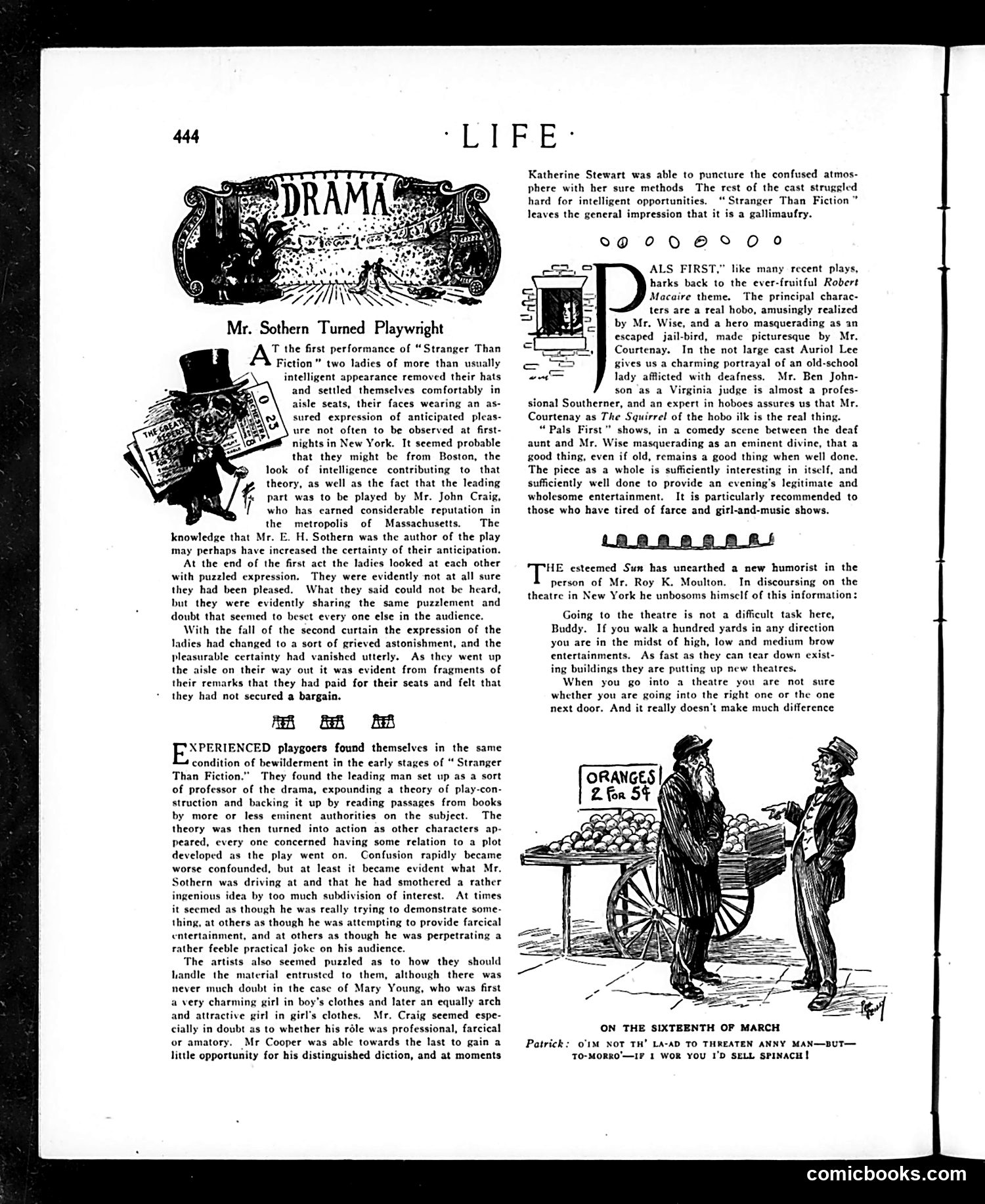
This page reviews E.H. Sothern's play "Stranger Than Fiction," starring John Craig. The main article describes audience confusion at the premiere: two intelligent Boston women arrived expectant but left disappointed, having paid for seats without getting value. The satirical critique explains the play's failure: Sothern attempted to theoretically demonstrate play-construction principles through dialogue and action simultaneously, creating bewildering confusion rather than coherent drama. The cast—including Mary Young and Katherine Stewart—struggled to understand whether they were performing serious drama, farce, or practical jokes on the audience. The cartoon (bottom right) is unrelated advertising for oranges at "2 for 5¢," featuring a street vendor—typical period commercial content. The review's overall point: ambitious theatrical experimentation without clear execution produces neither enlightenment nor entertainment.
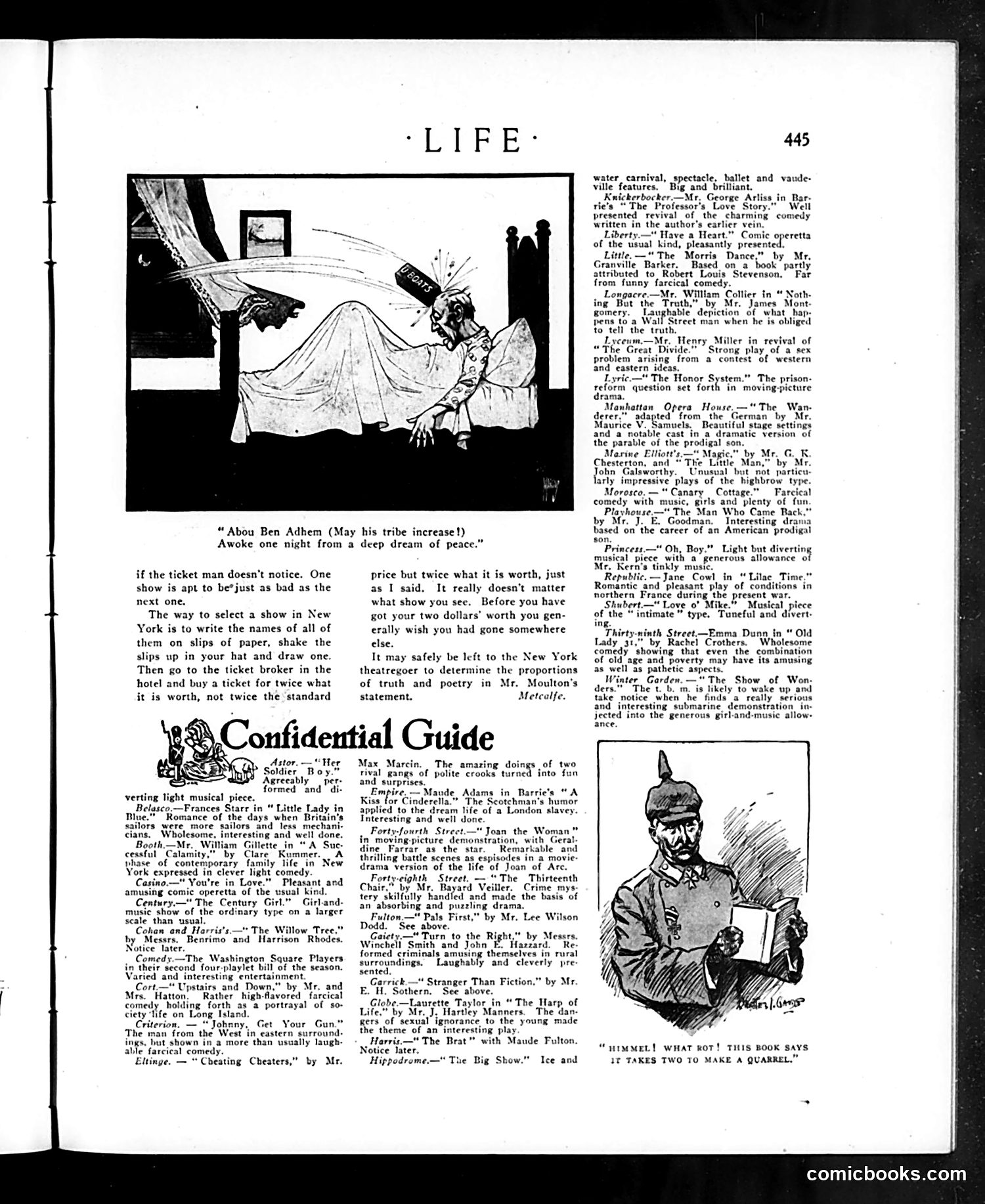
This page contains theater reviews rather than political cartoons. The main illustration shows a bedroom scene captioned "Abou Ben Adhem (May his tribe increase!) Awoke one night from a deep dream of peace"—a literary reference to a romantic poem, used humorously to introduce theater criticism. The "Confidential Guide" section consists of brief, satirical reviews of Broadway shows. The humor lies in the preceding commentary by "Metcalfe," which cynically advises New York theatergoers to select shows randomly since "one show is apt to be just as bad as the next one," and warns that ticket brokers charge twice what shows are actually worth. The reviews themselves employ light satire, describing productions with tongue-in-cheek assessments—calling operettas "of the usual kind" and noting a farce is "rather high-flavored." The overall point is gentle mockery of Broadway's commercialism and the mediocrity of contemporary theater offerings for affluent audiences. The illustrated figure (bottom right) appears unrelated to the reviews.
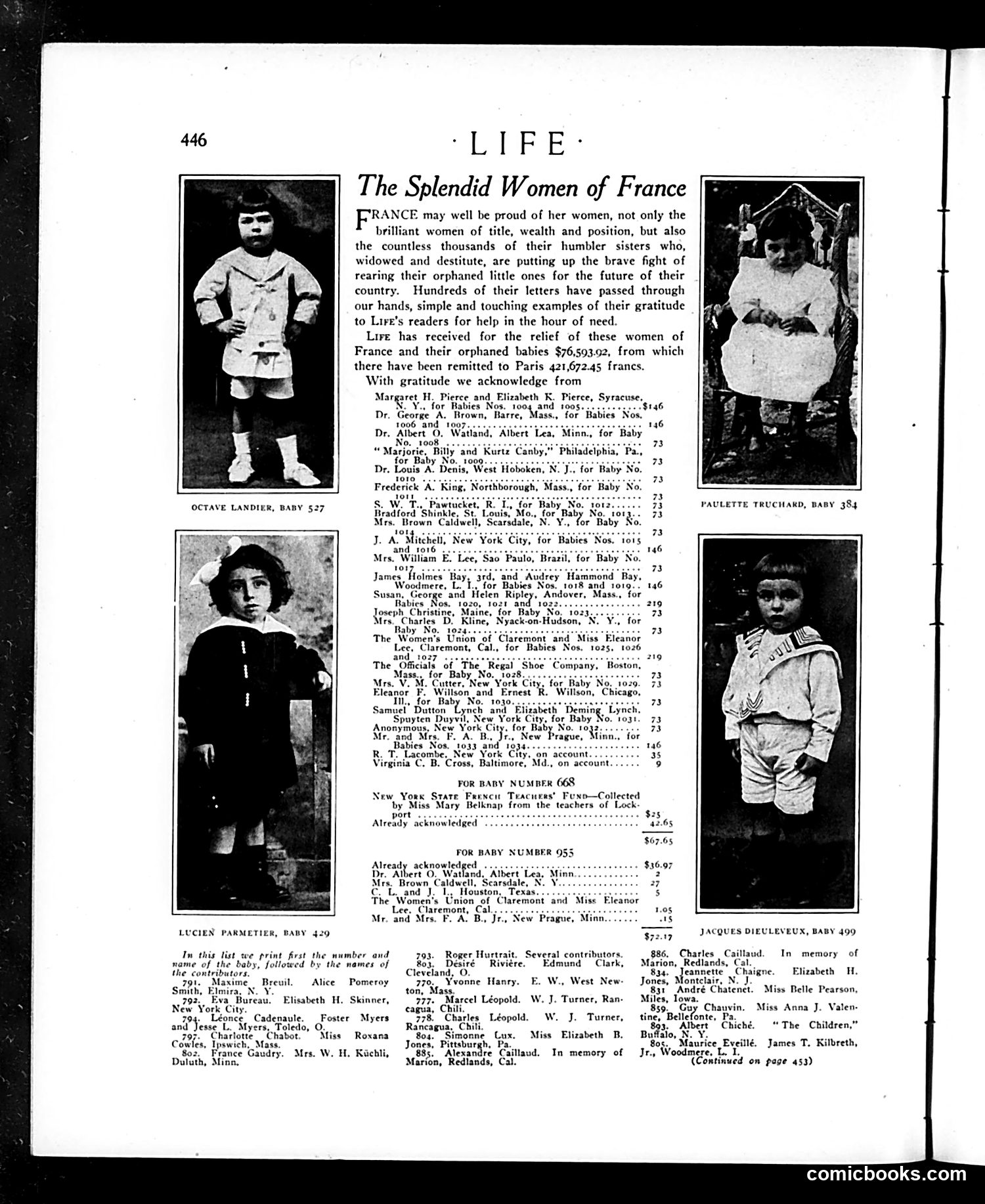
This page documents a *Life* magazine charitable fundraising campaign supporting French war widows and orphans—likely from World War I, based on the context of "destitute" women "rearing their orphaned little ones." The four photographs show French orphaned children (labeled with names and "baby numbers" like "Baby 527") whom American donors have sponsored. The accompanying text lists donors' names and amounts contributed, creating a transparent record of charitable giving. This represents early-20th-century American philanthropy toward allied European civilians affected by war. The sentimental presentation—combining touching photographs of children with donor acknowledgment—was typical of how *Life* mobilized middle-class American readers for foreign relief causes. Donors essentially "adopted" numbered babies, receiving recognition in print.
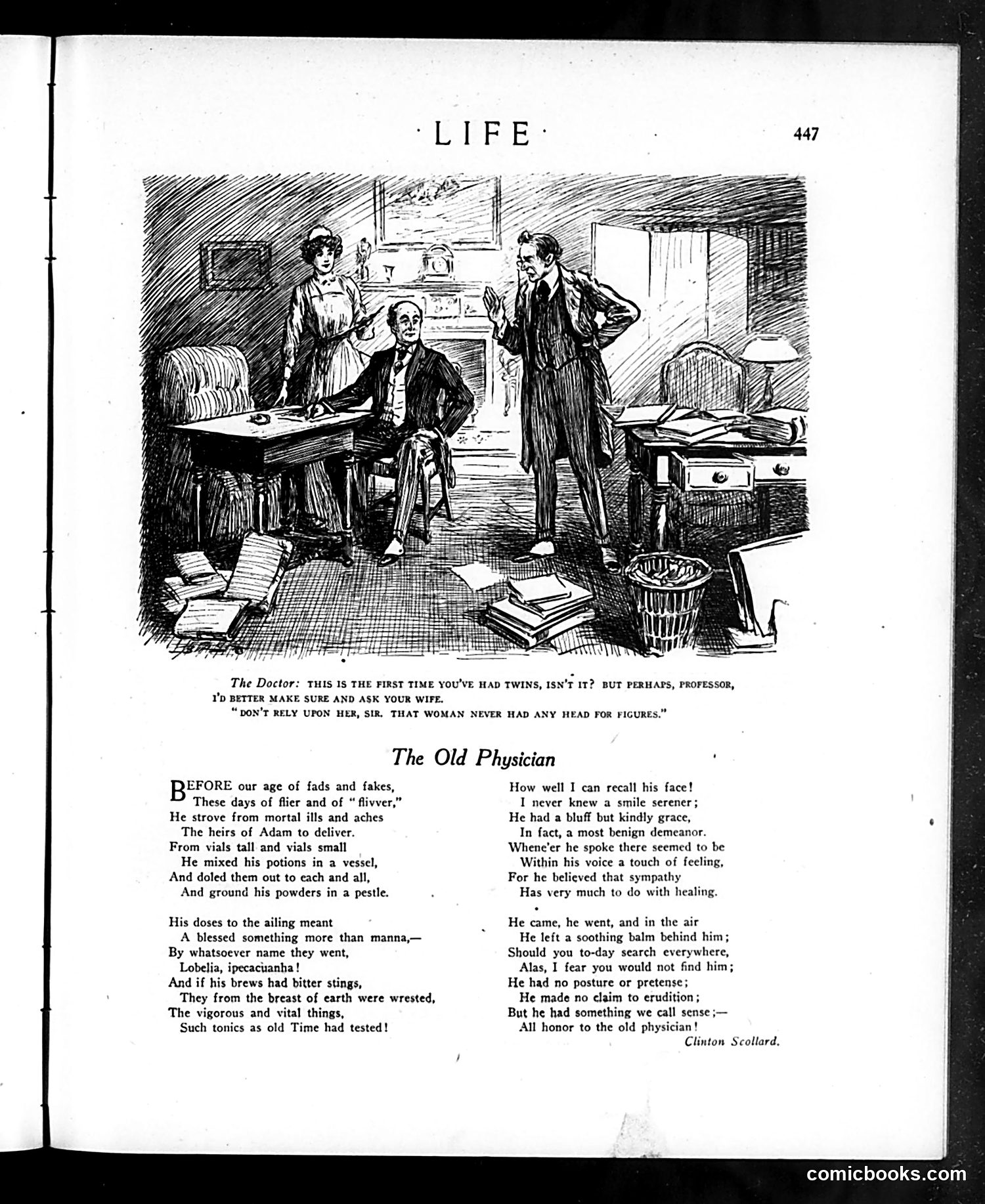
The cartoon satirizes professorial absent-mindedness about domestic matters. A doctor visits a professor's home after delivering twins, asking the wife to confirm details since "that woman never had any head for figures"—a sexist joke implying women are bad at math/accounting. The professor dismisses his wife's testimony despite her being the one who actually experienced childbirth, suggesting absurd male arrogance and the era's dismissal of women's competence and authority over their own experiences. The accompanying poem "The Old Physician" (by Clinton Scollard) nostalgically celebrates pre-modern medicine—herbalists using natural remedies like lobelia and ipecacuanha. It contrasts this with contemporary "fads and fakes," likely referencing early 20th-century patent medicines and quackery. The poem praises old physicians' sympathy and common sense over modern medical pretension, reflecting period skepticism about contemporary medical progress.
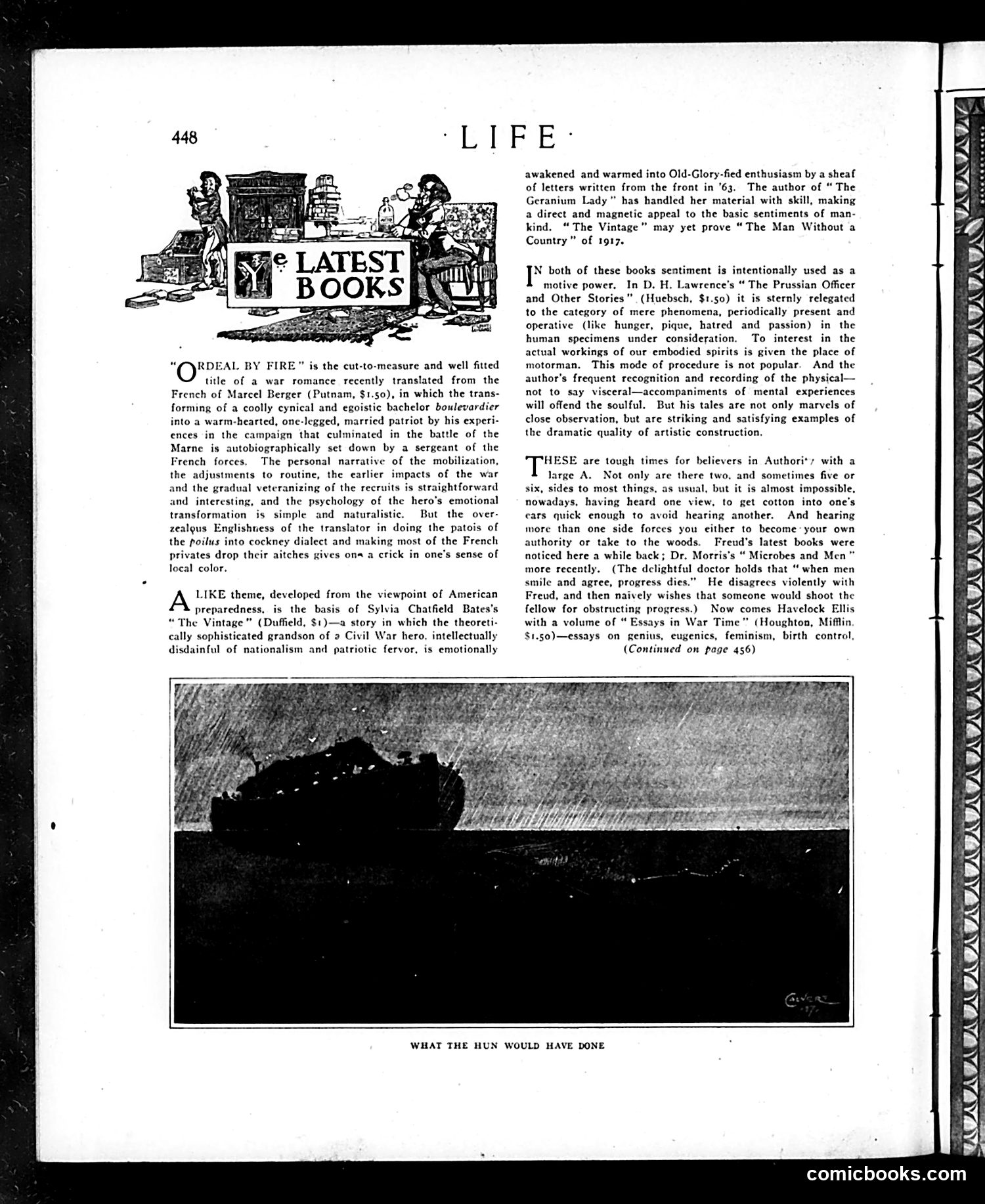
This page reviews recent books, primarily war-related fiction published around 1917. The reviews discuss three novels: 1. **"Ordeal by Fire"** by Marcel Berger—a French soldier's autobiography about transforming from a cynical bachelor into a patriotic amputee during WWI's Battle of the Marne. 2. **"The Vintage"** by Sylvia Chatfield Bates—about an American grandson of a Civil War veteran who becomes patriotically enthusiastic after reading letters from the front (apparently the 1863 Civil War era, based on context). 3. **D.H. Lawrence's "The Prussian Officer"**—short stories treating emotion as biological phenomenon rather than sentiment. The page criticizes overreliance on sentiment as motivation while praising artistic construction. The silhouette illustration captioned "WHAT THE HUN WOULD HAVE DONE" appears darkly satirical regarding German military action, likely referencing contemporary WWI propaganda about German atrocities.
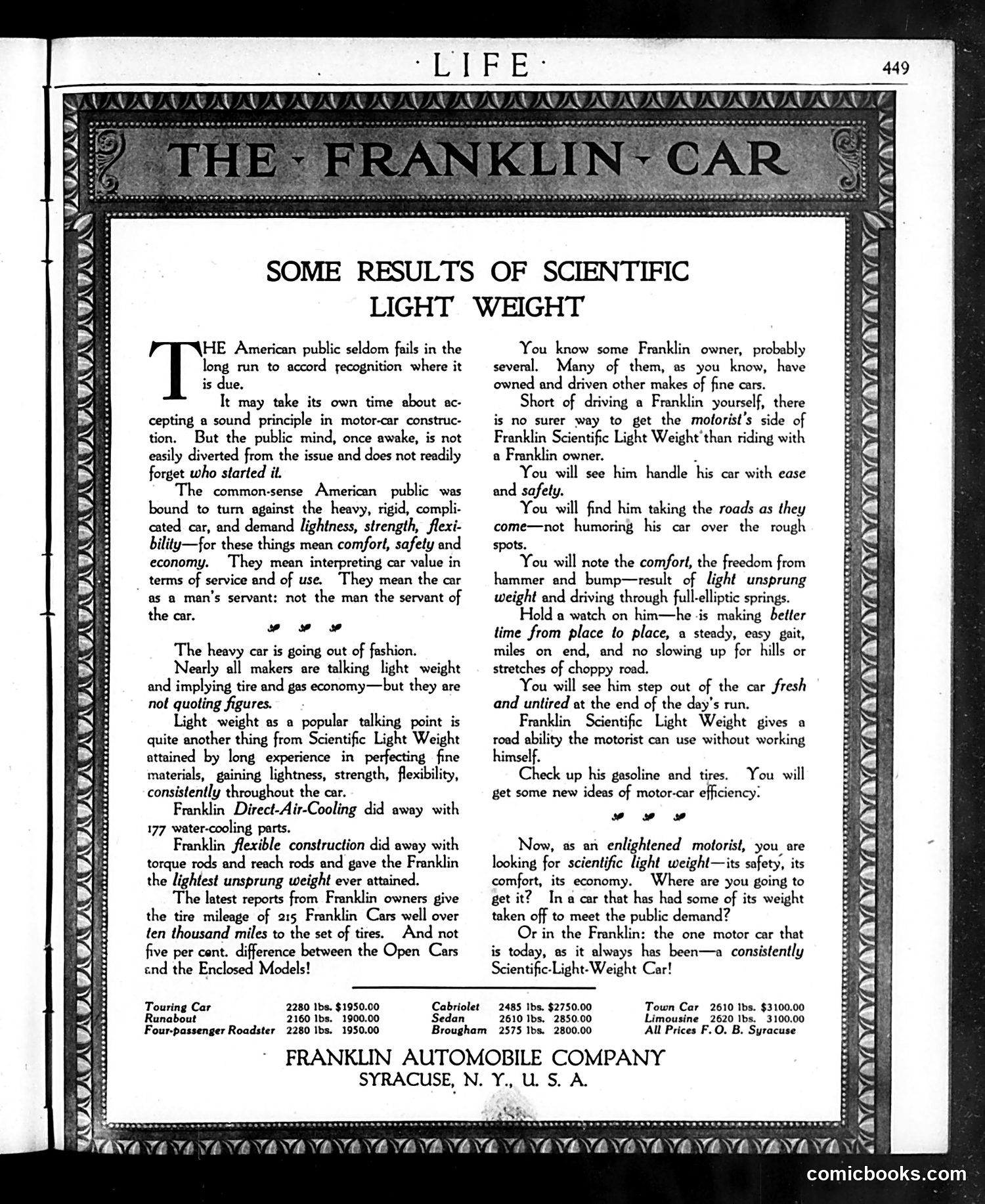
This is primarily a **car advertisement**, not a political cartoon. It appears in *Life* magazine (page 449) promoting Franklin automobiles. The "satire" is subtle and self-promotional: the ad mocks competitors by claiming they talk about "light weight" without "quoting figures," while Franklin alone has achieved "Scientific Light Weight" through genuine engineering—using air-cooling and flexible construction rather than heavy water-cooling systems. The ad positions the Franklin owner as a rational, enlightened motorist who values **comfort, safety, and economy** over fashionable trends. It contrasts Franklin's consistent engineering philosophy against other manufacturers who merely chase marketing buzzwords. The humorous implication: American consumers eventually recognize truth, but are easily distracted by advertising. The ad essentially claims Franklin had the answer all along—a dig at competitors now copying their approach.
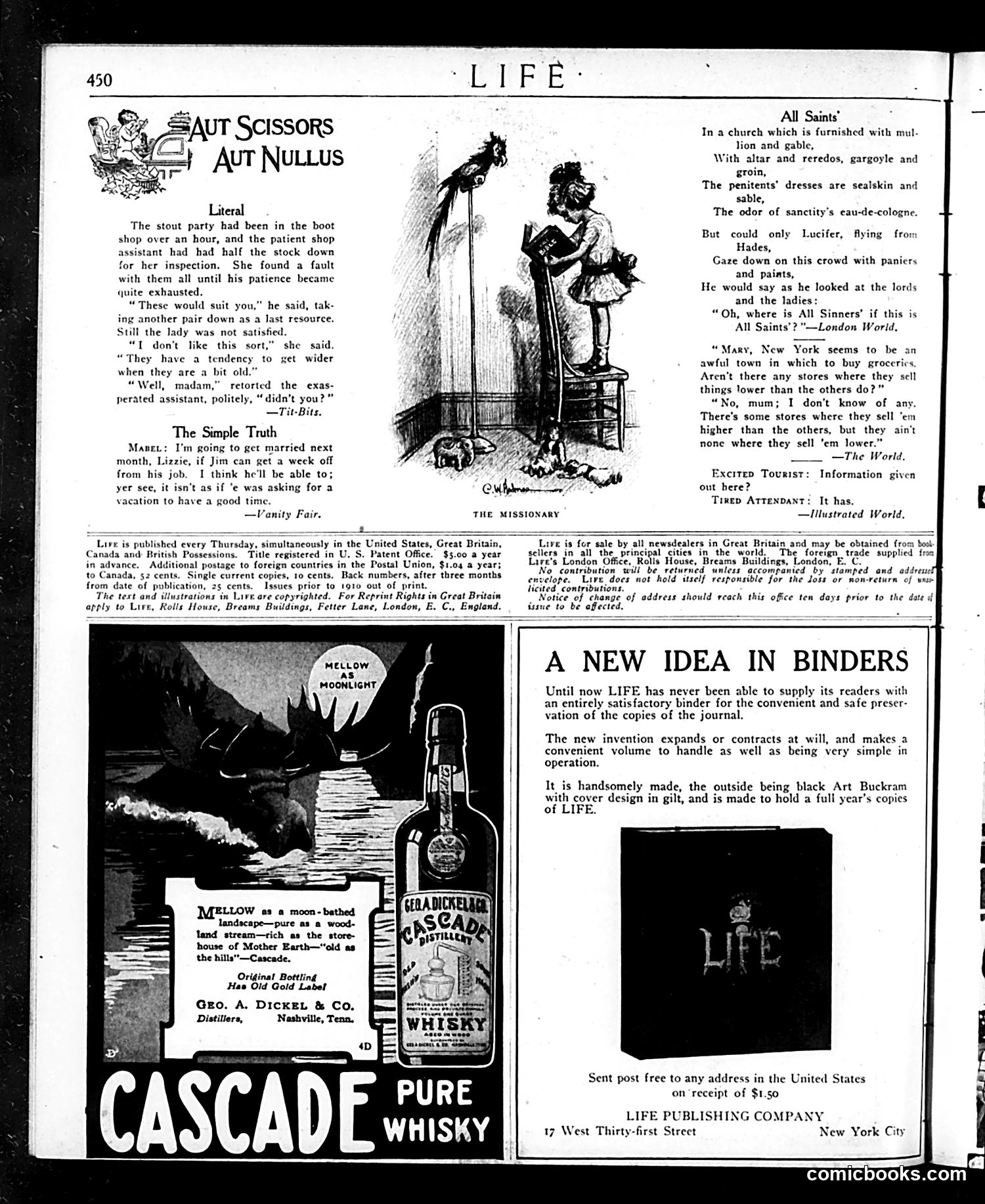
This page contains multiple short humorous pieces typical of early 20th-century satirical magazines: **"Aut Scissors Aut Nullus"**: A shoe-shop clerk becomes exasperated with an indecisive female customer who rejects every pair, complaining they widen with age. The joke satirizes women shoppers as unreasonable and particular. **"The Missionary"**: A poem mocking wealthy churchgoers at "All Saints'" church who dress in expensive furs and perfume while claiming piety. The satire suggests their material excess contradicts Christian virtue—even the Devil would question calling them "saints." **"The Simple Truth"**: A working-class woman notes her fiancé can get time off for marriage since it's not frivolous vacation—satirizing how ordinary workers must justify any time away. The remaining short jokes target New York grocery prices and tourist information services. The page also advertises **Cascade Whisky** and a new **LIFE magazine binder** ($1.50) for collecting annual copies—primarily advertising content.
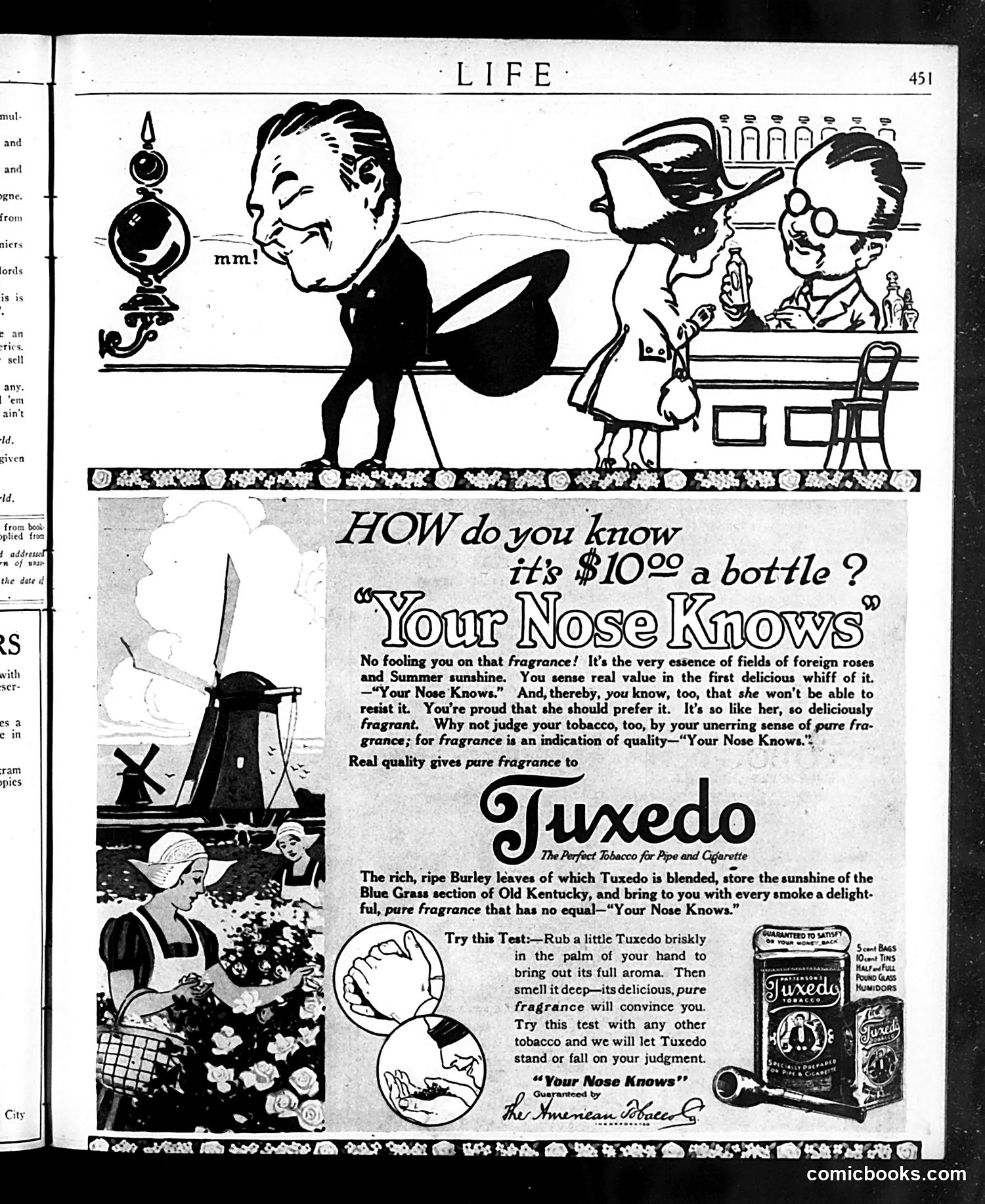
This page is primarily a **Tuxedo tobacco advertisement** using the slogan "Your Nose Knows." The top cartoon is a separate satirical sketch showing a man with an exaggerated nose smelling a perfume bottle, implying that one's sense of smell is a reliable judge of quality—a premise the ad then applies to tobacco. The advertisement targets male smokers by equating the fragrance of tobacco with value and quality. It emphasizes the "pure fragrance" of Tuxedo's Burley leaves from Kentucky, inviting readers to literally test the product by rubbing it and smelling it deeply. The Dutch windmill scene and pastoral imagery below reinforce associations with natural, quality ingredients. The ad represents **early 20th-century marketing** that relied on sensory appeals and lifestyle branding rather than health claims—tobacco advertising before health warnings were required. For modern readers, the most striking aspect is the casual promotion of smoking as a refined, quality-conscious choice.
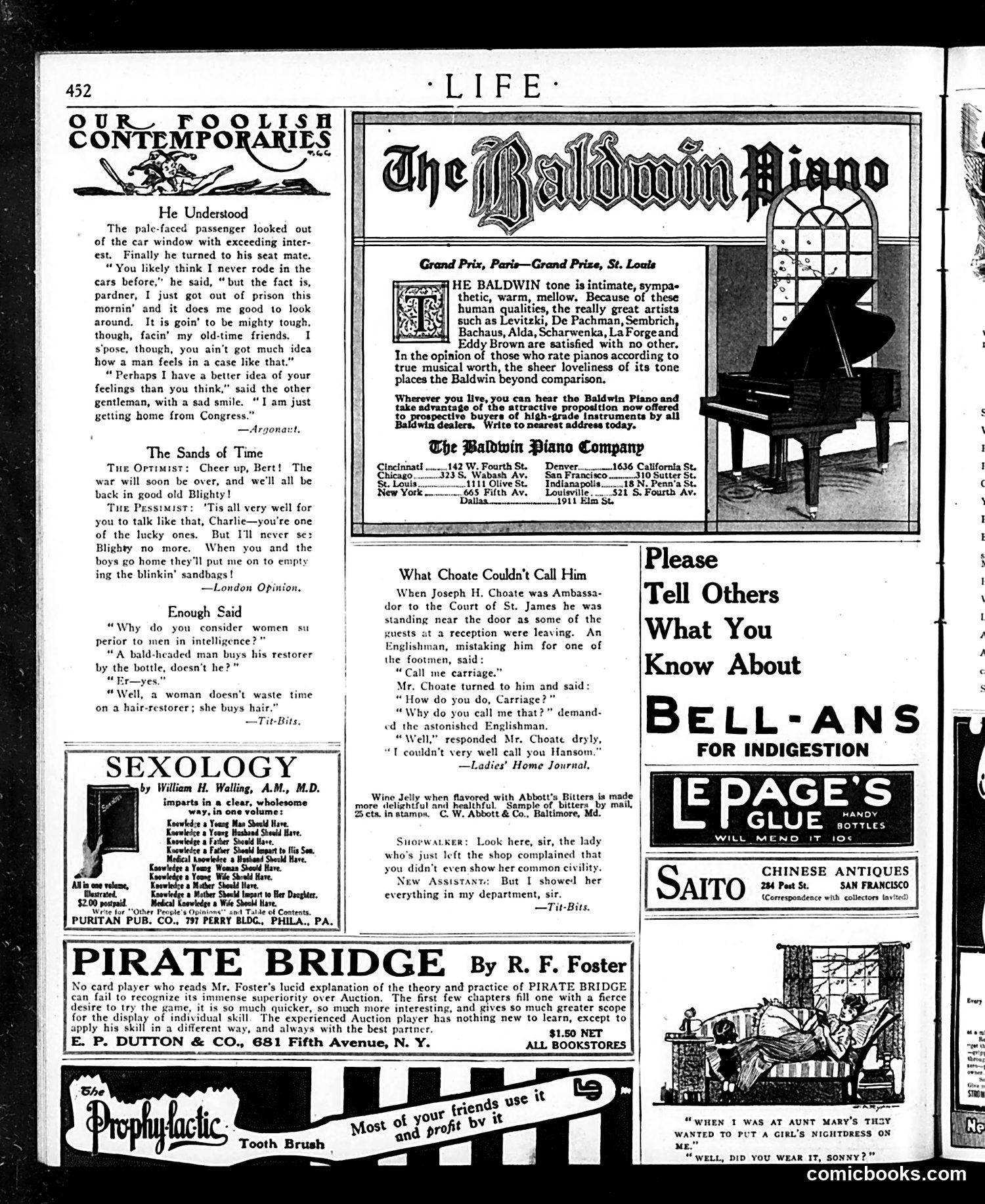
This page is primarily **advertising and humor miscellany** rather than political cartooning. The content consists of: **"Our Foolish Contemporaries"** section: Three brief satirical anecdotes mocking contemporary attitudes. "He Understood" jokes about a recently released prisoner finding comfort in train travel; "The Sands of Time" contrasts optimistic and pessimistic soldiers regarding WWI's end; "Enough Said" plays on gender stereotypes about vanity. **"What Choate Couldn't Call Him"**: A historical anecdote about diplomat Joseph H. Choate being mistaken for a footman at a reception, with wordplay on "Carriage" (the Englishman's suggested name). The remainder is **product advertising**—Baldwin pianos, Bell-ans digestive tablets, LePage's glue, Saito Chinese antiques, Prophylactic toothbrushes, and a bridge card game book. **Context for modern readers**: These jokes reflect early 20th-century social hierarchies, class consciousness, and gender stereotypes now considered outdated.
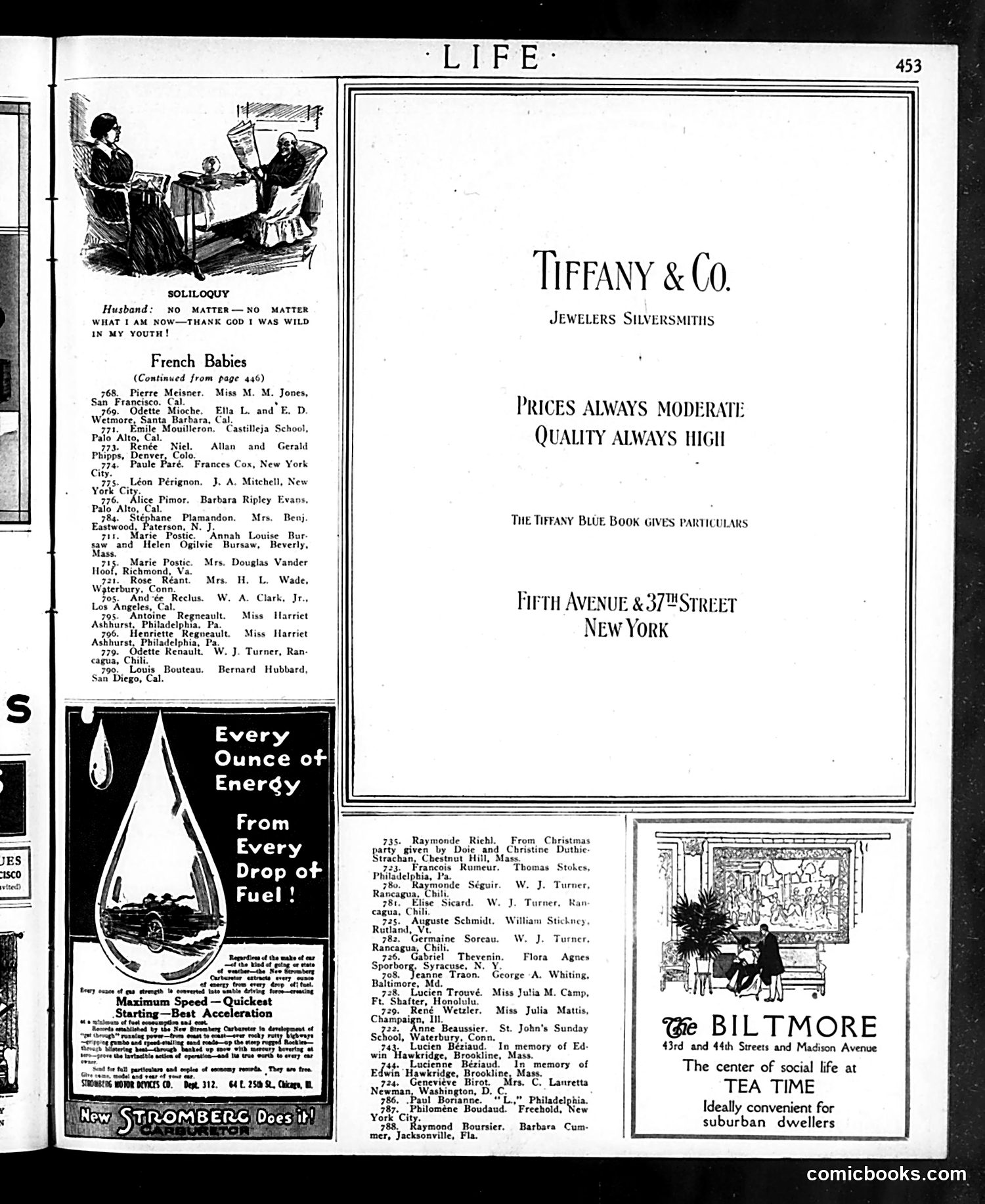
This page is primarily **advertising and announcements**, not political satire. **Top content:** A "Soliloquy" cartoon shows a husband telling his wife he's grateful he was "wild in [his] youth." The joke plays on marital domesticity—a mild observation about how men settle into married life. **Main features:** - A continuation of "French Babies," listing baptized infants (apparently a recurring LIFE feature documenting society births) - A Stromberg fuel advertisement emphasizing engine efficiency - **Tiffany & Co.** jewelry advertisement (Fifth Avenue & 37th Street, New York) - **The Biltmore Hotel** advertisement positioning itself as ideal for suburban visitors seeking "tea time" and social gathering **Context for modern readers:** This reflects early 20th-century American magazines' reliance on luxury advertising and society announcements to fund publication. The "French Babies" list documented upper-class christenings—a form of social status reporting now largely extinct.
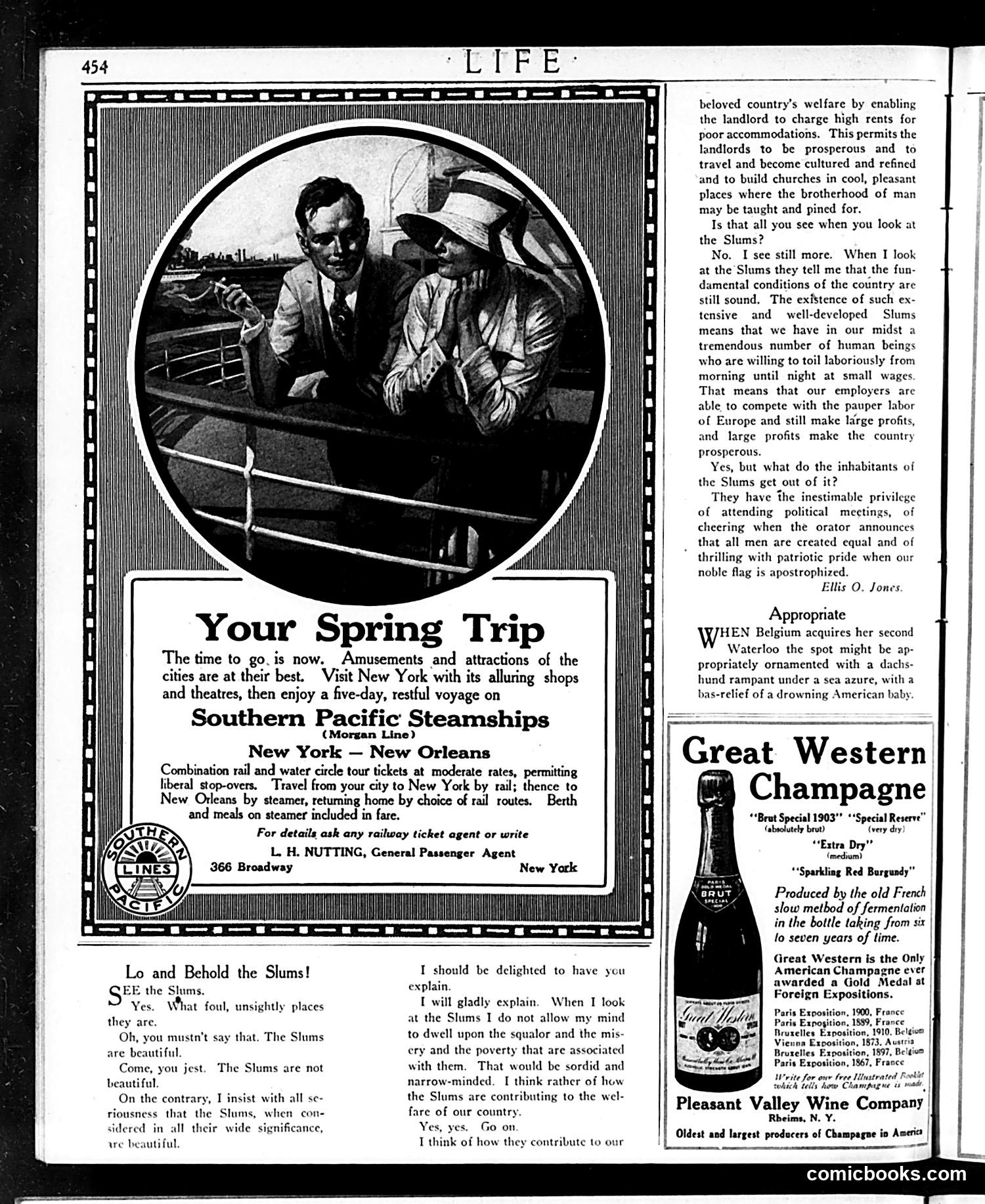
This satirical dialogue mocks the rationalization of urban poverty by wealthy classes. One speaker defends slums as "beautiful" and economically beneficial—they enable landlords to charge high rents, grow cultured, and build churches; they provide cheap labor that keeps American manufacturers competitive globally; and slum dwellers gain the "privilege" of attending political rallies where they're told "all men are created equal." The satire's point: the wealthy use self-serving logic to justify exploitative conditions while treating political promises of equality as compensation for actual poverty. The slum-dwellers are cynically portrayed as benefiting from patriotism and democratic theater rather than material improvement. The byline "Elis O. Jones" suggests this is a submitted piece critiquing how prosperity rhetoric masks systemic inequality—a Progressive Era concern about labor conditions and class disparity in early 20th-century America.
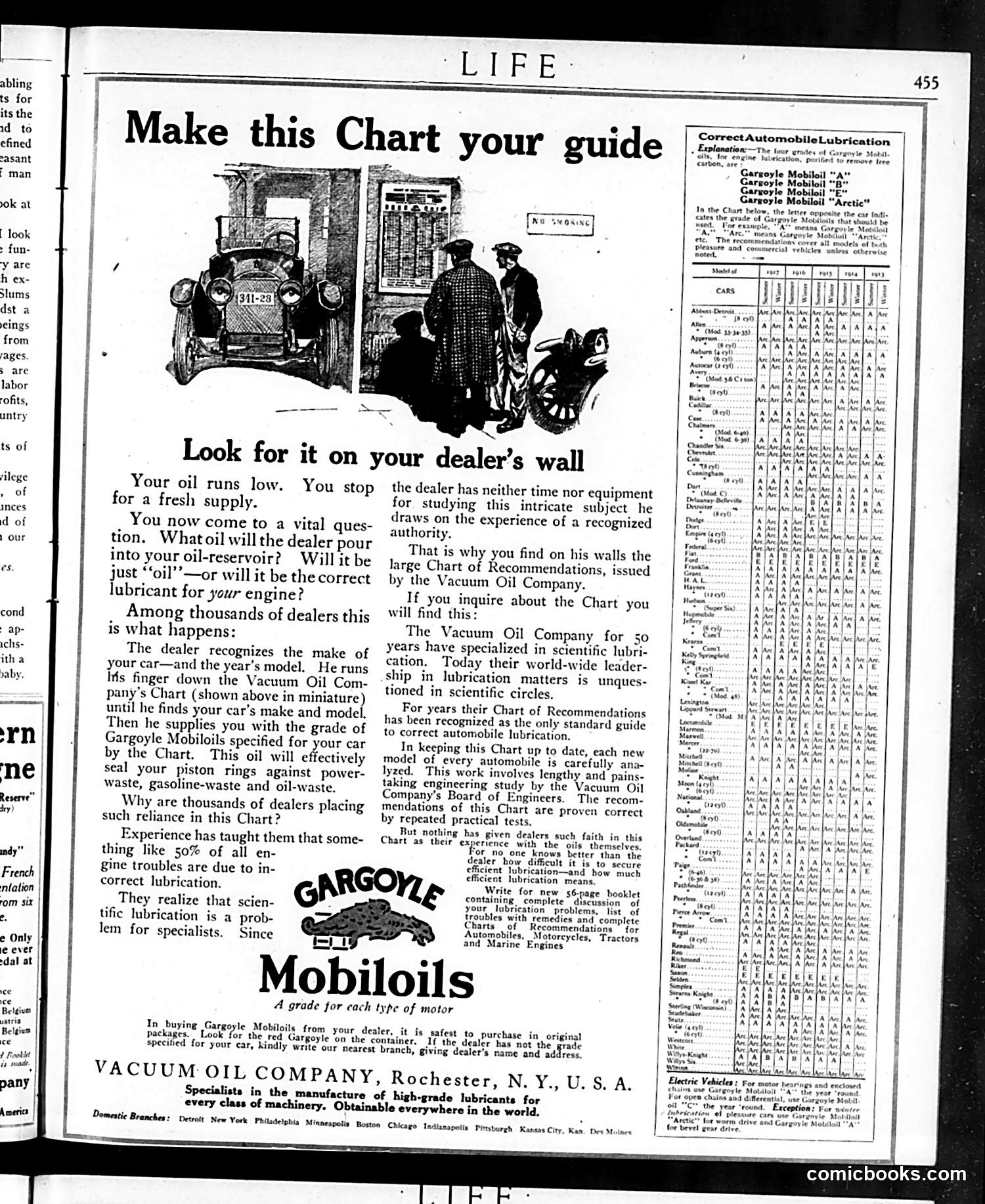
This is a **full-page advertisement** for Gargoyle Mobiloils, not a cartoon or satire. The page promotes the Vacuum Oil Company's lubrication chart system for automobiles. The central image depicts a dealer's shop scene where a car owner inquires about oil, with mechanics present. The accompanying text argues that most engine troubles (approximately 50%) stem from incorrect lubrication, positioning the dealer's wall chart as an authoritative solution. The chart itself—a detailed reference table visible on the right side—lists specific oil grades recommended for different car makes and models. The advertisement's logic appeals to dealers' practical concerns: they lack specialized knowledge in lubrication science, so the standardized chart provides credibility and customer confidence. The Vacuum Oil Company emphasizes its 50-year specialization in scientific lubrication to establish authority. The "Gargoyle" branding and color-coded oil grades (marked A, B, etc.) represent their product differentiation. This is straightforward **product marketing**, not political or social satire—typical of early automotive-era trade advertising emphasizing specialized technical knowledge and standardization.
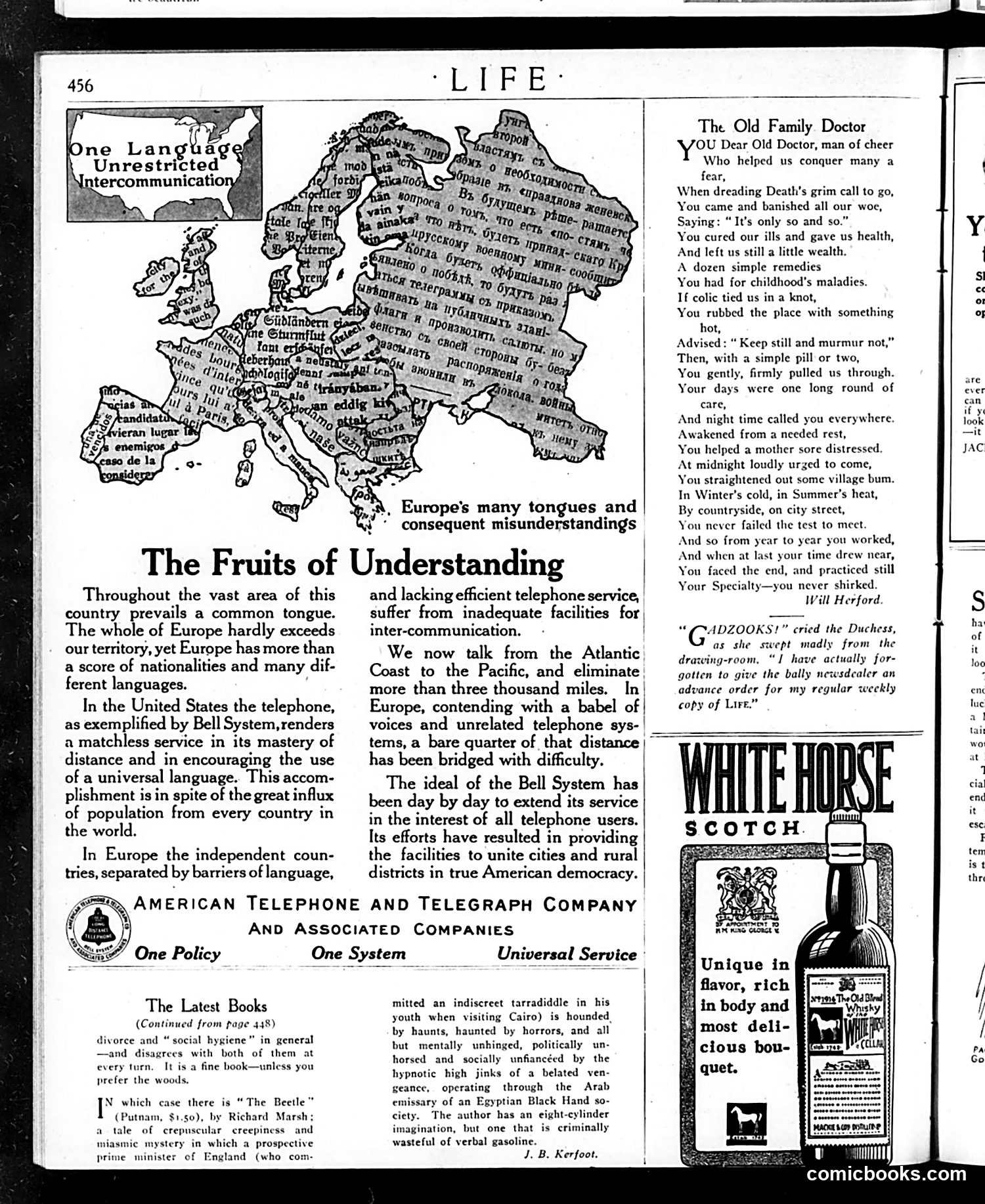
This is a 1920s corporate advertisement by AT&T disguised as social commentary. The map shows Europe fragmented by language barriers, with the main text arguing that America's telephone system (Bell System) has succeeded where Europe fails—by enabling communication across vast distances despite immigrant diversity. The satire is implicit rather than explicit: AT&T credits American technological achievement and "universal service" for national unity, while depicting European fragmentation as inevitable given linguistic division. This conveniently elides the real tensions between immigrant communities and native-born Americans, reframing assimilation as a technical rather than social problem. The page includes unrelated content: a poem honoring a rural family doctor, and advertisements for books and White Horse Scotch whisky, typical of Life magazine's mixed-content format.
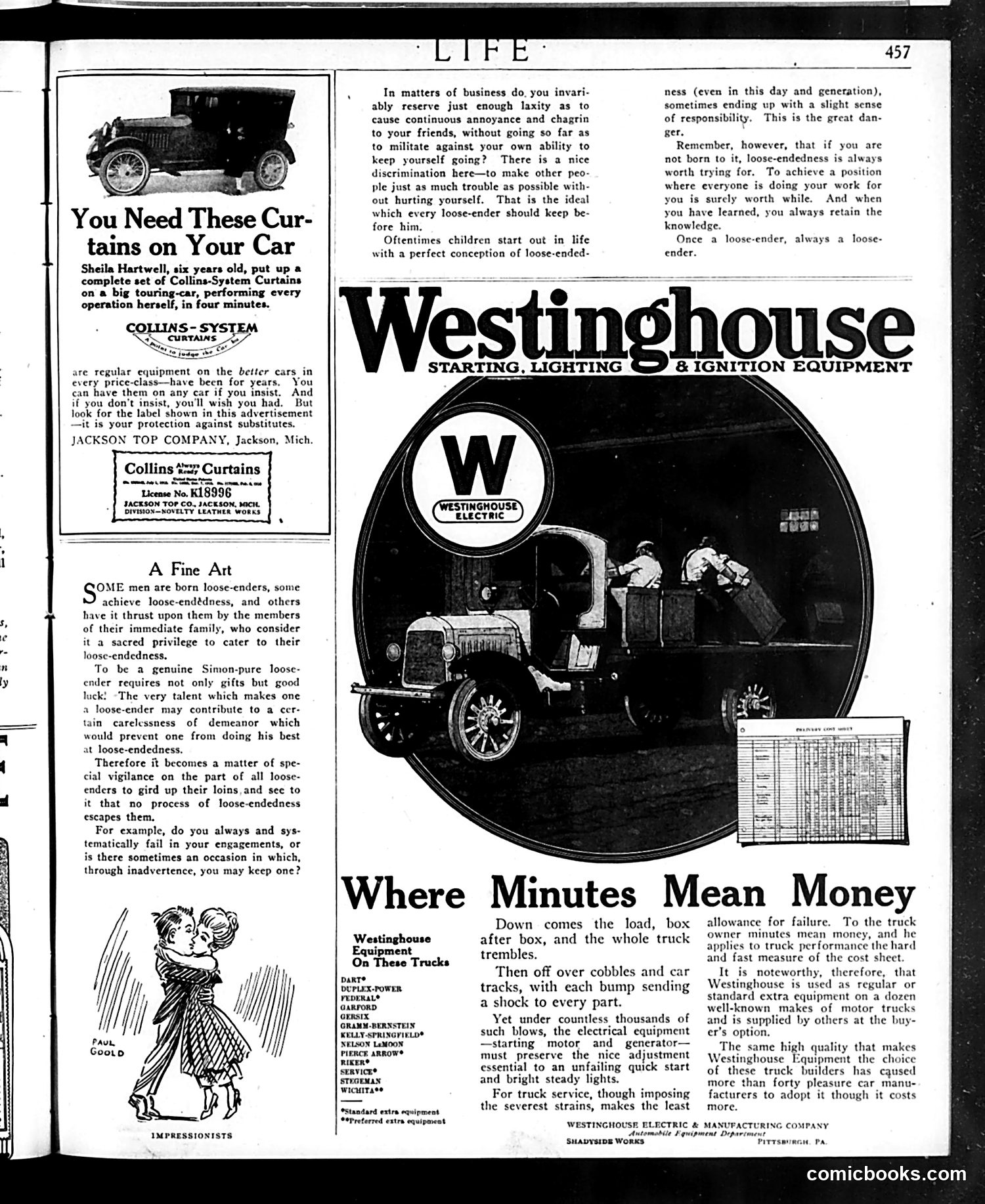
This page from *Life* magazine satirizes a social type: the "loose-ender"—a person chronically unreliable, perpetually disorganized, who inconveniences others while maintaining personal functionality. The article humorously elevates this into "a fine art," suggesting some people are naturally born this way, others achieve it, and others have it thrust upon them. The satire mocks both the loose-ender's lack of accountability and the enablers who tolerate it. A child named Sheila Hartwell demonstrates she's *not* a loose-ender by competently installing car curtains in four minutes—a contrast emphasizing the virtue of responsibility. The Westinghouse and Collins advertisements selling car equipment occupy the page's right half, exploiting this theme: reliability in machinery contrasts with human unreliability. Westinghouse equipment ensures trucks perform consistently despite "severe strains," implicitly suggesting humans could learn from mechanical dependability.
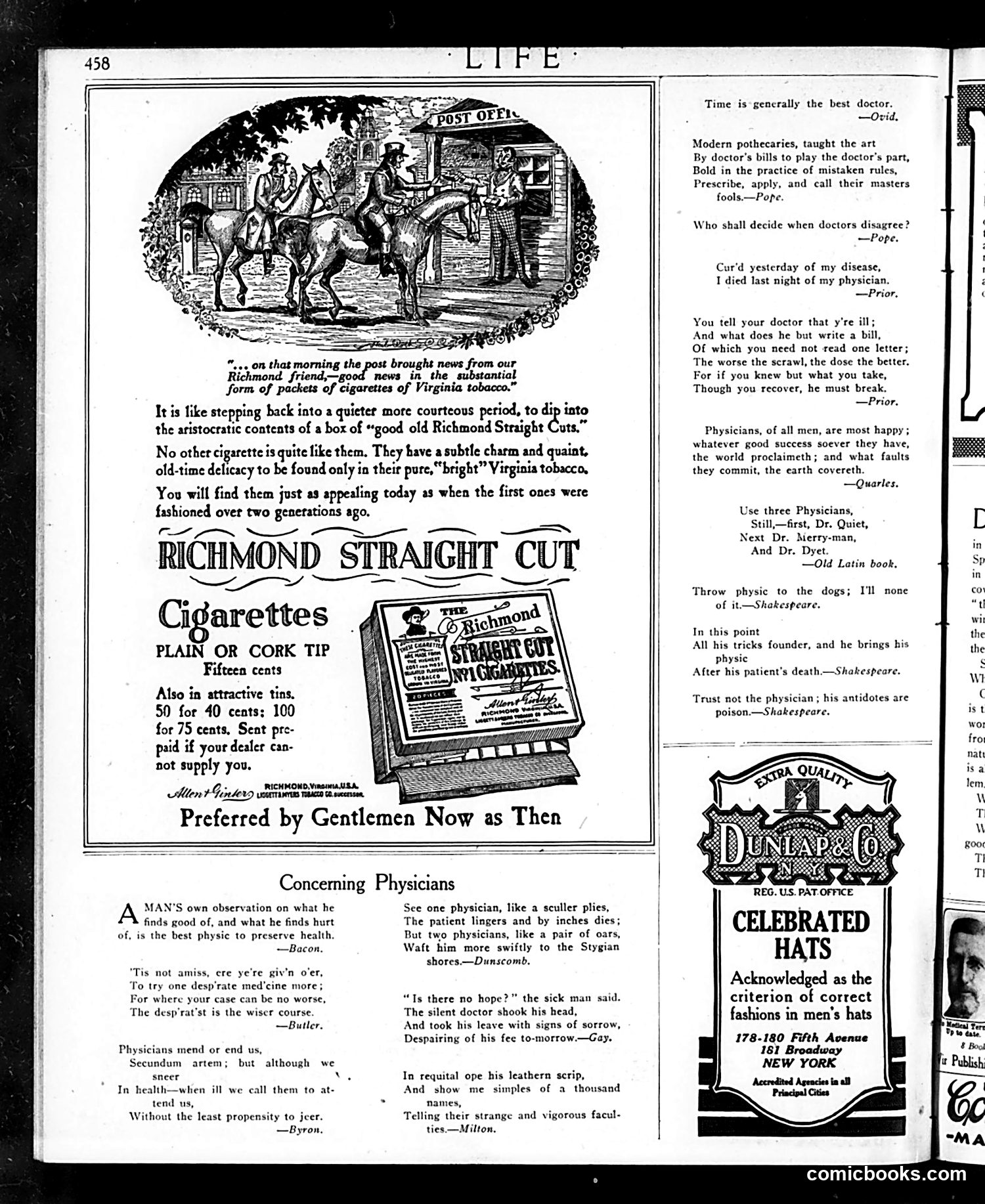
This page combines a cigarette advertisement with a satirical section attacking physicians. The top features a Richmond Straight Cut cigarettes ad using nostalgic imagery of a post office scene, marketing the product as refined and aristocratic—"preferred by gentlemen now as then." The bulk of the page presents a coordinated attack on doctors through classical and literary quotations. From Ovid, Pope, Shakespeare, and others, the passage assembles criticisms portraying physicians as incompetent, greedy, and dangerous. Key charges: they write illegible prescriptions, profit from patients' illness, cause deaths, and charge excessive fees ("despairing of his fee to-morrow"). This anti-doctor sentiment reflects early 20th-century American skepticism toward the medical profession—doctors lacked modern standards, often proved ineffective, and were viewed as profit-driven charlatans. The satire suggests "time is the best doctor," implying rest and nature heal better than physicians do.
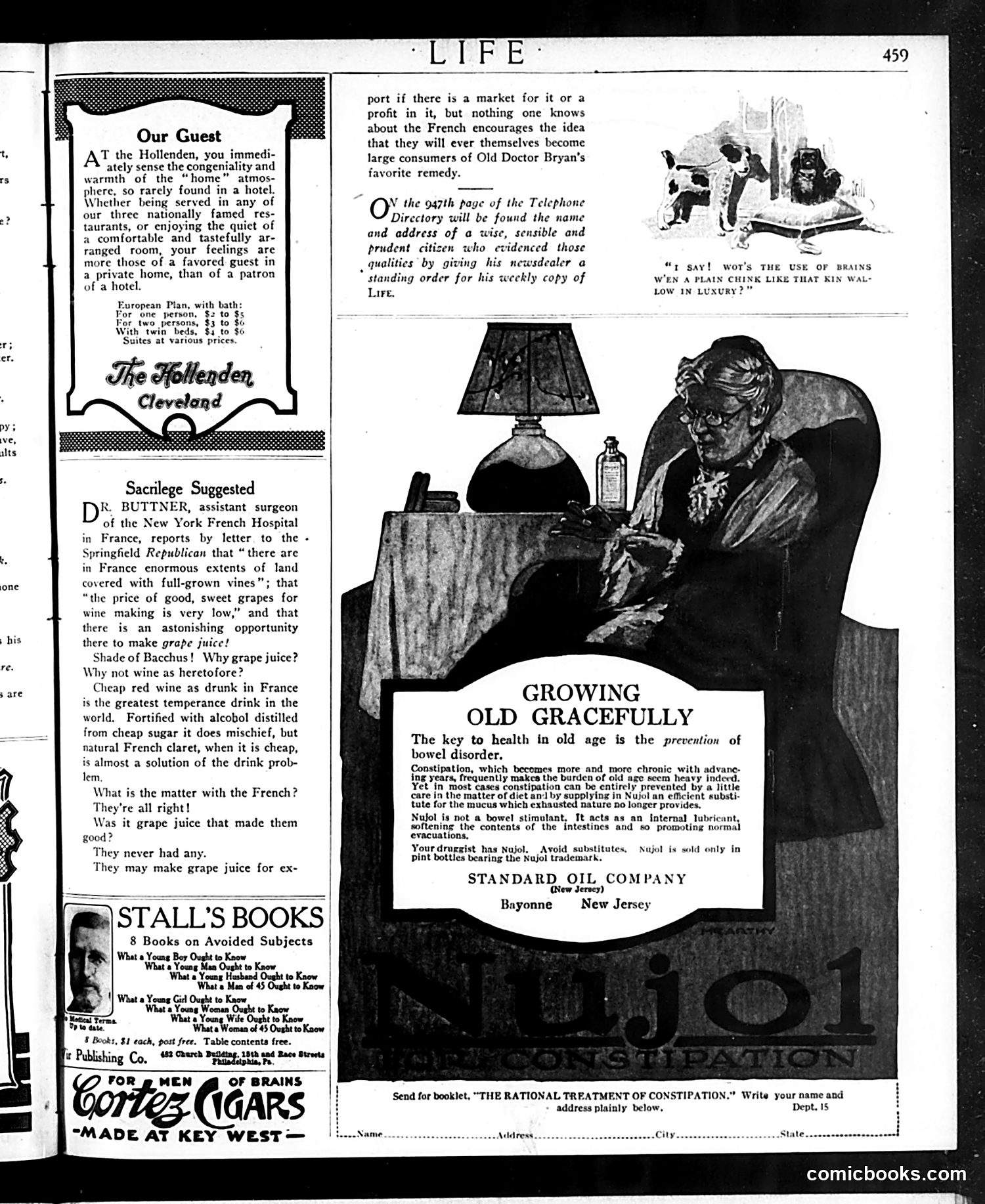
This is primarily an **advertising page** with one satirical commentary section. The main satire is "Sacrilege Suggested," which mocks American temperance advocates. An American doctor in France has suggested making grape juice from French vineyards instead of wine. The article sarcastically defends French wine culture, arguing that cheap natural claret is "the greatest temperance drink in the world" and questioning why Americans would want to convert the French to grape juice production. The joke targets Prohibition-era American moralism and the absurdity of exporting temperance ideology to a wine-producing nation with a different cultural tradition. The rest of the page contains period advertisements: The Hollenden hotel (Cleveland), Stall's Books, Cortez Cigars, and a Standard Oil Company "Nujol" laxative ad featuring an elderly woman—reflecting common early 20th-century marketing that treated digestive health as a major consumer concern.
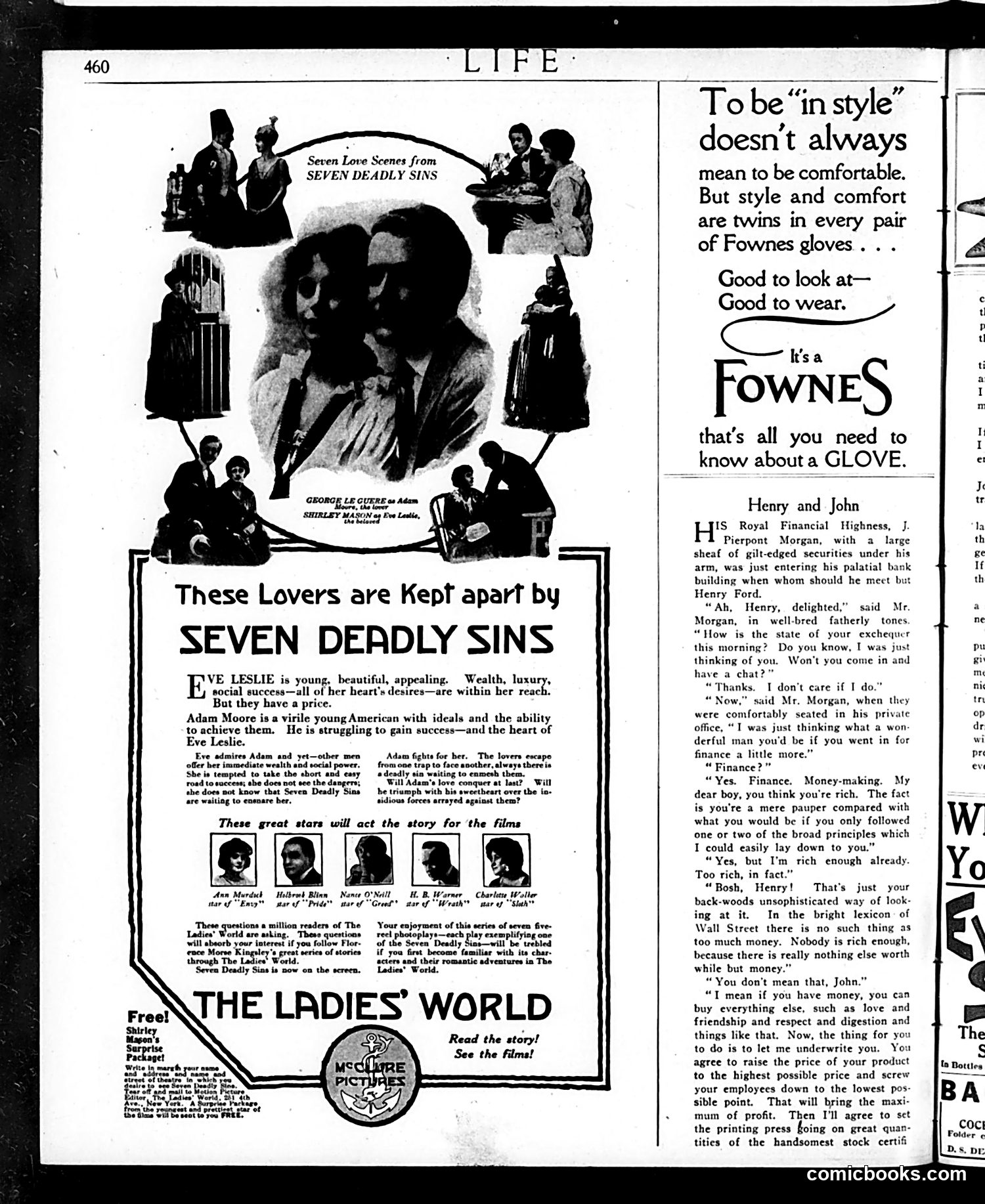
This page contains two distinct sections: **Left side:** An advertisement for the film "Seven Deadly Sins," a five-reel melodrama about young lovers Eve Leslie and Adam Moore kept apart by temptation and vice. The promotion cross-references a serialized story in *The Ladies' World* magazine, listing actors including Lillian Gish. This appears to be standard early cinema marketing. **Right side:** A satirical dialogue between Henry Ford and J. Pierpont Morgan. Morgan, a wealthy financier, lectures Ford on "real" wealth-building through financial manipulation—raising product prices while cutting worker wages, then issuing stock certificates to generate paper profits. Ford, portrayed as unsophisticated but content with his actual fortune, deflates Morgan's schemes. The satire targets financial excess and the gap between earned wealth (Ford's manufacturing) versus speculative wealth (Morgan's banking). For modern readers: this reflects 1920s anxiety about whether industrial magnates or Wall Street financiers represented "real" American success.
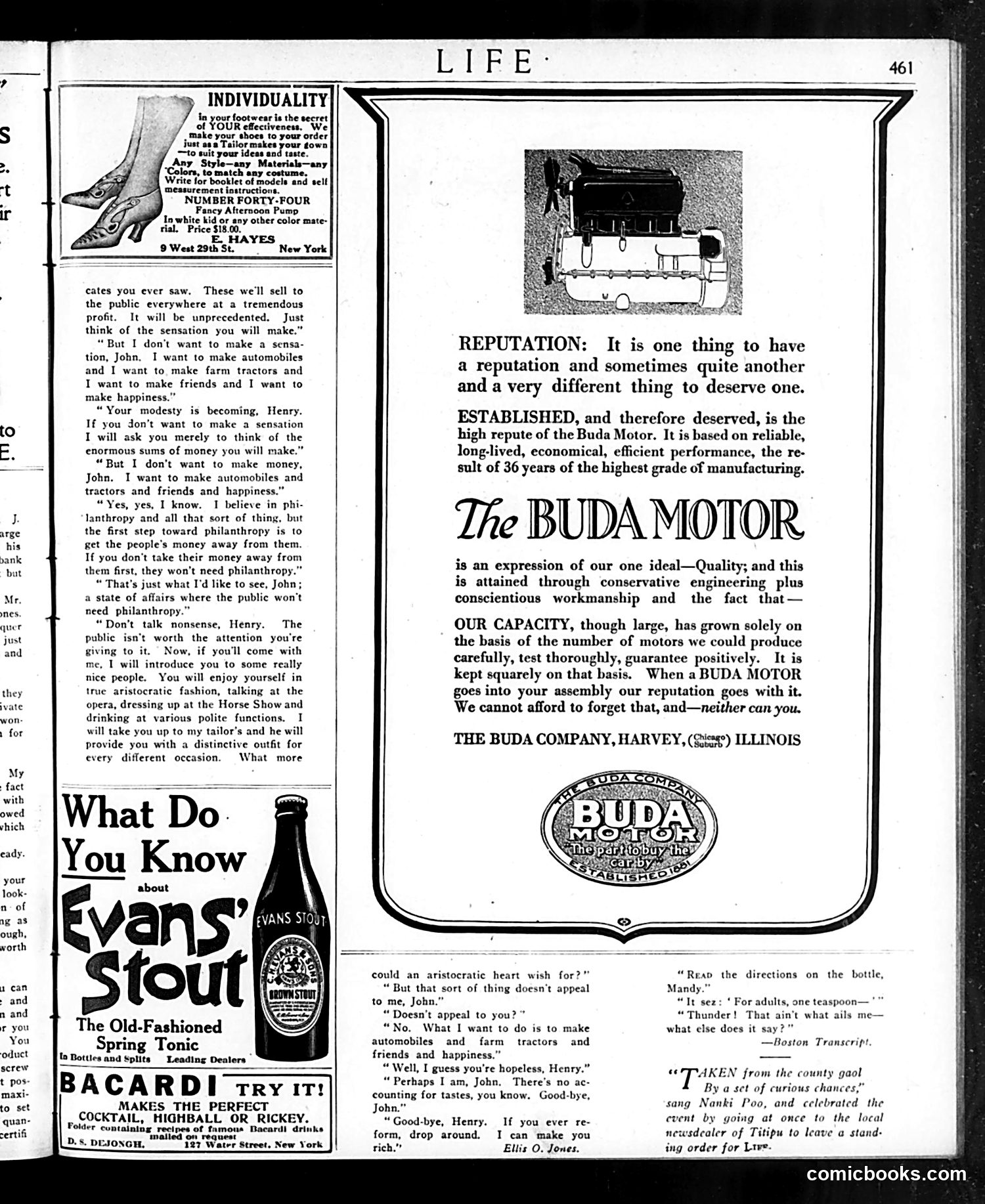
This page contains a dialogue-based satirical story (likely by Ellis O. Jones) mocking the conflict between commercial ambition and idealistic values. The unnamed characters appear to be "John" (a capitalist/businessman) and "Henry" (likely representing Henry Ford, given references to automobiles and tractors), though the text never explicitly names him. **The satire's point:** John repeatedly tempts Henry with wealth and high society—fancy tailors, opera, horse shows—while Henry insists he wants only to manufacture quality products and make friends and happiness. John's argument that one must extract money from the public before they'll need philanthropy represents corrupted capitalist logic. The surrounding advertisements (Bacardi, Buda Motors, Evans Stout, E. Hayes shoes) are period products unrelated to the narrative. The Boston Transcript joke at bottom is separate filler content. **Modern context:** This reflects early-20th-century tensions between industrial capitalism and idealistic manufacturing ethics—a debate about whether profits or social good should drive business.
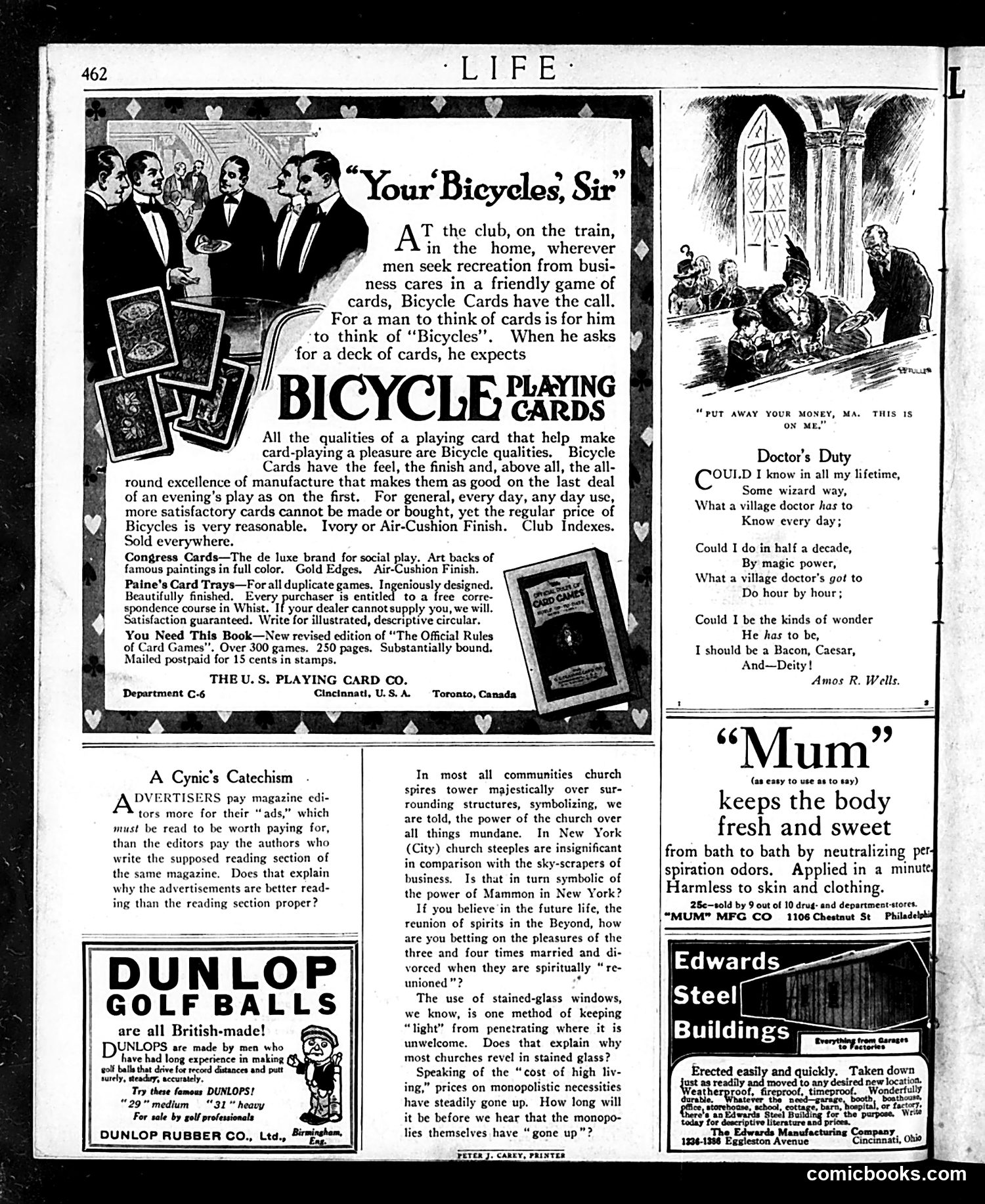
This page is primarily **advertising**, featuring four main commercial promotions: 1. **Bicycle Playing Cards** (large center): Markets cards to businessmen seeking recreation, emphasizing quality manufacture and the brand's dominance ("when he asks for a deck of cards, he expects Bicycle"). 2. **"A Cynic's Catechism"** (left column): A satirical commentary on advertising economics—the author mocks that magazines pay advertisers more than they pay writers, questioning why ads are better-written than editorial content. The piece also cynically critiques church architecture (steeples dwarfed by skyscrapers in New York), suggesting material wealth outweighs spiritual power. 3. **"Doctor's Duty"** (right): A poem by Amos R. Wells praising village doctors' impossible demands and miraculous capabilities. 4. **Minor ads**: Dunlop golf balls, "Mum" deodorant, Edwards Steel Buildings. The page satirizes commercial culture while simultaneously serving as a vehicle for advertising—a somewhat ironic juxtaposition the "Cynic's Catechism" explicitly calls out.