
Life, 1917-03-15 · page 25 of 42
Life — March 15, 1917 — page 25: what you’re looking at
What you’re looking at
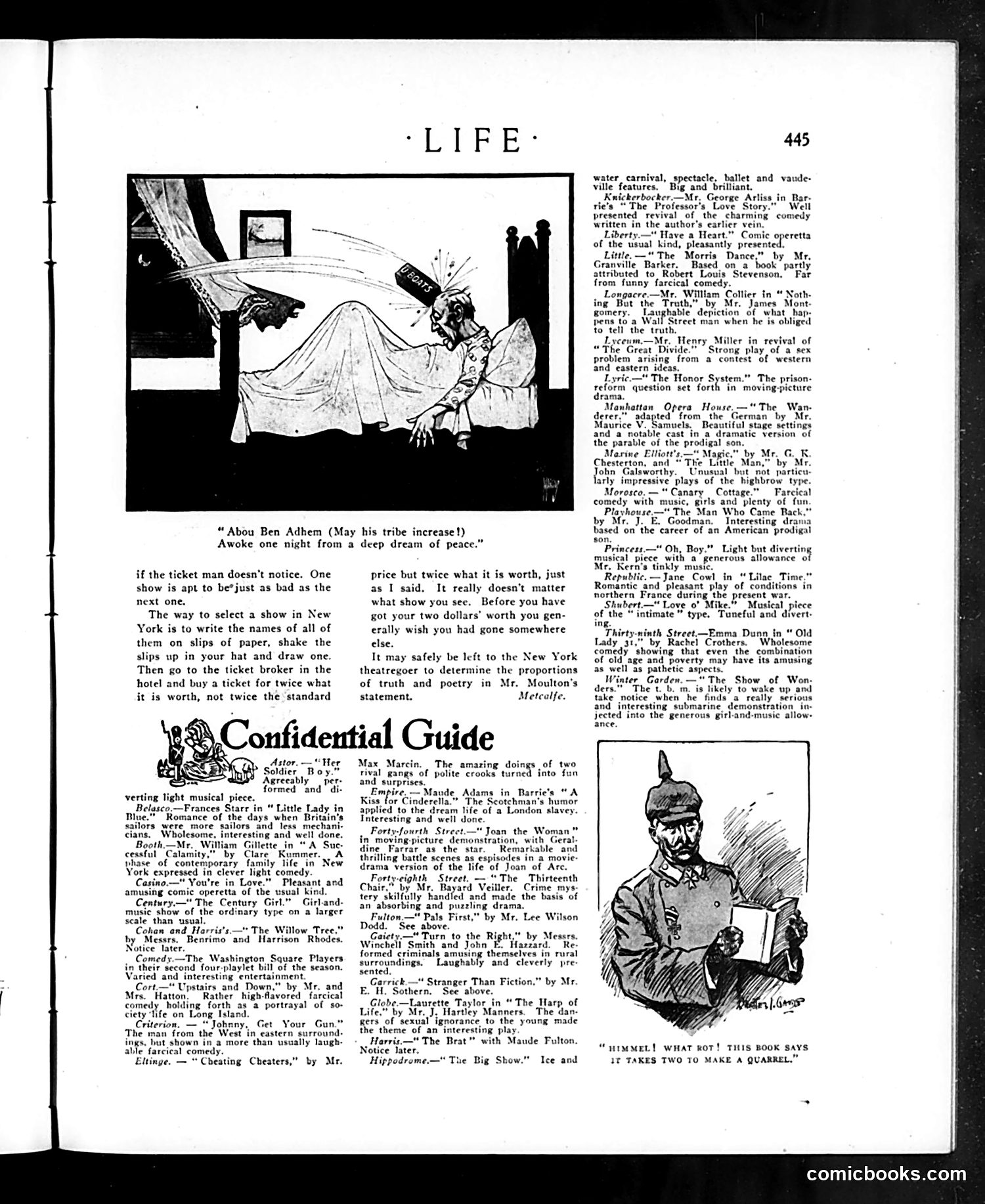
This page contains theater reviews rather than political cartoons. The main illustration shows a bedroom scene captioned "Abou Ben Adhem (May his tribe increase!) Awoke one night from a deep dream of peace"—a literary reference to a romantic poem, used humorously to introduce theater criticism. The "Confidential Guide" section consists of brief, satirical reviews of Broadway shows. The humor lies in the preceding commentary by "Metcalfe," which cynically advises New York theatergoers to select shows randomly since "one show is apt to be just as bad as the next one," and warns that ticket brokers charge twice what shows are actually worth. The reviews themselves employ light satire, describing productions with tongue-in-cheek assessments—calling operettas "of the usual kind" and noting a farce is "rather high-flavored." The overall point is gentle mockery of Broadway's commercialism and the mediocrity of contemporary theater offerings for affluent audiences. The illustrated figure (bottom right) appears unrelated to the reviews.
📄 Transcribed text from this page (OCR, searchable)
Machine-transcribed from the original scan — historical spelling and the odd misread are preserved.
"Abou Ben Adhem (May his tribe increase!) Awoke one night from a deep dream of peace. if the ticket man doesn’t notice. One show is apt to be*just as bad as the next one. The way to select a show in New York is to write the names of all of them on slips of paper, shake the slips up in your hat and draw one. Then go to the ticket broker in the hotel and buy a ticket for twice what it is worth, not twice the standard price but twice what it is worth, just as I said, It really doesn’t matter what show you see. Before you have got your two dollars’ worth you gen- erally wish you had gone somewhere else. It may safely be left to the New York theatregoer to determine the proportions of truth and poetry in Mr. Moulton’s statement. Metcalfe. Confidential Guide Astor. — "Her Soldier | Boy.” greeab) . San formed. and die verting light musical piece. Belasco.—Frances Starr in " Little Lady in Blue.” Romance of the days when Britain's sailors were more sailors and less mechani- cians. Wholesome, interesting and well done. Booth.—Mr. William Gillette in “A Suc- cessful Calamity,” by Clare Kummer. A phase of contemporary family life in New York expressed in clever light comedy. Casi You're in Love.” Pleasant and amusing comic operetta of the usual kind. Century.—" The Century Girl.” Girl-and- music show of the ordinary type on a larger scale than usual. Cohan and Harris's—" The Willow, Tree.” by Messrs. Benrimo and Harrison Rhodes. Notice later. Comedy.—The Washington Square Players in their second four-playlet bill of the season. Varied and interesting entertainment. Cort—" Upstairs and Down,” by Mr, and Mrs. Hatton, Rather high-flavored farcical comedy holding forth as a portrayal of so- ciety ‘life on Long Island. Criterion. — “Johnny, Get Your Gun." The man from the West in eastern surround ings, but shown ina more than usually laugh- able farcieal comedy. Eltinge. — “Cheating Cheaters,” by Mr. Max Marcin, The amazing doings of two rival gangs of polite crooks turned into fun and surprises. _ Empire. — Maude, Adams in Barrie's “A Kiss for Cinderella.” ‘The Scotchman’s humor applied to the dream life of a London slavey. Interesting and well don __ Forty-fourth Strect.—" Joan the Woman" in moving-picture demonsiration, with Geral dine Farrar as the star. Remarkable and thrilling battle scenes as espisodes in a movie- drama version of the life of Joan of Arc. Fortvoeighth Street. — “The Thirteenth Chair,” by Mr. Bayard Veiller. Crime mys tery skilfully handfed and made the basis of an absorbing and puzzling drama. Fulton.—" Pals First,” by Mr. Lee Wilson Dodd. See above. Gaiety —" Turn to the Right,” by Messrs. Winchell Smith and John E. Hazzard. Re- formed criminals amusing themselves in rural surroundings. Laughably and cleverly pre- sented, Garrick — Stranger Than Fiction.” by Mr. E. H, Sothern. See above. Globe.—Laurette Taylor in “The Harp of Life.” by Mr. J. Hartley Manners. The dan- gers of sexual’ ignorance to the young made the theme of an interesting play Harris —" The Brat” with Maude Fulton. Notice later. Hippodrome.—" The Big Show.” Ice and 445 water carnival, spectacle, ballet and vaude- ville features. ' Big and brilliant, Knickerbocker.—Mr. George Arliss in Bar- rie’s “The Professor's Love Story.” Well presented revival of, the charming comedy written in the author's earlier vein. Liberty.—" Have a Heart.” Comic operetta of the usual kind, pleasantly presented, Little. —" The Morris Dance,” by Mr. Granville Barker. Based ona book partly attributed to Robert Louis Stevenson, Far from funny farcical comedy. Longacre.—Mr. V ing But the Trath,” by Mr. James Mont. gomery. Laughable depiction of what hap- pens toa Wall Street man when he is obliged to tell the truth, Lyceum.—Mr. Henry Miller in revival of “The Great Divide.” Strong play of a sex problem arising from a contest of western and eastern ideas, Lyric.—" The Honor System." The prison- reform question set forth in moving-picture drama. Manhattan Opera House, —" The Wan- derer.” adapted from the German by Mr. Maurice V. Samuels. Beautiful stage settings and a notable cast in a dramatic version of the parable of the prodigal son. Marine Elliott's. —" Magic,” by Mr. GK Chesterton, and “The Little Man,” by Mr. John Galsworthy. Unusual but not partic larly impressive plays of the highbrow type. Morosco.— "Canary Cottage.” Farcical comedy with music, girls and plenty of fun. Playhouse.—" The Man Who Came Rack by Mr. J.-E. Goodman. Interesting dr: based on’ the career of an American prodigal son. Princess —" Oh, Boy." Light but diverting musical piece with a generous allowance o' Mr. Kern's tinkly music. Republic. —Jane Cowl in “Lilac Time.” Romantic and pleasant play of conditions in northern France during the present war. Shubert.— Love o” Mike.” Musical piece of the “intimate” type. Tuneful and divert: ing. Thirty-ninth Street—Emma Dunn in * Old Lady 31," by Rachel Crothers. Wholesome comedy ‘showing that even the combination of old age and poverty may have its amusing as well as pathetic aspects. ter Garden. —" The Show of Won- The t. b. m. is likely to wake up and take notice when he finds a really serious and interesting submarine demonstration in- jected into the generous girland-music allow- ance. “WIMMEL! WHAT ROT! THIS BOOK SAYS AT TAKES TWO TO MAKE A QUARREL.” comicbooks.com