
Life, 1917-03-15 · page 13 of 42
Life — March 15, 1917 — page 13: what you’re looking at
What you’re looking at
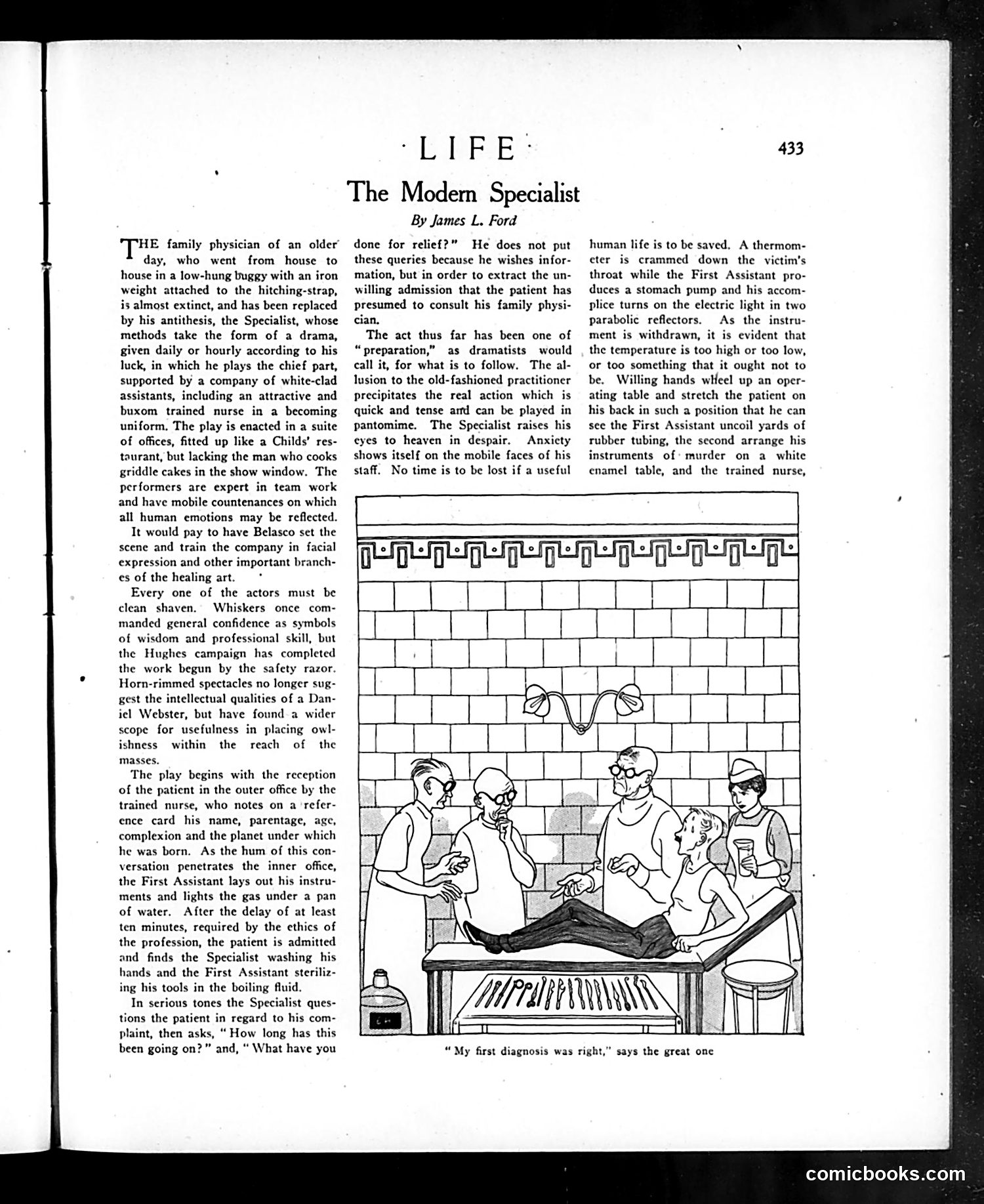
This satirical piece mocks the pretentiousness of medical specialists in the early 20th century. The cartoon depicts a patient on an examination table surrounded by multiple doctors in what appears to be an unnecessarily theatrical medical setting—complete with dramatic lighting and elaborate instruments. The text criticizes how specialists treat medical consultations like theatrical performances, emphasizing style over substance. The joke centers on one doctor's boast: "My first diagnosis was right," suggesting that specialists rely on showmanship and confidence rather than genuine expertise. Ford satirizes how the medical profession had adopted theatrical elements and overly complex procedures to impress patients and justify high fees, replacing the simpler competence of traditional family physicians.
📄 Transcribed text from this page (OCR, searchable)
Machine-transcribed from the original scan — historical spelling and the odd misread are preserved.
'HE family physician of an older’ day, who went from house to house in a low-hung buggy with an iron weight attached to the hitching-strap, is almost extinct, and has been replaced by his antithesis, the Specialist, whose methods take the form of a drama, given daily or hourly according to his luck, in which he plays the chief part, supported by a company of white-clad assistants, including an attractive and buxom trained nurse in a becoming uniform, The play is enacted in a suite of offices, fitted up like a Childs’ res- tourant, but lacking the man who cooks griddle cakes in the show window. The performers are expert in team work and have mobile countenances on which all human emotions may be reflected. It would pay to have Belasco set the scene and train the company in facial expression and other important branch- es of the healing art. r Every one of the actors must be clean shaven. Whiskers once com- manded general confidence as symbols of wisdom and professional skill, but the Hughes campaign has completed the work begun by the safety razor. Horn-rimmed spectacles no longer sug- gest the intellectual qualities of a Dan- icl Webster, but have found a wider scope for usefulness in placing owl- ishness within the reach of the masses. The play begins with the reception of the patient in the outer office by the trained nurse, who notes on a ‘refer- ence card his name, parentage, age, complexion and the planet under which he was born. As the hum of this con- versation penetrates the inner office, the First Assistant lays out his instru- ments and lights the gas under a pan of water, After the delay of at least ten minutes, required by the ethics of the profession, the patient is admitted and finds the Specialist washing his hands and the First Assistant steriliz- ing his tools in the boiling fluid. In serious tones the Specialist ques- tions the patient in regard to his com- plaint, then asks, “ How long has this been going on?” and, “ What have you “EE REE The Modem Specialist By James L. Ford done for relief?” He does not put these queries because he wishes infor- mation, but in order to extract the un- willing admission that the patient has presumed to consult his family physi- cian, The act thus far has been one of “preparation,” as dramatists would call it, for what is to follow. The al- lusion to the old-fashioned practitioner precipitates the real action which is quick and tense ard can be played in pantomime. The Specialist raises his eyes to heaven in despair. Anxiety shows itself on the mobile faces of his staff. No time is to be lost if a useful human life is to be saved. A thermom- eter is crammed down the victim's throat while the First Assistant pro- duces a stomach pump and his accom- plice turns on the electric light in two parabolic reflectors. As the instru- ment is withdrawn, it is evident that the temperature is too high or too low, or too something that it ought not to be. Willing hands wHeel up an oper- ating table and stretch the patient on his back in such a position that he can see the First Assistant uncoil yards of rubber tubing, the second arrange his instruments of: murder on a white enamel table, and the trained nurse, “ My first diagnosis was right,” says the great one comicbooks.com